

Introduction
During his regular beach-combing surveys, on the lookout for Quaternary vertebrate fossils along the coast of the so-called Second Maasvlakte (Maasvlakte 2 or MV2, near Rotterdam, the Netherlands), the second author has recently come across an egg- or pebble-like object containing a peculiar structure revealed through a hole on one side. This structure was subsequently recognised by the first author as the internal cast of a few whorls of a nerineoid gastropod. In view of the fact that this does not rank amongst the commoner fossil types found on MV2, it raised two questions: (a) what is the taxonomic identity of the fossil? And (b) what could be its provenance? Here, we shall briefly describe the fossil and try to elucidate its identity and origin.
Description
The fossil (Fig. 1), contained in the collection of the Natural History Museum Rotterdam (registration number NMR993000214645), is an ovoid pebble of silicified limestone, with a length of 36 mm and a central width of 21 mm. On one side it is open along about three-quarters of its length, revealing an internal structure showing the natural casts of the sediment infill of several whorls of a nerineoid gastropod. Two of these whorls are complete and reveal the characteristic irregular shape of a nerineoid internal aperture with folds and ridges (so-called plaits). Centrally located is the mould of the columellar cavity.
Fragment of the nerineoid gastropod Ptygmatis cf. bruntrutana (Thurmann, Reference Thurmann1832) (NMR993000214645) from dredged sand on the Maasvlakte 2 beach. Scale bar equals 10 mm.

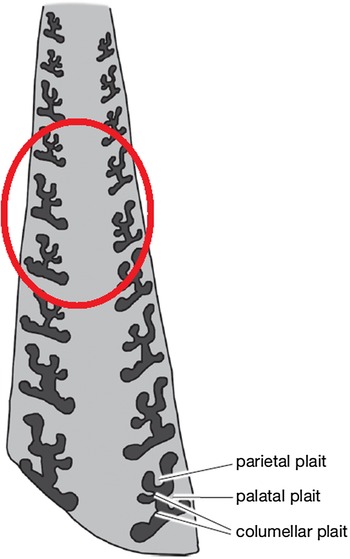
The Nerineoidea Zittel, 1873, is a superfamily of heterobranch gastropods, mostly with a long and pointed, turritelliform shell, consisting of many whorls. Some of the (sub)families (e.g. Ceritellidae Wenz, 1840; Cryptoplocinae Pchelintsev, 1960; Nerineidae Zittel, 1873; Itieriidae Cossmann, 1896) within this superfamily may have oviform or even oval shells (Kollmann, Reference Kollmann2014). The internal tube or aperture does not have a circular or oval circumference, as in other gastropods, but is characterised by longitudinal internal protrusions, called ridges or plaits. Based on the position of these plaits, columellar (protruding from the central axis or columella), parietal (protruding from the apical side of the tube) or palatal plaits (protruding from the external wall of the shell) may be distinguished (see Fig. 2). The result is a characteristic configuration of the tube when seen in longitudinal section; this configuration can be used in taxonomic assignment.
Schematic longitudinal section of a nerineoid shell, with terminology of internal plaits. The red oval shows the approximate portion of shell preserved in the Maasvlakte 2 fossil (see Fig. 1). After Kollmann (Reference Kollmann2014).

Within the superfamily Nerineoidea, a total of seven families can be differentiated on the basis of shell shape and the number and position of plaits (Kollmann, Reference Kollmann2014). Members of the family Ptygmatididae Pchelintsev, 1960, are characterised by two columellar plaits, in addition to a parietal and a palatal plait (Kollmann, Reference Kollmann2014). Representatives of the family Nerineidae possesses 1–3 columellar plaits, one parietal and one palatal plait (Kollmann, Reference Kollmann2014). Our specimen (Fig. 1) has two columellar plaits, a parietal plait and one large and one small palatal plait, so in theory it could belong to either one of these two subfamilies. The configuration seen in our fossil is identical to that observed in a specimen assigned to Ptygmatis bruntrutana (Thurmann, Reference Thurmann1832) from the Kimmeridgian of Alanquer, Portugal, and illustrated by Kollmann (Reference Kollmann2014, fig. 3I). Therefore, we identify our specimen, albeit with caution, as Ptygmatis cf. bruntrutana. Dr H. Kollmann (pers. comm., March 1, 2024) confirmed this conclusion. The age of the MV2 fossil is most probably early to middle Oxfordian (Late Jurassic), but a Kimmeridgian age cannot be excluded (Fischer, Reference Fischer2016, p. 200).
Provenance
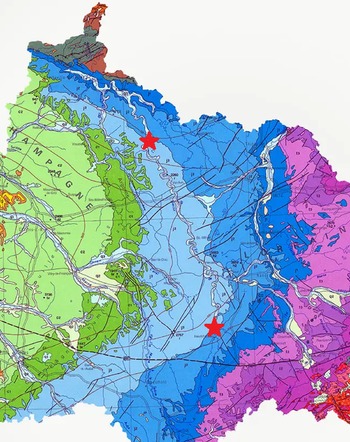
In order to explain the presence of a Late Jurassic gastropod in sandy sediments of the North Sea Basin, the only plausible line of reasoning leads to transport by the River Meuse (Maas). The piece itself appears to be a pebble rounded due to prolonged fluvial transport, its size of 36 mm corresponding to the size category ‘very coarse pebble’ (between 32.0 and 64.0 mm) of the USGS Wentworth grain size chart (Wentworth, Reference Wentworth1922; Williams et al., Reference Williams, Arsenault, Buczkowski, Reid, Flocks, Kulp, Penland and Jenkins2006). The River Meuse originates on the Plateau de Langres near the hamlet of Pouilly-en-Bassigny (Département Haute-Marne, France) and then flows northwards along the eastern margin of the Paris Basin. Between Neufchâteau in the south and Stenay in the north (Fig. 3, two red stars), it continuess through a relatively narrow valley, traversing Upper Jurassic sedimentary rocks (Bosch, Reference Bosch1992).
Map of the suggested provenance area in north-eastern France. Between the two red stars, the River Meuse (Maas) presently traverses Upper Jurassic deposits: Neufchâteau in the south and Stenay in the North. Source: BRGM.

In the literature, additional examples of Jurassic fossils of French provenance redeposited by the river Meuse in the Netherlands can be found. Jagt & Reumer (Reference Jagt and Reumer2010) described the case of a Jurassic echinoderm, a fragment of the Sinemurian crinoid Isocrinus (Chladocrinus) tuberculatus (Miller, Reference Miller1821) collected from the Oosterschelde estuary (province of Zeeland). They proposed three possible explanations for its provenance, as follows: (1) transportation by the River (Proto-)Meuse; (2) erosion out of a boulder used for coastal reinforcement or other building material, and (3) transportation across the North Sea from Jurassic strata along the coast of southern or eastern England. Jagt & Reumer (Reference Jagt and Reumer2010) ruled out the latter two possibilities and concluded that the crinoid fragment must have been transported and deposited by the River (Proto-)Meuse.
Jagt et al. (Reference Jagt, Kuypers, Michels and Stroucken2015) reported a Late Jurassic (probably Oxfordian) sea-urchin Hemicidaris aff. intermedia (Fleming, Reference Fleming1828) with an associated nerineoid from the Wessem area, province of Limburg, and suggested Upper Jurassic strata between Neufchâteau and Stenay as its provenance area. Earlier, Van der Lijn (Reference Lijn1974) had mentioned the find of a silicified Nerinea near Rothem (province of Limburg).
The present nerineoid fragment was not found in the Oosterschelde estuary or along the river itself, but instead on the beach of the artificially constructed Maasvlakte 2. During the first decade of this century, the Port of Rotterdam Authorities enlarged the Rotterdam harbour with about 2,000 hectares by construction of a land reclamation area extending into the North Sea. For this so-called Maasvlakte 2 (MV2), sand was dredged by trailing suction-hopper dredgers from a borrow area some 15 km west of the coastline of the First Maasvlakte (MV1) that had been constructed previously. Sediments were transported and subsequently deposited by ‘rainbowing’ or by pumping it ashore through pipelines. The borrow area where the sand has been dredged originally had a depth of minus 22–23 m Chart Datum (CD) and the existing seabed is lowered to an average depth of minus 40 m CD. The dredged sediments are of Late Pleistocene age and are known for their rich content of terrestrial and marine mammals, birds and molluscs (e.g. Mol et al., Reference Mol, Post, Reumer, van der Plicht, de Vos, van Geel, van Reenen, Pals and Glimmerveen2006, Reference Mol, Langeveld, Janse, Langendoen and Smolarz2015; Kuitems et al., Reference Kuitems, van Kolfschoten, Busschers and de Loecker2015; Langeveld, Reference Langeveld2020).
The sediment fill of the North Sea Basin originated from four major river systems: the now inactive Eridanos (Overeem et al., Reference Overeem, Weltje, Bishop-Kay and Kroonenberg2001) draining the Baltic region, and the rivers Rhine (Rijn), Meuse (Maas) and Scheldt (Schelde). A large portion of the southernmost North Sea Basin depocentre was filled in by upper Pleistocene Rhine-Meuse deposits now assigned to the Kreftenheye and Beegden formations (Busschers et al., Reference Busschers, Kasse, van Balen, Vandenberghe, Cohen, Weerts, Wallinga, Johns, Cleveringa and Bunnik2007, Reference Busschers, van Heteren and Westerhoff2012). Of the contributing rivers, only the Meuse traverses a long stretch of Jurassic deposits in its upper reach (Bosch, Reference Bosch1992). The influence of Belgian rivers, such as the Scheldt or smaller streams, can be ruled out. As already noted by Jagt & Reumer (Reference Jagt and Reumer2010, and references therein), with the exception of some small outliers, there are no Jurassic deposits in the erosional area of River Scheldt. Possibly some other Belgian rivers (Westerhoff, Reference Westerhoff2009, pp. 136, 137, fig. 6.9) may have transported Early or Middle Jurassic material from the southern Ardennes and Belgian Luxembourg northwards into the sedimentation area of the Rhine-Meuse river complex. As our fossil is not of Early or Middle, but of Late Jurassic age, a Belgian or Luxembourg provenance may be excluded. Therefore, we hypothesise that our nerineoid originates from Upper Jurassic levels in the Paris Basin of north-eastern France (Fig. 3), having been redeposited in the North Sea Basin by the River Meuse. To date, it constitues the find furthest away from the source area.
Acknowledgements
We wish to thank Dr Heinz Kollmann (Vienna) for confirmation of our identification and for stratigraphic information. John Jagt (Maastricht) critically read the manuscript and provided additional items of literature and helpful suggestions.


 Open access

