




If the population exceeds the territory, then one should open up new land; if the territory exceeds the population, then one should set about calling in colonists.Footnote 1
The Book of Lord ShangIn 221 BCE, soon after defeating his last rival and declaring himself the “First Emperor,” the ruler of Qin sent his armies north to build a wall.Footnote 2 Hundreds of thousands of unpaid workers—soldiers, convicts and corvée laborers—worked for a decade to connect existing walls and build new ones. This first “Great Wall of China” is traditionally portrayed as a geopolitical divide between pastoral nomads and agrarian Chinese empires, but we can also understand its construction as an episode in China's environmental history. The workers who built it ate grain and wore clothes produced by millions of taxpaying farmers on land whose diverse ecosystems had been replaced with agricultural ones. Their food, ceramics, and metals were all made by burning wood, and many of their buildings and tools were also made from wood, taking a toll on already disappearing woodlands.Footnote 3 And although some sections probably consisted only of watchtowers, the walls that were built divided arid regions of the north from wetter regions to the south, blocking wildlife from essential seasonal migrations in search of fresh pasture or shallower snow. The Great Wall was just one of Qin's megaprojects, but it exemplifies the ecology of political power in China's first empire.
China's environmental problems are well known, but historians are just beginning to reveal their long histories.Footnote 4 China's ecosystems were turned into farmland so long ago that when most people imagine its “natural” landscape they picture idyllic agricultural villages rather than forests home to rhinos, tigers, and deer.Footnote 5 While environmentalists elsewhere focus on saving wild animals from humanity, environmental efforts in China are more often focused on saving humans from their own industrial pollution. Over the past few millennia humans have transformed lowland China's environments so completely that environmentalists and biologists can be forgiven for turning their attention to other issues, leaving historians to reconstruct China's lost ecosystems and figure out how human civilizations managed to destroy them so thoroughly. It is difficult to avoid the conclusion that civilization itself is the problem: the more land used to feed people, the less there is for other species. But what was it about Chinese civilization that made it so successful at reorganizing its landscape to provide for humans? A key factor has been China's long history of centralized bureaucratic governments, which have been among the most sophisticated in the world for over two millennia and have consistently incentivized the expansion of agroecosystems. Scholars have long recognized that ancient Chinese states have played important roles in transforming their environments, but until recently the only specialists in early Chinese history who studied these questions were those in China and Japan.Footnote 6
This article will use a case study of Qin, the state that founded China's imperial system, to demonstrate how political systems are also ecological systems. After the fall of the Western Zhou state in 771 BCE Qin was just one of the many states fighting over subjects and territory. But it gradually grew in strength and eventually, in 221 BCE, Qin succeeded in destroying the multi-state system and replacing it with a centralized empire. It is fitting that “Qin” is the origin of the word “China” since Qin founded the imperial system that played a central role in building the nation-state we now call China.Footnote 7 Given that the People's Republic of China is home to almost one fifth of humanity and is also the world's largest carbon emitter, the importance of tracing the environmental genealogy of its political system should be clear. But Qin can also help us think more broadly about the importance of states in transforming the world's environment. Qin's role in expanding agriculture, increasing population, building infrastructure, and opening new lands to colonization and resource extraction has much in common with other powerful states, both ancient and modern.
Early Chinese states, like all political systems, were made possible by the domestication of plants and animals. Agriculture provided agricultural surpluses that supported political organizations. All of the energy in agrarian states came from photosynthesis, but states could only access this energy by mobilizing the grain and labor of farmers, so maintaining control over people was the key to political power. The development of states was a pivotal event in global environmental history because the centralization of political power gave small numbers of political elites the power over the rest of the population, and thus the power to decide how land is used and people's labor is expended. And since agriculture was the basis of their economies, agrarian states had strong incentives to occupy and populate new territory, promote the growth of human populations, and encourage agricultural intensification. By encouraging the spread of agroecosystems, which included both domesticates and associated species like weeds, fleas, rats, and cats, states increased the power of human societies to replace complex natural ecosystems with much simpler agricultural ones. States also had to manage these simplified ecosystems to ensure that they could continue to extract resources from them.
Until the 1970s scholars knew relatively little about Qin, but China's construction boom has unearthed so many archaeological materials that Qin has become one of the best documented ancient states. In particular, excavated tombs and wells have yielded caches of legal and administrative documents written on wood and bamboo. These provide us with a detailed picture of how the empire worked from the perspective of those who ran it.Footnote 8 In this paper I employ these documents, as well as other archaeological evidence and traditional histories to analyze the ecology of the Qin Empire at the height of its power during the reign of King Zheng/The First Emperor (r. 246–210 BCE). Qin established a network of administration across the subcontinent that mobilized the surpluses of its subjects to build infrastructure, often at scales far larger than any previous state could have achieved. Its roads, canals, and bridges facilitated the movement of people and resources, while its dams and dikes transformed hydrological systems to improve farmland. Qin was one of the most invasive states in the ancient world, and its demands on people's surplus grain and labor were so onerous that eventually it was overthrown by disgruntled subjects. But its system was quickly revived by the Han Empire, which was roughly equal in power and size to the contemporaneous Roman Empire but had a considerably more sophisticated administration.Footnote 9 The Han Empire lasted for over four centuries (c. 200 BCE–200 CE), and firmly established the centralized bureaucratic model of government as the standard form of political organization in China, which it remains to this day.
This article will begin by reviewing the origins of Qin's system and the geographical organization of the empire, and will then discuss how information moved across the empire. The next section describes how the grain collected in taxes was stored at granaries and distributed to the laborers who worked both on routine building and maintenance and on Qin's infamous megaprojects. Much of the labor Qin's subjects performed, from digging ditches to conquering new land, involved transforming environments in some way. The final section will review the state's use of non-agricultural resources and the laws that it issued to encourage the sustainable exploitation of plants and animals.
The Rise of Qin
Qin is famous for being the shortest Chinese dynasty, having collapsed only fourteen years after King Zheng declared himself “the First Emperor” in 221 BCE. But Qin had already existed for well over five centuries by then, so it is also in a sense the longest dynasty in Chinese imperial history. Qin was initially a small polity that bred horses for the Western Zhou dynasty (1046–771 BCE), but when the latter fell Qin took over its homeland in the fertile and well-defended Guanzhong Basin of modern Shaanxi Province.Footnote 10 The fall of the Zhou left a power vacuum in which dozens of small polities fought one another and a few larger states gradually conquered and absorbed the others. By the Warring States period (481–221 BCE) only a handful of large territorial states remained. As in early modern Europe, increasingly expensive inter-state warfare forced governments to develop administrative methods that could increase their revenues and their ability to wage war.Footnote 11 Qin's long history overlapped in time with the Assyrian, Achaemenid, and Mauryan Empires and with Alexander's conquest of Central Asia. We can be sure that some news of their existence arrived in East Asia with the nomads who moved across the steppe.Footnote 12
In the early centuries of Qin's existence most states were highly decentralized. Their rulers were closer to “first among equals” than autocrats. As in the classic model of feudalism, each kingdom was composed of the domains of various aristocratic families that were nominally subordinate to the ruler but were often his most dangerous rivals. To strengthen their states, rulers had to take over the land and subjects of these rivals and those of neighboring states. As powerful states grew by swallowing up the land and subjects of many small polities, they created a class of impoverished aristocrats who became ideal officials in their increasingly bureaucratic administrations. In order to access as much of the surplus grain and labor of the population as possible, states strove to dismantle extended kinship-based organizations into separate nuclear families, each of which would pay taxes and provide corvée and military labor directly to the state. This required an administration capable of registering each household, which was gradually developed over the course of the fourth and third centuries BCE. In addition to extending control over agricultural populations, states also took over resources that had previously been outside of state control, like forests.Footnote 13
These state-strengthening reforms occurred in all of the competing states, but only those in Qin are well recorded. Chinese tradition attributes most of Qin's political innovation to one man, Shang Yang, even though the process began before he arrived and continued after he was executed in 338 BCE. Essays written by his school of state-strengthening reformers are collected in the Book of Lord Shang. They display a belief that farming was the key source of wealth—or at least wealth accessible to the state—and that non-agricultural activity was parasitic.Footnote 14 They argued that the state should take control of non-agricultural land and force foragers to start farming and paying taxes: “If mountains and wetlands are unified under the control of the state then those who hate farming, are lazy, or are greedy, will have no way to obtain food. With no way to obtain food they will have to farm, and when they farm, uncultivated land will be brought under cultivation.”Footnote 15 It was much easier to exploit people's surpluses if they lived in one place and produced crops on land that could be measured. While scholars have assumed that the long transition from mixed subsistence strategies to intensive farming was a kind of natural process, the example of Qin makes clear that state power played a role in encouraging the transition towards modes of production that could be taxed.
Shang Yang's school recognized that people would prefer to avoid farming because it is strenuous and avoid fighting because it is dangerous. In order to make people want to farm and fight, they argued, the state had to reorganize society to make these the main routes to social and economic success. To this end, they advocated replacing aristocratic privilege with a system of ranks which men could earn by fighting in Qin's armies. Each increase in rank was awarded with various benefits, including farm plots. To provide this land, the state took direct control over large areas and reorganized them into strips of a standard width to make it easy to redistribute it according to rank.Footnote 16 These land grants were not hereditary. Every man had to earn his own rank rather than inheriting it from his father. Maps and satellite images of North China reveal that some areas of the landscape are divided into strips that are close in width to the standard 332 meters stipulated in Qin and Han law.Footnote 17 It would require careful fieldwork to prove it, but I suspect that these areas were laid out in early imperial times and have not changed much since. In later times the standard field widths grew larger, so the field strips in the 330-meter range probably date to the Qin-Han period.
Satellite image of an area to the northwest of Qin's capital, Xianyang. I have added black lines and their lengths to show that the width of many of these field strips is close to the Qin-Han standard of 332 metersFootnote 18

The writings of Lord Shang and his school call for an enormous amount of state control over society and the landscape, so much so that it is difficult to imagine any ancient state putting these ideas into effect. And because the standard narratives of Qin history were written in the subsequent Han Dynasty, scholars have often assumed that Han historians exaggerated Qin's power to make Han rulers look moderate. However, excavated documents reveal that this system was actually established—at least in some areas—and became the basis of Qin's ability to conquer all of its rivals and establish the first Chinese empire. Qin has traditionally been vilified as a despotic state, but it is worth recognizing that Qin promised all households eleven acres of land even if they held no rank at all. It thus provided its subjects with something in return for their taxes and service, a vaguely socialist economic model often overlooked in discussions of Qin politics. We have no sources on what the common people of this time thought about this—or anything else—but it is worth considering that an attack on aristocratic privilege combined with a meritocratic rewards system was probably popular among some segments of society. It would have created a class of people who benefitted from the reforms and had some loyalty towards the state.
Shang Yang's system exemplifies James Scott's idea that states transform landscapes and society to make them easier to administer. Scott lists a variety of methods modern states have used to make society simpler and more legible: “the creation of permanent last names, the standardization of weights and measures, the establishment of cadastral surveys and population registers, the invention of freehold tenure, the standardization of language and legal discourse, the design of cities, and the organization of transportation.”Footnote 19 This list is astonishing because Qin established all of these except freehold tenure, and it certainly transformed land tenure. In short, Qin has much in common with many early modern states, and probably went further in simplifying society according to administrative logic than any other ancient empire. But Qin collapsed, and it can be considered an experiment in how intensively an agrarian state can administer its population—an experiment whose failure provided an important lesson to subsequent Chinese rulers.
During its final century, Qin's reforms helped make it a superpower. Within a few generations it conquered all the other states in East Asia, expanding from a kingdom the size of Portugal to an empire as big as Western Europe.Footnote 20 At its brief height, Qin's territory included most of the flat arable land in East Asia and tens of millions of subjects. Qin's power extended across temperate East Asia from the edge of the Tibetan Plateau to the Pacific Ocean. Most of the people in the empire lived in the arable lowlands of the middle and lower Yellow River valley. This temperate region stretched from the dry forest-steppe zone in the west to greener forests in the east. By this time, agricultural society had already replaced the natural ecosystems of these lowlands with farms.Footnote 21 To the north stretched the vast steppes and deserts of Inner Asia, while dense subtropical forests blanketed the south. Qin's heartland lay in the forest-steppe zone and it had controlled the subtropical central Yangzi River valley for generations, so its officials already had experience administering a variety of ecological zones and subsistence methods, from sheep herding to rice farming.
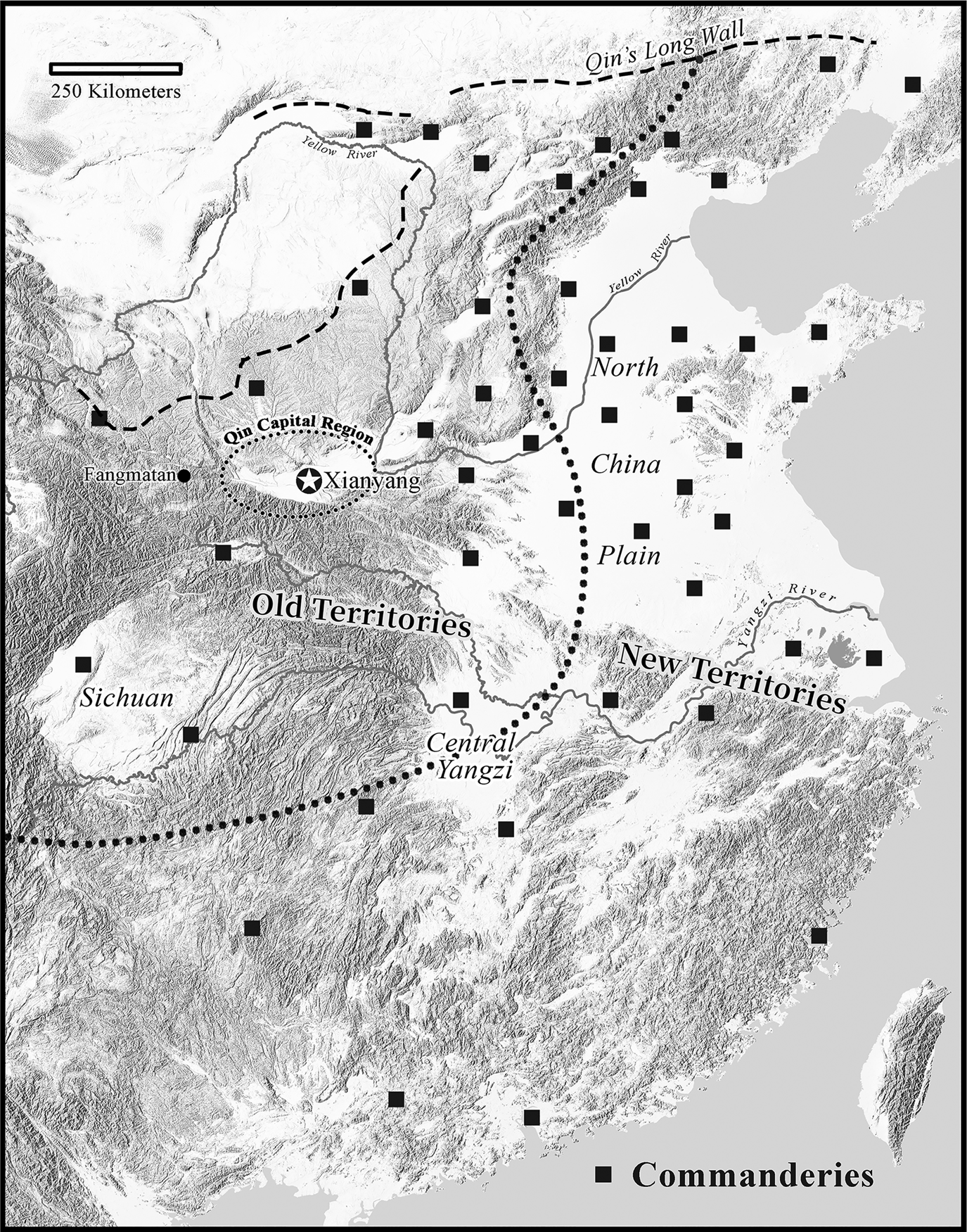
By the time of the First Emperor, the Guanzhong Basin of modern Shaanxi province had been its capital region for centuries. Excavated documents have recently revealed that the empire was divided at this time into Old and New Territories, the former of which consisted of the areas Qin had controlled before its massive expansion of the 220s. The New Territories had been conquered quickly, and Qin's control over them was weak.Footnote 22 The main administrative units across the empire were hundreds of counties, while military control was divided into around forty commanderies.Footnote 23 Qin's control centered on a network of fertile agricultural regions that were directly administered by county governments and their various bureaus, which included Public Works, Households, Granaries, and Finance.
Most maps of Qin's empire published in recent decades reflect the influence of twentieth century nationalist Chinese historical geographers who sought to project the modern Chinese nation into antiquity. Their maps inaccurately depict huge swaths of territory south of the Yangzi as Qin territory.Footnote 24 The only areas south of the Yangzi over which Qin had substantial administrative control were the modern provinces of Hunan and Zhejiang, where they had taken over the populations that had once been ruled by the states of Chu and Yue. Beyond that, Qin controlled only a network of routes to its commandery garrisons at the sites of the modern cities of Guangzhou and (probably) Fuzhou and as-yet unidentified sites in the modern provinces of Guangxi and Guizhou. Qin officials knew virtually nothing about the vast forested regions between these routes. The extent of the Qin Empire is best understood by looking at the locations of its commanderies, shown in Map 1.Footnote 25
The Qin Empire at its height. The New Territories, east and south of the dotted line, were those that Qin conquered between about 230 BCE and the collapse of the empire in 206 BCE. Based on Tan, Zhongguo lishi dituji, vol. 2, 3–12, and Korolkov, “Empire–Building,” 195. Base map by Lynn Carlson, GISP.
The biggest challenge for Qin was keeping control of the many millions of people in the lower Yellow River valley that it had rapidly conquered in the 220s, places where Qin had been feared for generations. If the First Emperor had not been a megalomaniac, he could have reduced taxes and labor service to convince the people of that region that Qin rule would benefit them. Instead, he kept conquering. To the south, Qin invaded all the way to the ocean. To the north, Qin attacked the pastoralists of the Ordos Plateau and built the Great Wall, prompting the people there to band together and form the world's first nomadic empire, the Xiongnu.Footnote 26 The brief rule of the Qin Empire established patterns that lasted for the next two millennia, most notably the rivalry between the empires of steppe and sown, and the gradual conquest and assimilation of the peoples of the region that is now South China, which was accompanied by the intensification of agriculture.
Knowledge is Power: The Circulation of Information in the Empire
Building an effective information network was particularly important for Qin because its income mostly consisted of grain grown across a huge area.Footnote 27 Apart from a few navigable waterways, there was no way to move grain or other bulk goods over long distances, so Qin officials had to control resources without bringing them to the capital. This is a problem shared by most terrestrial empires, but not by European overseas empires, and to a much lesser degree by the Roman Empire, which could ship bulk goods cheaply around the Mediterranean. In order to control distant resources, officials of Qin's central government built an administrative system that gathered information about the materials and labor at its command across the empire and directed local officials on how to employ them. Officials at the local level spent a lot of time collecting and synthesizing information and sending it to other officials. It was a very bureaucratic empire.
People and land were the basis of the whole political system, and the state kept careful track of them. The Book of Lord Shang emphasized this: “in registering the number of the people, record those who are born and erase those who die. When the people do not abscond from producing grain, fields will not be covered by wild grasses. Then the state is rich.”Footnote 28 Every year each district was supposed to send records of family members and landholdings to the county office.Footnote 29 The household registers list the status, rank and name of each person, beginning with the (usually male) head of household followed by other adult males, their wives, other adults (parents, concubines, servants, or slaves; with slaves sometimes listed after children) and children, including whose children they were.Footnote 30 Recording children made it easier to keep track of future taxpayers, laborers and soldiers.
A huge cache of administrative documents excavated from a well in the Qin border garrison in the town of Liye, Hunan, is particularly useful for understanding what kinds of information a Qin county office gathered.Footnote 31 These documents include not only registers of various things, but even registers of these registers: officials made lists of the things that they made lists of. The Bureau of Households kept registers of household members, conscript labor, equipment, taxes, debt pledges, field embankments, and boundary markers, and the number of people who had been interrogated.Footnote 32 The Bureau of Works kept registers of boats, tools, fines, and debts.Footnote 33 The Bureau of Granaries kept registers of grain, loans, livestock, animal feed, tools, cash, cattle, horses, and sheep.Footnote 34 The Bureau of Finance kept registers of lacquer, bamboo, ponds, chestnut orchards, mined iron, markets, cast metal, arrows, orchards, and work done in government workshops.Footnote 35 The goal of all this list-making was to keep track of the population and all taxable economic production and to make sure officials did not steal or neglect state property.
The government was especially concerned with harvests. Each year county officials had to inform higher levels of administration how many fields had been cleared for farming, along with the number of associated households.Footnote 36 When harvest time was approaching, Qin statutes also required local officials to promptly report detailed information on crops, including both good harvests and damaged crops.Footnote 37 These estimates were probably important for planning the season's warfare and public works, in addition to their main purpose of annually adjusting taxation rates.Footnote 38
Qin's system had been developed in a small region in which officials were never too far from the capital and could send information relatively easily, but this high level of administration was not appropriate for running an empire that stretched to the limits of the known world. The subsequent Han Empire opted for the much cheaper option of setting a fixed annual tax for each field. This reduced the amount of tax collected by the central government but also reduced the cost of administration. It also left some surplus for local elites, providing them with an incentive to support the empire, something the Qin system had failed to do.Footnote 39
Muscles and Sweat: Grain Taxes and the Labor of Mammals
The empire's power was based on its ability to deploy huge amounts of unpaid labor for both military and civil projects.Footnote 40 Humans did most of the physical labor, though horses and cattle also worked on state projects. All of this labor was powered by foodstuffs paid in taxes and by pasture. Each household had to pay taxes, usually in foods like millets or beans, but also in hemp and local specialty products. There was also a hay and straw tax that was sometime paid in coins. Qin maintained granaries across the empire whose main purpose was to stock these materials and then distribute them to military and civilian laborers. They probably also lent farmers seed grain if they needed it, and presumably fed people in times of famine.Footnote 41
Just as humans had tamed wild animals and turned them into beasts of burden, the transition from small, relatively egalitarian societies into highly stratified states required turning the population into laborers for elites.Footnote 42 As in the other end of Eurasia, where phrases like “the lord is my shepherd” encapsulated existing social relations, people in early China compared the relationship between elites and commoners to that between herders and their animals, a good example being the famous work of early political theory titled “Herding the People.”Footnote 43 Qin administrative documents similarly make clear that the state saw little difference between convict laborers and livestock, as shown in this document listing the things an inspector had inspected at a Bureau of Granaries: Footnote 44
Inspection of the offspring of the Office of Livestock's pigs and dogs.
Inspection of the Office of Livestock's pigs and dogs that died or escaped.
Inspection of the laborer-servants who died or escaped.
Inspection of the offspring produced by laborer-servants.
Inspection of cash produced in workshops.
Inspection of the Office of Livestock's geese that died or escaped.
Inspection of the offspring of the Office of Livestock's geese.
Total: [writing unclear].
Granary officials spent much of their time distributing grain to laborers and livestock. The amount of grain they gave to each person depended on their sex, age, and status. All adult males were legally required to do both military service and statute labor except those who held higher ranks or were disabled. Most grain was used to feed these commoners doing routine military or statute labor service, but Qin also exploited the labor of many convicts and debtors.Footnote 45 Not only did Qin's judicial system sentence many lawbreakers to hard labor sentences of various kinds, it often commuted traditional mutilating punishments to large fines which all but the wealthy had to pay off by working for the state. Sentences of castration and amputation of a foot were commuted to a fine of 12,500 coins, while nose amputation was commuted to 10,000 coins. Workers were paid only eight coins for a day of work.Footnote 46
Qin had a standardized system of quantifying labor into units which involved grading different types of laborers and different types of work. This standardized system allowed the administration to treat laborers as interchangeable units, giving it great flexibility in how it exploited them. Qin also established standards for exchanging grain, beans, coins, cloth, and other commodities with one another. By establishing a standardized exchange system across the empire, Qin's control greatly facilitated the spread of commerce, though this was only beginning by the time Qin collapsed. The benefits to commerce created by a subcontinent-wide governance system were only fully realized under the Han.Footnote 47
Qin used all the labor at its disposal to reorganize landscapes and hydrological systems across the empire, often to expand or improve arable land. The most common labor projects were routine activities like digging ditches, canals and irrigation works, constructing roads, dikes, walls, and buildings, and maintaining all of these. Qin maintained a series of roads across the empire to facilitate the movement of armies, the postal service, and other personnel.Footnote 48 Most of this network probably existed before Qin, but maintaining it was a regular responsibility of local officials, and probably a main corvée task. Qin also maintained a network of water transportation routes of which very little is known. Qin had the Ling Canal built to link the Yangzi and Pearl River valleys, probably to facilitate its invasion of the far south. Along with existing canals that linked the Yellow and Yangzi Rivers, the Ling Canal theoretically made it possible to ship goods on inland waterways from the Yellow River all the way to the South China sea.Footnote 49 The only commodities valuable enough to ship such a long distance were exotic animal products like elephant tusks, bird feathers, and rhinoceros horns.
In lowland areas the state built and maintained dikes to protect and expand arable land. Like the highway system and irrigation projects, the construction of large river dikes on the Yellow and Yangzi rivers is a classic example of the type of project that could only be achieved by a powerful state. Most of our evidence on early river dikes comes from Qin's Warring States rivals, or from the subsequent Han period, but we know that dikes were common in Qin because maintaining them was a regular duty of Qin officials. A statute on water control has been excavated from two different early Han tombs, and since most of the early Han legal corpus was adopted from Qin there is a good chance that a version of this law existed in Qin.Footnote 50 Another piece of evidence on Qin dikes comes from fragmentary administrative documents written in the first century of Han rule on repairing dikes in the central Yangzi basin. These dikes were probably damaged or abandoned during the wars at the end of Qin rule.Footnote 51 Dikes were built to replace seasonally flooded environments—including biodiverse wetlands—with taxable farmland.Footnote 52
Most labor was probably used on these routine infrastructure works, and they had the greatest effect on the environment, but Qin is best known for its megaprojects, which epitomized its ability to concentrate massive numbers of laborers at the whim of the emperor. Qin's two large-scale irrigation projects are classic examples of states transforming the environment for political power.Footnote 53 The Zheng Guo dam and canal project, completed in 246 BCE, irrigated the previously saline region east of the Qin capital at Xianyang. By turning a previously unproductive area in Qin's heartland into a reliable irrigated agricultural area, this project gave Qin a significant boost against its rivals. The Dujiangyan irrigation project in Sichuan was a classic colonial infrastructure project. Built after Qin conquered the region in the late fourth century BCE, this project helped destroy the unique civilization of Sichuan and replace it with an agricultural colony whose surpluses fueled further Qin conquests. Qin moved tens of thousands of households into conquered regions, which served both to develop those regions and to break down the solidarity of conquered peoples.Footnote 54
Qin's Long Wall—the first Great Wall of China—is perhaps the most (in)famous of Qin's megaprojects, and probably the most environmentally significant. Others included the First Emperor's mausoleum, of which the terracotta army is just one part, and various palaces. The Historical Records reports that 700,000 convicts were assigned to build the mausoleum and the Epang Palace, both in the Guanzhong Basin.Footnote 55 This figure is quite plausible given that the rammed earth foundations of the unfinished Epang palace still measure 1,270 x 426 meters.Footnote 56 The First Emperor's mausoleum complex covers an area of over fifty square kilometers, making it by far the largest tomb ever built in China, and “probably the largest burial complex of a single ruler ever to have been constructed anywhere in the world.”Footnote 57 Those who had lived through the fall of Qin considered these megaprojects to have been a major cause of the uprisings that toppled Qin because they were blatantly exploitative, and turned the people against the state. Sima Qian wrote “In my travels I saw the Long Wall and fortifications that Meng Tian built for Qin, cutting through mountains and filling up valleys to open up the Straight Road. He indeed treated the people's labor lightly.”Footnote 58
In addition to the labor of humans, Qin also employed that of domesticated cattle and horses—large, hoofed mammals whose power is easy for those of us living in the age of internal combustion engines to underestimate. Qin's core territory included vast areas of grazing land, and its abundance of cattle and horses gave it an advantage over its rivals in the more densely populated central Yellow River valley. Cattle were kept for ploughing and pulling carts. Government storehouses were allowed to lend their cattle and vehicles to common people for their private use, but the lender was responsible for the condition of the cattle.Footnote 59 Oxen were regularly evaluated and their keepers rewarded or punished depending on their health.Footnote 60 People were required to pay straw and hay taxes to provide feed for carriage horses and draft oxen, which officials then distributed to the animals based on their age and what kind of work they did.Footnote 61 Cows were given grain rations for fifteen days after giving birth.Footnote 62 Hard working horses, such as those of the courier service, were also fed grain and beans.
In contrast to cattle, which were valuable but not prestigious, horses were symbols of wealth and power. They were used for warfare, carrying messengers, and for pulling chariots and carriages. There were at least twenty-one different officials in charge of stables and horses in Qin palaces.Footnote 63 In the pastoral areas of the north there were large herds of cattle, horses, sheep, and goats, which Sima Qian cited as being among the great stores of wealth in the Han Empire.Footnote 64 Qin must have had some way to tax these but, unfortunately, we have no sources from that region. Tombs of nomadic pastoralists have also been discovered within Qin territory. We do not know if they paid tax or tribute, but we do know that Qin had regular trade relations with them for centuries, and their knowledge of horseback warfare probably contributed to the power of the Qin military.Footnote 65
While cattle and horses were the animals of most interest to the state, commoners were more likely to own pigs, dogs, and chickens. These are rarely mentioned in our sources, and it seems that Qin did not tax them. Government offices also raised pigs, dogs, geese, and chickens to feed their employees.Footnote 66 The state also collected exotic animals, or parts of them, from across the empire, including feathers for arrows and special fish for the imperial palace. And a record from Liye reveals that Qin awarded people exemptions from taxation for people who killed a tiger.Footnote 67 Tigers hunt both people and livestock, so it is not surprising that the state encouraged its subjects to kill them. Tigers are native to virtually all of China proper, but there are no wild tigers left in China.
Wood and Metal: State Control over Forests and Mines
The empire required plenty of raw materials, especially timber and minerals. The central government directly operated mines in key areas, had offices in charge of iron production, and also collected taxes from private producers of salt and iron. The main metals in this period were iron/steel and bronze (an alloy of copper, tin, and lead). China's iron works were among the most advanced in the world in terms of both technology and organization, but there is no solid evidence that any of the Warring States were more advanced in metallurgy than their rivals by the time of Qin's conquests. Iron tools were just beginning to be widely produced at this time.Footnote 68 Iron ore is widely available, but we know little about where Qin got its other metals. There were sources of copper, tin, and lead in the north, but more in the south, and Qin's conquest of the Central Yangzi in the 270s BCE gave it control over a key copper producing region.Footnote 69 Qin encouraged private entrepreneurs to produce metals in conquered territories like Sichuan.Footnote 70 Qin also had mines worked by convict and statute laborers.Footnote 71 State control of iron and salt has traditionally been considered an innovation of the Han Empire, but excavated documents and seal impressions reveal that it originated with Qin.Footnote 72 Wood was the fuel for producing metal and ceramics, and kilns and smelting sites were often located near forests. Qin also had workshops in its capital at Xianyang.
The most detailed information we have on Qin's exploitation of timber resources comes from seven maps excavated from the tomb of a Qin official that was discovered at a modern logging camp at Fangmatan, in the mountains west of the Qin capital (indicated on Map 1).Footnote 73 This area's timber was convenient because it could be floated down the Wei River to the capital.Footnote 74 These maps were made by the state to survey forest resources, either because Qin officials were overseeing logging operations or because they were regulating and taxing private loggers.Footnote 75 They are the only ancient resource maps discovered from ancient China, but contemporary writings make clear that maps were widely used by administrators. Given the size of the Qin state and its building projects, it must have needed a lot of timber, and these maps reveal where Qin obtained some of it. This is a chance discovery of a resource extraction operation that probably had parallels throughout the empire. Qin also imported high quality timber from the Yangzi valley to build palaces.Footnote 76
Qin obtained its timber in the mountains far from population centers because most large straight trees had already been cut from forests closer to home.Footnote 77 Contemporary political theorists complained about the overexploitation of resources, and argued that regulating resource use was the job of the ruler.Footnote 78 These ideas were eventually incorporated into Qin's statutes, which included seasonal bans on activities like cutting timber, blocking water courses, burning vegetation, collecting young animals or eggs, and various activities related to fishing and hunting.Footnote 79 Statutes related to hunting in royal parks were excavated from a tomb at the Yunmeng park in the central Yangzi region, which was well known for its abundant wildlife. The statutes assert that poachers caught hunting boar and deer in the park should be sentenced to hard labor, while those caught with dhole, wolf, raccoon-dog, porcupine, fox, pheasant, and rabbit should not be punished.Footnote 80 In other words, commoners could hunt small animals for their pelts, but larger animals were reserved for elites to hunt and eat.
Smaller-scale societies often have customs for protecting resources, such as taboos on harvesting specific species, or seasonal regulations. I suspect that by taking control of communal resources Qin replaced many of these customs with legal restrictions on their use. By making wild resources state property, Qin weakened cultural traditions of sustainable resources use and instead made such resources into forbidden goods, which would encourage people to think of them as something they should exploit whenever the chance arose. We have few sources on the moral economy of commoners in this period, but objections of Confucian thinkers to the state takeover of communal resources suggests that there was probably resistance to, or at least non-compliance with, laws against hunting, wood cutting, and foraging in forests.Footnote 81
Conclusion
The empire seemed solid when the First Emperor died in 210 BCE, but it quickly collapsed. Analyzing Qin's fall a generation later, Jia Yi believed that the empire would have survived if the Second Emperor had only corrected the harshest aspects of his father's rule. He argued that convicts and their families should have been released from labor camps and freed from mutilating punishments (which, as we have seen, were often effectively labor sentences), thereby freeing large number of people to return to their villages. The passage concludes by saying that if the second Qin emperor had “opened granaries and distributed wealth to relieve the orphaned, the childless, the poor and the destitute, lightened taxation and reduced labor projects to assist the people in need, simplified laws and lessened punishments to put people on probation” then people would have been able to live with Qin rule and would not have taken the risk of rebelling and overthrowing it.Footnote 82 This matches with the picture described above, in which Qin officials worked hard to take maximum advantage of people's labor by levying high taxes and finding various ways to make them work for the state. Despite this, it is worth emphasizing that the Qin Empire was only unsustainable in a political sense, not in an ecological one. The environmental consequences of the Qin Empire lie mostly in its legacy, the centralized bureaucratic political model.
The Qin Empire collapsed rapidly but the Han Empire rebuilt its administration, reconquered its territory and gradually established a strong grip over regions Qin had only barely controlled. The Han then expanded even further and played a substantial role in domesticating the landscapes of the Yangzi River valley and regions further south. Early Han administrators, many of whom had previously been Qin officials, decided to fix tax rates at lower levels, thereby reducing the cost of governing while leaving more of the surplus from the local economies to be taken by local elites. This alliance between central and local power structures relinquished some of the central control of Qin's system but made the system more politically sustainable. While Qin-style command economies have been resurrected several times in Chinese history (most recently in the 1950s), the early Han model of low central government taxation was a key modification of Qin's system innovation and awareness of the dangers of excessive taxation allowed the imperial system to endure for two millennia.Footnote 83
Because of the writings of Han scholar-officials like Jia Yi and Sima Qian, Qin became the paradigmatic lesson of why governments should not tax too much. Nonetheless, the long reign of the Han Empire established Qin's centralized bureaucracy as the paradigm of political organization in China. Qin's successors tended to have much weaker control at the local level than Qin did, but their general political model remained centralized bureaucracy. Even foreign rulers with very different political ideals, such as the Mongols and Manchus, ended up ruling China with versions of Chinese governance methods. From the point of view of comparative politics, Qin's model has thus been among the most successful innovations in human history. But because these agrarian empires encouraged the expansion of taxable farmland and the growth of the taxpaying population for over two millennia, their success helped create China's environmental crisis. They conquered more and more land and encouraged the spread of farmers into it, replacing diverse ecosystems with simplified agrarian ones. Their granary systems buffered populations against famines, and they mobilized the labor of their subjects to reshape landscapes and waterscapes across the subcontinent. And their administrative methods were also adopted by surrounding states.Footnote 84
While the role of states in transforming global environments has been widely recognized, environmental historians have rarely taken specific forms of political organization themselves as a focus of research. Yet such research agendas now have an urgent relevance. All states, ancient and modern, have depended on transforming environments to produce taxable surpluses, which inevitably increases human impact on the environment. But this does not mean that less government would be good for the environment, because reduced central government control simply unleashes a similar dynamic among other powerful groups in society. Building a sustainable future for our planet will require us to create better political systems, and with this goal in mind, there is much work to be done in rethinking human political history from an ecological perspective. Because of its highly organized and ambitious policies of resource extraction and control, the Qin dynasty and its long legacy of impact on governmental forms and environmental conditions in East Asia provide us with a rich and disquieting case study.
Competing interests
The author declares none.


 Open access

