


Introduction
After a quarter millennium of modern economic growth, the ability of capitalism to deliver social progress is being increasingly widely questioned. The climate crisis, embedded inequality, the cost of living squeeze and disruptive technological developments are leading many people to ask whether it is time to go ‘Beyond GDP’ in thinking about the measurement of growth. Have the wheels come off the ‘free market innovation machine’ (Baumol, Reference Baumol2002)? Smith’s fundamental argument, as he wrote in the pre-dawn of the Industrial Revolution, portrayed the division of labour and consequent increase in the quantum of exchange as the fundamental driver of economic growth. Early in Book I he set out his famous analysis of what created the wealth of nations: ‘It is the great multiplication of the productions of all the different arts, in consequence of the division of labour, which occasions, in a well-governed society, that universal opulence which extends itself to the lowest ranks of the people’ (Book I, Chapter 1). The potential for the specialisation afforded by the division of labour depends on scale: ‘As it is the power of exchanging that gives occasion to the division of labour, so the extent of this division must always be limited by the extent of that power, or, in other words, by the extent of the market’ (Book I, Chapter III).
The mechanisms of growth, delivering that ‘universal opulence’, are clear therefore: specialisation, trade and scale. If a pin factory increases its output by orders of magnitude, a correspondingly increased demand for pins is needed. Importantly, these mechanisms relate to the creation of a virtuous circle, one of self-reinforcing feedback. Specialisation creates the opportunities to trade, trade expands the market, greater scale enables finer specialisation. All too often, however, a static lens is brought to bear on conceptions of growth. For example in growth accounting exercises, production is assumed to be constant (rather than increasing) returns to scale, and input markets to be competitive, to enable the calculation of total factor productivity growth as the residual of growth in outputs less weighted growth in inputs of capital, labour and materials, where the weights are the relative factor prices:
 $$ \mathrm{Dln}\ \mathrm{TFP}=\mathrm{Dln}\ \mathrm{Y}\hbox{--} {\mathrm{v}}^{\mathrm{K}}\mathrm{Dln}\ \mathrm{K}\hbox{--} {\mathrm{v}}^{\mathrm{L}}\mathrm{Dln}\ \mathrm{L}\hbox{--} {\mathrm{v}}^{\mathrm{M}}\mathrm{Dln}\ \mathrm{M} $$
In a well-known phrase, Moses Abramowitz described productivity growth as ‘the measure of our ignorance’ (Abramovitz, Reference Abramovitz1993). But this is not wholly right; as well as ignorance, it is a consequence of overlooking the dynamic process driven by returns to scale in order to get a tractable static snapshot, year by year. The simple textbook treatment of increasing returns to scale also ignores the dynamics of the process by focusing on the long-run average cost curve and minimum efficient scale of production within the single representative firm.
However, as Allyn Young wrote in a 1928 article, Increasing Returns and Economic Progress, (which he summed up as ‘variations on a theme by Adam Smith’), ‘The division of labour among industries is a vehicle of increasing returns,’ (p. 538). The internal economies in the representative firm are minimal compared to the external economies (to use terminology from Marshall) due to a change in the organisation of the industry as a whole. Firms develop new products and tasks, new firms appear, the structure of the industry changes, new industries appear; and at each step a group of complex processes is transformed into a series of simpler ones, some of them being automated. Scientific and technical discovery reinforces the process. The variety of end products proliferates, and there is also an increase in the diversification of intermediate products. The geography of production changes.
Young sums up his description: ‘The division of labour depends on the extent of the market, but the extent of the market depends on the division of labour. In this circumstance lies the possibility of economic progress’ (p. 539). One could, anachronistically, label this a description of the virtuous circle of endogenous growth (Romer, Reference Romer1990), but rather than focus on skills or R&D as the vehicle for spillovers, the increasing returns stem from reorganising the process of production.
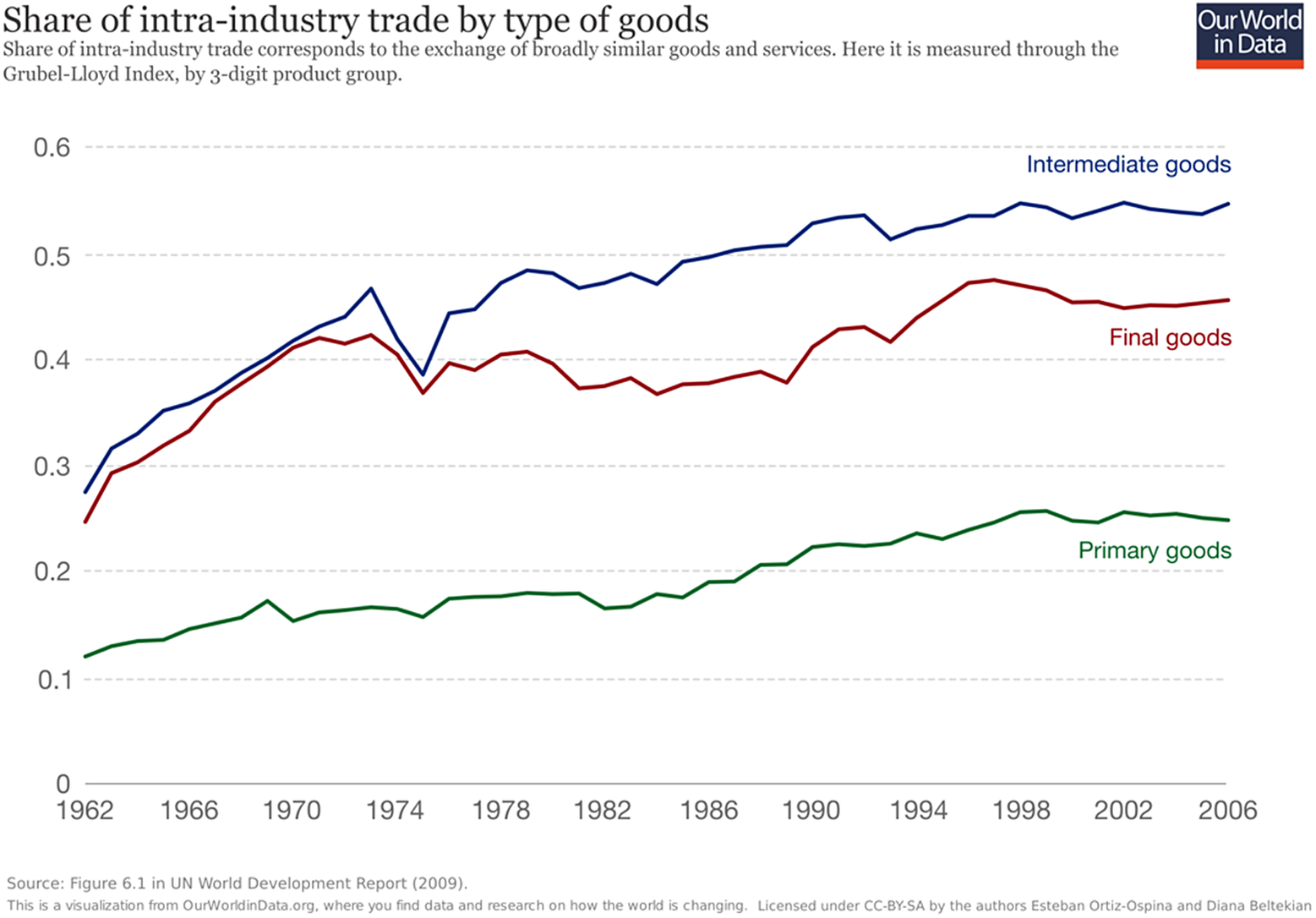
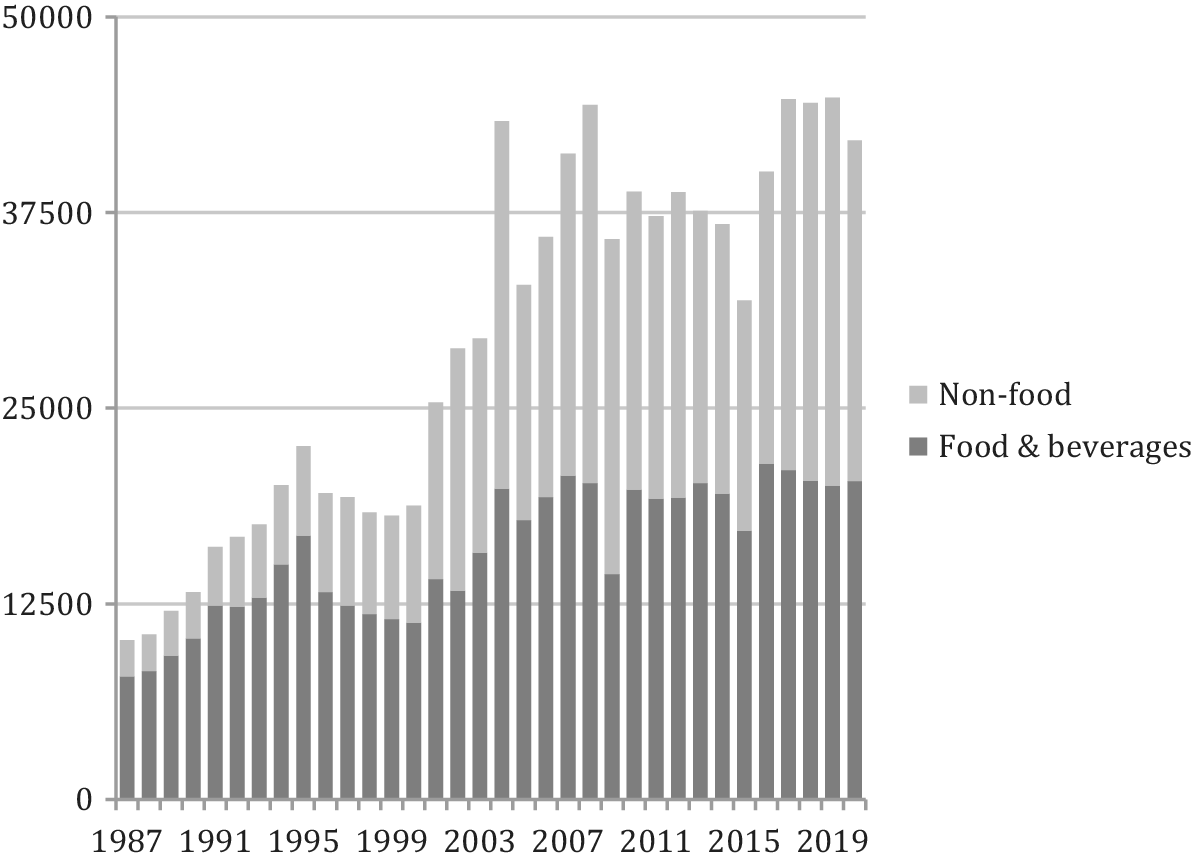
Process innovations are often overlooked in discussions of productivity; attention is more readily captured by the excitement of scientific discovery and new devices. However, time and again since the late 18th century there have been significant advances in processes of production. The American System of interchangeable parts in the 1800s, the factory system later that century as the Industrial Revolution got into gear, the assembly line of the early to mid-20th century, and the Toyota lean production revolution of the 1970s all represent examples of the growth process (Young, Reference Young1928) describes, enabling massive external economies. More recently, the creation of global production networks starting around 1980 and digital platform models from the 2000s have similarly reorganised the process of production and trade. The western economies now are globalized, networked, online, with a multitude of new devices, platforms and products. One measure of this increase in the division of labour and proliferation of products is the growth of trade in intermediate goods, which has been faster than growth of trade in final (or primary) goods (figure 1). Another metric is the vast increase in product variety—few statistics are available (although see figure 2) but there can be no doubt about the proliferation of choice particularly through digital commerce and digitised goods.
Share of trade by type of good

Variety of consumer products in US. Source: USDA ERS. https://www.ers.usda.gov/topics/food-markets-prices/processing-marketing/new-products.aspx (Online from 1998, offline prior to then.)

In summary, Smith’s fundamental growth mechanism of the division of labour and specialisation is a description of process innovation. In his pin factory, production is reorganised to enable the benefits of scale. Each worker’s task is simplified, some might be automatable. Perhaps an industry supplying new machine tools to pin factories will emerge. Perhaps the rapid expansion in pin supply and fall in price will lead to new pin-using activities. Perhaps the factory will innovate with new materials or a range of colours of pin, to differentiate its product in the expanding market. Its internal economies will be dwarfed by the external economies if the virtuous circle of growth gets under way.
The dilemma
If this increasing returns growth process describes the success of the capitalist machine since Adam Smith’s day, what has gone wrong in the 21st century? The Wealth of Nations offers a clue. In Book II, Smith wrote: ‘In general, if any branch of trade, or any division of labour, be advantageous to the public, the freer and more general the competition, it will always be the more so,’ (Book I, Chapter II). He famously noted the dangers of collusion among producers at the expense of consumers. Without competition, the dynamism of increasing specialisation may grind to a halt, or the benefits may simply be captured by those with market power.
The extent and intensity of competition is in part a matter of policy and enforcement. There is a large recent literature on the competition policy challenges posed by digital markets and on the policy failure of under-enforcement—particularly in the US (see e.g. Eeckhout, Reference Eeckhout2021; Philippon, Reference Philippon2019). The dilemma presented here is more fundamental, however: it is that in some cases the process of specialisation has reached the limit of the scope of the market. Highly specialized markets may be too small even at global scale to support competition. If a product is sufficiently specialised, one or perhaps two firms may be enough to produce at minimum efficient scale. Whereas there are multiple firms selling automobiles, designing them and assembling them with many thousands of specialised components, for some of the components there are few producers globally.
There are many examples of such bottlenecks in supply chains or global production networks, revealed by the experiences of shortages during the pandemic and subsequent supply shocks. For example, the scarcity of many types of computer chip (along with geopolitical angst) has focused minds in Europe and the US on the fact that 90% of the world’s advanced chips are manufactured in Taiwan, mainly by TSMC (Miller, Reference Miller2022). The machines that TSMC needs to do so are made by just one company, ASML, in the Netherlands. During the pandemic, bottlenecks appeared in the vaccine supply chain, not so much for the active biological materials, but rather affecting the large plastic bags needed to line bioreactors and the vials needed to transport doses of vaccine (Bown, Reference Bown2022); the US government invoked the 2nd World War Defense Production Act to overcome these. Following the Russian invasion of Ukraine and energy price spikes, both the UK’s two fertiliser factories (owned by one US firm) closed, leading to a loss of their by-product CO2 used in packaging in the food supply chain and in brewing beer, and also in the country’s nuclear reactors (Lowe, Reference Lowe2021). This left British Sugar’s bioethanol plant the sole UK producer of industrial carbon dioxide. These experiences gave prominence to the idea of markets where there are ‘too few to fail’.
The markets for some intermediate manufactured products are highly specialized, which limits their scope. In the case of digital markets, it is that marginal costs are so low relative to fixed costs that efficient scale is global (as indeed with a few manufactures such as aircraft). The reasons digital markets so often tend to be ‘winner-take-all’ with one dominant company have been widely described (see, e.g. Furman et al., Reference Furman, Coyle, Fletcher, McAuley and Marsden2019). Briefly, there are three mutually reinforcing reasons. One is the presence of standard internal productive economies of scale. The creation of their software and databases involves a high fixed cost, as does the investment in logistics machinery or data centres. Marginal costs, particularly of software products, are low. A second reason is the existence of network effects. The digital platform model matches suppliers on one side of the market with customers on the other, and both benefit the more connections there are on the other side—think of restaurants and diners or drivers and passengers. A third reason is the ‘data loop’, whereby a digital platform can use the data it has accumulated to improve its services—and sell more advertising to make revenue to improve services—and thus acquire more users and more of their data. This forms a significant barrier to entry for would-be competitors who do not yet have a large user base.
Moreover, the digital platform model often creates internal economies captured by the platform owner in markets where there are otherwise only limited increasing returns. Platforms perform a matching service that delivers for suppliers the benefit of a larger potential market for their products, and for customers the benefit of a wider choice even for niche products. But in many cases—such as taxi rides (Uber), meals out (OpenTable), handcrafted and second-hand items (Ebay, Etsy) or food delivery (Deliveroo) production is constant returns to scale (at best). The platform is a process innovation creating increasing returns to scale in the form of matching gains or time efficiencies. In the case of other platforms, the winner-take-all position of the dominant player means that it can capture a large part of any scale economies in production (Apple and Android app stores, Spotify). Whether these digital monopolies are natural or constructed through devices like data moats or technological excludability, the process of creating external economies through industrial reorganisation has come to a halt. The economies have been internalised and indeed largely captured by wealthy founders and venture capitalists.
In either case—the high degree of specialisation in production networks or the internalisation of gains from specialisation by digital platforms—the scope of the market seems to have reached a limit that means there is a trade-off between the continuing division of labour and the rigour of competition. The trade-off has been recognised in the form of the post-pandemic discussion of ‘resilience’ in supply and the live policy debate about the role of competition policy in digital markets.
The role of the corporation: state and market
The question is therefore whether we can hope for a continuing process of the division of labour with ever-increasing specialisation, and the productivity-enhancing industrial reorganisation in production this prompts over time; or rather whether the limit of the scope of the market has been reached. In either case discussed above—either already granular specialisation or digital markets—new natural monopolies seem to exist, with one or two firms able to produce at minimum efficient scale. Do the key process innovations of the late 20th and early 21st centuries, the digital platform and digitized global production network, represent the high-water mark of Smith’s ‘universal opulence’?
One reason the dilemma may be limited in the shadow it casts is that although globalized production is far more extensive than before the 1980s, much production activity in most economies does not take this form. A maximum of about 18% of companies in some sectors in the UK and US use contract manufacturing arrangements of the form involved in global production networks (Coyle and Nguyen, Reference Coyle and Nguyen2022). Firm-level evidence also suggests that a minority of companies are using digital tools successfully to increase their productivity (e.g. Coyle et al., Reference Coyle, Lind, Nguyen and Lind2022). Moreover, the phenomenon to date has largely concerned manufacturing, whereas services make up the larger part of the western economies. Some economists expect the process of globalisation to extend much further including into the service sectors (e.g. Baldwin, Reference Baldwin2019). This may be speeded up by the rapid emergence of new AI tools, easily and cheaply accessible through cloud services or APIs, that reduce the need for a high level of in-house IT skills. However, for the time being there is a long way left to go, particularly in the process of the division of labour and specialisation in tradeable services.
A different perspective on the dilemma is that the acuteness of the trade-off between scope of the market and competition is affected by the objective function of the firm. The standard assumption is that firms, including those with market power, are profit-maximisers. The market power and profitability are constrained through policies such as tougher anti-trust enforcement and regulation; the lobbying spend of large companies is one measure of how large an impact regulation can have in constraining profits.
One possible conclusion is that the interests of a monopoly will always run counter to the public interest. Adam Smith thought so. He was certainly no fan of the prominent international monopoly of his day, the East India Company, noting the adverse effects of the special privileges it had attained. Its political guarantee of market power interfered with the benign mechanism of self-interest serving the general interest, he believed, adding ‘The government of an exclusive company of merchants is, perhaps, the worst of all governments for any country whatever,’ he wrote (Book IV, Ch7), advocating the end of the Company’s charter monopoly privileges. His argument was that the Company had conflicting objectives because of its position. If it had a pure profit-seeking strategy it would harm the country in which it operated, whereas if it had broader governance objectives, its commercial incentives would be dulled. ‘As sovereigns, their interest is exactly the same with that of the country which they govern. As merchants, their interest is directly opposite to that interest’ he wrote (Book IV Ch 7), adding later, ‘No two characters seem more inconsistent than those of trader and sovereign’ (Book V Ch 2).
Another possibility, though, is that market power may be less harmful when the firm has a different type of objective function, one that embraces Smith’s counterposing of the interests of the state or sovereign and the interests of the market. Magill et al. (Reference Magill, Quinzii and Rochet2015) demonstrate that when there is only one firm producing in a market, profit-maximizing choices cause two inefficiencies. One is the classic market power divergence from perfectly competitive prices and quantities. The other is that the firm will under-invest in innovation due to a form of pecuniary externality affecting other stakeholders such as workers and consumers (such as higher wages due to the productivity increase): the increase in total social surplus exceeds the increase in the firm’s profit when it undertakes an investment that makes it more productive. An example might be exactly the kind of process innovation discussed earlier, where competition will encourage diffusion but a firm with market power may not invest in the new way of producing. When stakeholder externalities exist, the social optimum requires maximisation of stakeholder, not shareholder, value. Similarly, Kelsey and Milne (Reference Kelsey and Milne2006) argue that there will be fewer externalities on others produced by firms that are not pure profit-maximising. As Milligan et al note, in Germany and Japan, support for the idea of stakeholder value maximisation has historically been stronger than in the UK and US, where shareholder value maximisation is the norm. They propose governance rules should mandate stakeholder value maximisation, with appropriately defined and measured stakeholder outcomes for workers and consumers.
It is hard to see many of today’s large firms voluntarily adopting a stakeholder value objective function, particularly the US-based tech giants. However, even these are starting to appreciate that their power means a corresponding increase in their societal responsibilities. Some of the leading AI companies have called for a moratorium on further development of generative models but this can be seen as a ploy to maintain their competitive moat. For example, OpenAI’s CEO Sam Altman threatened the company would quit the EU market over its proposed regulations that would make companies responsible for high-risk AI systems they deployedFootnote 1 only a week after advising a US Congressional committee that the government should licence selected AI modelsFootnote 2—and only a day before signing a warning that his technology threatened the extinction of humanity.Footnote 3 More broadly, however, tech companies are on the whole resigned to being subject new regulation and anti-trust rules. (With exceptions: the reaction of Brad Smith of Microsoft to the CMA’s blocking of its proposed takeover of games company Activision brought to mind Adam Smith’s comment about the, ‘Insolent outrage of furious and disappointed monopolists,’ Book IV, Ch2).
There is a more general move toward a reformed corporate governance framework that shifts corporate purpose from shareholder value (and profit) maximization to a broader societal purpose (Mayer, Reference Mayer2019). This would be a big change in Anglo-Saxon corporate governance, where Friedman’s (Reference Friedman1970) polemic insisting that ‘The Social Responsibility of Business is to Increase its Profits’ has been embedded in legislation and practice. Without a change in this direction, however, a growing share of the economy will produce goods and services in a way that does not serve the public interest or deliver shared prosperity, that ‘universal opulence’ of a truly wealthy nation. For many decades the division of labour has not for the most part implied a reduction in competition. When the market’s scope has become global, however, Adam Smith’s dilemma becomes an important policy challenge.

 Open access

