


INTRODUCTION
Several researchers have shown that small-scale dairy farms play an important role in supporting livelihoods in both developing and developed countries by contributing particularly to employment generation, food security, family incomes, and have been considered an important means of alleviating poverty (see, for example: Bernués and Herrero, Reference Bernués and Herrero2008; Espinoza-Ortega et al., Reference Espinoza-Ortega, Espinosa-Ayala, Bastida-López, Castañeda-Martínez and Arriaga-Jordán2007; Flaten, Reference Flaten2002; Somda et al., Reference Somda, Kamuanga and Tollens2005).
In the highlands of central of Mexico, small-scale dairy farms offer large benefits to households, farmers and communities through employment generation and daily earnings of US$ 9–35 per day per family (Espinoza-Ortega et al., Reference Espinoza-Ortega, Álvarez-Macías, Del Valle and Chauvete2005). Each herd, on average, provides full-time employment for between one and up to four persons during the year (Martínez-García, Reference Martinez-Garcia2011) who each earn US$ 6–7 per day (Espinoza-Ortega et al., Reference Espinoza-Ortega, Álvarez-Macías, Del Valle and Chauvete2005). It is estimated that small dairy farms provide 1.5 million full-time jobs and contribute 0.85–1.3% of the GDP (Aguilar-Cruz, Reference Aguilar-Cruz2003; LACTODATA, 2011). Milk is destined for home consumption, sold to small-scale cheese makers, transnational enterprises, directly to consumers and to intermediary sellers (Espinoza-Ortega et al., Reference Espinoza-Ortega, Espinosa-Ayala, Bastida-López, Castañeda-Martínez and Arriaga-Jordán2007). These farms are an important supplier for the dairy industry for cheese, yoghurt, cream and dairy dessert processors (Álvarez et al., Reference Álvarez, Cervantes, Espinoza, Álvarez-Macías, Boucher, Cervantes-Escoto and Espinoza-Ortega2007). Thus, small-scale dairy farmers have been promoted as a rural development option in the State of Mexico, Mexico (Arriaga-Jordán et al., Reference Arriaga-Jordán, Albarrán-Portillo, Espinoza-Ortega, García-Martínez and Castelán-Ortega2002; Espinoza-Ortega et al., Reference Espinoza-Ortega, Álvarez-Macías, Del Valle and Chauvete2005).
It is well known that the use of machinery and tools plays an important role in the performance of dairy farms by increasing profitability and milk production (Espinosa-Solares et al., Reference Espinosa-Solares, de Gante, Gómez-Ramírez, Cruz-Castillo and Hernández-Montes2006). In the highlands of central Mexico, between 1996 and 2011 government has sought to improve small-scale dairying through a series of extension programmes (Martínez-García, Reference Martinez-Garcia2011). A range of innovations were promoted such as seed of improved varieties, tractors, mechanical irrigation systems, hammer mills, AI, data recording, milking machines, cooling equipment and improved male and female cattle, but levels of uptake have generally been low (Martínez-García, Reference Martinez-Garcia2011). Cervantes et al. (Reference Cervantes, Cesín and Pérez2007) regarded this as a factor responsible for the decrease in milk production from small-scale dairy farms in the last decade. However, some technologies are used widely, and they include fertilizers, herbicides, de-worming, vaccines and improved varieties of grass (Martínez-García, Reference Martinez-Garcia2011).
Small-scale dairy farmers’ decisions to adopt or not to adopt innovations depend on specific socioeconomic (education, age, experience, family members, family labour, household incomes) and farm characteristics (farm size, herd size, milk yield, land tenure and level of infrastructure) (Aguilar-Valdés and López-Lozano, Reference Aguilar-Valdés and López-Lozano2006; Bernués and Herrero, Reference Bernués and Herrero2008; Espinoza-Ortega et al., Reference Espinoza-Ortega, Espinosa-Ayala, Bastida-López, Castañeda-Martínez and Arriaga-Jordán2007; Martinez-Garcia et al., Reference Martínez-García, Dorward and Tahir2012; Pender, Reference Pender2004; Staal et al., Reference Staal, Baltenweck, Waithaka, deWolff and Njoroge2002). The lack of technology adoption by farmers has also been attributed to different factors such as lack of knowledge of how to use the technologies, technology's high cost, capital constraints, lack of extension services, lack of credit and government policies (Arriaga-Jordán et al., Reference Arriaga-Jordán, Albarrán-Portillo, Espinoza-Ortega, García-Martínez and Castelán-Ortega2002; Cain et al., Reference Cain, Muhammad and Rowlinson2007; Martínez-García, Reference Martinez-Garcia2011; Solleiro and Castañon, Reference Solleiro and Castañón2005). Farmer's wealth status has shown strong influence on the adoption of technologies which demand substantial expenditure (Cramb et al., Reference Cramb, Purcell and Ho2004; Kiptot et al., Reference Kiptot, Franzel, Hebinck and Richards2006; Lapar and Ehui, Reference Lapar and Ehui2004; Martínez-García, Reference Martinez-Garcia2011). Other factors noted in the literature are the importance of the technologies to farmers (Adegbola and Gardebroek, Reference Adegbola and Gardebroek2007) and information sources (promoters) (Klerkx and Leeuwis, Reference Klerkx and Leeuwis2009).
The factors mentioned above need to be analysed jointly to understand farmers’ reasons for adoption or rejection of technologies. Understanding these factors should enable the development of pathways to transfer innovations and to identify suitable crop or forage related and animal husbandry innovations for small-scale dairy farms. Thus, the aim of this research is to identify factors influencing adoption and rejection of five crop or forage related technologies (improved varieties of grass, artificial fertilizers, herbicides, seeds of improved varieties and tractors) and six animal husbandry technologies (de-worming, vaccines, AI, hammers mills, data recording and milking machines) which have been promoted to small-scale dairy farms in the highlands of central Mexico. In particular, it seeks to investigate the influence of socioeconomic and farm characteristics, farmers’ reasons to adopt or to reject each technology, the importance of each technology to farmers and the main promoters of technologies.
MATERIALS AND METHODS
Study area
This research was carried out in three municipalities of the State of Mexico, Mexico: Aculco, Santa Maria Rayon and Tejupilco. The region has temperate climate with a rainy season from June to October (annual rainfall of 700–1000 mm) and an elevation ranging from 2000–2,700 m asl. Milk production is a major economic activity in the three municipalities. Taken together, they account for 9.4% of the 567,000 l of daily total output from the state (INEGI, 2007). The milk produced is sold to local dairy agricultural manufactures, craft-cheese markets or transnational enterprises (Nestle), as well as intermediate sellers who collect the milk from the production unit and then take it to the cities where milk is sold directly to the consumer (Espinoza-Ortega et al., Reference Espinoza-Ortega, Espinosa-Ayala, Bastida-López, Castañeda-Martínez and Arriaga-Jordán2007). The milk is also sold direct from farmer to consumer, allowing farmers to achieve a better price per litre, US$ 0.70 (Martínez-García, Reference Martinez-Garcia2011). Espinoza-Ortega et al. (Reference Espinoza-Ortega, Espinosa-Ayala, Bastida-López, Castañeda-Martínez and Arriaga-Jordán2007) estimated that 82% of milk output from smallholders in the region was processed to make traditional cheeses, the majority of which were sold in Mexico City.
Data collection
Snowball sampling was used to identify participants. The technique involves the researcher asking each participant for the name of another potential participant, who after being interviewed provides the name of another, and so on (Vogt, Reference Vogt2005). Thus, 115 small-scale dairy farmers were selected from the three municipalities. The selection of farmers’ was based on a herd size of 3–20 animals, a criterion that has been established by Espinoza-Ortega et al. (Reference Espinoza-Ortega, Espinosa-Ayala, Bastida-López, Castañeda-Martínez and Arriaga-Jordán2007) to help define smallholders in the State of Mexico, Mexico. The sample size represents 5% of the total farms in the study area.
A structured questionnaire was designed to collect data for empirical analysis. In order to identify irrelevant questions and deficiencies in the questionnaire, a pilot study was conducted with 15 farmers from the 3 municipalities. The pilot provided experience for the researcher in applying the questionnaire and also tested the survey's practicality e.g. the time taken to administer the questionnaire (on average 45 min). Importantly, it helped establish if farmers easily understood the questions, and questions which proved to be irrelevant were subsequently omitted. Changes to the questionnaire that resulted from the pilot survey were made before the main survey was conducted. To achieve consistency in the way the questionnaire was applied, the researcher did all the interviews.
Data were collected from 115 farmers, between August 2008 and January 2009. The final questionnaire gathered socioeconomic information and details of farm characteristics, technologies promoted by government, technology promoters (for this study farmers identified promoters whom they considered to be the people who actively provided knowledge about technologies to them), technologies used and how long they have been used by farmers, farmers’ reasons for adopting or rejecting technologies, and importance of the technologies to farmers (Martinez-Garcia, Reference Martinez-Garcia2011). The farmers’ interviews started with an introduction, including on research background and survey design. To avoid interruptions with the farmers’ activities, the interviews were conducted in the farmers’ house during their free time or milking activity, which is normally carried out twice a day, in the morning and afternoon. However, some interviews were also conducted while farmers were looking after the cattle during grazing on the communal areas.
Technologies promoted by government and their importance to farmers
Mexico has an overarching national programme named Alianza para el campo (Alliance for the countryside), which focuses on supporting small, medium and low income farmers with the implementation of new crops, livestock health, livestock breeding, credit and mechanization of small dairy farms. Alliance for the countryside has seven national main programmes, each with different sub-programmes; 32 sub-programmes overall. However, only four out of the seven main programmes and nine sub-programmes focus on supporting small dairy farms (SEDAGRO, 2008); therefore, this research was focused on these programmes. In the State of Mexico, the Secretaría de Desarrollo Agropecuario (SEDAGRO) (Secretariat of Agricultural Development) carries out the programmes and sub-programmes focusing on supporting small dairy farms. In order to identify the technologies promoted by the local government of the State of Mexico to small dairy farms, the four programmes and nine sub-programmes were reviewed. Eleven technologies were identified and chosen; five crop or forage related and six animal husbandry technologies (Table 1).
Crop or forage related and animal husbandry technologies analysed.
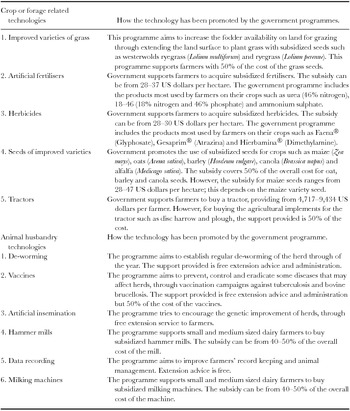
Source: Constructed using information from SEDAGRO (2008).
To measure the importance of each technology to farmers, a Likert type scale was used (Bryman and Cramer, Reference Bryman and Cramer2009). The response categories in the Likert scale were from (1) of no importance to (5) very important. Farmers’ reasons for adoption and non-adoption of each technology were grouped and coded. To identify the promoters of each technology, farmers were asked how and from whom they had learnt about each of the 11 technologies analysed.
Data analysis and identification of variables associated with technology adoption
In this study, a binary logistic regression analysis (Field, Reference Field2009) was utilized to identify socioeconomic and farm variables explaining the adoption of the 11 agricultural technologies. The variables were identified through the following model:
 \begin{equation*}
P(Y) = \beta _0 + \beta _1 X_1 + \beta _2 X_2 + , \ldots , + \beta _n X_n ,
\end{equation*}
\begin{equation*}
P(Y) = \beta _0 + \beta _1 X_1 + \beta _2 X_2 + , \ldots , + \beta _n X_n ,
\end{equation*}
where:
-
P (Y) is the probability of Y occurring
-
β0, β1, β2, . . ., βn are unknown parameters
-
X 1, X 2, . . ., Xn are explanatory variables
In our model, adoption of each technology is treated as a binary variable. Therefore, the binary response variables (Y) were obtained as follows: Y = 0, no adoption of the technology and Y = 1, adoption of the technology. The explanatory variables were selected based on previous studies on factors influencing technology adoption (Bernués and Herrero, Reference Bernués and Herrero2008; Pender, Reference Pender2004; Staal et al., Reference Staal, Baltenweck, Waithaka, deWolff and Njoroge2002). Thus a set of 14 explanatory variables were selected; 7 socioeconomic variables (farmer's age, farmer's education, farmer's experience, number of family members, number of farming work members, main source of income and wealth status) and 7 farm variables (herd size, number of cows in production, total milk yield per herd per year, management of the herd, number of hectares, number of technologies used in the farm and use of commercial concentrates). In terms of the adequacy of sample size, the literature has not offered specific rules applicable to logistic regression; however, some authors on multivariate statistics (Tabachnick and Fidell, Reference Tabachnick and Fidell2012) have recommended a minimum ratio of 10 to 1, with a minimum sample size of 100. However, Hair et al. (Reference Hair, Black, Tatham and Anderson2010) pointed out that the ratio should never fall below 5 to 1, meaning that there should be five observations for each explanatory variable. Therefore, the present research fulfils the minimum sample size in relation to the 14 explanatory variables selected.
In order to identify the variables associated with the adoption of each of the 11 technologies analysed, all 14 explanatory variables were included in the model; however, to eliminate those variables that contribute least to the predictive capability of the model, a backward stepwise analysis using likelihood ratio method was conducted, as recommended by Field (Reference Field2009). More crucial to the interpretation of logistic regression is the value of Exp b, which is an indicator of the change in odds resulting from a unit change in the predictor. Therefore, if the value is greater than 1 then it indicates that as the predictor increases, the odds of the outcome occurring increase. Conversely, a value less than 1 indicates that as the predictor increases, the odds of the outcome occurring decrease (Field, Reference Field2009). To analyse the data, SPSS 15 was used.
Identification of wealth status categories and their analysis
Wealth ranking was used to identify farmers’ wealth status categories. This involves community members defining wealth and classifying themselves and other farmers according to their criteria (Grandin, Reference Grandin1988). The wealth ranking was carried out by three key informants in each municipality. The nine key informants selected were experienced farmers with a broad knowledge of farmers who participated in the study. Lists with the names of small-scale dairy farmers from each municipality were constructed. The three different categories of wealth (high, medium and low) were placed in tick boxes in front of the name of farmers. A direct interview face to face with each out of the three key informants in each municipality was conducted. During the interview, the key informants were asked the wealth status of each farmer from the list, given to them. The information obtained from the three key informants was compared. The classification given by two or more of the three key informants was used. The 115 farmers were then divided into three categories of wealth (high, medium and low). The farmers’ classification was conducted according to key informants’ perceptions about possessions, socioeconomic and farm characteristics; for example, herd size, number of hectares, milk production, house size and its characteristics and availability of machinery. To identify differences in socioeconomic and farm's characteristics among the three wealth status; one way analysis of variance (Field, Reference Field2009) was conducted. Spearman rank order correlation (Field, Reference Field2009) was also conducted to identify the correlation of farmer's wealth status with the socioeconomic and farm variables. Kruskal–Wallis test was conducted to identify differences among the three wealth status regarding farmers’ perception of the importance of each technology. When differences were found among the three wealth status, Mann–Whitney U test was conducted (Field, Reference Field2009).
RESULTS
General features of the small-scale dairy farms
Average age of farmers was 51.3 years, education had been mainly elementary (average of 6 years); however, 7% of farmers had high school or university. The average number of years of farming experience was 26.5. The average family size was seven. Most farms (79%) provided full-time employment for family members and the owners of these farms considered milk to be their main source of income. Incomes for part-time farmers (21%) came from non-farm activities such as sale of crafts and salaried jobs as well as from milk production. Forty-seven percent of the families had off-farm activities, where typically one or two family members work in the nearest factories.
Farm activities were mostly carried out by family members, with respondents on average having three family workers. The average farm size was 4.7 hectares of which 54% was used for planting maize (Zea mays), alfalfa (Medicago sativa) and oats (Avena sativa) and the remainder for grassland. Average herd size was 10 animals of which 4.4 cows were in production. Average milk production was 10.5 litres per cow, with a production period of 240 days. Most farmers (94.8%) milked by hand. Breeds were crosses between native breeds and Holstein, although the latter predominates in most of the farms (75%).
Feed resources were based on forage, normally produced in the farm, and included improved grassland, crop residues, agricultural by-products, native grasses and weeds. Forages are usually cut and carried to stall to feed the herd. Sixty-one percent of farms used grazing (4.6 h per day on average) normally in communal areas and at plot edges. Most farms (86%) supplemented feed with commercial concentrates. Regarding the five crop or forage related and the six animal husbandry technologies studied, 6 and 8% of farms do not use any of them, respectively. More than half of farmers (59.1%) knew about government programmes on technology transfer, and these are farmers from high and medium wealth status categories. Eighty-six percent of farms reported that they did not have contact with the extension service. Reasons reported by farmers were lack of communication and initiatives by extension services and local authorities and lack of farmers’ interest in organising themselves to ask local authorities for the service. Farmers also reported that they considered farmers’ own experience to be sufficient to manage the herd.
Crop or forage related technologies and their promoters
Results for the five crop or forage related technologies adopted or rejected by farmers and their promoters are presented in the Tables 2 and 3. Overall, there was high adoption of improved varieties of grass, artificial fertilisers and herbicides; however, seeds of improved varieties and tractors had the lowest rates of adoption. Adopters’ perception of the importance of the five crop or forage related technologies was positive, ranging from important to very important; however, non-adopters’ perception was generally negative, since technologies were considered to be of no importance and little importance; except for tractors which were considered to be important. All five crop or forage related technologies were mainly promoted by relatives, other experienced farmers and farms’ own initiative. However, relatives were identified as the main promoters of improved varieties of grass, artificial fertilisers and herbicides; whereas farmers’ own initiative was important in adoption of tractors. Government was however the main actor responsible for promoting seeds of improved varieties.
Adoption, non-adoption and importance of crop or forage related technologies.
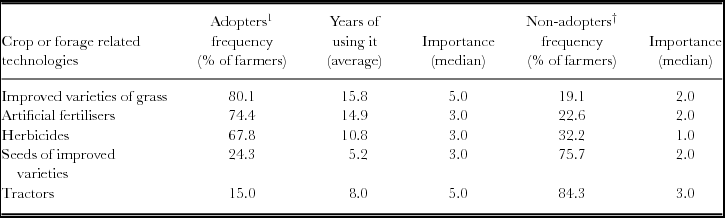
Degree of importance: 1 = of no importance, 2 = little importance, 3 = important, 4 = quite important, 5 = very important.
†The frequency of adopters and non-adopters was based on an n = 115.
Promoters of crop or forage related technologies.
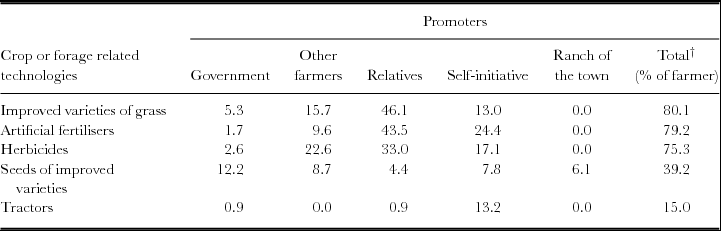
Ranch of the town is a medium size property planted with crops or combined with milk production and it is located in the town, and it is considered as successful farm by the local farmers.
†The frequency of farmers was based on an n = 115.
NB: The data for each promoter are showed in percentage of farmers. The percentages of fertilisers, herbicides and improved seeds are higher than in Table 2, because a farmer could adopt more than one variety of seeds, type of fertilisers or herbicides.
Improved varieties of grass were considered very important by adopters (80.9%) and farmers’ reasons for adoption of this were: increased fodder availability, increased milk production, decreased animal feed costs and that farmers considered grassland was the main animal forage. Farmers’ reasons linked with rejection of improved varieties of grass were: expense, lack of money or land, customary use of native grass for animal feeding, lack of experience of use of them, diary breed type (native breeds), and that some farmers did not consider milk production an important objective.
Artificial fertilisers were reported to be important by adopters (74.4%) since these were considered to improve land quality, and increase fodder and grain production (maize). However, the reasons associated with non-adoption were expense and lack of money, lack of land available, and that manure is used to fertilize crops.
Herbicides were considered important by adopters (67.8%), since these were reported to improve yields, reduce amounts of weeds and reduce workloads associated with crops. Non-adopters considered these of no importance and reasons for rejection given were: expense, lack of money, damage to the land, lack of land available, and herbicides are unnecessary because weeds are used as a fodder.
Seeds of improved varieties for forage were considered important by adopters (24.3%). Farmers’ reasons for adopting these mainly concerned improved production (e.g. increasing fodder and milk production), and that farmers considered that their land quality was appropriate for use of or experimenting with new varieties to increase production. Farmers’ reasons for rejecting seeds of improved varieties were that they are expensive and demand high investment in the crops, farmers lack knowledge on how to plant them and did not have land available. Improved seeds were considered of little importance by non-adopters.
A relatively small proportion of respondents (15.7%) were adopters of tractors and they considered tractors to be very important as they were useful both for cultivating crops and as a source of extra family income i.e. owners rent them to other farmers. Interestingly, tractors were considered equally important by non-adopters (84.3%), and the main reason for not obtaining their own tractors was lack the resources to buy them. Non-adopters also commented on the lack of communication from government programmes and their failure to provide credit services.
Animal husbandry technologies and their promoters
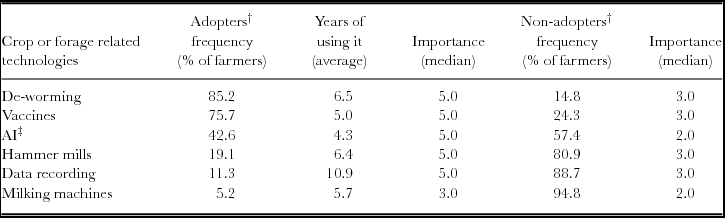
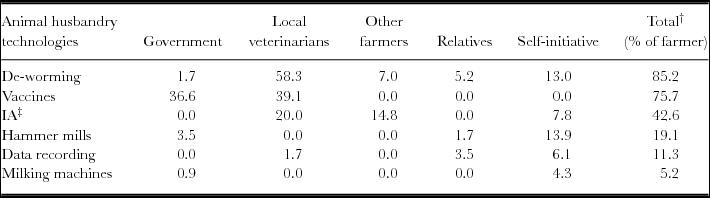
Results for the six animal husbandry technologies either adopted or rejected by farmers and their promoters are presented in the Tables 4 and 5. Overall, there was high adoption of de-worming, followed by vaccines and AI, with hammer mills, data recording and milking machines generally having lower adoption rates. It is important to mention that de-worming, vaccines, AI and data recording were technologies for which knowledge and support was needed but not necessary high capital investment.
Adoption and non-adoption of animal husbandry technologies.
Degree of importance: 1 = of no importance, 2 = little importance, 3 = important, 4 = quite important, 5 = very important.
†The frequency of adopters and non-adopters was based on an n = 115.
‡ AI: Artificial insemination.
Promoters of animal husbandry technologies.
†The frequency of farmers was based on an n = 115.
‡ AI: Artificial insemination.
Adopters’ perceptions of the importance of the six animal husbandry technologies was very positive; since farmers considered them as very important in the farm, except for milking machines, which were considered to be just important. Non-adopters’ perceptions were generally positive regarding de-worming, vaccines, hammer mills and data recording; however AI and milking machines were considered to be of little importance.
Regarding promoters, government was reported to have done little to promote technologies, although there had been a small amount of promotion regarding de-worming, hammer mills and milking machines; however government played an important role in the promotion of vaccines. Farmers reported that local veterinarians offered services for and were the most important in promoting AI, vaccines and de-worming. However, farmers’ self-initiative played an important role in buying machinery; mainly milking machines and hammer mills. Here, other farmers and relatives were less important in the promotion of animal husbandry technologies.
De-worming had the highest rate of adoption (85.2%); and was considered very important to preserve animal health in herds. Non-adopters considered it important and the reasons for rejection given included lack of knowledge and lack of extension advice.
Vaccines were adopted by a high proportion of farmers (75.7%). They were considered very important to prevent diseases in the herd, mainly tuberculosis and brucellosis. Non-adopters considered vaccines to be important, however reported that they did not use them because they lacked knowledge of how to, had only small herds and lacked extension advice.
AI was considered very important by adopters (42.6%). Farmers’ reasons for adoption were mainly to improve breeds and to save feed that would be needed if a stud-bull was kept. However, non-adopters considered AI to be of little importance, because low fertility in cows may require a veterinarian to repeat AI once or more and therefore these farmers preferred to use local bulls. Farmers also reported lack of knowledge and training to use it.
Hammer mills were considered very important by adopters (19.1%), since they were reported to be useful for grinding forage and for making the most of available fodder in the farm, thus avoiding wastage. Non-adopters considered hammer mills to be just as important, however their lack of money and the technology's high cost were the chief reasons for not obtaining mills. Farmers reported that there was a lack of credit and information communication on government programmes and that where they did exist there were too many associated requirements. They also reported that the application process took a long time.
Data recording had a low rate of adoption among farmers (11.3%). Adopters considered it very important to have control of the herd. Non-adopters also considered data recording as important but reported that they have few animals in their farms and lacked extension advice and knowledge of how to use to use recorded data.
Milking machines had a low rate of adoption among farmers. They were considered important by adopters (5.2%), since milking is made easier, less time consuming and is more hygienic. The non-adopters’ opinions differed; milking machines were reported to be of little importance, because they were considered to be unaffordable and these farmers reported that they had few animals, that milking machines damaged the cows’ nipples, and that there was a lack of credit and information communication on related government programmes. Furthermore, the government was reported to require too many conditions to be met when farmers apply for support.
Variables associated with the adoption of crop or forage related technologies
Results of the logistic regression model revealed that seven out of the 14 variables analysed showed a significant association (p < 0.05) with the adoption of the crop or forage related technologies (Table 6). These were farmer's age, farmer's education, farmer's experience, farmer's wealth status, herd size, total number of hectares and number of technologies used in the farm. However, the number of technologies used in the farm, showed a significant association (p < 0.001) with the adoption of all the five crop or forage related technologies.
Variables associated with the adoption of crop or forage related technologies.

B = beta values, SE = standard error and CI = confidence interval.
*Note: R 2 = 0.49 (Hosmer and Lemeshow), 0.38 (Cox and Snell), 0.61 (Nagelkerke). Model X2 = 55.83, p < 0.05*, p < 0.01**, p < 0.001***.
**Note: R 2 = 0.39 (Hosmer and Lemeshow), 0.34 (Cox and Snell), 0.51 (Nagelkerke), Model X 2 = 47.87, p < 0.05*, p < 0.01**.
***Note: R 2 = 0.29 (Hosmer and Lemeshow), 0.30 (Cox and Snell), 0.43 (Nagelkerke). Model X 2 = 41.69, p < 0.05*, p < 0.001***.
† Note: R 2 = 0.44 (Hosmer and Lemeshow), 0.39 (Cox and Snell), 0.58 (Nagelkerke). Model X 2 = 56.39, p < 0.05*, p < 0.01**, p < 0.001***.
†† Note: R 2 = 0.38 (Hosmer and Lemeshow), 0.28 (Cox and Snell), 0.48 (Nagelkerke). Model X 2 = 38.06, p < 0.05*, p < 0.001***.
Each of the five crop or forage related technologies was associated with different variables; for example, farmer's education, farmer's experience and total number of hectares played an important role in the adoption of improved varieties of grass, artificial fertilisers, herbicides and seeds of improved varieties; however, the adoption of improved varieties of grass, herbicides and seeds of improved varieties was highly associated with the variable number of technologies used in the farm, since this variable showed the highest Exp b value. Regarding the adoption of artificial fertilisers and tractors, the variable farmer's wealth status had the highest Exp b value here.
Variables associated with the adoption of animal husbandry technologies
Nine out of the fourteen variables analysed showed a significant association (p < 0.05) with the adoption of the animal husbandry technologies (Table 7); i.e. four socioeconomic variables (farmer's age, farmer's education, farmer's experience and main source of income (milk production) and five farm variables (herd size, number of cows in production, total milk yield per herd per year, number of management practices in the herd and number of technologies used in the farm). Therefore, the adoption of animal husbandry technologies were more associated with the characteristics of the farm.
Variables associated with the adoption of animal husbandry technologies.

B = beta values, SE = standard error and CI = confidence interval.
*Note: R 2 = 0.47 (Hosmer and Lemeshow), 0.33 (Cox and Snell), 0.58 (Nagelkerke). Model X 2 = 45.39, p < 0.05*, p < 0.01**, p <0.001***.
**Note: R 2 = 0.18 (Hosmer and Lemeshow), 0.19 (Cox and Snell), 0.28 (Nagelkerke). Model X 2 = 23.51, p < 0.05*, p < 0.01**, p <0.001***.
***Note: R 2 = 0.39 (Hosmer and Lemeshow), 0.42 (Cox and Snell), 0.56 (Nagelkerke). Model X 2 = 61.77, p < 0.05*, p <0.01**, p < 0.001***.
† Note: R 2 = 0.46 (Hosmer and Lemeshow), 0.36 (Cox and Snell), 0.59 (Nagelkerke). Model X 2 = 52.27, p < 0.05*, p < 0.001***.
†† Note: R 2 = 0.09 (Hosmer and Lemeshow), 0.07 (Cox and Snell), 0.14 (Nagelkerke). Model X 2 = 8.08, p <0.05*, p < 0.01**, p < 0.001***.
††† Note: R 2 = 0.21 (Hosmer and Lemeshow), 0.084 (Cox and Snell), 0.25 (Nagelkerke). Model X 2 = 10.10, p < 0.05*, p < 0.01**, p < 0.001***.
Each of the six animal husbandry technologies was also associated with different variables. The adoption of de-worming, AI and hammer mills was highly associated with the variable number of technologies used in the farm; however, the variable main source of income (milk production) was also important in the adoption of de-worming, since these both variables showed the highest Exp b value. In the case of AI, the variable farmer's education was important too. Regarding the adoption of data recording, vaccines and milking machines, the variables influencing adoption and with the highest Exp b value were herd size, farmer's experience and number of cows in production, respectively.
Farmers’ wealth status
Wealth ranking identified that 14% of farmers belonged to the high wealth status category, more than half (54.7%) to the medium wealth status category and 31.3% to low wealth status category. Table 8 details the main socioeconomic and farm characteristics; and the statistical differences among the three wealth status categories. There were no statistical differences (p > 0.05) regarding socioeconomic variables among the three wealth status categories; however, for the variables representing farm's characteristics, there were highly significant differences (p < 0.001) among the three wealth status categories; where the high wealth status category had the bigger size of farm. On the other hand, the analysis of Spearman rank order correlation showed a significant correlation (p < 0.001) between wealth status and all the variables representing farm's characteristics, with exception of number of management practices (Table 8).
Socioeconomic and farm characteristics per wealth status category.

†Reposnes to questionnaire item: What activity is the main source of income? (1) Milk production, (2) non-farm activities and 3) milk production and non-farm activities.
††SD: Standard deviation.
†††One way analysis of variance (p < 0.05).
a, d, cAverages within a row with different superscripts are significantly different (p < 0.05).
††††Spearman rank order correlation coefficient (r), ns: showing non-significance, * correlation is significant at the 0.05 level (2-tailed), ** correlation is significant at the 0.01 level (2-tailed).
Adoption and technology importance per wealth status category
Results for the five crop and forage related and the six animal husbandry technologies adopted and their importance per wealth status category are presented in the Table 9. Overall, there was highest adoption of technologies in the high wealth status category, followed by medium wealth status, with low wealth status category having lower adoption rates. Farmers in all three wealth status categories showed a great preference for three crop or forage related technologies (improved varieties of grass, artificial fertilisers and herbicides) and three animal husbandry technologies (de-worming, vaccines and AI). However, the medium wealth status category made more use of de-worming and vaccines than high and low wealth status categories.
Adoption of crop and forage related and animal husbandry technologies per wealth status category.

*High wealth status category (n = 16), **medium wealth status category (n = 63), ***low wealth status category (n = 36).
† p value of Kruskal–Wallis test (p < 0.05).
a,bMedians within a row not sharing a common superscript differ, Mann–Whitney U test (p < 0.05).
†† Degree of importance: 1 = of no importance, 2 = little importance, 3 = important, 4 = quite important, 5 = very important.
Adopters’ perception of the importance of the five crop or forage related and the six animal husbandry technologies was in general positive among the three wealth status categories; and there were no statistical differences (p > 0.05) among them; except for the use of seed of improved varieties (p < 0.05), which were considered by high and low wealth status to be quite important; whereas the medium wealth status category considered those to be just important in the farm.
Non-adopters perception of the importance of the five crop or forage related technologies was in general negative, since improved varieties of grass, artificial fertilisers, herbicides and seed of improved varieties were considered to be of no importance and little important for the three wealth status categories; however, tractors were considered by the high and medium wealth status category to be quite important, and important by the low wealth status, but unaffordable. In the case of the six animal husbandry technologies, there were no statistical differences (p > 0.05) among the three wealth status categories, and the non-adopters’ perception of the importance of each technology was slightly negative; however, hammer mills and data recording were considered to be important among the three wealth status categories. De-worming, vaccines and milking machines were also considered to be important to the low, high and medium wealth status categories respectively.
DISCUSSION
This study has shown that large amount of small-scale dairy farmers in Central Mexico have a lack of extension advice, communication of the information about government programmes on technology transfer and difficulties in obtaining credit. Similar results were also reported by Espinosa-Ortega et al. (Reference Espinoza-Ortega, Espinosa-Ayala, Bastida-López, Castañeda-Martínez and Arriaga-Jordán2007) based on work conducted in Central Mexico. The inadequacy of institutional support services has been considered to be a constraint for adopting innovations (Negatu and Parikh, Reference Negatu and Parikh1999).
Adoption and rejection of the crop or forage related technologies
The adoption of the crop or forage related technologies was based on their importance to farmers, usefulness, productivity and benefits to the farm; whereas their rejection was mainly related to economic restrictions; which was the case for all five crop or forage related technologies. Sanni et al. (Reference Sanni, Alenkhe, Edosio, Patino and Dixon2007) pointed out that high cost of technologies is one of the main constrains to adopting them. Other constrains were the lack of knowledge of the use of the technologies (improved varieties of grass and seeds of improved varieties for forage), lack of land (improved varieties of grass, artificial fertilisers, herbicides and seeds of improved varieties for forage) and the technologies were considered to be of little or no importance by non-adopters. These results imply that farmers with less capital, limited knowledge on how to use the technology and small land sizes were less willing to involve the use of the crop or forage related technologies.
Channels of communication regarding the crop or forage related technologies
Despite the lack of extension services, farmers showed high adoption of three crop or forage related technologies: improved varieties of grass, artificial fertiliser and herbicides; which were mainly promoted by relatives, followed by other experienced farmers, and then farmers’ own initiative. These results imply that relatives and other experienced farmers could be considered important sources of knowledge within a social network for communicating and spreading information on new technological innovations among small-scale dairy farmers. Sinja et al. (Reference Sinja, Karugia, Waithaka, Miano, Baltenweck, Franzel, Nyikal and Romney2004) reported the increased focus on use of farmer-to-farmer extension as a more viable method of technology dissemination. In addition, informal social networks such as relatives, friends and groups of farmers are important avenues for spreading technologies (Adekoya, Reference Adekoya2007; Kiptot et al., Reference Kiptot, Franzel, Hebinck and Richards2006). On the other hand, in order to increase adoption rates of crop or forage related technologies, which were considered to be important in the farm, extension advice is still needed.
Adoption and rejection of the animal husbandry technologies
The adoption of animal husbandry technologies was also based on their importance, usefulness, productivity and benefits to the farm. Farmers make adoption decisions based upon utility, productivity and profitability considerations, since these are overriding factors in farmers’ decision making (Batz et al., Reference Batz, Peters and Janssen1999). The rejection of de-worming, vaccines, AI and data recording was mainly due to the lack of knowledge on how to use the technology; this could be associated with the lack of extension advice to small-scale dairy farmers. The results suggest that farmers need aid and support of extension services to reinforce the adoption of these technologies which were considered to be important by non-adopters. Adekoya (Reference Adekoya2007) argues that extension advice provides the technical bases for the use of new technologies and increased knowledge has been shown to have a positive impact in their adoption. Therefore, enormous efforts in education, training and provision of adequate information, communication and skills for innovation are necessary (Sanni et al., Reference Sanni, Alenkhe, Edosio, Patino and Dixon2007).
The adoption of data recording and milking machines were associated with the scale of operation of the farm since herd size was shown to be a restriction to adoption. The rejection of machinery such as milking machines and hammer mills was mainly due to economic restrictions but also due to the lengthy and difficult process involved when trying to access credit, a finding supported by Espinoza-Ortega et al. (Reference Espinoza-Ortega, Espinosa-Ayala, Bastida-López, Castañeda-Martínez and Arriaga-Jordán2007). The access to information and credit has been shown to be strongly associated with the adoption of innovations (Matuschke et al., Reference Matuschke, Mishra and Qaim2007).
Channels of communication of the animal husbandry technologies
The promotion and communication of the animal husbandry technologies such as de-warming, vaccines and AI could be through the local veterinarians, since they played the most important role here. For example, Cervantes et al. (Reference Cervantes, Cesín and Pérez2007) argued that genetic improvement through AI could be more widely adopted by dairy farmers if it was promoted either by veterinarians or genetic improvement centres, and if farmers are more aware of the advantages of this technology. On the other hand, an extension approach which involves local veterinarians together with staff of government organizations could be an alternative for promoting and communicating vaccines among small-dairy farmers. Regarding machinery such as hammer mills and milking machines, farmers preferred to buy them by themselves instead of relying on government support. This is due to the difficulties that farmers have found during the process when they apply for support and government needs to develop a more accessible application protocol for small-scale dairy farmers if it is aiming to support and facilitate use of machinery.
Variables associated with the adoption of crop or forage related technologies
Different levels of technology adoption across farmers have been attributed to socioeconomic characteristics (farmer's age, farmer's education, farmer's experience, family size, family labour, source of incomes and credit) and farm characteristics (farm size, land size, herd size, farm production, management and technological level) (Bernués and Herrero, Reference Bernués and Herrero2008; Espinoza-Ortega et al., Reference Espinoza-Ortega, Espinosa-Ayala, Bastida-López, Castañeda-Martínez and Arriaga-Jordán2007; Lapar and Ehui, Reference Lapar and Ehui2004; Mafimisebi et al., Reference Mafimisebi, Onyeka, Ayinde and Ashaolu2006; Martinez-Garcia et al., Reference Martínez-García, Dorward and Tahir2012). This is supported by the findings from this study, where the adoption of the five crop or forage related technologies were associated with the farmer's skills and farm's dimensions; i.e. the probability for adopting crop or forage related technologies increased with farmers who were younger, had more education, experience, financial resources, larger herd sizes, greater land availability and were at a higher technological level.
Espinosa-Ortega et al. (Reference Espinoza-Ortega, Espinosa-Ayala, Bastida-López, Castañeda-Martínez and Arriaga-Jordán2007) found that younger and more educated farmers were more open and willing to try new ideas and innovations. The same was observed in this study, since the variables farmer's age and farmer's education played an important role in the adoption of seeds of improved varieties and herbicides. Farmer's education improves management skills and therefore the ability to adopt new innovations; moreover the increase of education level would render high returns in terms of the willingness and capacity of farmers to adopt new innovations (Bernués and Herrero, Reference Bernués and Herrero2008).
Farmer's experience, herd size and number of hectares were positively associated with the adoption of improved varieties of grass and seeds of improved varieties. Therefore, both knowledge and the larger scale of operation needed, enabled farmers to adopt these innovations. Similar results were found by Staal et al. (Reference Staal, Baltenweck, Waithaka, deWolff and Njoroge2002) in the adoption of varieties of grass and pastures. The adoption of improved varieties of grass and seeds of improved varieties for crops and forage also seem to be associated with the scale of operation; i.e. the bigger the herd size, the more fodder is used to feed the cattle. Land availability is a variable which can provide multiple sources of feed for keeping dairy cattle, as mentioned by Staal et al. (Reference Staal, Baltenweck, Waithaka, deWolff and Njoroge2002). Therefore, the probability of taking up these technologies increased in farmers with more experience, and bigger herds and land sizes.
Variables associated with the adoption of animal husbandry technologies
The adoption of animal husbandry technologies was also associated with farmer's skills. For example, the adoption of vaccines was significantly associated with farmer's age and experience; but farmer's education was not needed, since this variable showed a negative association with the adoption of vaccines indicting that farmer's with low education are potential adopters. However, the opposite was observed in the adoption of AI where education was an important factor. Farmers who have higher levels of education have better knowledge of the benefits of adoption of new innovations which increases the likelihood to adopt (Lapar and Ehui, Reference Lapar and Ehui2004). Farmers also made adoption decisions based on income perception i.e. if farmers’ income comes from milk production they are be more willing to adopt new innovations, as was the case with de-worming.
The adoption of AI, hammer mills, data recording and milking machines were associated with the scale of operation of farms since these technologies demanded a big herd size, more cows in production and therefore high milk production. Moreover, the technological level was also important in the adoption of AI and hammers mills i.e. the higher the technological level in the farm, the higher the probability for adopting these technologies. Scale of operation of farm is an important factor influencing adoption of new innovations as indicated by Bernués and Herrero (Reference Bernués and Herrero2008).
Technology adoption and rejection per wealth status category
The variable wealth status had a positive significant correlation (p < 0.01) with six out of the seven farm variables i.e. herd size, cows in production, total milk yield per herd per year, number of hectares, technologies used in the farm and use of commercial concentrates, as well as with number of crop or forage related and animal husbandry technologies used in the farm. Kiptot et al. (Reference Kiptot, Franzel, Hebinck and Richards2006) also found that wealth was positively associated with the adoption of new innovations.
The results also showed that all of the three different wealth status categories had specific technological preferences. The high wealth status category had the highest adoption of the crop or forage related and animal husbandry technologies. Bernués and Herrero (Reference Bernués and Herrero2008) pointed out that high economic position of the household influences the possibility of technological investments. This is supported by the findings of this study, where farmers of the high wealth status category were more willing to make investments in machinery such as tractors, hammer mills and milking machines, all of which require relatively high levels of capital investment. However, farmers with liquidity or capital constrains are less likely to adopt (Lapar and Ehui, Reference Lapar and Ehui2004) and farmers of the medium and low wealth status categories made more use of technologies which did not require high capital investment such as improved varieties of grass, fertilisers, herbicides de-worming, vaccines and AI. This could also be associated with the ease, utility, benefits and importance that farmers perceive these technologies have regarding their farms. Kiptot et al. (Reference Kiptot, Franzel, Hebinck and Richards2006) mentioned that farmers are indeed more concerned with technologies that have immediate benefits and are easy to implement.
CONCLUSIONS
This study provides new insights into what factors favour and constrain adoption of technological innovations in small-scale dairy farming and into the roles of different actors. Factors such as socioeconomic and farm variables were important together with reasons given by farmers including lack of extension advice, governmental constrains, high cost, capital constraints, lack of knowledge on how to use the technologies, and the perceived importance of each technology. Therefore, there is a need for orienting policies to small-scale dairy farmers which consider promotion of important technologies that demand low cost investment by farmers and where capital support is offered that this is through a simple and fast procedure. On the other hand, there is a need to reorient the promotion of the innovations which demand high investment (tractors, hammers mills and milking machines) to the bigger farmers. Policies should also take into account the promoters of the technological innovations identified in this research as sources of knowledge and channels to share information amongst farmers. For example, a farmer-to-farmer communication approach is likely to be more effective in the spreading information on the innovations which were mainly promoted by other experienced farmers and relatives. Participatory extension approaches could also be developed between veterinarian surgeons and farmers to support the uptake of technologies in which veterinarian played an important role.
It also has been concluded that the adoption of crop or forage related and animal husbandry technologies was associated with farm's dimensions and production scale; where the biggest and better off farmers were more willing to invest in new innovations and these results were confirmed by the findings regarding wealth status categories. However, all the three different wealth status categories had different technological preferences; for instance, the high wealth status category was more willing to invest in machinery such as tractors, hammers mills and milking machines; whereas medium and low wealth status categories made more use of technological innovations which had no high capital investment such as improved varieties of grass, fertilisers, herbicides, de-worming, vaccines and AI; therefore the different technologies promoted by government organizations fitted to different kind of small-scale diary famers. For effective and efficient service delivery, polices should develop a mixture of different extension approaches appropriate for different farmers’ wealth status categories and technologies, so that policy makers could target the right farmers and technologies.
These findings could be used by research and extension services to identify more clearly what types of technologies are most suitable for which farmers, together with the communication channels that are likely to be most effective. This approach to understanding better the factors that favour and constrain technology adoption, and the potential to subsequently use findings to improve interventions, has potential to improve the effectiveness and efficiency of research and extension in many countries and contexts.
Acknowledgements
The authors thank all farmers who participated in the study for their hospitality and full support. The first author wishes to thank the Consejo Nacional de Ciencia y Tecnología (CONACyT) for the doctoral grant 183885/301969 and to the Universidad Autónoma del Estado de México for supporting in the realization of this research.



