

1. Introduction
SW England forms the northern part of the Paleozoic Variscan (Hercynian) orogenic belt that extends from Central America across central Europe to Eastern Europe and south to Spain and Portugal (Figures 1 and 2). During and after closure of the Iapetus Ocean and the resulting Caledonian orogeny (Ordovician – Silurian – Early Devonian) in northern Scotland (extending to east Greenland, western Norway and the Appalachians), the Rheic Ocean in central and northern Europe opened in the Late Cambrian – Early Ordovician attained its greatest width during the Silurian and closed during the Late Devonian – Carboniferous (Murphy et al. Reference Murphy2006, 2009; Nance and Linnemann, Reference Nance and Linnemann2008; Kroner and Romer, Reference Kroner and Romer2013; Schulmann et al. Reference Schulmann, Lexa, Janousek, Lardeaux and Edel2014, Reference Schulmann and Edel2022). The polarity of the south-dipping subduction zone in SW England is in agreement with subduction polarity along the entire European Variscan belt from the Iberian Peninsula in the west to the Polish Sudetes in the east, from geological and geophysical (gravity, magnetic and seismic) data (Schulmann et al. Reference Schulmann, Lexa, Janousek, Lardeaux and Edel2014, Reference Schulmann and Edel2022 and references within). The Variscan orogeny, which was the consequence of Rheic Ocean closure, preceded the late Paleozoic-Mesozoic rifting of the Tethys Ocean and its closure during the Cenozoic Alpine – Himalayan orogeny.
Geological map of SW England showing the Lizard ophiolite complex, Cornubian granite plutons and Devonian – Carboniferous sedimentary rocks, after Shail and Leveridge, (Reference Shail and Leveridge2009); Leveridge and Shail, (Reference Leveridge and Shail2011a); Shail et al. (Reference Shail, Andersen, Simons and Williamson2014); Alexander et al. (Reference Alexander, Shail and Leveridge2019). Inset shows the location of SW England in the Variscan orogenic belt, after Linnemann (Reference Linnemann, Gerdes, Drost and Buschmann2007) and Nance and Linneman (Reference Nance and Linnemann2008).

Geological map of Cornwall showing the allochthonous units beneath the Lizard ophiolite, after Leveridge et al. (Reference Leveridge, Holder and Goode1990), Leveridge and Hartley (Reference Leveridge, Hartley, Brenchley and Rawson2006) and Harvey et al. (Reference Harvey, Stewart, Wilkinson, Ruffell and Shail1994). Also shown are the tectono-stratigraphic units of the Lizard ophiolite and the allochthonous thrust sheets beneath the Lizard ophiolite.

The Rheic Ocean closed as a result of the collision of the Avalonia (Laurentia) continental plate to the north with the Armorican massif – Saxothurigian zone – Bohemian massif in Europe to the south (Nance et al., Reference Nance, Gutiérrez-Alonso and Keppie2012). The Avalon terrane represents the southeast margin of the Caledonian – Appalachian orogen. The Cadomian terrane forms the pre-drift continuation of the Avalon terrane in NW France (Murphy and Nance Reference Murphy and Nance1989), so the two terranes share a common Proterozoic basement. The Rheic suture zone is marked by the Lizard ophiolite complex in SW England and has been mapped to the east along a boundary south of the Brabant massif (Murphy et al. Reference Murphy2006, 2009; Nance and Linnemann, Reference Nance and Linnemann2008; Figure 1). Seismic profiles across SW England (SWAT – Southwestern Approaches Traverse) show a SE dipping zone, approximately 8 km thick, corresponding to the southward continuation of the Lizard ophiolite (Le Gall, Reference Le Gall1990; BIRPS Seismic Atlas, British Institutions Reflection Profiling Syndicate, 1986; Alexander et al. Reference Alexander, Shail and Leveridge2019). This zone is interpreted as the Rheic suture separating the lower plate (underthusting Cornubia, Avalon plate) from the upper plate Normannian High (Cadomia; e.g. Holder and Leveridge, Reference Holder and Leveridge1986). Thus, the Lizard ophiolite delineates the northern margin of a suture zone formed during closure of the Rheic Ocean, extending eastward to the Rhenoherynian zone in Germany and the Czech Republic (Kroner and Romer, Reference Kroner and Romer2013; Janousek and Zák, Reference Janousek and Zák2015).
It has been suggested, based on detrital zircon ages and clasts of Ordovician quartzites in the Roseland Breccia Formation, that the Devonian mélange unit (Meneage Formation) beneath the Lizard ophiolite was derived from the over-riding Armorican plate (Nance and Murphy, Reference Nance and Murphy1994; Strachan et al. Reference Strachan, Linnemann, Jeffries, Drost and Ulrich2013). Bimodal ages are Neoproterozoic to Cambrian (710–518 Ma) and Paleoproterozic (2,200–1,800 Ma) and match similar lithologies in the Cadomian belt of NW France (Strachan et al. Reference Strachan, Linnemann, Jeffries, Drost and Ulrich2013). This model would make the Lizard ophiolite the only remnant of the Rheic ocean between the two continental plates, an interpretation that is at odds with geologic and paleomagnetic evidence for a wide Rheic Ocean (Nance et al. Reference Nance, Gutiérrez-Alonso and Keppie2012). An alternative model discussed here is that any Cambrian-Ordovician rocks on the Avalonia plate would have remained buried beneath the Devonian – Carboniferous rocks of SW England. Thus, the Roseland Breccia Formation mélange includes small blocks of Avalonian ‘basement’ rifted away and incorporated beneath the Lizard ophiolite during emplacement. The structurally lowest thrust slice beneath the Lizard ophiolite and the metamorphic sole are variably deformed meta-igneous rocks (gabbros, tonalites) that crop out on a series of offshore reefs south of Lizard Point (Man of War gneisses). A U-Pb zircon age of 499 ± 8 Ma suggests that they may be a structural inlier of pre-Hercynian basement, whereas 40Ar-39Ar age of c. 374 Ma suggests that these rocks were also concomitant with formation of overlying the metamorphic sole (Sandeman et al. Reference Sandeman, Clark, Styles, Scott, Malpas and Farrar1997). Similar undated gneisses are also exposed on the offshore Eddystone reefs south of Plymouth (Figure 1). They both have unknown provenance, but are assumed by some authors to be part of the over-riding Armorican plate (Holder and Leveridge, Reference Holder and Leveridge1986).
The Lizard ophiolite complex in Cornwall is the best-preserved ophiolite complex along the Rheic suture zone and its obduction onto the southern passive margin of Avalonia during the Devonian marked the beginning of the Variscan orogeny (Bromley, Reference Bromley1979; Kirby, Reference Kirby1979; Roberts et al. Reference Roberts, Andrews, Bull and Sanderson1993; Styles et al. Reference Styles, Cook and Holdsworth2000). The Lizard ophiolite, with its metamorphic sole, has been thrust to the NNW over the Gramscatho Group, a series of NNW-vergent thrust sheets comprising Devonian deep marine mudstones and sandstones exposed along the south coast of Cornwall (Holder and Leveridge, Reference Holder and Leveridge1986; Alexander and Shail, Reference Alexander and Shail1996; Cook et al. Reference Cook, Holdsworth and Styles2002; Shail and Leveridge, Reference Shail and Leveridge2009; Leveridge and Shail, Reference Leveridge and Shail2011a, b). A narrow belt of mélange (Roseland Breccia Formation and Carne Formation) is present along the northern margin of the Lizard ophiolite, although late- to post-Variscan faults now mark most of the geological boundaries (e.g. Power et al. Reference Power, Alexander, Shail and Scott1996). Emplacement-related thrusts strike ENE-WSW and show a vergence direction towards the NNW. Early compressional folds, thrusts and fabrics have been overprinted by late-stage Carboniferous – Permian top-to-SSE extensional fabrics and extensional faults (Alexander and Shail, Reference Alexander and Shail1995; Shail and Leveridge, Reference Shail and Leveridge2009).
The obduction of the Lizard ophiolite onto the previously passive continental margin occurred during Middle Devonian convergence as the Rheic ocean began to close. Folds indicating crustal shortening occur throughout the thrust sheets structurally beneath the ophiolite in the Gramscatho Group sediments (e.g. Rattey and Sanderson, Reference Rattey and Sanderson1984). These were overprinted by late orogenic Carboniferous – Permian extensional faults indicating NNW-SSE extension, and then by compression associated with strike-slip faulting (Shail and Alexander, Reference Shail and Alexander1997). Late Permian-Triassic post-orogenic continental red-beds beds unconformably overlie the Variscan basement just offshore to the south of the Cornubian peninsula (Evans, Reference Evans1990), marking the ending of the Variscan orogeny.
In this paper, we first summarize the structural evolution of SW England and then describe the composition and structure of the Lizard ophiolite crust and mantle units, the Landewednack metamorphic sole and the various granitic and mafic igneous rocks (Kennack Igneous Complex) associated with the sole and immediately overlying peridotite. We then review the Devonian – Carboniferous stratigraphy of SW England and discuss the structures formed during emplacement of the Lizard Ophiolite onto the southern passive continental margin of Avalonia. We present detailed structural maps along an NNW to SSE profile along the south Cornwall coast from Porthleven to the Lizard ophiolite. The Roseland breccia and Carne Formation mélange, the Portscatho Formation and the Mylor slates are entirely Devonian (e.g. Leveridge et al, Reference Leveridge, Holder and Goode1990) and show evidence of NNW-directed thrusting during the emplacement of the Lizard ophiolite, followed by top-SSE extensional fabrics. Finally, we infer the geological evolution of the Lizard ophiolite and underlying thrust sheets and relate these to similar structures beneath the Semail (Oman) ophiolite in Arabia. We also discuss how the three main components of the Variscan orogeny in SW England, the Lizard Ophiolite and its metamorphic sole together with its underlying Devonian thrust sheets, the Carboniferous Culm basin and the Permian Cornubian granites relate to each other.
2. Structure of SW England
The SWAT seismic reflection profiles provide important data with which to interpret the offshore geology of SW England. Seismic profiles (SWAT Lines 8, 9 and 10) show a large-scale south-dipping thrust stack beneath the obducted Lizard ophiolite rooting deep into the mantle (Le Gall, Reference Le Gall1990). The Lizard suture is a 7–8 km zone of highly reflective south-dipping reflectors, which are interpreted as the main Rheic suture zone. Overlying this is a seismically featureless upper crust presumed to be the Cadomian margin (Le Gall, Reference Le Gall1990). In contrast, the tectonic models of Franke (Reference Franke2024) and Stampfli et al. (Reference Gutiérrez Marco, Rábano and Garcia-Bellido2011) invoke northward dipping subduction beneath South Avalonia and south-dipping subduction beneath the Mid-German High. The geology of SW England shows no indication of north-dipping subduction, with the lack of a south-verging accretionary prism, the lack of calc-alkaline volcanics or Devonian calc-alkaline granites. The tectonic structure may well change along strike in northern Europe, but this configuration does not apply to Cornwall.
The structural evolution of SW England can be divided into four major time sequences:
-
(1) Devonian rifting and passive margin development, characterized by steep, south-dipping normal faults bounding graben systems (e.g. Leveridge and Hartley, Reference Leveridge, Hartley, Brenchley and Rawson2006; Leveridge, Reference Leveridge2011; Whittaker & Leveridge, Reference Whittaker and Leveridge2011). Exclusively deep marine facies are present in the Gramscatho Basin (e.g. Leveridge and Shail, Reference Leveridge and Shail2011b), and these are considered to reflect post-rift sedimentation on a highly attenuated passive margin followed by syn-convergence sedimentation after the onset of subduction (e.g. Shail and Leveridge, Reference Shail and Leveridge2009).
-
(2) Middle—Late Devonian convergence and thrusting of the Lizard ophiolite, together with underlying sedimentary thrust sheets, onto the formerly passive continental margin. Structures in the Gramscatho Group successions are characterized by tight to isoclinal NNW-vergent folds and thrusts, and SSE-dipping slaty cleavage that locally exhibits SSE-plunging mineral lineations, and are compatible with NNW directed thrusting (e.g. Leveridge et al. Reference Leveridge, Holder and Day1984; Rattey and Sanderson, Reference Rattey and Sanderson1984; Holder and Leveridge, Reference Holder and Leveridge1986).
-
(3) Following Devonian thrusting and emplacement of the Lizard ophiolite, an intra-continental basin formed in the Carboniferous (Culm Basin) that was inverted and shortened by N-S compressive stress during the latest Carboniferous (Lloyd and Chinnery, Reference Lloyd and Chinnery2002; Davison et al. Reference Davison, Jeffcoate and Oing2004). Carboniferous sedimentation in the Culm Basin, up to 4-5 km thick, was followed by ∼50% crustal shortening and inversion. The Culm Basin is not a classic flexural foreland basin because it was formed a long time after the obduction of the Lizard ophiolite. The causes of the Culm Basin formation remain unclear.
-
(4) Post-Variscan Permian extension and intrusion of Cornubian granite batholith (Floyd et al. Reference Floyd, Exley and Styles1993; Chappell and Hine, Reference Chappell and Hine2006; Simons et al. Reference Simons, Shail and Andersen2016; Searle et al. Reference Searle, Shail, Pownall, Jurkowski, Watts and Robb2024). Variscan convergence ended ca 305 – 300 Ma and was followed by NNW-SSE extensional reactivation (Shail and Wilkinson, Reference Shail and Wilkinson1994; Alexander and Shail, Reference Alexander and Shail1996; Shail and Alexander, Reference Shail and Alexander1997; Alexander et al. Reference Alexander, Shail and Leveridge2019). Granites of the Cornubian batholith were intruded during the Early Permian ∼293 – 274 Ma (Chen et al. Reference Chen, Clark, Farrar, Wasteneys, Hodgson and Bromley1993; Chesley et al., Reference Chesley, Halliday, Snee, Mezger, Shepherd and Scrivener1993; Smith et al. Reference Smith2019), with coeval intrusion of lamprophyre dykes ∼295 – 285 Ma (Dupuis et al. Reference Dupuis, Braid, Murphy, Shail, Archibald and Damian Nance2015, Reference Dupuis, Murphy, Braid, Shail and Nance2016). Permian-Triassic post-orogenic continental sedimentation (red-beds, conglomerates, fluviatile sandstones) were deposited unconformably across all structural units (Edwards et al. Reference Edwards, Warrington, Scrivener, Jones, Haslam and Ault1997).
3. Lizard Ophiolite
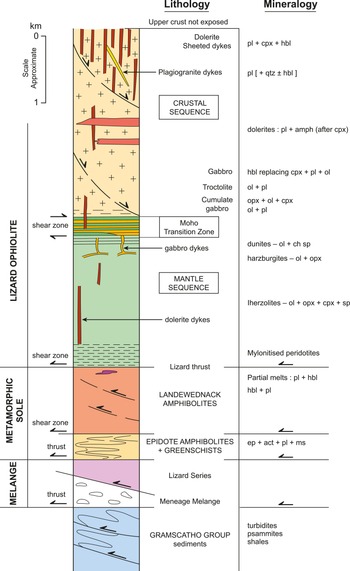
The Lizard ophiolite complex shows all components of a classic Penrose-type ophiolite comprising upper mantle and oceanic crust rocks with the exception of the pillow lava sequence (Strong et al. Reference Strong, Stevens, Malpas and Badham1975; Bromley, Reference Bromley1975, Reference Bromley1979; Kirby, Reference Kirby1979; Styles and Kirby, Reference Styles and Kirby1980; Mackay-Champion et al. Reference Mackay-Champion, Searle, Tapster, Roberts, Shail, Palin, Willment and Evans2024). The full range of ophiolite rocks exposed around the Lizard peninsula is shown in Figure 3. Upper mantle peridotites comprising lherzolites, harzburgites and depleted mantle dunites exposed in the Lizard are largely altered to serpentinites. Peridotites show classic serpentinite minerals, notably lizardite and chrysotile after olivine and bastite after orthopyroxene (Figure 4a). Late serpentine veins cut the peridotites and contain talc, asbestos and chrysotile (Figure 4b, c). The lower part of the mantle shows a compositional banding between dunites and lherzolite (Figure 4d).
Simplified composite section showing the full range of rocks exposed in the Lizard ophiolite and underlying thrust sheets, south Cornwall. Note that the uppermost pillow lavas are not exposed. The Landewednack amphibolites and Old Lizard Head Series are interpreted as parts of the Metamorphic sole. Not shown are the intrusive Kennack gneiss. Ol – olivene; Opx – orthopyroxene; Cpx – clinopyroxene; Chsp – chrome spinel; Pl – plagioclase; Hbl – hornblende; Qtz – quartz; Ep – epidote; Act – actinolite; Ms – muscovite.

Representative textures of serpentinised lherzolites and harzburgites from the Lizard ophiolite. (a) Classic chess-board textures showing serpentine fractures, (b,c) veins infilled with chrysotile/lizardite + talc + asbestos cutting serpentinised lherzolite, (d) alternating dunite and harzburgite banded ultramafic rocks.

The Moho runs across Coverack cove on the east coast of the Lizard peninsula and is rarely an abrupt contact between mantle peridotite and crustal gabbro (Figure 5). Usually, the contact shows interbanding of peridotites and gabbros, intruded by troctolite sills and late doleritic dykes, and is referred to as the Moho transition zone (Figure 6a). Massive gabbros representing the lower oceanic crust pass structurally upwards into a sheeted dyke complex, exposed near Porthustock (Roberts et al. Reference Roberts, Andrews, Bull and Sanderson1993; Hopkinson and Roberts, Reference Hopkinson and Roberts1995). Minor plagiogranite dykes intruding gabbros and sheeted dykes are interpreted as the final results of fractionation. Clark et al. (Reference Clark, Scott, Sandeman, Bromley and Farrar1998) published a U-Pb zircon TIMS age from a coarse-grained gabbro at Porthkerris of 397 ± 2 Ma, which is not the same as typical plagiogranite. Gabbros feed higher-level sheeted dykes (Figure 6b), but the upper pillow lavas have either been eroded or faulted and are not exposed. Pillow lavas exposed on Mullion Island structurally beneath the mantle peridotites are thought to be part of the sub-ophiolite mélange unit rather than part of the ophiolite (e.g. Leveridge and Shail, Reference Leveridge and Shail2011a).
Samples of Moho, showing lower crust gabbro (olivine + clinopyroxene + plagioclase) overlying serpentinised harzburgite (olivine + orthopyroxene ± chrome spinel); Coverack.

(a) Coverack Bay, showing mantle sequence peridotites (foreground), Moho Transition zone and lower crust gabbros (distant). (b) Sheeted dykes, south of Porthoustock. (c) Complex igneous textures of the Traboe complex gabbros, showing compositionally banded gabbros with cumulate textures, and late pegmatite partial melts (outlined in red) breaking up the banding, Porthkerris. (d) Basal peridotites of Lizard mantle sequence overlying amphibolites of the metamorphic sole along the Lizard thrust, Mullion Cove.

The Traboe cumulate sequence is exposed along the east coast of the Lizard peninsula near Porthkerris and was originally interpreted as a granulite facies part of a contact metamorphic aureole around the Lizard peridotite (Green, Reference Green1964a, b). The Traboe gabbros have the assemblage: hypersthene + diopside/augite + hornblende + plagioclase and show complex igneous banding with cumulate textures and small partial melts reflecting high-temperature (∼900ºC) hornblende breakdown melting (Figure 6c). Following Styles and Kirby (Reference Styles and Kirby1980) and Leake and Styles Reference Leake and Styles1984), we suggest that these rocks are part of the Lizard ophiolite (Mackay-Champion et al. Reference Mackay-Champion, Searle, Tapster, Roberts, Shail, Palin, Willment and Evans2024). Nutman et al. (Reference Nutman, Green, Cook, Styles and Holdsworth2001) published U-Pb SHRIMP ages of 387 ± 7 Ma, 386 ± 7 Ma and 393 ± 6 Ma from the Traboe hornblende-bearing gabbros, which they interpreted as dating the formation of the crustal sequence.
Trondhjemite – tonalite pods and dykes represent the final fractionated phase of gabbros and dolerites related to formation of the Lizard ophiolite crust. In common with similar trondhjemites from other ophiolite complexes, these rocks are composed almost entirely of plagioclase with minor amounts of hornblende and occasionally very small amounts of quartz (Pearce et al. Reference Pearce, Alabaster, Shelton and Searle1981; Rollinson, Reference Rollinson2015). They have depleted radiogenic isotopes and are similar to modern examples found in both slow- and fast-spreading mid-ocean ridges (Amri et al. Reference Amri, Benoit and Ceuleneer1996). Zircons extracted from these plagiogranites are used to determine the age of formation of the ophiolite crust. A U-Pb zircon age of 386.80 ± 0.3 Ma has been reported from a plagiogranite dyke at Porthustock in the Lizard ophiolite and is interpreted a representing the age of formation of the Lizard ophiolite (Mackay-Champion et al. Reference Mackay-Champion, Searle, Tapster, Roberts, Shail, Palin, Willment and Evans2024).
4. Landewednack metamorphic sole
An inverted series of metamorphic rocks immediately beneath the Lizard peridotites (Landewednack amphibolites; Old Lizard Head Series) are interpreted as a sub-ophiolite metamorphic sole (Jones, Reference Jones1997; Cook et al. Reference Cook, Holdsworth and Styles2002; Mackay-Champion et al. Reference Mackay-Champion, Searle, Tapster, Roberts, Shail, Palin, Willment and Evans2024). The Lizard thrust along the base of the ophiolite is a ductile shear zone and brittle thrust fault that is well exposed in cliff sections to the south of Mullion cove (Figure 7a,b) and at Cadgwith (Figure 7c,d). A fault places highly sheared serpentinized peridotites with ductile fabrics over amphibolites of the metamorphic sole (Figure 7b). Unlike the metamorphic sole beneath the Semail ophiolite in Oman (Searle and Cox, Reference Searle and Cox1999, Reference Searle and Cox2002; Cowan et al. Reference Cowan, Searle and Waters2014), the Landewednack amphibolites do not contain garnet or clinopyroxene (granulite facies), so are not as high temperature as many other ophiolite soles. The amphibolites have strong flattening fabrics, dipping at low angles to the NW. Lineations plunge towards the NW, and kinematic indicators show a top-to-the NW sense of shear (Cook et al. Reference Cook, Holdsworth and Styles2002). Petrological modelling suggests peak metamorphic conditions of 10 ± 2 kbar and 600 ± 75ºC (Mackay-Champion et al. Reference Mackay-Champion, Searle, Tapster, Roberts, Shail, Palin, Willment and Evans2024) although localised partial melt textures (hornblende melting) may indicate somewhat higher melting temperatures ∼850–900ºC. Nutman et al. (Reference Nutman, Green, Cook, Styles and Holdsworth2001) published U-Pb ages for zircons in the Landewednack amphibolites at ∼390 Ma. Mackay-Champion et al. (Reference Mackay-Champion, Searle, Tapster, Roberts, Shail, Palin, Willment and Evans2024) reported a U-Pb zircon age of 395.08 ± 0.4 Ma from partial melts of the metamorphic sole at Mullion cove. This age is, surprisingly, ∼9 m.y. older than the age of the ophiolite, suggesting that subduction initiation may have preceded ophiolite formation. More precise U-Pb age dating is required to verify whether this age really does date the amphibolite sole, or whether some sort of inheritance may have skewed the age (see Garber et al. (Reference Garber, Rioux, Smye, Cruz-Uribe, Baker, Vervoort, Searle and Fieneman2025) for a similar discussion on dating the metamorphic sole beneath the Semail ophiolite in Oman).
(a) Lizard thrust at a small beach south of Mullion Cove; banded peridotites overlying amphibolites of the metamorphic sole. (b) Ductile shearing of basal peridotites, Mullion Cove. (c) Brittle thrust placing Lizard peridotites over metamorphic sole amphibolites; Cadgwith Cove. (d) Lizard thrust placing harzburgites of the mantle sequence above Landewednack amphibolites of the metamorphic sole intruded by Kennack granites; Cadgwith.

5. Kennack Igneous Complex; granites in the Lizard ophiolite
The most enigmatic rocks of the Lizard ophiolite complex are the Kennack Gneiss, a series of variably deformed mafic gneisses, similar to the sole amphibolites, and felsic rocks intruded into the metamorphic sole and up into the lowest part of the overlying mantle sequence, best exposed along the coast at Kennack Sands (Flett and Hill, Reference Flett and Hill1912; Flett, Reference Flett1946; Bromley, Reference Bromley1979; Malpas and Langdon, Reference Malpas and Langdon1987; Pearce, Reference Pearce1989; Cook, Reference Cook1999; Sandeman et al. Reference Sandeman, Clark, Scott and Malpas2000; Evans, Reference Evans2021; Mackay-Champion et al. Reference Mackay-Champion, Searle, Tapster, Roberts, Shail, Palin, Willment and Evans2024). Felsic components range from granodiorite to syenogranite (quartz + K-feldspar + plagioclase + biotite); mafic components are meta-basaltic amphibolites (hornblende + plagioclase). The granites are clearly intrusive into the amphibolite and also into the basal lherzolites and harzburgites of the ophiolite sequence (Figure 8a). Frequently the felsic and mafic units are interbanded (Figure 8b).
(a) Syenogranites of Kennack Igneous Complex intruding basal peridotites of the mantle sequence, Kennack Sands. (b) Kennack granites intruding amphibolites of the metamorphic sole, Kennack Sands. (c) Xenolith of mafic gneiss enclosed in later syenogranite of the Kennack Igneous Complex, Kennack Sands. (d) Dyke of Kennack granite intruding lherzolites of the basal mantle sequence, Predannack Beach.

Three samples of Kennack gneiss gave igneous zircon U-Pb ages of 384 ± 4 Ma, 396 ± 10 Ma and 391 ± 8 Ma (Nutman et al. Reference Nutman, Green, Cook, Styles and Holdsworth2001). Felsic intrusions in ophiolites are widespread but small volume granitic intrusions (e.g. Pearce, Reference Pearce1989; Cox et al. Reference Cox, Searle and Pedersen1999; Rollinson, Reference Rollinson2015; Haase et al. Reference Haase, Freund, Koepke, Hauff and Erdmann2015; Rioux et al. Reference Rioux, Benoit, Amri, Ceulener, Garber, Searle and Leal2021). Apart from the in situ plagiogranite/trondhjemite pods and dykes in the gabbro – sheeted dykes, fractionated from the tholeiitic ophiolite crustal sequence (Group 1), two different types of granitoids have been distinguished along the base of the Lizard ophiolite. These can broadly be divided into Group 2 dioritic, tonalitic melts derived dominantly from melting a basaltic – amphibolite source, but with a minor felsic component indicating a secondary subducted sedimentary source, and Group 3 K-feldspar bearing syenogranites derived dominantly from melted subducted Gramscatho Group-type sedimentary rocks.
5.a. Diorites, tonalites, biotite granites
Group 2 mafic and felsic intrusions along the base of the Lizard peridotites, crop out extensively around Kennack Sands and along the east coast of the Lizard peninsula. They are complicated, with variably deformed diorites, tonalites and biotite granites (Malpas and Langdon, Reference Malpas and Langdon1987; Sandeman et al. Reference Sandeman, Clark, Scott and Malpas2000; Evans, Reference Evans2021). A single dolerite dyke intrudes the base of the peridotite at Kennack Sands (Mackay-Champion et al. Reference Mackay-Champion, Searle, Tapster, Roberts, Shail, Palin, Willment and Evans2024). Geochemistry and 143Nd/144Nd ratios (0.51218 – 0.51258) partly overlap with the range of the Landewednack amphibolites in the metamorphic sole, suggesting that the mafic melts could have been derived from melting the amphibolite sole (Styles and Kirby, Reference Styles and Kirby1980), although another source, such as meta-basalts in the subduction channel, may also be required. The amphibolite gneisses in the metamorphic sole at Kennack Sands continue along the coast, continuous with the metamorphic sole outcrops at Cadgwith and Church Cove. The lowest 143Nd/144Nd ratios suggest a minor component of melting of felsic material, which appears have mechanically mingled with the mafic gneiss. A minor amount of magma mixing is apparent, although the felsic granites always intruded later than the mafic (Figure 8c), albeit when the mafic magmas were only partially cooled. Dykes of the Kennack granites intrude across the Lizard thrust into the basal lherzolite-harzburgite (Figure 8d). Field relationships clearly indicate these late-stage intrusions occurred during the latest phases of subduction and ophiolite obduction.
5.b. Syenogranites
Group 3 felsic granitic melts along the base of the Lizard ophiolite are dominantly peraluminous K-feldspar bearing syenogranites that have high 87/86Sr ratios, low 143Nd/144Nd ratios (Styles and Kirby, Reference Styles and Kirby1980) and geochemical characteristics very different from the MORB-like ophiolite, the metamorphic sole and the mafic amphibolite component of the Kennack series. These rocks are interpreted as low-volume melts derived from a dominantly sedimentary source, similar to the Gramscatho Group turbidites structurally beneath the Lizard ophiolite. These syenogranites contain blocks and xenoliths of mafic melts and dykes and are mainly restricted to the metamorphic sole region, but with a few dykes that intrude up across the basal thrust into the peridotite mantle sequence (Figure 8c). U-Pb zircon ages reported by Mackay-Champion et al. (Reference Mackay-Champion, Searle, Evans, Roberts, Shail, Tapster, Palin and Willment2026) are ∼384 – 385 Ma. By this time the Lizard ophiolite had already been thrust across the continental margin and had cooled, allowing for the granite dykes to intrude across the basal thrust into the base of the peridotite.
Models to explain the Kennack gneiss include (a) later injection of the felsic granites into a mafic precursor (Teall, Reference Teall1887; Flett and Hill, Reference Flett and Hill1912; Bromley, Reference Bromley1979), (b) migmatization of the Old Lizard Head Series with the Landewednack amphibolite sole (Strong et al. Reference Strong, Stevens, Malpas and Badham1975; Kirby, Reference Kirby1979; Styles and Rundle, Reference Styles and Rundle1984; Malpas and Langdon, Reference Malpas and Langdon1987) and (c) magma mingling or mixing of two simultaneous magmas (Barnes and Andrews, Reference Barnes and Andrews1986; Sandeman Reference Sandeman1988). Geochemical modelling suggests a two- or three-component system with amphibolite basaltic melt, a subducted sediment component (Gramscatho Group sediment source) and a minor mantle harzburgite component (Mackay-Champion et al. Reference Mackay-Champion, Searle, Evans, Roberts, Shail, Tapster, Palin and Willment2026).
6. Devonian-Carboniferous stratigraphy of SW England
Devonian sedimentation in south Cornwall ranges from Lower Devonian continental lacustrine and fluviatile deposits (Dartmouth Group) to shallow marine sandstones and mudstones (Meadfoot Group) to more distal deep marine clastic sedimentary rocks of the Gramscatho Group and the Mylor Slate Formation (Figure 2). These sediments reflect deposition on a passive continental margin during opening of the Rheic Ocean to the south (Shail and Leveridge, Reference Shail and Leveridge2009; Leveridge and Shail, Reference Leveridge and Shail2011a, b). Limestone reefs deposited on basement ‘highs’ in the Devonian, and late syn- to post-rift successions including mudstones, radiolarian cherts and turbidites occur in the Veryan thrust sheet. A southward progression to deeper water sediments is known from the Roseland Breccia Formation, where blocks of greenschist facies meta-sedimentary and meta-volcanic rocks are preserved in a mudstone matrix. The Start complex (exposed at Start Point, east of the Lizard) is correlated with the Gramscatho Group, preserved structurally beneath the Lizard ophiolite (Figure 2).
The Gramscatho, Looe and South Devon basins (Figure 1) preserve Devonian sedimentary rocks and are separated from the younger Carboniferous Culm basin to the north by the Plymouth High. The marine Devonian stratigraphy is documented mainly from conodonts, ammonites and ostracods (Shail and Alexander, Reference Shail and Alexander1997; Shail and Leveridge, Reference Shail and Leveridge2009; Leveridge, Reference Leveridge2011; Leveridge and Shail, Reference Leveridge and Shail2011b). Sedimentary facies in the Devonian rocks show a shallow to deep-water transition from north to south, with progressively deeper turbiditic sequences in the thrust sheets beneath the Lizard ophiolite in south Cornwall. Mudstones record mainly diagenetic temperatures from shallow burial; no Barrovian facies type regional metamorphic rocks are exposed. In East Devon, the marine Devonian and Carboniferous rocks and Variscan structures are all unconformably overlain by Late Permian – Triassic post-orogenic red-beds of the Exeter Group marking the ending of the Variscan orogeny (e.g. Edwards et al. Reference Edwards, Warrington, Scrivener, Jones, Haslam and and Ault1997).
Along the Porthleven to Lizard part of the south Cornwall coast section beneath the Lizard ophiolite rocks the lithologies of the Dodman, Carrick and Veryan nappes (Figure 9) are similar, which generally makes detailed mapping of structures difficult. To remedy this, distinct lithostratigraphical units, with varying sedimentology, bed thickness and Bouma sequence turbiditic sequences, were mapped in order to define a higher resolution set of marker beds that could be used to pick out structures.

7. Structures in the sub-ophiolite thrust sheets, south Cornwall
Three major thrust sheets have been mapped beneath the Lizard ophiolite and its metamorphic sole (Landewednack amphibolites; Old Lizard Head Series). The Dodman Nappe includes solely the Dodman Formation. The Veryan Nappe includes the Pendower, Carne and Roseland Breccia Formations. The Roseland Breccia Formation is interpreted as a trench deposit along the footwall of the Lizard ophiolite. The Veryan thrust sheet consists of deep-water turbidites and shales of Middle Devonian age. The Carrick thrust sheet is dominated by slope facies sandstone-mudstone couplets of the Portscatho Formation (Upper Devonian) that extends east to Falmouth and Mevagissey (Figure 2). The Carrick thrust places the Portscatho Formation over the Mylor Slate Formation, into which the Lands’ End, Tregonning and Carnmenellis granite plutons were emplaced in the Early Permian. A detailed geological map of the Porthleven to Gunwalloe beach section (Willment, Reference Willment2019) is presented in Figure 10, and the adjoining profile east to the Lizard Boundary Fault is presented in Figure 11. Structures exposed are now described along this profile.
Geological map of the coastal section from Porthleven to Loe Bar to Gunwalloe beach, south Cornwall, after Willment (Reference Willment2019).

Geological map of the coastal section from Gunwalloe fishing cove to Jangye-ryn to Polurrian cove through the upper thrust sheets beneath the Lizard ophiolite, after Willment (Reference Willment2019).

7.a. Porthleven to Loe bar (Figure 10a, b)
From Porthleven Harbour to Caca-stull-Zawn (Figure 10a), outcrop is limited to the Mylor Slate Formation and matrix-supported pebble conglomerate of the Porthleven Breccia Member (Leveridge et al. Reference Leveridge, Holder and Goode1990). Deformation shows SE-facing and verging recumbent folds, sometimes sheathed along an ESE axis. Bedding parallel shear is usually difficult to observe amongst the fine laminations of the turbidite sets. Later, extensional, top-SE shear sense is clearly visible in the folding of cross-cutting metamorphic quartz veins, with variation in the strain between different horizons indicated by varying folding intensity. These higher strain areas may show localized C’-S fabrics at outcrop. This outcrop is occasionally segmented by large, brittle, SE-dipping faults. Slickenlines and synthetic features developed within some decimetre to metre wide fault zones are indicative of top-to-the SE extensional displacement (Alexander and Shail, Reference Alexander and Shail1996; Willment, Reference Willment2019).
South from the major fault at Caca-stull-Zawn to Loe Bar (Figure 10b), the Mylor Slate Formation rocks are intercalated with Portscatho sandy lithofacies, similar to the lithologies of the Portscatho Formation in the Carrick Nappe (Leveridge and Holder, Reference Leveridge and Holder1985). Where faults are present, they are moderately steeply SE-dipping with top-SE normal displacements. Alongside SE-facing and verging folding, concentrated around the more moderately dipping faults in this half of section, there are also NW-facing and verging isoclinal folds at decimetre to outcrop scale. Similar NW-facing folds are also found in Mylor Slate lithologies in the near-immediate hanging wall of the Caca-stull-Zawn fault. D1 – D2 structures are interpreted as obduction-related folding and thrusting that occur throughout the Gramscatho Basin.
7.b. Loe bar to Gunwalloe (Figure 10b, c)
At Loe Bar, a significant amount of deformation is indicated by complex faulting and veining, marking the contact between the Porthleven Breccia Member and the overlying buff sandstones of the Portscatho Formation. The Carrick thrust cuts across the beach at Loe Bar where it has been reactivated as a SE-dipping normal fault (Leveridge and Holder, Reference Leveridge and Holder1985; Holder and Leveridge, Reference Holder and Leveridge1986; Alexander and Shail, Reference Alexander and Shail1996). Folds exposed along this section clearly show NNW-directed transport related to the Carrick thrust. Tight-isoclinal NW-facing and verging recumbent folds are common at all scales, particularly in the 325 m Blue Rocks section, and the 200 m section NW of Fish Cellars (Figures 10c and 12a). These are commonly associated with NNE-SSW striking axial planar cleavage – slaty cleavage in mudstones (Figures 8 and 9) and spaced cleavage in sandstones. The fold limbs are commonly refolded by NW-facing folds, more moderately inclined decimetre-scale folds, with an associated axial planar crenulation cleavage, and kink bands (Figure 12a).
Folds and thrusts in the Devonian sandstone-mudstone sequence of the Portscatho facies, at Blue Rocks, east of Loe Bar. Bedding trace is in black, fold axial plane is in yellow, thrusts are in red. (a) Recumbent NNW facing syncline bounded by thrust detachment faults above and below. (b) NNW-facing folds and thrusts (red) overprinted by top-to-SSE extensional faults (blue). (c) Complex relationships between early compression-related folds (axial planes in yellow), quartz veining and later detachment faults (red). (d) Relationship between compressional folds and detachment faults (red). Note that most of the quartz veining is present in the finer grained mudstone units (by the hand).

These folds are frequently found in association with gently to moderately SE-dipping faults, with the geometry of fault planes and truncated limbs suggesting a significant flattening component (Figure 12b). The NW half of the Blue Rocks section (Figure 10b) exposes this association well and, due to the intensity of deformation, is postulated to represent a major internal thrust within the Carrick Nappe, the Blue Rock Thrust. Wilkinson and Knight (Reference Wilkinson and Knight1989) identified acritarchs and palynomorphs of mid- to upper-Frasnian age in the Mylor lithofacies within the Blue Rocks section and upper-Frasnian to Fammenian age in the cliffs immediately south of Loe Bar, which would suggest a thrust contact.
In the Blue Rocks area (Figure 10c), complex structures are seen in the fine-grained mudstones and shales. Chevron folds and axial plane cleavages are cut by detachment faults that show NNW-directed sense of shear. These compressional structures are overprinted by later extensional faults that truncate early folds, cleavage planes and intense calcite veining (Figure 12c, d). Steep normal faults are frequently present throughout this section, as they are throughout the entire area (Alexander and Shail, Reference Alexander and Shail1996; Shail and Alexander, Reference Shail and Alexander1997). However, SE-facing folds and Reidel shears are found on the gently to moderately SE-dipping faults, indicating reactivation of early compressional structures as SE-directed normal faults. Exact offsets can be measured at decimetre to metre scale, although a lack of distinctive marker horizons can obscure certain assessment of displacement across whole outcrops. The normal sense reactivation of these faults, thought to be thrusts due to their association with the NW-facing isoclinal folds, may be due to ‘extrusion’ of lower thrusted blocks in a foreland propagating, piggy-back system and reactivation during the later Permian-Triassic extension.
7.c. Gunwalloe to Church Cove (Figure 11d, e)
The Gunwalloe to Church Cove section (Figure 11d, e), extending east as far as the Lizard Boundary Fault, shows similar structures to the outcrops of the Loe Bar to Gunwalloe section, notably isoclinal folds and refolded folds, commonly associated with gently dipping faults with frequent normal sense reactivation. All these structures are cut by late normal faults. The Jangye-ryn lithofacies grades into the Portscatho Formation lithofacies along the Jangye-ryn beach. The Carne Formation lithofacies show little in the way of direct paleontological evidence for its age in the immediate mapping area, but in the Roseland peninsula has a gradational boundary with the Pendower Formation. Conodont assemblages indicate an upper Emsian age for the clasts in the Carne Formation (Sadler, Reference Sadler1973; Leveridge, Reference Leveridge1974; Leveridge et al. Reference Leveridge, Holder and Goode1990). Conversely, the sandstones of the Jangye-ryn lithofacies provide some of the only macrofossils available in the entire section; wood fragments identified as Dadoxylon/Araucarioxylon hendriksi (Lang Reference Lang1929; Leveridge et al. Reference Leveridge, Holder and Goode1990). These, along with acritarch and palynomorph assemblages, are indicative of a mid- to upper-Frasnian age (Le Gall et al. Reference Le Gall, Le Hérissé and Deunff1985), similar to the rest of the Portscatho Formation within the Carrick Nappe (Leveridge et al. Reference Leveridge, Holder and Goode1990). Overall, this suggests that the Halzephron thrust is likely an internal fault within the Carrick Nappe, which crops out within the mid- to upper Frasnian Jangye-Ryn Member of the Portscatho Formation, part of the Portscatho Formation. The contact at the southern end of Jangye-ryn is the Veryan Thrust, with all rocks to the SW constituents of the Veryan/Dodman Nappe (Leveridge et al. Reference Leveridge, Holder and Goode1990).
7.d. Church Cove to Polurrian (Figure 11f)
This section is also predominantly exposed in the intertidal zone at the base of sea cliffs and is only accessible in the vicinity of Poldhu and Polurrian Coves (Figure 11f). The Poldhu outcrops show homoclinal SE-dipping strata of the Carne lithofacies. Whilst a bedding-parallel cleavage is present, the associated NW-verging isoclinal folds are not well developed at outcrop. This is likely due to poor exposure, as many outcrops were at foreshore level, or the fact that the majority of the exposure is on strike parallel cliff faces, where fold hinges are not obvious. Faulting is also difficult to observe in these outcrops, but is more readily seen in the morphology of the Poldhu to Polurrian cliff line, frequently punctuated by crags, zawns and coves that exploit large, steep faults.
Between Poldhu and Polurrian (Figure 11f), the lithology changes to the Church Cove lithofacies, which is exposed southward from Polbream. As at Poldhu, the exposure at Polurrian and its orientation relative to strike make mapping of fold hinges and gently dipping faults difficult, leaving only bedding parallel cleavage in mudstones readily observable. The Lizard Boundary Fault is the major late fault separating the Church Cove lithofacies sedimentary rocks from the hornblende-plagioclase-epidote bearing Landewednack amphibolites of the metamorphic sole to the Lizard ophiolite (Figure 11f). The original Lizard thrust along the base of the ophiolite has been overprinted by later normal faulting (e.g. Power et al. 1996).
8. Model for the lizard ophiolite emplacement
The Lizard ophiolite crustal sequence formed above a south-dipping subduction zone and was obducted towards the NNW onto the previously passive continental margin of Avalonia, in much the same way that the Semail ophiolite was obducted onto the passive margin of Arabia. The lherzolite – harzburgite mantle sequence has been thoroughly serpentinized. Fractionation of the gabbro complex led to emplacement of dolerite dykes that would have fed pillow lavas, now eroded (Hopkinson and Roberts, Reference Hopkinson and Roberts1995). During late-stage fractionation, the final melt products were trondhjemitic, composed almost entirely of plagioclase with minor quartz. These plagiogranites form small, low-volume, wispy dykes and pods within the upper gabbro and sheeted dyke units. A trondhjemite dyke from Porthoustock gave a U-Pb age (ID-TIMS and LA-ICPMS) of 386.80 ± 0.3 Ma (Mackay-Champion et al. Reference Mackay-Champion, Searle, Tapster, Roberts, Shail, Palin, Willment and Evans2024), which we interpret as dating the age of the Lizard ophiolite. In the Oman (Semail) ophiolite, these plagiogranites are synchronous with the lower MORB-like volcanic suite (Pearce et al. Reference Pearce, Alabaster, Shelton and Searle1981; Rioux et al. Reference Rioux, Benoit, Amri, Ceulener, Garber, Searle and Leal2021).
The timing of initiation of the subduction zone within the Rheic Ocean is problematic. U-Pb dating of zircons from the sole amphibolites is frequently interpreted as timing the minimum age of subduction initiation. In Oman, these ages are concomitant with the age of formation of the ophiolite crust (e.g. Rioux et al. Reference Rioux, Benoit, Amri, Ceulener, Garber, Searle and Leal2021, Reference Rioux, Garber, Searle, Crowley, Stevens, Schmitz, Kylander-Clark, Leal, Ambrose and Smye2023; Garber et al. Reference Garber, Rioux, Kylander-Clark, Hacker, Vervoort and Searle2020, Reference Garber, Rioux, Smye, Cruz-Uribe, Baker, Vervoort, Searle and Fieneman2025; Searle et al. Reference Searle, Garber and Rioux2025). However, our limited U-Pb geochronology from the Lizard Complex would imply subduction initiation (395.08 ± 0.4 Ma from partial melts of the metamorphic sole at Mullion cove; Mackay-Champion et al. Reference Mackay-Champion, Searle, Tapster, Roberts, Shail, Palin, Willment and Evans2024), was some 9 m.y. older than the age of the ophiolite (∼386 ± 0.3 Ma). This would imply formation of the Landewednack amphibolite sole considerably earlier than formation of the Lizard ophiolite, an interpretation that is difficult to reconcile with metamorphic modelling that would require a long residence time deep in the mantle prior to exhumation (e.g. Garber et al. Reference Garber, Rioux, Smye, Cruz-Uribe, Baker, Vervoort, Searle and Fieneman2025). The model presented in Mackay-Champion et al. (Reference Mackay-Champion, Searle, Tapster, Roberts, Shail, Palin, Willment and Evans2024) explains the age discrepancy by subduction initiation followed by roll-back, leading to SSZ spreading and formation of the Lizard oceanic crust. More detailed U-Pb geochronology is now required from the Lizard metamorphic sole and Kennack Igneous Complex. Another difference with the tectonic history of the Semail ophiolite in Oman is that in the Lizard there is no high-pressure metamorphism at the deeper structural levels, as seen in the As Sifah eclogites in Oman (Searle et al. Reference Searle, Warren, Waters and Parrish2004, Reference Searle, Garber and Rioux2025; Garber et al. Reference Garber, Rioux, Searle, Kylander-Clark, Hacker, Vervoort, Warren and Smye2021).
An enigmatic suite of diorites, biotite granites and syenogranites (Kennack Igneous Complex) in the Lizard ophiolite is restricted to the metamorphic sole and along the base of the peridotite. The KIC shows a progression of melts derived initially from subducted basaltic (amphibolite) crust and progressing to an increasingly continental sedimentary source (Gramscatho-type sediments) with time. The KIC is restricted to the metamorphic sole, and the melts evolved through time from high-temperature melting (ca 900ºC) forming dominantly mafic melts from amphibole (hornblende) breakdown, but with a minor sediment input, to lower temperature melting of a sedimentary protolith forming the final K-feldspar – muscovite syenogranites (Mackay-Champion et al. Reference Mackay-Champion, Searle, Evans, Roberts, Shail, Tapster, Palin and Willment2026). It is likely that a secondary source of heating is required to explain the lower-temperature melts, such as a component of shear heating, similar to the formation of the metamorphic sole in Oman (Garber et al. Reference Garber, Rioux, Smye, Cruz-Uribe, Baker, Vervoort, Searle and Fieneman2025). Plagioclase-phyric dolerites enclose small pods of gabbro, and some intrude as dykes across the Lizard thrust into the base of the peridotite. Syenogranites are mainly undeformed and always intrude the earlier mafic magmas, which have been broken up into pods and xenoliths. Late-stage granitic dykes also intrude across the Lizard thrust into the base of the mantle sequence peridotites. Mechanical mingling of earlier mafic and later felsic magmas is common in the exposures at Kennack Sands. Geochemical modelling suggests that some minor amount of magma mixing may have occurred (Mackay-Champion et al. Reference Mackay-Champion, Searle, Evans, Roberts, Shail, Tapster, Palin and Willment2026).
9. Structural and tectonic synthesis
Detailed mapping of the sub-ophiolite thrust sheets west of the Lizard peninsula (Willment, Reference Willment2019) has revealed a complex paleogeography and tectonic evolution. Although it is not possible to restore the thrust sheets with accuracy, it is clear that the thrusts consistently dip towards the SSE, and verge to the NNW, usually emplacing older rocks over younger, and successively deeper water facies onto shallower water facies. Along the foreland, the Upper Devonian Mylor Slate Formation records folds and strong cleavage development showing that compressional deformation extends up to the uppermost Devonian. The Dodman, Carrick and Veryan thrust sheets show NNW-vergent folds, strong cleavage development and NNW-directed thrusts. The uppermost thrust sheet is the Givetian (Middle Devonian) Lizard thrust carrying the ophiolite and its metamorphic sole. We interpret the thrusts to have propagated in-sequence from deeper to shallower lithostratigraphical unites and from SSE to NNW with time. Compressional Devonian folds and thrusts were all affected by later Carboniferous and Permian extension. Low-angle normal faults and extensional fabrics have been superimposed on the Devonian compressional structures in the south Cornwall area (Shail and Leveridge, Reference Shail and Leveridge2009). In north Cornwall and Devon, a rapidly deepening Upper Carboniferous basin (Culm Basin) was subsequently inverted by compressional folds and faults during the latest Carboniferous (Lloyd and Chinnery, Reference Lloyd and Chinnery2002). The intra-continental Culm Basin is not a foreland basin related to the Lizard ophiolite emplacement as it formed much later in time, and its origins are poorly known. North-directed thrusts along the north flank of the Culm Basin (Bude thrust) and south-directed backthrusts along the south (Tintagel thrusts) suggest a ‘pop-up’ structure (Le Gall, Reference Le Gall1990; Figure 7).
Reconstruction of the thrust sheets in the Lizard peninsula and south Cornwall suggests a paleogeography very similar to the Late Cretaceous thrust sheets beneath the Semail ophiolite in the Oman Mountains (Figure 13). Here, a series of thrust sheets structurally beneath the ophiolite emplaced successively more outboard, deeper marine sedimentary rocks over more proximal continental margin turbidites, and slope facies sedimentary rocks onto the depressed continental margin (see Searle et al. Reference Searle, Warren, Waters and Parrish2004; Searle, Reference Searle2007). Thrusts generally propagated in-sequence from hinterland to foreland with time. In Oman, a similar stratigraphic time span (Permian to Late Cretaceous) occurs within each thrust sheet of the Tethyan sedimentary rocks (Haybi, Hawasina and Sumeini thrust sheets) beneath the ophiolite. The total amount of crustal shortening within the Hawasina and Haybi thrust sheets is difficult, if not impossible, to constrain, but shortening is much greater than that shown by restoration of the Gramscatho units along the south Cornwall profile.
(a) Simplified restoration of the structures in Devon and Cornwall, showing the Devonian passive continental margin of Avalonia with positions of the restored Tavy, South Devon and Looe basins in relation to the Gramscatho basin, and outboard to the Lizard ophiolite. (b) Simplified reconstruction of the Arabian continental margin at ca 95 Ma showing allochthonous thrust sheets of proximal to distal Tethyan oceanic rocks deposited between the continental margin and the Semail (Oman) ophiolite, immediately prior to obduction and emplacement of all thrust sheets from NE to SW onto the depressed continental margin. Note the similarities in the reconstructed continental margins prior to ophiolite emplacement.

The Variscan orogeny started with the obduction of the Lizard ophiolite and its underlying thrust sheets NNW onto the continental margin of Avalonia, very similar to the tectonic evolution seen in Oman. However, Oman has not suffered any continental collision since Late Cretaceous ophiolite obduction, hence the excellent preservation of obduction-related structures. Comparison of the Variscan orogeny in SW England can also be made with the India–Asia collision and formation of the Himalaya. The Indian plate Himalaya also experienced early ophiolite obduction onto the previously passive continental margin, prior to the collision of India with Asia at ∼50 Ma (Searle, Reference Searle and Shubert2015). Continent–continent collision immediately followed ophiolite obduction, with crustal shortening and thickening resulting in regional Barrovian facies metamorphism of middle and upper crustal rocks. Along the Himalaya regional Barrovian facies kyanite and sillimanite grade metamorphism (Searle et al. Reference Searle, Cottle, Streule and Waters2010) is widespread. Mid-crustal migmatization led to crustal melting and the in situ formation of extreme S-type peraluminous granites (muscovite-, biotite-, tourmaline- and cordierite-bearing leucogranites). By contrast, in SW England, there is no surface geological evidence for large-scale crustal thickening, no evidence for regional Barrovian high-grade metamorphism, and the granites are inter-connected and part of a major batholith, not smaller volume crustal melts associated with migmatites, as in the Himalaya (Searle, Reference Searle and Shubert2015). However, deep crustal stacking and south-dipping underthrusting beneath Cornwall have been surmized by Le Gall (Reference Le Gall1990; Figure 6) based on regional seismic reflection profiles. The cause of regional crustal melting in SW England to form the ∼293 – 274 Ma (Early Permian) Cornubian granite batholith has been inferred to be lithospheric extension and mantle partial melting (e.g. Shail and Wilkinson, Reference Shail and Wilkinson1994; Simons et al. Reference Simons, Shail and Andersen2016). One significant and important factor is the simultaneous intrusion of lamprophyre dykes (Dupuis et al. 2015) spatially and temporally related to the granites, suggesting an anomalous high heat flow from the sub-continental mantle during the Early Permian.
Several major tectonic problems in SW England geology remain unresolved, most notably:
-
(1) Why did subduction initiation apparently occur ∼9 m.y. prior to formation of the Lizard ophiolite crust sequence? Subduction could have occurred before ophiolite formation, but the metamorphic sole would have to had stayed statically buried at depth for a long time before ophiolite formation and exhumation.
-
(2) What was the provenance of the Roseland Breccia Formation mélange – the over-riding Armorican plate (Strachan et al. Reference Strachan, Linnemann, Jeffries, Drost and Ulrich2013), or a rifted part of the Avalonia plate incorporated into the thrust wedge beneath the Lizard ophiolite? If the former model is correct, it implies the English Channel south of Cornwall is entirely Armorican plate. It would be structurally very difficult to bring a hanging-wall slice of Armorica to accrete beneath the Lizard ophiolite. Reconstruction of the United Arab Emirates (North Oman) thrust stack beneath the Semail ophiolite shows a very similar profile with a distal rifted piece of Arabian continental crust (Ordovician Jebel Qamar exotic) immediately beneath the Semail thrust (Searle et al. Reference Searle, Cherry, Ali and Cooper2014; Figure 14).
Figure 14.Restored section across the Oman passive continental margin immediately prior to emplacement of the Semail ophiolite thrust sheet. The most distal thrust sheet, restoring farthest away from the continental margin, includes the Jebal Qamar exotic, which is underlain by a small rifted block of Arabian continental basement of Ordovician age (Searle et al. Reference Searle, Cherry, Ali and Cooper2014). A similar origin could explain the detrital zircon ages from the Meneage mélange and Roseland Breccia Formation in Cornwall.

-
(3) What is the age and provenance of the Man of War and Eddystone orthogneisses? Their structural position beneath the Lizard ophiolite and sole rocks suggests they were a rifted piece of Avalonian basement rather than belonging to the Normannian side of the Rheic ocean.
-
(4) Why did ophiolite obduction in the Lizard not lead on to crustal thickening and widespread regional Barrovian metamorphism as seen along the Himalaya? No regional staurolite- kyanite- or sillimanite-bearing Barrovian facies metamorphic rocks outcrop in SW England, although they are inferred to exist at middle or lower crustal levels (Searle et al. Reference Searle, Shail, Pownall, Jurkowski, Watts and Robb2024).
-
(5) What processes formed the intra-plate Culm sedimentary basin during the Carboniferous, after Devonian ophiolite emplacement had ceased?
-
(6) Why did the voluminous Permian granites in Devon and Cornwall form 100 m.y. after ophiolite obduction and the beginning of the Variscan orogeny? Similar post-collisional crustal melt granites in the Saxothuringian belt and the Moldanubian zone in central Europe formed during the mid- to Late Carboniferous (Janousek and Zák, Reference Janousek and Zák2015), whereas in SW England granites are Permian and intruded at 293 – 274 Ma.

10. Conclusions
The Emsian (Middle Devonian) Lizard ophiolite formed within the Rheic ocean above an SSE-dipping subduction zone, along which the metamorphic sole amphibolites of the Landewednack thrust sheets formed. The Lizard ophiolite together with its metamorphic sole was obducted towards the NNW onto the previously passive continental margin of Avalonia during the Late Devonian. Thrust sheets structurally beneath the ophiolite include the Meneage mélange and a series of thin-skinned thrust sheets of Middle and Upper Devonian Gramscatho Group turbidites, shales and sandstones and Upper Devonian Mylor Slate Formation. Thrusts generally propagated in-sequence (Lizard, Dodman, Veryan and Carrick thrusts) from SSE to NNW with time and are associated with NNW-facing folds and strong cleavage development (D1, D2). These compressional structures were overprinted by Carboniferous-Permian extensional fabrics associated with top-to-SSE shear sense indicators and late brittle faulting (D3). These detachments frequently cut and truncate earlier fold structures and D1 thrusts. There is no surface geological evidence of major crustal thickening or regional high-grade metamorphism. The Cornubian granites were formed during the Middle Permian (ca. 293 – 274 Ma), approximately 100 m.y. after obduction of the Lizard ophiolite. We suggest that the Variscan orogeny in SW England comprises three totally separate and temporally distinct time sequences: (1) Devonian formation and emplacement of the Lizard ophiolite and underlying thrust sheets of the Gramscatho Group (∼397 – 360 Ma), (2) deposition of the Upper Carboniferous Culm Basin sediments in north Cornwall and Devon (∼320 – 290 Ma) and their later inversion and compression and (3) regional extension accompanied by the generation and emplacement of the Permian Cornubian granites and associated lamprophyre dykes (∼293 – 274 Ma).
Data availability statement
All data supporting the conclusions in this study are available from the cited references; no new data are presented in this study.
Acknowledgements
We greatly appreciate detailed comments of the reviewers, Brendan Murphy, Damian Nance and an anonymous person, as well as the editorial comments of Olivier Lacombe.




 Open access

