


1. Introduction
Cross-national researchers have empirically evaluated if higher levels of national memberships in environmental international non-governmental organizations (EINGOs) are related to environmental outcomes, like forest loss. EINGOs should decrease forest loss due to their funding of conservation projects (Bradshaw and Schafer, Reference Bradshaw and Schafer2000), support of social movement activity (Keck and Sikkink, Reference Keck and Sikkink1998), shaping the language of international treaties (Frank Reference Frank1999), monitoring compliance of such treaties (Shandra, Reference Shandra2007), and overall, the spread of pro-environmental values. However, cross-national research on forest loss yields inconsistent findings. For example, Schofer and Hironaka (Reference Schofer and Hironaka2005) and Shandra (Reference Shandra2007) find that higher numbers of international non-governmental organizations (INGOs) correspond with less forest loss. More recently, however, Shandra et al. (Reference Shandra, Restivo and Sommer2019) and Restivo et al. (Reference Restivo, Shandra and Sommer2018) find no relationship between the two variables. What can explain these inconsistent results?
EINGOs are often critiqued for lacking the scale, scope, and local knowledge to fully address environmental issues (Murphy-Gregory, Reference Murphy-Gregory2020; Shandra, Reference Shandra2007). First, while some EINGOs have considerable funding, many struggle to raise funds necessary to support their activities in low- and middle-income nations (Keck and Sikkink, Reference Keck and Sikkink1998; Murphy-Gregory, Reference Murphy-Gregory2020). Moreover, there are other external forces that have more power, authority, and resources that tend to increase environmental issues (Bryant & Bailey, Reference Bryant and Bailey1997; Laaksonen-Craig, Reference Laaksonen-Craig2008; McMichael, Reference McMichael2004; Peet, Reference Peet2009). For example, Shandra et al. (Reference Shandra, Shircliff and London2011) find that structural adjustment increases forest loss and Assa (Reference Assa2018) finds that FDI increases forest loss and EINGOs hold less authority and power compared to forces such as foreign direct investment (FDI) and structural adjustment, among others. EINGOs may also be corrupted or easily coopted by companies or nations interested in ‘green-washing’ extractive activities (Schofer & Hironaka, Reference Schofer and Hironaka2005; Tasmim et al., Reference Tasmim, Sommer, Shorette and Shandra2020).
Second, EINGOs, due to their often top-down creation and maintenance may not adequately address the particular environmental, social, political, and economic context of the multiple nations they work within (Boli & Thomas, Reference Boli and Thomas1997; Boyle et al., Reference Boyle, McMorris and Gomez2002; Bromley & Powell, Reference Bromley and Powell2012; Meyer & Rowan, Reference Meyer and Rowan1977; Shorette et al., Reference Shorette, Henderson, Sommer and Longhofer2017). EINGOs tend to have a Global North perspective that has a particular view of environmental protection that may differ substantially from the perspectives of environmentalism in different contexts (Caldwell, Reference Caldwell1990; Frank, Reference Frank1997; Frank et al., Reference Frank, Hironaka and Schofer2000; Feshbach, Reference Feshbach1995; Inglehart, Reference Inglehart1990; McCormick, Reference McCormick1989; Meyer et al., Reference Meyer, Boli, Thomas and Ramirez1997; Nanda, Reference Nanda and Nanda1983). Thus, they may not be able to translate their activities to different contexts. Moreover, they may be beholden to the environmental norms and ideologies of their origin, be entrenched in narratives of global capitalism, or face other constraints from being less familiar with the environmental and cultural landscape, which could make their efforts irrelevant or at worst counterproductive to the environmental goals in the host nation (Sommer & Hargrove, Reference Sommer and Hargrove2020).
However, host nations of EINGOs that have stronger political authority, free of the direct control of external political actors should be better able to integrate their own versions of environmentalism into EINGO activities compared to nations with less control (Chibber, Reference Chibber2003; Evans & Rauch, Reference Evans and Rauch1999; Evans et al., Reference Evans, Rueschemeyer and Skocpol1985). These nations should be able to ensure that the goals and narratives of member EINGOs align with the environmental goals of their populations. If a nation has the capacity to retain autonomy over their domestic policy, then they are probably more likely to have the capacity to assert their own environmental narratives as well.
Building on these claims, in this article, I argue that a nation with more autonomy may be able to better incorporate its version of environmentalism or reinterpret existing norms of environmentalism into EINGO ideologies and activities to improve their effectiveness in the specific context of their state. I also argue that more autonomous states should be less entrenched in, for instance, deforestation inducing export-led development, and therefore more inclined to support the goals of EINGOs and strengthen their impacts (Frank et al., Reference Frank, Hironaka and Schofer2000).
Specifically, I claim that nations with stronger domestic autonomy, measured as the extent to which a nation is free of the direct control of external political actors, improve the effectiveness of EINGOs at reducing forest loss due to their ability to refute environmentally damaging narratives of export-led development, strengthen EINGO activities, and integrate their version of environmentalism or reinterpret existing norms of environmentalism into EINGO ideologies and activities.
I use ordinary least squares regression (OLS) for 91 low- and middle-income nations from 2001 to 2014 to test the relationship between the effect of EINGOs and domestic autonomy on forest loss. First, I test the linear effects of EINGOs and domestic autonomy on forest loss separately, then I create an interaction term between the two variables to test if EINGOs reduce forest loss more in nations with higher rather than lower levels of domestic autonomy. Moving forward, I review the literature that takes a critical perspective on decoupling in the world environmental regime. Following this, I describe how domestic autonomy on policy may make the activities of EINGOs more effective at reducing forest loss. Then, I review the methods, data, and results. I conclude with theoretical and empirical implications arising from the findings.
2. Previous research
For several decades, world society theorists have explored the disconnect between the stated values and goals of nations and their actual outcomes (Boli & Thomas, Reference Boli and Thomas1999; Meyer et al., Reference Meyer, Boli, Thomas and Ramirez1997; Schofer & Hironaka, Reference Schofer and Hironaka2005; Shorette, Reference Shorette2012). Suspected and documented non-compliance between policies and outcomes is often referred to as ‘decoupling’. Researchers find this disconnect, or decoupling in a wide variety of global values, including human rights (Hafner-Burton & Tsutsui, Reference Hafner-Burton and Tsutsui2005), women's rights (Boyle et al., Reference Boyle, Songora and Foss2001), health (Inoue & Drori, Reference Inoue and Drori2006), economic growth (Jorgenson & Clark, Reference Jorgenson and Clark2012), and environmental protection (Frank et al., Reference Frank, Hironaka and Schofer2000; Gupta, Reference Gupta2015; Hargrove et al., Reference Hargrove, Qandeel and Sommer2019; Henderson & Shorette, Reference Henderson and Shorette2017; Mejia, Reference Mejia2020; Shandra et al., Reference Shandra, Rademacher and Coburn2016; Shorette, Reference Shorette2012).
For example, Shorette (Reference Shorette2012) finds that there is differential decoupling between environmental norms, measured as treaty ratifications and membership to EINGOs, and agrochemical use by zone of the world system. Shorette (Reference Shorette2012) argues that compliance to environmental norms is highest in the core, resulting in lower levels of agrochemical use. She also finds that compliance is lowest in the semi-periphery because incentives to adopt pro-environmental practices are high but they lack the infrastructure to enforce them, and that there is no effect in the periphery because they lack incentives and capacity to comply with environmental norms (Shorette, Reference Shorette2012).
Building off this work, Mejia (Reference Mejia2020) finds that there is some evidence of decoupling between a nation's embeddedness in global environmental norms and their air pollution levels. Specifically, Mejia (Reference Mejia2020) finds that while embeddedness in global environmental norms reduces air pollution levels, the impact is smaller in semi-peripheral and peripheral nations. In a related study, Hargrove et al. (Reference Hargrove, Qandeel and Sommer2019) find that environmental treaty ratifications decrease CO2 emissions more in nations with higher rather than lower levels of governance.
Why does this decoupling occur? This previous work suggests that factors internal to the state may play a role in compliance to environmental norms and values. Building on this work, I argue that the domestic autonomy of states, or the extent to which the state is autonomous from the control of other states with respect to the conduct of domestic policy, may improve the effectiveness of EINGOs at reducing forest loss.
3. Possible interaction effects
The autonomy of nation-states has long been of importance to sociologists (Polanyi, Reference Polanyi1957; Skocpol, Reference Skocpol1985; Weber, Reference Weber1978). From analyses of empires and colonialism to the modern nation-state, researchers have analyzed how the social and political standing of nations impacts economic growth and development (Chibber, Reference Chibber2003; Evans & Rauch, Reference Evans and Rauch1999; Evans et al., Reference Evans, Rueschemeyer and Skocpol1985). Over the past few decades, both dependency theorists and comparative historians, among others, theorized that states free from external pressures should have better performances across a range of issues (Amsden, Reference Amsden2007; Rice, Reference Rice2008). One area of inquiry that has received less attention concerns how the autonomy of the state in terms of the conduct of domestic policy should impact the natural environment (Bryant & Bailey, Reference Bryant and Bailey1997).
Nations with higher levels of autonomy have more control over their policies and activities (Bhattarai & Hammig, Reference Bhattarai and Hammig2004). If less encumbered by foreign pressures, nations can prioritize policies that benefit people and the natural environment from their own insight and population's needs, rather than from outside perspectives and narratives that may not have the contextual information to construct workable policies (Chibber, Reference Chibber2003). Nations that have more jurisdiction over their internal policy decisions can integrate context-based information to reduce environmental issues such as forest loss, rather than entertain irrelevant or possibly even environmentally damaging endeavors (Amsden, Reference Amsden2007).
Such nations should have more power to integrate their own agendas, from the national level, local level, and domestic non-governmental activities, in EINGO activities (Keck and Sikkink, Reference Keck and Sikkink1998; Tasmim et al., Reference Tasmim, Sommer, Shorette and Shandra2020). From this, I hypothesize that EINGOs should reduce forest loss more in nations with higher rather than lower levels of domestic autonomy. Before empirically testing this hypothesis, I review the methodology and data used in this analysis.
4. Methodology and data
Until recently, cross-national research on forest loss was largely based on data made available in the United Nation's Food and Agriculture Organization's Global Forest Resources Assessment 2010 (e.g. Shandra et al., Reference Shandra, Rademacher and Coburn2016). These data are used to estimate forest loss over time. They are particularly valuable in discerning between forest loss from deforestation and forest loss from forestry plantations that were created to be cut down. This is an important distinction when measuring forest loss, as the dynamics that impact forestry plantations can differ from the dynamics that concern old growth or pre-existing forests (Shandra, Reference Shandra2007). However, the comparability of the data has been called into question because they are gathered utilizing collection methods that vary from nation to nation (Grainger, Reference Grainger2008). In some nations, forest loss estimates may be of low reliability because they are based on expert opinions or extrapolated from an outdated forest inventory rather than remote-sensing data (Grainger, Reference Grainger2008). For example, Grainger (Reference Grainger2008) empirically analyzed the FAO data, finding major inconsistences between three main trends in the data. She finds that these conflicting trends are due to errors, changes in statistical design, and new data use. Thus, while these data are often used in analyses over time, much cross-national work uses them cross-sectionally to try to reduce this error or use different data entirely (Shandra, Reference Shandra2007; Shandra et al., Reference Shandra, Rademacher and Coburn2016).
Following the work of recent scholars (Rudel, Reference Rudel2017; Rudel et al., Reference Rudel, Sloan, Chazdon and Grau2016), I use newly available data on forest loss derived from high-resolution satellite imagery (30 × 30 m). These data are obtained from the World Resources Institute's (2016) Global Forest Watch site. The major benefit of this measurement is that it more accurately captures forest loss from 2001 to 2014 compared to the forest loss estimates from the FAO because they use high-resolution satellite images for data rather than expert opinions or forest inventories that can be outdated or extrapolated from smaller samples (Grainger, Reference Grainger2008; Hansen et al., Reference Hansen, Stehman and Potapov2010). While this major improvement in measurement is the key reason these data are used in this study, these data are still flawed.
The measures used to standardize the forest loss data are only available for the year 2000 in the relevant time period for this analysis. Thus, I can only cross-sectionally capture the change in forest loss standardized in the year 2000 from 2001 to 2014 due to how recently high-resolution satellite imagery became available. Though this is a major limitation, it is important to note that this type of measurement is consistent with previous cross-national research (please see Shandra et al., Reference Shandra, Shandra and London2010, Reference Shandra, Rademacher and Coburn2016). Another limitation of these data is that they do not directly eliminate forest loss from forest plantations. However, these data aim to overcome that by measuring tree cover canopy density to eliminate certain types of forests, like forest plantations. Thus, the researcher can choose the tree cover canopy density level to sort out different types of forests from the data. Therefore, I include only forest loss data equal to 75% or greater tree cover canopy density (Hansen et al., Reference Hansen, Stehman and Potapov2010; Rudel et al., Reference Rudel, Sloan, Chazdon and Grau2016). While not perfect, these data have far fewer inconsistencies and internal conflicts than the FAO data (Rudel, Reference Rudel2017). See Hansen et al. (Reference Hansen, Stehman and Potapov2010) for an in-depth discussion of the methodology used to arrive at the estimates. I calculate forest loss in the following way. First, I follow Rudel (Reference Rudel2017) and set the minimum tree cover canopy density equal to 75% or greater to represent the loss of forests. The tree cover density for a nation represents the estimated percentage of a pixel taken from satellite imagery that is covered by tree canopy (World Resources Institute, 2016). In total, 75% tree canopy is the accepted limit for forest cover. Second, I obtain the amount of each nation's land area in hectares with the corresponding minimum tree cover canopy density (i.e. 75%). These base satellite tree cover data are only available for the year 2000, therefore the data are analyzed cross-sectionally. Subsequent data are calculated in reference to the 2000 base data. Third, I gather the number of hectares cleared from 2001 to 2014 in the preceding area. Fourth, I divide the total amount of hectares cleared by the total forest size in 2000 to compute the rate of forest loss (Rudel, Reference Rudel2017). The resulting variable represents forest loss between 2001 and 2014. Based on the limitations of the data described above, I use the following sample and statistical model.
4.1 Sample and statistical model
The sample consists of 91 low- and middle-income nations.Footnote 1 The sample was selected based on data availability and for theoretical reasons (Austin, Reference Austin2010; Noble, Reference Noble2017; Restivo et al., Reference Restivo, Shandra and Sommer2018; Shandra, Reference Shandra2007; Tasmim et al., Reference Tasmim, Sommer, Shorette and Shandra2020). High-income nations experience less forest loss than low- and middle-income nations and have less variation in the levels of domestic autonomy. Thus, including only low- and middle-income nations in the analysis is more theoretically relevant and better suited methodologically for the data available and for comparability. Moreover, nations with less forest area, including desert countries in Western Asia and Northern Africa must be removed from the analysis to not bias the results. After removing all high-income nations and nations with low forest area, the sample includes all nations with relevant data (i.e. no missing data for any indicators). I use OLS using robust standard errors to analyze the data. This is the most common methodology employed to analyze the determinants of forest loss with current data availability reviewed above (e.g. Shandra et al., Reference Shandra, Rademacher and Coburn2016; Sommer, Reference Sommer2017).
This model is denoted by the following formula:

where,
yi = dependent variable for each country,
a = the constant,
B1 to B k = unstandardized coefficients for each independent variable,
xk = independent variables for each country, and
ei = error term for each county.
To ensure that there are no potential errors in the analysis, I examine diagnostics for the following issues: multicollinearity, linearity, outliers, influential cases, and heteroscedasticity. There does not appear to be any potential problems with multicollinearity because mean and highest variance inflation factor scores do not exceed a value of 2.5 (see Table 2) (Roodman, Reference Roodman2014). I transform variables when appropriate to maintain linearity and note it in Table 2 (Tabachnick & Fidell, Reference Tabachnick and Fidell2013). Extreme values did not bias the results. However, there appears to be issues associated with heteroscedasticity based on Breush-Pagan statistics for each model. The null hypothesis for this χ 2 test is that the error variances are homoscedastic or equally distributed (Tabachnick & Fidell, Reference Tabachnick and Fidell2003). The coefficients for these χ 2 statistics are statistically significant for every model, indicating the presence of heteroscedasticity. To deal with this potential issue, I report robust standard errors.
4.2 Dependent variable
4.2.1 Forest loss
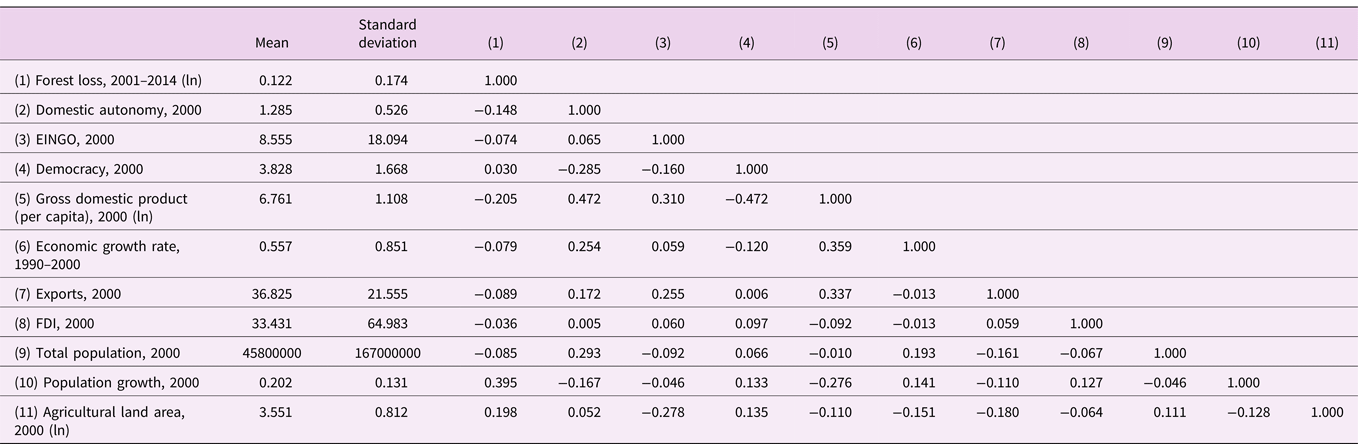
This variable uses data from the World Resources Institute (2016) to calculate the change in forest loss from 2001 to 2014 (Rudel, Reference Rudel2013)Footnote 2. To do so, I divide the provided number of hectares of forest losses in a country from 2001 to 2014 by the country's total forest size in hectares for 2000. This yields the change of forest loss over this period of time. In Table 1, I provide a bivariate correlation matrix for all the variables used in the analysis. Unless otherwise noted, all other indicators may be obtained from the World Bank (2015).
Descriptive statistics and bivariate correlation matrix for deforestation analysis (N = 91)

4.3 Main independent variables
4.3.1 Domestic autonomy
This measure represents the extent to which the state is autonomous from the control of other states with respect to the conduct of domestic policy. This measure was originally ordinal but was converted to interval level using a Bayesian item response theory measurement model (see Coppedge et al., Reference Coppedge, Gerring, Lindberg, Skaaning, Teorell, Altman and Knutsen2015; Dahlberg et al., Reference Dahlberg, Holmberg, Rothstein, Khomenko and Svensson2016). Domestic autonomy ranges from about −2 to 2, where less autonomous nations correspond with lower scores, and more autonomous nations correspond with higher scores.
According to the creators of these data (Coppedge et al., Reference Coppedge, Gerring, Lindberg, Skaaning, Teorell, Altman and Knutsen2015; Dahlberg et al., Reference Dahlberg, Holmberg, Rothstein, Khomenko and Svensson2016), non-autonomous nations are in a situation where national-level authority is exercised by an external power, either by law or in practice, or where domestic actors provide de jure cover for de facto control by a foreign power. In the sample in this analysis, some examples of nations with lower levels of autonomy include The Gambia, Central African Republic, Honduras, and Moldova. In the center of this continuum, semi-autonomous states are in a situation where external political actors directly constrain the ability of domestic actors to rule, decide who can or cannot rule through formal rules or informal understandings, or precludes certain policies through explicit treaty provisions or well-understood rules of the game from which the subject state cannot withdraw. Some nations in the middle of the sample of this variable include Bolivia, Thailand, Guyana, and Nigeria. On the far end of the continuum, in autonomous nations, domestic political actors exercise political authority free of the direct control of external political actors. Nations in the sample with high levels of autonomy include Mexico, Brazil, China, and Costa Rica. For more information on these measures, please see Dahlberg et al. (Reference Dahlberg, Holmberg, Rothstein, Khomenko and Svensson2016) and Coppedge et al. (Reference Coppedge, Gerring, Lindberg, Skaaning, Teorell, Altman and Knutsen2015). This newly available data are the best current measures for these phenomena. Independent variables are measured for the year 2000 to avoid simultaneity bias unless otherwise noted (Shandra et al., Reference Shandra, Rademacher and Coburn2016).
4.3.2 International environmental non-governmental organizations
This variable represents the number of INGOs working on environmental and animal rights issues in a nation for 2000 divided by total population. The data are collected by Smith and Wiest (Reference Smith and Wiest2005) from the Yearbook of International Associations, which is the most comprehensive annual census of international associations. According to Smith and Wiest (Reference Smith and Wiest2005), coders reviewed all entries in the Yearbook to identify INGOs that were explicitly formed to promote environmental protection and then created a matrix of all the organizations and countries. They assigned a 0 or 1 for membership, which was then aggregated to the total number of organizations active in each of the countries. Please see Smith and Wiest (Reference Smith and Wiest2005) for more details.
This measure is standardized by population to account for disparities in the sizes of nations and their populations in this analysis. While some argue that a strict, unstandardized count best represents how embedded a nation is in environmental norms because the number of organizations is not dependent on the size, resources, or population of a nation but on their conformity to the global values of environmentalism (Schofer & Hironaka, Reference Schofer and Hironaka2005; Shorette, Reference Shorette2012), the present article aligns better theoretically with those who find involvement in such organizations to also be a function of opportunity and ability (Shorette et al., Reference Shorette, Henderson, Sommer and Longhofer2017). Thus, I standardize this variable by total population following various other cross-national researchers (Givens and Jorgenson, Reference Givens and Jorgenson2013; Shandra et al., Reference Shandra, Shircliff and London2011; Sommer, Reference Sommer2018). However, I also include a model where the unstandardized version is substituted for the standardized measure (Dick, Reference Dick2010).
4.4 Control variable selection and measurement
I control for several factors consistent with previous research on forest loss: democracy, gross domestic product (GDP) (per capita), GDP growth, exports of goods and services as a percentage of GDP, FDI stocks as a percentage of GDP, total population, population growth, and agricultural land area. Democracy, GDP (per capita), exports, FDI, total population, and agricultural land area are measured for the year 2000 to avoid simultaneity bias. GDP growth and population growth represent the change in growth from 1990 to 2000 to control for economic and demographic changes that have been found to influence forest loss over the observed period in this study (i.e. 2001–2014).
4.4.1 Democracy
I use the average of Freedom House (2005) political rights and civil liberties scales to measure democracy within a nation. The political rights scale reflects whether a nation is governed by democratically elected representatives and has fair, open, and inclusive elections. The civil liberties measure reflects whether a nation has freedom of press, freedom of assembly, general personal freedom, freedom of private organizations, and freedom of private property. The variables have the following coding: free (1–2), partially free (3–5), and not free (6–7). While some argue democracy should reduce forest loss because it will be accountable to the interests of its citizens (Li & Reuveny, Reference Li and Reuveny2006; Marquart-Pyatt, Reference Marquart-Pyatt2004; Obydenkova et al., Reference Obydenkova, Nazarov and Salahodjaev2016; Ross, Reference Ross2001); others argue that democracies may be more partial to companies than environmentalists, and focus more on economic concerns of its citizenry than environmental ones (Kashwan, Reference Kashwan2017; Midlarsky, Reference Midlarsky1998). From these conflicting arguments, I expect democracy to have no impact on forest loss.
4.4.2 Gross domestic product
I control the level of economic development by including GDP per capita (current US dollars) for 2000 in the models. According to Burns et al. (Reference Burns, Davis, Jorgenson and Kick2001), economic development should be associated with lower levels of deforestation because more rich nations tend to import natural resources from poorer nations to avoid internal environmental damage.
4.4.3 Economic growth
This variable represents the percentage change of economic growth from 1990 to 2000. I expect that higher levels of economic growth should be associated with more forest loss because industrialization is often accompanied by activities that speed up forest loss, such as extractive activities (Jorgenson, Reference Jorgenson2006).
4.4.4 Exports
I also include goods and services exports as a percentage of GDP in the models. Previous research suggests that exports should increase forest loss due to the need to clear forests for raw materials or space for activities linked to the types of industrialization that drive goods and services exports such as agriculture, roads, mines, and factories (Jorgenson, Reference Jorgenson2006).Footnote 3
4.4.5 FDI
This variable measures FDI stocks in each nation standardized by a nation's GDP (United Nations, 2000). Higher levels of FDI should be associated with increased forest loss because foreign investment tends to influence receiving nations policies, often resulting in financial incentives (e.g. tax breaks) and regulatory concessions (e.g. environmental law exemptions) that make extraction of natural resources more profitable for investing and exporting nations (Jorgenson, Reference Jorgenson2008; London & Ross, Reference London and Ross1995; Shandra et al., Reference Shandra, Shircliff and London2011).
4.4.6 Total population size and growth
I include a country's total population size in millions in the models for the year 2000. Higher levels of population size should correspond with increased forest loss, because larger populations place greater pressures on forests in terms of production and consumption-related activities (York et al., Reference York, Rosa and Dietz2003). I also include the average annual percentage change in total population growth from 1990 to 2000. Rudel (Reference Rudel1989) suggests that ‘geometric’ growth in population outstrips ‘arithmetic’ growth in the means of subsistence, leading to ‘carrying capacity’ problems (e.g. forest loss). I also expect that higher rates of population growth correspond with more forest loss.
4.4.7 Agricultural land area
This variable captures the percentage of land that has crops and pastures for the year 2000 (World Bank, 2015). Higher percentages of agricultural land area should be associated with increased forest loss due to the clearing of forests for crops (Rudel, Reference Rudel1989).
5. Findings
Table 2 presents the OLS estimates for forest loss from 2001 to 2014. Two-tailed significance tests are reported. Model 1 contains the linear effects of forest loss. The next four models contain the interaction term with the control variables added step by step in each additional model. Model 2 only contains the main effects and interaction terms between EINGOs and domestic autonomy. Model 3 adds democracy, GDP, and GDP growth; model 4 adds exports and FDI; and model 5 adds total population, population growth, and agricultural land area. Model 6 removes all nations that have a population of less than 1 million, and model 7 includes the unstandardized version of the EINGO measure.
Ordinary least squares regression estimates of corruption on Forest Loss, 2001–2014

The first number is the unstandardized coefficient, the second number is the standardized coefficient, and the third number in parentheses is the robust standard error.
*p < 0.05, **p < 0.01, and ***p < 0.001 for a one-tailed test.
In model 1, the coefficients that represent domestic autonomy and EINGOs fail to reach the levels of statistical significance. This is surprising given previous literature and theory. However, as suggested, perhaps there is a moderating effect of domestic autonomy on EINGOs effectiveness at decreasing forest loss.
In model 2, the coefficients that represent the interaction term between EINGOs and domestic autonomy is negative and statistically significant. The interaction term remains significant as each new set of control variables are added, and even when nations with a population of less than 1 million are dropped from the analysis. However, model 7 reveals that the interaction replacing EINGOs per capita with a total count of EINGOs fails to reach the levels of statistical significance. I discuss this in detail in the discussion and conclusion section.
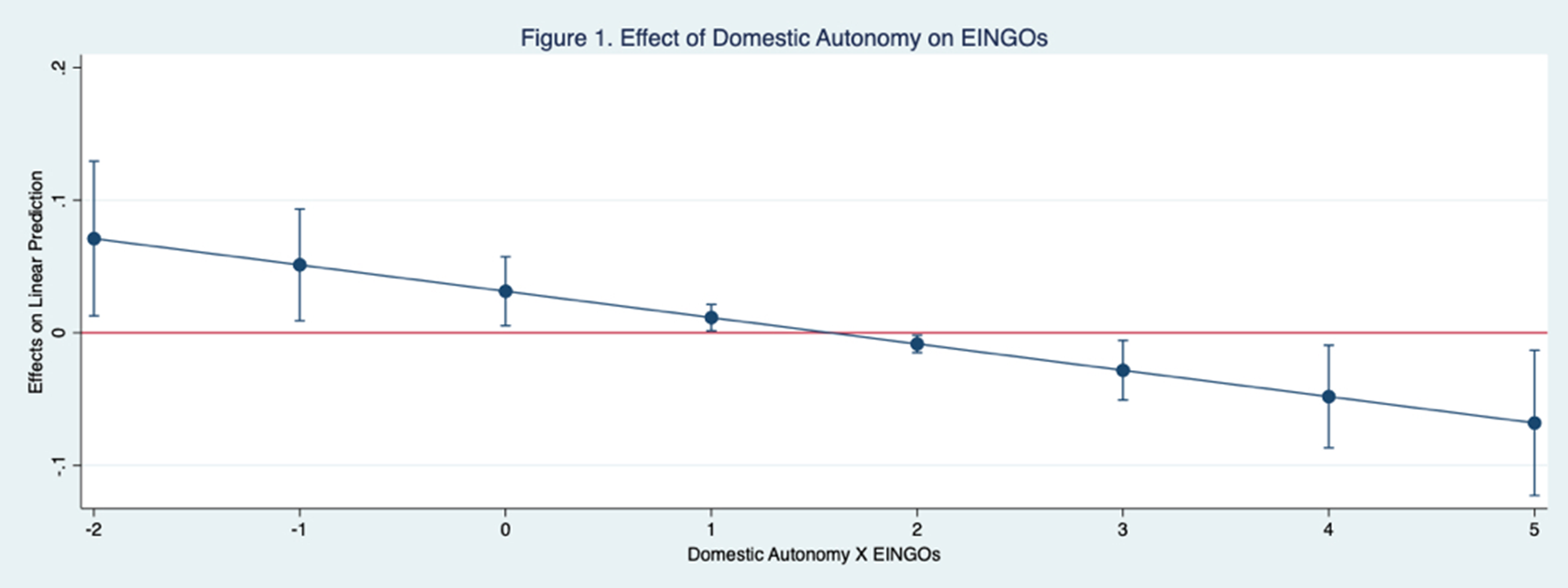
The calculated effects of the interaction between EINGOs and domestic autonomy relationships (see Figure 1) illustrate that EINGOs have differential effects on forest loss at different levels of domestic autonomy. In this figure, I use the coefficients from model 5 to graph the change in EINGOs as domestic autonomy simultaneously increases, holding all continuous covariates at their mean. I find that the calculated effect of EINGOs on forest loss is relatively low when domestic autonomy is low. This indicates that when EINGOs and domestic autonomy are low, there are higher levels of forest loss. However, initial increases in domestic autonomy result in an incline in the effect of EINGOs, supporting the hypotheses of this study. As domestic autonomy increases, the impact of EINGOs on forest loss steadily declines (as indicated by the downward sloping line). EINGOs are significantly associated with reduced forest loss in nations with higher levels of domestic autonomy.
Predicted effects of domestic autonomy and EINGOs on forest loss.
Moving to the control variables, GDP is associated with lower levels of forest loss until the demographic variables are added in model 5. Model 5 shows that population growth and agricultural land area are associated with higher levels of forest loss. Higher levels of population growth should yield higher levels of forest loss because of decreased resource availability (Jorgenson, Reference Jorgenson2006). Expansion of agricultural land may also increase forest loss due to the clearing of forest to make room for more crops (Rudel, Reference Rudel2013; Shandra et al., Reference Shandra, Rademacher and Coburn2016). This finding suggests that demographic factors may be a more important predictor of forest loss than GDP per capita. Other variables, including democracy, economic growth, exports, FDI, and total population fail to reach the levels of statistical significance in every equation.
6. Discussion and conclusion
I began this article by noting that many researchers in the world society tradition are concerned with decoupling between a nation's stated values and their outcomes. While previous research has aimed to explain this disconnection by incorporating ideas from world-systems and dependency theory perspectives (Mejia, Reference Mejia2020; Shorette, Reference Shorette2012; Sommer et al., Reference Sommer, Restivo and Shandra2020), few studies consider how the state may increase the effectiveness of EINGO activities in reducing forest loss. Building on this research, I argue that host nations of EINGOs that have stronger political authority, free of the direct control of external political actors, should be better able to ensure that the activities of member EINGOs align with the environmental goals of their populations and are not undermined by other activities, both external and internal, that tend to increase forest loss (Chibber, Reference Chibber2003; Evans & Rauch, Reference Evans and Rauch1999; Evans et al., Reference Evans, Rueschemeyer and Skocpol1985).
To test these claims, I used improved and newly available forest loss data from 2001 to 2014 to analyze if the domestic autonomy of a nation, or the extent to which the state is autonomous from the control of other states with respect to the conduct of domestic policy, increases the effectiveness of EINGOs at reducing forest loss. This argument rests on the assumption that nations with stronger political authority, free of the direct control of external political actors should be better able to integrate their version of environmentalism into EINGO activities compared to nations with less control.
Converging with previous research on decoupling, I find that there is a disconnect between stated values of nations and their outcomes (Meyer et al., Reference Meyer, Boli, Thomas and Ramirez1997; Schofer & Hironaka, Reference Schofer and Hironaka2005; Shorette, Reference Shorette2012). Specifically, my findings that EINGOs alone do not relate to forest loss converge with recent studies on forest loss (Restivo et al., Reference Restivo, Shandra and Sommer2018; Shandra et al., Reference Shandra, Restivo and Sommer2019). Though my findings diverge from several studies that find that embeddedness in the global environmental regime alone is associated with environmental outcomes other than forest loss (Hargrove et al., Reference Hargrove, Qandeel and Sommer2019; Mejia, Reference Mejia2020; Schofer & Hironaka, Reference Schofer and Hironaka2005; Shandra, Reference Shandra2007; Shorette, Reference Shorette2012). Taken together, these findings shed considerable doubt on the effectiveness of EINGOs at reducing forest loss in line with some previous research (Restivo et al., Reference Restivo, Shandra and Sommer2018; Shandra et al., Reference Shandra, Restivo and Sommer2019), and align with arguments critiquing the normative decoupling as well as the lack of grounding and relative power of EINGOs (Shorette, Reference Shorette2012).
Moreover, the non-significant impact of domestic autonomy is also concerning given the traditional and widely held Weberian perspectives of the authority and control of the state to meet its goals (Polanyi, Reference Polanyi1957; Skocpol, Reference Skocpol1985; Weber, Reference Weber1978). However, I find that the interaction between EINGOs and domestic autonomy has a negative and significant impact on forest loss, supporting the hypothesis of this article. These findings lend support to arguments concerning the decoupling between environmental promises and outcomes from previous research (Frank et al., Reference Frank, Hironaka and Schofer2000; Shorette, Reference Shorette2012).
Theoretically similar to Shorette (Reference Shorette2012), I find that EINGOs have differential impacts on environmental outcomes, and, as she theorized, that internal conditions of the state may explain these outcomes. Moreover, my findings also support Mejia's (Reference Mejia2020) work on air pollution, in that there may be something about more powerful nations that helps predict compliance to environmental norms. Furthermore, the present analysis supports the conclusions in Hargrove et al. (Reference Hargrove, Qandeel and Sommer2019) that internal state factors can moderate the impact of norms on environmental outcomes.
Another important finding of this article is that EINGOs as a discrete count, not standardized by population, does not result in a statistically significant interaction. Theoretically, this could mean the sheer number of EINGOs does not result in the same impact as the actual spread of EINGOs per person, suggesting that wider coverage rather than more EINGOs interact with domestic autonomy to impact forest loss. In some ways, this provides support that the material actions of EINGOs rather than the norms they spread are more central to the interpretation of the current analysis.
Going forward, world society and global political ecology theorists may benefit from integrating state perspectives in their analyses, which is what I have tried to do here. Consequently, global theorists may find that incorporating statist arguments, in addition to already held perspectives may provide a more holistic understanding of cross-national trends. The process of theoretical integration seems key to disembarking from one-sided or contradictory explanations (London, Reference London1987).
Despite the implications of this study, there are several ways future research may be improved. The first concerns the dependent variable of forest loss. Although the forest loss data used in this study provides clear and improved estimates from previous analyses, the data are not appropriate for panel analyses. Therefore, it may serve researchers to try to replicate these findings with improved forest loss data in the future. Moreover, although the domestic autonomy measure represents a novel and theoretically important measurement of state ability, it is still an imperfect proxy that can also be improved upon. Other avenues for future research may include understanding how autonomy influences other environmental outcomes to see if findings diverge from those indicated in this study.
Nonetheless, the findings of this study raise fundamental questions about relationships between the state, EINGO activities, and forest loss. This research concerns the importance of integrating how the autonomy of the state may interact with external factors that influence a nation's environmental outcomes. In sum, the dynamics of environmental ideologies, organizations, and the role of the state are complexly interwoven and demand theoretical integration (London & Williams, Reference London and Williams1988).
Acknowledgements
Thank you to John Shandra, Kathleen Fallon, and Andrew Hargrove who have given support and advice for this article.
Conflict of interest
None.
Jamie M Sommer is an Assistant Professor of Sociology at the University of South Florida, Tampa (USF). Her research and teaching interests broadly include environment, development, globalization, and political sociology.


 Open access

