






 Open access

Crossref Citations

This article has been cited by the following publications. This list is generated based on data provided by Crossref.
Makaremi, Shima
Asgarzadeh, Ali
Kianfar, Hamed
Mohammadnia, Alireza
Asghariazar, Vahid
and
Safarzadeh, Elham
2022.
The role of IL-1 family of cytokines and receptors in pathogenesis of COVID-19.
Inflammation Research,
Vol. 71,
Issue. 7-8,
p.
923.
Mertaniasih, Ni Made
Soedarsono, Soedarsono
Pakasi, Tiffany Tiara
Nuha, Zakiyathun
and
Ato, Manabu
2022.
Proposed Algorithm for Integrated Management of TB-SARS-CoV-2 Co-Infection in a TB-Endemic Country.
Tropical Medicine and Infectious Disease,
Vol. 7,
Issue. 11,
p.
367.
Kim, Boyeon
Kang, Young Ae
and
Lee, Jeehyun
2022.
Heterogeneous impact of Covid-19 response on tuberculosis burden by age group.
Scientific Reports,
Vol. 12,
Issue. 1,
Mihika, Fariha Alam
Jubayer Biswas, Md Abdullah Al
Khan, Md Maruf Haque
Islam, Syed Shariful
Haque, M. Atiqul
Banu, Sayera
and
Hassan, Md Zakiul
2022.
The Effect of the COVID-19 Pandemic on Pulmonary Tuberculosis Control in the Selected Upazila Health Complexes of Dhaka Division, Bangladesh.
Tropical Medicine and Infectious Disease,
Vol. 7,
Issue. 11,
p.
385.
Missaghi, Bayan
Malik, Muhammad Wasif
Shaukat, Waseem
Ranjha, Muazam Abbas
Ikram, Aamer
and
Barkema, Herman W.
2022.
Associations of the COVID-19 pandemic with the reported incidence of important endemic infectious disease agents and syndromes in Pakistan.
BMC Infectious Diseases,
Vol. 22,
Issue. 1,
Piracha, Zahra Zahid
Ali, Haider
Rasheed, Noor ul Huda
Saeed, Umar
Gilani, Syed Shayan
Abbasi, Umer Ali
Khan, Qasim
Noor, Elyeen
and
Noor, Seneen
2023.
Monkeypox Virus, A Global Public Health Concern and Challenge for Low-income Countries including Pakistan: A Right Time to Nip the Evil in the Bud.
International Journal of Clinical Virology,
Vol. 7,
Issue. 2,
p.
014.
Khatri, Govinda
Rai, Aneesh
Aashish
Shahzaib
Hyder, Saqlain
Priya
and
Hasan, Mohammad Mehedi
2023.
Epidemic of lumpy skin disease in Pakistan.
Veterinary Medicine and Science,
Vol. 9,
Issue. 2,
p.
982.
Shaikh, Ghulam Abbas
Yaqoob, Samina
Batool, Fareeha
Waseem, Radeyah
Shah, Hussain Haider
Abbasi, Asim Ali
Lashari, Nawaz
and
Dave, Tirth
2023.
A rare case of tuberculous myocarditis: A diagnostic challenge in a tuberculosis‐endemic country.
Clinical Case Reports,
Vol. 11,
Issue. 11,
Marco, Michael H.
Ahmedov, Sevim
Castro, Kenneth G.
and
Krishnasastry, Suma
2024.
The global impact of COVID-19 on tuberculosis: A thematic scoping review, 2020–2023.
PLOS Global Public Health,
Vol. 4,
Issue. 7,
p.
e0003043.
Bowen, Whitney
Tri, Ho
Romero, Sebastian
Shaheen, Roaa
Kipngetich, Victoria
McGowan, Nick
Moon, Sungho
Bhattacharya, Esha
Hecht, Robert
Soe-Lin, Shan
Collins, Chris
and
Ravi, Sanjana J.
2024.
Leveraging tuberculosis programs for future pandemic preparedness: A retrospective look on COVID-19.
PLOS Global Public Health,
Vol. 4,
Issue. 9,
p.
e0003454.
Zarzeczny, Angelina
and
Kahar, Payal
2024.
Vaccine Trends in Pakistan: A Review of Immunization Challenges and Setbacks Prompted by Inadequate Disaster Management.
Cureus,
Chan, Suryanti
Ahmed, Idris Adewale
and
Hamzah, Hamzah
2025.
Sustainable Development Goals (SDG) and Its Intersection With Health and Well-Being.
p.
91.
Bereda, Gudisa
2025.
Dual Burden of MDR‐TB and COVID‐19 in a Previously Treated Tuberculosis Case: Diagnostic and Therapeutic Dilemmas.
Clinical Case Reports,
Vol. 13,
Issue. 3,
Introduction
Mycobacterium tuberculosis is responsible to cause tuberculosis (TB), a granulomatous disease that mainly affects the lungs and may disseminate to other organs such as the brain and cervical vertebra. Spinal TB (Pott's disease) is the most prevalent and one of the deadliest types of skeletal TB, accounting for 50% of all cases. Although the thoracolumbar junction appears to be the most commonly involved location in spinal TB, any portion of the spine might be impacted [Reference Rasouli1]. It spreads mainly through an airborne medium. Symptoms include fever, night sweats, chest pain, weight loss and severe cough with phlegm and may show up with haemoptysis. It has a high mortality rate after HIV infection, and therefore, poses a severe public health hazard [Reference Fogel2, Reference Islam3]. According to the World Health Organization (WHO), the highest number of TB incidents in 2019 was reported, including 44% of emerging new cases from South-East Asia [4]. Pakistan is one of the eight countries with two-third of current emerging TB cases. Globally, 30 countries with an ample burden of TB accounted for 87% of new cases in 2019. With 216 population, Pakistan is amongst some most populous countries with a 2.04% rise in statistics since 1995, it has shown a significant demand for health care systems to cater to a large population. The low-middle income status of Pakistan which is accompanied by a shortage of medical resources and lack of trained medical staff significantly creates a hindrance to access quality health benefits [Reference Awan5]. Amongst 195 countries globally, Pakistan ranks in the 154th position to access quality health facilities. The quality health infrastructure deficit is significantly explicit. Pakistan hosts a variety of communicable and non-communicable diseases that place its population at high risk of HIV, polio, dengue, malaria and TB [Reference Hussain and Arif6, Reference Yousaf7]. Recently, the state's healthcare system has had to deal with a rise in the incidence of fungal diseases, particularly cutaneous mucormycosis [Reference Asri8, Reference Ghazi9]. Aside from that, dengue fever and measles have been shown to be on the rise [Reference Yousaf7]. A total of 4000 cases of mortality are observed each day globally due to TB infectious disease. The therapy to curb the disease is indeed an obstacle in low- and middle-income countries (LMICs). According to the studies, the south Asia inclusive of, Pakistan records a decline of 80% in diagnosis and testing, while a 75–80% decrement descried for the notification of new TB cases during the span of the COVID-19 pandemic. Furthermore, a 66.8% decline in routine Bacille Calmette-Guérin (BCG) vaccination enunciated during the catastrophic ongoing COVID-19 pandemic [Reference Malik10]. Moreover, the resources to eliminate TB consumed for COVID-19, including National TB Programme (NTP) workers, TB isolation wards, TB testing centres and physicians to direct the attention and resources for COVID-19 emergencies, hence majorly disrupting the management of TB at the national level [Reference Malik10]. The objective of this article is to highlight the rampant challenges faced during the TB management and catastrophic health crisis in one of the high TB burden countries, Pakistan, during the extant pandemic; and furthermore, suggestions and importance of TB health surveillance infrastructure of Pakistan to overcome the challenges.
Burden and current status of TB in Pakistan during COVID-19 pandemic
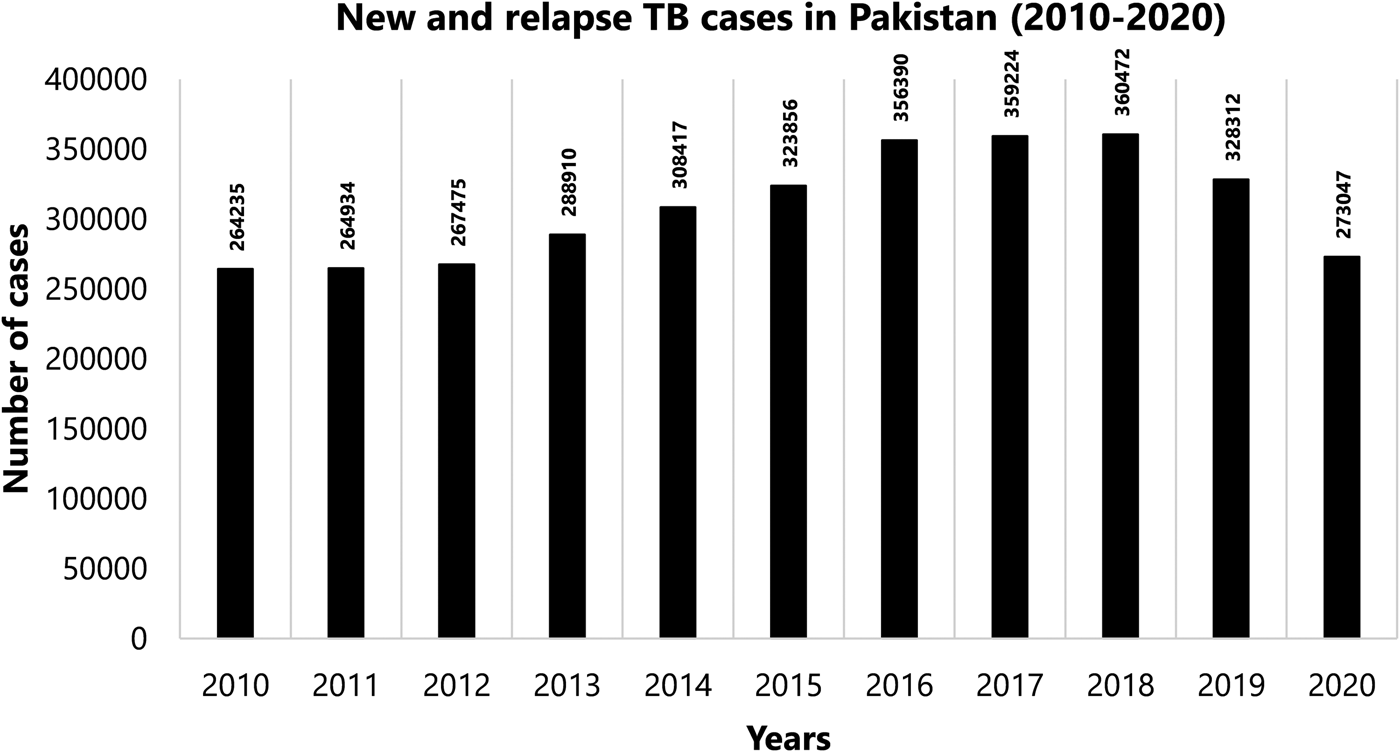
TB has long remained endemic in Pakistan. The WHO estimates over half a million incident TB cases every year in the country with an increasing proportion of drug-resistant cases [11]. The origin of nearly 61% TB cases in the Eastern Mediterranean WHO region is Pakistan, making it one of the leading contributors to the overall global TB burden [11]. According to WHO's Global Health Observatory, during the last decade, the number of new and relapse TB cases in Pakistan has remained relatively stable, with an average of over 312 222 cases per year (Fig. 1) [12]. However, a notable drop in 2020 was recorded [12, 13]. Latest provisional data from the WHO show 74 951 cases in the first quarter of 2021 [13].
Fig. 1. Trend of TB cases in Pakistan (2010–2020).
Since late February 2020 till October 2021, Pakistan has battled multiple surges (or ‘waves’) of the COVID-19 pandemic and reported a cumulative total of nearly 1.25 million COVID-19 cases [Reference Dong, Du and Gardner14]. The coexistence of endemic diseases in LMICs like Pakistan with a global pandemic can prove to be a catastrophe of unprecedented proportions. The modes of transmission of TB and COVID-19 are distinct. While COVID-19 spreads predominantly through direct breathing and touching of objects on which droplets land when discharged by somebody with the illness during exhaling, sneezing, coughing and speaking, TB spreads through inhalation of TB bacilli that keep suspended in the air in droplet nuclei for many hours. Thus, in addition to handwashing, respiratory measures such as a face mask and social distance can have a discernible influence on global TB incidence during the present COVID-19 pandemic. Despite the COVID-19 safeguards, more people died from TB in 2020, with much fewer individuals detected, treated or given TB preventive medication than in 2019, and total spending on critical TB treatments dropping. The first issue is a loss of resources and a disruption in access to TB treatment. Many countries have diverted human, financial and other resources from TB control to the COVID-19 response, decreasing the availability of critical services. The second concern has been that some people have had difficulty obtaining medical assistance during lockdowns [15]. The acute burden and overwhelming nature of the COVID-19 crisis has invariably led to shifting of priorities and resources of already-underequipped and fragile healthcare infrastructure in many countries including Pakistan from other deadly diseases like TB [Reference Malik10, Reference Roberts16]. Pakistan's NTP also converted some laboratories dedicated to TB into additional COVID-19 testing centres [17]. In addition, a drop in TB cases during COVID-19 pandemic is not limited to Pakistan [Reference Hussain and Arif6, Reference Asri8]. Pakistan's neighbour, India, showed plummeting TB cases in the early days of the pandemic and a 21% decline from 2019 was reported worldwide in 2020 [Reference Malik10, Reference Bardhan18]. Government-mandated lockdowns, disruption of routine out-patient services, rerouting of TB-specific facilities and fear of visiting hospitals all contributed to impaired case-detection of TB, letting multiple cases go undiagnosed [Reference Malik10, Reference Bardhan18, Reference Khan19]. Furthermore, due to COVID-19, stigma associated with respiratory diseases will potentially cause further isolation and refusal to report in many patients [Reference Fatima and Yaqoob20, Reference Islam21]. In India, reviews have suggested widespread disruptions to surveillance, prevention and management of TB patients at all levels [Reference Jain22]. Importantly, studies with mathematical models focusing on countries with a high TB burden have predicted an 8–14% increase in TB-related deaths regardless of social distancing and a net increase in TB deaths is expected in all scenarios with any level of disruption in treatment provision [Reference Finn McQuaid23].
The coincidence of COVID-19 and TB in Pakistan has presented a challenge to clinicians. Infection control and correct identification of the diseases are both of paramount importance. COVID-19 and TB are both predominantly pulmonary diseases [4]. The shared features in clinical presentation, such as cough, fever or shortness of breath, present a challenge to healthcare workers to adequately evaluate the condition and prevent the spread of both deadly diseases [Reference Fatima and Yaqoob20]. The mode of transmission of both diseases is extremely similar and explosive spread is possible in close contact and overcrowded settings [Reference Fogel2, Reference Awan5]. NTP in Pakistan has released extensive guidelines on outpatient evaluation of a patient presenting with symptoms that may overlap between COVID-19 and TB as it is highly likely for both patients to report to the same department [4, 17].
Challenges and efforts
Although the WHO Directly Observed Treatment Short-course (DOTS) approach for TB was implemented and piloted in Pakistan from 1995 onwards, and the NTP achieved diverse success in managing TB cases for many years, in 2020 WHO asserted another public health emergency, COVID-19, which, alongside its potentially disastrous symptoms, impacted millions of individuals and became a burden on the public and health ministries.
Pakistan, as a low-middle-income nation with an underdeveloped healthcare system, a continual scarcity of medical personnel, rising medical expenditures, a lack of medical equipment and severe budgetary restrictions, is unable to combat the COVID-19 and TB co-epidemics [Reference Awan5]. Because of some overlapping symptoms between TB and COVID-19, misdiagnosis of TB occurs frequently, which contributes to the increased prognosis of TB cases; correspondingly, TB health services have decreased significantly due to a shortage of health care workers and hospitals as a result of the COVID-19 pandemic. Increasing patients' knowledge of clinical presentation, transmission and control methods of TB could lead to a significant decrease in disease prevalence, but a nationwide study found that the Pakistani population has insufficient knowledge of symptomatology, transmission, diagnosis and treatment of TB, as well as disease-related misapprehensions [Reference Sara Ijaz Gilani24]. According to a qualitative study regarding the challenges faced by general practitioners (GP) in Pakistan, the significant proportion of GP were not aware of the appropriate sputum collection and how to consult a patient, the majority of GP were not aware of screening recommendations, they were not completely conscious of the definition of MDR-TB, the most of GP were thwarted when asked about management of TB in pregnant or lactating women, non-availability of tests were identified by some GPs, and none of the GP maintained a TB register for their patient [Reference Saima Perwaiz Iqbal25]. As a result, the infrastructure of the healthcare system, as well as an absence of adequate expertise, poses a significant danger to Pakistan.
In Pakistan, the BCG vaccination is administered at birth to protect against TB. Some chemotherapy medicines used in Pakistan include isoniazid, rifampicin, pyrazinamide, ethambutol and streptomycin. A doctor's physical examination, laboratory investigation of the sputum, a chest X-ray, a blood test and an examination of fluid extracted from a lump are all used to diagnose TB [Reference Sara Ijaz Gilani24]. Pakistan employs a Directly Observed Treatment method; according to WHO, it is a short course of therapy for TB and consists of identifying patients, treating them with medicines for 6–8 months and fostering adherence to a notoriously tough treatment regimen. Pakistan follows NTP in operation to diagnose, treat and prevent the spread of TB [17].
Public health impact
Over the course of a year, persons with active TB can infect 5–15 other people through intimate contact. Without adequate treatment, 45% of HIV-negative TB patients and virtually all HIV-positive TB patients would die [4]. As drug resistance grows, the options available to tackle it become fewer and fewer. Unfortunately, complacency in the face of TB is also the reason that few novel therapies are being discovered. Unlike therapy for drug-sensitive TB, which is nearly always 100% successful when done correctly, treating drug-resistant TB is significantly more challenging. Treatment for severely drug-resistant TB can take up to 2 years and includes a cocktail of progressively unpleasant medicines with side effects ranging from nausea to irreversible hearing loss. When it comes to health-related quality of life in persons with TB, it was discovered that it is much poorer than in those without TB [Reference Wong26].
Action plans
The strategies to tackle this threat involve:
(1) Allowing a convenient and close provision of healthcare services to the people
This can be achieved by delivering medicines at their doorsteps and for longer duration and free of cost, or building community medicine collection points for providing medicines [Reference Jamal27, Reference Fatima28]. This would reduce the number of visits and risk of exposure. Younger attendants (below 50 years of age) could on behalf of their patients collect the medicines and shifts could be arranged with four visitors at the maximum to minimise the exposure. Telemedicine services that encourage compliance to medication, act as a means to tackle any emergencies such as an adverse reaction and are a source of counselling should be introduced [Reference Farooqi29]. Establishing a link between private healthcare professionals (HCP) and the Pakistan NTP, strengthening treatment and reporting of TB patients, and improving TB screening, including simultaneous screening for TB and COVID-19 in patients with cough and fever, could help us deal with two problems at the same time. A door-to-door collection of sputum can improve TB screening.
(2) Empowering the primary care setup
By training the HCPs regarding infection and prevention control measures and correct use of personal protective equipment [Reference Fatima28]. The diagnostic and treatment centres for TB should be built and maintained according to airborne infection control standards that include large open fronts, exhausts for ventilation and air circulation, ultraviolet germicidal irradiation lights and designated sputum expectoration areas [Reference Jamal27]. To reduce the risk of COVID spread, staff should be rotated in shifts, working hours should be reduced, N-95 masks for staff and surgical masks for visitors should be provided, physical separation in waiting areas should be ensured, easy access to disinfectants should be provided and regular hand washing practises should be implemented. The use of electronic medical records to track diagnostic tests and therapy should be encouraged.
(3) Managing the stigma and fears
TB patients may be prone to stigma due to the similar nature of symptoms with COVID-19. TB is termed as a ‘great imitator’ due to its initial presentation with fever and respiratory symptoms [Reference Sarinoglu30] and many patients have been treated for COVID-19 despite a negative rt-PCR result until a sputum test confirmed TB. Thus, it is important to rightly introduce TB interventions in the communities by using the help and expertise of lady health workers (LHWS) especially at rural level [Reference Fatima28]. To avoid the spread of misconceptions about COVID-19 and TB, people should be taught about both through awareness campaigns and at congregational locations, and this community-level education encourages a person-centred approach to TB prevention.
As per precedent of SARS-CoV-2 and M. tuberculosis coexisting, there is a reasonable threat that TB and COVID-19 may coexist [Reference Bandyopadhyay31]. Evidence from various countries including Italy has been reported to show varying clinical presentations of a COVID-19 and TB infection co-occurring in individuals [Reference Tadolini32–Reference Kozinska34]. Also, due to the threat of TB or COVID-19 being misdiagnosed as the other, it is critical to screen and test for both disorders [Reference Sarinoglu30]. As WHO recommends for multi-disease testing, an integrated method might be utilised to identify and isolate both infections. Finally, in order to prevent paediatric TB, it is critical to guarantee the unhindered delivery of the only TB vaccination, the BCG vaccine.
Conclusion
The COVID-19 pandemic has presented a great challenge globally. Developing countries such as Pakistan have always been in a struggle to fight infectious diseases such as polio and TB. Amidst the ongoing battle against preexisting infectious diseases, this new infection could reduce the attention necessary for them and present with certain challenges like reduction in TB services due to lockdown and social distancing measures, which would automatically affect the screening, diagnosis and treatment of TB. Thus, in order to control the spread of these infectious diseases, it is crucial to identify and address these challenges by first allowing an easy access to healthcare facilities such as delivering TB medicines for long periods at door steps of patients or setting up collection points for them, by creating telemedicine services; second by strengthening the healthcare system to rightfully fight the infections simultaneously; and last, by addressing the stigma through awareness campaigns and educating people. Although it may seem daunting, a correct and collective approach with a correct mindset along with the aforementioned actions if taken can combat with the two diseases simultaneously and thus, prevent a major havoc to the healthcare system of Pakistan.
Financial support
None.
Conflict of interest
None.
Ethical standards
Not applicable.
Consent for publication
Not applicable.
Data availability statement
Data sharing is not applicable to this article as no new data were created or analysed in this study.