

More than 10 000 ectopic pregnancies are diagnosed annually in the United Kingdom [Reference Lewis1]. Although women may still present with the classic triad of symptoms – pain, vaginal bleeding and a period of amenorrhea, more women are now asymptomatic at the time of diagnosis. This has led to changes in the diagnosis and management of ectopic pregnancy in recent years. Historically, ectopic pregnancies were diagnosed and managed surgically in symptomatic women. The majority of ectopic pregnancies are now diagnosed nonsurgically often in asymptomatic women, with the majority visualized on ultrasound prior to treatment. Management has also changed to reflect this, with expectant and medical management now recognizing alternatives to surgical management in appropriately selected women.
Pregnancy of unknown location (PUL) is a descriptive term used to classify a pregnancy when a transvaginal ultrasound examination (TVS) has shown no sign of either a normally sited pregnancy or an ectopic pregnancy. A small proportion of women classified with a PUL have an underlying ectopic pregnancy.
Risk Factors
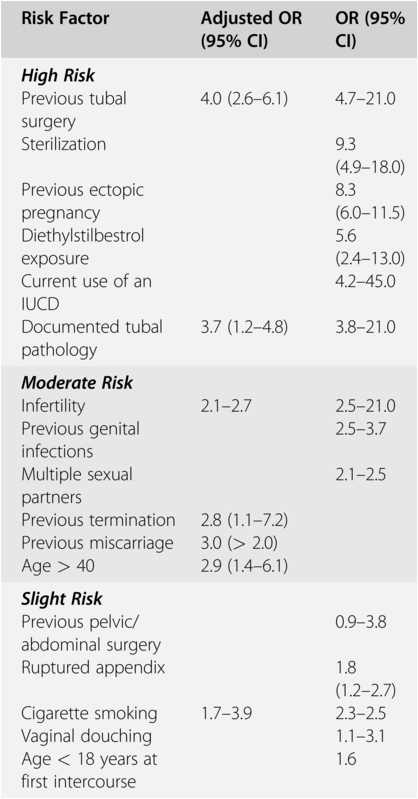
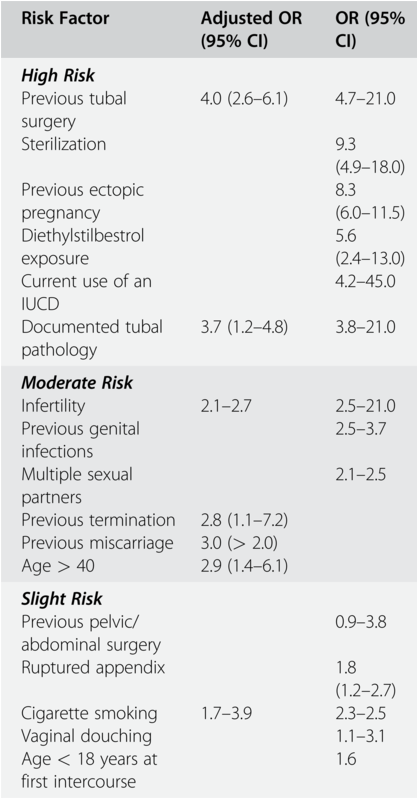
A number of risk factors have been identified for ectopic pregnancy. These are detailed in Table 18.1. It is thought that a third of cases are caused by tubal infection or previous surgery [Reference Ankum, Mol, Van der Veen and Bossuyt2]. The most common pathogen is Chlamydia trachomatis, although other organisms such as Neisseria gonorrhoeae may be responsible. Another third of cases are associated with smoking [Reference Ankum, Mol, Van der Veen and Bossuyt2]. The exact mechanism whereby smoking has an effect is unknown but may include a combination of delayed ovulation, altered tubal and uterine motility and altered immunity. The risk of ectopic pregnancy also increases with advancing age [Reference Bouyer, Coste, Fernandez, Pouly and Job-Spira3]; this may be a reflection of a higher probability of exposure to most risk factors, an increase in chromosomal abnormalities in trophoblastic tissue and age-related changes in tubal function delaying ovum transport and resulting in tubal implantation.
Diagnosis
Surgical Diagnosis
Historically, ectopic pregnancies were diagnosed at the time of surgery, and today some are still not diagnosed until a laparoscopy or laparotomy has been performed. Macroscopically there may be hemoperitoneum, with a distended fallopian tube. Microscopically there will be chorionic villi within the tube. There may also be signs of rupture of the tube. However, although laparoscopy or laparotomy is thought to be the gold standard for diagnosis, not all ectopic pregnancies will be diagnosed at the time of surgery. Some may initially be missed due to their small size or anatomical location. In one study, 4.5% (2 out of 44) of women were subsequently diagnosed with an ectopic pregnancy following a negative laparoscopy [Reference Li, Tristram, Hill and Cooke4]. Another study reported a 3–4% false negative rate and a 5% false positive rate associated with laparoscopy [Reference Atri, Leduc, Gillett, Bret, Reinhold and Kintzen5]. Histological confirmation may also not be possible due to a failure to obtain any tissue.
Ultrasound Diagnosis
Transvaginal ultrasound examination has now become the diagnostic technique of choice for tubal ectopic pregnancy. It is used to diagnose a tubal ectopic pregnancy by positively visualizing an extrauterine pregnancy. Using transabdominal ultrasonography (TAS), a normally sited sac can be visualized when the serum human chorionic gonadotrophin (hCG) is greater than 6500 U/L [Reference Romero, Kadar, Jeanty, Copel, Chervanak and DeCherney6]. However, with TVS, a normally sited sac should be visualized with serum hCG levels as low as 1000 U/L [Reference Aleem, DeFazio and Gintautas7]. A number of studies have assessed the performance of TVS for the diagnosis of ectopic pregnancy. Transvaginal ultrasound examination has been shown to have an overall sensitivity of 87.0–99.0% for the detection of ectopic pregnancy [Reference Braffman, Coleman, Ramchandani, Arger, Nodine and Dinsmore8, Reference Shalev, Yarom, Bustan, Weiner and Ben-Shlomo9, Reference Atri, Valenti, Bret and Gillett10, Reference Condous, Okaro, Khalid, Lu, Van Huffel and Timmerman11]. However, results must be interpreted with caution as the diagnostic ultrasound examinations reported in these studies were often performed immediately prior to surgery and were not the only ultrasound examinations performed. It has been shown that it should be possible to diagnose nearly 75% of ectopic pregnancies on the initial TVS examination performed at the time a patient first attends the clinic [Reference Kirk, Papageorghiou, Condous, Tan, Bora and Bourne12]. The other cases may initially be classified as a PUL, and the majority of those with an ectopic pregnancy will have them visualized on subsequent ultrasound examinations. The reason why some ectopic pregnancies are missed on the initial TVS has been studied. It would appear that these ectopic pregnancies are just too small and too early in the disease process to be seen on the initial TVS [Reference Kirk, Daemen, Papageorghiou, Bottomley, Condus and De Moor13]. In this study, at the time of the initial TVS, women with ectopic pregnancies classified as a PUL had a significantly lower reported mean gestational age and mean serum hCG levels compared to those women who had their ectopic pregnancies visualized on the initial TVS [Reference Kirk, Daemen, Papageorghiou, Bottomley, Condus and De Moor13].
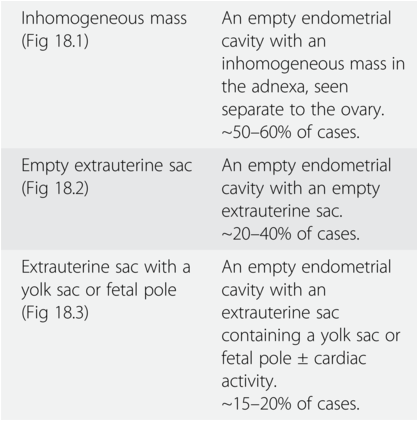
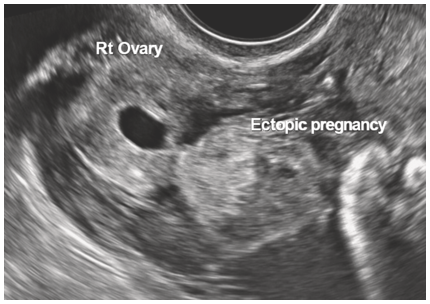
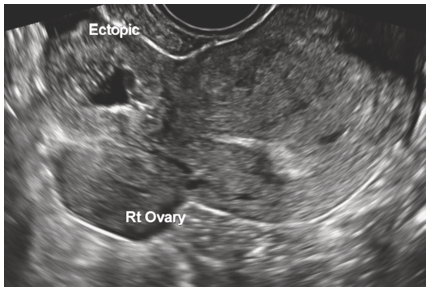
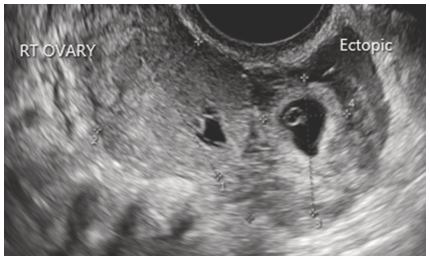
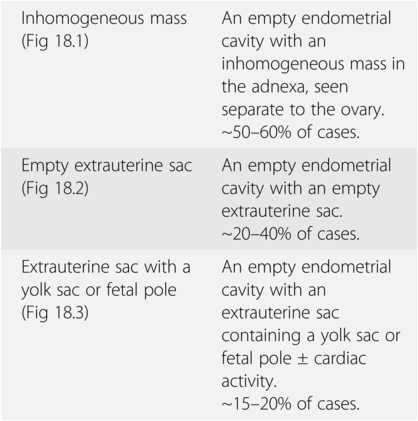
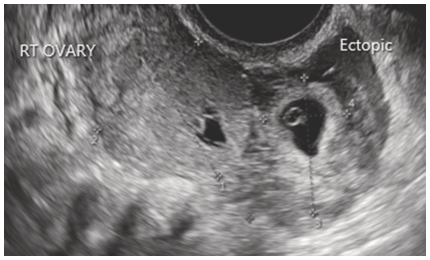
Specific criteria for the ultrasound diagnosis of tubal ectopic pregnancy have been described (Table 18.2 and Figures 18.1–18.3). There is also now published guidance on how to best measure an ectopic pregnancy on ultrasound [Reference Rajah, Googhart, Zamora, Amin, Jauniaux and Jurkovic14]. However, although not diagnostic, other findings may also suggest the presence of an ectopic pregnancy. There may be anechoic or echogenic free fluid within the pelvis. While anechoic fluid is unlikely to be significant, finding echogenic fluid within the pouch of Douglas or Morrison’s pouch may suggest hemoperitoneum secondary to a ruptured ectopic pregnancy or a tubal miscarriage, but it may also be seen with rupture of a hemorrhagic ovarian cyst. The finding of a collection of fluid within the endometrial cavity, often referred to as a “pseudosac,” is also widely discussed. However, with TVS, it is rarely difficult to distinguish this from an early intrauterine gestational sac, which is seen as an eccentrically placed hyperechoic ring within the endometrial cavity.
Inhomogeneous mass
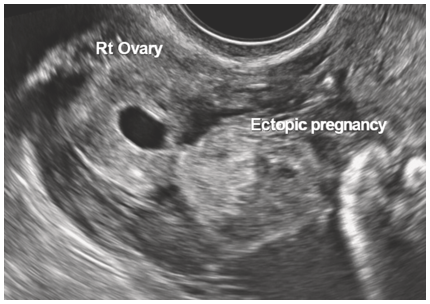
Empty extrauterine sac

Extrauterine sac with a yolk sac or fetal pole
Management
Surgical Management
Historically laparotomy with salpingectomy was the standard treatment for tubal ectopic pregnancy. Salpingotomy was then first performed in the 1950s, and in the 1970s laparoscopic procedures for the treatment of ectopic pregnancies were introduced [Reference Stromme15, Reference Bruhat, Manhes, Mage and Pouly16, Reference Garry17]. Laparoscopic surgery has been shown to be superior to laparotomy, making it the surgical approach of choice. However, in the case of a hemodynamically unstable woman, surgery should be by the most expedient method, which in some cases will be laparotomy. Reduced operating times, hospital stays, blood loss and analgesic requirements as well as shorter convalescence times and lower costs have been demonstrated in those undergoing laparoscopic procedures [Reference Lundorff, Thorburn, Hahlin, Källfelt and Lindblom18, Reference Lundorff, Thorburn and Lindblom19].
A common dilemma is whether a salpingotomy or a salpingectomy should be performed. In the presence of a healthy contralateral tube, current evidence would suggest that a salpingectomy is preferable. A multicenter randomized controlled study on 446 women with a laparoscopically confirmed tubal ectopic pregnancy and a healthy contralateral tube found that the cumulative ongoing pregnancy rate was 60.7% after salpingotomy and 56.2% after salpingectomy [Reference Mol, van Mello, Strandell, Strandell, Jurkovic and Ross20]. Repeat ectopic pregnancy rates were 8% in the salpingotomy group and 5% in the salpingectomy group.
However, in women with a history of fertility-reducing factors (contralateral tubal damage, previous ectopic pregnancy, previous pelvic inflammatory disease, previous abdominal surgery) higher rates of subsequent intrauterine pregnancy have been found if salpingotomy is performed. In one study, subsequent intrauterine pregnancy rates were 75% in those who had a salpingotomy compared to 40% in those who underwent a salpingectomy [Reference Becker, Solomayer, Hornung, Kurek, Banys and Aydeniz21].
With salpingotomy however, there is a risk that not all the functional trophoblast is removed. Persistent trophoblast has been reported in up to 3.9–11.0% after salpingotomy [Reference Yao and Tulandi22, Reference Sowter and Frappell23, Reference Hajenius, Mol, Ankum, van der Veen, Bossuyt and Lammes24, Reference Lund, Nilas, Bangsgaard and Ottesen25]. It is recommended that women undergoing salpingotomy have a serum hCG level taken seven days after surgery and then weekly until a negative result is obtained [26]. If levels fail to fall, methotrexate may be administered.
Medical Management
Methotrexate is the most commonly used drug in clinical practice for the treatment of ectopic pregnancy. It is a cytotoxic drug that binds to the enzyme dihydrofolate reductase, which is involved in the synthesis of purine nucleotides. As a consequence, it interferes with DNA synthesis and disrupts cell multiplication. It can be used both systemically and locally for the treatment of both tubal and non-tubal ectopic pregnancies.
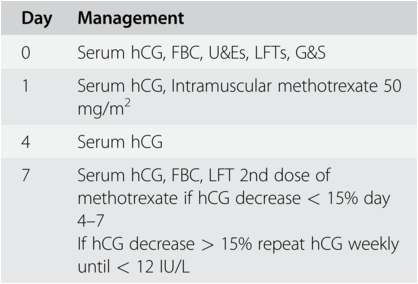
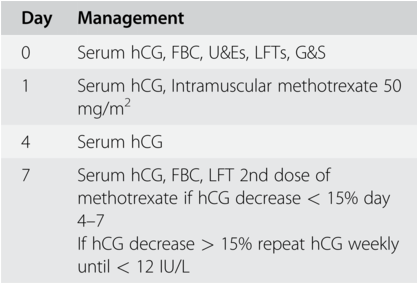
In the UK, methotrexate is most commonly given systemically as a single dose (Table 18.3) [Reference Stovall and Ling27]. This involves giving a single dose of 50 mg/m2 on the day of presentation or diagnosis (day 1). Serum hCG levels are checked on days 4 and 7 posttreatment. If the hCG level decreases by more than 15% between days 4 and 7, hCG levels are then checked on a weekly basis. If the hCG does not decrease by more than 15%, a second dose can be given. The reported need for a second dose ranges from 3% to 27% of cases [Reference Stovall and Ling27, Reference Erdem, Erdem, Arslan, Oç, Biberoğlu and Gürsoy28]. Absolute contraindications to its use include pain, signs of an acute hemoperitoneum, liver, kidney or bone marrow impairment. Relative contraindications include fetal cardiac activity, an ectopic mass greater than 3 cm in diameter and an hCG level greater than 5000 IU/L. It is important that any woman receiving methotrexate is reliable, compliant and counselled appropriately before it is administered. Side effects from a single dose of methotrexate are rare but include nausea, gastric disturbance, tiredness and abdominal pain. Women should also be advised to avoid alcohol, folic acid and sexual intercourse during the period of treatment.
Reported success rates of single-dose methotrexate range from 65% to 95% [Reference Kirk, Condous and Bourne29]. The largest single study of single-dose methotrexate has been conducted on 559 women with a success rate of 90.7% [Reference Lipscomb, Gomez, Givens, Meyer and Bran30]. These success rates vary due to different inclusion criteria. Some studies include women with PULs and presumed, but not visualized, ectopic pregnancies and women already known to have failing pregnancies with decreasing hCG levels. Inclusion of these women can lead to an overestimation of the impact of methotrexate, as it is likely that these ectopic pregnancies may have resolved without any intervention. Other studies include women with fetal cardiac activity, hemoperitoneum and high initial serum hCG levels who may have been excluded from other studies. Success is lower when there is positive fetal cardiac activity. This is probably a reflection of higher hCG levels and more active trophoblast. The presence of a hemoperitoneum could indicate either rupture of the ectopic pregnancy or tubal miscarriage. In the latter, one would expect methotrexate to work well as the pregnancy has already failed. A systematic review has found that there is a substantial increase in the failure of medical management with single-dose methotrexate when the initial serum hCG is greater than 5000 IU/L [Reference Menon, Colins and Barnhart31]. The trend in serum hCG before and after methotrexate administration is also an indicator of treatment success. An hCG level increase of less than 11–20% over 48 hours prior to the administration of methotrexate has been shown to be a significant predictor of success [Reference da Costa Soares, Elito and Camano32, Reference Kirk, Van Calster, Condous, Papageorghiou, Gevaert and Van Huffel33].
Work has been undertaken to evaluate the use of a combination of the epidermal growth factor receptor (EGFR) inhibitor gefitinib and methotrexate compared with methotrexate alone to treat ectopic pregnancy [Reference Skubisz, Horne, Johns, Nilsson, Duncan and Wallace34]. Initial results suggested that ectopic pregnancy implantation sites express high levels of EGFR and that gefitinib augments methotrexate-induced regression of pregnancy-like tissue. In a phase I toxicity study, administering oral gefitinib and intramuscular methotrexate to 12 women with tubal ectopic pregnancies, the combination therapy resolved the tubal ectopic pregnancies faster than methotrexate alone [Reference Horne, Skubisz, Doust, Duncan, Wallace and Critchley35]. However, in a large recent multicenter study, where 328 women were randomized to either methotrexate and oral gefitinib or methotrexate and placebo, no clinical benefit was found [Reference Horne, Tong, Moakes, Middleton, Duncan and Mol36]. In fact, it was found that adding gefitinib to parenteral methotrexate, increased minor adverse reactions.
Expectant Management
Expectant management has been shown to be safe and effective for selected women with ectopic pregnancy. However, close follow-up is required and emergency out-of-hours backup essential. Some units report offering expectant management to over 60% of their cases of ectopic pregnancy [Reference Elson, Tailor, Banerjee, Salim, Hillaby and Jurkovic37].
The reported success rates for expectant management range between 57 and 100% [Reference Craig and Khan38]. Success rates are known to be higher with lower hCG levels. In one study, the success rate of expectant management was 96% with serum hCG levels of less than 175 IU/L and 66% if serum hCG levels were 175–1500 IU/L [Reference Elson, Tailor, Banerjee, Salim, Hillaby and Jurkovic37]. Other studies have shown a success rate of 80–90% when hCG levels were less than 1000 IU/L and 60–67% when less than 2000 IU/L [Reference Shalev, Yarom, Bustan, Weiner and Ben-Shlomo9, Reference Cohen and Sauer39].
Lower initial hCG levels, a decreasing trend in hCG levels over time, the absence of an ectopic gestational sac visualized on ultrasound, and a longer time from the last menstrual period have been shown to be predictors of successful expectant management [Reference Ankum, Mol, Van der Veen and Bossuyt2, Reference Atri, Valenti, Bret and Gillett10, Reference Trio, Strobelt, Picciolo, Lapinski and Ghidini40]. Women undergoing expectant management can be informed that the likely length of follow-up, until their hCG level returns to nonpregnant levels, is usually under three weeks and that this length of this interval positively correlates with the initial level of hCG at the time of diagnosis [Reference Mavrelos, Memtsa, Helmy, Derdelis, Jauniaux and Jurkovic41]. Physical resolution of a tubal ectopic pregnancy is often more prolonged and is positively correlated with initial and maximum hCG concentrations. In one study, 112 out of 177 (63.3%, 95% confidence interval [CI] 55.7–70.4) of tubal ectopic pregnancies were indiscernible on ultrasound two weeks after serum hCG levels had returned to nonpregnant concentrations. However, in 8 out of 177 (4.5%, 95% CI 2.0–8.7), physical resolution took longer than 78 days [Reference Dooley, De Braud, Memtsa, Thantsis, Jauniaux and Jurkovic42].
A multicenter randomized controlled study has addressed the question whether there is a benefit in giving methotrexate rather than managing expectantly women with an ectopic pregnancy or a PUL with low or plateauing hCG levels [Reference van Mello, Mol, Verhoeve, van Wely, Adriaanse and Boss43]. There was, however, no difference in the primary treatment success rate of single-dose methotrexate versus expectant management [Reference van Mello, Mol, Verhoeve, van Wely, Adriaanse and Boss43]. Of note was that the majority of cases were PULs and not visualized ectopic pregnancies. The numbers were, however, too small to draw conclusions on whether certain subgroups could benefit more from either treatment. A systematic review and individual participant data meta-analysis (of randomized controlled trials comparing systemic methotrexate and expectant management in women with tubal ectopic pregnancy and low hCG (less than 2,000 IU/L) has since been performed.
This has shown no statistically significant difference in treatment efficacy between methotrexate and expectant management in women with tubal ectopic pregnancy with low hCG levels. Initial expectant management could be the preferred strategy due to fewer side effects [Reference Solangon, Van Wely, Van Mello, Mol, Ross and Jurkovic44].
Subsequent Fertility
A systematic review and meta-analysis of surgery, systemic methotrexate and expectant management for ectopic pregnancy concluded that subsequent fertility did not differ between the different treatments [Reference Mol, van Mello, Strandell, Strandell, Jurkovic and Ross20, Reference Helmy, Sawyer, Ofili-Yebovi, Yazbek, Ben Nagi and Jurkovic45]. In the absence of a history of infertility or tubal pathology, women should therefore be advised that there is no difference in the risk of future tubal ectopic rates regardless of the management method.
A more recent study has looked at subsequent pregnancies in patients managed for a tubal ectopic pregnancy who tried to conceive immediately after treatment; 86 (49.7%) underwent surgical treatment, 38 (21.9%) were treated with methotrexate and 49 (28.3%) had expectant management [Reference Baggio, Garzon, Russo, Iannicello, Santi and Laganà46]. The cumulative incidence of an ongoing normally sited pregnancy starting from 12 months after the ectopic pregnancy was 65.3% for the expectant management, 55.3% for the methotrexate group and 39.5% for surgery (P = 0.012). Post hoc analysis showed those who had expectant management having higher clinical pregnancy and live birth rates and shorter time between treatment and first normally sited pregnancy compared to surgery (P < 0.05). The cumulative incidence of recurrent ectopic pregnancy was comparable between the three groups. The authors concluded that women who were successfully managed expectantly appear to have better reproductive outcomes compared to women who underwent surgery, with the shortest time to achieve a subsequent normally sited pregnancy. However, the fact that the chosen treatment was primarily guided by the hCG value and the ectopic mass diameter based on their protocol, which is intrinsically related to the characteristics of the ectopic pregnancy, represents the main limitation of this study. Indeed, the observed differences between treatments may well be related to the ectopic pregnancy itself, instead of the treatment.
Pregnancy of Unknown Location
Pregnancy of unknown location is not a diagnosis; it is a term used to classify a pregnancy until the final clinical outcome is known. Any woman classified as having a PUL needs follow-up to determine the final clinical outcome, which may be an ongoing normally sited pregnancy, a failed pregnancy, an ectopic pregnancy or rarely a persisting PUL. Evidence suggests that between 6% and 20% of women with a PUL have an ectopic pregnancy [Reference Hahlin, Thorburn and Bryman47, Reference Banerjee, Aslam, Zosmer, Woelfer and Jurkovic48, Reference Banerjee, Aslam, Woelfer, Lawrence, Elson and Jurkovic49, Reference Condous, Van Calster, Kirk, Haider, Timmerman and Van Huffel50, Reference Kirk, Condous, Van Calster, Van Huffel, Timmerman and Bourne52]. Whilst 30–47% are ultimately diagnosed with an ongoing normally sited pregnancy, the majority (50–70%) will be found to be failing pregnancies where the location of the pregnancy is never confirmed [Reference Hahlin, Thorburn and Bryman47, Reference Banerjee, Aslam, Zosmer, Woelfer and Jurkovic48, Reference Banerjee, Aslam, Woelfer, Lawrence, Elson and Jurkovic49, Reference Condous, Van Calster, Kirk, Haider, Timmerman and Van Huffel50, Reference Kirk, Condous, Van Calster, Van Huffel, Timmerman and Bourne52].
It is suggested that modern ultrasound units scanning women in early pregnancy should try to maintain a PUL rate of less than 15% [Reference Condous, Timmerman, Goldstein, Valentin, Jurkovic and Bourne53]. Indeed, reports from specialized early pregnancy units report PUL rates of 8–10% [Reference Kirk, Condous, Van Calster, Van Huffel, Timmerman and Bourne52, Reference Cordina, Schramm-Gajraj, Ross, Lautman and Jurkovic54]. The majority of women with a PUL are followed up with serum hCG levels and repeat TVS examination until a final diagnosis is confirmed.
Single measurements of serum hCG are not useful in the prediction of PUL outcome [Reference van Mello, Mol, Opmeer, Ankum, Barnhart and Coomarasamy55]. However, serial measurements can be used to help predict outcome. A rise of 35% over 48 hours has been proposed as the minimal rise consistent with an ongoing normally sited pregnancy [Reference Seeber, Sammel, Guo, Zhou, Hummel and Barnhart56]. With failing PULs, the rate of decline of hCG is dependent on the initial serum hCG level, with a more rapid decline associated with higher starting concentrations [Reference Barnhart, Sammel, Chung, Zhou, Hummel and Guo57]. The change in serum hCG over 48 hours can also be referred to as the hCG ratio (serum hCG 48 hours/serum hCG 0 hours). An hCG ratio of 0.87 or decrease of 13.0% has been shown to have a sensitivity of 92.7% and specificity of 96.7% for predicting a failing PUL [Reference Condous, Kirk, Van Calster, Van Huffel, Timmerman and Bourne58]. Unfortunately though, there is no single way to characterize the pattern of change in serum hCG over 48 hours in ectopic pregnancies. While 10% of ectopic pregnancies will have hCG patterns that behave like a failing PUL, up to 15–20% will have serum hCG levels that behave like an ongoing normally sited pregnancy [Reference Silva, Sammel, Zhou, Gracia, Hummel and Barnhart59]. However, the majority will have serum hCG levels that increase more slowly (“suboptimal rise”) than expected with an ongoing normally sited pregnancy or decrease more slowly than expected with a failed PUL. A meta-analysis found the sensitivity of the serum hCG ratio to predict ectopic pregnancy ranges 74–100% and the specificity 28–97% [Reference van Mello, Mol, Opmeer, Ankum, Barnhart and Coomarasamy55].
Serum progesterone levels have also been used to predict the outcome of PULs. Levels of less than 20 nmol/L have a high positive predictive value for failing pregnancies, and a recent systematic review has shown that a single progesterone level predicts a nonviable pregnancy with a pooled sensitivity of 74.6% and specificity of 98.4% [Reference Banerjee, Aslam, Woelfer, Lawrence, Elson and Jurkovic49, Reference Verhaegen, Gallos, van Mello, Abdel-Aziz, Takwoingi and Harb60]. However, a single progesterone level does not have sufficient discriminative capacity to diagnose ectopic pregnancy with certainty [Reference Mol, Lijmer, Ankum, van der Veen and Bossuyt61]. A single progesterone level has, however, been shown to be useful in triaging and managing women with PULs [Reference Cordina, Schramm-Gajraj, Ross, Lautman and Jurkovic54]. In this study, a serum progesterone of less than 10 nmol/L was used to define a failing pregnancy. Using this approach, 252 out of 676 PULs were classified as a failing PUL, and only 4 needed further intervention.
Mathematical models have been developed to predict the outcome of PULs. These include Bayesian networks and logistic regression models based on variables such as serum hCG and progesterone levels, endometrial thickness and the amount of vaginal bleeding [Reference Banerjee, Aslam, Woelfer, Lawrence, Elson and Jurkovic49, Reference Condous, Van Calster, Kirk, Haider, Timmerman and Van Huffel50, Reference Condous, Van Calster, Kirk, Haider, Timmerman and Van Huffel51 Reference Gevaert, De Smet, Kirk, Van Calster, Bourne and Van Huffel62]. These models have been shown to have high sensitivities for the prediction of PUL outcome and to rationalize follow-up [Reference Kirk, Condous, Van Calster, Van Huffel, Timmerman and Bourne52]. They can also be used to triage women into high- or low-risk groups in order to reduce follow-up and allocate resources to pregnancies thought to be at increased risk of being ectopic. In a study on 1962 pregnancies, a mathematical prediction model (M4) was found to classify around 70% of PULs as low risk, of which around 97% were later characterized as failed PULs or normally sited pregnancies, while still classifying 88% of ectopic pregnancies as high risk [Reference Van Calster, Abdallah, Guha, Kirk, Van Hoorde and Condus63]. In 2019, a systematic review and metanalysis was performed on all the current published protocols for the management of PULs [Reference Bobdiwala, Saso, Verbakel, Al-Memar, Van Calster and Timmerman64]. It was concluded that the M4 model was the best available method for predicting a final outcome of ectopic pregnancy. More recently another model (M6) has been developed incorporating initial progesterone levels, and a two-step triage protocol has been developed to identify patients at high risk of an ectopic pregnancy [Reference Van Calster, Bobdiwala, Guha, Van Hoorde, Al-Memar and Harvey65]. The protocol has been externally validated in a number of units and is now implemented electronically into various formats for ease of use [Reference Christodoulou, Bobdiwala, Kyruacou, Farren, Mitchell-Jones and Ayim66].
Whatever method is used to predict PUL outcome, confirmation of a final diagnosis is needed. For women with suspected ongoing normally sited pregnancies or ectopic pregnancies, this will take the form of a repeat TVS examination. For women with a suspected failing PUL, this may involve further serum hCG levels until a nonpregnant level is obtained or a nonpregnant urinary pregnancy test result. Rarely a laparoscopy or uterine curettage may be needed in order to confirm a diagnosis. There is no consensus on what is an acceptable surgical intervention rate in women classified with a PUL [Reference Condous, Timmerman, Goldstein, Valentin, Jurkovic and Bourne53]. However studies report surgical intervention rates of 0.5–11.0% [Reference van Mello, Mol, Verhoeve, van Wely, Adriaanse and Boss43, Reference Kirk, Condous, Van Calster, Van Huffel, Timmerman and Bourne52, Reference Cordina, Schramm-Gajraj, Ross, Lautman and Jurkovic54].
Summary
Transvaginal sonography is now the imaging modality of choice for the diagnosis of ectopic pregnancy. More than 90% of ectopic pregnancies should be visualized on TVS prior to treatment. The majority of these (approximately 75%) will be visualized on the initial TVS examination at the time the woman first presents to the clinic. The remainder will initially be classified as a PUL. Ectopic pregnancies in these women are probably too small and too early in the disease process to be visualized on the initial TVS. Earlier diagnosis of ectopic pregnancy, often in asymptomatic women, means that surgical treatment is not always indicated. Medical treatment with methotrexate or expectant management is suitable for appropriately selected cases. Current evidence would suggest that there are no differences in subsequent fertility rates following the different treatments.