

Introduction
Tin is at the centre of many questions about the European Bronze Age. It is essential in making bronze, a copper-tin alloy, which is harder and casts more readily than copper alone. Tin is a rare metal and its sources still present a conundrum for archaeologists and geologists alike (Reference PenhallurickPenhallurick 1986; Reference Rapp, Betancourt, Karageoghis, Laffineur and NiemeierRapp 1999; Reference Skarpelis, Giumlia-Mair and SchiavoSkarpelis 2003; Valera & Reference Valera, Valera, Giumlia-Mair and SchiavoValera 2003; Haustein et al. 2010). In the words of Anthony Harding (2000: 201), 'through much of Europe, it is unknown how the bronzesmiths who turned out such enormous quantities of bronzework... acquired their supplies'. We believe that at least some of the tin used in the Bronze Age — in the Aegean, as well as in south-eastern and central Europe (and possibly further afield) — may have come from western Serbia, integrating the area into wider trade networks.
Fieldwork in western Serbia
In this context, Brooklyn College and the Cultural Heritage Preservation Institute of Valjevo in Serbia conducted archaeological fieldwork in the vicinity of Belotić and Bela Crkva in western Serbia from 28 July to 18 August 2010. Our objectives for this pilot season were twofold: to locate Bronze Age settlements; and to determine whether tin ore (cassiterite) is present in the streams of western Serbia, indicating deposits in the parent rocks.
Prior to our discovery of the settlement of Spasovine during an initial survey in 2008, there was virtually no published information on Bronze Age settlements in western Serbia (see Reference ZotovićZotović 1985). This region roughly encompasses the area of the rivers Drina, Jadar, Kolubara and upper West Morava, and it is rich in metallic ores. The proximity to vital ore sources gives our discovery a special weight. The pilot season of the joint Serbian-American Jadar project found several more Bronze Age settlements and tumuli and documented the presence of tin in the gravels of two tributary streams of the river Jadar.
Locating Bronze Age settlements
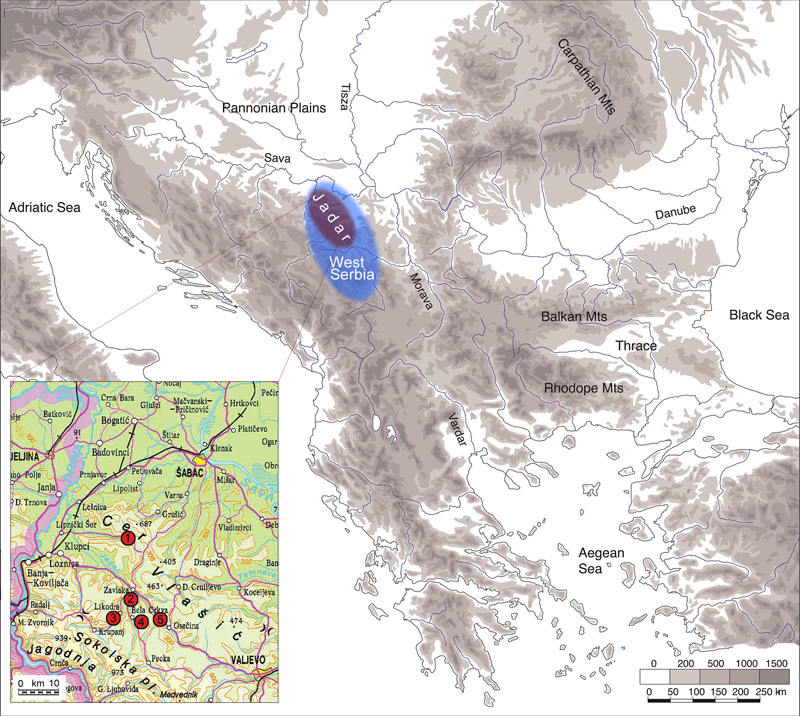
Location of fieldwork in western Serbia. Sites: 1 Spasovine; 2 Mali Gradac; 3 Likodra; 4 Kruglic; 5 Crkvine.

Survey conducted in the three-week summer season of 2010 increased the number of known settlements to five (Figure 1). Of these, Spasovine, a flat settlement, was tested with small exploratory excavations, and Likodra, a hilltop site, was surveyed. These and at least three others, Mali Gradac, Kruglić and Crkvine, form the first corpus of Bronze Age settlements known from the Jadar region. The locations of all of the sites indicate a possible connection with tin sources. Reference DurmanDurman (1997) and McGeehan-Liritzis & Taylor (1987) have written on the possible importance of west Serbian tin, but little archaeological work has been done here since the early 1980s.
Locating tin sources
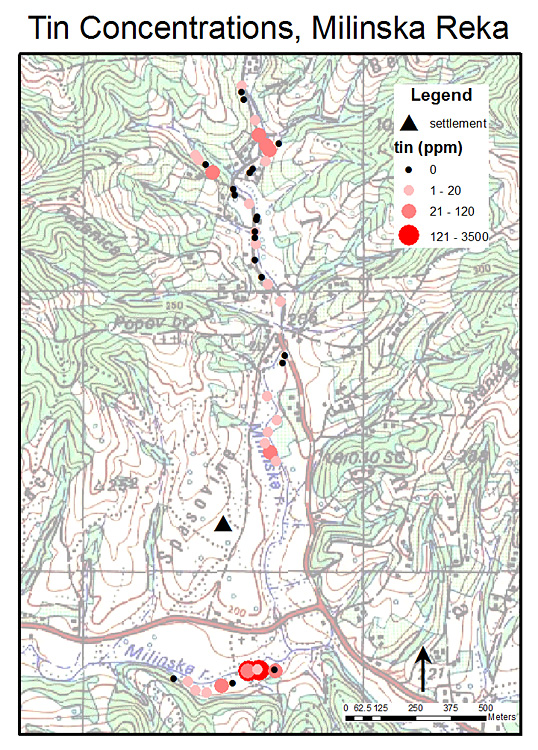
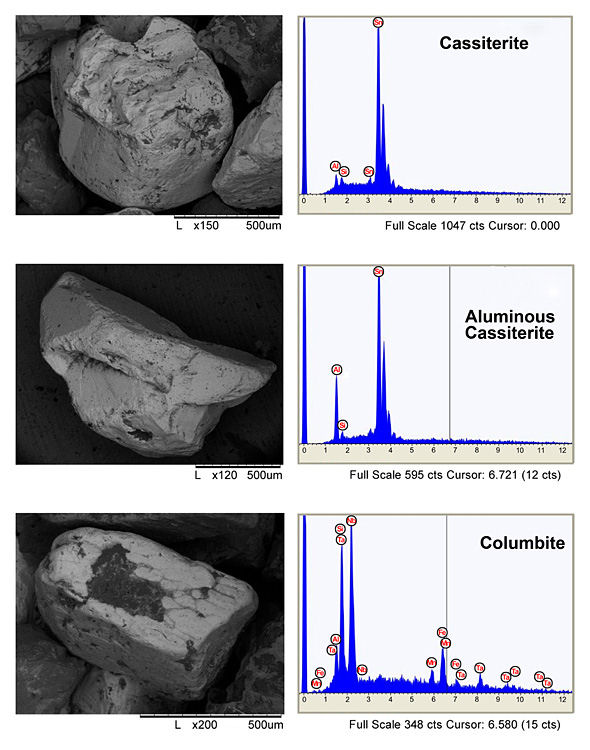
The metallurgical chain (Reference HardingHarding 2000: 206–20; Reference HauptmannHauptmann 2007: 7-8) begins with finding the ore. Our initial exploration for possible sources of tin ore involved sampling of sands and gravels from sand bars, banks and stream bottoms along tributaries to the Jadar flowing south from Mount Cer (Figure 2). Sediment samples were washed, sieved and panned in situ, and sample locations were recorded using GPS. Sand and gravel fractions were tested for elemental constituents using a hand-held Innov-X X-ray fluorescence (XRF) apparatus with a detection limit for tin of 50–150 ppm. Over 130 samples were processed in this manner. Analysis of tin-bearing sands from the Milinska Reka by Scanning Electron Microscope [SEM] with Energy-dispersive X-ray spectroscopy [EDS] indicates that several chemically and visually distinct forms of cassiterite are present. Additional indicator minerals of pegmatite-hosted tin mineralisation, such as columbite ([Fe,Mn][Nb,Ta]2O6), also occur in sands of the Milinska Reka.
Tin sampling: concentrations around Spasovine.

SEM analysis of cassiterite from tributaries of the river Jadar.

Tin was not easy to detect in most sediments sampled in 2010. Only three samples yielded statistically significant Sn concentrations, while many samples yielded low concentrations (10–30 ppm) that were below the manufacturer's stated 50–150ppm detection limit for the Innov XRF. Three of these sub-detection limit samples were further processed using heavy liquid (sodium polytungstate, density 2.89 g/cm3) separation techniques. The resulting heavy mineral concentrate from two of these yielded statistically valid Sn anomalies, (24.398±751 ppm and 126±16 ppm), and the presence of detrital cassiterite was confirmed in both samples through SEM analysis [Figure 3].
Prospect
The Jadar Project is designed to look at one part of the far-flung Bronze Age trade network (Reference Sherratt, Feinman and NicholasSherratt 2004), to document the process of tin production and to examine the effects of this production and dissemination on small communities. Our preliminary results are encouraging and future work will focus on further locating metal sources and archaeological sites and on documenting the environmental properties of these locales.