


1. Introduction
1.1. Motivation
Sustainability is becoming increasingly important in mechanical and plant engineering. With machine tools today, the focus is not only on productivity, work quality, and reproducibility but also on saving energy and resources. However, conventional materials and design methods only offer limited potential in this area (Reference Feng and HuangFeng & Huang, 2020).
The use of lightweight design is particularly relevant for moving components (Reference Leslie, Troung, Blank and FrickLeslie et al., 1996). In the field of plant engineering, machine spindles are often operated at exceedingly high rotation speeds. As a result, the mass of these components is a critical factor that must be considered. One possible solution for enhancing the performance of machine tools is to substitute tool steel with carbon fiber reinforced plastic (CFRP). This substitution has the potential to improve the movement dynamics, thus increasing the overall efficiency of the machine (Reference Bang and LeeBang & Lee, 2002; Reference Kono, Mizuno, Muraki and NakaminamiKono et al., 2019; Reference WeckWeck, 2006).
However, high-precision and highly stressed interfaces between drive components made of CFRP and other components pose a particular challenge for the product development (Reference Kilian, Fehn, Bischop, Brouschkin, Dege, Krause and WeigoldKilian et al., 2024). In addition to tribological system parameters such as friction speed, surface pressure and form of movement, the use of CFRP adds material-dependent parameters such as fiber and matrix materials, fiber volume fraction and fiber orientation (Reference WartzackWartzack, 2024; Reference WeidmannWeidmann, 2018).
The determination of tribological variables is challenging due to the scattering of the measured values, which occurs as a result of the variety of influencing variables and their fluctuations and time dependencies (Reference Czichos and HabigCzichos & Habig, 2020).
1.2. Research background
Tribological systems are ubiquitous and play a crucial role in a wide range of applications, from machinery and vehicles to medical implants and microelectronics. Through the targeted design and optimization of tribological systems, energy losses can be reduced, material wear minimized, and system reliability increased (Reference Hameed Sultan, Mohd Jamir, Abdul Majid, Azmi and SabaHameed Sultan et al., 2021).
Tribological systems investigate the interactions between two or more surfaces in relative motion to each other. Three main parameter groups influence tribological systems: Operational Parameters, Structural Parameters and Interaction Parameters. These parameter groups describe the complex interactions within a tribological system and are shown in Figure 1.
The operational parameters comprise the operational conditions of the system. Such parameters include, for instance, the form of movement, the normal force, and the speed. These parameters define the manner in which the system is loaded during operation and identify the external influences that act upon the tribological system. The structure of a tribological system is made up of triboelements 1 and 2, the interfacial element and the ambient medium. These components form the basis for the structural parameters describing the tribologically relevant properties, which include the geometry and material of the triboelements, their hardness, and the surface quality. These properties are decisive for the mechanical and chemical interactions in the contact area of the triboelements. The interaction parameters capture the dynamic interactions that occur between the operating parameters and the structural components of a tribological system. Such parameters include key factors such as contact mechanisms, friction, wear, lubricant film formation, and thermodynamic processes that occur during operation. These interactions exert a direct influence on the performance and service life of the system (Reference Czichos and HabigCzichos & Habig, 2020).
By systematically analyzing and optimizing these parameters, tribological systems can be adapted to specific applications and their efficiency and reliability can be improved (GFT, 2002).
Tribological systems and the tribological parameters based on (Reference Czichos, Woydt and TottenCzichos & Woydt, 2017a)

Tribology systems can be classified into different test categories. The range of test categories in tribometry extends from simple model tests, in which highly simplified test setups are examined, to specimen tests and operational tests, which assess components directly in operation. Accordingly, the objectives, scope and structure of these test categories vary considerably (Reference Czichos and HabigCzichos & Habig, 2020).
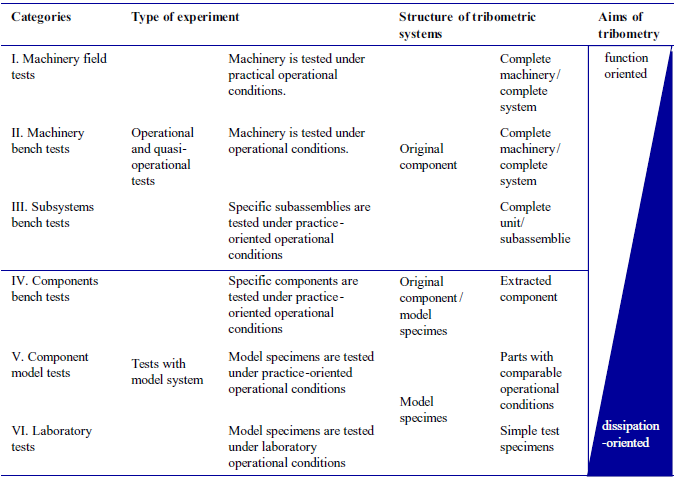
Tribological systems are divided into six tribological test categories with associated test types and system structures according to Table 1:
In test category I, field tests are carried out on the product under operating conditions. These full-scale field tests are generally associated with high costs due to the initial development costs. In addition to that, the influence of specific parameter can often not be sufficiently determined, so that a large number of tests are required to statistically validate the tests. In categories II to IV, test bench tests are carried out on tribological systems with products or components under defined boundary conditions. This enables a characterization of influencing variables and facilitates the transfer of the test results to the product that is to be designed. In these test bench tests, the abstraction of the operating conditions from the product is particularly important. In test categories V and VI, the focus is on researching friction and wear processes as well as creating the basis for transfer to practical applications. In these tests, geometrically simplified test specimens based on the contact geometry are used under laboratory conditions similar to the operating conditions. Examples of these model systems include the pin-on-disc, pin-on-ring, or pin-on-flat arrangements. These setups represent abstractions of the system design, offering the advantage of maintaining constant boundary conditions. However, the transferability to the specific application is limited (Reference Czichos and HabigCzichos & Habig, 2020).
From test category IV to test category I, the test specimens and operating conditions are increasingly less abstracted, which makes it easier to transfer the results to practical applications. A key limitation of tribometric tests is that results cannot usually be interpreted as material properties of the tested samples or materials, which emphasizes the importance of application-oriented tests (GFT, 2002).
Categories of tribological testing by tribological system based on (GFT, 2002) and (Reference Czichos, Woydt and TottenCzichos & Woydt, 2017b)

In the aviation industry, the building block approach (Department of Defense, 2002) is a proven procedure for testing products and components. Building blocks are defined as different levels of structural complexity gradually building up from component level to product level. This hierarchical model and test design is based on findings from lower levels of complexity and is closely linked to multiscale analysis, a frequently used approach in materials science (Reference Okereke, Akpoyomare and BingleyOkereke et al., 2014).
Reference Krause, Seemann, Oltmann and RasmussenKrause et al. (2016) extend the building block approach (Department of Defense, 2002) and define a test pyramid that includes material, structure, sub-product and product levels. Based on this Reference Heyden, Schwenke, Hartwich, Hanna, Krause, Krause, Hartwich and RennpferdtHeyden et al. (2020) integrate a test pyramid that includes the levels of material, structure, component and product level. The pyramid is divided into static and dynamic areas in order to take the different mechanical load types of lightweight structures into account more precisely. In addition, a supplementation of the pyramid with real, physical and virtual test models is made, which serve as additional model levels, thereby expanding the flexibility and applicability of the approach.
Reference Schwan, Hüttich, Wegner and KrauseSchwan et al. (2021) developed an approach based on the product component test pyramid, in which the different model levels Virtual Test Model, Physical Test Model and Reality are synthesized in a pyramid and the transferability of application-specific boundary conditions between the levels is simplified. The three levels of abstraction defined are the material level, the structure and component level and the product level, which are not generic due to their strong dependence on respective application areas. Instead, they are selected individually for each specific area of application and product. The transferability of the boundary conditions is demonstrated by the application of the method in the virtual testing of sandwich structures, in physical models in medical imaging technology and in combined environmental testing (Reference Schwan, Hüttich, Wegner and KrauseSchwan et al., 2021).
Reference Heyden, Schwenke, Hartwich, Hanna, Krause, Krause, Hartwich and RennpferdtHeyden et al. (2020) and Reference Schwan, Hüttich, Wegner and KrauseSchwan et al. (2021) have shown how mechanical and application-specific boundary conditions can be transferred between the different levels of abstraction during testing. However, these approaches do not address the systematic investigation and transfer of tribological parameters between the different levels of abstraction.
1.3. Research focus
Due to the large number of tribological parameters, the transfer of knowledge between the levels is becoming increasingly challenging. Until now, an approach based on the product component test pyramid has not been implemented taking tribological parameters into account. This leads to the key question of how tribological parameters can be effectively investigated and transferred across different test levels in the development of tribologically stressed components and products?
The aim of this approach is to develop tribologically stressed interfaces with a high number of influencing factors using a systematic approach. To this end, tribological parameters are to be investigated at various levels in order to determine influencing factors at these levels in a cost-effective and repeatable manner and then transfer the results to the higher level.
2. Approach for investigating tribological stressed interfaces
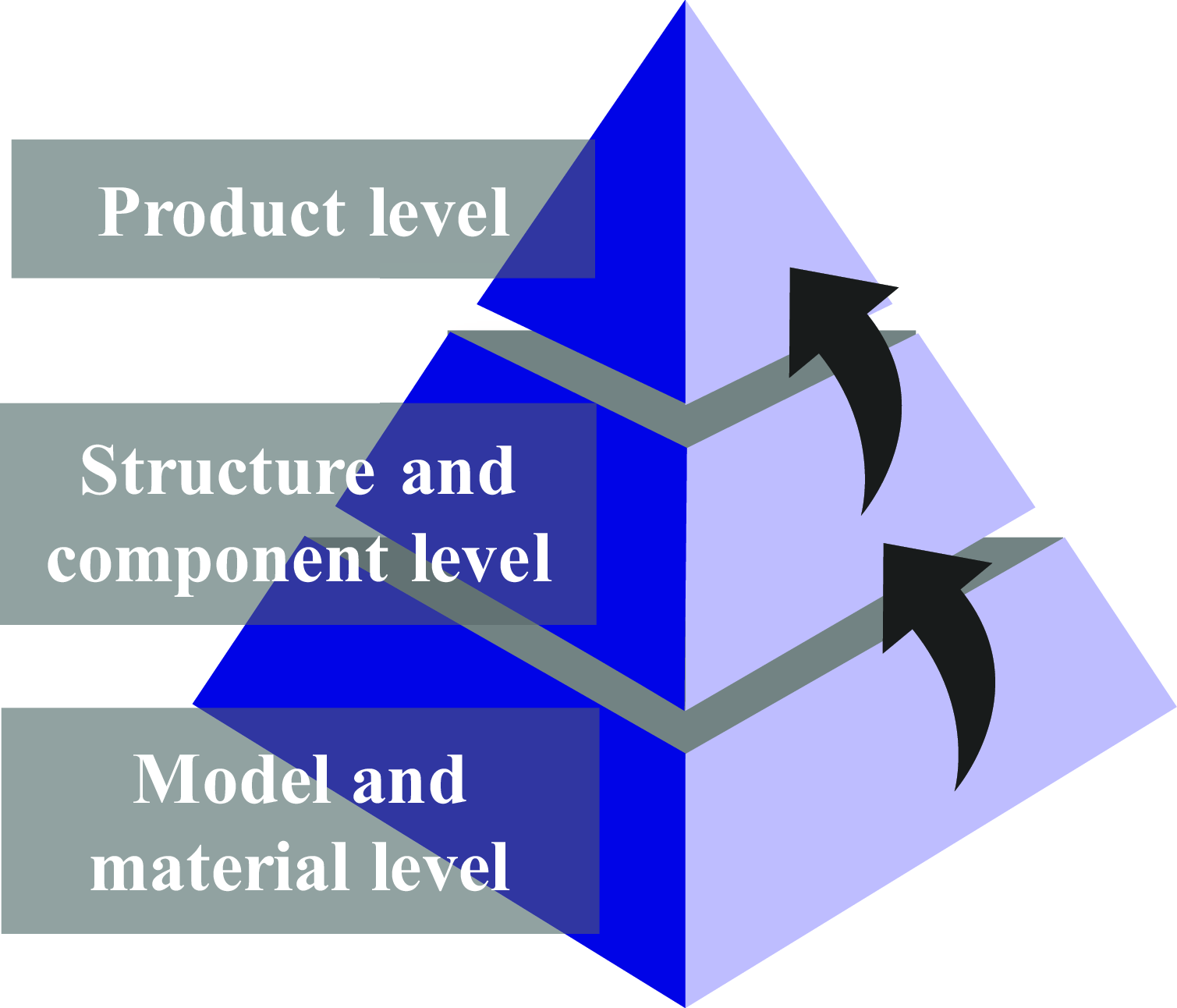
The approach proposed in this paper is based on the hierarchical product component test pyramid, which has been further developed by Reference Heyden, Schwenke, Hartwich, Hanna, Krause, Krause, Hartwich and RennpferdtHeyden et al. (2020) and Reference Schwan, Hüttich, Wegner and KrauseSchwan et al. (2021) and is shown in Figure 2.
Product component test pyramid for tribological stressed interfaces

The product component test pyramid is applied to tribologically stressed interfaces and the transferability of parameters between the levels of abstraction is demonstrated. The material level is extended by the model level, as tribological systems are described not only by the material properties, but also by their system parameters such as the operational, structural and interaction parameters. The model and material level form the basic level at which tests are carried out with simplified specimens under abstracted test conditions. The high degree of abstraction enables a cost-effective and efficient investigation of individual influencing factors. At product level, tribological tests are carried out with the product under operating conditions. The multitude of influencing factors of tribological systems, coupled with the inherent anisotropic properties of the material under examination, makes it unfeasible to characterize individual factors at this level. The structure and component level act as a bridge between these levels in order to facilitate the acquisition of information with a reasonable level of effort. At this level, tribological systems are investigated under application-oriented operating and structural conditions. The arrows in Figure 2 illustrate the transfer of knowledge and tribological parameters between the individual levels.
3. Application of the approach
3.1. Initial situation
The hollow shank taper interface (HSK) according to DIN 69893-1 (German Institute for Standardization, 2011) between the machine tool spindle and tool holder is a tribologically highly stressed interface, which is shown in Figure 3. This interface is subject to high requirements, such as tight tolerances for flatness and concentricity (< 3 μm), in order to ensure interchangeability, repeat accuracy, reliable torque transmission and high bending stiffness. However, the clamping process and dynamic loads lead to signs of wear that reduce the operating phase of these interfaces. In particular, wear on the tapered surface, which is primarily used for alignment, can significantly impair the required high accuracies in terms of concentricity and repeatability (Reference Brecher, Fey and KneerBrecher et al., 2016).
HSK interface between tool holder and machine tool spindle in three-quarter cut

Due to the geometric shape of the HSK, the force flow is not unambiguous, as both the cone and the contact surface transmit forces in a force-fit manner (Reference BahmannBahmann, 2013). Reference Brecher, Fey and KneerBrecher et al. (2016) showed that an increase in wear on the conical surface increases the frictional forces during clamping. These increased frictional forces reduce the force transmission via the face contact. To ensure a secure connection during dynamic machining, the tool holder must be tightened with a force of 75% (German Institute for Standardization, 2011) of the pull-in force via the face contact (Reference Aoyama and InasakiAoyama & Inasaki, 2001). This ambiguous force flow, combined with a conical surface where the surface pressure is not evenly distributed over the length in practice (VDMA, 2005), makes it difficult to clearly determine the tribological influencing variables.
3.2. Development of the rounded block-on-tube test setup
Replacing steel with CFRP for this interface enables a significant reduction in rotating mass. However, it also increases the number of tribological influencing factors due to the anisotropic material properties inherent to CFRP (Reference KlimachKlimach, 2015). Due to the large number of product parameters such as the uneven surface pressure, the double fit between the face contact and the tapered surface and the high form and position tolerances of the interface, it is only possible to determine the influencing factors responsible for the wear with a considerable amount of testing.
Therefore, investigations with abstracted boundary conditions and test arrangements at different abstraction levels as described in the approach are necessary. At the model and material level, which includes investigations with simplified model setups, numerous experiments were carried out on the friction pairing of CFRP and steel. Tribometers of category VI of tribological testing, such as the block-on-plate tribometer, have been used (Reference Rodiouchkina, Lind, Pelcastre, Berglund, Rudolphi and HardellRodiouchkina et al., 2021; Reference Rudnytskyj, Larsson and GachotRudnytskyj et al., 2022; Reference WeidmannWeidmann, 2018). However, with increasing abstraction of the tribological system, the transferability is reduced, making application-oriented investigations necessary (GFT, 2002). Due to considerable differences in geometry and manufacturing processes, a direct transfer of the results from the lowest level to the product level is not possible. Machine tool spindles, owing to their rotational symmetry, are produced using a winding process and subsequently refined through grinding. Consequently, the material properties of these wound components diverge from those of laid CFRP sheets.
For this reason, an additional test setup based on the Wishbone approach according to Reference Ostergaard, Ibbotson, Le Roux and PriorOstergaard et al. (2011) is developed at the structure and component level, combining a bottom-up and a top-down approach to investigate influencing factors at a level closer to the product. From the lowest level, the contact pressure and geometric contact area are maintained. From the product level, the manufacturing process, material and geometry of the tribological elements closely related to the HSK are adopted. This test setup can be characterized as a tribometer of category V to IV in tribological testing. Figure 4 shows the developed setup arranged within the product component test pyramid. The synthesis at the structure and component level according to the Wishbone approach is symbolized by the arrows.
Product component test pyramid with the block-on-tube test setups

In the tribometer developed at the structure and component level, a rounded block is pressed as a stationary base body with a defined normal force against the inner surface of a reciprocating sliding tubular counter-body. This test setup has a significantly lower degree of abstraction compared to tests at the model and material level. The use of tube samples enables the same manufacturing process to be used as in the application case, as well as the simulation of the same type of movement and surface pressure. A reduction of the influencing variables compared to the application case is achieved by the cylindrical tube specimens, as this test setup avoids the superposition of axial and radial forces, as they occur during force transmission in an HSK.
3.3. Methodical test bench development
In order to investigate the parameters at the structure and component level using the block-on-tube arrangement, a test bench is being developed for this arrangement. The test bench development process is based on the methodical product development based on Reference Ulrich and EppingerUlrich & Eppinger (2016). The phases of the development process are shown in Figure 5.
Product development process based on Reference Ulrich and EppingerUlrich & Eppinger (2016)

In the planning phase, the requirements for the test bench and the test specimens for investigating the tribological behavior were defined. The forces occurring in an HSK connection of size 63 are used for the transferability of the tests from the tribology test bench to the application.
In the concept development phase, an influence diagram, a hierarchical functional structure and a revenue-oriented functional structure were created. In the planning phase, requirements for the test bench and test specimens for investigating the tribological behavior were defined. The forces occurring in an HSK connection of size 63 are used for the transferability of the tests from the tribology test bench to the application. In the concept development phase, an influence diagram and a hierarchical functional structure were created. Based on the hierarchical function structure, a revenue-oriented functional structure is created in accordance with Reference Krause and GebhardtKrause & Gebhardt (2018). The relationships between the individual functions are derived from the hierarchical function structure together with the conditions of the system. In the next step, solution principles for the sub-functions were developed and arranged in a morphological box. Alternative solutions were evaluated according to technical and economic criteria using a strength diagram. The technical evaluation was based on the range of functions, continuous operation, reproducibility and maintenance. The economic evaluation was based on costs, production effort, set-up time and operation. The test bench was then designed and developed. The normal force is applied by a double-acting pneumatic cylinder. The normal force is controlled in conjunction with the load cell and a pressure control valve. A 5-2-way valve with spring return ensures safe operation of the pneumatics. For the test rig validation, repeatability and comparability were assessed in accordance with DIN ISO 5725-6 (German Institute for Standardization, 2022) using a block-on-plate configuration as described by Reference WeidmannWeidmann (2018). In this test setup, the stationary tribological element consists of a unidirectional CFRP block that slides against a ground steel plate, with a contact-area-to-wear-track ratio of less than 14%. Due to the identical connection dimensions of the CFRP block in both the block-on-plate and block-on-tube configurations, the same sample holder could be used, enabling the validation of the sample holder along with the connected measurement setup. The results for this test setup fell within the confidence limits for both repeatability and comparability, thereby validating the test rig for this configuration. Additionally, repeatability could also be demonstrated for the block-on-tube configuration using both steel and CFRP tube samples.
3.4. Abstraction levels for investigation of tribological parameters
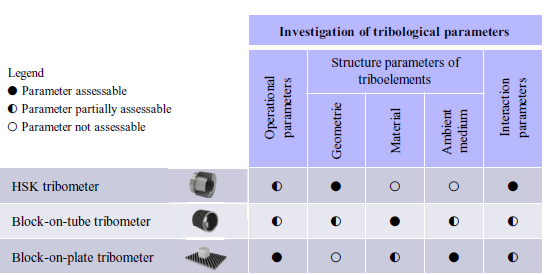
The tribological parameters need to be investigated at the three levels of abstraction. The product to be developed is the CFRP machine tool spindle with the HSK interface made of CFRP. As field tests with the machine tool are associated with high costs and a wide range of operating parameters, the tribological parameters are investigated using three test setups. The test setups are listed in Table 2 with the parameters that were assessed within this level using Harvey balls.
Investigation of tribological parameters across different levels

In these abstract test setups, attention is paid to ensuring consistent operational wear mechanisms according to GFT (2002). Starting at the lowest level of abstraction, the model and material level, a linear-reciprocating block-on-plate tribometer with a flat-on-flat configuration is used. The block is made of hardened and ground tool steel with a geometric contact area of 100 mm2, while the plate consists of a ground unidirectional CFRP prepreg plate.
The operational parameters, such as sliding velocity and contact pressure, are selected to closely resemble the application case. Since the contact pressure is not constant across the conical surface of the HSK interface, tests are conducted at different contact pressures to evaluate their effect on friction coefficient and wear behavior. To assess the influence of the sliding distance, the contact-area-to-wear-track ratio is varied from 14% to 83%. Additionally, to determine the effect of the fiber orientation of the CFRP plate, tests are performed with fibers aligned parallel and anti-parallel to the sliding direction. As the same manufacturing process cannot be used for the panel as for the application, the Harvey ball is only half filled. Since the tool holder interface is flushed with coolant lubricant prior to clamping, tests are performed in both dry and coolant lubricated conditions, which helps to analyze the influence of the ambient medium and results in a fully filled Harvey ball. This allows the influences of the operational parameters, to some extent the material properties, the ambient medium and the interaction parameters to be investigated cost-effectively and without superimposing influencing factors.
The knowledge gained is transferred to the structural and component level.
Here, the newly developed block-on-tube tribometer is used, where the tribological elements more closely resemble the actual product. The test specimens are manufactured from the same material and using the same production process as the final product, achieving a fully filled Harvey ball. This simplified setup allows for the cost-effective production of test samples and enables a targeted investigation of specific material parameters, such as the winding angle. In contrast to the unidirectional CFRP plate used at the lowest abstraction level, the CFRP tube specimens feature fiber crossover points due to the cross-winding pattern used in the filament winding process. During internal cylindrical grinding of the tube specimens, the fibers at these crossover points are partially removed, exposing the lower fiber layers. As a result, the fiber angle changes locally, and fiber ends become exposed in the frictional contact zone. Since the CFRP spindle is also wound and subsequently ground internally, the use of CFRP tube specimens helps reduce the gap between material parameters and geometry at the product level. The results obtained at this level, in turn, serve as the basis for the final product-level investigations.
Since field tests with the machine tool are associated with high costs and the superposition of multiple influencing factors, such as dynamic loads during operation and environmental influences, a specially developed HSK tribometer is used to determine fatigue strength and wear behavior. This tribometer allows for an isolated investigation of the clamping process of a steel tool holder in an HSK interface, which represents an end section of an original spindle and results in a fully filled Harvey ball. The tool holder is clamped and released via a clamping set with a drawbar, while the clamping and release forces are measured and recorded over multiple clamping cycles. For tribometer validation, an HSK interface made of tool steel is used, enabling a direct comparison with field tests.
Building on these results, further tests are conducted using an HSK interface made of CFRP, demonstrating the transferability of findings from lower abstraction levels. These findings form the basis for the development of CFRP machine spindles with a HSK interface made of CFRP, which can then be further evaluated in field tests.
4. Summary and outlook
The development of tribological interfaces presents a challenge due to the numerous influencing factors, particularly when using CFRP. To address this, this paper extends the product component test pyramid to incorporate tribological influencing factors, providing a systematic approach to their investigation. This approach enables the investigation and transfer of tribological influencing factors across different abstraction levels.
The applicability of the approach is demonstrated using the example of a CFRP machine tool interface. In this HSK interface, a steel tool holder is used in combination with a CFRP spindle. During the clamping process, the tool holder rubs against the inner surface of the spindle’s cone, causing wear and thereby reducing the service life of the interface. By substituting steel with CFRP in the motor spindle, the number of influencing factors increases.
At the model and material level, tribological parameters such as operational and material parameters are investigated. The findings serve as the basis for the structure and component level. Since the knowledge gap between block-on-plate model tests and costly experiments with the HSK interface is significant, the rounded block-on-tube configuration is developed at the intermediate structure and component level. This setup enhances transferability to the product level, as the test specimens can be manufactured using the same material and production process as the final product.
The findings are transferred to the product level and validated using an HSK tribometer, where the clamping process is examined with the original components of the CFRP spindle.
This application example demonstrates how tribological interfaces made of CFRP can be investigated using the extended approach. To further generalize the approach, additional studies on tribologically stressed interfaces are required. Additionally, simulations could complement experimental investigations by modeling interactions, enhancing test quality, and further reducing test costs.
Acknowledgment
This work was supported by the research project SPOTLIGHT - Schleifen Präziser Oberflächen roTierender LEICHTbaukomponenten zur Ressourceneffizienz in E-Mobility und Maschinenbau (03LB2061) supported by the Federal Ministry for Economic Affairs and Climate Action on the basis of a decision by the German Bundestag and was supported by the LuFo VI-3 project eKabKlima - Effiziente Kabinentechnologien für ein klimaneutrales Flugzeug (20K2203B) funded by the Federal Ministry for Economic Affairs and Climate Action based on the decision by the German Bundestag.




 Open access

