




Introduction: the cultural politics of British symbols of power in independent India
In the early hours of 13 August 1965, a dozen activists from the Samyukta Socialist Party, carrying hammers, chisels, ladders, and buckets of tar, made their way silently through the deserted streets of India's capital, New Delhi. The group headed for the towering white marble figure of King George V, the former British monarch and emperor of India, which dominated the city's central vista, Janpath. In December 1911, George V had travelled to New Delhi to preside over his own imperial durbar, or coronation, before a gathering of India's social and political elite. Following his death in 1936, the king-emperor's 70-foot statue, crafted in London by the artist Charles Sargeant Jagger, was placed under an imposing sandstone chhatri, or canopy, designed by Sir Edwin Lutyens, the British architect responsible for much of New Delhi's cityscape. Thirty years later, as the Samyukta Socialist Party members approached the royal effigy, two policemen stepped forward from the shadows and challenged the group. A brief scuffle ensued, in which one of the police constables was knocked unconscious and the other left badly beaten. The Samyukta Socialist Party members went on to smear George V's statue with tar, and hack off its crown, ear, and nose. Before vanishing back into the night, in a final gesture of defiance, the Socialists adorned the monument with a picture of Subhas Chandra Bose, the Indian National Army commander, who had taken up arms against the British in the Second World War.Footnote 1 The following day, the assault on British imperial statuary was widely condemned in India's English language press. In the Indian Express, the newspaper's editor, Frank Moraes, decried the ‘perverted patriotism’ which had driven his fellow Indians to deface the figure of George V and which appeared ‘designed to destroy sculpture and obliterate history’.Footnote 2
As social and cultural historians have noted, decisions to erect and remove statues and monuments are frequently motivated by a desire to seek retribution for the past and recast a new understanding of it. The imperial iconography that proliferated in India during the late nineteenth and early twentieth centuries has a rich cultural history. In British India, colonial statuary often dominated the public spaces designed and maintained by the ruling elite, symbolizing the state's power and underlining its desire to dictate a locale's spatial environment, sense of history, and popular memory.Footnote 3 In common with other corporeal manifestations of colonial authority, from educational establishments to charnel houses, British architecture and iconography played a crucial part in defining the physical and social structures of India's towns and cities.Footnote 4 The first British statue erected in the subcontinent—a marble representation of a former governor-general of India, Charles, Lord Cornwallis—was shipped from London to the southern Indian city of Madras (present-day Chennai) in May 1800. Between the arrival of Cornwallis's statue and that of a stone figure of the then prince of Wales, later Edward VIII, in the western Indian metropolis of Bombay (or Mumbai, as it is now known) in 1927, approximately 170 monuments to British monarchs and colonial officials made their way from Britain to the subcontinent.Footnote 5 In New Delhi, which was formally inaugurated as British India's administrative and political hub in August 1931, the location, organization, and design of colonial buildings and monuments was carefully orchestrated to, in the words of one historian of South Asia, ‘make the capital a new temple of empire, the quintessential statement of what British imperial rule had meant and continued to mean for Britain and for India’.Footnote 6 Or, as Herbert Baker, Edwin Lutyens’ architectural collaborator, put it, when it came to planning India's new capital, ‘First and foremost, it is the spirit of British sovereignty that must be imprisoned in its stone and bronze.’Footnote 7
Recent studies have broken new ground by emphasizing the transformational impact on receptions of contemporary history and public memory of major structural changes such as decolonization, social and economic disruption, and regional conflict, from post-colonial Africa to post-communist Eastern Europe.Footnote 8 Specifically, in the second half of the twentieth century, the desecration and removal of iconography associated with old and discredited regimes has served as a potent means for individuals and groups to affirm loyalty to a new socio-political order. Equally, in nascent post-colonial states across Africa and Asia, where illiteracy formed the rule rather than the exception, nationalist leaders pursued the eradication of familiar symbols of power both out of narrow self-interest and for broader political gain. In India, efforts to erase the physical legacy left by British colonialism can be interpreted less as a crude revanchist attempt to recast the past and more as a means of carving out the symbolic space in which to fashion a new and cohesive sense of unity in a nation vulnerable to fissiparous pressures along religious, ethnic, linguistic, and political fault lines. In this sense, the progressive displacement of imperial statuary that occurred in India following the end of British colonial rule, in August 1947, can be interpreted as a significant, and perhaps necessary, step in the creation of a new ‘imagined’ national community.Footnote 9
After the Second World War, as post-colonial regimes in Africa and Asia hauled down symbols of imperialism, to the surprise and approval of many Western observers, India initially evidenced little interest in sweeping away the remnants of its colonial heritage.Footnote 10 From the mid-1950s, however, calls for the removal of imperial statuary from India's public spaces came to represent an increasingly significant component in a broader dialogue between central and state governments, political parties, the media, and the wider public on the merits of embracing, or rejecting, the legacy of British colonialism. Before the decade was out, the ruling Congress Party encountered growing pressure from elements on the left of India's political spectrum to replace British statues with monuments celebrating a particular brand of Indian nationalism. Increasingly, the vision of a progressive, secular, industrialized, and outward-looking state, advocated by the nation's first premier, Jawaharlal Nehru, came into conflict with notions of a more parochial, insular, and spiritual India, championed by political opponents of the Congress Party. Between the late 1950s and Nehru's death in May 1964, factors such as the centenary of the Indian uprising, or first war of independence, in 1857; a decline in Nehru's health and political power; and a growth in provincial authority relative to that of central government added significant impetus to a campaign directed against British imperial iconography.
Moreover, the fate of British statues in South Asia acquired an important international dimension, as first governments in the United Kingdom, and latterly organizations representing the interests of former servants of the Raj, such as the Indian Civil Service Association, took an active interest in the issue. In particular, in the post-Nehru era, with Indo-British relations under considerable strain following disagreements between London and New Delhi over the Kashmir dispute, the Indo-Pakistan War of 1965, and Commonwealth immigration, efforts to replace British statuary in India gathered pace. At the same time, the United Kingdom's ongoing imperial retrenchment and its chronic financial weakness led many international commentators to question the nation's global relevance. In London, such barbs stung Harold Wilson's Labour government. Above all, Wilson's administration evidenced anxiety that its critics, both at home and abroad, would exploit the displacement of former symbols of imperial power to write Britain off as a spent force.Footnote 11 Conducted privately in the corridors of power in New Delhi and Whitehall, and publicly in the international press, between 1947 and 1970, the ‘battle of the statues’ witnessed national governments in India and the United Kingdom scrambling, in the face of shifting pressures from below, to strike a mutually acceptable compromise between the replacement, and the preservation, of British statuary in South Asia.
The contention that before 1947 the British empire was sustained to a considerable extent by a flimsy facade of imperial prestige has been well documented.Footnote 12 Much less attention has been given to the notion that the United Kingdom's post-colonial relationship with India was instrumental in shaping international perceptions of British global power. Notably, from the mid-1950s, the United States’ focus on the Third World as a crucial strategic battleground led the British Foreign Office to conclude that it was the United Kingdom's knowledge of the world outside Europe and, more especially, in the Commonwealth, that Washington valued most.Footnote 13 In early 1957, in response to concerns that the Soviet Union and Communist China were gaining influence in South Asia, the Eisenhower administration ramped up American political and economic support for India.Footnote 14 Two years later, in April 1960, a former American ambassador to India, Chester Bowles, underscored Washington's rationale for accelerating India's development. In an article published in the journal Foreign Affairs, Bowles contended that only India had the requisite economic and military potential to prevent China with its ‘spiralling population, ruthless Communist leadership and intense nationalist spirit . . . [from] develop[ing] fiercely expansionist tendencies . . .’.Footnote 15 Having narrowly defeated Richard Nixon in that November's presidential election, John F. Kennedy accelerated American assistance to India. In the Kennedy administration's first foreign aid budget, India was awarded an unprecedented $500 million in economic assistance. The remainder of the developing world was allocated less than half as much American aid.Footnote 16
The British government welcomed the United States’ enthusiasm for working with and—more often than not—through the United Kingdom in South Asia. The State Department had no wish to usurp post-war British influence in the subcontinent and risk weakening ‘the basic position [of dominance], which the free world has enjoyed economically and psychologically in India’.Footnote 17 Moreover, to the chagrin of American policy-makers, with the passing of the British Raj, much of India's anti-colonial zeal was redirected into attacks on ‘US imperialism’. In the early 1950s, Larry Wilson, a cultural affairs officer at the American Consulate in Bombay, observed ruefully that it was ‘a funny thing, we try and try and have been trying, and yet we’re not liked out here. The British are far better liked than the Americans!’Footnote 18 In 1955, having visited the subcontinent, Alec Douglas-Home, Britain's secretary of state for Commonwealth Relations, advised his cabinet colleagues that, ‘America, with all her money and strength, makes no headway in winning their [Indian] confidence.’ ‘In so far as any country from the West can exercise influence,’ Home added, ‘the task of holding them [Indians] lies upon us.’Footnote 19 Conveniently for the British, the largely illusory nature of their residual power in South Asia retained currency in Washington. Politically, as head of a Commonwealth, incorporating India and Pakistan; militarily, as India's principal supplier of arms; and financially, as New Delhi's major trading partner, the British were seen by the United States as an influential regional player. ‘The Americans,’ Commonwealth Relations Office officials noted with surprise, ‘. . . seem to have a respect for the amount of influence which they imagine we carry with the Indians.’Footnote 20
Equally, given the United States’ extensive global commitments elsewhere, Washington expected Britain to shoulder its share of the Western alliance's Cold War burden by spearheading support for India, while the United States ‘trailed somewhat behind’.Footnote 21 Or, as President Kennedy rationalized to his cabinet in November 1962, after India had become embroiled in a brief border war with China, ‘I would think you would, you must, figure India a British mission . . .I think the British ought to take the lead here.’Footnote 22 The fact that Whitehall recognized American perceptions of London's utility as an international partner hinged, in part, on Britain's ability to uphold Western interests in South Asia was not lost on the State Department. Reflecting upon the response of Harold Macmillan's government to the outbreak of Sino-Indian hostilities, officials in Washington speculated that, ‘Macmillan probably regards the Chinese attack on India as an acid test of the value of the Commonwealth and of Britain's ability to act as a world power.’Footnote 23
The political, economic, and military bonds that remained between Britain and India after 1947 provided London and New Delhi with a strong common interest in maintaining close and harmonious relations. However, significant scope existed for non-state actors in India and the United Kingdom to disrupt the smooth running of bilateral ties and, in Britain's case, to undermine increasingly tenuous claims of continued global significance. Here, the narrative surrounding British imperial statuary in India serves as a salient case in point. Post-war British governments believed that the United Kingdom's relationship with India could be leveraged, at least in part, to offset the nation's waning international influence. In fact, it will argued that this proved to be at least as problematic and flawed a strategy in the two decades after 1947, as it had been in those before.
The transfer of power and British colonial iconography in India
In early 1951, travelling through Asia on his way to take up the post of America's ambassador to India, Chester Bowles was struck by the ‘startling contrast’ in the reactions to colonial iconography that he encountered in Indonesia and India. In Indonesia, which had secured independence from the Netherlands two years previously, in 1949, Bowles observed, ‘workmen busily engaged in tearing down statues of Dutch governor-generals’. On his subsequent arrival in New Delhi, the American ambassador was surprised to discover that there were ‘still many streets named after English viceroys . . . [and] even a statue of [Sir John] Nicholson, who led the British against Indians during the “Mutiny”’.Footnote 24 Little appeared to have changed towards the end of the decade when Britain's prime minister, Harold Macmillan, visited New Delhi in 1958. Macmillan came away from India, ‘impressed by the respect in which the British people were now held and the balanced view which was taken by leaders of opinion on the value of their connection, past and present, with Britain’.Footnote 25 Moreover, the British premier was comforted to find that things in India were still done ‘according to the old style’. After dining one evening with India's president, in what had once been Viceroy's House, Macmillan reflected wryly that the plate and china was emblazoned with heraldic emblems from the Raj, while his wife, Lady Dorothy, had sat opposite a portrait of her grandfather, Lord Lansdowne, who had ruled over India half a century before.Footnote 26 The British leader was not the only world statesman to reflect upon the extent to which India seemed to be at ease with its colonial past. ‘When I noted an impressive statue of King George V standing in a prominent place near the [President’s] Palace,’ America's president, Dwight D. Eisenhower, recorded on a visit to India's capital in late 1959, ‘I could not help wondering whether we in our early days of independence would have tolerated among us a statue of King George III.’Footnote 27
In the years immediately following India's independence, relatively few attempts were made, officially or unofficially, to ‘recast’ the past by removing British imperial statuary, or rebranding the colonial nomenclature of streets and buildings. Prior to 1947, British statues had, on occasion, attracted the attention of Indian nationalists. In 1895, a canopied statue of Queen Victoria in Bombay was stained by a mysterious, corrosive black liquid, which, despite the best efforts of leading Indian and European chemists, took three years to remove. In Madras, a statue of General James Neil, a prominent figure in the events of 1857, was removed from public view in the late 1930s following a spate of attacks stretching back over many years.Footnote 28 At the time of the ‘Quit India Movement’ in August 1942, which saw the All-India Congress Committee call for Britain to withdraw from the subcontinent, a white marble statue of Queen Victoria, which stood in Nagpur's Maharaj Bagh gardens, was whisked away in the dead of night by local authorities after being disfigured. Five years later, a drought caused water levels in a local tank to recede, revealing the statue's fate. On the orders of the now Indian city administrators, Queen Victoria's effigy was removed, cleaned, and re-erected on a main road opposite Nagpur's Posts and Telegraphs Office.Footnote 29
Queen Victoria statue, Nagpur, circa 1961. The statue's right hand sustained damage at the time of the ‘Quit India Movement’ in August 1942. Source: DO 133/150, TNA. Reprinted with permission.

After 1947, in eastern India, the Corporation of Calcutta (Kolkata) wasted no time in changing the name of Clive Street to Netaji Subhas Road. In the capital, New Delhi, things moved more slowly. In was only in the 1950s that Kingsway, the main road linking India Gate with Rashtrapati Bhavan, the president's official residence, assumed the Hindi nomenclature, Raj Path, and Queensway, which bisected Kingsway, became Janpath, or the People's Road.Footnote 30 Such initiatives, however, were largely atypical. Indeed, in the late 1940s, Britain's deputy high commissioner in New Delhi, Sir Alexander Symon, reassured colleagues back in London that India's central government had little appetite for what Symon decried as ‘this facile method of “nation-building”’. Jawaharlal Nehru, Whitehall was informed, had ‘expressed great concern at the prospect of everyone waking up to find that his address was now Gandhi Street, Gandhinagar’.Footnote 31
The removal or defacement of British monuments in post-colonial India was still less common, although not unknown. In Bombay in November 1947, the municipal council removed marble busts of Queen Victoria and those of three former British mayors from its Corporation Hall.Footnote 32 A few months earlier, on the eve of independence, a serious case of desecration occurred at Cawnpore (Kanpur), in the northern Indian state of Uttar Pradesh. In 1863, a statue—the ‘Angel’, by the Italian sculptor, Carlo Marochetti—had been erected at the site where, six years earlier, 125 British women and children had been murdered and cast into a dry well by Indian forces under the command of Nana Sahib. Although many Indians viewed Marochetti's monument as a symbol of their racial oppression, to the British community in India it served as a sacred memorial to ‘cruelly massacred’ kith and kin.Footnote 33 Denied entry to a park surrounding the Memorial Well during British rule, on 15 August 1947, as the subcontinent celebrated its independence, thousands of Indians flooded through the park's gates. In the chaos and confusion that followed, the face of the ‘Angel’ was painted black and parts of the statue broken off.Footnote 34 Reasoning that, if widely reported back in Britain, the events at Cawnpore ‘would raise a storm’, Britain's high commissioner in India, Sir Terence Shone, downplayed the incident. The state government in Uttar Pradesh apologized to British officials for the act of desecration, the ‘Angel’ was relocated to a nearby churchyard for safekeeping, and the events of 15 August were brushed under a diplomatic carpet.Footnote 35
More typical was the sensitivity and forbearance that Indians evidenced towards the departing British at the Lucknow Residency, also in Uttar Pradesh. Revered by the British as a symbol of imperial resolve, in 1857 forces loyal to the East India Company had withstood a prolonged siege inside the Residency compound, as outside its walls rebellion against British rule spread across northern India. Following its relief, the Residency became the only building in the British empire on which the Union Jack was never lowered. In the run-up to Indian independence, left-wing agitators called for the British flag to be publicly hauled down and replaced with India's tricolour. Instead, the state government had the Union Jack lowered under the strictest secrecy, and its flagpole removed. Press photographers were banned from the ceremony and, in its aftermath, a temporary police post was established in the Residency grounds to prevent nationalist gatherings taking place.Footnote 36 Elsewhere, in Kanpur, where a British garrison had been besieged in 1857, one foreign journalist noted his surprise, shortly before the Transfer of Power, at witnessing how a raucous communist demonstration had fallen into complete silence on reaching the city's statue of Queen Victoria, and only resumed its clamour when it had passed some distance beyond the imperial memorial.Footnote 37
An absence of widespread antipathy towards the British in the months leading up to, and immediately following, the transfer of full constitutional power in South Asia goes some way to explaining the dearth of imperial iconoclasm in the subcontinent. Chester Bowles attributed this phenomenon to the Attlee government's decision to withdraw from India, ‘suddenly, peacefully and with dignity’. In contrast, no such amity survived in Indonesia, where the Dutch, ‘attempted to destroy the new republic by force and . . . [had] left in shreds and tatters because they did not understand that colonialism was doomed in Asia’.Footnote 38 Certainly, accounts from contemporary sources in the subcontinent suggest that many Indians and British alike celebrated the arrival of independence with a surprising degree of goodwill. Rupert Mayne, a British businessman working in India at the time, recalled later that, ‘everybody [was] patting you on the back and shaking you by the hand. We were the British heroes, the British who had given them independence.’Footnote 39 In Madras, the British governor, Sir Archibald Nye, was showered with flowers as he and his wife drove through cheering crowds celebrating Swaraj, or self-government.Footnote 40 In Calcutta, the influential news daily, The Statesman, published letters from its Indian readers applauding the British for ‘. . . the peaceful manner in which they decided to leave India—unheard of in the history of any empire . . . [and which] enhanced British prestige and character’. Not all Indians, however, were as generous to the British. Another of The Statesman’s subscribers complained bitterly that, ‘Unlike the emperor who found Rome a city of bricks and left one of marble, the British found India flowing with milk and honey. They are leaving her divided, poverty-stricken, backward.’Footnote 41
Considerable credit for the lack of any pervasive rancour between India and Britain can be attributed to Jawaharlal Nehru and India's spiritual leader, Mohandas Karamchand Gandhi. India's last viceroy, Lord Louis Mountbatten, subsequently attested that both nationalist leaders ‘bore no malice’ towards the British, and that in consequence, ‘the remarkably friendly relations between Britain and India are mainly due to them’.Footnote 42 For his part, Nehru attributed the ‘unique example’ of post-colonial Indo-British goodwill to Gandhi's emphasis on non-violence and reconciliation. ‘Always he was telling us,’ Nehru recounted, in December 1956, ‘“You are fighting for a principle, for independence. You are fighting against, let us say, British Imperialism; you are not fighting the British people; you are not fighting anyone British; be friendly with them.”’Footnote 43 Equally, as the scion of one of the most Anglicized families in early twentieth-century India, many of Nehru's political contemporaries believed that he had been inculcated with an essentially ‘pro-British’ outlook. America's ambassador to India in the late 1940s, Loy Henderson, concluded that Nehru, ‘although he had resented British colonialism . . . nevertheless had a great respect for British institutions and manners in general’. Years later, in conversation with one of Henderson's successors in New Delhi, John Kenneth Galbraith, Nehru observed playfully that it was his fate to be remembered as the ‘“last Englishman to rule in India”’.Footnote 44
On the issue of British statuary, Nehru took a firm stand against its removal, primarily on the grounds that it constituted an integral part of India's history.Footnote 45 Many Indians agreed, or at least they appeared to take no great offence at the continued presence of colonial iconography in their midst. The several hundred statues of Queen Victoria scattered across India, which invariably depicted an aged and plump monarch, seated on a throne, and wielding an imperial sceptre, served valued social functions. Familiar as local landmarks and points of reference, British statues acted variously as makeshift shrines, communal meeting places, benches for weary ayahs, and, on occasions, places for dhobis to air their laundry. In late 1948, in Calcutta, the governor of West Bengal advised British officials that, if nothing else, public apathy suggested that it was, ‘more and more likely that the [British] statues will be allowed to remain where they are’. Sir Bijoy Prasad Singh Roy, a prominent figure in Bengali political and commercial circles, went further and informed Britain's deputy high commissioner that, in concert with ‘influential friends’, he would do everything in his power to prevent the ‘petty and undignified’ removal of British statues.Footnote 46 Given the formidable socio-economic problems confronting independent India, powerful Congress Party figures, such as Vallabhbhai Patel, the nation's home minister, had little time or sympathy for the preoccupation that some state officials displayed towards British iconography. In December 1949, Patel administered a ‘very sharp reprimand’ to the state government in Bombay ‘for bothering about the question of monuments when they had far more urgent business on hand’.Footnote 47 Taking Patel's cue, New Delhi's Municipal Committee quickly fell into line and, in the spring of 1950, confirmed that it had no plans to remove British statues from the nation's capital.Footnote 48
The central Indian government's accommodating approach towards imperial iconography came as a relief to the British. Whitehall had long accepted that, as a self-governing dominion, India had every right to deal with British statues situated on its soil as it saw fit. The prospect of safeguarding British monuments by asking Nehru's government to sanction the relocation of a selection of the most important British statues back to the United Kingdom, in any case, appeared fraught with problems. Not least, selecting which statues should be repatriated and which should stay in India was deemed likely to ‘give rise to invidious and embarrassing distinctions’.Footnote 49 Underlying the difficulties involved in any Indian rescue operation, a senior official in the British High Commission in New Delhi counselled London that:
I very much doubt whether any proposal to remove these statues from India is, in fact, a starter . . . the Government of India may well be reluctant to permit memorials of this kind to leave the country, and the physical operation of removing these statues would involve very considerable expense. Nor can I imagine what use a series of somewhat weather-beaten and not uniformly first class statues could be put to in the United Kingdom. I thought we had too many already!Footnote 50
Given the Indian national government's benign attitude towards British statuary, officials in Whitehall were content, ‘to “let sleeping dogs lie”’. Becoming embroiled in the statuary question, the Commonwealth Relations Office concluded, made little sense as long as Indian policy with regard to imperial iconography posed no threat to ‘British prestige’.Footnote 51 In fact, only two British statues were ever repatriated at public expense from a former colonial territory. In December 1957, with anti-British sentiment in the Middle East running high in the wake of the previous year's Suez debacle, the government of Sudan removed statues of Major-General Charles Gordon and Field Marshal Lord Herbert Kitchener, both of whom were associated with the extension of British imperial authority in northern Africa, from the centre of Khartoum. Fearful that removal of the statues, ‘would be exploited by Egyptian propaganda as symbolizing a further loss of British influence in the area’, the Foreign Office quietly negotiated with the Sudanese for the return of the figures to the United Kingdom.Footnote 52
India's neighbour, Pakistan, took a similarly relaxed approach to the cultural remnants of British colonialism. Some of the more conspicuous ‘relics of the past’, notably the six-ton bronze statue of the ‘conqueror of the Punjab’, Sir John Lawrence, which stood before Lahore's court building, were removed from public view in the early 1950s by provincial governments.Footnote 53 Generally, however, national and provincial administrations in Pakistan displayed an indifferent attitude towards British statuary. In July 1951, an editorial on the subject appeared in Karachi's Civil and Military Gazette, which, the British were informed confidentially by Khwaja Shahabuddin, Pakistan's minister of information, had been approved by the government and constituted an unofficial statement of policy.Footnote 54 The article, which characterized British statues as ‘historical treasure’, argued that their preservation was ‘a national responsibility’. ‘Sad or sweet,’ it asserted, ‘the past is ours and it can never fail to be of invaluable guidance and absorbing interest occasionally to have glimpse into past struggles and fulfilments.’ Significantly, while indicating that the government's preference was for British statues to be placed in ‘the sanctuary of the National Museum’, no timescale was put forward for their removal.Footnote 55 Indeed, British officials received private reassurances from their Pakistani counterparts that the government was in no rush to tackle the statues question. In a Muslim country where sensitivity to issues surrounding idolatry ensured that postage stamps and currency bore no human images, and monuments to national leaders were conspicuous by their absence, the presence of British statues in Pakistan inevitably drew criticism from some religious as well as nationalist quarters. Yet, well into the 1960s, prominent British statues, such as that of Queen Victoria in Karachi's Frere Gardens, remained firmly in place.Footnote 56
1857 and the cultural politics of Indo-British relations
The debate surrounding British imperial iconography remained largely quiescent in Indian political circles until the mid-1950s. From late 1954, however, the approach of the centenary of the first Indian War of Independence, or Mutiny of 1857, saw political pressure build on the Congress government to sanction the replacement of colonial icons with symbols projecting Indian nationalism.Footnote 57 In response, the central government turned the issue over to state legislatures in Madras, Bombay, West Bengal, Uttar Pradesh, and Andhra, where the vast majority of British statues were situated. Each state was asked to compile an inventory detailing the location, subject, and size of its British statuary and to furnish an opinion on what should be done with it. In December 1954, Maulana Abdul Kalam Azad, India's minister for Education, published the survey's findings. They represented a picture of equivocation. In Andhra, the state government concluded that its British statues should remain in situ. In Bombay, no consensus could be reached, and the state's politicians looked to New Delhi to provide them with a lead. In Uttar Pradesh, the government's principal concern was that any action taken against British statues should be mindful of potential repercussions in the wider Commonwealth. The state of West Bengal failed to provide any response.Footnote 58
British attempts to ascertain the direction of India thinking on the statues question made equally little headway. In response to British enquiries on the subject, Azad confirmed that the matter was under active consideration, but intimated that a firm policy was unlikely to emerge for some time.Footnote 59 Efforts by Indian parliamentarians to coax the minister for Education into making a statement on the future of British statues within the centrally administered areas under his direct control, including New Delhi, proved similarly ineffectual.Footnote 60 On the whole, the British found Azad's ‘evasiveness’ reassuring. The central Indian government had previously indicated that it would support the removal of British statues to museums. Azad, however, appeared determined that this process should take place gradually, if at all, and with a minimum of fuss. In March 1956, having finally decided in principle to begin removing its imperial statues from public view, British officials noted that West Bengal's government had been petitioned by Azad to delay taking any action for a period of three years.Footnote 61 Later that year, the British High Commission in New Delhi concluded that:
. . . the implementation of the [Indian] Government's announced policy will be a slow and gradual process, but at the same time an inevitable one. What we must hope for, I think, is that the more valuable and interesting statues and other monuments will in fact be preserved more or less carefully. It is, I fear, too much to hope that the statues and pictures now adorning public places will remain indefinitely where they now stand.Footnote 62
Statuary was not the only legacy of Indo-British imperial exchange that had the potential to disrupt post-colonial relations. Around this time, demands from India's parliamentarians for the return of art, jewellery, and antiques that had left the country under British rule were met by rejoinders from Congress ministers that an inventory of such treasures would be compiled and their return sought.Footnote 63 Subsequent enquiries made by Indian officials regarding artefacts held by both the British and Victoria and Albert museums met with a frosty response. Following one approach made by India's high commissioner in London, Vijaya Lakshmi Pandit, for the return of Buddhist reliquaries held by the British Museum, Lord Hailsham, leader of the House of Lords, observed tersely that he was, ‘not enthusiastic at the desire of newly enfranchised countries to despoil the B[ritish] M[useum] of which I am a trustee; there would be no end to it’.Footnote 64 Hailsham's fellow trustees felt equally strongly that returning prominent artefacts to India risked creating a precedent that might lead, ‘to a flood of requests which might be difficult to resist’.Footnote 65 Although of comparatively minor significance in and of itself, the reluctance of Britain's museums to accommodate Indian claims regarding the subcontinent's cultural heritage occurred against the backdrop of a much more serious and politically charged disagreement between India, Pakistan, and the United Kingdom over ownership of the India Office Library.
The East India Company had established the India Office Library in 1801. Following the passage of the Government of India Act 1858, the Library came under Indian government control and, from 1870, was located in the newly constructed India Office building in Whitehall in London. The India Office collection contained a historical treasure trove of 20,000 documents and manuscripts, 280,000 books, 600 paintings, and rare pieces of jewellery and furniture from the Mughal and British colonial periods. Characterized as ‘one of the greatest oriental libraries in the world’, one senior post-war figure from the British heritage sector affirmed that no single institution could boast ‘such huge collections of primary and secondary authorities for research on Indian history, art and culture’.Footnote 66
In October 1947, the British government brokered an agreement with India and Pakistan under which a tripartite fact-finding committee was detailed to look into the India Office Library's future. The committee never met. It was not until May 1955, in a rare incidence of post-independence unity, that the governments of India and Pakistan reopened the Library question by issuing a joint communiqué in which they claimed ownership of the Library. Within India, the communiqué generated ‘strong press interest’. ‘It is of course taken as read [by Indians],’ one British diplomat recorded, ‘that the contents of the Library should be transferred to the sub-continent.’Footnote 67 Back in the United Kingdom, confusion existed as to why, having ignored the issue for almost a decade, India and Pakistan had suddenly decided to renew their claim on the Library. Commentators in the British press suggested that, with an official Indian history of the 1857 ‘Mutiny’ due for publication, and preparations underway in the subcontinent to mark its centenary, resurgent nationalist sentiment was a likely factor. ‘There is certainly much interest in events leading up to the mutiny, which most Indians believe were misrepresented by British historians,’ The Times noted, ‘. . . and this may be responsible for the renewed interest in the library.’Footnote 68
The following month, Britain's secretary of state for Commonwealth Relations, Lord Home, came under pressure in the House of Lords to confirm Britain's position on the Library question. In response, Home stated publicly that, under the terms of the Government of India Act 1935, the Library had become the legal property of Her Majesty's Government and would remain in the United Kingdom.Footnote 69 Undeterred, Maulana Azad travelled to London to make India's case for the return of the Library to South Asia. In part, the Indian government's position hinged on the fact that, until 1947, the India Office Building and its contents had been paid for and maintained with revenues drawn from the subcontinent. More significantly, however, New Delhi insisted that ‘strong moral considerals [sic]’ existed for repatriating a Library that was ‘the rightful heritage of India’.Footnote 70 Given the Library's extensive holdings of antiquities from across Asia and the Middle East, this, in turn, raised the vexed question of what precisely constituted the heritage of a subcontinent that for centuries had been a cultural and religious melting pot.
During two long interviews with Home, on 27 June and 6 July, Azad emphasized that ‘. . . the Indian public were expecting a fruitful outcome to the talks and if the Library was not returned to India this could have a serious effect on Indian public opinion’. The peaceful Transfer of Power to India, Azad added pointedly, had been without precedent and had generated abundant Indo-British goodwill. ‘It would be a pity,’ the Indian minister cautioned Home, ‘if this were threatened by adverse criticism regarding the United Kingdom Government's policy over the Library.’Footnote 71 The Commonwealth Relations Office had no desire to become ‘entangled in argument on this subject’ with either India or Pakistan. Influential elements within Britain's press and academia, however, were equally determined that ownership of the Library should remain unchanged.Footnote 72
In The Times, India came under attack for approaching the Library dispute in a ‘chauvinistic’ manner suggestive of ‘cultural nationalism’. Putting to one side the legality of Britain's claim on the Library, which The Times deemed beyond dispute, the newspaper cast doubt on whether India and Pakistan would ever agree to an equitable division of its contents. Moreover, much of the Library's intellectual and historical importance, The Thunderer argued, derived from the cohesion of its collection. Dispersing the contents between India, Pakistan, and the United Kingdom risked debasing its scholarly value.Footnote 73 On this point, The Times found itself in accord with Sir Leigh Ashton, director of the Victoria and Albert Museum. In correspondence with government ministers, Ashton asserted that the removal of the India Office Library from Britain ‘would be a disaster of the first magnitude’. ‘The abrupt removal of the Library would be a severe blow not only to ourselves but to other scholars,’ Ashton emphasized, ‘and in fact it would really mean the end of Indian studies in this country.’Footnote 74 In an open letter published in The Times on 12 November 1955, prominent members of British academia, including J. G. Edwards, director of the Institute of Historical Research; V. H. Galbraith, regius professor of Modern History at the University of Oxford; and, Geoffrey Webb, secretary of the Royal Commission on Historical Monuments added their voices to those calling on Whitehall to stand firm on the Library. The India Office Library constituted, The Times’ readers were informed, ‘an essential part of British history’. ‘By what civilized principle could we on our side justify a demand that the French should relinquish to us such of their archives as relate to the Norman Conquest of England? Or what would be thought of the Americans if they asked us such of our public records as relate to the colonial period of their history?’Footnote 75
In New Delhi, from his vantage point as British high commissioner, a concerned Malcolm MacDonald urged the Commonwealth Relations Office to steer a different course and seek a compromise solution to the Library impasse, ‘which satisfies Indian opinion whilst securing our interests and those of the collection itself’. Failure to offer up a remedy, such as joint ownership and management of the Library, MacDonald warned Lord Home, on 29 February 1956, could see the dispute ‘assume larger proportions in the political relations between the United Kingdom and India than the subject intrinsically merits, and do us considerable harm here’.Footnote 76 Later that year, with friction mounting between India and Britain on a range of international issues, from London's colonial policy in Cyprus and Aden, to New Delhi's dispute with Portugal over the contested territory of Goa, MacDonald reiterated the importance of showing ‘some generous understanding and genuine goodwill’ in resolving the Library row. If left to fester, he counselled, ‘Indian agitation for control of the Library would continue, widening another breach in relations between Britain and India’.Footnote 77
Public pressure on the British and Indian governments to stand firm on the Library question, however, hampered political efforts to arrive at a mutually acceptable settlement. A dispute, which Lord Home later complained to Cabinet colleagues represented ‘a troublesome irritant’ in Britain's relations with the subcontinent, rumbled on well into the 1960s.Footnote 78 It was not until late 1965—18 years after the Library's status had first been debated by the governments of India, Pakistan, and the United Kingdom—that a decisive breakthrough was made on the vexed question of ownership. Then, in an effort to draw the heat of contemporary politics from an irksome cultural legacy of Indo-British relations, it was agreed that a judicial tribunal should be appointed to decide the Library's fate.Footnote 79
The ‘Mutiny’ centenary and British colonial statuary
The upsurge in nationalism linked to the tenth anniversary of India's independence and, more significantly, the centenary of the Indian uprising of May 1857 had the additional effect of complicating New Delhi's colonial statues policy. Towards the end of the nineteenth century, modern Indian nationalists had consciously appropriated the events of 1857 and sought to extract political capital from the uprising's association with popular anti-colonial resistance. In 1909, V. D. Savarkar had been one of the first Indians to address the subject in his book, The Indian War of Independence, 1857.Footnote 80 Described by one British official as, ‘the first full-scale attempt to interpret the Mutiny as an organised national struggle for liberation’, Savarkar's work was considered so dangerous by the government of British India that it was proscribed before it was even published and was not allowed into the country until 1946.Footnote 81
A decade later, Indian historians, writing with the benefit of records from independent India's archives, reinterpreted the uprising. Works by R. C. Majumdar, S. B. Chaudhuri, and a state-sponsored official history of 1857, by S. N. Sen, disagreed on the genesis of the upheaval that swept across northern India, and offered competing theories as to its broader socio-political significance. By placing nationalism, in one form or another, at the heart of a new and dominant narrative of the 1857 episode, however, a new wave of Indian scholars ensured that Indo-British relations became entangled in popular remembrance and understanding of the uprising.Footnote 82 British statues once more became potent sites of memory. To some Indians, the preservation of British iconography acquired a new and important purpose. ‘Let these monuments of our national humiliation in marble and granite frown down upon us forever,’ one Indian expatriate wrote to a London newspaper in May 1957, ‘as a constant reminder of our past follies and all-time duties’.Footnote 83 Other Indians took a different view, and resolved to erase what they saw as the cultural vestiges of former colonial servitude from the subcontinent's public spaces.
In January 1957, British diplomats enjoying India's Republic Day parade in New Delhi had been disconcerted by the appearance of a large float depicting a tableau of the Rani of Jansi, a nationalist heroine in 1857, engaged in vigorous combat with two red-coated British soldiers.Footnote 84 Over the following months, a sense of foreboding in London that nationalist sentiment occasioned by the centenary would throw a harsh and unwelcome light on Britain's colonial legacy in India proved to be well founded. In India's parliament, Socialist politicians began to lambast the Congress Party for the ‘inordinate delay’ in removing foreign statues and erasing the symbols of India's ‘former humiliation’.Footnote 85 Compelled to respond, on 13 May, Jawaharlal Nehru issued the Indian government's first formal public statement on British statues. The Indian premier divided British statuary into three categories: statues of historical importance, statues with artistic merit, and statues deemed offensive to Indian national sentiment. Nehru announced that offensive statues would be removed progressively, but ‘in a manner so as not to create international ill will and raise up old questions which are dead and gone’. Those with historic or artistic significance would be relocated to museums, and the remainder, ‘if somebody else wants them’, were to be given away.Footnote 86
Days before making the statement, Nehru had authorized the removal of two British statues in Old Delhi. Under pressure from Socialist members of parliament, who threatened to deface the figures of the British generals, Sir John Nicholson and Sir Alexander Taylor, who had featured prominently in the ‘liberation’ of Delhi in September 1857, Nehru ordered their statues to be removed from opposite the city's Kashmir Gate. At the same time, Nehru rebuffed Socialist calls to replace the statues of British royalty in New Delhi. Distinguishing between distasteful ‘Mutiny’ effigies of British individuals directly responsible for the bloody suppression of Indian nationalism and monuments to less invidious members of the British colonial establishment, India's premier maintained that laws of civilized behaviour demanded that the latter should be treated with greater circumspection.Footnote 87 Some Indian politicians, such as Sri Prakasa, the governor of Bombay, echoed Nehru's conciliatory tone and implored their countrymen not to exploit the memory of 1857 to whip up anti-British feeling. The rhetoric of others, including India's president, Rajendra Prasad, proved more inflammatory. On 14 August, the tone of a speech delivered by Prasad on All-India Radio shocked the British high commissioner, Malcolm MacDonald. Characterizing the address as ‘a most bitter and prejudiced account of the “evil consequences” of the rule of the East India Company’, MacDonald felt sufficiently exercised to lodge a protest with Sir R. Pillai, secretary-general of India's Ministry of External Affairs.Footnote 88
More particularly, British officials were alarmed at developments in Uttar Pradesh, where much of the fighting between British and Indian forces had occurred in 1857. The ruling Congress Party had recorded a clear victory in a general election held between February and March, dominating the central parliament and securing majorities in 11 of the 13 state assemblies. Yet, as the British noted, opposition parties performed very creditably in many state elections, ‘where personal and local issues naturally assumed greater importance and the swing of the pendulum was more likely to go against Congress after their very long tenure of office’.Footnote 89 Significantly, although consolidating their position in several regions, Congress suffered reverses in the key states of Bombay, Bihar, and Uttar Pradesh. In Uttar Pradesh, where the incumbent Congress administration lost political ground to both Socialist and Hindu Nationalist opponents, towns and villages celebrated the centenary of India's ‘first war of independence’ by holding parades and public meetings, erecting martyr's memorials, and staging plays and poetry recitals.Footnote 90 With Congress's mandate weakened in the state, acts of desecration perpetrated against British statues by agitators linked to Dr Rammanohar Lohia, the firebrand leader of the left-wing Praja Socialist Party, and the Hindu nationalist Bharatiya Jana Sangh Party multiplied as the centenary celebrations gathered momentum.Footnote 91 From the standpoint of the Praja Socialist Party and Jana Sangh, such incidents provided a means of reclaiming ownership over India's authentic cultural heritage and, they argued, did not constitute iconoclasm.
On 10 May, the Praja Socialist Party staged a series of attacks on British statues across Uttar Pradesh, while at Gorakhpur, in the east of the state, the Jana Sangh covered a figure of Queen Victoria in a black cloth, and bedecked its pedestal with a portrait of the Rani of Jhansi.Footnote 92 In contravention of Nehru's directive that statues of British royalty should remain untouched, the Congress government in Uttar Pradesh lost its nerve and, on 27 June, ordered that all statuary ‘reminiscent of foreign domination’ be removed and placed in storage. In Agra, Allahabad, Kanpur, and Lucknow, Queen Victorias and George Vs came crashing down. Anxious not to fall behind in affirming their patriotic credentials, the governments of West Bengal, Punjab, and Madhya Pradesh promptly followed suit, and removed many of their prominent British statues from public view.Footnote 93 British officials bemoaned the fact that cultural politics in many of India's states had overtaken the central government's carefully calibrated response to the statue question. Pandit Nehru and his administration, complained the Commonwealth Relations Office, ‘have clearly not succeeded (and it is not clear that they have gone out of their way to apply any strong pressure) in persuading all the State Governments to exercise . . . restraint’.Footnote 94
Back in London, The Times melodramatically informed its readership that a ‘holocaust’ had overtaken British statuary in India.Footnote 95 Newspapers across the ‘old’ Commonwealth added to a chorus of disapprobation, bemoaning the disappearance of British statues from the subcontinent.Footnote 96 Press coverage of the British statues’ demise caught the attention of the Indian Civil Service Association, a body representing the interests of senior colonial officials who had served the Raj. The organization's president, Lord Hailey, a former governor of Punjab and the United Provinces, let it be known within Whitehall that the fate of British statues in India was, ‘causing concern to many of those who have had either official or private connections with India in the past’.Footnote 97 Moreover, Hailey used his political connections to press the United Kingdom government to seek an assurance from its Indian counterpart that British statues on the subcontinent would be treated with appropriate respect. Were such an assurance not forthcoming, Hailey intimated to officials in the Commonwealth Relations Office, he would feel obligated on behalf of his members to pursue the matter publicly through the House of Lords and in the letters pages of The Times.Footnote 98 In response Malcolm MacDonald was urged by Whitehall to approach Nehru, ‘if you think that a word from you to Nehru would strengthen his hand in restraining Provincial authorities’. ‘So much sentiment is involved here,’ the Commonwealth Relations Office emphasized to MacDonald, ‘that tactless removals [of statues] in India can cause disproportionate irritation in this country.’Footnote 99 Instead, after first raising the matter with senior Indian officials in the Home and External Affairs ministries, MacDonald obtained a private assurance from Pandit Pant, India's home minister, that any British statues dismantled in India would be treated with due reverence.Footnote 100
Still, as 1957 drew to a close, one news report estimated that over the preceding 12 months, 50 major pieces of British colonial statuary had disappeared from public spaces in northern India. Nevertheless, significant numbers of British statues remained dotted across the subcontinent. Although Uttar Pradesh had completely purged its British statuary, the neighbouring state of Bihar decided to leave all of its 48 British statues in situ.Footnote 101 Growing pressure on Nehru and his Congress government around the turn of the decade to toughen India's anti-colonial policy, from domestic and international critics alike, ensured that the issue of British statuary remained firmly on the subcontinent's political agenda. Notably, with Portugal refusing to vacate three colonial enclaves dotted along India's western seaboard, and African nationalists calling for a stronger show of Indian support in their struggles against European imperialism, the Indian government's credentials as an advocate of self-determination came under increasing attack.Footnote 102 To concerned British officials, it appeared all too evident that censure directed at the Indian premier's considered approach to colonial issues had begun ‘colouring all Mr. Nehru's thoughts and utterances (and silences) about Britain’.Footnote 103
Inevitably, a sharper Indian political focus on contemporary colonial questions, at home and abroad, translated into a renewed interest in the displacement of British statuary on the part of the state governments. In July 1959, in Bombay, moves were set in train to replace a statue of George V, which stood next to the Gateway of India on the city's waterfront, with a figure of Chhatrapati Shivaji Maharaj, a renowned Maratha warrior. As one of the best-known royal statues in India, the decision elicited strong feelings among those on both sides of the statues debate. One British expatriate living in Bombay, wrote to the editor of The Times of India to decry ‘the limits [to] which petty-mindedness and nationalistic feeling can be carried’. Back in London, William Haley, editor of The Times, echoed such sentiment. ‘Of course,’ Haley wrote to a friend, ‘this business of removing statues is really rather nonsense. Rather like un-writing history in George Orwell's 1984. What is done is done and there is no reason for the Indians to be ashamed of it . . . When will man-kind grow up?’Footnote 104
Official Indian sentiment, however, had begun to turn decisively against the retention of British statues in public locations. In September 1961, in Maharashtra (a new state carved from the former Bombay presidency along linguistic lines) a committee established to look into the retention of British monuments reported that none of the state's British statues could be regarded as offensive to Indian nationalism and extremely few had been defaced. Nonetheless, the committee recommended the progressive replacement of British iconography with that ‘more in consonance with the sense of patriotism and nationalism which has developed since the attainment of Independence in 1947’.Footnote 105 At the same moment, in eastern India, a similar process was underway. In Calcutta, municipal authorities announced that statues of Lord Lawrence and Queen Victoria, which stood in prominent positions in the heart of the city, would be replaced by figures of the Indian nationalist icons, Bal Gangadhar Tilak and Subhas Chandra Bose.Footnote 106 Only in New Delhi, it seemed, was a nationwide trend towards the removal of British statuary in India's principal cities bucked. The continued presence of British iconography in India's capital was shortly, however, to become a matter of contentious political debate.
Netaji Subhas Chandra Bose statue, Shyambazar Five Point Crossing, Calcutta, circa 1970. Source: Life Archive. Reprinted with permission.
It was around this time that British government officials became progressively more concerned at the public image of the United Kingdom projected in the subcontinent within wider realms of art and literature. In early 1962, after visiting Calcutta, Lord Home grumbled that the city's Victoria Memorial, which had been inaugurated back in 1921, presented an anachronistic and unhelpful interpretation of Indo-British relations. The Memorial's museum, the secretary of state for Commonwealth Relations observed, had too many pictures and exhibits ‘concerned with activities of [the] British Army in India, including shooting of Indians’. Efforts should be made, Home instructed Malcolm MacDonald's successor in New Delhi, Sir Paul Gore-Booth, to persuade the Memorial's trustees to present a perspective on the Raj that gave greater prominence to its legal and parliamentary reforms, social service provision, infrastructure development, ‘and other similar positive aspects of British Rule in India’.Footnote 107 Home's plan floundered once it became clear that the Memorial trustees were unwilling to countenance a major overhaul of its galleries without first referring the matter back to the national government in New Delhi. Such a development, British officials in India cautioned the Commonwealth Relations Office, might prove counterproductive. In particular, it risked encouraging left-wing politicians in the subcontinent to revisit calls that they had previously made for the Victoria Memorial to include pictures and statues of nationalists who had been prominent in the struggle for India's independence.Footnote 108
In the literary field, the British evidenced similar concern that a progressive contemporary spin be placed on India's colonial past. In the spring of 1962, Gore-Booth suggested to the Commonwealth Relations Office that ‘before the flood of second-class nationalistic material’ began to roll off Indian presses, consideration be given to encouraging the publication of ‘an authoritative popular-scholarly book entitled substantially “The British Period in India: A Reappraisal”’. Although uncertain ‘whether the dust has yet sufficiently settled on the British period in India for us to stimulate an exercise of this sort’, the Commonwealth Relations Office authorized Gore-Booth to discuss his proposal with S. C. Sutton, a senior librarian at the India Office.Footnote 109 Sutton shared Gore-Booth's anxiety that Indian scholars, writing ‘from a narrowly nationalist point of view’, might produce ‘a flood of indifferent historical publications’. One recent study of the Indian independence movement commissioned by the government in New Delhi, Sutton lamented, had proved to be ‘worthless’.Footnote 110
Having considered how best to counteract the negative impact of future official Indian histories of the British period—should they prove ‘as bad as the first’—the British High Commission proposed that, if needed, sympathetic scholars be co-opted to place ‘vitriolic’ reviews in publications such as The Times Literary Supplement. Likewise, British officials advocated embarking upon ‘a talent-spotting exercise’ in conjunction with British Council representatives in India, the objective of which was to identify Indian academics who might, with ‘judicious support’, be encouraged to ‘write in a more convincing way . . . about the history of the British in India’. Consideration was even given by Gore-Booth's staff to raising concerns over the quality of official Indian histories directly with members of the Indian parliament, a number of whom were judged to be ‘clearly aware of the unsatisfactory nature’ of the work being produced in this field.Footnote 111
Eventually, Whitehall officials were persuaded that the best antidote to jaundiced Indian histories of the modern independence campaign lay in publishing a series of British government documents covering the period in question. In July 1963, Gore-Booth's staff welcomed plans for what would, later in the decade, become the multi-volume Transfer of Power series, covering British rule in India between 1942 and 1947.Footnote 112 Lauding the concept of a state-sponsored documentary collection as ‘much better’ than either an official history of Indo-British relations or a covertly sponsored scholarly account, Gore-Booth's staff championed the proposition as a ‘splendid’ development likely to have ‘a very considerable impact in India’. Writing to a colleague back in London, one British official in New Delhi explained that the High Commission's enthusiasm for a documentary history was underpinned by a conviction that:
. . . the mythological period of Indian history is not so much in the distant past as in the period from, say, about 1914 to 1947. In many ways, India is still living on the emotional capital generated in that period, when ‘heroes’ were still alive . . . [the] recent past is impossible ground for serious historians, whereas nothing could be better calculated to disperse the mythological fog of the period than the publication of official documents showing that everyone was, after all, more or less human all the time.Footnote 113
Endgame: the retreat of British statuary in India in the 1960s
Jawaharlal Nehru's distaste for imperial iconoclasm in general, and that directed at iconography depicting the British royal family in particular, helped to ensure that New Delhi retained much of its British statuary into the mid-1960s. In May 1964, reflecting upon this historical anomaly, the editor of The Times observed that:
The curious thing is that they [British statues] have survived so long. Few newly independent peoples would not have been irked by all those patrician imperialists gazing down upon them. Lord Delamere had to concede his avenue in Nairobi to Mr. Kenyatta. De Lesseps was blown off his pedestal at Port Said. Stalin has all but disappeared from Eastern Europe. Queen Victoria was removed from Hong Kong by the Japanese . . . Delhi in fact is behind the rest.Footnote 114
Indeed, while the nine-foot statue of Lord Delamere, erstwhile leader of Kenya's white settler community, was removed from the centre of Nairobi in November 1963, a month before the country achieved formal independence from the United Kingdom, in India, the Congress government's approach to British statuary in New Delhi remained essentially benign.Footnote 115 Over the next 12 months, a period of unprecedented political upheaval in post-independence India turned the debate surrounding British iconography in the subcontinent on its head.
On 6 January 1964, Nehru suffered a stroke while attending the Congress Party's annual conference in Bhubaneswar, in eastern India. Concerned British officials were informed in confidence by Indian colleagues that Nehru had experienced a temporary occlusion, or failure of the blood supply to the brain, which had briefly paralysed his left side.Footnote 116 Back in Washington, the State Department asked American medical experts to review Nehru's clinical background. Their conclusions made for grim reading. ‘Given Nehru's history,’ the State Department was advised, ‘a recurrence of Thrombosis is likely. This might be in a day, week or decade. He [Nehru] is walking on eggs.’Footnote 117 As independent India's first, and at that point only, prime minister, Jawaharlal Nehru wielded a formidable amount of political power. On top of his prime ministerial responsibilities, Nehru managed India's external affairs portfolio, led its economic planning commission, ran the country's atomic energy programme, and chaired the ruling Congress Party's Working Committee. In 1958, Nehru's omnipotence prompted Malcolm MacDonald to reflect that, ‘Mr. Nehru has hitherto exerted unchallenged and almost unqualified personal authority [in India]. In fact, Indian democracy already possesses some of the features of a typical Asian autocracy.’Footnote 118
By the spring of 1964, however, Nehru was in terminal decline. Calling briefly on the Indian leader in March, a despondent Chester Bowles observed that Nehru's ‘mind was simply not in gear . . . it is difficult for me to believe that he can last long as [an] effective political force in India.’ On 13 April, in The Indian Express, Frank Moraes lamented that as a consequence of Nehru's infirmity, ‘the administrative machinery [of government] has begun to creak ominously. Drift is replacing direction.’Footnote 119 A little over a month later, Jawaharlal Nehru's abdominal aorta ruptured. Despite frantic efforts to save his life, at 1.44 pm Indian Standard Time on Wednesday, 27 May 1964, India's prime minister was pronounced dead.Footnote 120 When the news of Nehru death was made public, India came to a standstill. Government offices closed and shops pulled down their shutters. In New York, debate in the United Nations Security Council was suspended. Asked to comment on Nehru's passing, a spokesman for the Indian High Commission in London stated simply, ‘For us it is like the shattering of the Himalayas.’Footnote 121
Earlier in the year, Nehru's political opponents had seized upon the Indian premier's faltering grip on power to advance their interests. In March, Dr Lohia, who had led the campaign against the presence of British statuary in Uttar Pradesh, organized a Socialist rally outside India's parliament building, during which a statue of Lord Irwin, viceroy to India in the 1930s, was attacked with a hammer and covered in pitch. The following month, the Congress government came under renewed attack from Socialist members of parliament for continuing to allow the presence of British statues in New Delhi 17 years after India's independence. Under pressure to confirm a timetable for the removal of the capital's colonial iconography, India's deputy home minister, L. N. Misha, conceded ground to the government's critics, and announced that all British statues would be removed from New Delhi within two years.Footnote 122 Back in Britain, The Times portrayed the shift in Indian government policy as a ‘Victory for the iconoclasts’.Footnote 123 Having made the decision to proceed with the removal of British statues in New Delhi, the Indian government wasted little time in getting on with the job. By July, Lord Irwin's statue had been removed from its pedestal, and work begun on the process of dismantling the statues of a further two former viceroys, Lord Chelmsford and Earl Willingdon. ‘The Viceroys are disappearing from the roundabouts in Delhi,’ lamented one Commonwealth Relations Office official back in London, ‘. . . I think myself that it is a pity. It used to please me about the Indians that they had let the Viceroys be.’Footnote 124
The demise of Britain's viceroys in New Delhi heightened London's anxiety over the future of George V's statue on Janpath. Here official British concern centred less on the removal of the statue, which now seemed inevitable, and more on its fate once it had been ‘de-plinthed’. Attempts made by the Indian government to secure a suitably dignified retirement home for British statues had been beset with problems. The statues policy that Nehru had outlined in 1957 effectively ruled out giving away statues of historical or artistic significance to third parties. Moreover, the monumental size and immense weight of many pieces of British sculpture made their shipment overseas logistically and financially impractical. India's museums invariably lacked the space to house British sculpture and, in any case, their curators expressed scant enthusiasm for acquiring works of variable aesthetic merit and questionable appeal. Equally, the British were troubled by Indian plans to relocate colonial statues to the Exhibition Ground, a neglected patch of wasteland on New Delhi's outskirts. Officials in the Commonwealth Relations Office expressed alarm at an Indian solution to the capital's statue problem that threatened to turn, ‘the Exhibition Ground into a sort of Easter Island’.Footnote 125
Nonetheless, by August 1964, in the absence of a more suitable alternative, seven British statues, including those of George V and Queen Mary that stood outside Rashtrapati Bhavan, had been moved to the Exhibition Grounds. In an effort to save the three most prominent British statues in New Delhi (George V on Janpath, and those of Queen Victoria and Edward VII in Old Delhi) from a similar fate, Sir Paul Gore-Booth made a direct appeal to Nehru's successor as India's prime minister, Lal Bahadur Shastri. Although personally sympathetic to the presence of British statues in the nation's capital, Shastri made clear his determination to avoid the political complications thrown up by the assaults on British statuary perpetrated by ‘hooligans and people like Dr. Lohia’. ‘It looks,’ Gore-Booth informed the Commonwealth Relations Office back in London, ‘as if we may have to reconcile ourselves to the fact that all these statues will be going in the end.’Footnote 126
The wider political implications surrounding the despatch of British royal statuary to the Exhibition Ground in New Delhi, however, appeared no less problematic. In July 1965, The Statesman published an article, complete with incriminating photographs, which exposed the poor condition in which British statues were being maintained. ‘Dumped at the Exhibition Ground in New Delhi are these statues of British Viceroys and Generals,’ The Statesmen proclaimed loudly, ‘covered with layers of dust . . . They lie dirty and untended.’Footnote 127 The article rang alarm bells within the British High Commission, which promptly arranged for the Indian Ministry of Works to cover the monuments with tarpaulins, ‘to prevent zealous press photographers taking any more pictures of the statues in their present ignominious position’.Footnote 128
‘Paths of power lead but to the Museum’, The Statesman, 11 July 1965. Image of British viceroys and generals ‘dumped’ at the Exhibition Ground. Source: Extract from The Statesman, 18 July 1965, DO 170/54, TNA. Reprinted with permission.
The Indian government eventually stumbled upon what it regarded as an ‘excellent’ long-term resting place for New Delhi's British statuary: Coronation Park, a site in the outer suburbs of Old Delhi which, appropriately enough, had staged George V's imperial durbar. The British were less convinced of the site's suitability. While conceding that statues placed in Coronation Park, ‘might be out of sight and out of mind’, in another sense, British officials worried that ‘statues in this remote spot would not be looked after properly and that ill-disposed persons might easily mutilate them without anyone noticing for a long time’.Footnote 129
The unwelcome publicity generated by the defacement of George V's statue in Janpath in December, and an accompanying spate of imperial iconoclasm in Bombay, where ‘vandals’ linked to the Samyukta Socialist Party attacked a figure of Queen Victoria and decapitated three other imperial statues, brought home to British officials the urgency of resolving the statuary issue once and for all.Footnote 130 At the time, Britain's wider relationship with India was under considerable strain. The imposition of tougher immigration restrictions in the United Kingdom, and the purportedly pro-Pakistani position adopted by Britain during that autumn's Indo-Pakistan War, had left many Indians embittered. ‘Anti-British feeling,’ one British journalist in India cautioned his readers back home, ‘is keener now than it has been since 1919 when General Dyer massacred . . . Indian demonstrators in Amritsar.’Footnote 131 In October 1964, Harold Wilson's Labour government had come to power in Britain at a time of imperial retreat and with the British economy in a parlous condition. In public, Wilson's rhetoric belied these facts. In his first Guildhall speech as prime minister, in November 1964, Wilson famously stated, ‘We are a world power and a world influence or we are nothing.’Footnote 132 Six months later, the British premier appeared to have transformed himself into a parody of Rudyard Kipling, assuring a largely Indian audience in London that, ‘Britain's frontiers are on the Himalayas.’Footnote 133 In this context, the symbolism attached to the desecration and removal of British statues in India, which had once embodied the nation's global power, threatened to make Wilson's words appear embarrassingly hollow. Moreover, the British prime minister's discomfort was heightened by the fact that, at the very moment Queen Victorias were tumbling in the subcontinent, his government had made public funds available for the erection of a statue in central London of Mohandas Gandhi, the personification of British imperial retreat.Footnote 134
Wilson's unease was compounded further when the fate of British statues in India began to make headlines in the American press. A central pillar of Wilson's foreign policy hinged on Britain's ability to reinvigorate the Anglo-American so-called ‘special’ relationship, which, towards the end of Harold Macmillan's embattled administration, had come under considerable strain. In June 1966, in an address to the Parliamentary Labour Party, Wilson referenced Britain's military presence in the Indian Ocean when dismissing international critics charges that, when it came to holding the free-world line in South Vietnam and elsewhere, London ‘had nothing to contribute except speeches that no one will listen to’.Footnote 135 In Washington, the British premier's efforts to underpin the United Kingdom's credentials as global player were not helped by a proliferation of news stories laden with the symbolism of British retrenchment. Earlier in 1966, the New York Times informed its readership that dissident Republicans in Ireland had dynamited the column in Dublin's city centre, on top of which sat a statue of the British naval hero, Admiral Horatio Nelson.Footnote 136 Later that summer, the American broadsheet broke the news that the Indian government was contemplating replacing George V's statue on Janpath with a figure of Mohandas Gandhi.Footnote 137 Wilson's anxiety that a fresh wave of imperial iconoclasm in India would provide grist to the mill of his political detractors proved to be well founded. The American news agency, the Associated Press, was far from alone in observing sardonically that, having once embodied British power and prestige east of Suez, imperial statues in India now faced the ignominy of being vandalized, hauled down, or re-employed as ‘benches for idlers on a sleepy summer afternoon’.Footnote 138
At the same time, the Indian Ministry of Works informed British officials in New Delhi that doubts had been raised over the suitability of the Coronation Park site to accommodate British statuary. With no small sense of irony, the Ministry pointed out to the British High Commission that the site had originally been earmarked by Edwin Lutyens as a location for New Delhi, but building work had been suspended once it became plain that the ground was prone to flooding from the nearby river Jumna. The boggy ground of Coronation Park, it seemed, might once again defy British colonization. Apart from the technical difficulties associated with the site, Indian officials also candidly informed their British colleagues that considerable opposition existed within the Congress government to ‘spending a lot of time and money on [displaying] Statues of former British Rulers at a time of . . . strained relations with Britain’.Footnote 139
Over the following two years, Indian attempts to find a new home for George V's statue made little progress. The British High Commission rejected an Indian proposal to place the colossal statue within its own limited grounds. Back in London, given the absence of a suitable location or the necessary funds to cover shipment costs, the Ministry of Works and the Treasury ruled out the statue's repatriation. A move to place George V within a city park was scuppered by opposition from the Jan Sangh, which controlled New Delhi's municipal authority. Repeated failures on the part of British and Indian officials to reach closure on the issue perturbed the Commonwealth Relations Office, who fretted that ‘the longer matters are left the more likely this effigy of the Queen's grandfather will be subject to some kind of indignity’.Footnote 140 Moreover, to the chagrin of Wilson's government, members of the Conservative opposition in Britain began to turn the statue saga to their political advantage. Writing to the Commonwealth Relations Office in November 1968, John Peyton, Conservative Party member of parliament for Yeovil, enclosed a cutting from an Indian magazine depicting a vice-regal statue ‘in a Delhi dump’. Excoriating the government for allowing the neglect of British statuary in India, Peyton recommended that the Indians be asked to break up the statues. ‘In the last resort,’ the Tory member of parliament intoned, ‘death before dishonour!’Footnote 141
George V's statue was eventually taken down and removed to a storage facility in Old Delhi towards the end of 1968. There it joined 60 or so prominent figures from the British Raj for which no permanent home could be found in post-colonial India. The following August, in Calcutta, a marble statue of Lord Curzon, which had stood defiantly outside the main entrance to the Victoria Memorial, was dismantled and taken to join some of the 22 other statues removed from public view in West Bengal, at eastern India's version of Coronation Park, in Barrackpore.Footnote 142 Paradoxically, it had been Curzon who, around the turn of the twentieth century, had been the driving force behind efforts to put in place statutory protection for India's architectural heritage, a good deal of which represented the legacy of an earlier Moghul colonial incursion. Perhaps more than any other individual, it is Curzon who deserves credit for India's Ancient Monuments Preservation Act of 1904. Then again, as viceroy of India between 1899 and 1905, Curzon's policies, and in particular his ill-fated decision to partition Bengal, had played an important part in reviving the flickering embers of Indian opposition to the Raj. Perhaps, it was fitting, after all, that the last significant British victim of iconoclasm on the subcontinent should be so intimately associated with the revival of modern Indian nationalism.Footnote 143
The politics of statuary in contemporary India
Prior to 1947, examples of British imperial statuary could be found in virtually every significant town and city in northern India. By 1970, almost none remained. British statues were, however, still to be found in the subcontinent. Across southern India, where British officials noted ‘the presence of foreign statues is not a subject which generates much heat’, figures of King George V, Queen Victoria, and former viceroys, such as Lord Ripon, were left largely untouched.Footnote 144 In Bangalore's Cubbon Park, marble statues of Edward VII and Queen Victoria were still to be found gazing down upon the city's inhabitants. In the centre of Mysore, an effigy of Sir James Davidson Gordon, a city governor in the late nineteenth century, continued to look sternly in the direction of the former Residency building.Footnote 145 Reflecting, in the early 1980s, on the markedly different responses to the physical remnants of British colonialism evident in northern and southern India, Whitehall rationalized that, in the latter region, British culture had left both a deeper and more positive imprint. Seen from London, the people of southern India appeared, on the whole, ‘proud of their long associations with Britain’ and content to ‘consciously perpetuate’ these through commercial, linguistic, and cultural exchange. In contrast, in the North, where opposition to British rule had been stronger and more bitterly contested, a less accommodating attitude towards the material culture of the colonial era prevailed.Footnote 146
In part, regional variations in post-colonial responses to British symbols of power in the subcontinent can also be ascribed to internal political factors. Specifically, whereas in northern India nationalists invariably characterized the British as oppressors, in the South of the country, fear of cultural colonization by the Hindi North was often as much, if not more of, a political concern than external subjugation by the British. In a colonial context, British rule served as a buffer against northern domination of the South. Co-opting British symbols of power after 1947, whether in the form of language or through the preservation of material culture, provided one means of asserting the plurality of local customs, traditions, and dialects in the face of assaults from indigenous ‘others’. On meeting southern Congress Party workers in the late 1960s, one American diplomat was taken aback by the depth of alienation that existed between the northern and southern wings of the same political organization. ‘We feel,’ Congress activists in Madras bemoaned, ‘as if they [northerners] are in another country up there.’ Or, to paraphrase a linguistic maxim employed by one eminent politician at the time, Chakravarti Rajagopalachari, viewed from a southern Indian perspective, ‘Hindi divides, English unites.’Footnote 147
In the North, a void created in public spaces by the removal of British iconography saw politicians from across the political spectrum scramble to associate themselves with campaigns to erect statues of Indian nationalist heroes. Lack of funds, enervating disputes over which ‘freedom fighters’ should be commemorated, and the technical and artistic challenges inherent in producing substantial pieces of sculpture, all made for slow progress. Back in 1957, the government in Uttar Pradesh had run into trouble with Socialist activists when trying to identify acceptable national icons with which to fill the public spaces formerly occupied by British statues. Typically, having decided to commission a large effigy of Raja Chait Singh, an obscure eighteenth-century ruler of Benares, the state government was excoriated by Socialists who objected to taxpayer's money being spent in the commemoration of a figure they branded a turncoat and a fair-weather nationalist at best.Footnote 148
Over time, the emergence of diverse and contested notions of what constituted the modern Indian state continued to throw up difficulties when it came to replacing British statuary with vernacular Indian effigies. The importance that some sections of Indian society placed on the celebration of national figures, such as B. R. Ambedkar, who pioneered calls for social justice and campaigned against the inequities of the caste system, encountered resistance from other groups enamoured with the authoritarian politics more associated with individuals such as Subhas Chandra Bose. It was not until the late 1990s, for example, that India's Parliament building in New Delhi acquired a collection of Indian nationalist statuary to rival the British imperial works that had been removed from the capital 30 years earlier.Footnote 149 Indeed, the often-heated debate that has surrounded contemporary efforts to memorialize Indian nationalist icons offers up insights into the wider agendas and ambitions of the interest groups that muster around them. In the case of Ambedkar, for example, other scholars have emphasized that, in erecting effigies of the Dalit leader, his followers construct symbolic reference points for their democratic aspirations, while ceremonies performed around the statues offer this disadvantaged community opportunities to broaden its support base.Footnote 150 At the same time, in common with British colonial iconography, Ambedkar's statues have attracted unwelcome attention from Indians unnerved by expressions of Dalit assertiveness.Footnote 151
In recent years, as if making up for lost time, prominent members of India's political class have indulged in a frenzy of ‘statuemania’ akin to that witnessed in the subcontinent during the late Victorian period. Public statuary has long played a role in contemporary Indian cultural politics. Commenting in the mid-1970s on the Dravida Munnetra Khazagam Party's efforts to consolidate its hold on power in the south of the country, one political commentator observed that, ‘there will surely soon be nearly as many statues [of Dravida Munnetra Khazagam leaders] . . . in southern India as there used to be of Queen Victoria’.Footnote 152 The impact on voters of promoting a cult of political personality through statuary was, however, called into question by some observers. Reflecting, in October 1977, on a proliferation of ‘rather grand, gigantic and somewhat heroically cast’ statues of Dravida Munnetra Khazagam politicians along one of Madras's major thoroughfares, Mount Road, one Indian journalist suggested that ‘the only people likely to remember them are those from the Public Works Dept. who have to clean them’.Footnote 153
A seemingly pathological need among India's modern politicians to see themselves reproduced in marble or bronze reached its apogee in Uttar Pradesh in the first decade of the twenty-first century, under the administration of the then chief minister, and Dalit icon, Mayawati. Easily outstripping her political contemporaries’ capacity for self-aggrandisement, Mayawati oversaw the erection of statues of herself, and other eminent Dalit figures, across much of Uttar Pradesh. The scale of Mayawati's taxpayer-funded programme of self-commemoration, one American diplomat in India recorded in May 2007, ‘rival[led] anything seen in Nazi Germany during Hitler's regime’.Footnote 154 Discontent at the spiralling costs associated with an explosion of political statuary in Uttar Pradesh, and the degree to which such monuments acquired potency as symbols of endemic corruption among elected representatives unable, or unwilling, to tackle the state's formidable social problems, helped to undercut popular notions of the value and significance of public iconography. Once redolent of power and authority, statuary in India has increasingly become the object of common ridicule, or has simply been ignored.Footnote 155
On occasion, to purloin a phrase co-opted by one eminent scholar of British history, the empire, in an imaginative sense, has shown sporadic and fragmented signs of striking back in India.Footnote 156 In the 1970s, the Marxist government of West Bengal was confronted with a faltering economy, social unrest, and a deteriorating law and order situation. To the surprise of British officials, Siddhartah Ray, the state's chief minister at the time, announced plans to restore statues of British rulers that had been removed by a United Front administration over the preceding decade. Expressing sentiments aired by Nehru back in the 1950s, Ray declared that although British statues would not necessarily be returned to their old plinths, and might instead be displayed in the environs of the Victoria Memorial and Eden Gardens, ‘the statues are of historic importance and have artistic value’ and should be on public view. Taken aback that Ray's Marxist government had committed the ‘heresy of heresies’ and called for the return of colonial statues, after discussing the matter with the chief secretary of West Bengal, British officials came away convinced that the true motivation behind a seemingly perplexing volte-face was economic rather than aesthetic. In the face of harsh financial realities, one British official noted, voters in West Bengal were demanding that, ‘it was high time . . . [politicians] forgot all about ideology, adopted pragmatic and realistic policies, and allowed business to expand freely and create more jobs’. This was not lost on Ray's government, who had reasoned that the return of colonial statuary would reassure nervous British investors wary of West Bengal's reputation for political radicalism.Footnote 157
Indeed, as recently as the first decade of the twenty-first century, in what many commentators derided at the time as a shallow and transparent bid to attract inward investment, a further economic downturn prompted West Bengal's government to restore yet more of Calcutta's colonial heritage.Footnote 158 In late 2000, in an ironic twist, as British colonial statues were going back up in eastern India, in London, the city's left-wing mayor, Ken Livingston, set about tearing them down there. Calling for a statue of Sir Charles Napier, a former Army commander-in-chief in India, to be removed from its plinth in Trafalgar Square, Livingstone argued that the monument was anachronistic and unrepresentative of modern Britain. In the British press, Livingstone's critics noted ruefully that, on the issue of colonial iconography, London's mayor appeared to have moved to the left of West Bengal's Marxists, who had recently returned an effigy of Lord Napier of Magdala, an unrelated Indian contemporary of Sir Charles, to a plinth on Calcutta. ‘London's apparent willingness to ditch its reminders of the past,’ one British journalist observed, stood in marked contrast to the attitude adopted by the authorities in Bengal, who appeared ready ‘to bury old animosities’.Footnote 159
Likewise, having fallen into a sad state of disrepair, with the onset of a new millennium, the most historically significant British statues in Coronation Park found themselves earmarked for a facelift by New Delhi's municipal authorities. ‘These statues are a part of our history, whether they are Mogul or British,’ one member of a Delhi conservation group reflected in late 2007, ‘and it's time we worked on preserving them before they’re gone’. At the time, cynics equated the Delhi Development Authorities’ sudden interest in the city's imperial heritage with its bid to host the 2010 Commonwealth Games.Footnote 160 Certainly, moves to restore British colonial iconography in India have been largely limited to particular locations, such as Calcutta and New Delhi, and have occurred at times where a strong economic rationale for action existed. Here, if only tangentially, it is interesting to note how, in a cultural context, notions of colonial modernity, and the narratives of progress, expansion, and the promotion of unity that these encompass, have been turned on their head by Indian governments seeking to re-engage with the West. The cultural and economic politics associated with British statuary, it seems, remain alive in twenty-first century India.
The story of British colonial statuary in the subcontinent offers up new perspectives on the nature of the United Kingdom's relationship with India after 1947. Viewed in the round, it provides insights into the concerns harboured by British and Indian policy-makers that the cultural dimension of their common imperial histories might destabilize wider Indo-British relations. Moreover, from a British perspective it sheds light on the scope that existed for non-governmental actors within the Commonwealth to compromise British international ‘prestige’ at a time when the foreign policy of Harold Wilson's Labour government, in particular, was predicated on its ability to sustain an illusion of British global power. If nothing else, the dialogue which occurred between the governments of Britain and India between 1947 and 1970 on the question of colonial symbols of power reinforces the contention that the interdependent character of relations between the ‘colonizer and the colonized’ extends well beyond a formal transfer of constitutional power. As the decision taken by the Marxist government in West Bengal to reintroduce British statues in Calcutta attests, the legacy of empire continues to assert itself in the oddest of places, and at the strangest of times.
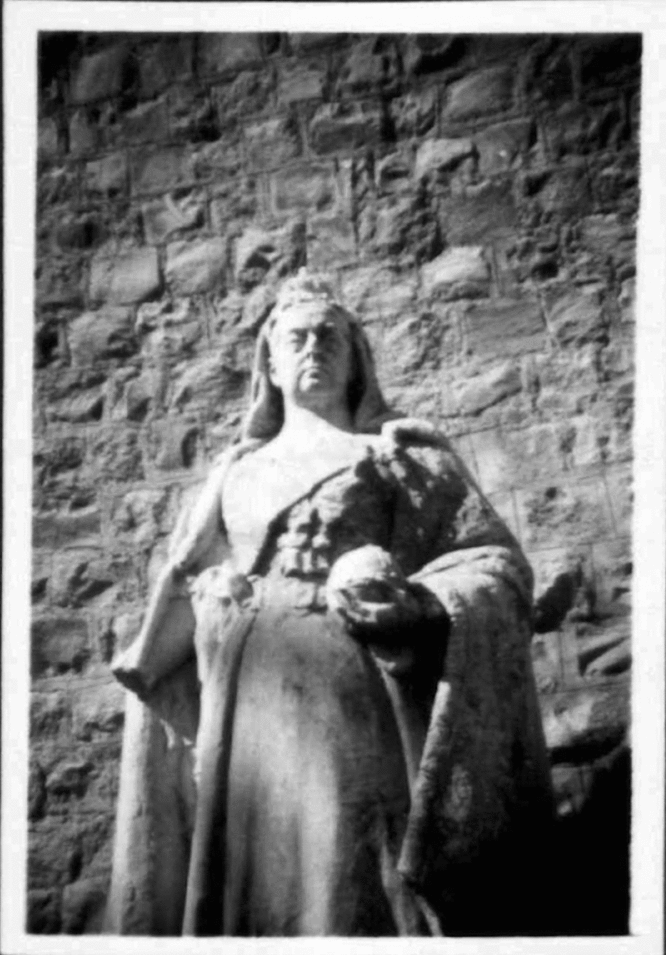
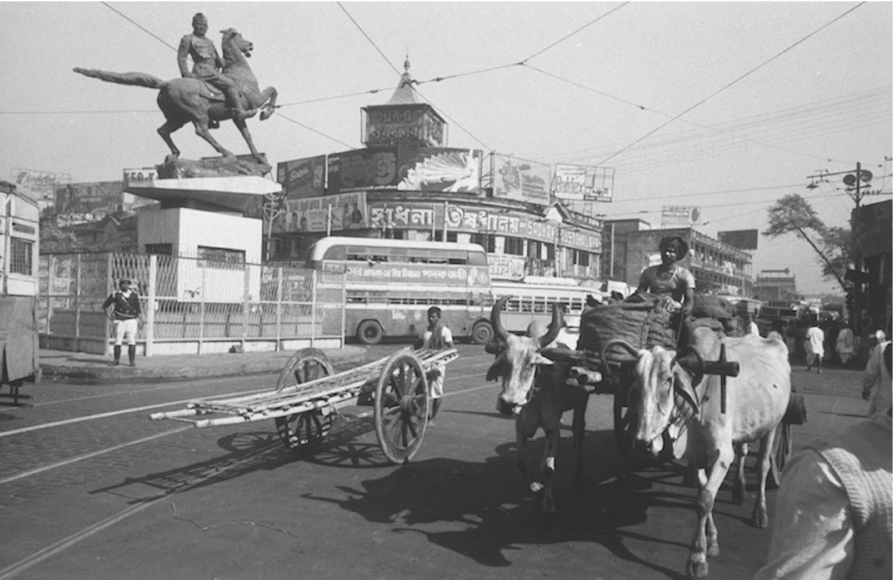
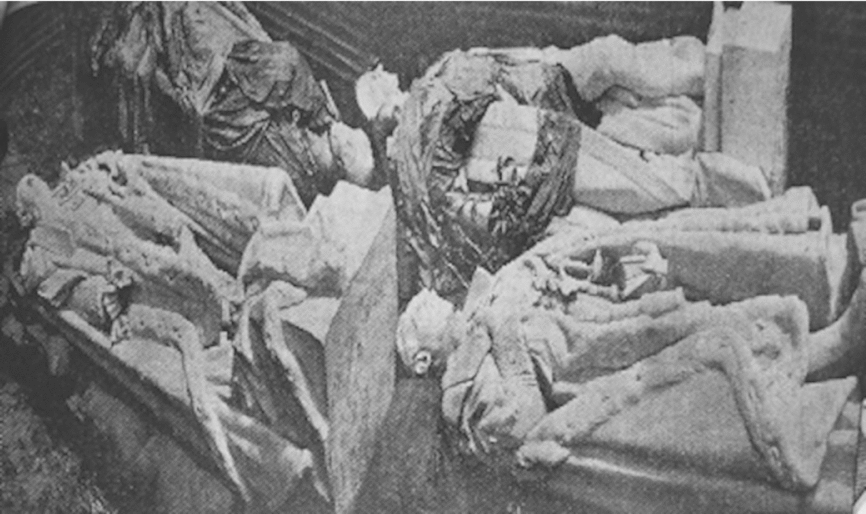

 Open access

