

5.1 Humanitarian Accountability
Accountability is a moral precept that holds people answerable for their deeds, either to themselves, to someone else, or to a principle. A broad definition sees it as ‘the giving and demanding of reasons for conduct’, usually encompassing the possibility of sanctions.Footnote 1 While it is a ubiquitous standard, accountability is particularly critical for organisations that pursue a moral cause and are founded on trust.Footnote 2 The various accountability obligations that guide the work of aid providers encompass hierarchical principal–agent relationships, introspection and contractual ties, and voluntary patronage. Hence, a basic classification distinguishes vertical (upwards), horizontal, and diagonal (downwards, or social) accountability.Footnote 3
While accountability is a universal principle arising from the dependence of human action on conscious decisions, it is also a hallmark of neo-liberal governance and the notion of ‘rational choice’ that has increasingly permeated the language and culture of humanitarian affairs.Footnote 4 However, the provenance of accountability goes beyond any particular school of thought and has been strongly in evidence over the past half-century. As early as the 1970s, there was a growing interest in social accounting,Footnote 5 and Médecins Sans Frontières (MSF) gave it a deliberately expressive twist with the propagation of its philosophy of témoignage, or, speaking out.
Moral Bookkeeping
Accountability is a prominent concept today – so much so that it is at risk of becoming a buzzword – and has always been a prerequisite for the legitimacy of aid efforts. A rare study analysing the emergence of the British charity market in the late nineteenth century argues that self-regulation and the establishment of accountability mechanisms were crucial for this development.Footnote 6 In its affinity with history, accounting provides a normative framework for reporting and bookkeeping practices.Footnote 7 However, few studies have mapped humanitarian accounting in a historical perspective. This absence aligns with the observation that ‘the history of NGOs as businesses has yet to be written’, and with the call for an alternative narrative of humanitarianism based on its ‘capitalist logic’.Footnote 8 Moreover, it coincides with the widespread ignorance of how calculative routines foster legitimacy, something Herbert Hoover cited in a statistical overview of his Commission for Relief in Belgium (CRB) during the First World War:
The multitude had but little concern for the bookkeepers in the back rooms of the offices of the relief organization. But the work of these men was of the utmost importance to those in official direction, not only that the relief undertaking might be effectively performed and presented to the world, but that our honor and the honor of our country in this trusteeship should never be challenged.Footnote 9
Accounts as lieux de mémoire of their relief efforts are enduring monuments for philanthropic organisations, encompassing both economic and symbolic confirmation of their power. They are documents of altruistic accomplishment, similar to those that furnish individual donors – apart from a sense of pride – with their ‘warm glow’ of inner goodness. Reports of how their gifts are delivered, what such gifts mean to the distributors and beneficiaries, and the gratitude that they produce give donors an emotional return on their investment. At the same time, gratitude is a confirmation of the donor’s role and may trigger societal, economic, and political transformation. Aid agencies are, therefore, eager to receive and document their share of moral credit. While some donors may display a lack of interest in a formal accounting, once a concern for impropriety or fraud is raised, the documentation of proper agency and the responsible administration of donations become essential. As the willingness to donate presupposes a belief in the appropriate distribution of aid, so accounting for revenues and allocations is a critical element of the moral economy.Footnote 10
All of these issues reveal characteristic differences between humanitarian accounting and that of for-profit businesses. Apart from efficiency, the moral economy of the former is also bound up with legitimacy, governance, and justice. For example, humanitarian gifts may be earmarked and subject to restriction, in which case their use for overhead expenditures or additional fundraising becomes problematic. Moreover, humanitarian organisations are generally expected to put their funds to work immediately, even at the expense of utility. Their notions of distributive justice are, thus, closely linked to procedures of accounting.Footnote 11 At the same time, donations can be badges of social status, relational aspirations, and communalisation. The representation of prominent people on ‘rolls of honour’ and other donor lists may garner attention, as may lack of charity be reputation-damaging (a phenomenon that seems to have decreased over the past century).Footnote 12 Although the economic power of donations is life-saving in absolute terms, its significance is frequently judged according to the circumstances of the individual contributor. The attention devoted to the humble gifts of poor people; donations from marginal or disadvantaged groups; and the pocket money contributed by children illustrate a ‘moral’ bookkeeping notion that may have its roots in religious tradition.
The documentation of material sacrifices affects the quality humanitarian causes acquire when adopted by a mass movement, and in turn reflects back on the movement and its surrounding society as moral high ground. A national effort thus becomes a catalyst of purification and cohesion. Moreover, the fact and spirit of giving may appear more momentous than the actual sum raised, even to beneficiaries: although the means of alleviation are commonly inadequate, the recognition of those who are suffering, the experience of solidarity and the provision of partial relief may serve to energise and raise the hopes of vulnerable populations.
Moral Economic Priorities
Viewing events from a moral economy perspective offers a partial remedy to the absence of business scripts and accounting practices in humanitarian studies. Ebrahim’s taxonomy of accountability mechanisms includes reporting, evaluations, participation, self-regulation, and social auditing.Footnote 13 Sources for investigating these dimensions include financial disclosures, annual reports, and other publications that document ideas, actions, and circumstances. Such accounting material shows how aid agencies pursued governance, justice, effectiveness, and legitimacy. The existing records supply detailed information on particular relief efforts. At the same time, any analysis of aid provision should be mindful of Giddens’s observation that the power of actors lies in their capability ‘to make certain “accounts count” and to enact or resist sanctioning processes’.Footnote 14
Accounting has been interpreted as a tool for handling ‘the tensions that surround moral-economic experience’ through an evaluation of the suitability of human choices and actions.Footnote 15 The abundance of human suffering and the consequential need of an efficient application of resources and a plausible selection among humanitarian causes are strong motives of accountability.Footnote 16 More specifically, the arena of ethical options between the donor and beneficiary commitment of relief agencies has been qualified as ‘accounting’s moral economy’.Footnote 17 This entails the prioritisation of certain stakeholders over others and, thus, encompasses needs assessment and the mechanics of triage.Footnote 18 However, the choice is generally not discretionary. Observers agree that an organisation’s upward accountability ‘for itself’ generally overshadows its social accountability ‘for the other’. The voluntary surrender of money and power disparities suggest a paternalistic moral compass that requires humanitarian agencies to be financially accountable to their funders, overriding broader normative postulates of social accountability. Much of the available literature deplores the donor-affinity of aid agencies compared to what frequently appears to be lip service to beneficiaries.Footnote 19
Thus, the moral economy in question is shaped, on the one hand, by an asymmetry of tangible material stewardship, and on the other, by the more elusive commitment that ideally accompanies a gift. The difficulty of imagining a reversed transfer of resources or compelling social accountability mechanisms is ‘the uncomfortable reality of charity’, which explains why the broadly advocated revaluation of beneficiaries makes little progress.Footnote 20 Principals may be weak, agents strong, and professional humanitarianism may have its intrinsic logic. However, this does not ultimately provide support to recipients or make ethical imperatives on their behalf coercive. As long as social accounting remains voluntary and confronts unequitable recipient societies that are hard-pressed by an emergency, it cannot advance accountability or raise critical issues effectively.Footnote 21 Rather, accountability continues to presuppose subordination under the post facto scrutiny of a legitimate superior. The basic model remains that of an agent liable to a principal who provides resources for a specific purpose. Transfers entail an understanding of the right to expect material improvement and accounts of how means have been used.Footnote 22 As an internalisation of moral claims held by an external authority, accountability frequently emphasises the asymmetry between donors and recipients.Footnote 23
Accountability is thus enmeshed with power, and at best may be a display of goodwill when exercised downwards.Footnote 24 Rather than ‘multiple accountabilities disorder’ (MAD) or agency loss through obstinate humanitarian organisations, the main problems remain the principal’s (i.e., donor’s) exercise of authority and the agent’s ‘over-accountability’.Footnote 25 Fraud and abuse are a particular concern in such an idealistic field as humanitarianism, making reliable books a necessity. However, an obsession with accountability and administrative integrity can foster proceduralism and risk aversion that may undermine relief work in emergencies – and the effectiveness and efficiency of collective action in general.Footnote 26 At the same time, visible downward accountability may serve the purpose of satisfying donors, that is, it may be a function of upward accountability, or it might entrench local inequalities.Footnote 27
5.2 Figures, Narratives, and Omissions: Ireland
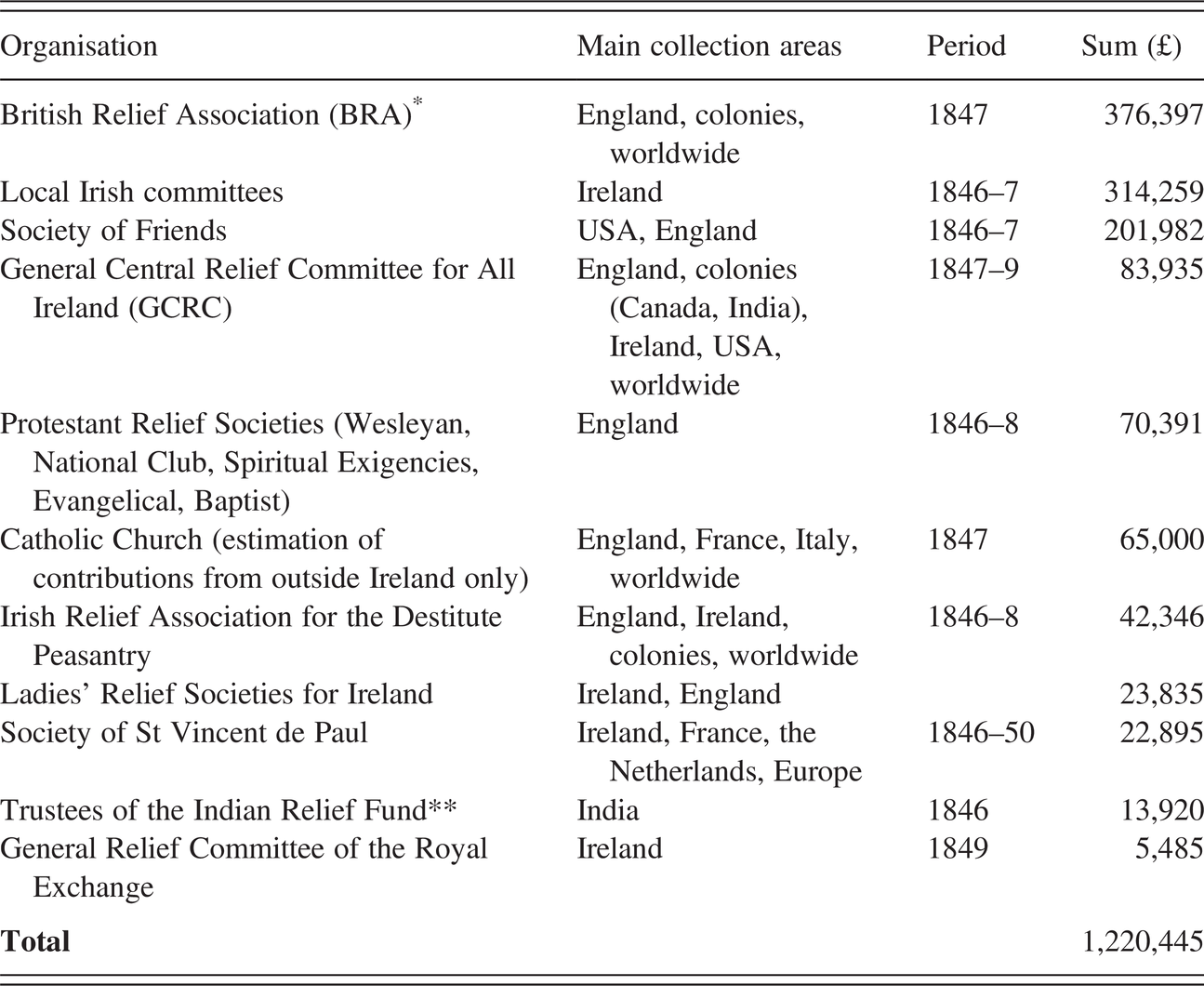
Aid providers accounted for their efforts at the time of the Great Irish Famine in ways that varied greatly. Accounting was generally a tool for apportioning and keeping track of donations, satisfying donors and partners, and creating legitimacy for the aid approach chosen. In the mid-nineteenth century, there was a general expectation that relief efforts would be publicly accounted for in the press. Double-entry bookkeeping was widely practiced, but there was no overall model of accounting, and each organisation chose its own way of public disclosure. Table 5.1 presents an overview of major organisations that distributed relief in Ireland between 1846 and 1850. Many smaller-scale channels also received donations. These included local committees whose distribution need not be in compliance with government rules (and therefore not systematically registered), various community charities and churches whose social work took on the task of famine relief, and private money that was passed from individual to individual. The total sum of voluntary contributions might thus have amounted to £1.5 million (the real price equivalent of £135 million in 2018Footnote 28).
* BRA’s income destined for Ireland: £391,701 (of which £20,190 passed on to GCRC). In addition to £2,606 cash documented in its report, BRA distributed £4,886 in provisions for a Bristol committee (‘Irish and Scotch Relief Committee-Room’, Bristol Mercury, 20 Nov. 1847).
** From 1847 on, revenues of the Indian Relief Fund (£9,063) were transferred to the GCRC.
At the time, the famine was considered an internal Irish matter by the British. However, others saw it as the internal administrative and moral responsibility of the UK, which at the time was the wealthiest, most powerful country in the world, with an efficient government apparatus and a strong culture of voluntary action. By contrast, foreign countries lacked the bond of a joint body politic with the Irish, commanded humbler means, and could not easily imagine the extent to which unmitigated market forces and laissez faire policies were allowed to prevail in Ireland.Footnote 29 A disaggregation of the accounts of various organisations, tracking the geographic point of origin of Irish relief donations, shows that contributions from outside Ireland comprised less than one million pounds (Table 5.2). Ireland’s own share of voluntary famine relief was probably higher than that of any external country, but is difficult to approximate; outside contributions were more systematically recorded. Irish famine relief in the 1840s was a worldwide endeavour, but our mapping shows considerable variations in the degree of responsiveness.

* Does not include unofficial charity not meeting government standards, the work of existing charities, informal local acts of charity, or domestic Irish donations to the Catholic Church used for famine relief.
The geographical perspective is informative in some ways and misleading in others. There is insufficient data for estimating the amount individuals of Irish descent contributed to English and imperial collections, but there is evidence that they were over-represented, in particular when considering the distribution of wealth. Moreover, expatriate UK citizens were often the ones to organise donations from distant parts of the empire and other locations worldwide.
Although most donations from abroad came from England, the Irish were looked upon in Britain as an unruly and backward people, in a way we recognise from Orientalist discourse. As a people, the Irish lacked the goodwill that they enjoyed in places like the USA, France, or Italy. Irish landlords largely shared the image problem of their tenant farmers, and only in the north and east of Ireland was there a conspicuous middle class. In fact, the final report of the BRA claimed that the failure of the staple food crop in western Scotland had been as severe as in Ireland, but praised ‘the prompt and systematic exertions which were made by the resident landowners and others in Scotland’. The BRA had placed its funds for Scottish relief at the disposal of two local committees. The approach towards Ireland, where there were few reliable agents, differed, and the Irish crop failure reportedly resulted in disproportionate suffering. Therefore, rather than local civil society, a government agency for military supplies, the Commissariat, was given primary responsibility for the distribution of relief.Footnote 31
Despite prejudice towards Irish beneficiaries, the sum raised by the BRA during the Great Famine exceeded that of any other campaign at the time. It included substantial contributions from Catholics, Irish, the British Colonial Empire, and foreigners of various nations. Nonetheless, English Protestants donated more than any other source outside of Ireland.Footnote 32 Apart from reflecting geographic proximity and financial means, it illustrates that the commitment emanating from political association, although still inadequate, was greater than that resulting from ethnic or spiritual ties. Alternative means of voluntary aid, such as government relief measures, denominational prayers, and private remittances, contextualise rather than change this picture.
An analysis of the accounting message of different organisations shows both similarities and varying approaches. Most fundraisers were eager to emphasise the broad background of their donors, including those from the establishment, celebrities, and also common people and groups whose donations represented a sacrifice. Thus, contributions by convicts, slaves, and Native Americans received special attention in the press. For example, an Irish newspaper exclaimed: ‘“Lo! the poor Indian” – he stretches his red hand in honest kindness to his poor Celtic brother across the sea.’Footnote 33 The first advertisement by the BRA set a precedent, listing a few humble donations among prominent and comparatively high ones, including a collection from a family’s children and servants.Footnote 34
British accounting, both governmental and voluntary, stressed the extent of relief efforts and the discharge of one’s duty; it was geared to declare the end of famine and justify the cessation of aid. By contrast, the accounts of the Irish Quakers, who distributed most US and some British relief, tended to reveal the insufficiency of aid efforts, being both critical of the British government and self-critical, while conveying a sense of Quaker leadership in the humanitarian sector. US accounts emphasised rallying around Irish relief as a manifestation of national unity and an acknowledgement of essential humanitarian values. For the USA, supporting the Irish was both a goal in itself and a challenge to British primacy in this field (even when Britain touted their unpolitical engagement in an integral part of the UK). Finally, while the Catholic Church proper accounted for its aid sporadically, Catholic newspapers and civil society organisations like the Society of St Vincent de Paul (SVP) offered some of the most transparent accounts of aid and moral economic calculations at the time.
British Relief
‘Were no accounts kept? Some people think that figures only tend to obscure (smiling).’ This sardonic remark and gesture of the Lord Lieutenant of Ireland rebuffed the Reverend Townsend, a member of a deputation to Dublin, in November 1847. Townsend, who had been one of the deputies from Skibbereen to London a year earlier, had voiced the ‘belief’ that not much money collected during the previous winter was left, if any.Footnote 35 On another occasion, while documenting the use of funds in a letter to a major donor, Townsend pointed to the expense of having to account for the daily expenditure of the many small sums he received.Footnote 36
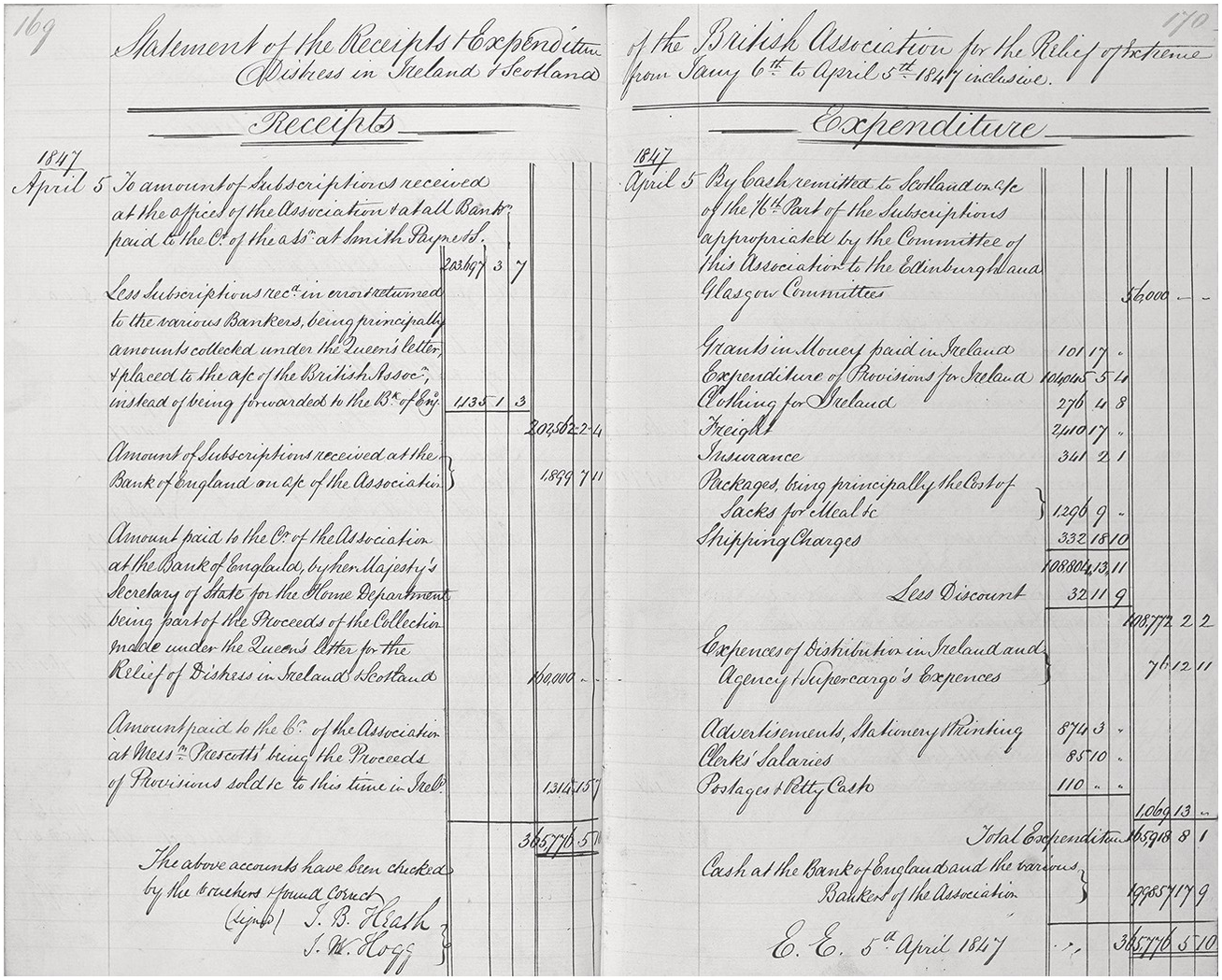
Accounting technologies were as crucial for British voluntary aid (see Figure 5.1) as they were for the government’s struggle to keep entitlements for official relief at bay – principally by excluding the purportedly ‘undeserving poor’ and by depressing benefits to an uncomfortably low level.Footnote 37 The general suspicion was expressed by a Times journalist who told the Skibbereen ministers in December 1846, during their fundraising mission to London, ‘that if the people of England were satisfied they would not be abused and laughed at by the Irish, it was not one million, but millions would be subscribed’.Footnote 38
Account book of British Relief Association, entry of 5 Apr. 1847.
Despite the safeguards they took against fraud and their blunt communication during the fundraising campaign, the BRA was not even the limited success some researchers have claimed. Rather than creating trust, prejudices were perpetuated against Ireland by the way money was spent, which may in turn have tempered donations as much as the perceived Irish lack of gratitude.Footnote 39 The contribution of one guinea by an anonymous ‘Saxon, who loves his brother Pat with all his faults’, and the tenuous documentation of gratitude in the final report of the BRA (which had a technical section headed by an address to the Ottoman sultan but without a reference to the queen) illustrates this ambiguity.Footnote 40 One-sixth of the £470,041 collected was reserved for Scotland, reducing the Irish share to £391,700. Although celebrated as an achievement, this amount barely exceeded the funds raised during the partial Irish famine of 1822, and represents a fraction of what the Times journalist had estimated would be raised if English confidence in the cause of Ireland could be inspired.
One of the functions of public accounting was the circulation of what Roddy, Strange, and Taithe call ‘a consistent tale of social hierarchies of giving’.Footnote 41 Suggested ‘appropriate’ contributions were solicited by establishing donor categories and subscription levels, and unlike later contributions, early ones were listed in order of status, rather than chronologically. Even before the first subscriber list had been published, Queen Victoria was persuaded to raise the amount of her initial subscription. Prime Minister Lord Russell also increased his contribution, giving himself precedence over the home secretary. It was not publicly acknowledged at the time that the Quaker banker Samuel Gurney made the first pledge of money, setting a benchmark of £1,000 for donations of comparable firms.Footnote 42
The official narrative started with the queen’s prompt donation and request to have her name placed at the head of the list. In light of her promise ‘of such further amount as the exigency might demand’, the queen’s failure to increase her initial subscription of £2,000 (apart from a £500 contribution to the Ladies’ Clothing Fund) signalled a lack of desire to support a greater relief effort.Footnote 43 Along with other members of the royal family, the archbishops of Canterbury and York (the latter made two donations, indicating another adjustment), the lord chancellor, and eventually his imperial majesty the Ottoman sultan, the queen’s name headed some two dozen lists of ordinary subscribers, collections, and colonial bodies, furnishing the voluntary subscription with examples of national duty among officials (within the limits indicated by the sums given) and lending the campaign exotic prestige.Footnote 44 The contributions were discussed in the press, along with rumours about a trifling royal donation of a mere £5; or a report that the sultan had been prevented, for reasons of protocol, from giving ten times as much or sending relief ships. Thus, money was seen by contemporary observers as symbolising humanitarian commitment and as a way authorities discharged their paternal and maternal responsibilities.Footnote 45
In 1846/7, the famine was viewed as a unique seasonal calamity (the role of the preceding government’s interventionist policy that had prevented excess mortality in 1845/6 was not widely known).Footnote 46 The food shortage persisted after the calamities of 1846/7, and the blight returned with full force in 1848 and 1849. Years of extreme mortality were to continue, but by autumn 1847, the UK government treated the famine as having come to an end. There was little suspicion abroad that this negation reflected wishful thinking and a preconceived downscaling of relief, rather than an authoritative statement by public servants accountable to those that they governed.
The cessation of exceptional relief measures funded by the UK government and the turn to a solely Irish-supported poor law in the autumn of 1847 marks the beginning of an ideologically motivated famine denial. Trevelyan’s quasi-official treatise, The Irish Crisis, published in January 1848, introduced a development image that attributed governmental and voluntary aid to Ireland back to ‘the potato system’ of an accounted for past. Selected data on funding, supplies, and policies corroborated the claim of an unparalleled relief effort that included a variety of experimental features. The reported figures demonstrated goodwill for the spiritual and temporal record, while claims that the Irish had been ‘saved from a prolonged and horrible state of famine, pestilence, and anarchy’, and that their case was ‘at last understood’ served to legitimise the status quo. At the same time, Trevelyan’s apologia celebrated the restrictive management of aid, including timely accounting techniques, as having laid the groundwork for a moral (and thus sustainable) improvement of Irish society that reliance on aid from outside could not undermine. As Trevelyan saw it, ‘great sacrifices’ were still required, as the Irish had been forced to realise ‘that the plan of depending on external assistance has been tried to the utmost and has failed … and that the experiment ought now to be made of what independent exertion will do’. Buttressed by conclusions drawn from recent experiences with Ireland, the underlying moral economic supposition was that relief, while occasionally a necessary evil, should exert pressure on the conscience of the local upper class and be distasteful to the pride of the lower classes in order to be properly contained.Footnote 47
With his early 1848 account of Irish misery, relief, and improvement, Trevelyan made the British government’s dismissive position on the Irish famine difficult to reverse, although those involved knew better. By 1849, the Treasury projected an outline of distressed areas of Ireland onto a railroad development plan, thus producing a contemporaneous famine map (Figure 2.1). Three colours were used to highlight (a) counties designated as ‘distressed’ by the Board of Works in May 1849 (the westernmost 60 per cent of the country); (b) areas bordering on the former that ‘should have been included’ in that category in the light of subsequent experience (10 per cent); and (c) areas that appeared ‘to be unable, under present circumstances, to provide from their own resources adequate employment for their population’ (10 per cent). However, the image of the distressed areas served as a depiction of the state of the country for internal administrative purposes only; there was no public acknowledgement of the needs depicted.Footnote 48
Against the background of generalised reluctance to provide aid, the 1847 BRA campaign demonstrated to the English, the Irish, and to the world-at-large (and even to the Almighty) that the UK lived up to a standard of civilised Christian solicitude for the well-being of fellow-citizens and supplemented government support with supererogatory voluntary action. Public accounting was a legitimising tool towards this end. At the same time, the voluntary campaign did not require the detail and frequency of governmental accounting reports. This decreased the workload on relief workers and resulted in more aid to beneficiaries.Footnote 49
Advertisements had already informed the public of some of the philosophy behind the use of funds when the BRA published its final report by early 1849. It included extracts of correspondence with agents, samples of working documents, resolutions of thanks, a balance sheet, tables of provisions, and a complete list of donors and ancillary collections. The report reveals the voluntary campaign’s dependence on official policy, but also includes one example in which public funding took over a measure instituted during the famine for some time after voluntary funds were exhausted. The issue was the feeding of school children, a major form of relief provided by the BRA from late 1847 to mid-1848, and which the BRA described as particularly satisfactory. The report viewed children as innocent victims of moral degradation who, by attending school, could be bearers of educational progress to society. The BRA chose poor law commissioners for Ireland as trustees of its remaining balance and by their actions endorsed the official denial that there was any continuation of the famine. It saw its own mission as having been accomplished and did not acknowledge the winter of 1848–9 as a period of repeated mass mortality.Footnote 50
Quaker Relief
Presuming that ‘evils of greater or less degree must attend every system of gratuitous relief’, the BRA report announced its confidence in having shown that any such evil had been ‘more than counterbalanced by the great benefits’ of its work for ‘starving fellow-countrymen’.Footnote 51 The Central Relief Committee (CRC) of the Society of Friends (SoF) in Dublin – the main broker of aid from the USA, and also an organisation supported by English Quakers and independent Irish and English donations – published its report in autumn 1852 in a different spirit. The committee explained the discontinuance of most of its efforts in the winter of 1847/8 as due to the exhaustion of relief workers (some helpers themselves having become ‘fit objects’ for aid and others dying), rather than because the situation had improved. When in the summer of 1849 Trevelyan, on behalf of the British prime minister, asked the CRC to resume its work (indirectly admitting governance failure and the premature nature of his own account), he was told that voluntary aid had necessarily been seasonal and that only the government commanded means to adequately address the prevailing distress.Footnote 52 Even the Irish Quakers admitted, ‘We have made mistakes of judgment in the selection of the means of relief, and committed errors in the details of administration; so that the means placed at our disposal have perhaps been less useful than they might have proved in other hands.’Footnote 53
The Quakers acknowledged that it was questionable for them to have used parts of the relief funds for a development project (a ‘permanent object’). While justifying an investment in their ‘model farm’, rather than in aid to the destitute, as having the greater benefit of wages compared to gratuitous relief, they showed that they had lost confidence in the profitability of their industrial experiment. Likewise, they described various fisheries projects as ‘failures as commercial undertakings’. They also discussed cash support versus relief-in-kind, anticipating much of Sen’s argument.Footnote 54
The CRC report totalled almost 500 pages. It accounted for £198,327, excluding 642 packages of clothing, the value of which remained undetermined. Of the total sum, £15,977 in cash and £133,847 worth of provisions (as its value was assessed in Ireland) had come from the USA in ninety-one shipments. The CRC discussed shifting public policy and what this meant for the liberality with which it offered its own relief. In addition, the report contained statistics on other organisations and pointed to a vast number of untraceable contributions there, estimating that the total sum of voluntary donations must have approached £1.5 million. The authors emphasised their close contact with fundraisers in the USA and fellow aid workers in Ireland. However, the voices of actual recipients were not heard in the report, and gratitude remained a minor issue in the documentation. Due to their meticulous accounting, the CRC occupied a special role among humanitarian organisations. They stressed their own reputation, including their capacity for self-criticism, which further increased the moral capital of the SoF. Moreover, they used their influence to advance the political argument that the problem of Ireland was a dysfunctional land law, rather than an improvident people.Footnote 55
US Accounts
Despite an early attempt at coordination, no joint campaign for Irish relief was launched in the USA. Regional hubs aggregated collections from areas near and distant, while Quakers, Catholics, and a number of small towns took independent action. The major regional committees were initially based in New York and New Orleans, with Washington, Boston, Baltimore, Philadelphia, and Charleston as supplementary centres.Footnote 56 The committees in New York, Philadelphia, and Charleston put out their own reports, and the Boston-based New England Committee published documentation of their field mission. Other committees probably accounted for themselves by notifying local newspapers.Footnote 57 US committees generally used their funds for the purchase of food for shipment to Ireland. In 1847, the British government defrayed freight expenses in the amount of £42,674, which was applauded in the USA. Overhead was thus significantly reduced, leading the head office of the Irish Quakers to announce, ‘The food put on board at New York, may be considered as laid down almost at the doors of the sufferers for whom it was intended.’Footnote 58 The fact that most US relief consisted of provisions-in-kind increased its value to the Irish and was so entered on the accounts of local Quakers. However, this effect seems to have been modest as famine prices rose to their highest level in Ireland before large US food shipments arrived.Footnote 59
The New York Committee, which administered cash and provisions valued at a total of US$242,043 (£50,531), tasked a subcommittee with preparing a report to satisfy contributors. It considered extensive documentation necessary because external donors could not be expected to follow account notes in the New York press. Another motivation was correcting ‘erroneous impressions that have obtained to some extent in Great Britain, in regard to the character and motives of the popular movement in America in behalf of the poor of Ireland’. The report was to show ‘an act of hearty popular benevolence, unconfined in its locality, disconnected with party, creed or sect, and coupled with no selfish end or aim’.Footnote 60 The statement also hinted at the suspicion that the USA had interfered in British–Irish affairs and had disparaged UK relief efforts, perhaps also alluding to US sympathies for the repeal of the union between Great Britain and Ireland, and UK–US rivalry over the Oregon territory.Footnote 61 While admitting that US donations were small in comparison to the country’s great wealth, the New York Committee maintained that the relief it provided had saved thousands from starvation, created ties across the ocean, and presented an example to the world. However, the committee devoted most of its space to lauding the campaign for its cohesiveness and promotion of Christian values among US citizens.Footnote 62
The Philadelphia Committee, citing the difficulty of estimating the value of the charitable acts made possible by its US$75,600 (£15,783) contribution, presented a simpler moral economic balance sheet: in Ireland, it claimed, the lives of thousands were saved, while in the USA, the hearts of thousands ‘were made to beat with pleasure, in the consciousness of good performed’. The report also suggested the enhanced positive relationship between nations as a permanent reward. Narrower in scope than the New York report, and without a list of subscribers or a full balance sheet, the Philadelphia summary presented a narrative into which key documents were integrated. It estimated that overall contributions channelled through Philadelphia had amounted to half a million US dollars, including separate collections from Quakers, Episcopalians, and Catholics, and more than US$300,000 in private remittances.Footnote 63
Boston’s first relief ship to Ireland became iconic. The USS Jamestown was a decommissioned battleship that the US government provided for a peace mission. With marked symbolism, loading began on St Patrick’s Day, and the ship’s reception in Cork was ecstatic. In place of a full account of activities and fundraising, the Boston Committee published a narrative of the voyage of the Jamestown written by its captain, Robert Bennet Forbes.
The report adhered to genre conventions with its extensive appendices of documents and economic accounts, but differed in several respects. It was more graphic than was common at the time, including a lithograph showing the ship’s departure from Boston harbour on 28 March 1847 (Figure 5.2). It also had poems of thanks that referenced the Bible: ‘A cup of water given … is registered in Heaven.’ The report’s brief first-hand accounts described scenes of horror with an accompanying comment that, considering the gravity of the situation, little more could be expected than to preserve the bare lives of the starving – with food that American hogs would reject. The report also suggested that Americans pay back a debt for relief that the Irish had provided to New England during the devastating war against Native Americans in 1676, including interest – the equivalent, it was said, of roughly US$200,000. Although the Boston Committee eventually managed to raise three-quarters of that sum (US$151,007, i.e., £31,525), in addition to receiving donations from New England through other channels, Captain Forbes wrote that Irish relief was ‘partly for the payment of an old debt and partly to plant in Irish hearts a debt which will, in future days, come back to us bearing fruit crowned with peace and good will’. Finally, while observing that England was ‘not deaf to the call of suffering Ireland’ and that the Irish expected too much, he noted their complaints of want of sympathy from the government and trusted that England would learn a charitable lesson and do more than she was doing in the future.Footnote 64
Departure of the USS Jamestown for Cork, Ireland, Boston, 28 Mar. 1847.

Accounting Practices among Catholics
Within the Catholic Church, donations were processed in a hierarchical, parish-based context; accountability was practiced through individual correspondence, epistles, and verbal communications to congregants. By the middle of the nineteenth century, these communal practices of the clergy were supplemented by such Catholic branches of civil society as voluntary associations and the religious press. While the bookkeeping practices of the Church tended to be lax, the SVP and the newspaper the Tablet represented a modernised moral economy with higher accounting standards.
Collections among Boston Catholics illustrate the poor documentation of most relief administered by bodies of the Church, reflecting the trust-base of their system. A study of Boston Catholicism, while conceding the difficulty of getting a clear picture of donated money and provisions, nevertheless estimates that Catholic charities in America conveyed US$1 million to the Irish clergy – a sum forty times the amount collected by Boston Catholics, and so highly improbable.Footnote 65
In New York, Catholics mostly transferred collections to the general city fund for forwarding to the Dublin Quaker committee in a display of ecumenical spirit. By contrast, the Catholic Church in Boston maintained their own separate fund. The documentation that has been preserved consists of correspondence between the bishop of Boston and his Irish colleague, Crolly, the archbishop of Armagh, in addition to scattered notes in a handwritten diocesan journal. These notes speak of various collection results, of an early interim ‘report to the people’ during a mass with a tally up to that point in time, and of the bishop’s estimate that the collection would amount to US$25,000 (plus private remittances by Catholics, which he believed had totalled US$125,000 for the first half of 1847). While the overall extent of the collection is evident, the only clear detail is that the bishop forwarded a total of £4,917 11 s 8 d to Crolly (US$23,550) to be distributed among the other archbishops of Ireland. But the calculation was left to the reader, and the final remittance was a round sum that must have been an approximation of a collection in US dollars.Footnote 66 At the same time, in a letter to Ireland that he read to his congregation, the bishop accurately noted that the Catholic solicitation had taken place before the general fund drive and therefore attracted early donations by Protestants; thus need, rather than faith, should determine the distribution.Footnote 67
Crolly stated that the archbishops had apportioned the distribution without distinction of creed, but did not specify the outcome of the division or the dispensation further down the aid chain.Footnote 68 Such lack of transparency was not a solitary case. Archbishop Murray of Dublin was reluctant to publicise how he distributed donations – his fear, according to one commentator, being that open accounting ‘might generate expectations which he would not be able to meet’.Footnote 69
By contrast, a nineteenth-century biography portrayed Archbishop MacHale of Tuam as a meticulous accountant and relief administrator. The writer (who lost the documents on which his book was based) claimed that MacHale did the whole work of receiving, acknowledging, and distributing donations unaided. However, MacHale’s interest in public accounting seems to have primarily emanated from the opportunity for political messaging. For example, in one acknowledgement of donations, he stated that it was a pity private charity was ‘rendered almost inoperative by the cruel and merciless theories of political economy; or, what is worse than theories, the cruel and merciless practical policy that has been adopted by our incapable rulers’. Elsewhere, he warned the government of the moral economy of hungry masses who would ‘prowl for food wherever they can find any to appease the cravings of hunger, which no argument of terror or persuasion, short of food, can appease’.Footnote 70
Vatican archives contain many details about Italian collections, and some records concerning the distribution of funds among Irish clerics; but attempts to aggregate this information have been limited and only sporadically published. A handwritten distribution chart for the second quarter of 1847 lists monies submitted to various Irish bishops and (to a lesser degree) monasteries. The total amount is £3,305, although due to a calculation error, the record underestimates the actual sum by £100.Footnote 71 In all, the Vatican sent approximately £10,000 to Ireland, £7,000 of which was collected in Italy.Footnote 72
Unlike the Holy See, the French committee for Irish relief published a concise tabulation of their accounts for the greater part of 1847, in accordance with the civil society standards to which the committee declared its adherence. However, it listed revenues per diocese, revealing its de-emphasised ecclesiastical perspective.Footnote 73 The French raised and distributed £15,917 among the Irish clergy in 1847, and an additional £4,000 in 1848 and 1849, when other relief efforts had slackened. They also published letters of thanks from the Irish clergy and a final report with an overall accounting. The report speculated that the French effort might have saved 60,000 lives directly and, as a foreign encouragement, might have produced additional ‘interest’ by stimulating the charity of the local middle and upper classes.Footnote 74
By contrast, the Catholics of England and Wales accounted for their relief work in a fragmentary manner. Proper balance sheets have come down to us only from the Lancashire District Catholic Fund, which brought in the highest proceeds of £4,921, and from the Northern District. In both cases, most of the revenue resulted from church collections. Whereas the northern distribution was scattered, the Lancashire fund was divided equally between the two archbishops in the most distressed southern and western parts of Ireland. This account also specified a minimum that Catholics from Lancashire had submitted through other channels.Footnote 75 A similar balance sheet for the district of York reported episcopal collections and donations by Yorkshire Catholics to alternative funds. The cases of York and of the Eastern District indicate that the way of publicising such accounts was as an attachment to pastoral letters delivered orally to the parishes, and only incidentally reprinted for a wider audience.Footnote 76
No other final accounts survive for dioceses in England and Wales, although some accumulated sums were published in the press at various points in time – principally in the Tablet. Thus, London reported £2,380 in early February 1847, and Wales approximately £422 in March.Footnote 77 No aggregated results are known for the Central District, but a church collection was reported from Birmingham, where relief efforts were concentrated on meeting the influx of Irish paupers to that city. As the London and the Central Districts passed their collections on to the GCRC via Murray, their overall totals may be approximated by studying the list of donations to that committee (£2,598 and £849, respectively).Footnote 78 The bishop of the Western district gave £5 to that fund out of his own pocket and published an impassioned plea for famine relief to his clergy, but his departure to Rome during the critical period seems to have preempted a coordinated effort at home. Instead, some Catholic churches of Bristol are recorded as having contributed to the city fund.Footnote 79
Not only did the Tablet’s modern approach to publicity make it the best source for information on English Catholicism and the Irish famine, but it became a channel for relief in its own right. After Fredric Lucas had issued an early call for aid, donations started coming in, and a collection began that raised more than £3,000 by the beginning of July 1847. The collection continued to amass scattered donations until 1852, the final year of the famine. No overall balance is known, but the Tablet published weekly accounts during the initial months of its drive, and an occasional summary or ad hoc notifications after June 1847. Later contributions were sometimes announced under the heading ‘Irish Poor’ and thereby merged with charity in general.Footnote 80
The amount received by the Tablet in the second week of January 1847 remained unsurpassed; the total for the last days of December and January was £1,202; the sum for February was approximately one-half of that; for March one-third; for April and May one-quarter; for June one-fifth. Contributions rapidly decreased after that. In general, donations were modest, and in many cases represented local collections taken among church congregations or solicited from the Irish community in England. ‘A few workmen’ sent five shillings, the smallest joint contribution, while the smallest individual subscription, given by ‘a poor English labourer’, was half a shilling. However, many individuals and groups donated several times over, or organised weekly collections. Some donors gave gold watches, silver cutlery, or precious textiles, which Lucas had to turn into cash. While this complicated the process of aid provision, it also conveyed a sense of the urgency of the aid cause.
Although the Tablet primarily solicited funds from Catholic residents of England, and engaged Catholic prelates and Catholic institutions for field distribution, some Protestants and people from abroad were among the Tablet’s contributors. Lucas mainly spread his relief throughout the severely afflicted western and southern parts of Ireland. Responding to appeals and correspondence published in his paper, and considering occasional requests by donors, he frequently indicated how he believed funds should be directed. To correspondents who faulted him for not sending money directly to local clerics, Lucas explained that the administrative burden of such a model would have been too high.Footnote 81
The Tablet, with its long-lasting documentation of first-hand reports on the famine, appeals for aid, and letters of gratitude, also stimulated and recorded many direct transfers by individuals or local groups of donors to Irish clerics: the aggregate sum would require a detailed analysis.Footnote 82 The most comprehensive private investment may have been made by E. V. Paul, a retired merchant from Bristol who, after having donated £5 through the Tablet, canvassed his home town for four and a half months, reportedly going several miles per day from door-to-door to solicit 1 s for the relief of sufferers in Ireland. The result of this ‘labour of love’, which he claimed made him feel ten years older, was another £115, partly submitted through the Tablet, and partly sent directly to various Irish clerics.Footnote 83 The fact that Paul suggested in the local press that he forwarded contributions directly to the neediest places, without mentioning his distribution through the Catholic Church, raises the issue of transparency.Footnote 84
In all, Catholic donations from England and Wales represented at least £20,000 out of the total of £525,000. This is double what might have been expected of a group which then comprised approximately 2 per cent of the population. The sum is even more remarkable since their numbers included many poorer individuals (frequently of Irish origin) and virtually excluded high society.
The Catholic institution that most systematically and openly accounted for its activities was the SVP. Despite consisting of a network of autonomous local branches, each of which was required to pay an overhead fee to the head office in Paris, the organisation granted the Cork ‘conference’ an extraordinary start-up gift of 100 francs (£4) in 1846. This gesture was meant to demonstrate the ‘spirit of fraternity’ among all Vincentians, and also illustrates the humble circumstances of the head office. In addition, the president and vice-president of the SVP gave a personal gift – eighteen copies of a lithograph that, when sold in Cork, brought in £25 (see Figure 5.3). Among other details and examples of field work, this event was extensively documented in the annual reports of the conference in Cork and the national council in Dublin.Footnote 85 Conferences held quarterly meetings on the local level, providing information that would ‘allow the members generally to judge of the mode in which the affairs of the society are conducted, and to do this by laying before them all the details of its usual operations’, including non-material aid such as sanitary measures and counselling.Footnote 86 By 1848, the Paris head office published the Bulletin de la Société de Saint-Vincent de Paul, with reports and financial summaries of the entire organisation’s activities, including selected details from Irish communiques.
Moïse sauvé des eaux (Moses Saved from the Water). Engraving by Henri Laurent after Nicolas Poussin, eighteen copies of which were a gift to Society of St Vincent de Paul Cork for fundraising purposes, 1846.

In 1847, the SVP’s extraordinary appeal for Irish relief raised £6,141 among its affiliates in France, Belgium, Italy, Turkey, Algiers, Mexico, England, and especially the Netherlands – the latter contributing almost half of the total sum. As an exception to general transparency, and apart from the separately transferred and reported English contribution, the aggregate sum was not broken down in the accounts and cannot be reconstructed in full detail. This levelling was intended to avoid methodological nationalism and emphasise the unity of the SVP. By contrast, the French Bulletin expected donors to read the table of distribution among Irish conferences with interest. In addition to this, the SVP chapter in Constantinople submitted £284 to the BRA.Footnote 87 The establishment of new local branches throughout Ireland was of particular concern in the matter of using additional funds from abroad. In 1847, international donations rose almost to the level of domestic contributions. However, collections from abroad tended to dry up over time and amounted to only £6,628 of the £22,895 in total funds raised between 1846 and 1850. This development can partly be attributed to the cautious financial management, reticence, and desire for reciprocity among the Irish, but also to the SVP’s aid philosophy, which favoured long-term expansion and commitment to a limited number of cases rather than indiscriminate all-around distribution. Only £2,410 of the funds from abroad were distributed by the end of 1847, facilitating sustained organisational growth over the following years.Footnote 88
In 1848, when there was still the prospect of a good harvest, the Irish SVP returned £300 for relieving the poor of Paris. The Irish branch was later convinced by the president general to retain a second instalment in order to benefit needier sufferers from the famine. This sum was invested in countering the Protestant mission in Dingle.Footnote 89 A SVP report included statistics suggesting that its work had reduced the number of converts to Protestantism (‘Soupers’) in the West Schull area, near Skibbereen, from 1,500 to 60, while the number of established Protestants had also declined from 600 to 300.Footnote 90
The SVP believed that face-to-face contact between volunteers and beneficiaries was the best means of offering assistance. For example, the Cork chapter commended itself as a powerful instrument for wealthier locals to alleviate the misery surrounding them with little cost or trouble to themselves. Unable to relieve suffering everywhere, the organisation made it clear that it needed to select its clients after the ‘likelihood of our being able to do most good’. This meant providing continuous relief, but in small increments, and preferably in kind, in order to guide clients towards self-help. Thereby, assistance could be provided to greater numbers. A particular concern was bridging periods of illness among breadwinners in order to prevent the degradation of whole families.Footnote 91 The national head office regarded such practices of triage as an economic service to the community, counteracting the increase of poorhouse inmates.Footnote 92
SVP Cork pointed out that it also attended needy Protestant families, although it did so reluctantly in order not to look like proselytisers (SVP also considered Catholics more afflicted and Protestant clergymen better equipped to provide relief). Moreover, SVP Cork maintained that its Christian charity blessed both the volunteer and the recipient, in contrast to mere almsgiving, which tended to degrade the latter.Footnote 93 They explained the shared ‘moral blessings’ of their work as follows: while the rich visitor enlarged ‘his’ mind in the encounter with a less favoured ‘fellow-creature’ and came closer to achieving salvation through charitable work, the poor counterpart experienced compassion and ‘his heart expands to the best influences of that divine Religion, which he must recognise as the principle that prompts the disinterested benevolence of which he is the object’. Ultimately, the subaltern elite who engaged in Irish SVP work stated their aim of downward accountability ambigiously as ‘raising tens of thousands of our fellow-countrymen from a state of abject misery, which makes the social condition of Ireland a disgraceful anomaly in modern civilization’.Footnote 94
Accounts as Explicit and Implicit Disclosure
Not all organisations were as bold as one Irish relief committee that claimed, in 1849, it had saved ‘probably 100,000 human beings’ with the sum of £5,485 it had raised.Footnote 95
The broadest adoption of accounting practices took place among Catholic institutions. The Church continued to utilise occasional letters circulated within its hierarchy, while contact with parishioners would take place from the pulpit. However, by the mid-nineteenth century, print media, on the one hand, and voluntary associations such as the SVP, on the other, represented an emergent culture of continuous reporting and transparency. Collaborative undertakings also enhanced open bookkeeping. Thus, while traditional trust-based modes of select accounting for charity persisted, they were (a) qualified by individual office holders; (b) supplemented by the contemporary review-based procedures of civil society; and (c) modernised by double-entry bookkeeping. Modern Church-affiliated organs and organisations also played a major role in documenting the voices of recipients and first-hand observers.
As various secular US relief campaigns show, even within civil society, there were marked differences in accounting for relief efforts. Notes posted in newspapers were standard, but some of the more significant regional organisations also published final reports or field mission documentation. The information presented varied considerably across cases. The report of the Dublin Quaker Committee appeared at a time when the famine had drawn to an end, in contrast to other final reports that were issued after the relief effort had prematurely ended. As most US relief was distributed by the Dublin Quaker Committee, their extensive documentation provides considerable insight into how resources and monies were deployed in practice.
While in a formal sense the BRA was a part of civil society, in reality it was a non-governmental organisation (NGO) commissioned by the UK government and intended to function as a form of quasi-colonial rule in Ireland.Footnote 96 The BRA thus illustrates the striking discrepancy between meticulous British public or semi-public accounting for relief (including solid and multifaceted statistical aggregates), and the complete absence of official or otherwise reliable mortality statistics of more than a fragmentary character. Among providers of relief, the BRA was also unique for its total exclusion of recipient voices and the degree to which its appeals relied on accounting – including advertising its auditors’ functions and names. The emphasis on reliable procedures, rather than compassion, reflected the a priori absence of trust in British–Irish relations. For Trevelyan, who was the acknowledged mastermind of official and semi-official famine relief, accounting for the provision of aid also became a means of relinquishing it in the future, with all due civilisational and Christian honours preserved. In the case of the BRA, morality became a de-humanised abstraction exclusively invested in the prevailing ultraliberal market economy, rather than in an equalising force that would uphold the dignity of human life.
5.3 The Power of Numbers: Soviet Russia
Supporters as well as critics of relief to Russia regularly demanded detailed information about incomes and expenses, purchasing practises, overhead costs, and the like. The lack of trust in Russian authorities and the promise of businesslike relief, but also the competition between different aid organisations, made professional bookkeeping a necessity. Accordingly, in the spirit of organised humanitarianism, relief workers were exhorted to rather ‘not … issue supplies than to issue them and be unable to account for them’.Footnote 97
Accounting was hampered by the difficulty of finding Russian personnel who were qualified for this task according to Western standards, and many local relief districts proved incapable of supplying central offices with adequate commodity reports, or they prioritised other tasks that they considered more urgent.Footnote 98 The steep currency depreciation in Russia – adding machines were soon unable to handle the high figures – led to further complications.Footnote 99 The Russian division of the American Relief Administration (ARA), which exchanged approximately US$650,000 for Russian roubles between 1921 and 1923, rejected the rates offered by the Russian government, saying that they would ‘practically amount to the confiscation of a part of our money’.Footnote 100 Until Russian banks agreed to extend market prices, the ARA bought the roubles needed to cover operating expenses from private individuals who happily accepted dollars or pounds in their foreign accounts.Footnote 101
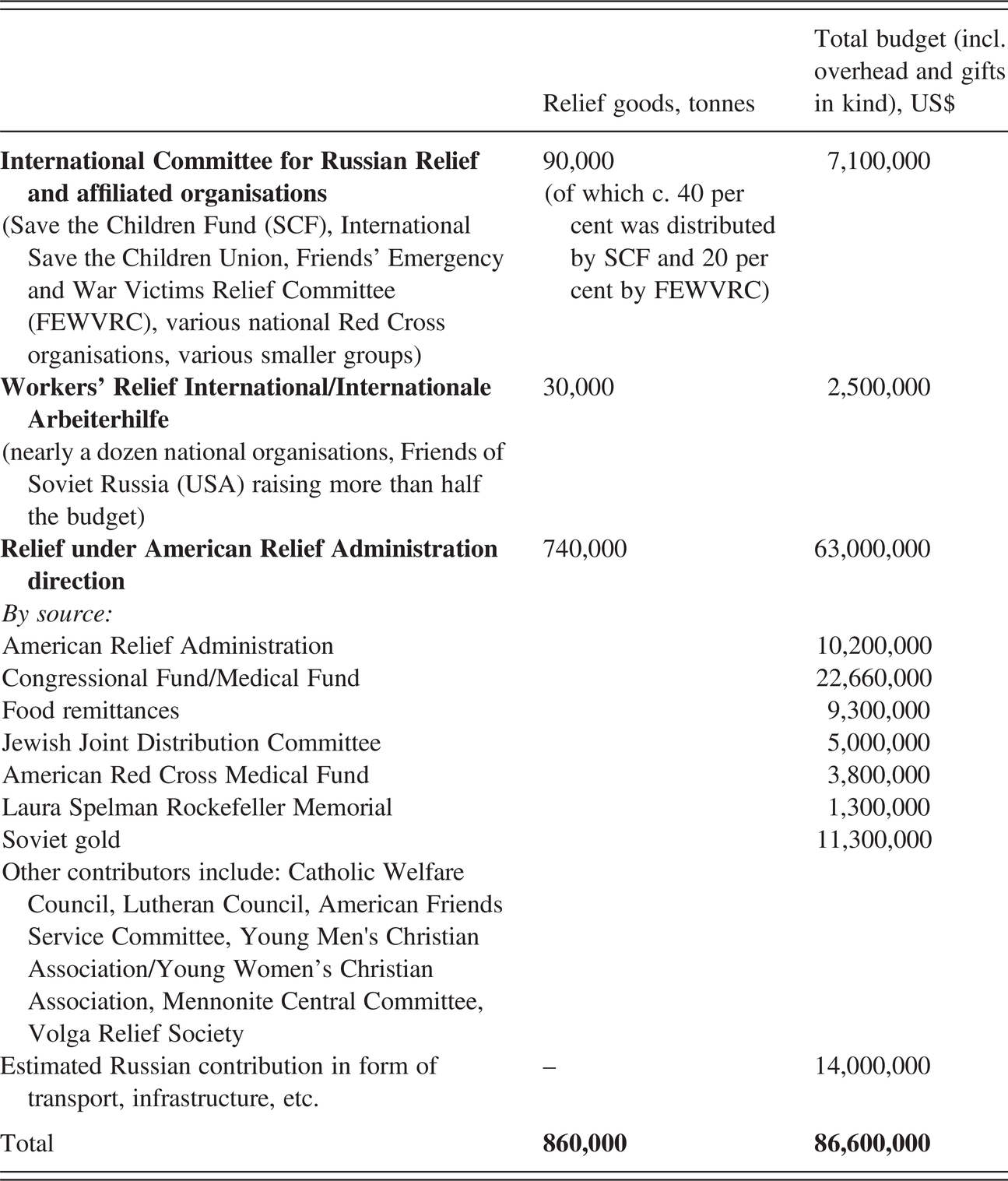
Statistics regarding foreign relief provided under Hoover’s direction from 1914 to 1923 shows that the Russian operation was a minor endeavour, standing for 1.2 per cent of the total budget.Footnote 102 Belgium received nine times that share between 1914 and 1919, and after the war the former enemy Germany received nearly twice as much. Excluding the massive supplies sent to France, Great Britain, and Italy, and taking into account only the so-called reconstruction period between August 1919 and July 1923, the ARA’s aid for Soviet Russia comprised little more than one-third of the total tonnage.Footnote 103 Nevertheless, the ARA was the dominant force among those organisations providing Russian relief. It distributed 740,000 t under its umbrella, whereas the International Committee for Russian Relief (ICRR) and its affiliated organisations, according to its own reports distributed up to 90,000 t, and the Workers’ Relief International (WIR) claimed to have distributed 30,000 t (see Table 5.3). At the same time, the relatively limited magnitude of relief for Soviet Russia does not diminish its practical and symbolic significance as a major instance of enemy aid, and as an engagement that facilitated a working relationship between the West and the victors of the Russian revolution in the early interwar period.
Organisations all desired to keep costs for personnel and administration low. The ARA instituted a hire-and-fire policy whereby staff could be laid off with one month’s notice when their services were no longer needed.Footnote 104 Overhead costs – especially their public relations aspect – were a sensitive topic that led to heated debate and controversy. Relief organisations faced the difficult task of justifying their practices and expenditures, such as placing advertisements.
The sources and effectiveness of famine relief were also contentious matters and involved ideological pride, particularly between the ARA and Soviet authorities. In the resulting information war, both sides resorted to arguments partly based on ‘creative accounting’. The political circumstances of enemy aid, combined with social expectations that both the public and individual donors held in connection with transnational aid, made gratitude an important element of the accounting genre.Footnote 105 Evidence in the form of reports, photos, films, gifts, and letters of thanks became an alternative return currency within the humanitarian moral economy. Different organisations, and even countries, struggled to receive their share – something that often led to conflict.
Hoover attached paramount importance to securing the ‘national portion’ of gratitude. Even when co-operating with foreign organisations, the ARA considered it a ‘fundamental principle’ that relief coming from the USA had to be ‘distributed as American food’, and that recipients needed to understand its origin, which caused some problems. For example, the American Friends Service Committee (AFSC) used to co-operate closely with the British Quakers and had initially appointed one of them as its head of mission. The ARA did not understand the Friends’ ‘reluctance and opposition to letting it be known that the relief which they give emanates from America’.Footnote 107 At the end of the relief campaign, the ARA proudly stressed that relief given by its affiliated organisation to Russia ‘outside the resources of the ARA, has amounted to over twice the total relief given to Russia by all other foreign relief organizations’.Footnote 108 In an interim report, Hoover even listed the contribution of US communist organisations.Footnote 109
The British Save the Children Fund (SCF) also increasingly emphasised the national origin of relief aid. Unlike the previous Budapest effort in which International Save the Children Union (ISCU) money was pooled, in Russia it was determined ‘that separate kitchens shall be maintained with the money received from different countries’. Each national group ‘should reap the full credit which its sacrifices and generosity deserve’, an article in The Record proclaimed.Footnote 110 Consequently, despite the ISCU’s involvement and the contributions of chapters from other nations, the provision of food in Saratov was often described as the ‘generous effort of the British people’.Footnote 111
Considering the circumstances under which relief was provided, official statistics seem to understate losses and damages. The ARA claimed that the cargo shortage reported at the five main Soviet ports of Petrograd, Batumi, Novorossiysk, Odessa, and Theodosia was less than 0.5 per cent, while financial losses from damaged goods made up an average of 1 per cent of the value. During transit via trains, trucks, and interior shipment another 0.5 per cent of the cargo (less than 4,000 t) was reported as loss.Footnote 112 The British relief expert Robertson came to a similar conclusion during his trip through Russia in early 1922, estimating that losses during train transport amounted to approximately 0.5 per cent.Footnote 113
According to §11 of the Riga agreement, the Soviet government was to reimburse the ARA for ‘any misused relief supply’, including shortages during transport.Footnote 114 By March 1923, the ARA had made 1,429 such claims, ‘supported by copies of ten thousand protocols’, totalling a sum of roughly US$300,000. Although there was no similar formulation included in the agreement Nansen had signed on behalf of the ICRR, British organisations assumed that Soviet authorities would compensate them for any shortage and submitted demand notes accordingly. Thus, the Soviet government was held responsible for losses on its territory, if not always financially, then morally and politically, and therefore found it in their own interest to prevent such incidents as far as possible. Many trains were under military protection, trucks and rail cars were sealed, and convoys partly accompanied by a special ‘ARA regiment’ of the Red Army. Warehouses in the cities ‘were kept under continuous guard and under lock and seal when closed’. The feared secret police, Cheka, succeeded in February 1922 by the State Political Directorate (GPU), proceeded with rigor against any suspicion of theft, embezzlement, or diversion. For example, Cheka officers took samples of relief goods and made sure similar items were not being sold in local markets. By early 1922, the SCF had reported only four attempts to break into one of their 400 warehouses. The ARA likewise mentioned ‘only few robberies of much importance’ during the whole course of their operation, and blamed ‘petty pilferage and leakage’ for the major part of their losses.Footnote 115
Businesslike Relief and Overhead Costs
In December 1921, Hoover’s associate Rickard, like Hoover a mining engineer, stated that the ARA’s ‘governing principles’ were the same as those of US engineering companies.Footnote 116 In the Riga negotiations, the ARA stipulated such conditions to the Russian government as had been given to countries that had previously received aid. This meant that the only costs for the ARA in Russia were the maintenance of US staff and the expenses related to the Food Remittance Division (including salaries for native personnel), as the latter was considered an enterprise–charity hybrid.Footnote 117 The Soviet government covered all internal costs connected with the child and adult feeding operations, such as the salaries of personnel cited earlier, travel expenses, kitchen and office equipment, and transport.Footnote 118
In addition, the ARA staff remained small, comprising some 200 members at a time, supervising a body of about 125,000 local workers.Footnote 119 This kept administrative overhead costs low and was intended to stimulate self-initiative and responsibility, crucial elements of the ARA relief philosophy.Footnote 120 When smaller affiliated organisations wished to send their own representatives to Russia, it was regarded as a waste of money. Haskell cabled that the ‘maximum amount of good could be accomplished’ if unnecessary expenses like this were avoided.Footnote 121 The ARA considered the performance of other organisations inefficient, with few exceptions. A letter to potential donors stated that contributions were best invested in the ARA relief operation, as most other agencies worked in ‘uneconomical’ ways. At best, they were ‘well-intended and wasteful’, at worst, ‘dishonest and wasteful’.Footnote 122
For the SCF, nineteen British citizens supervised a native workforce of 5,000.Footnote 123 The SCF also stressed professionalism and formulated three aims for its relief work: ‘1. To get the food to the children; 2. To feed the children as economically as we can; 3. To feed as many children as we can.’ Thus, they mirrored the ARA’s goal of making every dollar provide the maximum relief. Compared with such goals, spontaneous charity appeared as an outdated model. Given the enormity of the Russian famine, the SCF stressed that there was ‘little room for the amateur philanthropist’. For this reason, they discouraged potential donors from giving their money to other organisations: ‘We are better fitted to deal with child relief than anybody else… It would be false modesty if we did not claim to have expert knowledge and to assert that charity if it is to be of any use at all must be conducted on efficient businesslike lines.’Footnote 124
The examples show how accounting for aid and fundraising were intertwined. Low overhead and minimal purchase costs were extensively used in public relations work. The ARA proudly claimed that ‘not one cent … has been expended for internal overhead’; the AFSC promised that every dollar ‘will be turned over without one cent deducted by us’; and the communist Friends of Soviet Russia (FSR) assured donors that ‘experts in purchasing and shipping’ will ‘make every cent you give buy its utmost in value’ by purchasing food ‘at rock-bottom prices’.Footnote 125 Meanwhile, the SCF was ‘carefully watching the world’s markets’ and ‘buying on very large scale’.Footnote 126
However, even businesslike practices made humanitarian organisations vulnerable to criticism. Its countrywide advertisements caused the SCF to face allegations that it was spending a great deal of the donated money it received on public relations instead of famine relief.Footnote 127 A lengthy article in The Record addressed this issue and informed readers that the aim of the SCF was ‘to collect and distribute the largest possible amount at the smallest expense’. Old-fashioned fundraising based on personal contact and a network of regular donors was no longer adequate. In the face of urgent need, the SCF took ‘the bold step of advertising on a large scale, proclaiming to the world what it was doing and why it was asking for help’. Readers were assured that ‘advertising pays’ and that experience had shown ‘money drops off’ without advertising.Footnote 128
In December 1921, £10,998 spent on advertising yielded £61,115 in donations.Footnote 129 While the net profit in this example may appear impressive, 18 per cent overhead costs for public relations may appear less acceptable within a moral economy context, especially if compared to costs incurred by smaller organisations. In justification of the SCF position, Treasurer Watson later argued ‘that the larger the sum which a society sets itself out to raise, the greater must be the proportional expenditure’. It was easy, he continued, to raise £1,000 by spending £100, but to achieve the same ratio when raising £500,000 was practically impossible.Footnote 130 However, the question remained as to what degree the increase of total relief was legitimate in the eyes of a critical public, if it caused a disproportionate rise in overhead costs.
This Achilles’ heel of businesslike humanitarianism was soon attacked by adversaries of the SCF. Among them, the Daily Express, with its wide circulation, fought an aggressive campaign against the SCF’s Russian operations. After unsuccessfully spreading doubts about the existence of the famine, its journalists began criticising SCF’s overhead. One of the newspaper’s first headlines read, ‘One Pound in Three Goes in Expenses’. Although this statement was factually wrong, it touched a sore point.Footnote 131
To cope with such accusations, the SCF adopted an offensive strategy and allowed the Daily Express to access its documents. The investigative journalists could only report that in the course of the two and a half years of its existence, the SCF had collected £1,115,000 and spent £204,000 on expenses, that is a moderate overhead rate of slightly more than 18 per cent.Footnote 132 Furthermore, the SCF tried to demonstrate how reasonable its overhead was by drawing comparisons with other British relief organisations. As articles critical of the SCF often referred to the Quakers as shining examples, the Friends’ Emergency and War Victims Relief Committee (FEWVRC) was involuntary drawn into the conflict. SCF representatives analysed their balance sheets and pointed out that the Friends’ overhead rate was 19.5 per cent for the period September 1918 to September 1920 – higher than that of the SCF.Footnote 133 Chairwoman Ruth Fry, in turn, protested against such publicity and justified the Friends’ overhead costs by explaining that they administered the distribution of many goods supplied by other organisations. While such distribution involved overhead costs, the relief goods themselves did not necessarily enter the credit side of the Quakers’ accounts. For this reason, Fry claimed, and because of their service-intensive programme of medical aid, ‘any comparison of the overhead expenditure of the two Societies must of necessity be fallacious and misleading’.Footnote 134 Watson replied that he was not criticising the Quakers’ expenditure, but simply wanted to show ‘that no big charitable work can be carried on nowadays except on very considerable costs’.Footnote 135 In a second letter, he pointed out that ‘we did not start these comparisons and would not have troubled to make them had it not been for widespread criticisms of our work which are largely based on an alleged extravagance in our overhead expenditure and, on the other hand, underestimates yours’.Footnote 136
While the SCF successfully repelled the first wave of attacks, the Daily Express raised another criticism, once again connected to the professionalism the SCF claimed to have embraced. Similar to profit-making companies, SCF’s public relations campaigns were partly conducted on a commission basis, something that became public when journalists scrutinising SCF accounts noticed that an unnamed agent had received £10,000 as a commission fee. SCF representatives defended the sum by referring to the conditions under which that person had led the fundraising campaign: £8,000 per month were to be raised free-of-charge; everything beyond that earned the agent a 1.5 per cent commission. SCF argued that the fee was high because the campaign was effective and justified the bonus system: ‘We distinctly do not believe, as many people do, that such business can safely be entrusted to amateurs with no business experience.’ For this purpose, ‘first-class business people’ were engaged to bear the responsibility of organising a fund exceeding one million pounds. These people were said to earn far less than they would elsewhere.Footnote 137 Nevertheless, local SFC fundraisers were also upset, demanded explanations, and some threatened to stop working unless such commissions were made public.Footnote 138
The ARA took a different approach towards publicity. Here, too, professionals were hired to work on public relations. However, Baker, their chief, warned that ‘the moment we get into paid advertising, we will be driven into the position of a commercial enterprise’. Should this happen, Baker feared, newspapers and magazines would start to ask for their share of the donations.Footnote 139 Instead of paying for advertisements, the ARA press department had used its contacts with journalists and editors to produce articles and photo spread themselves.Footnote 140 These ‘mat releases’ proved successful, especially in the local press, and according to an analyst, the advertising space obtained in this way would have cost US$500,000 for the food remittance programme alone, if it had been purchased at display advertisement rates.Footnote 141 The FSR also provided a ‘matrix service’ and allowed periodicals to publish famine pictures at no cost, if they mentioned the FSR in the captions.Footnote 142
The total overhead costs of the ARA remain opaque, as concrete lists of expenditures do not exist. The rate of 3 per cent mentioned in several letters to donors may have referred to central administrative costs only, as other organisations claimed similar rates for such narrowly defined overhead.Footnote 143 Other documents merely state that the Russian government was responsible for the respective costs.Footnote 144 When the operation concluded, Haskell boasted that the margin established by the ARA in the sale of food packages earned enough money ‘to balance the entire overhead expenses… Therefore, there has been no costs to the American contributor or taxpayer for administration of the Congressional or other funds.’Footnote 145 However, most expenditures were simply added to the value of relief provided. ARA historian Fisher mentions in passing that shipping costs were about US$6.5 per ton.Footnote 146 Based on the 740,000 t of relief goods the ARA was responsible for, this amounts to nearly US$5 million. A later report indicates that in many cases, up to one-fifth of the budget was consumed by costs for freight, insurance, and related expenses.Footnote 147 One aspect of donor-driven aid is that benefits also accrue to producers and suppliers in the donor nation. For example, US farmers, shipping companies, and other businesses profitted from ARA contracts.Footnote 148 Some used political influence to obtain them.Footnote 149 Others criticised the whole operation as incompatible with free-market capitalism. A letter to a newspaper blamed the ARA for ‘selling food drafts on a profit basis, thereby interfering with the regular trade of American exporters’.Footnote 150
In general, organisations depending on private money were faced with a proportional increase in overhead costs from mid-1922 on because donations began to decrease. As people became weary of giving, more effort was needed to motivate them. SCF treasurer Watson remarked that matters grow more difficult ‘when the novelty of the appeal has worn off’.Footnote 151 Moreover, staff and infrastructure that had been established as donations peaked were not easily scaled back when less money was available. The FSR provides a particularly telling example. More than three-quarters of all cash donations the organisation collected came in the first fiscal year of the relief effort (August 1921 to July 1922). Overhead that year was 17.5 per cent. While FSR’s absolute overhead costs remained about the same in the following year, the radical drop in donations nearly quadrupled their relative overhead to a staggering 69 per cent.Footnote 152
Two Genres of (Creative) Accounting
During the famine, Nansen allegedly travelled second class in order to save £5, despite his status and age. This sum was reportedly used to prevent five Russians from starving.Footnote 153 A widespread feature of organisational articles, appeals, and accounting reports was stating the cost of one meal or of feeding a single recipient, often for a specific period of time. Such figures were supposed to convey a vivid impression of how efficiently the respective organisation worked. Conversely, potential donors could see how little was needed to save a child’s life (children usually served as the reference point). The message was simple: any donation, no matter how small, is a meaningful contribution. At the same time, moral pressure was increased because a life could be portrayed against a trivial expenditure. Also, a donor could easily calculate how many children’s’ lives his or her money could save. Similar messages were directly communicated to donors by relief organisations: ‘It may be of satisfaction to you to know that this check will be sufficient to provide food, clothing and medical attention to about seven children … until next harvest. These seven children, in all probability, would perish had this aid not been given by you.’Footnote 154 Rounded figures were used, and costs given as a rough estimate. Only in a few cases was the cost calculation described in detail. However, whether or not overhead costs were taken into account made a significant difference in the calculation.
Throughout the campaign, the SCF consistently claimed that they kept a child alive for one week with 1 s. They did so in The Record, in advertisements, and in debates if challenged for allegedly excessive overhead costs.Footnote 155 When necessary, the ratio was projected onto larger groups, higher sums, or longer periods. For example, when the SCF appealed for £100 donations for their kitchen programme, the organisation maintained that 100 children could be fed for twenty weeks for that sum.Footnote 156 It was also pointed out that £1 covered the costs for a child for five months.Footnote 157 In a simplified version, the time span was not stated and the slogan went: ‘Twenty shilling will save a life’. The SCF described itself in this context as unique in humanitarian history for being able to operate effectively with such an ‘amazingly low sum’.Footnote 158 Critics, however, doubted this assertation. Based on the previous figures, the Daily Express calculated the amount per child at 1½ pence per day after overhead costs, and asked sardonically, ‘How much food can be provided for this sum?’.Footnote 159 The ARA also doubted the SCF figures (at least internally) and assumed that considerably fewer children were being fed than officially claimed.Footnote 160
Nevertheless, SCF and ARA figures were similar, the latter claiming that ‘one dollar will feed a child for a month’ (about 5 s in 1922).Footnote 161 This figure was rarely made public, as the ARA did not launch fundraising campaigns. Previous research has not questioned the amount; both the SCF and the ARA figures appear roughly adequate.Footnote 162
Minor groups, especially those not affiliated with an umbrella organisation, had more difficulty keeping their expenditures per saved person low. In an appeal, the Federation for Ukrainian Jews (FUJ) promised that ‘the sum of £2. 6s will keep a Jewish soul alive for one month’.Footnote 163 The FSR could only promise to feed a child for US$2 per month, calculating in other appeal contexts 10 ¢ per meal, which would amount to US$3 per month on a diet of one ration daily.Footnote 164 Donations to the FSR were accordingly only one-half (or one-third) as cost-effective as donations to the SCF or ARA, if one solely considers the stated money-per-life ratio. For many organisations and committees, the most efficient alternative to undertaking relief work themselves, therefore, was to buy ARA remittance packages (see Figure 5.4).Footnote 165 For political reasons, this was not an option for the FSR.
Receipt of Frederick Roesch, South Dakota, for a US$10 American Relief Administration remittance delivery to the Weiss family in St Zebrikowa, 1922. The stamp indicates the content of the package. Note also the renewed appeal ‘Don’t forget us in the future’.

While organisations advertised low per capita costs, they boasted of impressively high total figures in their intermediate and final reports.Footnote 166 However, terms like ‘handled relief’ or ‘administered relief’ in such reports indicate that organisations also distributing relief on behalf of others (like the SCF, the Quakers, or the ARA) often included those contributions as part of their own accounts. In the ARA’s final statistics, the total tonnage was stated as 740,000 t.Footnote 167 This included not only contributions from organisations affiliated with the ARA, but approximately 170,000 t (almost one-quarter) paid for by the Soviet government as well. The SCF’s final report was exemplary for its meticulous bookkeeping in support of the claim to have ‘administered’ 35,476 long tons of food worth £687,518 12 s 1 d.Footnote 168 This exceeded their £400,000–500,000 budget (inclusive of overhead expenditures) for Russian relief, as estimated earlier. The term ‘administered’ explains the gap: it included food that was contributed by Nansen’s ICRR and by the British Russian Famine Relief Fund (RFRF). Nearly two-fifths of the tonnage came from the two organisations cited (see Table 5.4) and accounted for the more than thirty-five million adult rations listed in the report. As the ICRR likewise included relief goods ‘administered by the SCF’ in its own statistics (under the category ‘despatched by ICRR’), this double accounting makes it difficult to obtain an accurate picture of the total relief purchased, administered, and distributed.Footnote 169
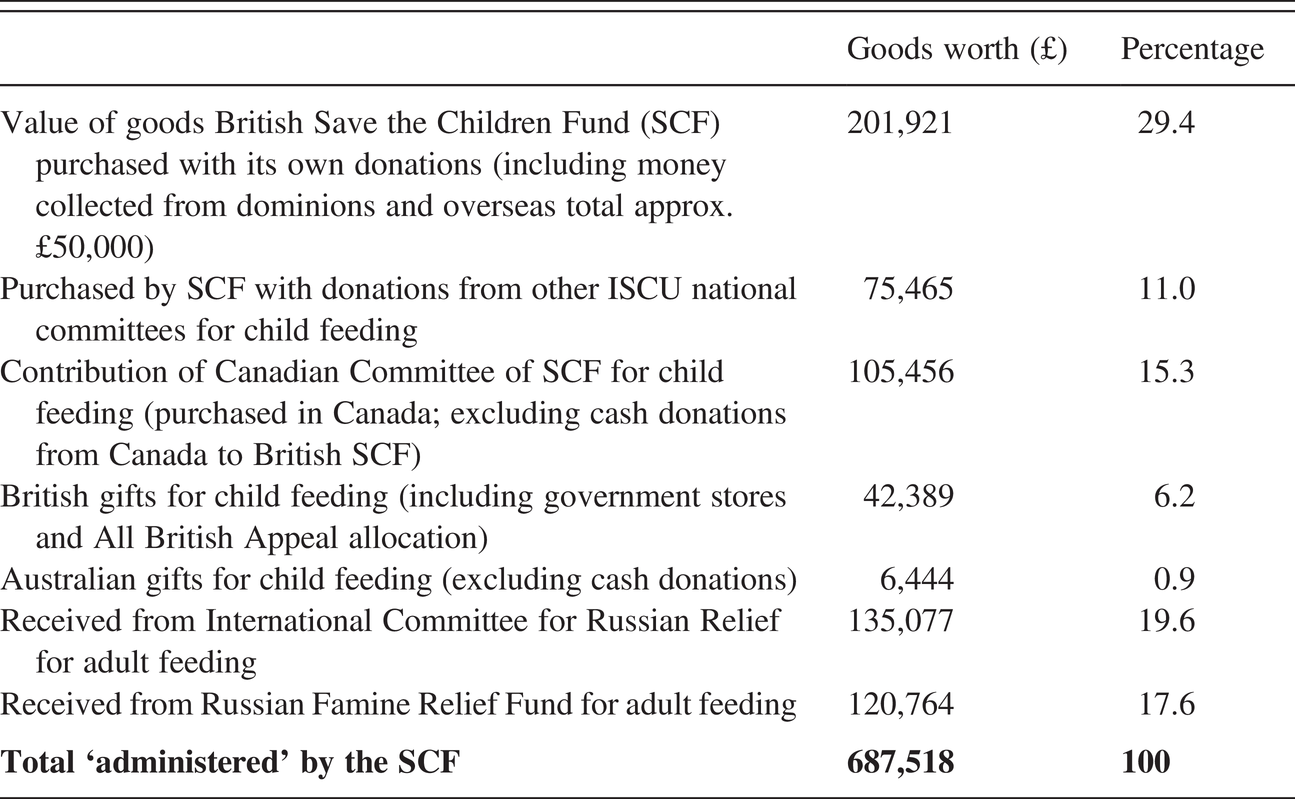
In point of fact, the SCF had not provided the 121,339,834 children’s rations all by itself that it claimed, as this figure included contributions by various non-British organisations affiliated with the ISCU, as well as donations from Commonwealth countries.Footnote 170 Non-British ISCU members and affiliates funded more than 10 per cent of the child feeding programme. Canada’s contribution exceeded that of other Commonwealth nations, comprising goods worth more than £100,000 (or nearly 25 per cent of the children’s food).Footnote 171
Based on SCF’s report, as shown in Table 5.4, less than one-third of the listed goods were purchased with private donations made directly to the SCF. If one excludes adult feeding from the calculation, the number rises to 47 per cent. Lists of donations for the kitchen programme up to July 1922 indicate a corresponding rate of approximately one-half for overseas and ISCU contributions.Footnote 172
Figures were also used to illustrate successes. In order not to appear dry or boring, statistics were presented in a way that was intended to be easy to understand. The SCF, for example, compared the quantity of goods it distributed with a ‘train 11,135 miles long’. The Communication Division of the ARA used considerable creativity to describe what had been accomplished. The final report informed readers that the American food delivered to Russia was enough to sustain ‘every living soul in the British Empire … for four days, still leaving enough over to give a meal to every inhabitant … of China’. The milk cans shipped to Russia, if lined up, would ‘encircle the earth at the equator’, and the tea supplied could ‘provide a large-sized cup for every man, woman, and child in the United States and England, still leaving enough in the samovars to give Romania a drink’.Footnote 174
All Aid Is Relative
Most organisations saw voluntary food aid not only as saving recipients from starvation, but bringing emotional relief as well. Ruth Fry of the FEWVRC wrote to her American fellow-believer, Wilbur Thomas, that ‘the value of our work is not measured purely by its size’.Footnote 175 The ARA claimed that food parcels ‘have an immense moral value’, and the SCF stated that ‘every gift given in love is a talisman that awakes kind feelings’.Footnote 176 The SCF further suggested that gifts from people who themselves were in difficult straights would convey a moral uplift beyond the cash value of their contributions.Footnote 177
The paradigm of those-who-do-not-have-but-give-anyway was widespread. Stories of self-sacrifice reached newspaper readers in the form of children who sold juice, collected mushrooms, or did gardening work to obtain money to donate. A little boy wanted to give his teddy bear or his bike to a hungry child in Russia. An inmate wished to donate a year’s salary.Footnote 178 Sick, poor, and elderly people also were among disadvantaged groups who contributed. Their stories suggested that the value of a gift could not only be calculated in monetary terms, but determined by the circumstances of the donor as well. Even ARA officials, who normally dismissed small-scale campaigns as an ineffective ‘drop in the bucket’,Footnote 179 acknowledged that the moral capital certain kinds of fundraising and relief accrued might sometimes outweigh economic inefficiency. An example are the travels of the ‘Russian Rag Doll Vera’ – a handmade toy that the Central Institute for the Dumb and Deaf in Petrograd had given ‘to the children of America’ as an expression of gratitude. After extensive preparations, Vera toured the USA for one year, bringing in contributions totalling US$245, or roughly the same amount it cost to send her around.Footnote 180
Organisations that depended on a large number of private contributions, rather than major donors and governmental aid, were especially inclined to motivate their audiences by assigning a moral, emotional, or even political value to the gifts they received. The WIR campaign in Germany, for example, claimed that ‘every Mark from a worker carried more political weight than half a million from the bourgeoisie’ (see also Figure 5.5).Footnote 181 Such meta-value was sometimes also ascribed to aid by the receiving parties. In a speech to high-ranking Turkish officials in Ankara, the representative of the Crimean Socialist Soviet Republic maintained that the Crimean population would ‘prefer a morsel of Turkey to a sack of flour from the Entente’, as the ‘flour of the Entente will poison us, while Turkey’s smallest relief is our remedy’.Footnote 182
Workers’ Relief International (WIR) poster from 1922, printed in Kazan. Inscription reads ‘The workers of the world will save the vanguard of the proletarian revolution from hunger – The working population of the Russian Soviet Republic!’. Note, WIR/Internationale Arbeiterhilfe flag and translation in Tatar language, using Arabic letters.

Some organisations magnified their own achievements and depreciated those of others by not only taking the absolute sums that they collected into account, but also circumstances such as national wealth, population size, or political agenda. FSR and WIR, for example, systematically devalued famine relief from competing non-communist workers’ organisations in their public statements. WIR organiser Willi Münzenberg pointed out that the few thousand belonging to the communist party in the Netherlands had collected half a million Dutch guilders, while the Amsterdam International, with its 20 million members, only raised 1.4 million.Footnote 183 Such comparisons were also used to motivate an organisation’s constituents to greater exertions. In early 1922, the FSR announced that US workers’ contributions amounted to more than one-third of the combined WIR collection. However, the text continues, if they ‘had done equally well as European workers, they would have donated one and a half million dollars’, since in Europe wages were lower and unemployment higher.Footnote 184 Similarly, in late 1920, Jebb responded to the apology of a French delegate for her country’s small contribution in these words: ‘It’s entirely right … that England should give far more than France, for her sufferings in the war have been far less; and France by raising a Fund of this nature has lent to the movement a moral support which is of incalculated value.’Footnote 185
The relativity of aid was also maintained by Russian authorities, who kept detailed accounts of imported relief goods. Such a report on the activities of foreign relief agencies registered the import of 540,600 t by those organisations up to August 1922.Footnote 186 According to this account, the ARA contributed 81.3 per cent of all imports, and the Nansen mission (including the SCF and British Quakers) 14.2 per cent, figures roughly corresponding with the Western data. However, the Russian accounting went further in listing the percentages of imported goods with regard to their value. In all, 68 per cent of food imports were corn and flour worth 25.8 per cent of the total value, whereas canned milk constituted 5.8 per cent of the total weight, but made up 40 per cent of the value. The account concludes that the composition of items in an average ton of goods from a relief organisation determined its value. Compared in this way, an average ton of food from the ARA was worth only 77 per cent of a ton from the Nansen mission.Footnote 187 A Russian newspaper article even claimed that, while ARA relief exceeded that of the communist WIR by far, it differed in quality because the ARA used this ‘splendid occasion for throwing away all the defective and rotten goods that have been lying for years in the stores’.Footnote 188
Accounting for Gratitude
Just as the moral economy of food aid could not be handled by a business attitude alone, it was insufficient from a relief organisation’s perspective to report credit and debit like an ordinary company. As the SCF pointed out, modern humanitarian work required a ‘combination of spirit and method’.Footnote 189 The donating public expected more than figures of distributed food and numbers of saved children. The ARA informed donors that its food was also carrying American ideals to Russia, engendering gratitude and ‘the reward of friendship for generations to come’.Footnote 190 The FSR argued similarly, although less subtly, that the names of donors would be ‘kept in the archives of the Soviet government, as a testimonial of their active sympathy at an hour of need’.Footnote 191 Appeals from Russian individuals and groups likewise often started with expressions of gratitude or descriptions of how a donor changed their lives – before asking for more food.
Sometimes it was the humanitarian agents who conveyed the feelings of recipients to the donors. A Mennonite relief worker put it this way:
Oh, so often I wished that the kind donors in far away America could have been present when the packages arrived, that they might see the beaming faces, and the sparkling eyes of the children, and the tears of gratitude in the eyes of the parents. They would have been richer by one of the purest and most beautiful joys of their whole life.Footnote 192
A representative of a village that received food from the Jewish-American Joint Distribution Committee (JDC) wrote that ‘people kiss each other in the streets and tears of joy are flowing’.Footnote 193 Europeans and Americans who could not see this with their own eyes depended on such reports in order to feel the ‘warm glow’, causing many similar descriptions to appear in publications of the major organisations and in the media.
Relief organisations found themselves under a certain amount of pressure to solicit expressions of gratitude and convey them to donors (see Figure 5.6). Contributors were often promised that they could expect letters of thanks and acknowledgement.Footnote 194 During its adoption campaign in Germany and Central Europe, the SCF prompted children in camps to write thank you letters to donors.Footnote 195 The same request was made to children fed in SCF kitchens. In the Russian case, naming a kitchen after its sponsor strengthened the bond even more.
Letter of gratitude to the American Relief Administration, depicting a life preserver with the Russian inscription ‘Thank you, ARA’. In the middle, a girl leaps across the Atlantic from Russia to the USA to deliver her letter. The drawing appears to have been inspired by a popular advertisement by the Einem Chocolate Factory.

When the ARA’s New York office made an applicant–donor match, they wrote to their colleagues in London and Moscow, ‘We presume that you will have letters of thanks forwarded to us.’Footnote 196 Such requests for upward accountability were also passed on to recipients of aid, causing some irritation. For example, a Russian engineer who had received a food parcel complained, in a letter ‘to the Chief of the ARA’ about being asked to formulate a letter of thanks, maintaining that it was ‘inadmissible to compel anyone to express their gratitude’.Footnote 197 The ARA replied that while they indeed had requested their delivery clerks to let recipients know that a letter of gratitude would be appreciated, no one was compelled to do so. Had the delivery clerk shown ‘excessive zeal’ in this case, they apologised.Footnote 198
Organisations working under the aegis of the ARA regularly demanded proof of gratitude from local supervisors. When the JDC’s Strauss received a box full of letters of thanks that the ARA had collected, he found a note inside saying, ‘I think your publicity department can get some pretty good stories out of them.’Footnote 199
The JDC initially agreed to a non-sectarian distribution of its contributions (altogether amounting to US$5–6 million).Footnote 200 Large amounts were used for general relief, although preferably in regions and cities with a large Jewish population. The JDC hoped that at least half of the food it distributed would reach Jewish children, and that public knowledge about the generosity of the American Jewry would make ‘the lot of Jews happier’ locally.Footnote 201 The JDC leadership also was concerned about receiving ‘a reasonable share’ of credit for the aid that they were providing. In addition, they saw themselves as owing it to their constituency ‘to take every possible step to insure that a fair share of our contribution reaches those for whom our funds are collected’.Footnote 202 The ARA promised to only use JDC funds in urban areas, and agreed on measures like placards to make sure the JDC received its ‘full credit’.Footnote 203 The ARA also pointed out that much of its own general relief had reached the Jewish population.Footnote 204
Smaller organisations that were not able to purchase or distribute relief goods on their own thought it particularly important that they receive a share of appreciation and gratitude for their activities, which took three forms: they could buy aid supplies in bulk sales (US$500 or more) to be distributed by the ARA according to the directives of the purchasing organisation; they could purchase drafts at US$10 each; or they could engage in so-called Eurelcon sales (European Relief Council), that is, buy food at cost from the ARA and distribute it themselves. Bulk and Eurelcon sales were the preferred methods as they provided a record of the food distribution. Members of communities or ethnic groups who bought individual remittance parcels left no systematic trace in the accounts, as their donations were aggregated and assigned to the ARA. For this reason, the Volga Relief Society (VRS) asked the members of German-Russian communities in the USA to notify the VRS of each food draft that they had purchased. The ARA, approving this strategy, requested that local branches mention their parent organisation when purchasing in bulk (something apparently often neglected).Footnote 205
At the end of the relief operation, the ARA claimed that its relief was a ‘miracle of God’ for the ‘Russian common people’, coming to them ‘under the stars and stripes’. The ARA not only brought food, but ‘demonstrated that at least one organisation could exist and succeed in Russia without submission to dictation’.Footnote 206 Another report praised the ‘excellence of the organization machinery of the ARA’, which was said to have singly ‘wiped out famine’.Footnote 207
Not everyone agreed with this assessment. Throughout the operation, the ARA struggled against Soviet authorities who tried to make sure that the Russian people’s gratitude towards the USA remained limited. There were some communists, especially at the end of the operation, who were eager to expose ‘the wolf of capitalism under the sheepskin of charity’.Footnote 208 The consequence was an information war between the ARA and Soviet authorities, during which both groups vyed for the hearts and minds of the Russian population.Footnote 209 The Soviet press claimed, for example, that political pressure by the US proletariat had forced the ARA to help Russia, and that the class solidarity of farmers was what stood behind the donations of corn.Footnote 210 Münzenberg even suggested that most of the help for the starving actually came from Russia itself.Footnote 211 Although this was hardly the case, his claim was not without merit. ARA historian Fisher estimated Russia’s contribution to the relief effort in cash, services, and facilities at US$14 million.Footnote 212 Together with the US$11 million in gold that was shipped to the USA, the Russian government was responsible for US$25 million – almost one-third of the total budget of the relief operation (see Table 5.3).
In addition, Nansen’s role was exaggerated, by Russians and Europeans alike, during and after the famine. ARA officers complained that Nansen was ‘helping the British with one hand and the Soviets with the other, and slapping the ARA with the back of both hands’.Footnote 213 Despite the fact that the ICRR and its affiliated organisations were responsible for little more than 10 per cent of the international relief programme, Nansen received more credit for his engagement than Hoover, not the least in the form of a Nobel Peace Prize.Footnote 214 The literature, both in Europe and in the Soviet Union, has overstated Nansen’s role for decades.Footnote 215
5.4 More than ‘Dollars’ and ‘Per Cent’: Ethiopia
Media and political interest placed extensive accountability requirements on organisations delivering famine relief to Ethiopia, Eritrea, and Tigray after October 1984. The scale of the disaster, coupled with growing public outrage about delayed international action in the face of abundance elsewhere, presented all parties with the challenge of proving that money pledged would be spent not only in an appropriate manner, but also as speedily as possible. Therefore, ‘the rush was to be seen to deliver food’, as the public, the media, and politicians came to demand visible action to salve their consciences over the earlier inadequate response.Footnote 216 However, despite vocal proclamations about public accountability, two newcomers to humanitarian aid, Band Aid and USA for Africa, resisted compliance with established accounting standards and charity regulators. At the same time, the 1980s was the decade in which evaluation became part of the toolbox of aid agencies. The United Nations (UN) World Food Programme (WFP), for example, conducted its first self-evaluation in 1985 in connection with the African Food Crisis.Footnote 217 While the suspicion with which major donors held the Ethiopian government and the rebel forces alike increased pressure for more rigorous accounting criteria than in other disasters, the political situation meant that many donor governments remained reluctant to enquire too closely into the potential effect of the resettlement programme or what might result from failure to ensure adequate aid to Tigray and Eritrea.
The difficulties of allocating famine relief in a country divided by civil war created the space for new auditors of aid, as most Western donors eschewed the Ethiopian government’s distribution channels in favour of provision through voluntary organisations. At the same time, the work of aid agencies was subjected to extensive monitoring by the Ethiopian Relief and Rehabilitation Commission (RRC). Each organisation was required to submit plans, budgets, quarterly and annual reports for scrutiny, and had to grant the RRC the right to review and verify its accounts.Footnote 218 However, the RRC itself had no procedure for accounting to international donors on how it had used the food aid it received.Footnote 219 Therefore, Jansson’s UN Office for Emergency Operations in Ethiopia (OEOE) was described as the international community’s ‘auditor’, a final check that the receipt and distribution of pledged grain and relief goods was, to the extent possible, as donors intended.Footnote 220 Similarly, consortia working with the liberation fronts, like the Emergency Relief Desk (ERD), conducted extensive monitoring, assessment, and evaluation work that proved more acceptable to donors than the reassurances of the Eritrean Relief Association (ERA) or the Relief Society of Tigray (REST) themselves.Footnote 221
Such assurances were given without the major donors ever having questioned the fundamental assumptions of the wider effort. MSF, for example, argued in a 1986 report that ‘donors have shown hardly any curiosity’ about the use of food aid in Ethiopia, and responded to accusations of abuse by only superficial investigations.Footnote 222 Cultural Survival similarly lamented the ‘subtle yet highly effective silence that surrounded the transfer of unprecedented amounts of relief supplies into Ethiopia’.Footnote 223 Only a small group of agencies that were mostly non-operational was committed to raising awareness of the manipulation of aid by the Ethiopian regime. Their goal was to promote greater accountability to aid recipients. The majority of aid providers preferred to focus on the job of delivering relief. In Italy, where corruption and political considerations influenced the state allocation of famine relief, some voluntary organisations tried unsuccessfully to take on a supervisory role and hold government spending to account on behalf of the public.Footnote 224
Accounting for aid to Ethiopia in 1984–5 was a ‘demanding task’, as commentators noted at the time. As a result, total figures were highly unreliable. In the mid-1980s, a ‘harmonised’ system of accounting remained a low priority, even for organisations within a single legal jurisdiction.Footnote 225 Overall, USAID calculated that the total cost of international emergency assistance supplied by private and government donations came to more than US$2 billion (see Table 5.5). USAID’s final disaster report is also one of the few sources to acknowledge the significant contributions raised by Ethiopian-based organisations, including churches, police and army units, peasant associations, and overseas embassy staff, although the report was unable to arrive at an overall amount for such aid.Footnote 227 The RRC itself calculated such home-grown aid at 2.6 million birr in cash and 32 million birr in kind, raised between December 1984 and August 1985 (in all US$17 million, according to the official exchange rate).Footnote 228 In fact, apart from the USAID report, which does not include accurate figures on private donations, it is rare to find accounting tallies that relate solely to aid for Ethiopia. It is difficult to separate the Horn of Africa, or Africa-at-large, from the rest of an organisation’s global activities. In part, this may be due to accounting standards that did not require a geographical breakdown of expenditures, lingering colonial attitudes towards the continent of ‘Africa’, and a preference for unrestricted fundraising income. In addition, organisations operated with different fiscal years, making year-to-year comparisons difficult, and rarely distinguished between relief, rehabilitation, and development activities. As in earlier crises, the determination of commodity values is also especially problematic when seeking to make comparisons.
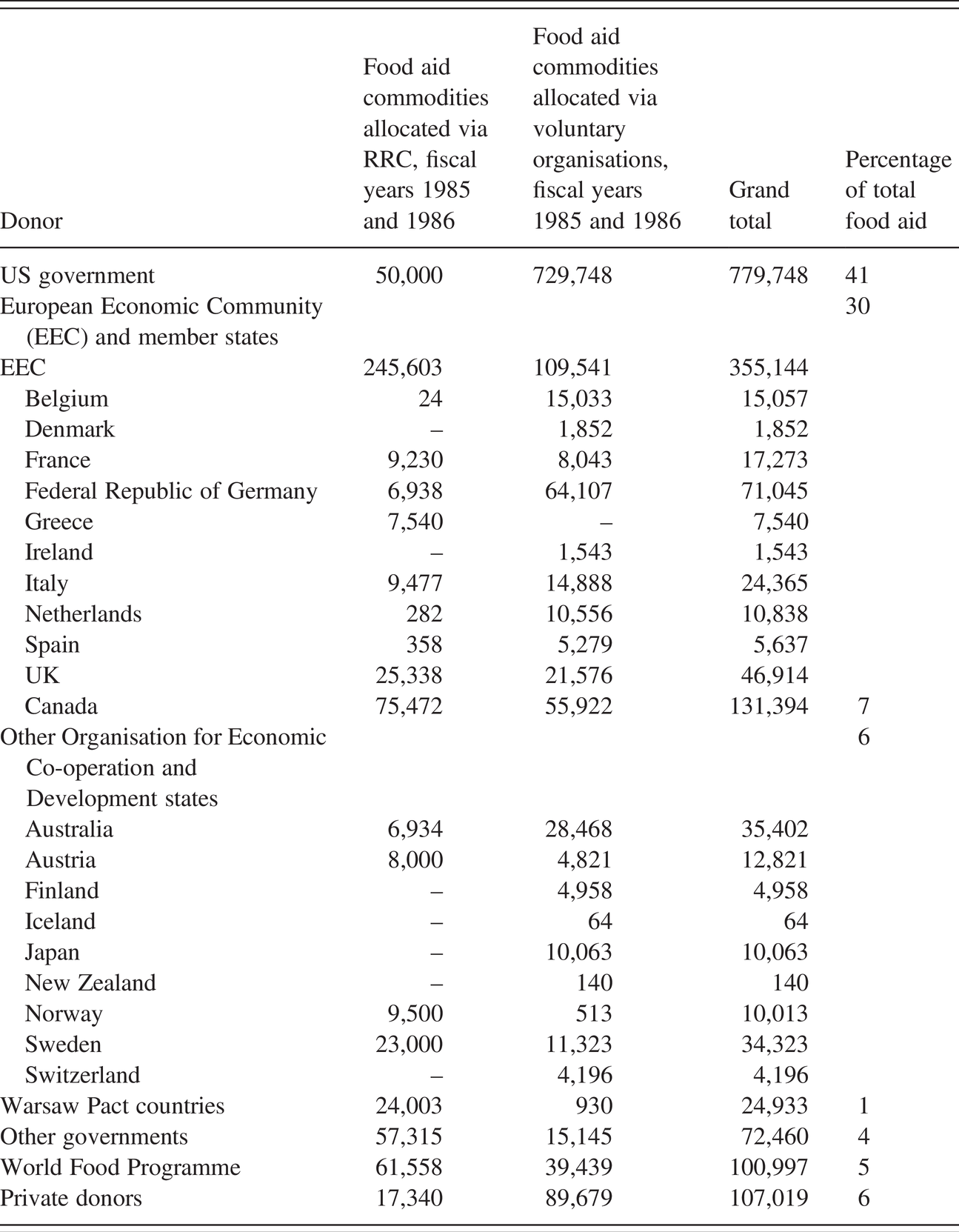
The best set of sources on famine relief income and expenditure in the 1980s are (a) the annual reports of individual voluntary organisations; (b) data collected by national umbrella bodies (e.g., InterAction in the USA or the Disasters Emergency Committee (DEC) in the UK); (c) evaluations published by various governmental or inter-governmental bodies (including USAID and the UN); and (d) retrospective histories of key consortia or partnerships.Footnote 229 Newspapers and magazines have also examined spending as part of their wider investigations into relief campaigns. In the summer of 1985, for example, the development weekly, New Internationalist, conducted a survey into accounting practices of UK voluntary organisations, noting that ‘allocating of spending between budget headings can be very arbitrary’.Footnote 230 In the USA, the Los Angeles Times sought to hold the so-called pop charities to account for poor financial reporting.Footnote 231
Impact of the Response on Voluntary Organisations
The international response to famine in Ethiopia is part of a long tradition of public generosity during major emergencies. In the 1980s, however, aid agencies were ready to presume donor fatigue after a succession of high-profile appeals in the previous decade (including campaigns for Ethiopia and Cambodia) and were surprised at the magnitude of public contributions prompted by media coverage in October 1984.Footnote 232 Commentators suggested that the potential for even greater involvement on the part of some donor publics, such as in Sweden, was missed because of a prevailing discourse of negativity towards fundraising for disasters.Footnote 233 The UN’s own evaluation of the relief operation in Africa concluded that the cynical attitude of certain officials led many to dismiss what was in fact ‘outstanding’ public generosity.Footnote 234 Jansson himself expressed an official’s ambivalence towards money raised by the public around the world, which he regarded as having little impact on the overall aid programme in 1984–5. He felt it was wrong to give the general public the impression that the responsibility for emergency aid lay with individuals or private groups ‘when it should be mainly with governments’. However, his assertion that the amount raised by efforts like Band Aid represented only a ‘tiny fraction’ of the more than US$1 billion worth of relief funded by governments in 1984–5 is questionable.Footnote 235
USAID judged that it was not possible to produce an accurate estimate of privately raised funds, but estimated that ‘it is undoubtedly in the tens of millions of dollars’.Footnote 236 This is a conservative figure as the total donated to existing voluntary organisations by the public around the world, and through special campaigns like Band Aid, while hard to calculate, amounts to hundreds of millions of dollars. In the UK, for example, the public had donated almost £100 million by September 1985.Footnote 237 InterAction estimated that private donations in the USA totalled US$250 million, excluding all government relief grants and goods. Band Aid had raised US$144 million by 1991. Canada similarly experienced a very high level of public engagement: a poll conducted in February 1986 found that 56 per cent of all respondents had donated something to African famine relief over the previous year, and 10 per cent had been directly involved in the fundraising.Footnote 238 In our calculation, funds raised through expressive and participatory methods such as telethons, charity single recordings, and benefit concerts alone totalled over US$270 million (see Table 5.6), not counting sums remitted directly to voluntary organisations or umbrella collections like the DEC.
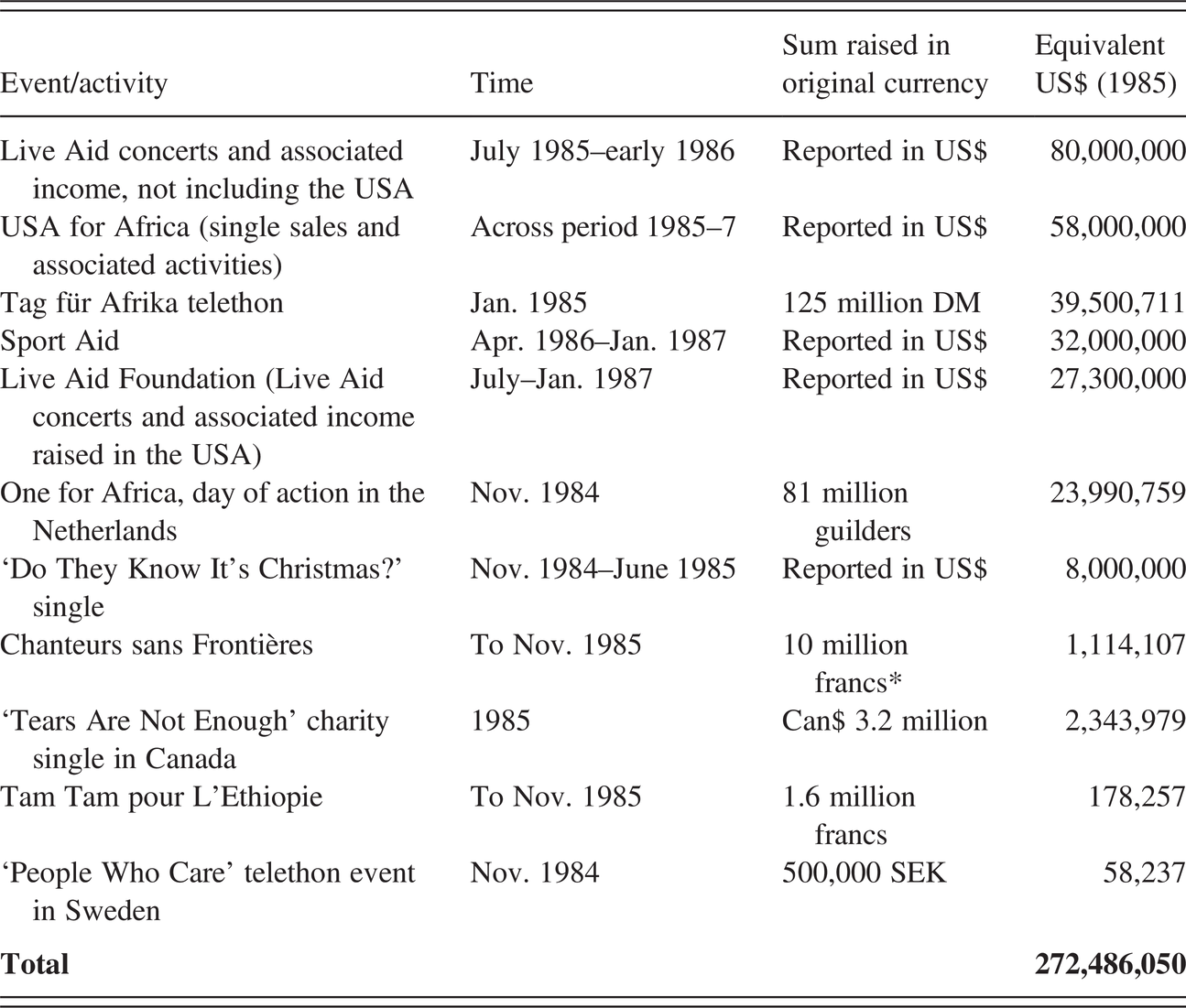
* 10 million francs remitted to Médecins Sans Frontières by November 1985, although overall income for Chanteurs sans Frontières widely reported as approx. 23 million francs (unverified).
In 1984–5, all voluntary organisations working on famine in Africa saw rapid and impressive growth in income, with significant contributions coming from outside their traditional support base.Footnote 240 This influx of funds resulted in challenges of accounting to the new donor constituencies for aid. The largely unsolicited donations can best be understood in relation to the size of an organisation’s normal operating budget.Footnote 241 In the UK and the USA, organisations saw their income increase two- or three-fold, meaning many, like Oxfam, moved into ‘an entirely different financial league’.Footnote 242 In the USA, Catholic Relief Services (CRS) received US$37 million in private donations in 1984, growing to US$50 million in 1985.Footnote 243 CARE had to employ a double shift to issue receipts to donors. In January 1985, it reported holding record sums in its bank account that were largely collected even before signing an agreement with the RRC to undertake relief work in Ethiopia. New donors were recruited and existing supporters increased their contributions; the average single donation to CARE more than doubled from US$11 to US$25 during the famine crisis.Footnote 244
The dramatic rise in donations also had a great impact on smaller agencies. In the UK, War on Want’s income grew from £1.7 million in fiscal year 1983/4 to £5.8 million in 1984/5, and its membership doubled (see Figure 5.7).Footnote 245 Save the Children’s receipts grew from £16.5 million to £42.5 million over the same period, and its donors also doubled.Footnote 246 The growth was less spectacular in Sweden, where the income of Rädda Barnen (Save the Children, Sweden) climbed from 129 million kronor in 1983 to 145 million in 1984. However, more significant changes were seen in a ‘wave of compassion’ that resulted in increased donations from individuals.Footnote 247 Rädda Barnen had collected over 20 million kronor for Ethiopia by February 1985. The aid organisation of the Swedish Church, Lutherhjälpen, raised approximately 50 per cent more from July to December 1984 compared with the same period twelve months earlier.Footnote 248 Regular donations also increased alongside one-off sums given to the famine campaign.Footnote 249 Although the public response to the African crisis was more muted in France, MSF France and MSF Belgium also raised two to three times more from private donations than ever before.Footnote 250 This growth in income presented organisations with challenges on how to spend what were often restricted funds. Donations were sometimes earmarked for feeding programmes that the agency did not even operate, and difficulties arose in meeting donor expectations of how rapidly funds could be put to work and make a difference.Footnote 251

By the 1980s, the trend in charity annual reports was to produce short, easy-to-digest, illustrated formats. They often contained photographs of development and aid workers in action, alongside maps and tables listing relief goods. Reflecting the language used in appeals, annual reports sought to account for each pound, dollar, or krona entrusted to the organisation by donors. However, since few supporters were likely to seek out audited accounts with their full breakdowns, the short-form accounts utilised simple graphics (such as images of piles of coins) to explain spending. Sources of income become opaque in such quasi-accounts, enabling organisations to blur public donations, legacy income, government grants, joint appeals, and trading revenue. Oxfam, for example, highlighted income from its charity shops and downplayed government grants. This kind of accounting presentation also allows organisations to selectively illustrate areas of spending by giving them their own budget line. Oxfam regularly included ‘blankets and clothing’ as a separate type of expenditure, even though the amount was negligible compared to such a catch-all as ‘grants to overseas programmes’, which were not broken down further.Footnote 252 Established organisations also made use of the media to help report on their work, collaborating with broadcasters eager for stories, particularly in the wake of Live Aid. Feeding shelters, for example, provided ‘accessible, visible evidence’ of an organisation’s work.Footnote 253 The International Committee of the Red Cross produced a film called Strategy for Salvation about its operation in Ethiopia and intended for distribution to the public via its national societies.Footnote 254
Accounts can thus conceal as much as they reveal. In a typical instance, the British government in August 1985 granted £1.47 million to Christian Aid for the purchase and distribution of 5,600 t of wheat to rebel-held areas of Eritrea and Tigray. As this was against official diplomatic policy, Christian Aid agreed that the donation would receive no publicity and the purpose would not be mentioned in its annual report. While the sum would have to be listed in the accounts, there would be no reference to its use for cross-border aid supplies.Footnote 255 Similarly, War on Want’s failure to make a clear distinction between its own funds and those of the Tigray Transport and Agriculture Consortium in its reporting was one reason behind the 1988 decision of the other consortium members to revoke its lead agency status.Footnote 256
Although organisations were not required to provide a breakdown of expenditures by geographical region, the prominence of income for disaster relief in the mid-1980s meant that most groups were concerned to account for spending on famine relief in Ethiopia and elsewhere in greater detail. Table 5.7 shows expenditures in Ethiopia, Eritrea, and Tigray (and in some cases in Sudan) by selected voluntary organisations. These funds derived from a variety of sources, including public donations and grants from national governments or the European Economic Community (EEC). Techniques were developed to manage donors’ expectations about what impact their contributions would make. Language used to convey the scale and complexity of the emergency reflected that of the original appeals.Footnote 258
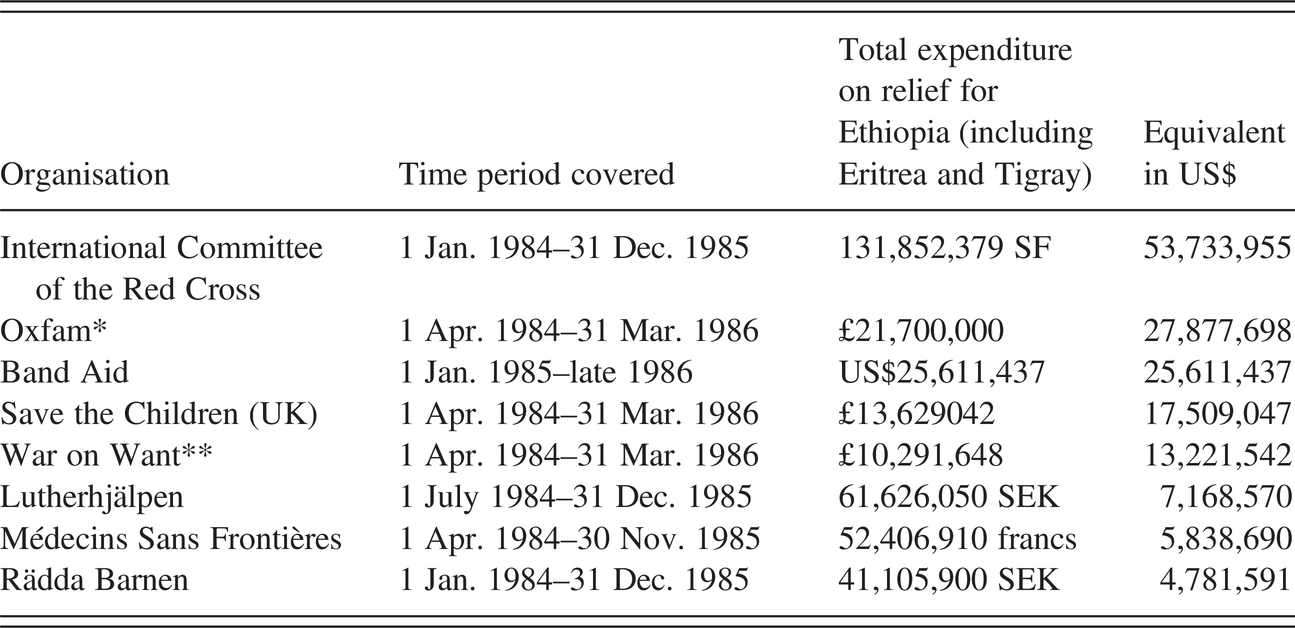
* Oxfam’s expenditure here also includes work in Sudan.
** War on Want’s expenditure includes funds of the Eritrean Inter-Agency Agricultural Consortium and Tigray Transport and Agricultural Consortium, for which it was a lead agency.
Voluntary organisations believed subsequent giving depended on an understanding of impact, and so agencies evolved different strategies for accounting to diverse groups of donors. Organisations primarily known for their development work, rather than emergency assistance, used annual reports and direct mailings to justify an apparent shift in priorities, while at the same time seeking to reassure long-term supporters.Footnote 259 Oxfam noted it had been ‘compelled’ to spend 69 per cent of its income in 1984/5 on emergency relief (compared to 33 per cent in 1983/4 and 20 per cent in 1982/3), but argued that an overall increase in income would mean more money for development.Footnote 260 Newsletters sent to regular subscribers focused on long-term development projects, but communications with new donors presented more simplistic ‘before’ and ‘after’ stories. In one leaflet that was part appeal, part narrative, Oxfam used photographs of the same mother and child three weeks apart, after they had benefitted from a feeding programme in Bora, Ethiopia.Footnote 261 Similarly, providing lists of donated goods was an easy way to suggest impact. Oxfam’s annual report for 1985/6 included a table of items sent to Ethiopia and Sudan. It listed 321 t of its branded ‘Oxfam biscuits’, 102 feeding kits, 10 Land Rovers, 75,000 identity bracelets, 16,000 t of wheat, and 700 rolls of plastic sheeting.Footnote 262
While often described as a post-1945 phenomenon, the adoption of businesslike administrative, banking, marketing, and fundraising practices across voluntary organisations has its roots in the nineteenth century.Footnote 263 It was a notable feature of humanitarian organisations that emerged during and after the First World War, and was further propelled at a time of expressive humanitarianism by the enhanced resources of the 1984–5 famine. The growth in income in the 1980s enabled the recruitment of additional highly skilled staff with expertise in accountancy, marketing, and computer use – particularly in European organisations, which lagged behind the USA in this respect. Band Aid sought to ‘bring unrelated business acumen to the problem of relief aid’ by appointing a board of trustees composed of television executives, media professionals, and lawyers, and by recruiting volunteers with public relations skills to help run the operation.Footnote 264 George Harrison’s main advice was that Band Aid should hire ‘proper’ accountants.Footnote 265
As a relatively small organisation, War on Want was able to employ full-time professional fundraisers for the first time and engaged a high-profile external advertising agency.Footnote 266 War on Want’s increased activity enabled a headquarters move to larger premises and the establishment of local offices across England and Wales.Footnote 267 MSF’s fundraising department grew from two to five paid staff members, and a marketing director was employed.Footnote 268 Oxfam and others computerised their donor records to increase efficiency and avoid communication errors with supporters.Footnote 269 At the same time, CARE was nearing the end of a five-year plan to upgrade its administration systems, including ‘office automation’, which required new computer hardware, and specialist software packages for fundraising and accounting.Footnote 270
A related development was the move by many organisations to greater monitoring and analysis of the effectiveness of fundraising campaigns. By February 1985, CARE had spent US$400,000 on advertising and direct marketing. It yielded US$5 million of funds earmarked for Ethiopia, an impressive 12.5 return on investment.Footnote 271 There was also a rise in the strategic use of magazine and newspaper inserts. From 1984 to 1985, Oxfam raised £1 million for Ethiopia through a selective mailing campaign. At the same time, it carried out its largest ever distribution of appeal inserts in magazines, resulting in nearly 17,000 new covenanters. In the second half of 1985, these Oxfam inserts generated an almost five-fold return on investment.Footnote 272 Save the Children worked closely with sponsors and the postal union to secure low-cost delivery of 20 million leaflets and 3 million envelopes, netting £1.5 million in donations.Footnote 273 In France, MSF sent a press kit to 1,500 newspapers, of which 150 took up the offer of an insert by March 1985.Footnote 274 The significant contribution to famine relief income derived from charitable trading arms and charity shops helped organisations to move towards more professional management.Footnote 275 In 1985, Oxfam had such 706 shops across the UK that generated a profit of £14 million that year.Footnote 276
The scale of the response to the famine in Ethiopia also led to renewed attempts at coordination between voluntary aid agencies, both in the field and in donor countries. It was part of a wider goal of demonstrating the humanitarian sector’s effectiveness, legitimacy, and accountability to donors. The umbrella group, InterAction, representing 121 US-based organisations, seized the opportunity presented by the African emergency to increase its influence with both the US government and UN agencies. Government endorsement consolidated InterAction’s position as a ‘legitimate, accountable organization’.Footnote 277 It collected intelligence and convened regular meetings of organisations working in Ethiopia, pushed for greater co-operation between US and European aid agencies, and was widely regarded as having played an effective coordinating role.Footnote 278 In Canada, aid organisations formed a coalition called ‘Africa Emergency Aid’ to unify their response to the crisis. It marked the first time voluntary organisations played an active role in decision-making regarding spending by the Canadian International Development Agency (CIDA).Footnote 279 The six self-styled ‘Ethiopia organisations’ in Sweden came together in a fundraising campaign that explained how their contacts in the field and years of experience justified the support of the public.Footnote 280
While co-operation was not always easy, overcoming differences between agencies increased legitimacy and accountability. Emergency Relief Desk (ERD), for example, celebrated working together ‘often against all odds’.Footnote 281 In the UK, the DEC also framed itself as an accountable body that took very seriously the task of ensuring donations were spent ‘wisely’.Footnote 282 In 1985, a conflict arose between the DEC’s five members and the wider pool of UK aid organisations over perceived unfair access to the broadcast media, government ministers, and donors. The chairman of Action Aid suggested that having only a small number of agencies involved was ‘inefficient as well as unjust’ because it did not maximise the response of the British public to emergency appeals.Footnote 283 Such claims were rejected because broadcasters preferred working with one body that could ‘provide the public with all reasonable guarantees of effective and responsible action’.Footnote 284
Expressive Accounting
The self-styled newcomers to relief, Band Aid and USA for Africa, declared that their work faced greater media and public scrutiny than other agencies, repeatedly stressing this ‘unique position’ in the aid world. Band Aid also argued that because its income resulted from participatory fundraising activities, its donations held a greater value than would be recognised in the accounts. Thus, the Band Aid Trust suggested an alternative balance sheet when it stated that its contribution could not ‘be measured simply in terms of the %’s or dollars in the charity’s account’.Footnote 285 Such moral accounting was a hallmark of the Band Aid Trust, which labelled every plane, ship, and sack of relief goods: ‘With love from Band Aid’ (see Figure 5.8). In a report that listed the total income from all Band Aid, Live Aid, and Sport Aid fundraising activities from 1984 to 1991 as US$144 million, Geldof asked those who had participated to remember the emotional legacy of their involvement: ‘Will you ever forget the gift of a small plastic record in the cold dark Christmas of ‘84? Will you ever forget singing on a bright summer day in ‘85? Will your legs not ache in sympathy with the memory of running in the spring of ‘86?’Footnote 286

Discussions of Band Aid and Live Aid have tended to focus on fundraising rather than expenditure; researchers have noted only the impressive sums raised without analysing how funds were spent.Footnote 287 In part, this reflects Band Aid’s reluctance to conform to traditional methods of accounting to donors, or its refusal to comply with charity watchdogs in favour of press releases. Other participatory fundraisers in the era of expressive humanitarianism, including the UK children’s television programme Blue Peter, have acted similarly. Since the 1960s, Blue Peter has developed innovative methods of reporting to its audience such as keeping a visual tally of funds raised via its hallmark ‘totaliser’. A Blue Peter broadcast in January 1985, for example, acted as a form of ‘annual report’, providing viewers with physical evidence of what donations for Ethiopia had bought by filling the television studio with trucks, seeds, tools, and well-digging equipment.Footnote 288 Presenter Simon Groom’s impassioned voice-over during his visit to Ethiopian relief camps was also a form of emotional accounting to the audience: ‘As long as I live, I will never forget the sights and sounds of that feeding centre.’Footnote 289
Similarly, the Band Aid Trust’s early press releases containing detailed lists of goods sent on emergency flights and ships served as reports of its work to the public.Footnote 290 After Live Aid, a commemorative photo album was published. Like all Band Aid merchandise, its object was to generate income (it was labelled ‘This book saves lives’), but it also gave an account of relief undertaken to date.Footnote 291 In early 1987, accountant Philip Rusted, responding to criticism that the Band Aid Trust had not filed any returns with the UK Charity Commission since July 1985, promised that a full report of spending would be forthcoming.Footnote 292 In fact, it was not until 1992 that ‘With Love from Band Aid’ was published as a report on grants that Band Aid had made to other organisations since 1985, although once again Band Aid stated that it was ‘not a set of accounts’. In the introduction to the report, Geldof stressed Band Aid’s focus on achievements, rather than spreadsheets: ‘Seven years. You can count them now in trees and dams and fields and cows and camels and trucks and schools and health clinics, medicines, tents, blankets, clothes, toys, ships, planes.’Footnote 293
Both Band Aid and USA for Africa, as organisations rooted in celebrity culture, produced documentaries that took the place of annual reports. They included details on how aid was distributed, facts and figures about sums raised and relief goods supplied, and information on administrative structures and personnel.Footnote 294 The Band Aid film Food and Trucks and Rock ‘n’ Roll, was first screened by the BBC in July 1985 as part of the Live Aid concert, although a section discussing the effects of African debt repayments to the West was omitted; following controversy, it was reinstated in a broadcast a year later.Footnote 295 The film was also sent to UK schools as part of a School Aid information pack. One question that the film addressed was Geldof’s establishment of what appeared to be a permanent new aid agency, despite his highly publicised distrust of voluntary organisations. The Band Aid Trust, Geldof responded, was created to ‘enable us to spend the money, the trustees to protect the money in people’s interest and the volunteers to act in spending the money’.Footnote 296 While the film did discuss some of the media criticism of Band Aid – notably its Sudan trucking operation – it was silent on issues of allocation or monitoring.
In its communications with the public, Band Aid was quick to point out that, in contrast to the established aid world, its organisational overhead was kept to a minimum through the use of free office space and equipment, sponsorship, unpaid staff, and interest income from bank deposits.Footnote 297 This was part of keeping a promise made to famine-affected regions that ‘every penny would go there’.Footnote 298 As Oxfam’s Tony Vaux recalled, Geldof had an ‘obsession with cost: nothing was to be wasted’.Footnote 299 Thus, CARE’s initial applications to Band Aid for funding were turned down largely on the grounds of cost, including high salaries and overhead. Reporting to New York, CARE Britain’s director judged Band Aid important, but ‘unlike other donors… BA [is] very conscious of media attention and cannot be seen to be paying admin costs and high (by UK standards) salaries’.Footnote 300 This was frustrating for established organisations with fixed field expenditures in country and costly headquarters to maintain at home.
Band Aid’s initial lack of investment in administration and its failure to employ professional staff ‘hampered the efficiency of the organisation’s spending’ and resulted in ‘naïve’ mistakes, according to a UN evaluation of relief efforts. The report recommended that full overhead should be charged and ‘proper explanations’ given to the donating public to account for this.Footnote 301 Concerns about the Band Aid Trust’s ability to manage its finances also caused discontent among its trustees, who were constantly being asked to make spending decisions far outside their areas of expertise: they were ‘lamentably short of regular and systematic financial information’, as one frustrated board member wrote to Geldof.Footnote 302 A set of management accounts was finally circulated to trustees in early September 1985, revealing an unallocated surplus of £23.7 million. By late 1985, the scale of the enterprise compelled Band Aid to employ paid field directors and establish a computerised accounting system. However, concerns over poor accounting standards persisted and an independent evaluation of Band Aid’s spending was later commissioned.
During the period for which figures are available (1985–91), Band Aid spent US$71.3 million on short-term relief and US$70.2 million on development projects across six African countries. Overheads came to US$2.5 million, but was covered by interest generated from large bank deposits.Footnote 303 The greatest beneficiary of aid was Ethiopia, receiving two-fifths (41 per cent) of relief spending and one-third (34 per cent) of development spending. However, against the aid allocated for Ethiopia, Eritrea, and Tigray alone in 1985 and 1986, the overall expenditure (US$25.6 million) is smaller than might have been imagined from the headlines it generated. Band Aid’s direct spending in the main crisis year of 1985 included US$6.7 million for thirty-three voyages that brought food, medical supplies, shelter materials, and vehicles to Ethiopia, and US$5.4 million in food aid and additional equipment channelled via the Christian Relief and Development Association (CRDA). Behind the simplistic refrain of ‘feed the world’ lay the reality that money was spent not so much on food aid, as on a more ambitious programme of rehabilitation, development, and research projects, the last named accounting for US$3.4 million of the long-term spending.
USA for Africa set itself apart from Band Aid by ‘the caution, the planning, the (albeit modest) bureaucracy, the hob-nobbing with the great’.Footnote 304 With offices in Los Angeles and New York, it maintained close relations with the UN and InterAction. By January 1986, USA for Africa had allocated US$19 million to direct relief, US$24.5 million to long-term recovery and development projects, and US$900,000 to domestic charity programmes in the USA. Many projects aimed at the rehabilitation of those affected by famine and at boosting the resilience of the country by digging wells, improving food storage, and creating horticulture schemes.
Like Band Aid, USA for Africa’s grant-making programme became increasingly professionalised and from summer 1986 on, it employed consultants to inspect each initiative its board decided to fund.Footnote 305 The African press welcomed the decision to commit significant amounts for rehabilitation and long-term development.Footnote 306 However, the first round of grants was criticised by US activists because of the proportion of funding (44 per cent) which had gone to UN agencies, with only 31 per cent to US-based voluntary organisations and 25 per cent to other parties. A poll commissioned by Save the Children USA found that 56 per cent of those interviewed had assumed all the money raised through the sale of a charity single would go to US-based voluntary organisations. The presumption was that USA for Africa’s priority ought to be accountability to those who had bought the recording, or even to the US public-at-large, rather than to the recipients of its funded programmes. The poll results were considered a ‘trump card’ that could be used to influence USA for Africa’s future spending patterns.Footnote 307 The organisation also came under greater scrutiny from US charity watchdogs than Band Aid: it was found to be non-compliant with seven voluntary standards for reporting financial information, and faced a potential state law suit for failing to file a financial disclosure statement for 1985.Footnote 308
Voluntary organisations were frustrated by the grant-making practices of USA for Africa, Band Aid, and the Live Aid Foundation because some felt these newcomers had siphoned off money that otherwise would have gone to existing agencies.Footnote 309 However, this probably underestimates the capacity of celebrity organisations to stimulate giving by new constituencies and in sustaining interest in the famine over a longer period than might otherwise have been the case.Footnote 310 Moreover, the evidence available does not corrobate the speculation that the new trusts ‘took all the money’.Footnote 311 Although in 1984/5 Band Aid’s reported fundraising income of £56.5 million led the UK ‘charities league table’, a list compiled annually by the Charities Aid Foundation, overall donations to other international aid agencies were also up 163 per cent over the previous year’s total. In fact, it was domestic charities in the fields of cancer, older people, youth, and the arts that appear to have suffered the most.Footnote 312
Accountability and Abuse
After October 1984, both the public and the media demanded rapid, visible action in feeding Ethiopia. From 1984 through 1987 and beyond, a continuous preoccupation of the media was that money donated by the public was not being spent quickly enough.Footnote 313 This presented a major challenge to many organisations. In April 1985, television and magazines in West Germany raised questions about delays in spending the money raised in January by the Tag für Afrika event, with Der Spiegel criticising the often ambiguous nature of charity reporting.Footnote 314 In the USA, CRS faced heavy criticism in the summer of 1985 when the New York Times accused it of spending less than US$9 million of over US$50 million donated by the US public since the previous October, and of spending too much on administration.Footnote 315 The National Conference of Catholic Bishops was forced to appoint a special commission to investigate these charges, and to engage the services of high-profile accountants and lawyers.Footnote 316
The Band Aid Trust faced similar accusations in the UK. A September 1985 article asserted that Live Aid money was ‘resting in a high interest rate account’. It also reported the frustrations of voluntary organisations that Band Aid ‘will not pass the cash around’.Footnote 317 The fear of trial-by-media for misallocated or delayed aid was strong, and some organisations chose to turn down donations rather than face such risks. Others stuck back. In a 1986 press release, USA for Africa answered its critics by stating ‘it is our belief that the money can either be spent wisely or spent fast’.Footnote 318 The increased pressure to spend funds quickly could contribute to ‘genuine moral and management problems’ in already overburdened voluntary organisations. However, few such organisations could be held publicly accountable for their mistakes, for only a small number were willing to conduct external evaluations or report openly to donors. According to the UN’s assessment of relief work across Africa, a lack of transparency lowered ‘confidence in the integrity of NGO operations’.Footnote 319
In Italy, the government’s Fondo Aiuti Italani (FAI) came under scrutiny from the media and voluntary organisations. Caritas in Italy, for example, suspected political manipulation of aid and taking bribes, while the media was once again concerned over delays in spending the donated money.Footnote 320
After MSF’s expulsion from Ethiopia in December 1985, an event that made headlines around the world, the organisation needed to communicate urgently with its donors. It immediately issued a special edition of its newsletter explaining the reasons for speaking out, and seeking to retain its supporters’ trust. The ‘Special Ethiopie’ issue published a full set of accounts of income and expenditures relating to its work in Ethiopia, Eritrea, and on the Sudanese border (see Figure 5.9). Enabled by a ‘huge movement of solidarity’ from April 1984 to the end of November 1985, MSF had earmarked just over 52 million francs (US$5.8 million) for this work (see Table 5.6). This included 19 million francs from private donations, 11.5 million francs from the sale of charity records, and 15.5 million francs from the EEC. Expenditures were broken down by salary for staff, medicine/nutrition, and transport costs, while administrative costs were listed at 3 per cent.Footnote 321 The French organisation, Cimade, had republished the Ethiopian government’s criticisms of MSF, notably that the organisation was ‘known to waste money’. MSF strongly denied such accusations, pointing out that its work was subject to strict financial control, that its fully audited accounts were available to all, and that it had ‘never been the subject of the least criticism’.Footnote 322 So confident in MSF’s accounting was its president Brauman that he defiantly challenged critics to send their own accountants in to audit MSF’s books within forty-eight hours, or face legal action for slander. This dramatic gesture, typical of the hunger for publicity of expressive humanitarianism, reportedly caused the financial director of MSF to ‘nearly faint’ when she heard of it.Footnote 323
Médecins Sans Frontières special bulletin, Dec. 1985.
A second major concern was the potential for diversion of aid by the government of Ethiopia (to feed its soldiers and supply forced resettlement programmes) or by the rebel forces. Suspicion of the Marxist government fuelled ongoing media speculation, with some newspapers putting the diversion at about 30,000 t a month.Footnote 324 Such claims had a negative impact on fundraising. Vaux maintained that every such news article, however ill-founded, would lead indignant donors to call in and threaten to withdraw their support.Footnote 325 Concern that the RRC would not be able to resist political pressure in selecting recipients for relief led the US government to contract CARE to monitor the ‘entire process of receipt and distribution of the food’ for the small share of relief grain that it allocated to the RRC directly. CARE reported back that the RRC had ‘performed commendably’.Footnote 326 Another strategy was the deployment of Western observers on aid convoys and at local grain transactions.Footnote 327 Max Peberdy, one such observer, pointed out that the need for voluntary organisations ‘to show that the “money really does get there”’ was for ‘the benefit of us in Europe, not for the benefit of those in Tigray’.Footnote 328
Band Aid’s director, Penny Jenden, later recalled that the organisation’s accounting and monitoring procedures were what she called ‘doubly strict’ when working with the rebel fronts.Footnote 329 Complicated ‘switch arrangements’ between relief grain and other goods that aimed to ensure timely supply and save on transportation costs, and the use of military barracks to store grain, added fuel to allegations of abuse, but investigations by the EEC and the UN failed to find evidence of any large-scale diversion.Footnote 330 A Central Intelligence Agency (CIA) report from April 1985 noted that it had been impossible to substantiate the frequent rumours that aid was being intercepted by the Ethiopian government for military needs, although the report assumed that the regime would do so if shortages became critical. At the same time, the CIA did claim that some of the money raised by the Tigray People’s Liberation Front (TPLF) for relief was ‘almost certainly’ being redirected for military purposes.Footnote 331 This statement was used as evidence for a 2010 BBC investigative report, although the BBC was later forced to retract it.Footnote 332
In public, voluntary organisations have consistently rebutted claims that a sizeable proportion of aid for Ethiopia, Eritrea, and Tigray was ever misused by rebels or by the government. However, aid workers claim that, realistically, a certain proportion of aid will be diverted in any emergency, and losing some 10 per cent of food provisions may be the price to be paid for delivering 90 per cent.Footnote 333 While performing such calculations is a routine aspect of the moral economy of aid, this is a difficult message to convey to donors, and one that does not fit in with the simplistic media view of aid. In a discussion on this topic in Swedish newspapers in early 1985, Rädda Barnen and the Swedish Red Cross noted that even with the best monitoring systems, the nature of emergency relief meant that ‘full proof that guarantees every krona reaches its target cannot be given’.Footnote 334 This speaks to a long-standing paradox: on the one hand, public displeasure at large sums being spent on administration or management, and, on the other, expectations that aid allocations should be thoroughly accounted for and monitored.
Voluntary organisations involved in relief to rebel forces pragmatically assessed the risk of a portion of the aid not reaching its intended destination, since ‘there was no practical way to provide food aid to families without some of it going to feed soldiers in the rebel movements’.Footnote 335 However, throughout the 1980s, a good deal of ERA, REST, and ERD activity ‘was consumed in furnishing monitoring reports and accounts’ to prove to international donors that aid was not falling into the wrong hands.Footnote 336 In the case of Tigray in particular, this concern may have been misplaced. The ‘TPLF was not a conventional army diverting relief grain, rather it was a political front mobilising a classic “people’s war”’.Footnote 337 International food aid helped the liberation fronts in both Eritrea and Tigray to stabilise populations and expand their resource base, thus indirectly allowing them to enhance their military capability.Footnote 338 According to its official history, War on Want saw its role as channelling aid to ERA and REST as ‘explicit support’ for these wars of secession.Footnote 339 This support was not something addressed explicitly in War on Want annual reports at the time.
For many organisations, the famine in Ethiopia was a period of internal reflection over their policies and practices on the ground, but rarely was the challenging nature of the relief effort admitted to supporters. Oxfam’s 1984/5 annual review reassured contributors that its ‘programme is well managed despite immense political and logistical difficulties’, while Save the Children sought to convince the public that its response had been ‘prompt and appropriate’.Footnote 340 Vaux later recalled the widespread feeling among aid agencies ‘that we must not frighten the donors’ by asking difficult questions about an organisation’s response.Footnote 341 Oxfam did, however, conduct several self-critical assessments of its decision-making.Footnote 342
In general, commentators have upheld the view of the UN, CIA, and EEC that diversion of international food aid by the Derg, while likely to have taken place, was below that of similar emergencies elsewhere.Footnote 343 In 1985, Jansson and colleagues estimated no more than 5 per cent of aid was being diverted. They considered reported instances of hijacking or robbery, appropriation by military units, and food aid being offered for sale at markets ‘insignificant in terms of food supplies lost’.Footnote 344 USAID reported a loss of 4.3 per cent, commenting that, once voluntary organisations took delivery of food at the ports, the reported loss was less than 0.5 per cent.Footnote 345 There is broad agreement, however, that the Mengistu regime manipulated international aid more fundamentally by prioritising grain for the resettlement scheme and by ensuring urban centres were well supplied.Footnote 346 The provision of international aid effectively allowed the government to transfer all of its own resources to its resettlement schemes. De Waal further argues that the main way that the Ethiopian government benefitted from international famine relief efforts may have been through exchange rates. By exchanging foreign currency at the official rate of 2.07 birr to the dollar, despite the fact that the market exchange rate was two to three times higher, the regime effectively taxed all monetary relief transactions, including port charges, transport, and local salaries, by 100–150 per cent.Footnote 347
Overall, it has been estimated that the supply of aid prolonged the civil war in Ethiopia by at least a year.Footnote 348 There was continued reluctance to fully acknowledge the moral economic complexities of aid, and these were discussed only to a limited extent in the media in 1984 and 1985. A Wall Street Journal article argued the public understood that ‘Ethiopia’s rulers were no Mr Nice Guys’, but that it was not prepared to hear that their own money might be doing more harm than good.Footnote 349
In their concern to hold organisations to account over programming decisions and the speed with which aid was allocated, most critics, including journalists and researchers, focused on the needs of donors rather than recipients. Moral outrage was sparked at the thought of hard-earned public money held in bank accounts rather than being spent on food for the hungry, but rarely did one question whether the aid to Ethiopia could be harming the country. Critics noted that many donors expressed a lack of interest in how the food sent was distributed on the ground. In late 1984, Cultural Survival proposed a study to examine issues such as resettlement that might assist organisational planning. No operational agency was prepared to help fund this study; organisations said that they could not take part in compiling such information ‘or even be seen to support its collection without jeopardizing our relief efforts in Ethiopia’.Footnote 350
Privately, many agencies were uncomfortable with the Ethiopian government’s approach to resettlement, but only MSF declared this publicly – and was expelled from the country by the Ethiopian government. After its expulsion, MSF issued an open letter to NGOs, explaining that its decision to speak out was based on concern that aid was being
diverted from its intended purpose towards ends that deny the interests of the drought victims… We believe that donors must be informed of the ways their contributions are to be used so that, aware of the facts, they may decide what they will support and what they will not.Footnote 351
MSF thus sought to put accountability towards famine-affected people back on the agenda. Speaking at the MSF general assembly meeting in 1986, Brauman denounced the way other humanitarian organisations were being complicit in the abuses of aid by their silence.Footnote 352 Interviewed fifteen years later, Vasset suggested that while many other aid agencies agreed privately with some of MSF’s findings, they apparently ‘found it easy to turn a blind eye to what was going on. They just focused on the little dying child.’Footnote 353 For such reasons, some critics looked upon aid organisations as largely driven by financial considerations.Footnote 354 Similarly, ongoing support for the aid effort had become a matter of course for Western donor governments whose voters demanded it. In contrast to MSF’s stance, the concentration on the innocent victim allowed most voluntary organisations to comply with enhanced accounting and accountability requirements regarding their own operations, without having to engage with the wider question of whether the overall aid programme was being manipulated for ends outside of their knowledge.
Humanitarianism in the 1980s
In 1984–5, concern to keep the public and the media informed on how famine relief funds were spent tended to privilege short-term, expressive methods of accounting, such as press releases and television documentaries, over formal accounting procedures and compliance with national charity regulators. Given their much-vaunted commitment to ensuring every penny reached beneficiaries, the newcomers to aid were surprisingly reluctant to publish audited accounts or full expenditure reports. Both USA for Africa and Band Aid missed key deadlines for reporting income and expenditures, failing to adhere to conventions such as fiscal or calendar years in a manner that established organisations would not have dared to ignore. The two young agencies reported their income and expenditure over much longer time periods than was usual in the humanitarian sector, making comparisons with other organisations difficult, and leading subsequent researchers to focus on fundraising, rather than expenditure. Thus, expressive humanitarianism was characterised by low overall transparency. De Waal argues that the intense pressure unleashed on other organisations by Band Aid spending the enormous amounts of money it raised ‘debased the currency of humanitarianism’ because it meant ‘high profile but less effective programs flourished at the expense of lower profile but more professional ones’.Footnote 355
Climbing income levels led to unanticipated growth for many established organisations involved in the relief effort, accelerating the adoption of businesslike practices in marketing, communications, fundraising, and administration across the humanitarian aid sector. There was a substantial increase in private giving. Although totals donated fell in 1986 from their 1984–5 peak, contributions in the UK were still double what they were on average at the beginning of the 1980s. One analysis of trends in giving to organisations involved in aid and development from 1978 to 2004 cites the increase between 1982 and 1985 as ‘the surge’.Footnote 356 The realisation that the Band Aid organisers had tapped into a whole new constituency of givers was eye-opening, and many groups sought to learn lessons from them. Research conducted by Oxfam as part of an international study in 1987 found that aid and development had become ‘legitimate areas of concern to the image-conscious youth of Britain’, although the public still tended to hold simplistic, negative views about Ethiopia and Africa.Footnote 357 While disaster relief had remained at the periphery of USAID’s mission in the 1960s and 1970s, it took prominence with the Ethiopian famine and marked the first time USAID donated over US$100 million to an international relief campaign, and created ‘a blueprint for future policymakers to follow’.Footnote 358
5.5 Keeping the Record: A Bicentennial Perspective
Our case studies illustrate the variety of aid documentation over time and across organisations. They also show the correlation of accounting practices with the logic of efficiency that has shaped the ‘distinctive morality for modernity’.Footnote 359 Broader issues of governance, legitimacy, and equity, while informing humanitarian efforts, remained secondary to the principle of efficiency. Thus, the humanitarian record presents the entangled moral and economic choices made, while rarely addressing the dilemmas faced. At the same time, aid efforts turned the prevailing notion of moral economy upside down. While material supplies were delivered, the moral demand for accountability was primarily raised by or ascribed to donors. Accounting practices were directed at satisfying aid patrons and demonstrating the efficiency of humanitarian efforts, but at the same time consumed resources that could have helped the needy.
Seen through the lens of Ebrahim’s taxonomy of accountability mechanisms,Footnote 360 transnational famine relief throughout the 1840s, 1920s, and 1980s placed great emphasis on reports. These included some participatory and evaluative frames, such as co-operation with local relief committees in Ireland, similar low-key interactions in Russia and Ethiopia, and UN and other evaluative studies of famine relief in the 1980s. However, involvement schemes did not address power disparities, nor did self-regulation or social auditing play a significant role in any of the cases considered (the informal self-regulation of MSF when withdrawing from Ethiopia being perhaps the only exception). Thus, downward accountability was negligible.
Accounting as the means by which providers of relief documented their conduct and achievements was a process that accompanied the provision of aid. The information generated was frequently used in other fundraising drives. When an effort had come to an end, the final report produced would often combine mission statements and contributions received with selected descriptions of recipients and the relief operation. Such accounting sought to shape rather than reflect reality. Apart from serving the self-aggrandisement of the elites who issued them, they functioned as a ‘technology of domination in-itself’.Footnote 361 This general conclusion of critical accounting research is illustrated by British accounting for famine relief in Ireland; by the attribution ‘battles’ in connection with aid to Soviet Russia; and by various aspects of reporting relief efforts in Ethiopia, including the conditionality of the regime’s permission to work in the country.
Throughout the cases we studied, we encountered critical discussions about overhead costs and the diversion of relief. In each case, governments receiving aid contributed significant funds and services that supplemented bilateral and voluntary efforts. At the same time, both the Russian and Ethiopian government attempted to profit from the manipulation of exchange rates. The dependence of relief organisations on the government with jurisdiction over the emergency area, in addition to their material contribution, made SCF co-founder Jebb admit that humanitarian efforts (not to be confused with ‘humanitarian interventions’) stabilise any existing order.Footnote 362 While this order was represented by the governments in London and Moscow in the 1840s and 1920s, the Ethiopian case was more complex, with competing power holders in government- and rebel-held areas. At the outset, relief efforts stabilised them both, but indirect support for the liberation fronts through famine relief eventually contributed to the downfall of Addis Ababa’s Derg regime in 1991.
The visibility of aid efforts was generally a major moral economic objective in itself, at times seeming to override that of making a difference on the ground. Such an inverted priority hampered British relief for Ireland, united communist and other foreign aid agencies in Russia, and was a common criticism of Band Aid and organisations working in Ethiopia. It was the beginning of what has become a neo-liberal obsession with metrics, benchmarks, and figures. However, the risk that accounting gimmicks result in a mere display of activity, and perhaps a concomitant misallocation, has been evident throughout our cases, paralleled by distortions linked to the quest for media visibility.Footnote 363 Conversely, statistical indicators, news items, and publicity images may all have enhanced the ‘return on investment’ for aid providers, making donors open their purses once again.
Shape of Accounts
Across our case studies, we noted a trajectory from prosaic and businesslike accounts to glossier publications by aid agencies, and from occasional to annual reports, even continuing on to opinionated storytelling or coffee table products, such as the commemorative photo book issued after Live Aid. These trends are broadly correlated to different periods of humanitarian action.
The era of nineteenth-century ad hoc humanitarianism was characterised by irregular (although in some cases frequent) accounts in the press and through campaign brochures. Not all relief efforts during the Great Irish Famine were systematically recorded. The Catholic Church in particular lacked a culture of written documentation. However, larger efforts often concluded with a major publication that became an organisation’s public repository. These accounts, referred to a single aid cause and were narrowly focused. Public relations were conducted by amateurs who may have had some business background. Reports assumed an educated readership and, as they aimed at putting an ephemeral drive on the historical record, they often included copies of original documents, sometimes several hundred pages long. Trevelyan’s semi-official summary was conspicuous with its broad polemic narrative, and the SVP reports were also noteworthy with their seriality and sweeping coverage of what was the first permanent transnational charity organisation.Footnote 364
The SVP disclosures were a forerunner of the periodical reports that have become the standard for organised humanitarianism in the twentieth century. The SCF regularly published accounts of various kinds in its journal, The Record, including total figures, origin of donations, and lists of donors. Limited operations, such as Hoover’s CRB and ARA, were reminiscent of the BRA of seventy years earlier, although on a grander scale and more dependent on government support. While the final reports issued by these organisations have much in common with some of the most comprehensive ‘memorial publications’ of the previous age, the government involvement in these aid initiatives assured the archival preservation of operational records.
Forms of popular accounting typical of the age of expressive humanitarianism (for example, showing how many times donated provisions would circle the earth) were already being employed by public relations experts at the beginning of the twentieth century. They became important tools to attract public attention for organisations delivering aid to Ethiopia in the 1980s. Film documentaries are another innovation that can be traced back to the aid efforts of the 1920s. By 1985, they were the vehicle for what amounted to Band Aid’s annual report. Even the expressive gesture by which MSF announced that they would open their books for auditors sent by their critics had its predecessor in the conflict between SCF and the Daily Express in the 1920s.
One might expect that advances in computerised bookkeeping would have made relief efforts at the end of the twentieth century more transparent. Instead, one is struck by the poor shape of humanitarian accounting and the lack of improvement over time. We have probably a better estimate of the value of combined relief efforts during the Irish and Soviet famines than we do in the Ethiopian case.
When Band Aid finally released a report on its activities, it took the form of a simple list of achievements. Similarly, data provided by organisations active in the 1980s was generally fragmented, often consisting of sporadic figures documenting certain fiscal years, and sometimes arbitrary pieces of emergency infotainment. The multi-purpose organisations active at the time usually invested little effort in singling out particular aid causes, either geographically or with respect to their emergency or development nature, making inter-agency comparison and cross-agency aggregation of figures difficlt. However, on occasion, a need to create trust might facilitate good practice. For example, the relief societies associated with the liberation fronts in Tigray and Eritrea made a concerted effort to produce accurate accounts and monitoring reports of famine relief in order to establish their international credibility.Footnote 365
Impersonalisation and Relativity of Aid
A specific feature of the age of ad hoc humanitarianism was the public use of donor lists to award individuals and groups (particularly church congregations) recognition and permanent commemoration. Their names, aliases, and chosen descriptions, the sums given, and sometimes their earmarking were a means of moral economic communication and helped to shape a meaningful fundraising objective and hierarchy. In the mass society of the twentieth century, such tables became unfeasible, but during the famine of 1921–3, both SCF and FSR continued to publish lists of individual donors, local committees, church congregations, factory staff, and union groups. Moreover, the FSR promised its contributors that their names would be perpetuated in Russian archives. Today, the identity of celebrities and major philanthropists continue to be given prominence in humanitarian accounts. Nevertheless, the disappearance of donors’ names, statuses, and contributions, and the disclosure of fundraisers’ debits at a highly aggregated level only, are a significant development in twentieth-century humanitarian accounting. While obscuring the identity of individual donors and amounts contributed has decreased donor competition and status climbing, it may have enhanced the ‘warm glow’ experienced in private. Community and national pledges of support remain relevant as a public source of pride.
A parallel trend has been the increased anonymity of recipients and the declining interest in evidence of their gratitude. In the nineteenth century, the precarious relationship between the British Isles made gratitude a delicate issue, and its absence was a major cause for the paucity of English contributions. However, while subaltern reservations and the belief in entitlements prevailed among many Irish, gratitude depended on the aid giver’s own perception of beneficiaries and vice versa. Gratitude, in most cases, was both expected and offered. Despite the rational economics of scale prevalent in the organised humanitarianism of the 1920s, evidence of gratitude remained significant for the legitimacy of aid to Soviet Russia among organisations and donor publics.
By the end of the twentieth century, Band Aid’s Christmas single pre-empted the need for expressions of gratitude on the part of recipients by assuring donors, ‘We can spread a smile of joy.’ For most participants in the fundraising drive, with love to and from Band Aid, or some other organisation, sufficed as emotional recompense. Aid for Ethiopia illustrates that the self-contained donor and ‘ironic spectator’ of the late twentieth century appreciated self-celebratory and mediated narratives of relief operations without needing to hear the testimony of recipients, that is, sentimental feedback. In earlier times, some of those ‘responses’ had anyway been fabricated by aid workers. Although a wish that beneficiaries know to whom they owed their relief has always existed, a shift has taken place from expecting personal acknowledgement to simply being involved in greater enterprises of doing good. The most significant collective frame of reference has always been the nation, but various organisations (and their brands) have likewise been prominent.
Growing anonymity may be seen as a consequence of the increasing cultural distance between donors and recipients that is noted in our case studies. Like the difference between imaginations of the Orient proper and the demi-oriental perception of Eastern Europe,Footnote 366 the Irish and Russians were perceived as somewhat ambiguous cases in a civilisational matrix, with greater similarity to the majority of donors than the Ethiopians. As a result, the Irish and Russian population had some chance of reaching out to aid providers in the nineteenth and early twentieth century, while Indians or Chinese struck by famine at the time lacked such an opportunity. Therefore, they more closely resembled the later Ethiopian case. However, our selection of cases was made on the basis of major voluntary relief efforts; ‘Oriental famines’ outside the British imperial world were not met by major international responses until the second half of the twentieth century. In fact, the increasing self-centredness of donors and their indifference to the nationality or race of the recipients may have facilitated providing aid to culturally and politically diverse groups of people.
The increasing anonymity of benefactors and beneficiaries in the twentieth century has been accompanied by less and less interest in having a variety of donors. During the Great Irish Famine, the contributions of celebrities, along with collections among convicts, slaves, and Native Americans, received special publicity, and the biblical ‘widow’s mite’ was a frequently used trope. The SCF summarised the relief efforts for Russia in a similar way, pointing to children, older people, and the poor, and concluding that its budget like ‘a coral island grew from a multitude of minute creatures’.Footnote 367 By the 1980s, there was less reference to marginal groups among donors, although local fundraisers and school children were routinely singled out for praise in annual charity reports. Organisations also encouraged a community spirit among an active constituency of donors, members of local branches, and buyers of charity merchandise. Moreover, media commentary focused on the mobilisation of youth and the role of Band Aid in making aid to Africa popular among previously uninterested people. As a result, the particular moral value of contributions by lower classes and disadvantaged groups has been a declining narrative over the past century, mostly as a result of raised standards of living and the emergence of a distanced, ‘ironic’ spectatorship among donors. Nonetheless, a broad donor base continues to lend legitimacy to humanitarian accounting.
The motif of beggars, children, and poor people sharing the little they have belongs to a view that some donations are more valuable than others of equal size. The quality of the donor and the circumstances of giving are frequently regarded to be of greater significance for overall accounting than the bare sum recorded in the books. In the Irish case, such a moral dimension caused many to esteem the pope’s donation more highly than the queen’s, although the latter was almost ten-fold as great. In Russia, Crimean Tatars allegedly favoured a few bushels of corn from Turkish fellow-believers over tonnes of grain from the USA. Even a major contributor to Ethiopian relief such as Band Aid claimed a surplus of moral capital that exceeded the purely monetary value of its relief.


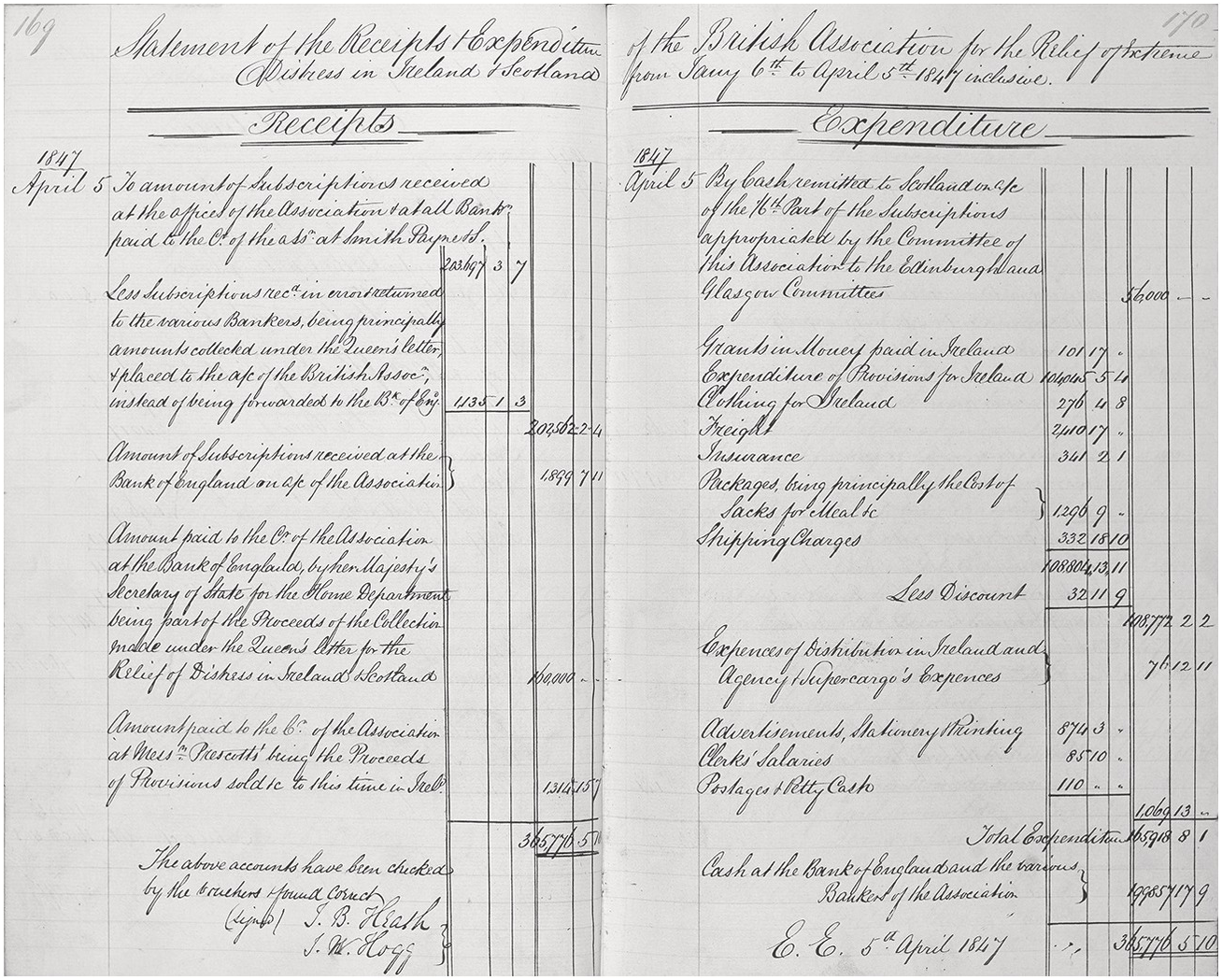


 Open access