


As one of the most ubiquitous and salient social policies in the developing world, conditional cash transfers (CCTs) are often introduced into polities marked by high levels of clientelism. Scholars’ view of the relationship between CCTs and clientelist practices has evolved dramatically over time, with a social policy that was once feared as just a new technology for deepening clientelist dependency (Zucco Reference Zucco2008; Hall Reference Hall2008) quickly reframed as an expression of programmatic choice (Zucco Reference Zucco2013; De La O Reference De La and Ana2013) and subsequently lauded for its ability to weaken clientelist dependency (Frey Reference Frey2019; Hunter and Sugiyama Reference Hunter and Borges Sugiyama2009; Hunter Reference Hunter2014).
The accuracy of these findings has been consistently critiqued, with concerns over measurement error and vulnerability to confounding in contexts where the selection process for program participation is often complex and opaque (Bohn Reference Bohn2011; Zucco and Power Reference Zucco and Power2013). This has prompted analysts to rely on more causally robust comparisons that exploit exogenous variation in policy coverage at the municipal level, and it is these studies that underpin the literature’s prevailing conclusions (Araújo Reference Araújo2021).
Despite its success in validating the importance of CCTs to contemporary electoral behavior, this body of evidence remains vulnerable to the risks of ecological inference due to the misalignment between evidence sourced from aggregated data and theory premised on the responses of individual voters (Bohn Reference Bohn2011). By blurring the responses of beneficiaries and nonbeneficiaries where the unit of analysis is the municipality, existing evidence inhibits our understanding of how CCTs produce electoral shifts. Where municipal exposure to CCTs increases the vote share of the national incumbent (Zucco Reference Zucco2013), it is unclear how much this is due to retrospective voting by beneficiaries or to a local economic boost that translates into pocketbook and sociotropic voting by nonbeneficiaries too. Where municipalities with higher rates of CCT exposure reduce support for local incumbents (Frey Reference Frey2019), it is unclear how much this is due to the empowerment of beneficiaries to vote autonomously or to the resentment of excluded nonbeneficiaries. Even where the literature identifies no effect of CCTs on voting patterns (Imai et al. Reference Imai, King and Velasco Rivera2020), this is consistent with a positive response among both municipalities exposed to CCTs and municipalities that are not, perhaps in anticipation of the program being expanded.
In each of these cases, our interpretation of voter behavior could be severely distorted because CCTs produce spillovers that violate the assumption of noninterference (Rubin Reference Rubin1990). This risk is not just hypothetical, with a growing literature documenting large economic and political spillover effects of social policies on nonbeneficiaries. Economic benefits have been shown to extend well beyond recipients to boost local economies (Egger et al. Reference Egger, Haushofer, Miguel, Niehaus and Walker2022), and nonbeneficiaries can resist expansion where they interpret policy as a signal that politicians do not share their priorities (Corrêa and Cheibub Reference Corrêa and Antonio Cheibub2016; Corrêa Reference Corrêa2015; Boas et al. Reference Boas, Daniel Hidalgo and Toral2021) or can be swayed by “social-policy-as-advertisement” for the incumbent (Bueno et al. Reference Bueno, Zucco and Nunes2023). Beyond the robustness of the quantitative estimates to these spillover effects, our interpretation of how local politics is shaped by CCTs—whether voters are polarized, disinterested, or react in unison—is dramatically different in each scenario.
To understand the electoral effects of CCTs, then, it is crucial to parse out their direct impact on beneficiaries from the responses of nonbeneficiaries, and to separate the effects of individual-level exposure from the contextual effects of higher levels of municipal coverage. To do so, this article studies the case of Brazil’s Bolsa Família program, relying on targeted data collection and a novel strategy of causal inference that takes advantage of the program’s extensive waiting list. The approach incorporates reliable counterfactuals by contrasting Bolsa Família beneficiaries with households that meet the same eligibility criteria but have not yet received the CCT.
Analysis of original survey data collected in twenty-seven municipalities in three states in Northeast Brazil confirms that beneficiaries are indeed much more comparable to those on the waiting list than to the noneligible on key socioeconomic, political knowledge and participation measures. Yet beneficiaries are significantly more likely to reject hypothetical vote-buying offers compared to those on the waiting list in the same municipality. This confirms an important effect of CCTs in reducing the vulnerability of recipients to clientelism, confirming that the mechanism detailed in Frey (Reference Frey2019) operates at the individual level.
However, the results also indicate no effect of individual CCT receipt on voting behavior, either in municipal or national elections, contrary to the findings of most prior studies. Reconciling this mixed evidence points to the need to consider the contextual and spillover effects of CCT programs. Even if the marginal effect of Bolsa Família reaching one more recipient does not alter voting behavior, if voters perceive and react to the contextual intensity of the program, aggregate shifts in voting behavior might still be produced. Extending the analysis to incorporate variation in municipal exposure to the program, the evidence suggests that while there is no effect on national voting, beneficiaries and nonbeneficiaries respond in unison to program expansion, collectively opposing local clientelist incumbents.
Existing theories of spillovers to nonbeneficiaries are difficult to reconcile with these findings. A collective response in opposition to the local incumbent is inconsistent both with theories of positive local economic spillovers from the program and with resentment and polarization around who benefits from the program. Frey’s (Reference Frey2019) account of a reduction in beneficiaries’ vulnerability does not specify any spillover that could cause increased skepticism of incumbents among nonbeneficiaries.
To address this gap, I propose a model of collective confidence which reflects the nature of clientelism as a trap in which voters must overcome a collective action problem to vote against a clientelist incumbent (Adida et al. Reference Adida, Gottlieb, Kramon and McClendon2019). Since there is only downside risk in voting against a clientelist incumbent whom a clear majority of voters support, the ability of CCTs to reduce beneficiaries’ vulnerability is therefore liberating only to the extent that it shifts attitudes among the broader population, consistent with the evidence presented here of electoral effects at the municipal but not individual level. Where a critical mass of beneficiaries is steeled by CCTs to oppose incumbents, this also has an empowering effect on nonbeneficiaries, whose voting calculus shifts to reflect the reduced risks and greater confidence that others will join them in rejecting the clientelist incumbent.
Preliminary evidence in favor of the collective confidence mechanism is drawn from an adapted conjoint survey experiment which demonstrates that where a larger portion of the municipal population receives Bolsa Família, respondents increasingly expect program recipients to reject clientelism.
In combination, the empirical findings and new theory presented here suggest that existing estimates of the effects of CCTs are subject to an ecological inference problem—they are likely to overestimate real but limited effects on beneficiaries and to overlook significant spillovers to nonbeneficiaries, who play an active and crucial role in undermining clientelism, and vital processes of collective coordination. While the pattern of spillovers is likely to be country-specific, this article makes the case that CCTs’ capacity to generate political change is not limited to those who receive them and can prove transformational for entire communities.
Existing evidence of the electoral impact of CCTs
It has long been recognized that when governments distribute benefits to citizens, they also restructure political competition, creating and empowering some groups over others and attracting the support of some voters while repelling others (Campbell Reference Campbell2003).Footnote 1 In developing contexts where clientelism is salient and contrasts starkly with the programmatic nature of CCTs,Footnote 2 these consequences are multiple. On the one hand, effective social policy has the potential to reward its initiators. The introduction of CCTs has been credited with boosting the national government’s vote share in Mexico (De La O Reference De La and Ana2015), Brazil (Hunter and Power Reference Hunter and Power2008; Zucco Reference Zucco2013), and Uruguay (Manacorda et al. Reference Manacorda, Miguel and Vigorito2011), and local incumbents’ vote share in the Philippines (Labonne Reference Labonne2013).
On the other hand, CCTs can also reduce voters’ economic vulnerability in developing contexts where politics frequently involves vote buying, promises of patronage employment, or the conditioning of access to public services. By providing citizens a secure source of income that politicians cannot disrupt, programmatic social policies can undermine support for clientelist candidates and practices (Sugiyama and Hunter Reference Sugiyama and Hunter2013; Bobonis et al. Reference Bobonis, Gertler, Gonzalez-Navarro and Nichter2022). For example, Frey (Reference Frey2019) identifies exogenous variation in municipal health funding in Brazil as an important channel of information that boosts enrollment rates in Brazil’s Bolsa Família program, and uses this to convincingly demonstrate that increases in municipal program coverage lead to reduced support for incumbent mayors, increased political competition, and fewer candidates from clientelist parties. Other studies, in Brazil and Mexico, have credited social policies that secure voters’ incomes with reducing incumbency advantages (Borges Reference Borges2011; Larreguy et al. Reference Larreguy, Marshall and Trucco2018).
Findings in this literature are compelling because they rely on causally identified research designs that produce plausibly exogenous variation in exposure to CCTs created through randomization, staggered rollout, or discontinuities at the level of the municipality (Frey Reference Frey2019; Labonne Reference Labonne2013) or precinct (De La O Reference De La and Ana2013). The credibility of these designs is reinforced by Araújo’s (Reference Araújo2021) meta-analysis, which finds consistent effects and no evidence of publication bias. Exceptions that derive evidence from individual-level comparisons either rely on observational data or narrow circumstances that are hard to generalize: Manacorda et al. (Reference Manacorda, Miguel and Vigorito2011) assess a temporary CCT program in Uruguay, whose effects may well be different from those of more institutionalized programs or from those in countries where clientelism is more widespread.
Studies using aggregated municipal-level data are valuable because they provide accurate and reliable estimates of aggregate causal effects. As Loney and Nagelkerke (Reference Loney and Nagelkerke2014) underscore, these effects are frequently of policy interest, and we must be careful to avoid an “individualistic fallacy” that ignores the operation of public policies at scale. However, these studies risk erring where they make “ecological” inferences about individual behavioral responses and the motivations driving those aggregate patterns (King et al. Reference King, Rosen and Tanner2004). Frey (Reference Frey2019, 5), for example, interprets the available evidence based on municipal-level variation in CCT coverage as supporting a theory of how an “increase in income reduces the vulnerability of poor voters … and therefore the opportunities for clientelistic exchanges.” Yet the same finding of reduced support for the incumbent could also be produced by a negative reaction among nonbeneficiaries, perhaps resentful of their exclusion from the program as others benefit. Other studies draw conclusions on individuals’ willingness to offer retrospective voting rewards despite recognizing that the data provide only indirect evidence (De La O Reference De La and Ana2013, 11) or “do not allow us to distinguish between any of these competing interpretations” of individual behavior (Baez et al. Reference Baez, Conover, Camacho and Zarate2012, 21).
These limitations matter because there are sound theoretical reasons limiting the degree to which CCTs can transform beneficiaries’ political behavior. For example, even after their basic income is somewhat secured, voters remain vulnerable to clientelist threats on other dimensions of essential public service access for which private substitutes are not available or affordable, for example in access to health care, education, or clean water, which is likely to instill considerable caution in voting against clientelist candidates. Local politicians are likely to adapt to find new margins on which to implement clientelism, switching away from policies subject to national rules and focusing on alternative policies they can effectively control (Trucco et al. Reference Trucco, Moreira and Akhtari2022; Nichter Reference Nichter, Diamond and Abente Brun2014; Kaufmann et al. Reference Kaufmann, Ferrara and Brollo2017). Moreover, Imai et al. (Reference Imai, King and Velasco Rivera2020) stress that the programmatic nature of CCTs means that receipt is by definition untied from personal vote choice, so that, particularly where there is broad partisan consensus on these policies, it should not rationally factor into vote choice. Hite-Rubin (Reference Hite-Rubin2015) concurs, showing that access to formal finance in the Philippines has not changed voting behavior but permitted voters to withdraw from politics altogether. Therefore, whether beneficiaries respond to CCTs as expected merits direct confirmation.
The attribution of municipal-level effects to beneficiaries’ responses is ultimately reliant on the assumption of no spillovers (the Stable Unit Treatment Value Assumption, SUTVA; Rubin, Reference Rubin1990). Spillovers may occur across municipalities, as neighbors observe expanding rates of CCT coverage and residents of other municipalities benefit while they do not. Even more problematic for the validity of ecological studies is when spillovers occur within a municipality to nonbeneficiaries. Yet the assumption that spillovers can be safely ignored has not been interrogated directly, and there are prima facie reasons to believe it is unlikely to hold in practice.
As a growing body of literature focused on CCTs’ broader socioeconomic consequences documents, these policies can stimulate local economies (Egger et al. Reference Egger, Haushofer, Miguel, Niehaus and Walker2022), increase the assets of nonbeneficiaries (Barrientos and Sabatés-Wheeler Reference Barrientos and Sabatés-Wheeler2009), and encourage transfers and loans by beneficiaries (Angelucci and Giorgi Reference Angelucci and De Giorgi2009). On the other hand, they can also increase food prices, potentially harming nonbeneficiaries (Filmer et al. Reference Filmer, Friedman, Kandpal and Onishi2023). They can spread information about health services, raising nonbeneficiaries’ welfare (Suarez and Maitra Reference Suarez and Maitra2021). But they can also alter school participation among the siblings of beneficiaries, increasing (Bobonis et al. Reference Bobonis, Gertler, Gonzalez-Navarro and Nichter2022) or reducing (Camilo and Zuluaga Reference Camilo and Zuluaga2022) enrollment. Where community leaders are beneficiaries, spillovers can be particularly large, altering other community members’ aspirations (Macours and Vakis Reference Macours and Vakis2014).
These effects may depend on the scale and duration of CCTs’ implementation. At scale, CCTs are capable of significantly reducing inequality (Soares et al. Reference Soares, Osorio, Soares, Medeiros and Zepeda2007; Ham Reference Ham2014), with myriad consequences for political preferences and behavior under the median voter model. Strategic investments in human capital may depend on complementary investments made by others in the community (Cahyadi et al. Reference Cahyadi, Hanna, Olken, Prima, Satriawan and Syamsulhakim2020). These economic and social effects will be translated into political behavior in context-specific ways, depending not just on simple income effects but also on relative comparisons of improvement, subjective judgments of deservingness and attribution of responsibility, and politicians’ efforts to frame and claim credit for changes.
Focusing on purely political spillovers, Corrêa and Cheibub (Reference Corrêa and Antonio Cheibub2016) document how powerful groups opposed to CCTs, such as business elites or wealthier taxpayers, mobilize in reaction to policy expansion. Their observational survey analysis in Latin America indicates that beneficiaries consistently increase support for the national incumbent, but nonbeneficiaries who oppose the policy, or income redistribution more generally, switch away to the opposition in countries where CCTs are implemented at scale. Corrêa (Reference Corrêa2015) similarly contrasts evidence of beneficiaries’ responsiveness with the lack of any net electoral shift in favor of incumbents in Latin American elections, implying that a countervailing negative response among nonbeneficiaries is responsible.
How do these diverse spillovers alter our interpretation of current findings derived from aggregate data? In some cases, the effect may simply reinforce the individual-level theories; for example, the retrospective rewards previously identified may simply be spread across a broader population. In other cases, the effect of spillovers may be offsetting and point to an underestimation of CCTs’ effects on beneficiaries. For example, if nonbeneficiaries are motivated to deliver retrospective rewards to local incumbents based on the economic stimulus while beneficiaries’ more secure incomes insulate them from clientelism and induce them to oppose incumbents, observed net electoral punishment may mask a (larger) negative reaction among beneficiaries and a (smaller) positive response among nonbeneficiaries. Separating individual effects from aggregate effects that capture broader spillovers is therefore crucial to both isolating accurate estimates and to interpreting whether CCTs generate unifying or polarizing responses.
In sum, the available municipal-level evidence is compatible with a wide range of plausible behavioral interpretations, leaves room for doubt over the true response of beneficiaries, and risks neglecting the political agency of nonbeneficiaries.
Bolsa Família in Brazil
To empirically isolate individual-level effects, this study focuses on the case of Brazil’s Bolsa Família program. Lauded for its impact in reducing poverty, inequality, mortality rates, and unemployment (Pescarini et al. Reference Pescarini, Campbell, Amorim, Falcão, Ferreira, Allik and Shaw2022), Bolsa Família emerged in 2003 through the federal government’s consolidation of a range of local experiments and sector-specific national programs. At this time, the Partido dos Trabalhadores (PT) occupied the presidency and was closely associated with the program.
Many of the most compelling studies of CCTs’ electoral effects have been conducted in Brazil, demonstrating its centrality to both voter behavior in national election campaigns (Hunter and Power Reference Hunter and Power2008; Zucco Reference Zucco2013) and the gradual erosion of clientelism in poor municipalities (Frey Reference Frey2019). Yet concern about the potential for spillovers to invalidate these findings is long-standing, and individual-level observational data have sometimes failed to corroborate these findings (Bohn Reference Bohn2011). Interpretation of individual-level data has proved controversial because of the inherent challenge of controlling for confounding variables such as income, education and region which are strongly correlated with program uptake in a country as unequal as Brazil, and due to measurement challenges in voting recall data in a fragmented and volatile party system (Zucco and Power Reference Zucco and Power2013; Bohn Reference Bohn2013). Studies of the leftward shift in Brazil’s Northeast have highlighted the role of national policy reforms by the PT but have been unable to separate the role of CCTs themselves from the broader economic boom that they supported (Borges Reference Borges2011). While there is a broad consensus that Bolsa Família is central to political competition, it remains unclear exactly how and when.
As of 2024, over twenty million beneficiary households received a monthly grant worth R$600 under the program, plus additional smaller sums for each child or pregnancy. In return, they must comply with minimum attendance requirements in school for those under eighteen, vaccination and attendance at growth monitoring clinics for children, and prenatal attendance for mothers. Eligible households must earn a per capita monthly income below R$218, a threshold that is updated relatively regularly but not automatically (Soares Reference Soares2012). Potential beneficiaries must first register in the Cadastro Único (Single Register), which is used to target a variety of social policies, and municipalities are responsible for the registration through the local office responsible for social assistance (Centro de Referência de Assistência Social, CRAS).
The program is supported and enforced by an autonomous and skilled national bureaucracy, with objective eligibility criteria and key program design features such as direct transfers into recipients’ bank accounts reducing the capacity and credibility of local politicians who threaten to remove recipients (Fried Reference Fried2012). Much of the policy’s success derives from its leapfrogging of powerful state governors and its administration at the municipal level (Fenwick Reference Fenwick2009), where performance is incentivized by additional financial transfers dependent on the Index of Decentralized Management (IGD), which captures registry updating and conditionality monitoring. The Ministry of Social Development (MDS) plays an active role in the oversight of enrollment, scrutinizing income declarations against other administrative data sources. The publication of beneficiaries’ details every month also helps discourage political manipulation, and municipalities are required to establish Social Control Agencies (ICS) that include civil society representation to oversee local implementation. Moreover, politicians seeking to enroll additional people face a strict constraint in the form of municipal quotas for enrollment estimated from prior national surveys of poverty. Independent audits of fraud find only a few thousand cases among millions of enrollees (Soares Reference Soares2012, 17), the targeting performance of the scheme has been well evaluated by independent studies (Soares at al. Reference Soares, Ribas and Guerreiro Osório2010), and even in locations where vote buying is widespread, Brazilians report that Bolsa Família is not used for this purpose (Sugiyama and Hunter Reference Sugiyama and Hunter2013). In short, Bolsa Família is an “ideal type” CCT.
Nevertheless, mayors may be more or less active in encouraging enrollment, and because the program is targeted at the poorest segment of society, a degree of stigma is often attached to applying for or receiving the transfer, with both recipients and nonrecipients frequently believing beneficiaries are complacent, likely to have more children, and spend irresponsibly (Layton Reference Layton2020; de Marins and Rodrigues Reference de Marins and Nogueira Rodrigues2022). Variation in enrollment effort by both eligible households and municipal administrations means that while receipt is not directly subject to partisan bias, there are many subtle influences shaping who benefits (Soares Reference Soares2012; Frey Reference Frey2019) that make observational comparisons of beneficiaries’ and nonbeneficiaries’ attitudes unreliable.
Three features make Brazil’s Bolsa Família suitable for this study. First, the broader political context of the Brazilian case, which combines transparent, fair, and competitive elections with a high incidence of clientelist practices, ensures ample scope for Bolsa Família to serve as both a focal point for retrospective voting and a bulwark reducing voters’ vulnerability to clientelist pressures. Despite socioeconomic progress, many citizens remain dependent on the discretion of local politicians and bureaucrats for access to government benefits, support, and jobs, particularly in the Northeast of Brazil, where this study is located (Nichter Reference Nichter, Diamond and Abente Brun2014, Reference Nichter2018; Toral Reference Toral2024a; Bobonis et al. Reference Bobonis, Gertler, Gonzalez-Navarro and Nichter2022).
While clientelism takes many forms, it relies on control over large amounts of resources that voters value, including public services which only the state is in a position to provide, and is therefore typically most available and beneficial to incumbents (Callen et al. Reference Callen, Gulzar and Rezaee2020). Rigorously documented evidence of clientelist and patronage practices by incumbent mayors is documented in Brazil’s health sector (Nichter Reference Nichter, Diamond and Abente Brun2014, 118–122), education sector (Ferraz et al. Reference Ferraz, Finan and Moreira2012), and more generally in hiring practices (Toral Reference Toral2024a,b).
While weak monitoring renders clientelism inefficient (Hicken and Nathan Reference Hicken and Nathan2020), and institutions such as the secret ballot and electronic voting have blunted some forms of clientelism, their impact has been incomplete (Gingerich Reference Gingerich2014) due to brokers’ innovations in monitoring (Nichter Reference Nichter2018, 40), as efforts have shifted to other observable outcomes through turnout buying, abstention buying and voter buying (Nichter Reference Nichter2018), and through the establishment of iterative long-term relationships in which voters feel normative obligations to their patrons (Finan and Schechter Reference Finan and Schechter2012; Ansell Reference Ansell2014) or have a reputational stake in credibly signaling support for politicians, such as through displays of flags or posters on their house (Nichter and Nunnari Reference Nichter and Nunnari2022; Gallego Reference Gallego2015). The perception of vote buying remains widespread, with 63.7 percent of respondents to an online survey of Brazil in 2016 indicating that it is common or very common for vote buying to take place in local elections (Nichter Reference Nichter2018, 39). In this study’s survey, some 21.3 percent of respondents report being made a vote-buying offer in the 2016 municipal election, ranging from 6 percent to 43 percent across municipalities. The contrast between a backdrop of clientelism—where voters must consider whether withholding political support risks their access to public resources—and the programmatic Bolsa Família enables an investigation of electoral reactions to the program.
The second motivation is that, as a large-scale, high-profile, and politically salient program, the scope for spillovers and reactions by nonbeneficiaries is large. Approximately 22 percent of households nationwide benefited from the program in 2024, and in the sample of municipalities surveyed for this study, coverage rates ranged from 18 percent to 64 percent of the municipality. In 2010, 54 percent of respondents to the AmericasBarometer survey reported personally knowing someone who received Bolsa Família in the past three years, a figure that rises to 76 percent in the three states studied here (AmericasBarometer 2010). Numerous features support its role as a public signal of government action and allow nonbeneficiaries to observe how intense the program is in their municipality. For example, registration on the Cadastro Único is a public process at a central community location, beneficiaries carry branded cards, and the list of beneficiaries can be publicly consulted. The program is also regularly discussed in national political debate and in the media (Biroli and Mantovani Reference Biroli and Mantovani2010).
The final motivation is to exploit a specific characteristic of Bolsa Família’s implementation: the existence of a waiting list to receive the transfer. The waiting list reflects the fact that the program is not an entitlement but is constrained by available budgetary resources and the accuracy and timeliness of the national government’s estimates of local poverty rates that define beneficiary quotas by municipality (Eiró Reference Eiró2019). This has created a gap between a household passing the eligibility criteria and actually receiving the grant. Brazil’s economic recession from 2014 pushed more families below the program threshold and reduced available financing resources (Contas Abertas Reference Contas2017), so the group of citizens on the waiting list rose rapidly. Nationally, at least two million eligible citizens were on the waiting list in 2017 (Ministério do Desenvolvimento Social 2017a). Since both recipients and those on the waiting list have passed through the same selection process—however it operates, even if there is some nonprogrammatic or self-selection component—that mechanism should not confound the results of a comparison between beneficiaries and those on the waiting list. Any differences in attitudes or voting behavior should be attributable to the timing of enrollment and exogenous budget pressures rather than household characteristics.
Causal evidence of policy feedback at the individual level
The empirical analysis exploits this comparison between beneficiaries and those on the waiting list, overcoming a number of limitations in past research designs. First, compared to studies using aggregate data, it is possible to isolate and measure the individual responses of beneficiaries. Second, compared to prior studies using individual-level data,Footnote 3 it provides more reliable counterfactuals in the comparison between beneficiaries and nonbeneficiaries. The primary concern is that there is an unobserved selection process determining who receives the transfer which introduces bias. But even in the best-case scenario, where Bolsa Família is extremely well targeted and all eligible households enroll, comparisons between beneficiaries below the eligibility threshold and those above it will inherently be constrained by the lack of overlap in their socioeconomic characteristics, making it difficult to attribute differences in political choices to the CCT. A comparison of beneficiaries and those on the waiting list both maximizes overlap in socioeconomic conditions and minimizes the risks of confounding, as both groups have met the same eligibility criteria and passed through the same selection process.
While being on the waiting list is itself a distinct policy experience and is not representative of all nonbeneficiaries, the extended duration and unpredictability of waiting-list times due to dependence on current beneficiaries exiting, the national budget situation improving, or a revised estimate of municipal poverty being published, mean that those on the waiting list are unlikely to adjust their attitudes or behaviors until they actually receive the grant.
To collect data on these target groups and to maximize inferential leverage, an in-person household survey was implemented between February and May 2017, targeting regions and households that were likely to be eligible for the Bolsa Família program in contexts where clientelist practices remain commonplace. The survey therefore focused on Northeast Brazil which, due to its relative poverty, has a high incidence of Bolsa Família beneficiaries and continues to experience extensive clientelism (Nichter Reference Nichter2018).Footnote 4 A total of 1,881 surveys were collected in twenty-seven municipalities in three states.Footnote 5 The three states were sampled from across the spectrum of demographic and governance practices within the Northeast—Ceará, Bahia, and Alagoas—to capture an accurate representation of how the program is implemented in practice.Footnote 6
In each state, one municipality was selected from each of nine equal-sized strata classified on two dimensions: by the proportion of Bolsa Família beneficiaries and by the degree of rule-conformity in Bolsa Família program implementation, as measured by the IGD index (Ministério do Desenvolvimento Social 2017b). This ensured representative variation in local socioeconomic conditions, scope for spillovers, and the quality of program implementation.Footnote 7 Within each municipality, four census sectors were randomly selected, with their centroids serving as starting points for a random walk methodology to survey twenty respondent households.Footnote 8
A key screening indicator was used to target the survey to households that were relevant for the study and most comparable: only households that self-reported as being registered in the national government’s Cadastro Único—a register of low-income families—were eligible to respond. This truncates the distribution of income of the respondents, so that the survey is representative not of the overall population but of poor households more likely to be eligible for Bolsa Família. This greatly facilitates comparison between recipients and nonrecipients, including those on the waiting list, which is the inferential objective.Footnote 9 While the primary comparison in this article is between recipients and those on the waiting list, noneligible respondents registered on the Cadastro Único were also surveyed to measure how much more similar those on the waiting list are to recipients than the broader noneligible population, and to provide a more comprehensive estimate of spillovers to nonrecipients. Respondents self-reported their status as recipients or not of Bolsa Família, and 17 percent of nonrecipients indicated they were on the waiting list for the program. Waiting-list respondents were present in all but one of the sampled municipalities and are well distributed geographically, such that no municipality accounts for more than 8 percent of the total, and each state accounts for at least 28 percent of the total.
The sampled municipalities were governed by a range of political parties, the large majority of which (including the DEM, PP, PRB, PSD, and PTB) have a history and reputation of employing clientelism and patronage and are regularly coded as such in academic studies (Freeze and Kitschelt Reference Freeze and Paul Kitschelt2010; Frey Reference Frey2019). Even among those parties with somewhat more programmatic reputations (five municipalities were governed by the PSDB, the Brazilian Social Democratic Party, with a center-right national reputation for macroeconomic stewardship, and one by the PCdoB, the Communist Party of Brazil), there is evidence of a reversion to nonprogrammatic practices in local office (Johannessen Reference Johannessen2020), particularly in the focal region of the Northeast of the country where norms and demands for clientelism are particularly high (Montero, Reference Montero2010; Nichter, Reference Nichter2018, 17). The principal results are robust to excluding these potentially less clientelist mayoral incumbents (see Appendix D). None of the municipalities was governed by the PT, the party that introduced and is most tightly associated with Bolsa Família, allowing us to interpret any shifts in mayoral voting independently of any rewards for the policy’s local expansion.
Figure 1 illustrates the probability of receiving Bolsa Família based on a propensity score regression incorporating key socioeconomic variables (monthly income excluding the grant, gender, an asset index, number of rooms in the house, piped water, bathroom, whether a household member is employed by the government, age, education, number of children and state of residence). In the first panel, there are clear and unsurprising differences in the likelihood of treatment between actual beneficiaries and nonbeneficiaries of Bolsa Família. The second panel focuses on a different comparison—between beneficiaries of Bolsa Família and those on the waiting list—illustrating that the probability of receipt between those two groups is dramatically closer.
Distribution of propensity scores for receiving Bolsa Família compared to (a) nonbeneficiaries, (b) those on the waiting list, and (c) matched dataset for those on the waiting list

There remain small differences in the distribution of the propensity score between beneficiaries and those on the waiting list, with those on the waiting list possessing characteristics that make them marginally less likely to receive the program. This may be due to a number of reasons. First, while most of the variables are time-invariant, it is also plausible that some, such as assets, reflect post-treatment effects of receiving Bolsa Família.
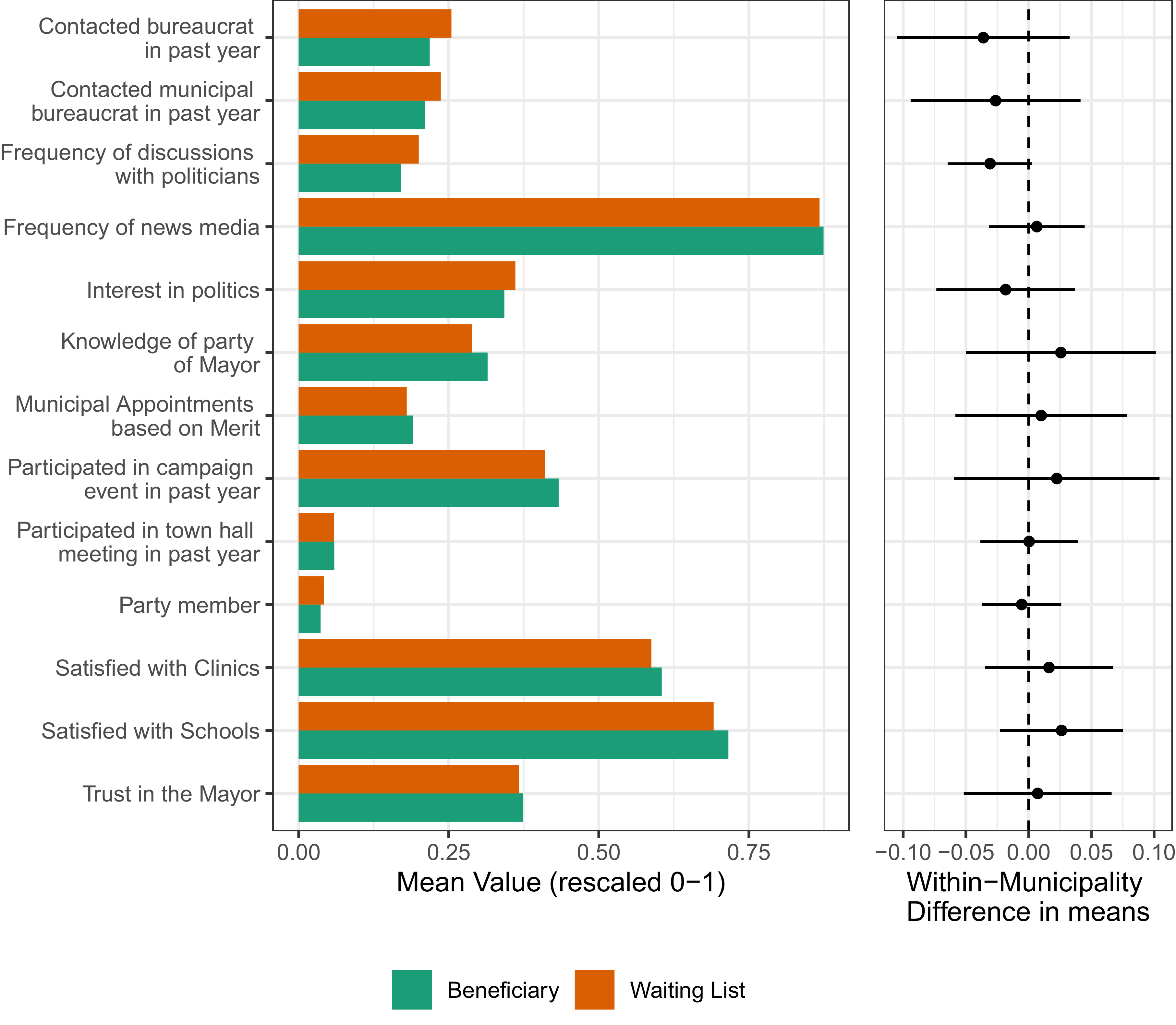
Second, households that applied later to the scheme, and are therefore more likely to be on the waiting list, could be less integrated into community or political life, so possess less information or be less integrated into networks that give them access to municipal bureaucrats responsible for registration. However, there is little evidence of this in the survey data. As Figure 2 summarizes, those on the waiting list in the same municipality are equally interested in politics, just as likely to have participated in a town hall meeting, and are just as likely to be informed about the political party of the mayor. In fact, those on the waiting list are, if anything, marginally more likely to have contacted a municipal bureaucrat in the last year, report a higher frequency of talking to politicians, and are more likely to be party members, although none of these differences are statistically significant. These findings are confirmed in comprehensive regressions reported in Appendix A that include a full set of socioeconomic covariates and show that none of the differences are statistically significant.
Balance in the matched dataset between Bolsa Família Beneficiaries and those on the waiting list for political interactions and attitudes

Third, those on the waiting list may be later enrollees who may have experienced recent economic hardship that pushed them under the eligibility threshold or prompted them to enroll while beneficiaries have had time to recover. It therefore remains important to ensure that the socioeconomic conditions of the two groups are closely comparable. Accordingly, the waiting-list methodology is supplemented with a matching procedure which further limits the sample to only the most comparable households among beneficiaries and those on the waiting list.
The matching procedure uses the optimal matching algorithm to minimize the average absolute distance between matched pairs (Hansen and Klopfer Reference Hansen and Olsen Klopfer2006). Observations are matched on the same socioeconomic characteristics used in the propensity score analysis and exactly matched on gender and municipality to ensure local comparisons. Given that there are more beneficiaries than people on the waiting list in the dataset, each waiting-list respondent is matched to the most similar beneficiary, and the estimand therefore focuses on the average treatment effect among those on the waiting list. The resulting pruning of the dataset produces almost identical distributions of the propensity score between treated and control groups, as illustrated in the third panel of Figure 1. Given the peak of both distributions around a propensity score of 0.5, we are effectively comparing a group of people who had, on average, a 50 percent chance of receiving Bolsa Família based on their socioeconomic circumstances, and in reality, half of that group already receives the grant. Appendix B documents the improvement in balance for each component variable, with remaining levels of imbalance under 0.1 of a standard deviation.
To measure shifts in the outcome variables, three core measures were used: The first focused on attitudes and the latter two on voting behavior. The first measure focuses on responses to a hypothetical vote-buying offer, which 70 percent of respondents rejected.Footnote 10 The second measure is of reported voting for the mayoral incumbent at the last election (approximately six months earlier), an indicator that past studies have focused on to understand increased voter autonomy and competitiveness and one that reflects the dominant role of local incumbents in deploying clientelism as described earlier.Footnote 11 The third measure is of voting intentions for the presidency, where a binary indicator is constructed to capture support for the PT given their long-standing association with Bolsa Família. While 56 percent of respondents indicated a willingness to support the PT for the presidency, only 21 percent indicated their intention to vote for the incumbent mayor.
These measures remain subject to a degree of social desirability bias, particularly for ethically contentious activities such as vote buying. However, social desirability pressures are limited in the local context, with a significant proportion of respondents willing to report vote-buying practices. If a fear of losing access to benefits were responsible for social desirability bias, this would be expected to generate greater reluctance among the most vulnerable respondents—those on the waiting list—which would attenuate the effect estimates toward zero.
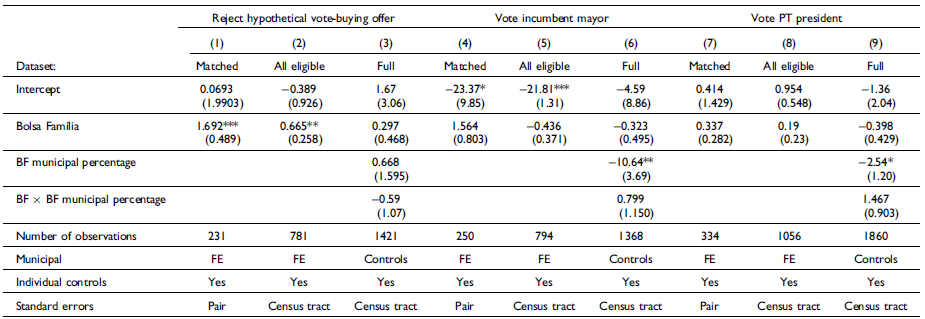
Table 1 reports logit regression results for the effect of receiving Bolsa Família on the log-odds of the three binary outcome variables. For each outcome, three analyses are presented. First, using the matched dataset with standard errors clustered at the matched-pair level provides the most reliable counterfactuals and the best estimate of the individual-level average treatment effect on nonrecipients. To improve generalizability and estimate an average treatment effect for the broader population of all those eligible for Bolsa Família, the second analysis uses the unmatched dataset of all beneficiaries and those on the waiting list, with standard errors clustered at the census tract level, reflecting the sampling design of the survey. The third analysis tests for the effect of context in the full dataset, as explained below, by interacting Bolsa Família receipt with the proportion of beneficiaries in the municipality, as reported by the Ministry of Development and Social Assistance.
The effects of Bolsa Familia on attitudes to clientelism and vote choice

*p < 0.05. **p < 0.01. ***p < 0.001.
The results indicate that recipients of Bolsa Família are significantly more likely to reject hypothetical vote-buying offers in both the matched and unmatched datasets (columns 1 and 2), supporting the argument that CCTs reduce vulnerability to clientelist pressure. The effect is large and significant, representing an increase in the odds of rejection of more than 400 percent in the matched dataset, equivalent to an increase from the control group mean of a 79 percent chance of rejection to 94 percent. The findings are robust to using a less strict definition of rejecting the offer (Appendix C) and to excluding municipalities where the incumbent mayor is from a less clientelist party (Appendix D). This attitudinal gap is particularly striking given the close similarities between the two groups in political participation, information, and satisfaction with public services (see Figure 2).
In contrast to these attitudinal effects, measures of voting behavior show consistently null effects (columns 4, 5, 7, and 8). For mayoral vote choice, the direction of the effect is not stable across specifications and, contrary to the theory of empowerment against clientelism, is positive but insignificant in the matched dataset. For presidential vote choice, the effect is in the expected direction of retrospective rewards but is not significant in either specification. So, while CCTs may be able to produce a significant shift in beneficiaries’ political attitudes, these findings call into question any direct individual-level effect of CCTs on voting behavior.
That CCTs have limited individual-level effects generates a puzzle when juxtaposed with the aggregate-level findings of existing studies. The survey data collected for this study provide one entry point for addressing this ambiguous evidence, since the stratified sampling design ensured substantial variation across municipalities in the proportion of the population receiving Bolsa Família. While the survey did not cover the full population, it did capture the representative views of all those eligible for broad social assistance, arguably those most likely to perceive and respond to the expansion of the program. To separate individual and contextual effects, the final set of models for each outcome uses the full dataset and includes as predictors individual Bolsa Família receipt, the municipality-wide coverage rate of the program, and the interaction of the two variables. Ideally, the exogenous variation in municipal coverage identified in Frey (Reference Frey2019) would be exploited, but this is prohibitive to combine with individual-level data, as it would require surveys to be conducted in hundreds of distant municipalities. Instead, the analysis here takes advantage of the variation in municipal coverage in the survey and controls for both the individual confounders previously described and municipal confounders that are likely to affect voting responses and be correlated with CCT coverage, specifically mean income, municipal population, and the quality of Bolsa Família program implementation using the IGD index.
The results in columns 3, 6, and 9 in Table 1 demonstrate that while attitudes are not sensitive to the intensity of Bolsa Família coverage in the municipality, voting choices are. A 10-percentage-point increase in the proportion of residents who receive the CCT is associated with a 65 percent reduction in the odds of voting for the incumbent mayor among nonbeneficiaries, and a 63 percent reduction among beneficiaries. Strikingly, the interaction term is small and not significant, suggesting these contextual effects operate equally to depress support for the local incumbent regardless of the individual’s receipt of Bolsa Família.
Contrary to existing studies, the results also indicate that program expansion might have harmed the PT in national elections, with a 10-percentage-point increase in coverage reducing support by 22 percent among nonbeneficiaries and 10 percent among beneficiaries. While it is unclear what drives this difference with past results, voting intentions were captured at a low point for the PT, during a period of protracted economic stagnation, following revelations of high-level corruption that implicated the party, and just months after the impeachment of President Dilma Rousseff. This is in contrast to prior studies conducted during periods of PT popularity and economic expansion (Zucco Reference Zucco2013), and it is plausible that beneficiaries felt particular frustration at the PT’s decline, or perhaps associated the new government of President Michel Temer of the Brazilian Democratic Movement (PMDB), a catchall party with a history of utilizing patronage and clientelism, with local clientelist incumbents and extended local punishments to the national level.
The consistent impact of context across beneficiaries and nonbeneficiaries also helps interpret null individual-level voting findings and highlights the salience of spillovers: Both beneficiaries and nonbeneficiaries respond only to aggregate rates of program coverage and not to their own receipt. This suggests that while beneficiaries’ attitudes react strongly to the economic security Bolsa Família affords, they are more cautious and strategic in adjusting their voting behavior, only opposing the local incumbent where the program is sufficiently widespread.
Collective confidence: A theory of political spillovers
Evidence of spillovers from conditional cash transfers raises the question of exactly what mechanism spills over from beneficiaries to nonbeneficiaries and why beneficiaries only respond to contextual shifts in coverage and not their individual policy benefits. That the estimated effect leads to a consistent rejection of incumbent candidates by both beneficiaries and nonbeneficiaries is not consistent with mechanisms previously described in the literature. A mechanism of rewarding incumbents for policy impact would imply universally positive responses (De La O Reference De La and Ana2013). If policy operates as advertising to nonbeneficiaries regardless of its impact on beneficiaries (Bueno et al. Reference Bueno, Zucco and Nunes2023), we would also expect to see a positive response from nonbeneficiaries. If policy implementation serves as evidence of distributional conflict (Corrêa and Cheibub Reference Corrêa and Antonio Cheibub2016) or as a credible signal of the government’s policy priorities (Boas et al. Reference Boas, Daniel Hidalgo and Toral2021), we would expect polarization in the responses of beneficiaries and nonbeneficiaries. Instead, the evidence suggests that nonbeneficiaries join with beneficiaries to punish incumbents.
Their motives for doing so are not well explained by existing theory. Where it is argued that beneficiaries punish local incumbents because of the economic security and autonomy granted by CCTs (Frey Reference Frey2019), it is not obvious how this motivation spills over to affect nonbeneficiaries. The broader local economic benefits that CCTs generate do not provide the same level of economic security and political insulation, since those gains are indirect, vulnerable to economic headwinds, and not protected by a national programmatic policy. Temporarily better-off nonbeneficiaries may still be extremely vulnerable to clientelist pressures. In addition, it is unclear how nonbeneficiaries would attribute these diffuse economic gains, since they are not the product of a single policy experience, or why they would not be willing to reward the local government for them in line with standard theories of sociotropic voting.
Instead, rationalizing the response of nonbeneficiaries requires a closer understanding of the political circumstances in which CCTs operate. Theories of how CCTs reduce vulnerability to clientelism help explain the empowerment of beneficiaries to reject clientelist offers (Bobonis et al. Reference Bobonis, Gertler, Gonzalez-Navarro and Nichter2022; Frey Reference Frey2019, Reference Frey2022), but these theories assume atomized voters and “sincere” voting choices, treating clientelism as a personal constraint on vote choice that is mechanically alleviated by economic security. This approach is at odds with the most insightful analysis of the nature of clientelism, which argues that its power derives not only from the selective incentives it applies but also from the “trap” that it imposes on voters: They face the risk of material loss if they fail to back a winning clientelist candidate, and only realize gains from backing a programmatic candidate if that candidate actually wins (Medina and Stokes Reference Medina and Stokes2002; Medina Reference Medina2010; Lyne Reference Lyne, Kitschelt and Wilkinson2007).
All voters, including nonbeneficiaries, therefore have a material interest in which candidates are most likely to win and, in turn, in how other citizens are likely to vote (Adida et al. Reference Adida, Gottlieb, Kramon and McClendon2019; Morris and Shin Reference Morris and Song Shin2002; Mvukiyehe and Samii Reference Mvukiyehe and Samii2017). Empirical evidence confirms that the electoral prospects of clientelist candidates are central to voters’ willingness to support them (Muñoz Reference Muñoz2018; da Silva Reference da Silva2023). In the limit, where a nonbeneficiary is certain that a majority will reject a clientelist candidate, they are no longer affected by the clientelist selective reward at all and can vote freely. And where a beneficiary believes a majority still supports a clientelist candidate, they have little incentive to harm their own interests and their relationship with patrons with futile opposition, consistent with the evidence of attitudinal but not behavioral change in the results above.
While Adida et al. (Reference Adida, Gottlieb, Kramon and McClendon2019) take a major step in recognizing the importance of voter coordination in clientelist contexts, their mechanism of coordination immediately follows from their assumption of collective monitoring and punishment by the patron. I argue instead that collective confidence is required in the more general case where clientelism operates at the individual level, that the specific mechanism of spillover is through strategic voting to minimize the risk of clientelist exclusion or punishment, and that policy measures affecting a subset of voters can affect the electoral calculations of many.
Crucially, in the context of this challenge of collective action, if CCTs are able to gradually alleviate the constraints on beneficiaries’ vote choices, they can also shift the balance of electoral risks faced by nonbeneficiaries who now perceive a greater chance of others joining with them and therefore a greater chance of their vote against clientelism not just exposing them to loss but succeeding in delivering programmatic benefits. These spillovers may have considerable leverage and explanatory power given that nonbeneficiaries typically significantly outnumber beneficiaries. Scholars of Bolsa Família have alluded to these broader spillovers that extend beyond personal economic security. Hall (Reference Hall, Midgley and Piachaud2013, 180) stresses how the program can create “a new form of leverage through which [voters] can collectively put pressure on politicians to deliver the goods rather than just empty promises,” Borges (Reference Borges2011, 21) argues the program has ‘undermined subnational patron-client networks,’ Leão and Pinzani (Reference Rego and Pinzani2019, 126) speculate that the poor’s conception of the state and their own self-respect have shifted through the ‘broadening and deepening of citizenship’, Melo et al. (Reference Melo, Melo, Ng’ethe and Manor2012, 161) argue it has produced ‘a new political market’ and Daïeff (Reference Daïeff2016, 15) suggests it contributes to the “rising cost and falling effectiveness of local brokers.” However, the mechanisms behind these claims remain vague and lack empirical evidence.
To validate the community-wide electoral implications of reduced vulnerability among Bolsa Família beneficiaries, Appendix E develops a formal model of strategic voting, building on the work of Medina and Stokes (Reference Medina and Stokes2002), Medina (Reference Medina2010), and Lyne (Reference Lyne, Kitschelt and Wilkinson2007). The model emphasizes that even if CCTs’ material impact is limited to beneficiaries, in the presence of clientelism all voters’ fortunes are tied together by the collective action problem they face. Strategically, both beneficiaries and nonbeneficiaries are therefore more responsive to factors that shape the overall resilience and preferences of voters and less responsive to their own personal circumstances, consistent with the empirical findings. This mechanism of collective confidence emphasizes the centrality of voters’ shared vulnerability and their expectations of others’ voting behavior.
To investigate whether the mechanism of collective confidence is operational in the context of Brazil and Bolsa Família, the survey also sought to measure how citizens’ expectations of others’ voting behavior are affected by the Bolsa Família program, specifically, whether learning about another individual’s receipt of Bolsa Família increases expectations that they will reject clientelism, and whether this expectation is stronger in contexts where the coverage of the program is greater.
To estimate the effect on expectations while minimizing framing effects and social desirability bias, and to actively control for other correlated characteristics of Bolsa Família receipt, an adapted conjoint survey experiment was used (Bansak et al. Reference Bansak, Hainmueller, Hopkins and Yamamoto2021). Respondents were asked to consider how they think other voters in their municipality would choose between clientelist and nonclientelist candidates. By manipulating the described characteristics of the hypothetical “other” voter, the methodology estimates how expectations of political behavior respond to three characteristics: gender, education, and Bolsa Família receipt. For clarity of communication, these characteristics were conveyed as images of a cartoon depiction of the hypothetical voter, as shown in Appendix F. To minimize the confounding of these characteristics with income, which is likely to be strongly correlated with perceptions of voting behavior, interviewers explicitly stated that all the hypothetical voters had an income of half a minimum salary (the Bolsa Família eligibility cutoff). Emphasis was also placed on the fact that this voter was a resident of the respondent’s own municipality, ensuring that expectations are anchored to local circumstances.
To measure the outcome variable, respondents were presented with two hypothetical mayoral candidates’ promises of support—one clientelist, one programmatic—and asked which they expect the hypothetical person to vote in favor of.Footnote 12 The design can be analyzed with a logistic regression that interacts two sources of variation: the characteristics of the hypothetical voter and the characteristics of the respondent’s municipality. The interaction tests the hypothesis that expectations of voting against clientelism are greatest when both the hypothetical voter receives Bolsa Família and rates of municipal Bolsa Família coverage are high. The models are run with state fixed effects, and with the same respondent and municipal covariates (mean income, population, and the quality of Bolsa Família implementation) as in the previous analysis to increase precision. The estimates are average marginal component effects (AMCEs) that identify the marginal effect of each attribute, averaging over all the other profile combinations (Hainmueller et al. Reference Hainmueller, Hopkins and Yamamoto2014).
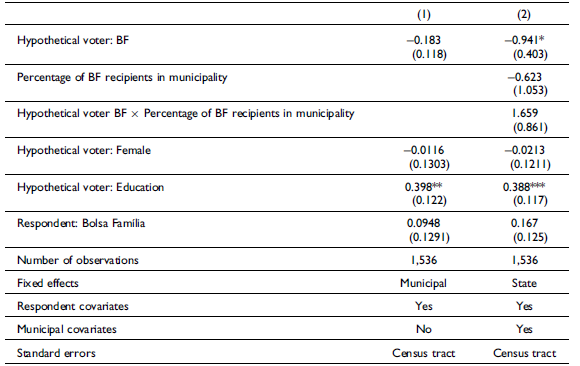
Table 2 illustrates that the hypotheses receive partial support. Consistent with a core implication of the collective confidence model, in municipalities with higher Bolsa Família coverage, respondents expect Bolsa Família recipients to be more willing to reject clientelism, as shown by the interaction term, which is positive and borders statistical significance (p = 0.062). In line with best practice guidelines (Brambor et al. Reference Brambor, Clark and Golder2005; Hainmueller et al. Reference Hainmueller, Mummolo and Xu2018), this pattern is supported by data across the analyzed range from 20 percent to 60 percent municipal coverage, with overlap of both treated and control units across this range, and is also very consistent in nonlinear models, as Appendix G confirms.
Logit models of conjoint experiment measuring the expectation that other voters support programmatic candidates

*p < 0.05. **p < 0.01. ***p < 0.001.
However, contrary to expectations, in municipalities with low program coverage, Bolsa Família recipients are actually expected to be less willing to oppose clientelism. This plausibly reflects media and political stereotyping of Bolsa Família recipients as poorer and more likely to be engaged in clientelist relationships (Layton Reference Layton2020), despite the survey script seeking to standardize income across all profiles. Nevertheless, it appears that when the program is more widespread, these stereotypes are mitigated and beneficiaries are expected to reject clientelism at equal or higher rates than nonbeneficiaries, as illustrated in Figure 3. These results control for average municipal income and program implementation quality, suggesting that it is the coverage of the program itself, and not any shift in stereotypes in wealthier areas, which are driving differences in expectations. They also control for the socioeconomic characteristics of the respondent and personal receipt of Bolsa Família, ensuring that empathy or income-dependent stereotyping is not driving expectations. Consistent with the evidence presented earlier and the collective confidence theory, voters expect Bolsa Família beneficiaries to support programmatic candidates only when they are part of a larger group that has the potential and confidence to move the electoral dial.
Marginal effect plot of conjoint experiment expectation that other Bolsa Família beneficiaries support a programmatic candidate, by proportion of beneficiaries in the municipality (odds ratio)

Conclusion
Unbundling the individual and spillover effects of CCT expansion is crucial to understanding their political consequences. A growing collection of studies has convincingly demonstrated that CCTs matter for election results using aggregated data, but have struggled to pinpoint which voters respond and how. This gap has diminished our understanding of the politics of CCTs as it remained unclear whether voters responded in concert or had polarizing reactions, a distinction that is central both to the program’s sustainability and to the character of the new partisan constituencies being generated.
By discounting the political responses of nonbeneficiaries, existing estimates of municipal-level treatment effects are likely to have overestimated the degree to which CCTs change beneficiaries’ voting behavior. The evidence presented here suggests that CCTs such as Bolsa Família can significantly alter the attitudes of beneficiaries and, when introduced at scale, the electoral calculations of entire communities. While Frey (Reference Frey2019) accurately highlights how the Bolsa Família program has empowered voters to reject clientelist incumbents, that effect is driven not only by the direct mechanism of reduced vulnerability, but also by the indirect mechanism of collective confidence as nonbeneficiaries perceive a growing set of allies willing and able to oppose clientelism and are themselves empowered to vote strategically in favor of programmatic candidates.
Indeed, in contrast to group mobilization and countermobilization dynamics highlighted in developed countries, the evidence suggests that beneficiaries and nonbeneficiaries turn against incumbent mayors at similar rates in response to municipal CCT expansion. CCTs’ most important feedback effects may be produced not by their material effects on beneficiaries’ economic security but by their psychological, cognitive, and interpretive (Pierson Reference Pierson1993; Soss Reference Soss2000) effects that bolster all voters’ confidence that they are likely to find resilient allies if they choose to oppose clientelist candidates. This implies that vulnerability to clientelism may be better conceived as a characteristic of political communities rather than individuals (Bobonis et al. Reference Bobonis, Gertler, Gonzalez-Navarro and Nichter2022) and that citizens excluded from CCTs have been at the forefront of resistance to clientelism.
While the evidence could not corroborate a parallel pattern of increased support for the program initiator—in this case, the PT—this is potentially explained by the volatile political circumstances and the nadir in the PT’s popularity at the time of data collection. Nevertheless, the data continue to suggest that beneficiaries and nonbeneficiaries responded in unison, calling into question suggestions that communities have polarized around CCTs (Corrêa and Cheibub Reference Corrêa and Antonio Cheibub2016).
The mechanism of collective confidence is likely to apply beyond the Brazilian case, particularly to other Latin American regions where clientelism is prevalent and CCTs are both programmatically implemented and publicly visible. The debate on the national political impact of Mexico’s CCTs (De La O Reference De La and Ana2013; Imai et al. Reference Imai, King and Velasco Rivera2020), for instance, focuses on aggregated data and continues to neglect the reaction of nonbeneficiaries, which - if spillovers occur across precincts - may alter the interpretation of findings that the program has no electoral effects. However, spillovers are context-specific, so empirical verification is essential for understanding whether nonbeneficiaries are consistently willing to join with beneficiaries to eject clientelist incumbents. For example, clarity of partisan responsibility and public visibility of the program vary by country, and differences in revenue sources and costs could provoke more polarizing reactions from nonbeneficiaries.
In addition, while important features of the collective confidence model have been validated by the evidence presented here, precisely how voters form expectations of others’ voting tendencies, how attitudinal change translates into voting behavior, and how changes in confidence propagate through community networks remain opaque and understudied.
None of the evidence presented here suggests that CCTs are more effective at changing voting behavior than previously understood. However, the findings do suggest that who reacts is likely to be broader-based across the population and contingent on the scale and public visibility of policy rollout. Accordingly, focusing investments to achieve a critical mass in specific municipalities, reducing community-wide vulnerabilities to discretionary policy-making, maximizing public knowledge about CCT coverage, and dispelling stereotypes around the political behavior of recipients may be important components of policy design to support community-wide transformations away from clientelism in local politics.
Supplementary material
To view supplementary material for this article, please visit https://doi.org/10.1017/lar.2025.10088
Data availability
Replication data for the quantitative analyses is available at https://dataverse.nl/dataverse/leidenPoliticalScience.
Acknowledgments
Thank you to the students who contributed to data collection, Soledad Artiz Prillaman, Rakeen Mabud, participants at the 2018 conference of the Associação Brasileira de Ciência Política, and the anonymous LARR reviewers for invaluable comments.
Funding
I thank the National Science Foundation for its generous funding of the household survey underpinning this research under award 1560659. The fieldwork received human subjects approval from Harvard University under IRB 16-0793, June 2016, and from the University of São Paulo under CAAE 66637616.7.0000.5561.



 Open access

