


Introduction
Tuberculosis (TB) is a preventable infectious disease that remains an important clinical and public health problem in the United States (U.S.). Incidence rates of TB disease in the U.S. during 2023 were 2.9/100,000 population and 10% of TB cases are reported to have died, 1 with an estimated 7-years-per-life-lost. Reference Lee-Rodriguez, Wada, Hung and Skarbinski2
Prior studies have estimated 50%–75% of TB patients are hospitalized, and 83% are hospitalized at the time of TB diagnosis. Reference Taylor, Marks, Rios Burrows, Weiss, Stricof and Miller3,Reference Thomas, Laraque, Munsiff, Piatek and Harris4 An analysis of 2014 data from the Healthcare Cost and Utilization Project National In-Patient Sample identified 4,985 hospitalizations with a principal diagnosis of TB, and average length of stay was 15 days. Reference Aslam, Owusu-Edusei and Marks5
Alameda County is a high TB burden county in California with TB incidence rates from 7.4–10.0 per 100,000 population during 2014–2023. 6 Highland Hospital is the largest safety-net hospital within Alameda County and annually averages >50,000 emergency department visits and 15,000 hospitalizations. 7 We reviewed and analyzed data for all patients hospitalized with TB at Highland Hospital during 2018–2022 to identify factors associated with excess length of stay.
Methods
This was a retrospective cohort study among adults aged ≥18 years old hospitalized for TB at Highland Hospital during 2018–2022. Data were collected on patient demographics, length of hospital stay, and clinical characteristics via the electronic medical record (EMR). Demographic information collected included patient age at time of hospitalization, sex, race/ethnicity, insurance status, and housing status (ie, housed, unhoused, or currently in shelter or transitional housing). Clinical characteristics included presence of comorbid medical conditions such as diabetes mellitus, human immunodeficiency virus infection (HIV), and malignant neoplasm; in addition, laboratory information regarding TB diagnosis such as acid-fast bacilli (AFB) sputum smear and culture and site of TB disease was collected.
The hospital length of stay for each patient was divided into two categories: 1) days spent for diagnosis and medical stabilization; and 2) days spent in an airborne infection isolation room after medically stabilized awaiting clearance to leave isolation. The second category was defined as excess hospital days. These categories for hospital length of stay were determined by EMR chart review by one of the authors (EH), and this information was reviewed and verified by a separate author who is a pulmonologist (FM).
We compared median length of stay and median excess length of stay by demographic and clinical characteristics. The primary relationship of interest, between AFB sputum smear status and excess length of stay, did not meet the proportional hazard assumption required of Cox proportional hazard models, so we further investigated this relationship by conducting multivariate quantile regression with bootstrapped standard errors using 3,000 replications. Variables included in the multivariate regression either had biological or social plausibility for influencing both AFB sputum smear status and hospitalization or were statistically significant in univariate analysis with p <.2. All analyses were conducted using STATA version 15.0 and R version 4.4.0. This study was approved by the Highland Hospital Institutional Review Board.
Results
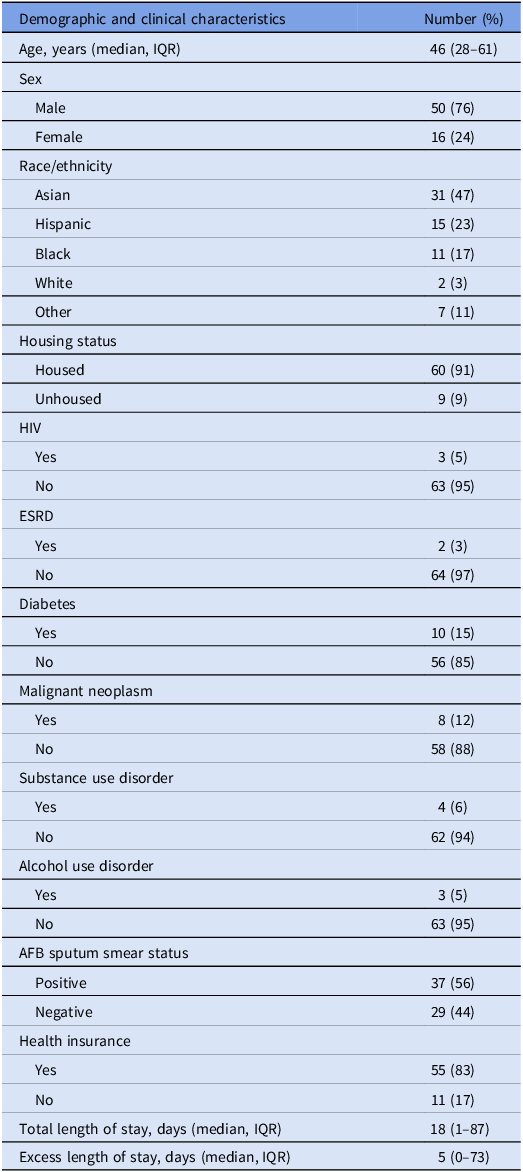
A total of 81 patients were hospitalized with TB during 2018–2022; 66 patients (82%) had pulmonary TB and 15 (18%) had extrapulmonary TB. Only patients with pulmonary TB were included in all analyses. Demographic and clinical characteristics of pulmonary TB patients are summarized in Table 1. Most patients were aged 40 years or older, male, Asian, and had housing at the time of TB diagnosis. Clinically, the most common comorbidity was diabetes, and few patients had HIV, substance or alcohol use disorder; laboratory results noted that most patients had a positive AFB sputum smear result. The median total length of stay and excess length of stay were 18 and 5 days, respectively.
Demographic and clinical characteristics of patients hospitalized with pulmonary TB, Highland Hospital, Alameda County, 2018–2022

Table 1. Long description
The table presents demographic and clinical characteristics of 66 patients hospitalized with pulmonary tuberculosis (TB) at Highland Hospital in Alameda County from 2018 to 2022. The table includes 14 rows and 2 columns, detailing age, sex, race/ethnicity, housing status, HIV status, end-stage renal disease (ESRD), diabetes, malignant neoplasm, substance use disorder, alcohol use disorder, AFB sputum smear status, health insurance, total length of stay, and excess length of stay. Key trends include a median age of 46 years, with 76% of patients being male and 47% being Asian. Most patients were housed (91%) and did not have HIV (95%) or ESRD (97%). Diabetes was the most common comorbidity (15%), while substance use disorder and alcohol use disorder were less common (6% and 5%, respectively). A majority of patients had a positive AFB sputum smear result (56%), and 83% had health insurance. The median total length of stay was 18 days, with an excess length of stay of 5 days.
AFB, acid-fast bacilli; IQR, interquartile range.
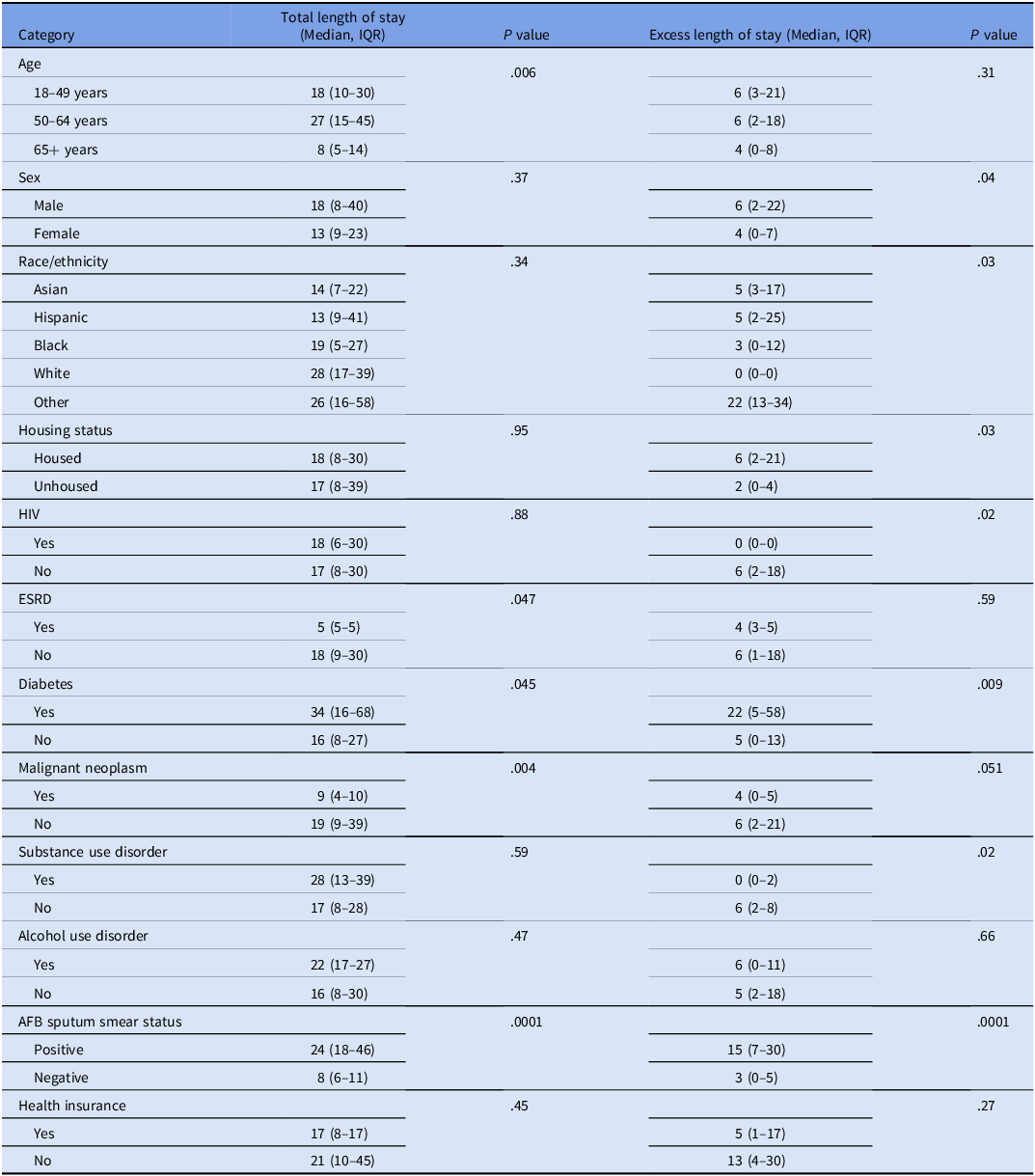
Comparison of median total and excess length of hospital stay by demographic and clinical characteristics are summarized in Table 2. Median total length of stay was significantly higher among patients without malignant neoplasm and patients with a positive AFB sputum smear; median excess length of stay was significantly higher among patients who were male, had an other race/ethnicity, had housing, HIV, diabetes, no report of substance use, and a positive AFB sputum smear.
Comparison of total and excess length of stay in days among patients hospitalized with pulmonary TB, by demographic and clinical characteristics, Highland Hospital, Alameda County, 2018–2022

Table 2. Long description
The table presents data on the total length of stay and excess length of stay in days for patients hospitalized with pulmonary TB, categorized by various demographic and clinical characteristics. It includes columns for total length of stay (median, interquartile range), P value, excess length of stay (median, interquartile range), and P value. The rows are categorized by age, sex, race/ethnicity, housing status, HIV status, ESRD, diabetes, malignant neoplasm, substance use disorder, alcohol use disorder, AFB sputum smear status, and health insurance. Notable trends include higher median total length of stay among patients without malignant neoplasm and those with a positive AFB sputum smear, and higher median excess length of stay among males, patients of other race/ethnicity, those with housing, HIV, diabetes, no substance use disorder, and a positive AFB sputum smear.
AFB, acid-fast bacilli; IQR, interquartile range.
After adjusting for diabetes, malignant neoplasm, race, insurance status, gender, HIV, substance use disorder, and housing status, positive AFB sputum smear result was still associated with longer median total (15 d, P = .002) and median excess (9 d, P = .011) length of stay.
Discussion
Among 66 patients hospitalized for pulmonary TB at Highland Hospital during 2018–2022, the median length of hospital stay was 18 days, with a median of 5 days of excess hospital stay, and positive AFB sputum smear results were significantly associated with longer excess hospital stay. Our findings have important implications for public health and clinical practice for at least two reasons.
First, our findings highlight the fact that pulmonary TB hospitalizations contribute substantially to U.S. healthcare system utilization. Reference Aslam, Owusu-Edusei and Marks5 Although recently released National TB Coalition of America infection control guidelines recommend release from isolation, independent of AFB sputum smear results, to community settings after 5 days of TB treatment, there still remain important gaps in guidelines. Reference Shah, Dansky and Nathavitharana8 Notably, the guidelines do not provide any changes to existing guidance for infection control in healthcare settings and other settings such as homeless shelters, jails, or other congregate settings. Reference Shah, Dansky and Nathavitharana8 However, certain states such as California 9 have issued guidance that includes homeless, shelters, jails and other congregate settings to allow for clearance from isolation after 14 days of effective TB treatment that are supported, in part, by studies of bactericidal and sterilizing activity of TB medications taken during the first 14 days of treatment. Reference Jindani, Doré and Mitchison10
Second, TB patients, especially those in safety-net healthcare systems, encounter many challenges that result from the period in which they are placed in isolation. Investment in community-based isolation housing and support for other basic needs may be needed for TB patients. During the coronavirus 2019 (COVID-19) pandemic several states created new networks and initiatives to support individuals who needed to isolate and connected them to existing resources. 11 Availability of similar services provided during the COVID-19 pandemic may be needed for TB and other infectious diseases that have long isolation periods.
The findings from these analyses are subject to two major limitations. First, our cohort study included pulmonary TB patients from a large safety-net hospital in a high TB burden California county. Therefore, these findings may not be applicable to all healthcare systems and counties. Second, because we were limited to EMR data, it is possible that we could not fully ascertain the reasons why pulmonary TB patients were awaiting discharge after they were medically stabilized. In particular, Highland Hospital changed its EMR during the cohort study and implemented a new EMR during 2019–2020, and information archived in the old EMR regarding reason for prolonged hospitalization was not as detailed. However, we did review all clinical notes in both EMRs; in almost all cases, the notes clearly indicate the reasons for the patient remaining in the hospital.
In conclusion, patients hospitalized with pulmonary TB at Highland Hospital during 2018–2022 had a median of 5 excess hospital days, and positive AFB sputum smears were associated with longer excess length of stay. Implementing new TB infection control guidance and investing in community-based isolation facilities and support may be needed to reduce healthcare utilization associated with pulmonary TB.
Acknowledgements
None.
Financial support
None.
Competing interests
The authors declare no conflicts of interest.
Human participant compliance statement
This analysis of data on patients hospitalized for tuberculosis was approved by the Highland Hospital IRB.

 Open access

