


Deficits in fear recognition occur in both psychopathy (Reference HareHare, 1995; Reference BlairBlair, 2003) and patients with amygdala damage (Reference Davis and WhalenDavis & Whalen, 2001; Reference Adolphs, Gosselin and BuchananAdolphs et al, 2005) suggesting a role for amygdala dysfunction in psychopathy. Recently, Adolphs et al (Reference Adolphs, Gosselin and Buchanan2005) showed that deficits in fear recognition associated with amygdala dysfunction are driven by lack of attention to other people's eyes, and could be overcome by instructing subjects to attend to the eyes. No study has tested whether these attentional processes occur in the fear-recognition problems characteristic of psychopathy. A positive finding might have enormous potential for understanding the development of the most severe forms of antisocial behaviour.
Whereas it may be naïve naive to think that deficits in fear recognition could account for antisocial behaviour seen in adult psychopathy, such deficits could have a powerful influence during critical periods of child development. Fear recognition necessitates understanding that other people are sentient, typically described as a theory of mind (Reference SkuseSkuse, 2003), in order to discern the source of threat from the direction of the other's gaze (Reference EmeryEmery, 2000). A theory of mind is necessary for the development of empathy; amygdala damage is associated with deficits in theory of mind development (Reference Shaw, Lawrence and RadbourneShaw et al, 2004); and children lacking this skill are less likely to develop healthy emotional connections or to benefit from the subtleties of caregiver discipline associated with the development of a conscience (Reference Hughes, White and SharpenHughes et al, 2000). Thus, we were particularly interested in testing whether fear-recognition deficits occur and could be modified in children with psychopathic traits.
METHOD
This study tested the relationships of fear recognition and eye gaze to psychopathic traits (callous-unemotional traits and antisocial behaviour) in community samples of children and adolescents. Psychopathic traits measured in these samples are prognostic of negative outcomes (Reference Dadds, Fraser and FrostDadds et al, 2005), have high genetic loadings (Reference Viding, Blair and MoffittViding et al, 2005), and have the advantage of not being confounded by comorbidity problems that characterise clinical and forensic samples. We hypothesised that:
-
(a) callous-unemotional traits would be uniquely associated with poorer recognition of fear in a free-gaze condition;
-
(b) highly callous-unemotional children would improve to normal levels when instructed to attend to the eyes;
-
(c) in a mouth-gaze condition, the highly callous-unemotional children would return to their previous levels.
The studies were conducted in schools in Sydney, Australia. The first experiment included 33 boys, ranging in age from 8 to 15 years (mean 12.07, s. d.=1.91); the second included 65 boys, ranging in age from 9 to 17 years (mean 13.2, s. d.=1.87). Both samples were from middle- to upper-middle-class backgrounds. Means and standard deviations for callous-unemotional and antisocial behaviour were consistent with normative samples from Australia (Reference Dadds, Fraser and FrostDadds et al, 2005).
Callous-unemotional traits and antisocial behaviour were measured as described in Dadds et al (Reference Dadds, Fraser and Frost2005). Parent and child scores were combined using a highest-score counts method. Accuracy of emotion recognition was measured using the University of New South Wales Facial Emotion Task (Reference Dadds, Hawes and MerzDadds et al, 2004), in which happiness, sadness, anger, disgust, fear or a neutral expression is displayed by four adult faces. Testing occurred in school classes. Emotions were presented in a random order for 2 s each. Participants recorded the emotion portrayed from a list of six emotions. In study 2, the faces were repeated in two further blocks. In blocks 2 and 3, participants were instructed to focus on the eyes and the mouth, respectively, of the display faces. The order of the blocks was chosen because free gaze needed to be first in order to avoid contamination by the later instructions. The look-at-the-eyes condition was scheduled next and the look-at-the-mouth condition last, so that any practice effects producing an improvement in accuracy over time would run counter to the experimental hypothesis that eye gaze would produce the highest accuracy.
RESULTS
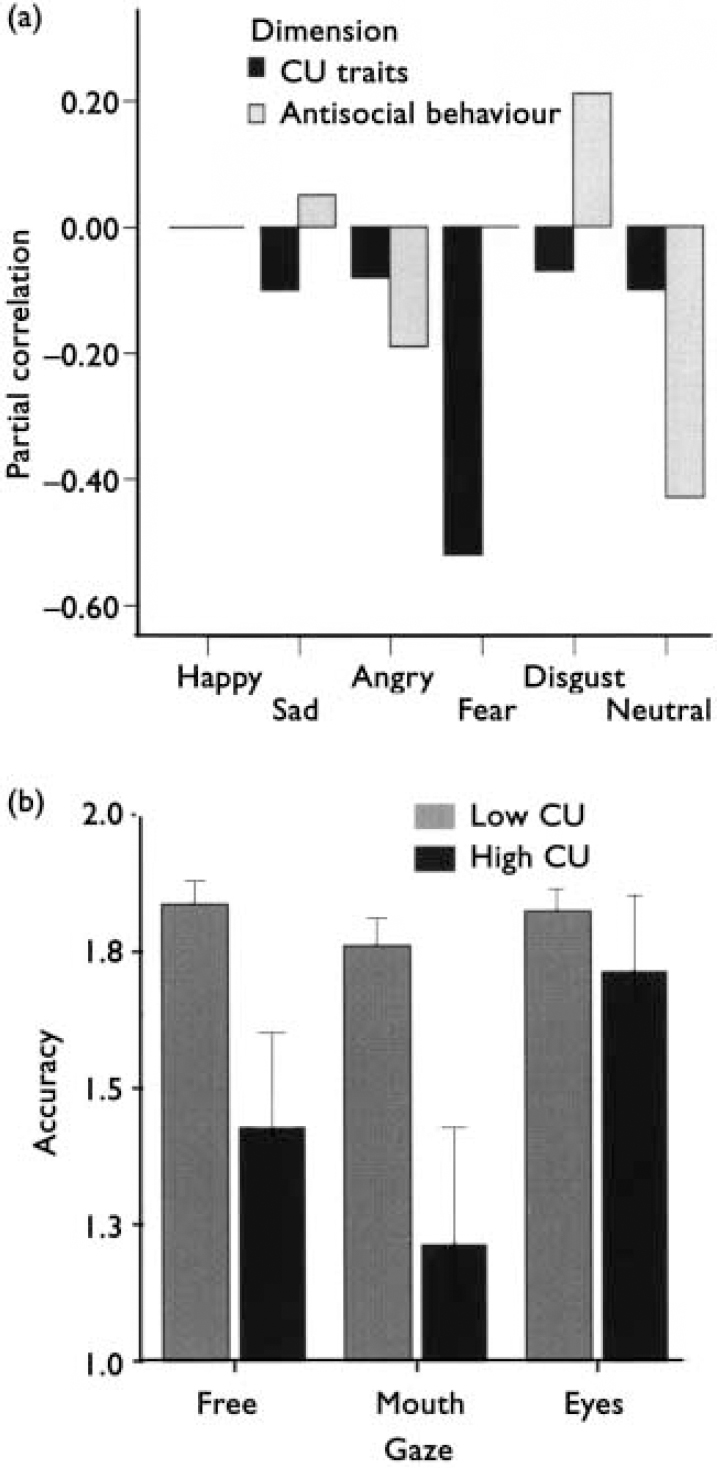
Partial correlations of callous-unemotional traits and antisocial behaviour to accuracy of emotion recognition are shown in Fig. 1a. Antisocial behaviour was associated with poorer recognition of neutral faces (r=-0.43, P<0.004), where neutral faces were most often mistakenly rated as angry. This finding is consistent with the hostilitybias model in which antisocial people are thought to over-interpret hostility in other people (Reference Dodge and PettitDodge & Pettit, 1993). As hypothesised, callous-unemotional scores were uniquely associated with poor recognition of fearful faces (r=-0.52, P<0.0001). The most common errors were to rate fear as neutral emotion or disgust. In the second experiment in the free-gaze condition, we replicated the finding that callous-unemotional scores were negatively correlated with fear accuracy (r=-0.36, P<0.01). The correlation dropped to r=0.05 in the eye-gaze condition, but was again significant in the mouth-gaze condition, r=-0.24, P<0.05. Thus, high callous-unemotional scores were associated with poorer fear recognition except when participants were instructed to look at the eyes. The mean accuracy scores of fear recognition for boys across the three gaze conditions for the sample split into high callous-unemotional (top 25%) and low-average callous-unemotional groups are shown in Fig. 1b. Clearly, highly callous-unemotional children are substantially poorer at recognising fear unless specifically instructed to look at the eyes. Direction of gaze made no difference to accuracy rates in low callous-unemotional children.
(a) Partial correlations of antisocial (controlling for callous-unemotional (CU) traits) and CU traits (controlling for antisocial) with accuracy of recognition of the six emotions for boys in study 1. (b) Mean accuracy for facial fear recognition for boys high and low on CU traits under three gaze conditions: no instruction, instruction to focus on eyes, instruction to focus on mouth. Significant interaction between gaze and CU category, F (2,55)=5.149, P=0.009. Error bars represent standard errors of the means.
DISCUSSION
These results show that antisocial behaviour and callous-unemotional traits are associated with very different emotion-recognition problems in young males. Specifically, antisocial behaviour is uniquely associated with a tendency to oversee hostility, and callous-unemotional traits, the affective aspect of psychopathy, are uniquely related to poor recognition of fearful expressions. The current study shows that this deficit in fear recognition is in part owing to visual neglect of the eye region of other people's faces, as with amygdala-damaged patients (Reference Adolphs, Gosselin and BuchananAdolphs et al, 2005), and can be temporarily reversed by directing attentional focus to the eye region of other people. Although this study is the first to demonstrate this effect, we note that Richell et al (Reference Richell, Mitchell and Newman2003) found that psychopathic individuals could identify facial emotions using stimulus faces that were truncated to include only information from the eye region.
Although they require replication in larger samples containing more extremes of the psychopathy traits, these findings indicate that emotion-recognition emotion-recognition problems in psychopathy are owing in part to a failure to direct attention to the emotionally significant aspects of the environment. This may have wide-reaching implications for understanding and intervening with high-risk children at developmentally sensitive periods. We argue that these attentional processes will be of critical importance in the early years of life, when responsiveness to normal discipline practices will depend in part on the ability to recognise the emotional states of caregivers. Further, the ability to recognise fear in other people may be a specific marker of the ability to develop theory of mind during the developmental stage that is critical for learning that other people are sentient, feeling organisms: a skill that is needed in order to treat others accordingly.
Acknowledgements
This research was supported by a National Health and Medical Research Council of Australia Project Grant to M. D.




eLetters
No eLetters have been published for this article.