


1. Introduction
Circular Colour, Material, and Finish (CMF) design has become critical for sustainability in the automotive industry. Approximately 80% of a product’s environmental impact is determined during the design phase (Directive - 2009/125 - EN - EUR-Lex, 2024), and CMF decisions directly influence a vehicle’s footprint by defining material choices and finishes. At the same time, carmakers are increasingly pressured to adopt circular-economy principles - such as using recyclable, renewable, and low-carbon materials - without compromising on quality or aesthetics (Reference Aguilar Esteva, Kasliwal, Kinzler, Kim and KeoleianAguilar Esteva et al., 2021). These requirements are contradictory since sustainable and renewable materials are consistently perceived as of “low quality” by the customers (Reference KaranaKarana, 2012; Reference NewtonNewton, 2017; Reference HarjuHarju, 2022). Nevertheless, this imperative has elevated CMF design from a purely aesthetic matter to a strategic lever for achieving climate goals. Leading brands have begun showcasing circular design concepts (e.g., BMW’s Vision Circular, 2021) as part of their commitment to this industry-wide shift.
Yet, a significant problem persists: CMF designers currently lack effective tools and data to evaluate the circularity and sustainability implications of their design choices (Reference Nawar, Etawy, Nassar, Mohammed and HassaboNawar et al., 2024). Decisions about colours and materials – leather vs. bio-fabric, virgin plastic vs. recycled composite – are often made with limited quantitative feedback on environmental impact. In practice, designers have few resources for real-time carbon footprint analysis or recyclability metrics during the concept stage. Our research interviews with automotive CMF professionals underscore this gap, as participants consistently expressed a need for accessible metrics such as CO₂ footprint, material recyclability, and weight implications to support informed decision-making. In other words, designers want to design for circularity, but the absence of integrated evaluation tools makes it challenging to judge how “circular” a given CMF choice truly is during development. This gap between sustainability goals and available design support tools hinders the industry’s progress towards a circular economy.
In response to these challenges, emerging design support technologies – particularly Agentic Artificial Intelligence (AI) systems - are being explored as potential solutions (Reference Stige, Zamani, Mikalef and ZhuStige et al., 2024; Reference Lee, Law and HoffmanLee et al., 2025). Agentic AI refers to AI systems that can autonomously plan, reason and execute tasks beyond simple query-response interaction to proactively assist users across complex workflows (Reference Hughes, Dwivedi, Malik, Shawosh, Albashrawi, Jeon and WaltonHughes et al., 2025). The rise of AI in design offers new ways to analyse large datasets and generate insights rapidly, empowering CMF designers to make sustainability-informed choices. For example, one of our recent initiatives (CMF Circularity AI: Transforming Vehicle Design with Customer Insights | Vinnova, 2025) proposes using Agentic AI in CMF design and customer insight data to help automakers select sustainable materials that meet both environmental targets and consumer expectations. There is a growing recognition that Agentic AI assistants could augment designers’ capabilities by providing quick lifecycle assessments, suggesting alternative eco-materials, or forecasting how a material will perform and age (Reference Hughes, Dwivedi, Malik, Shawosh, Albashrawi, Jeon and WaltonHughes et al., 2025). It is essential to understand that these tools are envisioned not as replacements for designer creativity but as supportive agents that provide data-informed feedback throughout the creative process. The convergence of AI and circular design thus presents a timely opportunity to bridge the current information gap in CMF practice. It should be noted that sustainability is a multidimensional concept encompassing ecological, economic, and social pillars. Given this context, the present study investigates how CMF designers perceive and address circularity in their workflows, and how Agentic AI systems might better support their sustainable design practices. The research aim is twofold: (1) to understand the user needs, attitudes, and pain points of automotive CMF designers regarding circularity, and (2) to explore the potential roles and requirements for AI-based tools that could assist in meeting those needs. In pursuing this aim, we asked: (RQ1) “How do automotive CMF designers currently integrate (or struggle to integrate) circular economy principles in their design decisions,” and (RQ2) “What do they expect or require from emerging AI tools to facilitate this process?”
By clearly articulating these needs and expectations, we seek to inform the development of user-centred design support systems that meaningfully advance sustainability in CMF practice. This paper builds further knowledge on (Reference Andersson and SiljeklintAndersson & Siljeklint, 2025) work, which investigated people-centred AI agent design in an automotive context, examining designers’ workflows and barriers to AI adoption, and on the data collected throughout the “CMF Circularity AI: Transforming Vehicle Design with Customer Insights“(2025) project. In this work, we offer a people-centred perspective and conceptual framework, emphasising factors such as trust, transparency, and the importance of AI as a creative aid rather than a replacement for human designers. During this study, we conducted in-depth interviews with automotive CMF designers to pinpoint their needs and challenges related to sustainability and circularity. By bringing together insights from academic research and industry practice, this paper provides a key finding on designer needs, attitudes towards circularity, and views on AI support. We discuss their implications for both theory and practice in sustainable design. With this effort, we aim to contribute actionable knowledge for the design research community and offer guidance for developing AI tools that truly align with CMF designers’ needs in the age of the circular economy.
2. Background
The perceived value and functionality of a product are significantly influenced by its appearance, tactile qualities, and operational behaviour of spaces and product components. These fundamental aspects are intrinsic to the subject of Colour, Material, and Finish (CMF). The selection of materials and the application of finishes are paramount in enhancing not only a product’s aesthetic appeal but also its functionality. Throughout the design process, designers must align CMF design decisions with customer expectations and the specific product usage context. (Reference Nawar, Etawy, Nassar, Mohammed and HassaboNawar et al., 2024)
In the context of the CMF design process, the selection of materials constitutes an essential stage, encompassing the selection of the base material in addition to colouring chemicals and finishing agents. The selection of a material from a variety of available materials depends on the specific definition of requirements for the target application. Material performance requirements can be categorised into five distinct types: functional, manufacturing, reliability, sustainability, and cost. The selection process may be subject to the implementation of various methodologies, including the Cost-Per-Unit-Property Method or the Weighted Properties Method. The provision of support is facilitated by knowledge-based expert systems (KBS). This paper focuses on sustainability requirements, thereby raising the question of the extent to which knowledge-based expert systems are up to date, comprehensive, and trustworthy in a highly dynamic, changing market environment. (Reference FaragFarag, 2020) In the context of automotive and CMF design, there has been a considerable shift in sustainability requirements, driven by growing sustainability requirements and customer preferences for sustainable products. The focus of this paradigm shift is on interior materials, which have been identified as a significant contributor to a car’s environmental footprint. A range of developments is influencing the selection of sustainable interior materials, with a focus on the reduction of emissions, the integration of renewable resources, and the enhancement of circularity and recyclability strategies. Consequently, this will result in the selection of renewable, recyclable or biodegradable resources for CMF design. (Reference UysalUysal, 2025). In recent times, KBS have been implemented within the material selection process to support the designers’ decision-making. A KBS is primarily a software tool that replicates human expertise to assist designers in selecting optimal materials using predefined logical rules and comprehensive databases. The system integrates a knowledge base, an inference engine, and a user interface. It can interpret design constraints, evaluate alternatives, and provide recommendations ranked according to a predetermined scale. However, the efficacy of such systems is depending upon the completeness and accuracy of their knowledge base, the appropriate formulation of rule sets, and regular updates to reflect new materials and technologies. The integration of KBS with existing design tools and the adaptation of the system to complex, evolving requirements remain key challenges that demand ongoing expert involvement and data refinement. (Reference Maleque and SapuanMaleque and Sapuan, 2013). The challenges and dependencies of a KBS can be addressed by AI-based experts or decision-support systems. Nevertheless, as these systems are predicated on probabilistic models, novel challenges emerge at the user level. It is evident that designers and users are unable to reproduce the decision-making and response processes. This has given rise to questions concerning data transparency, data reliability and privacy issues. Research has demonstrated that the concept of trustworthiness in AI encompasses a multitude of dimensions, including fairness, transparency, and privacy. These dimensions are not independent of each other and, in some cases, do have competing priorities. To illustrate this point, consider the contradiction between full transparency and the necessity for privacy assurance. (Reference Felzmann, Fosch-Villaronga, Lutz and Tamò-LarrieuxFelzmann et al., 2020) The extent to which users perceive ease of use and trust is a significant factor in enhancing user trust and facilitating higher adoption rates. The utilisation of AI in the domain of decision support systems is grounded on the principle of prioritising user needs. The implementation of such systems has the potential to enhance organisational performance through the systematic development and refinement of processes. (Reference Razzouki, Hammou and IzenzalRazzouki et al., 2025)
To understand user requirements and establish a reliable, transparent, and effective AI decision-support system for CMF designers, the subsequent section focuses on the designers themselves and gathers their requirements regarding such systems.
3. Methodology
3.1. Research design
We adopted a qualitative case study approach to investigate the research questions (Reference YinYin, 2009). A single-case design was chosen because our “how” research questions required exploring a contemporary phenomenon (automotive CMF design for circularity with AI support) in its real-world context. The case is bounded by the CMF Circularity AI project environment – focusing on automotive Colour, Material, and Finish design practices as they relate to sustainability and AI. This design allowed us to gather rich, contextual insights from practitioners, aligning with Yin’s guidance that case studies are appropriate when the boundaries between the phenomenon and context are complex and when multiple data sources are needed to understand why or how something occurs (Reference YinYin, 2009). By treating the automotive CMF design domain (within a sustainability-driven innovation project) as a single holistic case, we could deeply examine designers’ experiences and needs without the confounding variability of multiple case settings. The case study was exploratory, aimed at uncovering user needs and tool requirements rather than testing a specific hypothesis.
3.2. Participants
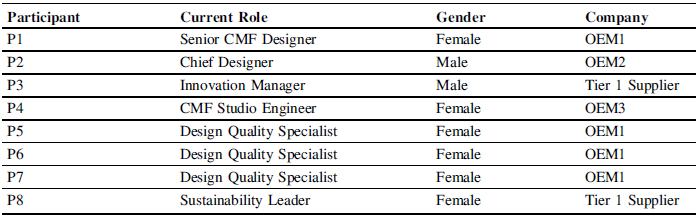
We employed purposive sampling to recruit professional automotive design professionals with direct experience in CMF design and sustainable materials. A total of eight participants took part in our study. These individuals were drawn from different automotive OEMs – including major vehicle manufacturers (OEMs) and a Tier-1 supplier – to capture diverse perspectives across the design value chain (see Table 1).
Study participants demographics overview

Prior to the interviews, all participants provided informed consent in accordance with the Swedish Psychological Association’s standards. They were assured of anonymity (we assigned codes and generic role labels instead of real names) and informed that the data would be used for research purposes only, in line with ethical guidelines and GDPR requirements. This careful selection and consent process helped ensure participants were comfortable sharing candid insights into their workflows, challenges, and expectations.
3.3. Data collection
Our primary data source consisted of in-depth, semi-structured interviews with the eight participants. An interview guide was developed (based on the study’s aims and the literature) to ensure consistency while allowing flexibility for probing insights. Each interview lasted approximately 60–90 minutes. Most sessions were conducted via video conferencing (given participants’ locations and schedules), though a few were in person where feasible. We began each interview with a brief introduction of the research and obtained permission to record the conversation. The interviews opened with questions about the participant’s background and current role in automotive design, to establish context. We then explored their design process and challenges, focusing especially on how (and if) circular economy principles figure into their CMF decision-making (addressing RQ1). Participants described how they select materials/finishes, what sustainability criteria they consider, and any difficulties in integrating circularity (e.g., lack of data, time pressures, or perceived quality trade-offs). We used follow-up prompts to delve into specific pain points – for instance, asking for examples of conflicts between sustainable material choices and design requirements. In the second half of each interview, we shifted focus to the topic of AI design support (addressing RQ2). Participants were asked about their familiarity with AI tools and what they would expect or desire from an “agentic AI” assistant in their workflow. We discussed potential features such as real-time sustainability metrics (e.g., carbon footprint calculators, recyclability scores), alternative material suggestions, trend analyses from customer insight data, and so on. Participants were encouraged to imagine how an AI tool might help them overcome the previously mentioned challenges – and to voice any concerns (such as trust, reliability, or creativity issues). The semi-structured format enabled us to cover key themes while adapting to each expert’s domain of expertise (some conversations went deeper into design quality evaluation, others into material engineering details, depending on the person’s background). All interviews were audio-recorded to ensure accuracy of data capture. The recordings were then transcribed verbatim using a secure, AI-assisted transcription tool for efficiency (locally deployed Whisper - an automatic speech recognition (ASR) system (OpenAI, 2022). After transcription, we reviewed each transcript against the original audio recordings to correct errors and removed any identifying information (names of people, specific projects or companies) to protect confidentiality. These clean transcripts formed the basis of our qualitative dataset. We also collected secondary materials to inform the case context – for example, internal project documents and literature on automotive sustainable design – but the interview data was the central source of evidence for our case study. Throughout the data collection, we followed Yin’s guidelines of creating a case study database: organizing interview notes, audio files, transcripts, and any related documents in a structured archive. This ensured that we had a clear audit trail from raw data to the conclusions, reinforcing the study’s reliability.
3.4. Data analysis
We analyzed the interview data using qualitative thematic analysis, combined with techniques recommended for case studies (e.g. pattern-matching and explanation building). The analysis procedure was systematic and iterative. First, two researchers independently read through each transcript to become familiar with the content. We then open-coded the data, assigning descriptive labels to meaningful segments of text. Many codes were derived inductively from the participants’ own words (e.g. “limited recyclability data” or “trust in AI’s suggestions”), while some codes were informed by our research focus (e.g. categories for sustainability challenges vs. AI tool expectations corresponding to RQ1 and RQ2). Using a collaborative coding approach, the team compared and refined these codes, merging similar ones and resolving any discrepancies through discussion. Through this process, a set of salient themes emerged that captured the patterns in the data. For example, under RQ1 (current integration of circularity) we identified themes such as “Lack of real-time sustainability feedback in design”, “Perceived quality trade-offs with eco-materials”, and “Organizational pressure versus circular ideals”. For RQ2 (AI tool expectations), common themes included “Desire for lifecycle impact metrics”, “AI as a creativity support (not a replacer)”, and “Trust and transparency requirements for AI”. We noted where participants converged or diverged in their views – a form of pattern analysis aligning with Yin’s suggestion to look for rival explanations and inconsistencies. Notably, all interviewees agreed on the need for an AI tool to provide quantitative environmental impact data, yet they had differing opinions on how the AI should present recommendations (some wanted strict guidance, others just inspiration). To ensure robustness, we also utilized computer-assisted analysis: we leveraged an AI-based text analysis assistant (Manus AI, 2025) to help aggregate and synthesize the large volume of qualitative data, essentially cross-checking the themes our manual analysis found. This tool helped quickly highlight common phrases and potential insights across transcripts, which we then verified against the raw data. Throughout analysis, we maintained a chain of evidence by linking each theme back to multiple quotes and instances in the transcripts (preserving representative examples for reporting). We also performed peer debriefing within the research team – one researcher would challenge the interpretations and another would double-check that conclusions were supported by the data – to avoid subjective bias. By triangulating findings across different participants and cross-validation within the team, we enhanced the credibility of our results. In summary, the data analysis yielded a comprehensive understanding of (a) how CMF designers currently deal with circularity and where the gaps are, and (b) what features and characteristics they would value in an AI assistant to support sustainable CMF design. These findings directly inform the user-centered design requirements we discuss later.
4. Findings
4.1. Designer needs and current gaps
Interviews revealed that CMF designers strongly desire better data integration in their workflow, especially for sustainability metrics. Nearly all participants emphasized the need for accessible environmental impact data (e.g., CO₂ footprint, material weight, recyclability) at the design stage. Currently, obtaining such information is tedious and unreliable – one designer (P3) described it as“very difficult to get some clear data from the suppliers” when validating material choices. In practice, designers often lack precise lifecycle data and must make educated guesses about a material’s sustainability performance. We found that a core user need is a tool that can quickly provide trusted sustainability insights (e.g., carbon footprint comparisons) to support material decisions, filling a gap left by today’s ad hoc, time-consuming data collection processes.
Another significant gap in current tools is usability and integration. Participants highlighted frustration with the clunky, siloed software they currently rely on. Many still use basic spreadsheets or separate databases to track materials and impacts, which they find cumbersome. “We need something much more friendly than Excel,” one interviewee (P5) stated, echoing a common sentiment that the user interface (UI) should be intuitive. We found that designers want a seamless, low-friction interface for querying data – for example, a chat-style or voice-driven tool – rather than navigating complex enterprise systems or manual Excel sheets. Integration with existing product data systems was also frequently mentioned. Interviewees noted that current PLM/BOM systems are not designed for easy queries, forcing manual workarounds. They expressed a need for the AI tool to pull information directly from internal databases (materials libraries, supplier information, BOM data) so they can automatically retrieve details such as where a material is used or its supplier’s specifications. In short, a well-integrated, user-friendly platform was seen as essential to addressing productivity gaps in today’s workflows.
Designers currently struggle with inconsistent or opaque data, which undermines trust in digital outputs. They stressed that an AI system must use credible, up-to-date sources and clearly document its references. For instance, a studio engineering manager (P4) explained she would require “clear statements on where this AI tool gets its information, what kind of databases are feeding its answers” before trusting the results. Similarly, others said they would only treat AI suggestions as preliminary indicators unless the tool can show confidence levels or source details for its recommendations.
We found that building trust through transparency is crucial: users want to double-check the AI’s advice against known benchmarks, and they expect the tool to facilitate this (e.g., by citing an industry-standard LCA database or flagging data uncertainties). This highlights a gap in current processes, where designers often have to compile and verify data themselves; an AI assistant could fill that gap by serving as a validated information hub.
Participants also pointed to collaborative and decision-support gaps in their current workflow. Because sustainable design decisions often involve justification to other stakeholders (management, engineering, or suppliers), designers said the tool should help communicate and document the rationale behind choices. For example, one interviewee (P1) suggested the AI could generate a brief report or summary of the decision process to “show design history and justifications”, lending weight to CMF proposals. At present, assembling such evidence is manual and time-consuming, so this feature was seen as a valuable support for gaining buy-in for novel or eco-friendly materials. Likewise, several interviewees wanted easier ways to share outputs or collaborate on analyses across teams. Today, results are often shared through email or presentations. In contrast, respondents envisioned features like a shared workspace or one-click export of the AI’s analysis for colleagues.
Finally, the interviews underscored some technical limitations in current design practice that designers hope AI tools could overcome. One noted issue was the disconnect between digital visualization and physical reality: CMF professionals often find that what they see on-screen (digital renderings of colours/materials) does not match the real-life outcome, due to lighting conditions or material behaviors that are hard to simulate. This gap in material fidelity means designers still rely heavily on physical prototypes, causing delays. While the proposed AI assistant was mainly imagined as a decision-making tool (not a rendering engine), some participants suggested that future versions might integrate with visualization software or AI image generation to quickly preview material choices more realistically. In addition, knowledge dissemination is a challenge – one interviewee (P7) noted having to “educate and build up the use of CMF” in the company because many colleagues lacked familiarity with design considerations. Such comments show that, beyond specific features, designers need support in bridging knowledge gaps and ensuring consistency. In summary, current tools and processes leave CMF designers without readily available data, with clunky interfaces, and with weak support for collaboration and visualization. The interviews highlighted these as priority gaps that an AI-driven CMF assistant should address.
4.2. Attitudes towards circularity
The participants generally expressed a strong personal commitment to sustainability and circular design, but practical tensions and contradictions within the industry tempered their attitudes. A clear theme was the conflict between sustainability goals and cost or organizational priorities. Many interviewees lamented that, in practice, eco-friendly materials or circular solutions are often overridden by budget concerns. As one CMF designer said (P1), “the one that sits on the money… they care if it costs too much,” implying that management will cut sustainable ideas if they are not cost-competitive. Indeed, some OEMs still lack a formal requirement to use sustainable materials, making such efforts rely on individual leadership support rather than mandates. Conversely, a few participants highlighted positive examples where their companies are increasingly prioritizing sustainability— for instance, one interviewee noted that their firm had established a dedicated sustainability team and was aligning material choices with clear environmental targets. These mixed experiences reveal an attitudinal divide: in some organizations, circularity is becoming a strategic goal, whereas in others it remains a secondary consideration. Designers operating in the latter context often feel frustrated that “they don’t care” enough about greener materials, highlighting a need to demonstrate that circular solutions can meet business constraints.
Another nuanced attitude that emerged is how circularity is defined and balanced against other sustainability criteria. Several participants noted that “sustainability” is multifaceted and can even be internally contradictory. One common tension discussed was longevity vs. circularity: making a product last longer (durability) versus making it easy to recycle or made from recycled content. For example, an interviewee pointed out that a part could be highly recyclable but not very durable, whereas a very long-lasting material might reduce waste even if it’s not easily recyclable. The trade-off between circularity, carbon footprint, and product longevity was explicitly acknowledged – these metrics can sometimes conflict with one another. Therefore, designers approach circularity pragmatically, recognizing that it’s not just about using recycled materials but also about the overall lifecycle impact. We heard that they would like tools to help evaluate trade-offs (e.g., balancing CO₂, recyclability, and expected lifespan) to support informed decision-making. A related challenge is the lack of standardization in measuring circularity: participants gave examples of inconsistent metrics, such as one automaker treating leather as a waste byproduct (thus giving it a low footprint) while another counts the full impact of raising a cow, leading to “very, very different results” for the same material. This inconsistency in circularity definitions complicates designers’ efforts and sometimes breeds skepticism about “sustainable” claims. It underlines why many interviewees want clear, comparable data – so they can cut through contradictory standards and genuinely advance sustainability.
Participants’ attitudes also reflected an understanding of operational constraints on circular design. Many acknowledged that CMF designers alone cannot drive circularity in isolation, because key decisions (materials, part geometry, manufacturing methods) are often made upstream in engineering or product strategy. One respondent observed that a large portion of what affects sustainability “is taken earlier in the chain from the CMF team”, outside their direct control. This reality sometimes led to a sense of powerlessness or dependency: even a highly sustainability-minded CMF designer may be limited if, for example, the vehicle architecture isn’t designed for disassembly, or if procurement will not approve certain recycled polymers. We found that designers adopt a realistic attitude – they focus on what they can change (choosing better finishes or secondary materials), but they also stress that a true circular economy requires cross-functional alignment beyond the CMF domain. Notably, one of the interviewees suggested that an AI tool could aid here by questioning the design choices and prompting more radical ideas like eliminating unnecessary parts entirely. This implies that designers are open to using AI to inject circular thinking at a systemic level (e.g. “reduce the inflow of materials” by design), even though such suggestions might challenge the status quo.
Cultural and aesthetic perspectives emerged as another arena of tension regarding circularity. Automotive design has a legacy of valuing material perfection and consistency, which can clash with the ethos of reuse and natural variation. Several interviewees critiqued the industry’s “obsession with ‘perfection’” – a mindset that every surface must look pristine and identical. This perfectionism can be a barrier to circularity: for instance, using recycled materials might introduce minor colour flecks or patina, and designing for longevity might mean accepting that materials will age and weather over time. One interviewee argued for embracing “beautiful aging” – the idea that materials developing a patina or wear can be seen as adding character, not as defects. Interviewee noted that current quality standards don’t readily accommodate this philosophy, as any deviation is viewed negatively.
We found a cautiously evolving attitude: while older norms prize uniformity, some designers are now advocating for a cultural shift to appreciate natural aging and variation as part of sustainable design. This insight suggests that successful circular design may require not just new tools, but also changes in taste and acceptance within design teams and consumers.
Despite the above challenges, the overall stance towards circularity was one of guarded optimism. Many participants conveyed that both the industry and their own teams are slowly shifting toward sustainability as a core value. One respondent noted a “cultural shift in design thinking” with new leadership that “understands the importance of starting with materials,” signalling organizational readiness for change. Designers take pride in their ability to be creative within constraints, as one interviewee highlighted being “impressed with our work” even when budgets and tools are limited. Such comments reflect a resilience and willingness to adapt: CMF teams are looking for ways to innovate on sustainability, and they appear eager to leverage any new tools (like AI) that can help them do so without sacrificing design integrity. In summary, attitudes towards circularity among CMF professionals are enthusiastic but pragmatic – they believe in its importance, are aware of the internal contradictions and hurdles, and hope that better data and organizational support (potentially facilitated by AI) will let them resolve those tensions in practice.
5. Discussion
5.1. Expectations and concerns about AI tools
When discussing a potential AI-based assistant for CMF design, participants had high expectations for its capabilities but also raised important concerns. Broadly, they envisioned the AI tool as a powerful assistant to streamline tedious tasks, inform decisions with data, and spark creative ideas – all while respecting the designer’s expertise. At the same time, they were cautious about reliability, misuse, and integration challenges. We found that interviewees were largely aligned regarding the ideal AI system in terms of key features and requirements, as well as risks or barriers that need to be addressed for successful adoption.
Overview of expectations and design implications of CMF agentic AI systems

5.2. Human–AI co-creation and authorship
We frame Agentic AI as a capable “second designer” that accelerates search, measurement, and exploration, but does not set taste or final design intent. This framing aligns with Reference Lee, Law and HoffmanLee et al. (2025), who claims that AI is most effective in design when positioned as a collaborator that augments human judgement rather than substituting for it. The value is speed and breadth—surfacing options, quantifying CO₂ or recyclability, recalling precedents-while authorship stays with the team that understands brand language, tactility, and how materials age in real use. Without care, over-reliance can flatten outcomes: prompts drift toward safe palettes, generative previews bias choices, and inherently inconsistent data can masquerade as certainty. So, we suggest treating AI outputs as proposals, not decisions—useful for narrowing the field, stress-testing assumptions, and revealing trade-offs, then judged against craft criteria like harmony under varied lighting, perceived quality over time, and brand fit.
To preserve authorship in practice, we propose explicit guardrails. First, keep designers “in the loop” with editable assumptions and locked prompts (templates for scope, boundaries, and brand cues). Second, mandate provenance: every chart, comparison, or image carries sources, model/version, data timestamp, and uncertainty notes; snapshots are frozen for audit. Third, institute review rituals—pair-reviews or “materials crits” where AI results are challenged against physical samples, known benchmarks, and prior programs. Fourth, separate ideation and decision modes: generative images live in a sandbox with watermarking and style guides; decisions rely on reproducible analytics and cross-checks. Finally, define escalation paths for disagreement (designer overrules with rationale) and continuous learning (when humans correct the tool, the system updates its defaults). These practices let teams benefit from AI’s reach without diluting creative identity or accountability.
5.3. Conceptual model: from pain points to capabilities, moderators, and outcomes
We propose a model (Figure 1) linking what designers struggle with to what an AI assistant must do and the conditions for adoption. The pain points are fragmented data and opaque sustainability metrics, low-usability tool chains and manual workarounds, heavy collaboration/justification overhead, and a digital-physical fidelity gap. The corresponding capabilities are a conversational interface; connectors to PLM/BOM, materials libraries, suppliers, CAD and images; analytics for CO₂, weight, and recyclability with comparative views; ranked recommendations for materials and constructions; and one-click reporting and export.
Conceptual model: from pain points to AI capabilities, adoption moderators & outcomes

Figure 1 Long description
A conceptual model illustrating the transition from pain points to AI capabilities, adoption moderators, and expected outcomes in circular CMF design. The model is divided into four main columns: Pain Points, AI Capabilities, Adoption Moderators, and Expected Outcomes. Pain Points include fragmented data and opaque sustainability metrics, low-usability tool chains and manual workarounds, collaboration and justification overhead, and digital-physical fidelity gap. AI Capabilities include a conversational interface, connectors to PLM/BOM, materials libraries, suppliers, CAD and images, analytics for CO2, weight, recyclability with comparative views, ranked material and construction recommendations, and one-click reporting and export. Adoption Moderators include transparency, usability and workflow fit, enterprise-grade security and confidentiality, and explicit human-in-the-loop process. Expected Outcomes include earlier and faster design decisions, higher decision quality on circularity and CO2, reduced rework and prototyping churn, and auditable rationales that travel across teams.
6. Conclusion
We examined how automotive CMF designers address circularity today and what they require from agentic AI to do it better. Using an interview-based case study, we found persistent gaps in accessible sustainability data at concept time, fragmented and siloed tools, and limited support for collaboration and justification. Designers value AI that fits the workflow (conversational queries, ingestion of PLM/BOM, CAD and images), delivers transparent and reproducible analytics (CO₂, recyclability, weight, cost), and produces shareable reports and defensible recommendations. They are optimistic yet cautious: adoption depends on source traceability, uncertainty disclosure, consistency of results, tight system integration, and enterprise security. The contribution of this paper is a concise, user-centred requirements set and a conceptual model that links current pain points to AI capabilities and adoption moderators, offering concrete design directions for CMF-focused decision support. Future work should prototype these capabilities with real project data and measure effects on decision quality, time, and circularity outcomes.
Acknowledgements
This work was supported by Vinnova (Sweden’s Innovation Agency) - d.nr.2024-03661


 Open access

