


Introduction
Menstruation as a biological process is a major public health concern (Sommer et al., Reference Sommer, Hirsch, Nathanson and Parker2015) and approximately half of the global population experiences it during their lifetime (VanLeeuwen and Torondel, Reference VanLeeuwen and Torondel2018). According to the World Bank (2022), globally, approximately 300 million women experience menstruation on a given day as a normal part of their lives, which emphasises the importance of fundamental menstrual hygiene (MH) practices. Maintaining menstrual health is essential for ensuring equality, rights, and dignity during menstruation cycles (Babbar et al., Reference Babbar, Martin, Ruiz, Parray and Sommer2022). Menstrual health is crucial for several reasons, each tied to broader societal goals such as improving overall population health (Sommer et al., Reference Sommer, Hirsch, Nathanson and Parker2015), achieving Sustainable Development Goals, and advancing gender equality and human rights (Loughnan et al., Reference Loughnan, Mahon, Goddard, Bain and Sommer2020; Patterson, 2019; Sommer et al., Reference Sommer, Torondel, Hennegan, Phillips-Howard, Mahon, Motivans, Zulaika, Gruer, Haver and Caruso2021). However, around 500 million women and girls do not have access to adequate resources (Alugnoa et al., Reference Alugnoa, Cousins and Sato2022; Babbar et al., Reference Babbar, Martin, Ruiz, Parray and Sommer2022; Khorsand et al., Reference Khorsand, Dada, Jung, Law, Patil, Wangari, El Omrani and Van Daalen2023; Sahiledengle et al., Reference Sahiledengle, Atlaw, Kumie, Tekalegn, Woldeyohannes and Agho2022) and sufficient facilities for Menstrual Hygiene Management (MHM) (World Bank, 2022). Lack of access to MHM has severe social consequences (Grabinsky, Reference Grabinsky2019; Sumpter and Torondel, Reference Sumpter and Torondel2013) and negative effects on women’s and girls’ health (Khanna et al., Reference Khanna, Goyal and Bhawsar2005; Khorsand et al., Reference Khorsand, Dada, Jung, Law, Patil, Wangari, El Omrani and Van Daalen2023), which are linked to various non-sexually transmitted reproductive tract infections (Das et al., Reference Das, Baker, Dutta, Swain, Sahoo, Das, Panda, Nayak, Bara, Bilung and Mishra2015). Poor vaginal hygiene may increase pregnancy risks, such as delivery of low birth weight (LBW) infants, preterm delivery of LBW infants, and clinical chorioamnionitis (Das et al., Reference Das, Baker, Dutta, Swain, Sahoo, Das, Panda, Nayak, Bara, Bilung and Mishra2015). Studies on MH in underdeveloped and developing countries have found that most women and girls fail to maintain proper hygiene practices (Hennegan et al., Reference Hennegan, Dolan, Wu, Scott and Montgomery2016; Van Eijk et al., Reference Van Eijk, Sivakami, Thakkar, Bauman, Laserson, Coates and Phillips-Howard2016). However, this problem is often undervalued in many countries, particularly developing nations such as Asia and Africa, where various cultural, social, economic, and infrastructural factors affect hygiene practices (Sommer et al., Reference Sommer, Kjellén and Pensulo2013; Sumpter and Torondel, Reference Sumpter and Torondel2013). Even when females have adequate knowledge about MHM, they may not practice good MH due to negative sociocultural views and stigmatisation of menstruation (Boakye-Yiadom et al., Reference Boakye-Yiadom, Aladago, Beweleyir, Mohammed, Salifu and Asaarik2018). The issue of period poverty is particularly acute in the rural areas of low-income and middle-income countries, where poor water, sanitation, and hygiene (WASH) facilities hinder women from maintaining proper hygiene (Babbar et al., Reference Babbar, Martin, Ruiz, Parray and Sommer2022). The context of menstrual practices in developing countries such as Bangladesh is not differentiated from this. In Bangladesh, approximately 52% of the female population is of reproductive age and experiences monthly menstruation (Zaheen, Reference Zaheen2021). According to the Bangladesh Bureau of Statistics, 29% of adult women use disposable pads, whereas 68% use old clothes (BBS, 2020). Another study found that only 24.3% of women used modern absorbents for MHM, whereas the rest used traditional practices. Modern absorbents are more commonly used in major cities and among women in urban households with educated household heads (Afiaz and Biswas, Reference Afiaz and Biswas2021). A study conducted in Dhaka revealed that an overwhelming majority of women and adolescent girls in slums (approximately 95% of women and 90% of adolescent girls) resort to using reused rags during their menstrual cycles, often without observing appropriate hygienic practices (Ahmed and Yesmin, Reference Ahmed and Yesmin2008). Studies in Bangladesh have identified misconceptions about menstruation, insufficient facilities in schools, and family restrictions as contributing factors to school absenteeism among adolescent girls (Alam et al., Reference Alam, Luby, Halder, Islam, Opel, Shoab, Ghosh, Rahman, Mahon and Unicomb2017). Research conducted in Chittagong, Bangladesh’s second-largest city, found that many adolescent girls were uninformed about menstruation even before their first menarche (Muhit and Chowdhury, Reference Muhit and Chowdhury2013). Menstrual restrictions in Bangladesh significantly hinder the daily lives of women and girls, especially those in marginalised communities. For instance, parents sometimes advise their daughters to stay at home during their menstruation to avoid being attacked by Jin/Shaitan (demons). This not only affects school dropout rates but also encourages early marriage. Women also seek help from kabirajs, who use herbal medicines to ward off evil spirits during menstrual problems. In addition, many people discriminate against menstruating women, believing that they will face issues by being around them (Zaman, Reference Zaman2022). Considering the importance of MH, certain policies (The National Strategy for Water Supply and Sanitation 2014, The Eighth Five Year Plan (July 2020–June 2025) in Bangladesh include menstruation in their agenda (Warrington et al., Reference Warrington, Coultas, Das and Nur2021). Nonetheless, these policies have not adequately addressed the structural barriers that impede women’s mobility, security, and prospects during menstruation (Zaman, Reference Zaman2022).
Managing MH during emergencies presents heightened challenges compared with normal circumstances (Behrman and Weitzman, Reference Behrman and Weitzman2016; Bhattacharjee, Reference Bhattacharjee2019; Budhathoki et al., Reference Budhathoki, Bhattachan, Castro-Sánchez, Sagtani, Rayamajhi, Rai and Sharma2018; Patel et al., Reference Patel, Panda, Sahoo, Saxena, Chouhan, Singh, Ghosh and Panda2022). Climate change has a severe impact on Asia and the Pacific, resulting in recurring natural disasters, such as droughts, floods, and storms, that damage critical infrastructure. According to Hennegan et al. (Reference Hennegan, Shannon, Rubli, Schwab and Melendez-Torres2019), the experiences of girls during menstruation are influenced by their physical and economic environments as well as their access to knowledge about menstruation and social support. Unfortunately, menstrual health is inadequately addressed in the region’s disaster response, posing significant health risks to both women and girls (UNFPA, 2023). Despite global advancements in gender equality, women and girls in this region still face growing challenges related to menstrual health (Yadav and Lal, Reference Yadav and Lal2018). During disasters (such as floods, earthquakes, and cyclones), people are often forced to leave their permanent residences, travel over difficult routes, and live in precarious conditions for significant periods of time (Hirani, Reference Hirani2024; Khorsand et al., Reference Khorsand, Dada, Jung, Law, Patil, Wangari, El Omrani and Van Daalen2023; Sadique et al., 2023). Women often face difficulties in managing their monthly menstruation in a safe, comfortable, and dignified manner (UNFPA, 2023). The absence of customary coping mechanisms, altered socio-economic dynamics, shifting priorities, environmental changes, and limited access to sanitation infrastructure exacerbate MHM issues among displaced populations, which can result in a variety of health issues, such as urinary and reproductive tract infections (Babbar et al., Reference Babbar, Martin, Ruiz, Parray and Sommer2022; VanLeeuwen and Torondel, Reference VanLeeuwen and Torondel2018).
Given Bangladesh’s geographical and climatic vulnerability, the country faces significant challenges related to extreme weather events, especially floods, due to its location south of the Himalayas and extensive river plains. According to the Global Climate Risk Index, 2022, Bangladesh ranks 7th among countries affected by extreme weather in the last two decades. Haor is a unique aspect of Bangladesh’s geo-diversity, consisting of about 858,000 hectares of land in the north-eastern part of the country, that is, Kishoreganj, Netrakona, Sylhet, Habiganj, Moulvibazar, and Brahmanbaria, which is about one-fifth of the total area of the country. Disasters in these areas are recurrent occurrences (Rana et al., Reference Rana, Kiminami and Furuzawa2022). The Haor region is characterised by its unique geographical features, including lowland floodplains and wetlands, which make it susceptible to seasonal flooding. One example is the inevitable flash flood every year. In addition, when floods take a devastating form, they adversely affect the lives of people living there, displacing thousands of people from their homes for a substantial amount of time. As a result, they must take shelter in higher available places. A recent example is the catastrophic floods of 2022, which affected approximately 7.2 million people and displaced approximately 4.8 million people in the northeast region of Bangladesh, most of them in the Haor area. Additionally, Haor people experience acute poverty (Newaz and Rahman, Reference Newaz and Rahman2019), ill health, low levels of education, and endemic unemployment (Ahmed and Haque, Reference Ahmed and Haque2023), which are worsened by frequent floods and climate-induced damages (Hossain et al., Reference Hossain, Ahmad, Mehedi, Ali and Azman2023).
In this context, understanding the attitudes towards and awareness of MH among girls in the Haor region is imperative. The lack of comprehensive studies focusing on this vulnerable population has exacerbated the existing knowledge gap regarding MHM practices during flood situations. Thus, it is critical to investigate the awareness levels, attitudes, and practices related to MHM among girls in the Haor region, particularly during floods. By addressing these issues, this research aims to shed light on the challenges girls face concerning MH in disaster-prone areas, contributing to the development of targeted interventions and policies to improve MHM practices and ensure girls’ overall wellbeing and dignity in Haor regions.
Methods and materials
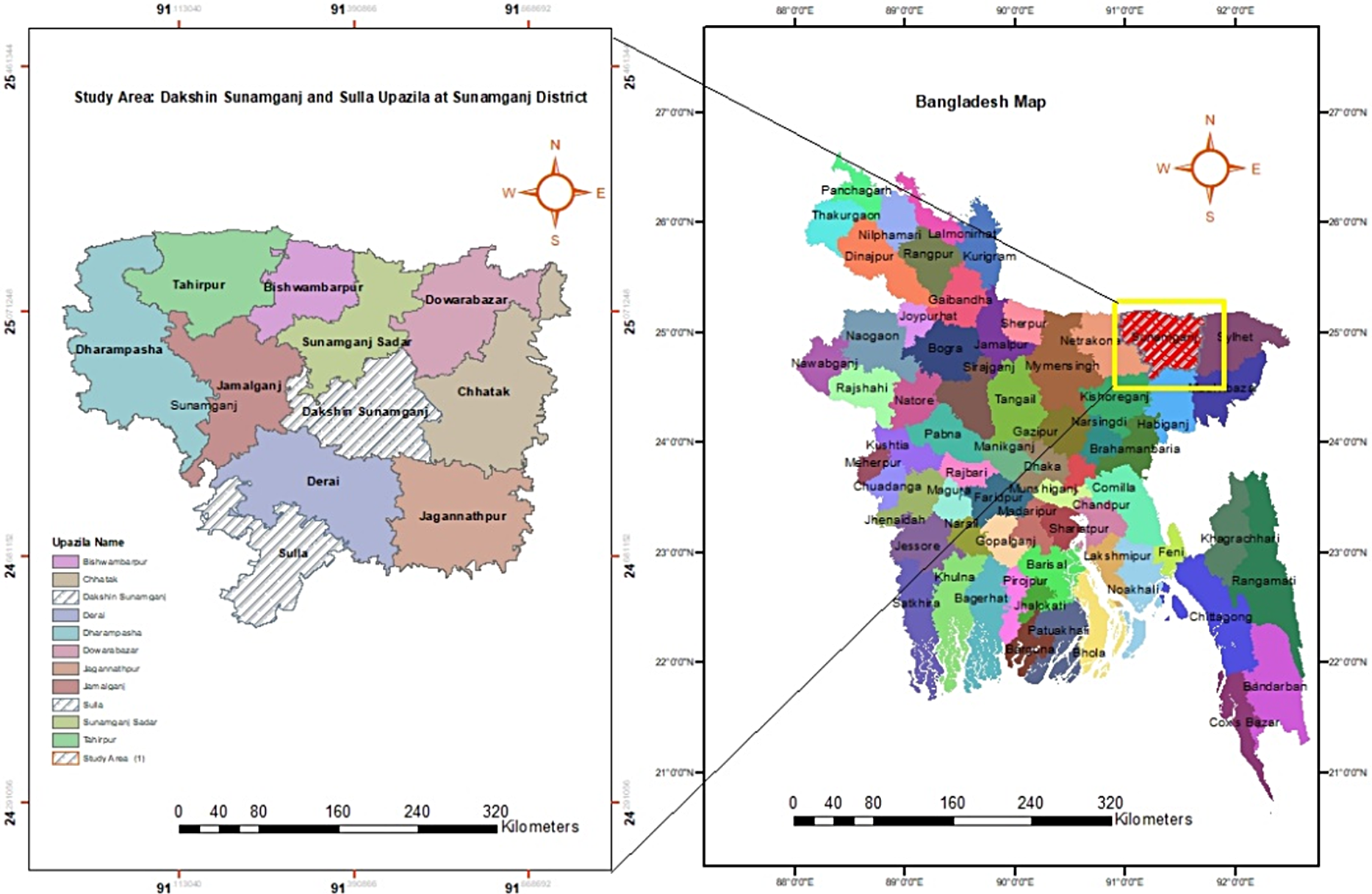
This qualitative study adopted a phenomenological approach to explore the attitudes and awareness of MHM among females in the Haor region of Bangladesh. Phenomenology allows for an in-depth exploration of individuals’ lived experiences and perceptions (Creswell and Creswell, Reference Creswell and Creswell2018), which is essential for understanding the complexities of MHM in this context. This study focused on the Haor region (Fig. 1), particularly in the Sunamganj district of north-eastern Bangladesh. Sunamganj, with its numerous rivers and Haors (wetlands), faces recurring floods that significantly affect the lives and livelihoods of its residents. Understanding MHM in disaster-prone areas is crucial to developing context-specific interventions and policies. Shantipur and Joysiddhi villages of Shantiganj (Known as Dakshin Sunamganj) upazila and Shantipur and Rouwa villages of Shalla upazila of Sunamganj district were purposively selected for data collection considering geographical vulnerability and flood occurrences. During annual monsoon floods, these villages become isolated from the mainstream, temporarily displacing most families from their homesteads. These villages are mainly built on relatively high ground or artificial high ground in the middle of the Haor lacking a concrete transportation system, and the narrow, unmetalled earthen roads linking them to Upazila become submerged.
Map of Sunamganj District. Source: Developed by author(s).
Purposive sampling was employed to select 33 females aged 15 years and above who resided in the Haor region based on reaching the data saturation level. Participants were selected through a culturally sensitive, community-based approach facilitated by local leaders and voluntary organisations. The research team first approached the representatives of the Union ParishadFootnote 1 , who are considered trustworthy by the people of the area. This establishes credibility in the study and creates interest in participation. Next, the leading persons of the neighbourhood, Gosti Pradhan (clan leaders), and respected elders, who play an important role in mutual assistance, especially during floods, are contacted. Additionally, with the help of local voluntary organisations involved in flood relief and recovery activities, it was possible to reach out to participants precisely. Participants were chosen based on their first-hand experience with menstruation and their exposure to flood events in the region. Efforts have been made to ensure diversity in participant demographics, including age, religion, socio-economic status, and educational background, in order to capture a range of perspectives. Data were collected using multiple methods, including field observations and semi-structured interviews. Field observations assessed the availability and supply of menstrual products in local markets, small shops, and dispensaries within villages. Additionally, semi-structured interviews were conducted with participants in their preferred language, Sylheti (Local language of Sylhet division including Sunamganj district), by a team of three female members native to the region, led by the researcher. These team members were carefully selected for their expertise in field data collection and proficiency in the local language to ensure effective communication and cultural sensitivity throughout the interviews. An interview checklist was developed to explore the participants’ attitudes, beliefs, and practices related to MHM and their experiences during flood events. The interviews were audio-recorded with participants’ consent and transcribed verbatim for analysis. Collected data were easier to transcribe and translate as the principal researcher was native to the greater Sylhet region. All interviews were transcribed exactly in Sylhet to preserve language nuances and cultural expressions. As such words or phrases do not have the correct English translation, it is agreed through group discussions that the correct meaning in their translation is maintained. The research team, who is experienced in the Sylhet language, emphasises cultural and linguistic nuances. In addition, back-translation and peer review methods were used to ensure accuracy, which ensured research quality and cultural sensitivity.
Thematic analysis was employed to identify the patterns, themes, and subthemes within the qualitative data. NVivo software was used to facilitate data management and analysis, thus enhancing the rigour and efficiency of the process. Inter-coder reliability was ensured through regular discussions and consensus-building among the research team.
All participants provided informed consent, and voluntary participation and confidentiality were ensured. Participants were assured of their right to withdraw from the study at any time, without repercussions. Multiple strategies have been employed to enhance the validity of the study’s findings, including member checking and peer debriefing. The researcher also practices reflexivity to acknowledge and critically examine their biases, assumptions, and preconceptions throughout the research.
Findings
Socio-demographic characteristics
Most participants were between the ages of 15 and 25 years. They had different levels of education, ranging from not being able to read or write to having a bachelor’s degree. The majority of the participants completed grades 1–8 in school. Most participants were married. The sample included equal numbers of Muslim and Hindu participants. Some participants lived in extended families, whereas others lived in smaller families. During the last flood, many participants lived in temporary shelters, tents, or unstable houses. This shows that people living in disaster-prone areas face difficulties and are vulnerable. Participants’ demographic characteristics are presented in Table 1.
Participants’ demographic characteristics
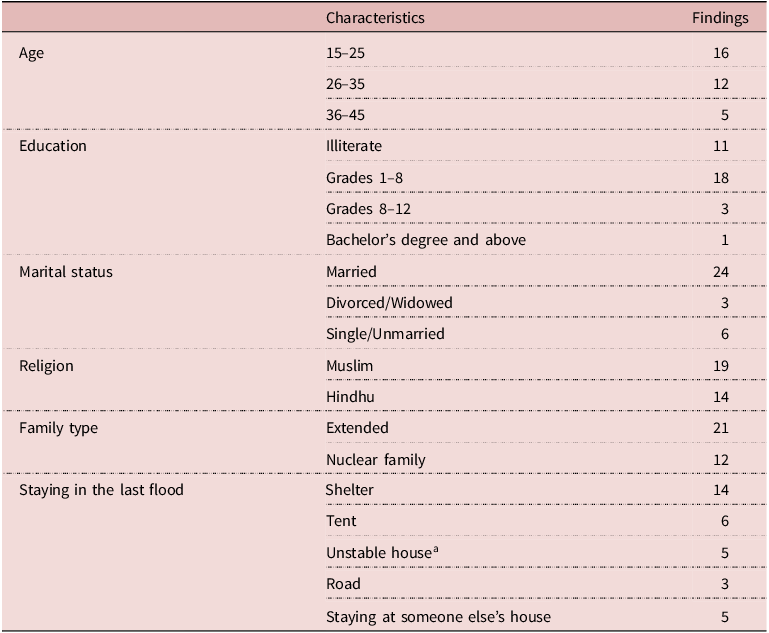
Source: Field Data.
aLoft on the roof of the house.
Menstrual health awareness
The study revealed that most participants did not have any knowledge about menstruation before the first menarche. While sharing their first experience of menstruation, one participant shared:
‘When I had my first period, I was terrified; I did not know why it happened. Then I told my sister about this, and she explained to me that it is menstruation, which is a normal cycle of girls after a certain age’.
Another participant echoed in the same way,
‘When I got to my first menstruation, I felt I was about to die. My stomach was hurting, and I started to bleed. I started crying, and I locked myself in the room’.
It was shared in all participants’ opinions that they acquired knowledge of menstrual management from their mother, sister, or other female members. However, they usually acquire this knowledge only after experiencing their first menstrual cycle. In-depth interviews revealed that women tend to follow traditional methods of managing menstruation, which they learn from their female family members. One participant stated the following:
‘I usually wear old clothes during menstruation. If any of our family members’ dresses become old or torn, we keep them for use during menstruation. We make that cloth several pieces and preserve them under the bed or in our private space’.
Upon questioning participants regarding their knowledge of modern menstrual products such as sanitary napkin, it became apparent that only a few respondents were aware of such products. Television has emerged as a significant source of information on menstrual products. However, most participants did not utilise these products and instead relied on traditional methods. It is worth noting that a few participants used menstrual products, albeit sporadically, and not regularly. Upon further inquiry, participants revealed their practices regarding changing clothes during menstruation. It was observed that most participants changed their clothes or pads once a day, whereas, on the heaviest day of their menstruation, they typically changed twice. However, participants expressed a desire to change more frequently because of discomfort. They could not do so because of the lack of appropriate facilities to ensure privacy and uphold their dignity. One participant opined while sharing why they did not change their clothes, even if they had to.
‘In our house, there are nine members, and we have only one latrine for everyone. There is no separate shower area or space near the latrine, which makes it challenging to change clothes during menstruation. Since we live in a joint family, there are no individual sleeping rooms, so many of us have to share a room together’.
Similar sentiments were echoed by other participants, further highlighting the challenges faced by female household members in the Haor region. While the use of sanitary latrines has increased in the Haor region, the lack of a separate bathing area remains prevalent in most households. Consequently, women encounter difficulties in changing sanitary pads or clothes during menstruation. The limited space also gives rise to various other issues, with one notable concern being the complications associated with washing the clothes used during menstruation. One participant shared this regard:
‘We really need a private place to wash our clothes during menstruation. Since we don’t have a separate bathing area, we have to fetch water from the pond with a bucket and wash it somewhere else. We try our best to clean them properly while washing. Unfortunately, we don’t have separate soap or detergent for this purpose. In our family, everyone uses one soap for bathing and another soap for washing clothes. We don’t buy separate soaps specifically for this’.
Similar to this participant, many participants did not use soap or detergent when washing menstrual clothes or products. This is because several families either lack separate soaps and detergents or are simply not accustomed to using them. However, it is worth noting that in families with separate bathing areas, girls use soap to clean their menstrual products or clothes.
Proper handwashing, genital hygiene, and appropriate disposal of menstrual materials after changing menstrual products are crucial. However, at the field level, most participants washed their hands and genitals with water only after changing their menstrual products. In many cases, the water used is from an impure pond, as not every household in the Haor area has access to a tube well. Several houses were required to share a single tube. In this instance, one participant added,
‘During my menstruation, I go to the latrine and clean my vagina with water. It would be better to use soap to keep it germ-free; however, the limited space in the latrine makes it difficult to ensure separate cleanliness. Additionally, we bathe in the pond where many people bathe or bath the cow and wash clothes together, so it’s not possible to do these things there’.
The participants also did not follow hygienic practices during the disposal of menstrual materials. Most of the time, menstrual materials are thrown into bushes. Regarding the disposal procedures, one participant said:
‘We burn the clothes used during menstruation. If burning is not possible, throw them in the abandoned drain behind the house’.
Attitudes towards menstruation
Attitudes of family members towards menstruation
In the Haor region, females generally have limited knowledge of menstruation. Discussions on this topic rarely extend beyond immediate family members, such as mothers, aunts, or close friends. Girls, in particular, may feel uncomfortable discussing menstruation with male family members such as fathers or brothers. These matters are typically kept confidential, and there is reluctance to inform other family members. Seeking medical advice or consulting a doctor for menstruation-related problems is often hindered by a lack of mindset and feelings of shyness or embarrassment. One participant expressed this sentiment:
‘I experience irregular menstruation, often with a delay of 10–15 days. While I acknowledge it as a problem, I hesitate to seek medical advice and have no intention of doing so in the future due to feeling extremely shy about visiting a doctor. I prefer to keep these issues to myself or confide in my mother alone. The thought of others, regardless of their gender, finding out about my situation and engaging in gossip is highly embarrassing for me’.
Traditionally, individuals in the Haor region rely on the advice of their mother, sister, or someone close to them when managing menstruation. These suggestions are often based on traditional experiences rather than scientific knowledge. For example, one participant mentioned,
‘Once, I did not have my menstruation for two consecutive months, and I only told my mother about it. Then my mother told me to eat well, take rest, and sleep’.
In many cases, girls are prevented from attending school during menstruation by their families. One participant shared,
‘I had my menstruation during the half-yearly exam, and my mother did not allow me to participate in that exam for fear of losing my dignity. As a result, I failed that exam’.
Additionally, their families often instruct girls to wear black dresses during menstruation to avoid bloodstains. However, it is worth noting that families with more female members have a more open and comfortable environment for discussing menstruation-related issues and health safety. In this regard, one respondent opined,
‘I know about the importance of health awareness during menstruation. My sister and I help each other in this regard. When I have my menstruation, my sister helps me with various tasks, and I also help her with various tasks during her menstruation so that she can rest a bit longer. And we discuss any menstruation-related problem with our parents (though comfortable talking with mother) and consult a doctor in case of more problems’.
It is unfortunate that even when there are discussions about menstruation in TV programmes or advertisements, girls feel uncomfortable sitting with their whole family because of shyness and social taboos. One participant expressed this discomfort:
‘Sometimes there are advertisements about sanitary napkins on TV or various programs on health issues, but when my family, especially my parents, are with me while watching TV, I feel uncomfortable sitting together with them on these topics’.
Community attitudes towards menstruation
In society, menstruation is not widely accepted as a normal and natural process. This is often considered a secretive and shameful experience for women. Many people feel too shy to openly discuss topics related to MH, such as buying sanitary napkins or seeking medical advice on menstruation-related issues. As a result, girls often feel uncomfortable engaging in regular activities during these periods. They may hesitate to go to school, work, or socialise with friends, fear humiliation, and embarrassment if others find out about their menstrual cycles. Sometimes, they avoid going out altogether or skipping school for a few days. One respondent expressed their feelings:
‘When I have my menstruation, I feel very uncomfortable doing normal activities. I feel shy about being in public during this time, and I don’t want anyone outside to know that I’m on my menstruating’.
In the villages of the Haor area, access to pharmacies is limited, and only a few shops have medicines available. Unfortunately, sanitary napkins are not among the products that they offer. Moreover, the market where sanitary napkins are available is located six villages away from the study area, making it extremely challenging for girls and women to purchase and use sanitary napkins. It is worth noting that girls usually feel more at ease buying sanitary napkins from beauty parlours where the sellers are women. However, in rural areas, such as the Haor region, where beauty parlours are scarce, girls can only purchase sanitary napkins if they attend college in the city. This leaves most girls uncomfortable buying sanitary napkins from shops as male vendors typically serve them. They did not want men to know about their menstrual cycle. They often rely on their mothers or older sisters to buy sanitary napkins. A study participant (age 43 years), whose husband had a local pharmacy in the nearest market. She shares,
‘Most of the time, women above 40 come to our shop to buy sanitary napkins. Girls aged between 15 and 30 years are less likely to buy them. Men hardly ever come to buy sanitary napkins’.
Furthermore, participants mentioned that girls felt uneasy purchasing sanitary napkins from shops due to the awkward behaviour of people around them, such as staring or laughing. To maintain privacy, shopkeepers wrap the sanitary napkins on paper before handing them to the buyer. One participant expressed the following concerns:
‘Because the shopkeeper is male, I feel uncomfortable buying sanitary napkins from him. The shopkeeper often smiles or gives me uncomfortable glances while giving me the napkins’.
As a result, most girls preferred to have their mothers, female friends, or older sisters when buying sanitary napkins. They may also wait a long time to reduce the crowd in the shop or visit a different shop altogether. It is worth noting that girls often feel uncomfortable explicitly asking for sanitary napkins at shops, further highlighting the discomfort and stigma surrounding menstruation. Instead, they may enter the store and pretend to look for something else, allowing the seller to understand their needs and provide the product wrapped in newspapers. One participant said,
‘We cannot verbally say we want to buy sanitary napkins. We usually go to the store and pretend to be looking for something. The seller then understands our need and provides us with the product by wrapping it with the newspaper’.
Furthermore, when a person who menstruates needs to buy sanitary napkins, they often rely on someone else – usually their female friend – to ask the shopkeeper for the product. One participant said,
‘When I go to the shop to buy sanitary napkins for my female friend, I don’t feel uncomfortable. But when I need to buy sanitary napkins for myself, I feel ashamed, and my friend does it for me at that time’.
Perception of stigma or taboos associated with menstruation
Unfortunately, even today, many families consider menstruation a time of impurity, leading to restrictions on various ritual activities such as worship, prayer, and even touching holy scriptures. This results in negative attitudes towards girls, with many of them developing a deep-rooted hatred towards their menstruation, viewing it as unnecessary and worthless. One participant shared her experiences:
‘During Durga Puja (a significant festival in Hinduism that commemorates the triumph of the goddess Durga over the demon king Mahishasura.), when it was held near our house, my entire family went to the puja mandap to offer Anjali (the act of offering prayers and devotion to God) but I was not allowed to participate because I was on my menstruating. I was even told to avoid entering the kitchen. My food was cooked separately, and my mother served herself’.
Similar superstitions are also prevalent among some Muslim families. One participant stated,
‘Girls are not allowed to pray during their menstruation. Even touching the Tasbi (prayer beads) and the Holy Quran is forbidden. My mother told me that I am impure and cannot engage in prayer’.
A conservative attitude towards menstruation is also observed among specific segments of society, particularly among religious leaders known as mullahs. One participant (43years of age) shared the following experiences:
‘Due to the pressure from society’s Mullahs, we cannot openly display sanitary napkins in our shop. Mullahs insist on keeping sanitary napkins hidden from their sight in shops. They consider these items as something to be concealed’.
These examples highlight the deep-seated beliefs and cultural norms that perpetuate the stigma and discrimination surrounding menstruation even among religious and community leaders. It is disheartening to see that even slight abdominal pain during menstruation can cause fear among girls, as they worry it may affect their future reproductive capacity. There is fear among girls that if they are unable to conceive after marriage, society will not value them. One participant expressed this concern:
‘If I experience even a little stomachache during my menstruation, I become anxious because I feel like I have a serious illness that will affect my ability to have children’.
In the Haor region, many girls believe that menstrual clothes should be buried underground or burned early in the morning. They believed that if an animal dug up the cloth used as a sanitary napkin during menstruation, she would never be able to become a mother. One participant shared,
‘We have to wake up early in the morning to bury the clothes used during menstruation underground. I heard this from my mother and grandmother’.
Misconceptions about dietary restrictions during menstruation are also prevalent in society. Many believe that certain foods, such as milk, eggs, and bananas, should not be consumed during this time. However, some girls did not believe in these superstitions. One participant stated,
‘During my menstruation, many people advised me not to eat milk, eggs, bananas, etc., but I do not believe in these superstitions’.
There is a misconception that menstruation is a secret process for girls, and should not be discussed with male family members, even in their absence. One respondent shared an incident in which her father realised that she was menstruating while serving him lunch. He left the house without eating, and later, her mother was severely beaten by her father to teach her to avoid appearing to male family members during menstruation. This belief stems from the notion that men are unlucky if they encounter menstruating women. The stigma surrounding menstruation is so strong that girls’ participation in auspicious events during menstruation is often blamed for the adverse outcomes. One participant shared her experience attending her brother’s wedding during menstruation without informing anyone. After the wedding, when she shared this with her mother, she was beaten. Later, when conjugal conflicts arose between her brother and sister-in-law, she was blamed for her participation in the marriage in an impure state, which was believed to have caused turmoil.
In some cases, girls were forced to stay in separate huts away from their homes during menstruation. They must eat, drink, and bathe in that hut, often located far from their home, which becomes a source of fear, particularly at night. Unfortunately, some men in the area disturb them by throwing stones on the roof, teasing, and laughing at night. One participant shared her experience:
‘I was embarrassed to tell my parents about my menstruation because I was afraid, they would force me to live in an isolated hut away from home. This hut is sometimes used as a cowshed, and cow dung smells all around. Sometimes, cows’ step on us in their sleep, and various insects are breeding here, which can lead to diseases. Dirt and straw stick to my body’.
These situations have a detrimental effect on girls’ wellbeing. It is disheartening to note that some girls pray that ‘May God not give birth to a girl child in her womb’, as they do not want their daughters to be subjected to such conditions.
Challenges faced in managing menstruation, particularly during floods
During floods in the Haor region, roads and houses are submerged, forcing many families to build huts in the floodwater to survive. In-depth interviews revealed that the primary concern for these families was obtaining two meals a day and ensuring basic survival, leaving little focus on menstrual health and safety. With every family member occupied with managing food, dry wood for cooking, and safe drinking water, limited attention has been paid to menstruation-related issues. In such critical times, menstruating women also contribute to various tasks without adequate rest, often getting wet in floods or rainwater while performing these duties. Consequently, they face difficulties in maintaining clean and dry clothes, as the priority is to meet basic needs rather than the MH.
Even when houses are submerged, families are compelled to construct lofts on the roofs to stay afloat because of the high incidence of robberies in the Haor area during floods. This poses additional challenges to girls during menstruation. One participant shared their experience during floods in the Haor area, stating:
‘During the floods, there is an increase in robberies. That’s why we live in lofts above the water instead of going to shelters to protect our residence. Unfortunately, this situation poses significant difficulties for girls when they are menstruating. In emergencies, we construct makeshift toilets using bamboo and cloth fences. It is in these toilets that we change and wash our clothes. However, the water in these areas becomes filthy, but we don’t have any other option. Sores grow around the vagina due to the use of this dirty water’.
During floods in the Haor area, clean water becomes scarce, as most houses are submerged. Only a few houses in higher regions have access to tubewells, but collecting water is challenging due to floods and lack of boats. As a result, drinking clean water becomes difficult and maintaining personal hygiene, especially during menstruation, becomes a struggle. Bathing in floodwaters is the only option available for many individuals. One respondent shared the following experiences:
‘During floods, our tubewell gets submerged, so we have to collect drinking water from other houses. It becomes impossible to obtain clean water for bathing. During the last flood, I had to bathe in floodwater while menstruating. Even after my menstruation, I had to clean my vagina with floodwater. Unfortunately, this led to an allergic infection in that area, and it took a long time for me to recover after the flood receded’.
The participants highlighted families’ economic challenges in the Haor area, making it difficult to afford sanitary napkins or to seek timely treatment for menstruation-related issues, especially during floods. Since boats are the primary means of transportation during floods and most families do not own boats, they must share a single boat to go to the market. This situation creates limitations: if someone from one family uses the boat for work, someone from another family cannot go out for any important matters. One participant shared the following experiences:
‘During the last flood, we didn’t have a boat. Once a week, my father would borrow my uncle’s boat to go to the market and buy daily necessities. In such a situation, I couldn’t tell him that I was menstruating and needed sanitary napkins because I knew my father was facing financial difficulties’.
Under such circumstances, seeking medical assistance for menstruation-related problems is challenging. With limited access to transportation, it is not feasible to travel by boat to a doctor in a city. Moreover, the Haor area lacks adequate community clinics (CCs); even if they exist, they are often submerged during floods. This forces individuals to travel across several villages to reach CCs, further exacerbating the difficulties faced during floods.
Few participants shared that during floods, sometimes they have to take shelter in relatives’ houses, so it is impossible to maintain health and safety during menstruation. One respondent said,
‘During the last flood, our house was flooded when we took shelter at my uncle’s house. Many other families and we took shelter in my uncle’s house. Our accommodation was on the open balcony. My mother had made a small space with clothes where I would change the clothes used during menstruation. But it was embarrassing for me’.
In addition, maintaining the MH becomes more difficult for those who live in tents on high roads or dunes during floods. Describing the experience of the time spent during the flood, one participant said:
‘We made cloth tents on the muddy side of the road to stay. There are no toilet facilities in such places. Sometimes, we don’t urinate even once in the whole day. In the evening, we have to go behind the bushes to defecate. When we have our menstruation, we wear the same clothes. After wearing it, we must stand in a muddy place all day. And we have to wait for the evening. We went behind the bush when it was evening and changed our clothes. We had to wear the same clothes again and again because we didn’t have enough clothes. Due to repeated use of the same cloth, there was severe irritation in the vagina’.
MHM in shelter
In the Haor region, during floods, a limited number of primary schools serve as shelters for people from six villages, resulting in overcrowding. These shelters were also used to house livestock. This poses a challenge for the management of MH. One participant shared the following experiences:
‘In a small room, 30–35 people, including both men and women, had to stay together. This made it difficult for women during their menstruation, as there was no privacy and limited sleeping space. Men sometimes entered the room, further complicating the situation’.
The participants also highlighted issues with toilet facilities in shelters. One participant mentioned,’
‘Only two toilets are available, without clear indications for men and women. People use whichever toilet is available, causing delays and unclean conditions. This makes it challenging to maintain proper hygiene for menstrual needs’.
The lack of additional bathroom facilities and unhygienic conditions in toilets further exacerbate the situation. The participants mentioned that there was a lack of clean water in the shelter.
‘The tubewell at the shelter was abandoned. Due to this, we used flood water to complete all necessary works. I only boiled water for food and drank it’.
Many women wear the same clothes throughout the day because of overcrowding in toilets and insufficient space to change menstrual materials inside shelters. A participant shared,
‘There is no place to change sanitary napkin or clothes in the shelter. There was no way I could change sanitary napkin or clothes during the day. At night, with some girls’ help, I would go behind the bushes and change. It was very uncomfortable to wear the same clothes. Many times, I used to fall into discomfort when bleeding heavily. I was always afraid that if anyone saw it, it would be humiliating for me’.
Participants highlighted the challenges in washing and disposing of menstrual materials used in shelters. Due to overcrowding, women cannot clean or dry their menstrual items during the day, even in the floodwater surrounding the shelter. The disposal of menstrual materials also poses a problem. One participant shared their experiences, stating the following:
‘There was no provision in the shelter for disposing of used menstrual materials. Often, we discreetly threw them into the floodwaters. To clean the used items, I would go a short distance from the shelter by boat with my companions. There, I would clean everything in the floodwater, dry it in the sun, and return to the shelter. However, we had to be cautious and avoid going out with the boat if there were many men around’.
Another issue highlighted was the lack of availability of menstrual products in shelters. Many women could not bring their menstrual products from the market because of emergencies. Consequently, they resorted to using their old clothes during menstruation. Various relief aids were provided by the government and private agencies during the floods, and some NGOs distributed menstrual products along with relief supplies. However, despite the need for menstrual products, women hesitated to obtain relief because of feelings of shame. One participant expressed the following sentiment:
‘An NGO was distributing sanitary napkins, and everyone had to stand in line to receive them. I did not join the line because there were many men around. However, I needed sanitary napkins the most. I am not alone; many others like me refrained from standing in line due to feelings of shame’.
Discussion
Providing girls with timely and accurate information about menstrual management can significantly enhance their ability to effectively manage their MH (Unicef, 2019). Conversely, inadequate knowledge often precipitates challenges in maintaining MHM (Dutta et al., Reference Dutta, Badloe, Lee and House2016). The findings highlight that the primary source of information for girls in the Haor region is their mothers who predominantly use traditional menstrual management practices. However, this method often lacks timeliness and accuracy. Consequently, girls frequently adopt unsafe practices that are perpetuated in adulthood. A lack of proper information about menstruation leads to misconceptions about menstruation (Haque et al., Reference Haque, Rahman, Itsuko, Mutahara and Sakisaka2014). Furthermore, this study reveals a prevailing belief among Haor region girls that menstruation is a curse, a sentiment evident in other regions, such as Nepal, India, and Uganda (Boosey et al., Reference Boosey, Prestwich and Deave2014; Goel and Kundan, Reference Goel and Kundan2011; Schmitt et al., Reference Schmitt, Clatworthy, Ratnayake, Klaesener-Metzner, Roesch, Wheeler and Sommer2017).
The study further highlighted the persistence of traditional menstrual management practices among participants despite exposure to alternative methods through media channels such as television. Although some participants sporadically used menstrual products, indicating partial adoption of modern methods, barriers, such as accessibility and affordability, hindered consistent use. This aligns with the existing literature, which highlights the economic constraints faced by women in rural areas, limiting their access to sanitary products because of their limited knowledge and familiarity, compounded by financial constraints (Tufail et al., Reference Tufail, Ahmer, Gulzar, Hasanain and Shah2023). Similarly, this study reflects low rates of sanitary product usage among girls in the Haor region, attributed partially to economic constraints and exacerbated by distance from local markets. Only girls who attend school and college have access to the local market, so they can only access sanitary products. However, limited access to sanitary products is particularly pronounced during floods, as poor transport conditions prevent regular attendance at schools, where access to local markets is typically available. Another notable observation was the inadequate infrastructure and facilities for MHM in the Haor region. The lack of separate bathing facilities and limited privacy for changing menstrual products contributes to women experiencing discomfort and challenges during menstruation. These findings echo previous studies that highlighted the importance of adequate sanitation facilities in promoting MH and dignity (Mahon and Fernandes, Reference Mahon and Fernandes2010; Yongsi, Reference Yongsi2021). The reluctance or inability to use soap or detergent to wash menstrual clothes further illustrates the intersection between socio-economic factors and MH practices. The study also revealed gaps in hygienic practices after changing menstrual products, with many participants washing only their hands and genitals with water, often from unclean sources.
The Haor region of Bangladesh exhibits entrenched traditional beliefs regarding MHM, mirroring broader societal norms. Traditional notions dictate practices, such as dietary restrictions and associating menstruation with readiness for marriage, reflecting deep-seated cultural attitudes (Habib et al., Reference Habib, Basak and Chakrabarty2020; Khan et al., Reference Khan, Jamil, Nahar and Alam2022; Nahar et al., Reference Nahar, Tuñón, Houvras, Gazi, Reza and Huq1999). These beliefs manifest in various customs, including seclusion during menstruation, avoidance of certain activities, limitations in social participation and religious practices, perpetuating stigma, and impeding women’s rights and dignity. Access to healthcare related to menstruation is hindered by cultural taboos and practical challenges, particularly in rural areas such as the Haor region. Consultation with qualified healthcare professionals is often restricted, further exacerbating the difficulties faced by women in managing their menstrual health. Geographical isolation, environmental vulnerability, and economic constraints compounded these challenges, limiting access to essential services, including menstrual healthcare. In the Haor region, where infrastructure and communication systems are inadequate, the impact of these barriers is acutely felt, especially during natural disasters such as floods. During floods, inundated roads and infrastructure further compromise limited access to healthcare services, rendering essential facilities inaccessible for extended periods (Habib et al., Reference Habib, Basak and Chakrabarty2020). Although initiatives such as CCs aim to bridge the healthcare gap in rural areas, their scarcity in Haor regions exacerbates the plight of girls and women seeking menstrual health services.
In the context of global menstruation discourse, the belief in concealing menstruation to protect women’s dignity is prominent (Sommer et al., Reference Sommer, Hirsch, Nathanson and Parker2015), a sentiment echoed in Bangladesh (Haque et al., Reference Haque, Rahman, Itsuko, Mutahara and Sakisaka2014; Zaman, Reference Zaman2022). In the Haor region, menstruation is viewed as a taboo subject, leading to discomfort even in educational settings. The most prevalent method for managing menstrual blood involves using rags or clothes, with a similar trend observed among Haor girls, albeit with poor hygiene practices (Warrington et al., Reference Warrington, Coultas, Das and Nur2021). During floods, challenges are exacerbated by MHM owing to limited access to clean water, privacy, and disposal facilities. Girls resort to unclean clothes, leading to health issues such as infections and irritation, a situation mirrored in previous studies (Van Eijk et al., Reference Van Eijk, Sivakami, Thakkar, Bauman, Laserson, Coates and Phillips-Howard2016). Displacement during floods compounds MHM challenges, particularly for girls seeking refuge in shelters or makeshift locations (Parker et al., Reference Parker, Smith, Verdemato, Cooke, Webster and Carter2014; Sadique et al., 2023). In flooded areas, the dilemma of maintaining MHM with dignity arises because inadequate sanitation facilities hinder timely cloth changes (Sadique et al., 2023). Similar challenges have been documented in studies focusing on displaced women (Atuyambe et al., Reference Atuyambe, Ediau, Orach, Musenero and Bazeyo2011; Krishnan and Twigg, Reference Krishnan and Twigg2016; Wickramasinghe and Lanka, Reference Wickramasinghe and Lanka2012). During emergencies, girls resort to changing sanitary products in dimly lit or secluded areas and face the risk of teasing and harassment (Miiro et al., Reference Miiro, Rutakumwa, Nakiyingi-Miiro, Nakuya, Musoke, Namakula, Francis, Torondel, Gibson, Ross and Weiss2018). Roadside shelters pose a greater risk of harassment due to their exposure, making them more vulnerable to violence.
Conclusion
In conclusion, the findings of this study underscore the critical need for comprehensive MHM interventions in the Haor region of Bangladesh, particularly during floods. The prevalence of traditional menstrual management practices coupled with inadequate access to timely and accurate information exacerbates the challenges of maintaining MHM among girls in this region. Economic constraints, limited access to sanitary products, and inadequate infrastructure compounded these challenges, particularly during natural disasters such as floods. To address these issues effectively, the government should implement a plan and need-based programme that emphasises MHM in Haor areas. As the Ministry of Disaster Management and Relief of Bangladesh conducts activities at the district, upazila, and union levels nationwide, it is recommended that the ministry coordinate with the concerned upazila and union authorities for the early identification of relief centres as part of flood preparedness. The plan may include the provision of sanitary pads and other essential hygiene items at separate locations for women in each shelter. Moreover, voluntary organisations and NGOs distributing food and health items during floods should follow culturally sensitive methods to effectively reach girls and women. For example, these materials can be delivered room-to-room by female volunteers only to maintain women’s privacy and cultural sensitivity. Thus, there is a need to increase the number of CCs equipped with appropriate facilities to provide MHM-related healthcare services. These clinics can serve as accessible sites for girls and women to receive information, guidance, and necessary supplies for the safe and hygienic management of menstruation. NGOs working on health issues should take practical steps and prioritise MH within their scope of work.
Data availability statement
The data that support the findings of this study are available upon request from the corresponding author. The data were not publicly available because they protected the privacy and confidentiality of the participants.
Acknowledgements
We extend our heartfelt gratitude to all the participants, whose voluntary cooperation facilitated the data collection process for this study. Special thanks to Md Imrul Hasan for his invaluable assistance in crafting the study area map. Additionally, we express our appreciation to the dedicated members of our data collection team – Arpita Chakravorty Jui, Jhuma Das, and Shamsujjaman Raju – for their diligent efforts during the data collection phase.
Author contribution
Abdul Basit: Conceptualisation, Methodology, Software, Writing-Reviewing and Editing Omme Same Antu: Writing-Original draft preparation. Mahfuzul Mithun: Data Curation and Visualisation. Dr. Mohammad Shafiqul Islam: Supervision.
Funding statement
This study received no external funding.
Competing interests
The authors declare no conflict of interest.
Ethical standard
This study was conducted within the Department of Public Administration at the Shahjalal University of Science and Technology and rigorously adhered to ethical principles and guidelines.

 Open access

