




Introduction
In April 1936, a Japanese magazine reflected on how Ethiopia, at the time being brutally invaded by Italy, was first known in the archipelago with these telling words: ‘Even the name of the Ethiopian Empire was first known throughout Japan under that of Kuroda Masako. You can forget the Prime Minister’s name, but everyone knows Kuroda Masako.’Footnote 1 In an earlier issue, Kuroda was even defined as the one who had ‘made the Japanese general public aware that a place called Ethiopia existed on the face of the earth’.Footnote 2 Albeit hyperbolic statements, these words testify to the extraordinary amount of attention that noblewoman Kuroda Masako received in 1934 from the Japanese general public. Besides being a much-publicized popular phenomenon, Kuroda’s engagement to Ethiopian nobleman Araya Abebe also connected non-governmental actors from three continents, eventually escalating into worldwide diplomatic tensions.
Although the Kuroda-Araya engagement constituted at once the ‘number-one topic of 1934’Footnote 3 and a pivotal moment in defining Japan’s international standing, it is today a rather understudied story. In Japanese scholarship, the encounter between Ethiopia and Japan has been framed by either considering Ethiopia as a new economic market or focusing on individuals who discovered Africa through the West, mainly interiorizing Western prejudices even after setting foot on the African continent (in the rare cases when that actually happened).Footnote 4 Furthermore, great emphasis has been placed on the diplomatic aspect of such a relationship in the first decades of the twentieth century, as exemplified by the studies of scholars like Jay Calvitt Clarke III and Fujita Midori, while overlooking the fundamental role of non-governmental actors in the diplomatic fallout.Footnote 5 Those few who have analysed the Ethiopian-Japanese relationship less from a diplomatic and more from an intellectual perspective have done so as Africanists, like Sara Marzagora,Footnote 6 or Americanists, like Taketani Etsuko, who elucidate the African American reaction to such a union.Footnote 7 Still, thus far, neither the non-governmental side of this story nor the Japanese actors involved have been brought to the forefront.
This article, instead, will only briefly address the diplomatic denouement of the Kuroda-Araya engagement. This is because by focusing on the diplomatic aspect of the incident, one fails to grasp how such an unprecedented relationship tried to contest from below the Western civilization discourse, heavily imbued with concepts of masculinity, Christianity, and whiteness. In contrast, I present an account of transnational history that challenges this paradigm. Using previously untapped Japanese sources like Kuroda Masako’s writings, I do so by revealing the history of non-governmental actors who directly interacted with each other, unmediated by (if not in contrast with) Western powers. Through this engagement, albeit unrealized in the end, the actors involved hoped to create a racially equal and anti-hierarchical world order, actively trying to divorce the core pillars of the Western civilization discourse. Just the existence of the educated-yet-dark-skinned, African-yet-monogamous, Christian Araya challenged the union of whiteness and Christianity as a fundamental component of progress, while Masako tried to use her influence to erode the predominance of masculinity in the imperial project.
In discussing Kuroda and Araya’s ideas and practices, this article showcases their voices and agency for the first time. Araya wrote less on his engagement, focusing instead on his war efforts, but by using Kuroda’s articles and interviews, I analyse in depth what I call her racially equal imperial feminism, which she used to better the position of women in the Japanese empire-building process. Here, I refer to Kuroda as an ‘imperial feminist’ because she used her writing to illustrate to women that her future role in Ethiopia—and hopefully every woman’s role in any setting—went beyond the institution of marriage. While she did not explicitly mention Ethiopian women, Kuroda, the ‘number one bride of the moment’, showed little interest in racial difference when interviewed, often explaining that she did not have any lingering racial prejudice and was ‘simply stimulated by patriotism’.Footnote 8 While Kuroda’s feminism was heavily nationalistic and framed as mainly focused on Japanese women’s responsibilities in the imperial project, I add ‘racially equal’ because of this race-blind approach and of the symbol she came to be in the struggle against racial hierarchies worldwide.
By examining Kuroda’s feminist commitment and her representation in various media, I elucidate how her practices catalysed interest not only from the general public but also from a larger intellectual scene. Her followers were not only women who were ‘burning from curiosity [to know] what kind of woman Kuroda Masako [was]’.Footnote 9 Because of Kuroda’s approach towards race and the ethnicity of the betrothed, the engagement made some fringes of Pan-Asianists and Pan-Africanists trust that an anti-hierarchical alternative world was possible. In their engagement, these intellectuals found the first and most spectacular step of a racially equal mapmaking project that transcended the nations involved.
In just a few months, the Kuroda-Araya engagement made headlines worldwide because of these new racial possibilities but quickly escalated into diplomatic incidents. In this article, I show how the intellectual and popular enthusiasm for the union of Ethiopia and Japan, epitomized by the impending nuptials, grew so unexpectedly as to become a danger to the state-endorsed ideology and agenda, which was not limited to Japan. In 1934, Ethiopia and Japan shared some similarities that were not lost on many spectators: both were non-white countries, uncolonized, and had proudly defeated two Western powers in the previous decades.Footnote 10 What Ethiopian Foreign Minister Heruy Wolde Sellase (1878–1938) wrote in 1931, the year of the first Ethiopian diplomatic mission to Japan—that it was ‘really astonishing that two countries like Ethiopia and Japan, so similar in their national spirit, so similar for the courage of their citizens, have gone so long without knowing each other’Footnote 11—resonated with many observers worldwide. As I show later, not only the Japanese public but also the African American community were heavily invested in the project, as Ethiopia and Japan both held a unique position in it in the 1930s.
Although (or perhaps precisely because it was) unrealized, eventually this marriage caused a rupture between such widespread popular sympathy towards Ethiopia and the statal vision of Japan’s international position. This distance between popular sentiment and the government agenda erupted in a series of protests in Japan and elsewhere against the annulled engagement, which only escalated with Italy’s invasion of Ethiopia. The general populace was quite sensitive to topics such as racial solidarity and thus was very sympathetic to Ethiopia, as opposed to the Japanese government, which soon realized Ethiopia was not worth pursuing as an ally. As a result of this popular enthusiasm, which transcended continents and challenged the state vision, I suggest that the engagement ultimately unveiled the true commitment (or rather lack thereof) of the Japanese government towards the Ethiopian one and, more generally, the non-white cause. In the literature, the process of Japan disavowing its image as ‘the champion of the darker races’ is usually associated with the Second Italo-Ethiopian War, where the Japanese state did not commit itself. Here, I contend that it was a process already enacted by rumours of a Japanese-Ethiopian alliance, personified by Kuroda and Araya, which eventually contributed to a realignment of Japanese governmental stances towards race, gender, and worldwide power dynamics. Lastly, I suggest that the Second Italo-Ethiopian War constituted the last phase of Japan’s bureaucratic disengagement from Ethiopia and the first step towards realigning with Fascist Italy, ironically Ethiopia’s nemesis in the 1930s.
Japan and Ethiopia’s first encounters
The 1931 mission allowed the Ethiopian delegation to study the Japanese model of modernization, which was not only successful, but primarily non-white and non-Western. Such was the admiration of the newly crowned Ethiopian emperor for Japan that he demanded the 1931 Ethiopian Constitution be modelled after the 1889 Meiji one, as he reportedly dreamed ‘of Ethiopia as the Japan of Africa’.Footnote 12 Ethiopian elites’ scions too looked at the Japanese path of modernization with keen interest. Their parents had witnessed with enthusiasm Japan’s victory over Russia in 1905, and they too were not immune to the Japanese charm. Some youngsters admired Japan to the point that they earned the moniker of ‘Japanizers’. As Marzagora shows, this young generation of Ethiopians educated overseas (also nicknamed the Young Ethiopians), critical of their country’s appeasement towards Western countries, tried to vouch for a racialized alliance with Japan, perceived to be the safer option to maintain independence.Footnote 13
On the Japanese side, the mission also permitted the Japanese population to see first-hand the ‘uniqueness’ of Ethiopia. The African country was then mainly attractive as a new economic market, especially after the 1929 crisis and in light of the perceived ‘yellow peril’ of Japanese economic dumping. At a time when Japanese immigration was banned in the United States and when the perceived overpopulation of the archipelago ‘needed’ to be diverted somewhere else, Ethiopia seemed a suitable candidate as a possible new outlet for both Japanese people and goods. Conversely, in Ethiopia, Japan was perceived as the perfect commercial partner: a non-white country, far away enough to be innocuous, and with cheaper goods, which were by 1931 much more commonplace than Western ones.Footnote 14
Although, as we will see, Ethiopia was actually never represented as equal to Japan, initially the Japanese press took pains to describe how Ethiopia, albeit a faraway country with an aura of exoticism, could be compared to Japan. The first element of similarity lay in the fact that the two countries had never experienced a foreign invasion, in particular from the West. Then Ethiopia had national sovereignty, an almost unique case in the African continent at the time, and Japan had colonies, a unicum in East Asia. That could have already been sufficient to ignite anti-Western activists, but additionally Japan and Ethiopia had defeated respectively Russia in 1905 and Italy in 1896. As many scholars have argued, these two victories gave Japan and Ethiopia a pre-eminent position in non-white and non-Western circles all around the world. On the one hand, following the victory over Russia and its failed attempt to introduce an equality clause at Versailles, many Asians and African Americans saw in Japan the liberator that would free Asia and the darker races from the Western yoke. Conversely, after the battle of Adwa, Ethiopia was brought to the forefront and visited by many protagonists of the black diaspora.Footnote 15 Ethiopia, for African Americans and the Pan-African movement, also gained a religious significance: it was a sacred land, the icon of black sovereignty, the only Christian bulwark in Africa.Footnote 16
Besides, both countries boasted an unbroken imperial lineage. The Asahi newspaper, for instance, remarked that there were ‘no other empires in the world as noble as those of Ethiopia and Japan’.Footnote 17 As Baron Shidehara Kijūrō (1872–1951), then Minister for Foreign Affairs, put it at a welcome party for the Ethiopian delegation in 1931: ‘The most indolent imagination must be impressed by the spectacle of the meeting for the first time of the two Sovereignties of immemorial antiquity unbroken through all ages.’Footnote 18 The notion of an ‘unbroken imperial line’—in Japanese, bansei ikkei—was a pillar of Japanese state orthodoxy in the 1930s which confirmed Japan’s cultural superiority.Footnote 19 Using phrases like bansei ikkei in connection with Ethiopia thus helped bring together two distinct racialized populations on the level of political history.
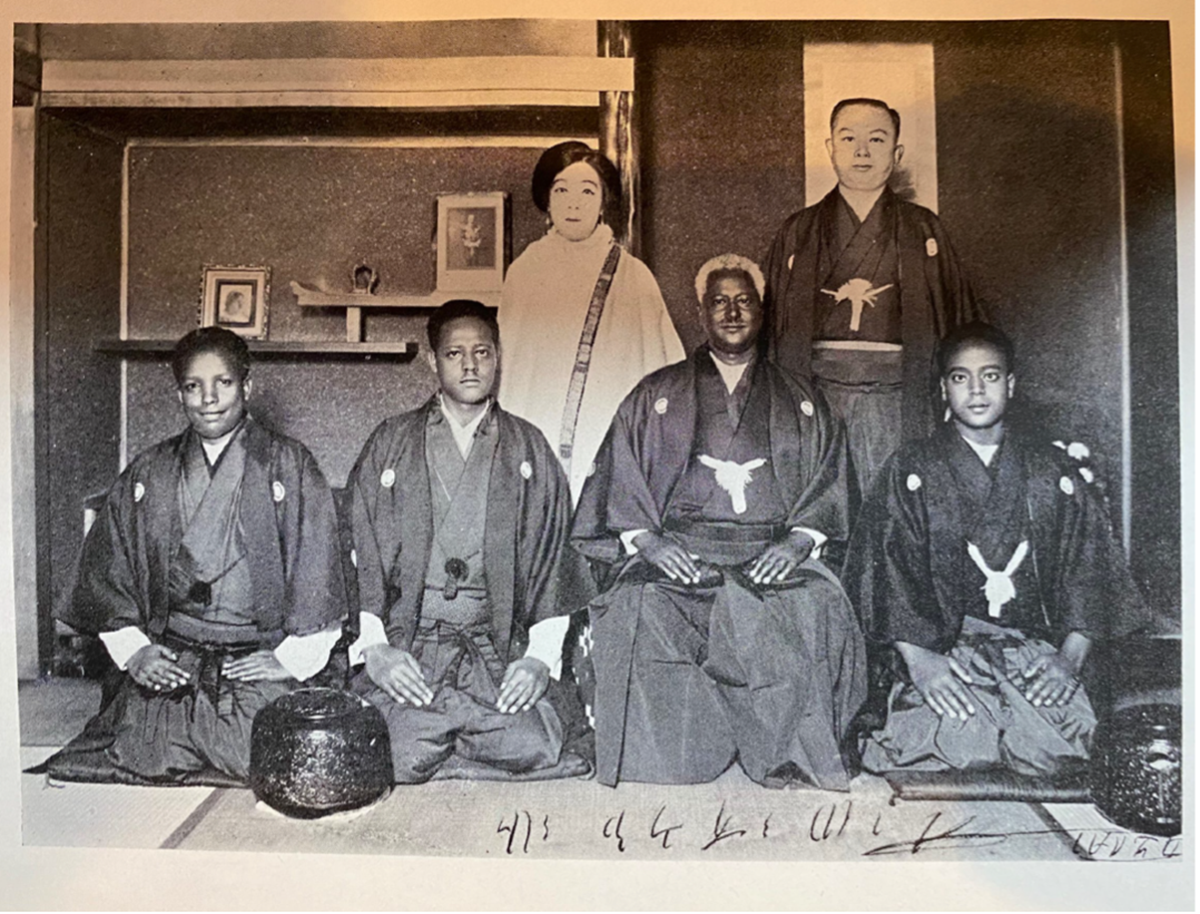
To many with Pan-Asian and Pan-African sympathies, an alliance between Ethiopia and Japan, with the Kuroda-Araya engagement as its most spectacular step, represented the best move to bring together Pan-Asianism and Pan-Africanism against the Western civilization ideology. Despite their internal variety and clearly different geographic scopes, these two movements shared a common enemy: Western and white countries. The activist and lawyer Sumioka Tomoyoshi (1873–1943) had penned an article about Ethiopia in his magazine Daidō titled ‘Get to Know Abyssinia!’ even before the 1931 mission.Footnote 20 A friend of the renowned ultranationalist activist and thinker Tōyama Mitsuru (1855–1944), Sumioka had then made a name for himself by defending in court, with ‘empassioned rhetoric’ (netsuben), some of the country’s most notorious ultranationalist activists in an era that saw repeated incidents of right-wing terror.Footnote 21 Conscious of what Ethiopia could represent for Japan, in 1931 Sumioka had additionally hosted the Ethiopian delegation at his house, where his guests would don Japanese garments and he and his wife would dance Ethiopian dances (see Figure 1).Footnote 22 When Sumioka came to know Araya’s intention regarding a Japanese wife, he saw a concrete possibility of achieving the union between Ethiopia and Japan, and immediately offered his services. Araya, understanding the Japanese custom of prearranging conjugal unions in the 1930s, was eager to appoint him as a matchmaker, although Sumioka’s experience of the field was nil.
The Ethiopian delegation with Sumioka and his wife. From left to right: (standing) Sumioka Chōko, Sumioka Tomoyoshi; (seated) Daba Birrou (interpreter), Lij Teferi Gebre Mariam (Ethiopian consul at Djibouti), Heruy, and Araya Abebe. Source: Heruy, Dai Nihon, pp. 92–93.
Araya’s search for a Japanese bride
The 1931 mission also had the unintended effect of launching into the public sphere the figure of Araya Abebe, ‘the most handsome man in Ethiopia’.Footnote 23 Born in 1909, he was brought up in a noble Ethiopian family: he had the honorific title of LijFootnote 24 and his father was a relative of Emperor Haile Selassie.Footnote 25 His upbringing had an international breadth, and he had come to admire Japan’s modernization, hoping to facilitate the investment of Japanese firms in Ethiopia.Footnote 26 He found in Japan a non-white exemplar that could unify all colouredFootnote 27 races successfully, and thus provide a valid alternative to the Western threat to Ethiopia. Once in Japan, Araya devised a quixotic plan to connect the Asian and the African nations: he would seek a Japanese wife, hoping his wedding would inaugurate more interracial marriages between the two empires. When he appointed Sumioka as the go-between, he most likely had little idea of the proportions his desire was to assume, but he certainly had in mind that his marriage would not be exclusively a private matter between two individuals. He would later remember how his wish for a Japanese wife was primarily for practical concerns he already held in 1931: ‘Since I had the desire to build a friendship between Ethiopia and Japan, already on the ship back home I was secretly thinking how I wished a Japanese lady as a wife.’Footnote 28
As the nakōdo, Sumioka decided to publish Araya’s announcement in the Asahi shimbun to elicit a ‘great sensation’, which in the event was the result he obtained.Footnote 29 In composing his initial announcement, Sumioka tailored his appeal for broad public consumption, nowhere specifying the class or social status of the future bride, so long as the candidate was a ‘Japanese woman, beautiful and fluent in English with age between 19 and 24 years’. Footnote 30 Noteworthy, too, is that Sumioka addressed his invitation not to figures of authority within the household or to community leaders but directly to a wide audience of female newspaper readers. Indeed, as the case of Kuroda herself demonstrates, applicants sometimes sent their resumés and photos unbeknownst to their parents.
As it had been with the press coverage of the 1931 mission, coverage of Araya’s announcement also tended to highlight Ethiopia and Japan’s divine origins and their shared ‘grand destiny’. Additionally, with the topic being a marriage, a third theme loomed large: the interracial character of the union. Although some non-governmental actors wished to create a non-white connection, the Japanese press was heavily influenced by state-sanctioned views of race and, in some cases, it expressed anxiety over a ‘black’ man desiring a Japanese woman.Footnote 31 Far from being an atemporal ‘fairytale-like story’ (otogibanashimeita monogatari), the Kuroda-Araya engagement was in fact deeply entangled in contemporary ideologies of race.Footnote 32 Fortunately for scholars, mainstream journalism, albeit a form of popular discourse then censored and controlled, holds the potential to reveal aspects of everyday racial thought and practice in 1930s Japan in ways that official records do not always disclose. At times a single sentence of popular print can yield a treasure trove of unspoken assumptions. One such telling utterance may be found in a Yomiuri newspaper article of November 1933. In the words of the anonymous Yomiuri journalist: ‘One would think that being the wife of a prince with a dark face would naturally only appeal to the unattractive, but in fact only beautiful girls applied.’Footnote 33 One can hardly imagine a more loaded statement.Footnote 34
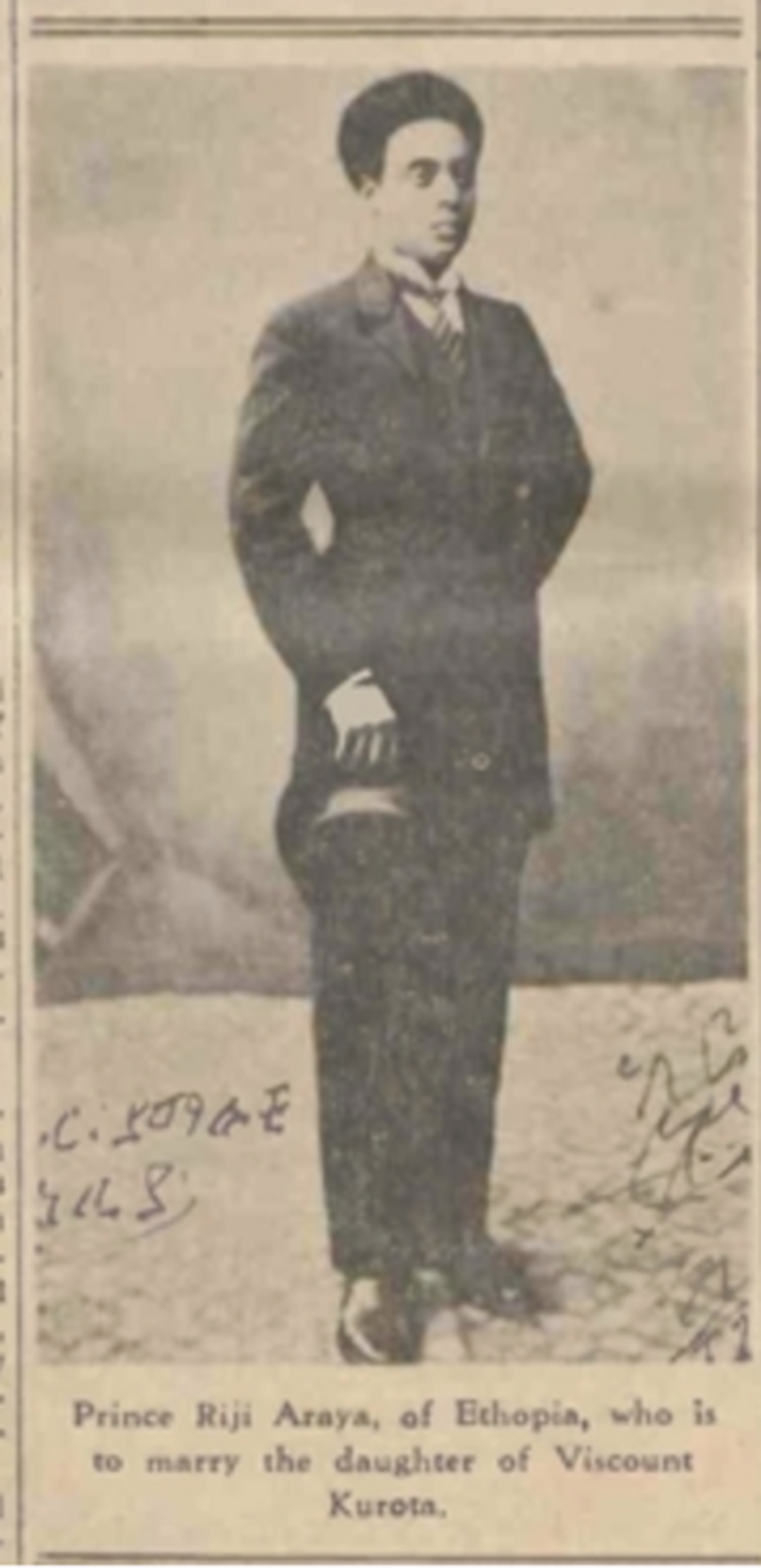
To make a dark-skinned Ethiopian bridegroom more attractive to the general readership, the Japanese press engaged in various forms of whitewashing, some of them quite literal. A 1933 report from the conservative Yomiuri summarized a frequently expressed view: ‘Ethiopians, when compared to Japanese, are much darker, but not as dark as Japanese would imagine when talking about “blacks”.’ The same reporter noted that ‘their eyes, noses, mouths and so on are incredibly similar to ours in shape’, displaying a classic symmetry popularly ascribed to King Solomon’s union with the Queen of Sheba, a connection to Christianity the Ethiopian ruling classes were particularly proud of when championing their country’s exceptionalism.Footnote 35 As one French newspaper remarked, conscious of the ambiguous position that Japan held in contemporary racial discourse,Footnote 36 the engagement represented ‘the first time that a member of the Japanese nobility had thought of an alliance with a man whose race—despite him being part of the Imperial family—could in Japan only be considered inferior’.Footnote 37 But in this regard the internationally educated Araya Abebe, a ‘monogamous Christian with lighter complexion than expected’,Footnote 38 was even called the ‘Gloucester of Ethiopia’ in the Japanese press, in effect removing him from a perceived backward continent and placing him alongside a noble European gentleman (see Figure 2).Footnote 39
The formal photograph of Araya Abebe that he asked Sumioka to show his fiancée. Source: ‘Hanayome ni misete hoshii to’, Asahi shimbun, 7 February 1934, p. 11.
Kuroda Masako’s pioneering mission
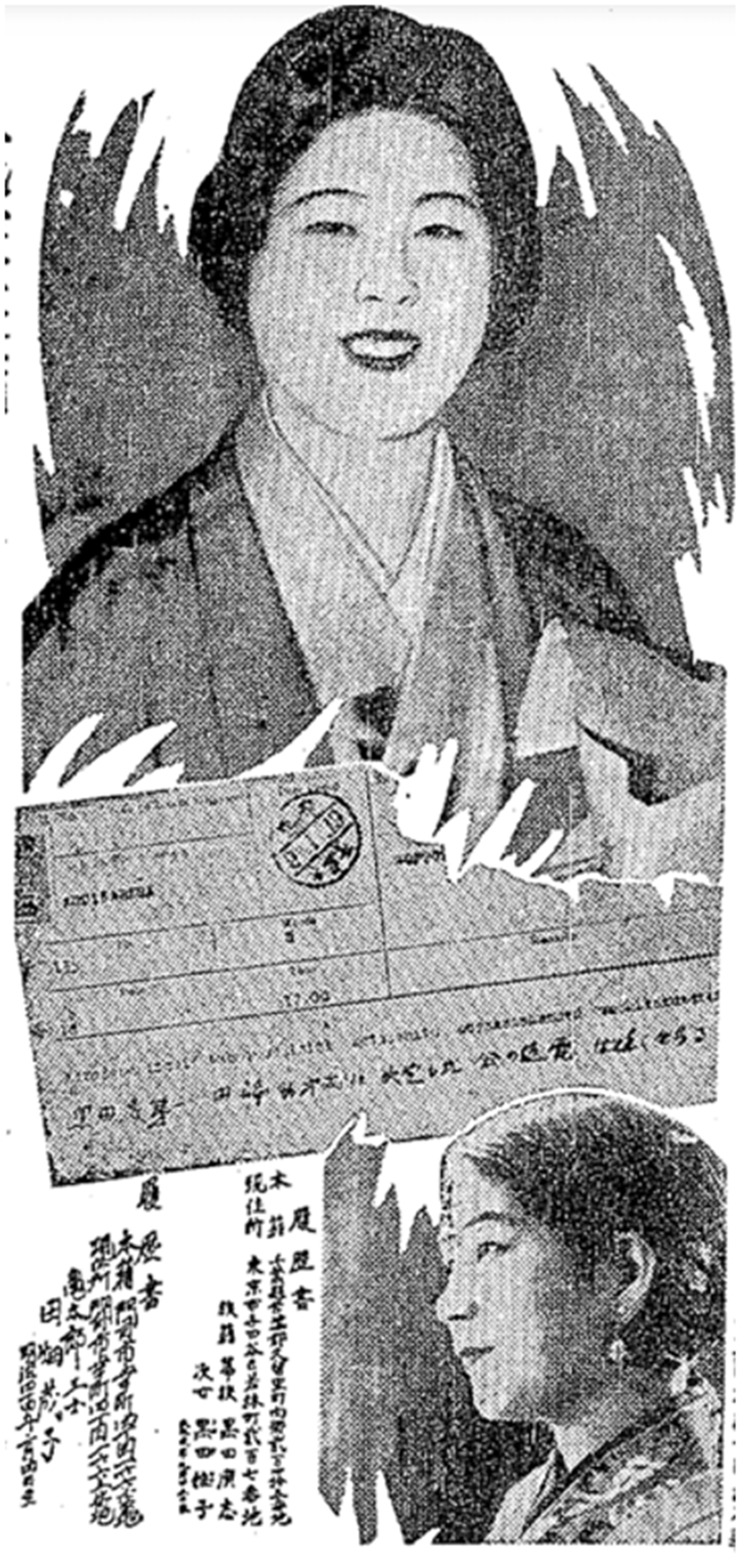
If Araya’s marriage plans also aimed to save Ethiopia from its belligerent European neighbours, his fiancée had even grander goals for their engagement, endeavouring not only to uncouple the Western tenets of whiteness and Christianity, but also challenging the civilization discourse in regard to gender. Selected in January 1934 (see Figure 3), the 21-one-year-old Kuroda MasakoFootnote 40 soon became instrumental in an imagined transnational connection between Ethiopia and Japan, but she had her own ideas about the future of the Japanese empire. She soon realized that her ideas could be heard by far more people than she had ever imagined, given the extraordinary amount of attention she received in the first months of 1934. Kuroda received dozens of letters a day from correspondents, both male and female, wishing for a position in her future retinue, whether as ladies-in-waiting, nurses, court physicians, maidservants, or bodyguards.Footnote 41 Businessmen asked her to promote their firms in Ethiopia, hoping to uncover new commercial opportunities.Footnote 42 Others even travelled great distances to meet her in person, including a journalist couple, the Wells, who ‘came all the way from the US to meet Kuroda Masako, who is to become an Ethiopian princess’.Footnote 43
Clockwise from top: Kuroda Masako, the 19 January 1934 telegram from Addis Ababa stating Araya’s top two preferences, Tabata Shigeko, and the two candidates’ resumés. Source: ‘Hanayome kōho wo meguri’, Asahi shimbun, 20 January 1934, p. 7.
Kuroda quickly made it clear that her application, initially stymied by even her family, was only the first step in vocally promoting her pioneering journey to Africa on behalf of her country. First, she was interviewed by many mainstream newspapers, but male journalists were more concerned with racial and gendered issues, describing her as ‘on the front line’ in all her undertakings, ‘despite being female’.Footnote 44 One Yomiuri interviewer candidly identified the ‘most worrisome question for him as a Japanese man’ when contemplating Kuroda’s future marriage: ‘Are you in some way dissatisfied with Japanese men?’ Kuroda, disregarding the racial prejudice towards her fellow country people she so vehemently condemned in the United States, politely denied the suggestion and stated merely that ‘Ethiopia and Japan share the same national spirit’, so she did not see the difference between the two countries, thus dismissing the man’s attitude towards her interracial wedding.Footnote 45
Conversely, in her disavowal of ‘ethnic prejudice’ (minzokuteki henken), she was praised by the feminist critic Kamichika Ichiko (1888–1981), who devoted a lengthy column to the impending engagement in the 20 January 1934 edition of the daily Yomiuri newspaper. A long-time champion of women’s rights, Kamichika praised the ‘modernism’ of the young women who had applied to become Araya’s bride. What was most remarkable, according to Kamichika, was that women of the ‘wealthy classes’ (including both Kuroda and the wealthy bourgeois second-placed Tabata) stood at the cutting edge of change in dismantling such prejudices, and women of future generations would one day thank them for their ‘courage and determination’.Footnote 46
As a woman writing in mainstream newspapers, Kamichika represents the link to the opposite side of the media spectrum—the women’s press—which portrayed Kuroda Masako’s life and experiences as examples to follow.Footnote 47 Whether in the form of reportage, interviews, or roundtable discussions, coverage focused squarely on Kuroda, leaving Araya a somewhat blurry presence, while in the mainstream press the two names were inevitably linked and rarely appeared separately. Women’s magazines emphasized the bride’s subjectivity and agency with regard to the challenges of marriage and domestic life, issues of special relevance to female readers, but Kuroda used such an arena to subvert women’s public role in the empire. While in truth, the significance of the engagement of the women’s press lay less in its geopolitical consequences than in its domestic implications, Kuroda used women’s magazines as an arena to passionately discuss her ideas on the pioneering role of women in the colonies, and felt free to express her views about Ethiopia and, more generally, the role of Japanese women in the imperial effort.
One of the ways in which the women’s press constituted a better arena for Kuroda was by providing her with a space to express herself in writing, thereby allowing her to be represented not only in the third person as a public icon, but also in the first person as a thinking—and gendered—subject. A six-page essay by Kuroda titled ‘I’m Off to Ethiopia to be Married’ appeared, for example, in the March 1934 issue of Fujin kōron, a women’s magazine that targeted relatively educated readers.Footnote 48 Around the same time, she penned another 20-page account in which she elaborated further on the themes tackled in her Fujin kōron article, titled ‘When I Become a Woman of Ethiopia [literally, a Person of Ethiopia]’. Tellingly, Kuroda chose to title one section of her essay ‘To the Women Who Sympathise with Me’ (Watashi ni godōjō kudasaru josei e), knowing that her audience was predominantly female.Footnote 49
In both pieces of writing, Kuroda indeed viewed herself in explicitly gendered terms. Bolstered by love for her nation and her wish to become an integral part of the imperial project, she always imagined Japanese pioneers in Africa as almost exclusively women. She wished to highlight that, in Japanese colonies or controlled territories like Manchuria, women had an important role to play in their nation’s ‘valiant leap’ (yūhi) overseas.Footnote 50 In Kuroda’s words, now was the time for women to ‘acknowledge clearly and forcefully our “national” existence’ (sekkyokuteki ni kokkateki josei to shite no sonzai o hakkiri ninshiki shinakereba naranai), while admiring those Japanese women who were doing ‘great courageous deeds overseas’.Footnote 51
Nevertheless, she realized that, in territories controlled by Japan, the empire was still mainly a masculine enterprise, and she tried to actively disengage empire-building from the male sex, envisioning new possibilities for women. ‘Although [colonial] development (kaitaku) is a responsibility assigned to men,’ she wrote, ‘I do not think it impinges on men’s prerogatives if women too, to the extent they are able, seek out new horizons and engage in development activities as women.’Footnote 52 Therefore, in promoting the hitherto unknown Ethiopia as equal to Japan, Kuroda envisioned a transnational role for women, not within the protected territory of the home islands, but in a new space where men and women could be more equal. While she was a staunch supporter of the Japanese empire, she had to come to terms with the fact that, as a woman, she was not the ideal actor her nation envisioned to start a new enterprise in Africa. Trying to overcome the ideological impasse between her belief in women’s equal role in the imperial enterprise and imperial chauvinistic foundations, she firmly expressed her intention to become a ‘good bridge’ between Ethiopia and Japan, with the African country becoming ‘literally a sister country’ (shimaikoku) for Japan, in effect trying to advocate for her country in a new land where Japanese women could have more liberties and freedom of action.Footnote 53 Even though only nine Japanese lived in Ethiopia at the time,Footnote 54 Kuroda went so far as to predict that the distant African nation would someday become a ‘second homeland for us all’ (minasama no daini no kokyō), envisioning Ethiopia as a unique opportunity for Japan.Footnote 55
In choosing Ethiopia, Kuroda showed an acute awareness of the international situation in the 1930s. Like many of her contemporaries, she pointed to the racialized legal restrictions that many countries in the world placed on Japanese immigration. ‘If we look around us today, which are the countries that open their doors and truly welcome us?’ she asked pointedly. ‘Aside from part of South America and the newly emerging nation of Manchuria [Manchukuo], it is the Ethiopian empire alone.’Footnote 56 From 1924, as a matter of fact, the United States had banned Japanese immigration, and Kuroda’s vision of Ethiopia was a consequence of such exclusion.
While she did not explicitly acknowledge Ethiopian women, Kuroda’s vision of imperial feminism promoted diverse roles within a context of overall equality between Ethiopia and Japan. Unsurprisingly, then, her wedding and subsequently sharing of Japan’s cultural knowledge with Ethiopia were opposed by the Japanese state. It is important here to clarify that Kuroda, while initially hoping to serve her state, always remained a non-governmental actor, ironically becoming, in fact, what I define as a counter-state actor, going against the interests of her nation within just a few months. Her words challenged the innate patriarchal architecture of empire-building, and for Japanese women she became a symbol of a dauntless modern girl who defied patriarchal authority, disregarded Japanese racial superiority, spoke English fluently, and declared that she had not dreamed of marriage but rather of adventure overseas.Footnote 57 Even more dangerous than her words was that parties other than feminist groups viewed her as the symbol of interracial union and alternative alliances in the non-white world. Although Kuroda’s focus was mainly on Japanese women attaining liberty elsewhere, her lack of reticence about interethnic marriages, a feature almost unique amongst noble people,Footnote 58 became a call for racial equality worldwide, as Kuroda was narrating a utopian history based on equality despite the differences between Ethiopia and Japan.
A coloured and ‘royal’ wedding
Kuroda and Araya’s status further complicated their ‘marriage problem’ (kekkon mondai), as it was defined in much of the Japanese media. Takie Sugiyama Lebra writes, ‘what would have occurred among commoners without drawing public attention was sensationalised if a kazoku woman was involved’, and that applied to Kuroda too.Footnote 59 In the international press, due to her noble status, she was dubbed a ‘Japanese princess’, her father even becoming a ‘member of the Imperial family’.Footnote 60 In some reports, the Japanese emperor had personally given his consent for the ‘royal’ marriage.Footnote 61 In contrast, in the case of the Japanese press, where Kuroda was clearly depicted as a minor member of the peerage, it was Araya whose rank more typically received a rhetorical boost. Footnote 62 Headlines usually identified Araya as a member of Ethiopia’s ‘imperial family’ (kōzoku) or an ‘imperial nephew’ (kōsei), referring to him respectfully as ‘his highness’ (denka). While such designations were not necessarily incorrect, they tended to magnify the degree of Araya’s proximity to the throne. An ordinary reader in Japan could be forgiven for assuming, nevertheless, that by wedding this princely figure, Kuroda might one day ascend the throne as empress of Ethiopia herself.
Pan-Asian and Pan-African supporters were galvanized by such reports about the royal and coloured character of the union. In the words of the foreign correspondent Shōji Yūnosuke, who had spent almost a year in Ethiopia in 1932, the marriage was clearly a matter of the ‘unity of Oriental peoples’, in effect including Africans and African Americans in such a group. To many like him, the ‘Ethiopian marriage issue’ had to constitute ‘the first practical step toward racial equality and the unity of Oriental peoples’.Footnote 63 Even an actor as involved with the state and the West as Nitobe Inazō was reportedly very pleased with the project of uniting Ethiopia and Japan, even offering to adopt the future bride.Footnote 64
To be sure, it was mainly for her noble status that Sumioka and his wife had chosen Kuroda for Araya. Already by October 1933, the lawyer imagined the bride ‘to be the daughter of a baron, an office of dignity to be given only to some blood relations of the Royal family’. Regarding the details of the wedding ceremony, the lawyer-cum-nakōdo imagined that ‘it would be advisable to take to H.I.M. the Emperor of Japan a small present in the shape and type of some leopard or lion skins of the best quality’.Footnote 65 Kuroda was the best option among the applicants to fulfil his lofty ideal of a non-white alliance, while trying as much as possible to tie together the two imperial families, an enterprise he knew had no precedent in Japan.Footnote 66 He was not the only one trying to involve the Japanese emperor but also circumventing Japanese bureaucrats. In December 1933, special correspondent for the Ōsaka mainichi newspaper, Yamauchi Masao, based in Ethiopia since 1931 and from then on always in touch with Sumioka, assured his sovereign that this particular marriage would guarantee Japan a special place in Ethiopia’s political and economic panorama:
The intended marriage of Lidj [sic] Araya will help us to secure this loan [from the Japanese government to the Ethiopian one, ‘to cover the expenses and out-put on the purchase of a plant for the purpose of iron-works, which is the cradle of civilization’] without any difficulty, on the understanding that Your Imperial Majesty may be willing [to] give a warrant of security in any manner desired. As Your Imperial Majesty is quite aware, I am always trying to cultivate a good link and existing friendship between Japan and Ethiopia on the formation of strong foundations. I understand that the Ethiopian delegates sent on mission to Japan [in 1931] were refused a loan of this type owing to the lack of introducing the greatness and wealth of Ethiopia into the knowledge of the people of Japan. But now since the situation of Ethiopia is such, I assure Your Imperial Majesty to be able to get this important loan of money, of which we shall strive and endeavour to keep it quite secret in any way possible.Footnote 67
A union between Africa and Asia, Yamauchi wrote, would make Japanese industries ready to invest in Africa and help Ethiopia secure weapons, hence the need for secrecy from European powers. While it is unclear whether this letter ever reached the Japanese emperor, it highlights how the actors most involved with the Kuroda-Araya wedding were conscious of the reluctant bureaucratic position towards Ethiopia, which was to be fully revealed with the debacle of the wedding. Therefore they tried to create a web of alternative supporters, even attempting to mirror Haile Selassie’s sympathy for Japan in Hirohito.
Whether due to these actors’ efforts or Japan’s image as the ‘champion of the darker races’, the influence of the Kuroda-Araya wedding went well beyond Asia and Africa. The possible union of such symbolically powerful countries was felt particularly by the African American community in the United States, whose enthusiasm for Japan and Ethiopia was further ignited by the news of the engagement. The likely alliance of the two countries, ‘among the oldest empires in the world’,Footnote 68 and the ‘first non-European peoples […] to defeat the white race at arms’, had already been hailed by an elated African American press, which considered Japan as the ‘logical leader’ of ‘all coloured peoples’.Footnote 69
The African American press, more than any other, tended to highlight less the economic advantages for both Japan and Ethiopia and more the couple’s noble character. The Afro-American underscored the fear that the union ‘of royal houses of darker races’ caused in international circles in Europe.Footnote 70 In an internal war clearly defined by racial boundaries, African American journalists and intellectuals took issue with the white American press which they judged guilty of having diminished the significance of the marriage. So, the Chicago Defender charged: ‘American newspapers, in seeking to cast reflection on the proposed marriage, referred to the father of the prospective bride as a “somewhat impoverished viscount”’.Footnote 71 The article then pompously (and erroneously) defined Viscount Kuroda as a ‘wealthy landowner and outstanding figure in the high councils of state affairs’. It also exaggerated Kuroda Masako’s attributes: ‘Miss Kuroda is exceptionally intelligent, having been graduated from one of the most aristocratic colleges in Japan, which outranks Vassar college in America.’Footnote 72
As this internal strife within the American press demonstrates, the wedding was to seal more than ever coloured solidarity against white power.Footnote 73 The Chicago Defender announced: ‘This marriage is seen as a move to cement more thoroughly the bond between the black and yellow races, which has been watched ever since the Japanese obviously sought to resist white supremacy and the encroachments on their rights and territory.’Footnote 74 George Schuyler (1895–1977) wrote in the Pittsburgh Courier that ‘associated with Japan, the Ethiopian kingdom will doubtless become a power in Africa’. Taking swipe at the racial segregation enacted in the United States, he continued: ‘It would seem that inter-racial marriage is not the deplorable thing that some Negroes and most white folks would have us believe.’Footnote 75
While Schuyler was critical of the imperialist stance he saw in Japan, anthropologist J.A. Rogers (1880–1966) was more enthusiastic, giving his wholehearted acceptance of race-mixing:
a growing bond of sympathy among the darker people of the world is inevitable under present conditions. […] The mention of marriage between a Japanese and an Ethiopian will also cause a racial flutter among Americans, regardless of color, so wrapped are they in the stupid and entirely false belief that race is a matter to be worried about […] All people, no matter how pure they seem, are mixed. The darkest race was once very likely white, and the whitest race was once black […] Therefore, except to ignorant folk, the news of a union between Japanese and Ethiopian royalty will mean little, racially. Economically and socially, however, it is of great significance.Footnote 76
For a minority much vexed racially and to whom interracial marriage was virtually impossible, that the two most prominent non-white countries conceived an alliance through marriage represented an ironic twist of an instrument that had a distinct old-world flavour to it. The proposed union of Kuroda and Araya—and generally an alliance between Ethiopia and Japan—thus offered these actors an arena for further articulating and contesting prevailing Western-based ideologies about interracial marriages and racial segregation, which they suffered daily. In sum, Kuroda and Araya’s engagement demonstrated that divorcing race from Western civilization discourse was possible, even as they challenged every pillar of it.
The 1934 shift
These subversive opinions endangered the respective governments’ agendas, be it racial hierarchy in the United States, or Ethiopia’s appeasement of its European neighbours. Although the reason why the marriage did not come to pass was a combination of Italian (and generally Western European) pressure and Ethiopian fears that it would displease its neighbours, on the Japanese side there were undoubtedly race and gender-based hesitations, which were fully concretized in just three years. What in 1931 had been considered a surprising brotherly commonality between Ethiopia and Japan ironically contributed to the Japanese government’s ultimate disengagement from Ethiopia in 1934. The Osaka jiji shinpō best summed up the widespread sympathy for Ethiopia up to the spring 1934, writing that the Ethiopian ‘national character (kokuminsei) is similar to ours’, with Ethiopia being ‘the most unique country in Africa, […] said to be as old as Egypt, considered the oldest country in the world’, with ‘marriage customs [that] are strikingly similar (kokuji) to those of Japan’.Footnote 77 However, conscious of political directions and the repercussions that insisting on the similarities with Ethiopia would have brought, from 1934 newspapers and various printed accounts assured the readers that, in truth, Ethiopia had never been fully equal to Japan.
The timing of the shift was hardly a coincidence. In 1931, when Ethiopian delegates disembarked in Kōbe, the Japanese popular welcome was reportedly warm and enthusiastic. Heruy recalled that everywhere they went they were fêted and welcomed by hundreds of young students with small flags; it was a pity that it was a spectacle he ‘could not show to all Ethiopian citizens’.Footnote 78 That first diplomatic encounter started some groups’ fantasies, in Japan and worldwide, of non-white alliances and eventual supremacy. By 1934, however, these dreams grew out of control, with the wedding talks, and what government officers saw did not fit the imperial agenda. Following a 1926 Japanese enquiry on the Ethiopian response to Japanese goods and the 1931 Ethiopian mission, business interest in the country had grown, but already by 1932 a report on Japanese migration overseas stated that it would be troublesome for Japanese entrepreneurs to flourish in the Ethiopian agricultural products market.Footnote 79 The Japanese government was also very hesitant about opening a legation in Addis Ababa, only consenting to an honorary consulate-general in Osaka to help those interested in doing business, despite the difficulties.Footnote 80 Regardless of the propaganda on the shared cultural links with its colonies, for Japan’s state imperialism the way proposed by a female subject like Kuroda with equality as a foundation of future progress was simply unfathomable, even with a non-colony like Ethiopia.
The press, increasingly censored and controlled, followed suit. For instance, the booklet that followed Kuroda’s 20-page account, issued by the government’s Institute of International Economics (Kokusai keizai kenkyūjo) and titled Akeyuku Echiopia (Ethiopia dawns), presented Ethiopia merely as a backward country with interesting economic openings for Japan. The Institute recognized the extreme curiosity of Japanese citizens, whose ‘interest in Ethiopia could not be understated’, but never mentioned an affinity between Japan and Ethiopia—a country that moreover still practised slavery. Footnote 81 Instead, Japan was portrayed, unsurprisingly, as the more advanced and civilized country of the two. Unlike in Ethiopian accounts, where Ethiopia considered itself to be approximately level with Meiji-period Japan in terms of progress, 1930s Ethiopia was continuously compared to Tokugawa Japan.Footnote 82 One sentence states: ‘Japan had such a society during the Tokugawa period, but in Ethiopia still now there exists, astonishingly, a class of warriors.’Footnote 83 The press also became more prone to highlight the most exotic aspects of the ‘mysterious’ African country, such as the presence of lions, to reinforce the image of a savage Ethiopia, a ‘faraway black country with widespread lions and venomous snakes’.Footnote 84 Finally, the account that Heruy penned about Japan was uncoincidentally translated into Japanese only in 1934 because it reinforced the idea, in Ethiopian eyes too, that Japan was superior—even the title had been changed in Japanese to Dai Nihon (Great Japan) to underscore such grand imagery.Footnote 85
Unsurprisingly, then, on 3 April 1934, the Tōkyō nichinichi shimbun announced that the engagement between Kuroda Masako and Araya Abebe had been broken, and not by themselves. The article, penned by the special correspondent to Ethiopia Nanjō Shin’ichi, reported that ‘a certain country’ had fiercely interfered.Footnote 86 The culprit was soon explicitly recognized as Italy, which still bore the scar of its 1896 defeat and suffered intense economic competition from Japan, both in Africa and in South America.Footnote 87 When the Italian dictator was accused of being mainly responsible for breaking the ‘curious episode of the current Japanophilia disease in Ethiopia’,Footnote 88 the allegation soon became an international incident that diplomatic circles attempted to rectify. Italian diplomats ceaselessly tried to protect their country’s international image, denying any possible involvement and trying to shift the blame onto the Japanese government. As one fascist newspaper put it, ‘It is instead the Imperial Japanese Court that, boastful of its ancient traditions, did not allow the wedding with the Abyssians, with a certain tone lacking deference to the natives of the Negus Empire.’Footnote 89
Italian diplomacy was undoubtedly anxious to downplay Italy’s role at the expense of the Japanese bureaucracy, but after thorough investigation, it seemed the Japanese aristocracy, keen to retain their status as ‘honorary’ whites in Western powers’ eyes, were less than eager to consent to the marriage. In regard to the Kuroda engagement already by January 1934, the Tōkyō nichinichi shimbun had reported the opinion of the historian Honda Tatsujirō (1868–1938), then affiliated with the Ministry of the Imperial Household. According to Honda, there was ‘no precedent for a member from a foreign royal family to marry a member of the Japanese aristocracy’. ‘Since Masako is a noblewoman,’ he continued, ‘she will naturally have to apply for the Ministry of the Imperial Household to approve her engagement prior to her marriage.’ Honda did not want to discard the option altogether, however, but ‘we need to consider the prestige of the noble families of this country’. The matter, he explained, would be carefully taken care of once the Kuroda family applied for a marriage licence, foretelling future hindrances to the engagement.Footnote 90 Additionally, in a March 1934 Imperial Diet discussion regarding Ethiopia, when committee member Hattori asked what the Ministry of Foreign Affairs thought about the marriage of Kuroda, government commissioner Matsumoto vigorously stated that the marriage was ‘not related in any way to the work of the Ministry of Foreign Affairs’ and that the Ministry had ‘never touched on that subject’, trying to downplay the ‘proportions of the matter’.Footnote 91
While the Japanese and Italian governments were frantically trying to avoid any mention of the marriage, the Ethiopian government is another suspect in sabotaging the engagement. Some days after attacking Italy, the Tōkyō nichinichi shimbun claimed that the marriage had instead been cancelled on the Ethiopian side. Apparently, Haile Selassie was outraged by the Japanese press’s confusing Araya with the Crown Prince.Footnote 92 Reportedly, the much publicized wedding had received little attention in Ethiopia. The cold reaction to the engagement was confirmed by later interviews with Heruy and Haile Selassie. In his later autobiography, the Ethiopian emperor claimed that the Italian press published the ‘even worse story’ of the marriage between a Japanese princess and the Crown Prince of Ethiopia.Footnote 93 He did not spare the Japanese press too, which had so enthusiastically received Heruy’s delegation in 1931. It had, in fact, written too much and in too romanticized a way about the proposed marriage, provoking Mussolini and worsening Ethiopia’s international standing.Footnote 94 In 1935, when asked about the talk of a proposed marriage between a ‘Japanese princess’ and ‘an Ethiopian prince’, Heruy, too, burst out: ‘Fairy tales! Goodness knows where they sprang from!’Footnote 95
The most disappointed by the outcome of the marriage were, unsurprisingly, those actors to whom the marriage meant a new racial alliance, in clear contrast with their governments’ wishes. Kuroda, by now fully aware of her country’s aversion to her project, expressed publicly her new-found opposition to Japan’s ruling elites: ‘I will go to Ethiopia even in the capacity of a private citizen, if the Imperial Household authorities should disapprove.’Footnote 96 Sumioka gave an interview after the announcement of the failed engagement talks, explaining to the press that he had tried to ask both Heruy and the Japanese Ministry of the Imperial Household when Araya would travel to Japan, but he had received no response. However, he did not blame only the Italian government: ‘I suspect that other countries may have been pressuring Ethiopia rather than only a certain country.’ He also polemically stated that it was ‘impossible for Ethiopia to have cancelled the wedding without taking into consideration the desires of the Japanese government’, thus claiming that ‘there was an air of opposition from the [Japanese] Ministry of Foreign Affairs’, accusing it of being ‘weak’.Footnote 97
These counter-state actors continued to promote the Ethiopian cause regardless. Educator Itō Kan’ichi (1911–1996), just a few months before Ethiopia’s defeat in 1936, continued to stress Ethiopia’s similarity to Japan and the country’s high status, writing about Ethiopians’ ‘superior facial features, courageous nature, and good intelligence’ among African populations.Footnote 98 Yamauchi kept covering topics of interests from Ethiopia, from architecture to history. Sumioka continued telegraphing slogans such as ‘We love Ethiopia’.Footnote 99 Alongside Tōyama, he also founded the ‘Friends of Ethiopia Group’ to support the African country.Footnote 100
The African American press, largely oblivious to Japan’s own imperial project, initially only blamed white and fascist Italy. The ‘reason for the disapproval of the Italian government is said to be based upon the fact that an alliance between Ethiopia and Japan would jeopardize the Italian Samaliland [sic], a strip of land bordering Ethiopia’.Footnote 101 Even a year after the cancellation of the engagement, the Chicago Defender reported ‘objections of Mussolini to union of Japan and Ethiopia’, which ‘shattered the international planned romance’.Footnote 102 The African-American press, hopeful that Japan would not abandon Ethiopia, nourished subsequent rumours about the marriage and a future alliance between the two most important non-white countries. The Chicago Defender eagerly announced, at the end of 1936, that ‘rumors are persistent now that the couple plan to marry in November. Indication that there is a close relationship between Japan and Ethiopia is shown in the fact that Japan is training 500 Ethiopian pilots.’Footnote 103 Again, the main culprit for the annulled wedding, a ‘historic union’, was the Italian Duce:
While Abyssinia was making preparations for the wedding, Italy was shaping her military plans for a fascist conquest of Ethiopia. To have allowed two of the oldest empires to be united by sentimental ties would have complicated, if not completely ruined the Italian designs. Mussolini made it clear to Japan that such a union would greatly disturb the cordial relations existing between Italy and Japan, and that his government would look with disfavor upon any further continuance of such negotiations. It is rumored, however, that the prince proposes to marry Mademoiselle Kurade [sic] in November of this year. Japan, it was learned from reliable sources, will interpose no objections to the union.Footnote 104
Initially convinced that Japan would help Ethiopia in the Second Italo-Ethiopian War because of the failed marriage,Footnote 105 the African American press eventually had to begrudgingly accept Japan’s official indifference—if not hostility—towards the cause of the coloured races. The Chicago Defender, in an article titled ‘Japan and the Negro’, used scathing words against the former ‘ally’:
The popular fallacy that Japan—by reason of its non-Nordic classification—is interested in the black races should be discarded by all those who entertain such sentimental bunkum. Throughout their long history the Japanese have systematically avoided any association with the Negro race that might cause the white world to identify them with the descendants of the dark continent. They, like their German partners, look upon Negroes as inferior people.Footnote 106
One last attempt to rekindle Ethiopian-Japanese intimacy on the Ethiopian side was made by Daba Birrou, who had participated in the 1931 mission. Sent by Haile Selassie to Japan in the autumn of 1935 to obtain help against the Italian menace, he found Sumioka and thousands of non-governmental actors willing to welcome him.Footnote 107 However, the Japanese government did not commit itself.Footnote 108 In fact, it first informed the Italian embassy of its intention not to send arms, munitions, or soldiers, regardless of (or perhaps precisely because of) Kuroda’s and other pro-Ethiopian activists’ declarations about the beginning of a racial war which would push Italy and Japan to the verge of a diplomatic incident.Footnote 109
Nevertheless, Sumioka and the main promoters of the wedding tried to back Ethiopia after the Italian invasion too. A letter sent to the Italian dictator Mussolini by the Dai Nippon Turan Young Men’s Association to protest against the invasion bore the headline ‘Arise, all coloured brothers! And slay the white wolf in the Mediterranean which tries to pounce upon the black lamb in East Africa!’ The first paragraph of the pamphlet clearly reaffirmed their racial solidarity with Ethiopia, considered a sort of ‘honorary’ Asian country:Footnote 110
If it is a theory in anthropology that the world’s mankind is to be divided into two big groups, the white and the coloured races, all the coloured peoples in the world with us Japanese included are naturally the brothers of the dark, brown-complexioned Ethiopians. And the rivalry of these two big groups of mankind is a fact that we cannot deny. History proves that this rivalry has always made a cause of the world’s racial conflicts. The rivalry between Italy and Ethiopia, therefore, seems to forebode a racial conflict between the whites and the coloured. In other words, Italo-Ethiopian controversy is deemed to be a prelude to the racial war between the whites and the coloured, possibly becoming an incensitive [sic] to another World War. Footnote 111
Scholar Hasegawa Satoru aptly recapitulated the contradictory Japanese position at the outbreak of the war, torn between Japan’s popular sympathy to non-white peoples and its own anti-Euro-American endeavour:
[Japan] has adopted a wait-and-see (seikanteki) attitude […] Japan is similar to Germany and Italy in its desire to break with the status quo, and […] in its acute need for overseas development it is similar to Italy, so the Italian position is understandable. On the other hand, when it comes to the question of race, however, we are in a very difficult position, because we cannot agree with Italy’s invasion of Ethiopia, since we ourselves insist on the liberation of Asia from the hands of the white man.Footnote 112
Even Sumioka conceded that Italy had an overpopulation problem just like Japan, foretelling the future alliance with Ethiopia’s main enemy.Footnote 113
It needed some time for the Japanese government and public opinion to realign and view Italy as a more palatable choice for an alliance. Disengaging from Ethiopia did not automatically mean entering into an alliance with Ethiopia’s main threat in 1934—Italy—whose relationship with Japan was, in fact, tense. The two governments were at odds regarding Ethiopia and were economic competitors in many other contexts. In addition, the fascist bureaucrats had initially supported China against Japan. As we have seen, the broken engagement at first resulted in diplomatic incidents between the two nations: in Italy, the Japanese embassy needed 200 police officers to deal with the disorder, while in Japan, Ambassador Auriti received insulting letters and death threats.Footnote 114
In sum, a Japanese alliance with Italy was neither a predestined nor an immediate choice for Japanese bureaucrats and politicians. In fact it was a cautiously pondered decision only finalized after 1936, when Ethiopia began to be more and more associated with Manchuria rather than Japan, as a consequence of both countries distancing themselves from the League of Nations.Footnote 115 Moved by the very same urge against Anglo-American capitalism that had once joined Japan and Ethiopia, Fascist Italy became another viable ally in Japan’s governmental agenda; indeed, a more palatable one. Italy, as a matter of fact, while claiming to be against the Anglo-American world order, did not try to uncouple itself from the basic order of civilization, as it was understood in Japanese ruling circles too: a white nation with the centre of Christianity in its capital, with a role among the ‘civilized’ countries and a male charismatic leader who sidestepped a female-brokered alliance.Footnote 116
Conclusions
As Schuyler wrote in 1937, ‘Ethiopia was the acid test of Japan’s love for the darker peoples’, a test that Japan ‘failed’ in the eyes of the same activists who only a few years earlier were enthusiastic about the archipelago.Footnote 117 To be sure, popular Japanese fascination with Ethiopia, or as Fujita calls it, the ‘Ethiopia boom’, would have quickly faded out had it not been for Kuroda and Araya.Footnote 118 Araya’s announcement had prompted the response of some 20 girls in just a month, a phenomenon that puzzled some newspapers. Even worse in the eyes of the Japanese government, the selected candidate belonged to the peerage. Albeit minor nobility, nonetheless Kuroda’s status, coupled with Araya’s inflated credentials, soon blew the matter out of proportion. Despite praising her courage, many did not see why an aristocrat would want to migrate and wondered why a member of a noble family would want to live in a ‘land of black people’ (kokujin no kuni).Footnote 119 Unlike other Japanese women overseas, Kuroda was not forced to leave the country out of poverty. Nevertheless, she had assigned herself the role of pioneer in Ethiopia. Even if Kuroda believed that Ethiopia could welcome Japanese women like South America or Manchuria, it remained a black nation surrounded by white powers, and the Japanese political elite’s acquired notions of Western racial superiority played a part in not backing her project.
It did not help that Kuroda was a woman, as she, in her journey from being an imperial feminist to an unexpected counter-state actor, caused anxiety on account of her gender.Footnote 120 As Kuroda was acutely aware, empire-building, as elsewhere, had always been considered by Japanese policymakers a manly enterprise. A woman—even more so a vocal woman who acted without her family’s approval—could not be the most suitable subject to start a new colony in Ethiopia. The (mostly male) press always identified Kuroda as ‘manly’ to highlight that she deviated from 1930s gendered expectations about women, even after her marriage. When interviewed by the Shufu no tomo magazine, the reporter concluded that Kuroda was patient, sympathetic, strong-willed, and, most notably, masculine.Footnote 121 Kuroda, while claiming her patriotic role, at the same time challenged patriarchal concepts of familiar authority and womanhood, eventually becoming a ‘problematic woman’Footnote 122 arrested for her supposedly communist activities.Footnote 123
Despite Kuroda’s later treatment in the press, her engagement represented the pinnacle of Ethiopian-Japanese intimacy. In this article, I elucidated how the idea of an alliance between Ethiopia and Japan was soon enthusiastically welcomed both in Japan and in non-white communities, as an unprecedented relationship unmediated by Western powers. Ultimately, I suggested that this engagement, albeit unrealized, provided an arena for contesting Western-acquired racial assumptions; many Japanese activists saw in Ethiopia (and vice versa) a spiritual brethren race presenting an alternative to the white and Western world order. In stark contrast with sympathy from the general public and intellectuals, the bureaucrats’ interest in this union soon faded. On the Japanese side, Ethiopia was simply neither economically nor politically worth pursuing, unlike Fascist Italy later. Araya’s announcement and Kuroda’s choice thus accelerated the process of governmental detachment from Ethiopia, even as it ignited popular excitement.
The actors who championed this transnational dream of racial equality—Kuroda Masako and Araya Abebe—never met, nor did many Japanese pro-Ethiopian activists ever set foot in Ethiopia.Footnote 124 Nevertheless, the African empire represented in the imagination of many anti-Western groups a vivid fantasy of transnational coloured intimacy. In this article, I have explored a rather neglected alliance that started as a diplomatic possibility and became a non-governmental challenge that hoped to lay the foundations for a world order that would rethink existing racial hierarchies in the 1930s. Future studies could unveil further attempts to build alternative world orders beyond, and at times against, the nation-states and the Western civilization order, as was the case with the short-lived dream of an Ethiopian-Japanese union.
Acknowledgements
I must thank Professor Sho Konishi and Professor Gregory Pflugfelder for their critical and insightful feedback on previous drafts of this article. My thanks also go to the members of the Oxford Japanese History Workshop for their helpful comments. I am grateful to Dr Alice Baldock for her support and kindness. Finally, thank you to the anonymous reviewers and editors at Modern Asian Studies.
Funding statement
The research for this article was generously supported by the Oxford Sasakawa Fund; the Great Britain Sasakawa Foundation; the Japan Foundation Endowment Committee; Queen’s College, University of Oxford; and the Faculty of History, University of Oxford.
Competing interests
The author declares none.


 Open access

