

Introduction
When 25-year-old artist Edward Reep (1918–2013) volunteered his services to the US Army and joined the Art Unit within the Engineering Corps,Footnote 1 he did so with a certain degree of bravado. Recounting his experiences on the Italian front, he said of himself: ‘more willing than knowledgeable, I almost destroyed myself on two occasions through my own stupidity’ (Reep Reference Reep1987, 12–13). With photographs and sketches, Reep’s job was to compile an artistic reportage of the advancement of the Allied troops along the Italian peninsula, and on 21 April 1945, he participated in the liberation of Bologna.
In the town square of Bologna, where the city jail is located, a collaborator had just been slain beneath the iron-barred windows of the jail, his fresh blood still visible on the brick wall below. Within minutes an Italian flag was hung on the wall, above and to the left of the bloodstain, the tricolored red, white, and green presenting a starling panache of colour against the ancient, dull brown bricks. The House of Savoy emblem had been ripped away from the white central panel of the flag; pinned in its place was a stiff black ribbon of mourning. … A derelict green table was then thrust against the bedecked wall, and placed upon it were little mementos, mostly photographs and flowers commemorating the loved ones who had perished; more photos were pinned to the flag. (Reep Reference Reep1987, 163)
What Reep had witnessed was the creation of the Sacrario dei partigiani in Piazza Nettuno in Bologna. The location was not casual: the Sacrario was deliberately placed in front of Palazzo d’Accursio, the historical seat of the town council. There, many partisans had been executed, and their bodies left on display as a warning to the population. This moment of commemoration does not happen after the Liberation, but rather during its last throes; as the Nazi-Fascist troops retreat, the women of the city come forward and lay pictures, mementos of and flowers for their husbands, brothers and sons. Amongst the pictures put up is one of Irma Bandiera (1916–1944), liaison agent for the 7th GAP Brigade in Bologna and posthumous recipient, in October 1944, of the Gold Medal of Valour – the highest Italian military honour – for her actions in and sacrifice for the Resistance against Nazi-Fascism.
The Sacrario is a good place to start the examination of the Resistance memoryscape in Bologna. As a locus, it allows the immediate connection between the living community and its dead to come to the fore. It thus raises questions of who is and who is not remembered, of who the actors involved in the creation of this memory are and of the implications of the narratives created around this memory.
In this article, I examine the space that women have in public commemorations of the Resistance around the city of Bologna, not only as subjects of the commemoration itself but also as actors and vectors of how this memory is preserved. To do so, I will examine as case studies two monuments, inaugurated in 1964 and 1975 respectively: the Sacrario ai caduti partigiani, in the Certosa Cemetery, and the Monumento alle 128 partigiane cadute (also known as the Memoriale alle donne della Resistenza) located in the park of Villa Spada. I will trace women’s presence by focusing on the efforts made to preserve and immortalise Irma Bandiera immediately after her death; thus, I will use her as a vector for a gendered analysis of the monumental memory of the Resistance across the city as it developed from 1945. I will question why she was chosen to become a national and local symbol; and how her memory acted as binding agent between the two organisations involved and vested in the creation and perpetuation of this memory: the Municipality of Bologna, the civic institution responsible for the effective creation and legislation of the monumental identity of the city, and the Bologna section of the Unione Donne Italiane (UDI). The UDI, as the direct postwar heir to the Gruppi di Difesa della Donna (GDD) (Alano Reference Alano2003), intersected its social political action within the new Italian democratic system (Orlandini Reference Orlandini2018) with the perpetuation of the memory of how women participated in the Resistance, organising scholarly conferences and cultural or political events. Working in parallel for many years, these two organisations joined forces in their commemorative activities only in 1975, with the creation of the Monumento alle 128 partigiane cadute.
Building on Achille Mbembe’s (Reference Mbembe2003) theory of necropolitics, Hans Ruin (Reference Ruin2019, 7–8) contended that the space of politics, understood as ‘communal organisation and action’ is constantly upheld by both the living and the dead. This is not only achieved through the way a community cares for its dead, but also through the creation of legacies that can ‘bind the living and the dead together in mutual commitment’. This, as scholars have shown, is a fundamental characteristic of Resistance memory (Portelli Reference Portelli2006; Foot Reference Foot2010; King Reference King2023). This commitment is carried out both through themes, such as employing notions of sacrifice and martyrdom in their public-facing discursive practices, and by creating connections with the physical space where the partisan died, which fundamentally contributed to the creation of a paradigm of victimhood that shaped the civil religion and the collective memory of the Republic (Schwartz Reference Schwartz2010; De Luna Reference De Luna2011, 40–43). This paradigm of victimhood holds within itself a gendered dimension, as women can fulfil a double role as perfect victims and a locus for the expiation of the country’s perceived sins. The femmes tondues, women whose hair was shaved in an exercise of public humiliation and punishment for their collaboration with the German army, occurred across Europe including Italy, although no conclusive numbers are available. The tontes (‘shearings’), Virgili (Reference Virgili2000, 10) argues, are a way for the country to reestablish their newfound patriotism, where misogyny, anger and violence converge to make epuration and punishment a visible effort. To the tonte, however, must correspond a woman who instead represents the female contribution and ultimate sacrifice to the Resistance (Virgili, 318–321): Danielle Casanova (1909–1943), for instance, filled that role for the French Communist Party. This dyad is reflected also in popular culture: in Rossellini’s Rome, Open City, Anna Magnani’s Pina is juxtaposed to Maria Michi’s Marina, who sells out the Resistance to the Germans.
This article explores the legacy of the Resistance as it was upheld by the city of Bologna and its community: if it is true that cities ‘are engaged in a continual process through which they develop and refine their self-image’ (Young, Reference Young2014, 41), this study will analyse the development of a discursive nexus whereby the city of Bologna’s identity is portrayed as inextricably linked to the Resistance, to its dead and to its heroes, chief amongst them Irma Bandiera. Utilising Young’s (Reference Young2014, 41–43) terminology of the ‘legislated city’ – that is, ‘a space in which a particular kind of experience is encapsulated and produced through the regulation of space, temporalities and behaviours’ which can be mapped – this article bases its analysis on the understanding that a foundational element of Bologna’s postwar identity can be found in the Resistance, experienced as a communal effort leading to the sacrifice of its citizens, as evidenced by the placement of the Sacrario in the very the centre of the main square of the city.
That is not to say that this memory and identity were shared by the entire community at the time, nor that they are today: studies on the memory of the Resistance in Italy show how fragmented and contested the subject still is, and the role that both associations and political parties have as storytellers in the creation of a public and political narrative of the movement (Focardi Reference Focardi2020; Cooke Reference Cooke2011). Emilia-Romagna is a compelling case study to examine due to the region’s long history as a centre of communist and socialist thought and political activity, which continued after the end of the Second World War and impacted both the memorialisation of the Resistance within the region (Silingardi Reference Silingardi2008) and region’s status as a place of violent anticommunist repression during Fascism (Creatini Reference Creatini, Baldissara and Capuzzo2023). When we talk about the developing of Bologna’s identity between 1945 and 1975 especially, we talk about an identity that is inevitably shaped by socialist and communist tendencies, as exponents of both parties were predominant in the city council. As this study will show, Irma Bandiera’s presence in the monumental landscape of the city was due to the Italian Communist Party’s rhetorical usage of her life and death, which elevated her as a nationwide example to young communist girls (Goretti Reference Goretti2012). Still today, her legacy continues at both institutional and local level: in 2017, the President of the Chamber of Deputies Laura Boldrini presided over the event Montecitorio a porte aperte, which was dedicated to Bandiera. That same year, street artist duo Orticanoodles in collaboration with CHEAP Collective in Bologna created a mural of her on the façade of the Bolognese elementary school Bombizzi, and Roberto Dall’Olio published a poem, Irma, on her life (Dall’Olio Reference Dall’Olio2017). Even more recently, in November 2024, in public protests in Bologna against the Casapound rally that took place on the ninth of the month, red banners declaring Bologna an antifascist city carried a picture of Bandiera’s face inscribed within a star.
Nevertheless, the memory of the Resistance tends to be male dominated, both in public language and rhetoric and in the physical space of commemorations: most of the scholarship, national in scope or centred on singular figures or events, by necessity discusses those commemorations and monuments that provide the best material for a theorisation of Resistance memory on a national level. In effect, this has led to overlooking the emplacement and visibility of women in these commemoration sites. There are very few monuments specifically dedicated to the women of the Resistance in Italy. Amongst these are the monument in honour of Alma Vivoda (1911–1943, considered to be the first partisan to fall in the Resistance) in Trieste; the Scalinata monumentale alle donne della resistenza in Podenzana (Massa Carrara, Tuscany); the Monumento alle 128 partigiane cadute in Bologna; and the earliest example, Leoncillo Leonardi’s Monumento alla partigiana veneta in Venice. Of these, only the Monumento alla partigiana veneta has enjoyed some scholarly attention (Bascherini Reference Bascherini2017), probably due to its status as the first monument destroyed by a neofascist bomb in 1961. Studies on memorialisation efforts across Bologna only analyse the statuary work (Caldarola Reference Caldarola2017, Guidotti et al. 2021–Reference Guidotti, Sangiovanni, Pirazzoli and Nannini2022), and scholarly work on the UDI has discussed its history, its campaigns and relationship with political parties on the national level but has not examined how the organisation interacted with the memory of the Resistance post-1955 (Michetti, Repetto, and Viviani Reference Michetti, Repetto and Viviani1998; Gabrielli Reference Gabrielli2000, Reference Gabrielli2005, Reference Gabrielli2009). In carrying out this gendered analysis of Resistance memory in Bologna, then, I provide the first analysis of the monumental commemorative landscape of the city. I also explain why Irma Bandiera remained central to the memory of the Resistance, despite most other women becoming victims of those processes of ‘forgetting and omissions’ (Mihai Reference Mihai2022, 10) that are at the core of the political narrativisation of the Resistance. To carry out this study, I will first provide a historical account of Irma Bandiera’s life and role in the Resistance to explain why she became such a fundamental figure in the commemorations carried out by the Unione Donne Italiane (UDI) and by the PCI. Then, I will examine the commemorative topography in Bologna, focusing on two instances: the creation of the Monumento Ossario ai Partigiani Bolognesi in the Certosa cemetery (1954–1963), and the Monumento alle 128 partigiane cadute in the park of Villa Spada (1975).
Historicising Irma Bandiera and the women of the Resistance
Approaching official online sources – such as the Enciclopedia delle donne or the National Association of Italian Partisans (ANPI) website – to learn more about Irma Bandiera means confronting different narratives concerning her death: important details, such as the location of her body, the torture she experienced, and even the day of her murder contradict one another. This is because, as we shall see in this section, there is an essential tension in her story between presence and absence. Despite her continuous presence in commemorative efforts around the city, there are no archival materials or private sources that can shed light on her life and her thoughts during the Resistance, and no historical record of either her arrest or the tortures she endured before she was killed. The narrative instrumentalisation of her death has found in this absence and in the second-hand accounts of her life and her last days, fertile room to grow. This process was not unusual in the commemorative practices of the PCI during the war. The fates of other women partisans, such as Gabriella degli Esposti (1912–1944), who was tortured, maimed and killed at seven months pregnant after a reprisal in Castelfranco Emilia, were used to push women towards Resistance action. Though postwar Italy recognised degli Esposti’s death and work for the Resistance, her story remains deeply rooted in her role as a mother and a partisan, as emphasised by the citation for her Gold Medal of Valour. The specificity of degli Esposti’s story, the presence of her two daughters as witnesses when she was taken away and her execution with five other partisans, meant that the story of her death could not be shaped as freely as Bandiera’s. In the long run, this allowed the PCI and the UDI to centre around Bandiera the image of the ideal female (communist) partisan.
Political action on her behalf begun immediately after her murder, with the partisan brigade ‘1° Brigata Garibaldi “Irma Bandiera”’, beginning its operations in Bologna at the end of August 1944. Her centrality to the memory of the Resistance is primarily attributed to the way her death has been narrated and reinterpreted over the decades to align with the needs of various storytellers. This process has solidified her role in the perpetuation of Resistance memory, particularly in relation to themes of sacrifice. A distinction, then, must be made between the historical facts of Irma Bandiera’s death, her subjection to Fascist torture, of Bandiera as a person, as an antifascist, partisan woman, and what instead was done to her story after her murder. In other words, following Henrik Rønsbo and Steffen Jensen’s (Reference Rønsbo, Jensen, Jensen and Rønsbo2014) theorisation, there must be a distinction between the victim herself and the status of victimhood placed upon her by the political powers interested in her story. Without denying or questioning the experiential suffering of the victim, the narrative that emerged following Irma Bandiera’s death became immediately a political tool and, as such, must be questioned to see how it holds up against the historical record that is available.
Irma Bandiera was born in Bologna in April 1915, to Angelo Bandiera and Argentina Monferrati, the youngest of two sisters. Her father had fought in the Great War and had developed, during the 1920s, antifascist ideas that he then passed on to his daughters. Interestingly, according to Dino Cipollani (1924–2009), former partisan and Bandiera’s neighbour in Funo, these ideas resonated more with Nastia, Irma’s older sister, rather than with Bandiera herself (Arbizzanti Reference Arbizzanti1989, 133). Forced to evacuate from Bologna due to the Allied bombings of the city, Irma Bandiera relocated with her family to the nearby small communities of Funo and Argelato, where her uncle and aunt resided. It was there that ‘Mimma’ developed a close connection to the Resistance: she worked as Dino Cipollani’s liaison officer between October 1943 and March 1944 within the 7th GAP Brigade. When he switched divisions, the commander of the Brigade finally gave her the rank of active partisan, taking her on as his liaison agent (Arbizzanti Reference Arbizzanti1989, 140). Bandiera was arrested at her uncle’s house on the evening of 7 August following a partisan attack on the casa del fascio in Funo, with several other brigade members. The night after her arrest, the partisans set on fire the casa del fascio and, in the reprisal that followed, civilian houses were burned down and their inhabitants killed. While most of the partisan prisoners were killed at this time, Irma Bandiera was kept alive and brought to Bologna because, as a liaison agent, she held vital information on the locations of partisan bands. This recollection of events (Bergonzini Reference Bergonzini1980, 602; 877) is confirmed by the testimonies given during the 1947 trial of Pietro Torri (1901–?),Footnote 2 a local Fascist leader from Bologna who stood accused of her murder and several other massacres in the area (Mandreoli Reference Mandreoli2017).
In the seven days that followed her capture, the partisans and her family made several attempts to locate her, but none succeeded; her body would be found on the morning of 14 August 1944. When she was brought back to the medical examiner’s office, the coroner – a friend of the Resistance – took photographs of Bandiera’s face, documenting the tortures she had endured. She was buried in the Certosa cemetery a few days later. The seven days from 7 to 14 August cannot be accounted for: this absence from historical record made possible many different versions of her end. The most quoted narrative, the one promoted by the PCI, sees her as a victim of constant, unimaginable tortures: ‘they had cut her breasts, burned part of her body, she was repeatedly raped, and they had entered her body with a long and sharp object, presumably the barrel of a rifle’ (Il costruttore, 1953, 20). The narrative continues by recounting that, before executing her, the Fascist squadron brought her outside her parents’ home and repeatedly demanded that she betray the partisans. When she refused, they first threatened her parents, then they blinded her and killed her, leaving her naked body under the surveillance of two guards as a warning to the population.
The records of the Torri trial, however, tell a different story. The first thing the investigators noted was that her body was clothed, with only underwear missing, and that it was left close to the Meloncello Arch, at least one and a half kilometres away from where her family lived. The police report records evidence she was raped before being murdered: she was shot five times, but no signs of torture were found. The only available copy of the autopsy, made by the city’s coroner, confirms that her body showed no signs of external, pre-mortem injury.Footnote 3 Her breasts were not cut, and the only burns on her body were those created by two point-blank shots to her head. While she undoubtedly went through psychological torture and suffering while under capture, evidence suggests that the PCI and the ANPI attempted to capitalise on her suffering and emphasise her martyrdom. This is evident from the fliers published by both the GDD and the PCI after her death and in the narrative that was promoted by Noi Donne between 1946 and 1948, which emphasised her stolen youth in order to encourage women to take part in political action. In her partisan biography, published in 1955 within Renata Viganò’s commemorative piece, she is characterised as a ‘little girl’: Viganò wrongly describes her as a 23-year-old and this emphasis, placed entirely on her youth, serves to infantilise her, thereby contrasting her perceived lack of agency with the brutality of the ‘monsters’ who tortured her (Viganò Reference Viganò1955 in Perry Reference Perry2001, 323–324).
John Foot (Reference Foot2010, 148) has shown that ‘Resistance memory is intimately linked to death, to sacrifice and to the places where “martyrdom” occurred’. This is why the Monumento alle 128 partigiane cadute stands in the Villa Spada park, just behind the place where Bandiera was killed, and why the road that bears her name starts from the same spot. However, even in death, no victim is remembered in the same way. This difference is starker when looking at how women are commemorated: if the men who died are remembered as heroes across the monumental landscape, the few women who emerge tend to be remembered for their suffering. Notably, when the partigiana veneta monument was rebuilt, following the 1961 bombing, Augusto Murer portrayed a dying, unarmed partisan woman, strikingly different from Leoncillo’s more combative and explicitly political version created ten years earlier. Pain is a vector that carries empathy for the victim, and this is exacerbated when this victim is considered an innocent – or ‘pathetic’, to use Diana Meyers’ (Reference Meyers2011) term. In the context of a war, a woman or a child being murdered will inevitably generate more empathy and anger rather than a man, due to their perceived status as harmless, innocent victims who had no agency in their own death. A significant factor contributing to Irma Bandiera’s recognition across Italy is her ability to embody an image of innocence through her story.
The emphasis on the suffering of Irma Bandiera and on her status as a victim ensures an internal, moral transaction within the audience who is being told about her, where ‘the moral debasement of perpetrators corresponds to the moral strength of victims’ (Danneskiold-Samsøe Reference Danneskiold-Samsøe, Jensen and Rønsbo2014, 242). The moral strength attributed to Bandiera because of her silence in the face of brutality and her ensuing suffering were emphasised, if not exploited, in the postwar period, to promote an idealised version of the communist woman who fought in the Resistance. This became a necessity with the emergence of the Cold War political landscape, particularly in Italy, where the opposition between the PCI and the anti-communist bloc, led by the Democrazia Cristiana, was marked by intense and often violent conflict. Pro-communist propaganda compared her to the Catholic saint Maria Goretti (1890–1902) as they both were raped (Goretti Reference Goretti2012), and the two were heralded as key examples that young communist girls had to model themselves on for their impeccable morality and spirit of sacrifice. The origin of these narratives can be traced back to the detail that her death acquired through the communist press. In the 1946 special issue of Noi Donne dedicated to the institutional referendum (Noi Donne 1946), Irma Bandiera’s murder was described succinctly, noting only that her parents heard the machine gun fire that killed her. However, by 1948, accounts of her death had expanded to include her alleged last words, ‘in me you martyr all the women of Italy that, like me, hate and despise you’ (Floreanini Reference Floreanini1948, 6). By 1968, Irma Bandiera had even acquired a husband and children, with her entry in the Enciclopedia dell’antifascismo e della Resistenza, edited by PCI leader Pietro Secchia, defining her as a ‘caring wife and mother’ (Secchia Reference Secchia1968, 231). These narratives were perpetuated and popularised, in the city of Bologna, by events and public gatherings organised by the UDI, especially around key commemoration dates and mass mobilisations of women for peace campaigns, often accompanied by speeches by authors and politicians such as Joyce Lusso (1912–1998) or Nilde Iotti (1920–1999).Footnote 4
Commemorating the Resistance in the Municipality of Bologna, 1945–1975
Although Irma Bandiera is one of the best-known names of the Resistance, women struggle to find visibility in the Italian monumental landscape of works commemorating the fallen of the Resistance. When they are commemorated at all, it is most often through local topography, through street names and plaques in their honour. Bandiera became the first female partisan in Bologna to be commemorated in this way in 1947,Footnote 5 reflecting a functional and legitimising memory that also saw figures such as Vittoria Nenni (1915–1943) and a few other female Resistance and antifascist heroes recognised across the country’s topography (Zucchi Reference Zucchi2025). Of course, she also appears in the Sacrario dei Partigiani in Piazza Nettuno: what started as a moment of civilian commemoration and mourning was, quickly enough, placed underneath the aegis of the ANPI and of the Municipality.Footnote 6 Since its inception, the Sacrario is an example of what Peter Jan Magry and Cristina Sànchez Carretero define as ‘grassroot memorialisation’ and, as such, it can be said that the original monument had ‘the aim of changing or ameliorating a particular situation’ (Margry and Sànchez Carretero Reference Margry, Sánchez Carretero, Margry and Carretero2011, 2). Moreover, due to the intrinsically political nature of its timing and its position in the city, it represents an instance in which situational public art – art that depends on political intent and placement just as much as it depends on a community’s reaction to it (Young Reference Young2014, 8) – becomes inscribed within the legislated space of the city itself. As a shrine, it remained in its original location for at least a decade, with the city population periodically renewing it as the summer heat inevitably damaged the photographs, until the city council decided to establish a more permanent fixture on the walls of the Palazzo.Footnote 7
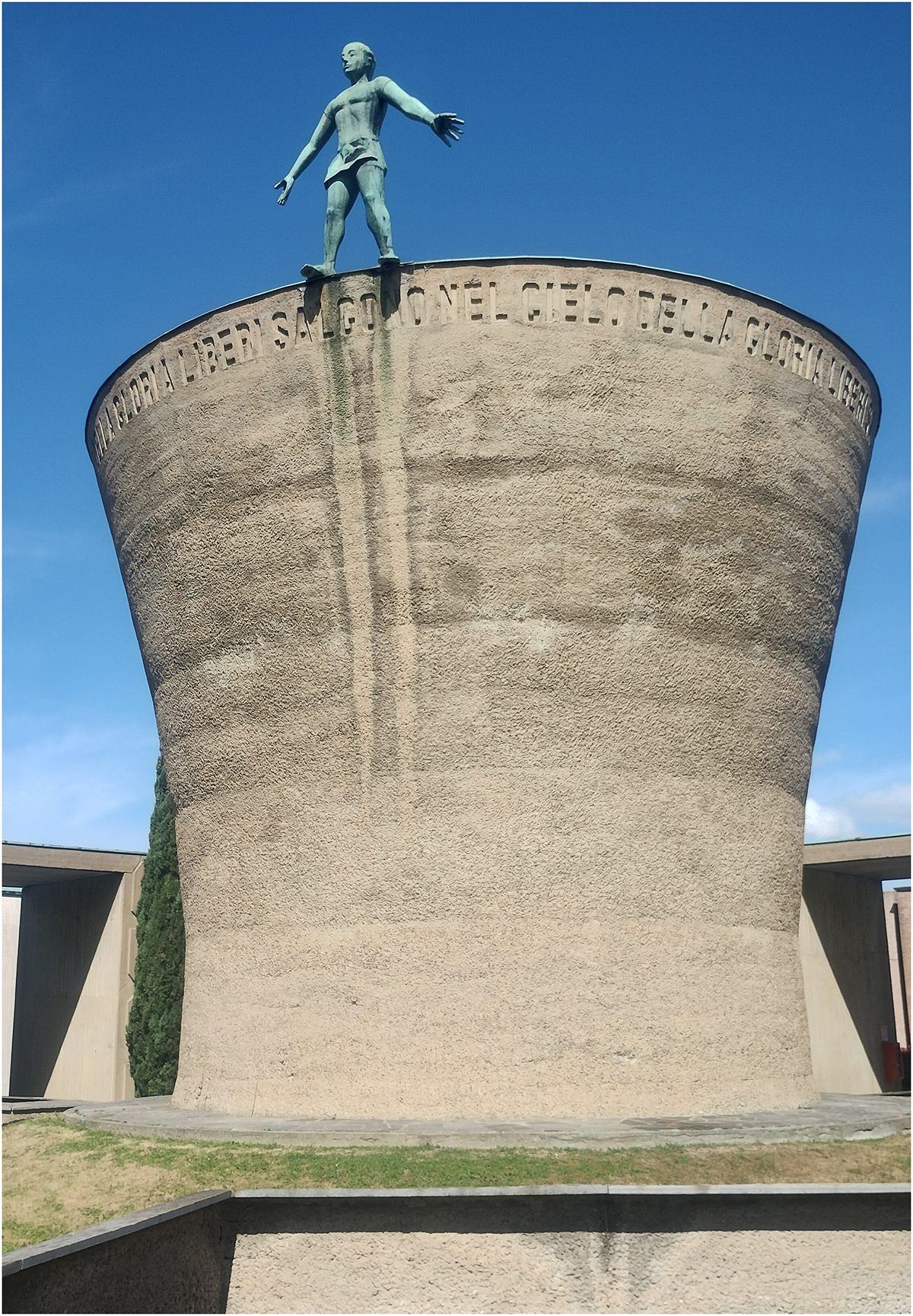
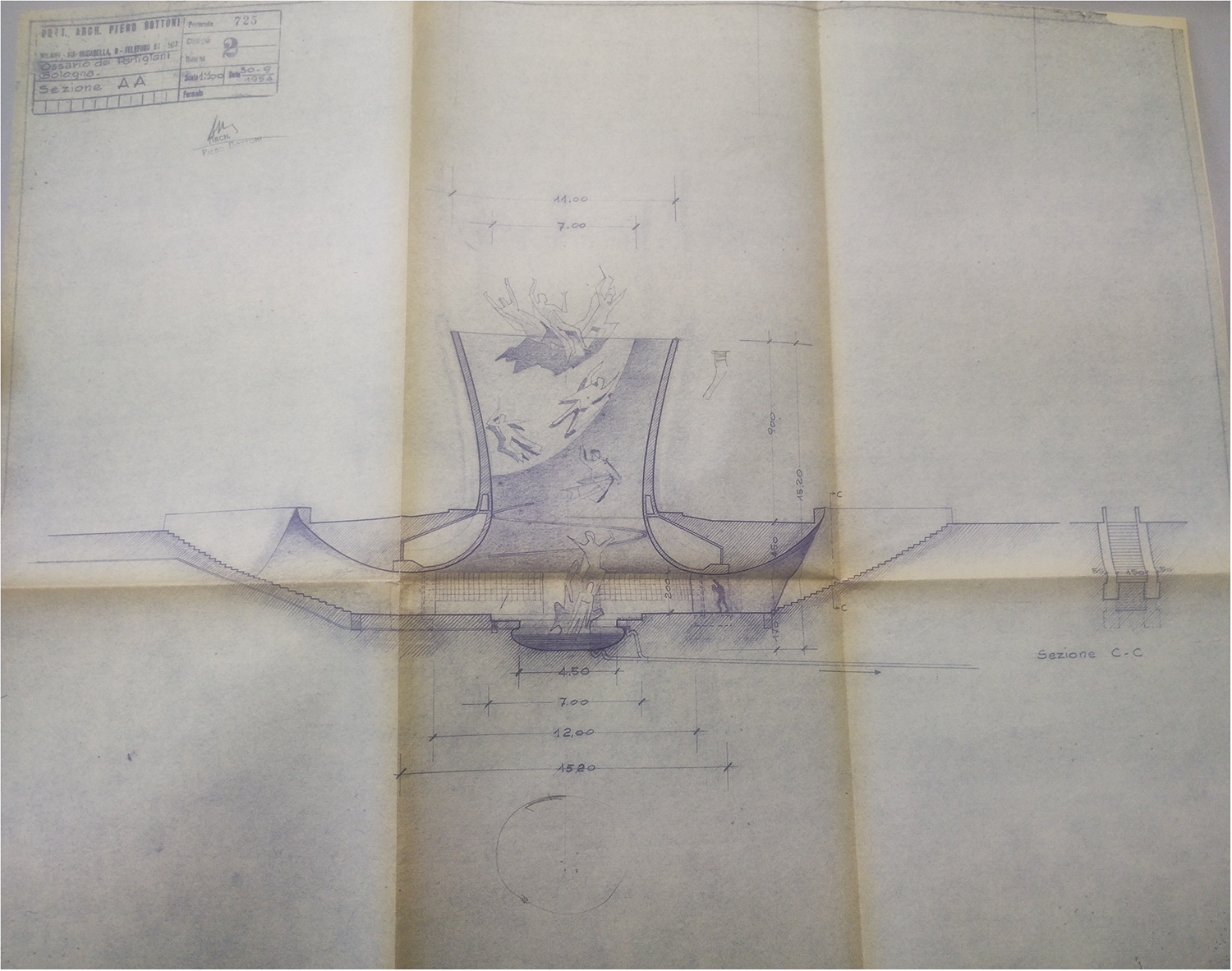
The communion between the living and the dead, which culminates in the creation of the Sacrario, is a characteristic of all the monuments of the Resistance in Bologna. This is due to the shared rhetoric of the PCI and the ANPI surrounding the Resistance. Both institutions interpreted the Resistance ‘as a movement that united Italians from across the political spectrum … and that, above all, saw innumerable citizens offering their blood as sacrificial cement for the new Republic’ (Cooke Reference Cooke2011, 69). The use of the story of the Cervi family – seven brothers executed in 1943 for sheltering POWs and army deserters – illustrates how both these institutions sought to showcase the Resistance as a grassroots movement. This narrative is kept alive today through the annual pastasciutta antifascista, on 25 July, commemorating the pasta meal the Cervi family shared with their community following Mussolini’s fall. Continuing in this vein, in 1950, the City of Bologna initiated a public tender process for a monument that could ‘celebrate the sacrifice and gather the Remains of the martyrs of Freedom.’Footnote 8 This was to be erected in the Certosa Monumental Cemetery with the aim of housing at least 500 burial niches that would contain the ashes of partisans. Logistically and symbolically, this monument had to be erected in the newer part of the cemetery, the Campo degli Ospedali, and just a short, straight walk from both the monument dedicated to the fallen soldiers of the First World War and the one dedicated to the those who died in the Risorgimento. Two consecutive public tenders for this monument would remain unfulfilled, leading to its commission in 1954 to the architect Piero Bottoni. The monument, built in concrete, is a hollow cone that stands above the Ossario, which contains the remains of 500 partisans of Bologna, including those of Irma Bandiera and the women involved with the Resistance. Within the monument are three groups of statues of men and women gradually freeing themselves from the shackles of their torture, ascending from the shadows to the sky (Figures 1 and 2). Bottoni intended the monument to celebrate unity between the living and the dead that, through an act of evocation would give ‘new life to the dead: FREE THEY RISE IN THE SKY OF GLORY.’Footnote 9 This message is repeated across the upper end of the cone, right underneath the silhouetted figures of the partisans, ‘resurrected to fight for freedom, along with the living.’Footnote 10 Dominating the landscape around it, the monument depicts the partisans as larger-than-life figures, heroes to be admired and remembered: they might be next to the living, but there is no possibility of dialogue between the two.
External view of the Ossario ai Caduti Partigiani; Cimitero Monumentale della Certosa, Bologna.

Sketch of the interior of the Monumento Ossario ai caduti partigiani; Archivio Storico Comunale di Bologna, prot. 29200/58.

The unity between the living and the dead is intrinsically political. Opposite the lower group of statues – shapeless figures with vague human features emerging from the ground – an inscription reads ‘the tombs are uncovered; the dead are raised’. The first line of Garibaldi’s hymn connects the dead of the Liberation specifically to the Garibaldi (communist) brigades, clearly also an effort to reclaim the history of the Risorgimento from the Fascist regime (Pollini Reference Pollini1933; Fogu Reference Fogu2003; Baioni Reference Baioni2006). The monument does constitute a place of remembrance of all victims of the Liberation, with a child ‘representing [the memory of] all innocents who died in the reprisals against the partisans’.Footnote 11 While these civilians were not directly involved with the Resistance and thus do not find a place for their remains in the tombs below ground, the monument provides a place for their sacrifice to be recognised in the official commemorative topography of the city. This monument also stands out as one of the first to represent women’s contribution to the Resistance: Bottoni worked with his wife, sculptor Stella Korczynska, until her death in 1956, and with sculptor Jenny Mucchi-Wiegmann (1895–1969) to create the statues within the monument. The statuary group of the Ossario includes two female partisans in the male-dominated group of partisans rising towards the sky – a vision of the Resistance that includes women in the struggle for Italy’s liberation. However, it is telling that the only figure who fully ascends ‘free in the sky of glory’ is male, thus reflecting a heroic narrative of the Resistance that, while inclusive to a degree, remains quite outdated.
The UDI, the Monumento alle Partigiane Bolognesi and the creation of collective memory
Commemorative art honouring women of the Resistance, primarily in the form of statues, had been created prior to the Ossario. Notable for their history are the two bronze statues, Il Partigiano and La Partigiana, sculpted by Luciano Minguzzi in 1946. These statues are renowned for being crafted from the molten metal of Mussolini’s equestrian statue, which once stood in front of the city stadium Dall’Ara (Caldarola Reference Caldarola2017; Guidotti et al 2021–Reference Guidotti, Sangiovanni, Pirazzoli and Nannini2022). It would be incorrect, then, to say that women were absent from public art: in the monumental landscape around Bologna, the Resistance was always understood as a communal effort, involving both men and women. It is, however, a presence that is understood to signify participation and does not place men and women on the same level in terms of importance and degree of active involvement.
Women do not feature in Italy’s commemorative landscape until the 1970s. In Rome, for instance, in 1973 an area began to form around a street dedicated to Irma Bandiera with nearby streets named after other female partisan martyrs, including Garbiella Degli Esposti, Lidia Bianchi and Norma Pratelli Parenti (Zucchi, Reference Zucchi2025, 133). In Bologna, the first monument erected to the women of the Resistance was built thanks to the action of the UDI in 1975. The UDI’s early commemoration efforts were, at first, closely aligned to their broader political agenda of enfranchisement and social emancipation, as evidenced by the rallies for peace and social justice held in the city between 1948 and 1955, which explicitly called on women to unite ‘in the name of Irma Bandiera and the 128 heroines who fell’ during the Resistance.Footnote 12 In 1956, with the publication of Nikita Khruschev’s On The Cult of Personality and its Consequences – the report that exposed Stalin’s crimes – a crisis engulfed the Italian Communist Party, also impacting the UDI. The soul searching that ensued led the UDI to conclude that, from a political standpoint, the organisation had failed to connect the challenges women faced to the patriarchal structures of Italian society and to a broader agenda of emancipation (Riviello Reference Riviello, Bonacchi and Novelli2010, 238). This, in turn, changed the way the organisation approached the Resistance and its memory, and emphasis began to be placed on the role of women in the Resistance.
In Italian literary studies, the question of a ‘gendered Resistance’ (Cooke Reference Cooke2011, 73), had been raised when Renata Viganò published L’Agnese va a morire (1949), a fictional account of some of Viganò’s experiences as a partisan in the Comacchio valleys. This aspect of the Resistance movement gained further visibility with the publication of Ada Gobetti’s Diario Partigiano (1956). The twentieth anniversary of the Resistance brought attention back to the role of women: in 1964, an interview with four female members of GAP brigades appeared in Il Contemporaneo (Tagliabracci Reference Tagliabracci1964). The following year, renowned film director Liliana Cavani produced a documentary for the Italian broadcasting agency RAI, titled Prima Pagina: La donna nella Resistenza. Through testimonies and interviews, Cavani brought for the first time to the general public the experience of women during the Resistance. The memory of the Resistance took on a new meaning during the 1970s thanks to the convergence of the advocacy of the feminist movement and the emergence of internal terrorism, where women played a huge and visible part in the armed struggle. In this context, the Resistance and Liberation gained renewed attention and significance, especially from the younger generation, while women begun to emerge in the historiography dedicated to the period (Bruzzone Reference Bruzzone and Farina1976; Guidetti Serra Reference Guidetti Serra1977; Vaccari, Bortolotti and de Biase Reference Vaccari, Bortolotti and de Biase1978).
The Monumento alle 128 partigiane cadute provides the opportunity to examine the convergence between national public memory and the evolution of historiographical thought, which Caldarola (Reference Caldarola2017, 41) finds fundamental to analyse Resistance monuments effectively. The monument marked the thirtieth anniversary of the Liberation, and was the result of the combined efforts of the Municipality of Bologna, the provincial section of both ANPI and UDI, alongside the active participation of the local community, led by the women in the Saragozza neighbourhood. The local women’s groups had campaigned since the Liberation to have such a monument built and it was probably the rise and influence of second-wave feminism that contributed to a response from city and other local authority institutions. This was not a coincidence: 500 metres from the park stands the Meloncello Arch, the place where Irma Bandiera’s body was found, and the street that carries her name. This made Saragozza an epicentre of women’s collective memory of the Resistance in Bologna. The architect tasked with the design of the monument, Letizia Galli Mazzuccato – who had previously worked at the Monumento ai partigiani di Sabbiuno (1973), in the hills outside Bologna – was clearly aware of this history. In the pamphlet published for the inauguration of the monument, Mazzuccato wrote that for the previous 30 years, ‘it seemed as though the Resistance should only be within the purview of those who worked with it’.Footnote 13 Now, instead, there was a fundamentally new, and widely shared, need to change the way Bologna collectively approached its past.
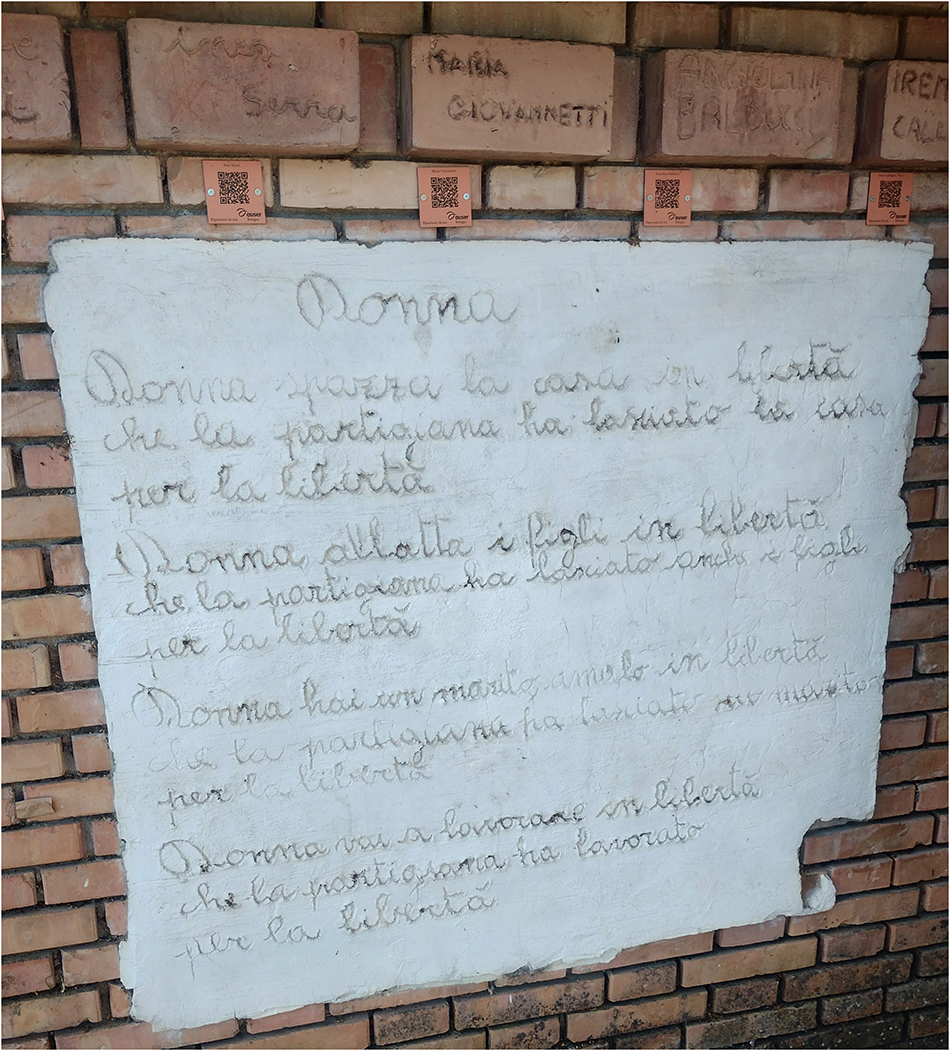
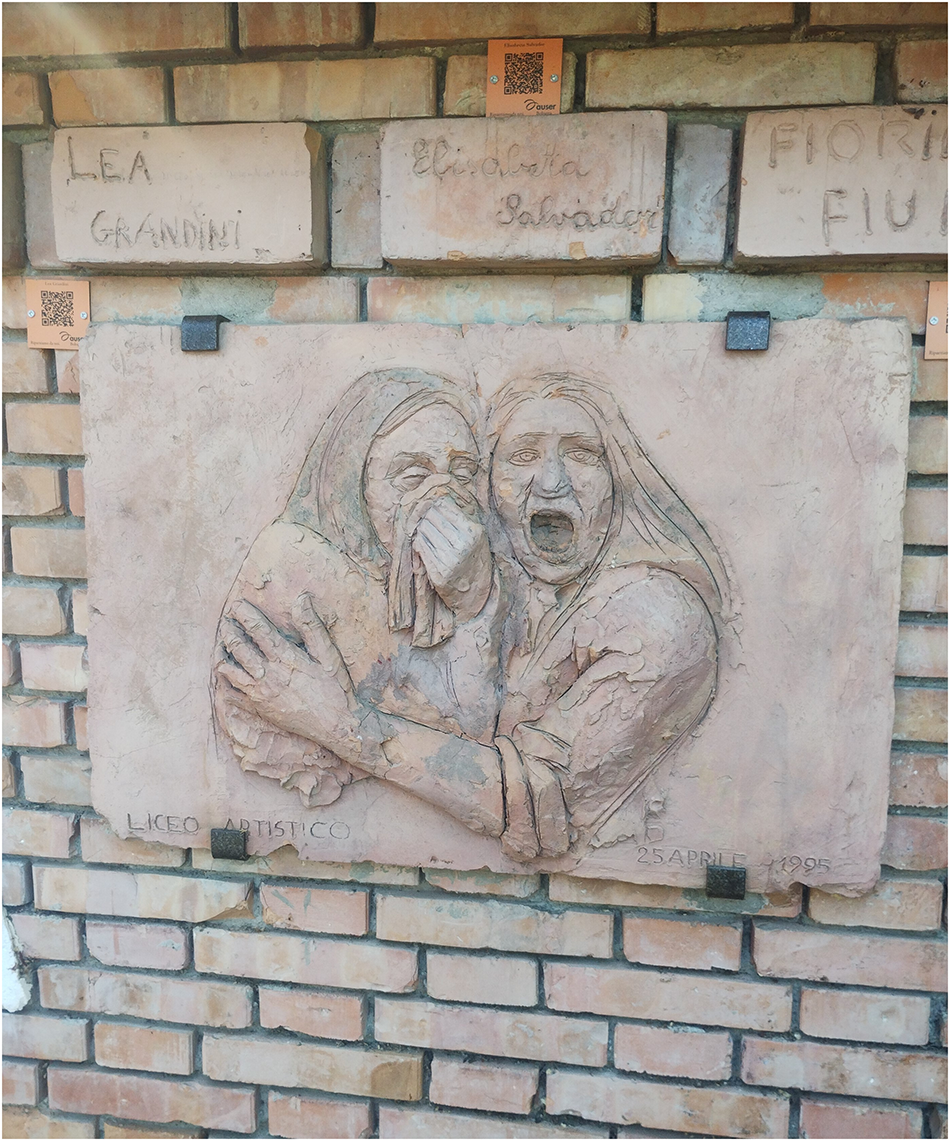
The community became involved in every stage of the creation of the monument, from planning to construction, in what was a first instance of participatory practices for the city of Bologna. The intention of Mazzuccato, and also of the ANPI, was for this monument to be a space for dialogue between people, where memories could be passed on from one generation to the next, so the community could ‘learn to express itself, to become aware of its own political and social practice’.Footnote 14 The decision was therefore made to involve teenagers from the local art high school: after studying the Resistance, they were asked to write a plaque to introduce the monument and produce artwork on wooden slabs to be affixed to its wall. The children of the neighbourhood elementary school, in their turn, were tasked with writing the names of the 128 women on bricks that would be used to erect this wall. In proposing the project to the schools, the committee overseeing the celebrations for the 30th anniversary of the Resistance sent a pamphlet to the classrooms, which described the purposes and characteristics of the monument:
We want to remember the 128 fallen partisans with a monument: but we thought that if we built a statue on a pedestal many would have walked right in front of it without even understanding and even if we wrote underneath it ‘monument to the 128 fallen partisans’ in a few years no one would have remembered anyway. Therefore we said: ‘let’s make a monument everyone can understand.’Footnote 15
The monument, conceived as a place to bring together the generation that had fought in the Resistance, their children, and grandchildren, had the explicit purpose of acting as a barrier against oblivion and as an educational tool. In the pamphlets aimed at the schoolchildren, it is not surprising to see mention of Irma Bandiera, remembered for her torture and her steadfast protection of her comrades. However the cultural barriers that the women who joined the Resistance broke were also acknowledged, noting that ‘the contribution of women is fundamental, because it breaks centuries-old habits; it creates a new mentality’.Footnote 16
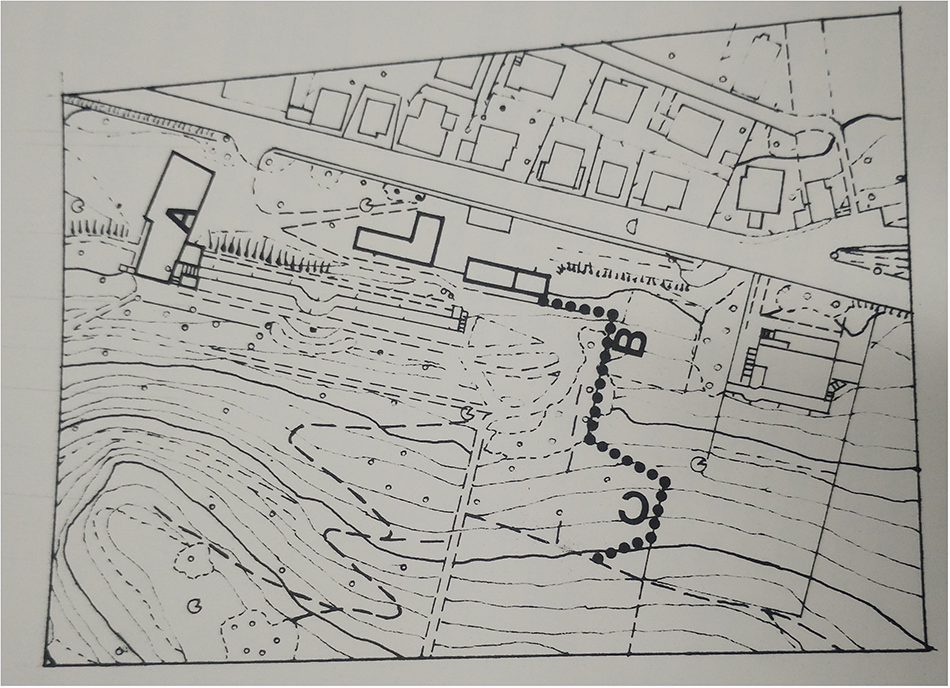
The monument, built by and for the community, was to be an instrument to be used: throughout the documents, the phrase mentioned most often is that it was to give people ‘the right to make culture’,Footnote 17 to embody, in art and sculpture and even theatre, the collective history and spirit of the community. The location for the monument was determined by necessity, dictated by the geographical constraints of the Villa Spada park, which was hilly and small. Mazzuccato decided to embed the monument within the natural landscape. It was to be a wall – representing the wall against which most partisans were executed (Figure 3)Footnote 18 – snaking around the side of the garden. On the wall, 128 bricks would bear the names of partisan women (point B in Figure 3), embellished by art created by the high school students (Figure 4). As the wall becomes embedded into the hill, a series of big steps, not unlike the seating in an ancient arena, provide space for people to gather, think, and reflect. The lawn encased between the wall and the steps, in the original plans, was to become a theatre stage to allow freedom of expression within the community.
Project plan of the Monumento alle 128 partigiane cadute: UDI Bologna.

First section of the Monumento alle 128 partigiane cadute, Villa Spada, Bologna.

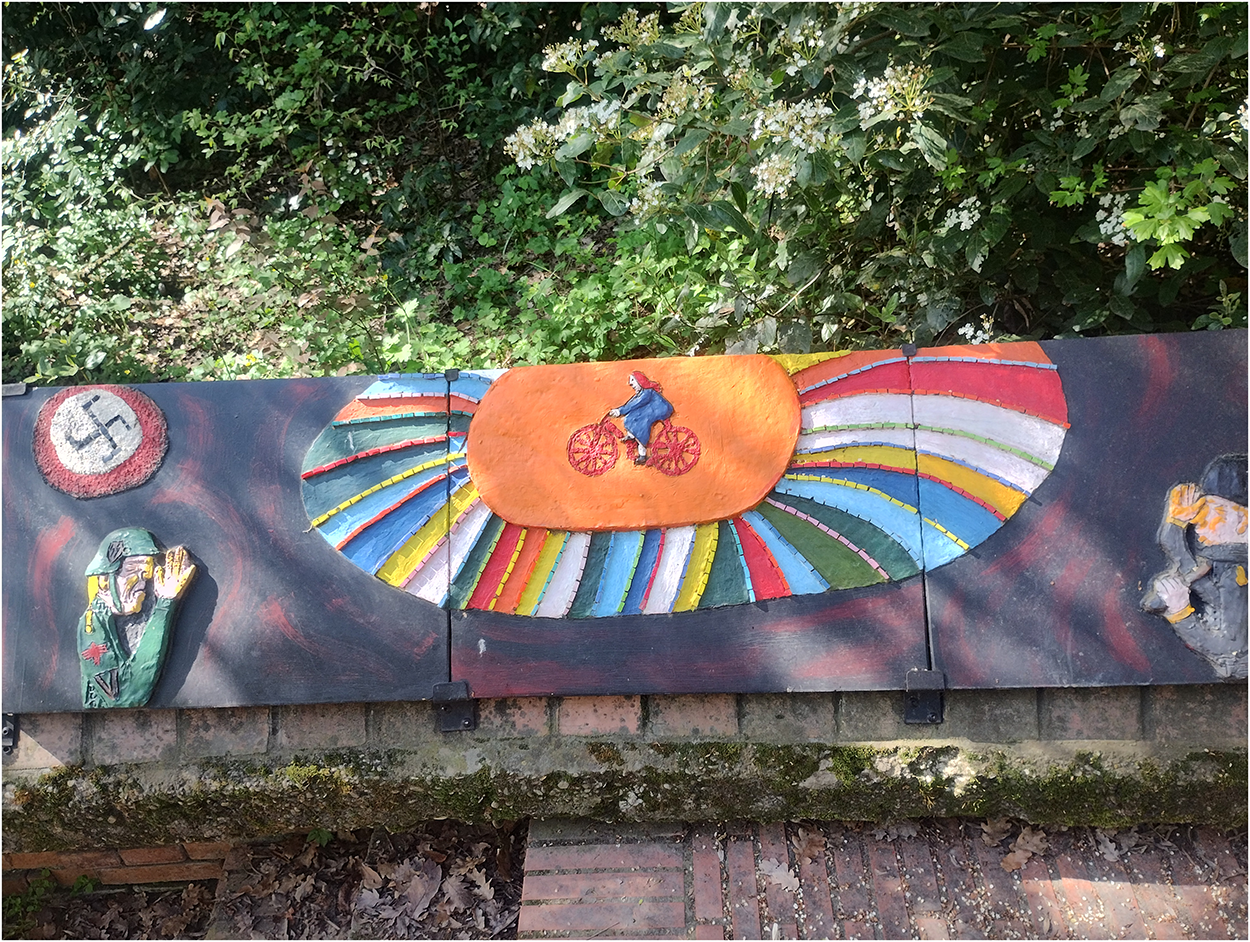
In June 1975, representatives from all branches of the ANPI in the province, the living relatives of the 128 women and former partisans themselves participated in the inauguaration of the monument.Footnote 19 There is no record that determines whether the theatre stage built in the monument was used in this instance. What it certain, however, is that as an example of participatory architecture, it continues to evolve and to be a place of education: despite the ground around the monument being now unkempt and wild, and the wall in places marred by graffiti, the monument attracted the exhibition of further student art on the 50th anniversary of the Liberation in 1995 (Figure 5). In 2015, the local elementary schoolchildren created a mosaic to add on to the end of the wall (Figure 6). Graffiti depicting women riding bycicles with red handkerchiefs around their necks and the names of some of the partisan women adorn the building that houses the neighbourhood library (the L-shaped building in between A and B in the map, Figure 3) and the wall now boasts a QR code next to every name on the wall, so that every visitor can learn the history of its protagonists.
Section of the Monumento alle 128 partigiane cadute, Villa Spada, Bologna.

2015 addition to the Monumento alle 128 partigiane cadute, Villa Spada, Bologna.

Conclusion
In 2013, six artists based in Bologna created the CHEAP Collective. This all-woman collective began by organising regular local festivals where artists showcased their talent. In 2017, they began focusing on street art. CHEAP Collective ditched the regularity of planned festivals and the ‘traditional’ art medium of paper and canvas, in favour of spontaneous, irregular muralism and graffiti art on the city walls of Bologna. On 25 April 2017, CHEAP Collective collaborated with Milan-based artist duo Orticanoodles to create a mural of Irma Bandiera, referring back to the most famous picture of her, in an attempt to ‘utilise a contemporary language to celebrate antifascism, intervening on the urban landscape to add another element to the collective mechanism that is memory’ (CHEAP Collective 2017). Within the legislated city of Bologna, then, the usage of street art and muralism reinforces the antifascist identity of the city: the choice of location – the elementary school ‘Bombizzi’ – places this memory immediately within the community while also amplifying its usage as an educational tool. In the past two decades, there has been a growing trend called odonomastic guerrilla warfare: grassroot interventions in street naming aimed at reshaping local history and memory. From Argentina to Spain to Italy, collectives like CHEAP and Resistenza Cirenaica, active in the Bolognese Cirenaica neighbourhood, work to redefine the city’s identity and historical memory, rooted in antifascism, antiracism and feminism (‘Guerriglia Odonomastica’, 2018).
In terms of representation, Irma Bandiera stands out amongst the women of the Resistance as the one who was most often commemorated, whose story was retold and reimagined to further political action. In the field of memory, Bandiera – and to a certain extent the city of Bologna – are the exception to the rule that compartmentalised the memory of male and female partisans in the local topography through the naming of streets and plaques. This article has shown how Irma Bandiera’s memory was politicised and instrumentalised throughout the 1940s and 1950s by both the Italian Communist Party and the UDI and, especially in Bologna, how this embedded her firmly within the local public discourse of antifascist identity. The creations of these narratives, as well as their re-emergence in response to national and international events, such as the beginning of the Cold War and the campaigns for peace led by the UDI, reverberated within the architectural and monumental landscape of the city and were used, periodically, as a tool to counteract postwar anticommunist propaganda.
While the memory of the antifascist Resistance has always been, by nature, political in conception and in message, this article has shown how, in Bologna, it has been a fundamental cornerstone built on and utilised by the community itself. Due to the history of the city and of the region as a centre of socialist and communist thought and due to the longstanding traditions of class struggle, the city of Bologna has commemorated the dead of the antifascist Resistance from the moment of the Liberation, as the Sacrario attests. This first example of grassroots commemoration became a permanent installation ten years later, in 1955, at the same time as the projects for a commemorative monument in the city cemetery were being approved. As this article has shown, the two monuments discussed here have a completely different history and purpose, reflecting the different memorial needs they were fulfilling. Enclosed within the walls of the Certosa, the Monumento Ossario, inaugurated in 1964, places the dead and the living side by side, but its location reinforces a static commemoration of the Resistance. While women are included, the monument is designed to inspire awe and respect rather than encourage engagement. By contrast, the Monumento alle 128 partigiane cadute of 1975 is the only example of participatory architecture, putting at its core dialogue from its very inception: dialogue between stakeholders interested in the perpetuation of this memory, across generations. As an educational experience, this monument is ever-changing, with additions made to its original artwork, by teenagers and children alike, working within the scope of ANPI-backed initiatives to bring the legacy of the Resistance out of textbooks and into a community.
Acknowledgements
I am indebted to the team at the Archivio Storico Comunale di Bologna, who granted me permission to reproduce Bottoni’s sketch (PG.N. 49176/2025 on 27/01/2025) and Dr Gabriele Amadori, who helped me navigate the archive; to Dr. Benedetto Fragnelli at the Archivio dell’Unione Donne Italiane in Bologna and the team at the Archivio di Stato di Perugia. Finally, I need to thank both my supervisors, Professor Daniela La Penna and Professor Claire Gorrara, for their overarching support over the past four years and the several rounds of feedback and revisions they kindly provided as I was preparing this article for publication; and the two peer reviewers for their insightful commentary and very helpful suggestions.
Funding statement
This research was made possible by the Arts and Humanities Research Council (AHRC) through the South, West and Wales Doctoral Training Partnership, which enabled me to travel to Italy for archival research and to Lima to present a first version of this paper at the Memory Studies Association Conference in July 2024.
Competing interests
The author declares none.
Martina Biavati is a PhD candidate at the Universities of Reading and Cardiff. Her PhD project is a comparative study of Italian and French Communist women, their experience of the Resistance and their lives in postwar Italy and France.

 Open access

