


Introduction
Over the past five years, hundreds of thousands of people across Europe have taken to the streets to call for tougher measures against climate change. The EU has put forward and started concretising its “man on the moon” moment for climate change – the European Green Deal – and has been labelled a leader in climate policy. But these policies are often neither as ambitious as some civil society organisations would like, nor as cost-efficient as some economic interest groups would prefer. Several important academic studies have engaged with advocacy on EU climate policy, mostly qualitatively analysing single or small-n comparative case studies (see for instance Gullberg Reference Gullberg2008; Bocse Reference Bocse2021; Thomas Reference Thomas2021). Yet, due to scant quantitative research on lobbying on climate policy in the EU, we still know relatively little about which systematic patterns characterise interest group mobilisation and success in EU climate policy across policy issues and types of groups. This paper addresses this gap by examining which groups lobby for and against stricter climate policies in the EU, and when these organisations achieve their objectives.
Although popular debates and earlier academic research often portrayed “big business” as a key force standing in the way of climate and environmental policy (Greenwood Reference Greenwood2003; Gullberg Reference Gullberg2008; Skovgaard Reference Skovgaard2014; Delreux and Happaerts Reference Delreux and Happaerts2016), research has largely moved past this idea. Business groups and public interest organisations often lobby for the same cause, and business groups often actually lobby against each other (Wonka et al. Reference Wonka, De Bruycker, De Bièvre, Braun and Beyers2018), with policy positions split according to the economic benefits or losses expected from the proposed regulation (Vormedal Reference Vormedal2008; Kim et al. Reference Kim, Urpelainen and Yang2016; Brulle Reference Brulle2018). Current explanations for lobbying success often base themselves on the resources that a group controls, highlighting the strategic advantage that resourceful groups can have in developing strategies, forming networks, and providing expertise (Vormedal Reference Vormedal2008; Böhmelt Reference Böhmelt2013). Yet, in light of the highly politicised nature of climate policy and the importance of the issue in domestic electoral arenas, we cannot ignore the role of public opinion in understanding interest group mobilisation and success. We therefore propose that while an interest group’s economic affluence matters, so does its congruence with public opinion. An interest group’s lack of economic resources may be counterbalanced by high levels of congruence with public opinion on a subject. Whether or not a group’s position aligns with public opinion fundamentally changes its likelihood of successfully achieving its goals. Such a relationship has been found in the literature on congruence (Rasmussen et al. Reference Rasmussen, Mäder and Reher2018), but might be particularly important in a field such as climate policy, which has seen a sharp increase in public attention and mobilisation in recent years.
This paper therefore examines when interest organisations lobbying on EU climate policy successfully achieve their policy goals. We take a resource dependency approach to focus on the economic and political resources that interest organisations can provide to climate policymakers. Empirically, the paper analyses six policy issues taken from Eurobarometer polls. For each issue, we identify the stakeholders that sought to influence policy decisions, the economic resources that they control, and the political context. We find that both factors are important: groups with higher economic resources and those that take positions aligned with public opinion are more successful in their lobbying. Yet the effects of economic resources seem to be constrained by high or low levels of congruence: economic resources help a group to leverage public opinion, but only up to a certain point.
Our focus on the EU and its comparatively consensual decisionmaking system (Mahoney Reference Mahoney2007) may imply that the findings cannot be readily generalisable to climate policies in other legislatures. On the one hand, EU policy is often highly technical and complex, requiring specialised expertise, well-networked professionals and ideally a permanent presence in Brussels to navigate its intricate institutional framework (Berkhout and Lowery Reference Berkhout and Lowery2010). On the other hand, the EU seems an unlikely setting for congruence to have an impact on lobbying success. EU policies are often seen as disconnected from citizens’ daily lives, and some argue that national politicians even use the EU to depoliticise and circumvent national electorates (Moravcsik Reference Moravcsik1998; Føllesdal and Hix Reference Føllesdal and Hix2006). Hence, the EU serves as a valuable case to test both the unlikely impact of congruence and the likely impact of affluence on lobbying success.
The findings of this paper contribute to the academic literature on when and why interest organisations are successful in policymaking. Moreover, the paper’s focus on EU climate policy allows us to draw more fine-grained and policy-specific conclusions. Knowing the positions that interest organisations take on climate policies and how successful they are is an important step to understanding and predicting policies’ success and failure, potentially avoiding policy deadlock. This is not only a matter of environmental sustainability, but also one of democratic responsiveness: over 90% of EU citizens believe climate change is a serious problem and over 55% think that the responsibility for tackling it lies with business and industry (European Commission 2021). Understanding who lobbies on climate change, whether and when they are successful and the role of public opinion therein is key to ensuring efficient climate policy solutions in the future.
Lobbying on environmental and climate policy
Studies of lobbying have focused on a range of policy areas, including environmental and climate policy, which is a particularly interesting case for a few reasons. First, as highlighted above, environmental regulations often pit the common good of biodiversity, clean air, and the planetary future against increased costs for certain sectors and businesses, leading to diverse lobbying positions (Vesa et al. Reference Vesa, Gronow and Ylä-Anttila2020). Second, climate change is a complex problem, and policy decisions require scientific expertise and a knowledge of the impacts of potential regulations, leading to the inclusion of societal groups in the policy process. Finally, climate policy has recently risen in salience, as scientists and movements alike have underlined the urgency of tackling the climate crisis. Along with the large number of well-resourced environmental NGOs working in the EU (Delreux and Happaerts Reference Delreux and Happaerts2016, 130–134), this makes it a fertile ground for studying mobilisation and lobbying – particularly in relation to public opinion.
Early studies of lobbying on climate policy often studied groups by type, pitting environmental NGOs against business groups. Yet, recent findings clearly show that policy preferences and positions rather follow the distribution of costs and benefits of regulation. In the USA, studies have found that businesses’ preferences often tend to be split along the lines of “winners” and “losers” of potential regulation (Vormedal Reference Vormedal2008; Kim et al. Reference Kim, Urpelainen and Yang2016; Brulle Reference Brulle2018). This implies that industry is not automatically against environmental regulation, but that a subset of particularly affected businesses lobby against more stringent environmental protection. Similar findings apply to businesses in Finland (Vesa et al. Reference Vesa, Gronow and Ylä-Anttila2020) and transnational corporations (Witte Reference Witte2020): corporations in sectors dependent on fossil fuels are more likely to counter climate measures. In the EU, lobbying against 2030 targets mostly came from energy-intensive industries such as oil and gas producers, while associations representing renewable energies were in favour of stricter targets (Fagan-Watson et al. Reference Fagan-Watson, Elliot and Watson2015; Fuchs and Feldhoff Reference Fuchs and Feldhoff2016). And even those companies that are opposed to climate change measures are unlikely to directly oppose them: in the EU, for instance, most business groups take a “hedging” stance, aiming to water down regulations or alter them to reduce the costs on their industries, rather than simply opposing them (Meckling Reference Meckling2015). This false dichotomy between NGOs and business groups may also arise when discussing financial affluence and lobbying strategies: although it is often assumed that NGOs are financially deprived and will therefore use more “outside,” public-facing strategies, group type was found to be irrelevant for group strategies in the EU for environmental issues (Junk Reference Junk2016). So what factors do determine the success of groups lobbying on climate policy?
Few studies examining climate policy lobbying specifically look at lobbying success or influence, and those that do focus mostly on groups’ resources. Business groups are more successful when lobbying national representations in the context of international negotiations, presumably because their higher resources help them provide better policy advice and expertise (Vormedal Reference Vormedal2008; Böhmelt Reference Böhmelt2013). In the EU, business groups’ higher levels of resources provide them with more access to (and opportunities to influence) policymaking institutions (Coen Reference Coen, Levy and Newell2005; Bunea Reference Bunea2013; Fuchs and Feldhoff Reference Fuchs and Feldhoff2016; Bocse Reference Bocse2021). A couple of studies have added insight into the role of advocacy coalitions (Vesa et al. Reference Vesa, Gronow and Ylä-Anttila2020; Bocse Reference Bocse2021); groups playing key roles in advocacy coalitions are more likely to succeed. Finally, issue conditions such as whether groups support or oppose the status quo and issue salience have been hypothesised to play a role in lobbying success, but with little empirical support in the field of climate and environmental policy (Böhmelt Reference Böhmelt2013; Bunea Reference Bunea2013; but see Lucas Reference Lucas2019).
While the literature on climate and environmental advocacy has actively engaged with the broader interest group literature, the recent focus on public opinion and congruence in interest group research has not yet shifted to these policy fields. One of the main arguments of interest group studies focusing on congruence is that interest groups can serve as key intermediaries between policymakers and the broader public (De Bruycker Reference De Bruycker2020; Klüver and Pickup Reference Klüver and Pickup2019; Rasmussen and Reher Reference Rasmussen and Reher2019). Interest groups representing large segments of society or whose policy positions converge with majority opinion are more easily identified by policymakers as credible and valuable interlocutors and therefore more likely to see their policy goals achieved (Rasmussen et al. Reference Rasmussen, Mäder and Reher2018). This is especially true for salient or politicised issues (De Bruycker Reference De Bruycker2020; Willems Reference Willems2020). This focus on the role of public opinion seems especially promising in the field of climate policy, as it has seen increased public attention and politicisation in recent years. This paper advances the literature on climate change advocacy and success by integrating this representational perspective into a classic resource dependency framework, which is outlined in the following section.
Resource dependencies and climate policy
Resource dependency theory highlights organisations’ dependence on resources from their external environment to survive and execute their core activities (Pfeffer and Salancik Reference Pfeffer and Salancik1978). In lobbying studies, this dependence is highlighted in resource exchange approaches, which emphasise policymakers’ need for technical and political expertise to design policies that are effective and feasible, and their dependence on external organisations – including interest groups – for much of this information (Bouwen Reference Bouwen2004; Braun Reference Braun2012; Flöthe Reference Flöthe2019). Interest groups provide expert information to help policymakers assess the consequences of an intended policy measure and develop policy solution; in return, they hope to see their own policy goals advanced (Gullberg Reference Gullberg2008, 162; Bernhagen Reference Bernhagen2013). Climate policy is no exception: the complex nature of many climate change issues requires technical input from interest groups (Vormedal Reference Vormedal2008; Delbeke and Vis Reference Delbeke and Vis2015). As a result of this mutual dependence, interest groups compete to provide the most reliable and relevant information to maximise their chances of lobbying success (Klüver Reference Klüver2013), which we define as the degree to which interest groups achieve their policy goals (Mahoney Reference Mahoney2007; Klüver Reference Klüver2011).
In line with previous research (Flöthe Reference Flöthe2019), we argue that both economic and political resources affect lobbying success. Economic resources are the financial means that an organisation can spend on lobbying, allowing it to employ more staff and gather more expertise to influence policy on a particular issue (Flöthe Reference Flöthe2019, 161). Political resources, on the other hand, are an organisation’s ability to represent a wide constituency and mediate between social interests and policymakers (Flöthe Reference Flöthe2019, 162). These are less tangible than economic resources and refer to the political support and leverage that interest groups can mobilise (De Bruycker Reference De Bruycker2016).
Existing research shows that financial and economic resources contribute significantly to groups’ ability to provide useful information to policymakers (Bernhagen Reference Bernhagen2013; Flöthe Reference Flöthe2019). Resourceful interest organisations are more professionalised and therefore more capable of providing policymakers with the required policy information (Dür et al. Reference Dür, Bernhagen and Marshall2015). The more economic resources that a group has, the more time, energy and specialised staff it can dedicate to conducting research, monitoring policies, designing potential solutions and communicating this information to the relevant decisionmakers. Economic resources allow lobby groups to hire seasoned, high-quality lobbyists, spend more time on lobbying and lobby a more diverse set of policy venues (Mckay Reference McKay2012, 920). Moreover, political influence is often a long-term, iterative, and incremental process which requires persistence and continuing investments over time (Lowery Reference Lowery2013, 13), a luxury that mostly affluent organisations can afford. Based on the assumptions that offering relevant expertise can enhance lobbying success and that this relevant expertise is mostly offered by resourceful organisations, we propose the following hypothesis:
Hypothesis 1: Interest groups with more economic resources are more likely to achieve lobbying success in EU climate policy.
Yet, climate policies must not only be technically sound and impactful but should also enjoy support from public opinion. Well-worn examples such as the gilets jaunes in France highlight the risk of pushing through climate policies without public input or approval. In the EU context, decisionmakers seek to secure public support to avoid legitimacy loss (in the European Commission) or electoral retribution (in the European Parliament and the Council) (Braun Reference Braun2012). While EU public policy is often characterised as being technocratic and distant from most citizens’ everyday experiences (Føllesdal and Hix Reference Føllesdal and Hix2006; Rauh Reference Rauh2022), recent studies have shown that EU policies can be politicised and draw attention from a wide range of citizens, stakeholders and the media (Rauh Reference Rauh2019). Under such circumstances, the risks to decisionmakers’ legitimacy or standing are higher. This is especially true for EU climate policy, which is increasingly politicised and subject to competing frames by protest movements and the news media (Skovgaard Reference Skovgaard2014).
Organisational type has often been used as a proxy for political resources, the idea being that NGOs, social movements or citizen groups speak on behalf of a broad, “diffuse” constituency and hence enjoy stronger political backing (Bernauer and Gampfer Reference Bernauer and Gampfer2013; Delreux and Happaerts Reference Delreux and Happaerts2016; Hanegraaff and Pritoni Reference Hanegraaff and Pritoni2019). Yet, organisational types encompass diverse groups, and recent studies have shown that the capacity to offer political support goes beyond organisational type alone (Willems Reference Willems2020). We therefore examine congruence – the extent to which a group’s position on an issue aligns with public opinion – as a political resource. The link between congruence and success relies on groups’ role as public-elite intermediaries that transmit the opinion of their members and constituencies to policymakers (Klüver and Pickup Reference Klüver and Pickup2019; Bevan and Rasmussen Reference Bevan and Rasmussen2020). Groups representing a broadly endorsed position are more attractive partners to strengthen decisionmakers’ political credibility. Indeed, recent research shows that groups whose position resonates with public opinion are more likely to achieve their policy goals (Rasmussen et al. Reference Rasmussen, Mäder and Reher2018, De Bruycker and Beyers Reference De Bruycker and Beyers2019). However, others have found that this success may depend on policy positions supporting the status quo (Rasmussen et al. Reference Rasmussen, Binderkrantz and Klüver2021) or the stage of the policy cycle (Willems and Beyers Reference Willems and Beyers2023).
In contrast to research that conceptualises political resources as active resources, for example, groups’ ability to signal their constituencies’ interests (Bouwen Reference Bouwen2002; Braun Reference Braun2012; De Bruycker Reference De Bruycker2016; Flöthe Reference Flöthe2019), we follow the literature on congruence with public opinion that sees this more as a “passive” resource: a resource that groups benefit from, but without specifically controlling. The literature on congruence does not require groups to signal this congruence to policymakers; it is enough that the positions that they communicate to policymakers align with public opinion (Rasmussen et al. Reference Rasmussen, Mäder and Reher2018; Willems and Beyers Reference Willems and Beyers2023). Previous research has also highlighted that individual groups do not have much power over salience or public opinion (Dür and Mateo Reference Dür and Mateo2014). Rather, interest groups defending a majority opinion are identified by policymakers as credible intermediaries (De Bruycker and Rasmussen Reference De Bruycker and Rasmussen2021). This may especially be the case for issues where policymakers are already aware of public opinion, for instance, where they have commissioned opinion polls such as the EU’s Eurobarometer. In such cases, policy institutions may react to public opinion rather than to interest groups, and the interest groups that find themselves on the same side as the majority are therefore more likely to achieve their preference.
Hypothesis 2: Interest groups whose positions align with public opinion on an issue are more likely to achieve their policy goals.
As we conceptualise congruence and economic resources as two types of resources that contribute to groups’ advocacy success, we also examine the extent to which they are substitutable: in other words, to what extent a group can compensate for a lack of congruence with economic resources (or vice versa). Since we argue that policymakers need political support and technical information, we expect that interest groups that possess both types of resources will be more likely to achieve their preferences. Previous studies have showed that different types of policymakers exhibit different sensitivities to political support and technical expertise: members of the European Parliament are more open to political pressures, while executives and civil servants are in need of technical expertise (Bouwen Reference Bouwen2004; De Bruycker Reference De Bruycker2016). Hence, across the EU policy process, where typically all three institutions (the European Commission, European Parliament and Council) are involved, interest groups will require both economic and political resources to meet different policymakers’ needs.
Moreover, while we argue that congruence is mostly a passive resource, groups with economic resources may also be able to activate public opinion by signalling public support to policymakers. Indeed, an interest group will not be able to actively leverage the public approval of its positions if it lacks the economic capacity to develop and communicate its expertise through costly outside lobbying campaigns (Danielian and Page Reference Danielian and Page1994; Thrall Reference Thrall2006). Since policymakers seek both technical expertise and legitimacy, they are likely to prioritise groups that possess both. We therefore expect the effects of economic and political resources on preference attainment to be conditional, rather than independent from one another. Examining their combined effects also allows us to better distinguish between interest groups that actively or passively benefit from high levels of congruence, and to discern whether interest groups can reap the benefits of their economic resources irrespective of public opinion, or whether certain levels of public approval are required to ensure lobbying success.
Hypothesis 3: Interest groups with both higher levels of congruence and more economic resources are more likely to attain their policy preferences.
Research design
The dataset used for the empirical analyses is part of a larger project which studies the relationships between interest groups, elites, and public opinion in the European Union. The starting point for this project is a sample of 41 issues that were the subject of Eurobarometer polls between 1 January 2012 and 31 December 2014. In this study, an issue is operationalised as a specific policy topic for which the EU is at least partially competent and where citizens in all EU member states were surveyed. All the issues deal with specific proposed policy measures or objectives for which it was possible to identify from responses a position in favour of policy change (stronger regulation) and a position against policy change (opposing stronger regulation). This research design builds on insights from previous policy-centred research projects founded upon concrete policy issues where public opinion polls were conducted (Rasmussen et al. Reference Rasmussen, Mäder and Reher2018; Wratil Reference Wratil2019). Given the focus of this paper, only the issues which unambiguously fall within the scope of EU climate policy were retained. This resulted in a sample of six issues, as shown in Figure 1. As with any research at the level of policy issues, these issues are interrelated; however, each issue has a different substantial focus and scope. Where it was impossible to separate lobbying strategies and influence on issues, these were combined (as for instance was the case with biodiversity, ID22; see annex (section 1)).
Overview of issues in sample.

The sampled issues vary in terms of the substantive topics addressed, the media attention they attracted and the number of interest groups that mobilised. A two-pronged approach was taken to identify relevant interest groups. First, a content analysis of 236 news media articles was conducted for the issues in the sample in eight European media outlets.Footnote 1 The relevant media coverage between 1 January 2010 and 31 December 2016 related to the sampled set of cases was assembled manually through detailed keyword searches. All the archived media articles were coded by identifying the relevant statements made by political elites. Statements are quotes or paraphrases that can be attributed to a specific actor; these were coded for their relevance to the issue and the positions adopted in favour or against a policy measure. The content analysis allowed us to identify relevant interest groups active in EU climate policy. In total, 103 groups and 277 media statements were identified based on the media analysis. A descriptive overview of the positions of the different political actors is available in the annex (section 2).
Alongside this media content analysis, a survey was conducted with policy experts from interest groups that were active on the sampled issues. The survey was executed for the larger set of 41 issues, to which 183 experts replied. The survey has a response rate of 30%, which is comparable to previous surveys targeting interest group experts (Crepaz and Hanegraaff Reference Crepaz and Hanegraaff2020). For the six issues related to EU climate policy, 17 expert responses were collected. Experts were asked to mention relevant interest groups that came to mind which were active on the policy issue in question. This led to the identification of 54 additional organisations, which had not yet been identified in the news media analysis. In total, we identified 157 interest groups active on our sampled set of policy issues: 57% business interests (professional associations, business umbrella groups, and firms) and 43% civil society organisations (NGOs and social movement organisations).Footnote 2
To measure our dependent variable – lobbying success – we rely on preference attainment. We compare the positions of interest groups with the final EU policy measures taken on the policy issue between 2011 and 2017 (see also Rasmussen et al. Reference Rasmussen, Mäder and Reher2018, 150). Only treaty changes, binding agreements, directives, and regulations were treated as policy responses. To assess whether the EU adopted policies on an issue, desk research was conducted by searching the Eur-Lex database, examining the websites of European institutions and by asking policy experts in the survey whether relevant policy responses were adopted. For five out of the six sampled issues, relevant directives or regulations were identified (only shale gas (ID24) had no binding policy measures). If policy measures were taken on the issue and an interest group was in favour of stricter climate policy regulation, the group was considered to have achieved its preferences. If no EU climate policy measures were taken in the considered period, groups that opposed policy change on the issue are considered to have achieved their preferences. For instance, for national emissions ceilings (ID5), the National Emission Ceilings Directive (2016/2284) sets stricter limits on climate pollutants in Europe. Groups in favour of stricter climate measures on this issue were then coded to have achieved their preferences, while groups against stricter policies on this issue were coded to not have achieved their preferences. For groups with an unclear position (n = 48; 31%), preference attainment could not be determined. The preference attainment variable indicates that 87 (56%) groups achieved their preferences, while 22 (14%) did not.
While preference attainment is a widespread method for measuring lobbying success in large- and medium-n studies, it is obviously not without drawbacks (Dür Reference Dür2008). Preference attainment cannot be seen as equal to influence, as groups may achieve their preferences due to sheer luck or coincidence. Yet, unraveling broad patterns between interest group characteristics and preference attainment enables an assessment of the conditions under which different stakeholders win or lose policy battles (Mahoney Reference Mahoney2007; Baumgartner et al. Reference Baumgartner, Berry, Hojnacki, Leech and Kimball2009). Acknowledging the empirical challenges of preference attainment as a success measure, we present the analysis with a measure of perceived influence based on experts’ identification of influential groups on the issue as a robustness check in the online annex (section 5). Our relatively black-and-white measure of preference attainment means that we cannot assess hedging strategies, whereby groups do not directly oppose or support a policy but provide more nuanced positions to weaken regulation (Meckling Reference Meckling2015), or strategic positioning, where groups take one position in the public eye yet lobby in the other direction behind the scenes. Yet, it also has the advantage of reducing the risk of inconsistencies in the framing of groups’ positions, for instance, by different media outlets. We provide the list of groups for whom no policy position could be ascertained in the annex and present robustness checks in which we assume that these groups were in fact advocating against stricter climate measures behind the scenes (section 7).
Our first independent variable, economic resources (H1), is operationalised as the “the amount of money spent on lobbying,” annual costs on lobbying activities as indicated in the European Transparency Register. Although the register has faced severe reliability issues since its conception (Greenwood and Dreger Reference Greenwood and Dreger2013), in recent years it is becoming more consistent and the incentives for interest groups to offer accurate information have significantly increased due to intense monitoring by news media and NGOs. To allow for an intuitive interpretation and robust estimation of the interaction effects, we recoded this variable in three proportional categories (Hainmueller et al. Reference Hainmueller, Mummolo and Xu2019). The lowest category applies to interest groups that spent up to €100,000 annually on lobbying activities (24%). The middle category captures groups spending between €100,000 and €1 million (49%), and the highest category labels groups that spent more than €1 million (28%). This information was coded in the spring of 2018, before the survey project was concluded, and applies to the financial year 2017, which is the final year that we considered for policy responses as part of our preference attainment measure.Footnote 3 In the annex (sections 6 and 8), we present robustness checks with alternative operationalisations for financial resources, looking at (1) the number of FTEs employed in the Brussels office and (2) changes in the annual budget between 2012 and 2017.
Our second key independent variable – the congruence of an interest group with European public opinion (H2) – was measured in two steps. First, interest groups’ positions were identified by cross-validating the media content analysis and expert survey responses. In case of inconsistency (when the position in the media was unclear), priority was given to the survey responses. Across all issues, this resulted in a total of 88 groups (55%) supporting policy action, 21 groups (13%) opposing policy change and 48 groups (31%) with an unclear position. The relatively large number of groups with an unclear position is mostly because it was not always possible to code the position of interest groups based on media statements, and we did not attribute a position to an interest group in cases of doubt. In the second step, we matched the position of interest groups with the relative share of European citizens adopting a similar position in favour of or against policy change as reported in the Eurobarometer surveys (see also Flöthe and Rasmussen Reference Flöthe and Rasmussen2019). For instance, on the issue of Air Quality Standards (ID12), the position of the agricultural lobby group COPA-COGECA matches with 28% of European citizens, while environmental organisation Friends of the Earth Europe has a congruence measure of 58%.Footnote 4
We also include some control variables in the analysis. First, media salience was measured by counting the number of media articles that covered the sampled issues. This variable was log-transformed to linearise its relationship with the dependent variable. Second, as mentioned in the theoretical section, group type is often conflated with economic resources and public support. Therefore, we include a control variable for whether the interest group in question is a specific business association, an encompassing business association, a firm or a civil society organisation (citizen action group, NGO or social movement organisation). We define encompassing business organisations as business umbrella groups with a wide, cross-sectoral constituency.Footnote 5
Third, we control for whether an interest group was present in news media debates, as this taps into the difference between groups using public lobbying strategies and groups lobbying behind the scenes (Junk Reference Junk2016). Fourth, we control for whether the interest group represents a national, EU or international constituency. EU-level organisations can be expected to be more specialised in EU policies, benefit from the support of a broader network of membership groups in the national capitals and are also more likely to be the beneficiaries of EU subsidies (Mahoney and Beckstrand Reference Mahoney and Beckstrand2011; Persson and Edholm Reference Persson and Edholm2018). Hence, these groups can be expected to achieve their policy goals more easily (see also Bunea Reference Bunea2013). Fifth, we control for interest groups’ positions in favour or against stricter policy action on a given issue, as positions are known to affect preference attainment (Baumgartner et al. Reference Baumgartner, Berry, Hojnacki, Leech and Kimball2009; Bunea Reference Bunea2013). We are aware that this may introduce endogeneity, but we include both variables in our models as we otherwise risk estimating the effects of position and not congruence. Our results remain stable when excluding position from the models. Sixth, we control for mobilisation density, to represent the amount of other like-minded (or competing) lobby groups that are active. We measured mobilisation density by counting the number of interest groups that were identified on a policy issue. This measure was also log-transformed to account for its strongly skewed distribution. Finally, we control for whether the interest group worked in a coalition, which is expected to increase interest group success in the dense lobbying environment of EU climate policy (Junk Reference Junk2019b; Klüver Reference Klüver2013). Data on coalition membership were gathered through the survey and cross-referenced with joint statements in the media analysis.
Results
Before turning to the explanatory analysis, we examine the positions of the identified interest groups on our sampled policy issues. Figure 2 indicates that civil society groups overwhelmingly support stronger policy action on climate change, together with a substantial part of the mobilised business community. While the business community is divided, most encompassing business groups oppose EU policy action. This may imply some division of labour where businesses ask their umbrella organisations to do their “dirty work” and defend unpopular positions – or that businesses let their umbrella organisation speak to indicate unity on the topic (Junk Reference Junk2019a; Chalmers Reference Chalmers2020). Differences can also be explained by looking at the issue level. On energy efficiency (ID40), the business community was almost unanimously in favour of policy action, while for other issues, such as greenhouse gas emission ceilings (ID5), relatively more business groups opposed policy change.
Positions of interest groups adopted vis-à-vis EU policy action for different group types.
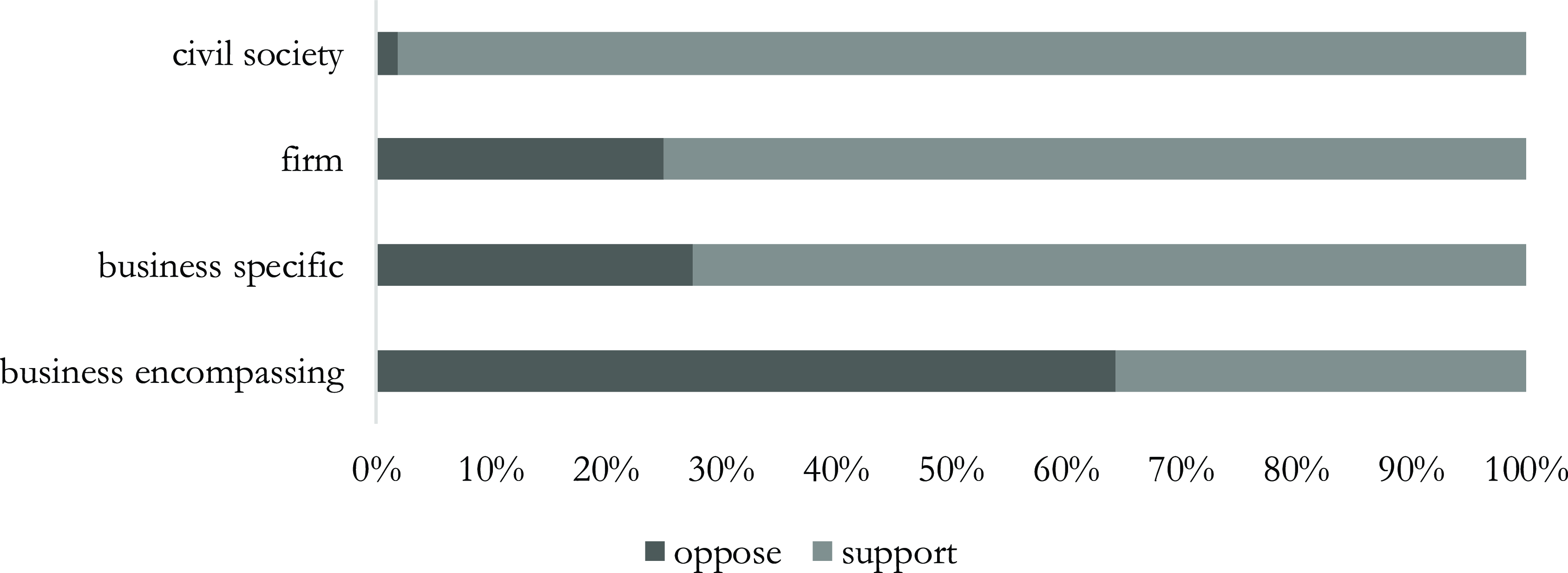
A more qualitative inspection of our dataset shows that the so-called “winners” and “losers” of more stringent climate change policies (Vormedal Reference Vormedal2008; Kim et al. Reference Kim, Urpelainen and Yang2016; Brulle Reference Brulle2018) almost perfectly overlap with positions adopted in favour or opposed to new climate policies. Industries that financially benefit from ambitious climate policies (producers of energy efficiency technologies, glass, home appliances, renewable energy, etc.) welcome new regulations. Those facing new restrictions and costs (agricultural, oil, and shale gas companies), by contrast, position themselves against almost all new climate policies. A third set of business groups (Eurochambers, BusinessEurope, and Eurogas) welcome or oppose regulations depending on the issue in question.
These descriptive results suggest that it is worthwhile looking beyond the business–civil society divide and to control for both group type and positions vis-à-vis policy action as potential confounding factors. In order to untangle the different aspects that are associated with lobbying success and due to the dichotomous nature of our dependent variable, we conduct a binary logistic regression. Since preference attainment could not be determined for all the interest groups in our sample (as some adopted an unclear position), we ran the regression with only those groups that adopted a position in favour or against policy action (n = 109). Excluding groups with an unclear position increases the baseline probability of lobbying success up to 78%, which is on the high side but not unusual considering other recent studies (e.g. Varone et al. Reference Varone, Eichenberger, Gava, Jourdain and Mach2021, 490–491), the wide support base for policy action on climate change and our rather low binary threshold for achieving preference attainment. Moreover, in the annex (section 7), we explore the option that interest groups with an unclear position were in fact opposing stricter climate measures. This robustness check reduces the baseline probability of preference attainment to 64%. Because our observations are nested in issues, we present coefficients with robust standard errors. The results of the regression are presented in Table 1.
Binary logistic regression of preference attainment

Robust standard errors in parentheses with significance levels indicated by †p < 0.10, *p < 0.05 and **p < 0.01.
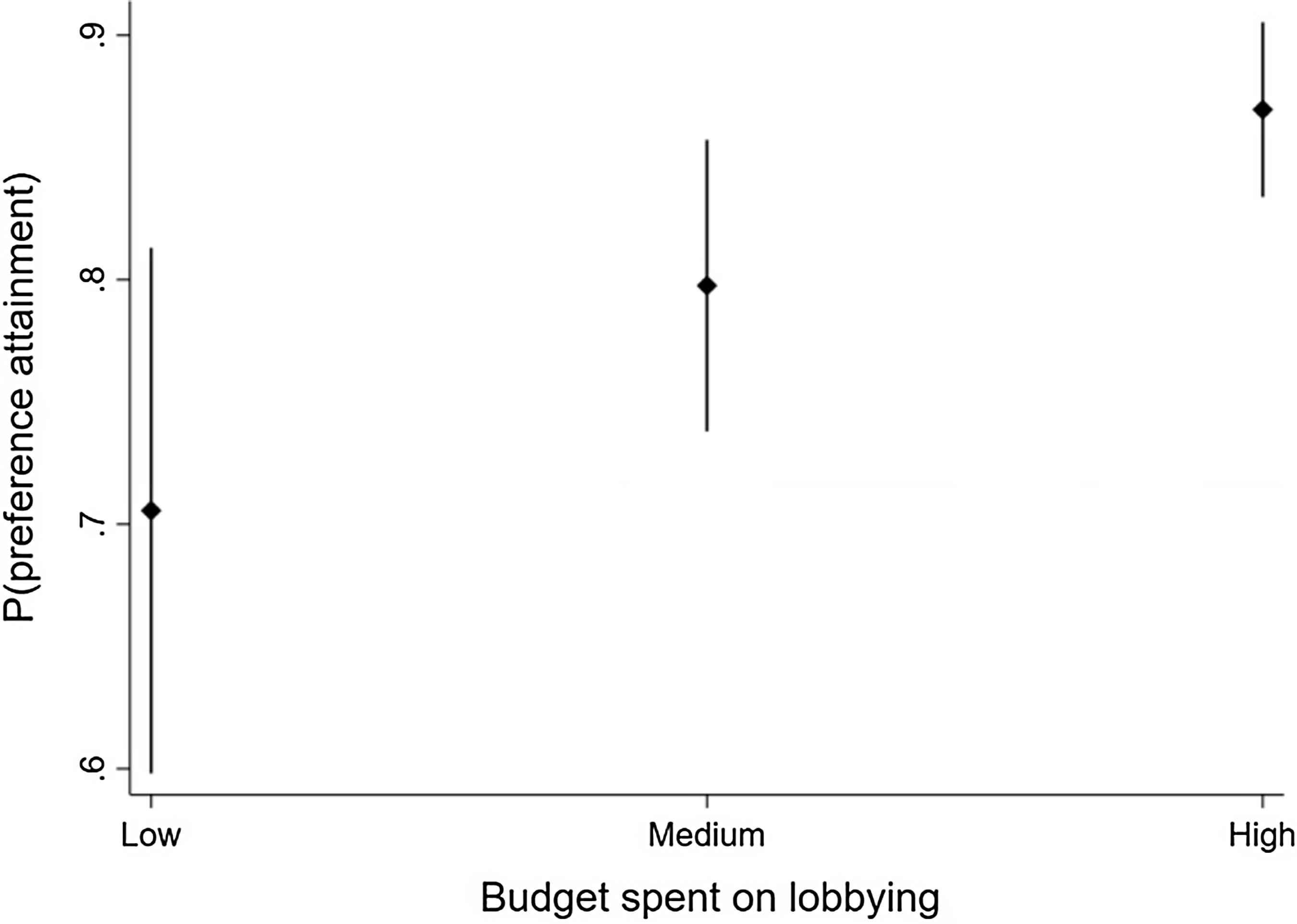
Our first hypothesis finds confirmation in the data. Model 1 shows that groups with higher economic resources are more likely to achieve their policy goals. As indicated in Figure 3, groups with a budget of €1 million or more have an 87% predicted probability to achieve their preferences, while this is only 71% for groups with a budget of €100,000 or less. This finding holds true when using our measure of perceived influence and the alternative measures of economic resources: increases in the budget over time or the number of FTEs employed in the Brussels office (see annex sections 5, 6, and 8). As indicated by the resource dependency perspective, economically resourceful groups are more likely to provide EU decisionmakers with valuable policy expertise and get favourable policy concessions in return. We can conclude that economic resources significantly aid interest groups to achieve their policy goals and to be perceived as more influential. But can political resources counterbalance economic inequalities?
Predictive margins of budget invested in lobbying.
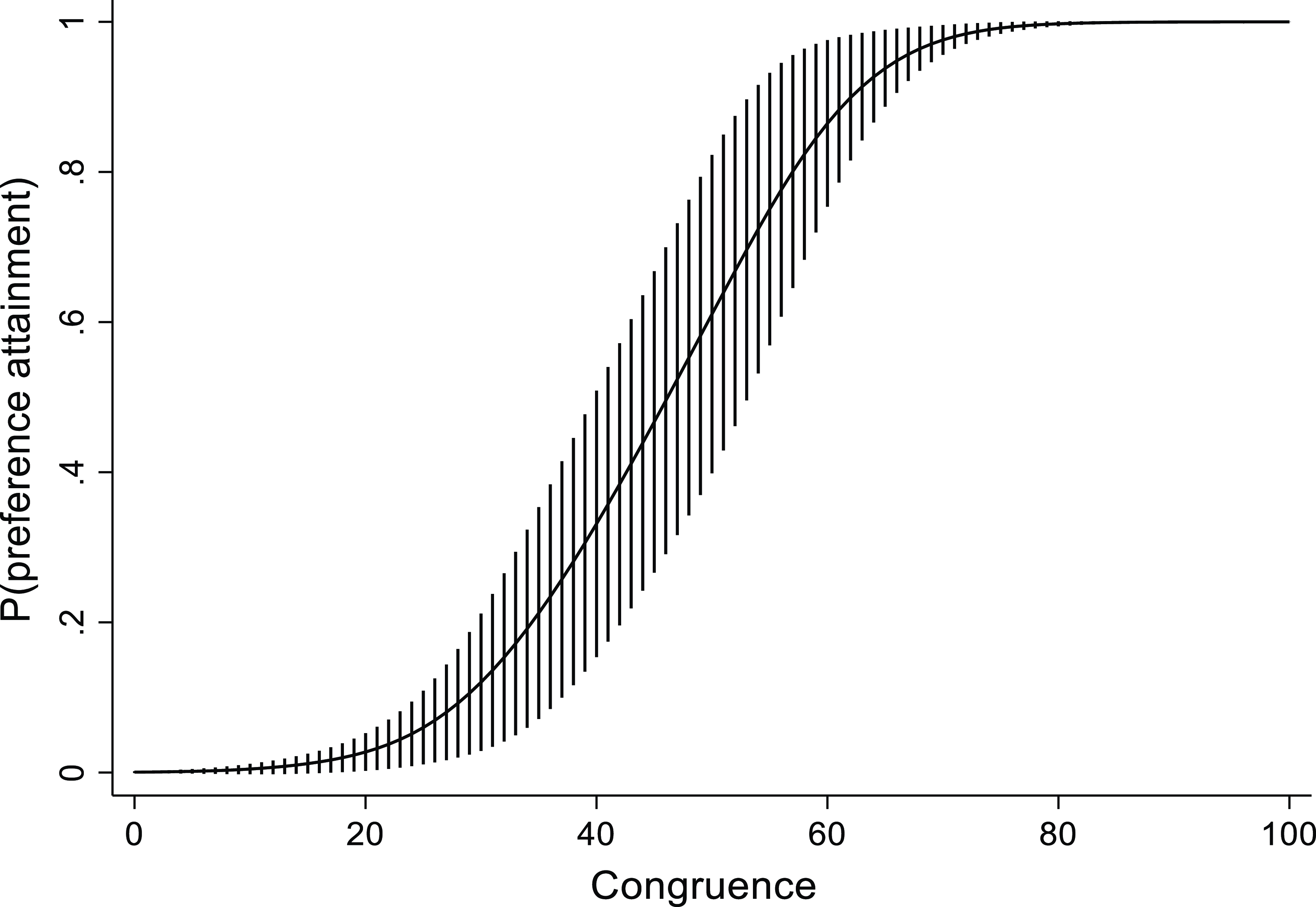
When turning to our second hypothesis regarding congruence with public opinion, the findings demonstrate that groups whose positions are more congruent with EU public opinion on policy issues are more likely to see their goals achieved. Figure 4 presents the predicted probabilities of preference attainment for different levels of congruence. Based on our model, an interest group which advocates a position which is endorsed by 40% of the European citizens has a probability of 34% (S.E. = 0.08) to attain its preference on an issue, while this probability is 85% (SE = 0.05) for groups backed by 60% of the European citizenry.
Predicted probabilities of preference attainment for different levels of public congruence.
Our conceptualisation of public opinion as a passive resource rather than an actively tradable currency also seems to find support in our analysis. The robustness check in the annex using perceived influence shows that interest groups that enjoy higher levels of congruence are not significantly more likely to be seen as influential on an issue by experts. While interest groups are more likely to achieve their goals when backed by a favourable public mood, this does not yet make them more “influential.” Achieving these goals seems to be a result of policymakers’ responsiveness to public opinion, rather than policymakers being triggered by an interference by the interest group in question. While preference attainment and reputational measures of success each come with their own flaws, the experts in our survey could arguably determine more precisely which interest groups attained their preferences because of strategic action rather than coincidence. Moreover, perception-based measures more effectively capture informal or less visible routes to lobbying success (Pedersen Reference Pedersen2013). The latter is important to understand the role of strategic positioning in EU climate lobbying: groups that may claim that their positions align with public opinion, but lobby differently behind the scenes. Such differences would be better captured in our reputational measure of success, which is not significantly affected by congruence – indicating that there may indeed be some strategic positioning of groups in our sample. While congruence is thus positively associated with preference attainment (confirming H2), this association is likely exogenous from interest groups’ behaviour, and rather results from policymakers’ inclination to listen to the public. In sum, congruence is rather a passive resource from which groups can benefit.
Model 2 incorporates an interactive term between congruence and financial resources to test whether and how congruence and financial resources conjointly affect interest group success (H3). While the coefficient of the interactive term is insignificant, we follow the advice of Brambor et al. (Reference Brambor, Clark and Golder2006) and interpret the marginal effects, presented in Figure 5. The marginal effects demonstrate a significant interaction effect of congruence and financial resources on preference attainment. Congruence with public opinion magnifies success for interest organisations with high economic resources, but only if congruence is between 40 and 72%. Hence, only for intermediary values on the congruence scale, interest groups can benefit from higher lobbying expenditures. When less than 40% of citizens agree with an interest group, even a higher lobbying budget does not help them achieve their policy preferences. Likewise, when at least 72% of citizens agree with an interest group’s stance, extensive lobbying expenditures seem to be redundant, since the interest group is already likely to achieve its objectives, even in the absence of high lobbying expenditures.
Marginal effects of budget invested in lobbying for different levels of congruence.

We observe similar results when considering our alternative measure of interest group success in the annex (see Figure A5). Affluent interest groups are only considered significantly more influential by the experts in our survey when they enjoy congruence levels between 40 and 80%. Hence, the constraining role of congruence on the effects of financial resources likely also holds for the success of interest groups’ behavioural interventions such as strategic positioning or inside lobbying strategies. These interaction effects were confirmed in robustness checks and hold when including groups with unclear positions and measuring staff numbers or resource change over time. It therefore seems that economic resources do allow interest organisations to leverage and “activate” the passive political resource of congruence with public opinion, but only up to a point. If the public is strongly for or against change, groups’ economic resources do not make a difference.
Our control variables also yield some interesting results. Our variables capturing issue characteristics, whether groups appear in the news media, and whether groups are EU-level federations are not significant in explaining variation in preference attainment. However, the regression shows that encompassing business interests are less likely to achieve their preferences when compared to civil society organisations. Clearly, business groups as a whole are thus not more likely to achieve their preferences in EU climate policies when compared to civil society organisations (see also Baumgartner et al. Reference Baumgartner, Berry, Hojnacki, Leech and Kimball2009; De Bruycker and Beyers Reference De Bruycker and Beyers2019). Finally, the findings suggest a negative effect of lobbying in a coalition. This may be because coalitions are a “weapon of the weak” and are used mostly when organisations fear losing a policy battle (Hanegraaff and Pritoni Reference Hanegraaff and Pritoni2019), or because the effect of coalitions is contingent on the context of the policy issue (De Bruycker and Beyers Reference De Bruycker and Beyers2019; Junk Reference Junk2019b).
Conclusion
We started this paper with the observation that widespread protest across Europe has materialised over the past years, with citizens calling for tough policy measures against climate change. While business interests also have a stake in EU climate policy and are actively lobbying the EU’s institutions, little is known about which interest groups achieve their policy goals in EU climate policy. This paper has sought to address this gap by examining which interest organisations lobby on EU climate policies and the circumstances under which they achieve their policy goals. To do so, we analysed six climate policy issues based on a content analysis of news media and expert surveys. Our study illuminates the significance of public opinion in climate lobbying. The results of this study suggest that future research on climate lobbying should give due consideration to the key role of public opinion and its relationship with economic resources. Additionally, future interest group studies considering the role of public opinion could conceive of congruence as part of a resource exchange perspective and as a passive resource that interest groups can activate through the deployment of economic resources.
Our study reinforces calls to look beyond the organisational form of interest groups to fully understand their positioning in EU climate policy. Our descriptive results show important systematic differences between civil society and business groups, yet echo previous research in demonstrating that we cannot take group type as a credible proxy for resources and public support (Greenwood Reference Greenwood2003, 183; Adelle and Anderson Reference Adelle, Anderson, Jordan and Adelle2012, 164). While business interests represent the most vocal community arguing against EU climate change policies, the mobilised business community is far from unified, and many business organisations do support EU climate policy action.
This paper examined one policy field in the EU; to what extent are the findings generalisable to other contexts? As highlighted above, climate policy is a salient policy area that receives a lot of lobbying from well-resourced civil society groups (Dür et al. Reference Dür, Bernhagen and Marshall2015; Delreux and Happaerts Reference Delreux and Happaerts2016). As such, it is plausible that congruence with public opinion may be more important in this policy field than others. Yet, these data were collected in the early-to mid-2010s, prior to the sharp rise in salience of climate policy after the Paris Agreement, reducing the influence of salience on these results. The EU institutional system also provides a particular context, with a policymaking system based more on consensus building than many other systems (Mahoney Reference Mahoney2007), yet we believe that this further strengthens the generalisability of these findings. If congruence is important in a system based more on negotiation, compromises and consensus, we can imagine that it may be even more important in systems that have higher levels of polarisation, as well as national political systems that work closer to the citizens and domestic media scrutiny.
Of course, this research is not without limitations, and we consider this paper a first step towards understanding patterns of interest mobilisation and success in EU climate policy. First, we omit groups with unclear positions from the media analysis. This ensures accuracy regarding groups’ positions; however, those that take a negative position on the issue may be overrepresented in the omitted groups, as these are more likely to not make their opinions clear in the media. Second, our measure of preference attainment is a rather blunt tool, as it measures merely the presence or absence of final legislation; we are therefore unable to comment on weakening of regulations or “hedging” strategies, which have previously been shown to be important strategies used by businesses on EU climate policy (Meckling Reference Meckling2015). This means we may underestimate the influence of organisations against stricter regulations. We have tried to account for this in the annex by using alternative measures of success and by assuming groups with an unclear position were lobbying against the proposal; our findings hold using these alternative measures.
Third, the Eurobarometer and survey data are somewhat dated. Yet, as highlighted above, we believe this may even strengthen the results: if public opinion already had an effect in the early-to-mid-2010s, the increased salience in the 2020s is likely to heighten the effect of congruence for group success. A valuable contribution to future research would be taking a more longitudinal, qualitative approach to study the dynamics of congruence and interest group success over time. This would also provide deeper insight into the extent to which groups use strategic positioning in their externally facing lobbying and how this compares to their lobbying behind the scenes, a research line that has been fruitful in studying the differences between companies’ lobbying activities and corporate social responsibility policies (Van den Broek Reference Van den Broek2021; Bernhagen et al. Reference Bernhagen, Kollman and Patsiurko2022).
With the European Green Deal, the von der Leyen Commission has set the scene for highly ambitious climate measures, making EU climate policy a top priority and the foundation for future EU integration and economic development. Now more than ever, quick climate action is necessary on all fronts. Our results point to four implications for political actors. First, the media – and political commentators more generally – should avoid painting a Manichean picture of “bad” business groups versus “good” civil society organisations. Although most of those that oppose stronger regulations are business organisations, business is not monolithic, and many business organisations in our sample supported stronger regulation. Creating more polarisation is likely to be counterproductive in getting fast and effective climate regulation. Second, our findings have important implications for EU institutions when designing frameworks for stakeholder engagement and participatory governance. Rather than focusing on achieving balanced representation among different types of organisations, our research suggests that it would be more fruitful to maximise the diversity in viewpoints within these organisational types. Particularly targeting businesses that advocate for strict climate policies and practice sustainability can lead to a productive dialogue and may influence other industries to follow suit.
Third, based on these findings, EU institutions should consider the financial resources and alignment of interest organisations with the views of European citizens when evaluating groups’ input and allocating public funds. Wealthier organisations may have a disproportionate influence and should not be given preferential treatment by institutions. Conversely, less financially well-off interest groups may be underrepresented and should be given more consideration in terms of funding, access, and weighting of their input (see also Persson and Edholm Reference Persson and Edholm2018). Finally, our results on congruence and its interaction with economic resources may send a message to interest organisations themselves. To be successful in EU lobbying, it is important for a lobby organisation, regardless of its financial resources, to have a basic level of public support. This can be achieved by transparently communicating the organisation’s goals and actions and ensuring that its interests align with the broader public’s concern for climate issues. By leveraging its wealth to demonstrate a commitment to sustainable practices and actively supporting stricter climate policies, an organisation can increase its credibility and potentially benefit more from public support.
Supplementary material
To view supplementary material for this article, please visit https://doi.org/10.1017/S0143814X23000120
Acknowledgements
Earlier versions of this manuscript were presented at the 3rd ECPR SGIG online webinar on “Consulting civil society in times of crisis” (Jun 2020) and the 10th ECPR SGEU Conference (Jun 2021). We are grateful to the participants of these events for their valuable comments and insights. We are grateful to Anna Herranz-Surrallés, Christian Rauh and the three anonymous reviewers for their thoughtful feedback and suggestions.
Data availability statement
Replication materials are available in the Journal of Public Policy Dataverse at https://doi.org/10.7910/DVN/7ILJXG
Funding
The data collection for this paper was supported by a research grant (12N1417N) to Iskander De Bruycker from the Research Foundation Flanders (FWO).
Competing interests
The authors declare none.


 Open access

