

Introduction
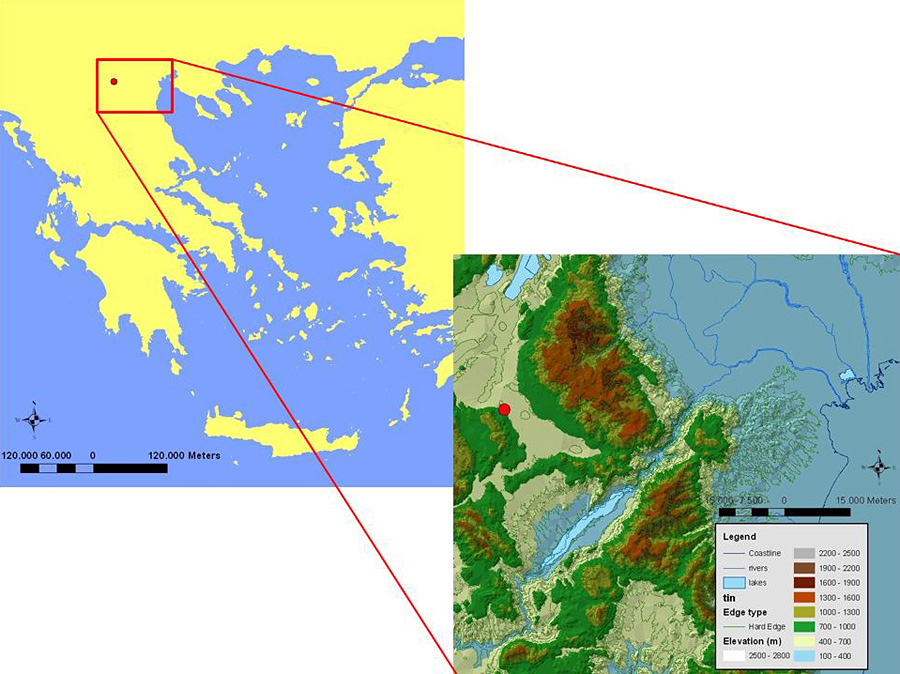
Map of Greece and the location of Mavropigi-Filotsairi in northern Greece (prepared by A. Halkioti).

The fertile plains of central and western Macedonia are of key importance for early Greek prehistory, and Nea Nikomedeia, dated to the end of the seventh millennium BC, has long been considered one of the earliest farming settlements in Europe (Reference RoddenRodden 1965: 83). In recent years, surveys carried out along the periodically exposed shores of the artificial lake of Polyphitos, and rescue excavations imposed by large-scale public works in the region, have revealed over 30 Early Neolithic sites. They offer a welcome opportunity to examine the material remains, cultural preferences and origins of early farming groups moving from the south-east into Europe (Reference Karamitrou-MentessidiKaramitrou-Mentessidi 2005: 524).
The site
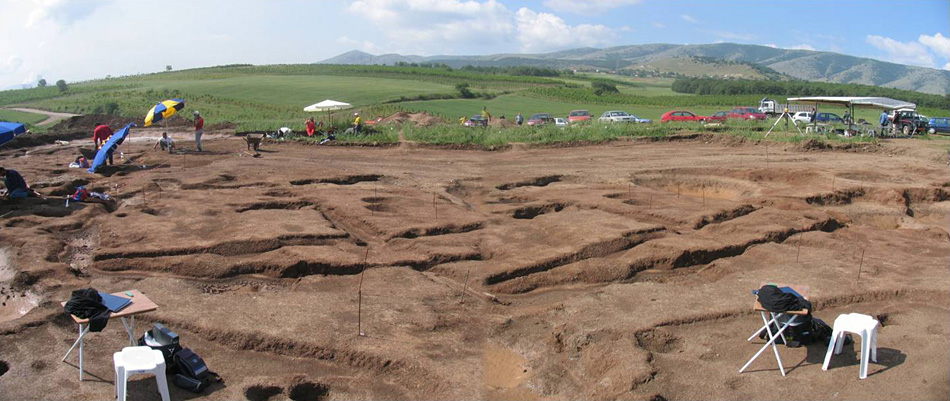
Rescue excavations at Mavropigi-Filotsairi, made necessary by the mining activities of the nearby lignite-fuelled power stations, have revealed occupational sequences dating to the middle of the seventh millennium cal BC (Figure 1). The site is located in an inconspicuous flat area (Figure 2), not far from the low hills of Mount Askio on the western edge of the former lake basin of Kitrini Limni (650m asl) in what seems to have been a particularly favourable environment for early agriculturalists (Andreou et al. 1996: 33).
The rescue excavation of the site in progress (photograph by N. Efstratiou).

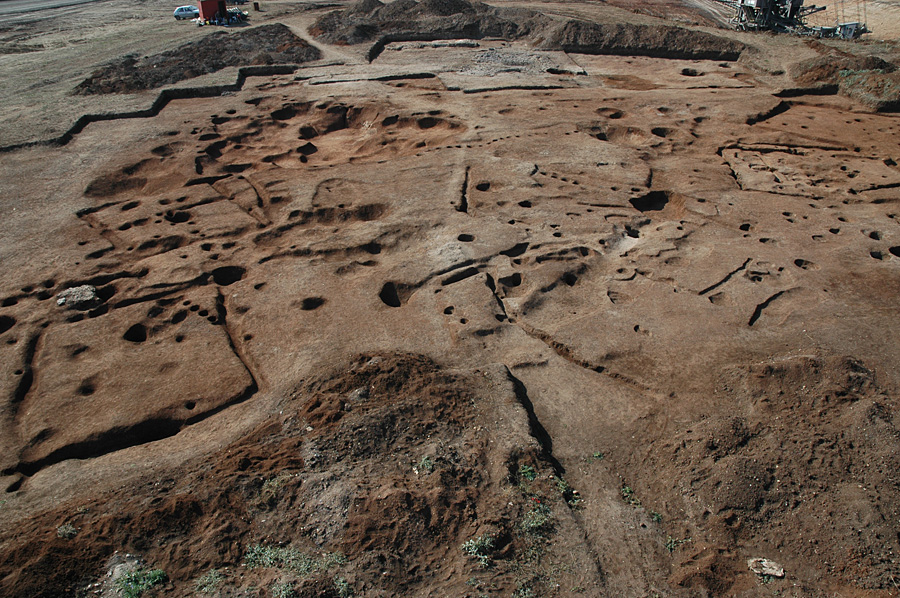
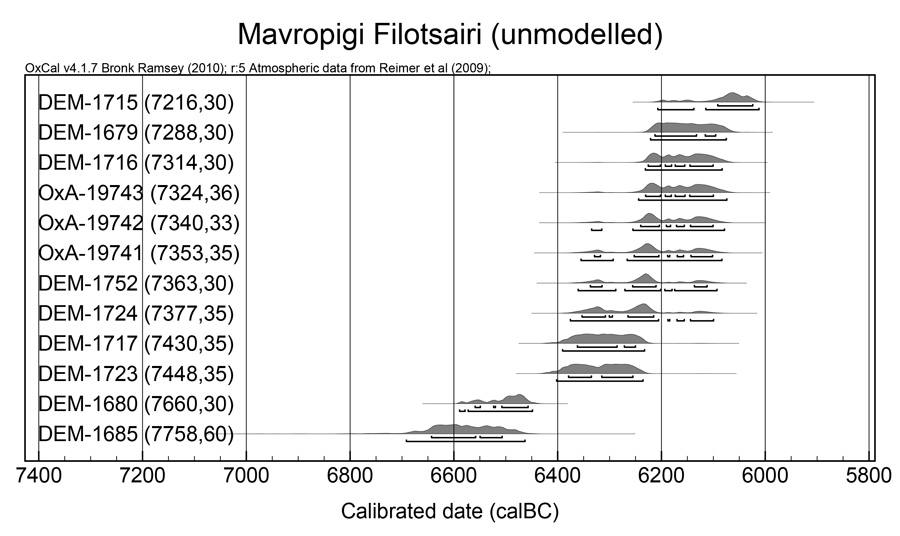
Systematic investigation of the shallow archaeological deposits has brought to light an impressive array of architectural remains from three main occupation periods and a number of minor building phases. They document the evolution of a complex settlement layout, consisting of a central pit-house, initially built as a small semi-subterranean feature and subsequently as a large post-framed structure on the ground surface, exceeding 100m² in size (Figure 3). Around this unit, the well-preserved remains of seven rectangular, free-standing, post-framed and pisé housesfrom 50 to 90m²in size and comparable to those at Nea Nikomedeiaextend over the entire 4000m² extent of the site. Over 17 radiometric and AMS dates, derived from charcoal, carbonised seeds and human bone, provide evidence for uninterrupted occupation from 7660±25 BP/65906450 2σ cal BC (DEM-1680) to 7216±25 BP/62006010 2σ cal BC (DEM-1715) (Figure 4).
Mavropigi-Filotsairi : the large central pit-house at the rear left of the excavated area and the ground plan of the four free-standing, post-framed and pisé houses (photograph by G. Karamitrou-Mentessidi)

The radiocarbon dates available so far from the site (by Y. Maniatis).

Structures and assemblages
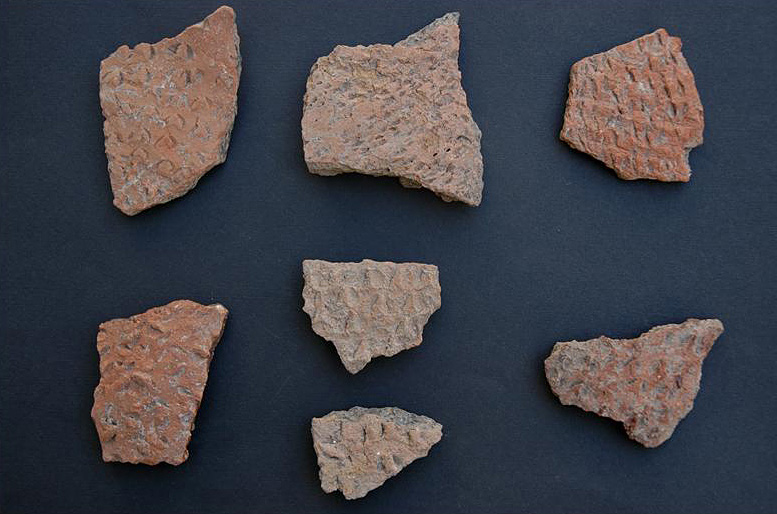
Mavropigi-Filotsairi : ceramics with impressed decoration (photograph by G. Karamitrou-Mentessidi).

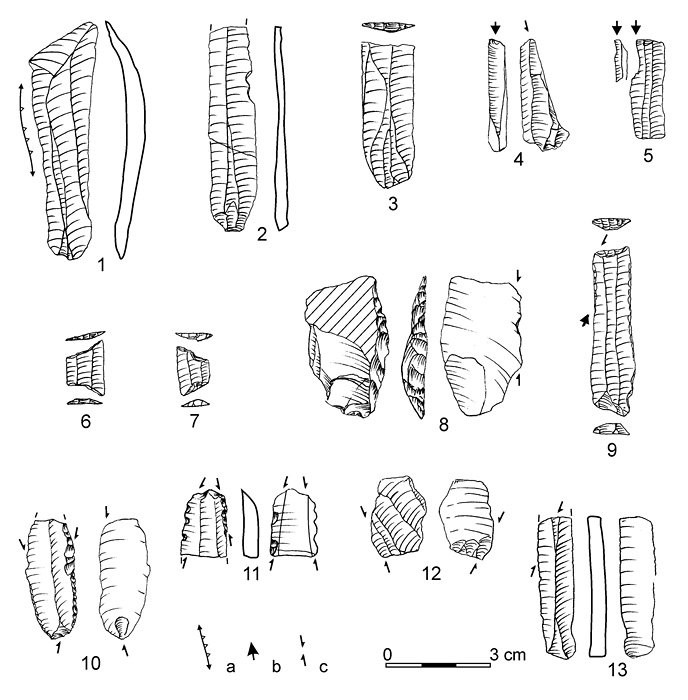
The finds include early ceramic wares in a variety of shapes and decorative techniques (monochrome, painted, impressed), over 100 anthropomorphic and zoomorphic clay figurines, weaving equipment, stamp seals, bone and ground stone tools and ornaments. Of particular interest is the context and early date of the impressed wares and their relationship to the spread of farming into the Balkans and the west (Reference Spataro and GeorghiuSpataro 2009: 63) (Figure 5). A preliminary analysis of the lithic assemblage by Kozłowski and Kaczanowska does not show techno-typological affinity with the Late Mesolithic industries of north-western Greece, but contributes to an understanding of the Neolithisation process in the region by suggesting possible links with other early Greek Neolithic, Balkan and western Anatolian macroblade industries (Perlès 2001). 25 different raw materials, obtained both from the immediate vicinity (flint, radiolarite, quartzes) and from distant sources (obsidian, 'silex blond' flint) were used for making retouched tools, predominantly blades and including end-scrapers, truncations, perforators, burins, trapezes and sickles (Figure 6).
The lithic industry of Mavropigi-Filotsairi : 1 and 2 (unretouched blades), 3 (retouched truncation), 4 and 5 (burins), 6 and 7 (trapezes), 8 (backed piece), 9 to 13 (sickle inserts) (drawings by J.K. Kozlowski and M. Kaczanowska).

The economy of this early farming community was based on fully domesticated plants and animals. The ongoing faunal study shows over 90 per cent reliance on domestic animals (sheep, goats, cattle, pigs). Palaeogenetic studies of wild and domesticated cattle are expected to throw important light on domestication processes in Greece and the Balkans. A preliminary examination of plant remains has identified einkorn (Triticum monococcum), emmer wheat (Triticum dicoccum), new glume wheat type, barley (Hordeum sp.), lentils (Lens sp.), Sambucus sp., Pistacia sp. and Cornelian cherry (Cornus mas) (Reference ValamotiValamoti 2011: 245). Concentrations of emmer or new glume wheat type grain in mortuary contexts provide important new evidence for plant offerings in early farming burial practices.
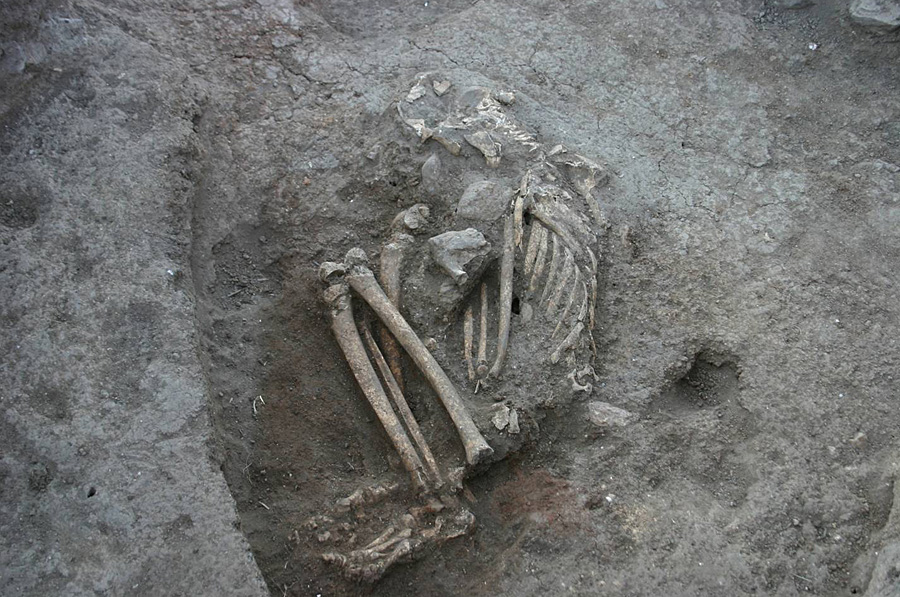
The palaeoanthropological record is of special interest (Papathanasiou & Richards 2011: 257) (Figure 7). The well-preserved skeletal remains of 17 burials of male and female adults, sub-adults and infants comprise one of the earliest and best-dated groups of agriculturalists from Europe (63006000 cal BC). A very successful palaeodietary reconstruction with carbon and nitrogen stable isotopes of bone collagen indicates a primarily C3 terrestrial diet focused mainly on plants with no marine input. Samples have also been submitted for mitochondrial DNA analysis.
Mavropigi-Filotsairi : a typical Neolithic burial (photograph by G. Karamitrou-Mentessidi).

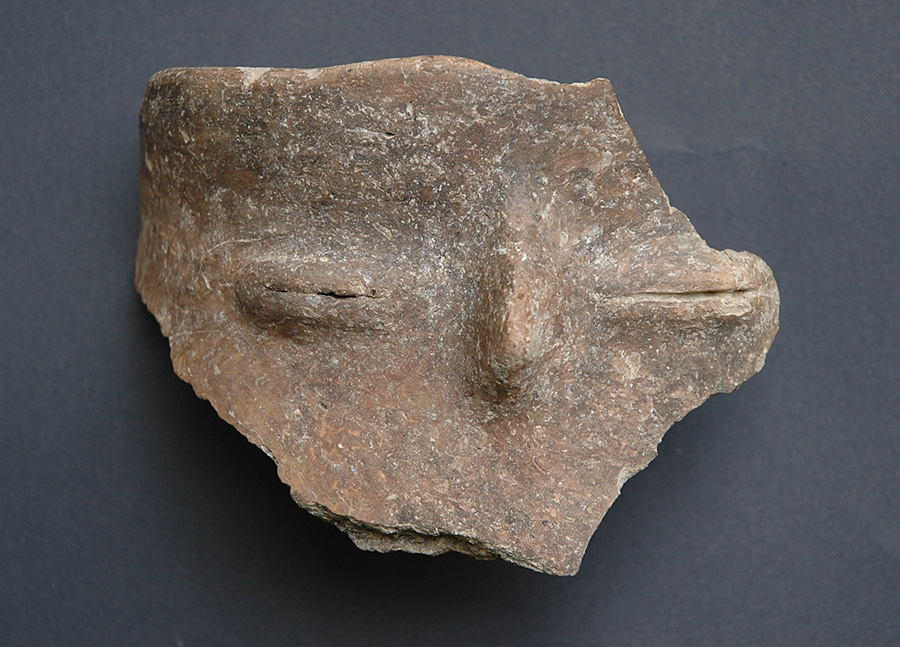
Mavropigi-Filotsairi : a fragment of an anthropomorphic representation on a vessel ( 12cm wide), very similar to the well-known example found at the early site of Nea Nikomedeia (Perles 2001: 265, fig. 12.3) (photograph by G. Karamitrou-Mentessidi).

Discussion
The rich assemblages uncovered at Mavropigi-Filotsairi throw important light on the socioeconomic organisation and symbolic 'world' of the early farming communities which moved into the Balkans around the middle of the seventh millennium BC, if not earlier (Figure 8). The 500-year sequence of occupation, confirmed by radiocarbon dating, has pushed back the previously poorly documented record of the first fully fledged Neolithic communities of northern mainland Greece, while leaving open the question of their origin, which will need to take into consideration the fact that groups of farmers reached Crete a few hundred years earlier (Efstratiou et al. 2004: 39). The accidental manner in which the site was discovered presents the possibility that it may be one of many mature Early Neolithic settlements scattered across the plains of western Macedonia (Greece).
Acknowledgements
We would like to thank for their efforts all the field archaeologists who participated in this rescue excavation, which had to be completed to a strict timetable and often under unfavourable circumstances. Our special thanks go to Mr K. Moschakis, Mr K. Papastathis, M. A. Kyrinas and Mrs K. Anagnostopoulou.