


1. Introduction
The field of design education has undergone a significant transformation with the increasing integration of cutting-edge technologies such as Augmented Reality (AR) (Reference TurgayTurgay, 2017; Reference Wei, Weng, Liu and WangWei et al., 2015), Virtual Reality (VR) (Reference Aydin and AktaşAydin & Aktaş, 2020; Reference Cho and SuhCho & Suh, 2023; Reference Choi and KimChoi & Kim, 2023; Reference Hamurcu, Timur and RızvanoğluHamurcu et al., 2023; Reference Horvat, Martinec, Lukačević, Perišić and ŠkecHorvat et al., 2022; Reference Mejia-Puig and ChandrasekeraMejia-Puig & Chandrasekera, 2023; Reference NishaNisha, 2019; Reference Özgen, Afacan and SürerÖzgen et al., 2019), and Artificial Intelligence (AI) (Reference Chaudhuri, Dhar and YammiyavarChaudhuri et al., 2020; Reference FleischmannFleischmann, 2024b, Reference Fleischmann2024a; Reference Huang, Liu, Dong and LuHuang et al., 2024; Reference KimKim, 2024). These emerging technologies have revolutionized the way design is taught, learned, and practiced, providing innovative approaches to enhance student engagement, creativity, and problem-solving abilities. As the design landscape continues to evolve, understanding the impact of these transformative technologies is crucial to shaping the future of design education. Technological evolution has had a significant influence on designers’ workflows (Reference TurgayTurgay, 2017). Before the widespread use of the internet, designers manually created mood boards using magazines, textiles and other physical samples, and drawing skills were important. Today, students collect and organise design inspiration digitally, increasingly supported by AI tools that can rapidly convert designs into 3D models, demonstrating a profound shift in method and efficiency.
Therefore, the primary objective of this study is to conduct a hybrid bibliometric analysis with TCM application on design education, focusing on the integration of emerging technologies, such as AR, VR, and AI. This research seeks to trace the evolution of design education to identify key trends and existing gaps in current pedagogical practices. Building on these insights and further informed by observations within the authors’ own design courses, the study proposes a preliminary conceptual framework for facilitating collaborative design projects where students work alongside technology as a creative partner. This framework is intended as a theoretical contribution to guide future empirical research and curriculum experimentation. Accordingly, the study addresses the following question, “How have emerging technologies been integrated into design education to enhance the learning experience and prepare students for the demands of an evolving industry?” This research contributes to this question by offering a data-driven overview of existing literature and by outlining a forward-looking framework that aims to support pedagogical transformation. By identifying these trends and gaps, this study seeks to offer humble insights for educators looking to move beyond isolated tool usage toward a more integrated approach, potentially helping curricula evolve alongside the changing professional landscape.
2. Methodology
A protocol is an essential component for conducting a systematic literature review as it facilitates meticulous planning, consistent implementation, and transparency, hence enabling replication. The Quality of Reporting of Meta-analyses Conference (QUOROM) developed a checklist and an accompanying flow diagram to help the evaluation process of meta-analyses (Reference Moher, Cook, Eastwood, Olkin, Rennie and StroupMoher et al., 1999). Due to the constraints of the QUOROM protocol, Reference Moher, Liberati, Tetzlaff and AltmanMoher et al. (2009) introduced the PRISMA (Preferred Reporting Items for Systematic Reviews and Meta-Analyses), a revised iteration of the original QUOROM protocol that consolidates systematic reviews and meta-analyses into a single document, thereby enhancing conceptual advancement in the domain of systematic reviews. The limitations of the PRISMA framework can be accurately described as dual in nature: This framework was initially designed primarily for systematic reviews within the medical and clinical trial research domain; furthermore, it places considerable emphasis on transparency and accountability through a checklist, yet it lacks a definitive methodology to assist authors at stages of the review process. The PRISMA framework also lacks clarifications that facilitate decision-making about the sorts of reviews (Reference Paul, Lim, O’Cass, Hao and BrescianiPaul et al., 2021). Reference Paul, Lim, O’Cass, Hao and BrescianiPaul et al. (2021) introduced an innovative approach, “Scientific Procedures and Rationales for Systematic Literature Reviews” (SPAR-4-SLR), to address these shortcomings. In our research, we utilized this approach to organize, structure, and assess literature. Figure 1 illustrates the model’s configuration, with three principal processes and six subordinate steps.
The first stage of the process entails identifying the area of concentration, which in this instance is “Design education and emerging technology.” Subsequently, we formulated the research questions: “Can we discern a prevailing pattern in academic articles regarding the utilization of emerging technologies in design education?” and “What insights can we derive from this trend?” Ultimately, we determined that the sources comprised original papers, and we assessed their quality utilizing the Web of Science. The initial sub-step of acquisition involved employing the Web of Science (WoS), esteemed for its precision as a literature indexing tool for scientific knowledge and its capacity to provide substantial insights across various scientific disciplines. Reference Forliano, De Bernardi and YahiaouiForliano et al. (2021) shown that WoS surpasses Scopus regarding adherence to more rigorous quality requirements. Reference Merigó, Mas-Tur, Roig-Tierno and Ribeiro-SorianoMerigó et al. (2015) indicated that WoS, with complimentary keywords, demonstrated a reduced incidence of false positive outcomes regarding authors and disambiguation keywords. Consequently, it is imperative to emphasize that dependence exclusively on WOS confined our database to Clarivate, potentially excluding relevant studies from alternative sources such as Elsevier’s Scopus and Google Scholar.
Our study conducted an assessment to examine the relationship between design education and developing technology, particularly focusing on the current developments in artificial intelligence. We restricted our article collection process to the timeframe from January 1993 to December 2024. We employed a methodical three-step search procedure, leveraging a database with academic filters pertinent to linguistics to pick obtain publications authored in English. We meticulously delineated the inclusion and exclusion criteria for our study, ensuring alignment with the standards set by prior studies (Reference Cheng, Wang, Xie and YanCheng et al., 2023; Reference Tigre, Curado and HenriquesTigre et al., 2023). To alleviate selection bias, our study is confined to peer-reviewed publications due to the challenges in assessing the quality of published books and conference proceedings. We utilized a varied selection of search terms derived from prior reviews (Reference Goodell, Kumar, Lim and PattnaikGoodell et al., 2021; Reference Wu, Ngai, Wu and WuWu et al., 2020), including: augmented reality ; virtual reality ; mixed reality ; extended reality ; artificial intelligence ; machine learning ; deep learning ; and design NEAR/3 education or teaching or learning or course. This selection ensures a thorough examination of the various aspects of the sector, encompassing the technological effects on design education.
A total of 617 results were identified. Subsequently, we commenced the structuring process by selecting the organization. There exist several categories of reviews: structured reviews grounded in theories, constructs, and methodologies (Reference KahiyaKahiya, 2018; Reference Paul and SinghPaul & Singh, 2017); framework-based reviews (Reference Donthu, Kumar, Mukherjee, Pandey and LimDonthu et al., 2021; Reference Goodell, Kumar, Lim and PattnaikGoodell et al., 2021)); hybrid or integrated reviews (Reference Bahoo, Alon and PaltrinieriBahoo et al., 2020; Reference Dabić, Maley, Dana, Novak, Pellegrini and CaputoDabić et al., 2020); theory-driven reviews (Reference Gilal, Zhang, Paul and GilalGilal et al., 2019); meta-analysis-based reviews (Reference Knoll and MatthesKnoll & Matthes, 2017); and bibliometric studies (Reference Ballouk, Ben Jabeur, Challita and ChenBallouk et al., 2024).
Application of the SPAR-4-SLR protocol

Figure 1 Long description
The flowchart illustrates the stages of a research process in design education and emerging technology. The process begins with the Identification stage, which includes the domain, research question, source type, and source quality. The domain is Design Education and Emerging Technology, the research question is about the global trend of scientific publications on the application of emerging technologies in design education, the source type is articles, and the source quality is WOS. The next stage is Acquisition, which involves the search mechanism and material acquisition using WOS, the search period from 1992 to 2024, search keywords such as augmented reality, virtual reality, mixed reality, extended reality, artificial intelligence, machine learning, deep learning, and design NEAR/3 education or teaching or learning or course. A total of 617 articles are returned from the search. The Organization stage follows, with organizing codes being Antecedent and Outcome, and the organizing framework being 4Ws. The Purification stage involves excluding certain article types and controlling the output using web of science categories, resulting in 502 articles. Only original articles in English and articles in Education Educational Research are included, totaling 115 articles. The Evaluation stage involves the analysis method being bibliometrical and content, and the agenda proposal method being gap analysis. The final stage is Reporting, which uses graphs and words as reporting conventions and has limitations related to data type and review type.
In our study, we adopted the technique of hybrid integrated review to conduct a comprehensive investigation of the application of developing technology in design education. We employed the 4Ws approach (Who, What, Where, When) proposed by Reference Chakma, Paul and DhirChakma, Paul, et Dhir (2021) during the review process. This approach ensures that the subsequent VOSviewer and CiteSpace analyses cover all critical dimensions of the research landscape. The document type was refined to exclusively encompass original articles authored in English during the purification substep. Furthermore, CiteSpace was employed to eliminate any redundant data. A literature search was conducted after the establishment of academic and linguistic criteria within the databases, resulting in the retrieval of 115 publications that fit the defined selection criteria for bibliometric analysis.
During the assessment phase, bibliometric methods were employed to statistically identify essential characteristics pertinent to a particular field of research (Reference Junquera and MitreJunquera & Mitre, 2007). At this step, one may verify pertinent data concerning a study issue, including prominent writers engaged in the investigation, the volume of published content, and associated terminology. Thus, it facilitates an examination of the relationship between factors (emerging technologies in design education) and data across many nations (Reference Casadesus-Masanell and RicartCasadesus-Masanell & Ricart, 2011). This method also facilitates the use of scientific cartography tools (Reference Aria and CuccurulloAria & Cuccurullo, 2017). This study utilized bibliometric analysis with VOSviewer software, a web-based application that provides an intuitive interface for bibliometric evaluation. Moreover, it has a concept map and delineates a contemporary trending topic. We utilized the Bing search engine to pinpoint the regions exhibiting the highest levels of activity within this search area. Furthermore, we employed CiteSpace software to discern the cluster with the highest degree of activity. Subsequently, we implemented the framework-based review model proposed by Reference Rosado-Serrano, Paul and DikovaRosado-Serrano, Paul, et Dikova (2018) and applied the 4Ws methodology to examine the research questions: “What is the current state of the integration of new technologies in the design education?” What is the correlation between the emerging technologies and design education? The objectives of the bibliometric analysis were as follows: A) To gather bibliometric data from 115 scientific publications in WOS; B) To employ Vosviewer and CiteSpace to aggregate and record quantitative data from a specified selection of articles; C) To identify prominent authors in this field by evaluating the number of authors per article and an author dominance index; D) To achieve a comprehensive understanding of the network within this research domain through citation analysis and mapping of collaborative relationships.
3. Result of the bibliometric analysis
3.1. Number of publications per year and country/region analysis
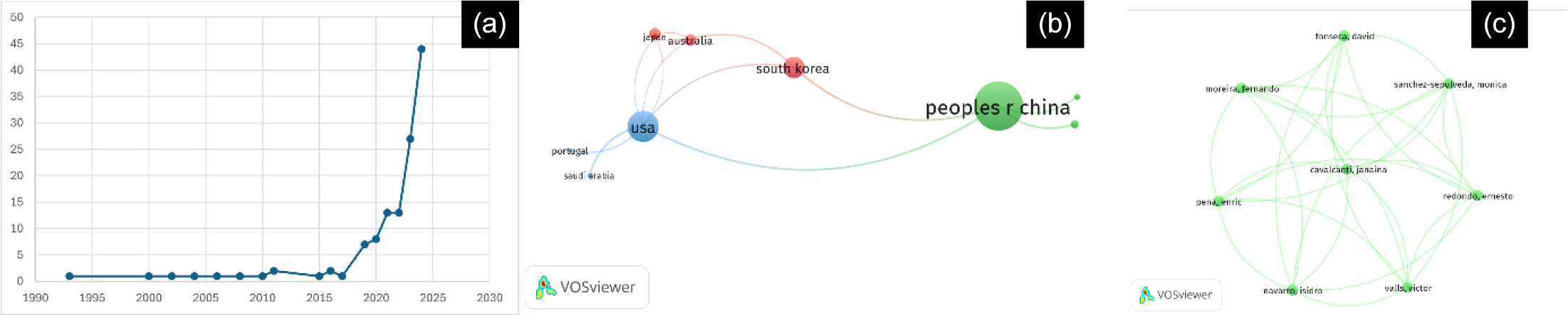
This result indicates a marked increase in research on artificial intelligence (AI) in education, particularly since 2018 (Figure 2 (a)) in line with the study of Reference Afzaal, Shanshan, Yan and YounasAfzaal et al. (2024). The first study that addressed the subject of AI and design was published by Reference DymDym (1993), which highlights that the advancements in AI offer novel methods for representing design information pertaining to developed items and the design process. AI, and especially generative AI, is transforming design education by enhancing creativity and operational efficiency (Reference Hashem and HakeemHashem & Hakeem, 2024), with AI-supported design practices becoming increasingly prevalent in architectural curricula, driving the need for educational adaptation. Beyond design, AI applications are expanding across higher education and specialized domains, though challenges persist, including the need for specialized training and ethical considerations (Reference Hashem and HakeemHashem & Hakeem, 2024). In line with the study of Reference Afzaal, Shanshan, Yan and YounasAfzaal et al. (2024), collaborative research networks show the United States and China leading in publication volume. Despite these advances, existing bibliometric studies of AI in education largely focus on general higher education and digital legacy issues (Reference Afzaal, Shanshan, Yan and YounasAfzaal et al., 2024), while research in design education remains narrow, emphasizing AI-led CAD applications (Reference Chen, Chang and WuChen et al., 2020), spatial cognition, or isolated workshop case studies with emerging technologies (Reference Hashem and HakeemHashem & Hakeem, 2024; Reference KimKim, 2024; Reference TurgayTurgay, 2017). This fragmented focus and the absence of a comprehensive framework continue to hinder the effective integration of generative AI within academic environments (Reference Shailendra, Kadel and SharmaShailendra et al., 2024).
(a) Time evolution of total publications in the WOS databases (b) Cooperation network of productive countries (c) Network of co-authors

To date, 36 countries have contributed to this research (N = 115), the highest number of contributions in terms of deploying AI in the design came from China (32), followed by the United States (23), Korea (14), and Australia, UK, Turkey, and Taiwan (7 each). The VOSviewer analyse on cooperation network of productive countries (Figure 2 (b)) shows that China and the USA dominate both productivity and collaboration intensity, while South Korea plays a key bridging role linking the two centres. Smaller contributors (Malaysia, Taiwan, Portugal, Australia) are largely connected through these hubs.
The co-authorship network (Figure 2 (c)) reveals a cohesive core with dense internal collaboration contrasted by a fragmented periphery of authors with limited output and weak connectivity. While some isolates indicate single-team publishing, citation impact is often decoupled from network centrality, as highly cited authors frequently exhibit low collaboration strength.
3.2. Journal analysis
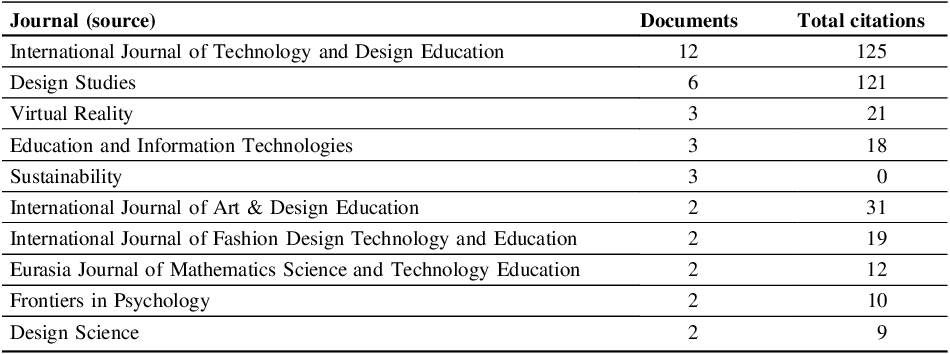
Two journals dominate the field, the International Journal of Technology and Design Education (12 papers; 125 citations) and Design Studies (6 papers; 121 citations) (Table 1). Together, these two outlets account for 49% of the documents and 67% of the citations within the top 10 sources, suggesting that the literature is anchored around a small core of specialized design and design-education journals.
Most productive journals

4. TCM application
4.1. Conceptual and theoretical approaches
The reviewed literature demonstrates a rich and evolving theoretical foundation for contemporary design education, shaped by reflective, experiential, constructivist, and technology-mediated perspectives. Reflective Practice Theory conceptualizes design as a collaborative and reflexive process, where participants engage iteratively through verbal and graphical modes to co-define problems and generate learning outcomes within representational ecosystems (Reference Dorta, Kinayoglu and BoudhraâDorta et al., 2016). Complementing this, Research-by-Design approaches, supported by frameworks such as the Co-Evolution Model, emphasize the integration of research and pedagogy through comparative and intercultural design exploration (Reference Devisch, Hannes, Trinh, Leus, Berben and HiếnDevisch et al., 2019).
Learning theories provide further grounding for the incorporation of digital tools in design education. Constructivist and Experiential Learning Theories underpin the use of augmented and virtual reality, fostering conceptual understanding, creativity, and knowledge construction through hands-on engagement and reflective iteration (Reference FleischmannFleischmann, 2024a; Reference Horvat, Martinec, Lukačević, Perišić and ŠkecHorvat et al., 2022; Reference Lemons, Carberry, Swan, Jarvin and RogersLemons et al., 2010; Reference NishaNisha, 2019; Reference Wei, Weng, Liu and WangWei et al., 2015). Technology-Mediated Learning Theory explores how digital platforms enhance motivation and participation by aligning technology use with learner-centered strategies (Reference Huang, Liu, Dong and LuHuang et al., 2024), while studio pedagogy maintains the tradition of “learning by doing,” connecting experiential design processes to real-world contexts.
Emerging computational and cognitive frameworks further expand this theoretical base. Creativity Assessment Theory and computational evaluation models extend objectivity in assessing novelty and design aptitude (Reference Chaudhuri, Dhar and YammiyavarChaudhuri et al., 2020), while Embodied Cognition Theory highlights how virtual embodiment influences ideation and spatial reasoning (Reference Mejia-Puig and ChandrasekeraMejia-Puig & Chandrasekera, 2023).
Technology Acceptance Models and hybrid learning frameworks examine usability and adoption in digitally mediated environments (Reference Aydin and AktaşAydin & Aktaş, 2020; Reference Hamurcu, Timur and RızvanoğluHamurcu et al., 2023; Reference Özgen, Afacan and SürerÖzgen et al., 2019).
Finally, contemporary studies advance the Human–AI Co-Creativity Theory, emphasizing cognitive offloading, augmented ideation, and ethical collaboration between students and AI systems (Reference KimKim, 2024).
Complementary research into spatial cognition (Reference Cho and SuhCho & Suh, 2023; Reference Choi and KimChoi & Kim, 2023) and constructivist applications within the metaverse (Reference ChunChun, 2023) reflects the continuous adaptation of design education theories to emerging technologies and digital ecosystems.
4.2. Context and background of technology-integrated design education
The reviewed studies collectively depict an evolving landscape of design education shaped by digital, immersive, and intelligent technologies. The digital paradigm, while expanding collaborative opportunities, often fails to fully support co-design and the agile transfer of tacit knowledge (Reference Dorta, Kinayoglu and BoudhraâDorta et al., 2016). Research-by-design approaches reveal diverse interpretations across cultural contexts, underscoring the need for tailored methodologies that integrate educational training with systematic design inquiry contexts (Reference Devisch, Hannes, Trinh, Leus, Berben and HiếnDevisch et al., 2019). In creative design education, challenges such as limited understanding of design pedagogy and low student motivation persist, particularly in high school contexts (Reference Wei, Weng, Liu and WangWei et al., 2015). Immersive technologies, including virtual reality (VR), have been widely examined for their potential to enhance spatial cognition, ideation, and design comprehension (Reference Cho and SuhCho & Suh, 2023; Reference Choi and KimChoi & Kim, 2023; Reference Horvat, Martinec, Lukačević, Perišić and ŠkecHorvat et al., 2022; Reference Mejia-Puig and ChandrasekeraMejia-Puig & Chandrasekera, 2023). However, research also highlights the risk of technology overshadowing traditional studio practice and hands-on engagement (Reference TurgayTurgay, 2017). Several studies advocate for a stronger integration of contextual understanding and user-centered thinking, moving beyond aesthetics toward purposeful design (Reference NishaNisha, 2019). Others emphasize the pedagogical importance of teamwork and interdisciplinary collaboration, including partnerships with generative AI (Reference FleischmannFleischmann, 2024b, Reference Fleischmann2024a). In engineering and product design, hands-on model-building activities remain essential for understanding the design process (Reference Lemons, Carberry, Swan, Jarvin and RogersLemons et al., 2010), while artificial intelligence-generated content (AIGC) introduces new opportunities for innovation in educational contexts (Reference Huang, Liu, Dong and LuHuang et al., 2024). Yet, assessing creativity and novelty continues to rely heavily on subjective expert evaluation, raising concerns about consistency and scalability (Reference Chaudhuri, Dhar and YammiyavarChaudhuri et al., 2020). Within the realm of virtual and augmented reality, studies explore usability and adoption challenges among students and instructors in various design fields, including industrial, architectural, and interior design (Reference Aydin and AktaşAydin & Aktaş, 2020; Reference Hamurcu, Timur and RızvanoğluHamurcu et al., 2023; Reference Özgen, Afacan and SürerÖzgen et al., 2019). AI-driven collaboration has also begun to influence creative ideation, particularly in fashion design education (Reference KimKim, 2024). Meanwhile, metaverse-based education represents an emerging but still underexplored area of research, with potential to further transform digital learning environments (Reference ChunChun, 2023). Overall, these studies reveal both the promise and limitations of integrating emerging technologies in design education, highlighting the need for frameworks that balance technological advancement with human-centered, reflective, and collaborative learning.
4.3. Methodological approaches in technology-integrated design education research
The reviewed studies employ diverse methods, reflecting the interdisciplinary and technology-driven nature of design education research. Case studies dominate, frequently examining immersive co-design environments, life-size visualization, and collaborative workflows (Reference Devisch, Hannes, Trinh, Leus, Berben and HiếnDevisch et al., 2019; Reference Dorta, Kinayoglu and BoudhraâDorta et al., 2016). Quasi-experimental and experimental designs test augmented and virtual reality (AR/VR) platforms, often using control and experimental groups to assess motivation, spatial reasoning, or ideation (Reference Horvat, Martinec, Lukačević, Perišić and ŠkecHorvat et al., 2022; Reference Wei, Weng, Liu and WangWei et al., 2015). Mixed-method and project-based approaches track learner progress through hands-on modules, 3D-printed outputs, VR redesigns, and peer review to map spatial and creative development (Reference NishaNisha, 2019). Nevertheless, several recurrent methodological weaknesses emerge. Surveys and self-assessment questionnaires are common for evaluating generative AI use, though they are rarely complemented by expert evaluation, limiting the robustness of conclusions. Also, many studies are single-case analyses or narrowly focused within specific domains, constraining generalizability (Reference Chaudhuri, Dhar and YammiyavarChaudhuri et al., 2020; Reference Huang, Liu, Dong and LuHuang et al., 2024; Reference Lemons, Carberry, Swan, Jarvin and RogersLemons et al., 2010). Sample sizes are often small, and participant demographics are inconsistently reported; while the educational level is usually specified, gender, which can influence spatial cognition, is rarely considered (Reference Cho and SuhCho & Suh, 2023; Reference Choi and KimChoi & Kim, 2023). Studies frequently target narrow subjects, such as space design in VR or syntax-driven model creation in AI-enhanced design, neglecting broader considerations like user experience (UX), interface design, or content creativity (Reference ChunChun, 2023; Reference KimKim, 2024). Computational modeling and machine learning are increasingly used to quantify novelty and correctness, while embodied cognition frameworks assess the impact of virtual body representations on spatial reasoning (Reference Mejia-Puig and ChandrasekeraMejia-Puig & Chandrasekera, 2023). Hybrid methods combine theoretical analysis, hands-on experimentation, and digital tools to evaluate cognitive and creative outcomes (Reference Özgen, Afacan and SürerÖzgen et al., 2019; Reference TurgayTurgay, 2017). Research-creation and participatory observation methods explore AI-supported collaboration and metaverse-enabled learning, though these remain concentrated on limited aspects of creative and collaborative processes (Reference ChunChun, 2023; Reference Hamurcu, Timur and RızvanoğluHamurcu et al., 2023; Reference KimKim, 2024).
Overall, while methodological innovation is evident, limitations in sample size, scope, participant diversity, and evaluation rigor suggest a need for more comprehensive and inclusive research designs in technology-mediated design education.
5. Conclusion & discussion
Bibliometric data reveals a sharp increase in publications since 2018, led by China, the US, and South Korea. This surge aligns with a rapidly expanding AI-in-education market, projected to reach a 36% CAGR by 2030 (Grand View Research, Inc., 2024). While design education traditionally bifurcates into studio-based or engineering-integrated models (Reference Meyer and NormanMeyer & Norman, 2020), digital-native students now require pedagogy that frames AI as a collaborative partner rather than a threat (Reference FleischmannFleischmann, 2024b).
Current literature frequently highlights VR’s utility in spatial cognition (Reference Aydin and AktaşAydin & Aktaş, 2020; Reference Özgen, Afacan and SürerÖzgen et al., 2019) and AI’s dual role in collaborative learning (Reference Huang, Liu, Dong and LuHuang et al., 2024; Reference KimKim, 2024) and creative assessment (Reference Chaudhuri, Dhar and YammiyavarChaudhuri et al., 2020). However, most AI studies remain descriptive or focused on the general advantages of Generative AI (GAI), such as personalized feedback (Reference Verganti, Vendraminelli and IansitiVerganti et al., 2020). As the industry shifts toward digital prototyping, design education must move from manual skillsets toward high-level digital curation and creative steering (Reference Verganti, Vendraminelli and IansitiVerganti et al., 2020).
Existing research often relies on single-case designs with small, homogeneous samples, limiting generalizability. Future directions include diversifying participant pools, refining creativity assessment frameworks, and exploring hybrid physical-digital models. A primary limitation of this study is its exclusive reliance on the Web of Science (WoS) database; incorporating Scopus or Google Scholar in future reviews could provide a broader view of interdisciplinary proceedings and professional reports.
6. Avenue for future study
The CiteSpace analysis identifies several pivotal research clusters defining the current landscape (Figure 3). Cluster #0 (New Representational Ecosystem) represents the largest shift, moving studio pedagogy toward immersive digital environments with AI and VR as core infrastructure. Clusters #1 (Augmented Reality) and #2 (Design Education) focus on metaverse applications and spatial perception in virtual modes. Cluster #4 (Learning Outcome) highlights recent trends in the “commodification of creativity” via Generative AI integration, while Cluster #6 (Studio Practice) confirms that core design values remain rooted in the studio despite the transition to digital workflows. Collectively, these findings informed the proposed framework.
Timeline visualization of research cluster evolution (1993–2024)

Figure 3 Long description
A diagram of the research cluster evolution. The diagram features a series of interconnected nodes and lines, representing the evolution of research clusters over time. The nodes are color-coded and labeled with different research themes, including new representational ecosystem, augmented reality, design education, learning design, learning outcome, benefit, and studio practice. The lines connecting the nodes indicate the relationships and transitions between these themes over the years. The overall structure shows a progression and interconnection of various research themes in the field of design education.
Traditionally, design education has emphasized skill-based training, particularly within the classic design studio model (Reference FormosaFormosa, 2025; Reference Meyer and NormanMeyer & Norman, 2020). Contemporary approaches, however, require a shift toward human-centered learning that moves beyond form and visual representation to address the “why” and “how” of design (Reference BrownBrown, 2008). This entails transitioning from teacher-centered instruction to collaborative learning environments, where instructors act as mentors rather than all-knowing authorities (Reference Martins Pacheco, Geisler, Bajramovic, Fu, Vazhapilli Sureshbabu, Mörtl and ZimmermannMartins Pacheco et al., 2024). Given the increasing complexity of design challenges, education must be multidisciplinary, equipping students with the ability to integrate diverse knowledge and solve complex problems (Reference Martins Pacheco, Geisler, Bajramovic, Fu, Vazhapilli Sureshbabu, Mörtl and ZimmermannMartins Pacheco et al., 2024; Reference Meyer and NormanMeyer & Norman, 2020). As Reference FormosaFormosa (2025) emphasizes, design education should be holistic and inclusive, focusing on understanding human behavior, interpreting data, and engaging with research, rather than solely producing aesthetic outputs. Current research often focuses narrowly on specific tools, such as AI or VR, measuring isolated parameters without addressing broader educational objectives. A holistic approach aligns with Reference Davis and DubberlyDavis and Dubberly (2023), advocating flexible, context-responsive, and sustainable design practices. Human designers and AI agents occupy complementary roles in creative problem-solving (Reference Chen, Chang and WuChen et al., 2020), with AI functioning as a brainstorming partner, dialogue collaborator, and shared activity object in co-creation (Reference Vartiainen, Liukkonen and TedreVartiainen et al., 2025). Computational skills, similarly, serve as both tools and media for engaging with user-centered design outcomes (Reference Davis and DubberlyDavis & Dubberly, 2023; Reference YuYu, 2025).
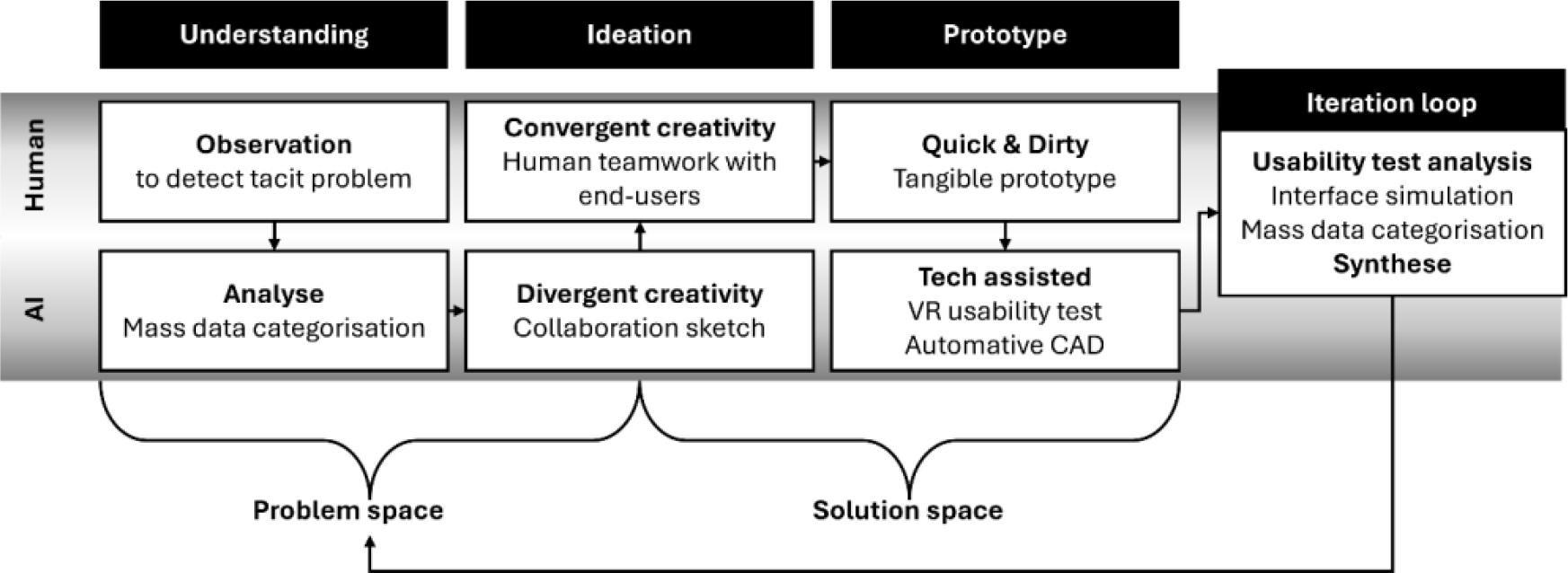
Building on these bibliometric insights and informed by observations within the authors’ design courses, this study proposes a framework for collaborative human-AI design project-based learning (Figure 4). Rather than treating technology as a peripheral tool, this framework explicitly aligns with the Design Thinking phases (Design Council, 2026) to integrate AI systematically into the creative process. For instance, AI-supported data analysis enhances the Empathize and Define stages by processing complex user information, while ‘divergent ideation’ supports the Ideate stage, positioning AI as a ‘brainstorming partner’ (Reference Vartiainen, Liukkonen and TedreVartiainen et al., 2025). Throughout these phases, ‘reflection’ and ‘convergent judgment’ remain essential human-led processes, ensuring that the designer maintains creative agency and ethical oversight.
Collaborative human-AI design project-based learning framework

This framework integrates AI as an active collaborator within Design Thinking-based project learning. By adopting a holistic, human-centered approach, the model augments initial observation and divergent ideation with AI-driven data analysis. While human judgment remains central to convergent thinking and reflective decision-making, AI facilitates rapid prototyping and testing. Ultimately, this positioning of AI as both a tool and co-creator enhances learning efficiency. Future research will focus on qualitative testing and iterative refinement across diverse multidisciplinary contexts to support AI-augmented design environments.



 Open access

