


Introduction
GPS-tracking technology has been particularly helpful in understanding the movement and dispersal patterns of a number of bird species (Bridge et al. Reference Bridge, Thorup, Bowlin, Chilson, Diehl and Fléron2011; Cooke et al. Reference Cooke, Hinch, Wikelski, Andrews, Kuchel and Wolcott2004; Jouventin and Weimerskirch Reference Jouventin and Weimerskirch1990; Nathan et al. Reference Nathan, Getz, Revilla, Holyoak, Kadmon and Saltz2008). For example, long-lived species, such as vultures, have received a good deal of attention due to their threatened status and the important ecosystem services that they provide (Alarcón and Lambertucci Reference Alarcón and Lambertucci2018; McClure et al. Reference McClure, Westrip, Johnson, Schulwitz, Virani and Davies2018; Oliva-Vidal et al. Reference Oliva‐Vidal, Sebastián‐González and Margalida2022b; Safford et al. Reference Safford, Andevski, Botha, Bowden, Crockford and Garbett2019). Vultures have very particular life histories, including delayed maturity (Grande et al. Reference Grande, Serrano, Tavecchia, Carrete, Ceballos and Díaz-Delgado2009; Margalida et al. Reference Margalida, Jiménez, Martínez, Sesé, Llamas and García2020), prolonged parental care (Margalida et al. Reference Margalida, García, Bertran and Heredia2003), and extensive movements during the pre-adult dispersal period (Guido et al. Reference Guido, Cecchetto, Plaza, Donázar and Lambertucci2023; Margalida et al. Reference Margalida, Carrete, Hegglin, Serrano, Arenas and Donázar2013; Morant et al. Reference Morant, Arrondo, Sánchez‐Zapata, Donázar, Cortés‐Avizanda and De La Riva2023b). GPS-tracking technology has enabled researchers to identify key demographic parameters such as survival by age-class and causes of death, as well as movement behaviours (which can identify critical conservation areas such as communal roosts), migratory movements, flight paths, habitat use, and resource selection (Alarcón and Lambertucci Reference Alarcón and Lambertucci2018; Delgado et al. Reference Delgado-Gonzalez, Cortés-Avizanda, Serrano, Arrondo, Duriez and Margalida2022; García-Jiménez et al. Reference García-Jiménez, Pérez-García and Margalida2018; Margalida et al. Reference Margalida, Pérez-García, Afonso and Moreno-Opo2016; Reading et al. Reference Reading, Azua, Garrett, Kenny, Lee and Paek2020; Rousteau et al. Reference Rousteau, Duriez, Pradel, Sarrazin, David and Herniquet2022). The study of movement ecology has therefore emerged as a crucial factor in the design and improvement of management and conservation measures for avian scavenger species (Alarcón and Lambertucci Reference Alarcón and Lambertucci2018; Arrondo et al. Reference Arrondo, García‐Alfonso, Blas, Cortes‐Avizanda, De la Riva and Devault2021; Carrete and Donázar Reference Carrete and Donázar2005; Cerecedo-Iglesias et al. Reference Cerecedo-Iglesias, Bartumeus, Cortés-Avizanda, Pretus, Hernández-Matías and Real2023; Fozzi et al. Reference Fozzi, Brogi, Cavazza, Chirichella, De Rosa and Aresu2023; Margalida et al. Reference Margalida, Pérez-García, Afonso and Moreno-Opo2016).
Raptors, and particularly vultures, show distinct movement patterns in relation to age and pre-adult individuals exhibit larger home ranges compared with adults (Cerecedo-Iglesias et al. Reference Cerecedo-Iglesias, Bartumeus, Cortés-Avizanda, Pretus, Hernández-Matías and Real2023; Margalida et al. Reference Margalida, Carrete, Hegglin, Serrano, Arenas and Donázar2013; Morant et al. Reference Morant, Arrondo, Sánchez‐Zapata, Donázar, Cortés‐Avizanda and De La Riva2023b; Reading et al. Reference Reading, Azua, Garrett, Kenny, Lee and Paek2020). However, this generally consistent pattern is not always observed in all avian scavenger species (Guido et al. Reference Guido, Cecchetto, Plaza, Donázar and Lambertucci2023; Rivers et al. Reference Rivers, Johnson, Haig, Schwarz, Burnett and Brandt2014). Investigations focusing on age differences among individual pre-adult vultures are scarce (García-Macía et al. Reference García-Macía, Álvarez, Galán, Iglesias-Lebrija, Gálvez and Plana2024; Krüger et al. Reference Krüger, Reid and Amar2014), and studies have primarily focused on comparisons between adults and immatures or between territorial and non-territorial individuals (García-Jiménez et al. Reference García-Jiménez, Pérez-García and Margalida2018; Reading et al. Reference Reading, Azua, Garrett, Kenny, Lee and Paek2020; Rivers et al. Reference Rivers, Johnson, Haig, Schwarz, Burnett and Brandt2014). Territorial individuals tend to make more limited movements than non-territorial ones due to breeding commitments that limit foraging movements to areas close to their nest sites (Iglesias-Lebrija et al. Reference Iglesias-Lebrija, Peragón, Galán and Álvarez2015; Whitfield et al. Reference Whitfield, Fielding, Anderson, Benn, Dennis and Grant2022). Conversely, sex-specific movements exhibit greater variability across different vulture species. Generally, females exhibit higher movement frequencies and cover greater distances than males, and often occupy larger home ranges (García-Macía et al. Reference García-Macía, Álvarez, Galán, Iglesias-Lebrija, Gálvez and Plana2024; Margalida et al. Reference Margalida, Pérez-García, Afonso and Moreno-Opo2016; Morant et al. Reference Morant, Arrondo, Sánchez‐Zapata, Donázar, Cortés‐Avizanda and De La Riva2023b), although this pattern was not observed in immature individuals of some species, for example, the Andean Condor Vultur gryphus (Guido et al. Reference Guido, Cecchetto, Plaza, Donázar and Lambertucci2023). In any case, regardless of age or sex, the movements and patterns of spatial use observed in vultures are influenced by both internal factors such as territorial status, breeding region or breeding season, and external factors including environmental characteristics (García-Jimenez et al. Reference García-Jiménez, Pérez-García and Margalida2018; Gavashelishvili et al. Reference Gavashelishvili, McGrady, Ghasabian and Bildstein2012; Margalida et al. Reference Margalida, Carrete, Hegglin, Serrano, Arenas and Donázar2013; Morant et al. Reference Morant, Arrondo, Sánchez‐Zapata, Donázar, Cortés‐Avizanda and De La Riva2023b; Reading et al. Reference Reading, Azua, Garrett, Kenny, Lee and Paek2020).
The pre-adult phase plays a crucial role in the life of raptors and marks the period during which individuals disperse from their natal area and learn to find food and resources for survival (González et al. Reference González, Oria, Margalida, Sánchez, Prada and Caldera2006; Serrano and Tella Reference Serrano and Tella2003). This phase is not only important at the individual level but also has population level implications, particularly for species living in dynamic environments and for those distributed in metapopulations (Carrete and Donázar Reference Carrete and Donázar2005; González et al. Reference González, Oria, Margalida, Sánchez, Prada and Caldera2006; Margalida et al. Reference Margalida, Carrete, Hegglin, Serrano, Arenas and Donázar2013). The study of movement patterns during the subadult stage has presented challenges in the past, leading to significant knowledge gaps in species such as the Cinereous Vulture Aegypius monachus (García-Macía et al. Reference García-Macía, Álvarez, Galán, Iglesias-Lebrija, Gálvez and Plana2024). Newly developed telemetric methods could help to increase our understanding of the specific movement ecology of the different age-classes in the pre-adult stage and optimise management and conservation actions.
The Cinereous Vulture is a vulnerable species facing numerous threats, including illegal direct poisoning and secondary exposure to poisons in the environment (Hernández and Margalida Reference Hernández and Margalida2008; Herrero-Villar et al. Reference Herrero-Villar, Delepoulle, Suárez-Regalado, Solano-Manrique, Juan-Sallés and Iglesias-Lebrija2021; Jung et al. Reference Jung, Kim, Lee and Kim2009; Moreno-Opo and Margalida Reference Moreno-Opo and Margalida2014), and little is known about the movement patterns of pre-adults in the population (but see Gavashelishvili et al. Reference Gavashelishvili, McGrady, Ghasabian and Bildstein2012; Jiménez and González Reference Jiménez and González2012; Reading et al. Reference Reading, Azua, Garrett, Kenny, Lee and Paek2020). Here, we set out to: (1) provide an integrated description of its movement ecology, quantifying its use of space, i.e. home ranges, core areas, and the areas of maximum activity, as conventionally estimated by the minimum convex polygon (MCP); (2) determine whether internal factors such as an individual pre-adult Cinereous Vulture’s age or sex, or season (breeding or non-breeding) affect space use and movement behaviour. Our results will contribute to a better understanding of the movements of pre-adults in a reintroduced population of this endangered vulture species and provide new insights to improve conservation and management strategies.
Methods
Study species
The Cinereous Vulture is a large Eurasian obligate scavenger, with a significant population on the Iberian Peninsula (>2,000 pairs) (Del Moral Reference Del Moral2019; Moreno-Opo and Margalida Reference Moreno-Opo and Margalida2014), where it favours Mediterranean forest areas, primarily in the central part of the peninsula (Moreno-Opo et al. Reference Moreno-Opo, Fernández-Olalla, Margalida, Arredondo and Guil2012). Due to dedicated conservation efforts, it was successfully reintroduced to the Pyrenean mountain range (north-east Spain) in the 2000s using soft release cages (Álvarez et al. Reference Álvarez, Gálvez, Millet, Marco, Alvarez, Rafa, Zuberogoitia and Martínez2011; Delepoulle et al. Reference Delepoulle, Plana, García-Ferré and Del Moral2017). Subsequently, this population has made a notable recovery, reaching 18 breeding pairs in 2022. Despite the overall recovery observed across the Iberian Peninsula, the Iberian population faces several threats, including the illegal use of poisons, secondary poisoning, lead poisoning, environmental pesticides, collisions with energy distribution infrastructure, landscape transformation, and shortages of its carrion food due to sanitary regulations (Donázar et al. Reference Donázar, Margalida, Carrete and Sánchez-Zapata2009; Hernández and Margalida Reference Hernández and Margalida2008; Oliva-Vidal et al. Reference Oliva-Vidal, Martínez, Sánchez-Barbudo, Camarero, Colomer and Margalida2022a, 2022b; Pérez-García et al. Reference Pérez-García, Morant, Arrondo, Sebastián-González, Lambertucci and Santangeli2022; Vasilakis et al. Reference Vasilakis, Whitfield, Schindler, Poirazidis and Kati2016). Our study used GPS-tracking data collected from vultures reintroduced to the Catalan Pyrenees (the areas around Boumort and Alinyà, Lleida province, north-east Spain).
Tracking and data collection
From 2009 to 2020, the movement patterns of 88 Cinereous Vultures from the reintroduced Pyrenean population were monitored using solar-powered Argos satellite and GPS/GSM transmitters weighing between 40 g and 70 g (Microwave PTT-100 70 g GPS/Argos Solar MTI n = 51, Microwave 70 g GSM-GPS MTI n = 3, Ornitela OT-50 n = 18, E-obs solar 48 g GPS-GSM n = 10, Ecotone 50 g GPS/GSM n = 5, SOLAR GPS BIRDBORNE 40 g PTT_NST n = 1). The transmitters were attached using backpack breakaway harnesses with a 0.64-cm Teflon ribbon sourced from Bally Ribbon Mills (Bally, PA, USA) (García et al. Reference García, Iglesias‐Lebrija and Moreno‐Opo2021). The transmitters were programmed to provide location fixes at intervals ranging from one to two hours between 06h00 and 22h00 UTC, except for four individuals whose transmitters transmitted GPS locations every 15 minutes. The birds were classified into four age-classes based on plumage characteristics following Clark (Reference Clark, Chancellor and Meyburg2004) and De la Puente and Elorriaga (Reference De la Puente, Elorriaga, Dobado and Arenas2012): young first year (from fledging until the end of their first year of life), juvenile (birds in their first year after the year of fledging), immature (two to three years old), and subadult (in their fourth year). To calculate the age of birds according to their hatching date (birthdate), the average hatching date was set at 15 April, based our own past observations of wild vultures in the study area. Of the subadult individuals, seven started their first breeding attempt at this age. As no differences in any estimator of movements or spatial use were found according to the breeding status of subadults (P >0.3), the data for them were pooled. Gender identification was performed using blood samples and polymerase chain reaction (PCR) amplification of the CHD-W gene (Wink et al. Reference Wink, Sauer-Gürth, Martinez, Doval, Blanco and Hatzofe1998).
Movement modelling
We examined the diurnal activity patterns of Cinereous Vultures using four distinct movement estimators commonly used in other vulture studies (García-Jiménez et al. Reference García-Jiménez, Pérez-García and Margalida2018; Guido et al. Reference Guido, Cecchetto, Plaza, Donázar and Lambertucci2023; Margalida et al. Reference Margalida, Pérez-García, Afonso and Moreno-Opo2016). These estimators (in km) were: (1) cumulative distance travelled, as the sum of all distances travelled during each day; (2) maximum displacement, as the maximum Euclidean distance reached daily from the first location of the day to any of the other subsequent locations throughout the day; (3) maximum daily dispersal, as the maximum Euclidean distance reached during the day between the initial position (nest or release point) and any position recorded each day; this measure not only shows the maximum dispersal distance reached (maximum annual dispersal) but also indicates whether more or less time has been spent away from the origin zone; (4) maximum annual dispersal, as the maximum Euclidean distance reached between the initial position (nest or release point) and any position recorded within a year or season. The distance between locations was determined using basic trigonometry. To ensure a standardised and robust data set, we only included data from days when a minimum of four consecutive GPS locations were recorded during the daytime, with a maximum time interval of four hours between fixes. After filtering the data, we analysed the results from 35,603 days, involving 51 individuals, over the period from 1 April 2008 to 30 October 2020. A total of six tracked birds did not meet the minimum recorded location criteria, and 31 tagged vultures did not reach the minimum one-year tracking requirement, leading to the exclusion of their data from the analysis. We investigated variations in the daily movement estimators in relation to factors such as sex, age-class, season, and their interactions. The year was divided into two seasons according to the breeding phenology of the species: the non-breeding season (September–January), and the breeding season (February–August).
We used the dynamic kernel models available in the adehabitatHR package with the R statistical software (R Core Team 2020) to calculate home ranges using kernel density estimation (KDE). We used the ad hoc method as a smoothing parameter to estimate the annual home range of a bird, to allow comparisons with previous studies. We determined the 90% (KDE 90%) and 50% (KDE 50%) kernel density contours (km2). The KDE 90% represents the overall home range, while the KDE 50% shows the core area of activity. Additionally, we computed the MCP (km2) for each bird. Individual birds with fewer than 15 locations per month and those lacking data for all 12 months of the year were excluded from the analyses, resulting in 41 tagged vultures being removed from the analysis. After filtering, we analysed the data from 111 annual home ranges, obtained from 47 individuals, over the period 1 April 2008 to 30 October 2020. We examined variations in home range parameters according to factors such as sex and age, and their interaction.
Statistical analysis
We used the linear mixed models (LMMs) in the nlme and lme4 packages in the R statistical software to investigate the effect of factors such as sex, age, and season on movement patterns. The identity of individual birds and year were included as random factors in the models to avoid pseudoreplication and to account for the influence of intrinsic characteristics specific to each individual and year. Similarly, we used LMMs to analyse the impact of sex and age on annual home range sizes, with sex and age as fixed factors, and individual identity and year as random factors. Pairwise comparisons between age-classes were assessed using Tukey post hoc tests utilising the emmeans package to detect differences in factor categories. Log transformations were applied to all movement and home range estimators to meet the normality assumptions of the models. To determine the best explanatory models, we compared the models using the corrected Akaike information criterion (AICc) and Akaike weights (wi), following an information theoretical approach (Burnham and Anderson Reference Burnham and Anderson2002). Delta AICc values were calculated to determine the strength of evidence, and AICc weights were used to represent the relative likelihood of each model. Models with a delta AICc value <2 were excluded. We selected the best models indicated by the AICc differences using the “dredge” function of the MuMIn package in R. All statistical analyses were conducted using the R statistical software package v. 4.0.0 (R Core Team 2020). All tests were two-tailed, and statistical significance was set at α ≤0.05.
Results
Home range and core areas
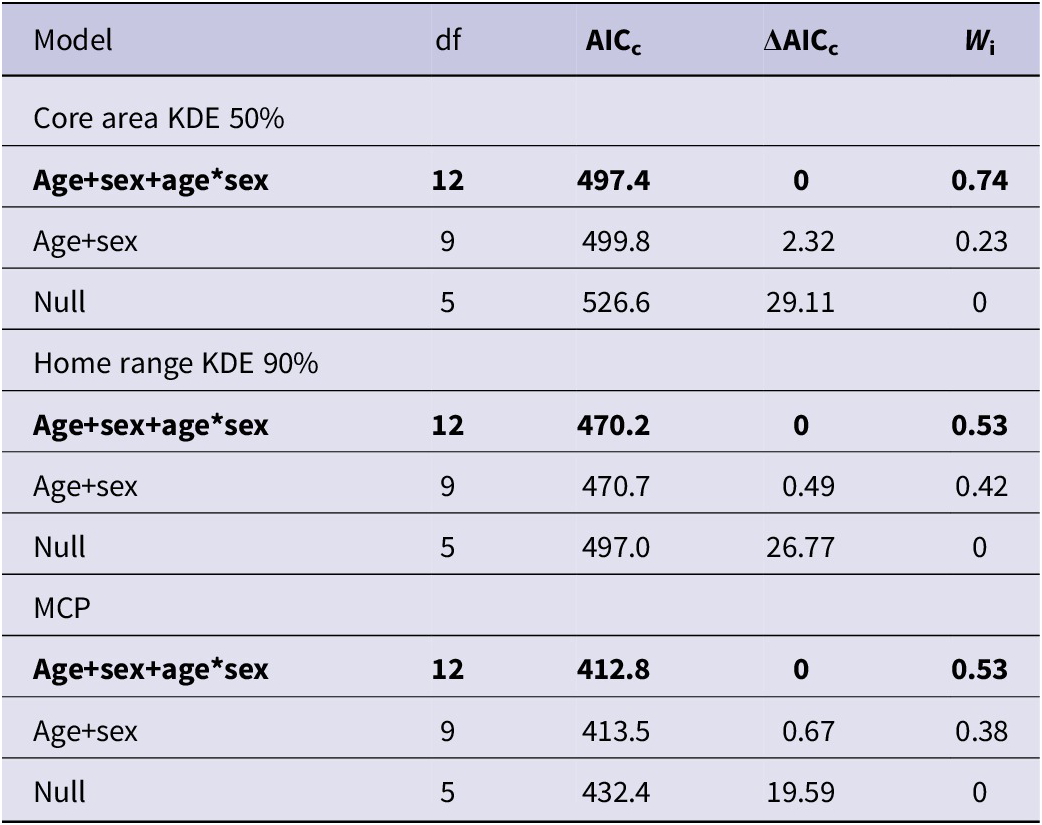
Birds in the reintroduced population of Cinereous Vultures in the Pyrenees exhibit large foraging areas encompassing the entire Iberian Peninsula and make dispersal movements into the Alps, southern France, and even the Balearic Islands (Table 1, Figure 1). The results of the selected model results showed that space utilisation (MCP), the home ranges (KDE 90%), and core areas (KDE 50%) were all influenced by age and sex (Table 2). Overall, the results indicate significant variation across the different age-classes (Tables 1, 3, and Supplementary material Table S1, Figure 2), with larger home ranges and core areas observed in subadults, followed by the other age-classes: KDE 90% young first year 11,513.03 km2, juveniles 12,478,94 km2, immatures 15,572.50 km2, and subadults 23,388.02 km2; KDE 50% young first year 2,793.04 km2, juveniles 1,848.46 km2, immatures 2,744.88 km2, and subadults 4,352.21 km2 (Table 1, Appendix S1, Figure 2). Regarding the MCP, the dispersal and exploratory movements of juveniles covered larger areas (95,273.16 km2), followed by subadults (60,720.97 km2), immatures (57,451.00 km2), and young first year (21,967.54 km2) (Table 1, Appendix S1, Figure 2). Furthermore, an individual’s sex was identified as an important factor, in addition to its interaction with age, and females had larger range areas than males (Tables 1 and 2, Figure 2). This was especially relevant in the case of young first year and subadults where females covered larger areas than males (Table 1, Figure 2). However, the interaction between sex and age was not significant (P >0.05, Table 3), displaying some variability across age groups and individuals.
Annual home range size (km2) of reintroduced Cinereous Vultures Aegypius monachus tracked from 2008 to 2020, according to the age-class and sex. The table shows the minimum convex polygon (MCP), 90% and 50% kernel density estimations (KDE), the number of birds per age-class (n), and the total number of annual home ranges analysed. All data show mean ± standard deviation (SD) in km2

AICc-based model selection to assess the effects of various factors on the home ranges of reintroduced subadult Cinereous Vultures Aegypius monachus in a study area in the Pyrenees (Spain). Only the models with ΔAICc <2 or the second ranked and the null model are shown. Selected models are in bold. AICc = corrected Akaike information criterion; KDE = kernel density estimations; MCP = minimum convex polygon
Results of the selected linear mixed models to evaluate how the minimum convex polygon (MCP) size, home range size kernel density estimator (90% KDE) and core area (KDE 50%) of the contour areas of individual Cinereous Vultures Aegypius monachus are affected by age (first year, juvenile, immature, or subadult), sex, and their interactions. The asterisks show statistically significant results

Map showing the differences in the use of space by the 51 monitored Cinereous Vultures Aegypius monachus from the Pyrenean population used in the analyses. The minimum convex polygon (MCP), home range kernel density estimation (KDE 90%), and core area (KDE 50%) are shown.

Example of spatial use change by age-class of two individuals (female on the left and male on the right) of Cinereous vultures Aegypius monachus, tagged at the nest, that reached adult age. (a) The minimum convex polygon (MCP); (b) the home range kernal density estimation (KDE 90%); (c) the core area (KDE 50%).

Movement parameters
The movement patterns of reintroduced pre-adult Cinereous Vultures were determined by age, sex, and season, and also showed interactions between sex and age, and age and season (Tables 4, 5, and Appendix S2, Figures 3 and 4). The results showed that all of the movement estimators analysed showed differences between age-classes (Table 6 and Appendix S2, Figure 3). Specifically, juveniles displayed greater accumulated daily distances and maximum displacements than the other age-classes, followed by immatures, subadults, and young first year in decreasing order (Table 4 and Appendix S2, Figure 3). Regarding the maximum daily dispersal, Cinereous Vultures spent longer periods away from their natal areas as they aged, with some individuals settling in locations far away from the Pyrenees (Figures 3 and 4). After the first year of life, juvenile vultures showed the highest annual dispersal distance (Table 4, Figures 2 and 3), and this distance gradually decreased until the subadult age-class (Table 4, Figure 3). These age-related differences were further modulated by season (Table 6, Figure 4), with all of the movement parameters generally showing greater values during the breeding season compared with the non-breeding season. Regarding all of the daily movement estimators, females generally moved further than males during the breeding season, and these differences were greater for the maximum annual dispersal, but depending on age (Figure 4).
Mean daily cumulative distance travelled per day (“cum dist”), maximum displacement per day (“max displ”), maximum daily dispersal (“max dispersal”), maximum annual dispersal distance (“dispersal”) by age-class, the number of Cinereous Vultures Aegypius monachus tracked (n), and the number of tracked days (days) by age-class. All data are presented as mean ± standard deviation (SD) in kilometres (km)

AICc-based model selection to assess the effects of various factors on the movements of subadult Cinereous Vultures Aegypius monachus in a study area in the Pyrenees (Spain). Only the best model and the second-ranked model with the null models are shown. Selected models are in bold. AICc = corrected Akaike information criterion

Results of the selected linear mixed models to evaluate how the daily cumulative distance travelled, maximum displacement, maximum daily dispersal, and maximum yearly dispersal of individual immature Cinereous Vultures Aegypius monachus are affected by age (first year, juvenile, immature, or subadult), sex, season, and their interactions. The asterisks show statistically significant results

Data and results (mean ± 95% CI) for movement patterns of the 51 subadult Cinereous Vultures Aegypius monachus monitored by age-class and sex. (a) Cumulative distance; (b) maximum displacement; (c) maximum daily dispersal; (d) maximum. annual dispersal.

Data (mean ± 95% CI) of the movement patterns of the 51 subadult Cinereous Vultures Aegypius monachus monitored by age-class and season. (a) Cumulative distance; (b) maximum displacement; (c) maximum daily dispersal; (d) maximum annual dispersal. Season refers to the phenological period of the species; non-breeding season (September–January) and breeding season (February–August).

Furthermore, interactions between age and sex were also observed, as indicated by the model results (Tables 5 and 6). Overall, female vultures tended to cover greater distances in all movement parameters compared with males across most age-classes, except during the immature stage (Table 4, Figure 3). Notably, a significant interaction between sex and season was only observed for the maximum daily dispersal (Table 6, Figure 4). Conversely, no interaction effects were found for the maximum yearly dispersal (Tables 5 and 6).
Discussion
Our findings advance our understanding of the hitherto practically unknown movement ecology of pre-adult Cinereous Vultures and the intrinsic factors (i.e. age, sex, and season) that influence their spatial ecology (but see García-Macía et al. Reference García-Macía, Álvarez, Galán, Iglesias-Lebrija, Gálvez and Plana2024; Jiménez and González Reference Jiménez and González2012; Reading et al. Reference Reading, Azua, Garrett, Kenny, Lee and Paek2020). Based on our MCP home range size estimates, reintroduced pre-adult Cinereous Vultures foraged over extensive areas (up to 95,000 km2 for juveniles). We also showed that an individual’s age was the most important factor determining both their range areas and their movement patterns (Tables 2 and 5, Figures 2 and 3). Similar to Bearded Vultures Gypaetus barbatus (Krüger et al. Reference Krüger, Reid and Amar2014; Margalida et al. Reference Margalida, Pérez-García, Afonso and Moreno-Opo2016), the home ranges and core areas of individual reintroduced Cinereous Vultures increased with increasing age, being larger in subadult individuals than those in the 1–3 years age-classes. These findings are inconsistent with those reported by García-Macía et al. (Reference García-Macía, Álvarez, Galán, Iglesias-Lebrija, Gálvez and Plana2024), who observed that the home ranges and core areas of Cinereous Vultures from different populations in the Iberian Peninsula decrease with age. However, comparing the results between the two studies is challenging, as García-Macía et al. (Reference García-Macía, Álvarez, Galán, Iglesias-Lebrija, Gálvez and Plana2024) estimated home ranges and core areas monthly, while in the present study, we estimated them annually. Additionally, their data come from different populations with a low number of individuals (4–11 vultures), so potential biases due to differences between each population are not ruled out (Fluhr et al. Reference Fluhr, Benhamou, Peyrusque and Duriez2021; Margalida et al. Reference Margalida, Carrete, Hegglin, Serrano, Arenas and Donázar2013). Considering the MCP, the exploited areas were larger in juveniles, with the minimum area covered found in birds during their first year of life. Young first year birds showed greater inter-sexual differences, with males exploring smaller foraging areas than females, which showed larger exploratory movements during the first year of life. This agrees with previous observations in the centre of the Iberian Peninsula (Jiménez and González Reference Jiménez and González2012), and also the dispersal movements observed during the second year, which sometimes exhibited several shorter exploratory trips, consistent with our observations of the greater distances travelled and larger MCP of juvenile vultures. The same movement pattern was evident in subadults, with notable inter-sexual differences in terms of movements and home ranges, with males exhibiting smaller ranges (Tables 1 and 4, Figure 2). During the subadult stage, females exhibited the largest foraging areas. Considering that some of the individuals monitored attempted their first breeding at this age (seven of the subadults), we would expect that an attachment to a breeding territory would reduce the foraging areas in this age-class. However, although a reduction in the movements and home ranges of these individuals was observed, these differences were not significant, probably because they were only firsts and unsuccessful breeding attempts. Accordingly, these findings suggest this behaviour could be explained by foraging experience that had identified distant food patches that individuals could visit regularly and/or that exploration could have identified potentially suitable breeding sites or partners before taking up a breeding territory (Holland et al. Reference Holland, Byrne, Bryan, DeVault, Rhodes and Beasley2017). These possibilities are supported by the significant effects of the interaction between age and sex, and the importance of season on dispersal-related estimators. These findings could explain the dispersal behaviour of vultures, particularly of females, who range over longer distances and spend more time away from the core breeding area (García-Macía et al. Reference García-Macía, Álvarez, Galán, Iglesias-Lebrija, Gálvez and Plana2024; Margalida et al. Reference Margalida, Pérez-García, Afonso and Moreno-Opo2016; Morant et al. Reference Morant, Arrondo, Sánchez‐Zapata, Donázar, Cortés‐Avizanda and De La Riva2023b; Serrano Reference Serrano, Sarasola, Grande and Negro2018). However, it is important to note that these movements do not align with the migratory patterns observed in this species in other regions (Kang et al. Reference Kang, Hyun, Kim, Lee, Lee and Hwang2019; Ramírez et al. Reference Ramírez, Elorriaga and de la Cruz2022; Reading et al. Reference Reading, Azua, Garrett, Kenny, Lee and Paek2020), although some individuals have been observed residing in distant locations for extended periods or have finally established themselves in the Massif Central (France) or the Balearic Islands (Figure 1).
Our findings suggest that pre-adult vultures increased their foraging distances and frequency of movement to coincide with their breeding period (spring and summer) (Figure 4). This could be attributed to the greater number of daylight hours and to more suitable atmospheric conditions for soaring flight (Hiraldo and Donázar Reference Hiraldo and Donázar1990). As in other large avian scavengers, the search for food resources (which are spatially unpredictable or widely dispersed) requires long-distance movements that are favoured by the convective thermals used for soaring flight, which are more frequent in warmer weather (Bohrer et al. Reference Bohrer, Brandes, Mandel, Bildstein, Miller and Lanzone2012; García-Macía et al. Reference García-Macía, Álvarez, Galán, Iglesias-Lebrija, Gálvez and Plana2024; Krüger et al. Reference Krüger, Reid and Amar2014; Mandel et al. Reference Mandel, Bildstein, Bohrer and Winkler2008). It is important to note that the autumn and part of the winter (the non-breeding season) largely coincide with the hunting season on the Iberian Peninsula, which provides an abundance of food resources for vultures (Morant et al. Reference Morant, Arrondo, Cortés-Avizanda, Moleón, Donázar and Sánchez-Zapata2023a). These resources are often concentrated at supplementary feeding stations, or in patches well-known to vultures and which can be located close to their core areas (Deygout et al. Reference Deygout, Gault, Sarrazin and Bessa-Gomes2009; Margalida et al. Reference Margalida, Pérez-García, Afonso and Moreno-Opo2016; Monsarrat et al. Reference Monsarrat, Benhamou, Sarrazin, Bessa-Gomes, Bouten and Duriez2013). In fact, non-adult Cinereous Vultures are more numerous at certain feeding sites during periods when adults are more scarce, probably to reduce intraspecific competition or to minimise the risk of starvation during the post-fledging period (Moreno-Opo et al. Reference Moreno-Opo, Trujillano and Margalida2015, Reference Moreno-Opo, Trujillano and Margalida2020). Their relative lack of foraging experience could favour their attachment to the predictable food resources of supplementary feeding sites (Montsarrat et al. 2013). This situation is particularly prevalent in the region occupied by the study population, where numerous supplementary feeding stations have been established for vulture conservation (Moreno-Opo and Margalida Reference Moreno-Opo and Margalida2014; Moreno-Opo et al. Reference Moreno-Opo, Trujillano and Margalida2015). Consequently, subadult vultures may be less mobile during this period of high and predictable patches of food availability (Deygout et al. Reference Deygout, Gault, Sarrazin and Bessa-Gomes2009; Reading et al. Reference Reading, Azua, Garrett, Kenny, Lee and Paek2020), which also coincide with less favourable atmospheric conditions for soaring flight and fewer daylight hours. In the case of subadult vultures, the observed increase in their movement during the spring–summer period (the breeding season) may also be influenced by breeding behaviour and interactions with and/or attraction to conspecifics in search of potential mates, vacant territories ready for occupation or the establishment of new territories by non-breeding individuals (Holland et al. Reference Holland, Byrne, Bryan, DeVault, Rhodes and Beasley2017; Morrison and Woods Reference Morrison and Wood2009). The energetic requirements of reproductive individuals are also higher during breeding prompting them to explore larger foraging areas, coinciding with the seasonal higher abundance of extensive livestock (Margalida et al. Reference Margalida, Oliva-Vidal, Llamas and Colomer2018).
This study provides crucial insights into the spatial ecology of Cinereous Vultures on the Iberian Peninsula, enhancing our understanding of the foraging ecology of this endangered species during the pre-adult period, and identifying priority areas for conservation and management actions (Katzner and Arlettaz Reference Katzner and Arlettaz2020). For example, the identification of patches visited regularly outside protected areas can allow managers and policymakers to adopt conservation measures on these more vulnerable sites. Additionally, the provided home ranges and movements, and both daily and dispersal movements, can contribute to a better design of future conservation actions for the species in this reintroduced population. This includes considerations for supplementary feeding sites, new release areas, and potential stepping stones to connect this population with other nearby populations (García-Macía et al. Reference García-Macía, Álvarez, Galán, Iglesias-Lebrija, Gálvez and Plana2024; Serrano et al. Reference Serrano, Margalida, Pérez-García, Juste, Traba and Valera2020). Furthermore, these findings will enable the assessment of the influence on the species of the creation of new areas of renewable energy infrastructure on the Iberian Peninsula, such as wind or solar energy farms (Pérez-García et al. Reference Pérez-García, Morant, Arrondo, Sebastián-González, Lambertucci and Santangeli2022; Serrano et al. Reference Serrano, Cortés-Avizanda, Zuberogoitia, Blanco, Benítez and Ponchon2021). In this sense, recent studies identified that food availability and conspecific presence were the main drivers of vulnerability and exposure to collision in wind farms in Iberian Griffon Vultures Gyps fulvus (Morant et al. Reference Morant, Arrondo, Sánchez-Zapata, Donázar, Margalida and Carrete2024). Therefore, these data provide new possibilities for the conservation of the Cinereous Vulture in this reintroduced population and can contribute to the management and conservation of other threatened Cinereous Vulture populations and reintroduced vultures worldwide.
In conclusion, this study demonstrates the relevance of behaviour to conservation, and how the insights gained from behavioural studies can be used to address conservation challenges (Berger-Tal et al. Reference Berger-Tal, Polak, Oron, Lubin, Kotler and Saltz2011; Blumstein and Fernández-Juricic Reference Blumstein and Fernandez-Juricic2010; Van Overveld et al. Reference Van Overveld, Blanco, Moleón, Margalida, Sánchez-Zapata and de la Riva2020). Our findings show significant variation in spatial utilisation and movement patterns among individual reintroduced Cinereous Vultures, with notable differences according to age and sex, as well as a strong influence of season. Generally, both range size and movements increased with age, and females exhibited larger ranges and covered greater distances across most movement estimators and age-classes. However, Cinereous Vultures also displayed considerable individual variability in range sizes and movement patterns. Season also emerged as a crucial factor influencing their movement, probably due to atmospheric conditions, availability of food resources in specific predictable patches, and the interactions between conspecifics during breeding or mate-seeking by subadult vultures, which exhibited the largest range sizes and distances travelled. Future investigations should focus on unravelling the movement ecology of adult Cinereous Vultures after their establishment following reintroduction or as new breeders, in order to compare the movement patterns of pre-adult and adult age-classes to complete our understanding of the behavioural ecology of this species, focusing on the significance of supplementary feeding stations, landfill sites, and habitat utilisation.
Acknowledgements
This work was partially supported by the Junta de Comunidades de Castilla La Mancha [SBPLY-19-180501-000138] and Ministry of Science and Innovation [PID2022-142328OB-I00]. J. T. benefitted from a postdoctoral contract (POSTDOC_21_00654) from the University of Cordoba funded by the Consejería de Transformación Económica, Industria, Conocimiento y Universidades of Junta de Andalucía through the grants program “Plan Andaluz de Investigación, Desarrollo e Innovación (PAIDI 2020)”. The authors would like to thank the Government of Catalonia (Department of Climate Action, Food and Rural Agenda). Association TRENCA, Foundation Catalunya-La Pedrera, and staff members from the Boumort National Hunting Reserve (RNC) for its promotion of the Reintroduction Programme for the Cinereous Vulture in the Catalan pre-Pyrenees (Sierra Boumort and Alinyà). The “Obra Social La Caixa” (via agreement with the Government of Catalonia), “Red Eléctrica de España” the Ministry for the Ecological Transition and the Demographic Challenge partially funded the project. The authors would also like to thank the Spanish autonomous regions of Extremadura, Catalonia, Andalusia, Madrid, Castilla-La Mancha, Valencia, Murcia, and Asturias. The Spanish Ministry of the Environment (MITERD) and TRAGSATEC provided technical support during the tagging with GPS and VHF transmitters. Thanks go also to the Catalonia Rural Agents, especially the “Grup Especial de Verins i Antifurtivisme (GEVA)”, the “Grup de Suport de Muntanya (GSM)”, and the “Unitat RPAS del Grup de Suport Aeri”. Special thanks go to the GREFA Veterinary, Rehabilitation, Rescue, Captive Breeding, Conservation, Informatics, and Communication Departments.
Supplementary material
The supplementary material for this article can be found at http://doi.org/10.1017/S0959270924000108.



