




The article aims to explain a kind of paradox related to the Russian institution of so-called national cultural autonomyFootnote 1 (NCA); the paradox is the combination of high domestic public demand for NCA with the full absence of its utilitarian ends and functions. On the one hand, NCA is a building block of Russia’s nationalities policy; the concept figures in numerous pieces of legislation including the 1996 Federal Law on national-cultural autonomy and the most recent guiding document – the Strategy of the State National Policy (Strategiya 2012). The NCA law is not a dead letter; it was repeatedly amended (the last time in 2022), although without drastic changes. The federal executive recurrently updates the rules of guidance, funding and supervision concerning NCA. The number of civic associations registered as NCA is steadily growing; the number of scholarly publications about NCA is growing too.Footnote 2 No surprise that Russian officialdom keeps praising NCA as a big achievement.
On the other hand, entities which have the status of NCA function among and on basically equal footing with other and more numerous ethnicity-based civil society organizations (CSO). The practical outcomes of NCA are meagre if existent at all. These organizations are neither a potential replacement nor a supplement to federalist arrangements; NCA has neither established cultural and educational institutions nor somehow affected public decision-making. Experts both inside and outside Russia recurrently conclude that the NCA legislation and policy have in some way failed (Bowring Reference Bowring and Nimni2005; Kalashnikov Reference Kalashnikov2020; Prina Reference Prina2016), and even Russian officials used to admit this (Federal’nyy Reference Federal’nyy2011).
Most observers who notice the gap narrate the situation as legal uncertainties, inconsistencies or manipulative tricks, thus by default acknowledging some intentionality and goal-oriented rationale behind the law. Some suggest that NCA was designed as a protective mechanism which has not worked out properly because of either a low-quality legislative technique or of flawed and reluctant implementation (Bowring Reference Bowring and Nimni2005; Torode Reference Torode2008). Some suppose that the law, on the other hand, aimed at curtailing minority rights and controlling minority activities (Prina Reference Prina2020; Reference Prina2021) or even at reducing the conflictual potential of ethnic federalism (Smith Reference Smith2021).
Such interpretations have their merits and can be grounded in some empirics, but they nevertheless leave questions behind. Truly, the law contains ambiguous formulations and inconsistencies, it provides limited rights for its supposed beneficiaries, and public authorities have recurrently interpreted it in a restrictive way (see Prina Reference Prina2016, 180–201). However, the issue at stake is that the very goals and rationales of the NCA concept and the law as such are under question as well as the lack of restrictive and disciplinary action to materialize the law’s declared or supposed aims.
The question is about the reasons for creating and maintaining a seemingly dysfunctional and/or purposeless ideological construction and organizational framework. This article aims at identifying the relevant actors, deconstructing their motives and intentions as well as explaining the reactions of target audiences. I am also going to offer an approach that would be applicable beyond the individual case in question and explain a rift between imaginaries and substantive relationships as well as between rhetoric and deeds with regard to ethnic diversity.
The Russian NCA case might be of scholarly interest beyond the modern history of Russia alone. Russia is one of the few countries where nonterritorial autonomy has been widely debated and employed in legislation as well as in diversity governance; this process went in parallel with similar discussions and motions in Eastern and Central Europe. Notably, some non-Russian (as well as countless Russian) researchers in the 1990s and even later referred to the 1996 NCA Law as a remarkable contribution to the advancement of nonterritorial autonomy for ethnic groups (Ghai Reference Ghai and Skurbaty2005, 41; Smith Reference Smith, Cordell and Wolff2011, 284; Suksi Reference Suksi2011, 63; Torode Reference Torode2008, 192).
Below, I will briefly introduce the ideas of nonterritorial autonomy and of NCA as its local version, outline the framework of simulative politics and suggest its applicability to the NCA case. I will further overview the adoption of the NCA law, describe the major features of Russian NCA and highlight the legal and political incoherences. Afterwards, I will consider the stakeholders’ rationalizations, ideational sources of and the possible reasons for the establishment of the NCA framework. Afterwards, I will introduce a case for the comparison and for justifying the relevance of the proposed explanatory perspective in a broader context.
Theoretical Approach
Nonterritorial autonomy
Below I regard nonterritorial autonomy and NCA as its version as categories of practice without sticking to any definite interpretation or model. The framework idea of nonterritorial autonomy is about the self-organization of ethnic groups beyond regular territorial government so that the achieved settings could perform public functions thus satisfying ethnic groups’ needs and interests (Eide, Greni and Lundberg Reference Eide, Greni, Lundberg and Suksi1998; Nimni Reference Nimni2007). The most prominent version is the idea coined at the turn of the 20th century by Austro-Marxists who called it “national autonomy” (in contrast to territorial autonomy) and “personality principle” (Bauer Reference Bauer2000; Renner Reference Renner and Nimni2005). Simply speaking, the idea envisaged the organization of “nations” (large ethnicities) as self-governing hierarchically organized corporations which must be based on recorded personal membership and run cultural and educational affairs (Nimni Reference Nimni2007). According to Austro-Marxists (and all further proponents of NTA), such arrangement must decouple specific ethnicity-based group interests from regular territory-based politics and thus forestall territorial claims and related conflicts.
The idea has been never implemented in full, and over the last century there have been few cases when merely individual elements came into being (Osipov Reference Osipov2021). In parallel, the concept has lost a clear meaning and demonstrated a “conceptual stretching” (Sartori Reference Sartori1970). Nonterritorial autonomy develops mainly as a bunch of normative or projective ideas; it has neither a commonly acceptable meaning nor definite substantive referents. However, the idea has gained currency as a desired remedy for ethnic conflicts over territory and a potential policy tool for satisfying minorities’ aspirations. Nonterritorial autonomy figures under different names in some national legislations, in some soft-law international instruments and – increasingly – in modern scholarly literature (see Andeva, Dobos, Djordjević, Kuzmany, and Malloy Reference Andeva, Dobos, Djordjević, Kuzmany and Malloy2023).
Autonomy’s linkages
The NCA case takes place at the intersection of three strands of public thought and practice. They are prone to creating gaps between speech and deeds, and the related considerations partly applicable to nonterritorial autonomy in general.
First, nonterritorial autonomy is about the conceptualizations of ethnic diversity; most versions of this framework idea rest on a “groupist” (for the term’s meaning see Brubaker Reference Brubaker2004, 11) vision of ethnicities as cohesive entities and actors. The discursive reification of ethnic groups being translated to practical politics cannot but conflict with empirical realities and lead to the creation and usage of tropes and imageries decoupled from or devoid of substantive referents.
Second, NCA was promoted and accepted against the backdrop of communist and particularly Soviet legacies in narrating, interpreting and handling ethnic diversity (Osipov Reference Osipov2013). Communist diversity policies involved a discourse of group rights and group entitlements (such as the right to self-determination and to development); concurrently, they presupposed a distance between official rhetoric and official action.
Third, the NCA framework was elaborated and then employed during Russia’s transit to market economy that could not but compel the society’s adaptation to neoliberal principles based on broad commodification and subjection of social relationships to the logic of market exchanges. The latter imply drastic changes in public-private relationships including the ideas of fostering bottom-up communal initiatives, the reduction of state obligations and new disciplinary techniques (Harvey Reference Harvey2005; Saad-Filho and Johnston Reference Saad-Filho and Johnston2005). Although neoliberalism seemingly promotes private initiative and economic freedoms, it tends to restrictive and repressive mechanisms aimed at guiding the behavior of market agents (Dean Reference Dean2019; Wacquant Reference Wacquant2009). Neoliberal framework presupposes governmental regulatory authority that facilities the “proper” market-oriented activities of appropriate agents, excluding those ones who do fit in the prescribed behavior in the market or public sphere (Chandler and Reid Reference Chandler and Reid2016; Lazzarato Reference Lazzarato2009).
These three strands are important for the analysis of autonomy arrangements and ethnic politics in general because they supposedly provide incentives and opportunities for creating public imaginaries (such as of a self-determining community, service or commodity provider, or a civil society initiative) decoupled from substantive referents for affecting the attitudes and behavior of target audiences and for seeking their support. Still, this perspective has been largely neglected in the literature, and the article addresses this gap.
Legitimacy
It is commonplace both for scholarship and the public that an idea aimed at social change and the organization promoting this idea must enjoy some degree of popular acceptance and support. Notably, a still influential current of so-called sociological institutionalism argues that social action is culturally dependent and is shaped by the “logic of appropriateness” or alignment with legitimate templates (Schmidt Reference Schmidt, Béland and Cox2011, 51–55). Although there is no uniform understanding of legitimacy of organization and its action, in a broad sense it can be defined as “a generalized perception or assumption that the actions of an entity are desirable, proper, or appropriate within some socially constructed system of norms, values, beliefs, and definitions” (Suchman Reference Suchman1995, 574). In other words, public acceptance follows from shared visions of the problem, its context and a desirable approach. In this regard, one may use the concept of Zeitgeist, or “a set of assumptions that are widely shared and not open to criticism in a particular historical moment” (Mehta Reference Mehta, Béland and Cox2011, 27). Assuming that organizations seek legitimacy, their compliance with public beliefs and values as well as broader Zeitgeist becomes a condition for the retention of the status position and more effective performance.
Simulation politics
Modern scholarship has included gaps between public representation and actions of organizations or public figures. Since long ago, scholarship has highlighted such phenomena as the “decoupling” of the external form and the substance of a social activity or organizational setting (Meyer and Rowan Reference Meyer and Rowan1977). The incongruences between substantive activities and their positioning before external audiences as well as between the activities of organizations’ different segments also termed as “systemic hypocrisy” (Brunsson Reference Brunsson1989) are in some way inevitable and caused by objective reasons since material action and public self-representation aim at different ends.
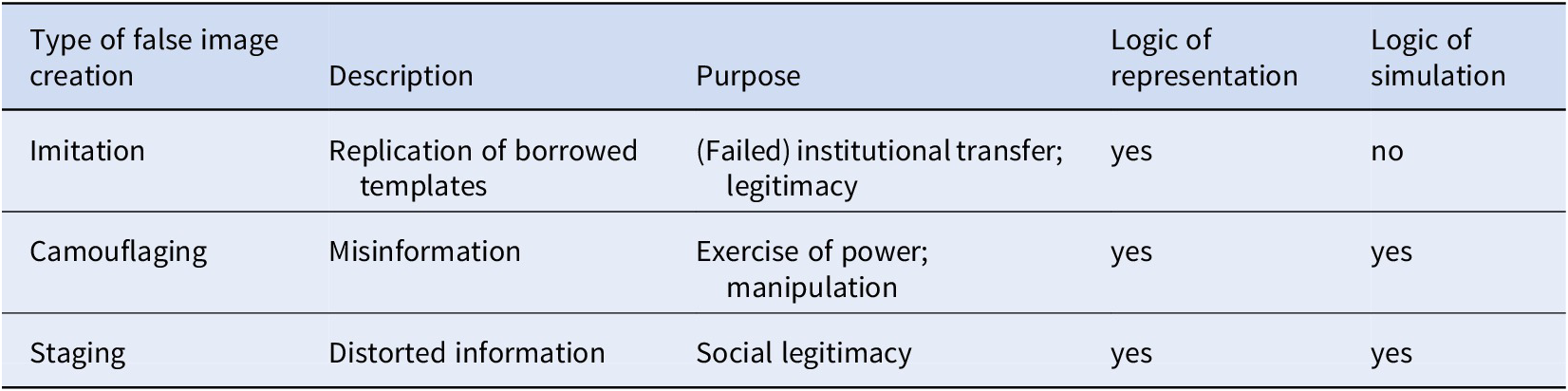
The creation of an image that mismatches actual performance and hides its reasons and ends can be of different character and have different motives behind. Such activities vary; related scholarly typologies and definitions vary too. For identifying the character of the activities related to NCA, I would suggest three ideal types of the gaps between action and image creation according to the purposes. The first one is imitation of some borrowed arrangement, institution or policy resulting in replicating the form but not the fully functional substance (Andrews, Pritchett, Lant and Woolcock Reference Andrews, Pritchett, Woolcock, Andrews, Pritchett and Woolcock2017; Farneti Reference Farneti2015). Imitation can be practiced bona fide or for the sake of creating a positive image. The second one (camouflaging) is aimed at exercising power over other people through misinformation (“window-dressing” or “smokescreen”). The third one (here I borrow the term “staging” from Pisano Reference Pisano2022) seeks organizational legitimacy before target audiences, or congruence between the social values associated with the activities and the norms of larger social system (Dowling and Pfeffer Reference Dowling and Pfeffer1975, 122). Such phenomena are widely spread since the organization’s appearance rather than actual performance suffices for attaining legitimacy (Berrone, Gelabert, and Fosfuri Reference Berrone, Gelabert and Fosfuri2009).
Modern scholarship also distinguished between two kinds of false image creation – based on the logics of representation and simulation (Luke Reference Luke1991; Weber Reference Weber1995). Images based on empirically existing referents follow the first logic; images based on non-existent entities and relationships the second one. The notion of simulation stems from Baudrillard’s concept of simulacrum – a sign without a substantive referent, a nomination, symbol or description that signify a non-existing or imaginary object (Baudrillard Reference Baudrillard1994). As Blühdorn writes, “simulation <…> is the use of symbols, signs and images which do not represent or refer to anything that is authentic, but which themselves produce or perform a reality, and present themselves as evidence of its authenticity.” (2007, 267). Of primary importance thus is the phenomenon of simulation policies which are aimed at demonstrating activities for the sake of demonstration and not at achieving any declared or hidden outcomes (Blühdorn Reference Blühdorn2007; Reference Blühdorn2013; Death Reference Death2011; van Ham Reference van Ham, van Ham and Medvedev2002).
Imitation by definition must stick to the logic of representation; camouflaging and staging can employ both. Potential combinations are placed in Table 1; however, this scheme cannot exhaust all scenarios that involve the dissociation of the form from the substance and does not assume that these scenarios are mutually exclusive.
Types of false image creation, intentions and logic behind
I intend to identify the kinds of decoupling NCA-related images from substantive social relationships (imitation, camouflaging or staging) through situational analysis by scrutinizing the adoption of the legislation in question as well as its further implementation and rationalization. The key task here is to trace the logic of image creation and identify it as representation or simulation; the concept of simulation is in the spotlight.
Empirical Basis
This study is based on archival search, the examination of parliamentary records, officials’ and other public figures’ policy statements as well as expert opinions concerning NCA in Russia in different periods. The legislative process is well documented, and the related materials are available in the State Archive of the Russian Federation (GARF). The outputs of the parliament’s lower chamber (the State Duma) concerning the drafting of the federal law on NCA in 1995-1996 (including the drafts and explanatory notes) are stored in Fund 10100, register 14, files 4685 and 4686 (GARF, f.10100, op. 14, d. 4685 and 4686). This period’s communication of the Russian Government on the same matter is reflected in Fund 10200, register 5 (GARF, f.10200, op. 5, d. 2599, 2600, and 2601). The records concerning the alternative draft law on national-cultural associations (1995) are in Fund 10100, register 1 (GARF, f.10100, op. 1, d. 1235 and 1361). The full transcripts of the parliamentary plenary discussions on the draft law and further amendments are in open access on the website of the State DumaFootnote 3 and the governmental legal database.Footnote 4 The proceedings of the major roundtables and expert meetings on NCA issues have been issued as separate printed editions (Federal’nyy Reference Federal’nyy2011; Vstrecha Reference Vstrecha2002) or available online (Stenogramma Reference Stenogramma2007). Finally, opinions of the relevant public figures and experts have been published in Russian media and academic periodicals.
The Adoption of the Russian NCA Law: Timeline and Context
The Russian Empire, or precisely, its Jewish public figures of the early 20th century, gave rise to the term “national-cultural autonomy” that has ultimately penetrated even Anglophone academy (Nimni Reference Nimni2005). Both some liberal thinkers and social democrats (the Jewish Worker’s Party Bund) sought to avoid the insulation of the Jewish community and to decouple the protection and promotion of the Jewish identity from the community’s inclusion into broader societal and political life (Gechtman Reference Gechtman2007; Rabinovitch Reference Rabinovitch2014, 15–78); in part, these searches were inspired by Austro-Marxist ideas of national autonomy. The solution looked at limiting the scope of national autonomy to culture; hence the term NCA.Footnote 5 The radical social democratic current (later known as Bolsheviks) headed by Lenin was against all kinds of autonomy including in the workers party and vehemently attacked the NCA ideas as a manifestation of nationalism and thus detrimental for the cause of the working class (Lenin Reference Lenin1913/1973).
After the 1917 Bolsheviks takeover, Lenin’s and Stalin’s writings against cultural autonomy became part of the communist ideological canon. The Soviet people were familiar with the NCA concept because critical remarks about the idea were an obligatory mantra in all writings about autonomy or broader nationalities issues (see Kutafin Reference Kutafin2014, 724–726). The Soviet nationalities policy rested on ethnicity-based territorial autonomy and ethnic federalism (Brubaker Reference Brubaker1996; Roeder Reference Roeder, McFaul and Stoner-Weiss2004) – the ideas that Lenin and the Bolsheviks appropriated after coming to power. The Soviet liberalization of the late 1980s brought about the criticism targeting the territorialization of ethnicity – the backbone of the already compromised communist nationalities policy – and the praising of cultural autonomy as a perspective but erroneously rejected solution (Codagnone and Filippov Reference Codagnone and Filippov2000, 271–272; 275–276). The dominant term since then has been the already commonly known “national-cultural autonomy”.
Conversely, NCA as a promising solution from the late 1980s became a commonplace for mainstream legal scholars (Lazarev Reference Lazarev1990), public opinion leaders (Popov and Adzhubei Reference Popov and Adzhubei1988) and even the still ruling communist party (Rezolutsiya 1990). From 1991 on, NCA and similar concepts even appeared in the major official constitutional draft of the Russian Federation (Rumyantsev Reference Rumyantsev2007, Vol.2, 566, Vol.3, 82, Vol.4, 206, 359, 373), alternative drafts and several pieces of Russian legislation.Footnote 6 There was a drastic increase in scholarly and journalistic publications about NCA (Guboglo Reference Guboglo1995, 114–115).
Surprisingly, there was barely a demand for NCA from the grassroots. Organizations of dispersed minorities and “non-titular” groups at large (such as ethnic Russians in the federation’s constituent republics) did not publicly raise the issue of cultural autonomy or make related claims. There were a few exceptions of claim-making or labeling the already existing organizations as “autonomies” in the late 1980s – early 1990s, but they were short-lived and mainly went unnoticed (Bowring Reference Bowring2007, 426–427; Osipov Reference Osipov2004, 73–74).
From 1992, the federal executive bodies in charge of nationalities policy were promoting the formula of “shifting the accent” (or the “center of gravity” in some versions) from ethnic federalism to cultural autonomy (Codagnone and Filippov Reference Codagnone and Filippov2000, 276; Guboglo Reference Guboglo2000, 202–204). Russian officials were concerned about the supposed political and social marginalization of “non-titular” ethnicities in Russia’s republics. These anxieties surfaced even in the Presidential Address to the Federal Assembly in February 1994. President Yeltsin expressed his worry about the division of some republics’ population into “autochthonous” vs “non-autochthonous” and the restriction of the latter’s rights (Poslaniye Reference Poslaniye1994, 49–51). As a remedy, he suggested the self-organization of dispersed groups into the structures of “national-cultural autonomy”. A year later, in his 1995 Address, Yeltsin reiterated the idea, speaking about the self-organization of “peoples” and about “self-government” through “national-cultural associations” (Poslaniye Reference Poslaniye1995, 82).
The 1994 Address was the ground for the government’s assignment for the Ministry of Nationalities Affairs about the elaboration of a law on NCA. The ministry took the task on but then for some reasons suspended the draft. Some members of the newly elected lower chamber of the federal legislature – the State Duma – decided to compile and launch their own bill partly using the job already done. This updated draft, done mainly by a group of experts – academics and retired bureaucrats – literally was not about autonomy, but “national cultural organizations” (GARF, f.10100, op. 1, d. 1235). It envisaged a hierarchy of civil society entities representing individual ethnicities and established at the local, regional, interregional and federal levels. The organizations were authorized to engage in cultural and educational activities and to seek public funding for these purposes. The authors explained the reasons that the term “autonomy” was dropped was that this word allegedly meant some public character of the related organizations and their embeddedness in the state machinery. Instead, the drafters aimed at the “de-etatization” and thus depoliticization of ethnicity and relied instead on the self-organization of individuals beyond governmental structure.
The parliamentary bill was not adopted for procedural reasons; in October 1995, the Government submitted an updated draft law on national-cultural autonomy that was almost identical with the preceding versions of the MPs including the emphasis on ethnic groups’ self-organization in the framework of civil society (GARF, f.10100, op.14, d.4685, 4686). The word “organizations” was again replaced for “autonomy”. The text envisaged three levels of NCAs established from ground up at the local, regional, and federal levels, the scope of operation limited to the issues of culture, language and education, and optional public funding under unspecified schemes.
The draft was enacted in June 1996 and became Federal Law “On National-Cultural Autonomy”.Footnote 7 Since then, the law’s main principles and provisions have remained basically intact. In two following sections I compare the functioning of the law and its outcomes with the representations – justifications and rationalizations routinely voiced by the lawmakers and public figures. This juxtaposition may illuminate the logic behind the law’s design and implementation mode.
Functioning, Context and Outcomes: What Russian NCA Is and Is Not
The federal law on national-cultural autonomy employs the concept of NCA in two meanings: as a general principle and as a type of organization (and therefore NCA is referred to as a kind of organizational entity below). The law defines NCA as social non-profit organization which is to represent an individual group and is to be based on voluntary but formally recorded individual membership. Such organizations are to be established exclusively on a bottom-up basis. Local (functioning within a municipality or a low-level administrative entity) civil organizations (the law employed the term in plural, and that means more than one CSO) of a certain ethnicity can establish a local NCA; local NCAs of a certain ethnicity can set up a regional NCA within a federation unit, and regional NCAs can form the federal NCA (and the law assumed only one federal NCA per ethnic group). “National-cultural” clearly means non-political; NCA could engage only in activities concerning culture, language and education. The law envisages the right of public authorities to fund NCA but has not specified the order and scope of this funding, in fact leaving it to authorities’ discretion.
There have been several amendments, and the major one concerned the scope of right-holders. While initially all ethnicities could establish NCA, since 2003 this entitlement concerns only “groups in a situation of minority within a respective territory”. The law does not specify what “minority”, “situation” and “respective territory” mean. Other amendments slightly altered the founding procedures, changed the bodies in charge of official registration, narrowed and then widened the opportunities for public funding (barely used in practice notwithstanding). Starting from 2009, the list of allowed activities has been extended and included charities and the support to the integration of migrants.Footnote 8
Generally, NCAs are civil society organizations without any public competencies and guaranteed public support. Nevertheless, the number of NCAs has been steadily growing. There were 255 by 2000 (ACFC 2000, 16) and about 790 by 2011 (Zorin Reference Zorin2011, 21). On November 25, 2024, there were 1,144 registered NCAs within Russia’s internationally recognized borders, of them 22 federal, 267 regional and 855 local organizations representing several dozens of ethnicities.Footnote 9
Neither the NCA law nor a broader idea of NTA is a replacement to ethnic federalism or a policy tool aimed to undermine or transform it.Footnote 10 Since the very beginning of public discussions about nonterritorial autonomy in the early 1990s there has been a wide consensus among public officials, scholars and activists that NCA was a supplement to ethnic federalism (Guboglo Reference Guboglo2000, 202–205). Indeed, there were some experts who insisted that the abolition of ethnic-territorial entities in favor of NCA would be politically adoptable (Vdovin Reference Vdovin1994), but these views were truly marginal.
The State Duma members who voted for the NCA law also did not regard it as even a device easing the transition from ethnic federalism. Federica Prina noted that the enactment “was situated within a security context” “to pre-empt claims for regional autonomy (or potentially separatism)” (2021, 12). However, it was not fully correct: according to archival records, parliamentary and governmental paperwork related to NCA contained a few references about the need to depoliticize minority issues by shifting them to the civil society domain (GARF, f.10100, op. 14, d.4686, l.23–24, 75, 144). The NCA draft law was debated and adopted in the State Duma at the first hearing on November 22, 1995,Footnote 11 and there was only one query that linked NCA with federalism or territorial claims. The MP Boris Khangeldyev asked whether the introduction of NCA would require constitutional amendments since NCA might be a public law institution on equal footing with federation entities. The answer of the deputy minister on nationalities affairs was “no”, and the issue was closed.Footnote 12 No questions concerning the future of territorialized ethnicity arose during later discussions on the NCA draft law or further amendments.
Republics within the Russian Federation did not object to the NCA law as such and did not look at it as a threat to their status. Few regions (republics and provinces on equal footing) criticized the draft NCA law for alleged interference in the regions’ competences or, conversely, for its too narrow scope (GARF, f.10100, op.14, d.4685, l.135-136; f.10200, op. 5, d. 2600, l.7–21). The leadership of the Republic of Bashkortostan opposed the very term “autonomy” rather than the law’s conception, but so did the “non-ethnic” city of Saint Petersburg. Bashkortostan’s own act on national cultural organizations of 1998 that was a blueprint of the federal law clearly confirmed this. Finally, NCA was never employed as a ground for the federal government’s claims against Russia’s regions or a tool of pressure. Moreover, in no way was the idea that figured in the 1994 presidential Address – the idea of empowering NCAs financially and politically as a counterbalance to the domination of titular ethnicities – ever implemented in any degree.
NCA has not been a tool to centralize minority governance and put it under bureaucratic control. Indeed, the law envisages only one federal autonomous entity per ethnic group; a decision of the Russian Constitutional Court of 2004 (Postanovlenie Reference Postanovlenie2004) extended this principle to regional NCAs, and in practice, parallel NCAs of the same group are not allowed at the local level.Footnote 13 However, the law does not establish any operational subordination of low-level NCA entities to the higher tiers; moreover, local NCAs have no duty to be members of the regional NCA, and regional NCAs may refrain from joining the federal organization. What is even more important, ethnic groups are not obligated to form NCAs; ethnicities can establish social organizations of other types. In practice, the government has never compelled ethnicity-based ordinary NGOs.
NCA as such is barely an instrument to restrict minority rights since it is not the only form of ethnicity-based civil society organization. Indeed, ethnicity-based associations have been under increasing pressure and stricter control of the authorities partly justified by security considerations, the promotion of common civic identity, and the desire to de-ethnicize political life (Prina Reference Prina2020; Smith Reference Smith2021; Yusupova Reference Yusupova2022). The NCA law and its very title were clear messages that ethnic issues should be out of politics and political contestations, but the de-politicization of ethnicity concerned all kinds of organizations and is achieved by other means of control and persuasion. Other non-governmental structures have neither experienced discrimination vis-à-vis NCAs nor have been pressurized to rearrange themselves into NCAs or join the already formed NCAs. Surprisingly, ordinary non-profit organizations (such as “social organizations” (obshestvennye organizatsii) based on recorded membership, social movements or social funds) have the same and in some cases more rights under Russian law (including the opportunity to seek and obtain public funding) than NCAs and face fewer burdens concerning establishment, operation and reporting.
NCA do not enjoy exclusive entitlements or functions to support minority, diasporas or other ethnicities. More precisely, NCAs operate in line and in the same manner as other CSOsFootnote 14 without guaranteed funding or regular and effective participation in decision-making or other public affairs. Such activities take place, with regard to resource support on the basis of short-term grants, but NCAs neither enjoy advantages nor face specific hurdles. Even officials used to publicly acknowledge that public funding for NCA was barely visible (Stenogramma Reference Stenogramma2007, 6, 20; Vstrecha Reference Vstrecha2002, 8).
To sum up: NCA is a kind of civil society organization; there can be other types of ethnicity-based CSOs; NCA is in a worse position than ordinary CSOs in terms of restrictions on operations and more burdensome procedures of foundation; NCAs enjoy no guarantees of public financing or other support and no special functions or entitlements; there is no obligation for minority groups to establish NCAs or to join them; NCAs do not enjoy preferential treatment vis-à-vis other types of organizations. NCAs do not figure as policy tools, particularly targeting ethnic federalism; symptomatically, there was no opposition of “ethnic” regions to the adoption of the NCA law. The impracticality of the very framework is on the surface; what was it for then?
It would be erroneous to judge Russian NCA as camouflaging, or a fraud, or a departure from minority rights standards, or a negligence of some canonic models of autonomy. There were no clear promises concerning minority protection in the course of the NCA law’s enactment except for general wording about “national development” and “equal opportunities for all nationalities” (GARF, f.10100, op. 14, d. 4685, 4686). Similarly, there are no clear signs that this entire development qualifies as imitation, or of an ineffective borrowing of an external model. By the mid-1990s, international minority rights standards were vague;Footnote 15 besides, there is no universally acceptable template of nonterritorial autonomy. Its most prominent version – that is, the idea of Austro-Marxists of the early 20th century – was not a reference point for Russian lawmakers (Osipov Reference Osipov2004, 76–86; Prina Reference Prina2020, 309).Footnote 16
Image Creation and Justifications
During the elaboration and after the adoption of the NCA law the drafters and a number of Russian officials extensively commented and explained the law’s operational scheme and rationales. Official and expert arguments concerning NCA also circulated before the law’s drafting process as well as years later; they are still in use. The multiplicity of statements, interviews and papers issued mainly by Russian officialdom and also by mainstream experts and ethnic leaders reveals several steady lines of interpretation and justification that are listed below.
(1) NCA as self-organization and self-determination of groups. The law itself is not very clear in this regard; it speaks of “national-cultural self-determination” without specifying the right holder but refers to “citizens belonging to a certain ethnic group”. The bill’s Explanatory Note referred to NCA as a framework for the “self-organization of peoples” and for their “self-governance” as well as a device for securing groups’ “national development” (GARF, f.10100, op.14, d.4686, ll. 23-24, 75-76). The drafters of the law and the spokesperson of the Nationalities Ministry explicitly talked about the cultural self-determination and self-organization of ethnic groups during the second hearing of the law;Footnote 17 official figures did similar comments afterwards (Abdulatipov Reference Abdulatipov1999; Bauer Reference Bauer1999).Footnote 18 In the same vein, the 2004 Decision of the Constitutional Court stated that NCAs embodied groups as such and differed from “ordinary” CSOs by their entitlements to represent ethnicities and to receive public funding (see Postanovlenie Reference Postanovlenie2004). This attitude explains why the government from the very outset wanted to allow only one NCA per ethnic group within a certain territory; the provision dropped from the initial governmental draft law of October 1995 but returned and came into being as the 2003 amendment (see Osipov Reference Osipov2004, 82–83, 93–97). As regards later scholarly comments, most straightforwardly declare that NCA are the embodiment of and an organizational shell for group self-determination (Fomichenko Reference Fomichenko2005; Gerasimova Reference Gerasimova2007; Samoilenko Reference Samoilenko2008).
(2) NCA as voluntary association of citizens. The drafters of the law and then official commentators used to stress that free individuals and only individuals make decisions about their ethnic affiliation and participation in NCA. The mainstream regularly points out that no one can impose this choice on an individual, and individual rights are the priority. The Explanatory Note to the NCA draft law (which actually did not change from the first to the last hearing) clearly stated that NCA emanates from bottom-up private individual choice and initiative (GARF, f.10100, op. 14, d. 4686, l.23-24, 75). NCA is thus a civil society organization beyond state machinery; state interference in civil society affairs would be illogical and counter-productive (Zorin Reference Zorin1996, 12).Footnote 19 Surprisingly, such statements go in parallel with the ideas of NCA as group self-determination. The lawmakers and further commentators also did much not to regard NCAs and ethnicity-based regions on equal footing although both types are rhetorically addressed as forms of self-determination (Federal’nyy 2011; Vstrecha Reference Vstrecha2002).
(3) The need of minority recognition through a high symbolic status. This view that the very label of “autonomy” and the very existence of a separate law are guarantees of state support is shared and widely used by official and non-state actors (see Prina Reference Prina2020). For example, in a letter to Russia’s deputy prime-minister dated May 1995, a deputy minister of nationalities affairs criticized the alternative draft of the MPs on “national-cultural organizations” (almost identical to the governmental draft on NCA) on the grounds that civil society organizations would not provide guarantees for minorities while “autonomy” (also a CSO) would (GARF, f.10200, op.5, f. 3667, l.9-11).
(4) The need of special state control. An argument is that NCA albeit a voluntary civil society formation arguably needs governmental overview and legal regulation. The state is obligated to control NCA, define the right holders, the scope of operation, organizational forms and the procedures establishment, and forestall activities contradicting the rationales of the law (Abdulatipov Reference Abdulatipov1999; Khabrieva Reference Khabrieva2003, 109–116; 165–177).Footnote 20 This approach explains why the government in 2003 outlawed multi-ethnic NCAs and NCAs established on behalf of local or regional ethnic majorities and why the lawmakers were slow and reluctant to extend the scope of NCAs’ allowed operation within two decades after the law’s enactment. A part of this restrictive attitude to NCAs is its depoliticization or barring them from engagement in politics by legal means. The desire to regulate NCA also manifests itself in the officialdom’s and experts’ numerous invectives against ethnic entrepreneurship or engagement in NCA for financial or political ambitions (Abdulatipov Reference Abdulatipov1999, 5; Bauer Reference Bauer1999, 14–15; Zorin Reference Zorin2003, 262). For example, a chair of the State Duma Nationalities Committee Valentin Kuptsov (Federal’nyy Reference Federal’nyy2011, 7) and a councilor of the Ministry of Culture Alexander Pozdniakov made such statements at a roundtable in Duma (Federal’nyy Reference Federal’nyy2011, 71, 79–80). A “genuine” NCA must be preoccupied with cultural affairs proper as officials or mainstream experts point out (Federal’nyy Reference Federal’nyy2011, 72).
(5) The government’s obligations and responsibility. Despite item 4, the state bears no direct responsibility for the sustainability and functionality of NCA; it provides only for the framework. No version of the draft law specified any clear obligations and mechanisms of public funding. The Explanatory Note stressed that the law would not cause any additional financial burden for the government and that the funding would be provided from an unspecified “consolidated budget” (GARF, f.10100, op.14, d.4686, l.78-79; f.10200, op. 5, d. 2599, l.68-69). Surprisingly, the drafters in parallel wrote and talked about “state support and guarantees” for NCA (GARF, f.10100, op.14, d.4686, l. 27-28, 75-76, 147-148).
The law in effect contained and contains vague formulations concerning public funding; they can be interpreted in both ways – as the obligation or the right of the executive to support NCA. In some cases, when the officialdom seeks to underline a special status of NCA as a kind of group self-determination, it recognizes state obligations (as did the Constitutional Court in 2004). In more numerous instances, official spokespersons acknowledge scarce or absent public funding (Federal’nyy Reference Federal’nyy2011, 70; Stenogramma Reference Stenogramma2007, 6, 20; Vstrecha Reference Vstrecha2002, 8) but call on NCAs to get rid of “dependency” and “sponging” and insist that they need to earn money themselves (Federal’nyy Reference Federal’nyy2011, 53, 69–70).
(6) Fairness. The claim is that the NCA law and policies aim at ensuring justice. The latter, according to the Explanatory Note, and not political or security considerations, was the major explanation behind the draft law (GARF, f.10100, op. 14, d. 4686, l.23-24, 75) and further of the law proper (Petrova Reference Petrova2008, 8–10; Zorin Reference Zorin2011, 20). Arguably, the law provides for the self-organization of groups that for some reasons cannot benefit from ethnicity-based statehood or are in a minority position within a certain territory. The principle of justice manifests itself in individuals’ right to organize themselves on ethnic basis and in “fair” restrictions on this self-organization to minorities only. The issues of resource redistribution and particularly of the funding sufficiency was discussed neither during the enactment of law nor in course of its implementation.
To wrap up, in the state’s view, as civil society organizations, NCAs must be built exclusively on bottom-up basis starting from individual citizens and their local “communities”; hence the complex and burdensome procedure of establishment. NCA was thus designed for empowering civil society and excluding “ethnic entrepreneurs” with business or political ambitions. The existence of local “communities” was presupposed, and they were to be represented either by local CSOs that further found an NCA (up to the 1996 version of the law) or at least by the meeting of local dwellers (as the 2003 version in force envisages). Accordingly, local communities united in NCAs were to establish regional NCAs, and regional NCAs – the federal organization. In parallel, NCA is deemed as a form of self-determination for a distinct group as such; hence the idea of encouraging the hierarchy of organizations and their pyramidal structure. The assumption that the legitimate public interests of ethnic groups concern only culture and language leads to restrictions upon the organization’s scope of operation.
The major conclusion that can be drawn from summarizing the mainstream justifications is their incoherence as well as partial incompatibility among themselves and with empirical realities. Similarly to the design, functions and outcomes of the law, the justifications and explanations leave no chance to detect a political rationale, achievable goals or an attempt to create a workable mechanism. Again, one can hardly presume a camouflaging-style plot with hidden goals or an imitation of a borrowed model. In turn, the mainstream narratives operate simulacra, such as local ethnic communities, self-determining “peoples” and self-sustainable civil society seeking to “develop” ethnic cultures.
Discussion
The law itself and the official perceptions of the law and the desired NCA policy can be explained as a mechanic combination of the local stakeholders’ explanatory opinions listed above. In particular, this clarifies the seemingly weird and illogical conception of NCA. As mentioned, the feckless use of group rights terminology, such as “self-determination”, “sovereignty” of ethnic groups, “national development” [in the meaning of ethnic] can be traced back to the Soviet vocabulary (Brubaker Reference Brubaker1996; Roeder Reference Roeder, McFaul and Stoner-Weiss2004). The transfer of Soviet terminologies and tropes to post-Soviet environments turned out to be almost seamless (Codagnone and Filippov Reference Codagnone and Filippov2000; Malakhov and Osipov Reference Malakhov and Osipov2023). In parallel, most messages coming from the NCA law and from its commentators fit in a neoliberal repertoire. Neoliberalism urges bottom-up self-organization and discourages social obligations of the state. It welcomes local communities and civil society organizations as market players and service providers which can at least partly substitute for the state (Hale Reference Hale2002; Jenson and Levi Reference Jenson, Levi, Hall and Lamont2013; McNeish Reference McNeish2008).
Among the drafters of the MPs proposition on “national-cultural organizations” and then of the NCA law were well known Soviet academics including legal theorist Grigori Atamanchuk and ethnologist Mikhail Guboglo (GARF, f.10100, op.1, d.1235, l.29; f.10200, op. 5, d.2599, l.13-14). Their publications and statements do not allow to suspect that they were familiar with the debates about the neoliberal turn of the 1980s–1990s and even knew what neoliberalism was. Rather, the major simplified perceptions and related buzzwords that came to the Soviet Union after its opening became part of first of elite discourse and then of public common sense.
Popular rhetoric of democratization, de-etatization and deregulation fit in this outlook (Hemment Reference Hemment2004; Henderson Reference Henderson2003; Verdery Reference Verdery1996) also assuming the need to put an end to paternalism and “free meal-ticket mentality”.
Despite the unclarities in meaning (Kumar Reference Kumar1993; Jensen Reference Jensen2006), “civil society” was and still is a popular mantra in post-communist area (Verdery Reference Verdery1996, 104–105) including Russia (Sungurov Reference Sungurov2018). In the early 1990s, the political and academic mainstream appropriated and widely used the concept as a magic formula for democratic transit (Ljubownikow, Crotty and Rodgers Reference Ljubownikow, Crotty and Rodgers2013, 154–155; Salmenniemi Reference Salmenniemi and Purdue2007, 23). The government employed it too – I would remind of the presidential Addresses to the Federal Assembly (Poslaniye Reference Poslaniye1994, 32–33; Poslaniye Reference Poslaniye1995, 101–102). The ideas of initiating and orchestrating the building of a “genuine” civil society from above (given that drivers of change other the government were barely visible) were also spread (Henderson Reference Henderson2003, 41–49; Salmenniemi Reference Salmenniemi and Purdue2007, 24). The premises and principles of the NCA law thus followed from that time’s common-sense perceptions, and the latter were in line with global shifts (Sending and Neumann Reference Sending and Neumann2006; Rosenau Reference Rosenau, Held and McGrew2002).
Three things are particularly notable. First, official statements and expert publications demonstrate no reflections concerning the law’s internal contradictions, such as the freedom of civil society organization based on individual choice vs heavy formal restrictions; self-determination vs clumsy organizational forms imposed from above; and the value of ethnic cultures plus the need to secure their “development” vs the lack of state obligations. Second, there was no bottom-up demand for the very framework of NCA during the elaboration and adoption of the law. The supposed beneficiaries of the law have kept silent about the law’s deficiencies and on the contrary used to demonstrate positive attitude emphasizing the high symbolic status of the law and the NCA framework. Third, the government did little, as shown before, to implement any of these provisions in practice. One can rather talk about the law as a list of wishes and opinions, although formal guidelines and restrictions to a certain degree impede ethnic organizations’ activities.
The entire NCA framework has been mainly a business of state bureaucracy, some policymakers and scholars with a passive role of minority spokespersons and activists (Osipov Reference Osipov2004; Prina Reference Prina2020). The background, capabilities and activities of the people partaking in the elaboration of the law are easily traceable; besides, one should keep in mind the competition between at least two groups of official drafters in 1995-1996. There is no room for a suggestion about deliberate camouflaging – a conspiracy aimed at hiding the curtailment of minority rights and the dismantling of federalism. Likewise, there are no reasons to interpret the NCA policy as imitation that failed. There was no working model to imitate and no incentives or pressures to borrow any ideas or arrangements from the outside.
The only plausible reason for the undertaking is the desire to demonstrate activity before peers and superiors. This activity followed as well as was guided by Zeitgeist or commonly acceptable beliefs, perceptions and discursive forms. The suggestion that all stakeholders simulated constructive activities for maintaining their personal status and organizational legitimacy ideally explains the process and its outcomes.
Academics who contributed to lawmaking confirmed their credentials as public figures and experts in ethnopolitics. The members of the State Duma and the officials from the Ministry of Nationalities Affairs demonstrated their competence and capabilities. Ethnic activists got a chance to show homage to the state which they ultimately depended on. Numerous scholarly commentators increase the number of their publications without engaging in controversies or conflicts. All the stakeholders displayed their loyalty to the rules of the game: the dominant discourse, the established power hierarchies and to the values of the broader society. All these tasks did not require the elimination of logical contradictions. There has been also no demand for substantive activities aimed at consistent implementation of the law’s conception. Securing advantages of NCAs before other organizations, the creation of a genuine centralized hierarchy of organizations of different territorial levels, the provision of public support and so on have been redundant. The imaginaries and the very rhetoric of self-determining nationalities suffice; moreover, a consistent implementation would involve burdens and losses as well as related responsibilities.
To conclude, the adequate explanation is that the NCA framework applies to simulacra. Indeed, organizations registered as NCA do exist, but the notion self-organizing ethnic “communities” and the very idea of their internal affairs and “cultural development” have no substantive referents. Therefore, the NCA law and related activities qualify as a search for organizational legitimacy as well as personal status maintenance through a simulation policy.
Paradoxically, the NCA case can be regarded in terms of power relations not a top-down imposition of certain agendas and rules but rather as the stakeholders’ consent based on shared common-sense assumptions and tropes. The NCA framework is not about forcing the subordinates (ethnic spokespersons) to comply. As a manifestation of common sense and Zeitgeist, it contributes to societal cohesion and communication related to ethnic diversity. In this sense, it would be erroneous to regard the NCA law as a failure.
An Analogue
In this section I will argue that nonterritorial autonomy and related debates can be approached as staging and simulation politics beyond the considered and truly specific individual case. The labels of “cultural autonomy” or “self-government” in the meaning of nonterritorial autonomy are already in use across Europe, and reportedly there are discrepancies between the naming and the content. There are two most relevant geographical areas: Scandinavia with the Saami councils and Central and South-East European countries with elected minority coordinative and representative bodies. These entities are legally entitled to seek public funding, to run cultural and educational institutions and to participate in decision-making concerning their constituencies (for an overview see Malloy, Osipov and Vizi Reference Malloy, Osipov and Vizi2015; Vizi, Dobos and Shikova Reference Vizi, Dobos and Shikova2021). In fact, these entities serve primarily as publicly elected consultative bodies (Dobos Reference Dobos, Smith, Dodovski and Ghencea2023; Falch, Selle and Strømsnes Reference Falch, Selle and Strømsnes2016; Smith Reference Smith, Smith, Dodovski and Ghencea2023; Yupsanis Reference Yupsanis2019) also capable of running short-term cultural projects of their own or in cooperation with the government. The bottom line is that in no case do self-governments despite their high profile significantly differ from ordinary CSOs and embody a self-sufficient and sustainable system that takes over responsibility for minorities’ educational and cultural affairs save overall decision-making on minority issues.
Here I refrain from a broad comparison and look over only one case, presumed the closest to the Russian one, and this is cultural autonomy in Estonia. The Estonian approach looks different from the Russian NCA in terms of prehistory, political context and the proposed institutional design. A closer look nevertheless reveals parallels.
In between two world wars, Estonia was one of the few countries (or even the only one) that implemented the ideas of NTA. The 1925 Law on Cultural AutonomyFootnote 21 backed by a constitutional provision allowed the creation of autonomous entities based on registries of national minority members. The law referred to three listed minorities (Germans, Russians, and Swedes) and other ethnicities of not less than 3,000 people and endowed these groups with the right to cultural autonomy. Minority members enrolled by municipalities and included into the minority voters list, could form a “national minority self-government” (which became a public law entity on equal footing with municipal bodies) and elect the governing council. A minority self-government was authorized to run the given minority’s schools and cultural affairs and to get public funding for these purposes (Smith Reference Smith2016). In fact, only Jews and Germans formed cultural self-governments which functioned until the Soviet occupation of 1940; other groups were late because the law was suspended in 1934, after the coup and authoritarian turn (Poleshchuk Reference Poleshchuk, Nimni, Osipov and Smith2013, 152).
In 1988, during the Soviet liberalization, Estonian national movement revived the idea of cultural autonomy for minorities (Lagerspetz Reference Lagerspetz2014, 7). After the reinstatement of independence, the 1992 constitution included a provision about minorities’ right to cultural autonomy, and the 1993 Law on Cultural AutonomyFootnote 22 seemingly reintroduced the old pre-war scheme of minority self-government. This scheme rested on the registries of the historic minorities (Jews were added to the list) and of the groups outnumbering 3,000 people and on minority councils elected by minority voters.
Some details, however, have drastically changed the conception. The law does not say a word that minority self-governments and their governing bodies are legal entities. In fact, they are not, and thus they, albeit possessing a specific symbolic position, are not able to operate finances, directly obtain public or any other funding, and establish or run other organizations (Lagerspetz Reference Lagerspetz2014, 2, 12; Poleshchuk Reference Poleshchuk, Nimni, Osipov and Smith2013, 156–157). The government reserves the right to approve minority registries, and public funding for minority institutions and activities was and still is not guaranteed. Besides, non-citizens cannot be members of cultural self-governments whereas a large part of people belonging to the largest – Russian – minority does not hold Estonian citizenship. Minority self-governments are therefore redundant as an institution since “ordinary” non-governmental organizations can run the same businesses within engaging in complex and burdensome establishment procedures. In 1996–2011, at least four times some Russian minority CSOs tries to establish a Russian self-government but in all cases the government refused to recognize the registry under a variety of pretexts (Lagerspetz Reference Lagerspetz2018). In 2004 and 2007, the government ultimately facilitated the creation of the self-governments of Ingrian Finns and Swedes; however, these minorities’ activities have been mainly carried out through the already existing CSOs (Poleshchuk Reference Poleshchuk, Nimni, Osipov and Smith2013).
The most important thing here is the official and mainstream explanations of why the government needed a dysfunctional institution. First, there was a strong restorationist discourse, or extensive references to the return to the golden age (Aidarov and Drechsler Reference Aidarov and Drechsler2011, 47–48; Smith Reference Smith, Williams and Sfikas1999). The 1993 law allegedly signified this return to the “normality” of the previous national independence period, and few people noticed that the content of the law was totally different. Second, the government cared about a positive international image of the country (Aidarov and Drechsler Reference Aidarov and Drechsler2011, 46–47; Lagerspetz Reference Lagerspetz2014, 3).
Third, the country’s political mainstream consistently and explicitly follows neoliberal principles (Aidarov Reference Aidarov2015, 22–23, 25). The government was not supposed to bear any responsibility before minorities and to patronize them; minorities as a part of civil society were expected to care about themselves and to raise money for this. Accordingly, the government could and should have helped those citizens and communities who strived to help themselves to behave as proactive market players and be self-sufficient. In this perspective, the government was allowed and even obliged to make a choice and promote (and accordingly approve) only the “right” actors. Fourth, quite predictably, there has been a strong discourse of control and securitization intertwined with majority nationalist aspirations, and this combination explains the non-registration of Russian self-governments (Aidarov and Drechsler Reference Aidarov and Drechsler2011, 51–52; Lagerspetz Reference Lagerspetz2014, 14–15).
Conclusion
The considered case – the Russian federal law on national-cultural autonomy of 1996 and the practices of its (non)implementation and public justification – is a bright example of a rift between the form and content of a social phenomenon and, in a narrower perspective, between image creation and substantive action. The law turns out to be a compilation of socially acceptable albeit partly contradictory propositions and statements that serve the purpose of creating a picture of a well-intentioned policy based on progressive and universally acceptable principles. The social and political context at the time when the law was adopted and in later periods allows to exclude any conspiracy such as an attempt of the government or an interest group to achieve purposes different than the declared ones and to camouflage this intention. There are also no reasons to talk about failed imitation of a certain model. The sufficient explanatory scheme fits in the conception of staging as simulation politics aimed at merely demonstrating constructive and socially acceptable activities. These undertakings serve the purpose of maintaining organizational and personal legitimacy of the stakeholders as competent policymakers, experts or civil society activists who follow and promote a progressive agenda. The situation shall be regarded not as a unilateral simulation performed by the stronger actor – the government – but rather as a multilateral interaction of the stakeholders equally accepting the communicative mode.
There are reasons to regard this case not as a stand-alone isolated situation but rather an example of a broader trend and a widely spread phenomena of gaps between “talk” and “action” in ethnopolitics where modern Zeitgeist requires compliance with certain requirements and principles of narration and action. The first kind of pressure comes from group-centric vision of social reality and the imaginaries of “communities” allegedly seeking self-determination and the protection of their “identity”. The second one is the modern neoliberal thought that includes the promotion of bottom-up communal self-organization, the negligence of public sector’s responsibility for society’s well-being, and the need to increase the government’s regulatory power for encouraging, channeling and facilitating activities only of appropriate market players. Power relations in this context shall be regarded at first place not as coercion or manipulative techniques emanating from some governing center but rather as a shared rationality and shared discourse. From this perspective, a further analysis between the symbolic and substantive as well as the identification of the mechanisms behind them must be productive.
Disclosure
None.

 Open access

