




Introduction
There is a growing demand for humanitarian aid around the world (Anheier et al., Reference Anheier, Krlev and Mildenberger2018; UNHCR, 2018a). The civil war in Syria, as well as violence in Afghanistan and South Sudan, has created an unprecedented number of displaced people, with over 68.5 million globally displaced people (UNHCR, 2018b). In the last few years, there have been increasing numbers of migrants, refugees, and asylum seekers (MRAs) arriving in Europe (UNHCR, 2018b). Since the end of the EU's mandatory refugee relocation scheme in September 2017, more than 50,000 refugees remain stranded in Greece, where they will most likely remain (UNHCR, 2018a; International Rescue Committee, 2019). This has placed increasing pressure on an already struggling Greek economy (International Rescue Committee, 2019).
Recently, the aid sector has become interested in how humanitarian innovation can help (Betts and Bloom, Reference Betts and Bloom2014; Corsini et al., Reference Corsini, Aranda-Jan and Moultrie2019). In Europe, a small but growing number of humanitarian makerspaces are being established to support MRAs and local populations. It is hoped that these makerspaces can support bottom-up design, in which people can use resources to develop solutions to meet their own needs (Betts et al., Reference Betts, Bloom and Weaver2015). These initiatives reflect a general shift in the humanitarian sector, away from providing aid to empowering people to create their own solutions (ibid). Importantly, this trend positions refugees as agents of change rather than powerless victims (Long, Reference Long2001; Easton-Calabria, Reference Easton-Calabria2015).
Despite the growing number of humanitarian makerspaces in Europe, there is little understanding of their impacts, particularly from the perspective of beneficiaries (Corsini and Moultrie, Reference Corsini and Moultrie2018). Among very few related studies, Stickel et al. (Reference Stickel, Hornung, Aal, Rohde and Wulf2015) explore the potential for 3D printing with marginalized children in a Palestinian refugee camp. They find that 3D printing supports self-expression and collaboration; however, they focus mainly on the technological barriers of using 3D printing in the humanitarian sector. Wharton et al. (Reference Wharton, Arabian, Levin, Wyne, Altman, James and Taylor2018) provide some initial recommendations for operating innovation labs, based on practitioner experiences in Syria, Jordan, Turkey, Greece, and Germany. Dittert and Katterfeldt (Reference Dittert and Katterfeldt2018) observe that digital fabrication can be used to support self-expression in refugee youth. Whilst this literature suggests the potential of humanitarian makerspaces, there remains sparse evidence of their impacts. Furthermore, there is little understanding of how the design of these spaces will ultimately influence their outcomes.
In response, this study analyses three humanitarian makerspaces that support MRAs in Greece. It provides much-needed evidence of the impacts of humanitarian makerspaces, and documents the challenges and enablers which limit and advance their work. Importantly, this study highlights the perspectives of beneficiaries (people who use the makerspace including MRAs and local populations), in order to evaluate how humanitarian makerspaces meet their needs. It also focuses specifically on the European context, which has largely been overlooked by refugee studies to date (Betts et al., Reference Betts, Bloom and Weaver2015).
This paper is structured in the following way. First, we explain the methods used. Second, we reveal their desired and actual impacts in six key areas. We underline some of the enablers that help to achieve these impacts. Third, we identify the challenges which are limiting progress, highlighting the need for an enabling ecosystem in both the local and humanitarian context. Finally, in our discussion, we highlight how the design of these spaces are naturally related to their outcomes. We draw on theories of participatory design to emphasize that both the makerspace and the designs created within them are the outcomes of user-driven design.
Method
Case study selection
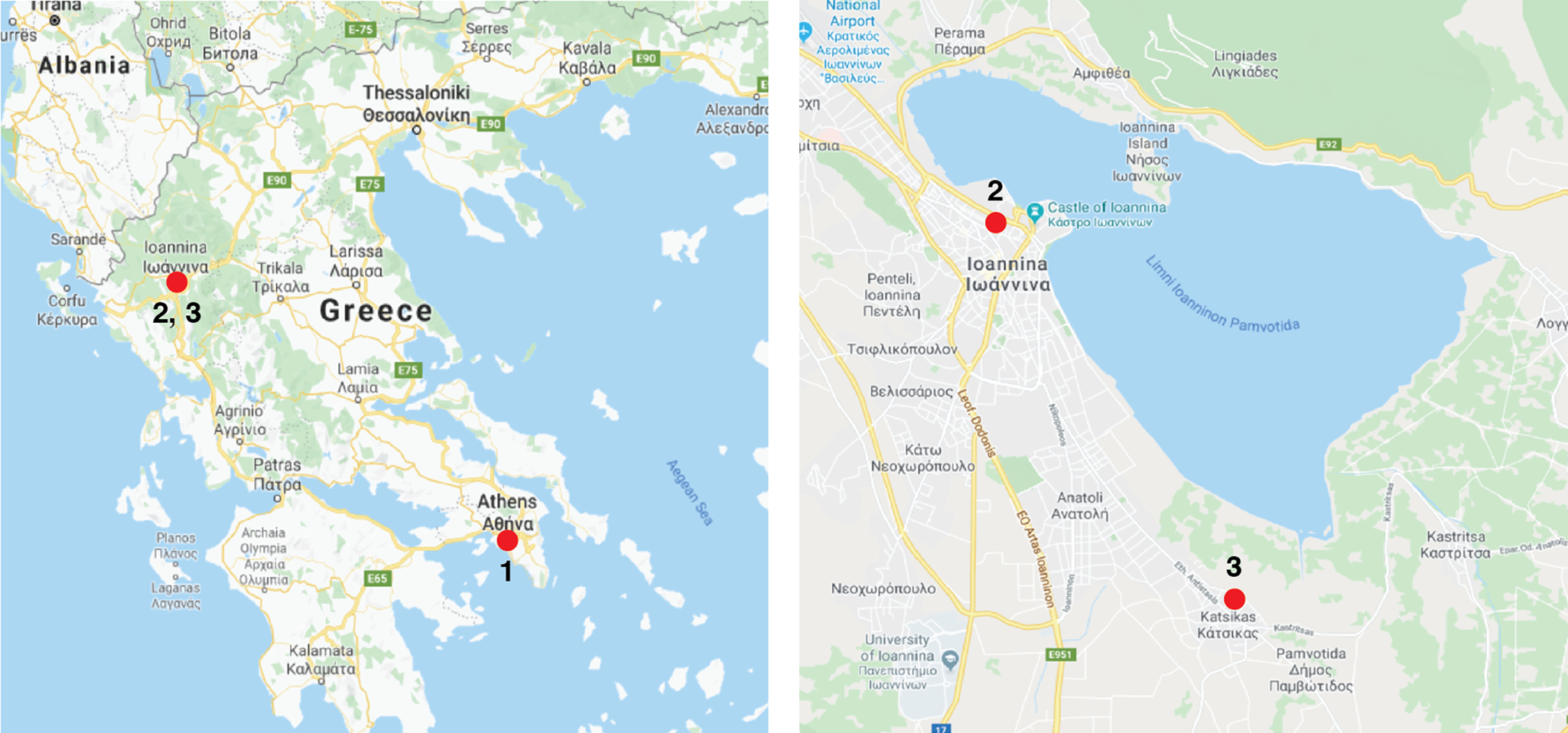
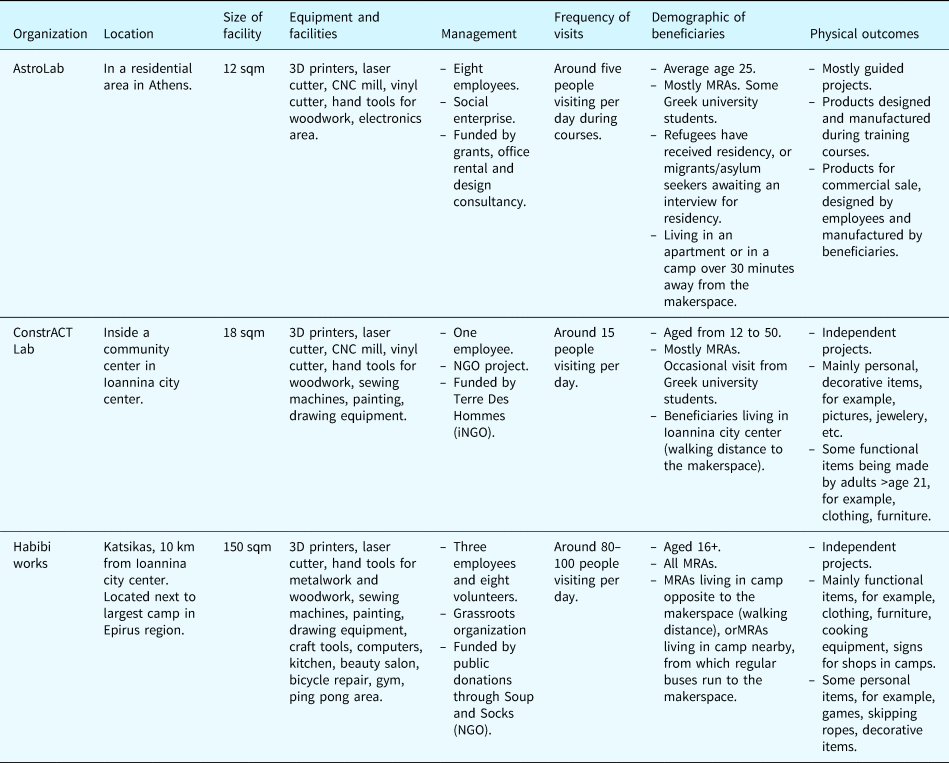
A multiple-case study approach was selected to provide detailed examinations of real-world phenomena (Yin, Reference Yin2018). It was decided to choose case studies that reflected a diversity of contexts, within a particular country. As such, we selected three case studies in Greece, as this offered the potential to study humanitarian makerspaces in the following contexts: inside a large city; inside a small city; and next to a refugee camp. These case studies were selected from a list of humanitarian makerspaces in Europe, identified through online searches and word of mouth. Figure 1 shows the exact locations of the makerspaces in Greece. Appendix Table 1 provides an overview of the case studies.
Locations of the makerspaces: 1. AstroLab, 2. ConstrACT Lab, and 3. Habibi Works (Imaged adapted from Google Maps).
Data collection
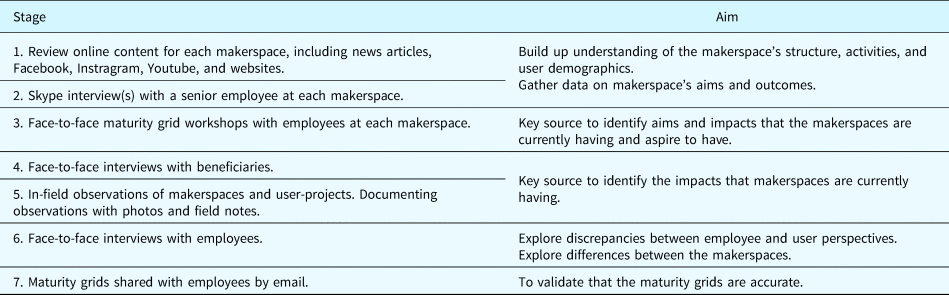
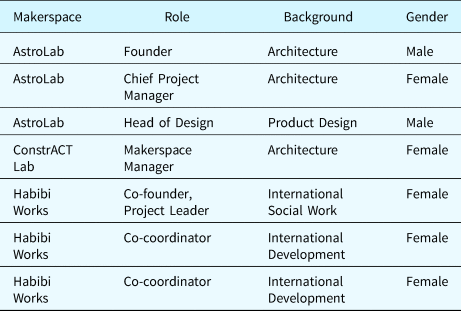
Multiple data sources were reviewed in order to gather rich insights on the makerspaces (see Table 1). The first author traveled to Greece for 2 weeks to conduct in-field observations and to interview beneficiaries and employees at the makerspaces. Additionally, a 60–90 min workshop was held with employees at each makerspace. Details of the workshop participants can be found in Appendix Table 2.
Stage and aim of data collection
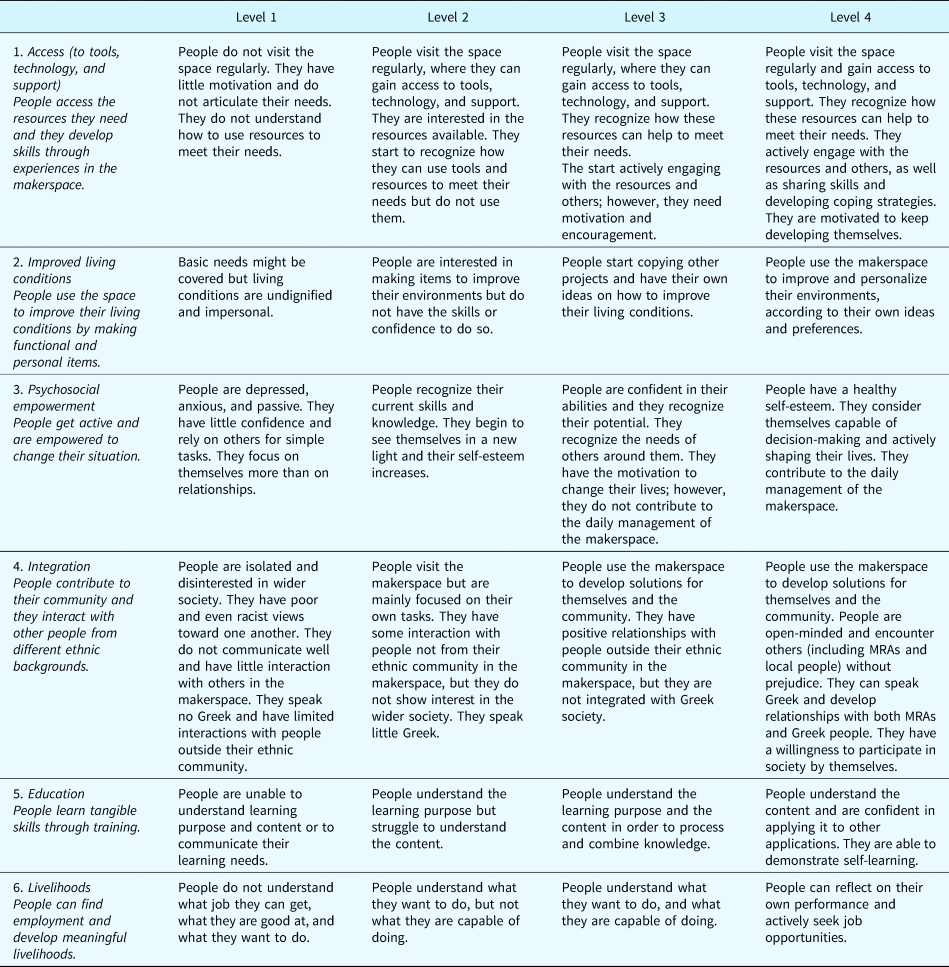
The workshop used a maturity grid tool for data collection. A maturity grid “consists of a series of cells where levels of maturity are allocated against key aspects of performance or key activities. An important feature of a maturity grid is that it provides descriptions for the characteristic traits of performance at each level” (Maier et al., Reference Maier, Moultrie, Clarkson, Buono, Grossmann, Lobnig and Mayer2011). As such, they help to elicit different perspectives, stimulate reflection, guide decision making, and identify areas for improvement (Maier et al., Reference Maier, Moultrie and Clarkson2012). This approach was chosen in order to evaluate the aims and impacts that humanitarian makerspaces are currently having and aspire to have.
During the workshop, the participants were informed of the aims of the workshop. Blank templates of the maturity grids were printed on A3 for the participants to work on. The maturity grid was explained to the participants and examples for how to complete them were shown. The participants were then asked the write down the key impacts that their makerspace offered MRAs and local populations. Taking each impact, in turn, the participants were asked to describe the scenario that reflected the greatest positive impact (level 4), and the scenario that reflected the least impact (level 1). The participants were also invited to describe the intermediary scenarios (levels 2 and 3). For each impact, in turn, the participants were asked to reflect on the factors that supported progression to higher levels of impact and the factors that limited progression. Participants were also asked to score the impact of the makerspace according to the level that reflected the current reality. Audio recordings of the workshop were reviewed to validate and include any additional points, which were not captured physically on the grids. These maturity grids were shared with the participants via email after the workshop to provide participants with an opportunity to add any other points.
Data analysis
The three maturity grids were compared to identify similarities and differences, in order to create a generic maturity grid. To start with, the desired impacts of each makerspace were compared and similar concepts were combined. For example, the desired impacts “psychosocial empowerment” and “improved mental health” were combined to form “psychosocial empowerment”. The impacts “integration”, “first steps of integration”, and “participation in society” were combined to form “integration”. This resulted in six desired impacts of humanitarian makerspaces (see Table 3). The maturity grids from each workshop were then synthesized to create new maturity levels, from one to four, as part of the combined maturity grid.
In order to evaluate each makerspace against the new maturity levels, data triangulation was used (Olsen, Reference Olsen, Haralambos and Holborn2004). Data was analyzed and compared from three main sources: (1) maturity grids and scores defined in the workshops; (2) interviews with employees and beneficiaries; and (3) in-field observations at the makerspace. All the interviews were transcribed verbatim and imported into MAXQDA. The transcripts were coded using the six impacts defined above. Particular attention was paid to the beneficiaries’ interviews, in an attempt to validate the claims made by the employees at the makerspace. Based on these three sources of information, a new score for each makerspace was defined. The challenges and enablers identified were also compared across the case studies. The challenges were grouped thematically to produce the final set of factors. Even if a factor was only mentioned once, it was considered important because of the small number of cases studied reviewed. Table 2 provides an overview of the data analysis stages and aims.
Stage and aim of data analysis

Results
Table 3 shows the final maturity grid that resulted from this study. It reveals six areas of impact that humanitarian makerspaces aspire to have. However, we find that different types of makerspace prioritize different impacts. Our study draws attention to the difference between workshop-makerspaces and training center-makerspaces. Workshop-makerspaces (e.g., ConstrACT Lab and Habibi Works) are spaces that focus on providing open access to tools and technology, and nurturing relationships in the community. They encourage open-ended, exploratory design. On the other hand, training center-makerspaces (e.g., AstroLab) adopt a skill- and employment-based approach, using technology and tools as a means to facilitate specific training and learning outcomes. They support more guided design projects.
Combined maturity grid for humanitarian makerspaces
Our findings show that workshop-makerspaces are largely focused on the following impacts: (1) access (to tools, technology, and support), (2) improved living conditions, (3) psychosocial empowerment, and (4) integration. Whereas, training center-makerspaces are focused on (4) integration, (5) education, and (6) livelihoods, with a lesser focus on (3) psychosocial empowerment. Figure 2 highlights the difference between types of humanitarian makerspaces and their desired impacts. It also indicates the actual impacts of the case studies in this research.
Desired and actual impacts of humanitarian makerspaces.

Impacts of humanitarian makerspaces
Access (to tools, technology, and support)
For ConstrACT Lab and Habibi Works, access is viewed as both a means and an end. By providing access to resources, it is believed that beneficiaries will pursue their own goals. The desired outcome is thus a scenario in which beneficiaries are able to access and actively engage with the resources available. Getting active is considered to be an important and necessary part of access; the resources inspire people and provide them with the opportunity to change their circumstances. The possibility for learning, as an indirect outcome of access, is also highlighted by the makerspaces. Rather than learning for the sake of learning, beneficiaries acquire new skills by working on projects.
“Here we have the machines. If you are the type to do anything, if you come here, you must do something. Like yesterday, I made something to stand my phone. It's in my apartment now. When I came yesterday I felt relaxed, but I decided I must do something.”–Beneficiary 1 at Habibi Works
Whilst traditional makerspaces mainly focus on providing access to making, humanitarian makerspaces offer a much more holistic provision of resources. In humanitarian makerspaces, access to social support (e.g., advice, mentoring) plays an important role alongside access to tools (e.g., 3D printers, sewing machines, etc.) and technology (e.g., WiFi, IT). We found that in both ConstrACT Lab and Habibi Works, beneficiaries benefited from accessing different types of resources. Some beneficiaries visited the makerspaces regularly to make things using the tools available, whereas others visited the makerspace to access different resources. For example, we observed that one beneficiary visited ConstrACT Lab for help editing his CV and used the internet to search and apply for jobs. We also spoke with beneficiaries who visited Habibi Works daily to use the WiFi to complete online training courses in English and coding.
In general, we observed that adults aged over 25 tended to use one or two tools in the makerspace, which they were already familiar with (typically craft tools or non-digital tools). Beneficiaries aged less than 25 were more likely to access a wide variety of tools, including those that they had little or no experience of using. To encourage beneficiaries to engage with the facilities, employees at the makerspaces provide support and mentoring, introducing beneficiaries to the tools that they are most comfortable with using first. This provides beneficiaries with a manageable way of exploring new tools and technologies.
Living conditions
Improving the immediate living conditions of beneficiaries is a key aim for ConstrACT Lab and Habibi Works. The makerspaces allow beneficiaries to make items that they need, which are often overlooked by aid agencies. In Habibi Works, several women were making curtains for their containers in the camp. Many of the female MRAs wear headscarves in public for religious reasons. Without curtains to provide adequate privacy, many women were wearing headscarves even when inside their home, limiting their comfort. This example highlights how beneficiaries are often best placed to meet to their own needs and to determine what they need to make, rather than relying on aid agencies to provide what they think beneficiaries need.
Many other examples of beneficiaries making functional items, such as furniture, cooking equipment, and clothing, were observed. One beneficiary at ConstrACT Lab described how the makerspace allowed him to create warm, comfortable clothing for himself.
“So when I came, I felt cold and I didn't have money. So I see this space, and I ask ‘is it possible to make something here?’ They say ‘yes, if you have anything you can come and use the machines’. So I knew nothing about sewing. I just had the idea and I fixed it. It's not supposed to be something to sell, it's something just to cover my body when I feel cold.”
–Beneficiary 1 at ConstrACT LabMakerspaces also allow beneficiaries to improve their living conditions and express themselves through the production of meaningful items. They are able to personalize their living environments and create a sense of home. Many beneficiaries at both ConstrACT Lab and Habibi Works were seen using the laser cutter to engrave photos, poetry, or verses from the Quran. One beneficiary was proud of vinyl stickers, which he had made to customize his clothing and to create posters for his accommodation. He also explained that the only items he had from his country of origin were two necklaces, one of which he had lost. He was able to use the 3D printer to create a new version of the lost necklace, and this evidently resulted in great satisfaction.
“I had a necklace, I lost it. And every day I think to make a necklace … So today I came and I tried to make this necklace again. And it took a little bit of time and now it's ready.”
–Beneficiary 2 at ConstrACT LabIn this area of impact, ConstrACT Lab and Habibi Works are making some of the most progress. Reflecting on this, employees identified that providing mentoring and support, and inviting experts to run inspirational workshops were important drivers for impact. Furthermore, sourcing materials according to beneficiaries’ requests was also considered important. When the beneficiaries were asked what they would improve about the makerspaces, they often requested more access to materials and tools. Habibi Works found that setting project budgets w also necessary to ensure equal access to resources. Alongside these recommendations, setting up the spaces in an open layout encourages people to see and learn from others to get inspired.
Psychosocial empowerment
All the makerspaces studied are in some way empowering beneficiaries and challenging the humanitarian model of dependency. For AstroLab, improving people's mental health is not a direct aim, but something that they consider to be a corollary to the positive changes that take place in beneficiaries’ lives, as they acquire skills and seek employment. For ConstrACT Lab and Habibi Works, psychosocial empowerment is a goal that underlies all their work. They encourage people to recognize their own potential and capacity to change their own lives. Many of the beneficiaries interviewed described how the opportunity to do things themselves restored a sense of self-worth and confidence.
“I have my own passion to sew my own clothes, it's to be my own model. For me I feel good when I wear clothes that I sew myself. I'm the designer.”
–Beneficiary 1 at ConstrACT LabSeeing themselves in a new light, many beneficiaries also recognized how they could contribute to the wider society.
“Like here, if you bring some clothes for people to sew for you, they will say ‘no, you have to do it by yourself’. Instead they will teach you the technical know-how for you to do it yourself. Because tomorrow you might even buy a machine … You will feel good, you will not beg people ‘please do this or that’. It makes someone strong”
–Beneficiary 1 at Habibi WorksFor many people visiting ConstrACT Lab and Habibi Works, the makerspace provides a safe space to relax and to find a purpose. Many of the beneficiaries expressed how visiting the makerspace helped to alleviate their boredom and frustration.
“In the camp, a lot of people are depressed and disappointed. They need a place to stay, to use some facilities.”
–Beneficiary 2 at Habibi Works“When they [Habibi Works] are closed, everybody gets mad. When they take a weekend, nobody knows how to spend the day.”
–Beneficiary 3 at Habibi WorksFor some MRAs, access to the makerspace allows them to cultivate a sense of normality through continuing to practice an interest that they had prior to arriving in Greece. For example, one beneficiary at ConstrACT Lab was previously an artist in Syria, and since arriving in Greece, he had painted many scenes of his boat journey to Greece. He came to ConstrACT Lab, so that he could learn new skills and create digital art work. In this way, makerspaces provide the opportunity for people to express themselves according to their own interests, offering a great sense of fulfillment.
Psychosocial empowerment is also related to the active involvement of beneficiaries in the makerspace. As beneficiaries recognize their own potential, they see themselves as capable of making decisions and shaping their environments. Although beneficiaries in ConstrACT Lab were mainly reliant on the makerspace manager for the daily management of the space, and in Habibi Works, many beneficiaries took on a more active role and contributed to the space in a variety of ways. For example, people were proactive about suggesting new ideas, they took responsibility tidying and cleaning the space, they helped build the makerspace and they maintained the allotment.
Integration
All the makerspaces identify integration as a key area of impact; however, their approaches in seeking this goal differ. AstroLab takes a skill-based approach to integrating MRAs with local populations. As such, they emphasize the importance of learning Greek and other skills, which will enable MRAs to enter the job market. They consider that this will result in integration. At the same time, making is believed to intrinsically inspire collaboration. Employees at AstroLab recount stories about training sessions in which people of different ethnic backgrounds initially refused to work with one another; however, by the end of the course were collaborating to create shared projects. Clearly, setting shared and collaborative projects are key enablers for integration.
Many of the beneficiaries at ConstrACT Lab and Habibi Works also confirmed that their relationships had positively improved with other people in the space. By setting values and codes of conduct based on equality, the spaces had cultivated a sense of openness. Habibi Works focus on creating spaces for encounter, by creating social spaces and organizing community events, to encourage interactions between people of different cultures. Every day, all the working areas are closed at lunchtime and everyone in the makerspace (more than 50 people) sit down together on the floor in the middle of the makerspace to eat the same meal, which has been prepared by beneficiaries and staff in the kitchen. After eating, each person cleans his or her own plate and cutlery. Participating in this ritual is a special moment in which the sense of community is strongly felt.
“Before I was lonely, but when I came here, I saw lots of people while I'm eating food. I got to know them. And sometimes I play table tennis with them.”
–Beneficiary 4 at Habibi Works“My confidence has changed because for example in the past I couldn't have a good relationships with other boys, with people from other countries, but right now I can have a good relationship.”
–Beneficiary 7 at Habibi WorksThe makerspaces also provide people with a way to manifest their care for others in physical forms. Many of the children in ConstrACT Lab were making gifts for their Greek friends at school. This had become increasingly popular around Christmas time. These objects are a physical expression of integration, and they underline how makerspaces provide the means for people to actively participate in the local culture.
“I came here to make a picture on Inkscape of Goku, who is a cartoon, because my friend says to me he wants a sticker of Goku.”
–Beneficiary 2 at ConstrACT LabEducation
For AstroLab, education is viewed as a primary and necessary requirement, in order to drive social change. We consider education to refer to didactic pedagogies that tend to take place in training center-makerspaces, as oppose to constructivist approaches, which typically occur in workshop-makerspaces, such as ConstrACT Lab and Habibi Works. In fact, Habibi Works do offer some ad hoc taught lessons for young adults, in Maths, English, and Science, but this has organically emerged as a result of individual volunteers’ interests and initiatives and is not a major focus.
AstroLab's educational programs are mainly related to digital fabrication tools, and this focus is motivated by the belief that people need to be equipped for an increasingly digital future. For adults, the training courses cultivate existing and future employment skills. For children, workshops provide an opportunity to unlock creativity and to recognize the potential of digital fabrication. Importantly, AstroLab emphasize that providing access to ‘advanced’ digital technologies counters societal expectations of what vulnerable populations can do.
Beneficiaries report a sense of fulfillment, having completed the courses. They view their newly acquired skills as being relevant to their future lives and personal development.
“The first time I was confused designing on the computer, but step by step, I think we are better … It was a workshop we did here … It was so beautiful with the laser machine … I hope I will find a place to continue this is Germany.”
–Beneficiary 1 at AstroLabNotably, AstroLab emphasize that education must focus on both soft and hard skills. Their observations that people struggle to combine and process knowledge, led to the development of a new study skill-based program “How to Learn”. Beyond that, the more collaborative and participatory aspects of the courses are believed to instil greater critical reflection. Encouraging beneficiaries to share their knowledge with other learners is an important driver for participation.
“We also often have an issue with women, who for different reasons, find it harder to come to class. We had a scenario with a woman who we didn't expect to commit that much, however this woman over exceeded her potential. She was even helping the rest of her classmates, she would show she knew even more things than we knew she knew … When I caught up with her in September, she was still doing things, trying to evolve things.”
–Employee 1 at AstroLabFor children, education is a goal in of itself, whereas for adults, there is a greater emphasis on education for the purpose of seeking employment. Many of the beneficiaries arriving at AstroLab are motivated by the potential of finding employment through acquiring new skills. Yet, several of the beneficiaries interviewed were interested in careers that the current vocational training at AstroLab does not support. For example, the beneficiaries interviewed wanted to be hairdressers, chefs, or mechanics. Whilst the digital courses certainly offer the potential for developing soft skills and help to narrow the digital divide, they overlook the current realities of beneficiaries and the need for employment in the short-term. Given the current job market and constraints of a short-term course, it is unlikely, for example, that someone who attends an intensive 3D printing course will be able to find related employment. This concern has been acknowledged by AstroLab and they are beginning to shift toward more low-tech educational training courses for adults. For example, they are starting a new cooking program and expanding their woodwork courses.
Livelihoods
Whilst ConstrACT Lab and Habibi Works do not actively promote livelihoods, they believe that they facilitate the conditions in which beneficiaries begin to start recognizing their potential and their ability to find employment. For AstroLab, on the other hand, securing livelihoods for adult beneficiaries is an overarching goal. This is grounded in the belief that employment will necessarily lead to other benefits, such as integration, empowerment and improved living conditions. At the same time, they recognize that before addressing livelihoods, other basic needs must be met.
AstroLab are clear that their role is not to meet all the needs of beneficiaries, but rather to offer support that is complementary to other services, where basic needs are met by other programs. People's desire to find employment was apparent in the interviews conducted at the makerspace. Many refugees had been referred to the space by other NGOs, and their interest was driven by the prospect of securing a job after completing the course.
“People come here, they are not here to play around, they are looking for hope, looking for something concrete to change their lives.”
–Employee 2 at AstroLabAstroLab have taken several different approaches to promoting livelihoods. First, they have actively supported job-matching, resulting in the equivalent of 17 full-time employments for beneficiaries. These jobs varied, from woodwork to engineering to tailoring to house-cleaning. Notably, few of these positions leverage digital fabrication-based skills, reflecting the relatively small demand for these skills in the current job market. One recommendation is that training courses should focus on matching current market demand, in light of beneficiaries’ existing skill sets. AstroLab found that using selective applications was important for identifying high-skilled beneficiaries that would be best suited to their programs. To their success, AstroLab discovered that job-matching was most effective when good partnerships were established with employers and educational programs were held at the potential employer's facility. This approach was adopted for the agricultural course and the fashion and textiles course; it encouraged interaction between the beneficiaries, and the employer and employees, resulting in spontaneous job offers.
Second, AstroLab have focused on job-creation, by starting initiatives in the makerspace that are co-owned by refugees. For example, the lab launched Xenios, a cultural brand for merchandise. Employees also initiated an AirBnb experience, which invited tourists to visit the lab and create a keyring as a souvenir of Greece. Finally, they also planned to launch an agricultural cooperative selling organic food. Although each of these initiatives seemed promising, challenges finding the capital to transform their projects from ideas into companies stalled their development.
Following on from this, AstroLab reflect on how the potential for beneficiaries to start their own businesses has been overstated. Although the media has highlighted success stories of refugees starting their businesses in Greece, these are exceptions rather than the norm. In reality, people are living in precarious situations, and they lack the resources to start new businesses. Whilst greater access to resources for business incubation would help to address this, not everyone has the skills or interest in being an entrepreneur either. More broadly, they point toward the inherently risky nature of entrepreneurship, as the low success rate of start-ups.
“We don't do incubation, because incubation needs €15,000 per beneficiary. Of the selected 100 beneficiary this easily brings the amount to €1 million. And you need the right services to support that, you need mentors to come, it's a whole package, and you cannot give this fake incubation because then you create more disappointment if it's not concrete.”
–Employee 2 at AstroLabChallenges limiting the impact of humanitarian makerspaces
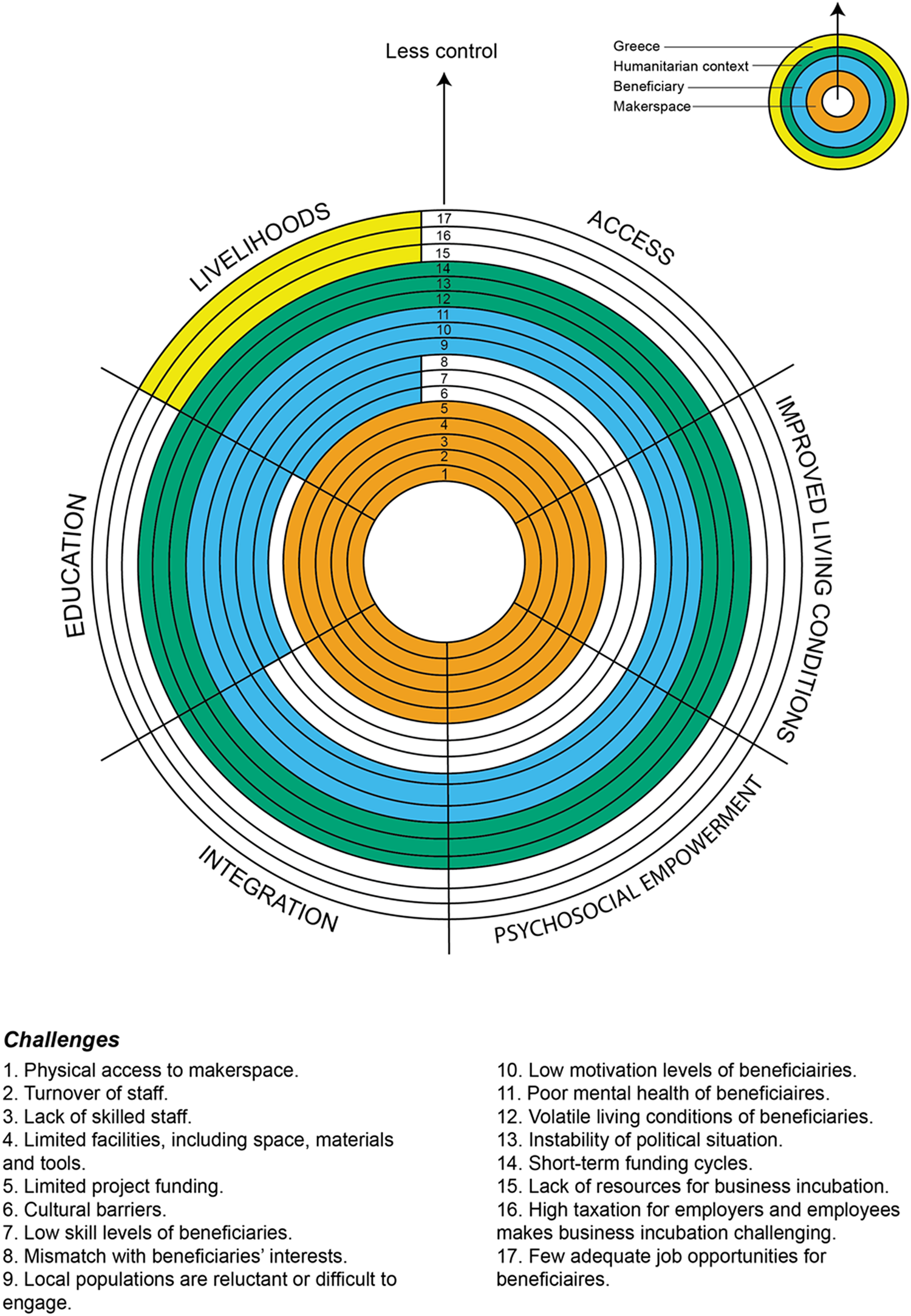
After reviewing the data, we found that many challenges reported by employees at the makerspaces were relevant to multiple areas of impact. Synthesizing this data, we noted that the humanitarian makerspaces had varying degrees of control over these barriers. In some cases, the challenges were related to the makerspace itself. In other cases, they were related to the beneficiary, the humanitarian context, or the local (Greek) context. Figure 3 shows whether each challenge is related to the makerspace (factors highlighted in orange), the beneficiary (factors highlighted in blue), the humanitarian context (factors highlighted in green), or Greece (factors highlighted in yellow). Each challenge is highlighted in one or multiple segments to indicate whether the challenge limits impact in one or multiple areas. For example, the first challenge “physical access to the makerspace” is related to the makerspace, so it is highlighted in orange. It affects all areas of impact (access, improved living conditions, psychosocial empowerment, integration, education, and livelihoods), so the whole circle is highlighted. The final challenge, “few adequate job opportunities” is related to Greek context, so it is highlighted in yellow. It only affects livelihoods, so only this segment has been highlighted.
Challenges faced by humanitarian makerspaces.
Makerspace-related challenges
The makerspaces all face significant resource constraints, with respects to funding, staff, materials, and tools. For example, ConstrACT Lab is situated in a community center and is only supervised by one member of staff. The makerspace was previously in a larger room but was relocated after the manager felt she could not adequately supervise the space safely. Often the beneficiaries worked very close to one another and this caused some tension, especially between adults and children. As the lab is funded by TDH, any requests for new tools and materials must be approved by headquarters or are provided via donations. At the time of visiting, the makerspace was awaiting several orders, including textiles, which meant that many beneficiaries who usually visited the space were not attending, according to the lab manager.
Partly in an attempt to mitigate the constraints of these limited resources, AstroLab shifted to a more selective, training center model. They simply recognized that they could not help everyone with their limited space and facilities. Rather AstroLab prioritize a more narrow focus, helping beneficiaries who they consider to show the greatest potential.
Unlike the other makerspaces, Habibi Works relies solely on public donations. Whilst this allows them to act independently of donors and increases their autonomy on the ground, it also means that there is uncertain and limited funding for people, materials, and tools. All the staff were volunteers for almost two and a half years, with only a core team of three people having received a salary since mid-2018. Running the space has required a large investment from staff, both financially and personally. As such, it has been difficult to retain talented volunteers with expertise, limiting the organization's ability to develop the space.
Despite the fact that the makerspaces were located in areas close to refugees, some beneficiaries still found that physical access to the makerspace was challenging. Some of the beneficiaries interviewed at ConstrACT Lab (in the city center of Ioannina) had wanted to visit Habibi Works (5 km outside of Ioannina) to access additional resources; however, they had not been able to because they could not access transport to the space, or they had other responsibilities (e.g., childcare). In the cases examined, there also seemed to be a trade-off between finding a location that was accessible for both MRAs and local populations.
Beneficiary-related challenges
The next set of challenges were factors identified by employees, which are related to the beneficiaries. We attempted to validate these with the experiences of the beneficiaries; however, the complex nature of some of these factors made it difficult to do so in all cases.
In all the makerspaces, the poor mental health of beneficiaries was perceived to be an obstacle to achieving impact in all six areas. Often this was considered to go hand in hand with low motivation levels. Many times during field work, refugees spontaneously shared personal trauma that they had experienced leaving their countries. This was not a topic that we addressed in our research questions directly; however, some beneficiaries expressed that their mental health prevented them from accessing the facilities available.
Whilst the staff at the makerspaces provided a supportive role, often listening to people's problems, none of the makerspaces had expertise in handling the psychological needs of individuals. In light of this, further collaboration with other services is recommended in order to support the broader needs of beneficiaries, which the makerspace alone cannot meet.
Specifically related to the areas of education and livelihoods, AstroLab identified a few challenges related to the beneficiaries. First, they put forward that cultural differences among non-Greek beneficiaries presented a barrier when finding employment. Additionally, they pointed out that the low-skill levels of beneficiaries and recruiting beneficiaries with suitable interests was a challenge. Notably, these challenges were perceived as being related to the beneficiaries, rather than indicating a poor fit between the makerspace and the beneficiaries. In this case, a closer emphasis on matching and not fitting is needed.
Humanitarian context-related challenges
The next set of factors affect all six areas of impact and are related to the humanitarian context itself. For many reasons, vulnerable people might struggle to access the space or make regular commitments. For refugees, this challenge is also coupled with the instability of the political situation. Many refugees do not know how long they will stay in Greece or if they are relocated, where they will move to. For some refugees, this reduces their motivation to participate in Greek society and to engage with the resources available at the makerspaces.
ConstrACT Lab also point out that the changing demographics of users meant that it was necessary to constantly adapt the makerspace according to their changing needs. For Habibi Works, this political uncertainty also changed how they engage with partners. When they first started in 2016, the refugee relocation scheme was still in operation, so the integration between MRAs and Greeks was not a priority. Consequently, Habibi Works did not engage much with local, Greek partners. Now in light of the reality that many MRAs will remain in Greece, Habibi Works have shifted their focus to engage more with local populations.
Finally, the makerspaces are constrained by the short-term funding cycles that are typical in the humanitarian sector. For AstroLab, this means that it is difficult to fund long-term educational programs, which they feel would create a greater impact. For ConstrACT Lab, the lack of permanent funding meant that they had to close the lab for 3 months in 2018, as a new source of funding was secured. Habibi Works sidesteps this issue by relying only on public donations. Nonetheless, they are reliant on the generosity of the public, which is not guaranteed and is challenging when the refugee crisis falls out of the media.
Local (Greek) context-related challenges
The final set of challenges limit the potential impact on livelihoods and are related to the local context. Greece has experienced a severe economic crisis for the last decade. AstroLab draw attention to the fact that there are few adequate job opportunities for beneficiaries. The current job market is highly competitive as there is high unemployment. At the same time, there is exploitation of vulnerable populations, particularly those with low-skill levels. AstroLab described how beneficiaries who had completed their agricultural training course applied for jobs, however, were disappointed to find that they were being offered almost half of a basic salary. ConstrACT Lab had also noted that local businesses had approached the makerspace, as they were interested in hiring beneficiaries. The makerspace decided that before any such arrangement could be set up, proper due diligence should be conducted to prevent any risk of exploitation of the beneficiaries.
In terms of business incubation, limited access to capital as well as high taxations for employers and employees, prevent this from being a viable option in Greece. As a result, AstroLab have not actively pursued the business initiatives that have been started in the makerspace.
Discussion
Globally, makerspaces are emerging as new spaces for design and making (Smith, Reference Smith2017). Recently, a number of humanitarian makerspaces have been set up in the belief that these design spaces can support crisis-affected communities. In this study, we conducted three case studies of humanitarian makerspaces in Greece. We explored how humanitarian makerspaces give rise to design activities and outcomes that positively impact crisis-affected communities.
To date, humanitarian innovation has largely centered around new technologies (Sandvik et al., Reference Sandvik, Gabrielsen Jumbert, Karlsrud and Kaufmann2014; Corsini and Moultrie, Reference Corsini and Moultrie2019). Our findings reveal that whilst digital tools play an important role in the fabric of the makerspace, they are only part of the picture. Therefore, it is misleading if humanitarian makerspaces are presented as “digital” makerspaces. Often we find that non-digital and craft tools are more likely to be used to create functional items, even if digital tools played an important role in inspiring and activating people. For example, we found that people were using carpentry tools to make tables and shelves for their accommodation; people were using metalwork tools to make grills to cook and barbeque on; and people were using the sewing machines to repair or make clothing. On the other hand, 3D printing and laser cutting were popular tools for making custom items such as jewelery, decorations, and art work.
There is a need to not just think about the technology that goes inside makerspaces, but the design and processes that take place within them. It is clear that people benefit from both the products created in makerspaces and their experiences whilst designing these products. During the design process, people use problem-solving and creative thinking, they learn new skills and exchange knowledge, they collaborate and help each other. Our study, therefore, proposes that design in humanitarian makerspaces is a key trigger for facilitating a broad range of impacts, including improved living conditions, integration, empowerment, education, and livelihoods. Whereas the majority of training interventions for displaced people in Greece have focused on improving employability (Aiyar et al., Reference Aiyar, Barkbu, Batini, Berger, Detragiache, Dizioli, Ebeke, Lin, Kaltani, Sosa and Spilimbergo2016), relatively few interventions have been aimed at increasing resilience or developing psychological capital (Pajic et al., Reference Pajic, Ulceluse, Kismihók, Mol and den Hartog2018). Thus, we suggest that humanitarian makerspaces are a unique intervention, in that they support the development of both hard and soft skills through design.
Our study also highlights that humanitarian makerspaces are not homogeneous and support different types of design activities. Workshop-makerspaces encourage more open-ended and exploratory design, whereas training center-makerspaces support more structured and guided design. We draw attention to the need for these spaces to be adapted according to their context (Aranda-Jan et al., Reference Aranda-Jan, Jagtap and Moultrie2016). Our findings suggest that workshop-makerspaces are best suited to meeting the immediate and basic needs of beneficiaries, providing them with the opportunity to improve their living conditions, to develop relationships with each other, to express themselves, to get active and empowered. Training center-makerspaces, which are more focused on formal education and livelihoods, are better suited to achieving the long-term goals of skills development and employment. In order to benefit from these facilities, the basic needs of beneficiaries must already be met. It is possible that with enough capacity, these two models could be integrated to cater to the evolving needs of beneficiaries.
Of note, this study supports the view that vulnerable groups can actively shape their experiences (Betts et al., Reference Betts, Bloom and Weaver2015; Easton-Calabria, Reference Easton-Calabria2015). It enriches research on Design for Base of Pyramid (BoP), which promotes the belief that vulnerable groups can be both the producers and consumers of products, thus improving social well-being and sustainability (Jagtap et al., Reference Jagtap, Larsson and Kandachar2013, Reference Jagtap, Larsson and Warell2017; Jagtap, Reference Jagtap2019a, Reference Jagtap2019b). In addition, we observe that the range of design activities happening in the makerspaces extends beyond just the design of products, to include the design of new facilities and community services. For example, in Habibi Works, beneficiaries requested additional facilities, built a bicycle shed and helped create an allotment. The makerspace was initially set up after MRAs were asking volunteers in Katsikas refugee camp for tools to repair and make things. In this way, the makerspace has evolved as a co-creation between the humanitarian community and beneficiaries. Expanding on theories of participatory design (Björgvinsson et al., Reference Björgvinsson, Ehn and Hillgren2010), we argue that humanitarian makerspaces not only facilitate the production of user-driven products within the makerspace, but that humanitarian makerspaces can be seen as user-driven products themselves.
We, therefore, reflect on critical views of humanitarian innovation (Scott-Smith, Reference Scott-Smith2016), to highlight that beneficiaries can in fact request, drive, and benefit from humanitarian makerspaces. However, we also find that this is not happening in all cases and more participation from beneficiaries is needed. In contrast to Habibi Works, which started as a grassroots organization, ConstrACT Lab was set up as a top-down initiative by TDH, an international NGO. In this sense, it was not requested by the beneficiaries themselves and their level of engagement in driving the makerspace is fairly limited. Mostly, they look to the makerspace manager for help, and they do not contribute to the day-to-day running of the space. AstroLab, was set up by Odyssea, a company that formed in response to needs of vulnerable populations on Lesvos island (MRAs and Greeks). Again, the makerspace was not requested by the beneficiary community, and on the whole, beneficiaries are passive in the sense that they engage with the resources available; however, they mainly receive rather than give support, and they look to others for the management of the space.
In light of this, we suggest that reconsidering the humanitarian makerspace as a user-driven design could help to maximize the benefits of these spaces for beneficiaries. Allowing beneficiaries to assume an active role in the creation of humanitarian makerspaces enables a model of matching real needs instead of providing for assumed needs. Furthermore, the active engagement of beneficiaries disrupts the cycle of dependency (Kibreab, Reference Kibreab1993) and repositions vulnerable people as active contributors to society.
Conclusion
As the number of displaced people and demand for humanitarian aid has risen to an unprecedented level, the humanitarian sector has begun to look for innovative solutions. In this research, we have explored how humanitarian makerspaces can impact crisis-affected communities. We conducted a multi-case study analysis, selecting three makerspaces in Greece (one next to a refugee camp, one in a small city, and one in a large city). We conducted in-field observations, interviews with beneficiaries and employees, and led workshops with employees. Our analysis identified how makerspaces support different types of design activities and therefore have different impacts. We reflect on the fact that all of the case studies are currently falling short of their ultimate goals, and we identify barriers and enablers that affect progress. Importantly, our findings draw attention to the need for an enabling ecosystem, in both the local and humanitarian context.
We believe this study provides a detailed examination of humanitarian makerspaces; however, we recognize that there are some limitations of our research. First, we have focused on humanitarian makerspaces that support displaced people. It is possible that humanitarian makerspaces may vary in different types of humanitarian crisis. Second, we have only conducted a small number of cases in Greece. We encourage other researchers to conduct additional studies in other regions, including low-income and lower middle-income countries. Finally, we believe that a more detailed comparison of humanitarian makerspaces with other types of training- and community-based interventions would confirm our suggestion that design plays a specific and important role in humanitarian makerspaces and that humanitarian makerspaces are different to traditional humanitarian interventions.
Overall, we believe that this research has important practical and theoretical implications. In terms of theory, we have highlighted how different types of humanitarian makerspaces give rise to different design activities and have different impacts. We draw on theories of participatory design to emphasize that both the makerspace and the designs created within them can be the outcomes of user-driven design. For practitioners, we have clarified the goals of humanitarian makerspaces and reflected on current impacts. We have also provided lessons learned and identified areas for improvements.
Acknowledgment
The researchers would like to thank all the participants in this study. The research is supported by funding from the UK EPSRC Doctoral Training Programme, grant number EP/L504920/1.
Appendix
Overview of humanitarian makerspaces
Demographics of workshop participants
Lucia Corsini is a Doctoral Researcher at the Design Management Group, Institute of Manufacturing, University of Cambridge. Lucia has a BA and MEng in Manufacturing Engineering from the University of Cambridge and has studied Design at Central Saint Martins, University of the Arts London. She has experience working on design and innovation projects in the private and public sector and has also worked on Design for Development projects in Bangladesh, Benin, and Kenya. Her research interests include sustainable design, designing for social change, and social innovation.
Dr. James Moultrie is a Senior Lecturer in Design at the University of Cambridge. Before joining academia, James worked in industry where he was awarded a ‘Scientific and Technical Academy Award’ for the design of movie lenses. James is well known for his research investigating the economic value of design, including the ‘Design Scoreboard’ project which developed an original comparison of national design capabilities. Other research includes work on sustainable design and he is passionate about design for manufacture and assembly and regularly works with companies to improve design for assembly.


 Open access

