

Introduction
Since its discovery in the 1960s, the Zvejnieki cemetery in northern Latvia has become a reference for hunter-gatherer burial archaeology. The current number of 330 excavated graves (Zagorskis, Reference Zagorskis1987, Reference Zagorskis2004; Larsson et al., Reference Larsson, Nilsson Stutz, Zagorska, Bērziņš and Ceriņa2017) makes it one of the largest burial grounds in northern Europe. Zvejnieki is exceptional not only for the quantity of recorded burials but also for their temporal span, from the eighth to the third millennium bc and beyond. Well-documented by the standards of the day, the burial practices reflected by the unusually well-preserved human bones and diverse material culture have been (and still are) widely studied and published, making Zvejnieki the showcase site of the Latvian Stone Age.
A considerable number of other Stone Age graves in present-day Latvia—over 115 individuals, from at least ten sites—have largely been overlooked. Often published in small fieldwork reports in Latvian or Russian, they remain relatively unknown to the international scientific community. The aim of the present article is to provide an overview of this little-discussed material and to discuss the chronology of Latvian Stone Age burials in detail. The funerary data are compared with research based on the Zvejnieki cemetery—which as mentioned above has historically dominated the discussion—and our observations are evaluated against northern Stone Age mortuary practices in their wider context. Such a study is necessary in light of other fundamental overviews recently carried out in other parts of the eastern Baltic region (Tõrv, Reference Tõrv2018; Ahola, Reference Ahola2019; see also Butrimas, Reference Butrimas2012). Furthermore, biomolecular and other archaeometric analyses, including on Latvian burial assemblages (Eriksson et al., Reference Eriksson, Lõugas and Zagorska2003; Jones et al., Reference Jones, Zariņa, Moiseyev, Lightfoot, Nigst and Manica2017; Meadows et al., Reference Meadows, Bērziņš, Legzdiņa, Lübke, Schmölcke, Zagorska and Zariņa2018), require a solid archaeological background.
The data relating to sites and burials are compiled in Table 1 and the online Supplementary Material. The traditional periodization of the Latvian Stone Age (e.g. Zagorska, Reference Zagorska, Larsson and Zagorska2006) is associated with blocks of archaeological cultures, defined in terms of culture history. The adoption of pottery marks the transition from the Mesolithic (9000–5400 bc) to the Neolithic (5400–1800 bc), the latter being traditionally divided into the Early (sixth–fifth millennium bc, epitomized by the Narva culture), Middle (Comb Ware culture, fourth millennium bc), and Late Neolithic (Corded Ware culture, third millennium bc). Here, we use absolute dates whenever possible, to avoid the problems caused by the variety of traditional chronological labels in different countries.
Stone Age sites with confirmed burials and disarticulated human remains, as well as sites mentioned in the literature as potential Stone Age burial sites. Burial classes: 1 confirmed burials; 2 possible burials; 3 loose human remains; 4 stray finds taken to indicate burials; 5 oral tradition of additional burials. Temporal classes: H hunter-gatherer; C Corded Ware; * sites with burials previously connected with the Late Neolithic and/or Corded Ware culture based on body position.

Most of the period under study is characterized by hunter-fisher-gatherer communities, with productive livelihoods only appearing in the context of the third-millennium bc Corded Ware culture. Consequently, the main focus is on hunter-gatherer burials. However, the line between hunter-gatherer and Corded Ware (or generally ‘Late Neolithic’) burials can become blurred: in past research they were often discussed together, and some hunter-gatherer burials have been interpreted as Corded Ware interments (Zagorskis, Reference Zagorskis1987; Loze, Reference Loze, Larsson and Zagorska2006a; see below). We have therefore included all Corded Ware burials in this article.
A Brief History of Latvian Stone Age Burial Archaeology
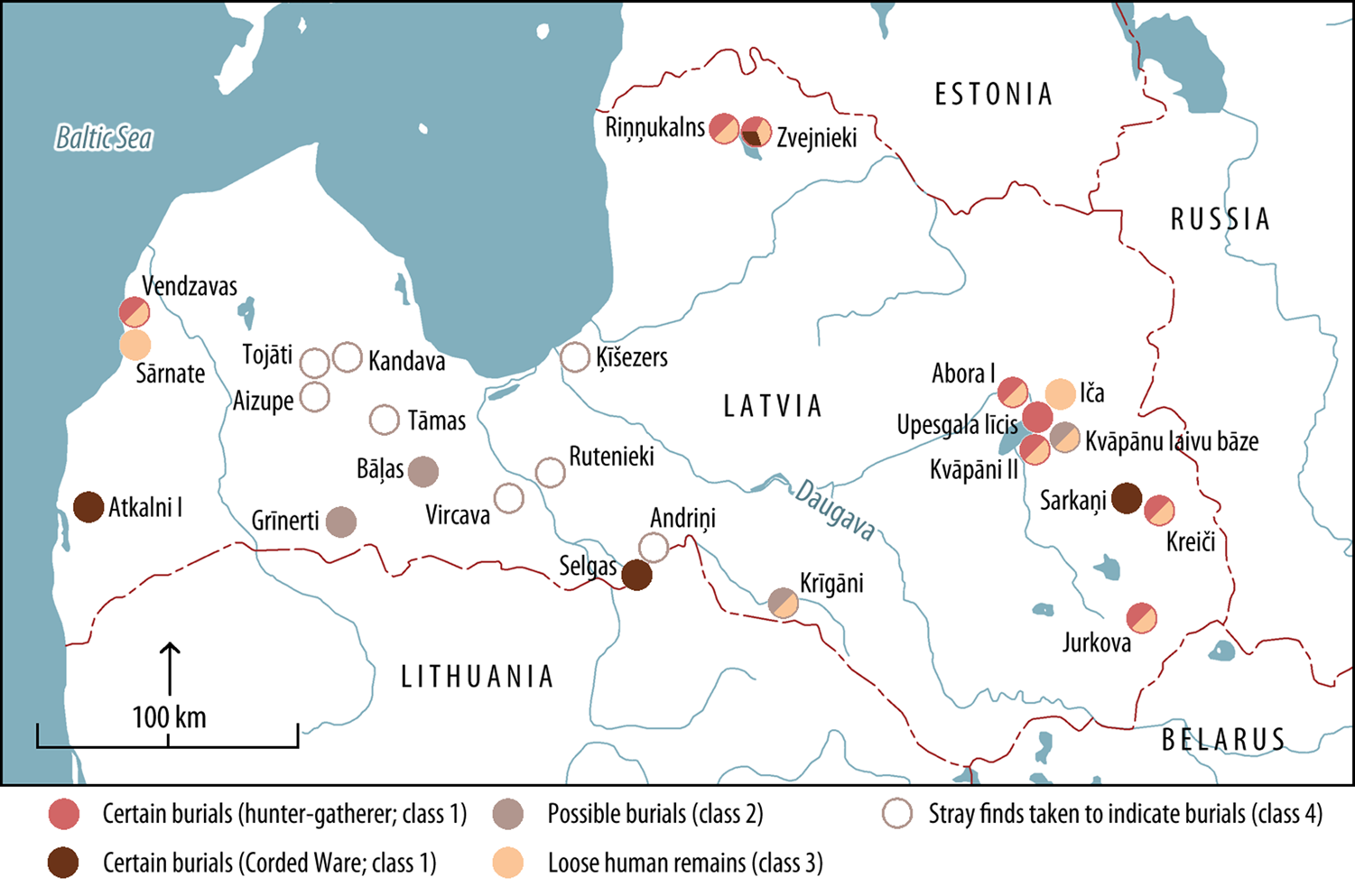
In 1827, a human skull accompanied by stone and antler implements was reported to have been found in Aizupe in western Latvia (Eberts, Reference Eberts1926: 4; Šturms, Reference Šturms1927a: 23) (Figure 1). However, the first documented Stone Age burials of the entire eastern Baltic region are those of Riņņukalns by Lake Burtnieks in northern Latvia. The site was discovered in 1874 and investigated over the following decades (Sievers, Reference Sievers1875; Šturms, Reference Šturms1927b: 1–8) (Table 1). It remained the only known Stone Age burial site in Latvia until World War II, as even the fieldwork boom preceding the war (Šnore, Reference Šnore1938) revealed only inconclusive evidence of graves (see Šturms, Reference Šturms1946: 13).
Latvian Stone Age burial sites and possible locations mentioned in the text.
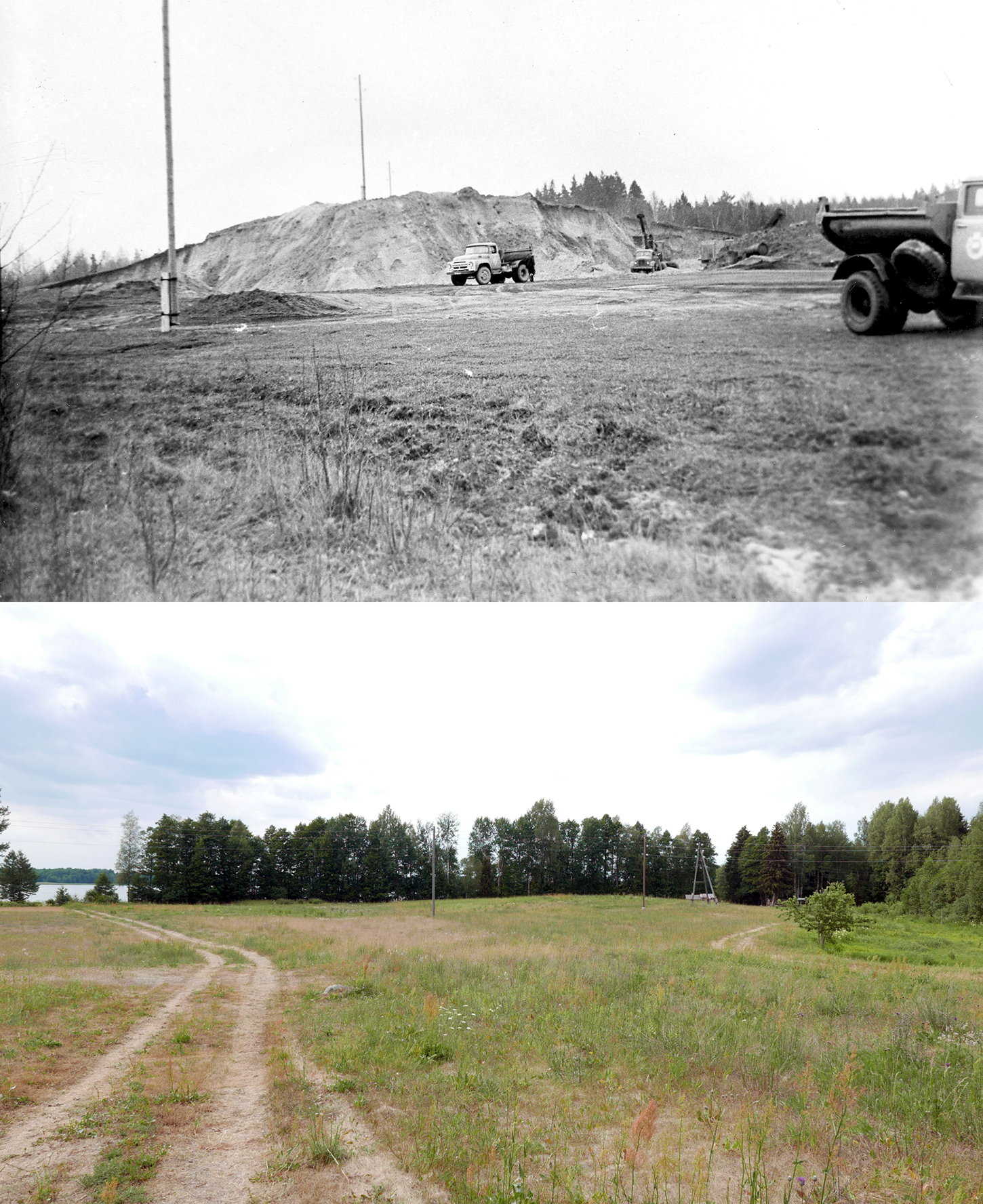
Under post-war Soviet rule, construction projects began to reveal antiquities. A Stone Age burial ground was found during sand quarrying in Kreiči in south-eastern Latvia and studied between 1955 and 1959 (Zagorskis, Reference Zagorskis1961) (Figure 2). A few more Stone Age burials were hastily investigated in 1967–68 in Jurkova, south-eastern Latvia, before gravel extraction levelled its sandy hill, which also contained a medieval cemetery (Cimermane, Reference Cimermane1968; Vankina & Cimermane, Reference Vankina and Cimermane1969) (Figures 3 and 4). The Zvejnieki burial ground was similarly discovered in gravel extraction in the northern Lake Burtnieks area, and was investigated between 1964 and 1971 (Zagorskis, Reference Zagorskis1987, Reference Zagorskis2004).
Plan of the Kreiči site (after Zagorskis, Reference Zagorskis1961: fig. 2).

Jurkova: modern exploitation revealing archaeological sites but also destroying the environment and cultural heritage. The illustration shows the site in 1967 (above; photograph in Cimermane, Reference Cimermane1967: 15) and the area in 2019, with the hill removed (below). Top photograph by permission of the Repository of Archaeological Material, Institute of Latvian History at the University of Latvia (VIAA 205:15).
Map and plan of the Jurkova site (after maps in Cimermane, Reference Cimermane1967 and Vankina, Reference Vankina1968).

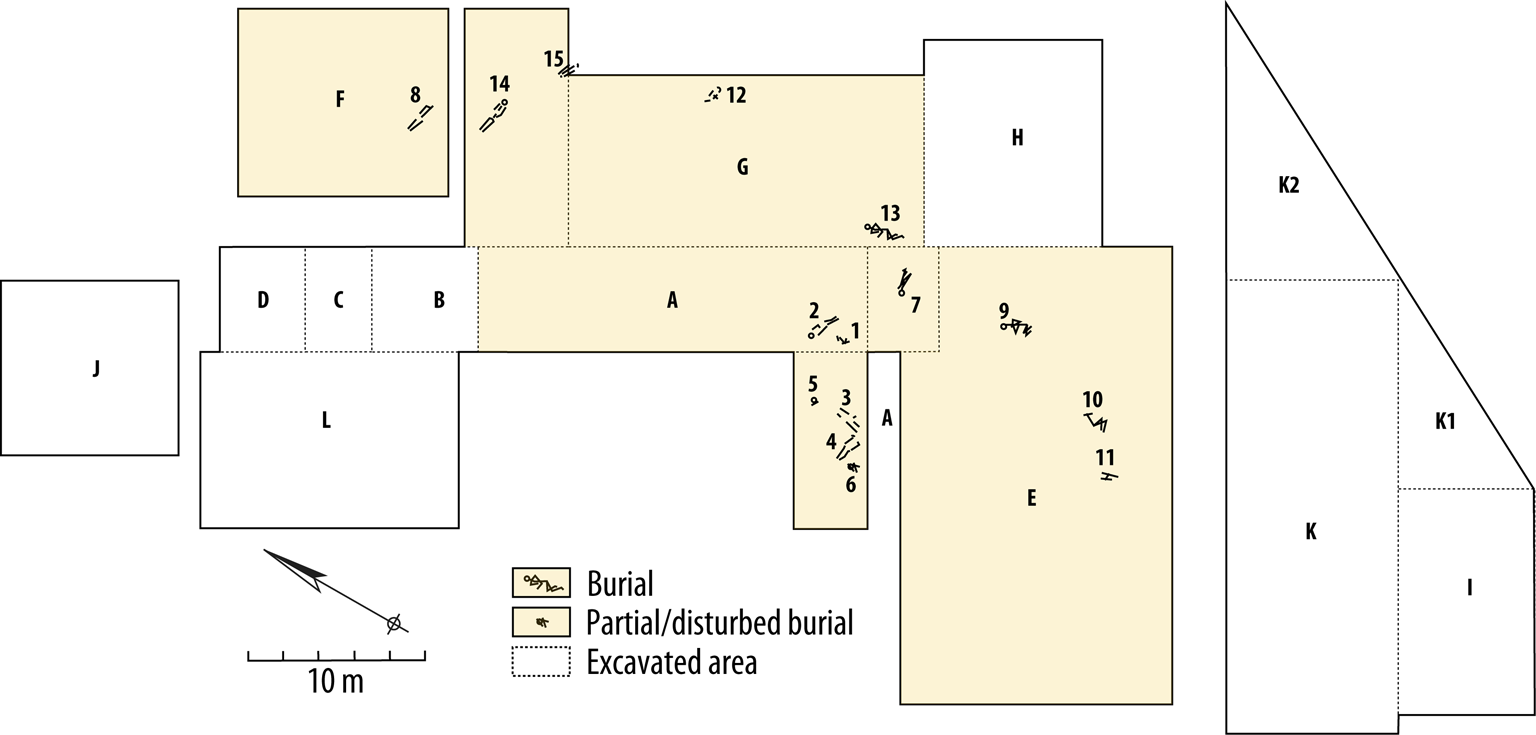
Large-scale amelioration works in the Lake Lubāns region of eastern Latvia led to major landscape modifications and the discovery of a series of Stone Age sites (see Macāne, Reference Macāne2007). Between 1964 and 1971, at least sixty-one burials were investigated at the Abora I site (Loze, Reference Loze1979: 43–52) (Figure 5). At Kvāpāni II, another fifteen graves were unearthed in 1977–78 (Loze, Reference Loze1987a: 32–35, Reference Loze2015: 40–43) (Figure 6), and three more burials were excavated at Upesgala līcis in 1990 (Loze, Reference Loze1992a). An individual burial was found in 1988 at the Iron Age site of Atkalni I near the present-day seaport of Liepāja (Petrenko & Virse, Reference Petrenko and Virse1990). In addition, numerous sites have, over the years, yielded undated burials and disarticulated human bones (Stubavs, Reference Stubavs1980; Bērziņš, Reference Bērziņš2008: 337; Loze, Reference Loze2010: 94).
Plan of the Abora I site (after Loze, Reference Loze1979: fig. 38).

Plan of the Kvāpāni II site (after Loze, Reference Loze1987a: fig. 5, Reference Loze2015: fig. 12).
The first studies of Stone Age interments after the collapse of the Soviet Union were undertaken in 1994, when two Corded Ware burials, both originally dug up by local landowners, were investigated in Sarkaņi in eastern Latvia and in Selgas on the Lithuanian border (Grasis, Reference Grasis1996, Reference Grasis2007). In 1998, a burial was excavated at the Mesolithic settlement of Vendzavas on the Latvian seacoast (Bērziņš, Reference Bērziņš2002).
A new phase of burial archaeology started in the 2000s through an international research collaboration, with a Latvian-Swedish project that investigated further burials at the Zvejnieki cemetery between 2005 and 2009 (Larsson, Reference Larsson2010; Nilsson Stutz et al., Reference Nilsson Stutz, Larsson and Zagorska2013; Larsson et al., Reference Larsson, Nilsson Stutz, Zagorska, Bērziņš and Ceriņa2017). New finds of human remains were also made by the Latvian-German cooperative project at the Riņņukalns site in 2011–2018 (Bērziņš et al., Reference Bērziņš, Brinker, Klein, Lübke, Meadows and Rudzīte2014; Lübke et al., Reference Lübke, Brinker, Meadows, Bērziņš, Zagorska, Grünberg, Gramsch, Larsson, Orschiedt and Meller2016; Brinker et al., Reference Brinker, Bērziņš, Ceriņa, Gerhards, Kalniņš and Krause-Kyora2020).
The Material and its Classification
The main sources for this study consist of Stone Age burials excavated in Latvia, excluding Zvejnieki. All the relevant literature was reviewed, and an archival study of the available reports and related documentation undertaken at the Repository of Archaeological Material, Institute of Latvian History at the University of Latvia in Riga. Finds present in the collections and permanent exhibition of the National History Museum of Latvia (Riga) and the Liepaja Museum were examined. Human osteological material was not investigated; all osteological information (see online Supplementary Material) was taken from publications.
The level of documentation often makes evaluating the finds and contexts difficult. Decades ago, shovels were used but no sieving took place, and many excavations were rescue excavations with limited resources. In Soviet times, local enthusiasts or school children were frequently employed as labour; professional archaeologists were few and primarily oversaw the works. Consequently, descriptions of individual burials can be extremely sketchy, and site plans, drawings, and photographs are often missing. Particular problems, especially in the Lake Lubāns area, arise from discrepancies in the field reports and subsequent publications. These contradictions have been tracked by consulting the primary documentation whenever possible.
The burials appearing in publications and reports have been divided into five classes (Table 1 and online Supplementary Material). Class 1 includes secure burials containing confirmed human remains with diagnostic artefacts; burials without grave goods, but located within a Stone Age site amidst definite burials, are also included in this category. Our article will mainly focus on these burials. Class 2 refers to possible burials, i.e. human remains discovered during archaeological excavations but without grave goods and located at sites dating to later periods; these may be of the Stone Age date, according to their body position and/or adjacent (stray) Stone Age finds. Class 3 includes disarticulated human remains found in Stone Age settlement layers; it is not possible to verify whether they derive from destroyed inhumations or represent alternative ways of body disposal. Class 4 covers the Corded Ware-related artefacts mentioned in the literature as representative of burials (especially Šturms, Reference Šturms1970: 285; Loze, Reference Loze, Buchvaldek and Strahm1992b, Reference Loze and Siemen1997, Reference Loze, Larsson and Zagorska2006a), although their burial status is generally hypothetical. Class 5 consists of oral evidence, i.e. burials allegedly found by the public before investigation by an archaeologist.
Chronology presents a challenge, since most burials lack typologically dateable grave goods and radiocarbon dates (see below). Given ‘persistent practices’ (Tõrv, Reference Tõrv2018; see below), individual hunter-gatherer burials are difficult to date accurately from burial customs alone. We therefore employ a simple division into hunter-gatherer and Corded Ware burials here. Unlike many previous accounts, where body position alone was considered sufficient to associate a burial with the Late Neolithic and/or Corded Ware culture, here we have retained only secure burials with Corded Ware-related grave goods (such as battle axes or other axe types, Corded Ware pottery, flint knives or tools, bone and antler plaques, awls, or tools) and burial customs (mainly single inhumations in a crouched or supine position with bent legs). Only three graves belong to this category, the remaining burials are labelled as those of hunter-gatherers.
Burial Practices in Stone Age Latvia
Burial characteristics
The burials are flat graves. When (oval/round) burial pits are identifiable, the size of the single burials varies from c. 0.5 × 1 m to 1 × 2 m; double and multiple burials are slightly larger, up to 1 × 2.5 m (see online Supplementary Material). The pits of Corded Ware burials seem to be larger than those of the hunter-gatherers, although they are disturbed and generally too few to draw conclusions. Nonetheless this is in line with data from neighbouring areas, which suggest that hunter-gatherer burials more closely followed the physical dimensions of the buried bodies (Ahola & Heyd, Reference Ahola and Heyd2020: 84).
The Corded Ware burials are also deeper, being 0.9–1.4 m deep, whereas the hunter-gatherer graves range between 0.2 and 0.9 m in depth, with an average of 0.5 m. The shallowness of some graves has sometimes been interpreted as some hunter-gatherer burials being originally placed on the surface of the ground and covered with soil (Kreiči: Zagorskis, Reference Zagorskis1961: 8; Kvāpāni II: Loze, Reference Loze2008a: 12). Similar suggestions have been made concerning some burials in the hunter-gatherer cemetery of Sakhtysh IIa in central Russia (Kostyleva & Utkin, Reference Kostyleva and Utkin2010: 41), but none of these suggestions can be confirmed by the available documentation.
Despite undefined grave cuts, often poorly preserved skeletons, and later disturbances, the orientation of most hunter-gatherer burials has been approximated. The heads are oriented most often towards the north, the east, and the south-east, but there are significant variations between sites: for example, the bodies in Abora I are often buried with the heads towards the north, the south, or the south-west, while in Kreiči the heads are oriented to the south-east. Simple explanations (e.g. the local terrain influencing orientation) cannot be found, and varying orientations are also characteristic of burials in Zvejnieki (Zagorskis, Reference Zagorskis1987: 94; Zagorska, Reference Zagorska, Grünberg, Gramsch, Larsson, Orschiedt and Meller2016: 229) and surrounding regions (Larsson, Reference Larsson1988: 104; Kostyleva & Utkin, Reference Kostyleva and Utkin2010: 251–59; Butrimas, Reference Butrimas2012: 152; Tõrv, Reference Tõrv2018: tab. 13). Corded Ware graves seem to follow an east-west axis, which is typical of this type of burial (e.g. Ahola & Heyd, Reference Ahola and Heyd2020: 84).
Body position and treatment
More than half the hunter-gatherer inhumations were in a supine position. Even including positions inferred from disturbed and incomplete skeletons, one-third of body positions remains unknown. We know of nineteen crouched and supine burials with bent legs, three prone burials, and six (half-)sitting (Figure 7). Extended supine and flexed positions are also the most common in many other northern hunter-gatherer burial sites (e.g. Butrimas, Reference Butrimas2012: 151; Brinch Petersen, Reference Brinch Petersen2015: 90; Tõrv, Reference Tõrv2018: fig. 80). Prone burials are encountered only occasionally (Zagorskis, Reference Zagorskis1987: 23; Larsson, Reference Larsson1988: 114; Kostyleva & Utkin, Reference Kostyleva and Utkin2010: 253, 256; Ahola et al., Reference Ahola, Mannermaa, Kashina, Marila, Lavento, Mannermaa and Ahola2020: 51), and the unexpectedly frequent (half-)sitting burials have some parallels in the Baltic Sea region (Larsson, Reference Larsson1988: 107; Nilsson, Reference Nilsson2007: 45; Butrimas, Reference Butrimas2012: 151; Bugajska, Reference Bugajska2015: 11; Grünberg, Reference Grünberg, Grünberg, Gramsch, Larsson, Orschiedt and Meller2016: 16), although none is known at Zvejnieki.
Burials in (half-)sitting position. Top: woman and child with red ochre (Kreiči burials 15 and 16). Bottom: male(?) buried under large stones and accompanied by a crouched male (Kreiči burials 12 and 13). Key: 1: dark soil; 2: clayey sand; 3: red ochre. Not to scale (after Zagorskis, Reference Zagorskis1961: figs. 5 and 7).
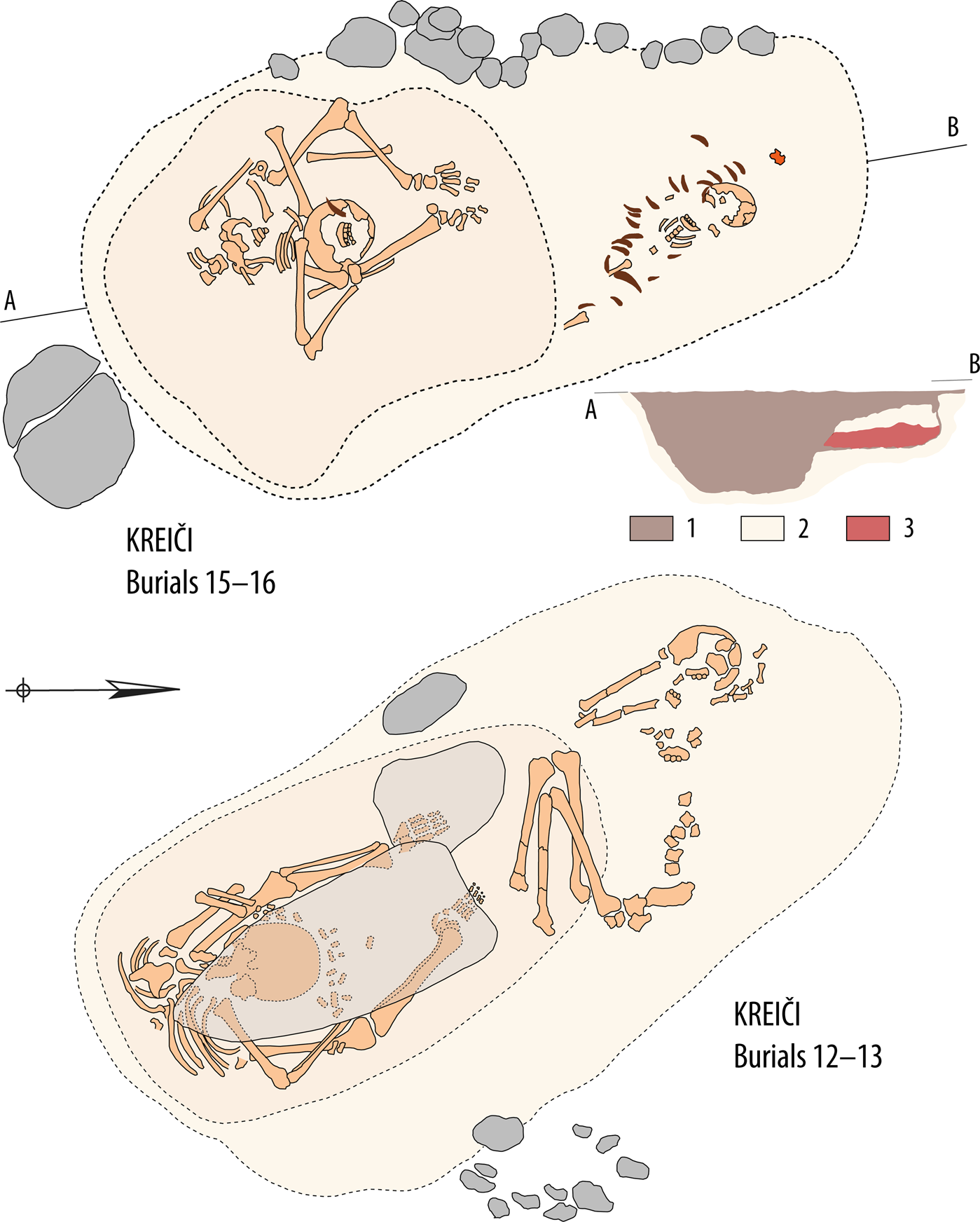
Three-quarters of the burials are single inhumations, but some double burials are known, especially at Kreiči, and multiple burials have been recorded particularly at Abora I (four persons maximum). The body positions are usually, but not always, the same for all individuals in one grave; the orientations are either the same or opposing. Infants and children, as well as the deceased placed in a (half-)sitting position, often form part of double or multiple burials (Figure 7).
In a few cases (Abora I), the multiple burials may be the result of later mixing, which unfortunately can no longer be determined. In most cases, it is similarly impossible to evaluate whether partial skeletal remains result from post-burial body modification or later destruction (including loose bones found in settlements). Occasionally (at Abora I, Kvāpāni II), the remains are probably secondary depositions of disarticulated bones, but once again the lack of documentation prevents further study (see Nilsson Stutz, Reference Nilsson Stutz, Larsson and Zagorska2006; Tõrv, Reference Tõrv2018). It also appears that several burials are missing or consist only of a skull (Abora I, Kreiči, Kvāpāni II); the manipulation of skulls is a fairly common trait among hunter-gatherer inhumations (Zagorskis, Reference Zagorskis1987: 93; Kostyleva & Utkin, Reference Kostyleva and Utkin2010: 259; Butrimas, Reference Butrimas2012: 151; Brinch Petersen, Reference Brinch Petersen, Grünberg, Gramsch, Larsson, Orschiedt and Meller2016: 59; see also Gummesson et al., Reference Gummesson, Hallgren and Kjellström2018: 85). Modification of the cadaver has been proposed in the case of the unnatural position of the Vendzavas burial (Bērziņš, Reference Bērziņš2002: 33), and some prone or heavily flexed individuals (Kreiči: Zagorskis, Reference Zagorskis1961: 6, 9; Kvāpāni II: Loze, Reference Loze1979: 53) are thought to indicate that the body was wrapped or bound, representing burial practices well-attested in Zvejnieki and several other sites in northern Europe and Russia (Nilsson Stutz, Reference Nilsson Stutz, Larsson and Zagorska2006: 230; Kostyleva & Utkin, Reference Kostyleva and Utkin2010: 251; Bugajska, Reference Bugajska2015: 20; Tõrv, Reference Tõrv2018: 188).
Corded Ware burials are of single bodies (at Selgas a woman was buried with a child), in crouched or supine position with bent legs, as described in our definition of Corded Ware burial. They resemble the Corded Ware burials found elsewhere in the eastern Baltic, including Zvejnieki (Kriiska & Tvauri, Reference Kriiska and Tvauri2002: 81; Zagorska, Reference Zagorska, Larsson and Zagorska2006: 103; Piličiauskas, Reference Piličiauskas2018: 119).
Internal grave structure
The simple primary pits of the hunter-gatherer graves are seldom accompanied by clearly identifiable internal or covering structures. Various stone settings, packings, and frames are present in Kreiči (Figure 7); the site lies on morainic terrain, and single stones have also occasionally been placed in burials at Abora I, Jurkova, Kvāpāni II, and Riņņukalns. Stones and stone settings, either underlaying or covering the burials, are also known at Zvejnieki (Zagorskis, Reference Zagorskis1987: 88; Zagorska, Reference Zagorska, Grünberg, Gramsch, Larsson, Orschiedt and Meller2016: 231) and other hunter-gatherer burial sites in stone-rich areas, such as southern Scandinavia and Finland (Brinch Petersen, Reference Brinch Petersen2015: 101; Larsson, Reference Larsson, Grünberg, Gramsch, Larsson, Orschiedt and Meller2016: 178; Ahola, Reference Ahola2019: 45–47).
Organic materials related to the burial are recognized and recorded even more rarely. In Vendzavas, the deceased was covered with material that may have been bark (Bērziņš, Reference Bērziņš2002: 34). The use of wooden containers for some of the dead has been proposed at Abora I (Loze, Reference Loze1987b: 6–7, Reference Loze2008b: 119), but this interpretation is based on highly insecure evidence (a piece of wood and a posthole). Organic inner components (wood, bark, basketry, etc.), used either as platforms, coverings, or containers, are not reported from Zvejnieki, even though they are known from numerous hunter-gatherer burials elsewhere in the Baltic region (Brinch Petersen, Reference Brinch Petersen2015: 90, 101; Bugajska, Reference Bugajska2015: 20–21; Larsson, Reference Larsson, Grünberg, Gramsch, Larsson, Orschiedt and Meller2016: 178–79; Ahola, Reference Ahola2019: 47).
Red ochre is found only in a few graves in Jurkova and Kreiči (Figure 7). Although mentioned as the most important symbolic feature of hunter-gatherer burials (e.g. Zagorska, Reference Zagorska, Grünberg, Gramsch, Larsson, Orschiedt and Meller2016: 236), ochre is often missing from northern European and Russian graves (Kostyleva & Utkin, Reference Kostyleva and Utkin2010: tabs. 15 and 16; Tõrv, Reference Tõrv2018: 170; Ahola, Reference Ahola2019: 20), and is absent from nearly half the Zvejnieki burials (Zagorska, Reference Zagorska, Fahlander and Oestigård2008: 117). Traces of fire and charcoal, charcoal spreads, or pits are reported from a few graves in Jurkova, Kreiči, and Riņņukalns. Hearths are also sometimes recorded on other northern burial sites (Larsson, Reference Larsson1988: 114–15; Kostyleva & Utkin, Reference Kostyleva and Utkin2010: 256; Butrimas, Reference Butrimas2012: 156; Ahola, Reference Ahola2019: appendix 1), but are not present in Zvejnieki. Features interpreted as cremations, while on rare occasions present in hunter-gatherer contexts elsewhere (Brinch Petersen & Meiklejohn, Reference Brinch Petersen, Meiklejohn, Larsson, Kindgren, Knutsson, Loeffler and Åkerlund2003; Grünberg, Reference Grünberg, Grünberg, Gramsch, Larsson, Orschiedt and Meller2016: 14; Larsson, Reference Larsson, Grünberg, Gramsch, Larsson, Orschiedt and Meller2016: 179; Ahola, Reference Ahola2019: 60), are not reported from Latvia.
Small pits filled with occupation material derived from a cultural layer have been found in burials in Kreiči and Upesgala līcis. The use of such material (from an adjacent settlement) as grave fills is a common feature in Kreiči. A similar intentional use of particular soils as part of burial practices is also described in Zvejnieki (Zagorskis, Reference Zagorskis1987: 92, 97; Larsson et al., Reference Larsson, Nilsson Stutz, Zagorska, Bērziņš and Ceriņa2017: 86) and other cemeteries, for example in Sweden and Finland (Larsson, Reference Larsson, Grünberg, Gramsch, Larsson, Orschiedt and Meller2016: 180; Ahola, Reference Ahola2019: 64–65).
No clear internal structures or covering mounds were recorded for the Corded Ware graves. This lack, or simplicity, of covering and internal structures is a feature characteristic of the eastern Baltic and Finnish Corded Ware burials in general (Piličiauskas, Reference Piličiauskas2018: 119; Ahola & Heyd, Reference Ahola and Heyd2020, 83–84).
Grave goods
The presence and quantity of grave goods vary considerably between sites and burials, but they are generally few: almost two-thirds of burials have no grave goods. Only in Kreiči are more than half of the deceased provided with artefacts, although Abora I and Jurkova also contain some wealthier burials (Figure 8). Usually a maximum of five items are present (almost seventy-five per cent of the burials with finds), and both men and women, young and old, may be buried with grave goods.
Assemblages present in Latvian hunter-gatherer burials (excluding Zvejnieki).

The frequency of grave goods and content of the assemblages correspond to the situation in other adjacent major hunter-gatherer burial sites, including Zvejnieki. Animal tooth pendants, including unworked teeth, constitute almost half the grave goods. Usually one or two pendants are found in a burial, although the richest graves contained forty-six (Kreiči burial 15) and twenty (Kreiči burial 6) such artefacts (Figure 9). Teeth from numerous species (wild boar, elk, red deer, aurochs, bear, dog, beaver) provided the raw material for the pendants.
Grave goods from Kreiči. Burial 6 contained twenty amber pendants (a) and fourteen tubular bone beads (b); Burial 15 (see Figure 7) had an amber plate (c) and forty-three animal tooth pendants (d: bear; e: wild boar; f: elk, and g: red deer including h: a full set of unperforated teeth from a single mandibula) and animal bones (i: beaver astragalus). By permission of the Department of Archaeology, National History Museum of Latvia (LNVM VI:35).

Amber ornaments comprise some thirty per cent of the finds, but over seventy per cent of these come from Abora I, a site with major amber workshops nearby (Loze, Reference Loze2008b). Only here is amber more frequent than tooth pendants; at other sites amber consists of mostly isolated finds, if at all present. Amber is represented by various buttons and pendants, tubular beads, perforated plates, and irregular pieces (Figure 9). Precise information about the location of individual grave goods in the burials is often missing, with the exception of Kreiči. The location of amber ornaments (like that of animal tooth pendants) on and around the head, upper body, and limbs indicates that they were used as ornaments or amulets worn on the body or sewn onto clothing or wrappings.
Lithic items are relatively rare (some seven per cent) and consist mostly of flint (and some slate) flakes, small tools, and arrowheads. The remaining grave goods are made of bone and antler (c. fifteen per cent), including pendants and beads, tools, arrowheads, and some worked and unmodified pieces. In addition, abundant fish remains were discovered in connection with some burials in Riņņukalns and Abora I (see Larsson, Reference Larsson1988: 145; Brinch Petersen, Reference Brinch Petersen2015: 101 for Scandinavian parallels).
Ceramic vessels are generally not found in the funerary assemblages of hunter-gatherers in northern Europe and Russia (Zagorskis, Reference Zagorskis1987: 78; Ahola, Reference Ahola2019: 57). Most pottery fragments (as well as lithics and small animal bones) in the graves are interpreted as deriving from the cultural layer used to fill the graves. While the focus has usually been on ‘formal’ goods placed in burials, it is possible that some of these fragments may have been deliberately deposited (Ahola, Reference Ahola2017: 210; Larsson et al., Reference Larsson, Nilsson Stutz, Zagorska, Bērziņš and Ceriņa2017: 85; Brinker et al., Reference Brinker, Bērziņš, Ceriņa, Gerhards, Kalniņš and Krause-Kyora2020: 5). A few ceramic sherds are known from two pits found under the deceased in Upesgala līcis and Kreiči.
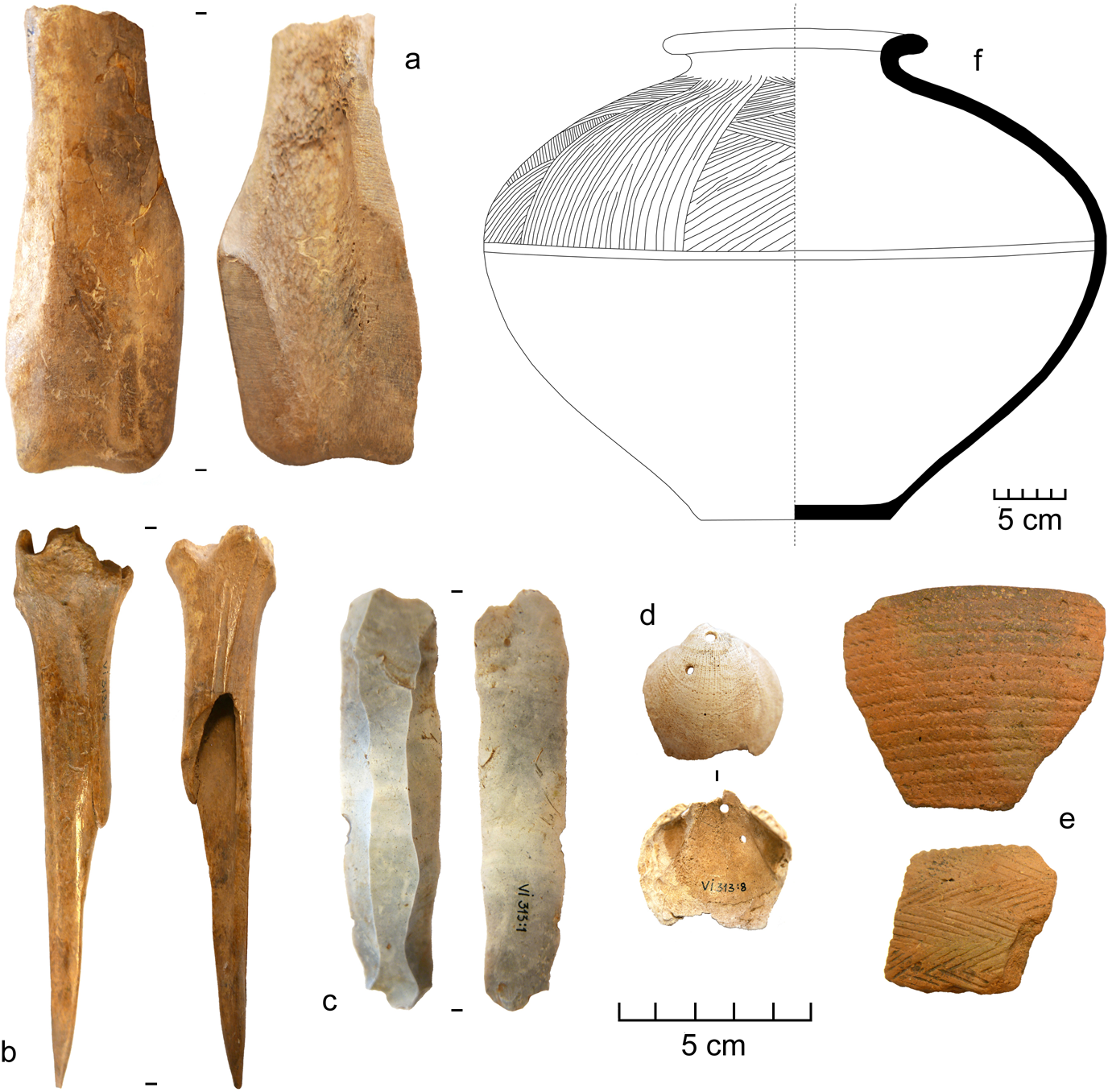
As our definition suggests, finds are present in all the Corded Ware burials, and consist of stone (battle) axes, pottery, flint and bone tools, and ornaments (Figure 10). These assemblages parallel the finds usually encountered in Corded Ware burials elsewhere in the eastern Baltic (Kriiska & Tvauri, Reference Kriiska and Tvauri2002: 81; Piličiauskas, Reference Piličiauskas2018: 119; Ahola & Heyd, Reference Ahola and Heyd2020: 86–87), including Zvejnieki (Zagorskis, Reference Zagorskis1987: 78; Loze, Reference Loze and Siemen1997: 139–40).
Selected grave goods from a Corded Ware burial in Selgas: a: bone adze; b: bone awl; c: flint knife; d: shell ornament; e: fragments of two Corded Ware beakers; f: reconstructed amphora (after Grasis, Reference Grasis2007: fig. 5). By permission of the Department of Archaeology, National History Museum of Latvia (LNVM VI:313).
Discussion
Absolute chronology is one of the challenges that Latvian burial archaeology faces. The only adequately dated sites are Zvejnieki (Zagorska & Larsson, Reference Zagorska and Larsson1994; Eriksson et al., Reference Eriksson, Lõugas and Zagorska2003; Larsson, Reference Larsson2010; Zagorska et al., Reference Zagorska, Meadows and Iršenas2018) and Riņņukalns (Bērziņš et al., Reference Bērziņš, Brinker, Klein, Lübke, Meadows and Rudzīte2014; Lübke et al., Reference Lübke, Brinker, Meadows, Bērziņš, Zagorska, Grünberg, Gramsch, Larsson, Orschiedt and Meller2016; Brinker et al., Reference Brinker, Bērziņš, Ceriņa, Gerhards, Kalniņš and Krause-Kyora2020). The former site spans an exceptionally long period, between the late eighth and third millennium bc (and beyond), and the latter dates to the later fourth millennium bc. Radiocarbon studies have shown that the freshwater reservoir effect may be substantial (up to almost a millennium; Meadows et al., Reference Meadows, Lübke, Zagorska, Bērziņš, Ceriņa and Ozola2014: 829, Reference Meadows, Bērziņš, Brinker, Lübke, Schmölcke and Staude2016: 688), and must be taken into account when dating samples from present-day Latvia.
Individual dates of human bones from Selgas (Ua-19802, 4165±60 bp) and Sarkaņi (Ua-19801, 4285±75 bp; Eriksson et al., Reference Eriksson, Lõugas and Zagorska2003: tab. 3), assumed to be free of the reservoir effect (Meadows et al., Reference Meadows, Bērziņš, Legzdiņa, Lübke, Schmölcke, Zagorska and Zariņa2018: 1002), agree with the age of their Corded Ware assemblages. The dating of a human bone from burial 2 in Kvāpāni II (GIN-6299, 5250±200 bp; Loze, Reference Loze2008a: 12) is of little use, given the wide error margin and unknown reservoir offset. The dates of charcoal, wood, and peat from different cultural layers of the Abora I site (Loze, Reference Loze1979: 121; Loze & Eberhards, Reference Loze and Eberhards2012: tabs. 1–3), like the AMS dates of pottery and food residues (Piličiauskas et al., Reference Piličiauskas, Kluczynska, Kisielienė, Skipitytė, Peseckas and Matuzevičiūtė2020: 102), cannot be directly connected with the human remains found there, which is also the case with the determinations from Iča, Sārnate, and Vendzavas (Loze, Reference Loze, Buchvaldek and Strahm1992b: tab. 1, Reference Loze2010: 109; Bērziņš, Reference Bērziņš2008: tab. 2; Berg-Hansen et al., Reference Berg-Hansen, Damlien, Kalniņš, Zagorska, Schülke and Bērziņš2019: tab. 1).
Although most hunter-gatherer burials are located in or near settlements, it is equally difficult to securely link human remains with dateable material even at these sites. Burials, like most Stone Age remains, tend to lie in somewhat elevated locations with mineral soils near (fresh)water bodies and wetlands, which often have been used over long periods. Mobility cycles, hiatuses, and repeated occupation are often difficult to document and may result in a palimpsest. There are also examples where radiocarbon dating has shown considerable age differences between human and habitation remains (Tõrv & Meadows, Reference Tõrv and Meadows2015). Consequently, stratigraphic sequences give relative, not absolute ages, and contemporaneity inferred from proximity must be proved, not assumed.
Individual burial customs visible in the material do not date the graves very accurately. Some general trends for certain features, such as the frequency of multiple burials or red ochre (Zagorskis, Reference Zagorskis1987: 93–94; Zagorska, Reference Zagorska, Larsson and Zagorska2006: 101, Reference Zagorska, Fahlander and Oestigård2008: 122) are suggested, but numerous long-term trends coupled with significant local and individual variation in the northern hunter-gatherer burial practices (see Tõrv, Reference Tõrv2018; Ahola, Reference Ahola2019) prevent us from using them as strict chronological markers. Typological dating of burial assemblages are also of limited use: most burials contain no grave goods, and, when artefacts are present, they usually provide only broad time frames (see e.g. Zagorska, Reference Zagorska, Grünberg, Gramsch, Larsson, Orschiedt and Meller2016: 233 for animal tooth pendants and Bērziņš, Reference Bērziņš2008: 119–20; Loze, Reference Loze2008b for amber items).
In the absence of other indicators, body position served as a central criterion for dating Latvian burials (Macāne, Reference Macāne2007: 52). In particular, all crouched or supine burials with flexed legs were directly attributed to the Corded Ware culture or the Late Neolithic in general (Zagorskis, Reference Zagorskis1961: 14, Reference Zagorskis1987: 96; Loze, Reference Loze1987a, 35, Reference Loze, Larsson and Zagorska2006a; Gerhards, Reference Gerhards2003: 120). Radiocarbon dating has now shown that the flexed posture is present in the eastern Baltic at least from the sixth millennium bc (Eriksson et al., Reference Eriksson, Lõugas and Zagorska2003: 15; Piličiauskas, Reference Piličiauskas2018: 114; Tõrv, Reference Tõrv2018: 138; Brinker et al., Reference Brinker, Bērziņš, Ceriņa, Gerhards, Kalniņš and Krause-Kyora2020, 9; see also Larsson, Reference Larsson, Lang and Kriiska2000: 92), while also known in later contexts (Gerhards, Reference Gerhards2003). Thus, body position alone is insufficient to assign a burial to a given period (see class 2 burials; also Grasis, Reference Grasis2007: 52–53; Piličiauskas, Reference Piličiauskas2018: 114); for example, only three (nos. 88, 137, 186) of the eleven burials earlier associated with the Corded Ware culture at Zvejnieki can demonstrably be linked to it (see also Zagorska, Reference Zagorska, Larsson and Zagorska2006: 103).
The dating of many burials remains broad and tentative. Internal site chronologies cannot be adequately constructed, and, even where detailed spatiotemporal interpretations have been proposed (Abora I, Kreiči, Kvāpāni II; see Zagorskis, Reference Zagorskis1961, 14; Loze, Reference Loze1987a, 32–33; Reference Loze1987b: 6), they cannot be substantiated, as the groupings are based on the depth of the burials, untested spatial patterning, or body position. Similarly, the temporal division based on spatial patterning in Zvejnieki (Zagorskis, Reference Zagorskis1987: 83–86) does not appear valid in light of the radiocarbon dates obtained (Zagorska & Larsson, Reference Zagorska and Larsson1994: 8; Zagorska, Reference Zagorska, Larsson and Zagorska2006: 93).
Individual graves from Atkalni I, Sarkaņi, and Selgas are linked to the Corded Ware culture. At Vendzavas, on the other hand, nothing contradicts the proposed Mesolithic dating (Bērziņš, Reference Bērziņš2002: 34), although this cannot be confirmed. Burials at Riņņukalns belong to the later fourth millennium bc (Lübke et al., Reference Lübke, Brinker, Meadows, Bērziņš, Zagorska, Grünberg, Gramsch, Larsson, Orschiedt and Meller2016; Brinker et al., Reference Brinker, Bērziņš, Ceriņa, Gerhards, Kalniņš and Krause-Kyora2020: 9) and Stone Age occupation at the Abora I site dates to the fourth and third millennia bc (Loze, Reference Loze1979: 119–21, Reference Loze1987b: 6). Grave goods (amber items) suggest a similar date, but further cultural attribution is not possible. The fourth-millennium bc date of the Kreiči settlement (Zagorskis, Reference Zagorskis1963: 33) is not contradicted by the material found in the burials. The assemblage of the Kvāpāni II settlement dates from at least the sixth millennium to the third millennium bc (and even later), with a heavy emphasis on the fourth millennium bc (see Loze, Reference Loze2015: 71–72). The broad fifth–fourth millennium bc date suggested by one radiocarbon date is possible for the graves without datable finds but cannot be verified. A sherd of pottery from a grave at Upesgala līcis possibly connects the burials to the fourth-millennium bc context of the settlement site (Loze, Reference Loze1992a: 66). Finally, Jurkova can only be broadly dated to the Mesolithic-Neolithic period.
Latvian Stone Age hunter-gatherer burial evidence is substantial compared to that from other eastern Baltic regions, and the number of finds is paralleled only on the large Russian burial sites, or in southern Scandinavia (e.g. Gurina, Reference Gurina1956; Larsson, Reference Larsson1988; Kostyleva & Utkin, Reference Kostyleva and Utkin2010; Brinch Petersen, Reference Brinch Petersen2015). The Corded Ware evidence, on the other hand, is too limited for reaching more than preliminary conclusions.
Almost all known hunter-gatherer burials are situated in the northern and eastern part of Latvia, whereas individual Corded Ware graves and uncertain finds are present in the south and west. This may partially reflect prehistoric preferences and local environments. Inland areas in the north, and especially the east, are characterized by networks of lakes and rivers, a preferred habitat for northern hunter-fisher-gatherers. Waterways leading towards the Valday Hills and further east acted as a highway, and promoted the large-scale exchange of flint and amber (Loze, Reference Loze2008b). The western areas are characterized by undulating lands cut by rivers flowing towards the coast. Corded Ware finds in this part of the country show connections with the territory of present-day Lithuania and further south (Grasis, Reference Grasis2007; Piličiauskas, Reference Piličiauskas2018: 150); Corded Ware material is also found in the east and north, with links to present-day Estonia (Jaanits et al., Reference Jaanits, Laul, Lõugas and Tõnisson1982: 102–17).
While the river Daugava has been a major border dividing the area and placing the west of Latvia into the southern and the east into the northern cultural sphere many times in the past (e.g. Eberts, Reference Eberts1926: 7), the current perspective on burials is at least as much an artefact of research history. Nearly all the graves have been discovered by chance and modern land use: the prominence of the Lake Lubāns area is largely the result of extensive rescue excavations, and the enhanced visibility of the Lake Burtnieks region is owed to the well-published studies at Zvejnieki and Riņņukalns. Interestingly, substantial hunter-gatherer settlement sites (mostly without burials) are known along the less well studied western seaboard (see Vankina, Reference Vankina1970; Loze, Reference Loze2006b; Bērziņš, Reference Bērziņš2008).
The era of hunter-fisher-gatherers lasted several millennia, whereas the Corded Ware culture spanned only a few centuries, presumably resulting in fewer burials. Differences in the hunter-gatherer and Corded Ware evidence may owe as much to research priorities as to the scale and nature of past cultural practices. Corded Ware burials occur individually or in small groups outside settlements, as they do in surrounding regions (Loze, Reference Loze, Larsson and Zagorska2006a: 312–17; Ahola & Heyd, Reference Ahola and Heyd2020: 87–88). They are therefore harder to detect archaeologically than hunter-gatherer graves, which are usually encountered in larger groups, characteristically located at settlement sites. Separate hunter-gatherer cemeteries exist only in Kreiči and Zvejnieki, albeit beside settlements.
Settlement site burial is also the most common hunter-gatherer burial practice elsewhere in northern Europe (Zagorskis, Reference Zagorskis1987: 95–96; Larsson, Reference Larsson1988: 99; Tõrv, Reference Tõrv2018: 159; Ahola, Reference Ahola2019: 39). Even if Latvian burial archaeology has traditionally concentrated on the meticulous description of finds and kept interpretation to a minimum, it is proposed that settlement site burials indicate that the dead were kept close to the living (Balodis, Reference Balodis, Balodis and Tentelis1938: 48). However, the settlement remains and the burials need not always be contemporary; moreover, the proposed custom of burying the dead under the thresholds of houses in Kvāpāni II (Loze, Reference Loze2008a: 12) cannot be validated. The entanglement of the dead and the living, the mixing of ‘the past in the past’ (Larsson et al., Reference Larsson, Nilsson Stutz, Zagorska, Bērziņš and Ceriņa2017: 86), is also recognized in the incorporation of occupation layers in the grave fills, or the deliberate intersection of burials and the mixing of older burials in new graves (Nilsson Stutz et al., Reference Nilsson Stutz, Larsson and Zagorska2013: 1026–27; Tõrv, Reference Tõrv2018: 249).
The evidence presented here supports the view that the generally shared (‘core’) concepts of hunter-gatherer mortuary practices were based on a flat grave tradition (see Zagorskis, Reference Zagorskis1987: 93; Tõrv, Reference Tõrv2018: 257–60; Ahola, Reference Ahola2019: 59). In the Latvian context, the greatest difference between Zvejnieki and other Latvian burial sites is the large quantity of burials associated with settlements (see also Zagorskis, Reference Zagorskis1987: 95). A near-total absence of ochre, generally scarce grave goods, sitting inhumations, signs of fire, smaller size and shorter period of use distinguish them from Zvejnieki. This may reflect temporal differences or different characteristics connected with cemetery and settlement site burials (see also Ahola, Reference Ahola2017: 210), and at the same time demonstrates the great diversity of Stone Age mortuary practices.
The earliest hunter-gatherer funerary practices recorded in Latvia are paralleled especially in other eastern Baltic region and southern Scandinavia, but also in western Russia. The turn of the fourth millennium bc marks a transformation, particularly visible in the material culture of the burials (e.g. amber ornaments) and certain practices (e.g. multiple burials, increasing use of ochre). This shift is associated with the appearance of the so-called Comb Ware culture, which influenced vast territories between the Baltic Sea and the Urals. This manifested itself in an increasing eastern influence on the eastern Baltic, also documented in new forms of technology and material culture (e.g. Loze, Reference Loze2008b; Berg-Hansen et al., Reference Berg-Hansen, Damlien, Kalniņš, Zagorska, Schülke and Bērziņš2019: 20), as well as in the aDNA data (Jones et al., Reference Jones, Zariņa, Moiseyev, Lightfoot, Nigst and Manica2017: 2–3; Saag et al., Reference Saag, Varul, Lyn Scheib, Stenderup, Allentoft and Saag2017: 2189; Mittnik et al., Reference Mittnik, Wang, Pfrengle, Daubaras, Zariņa and Hallgren2018: 8). Nonetheless, the evidence that we have lacks the most typical examples of this burial tradition (Zagorskis, Reference Zagorskis1987: 85; Ahola, Reference Ahola2019: 59); rather, it represents parallel or later practices in the area. Despite such changes (or variation) in funerary behaviour during the fourth millennium bc, a clear break with the old customs took place with the arrival of Corded Ware individuals in the early third millennium bc (Jones et al., Reference Jones, Zariņa, Moiseyev, Lightfoot, Nigst and Manica2017: 3; Saag et al., Reference Saag, Varul, Lyn Scheib, Stenderup, Allentoft and Saag2017: 2189; Mittnik et al., Reference Mittnik, Wang, Pfrengle, Daubaras, Zariņa and Hallgren2018: 8), introducing a whole new culture of death, shared widely in Europe (see Furholt, Reference Furholt2019).
Conclusion
Latvian Stone Age burials have been largely approached through the lens of ideal burial presenting conventional inhumation as the only imaginable way to bury a person (e.g. Balodis, Reference Balodis, Balodis and Tentelis1938: 42, 47); today, this practice can be called ‘deviant’ (Ahola et al., Reference Ahola, Mannermaa, Kashina, Marila, Lavento, Mannermaa and Ahola2020: 47). Just a fraction of the Stone Age population was inhumed in flat graves, and burial practices must have been diverse, albeit potentially hard to trace archaeologically. Disarticulated human bones, present on all major Latvian hunter-gatherer sites discussed here (see Table 1), may be an indication of some of these alternative ways of handling human remains (Brinch Petersen, Reference Brinch Petersen, Grünberg, Gramsch, Larsson, Orschiedt and Meller2016, 59; Tõrv, Reference Tõrv2018) and require more attention in the future.
Besides the preconceived opinions guiding research, the varying archaeological visibility of different material cultures of death directly affect the representativeness of the material. Modern-day Latvia is no exception. Settlement site burials are generally easier to detect archaeologically than single graves, and rich cemeteries deflect attention from more ‘marginal’ finds. Preservation conditions and later disturbances may affect a grave's integrity, the uneven geographical distribution of fieldwork and modern land use create biases, the level of recording varies, and what becomes ‘common knowledge’ through publication further filters the data.
Zvejnieki is a unique site with exceptionally well preserved and documented material. It is also published extensively in English, overshadowing other Latvian burial sites. Even though the more than one hundred burials presented here do not directly overturn the story told by Zvejnieki, it introduces spatial depth and nuances previous perspectives. In a wider context, Latvian burials are positioned between various cultural and geographical zones and evidence dynamic and interconnected populations throughout the Stone Age. Much of their value lies in their ability to illustrate the various cultural traditions and their manifestations at different times, reflecting links around the Baltic Basin and with southern Scandinavia but also with the Russian Plain. Present-day Latvia has on many occasions been at the crossroads between northern and southern cultural spheres, with the river Daugava acting as its connecting, or dividing, line.
Supplementary Material
To view supplementary material for this article, please visit https://doi.org/10.1017/eaa.2020.64.
Acknowledgements
This study was supported by the Anérs stiftelsen and Helsinki University Humanities project. The authors wish to thank Normunds Grasis and Ritvars Ritums at the National History Museum of Latvia, and Silvija Tilko and Aigars Vāvere at the Institute of Latvian History for their help with museum collections and archival materials. We also thank four anonymous reviewers for their comments on a previous version of this article.


 Open access

