

I. Introduction
One of the most important steps towards establishing an independent judiciary is specifying certain protections for the courts and judges in the written constitution. This can be done by incorporating various regulations regarding the appointment and removal processes of judges, their jurisdictions or the structure of certain courts. The extent to which constitutional protections for the judiciary affect judicial behavior in practice has been an essential scholarly debate in the past two decades. Although the existing studies show mixed empirical results (Carruba et al. Reference Carruba2015; Hayo and Voigt 2007; Melton and Ginsburg Reference Melton and Ginsburg2014), it is important to explain why numerous constitutional protections for the judiciary are included in some constitutions, while no constitutional protections are provided in others. The insurance theory asserts that an incumbent government that anticipates losing power would empower the judiciary to ensure that its rights and policies will be protected once it falls into minority status (Finkel Reference Finkel2008; Ginsburg Reference Ginsburg2003; Landes and Posner Reference Landes and Posner1975; Ramseyer Reference Ramseyer1994). On the other hand, the political actors who expect to maintain their power do not desire to empower the judiciary (Chavez Reference Chavez2004; Stephenson Reference Stephenson2003). In other words, the central premise of the insurance theory is that politicians offer independent courts when political competition is intense, and incumbents’ expectation of winning the future elections is low (Finkel, Reference Finkel2008; Ginsburg, Reference Ginsburg2003; Landes and Posner, Reference Landes and Posner1975; Ramseyer Reference Ramseyer1994; Stephenson Reference Stephenson2003).
Although some scholars have tried to assess the validity of the insurance theory across different political regimes (Aydin Reference Aydin2013; Epperly Reference Epperly2019; Popova Reference Popova2010; Sachs Reference Sachs2015), they have not differentiated between the ‘establishment’ and ‘maintenance’ of judicial independence (Vanberg Reference Vanberg2015). The establishment of judicial independence mostly refers to de jure judicial independence, whereas maintenance of judicial independence refers to de facto judicial independence. In the literature, de jure judicial independence refers to the adoption of constitutional guarantees and regulations regarding the judicial independence and contains issues such as the tenure of a judge, the nomination process and salary protections (Feld and Voigt Reference Feld and Voigt2003). De facto judicial independence, on the other hand, refers to judicial behavior and tries to discern whether and how the formal rules are implemented in practice (Rios-Figueroa and Staton Reference Rios-Figueroa and Staton2009). Focusing on de jure judicial independence, the objective of this study is to explain how the power distribution among the key actors affected their decision to establish an independent judiciary.
Most of the existing studies on insurance theory use political competition as an indicator of political uncertainty, and measure it by taking the difference between the proportion of seats held by the first and second parties in the legislative branch (Aydin Reference Aydin2013; Ginsburg and Versteeg Reference Ginsburg and Versteeg2014; Stephenson Reference Stephenson2003). Yet this creates theoretical and methodological problems. First, using seat shares to measure political competition during the constitutional-design periods is quite problematic. A new constitution is often adopted right after a crisis-like situation such as a war, coup, declaration of independence or revolution, or during a transitional period from democratic rule to authoritarian rule or vice versa. In those periods, the parliament is usually dissolved and the parliamentary election is scheduled for the post-constitutional period. It becomes impossible to use the legislative seats’ distribution to measure political competition in the transitional periods. Second, insurance theory conceptualizes post-constitutional uncertainty as electoral uncertainty and focuses on the parties’ probabilities of winning the upcoming election (Ginsburg Reference Ginsburg2003). It assumes that when a hostile government confronts a newly empowered court, it will respect the judiciary’s independence. But in the context of transitional regimes epitomized with deep polarization and mistrust, the credibility of this commitment would be undermined. Establishing a subordinate judiciary might seem more beneficial to the ruling government (Popova Reference Popova2010; Aydin Reference Aydin2013). For this reason, we need a more comprehensive understanding of post-constitutional uncertainty. Third, the insurance theory assumes that the costs of violating judicial independence would be high. A public backlash is one of the major costs the incumbent government can face for creating a dependent judiciary. The public might punish the incumbent government for its wrongdoings through elections or public protests. Yet, for the public backlash to appear as a credible mechanism that would prevent the incumbent government from interfering with the judiciary, the public should be aware of the government’s policies and be willing and capable to punish the incumbent government. For all these reasons, this article asserts that to measure post-constitutional political uncertainty, one should consider not only the power distribution among the ‘political’ actors, but the power distribution among all actors involved in the constitution-making process, including the public and civil society.
Comparing the constitution-making processes of the constitutions of Egypt (2012) and Tunisia (2014), in the first part of the study I present ‘duration of the constitution-making process’ as an alternative indicator of power distribution among all potential actors during the constitution-making process, which can be used to predict post-constitutional political uncertainty. As such, the theoretical framework asserts that as the length of the constitution-making process increases, the possibility of deliberation at the public level will increase. Active and efficient public participation during the constitution-making process will increase mutual trust between political actors and reveal the power and credibility of the public as a control and constrain mechanism. This will decrease post-constitutional uncertainty and increase the drafters’ tendency to adopt democratic constitutions that establish independent and powerful judiciary. In the second part of the article, to test this argument, I use a large dataset that covers information on the content and design processes of 140 countries’ most recent constitutions adopted between 1945 and 2018. The empirical results indicate that as the duration of the constitution-making process increases, the number of constitutional guarantees for judicial independence also increases.
As a result, this study aims to make methodological and theoretical contributions to the constitution-making and judicial politics literature. First, by introducing the duration of the constitution-making as an alternative indicator of power distribution among all actors in the constitution-making process, it becomes possible to empirically answer any research question that look at the effects of power distribution during the constitution-making process. Second, this study does not refute the central logic of the insurance theory, but rather argues that it fails to explain the establishment of judicial independence in specific contexts. Adopting a more comprehensive understanding of post-constitutional uncertainty, this study emphasizes the importance of the power of the public in establishing judicial independence and argues that to predict post-constitutional uncertainty, one should focus on power distribution among ‘all’ actors, including the public and civil society. As such, this theoretical approach aims to explain the establishment of judicial independence even in contexts where there is deep polarization and mistrust among the political parties.
The article starts by presenting a detailed comparison of the constitutions of Egypt (2012) and Tunisia (2014) in terms of their formulation processes and the regulation of judicial independence. Based on this comparison, the theoretical framework is presented in the Section III. Section IV offers the dataset, key variables and the empirical models to be tested. Section V presents the empirical results and the robustness checks. The study ends with concluding remarks where the general findings are summarized.
II. Constitution-Making Processes in Egypt (2012) and Tunisia (2014)
Egypt and Tunisia are North African countries with Arab and Muslim majority populations. They have mixed legal systems that include civil law and Islamic law in personal statutes such as marriage. They experienced colonial rule until the 1960s, and were under the rule of strong authoritarian regimes until the Arab Spring uprisings of 2011. These Arab Spring uprisings, which spread across the Middle East and North Africa, provided a similar political and social context under which Egypt and Tunisia adopted their new constitutions.
In this article, the establishment of judicial independence refers to de jure judicial independence.Footnote 1 Although different constitutional regulations are presented in different studies as de jure judicial independence indicators, the most commonly shared indicators include a statement of judicial independence, appointment and removal procedure of judges, financial independence of the judicial body, and judicial tenure (Feld and Voigt Reference Feld and Voigt2003; Rios-Figueroa Reference Rios-Figueroa, Helmke and Rios-Figueroa2011; Melton and Ginsburg Reference Melton and Ginsburg2014). In this regard, to evaluate the level of de jure judicial independence in Egypt and Tunisia, I look at both countries’ constitutions and search for the following: whether the concept of ‘judicial independence’ is explicitly mentioned in the constitution; how the appointment and removal processes of higher court judges are regulated; whether the financial independence of the constitutional court is protected; whether the number of constitutional court judges is specifically set in the constitution; and how the tenure of the higher court judges is regulated.
Although both countries shared certain similarities, the post-Arab Spring constitution of Tunisia included more robust protections for judicial independence (see Table 1). In contrast, the constitution of Egypt (2012) does not provide solid institutional protections for an independent and powerful judiciary. But why? This section aims to explain how the constitution-making process might have affected the adoption of constitutional protections for judicial independence in the constitution of Tunisia (2014) but not in the constitution of Egypt (2012).
De Jure Judicial Independence in Egypt and Tunisia

The constitution-making process in Egypt (2012)
Anti-government protests started in Egypt in January 2011. The online campaigns against Mubarak’s rule and his police-state brutality escalated the tensions in Egypt (Stein Reference Stein and Kitchen2012). Right after the uprising, in February 2011, President Hosni Mubarak was forced to resign and the interim military government—the Supreme Council of the Armed Forces (SCAF)—suspended the 1971 constitution. The SCAF announced that parliamentary elections would be held between November 2011 and January 2012. In the meantime, the Muslim Brotherhood formed a political party—called the Freedom and Justice Party—which previously had been banned under Mubarak’s regime. After the election, the Muslim Brotherhood obtained the majority of the seats (around 42 per cent) in the parliament and the second party, the Al-Nour Party, had 21 per cent of the seats. The ruling government was a coalition government, named the Democratic Alliance and led by the Muslim Brotherhood’s Freedom and Justice Party (FJP) and six more parties. In May 2012, Mohammed Morsi was elected as the President of Egypt (Cross and Sorens Reference Cross and Sorens2015).
The Islamist-dominated parliament elected a 100-member Constituent Assembly (Meyer-Resende Reference Meyer-Resende2014) to write the new constitution of the country. But according to a 1994 ruling of the Supreme Constitutional Court, the parliamentarians should not have elected themselves. Since half of the Constituent Assembly members were chosen from among the parliamentarians, in April 2012 the Supreme Administrative Court dissolved the first Assembly (Partlett Reference Partlett2012). The second Constituent Assembly was elected in June 2012. This time the Assembly was composed of 39 members from the parliament and 61 members from different religious and social groups and institutions (Maboudi and Nadi Reference Maboudi and Nadi2016). Although in the beginning the political elite agreed on the ground rules of the constitutional design and inclusion of the public in the process, a few months later a severe conflict erupted among the political elites. In November 2012, Morsi issued a constitutional declaration that centralized power in the hands of the president until the new constitution was ratified and the new parliament elected (Egypt Independent, 22 November 2012). The non-Islamist members of the Constituent Assembly were already accusing the Islamists of making unilateral decisions. After this declaration, the tension between the Islamists and liberals has turned into animosity, and 29 out of 100 members of the constituent assembly resigned (Egypt Independent, 25 November 2012). These developments triggered the eruption of mass protests across the country (Cross and Sorens Reference Cross and Sorens2015). Among intense political competition and polarization between the Islamists and liberals, the Constituent Assembly approved Egypt’s constitution on 30 November. As a result, the constitution of Egypt (2012) was completed and approved just in eight months (March–November 2012).
Although the constitution was ratified by a public referendum, public participation in the whole constitution-writing process was very limited (Albrecht Reference Albrecht2013; Meyer-Resende Reference Meyer-Resende2014). Although the crowdsourcing initiative was used as a public participation mechanism, it was unsuccessful (Maboudi and Nadi Reference Maboudi and Nadi2016). There was no public consultation during the constitution-making process (Owosuyi Reference Owosuyi2016) and no real opportunity for dissent (Democracy International 2014). This is unsurprising. For active public participation, the constitution-making process should be transparent. The media should be free so the public can be aware of all developments and the proposed content of the constitution. When we look at the Egyptian case, we see that the chairman of the Constituent Assembly occasionally banned live broadcasts during the process, and the Constituent Assembly’s website lacked regular updates and did not provide a proper mechanism for electronic feedback from the Assembly members (Meyer-Resende Reference Meyer-Resende2014).
The constitution-making process in Tunisia (2014)
Right after Mohamed Bouazizi’s self-immolation in December 2010, several uprisings and anti-regime protests spread across Tunisia. Zine El Abidine Ben Ali, who was Tunisia’s president for 23 years, fled from the country in January 2011, leaving Prime Minister Mohamed Ghannouchi (leader of the Ennahda party) to take charge (Brown Reference Brown2012). Although Ghannouchi promised that elections would be held within six months, the statement was not enough to end the protests (Jamal and Kensicki Reference Jamal and Kensicki2016). In February, Ghannouchi resigned with all the ministers of Ben Ali’s government (Spencer Reference Spencer2011). In the following month, the Constitutional Democratic Rally (Rassemblement Constitutionnel Démocratique, RCD) party was dissolved, then its senior members were banned from participating in the upcoming elections for the constituent assembly (Brown Reference Brown2012).
The National Constituent Assembly (NCA) election was held in October 2011, in a peaceful atmosphere, to formulate a new constitution and rule the country until the upcoming elections (Carter Center 2014). Including representatives from nineteen political parties and coalitions, the NCA can be defined as a highly inclusive body. The Ennahda (Islamist party) won the highest number of seats with 89 out of the Assembly’s 217 members (Carter Center 2014). While Ennahda held 41 per cent of the seats, the second party, Congress for the Republic Party (CPR), held 13 per cent of the seats. As a result, between 2011 and 2014, Tunisia was governed by a coalition government named the Troika that included Ennahda, Ettakatol (Democratic Forum for Labour and Liberties) and the CPR (Meddeb Reference Meddeb2019). The drafting process started in February 2012 with tension between the Islamists and secularists. In August 2012, first draft of the constitution was published and the NCA invited civil society representatives for an open debate on the draft. More than 300 civil society representatives participated in a two-day deliberation (Maboudi Reference Maboudi2019). Revising the first draft in line with the suggestions proposed by the civil society, the NCA issued a second draft in December 2012. After the second draft’s publication, the Ennahda-led majority in the NCA decided to open up the process to the general public. The reason for this opening up was based on the civil society organizations’ liberal demands (Maboudi Reference Maboudi2019). Ennahda was expecting to counterbalance some of these liberal demands through the use of public opinion. As a result, the constitutional committees’ representatives and the citizens came together in 44 different meetings in which more than 2,500 suggestions for the constitution were made (Maboudi Reference Maboudi2019). Yet the public’s and the secularists’ propositions were not included in the third constitutional draft, published in June 2013. This led to intense criticism and increasing numbers of protests. As a result, Ennahda agreed to the establishment of the Consensus Commission. Its members represented different political parties and social groups, and had the final vote on controversial issues.
In 2013, two secular politicians were assassinated, which led to a severe political crisis and civil unrest in Tunisia. Most of the protesters blamed Ennahda for the attacks. All these developments set back the constitution-making process (Abouaoun Reference Abouaoun2019). The political deadlock between the Secularists and Islamists was resolved by the intervention of four civil society organizations: the General Union of Tunisian Workers (UGTT), the Human Rights League, the Bar Association, and the employers’ union (Yahya Reference Yahya2014). In July 2013, the Muslim Brotherhood government in Egypt was overthrown following a military coup. This event might have fed the fear of a counter-revolution against Ennahda (Netterstrom Reference Netterstrom2015).
Among all these political crises and considerable public unrest, the Ennahda-dominated NCA revised the June 2013 draft. In January 2014, the constitution-making process ended with ratification of the constitution. In October 2014, the general election was held and the secularist Nidaa Tounes party defeated the Islamist party Ennahda and won 85 seats compared with 69 for Ennahda (Abouaoun Reference Abouaoun2019). Although the initial plan was to complete the constitution-writing process in one year, it was eventually completed in 24 months (February 2012 to January 2014) (Carter Center 2014). The involvement of various actors in the constitution-making process in Tunisia extended the duration of the constitution-making process, leading to heated debates and public pressure that pushed the drafters to design a more democratic constitution.
Looking at both cases, we see that the levels of political competition in both cases were quite similar. While the Freedom and Justice Party held 42 percent of the Parliament seats in Egypt, the second party – Al-Nour Party- had 21 percent of the seats. In Tunisia, while Ennahda held 41 percent of the seats, the second party - Congress for the Republic Party (CPR) - held 13 percent of the seats. In both instances, despite lacking clear majorities, the FJP and Ennahda were dominant actors. Although these parties were politically predominant, post-constitutional political uncertainty was quite high. There was severe polarization and mistrust among political actors involved in the constitution-making process in both countries. Non-Islamists feared that Islamists would hijack the revolution to establish an Islamic system. In contrast Islamists feared that their rivals would reduce them to insignificance or even crackdown on them again through a counter-revolution.
However, public involvement in the constitutional process was quite divergent and largely shaped the course of the transitions in these two countries. In Tunisia, the public participation in the constitution-making process was relatively extensive compared with Egypt. In Tunisia, the NCA was directly elected in a popular election. Public involvement was sustained by other means, such as deliberations with civil society and public protests. In the end, Tunisian political actors – Ennahda and other political parties in the NCA – built consensus around the main constitutional principles and ratified one of the most liberal constitutions in the region with proper checks and balances and an independent judiciary. In Egypt, in contrast, ongoing polarization increased uncertainty and the stakes of the game, evoking fear in the Muslim Brotherhood; this further incentivized the Muslim Brotherhood and its allies to dominate the process and draft a constitution that empowered the executive over the judicial branch. With no unified public involvement to mitigate polarization and resolve conflicts, the Egyptian constitution turned out to be a Muslim Brotherhood constitution.
III. Duration of the constitution-making process as an alternative indicator of post-constitutional political uncertainty
According to the insurance theory, when many political forces are competing for power and the possibility of losing the post-constitutional legislative election is high, the constitution-makers would establish an independent judiciary as political insurance (Ginsburg Reference Ginsburg2003). An independent judiciary will protect their political interests, rights and liberties once they fall into minority status (Finkel Reference Finkel2008; Ginsburg Reference Ginsburg2003; Stephenson Reference Stephenson2003), or ensure that their policies will be implemented even after they leave office (Landes and Posner Reference Landes and Posner1975; Ramseyer Reference Ramseyer1994). Yet, if a single party believes it is likely to hold on to political power, it will have little incentive to establish an independent judiciary.
The critical element of the insurance theory is political uncertainty, and it refers to the possibility of losing power in the upcoming elections. Using the electoral competition as an indicator of political uncertainty, Ginsburg (Reference Ginsburg2003) argues that if power is fragmented among different political parties at the time of the constitutional design, the possibility of winning the post-constitutional election is lower for the incumbent government. And this denotes high levels of post-constitutional uncertainty. Yet suppose that the incumbent government holds absolute power at the time of the constitutional design. In that case, it will probably continue to dominate the political landscape after adopting the constitution, which shows a low level of political uncertainty for the post-constitutional period. As a result, using the power distribution among the political forces as the indicator of post-constitutional political composition, Ginsburg (Reference Ginsburg2003: 25) argues that if a single party believes it is likely to hold onto political power, it will have little incentive to set up an independent judiciary. In contrast, if many political forces compete for power, the designer’s party cannot count on re-election. Thus its incentive for adopting an independent judiciary would increase.
Taking political competition as the indicator of political uncertainty, many scholars have measured it by taking the difference between the proportion of seats held by the first and second parties in the legislative branch (Aydin Reference Aydin2013; Ginsburg and Versteeg Reference Ginsburg and Versteeg2014; Stephenson Reference Stephenson2003). Yet the strategy of using the seat shares to measure the political competition of the constitutional-design periods is quite problematic. First, usually a new constitution is adopted right after a crisis-like situation such as a war, coup, declaration of independence or revolution, or during a transitional period from democratic rule to authoritarian rule or vice versa. The parliament is usually dissolved in these periods and the parliamentary election is scheduled for the post-constitutional period. In those cases, it becomes impossible to use the legislative seats’ distribution to measure political competition in the transitional periods. For instance, in their study, Ginsburg and Versteeg (Reference Ginsburg and Versteeg2014: 42) acknowledge that, in some cases, data were not available at the time the first constitution was adopted. They interpolated the existing data backward and assumed that the constitution-makers foresaw the composition of seats in the legislative branch after the first election. This assumption is quite problematic. Post-constitutional election results neither measure the level of political competition at the time the constitution was written nor predict the calculations of the political actors during the drafting process. In this regard, presenting an alternative measure of political competition that indicates post-constitutional uncertainty and that can be used in transitional regimes where there is no data for legislative seat shares appears to be an imperative task.
Second, insurance theory conceptualizes post-constitutional uncertainty as electoral uncertainty and focuses on the parties’ probabilities of winning the upcoming election. The proponents of the insurance theory assume that when a hostile government confronts a newly empowered court, it will respect the judiciary’s independence. But in the context of transitional or authoritarian regimes epitomized by deep polarization and mistrust, the credibility of this commitment would be undermined. In other words, in these regimes the outgoing government will probably not trust that the incoming government will respect the newly established institutions. As a result, despite high levels of political competition, the intense polarization and mistrust among the political actors might prevent the incumbent government from establishing an independent judiciary. For this reason, I argue that in the context of transitional or authoritarian regimes, legislative seat shares that signal the post-constitutional election results may not successfully predict post-constitutional uncertainty.
Third, according to the insurance theory, the key benefit of judicial independence is providing insurance by protecting the incumbent government from the opposition’s attack after the electoral change (Finkle Reference Finkel2008; Ginsburg Reference Ginsburg2003). Yet it is important to note that establishing a subservient judiciary also has certain benefits. For instance, a subservient judicial system can help the incumbent government to maximize its re-election by weakening the opposition parties’ social credibility, financial and even legal standing (Aydin Reference Aydin2013). As a result, despite high political competition levels, the intense polarization and mistrust among the political actors might prevent the incumbent government from empowering the judiciary. This study argues that political actors are rational actors with full information about the potential costs and benefits of having an independent or subservient judiciary.Footnote 2
Fourth, the insurance theory assumes that the costs of violating judicial independence would be high, yet Popova (Reference Popova2010) and Aydin (Reference Aydin2013) argue that the potential costs of violating judicial independence would be lower in non-democratic and transitional regimes. A public backlash is one of the major potential costs faced by the incumbent government in return for creating a dependent judiciary. The public might punish the incumbent government for its wrongdoings through elections or public protests. If the potential of facing public backlash is low, then even under the competitive political environment, the ruling party might abstain from creating an independent judiciary. In other words, the public appears as an essential actor whose power should also be considered to predict the post-constitutional uncertainty. While legislative seat share is a good measure of electoral political competition, it does not indicate post-constitutional uncertainty particularly well. Developing on all these criticisms, the current study asserts that a valid measure of post-constitutional political uncertainty should not only consider the power distribution among the ‘political’ actors; it should consider the power distribution among all actors involved in the constitution-making process, including the public and civil society.
The power of the public
How can a powerful civil society and public that actively and efficiently engages in the constitution-making processFootnote 3 affect the political actors’ perception of post-constitutional uncertainty and their decision to establish democratic institutions? Regarding the effect of public participation on the contents of the constitutions, different expectations appear in the literature. On the one hand, some scholars argue that public involvement in the constitution-making process will increase public awareness (Elkins, Ginsburg and Melton Reference Elkins, Ginsburg and Melton2009; Widner Reference Widner2008). This will empower the citizens to act as a control and constraint mechanism that will prevent drafters from formulating a constitution based on their self-interest (Eisenstadt, LeVan and Maboudi Reference Eisenstadt, LeVan and Maboudi2015; Widner Reference Widner2008). Similarly, Ginsburg, Elkins and Blount (Reference Ginsburg, Elkins and Blount2009) argue that drafters will include more legal protections of individual rights if the constitution is ratified by public referendum. As a result, scholars have demonstrated that public participation in constitution-making processes leads to the inclusion of higher numbers of human rights protections in general (Samuels Reference Samuels2006), or Indigenous people’s rights (Marulanda Reference Marulanda2004), or women’s rights (Hart Reference Hart2003) in particular.
In contrast to these positive effects of public involvement, some scholars define the constitution-making process as an elite affair and assert that mass public involvement can derail negotiations (Arato Reference Arato1995; Elster Reference Elster1995). The argument is that when negotiations are public, representatives and political leaders often find it difficult to compromise (Elster Reference Elster1995). Some scholars argue that high levels of public visibility will push the politicians involved in the process to mobilize their supporters, which may lead to mass polarization (Brown Reference Brown2008). Similarly, Ghai (Reference Ghai2012) states that public participation in constitution-making processes could increase populism and lead to the manipulation of the people by interest groups and elites. Voigt (Reference Voigt, van Aaken, List and Luetge2003) argues that high levels of public involvement might decrease textual coherence and lead to internal inconsistencies. Public participation might also increase the number of veto players, making reaching consensus more difficult (Tsebelis Reference Tsebelis2002).
Following the steps of the first group of scholars, I argue that public participation in the constitution-making process leads to adopting a more democratic constitution via two different mechanisms. First, active public participation in the constitution-making process supported by the involvement of a strong and coherent civil society helps distrustful political parties to come together and develop interpersonal relationships. When non-partisan civil society organizations work together towards a common goal, they will organize face-to-face meetings between the political parties and the civil society organization representatives. As a result, an opportunity to develop trust and bridge the political divides may arise. This argument develops on the basis of the classical intergroup contact theory asserting that pursuing a common goal (Allport Reference Allport1955) or face-to-face contact between different groups (Paluck, Green and Green Reference Paluck, Green and Green2019) reduces prejudice and stereotyping.
Despite all polarization and mistrust, for instance, we have seen that the political actors in the Tunisian case managed to make certain compromises whereas the political actors in Egypt did not (Stepan, Reference Stepan2012; Stepan and Linz, Reference Stepan and Linz2013). Trust between secularist and Islamist elites in Egypt deteriorated further since the two elite groups had little time to interact and build mutual trust after the transition, whereas inter-elite trust in Tunisia was established with the help of functioning trust-building arenas during the transition period (Hassan, Lorch and Ranko Reference Hassan and Ranko2019). These trust-building arenas were developed with the active participation of civil society organizations in the constitution-making process. As Jermanova (2020) shows, the inclusive constitution-making process in Tunisia allowed for a transformation of interpersonal relationships between political rivals. Using original interviews gathered in Tunisia between 2014 and 2020, Jermanova (2020) demonstrated that regular interactions helped NCA members to overcome the prejudices they held towards each other and to develop cross-partisan ties. Overcoming prejudices and increasing trust between parties will increase their belief that the incoming government would respect the independence of the newly established institutions. As a result, this may convince them to establish independent and powerful institutions.
Second, public involvement in the constitution-making process affects the political actors’ perception of the public as a control and constrain mechanism. Extensive public participation shows that the public is highly engaged with the political system, has an interest in politics and has higher motivation and a greater ability to evaluate the system. For instance, if citizens are divided along ethnic, ideological, religious or socioeconomic lines, the society will be unable to punish or mobilize against an incumbent government that transgresses the constitution (Negretto and Sanchez-Talanquer Reference Negretto and Sanchez-Talanquer2021). But an active civil society engagement in the constitution-making process may help different sections of the population to come together and work together. This may empower the public and increase its ability to act as a unitary actor. Under these conditions, the political actors would realize that citizens can be mobilized and come together for a common cause despite their differences. Increasing the credibility of the public as a control and constraint mechanism might affect the political actors’ cost–benefit calculations for establishing an independent judiciary. Under these conditions, the political actors will perceive the costs for eroding the power and independence of the judiciary via constitutional reforms or direct attacks to be quite high. If the political actors try to erode the power and independence of the judiciary, for instance, the strong civil society might easily mobilize its citizens and punish the government for violating judicial independence.
At this point, it is also important to note that a strong civil society does not decrease the demand for insurance. Horizontal, vertical and diagonal accountability mechanisms are essential for good governance, and their success depends on them working with one another. For instance, under vertical accountability, the public can hold the ruling government accountable via elections. Under horizontal accountability, the judiciary can punish the government for wrong behavior (O’Donnel Reference O’Donnel1998). As the key actor of diagonal accountability, on the other hand, civil society can provide information and raise awareness that in turn may help the citizens and the judiciary to hold the government accountable (Luhrmann, Marquardt and Mechkova Reference Luhrmann and Mechkova2020).
In Tunisia, after the constitution’s first draft, women’s rights groups organized large protests to demand equality for men and women in the draft text (Carter Center 2014). The UGTT – the Tunisian trade unions federation – also took on a political role throughout the process and organized mass protests supporting these demands, including civil liberties and gender equality (Hartshorn Reference Hartshorn2017). Unlike Tunisia, Egypt had no unified credible and coherent network of civil society organizations that could force political actors to sit around a table. Once popular mobilization started after November 2012, no organization was coherent enough – like the UGTT in Tunisia – to command and control the protesters (Gumuscu Reference Gumuscu2023). Since no organization could control the masses, no one held leverage over Morsi or signalled any future credibility as a check on political actors. Although the crowdsourcing initiative was used in Egypt as a public participation mechanism, it was unsuccessful (Maboudi and Nadi Reference Maboudi and Nadi2016). There was no public consultation during the constitution-making process (Owosuyi Reference Owosuyi2016) and no real opportunity to dissent (Democracy International 2014). This is not surprising. For an active and efficient public participation, the constitution-making process should be transparent. The media should be free so that the public can be aware of all developments and proposed contents of the constitution. In other words, deliberation can happen only under certain conditions, such as free access to information, balance between parties, diversity, equal consideration (Fishkin Reference Fishkin2013) or the existence of an active civil society, free public sphere and free press (Chambers Reference Chambers2019).
When we look at the Egyptian case, we see that the chairman of the Constituent Assembly occasionally banned live broadcasts during the process, and the Constituent Assembly’s website lacked regular updates and did not provide a proper mechanism for electronic feedback from the Assembly members (Meyer-Resende Reference Meyer-Resende2014). However, several civil organizations played an active role in the Tunisian constitution-making process, which in return increased transparency (Carter Center 2014: 9). This condition contributed to a vigorous public debate around critical issues in the constitution. It underlined numerous insufficiencies and inconsistencies in the drafts so the constitution was drafted three times.Footnote 4 Each draft was sent for public consultation, and the last draft was voted for article by article in the assembly.
As a result, efficient and active public involvement in the constitution-making process helps to increase trust between polarized political actors and serves as a signal that the public can efficiently control and constrain the ruling government during and after the constitution-making process. As such, public participation would show that violating judicial independence in the post-constitutional period would be very costly for the violator, which will act as a guarantee that the incoming government would respect the newly established judicial independence. This will decrease the political actors’ perception of post-constitutional uncertainty. For all these reasons, a valid measure of post-constitutional political uncertainty should capture the power distribution among all actors, including the public and civil society.
If power is distributed equally among all potential actors, bargaining will be more complicated and it will extend the constitution-making process (Arato Reference Arato1995; Elster Reference Elster1995). This extended period will also provide the necessary framework for developing a fruitful two-way conversation and cooperation between civil society and government representatives. From the existing literature, we also know that the quality of public deliberation during the constitution-making process increases with the length of the process. For instance, focusing on the 2014 referendum in Scotland, Tierney (Reference Tierney2015: 15) states that ‘the referendum was proposed 33 months before it was held, and both sides had almost two years from the time the question was set to persuade their sides. The length of the process facilitated deliberation by giving people time to learn about, reflect upon and deliberate with others over the issues at stake.’ From this perspective, it would be correct to state that the duration of the process reveals the power of the public. And as we have already discussed, a powerful public and civil society will be perceived by the political actors as a credible control and constraint mechanism that will ensure the incoming government’s respect for the newly established judicial independence.Footnote 5 Power struggles or bargaining problems between the political parties can also extend the duration of the constitution-making process. In other words, a long constitution-making process may denote equal power distribution between the political parties. Equal power distribution among the actors would mean that the ruling party would be quite uncertain about its re-election. As the insurance theory suggests, in that case the ruling party would support the design of an independent judiciary that will protect its rights and liberties (Ginsburg Reference Ginsburg2003). But even under these conditions, the power of the public and civil society matters, since an efficient public engagement will help the parties to come together, restore trust, resolve their disputes and finalize the document.
On the other hand, if power is not distributed equally among the actors, the weaker parties would have to make concessions, which would shorten the duration of the constitution-making process. In these processes, citizen participation usually comes into the picture at the very end of the process, the debate is dominated by the government and the public sphere is hampered and suppressed (Chambers Reference Chambers2019). These types of processes are usually relatively short, and unequal power distribution among the actors would mean that the powerful party that would shape the constitution would also be confident that it would win the post-constitutional elections. Based on all these factors, the current study presents ‘duration of the constitution-making process’ as an indicator of power distribution among all potential actors involved in the constitution-making process and hypothesizes that:
H1: As the duration of the constitution-making process increases, the possibility of forming an independent and powerful judiciary will increase.
IV. Data, measurement and model
To test this key hypothesis, I use a dataset that includes information on the content and formulation processes of 140 countries’ most recent constitutions ratified between 1945 and 2018.Footnote 6 The dataset excludes the reinstated constitutions and constitutional amendments.
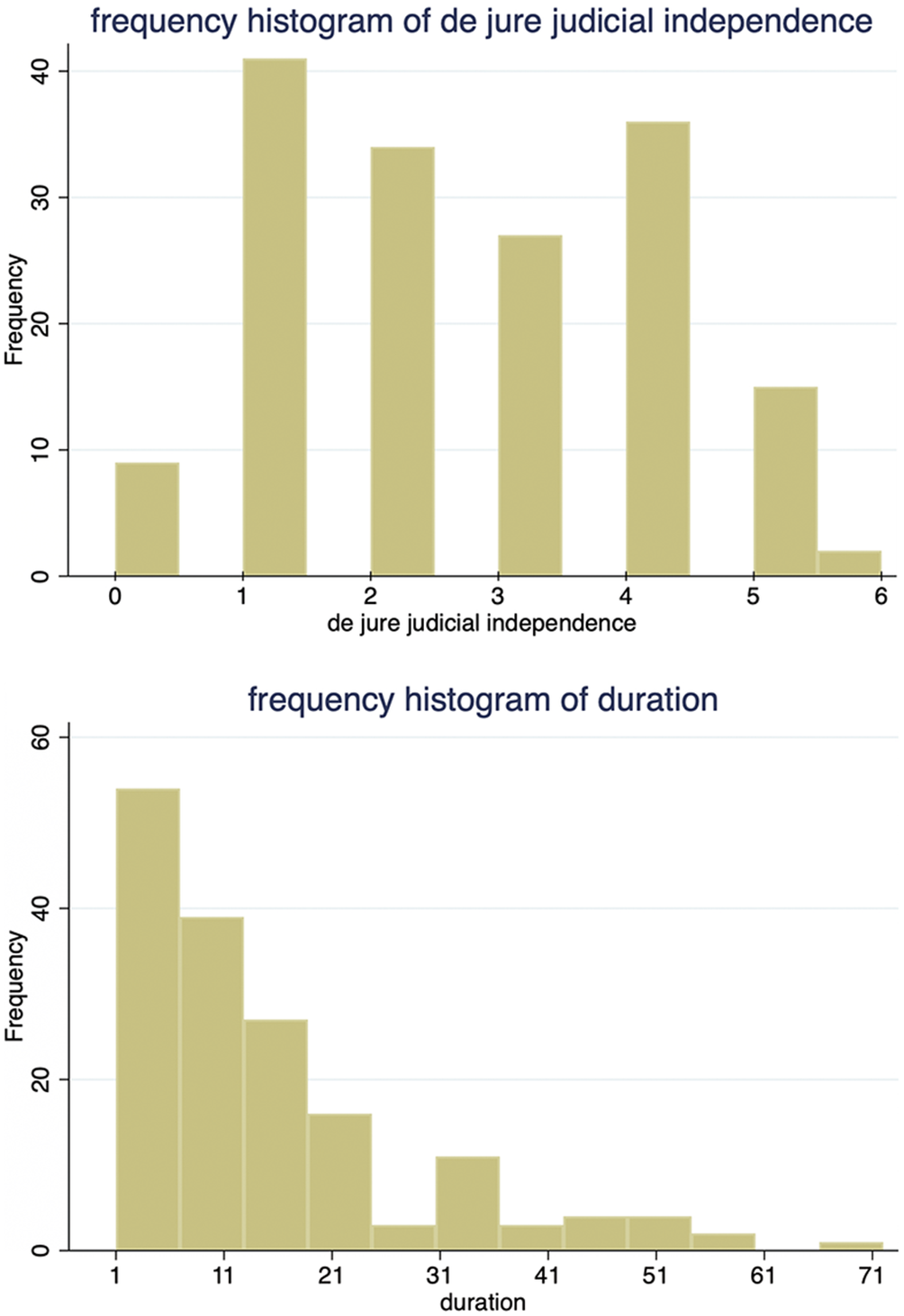
The dependent variable of the empirical model is de jure judicial independence that refers to the establishment of an independent judiciary by incorporating institutional guarantees in the constitution to protect judicial independence. In the literature, the key indicators of de jure judicial independence include the statement of judicial independence, appointment and removal procedures of judges, financial independence of the judicial body, and judicial tenure (Feld and Voigt Reference Feld and Voigt2003; Melton and Ginsburg Reference Melton and Ginsburg2014; Rios-Figueroa Reference Rios-Figueroa, Helmke and Rios-Figueroa2011). Accordingly, I use Melton and Ginsburg’s (Reference Melton and Ginsburg2014) measure of de jure judicial independence that is an additive index composed of six indicators. Each indicator looks at whether: (1) the concept of ‘judicial independence’ is explicitly mentioned in the constitution; (2) the tenure of the constitutional court judges is a life term; (3) in the appointment of the constitutional court judges, the judicial council or two or more actors are involved; (4) removal of the judges is prohibited or requires a majority vote in the legislature, or a proposition by the public and judicial council that needs to be approved by another political actor; (5) the constitution explicitly limits removal of the judges to crimes and other issues of misconduct, treason or violations of the constitution; and (6) the constitution specifically states that the salaries of the judges cannot be reduced or the judiciary has an independent budget. Although some indicators might be more efficient in protecting judicial independence than others, since our purpose is to measure the number of potential protections included in the constitution, I created an additive index. Each indicator is a binary variable coded either as 0 or 1. The de jure judicial independence index is composed of the sum of these six indicators and ranges between 0 and 6. The mean value of de jure judicial independence in the sample is 2.56, with a standard deviation of 1.49.Footnote 7
Our key hypothesis asserts that as the duration of the constitution-making process increases, de jure judicial independence will increase. In order to calculate the duration of each process, the start and end dates of each process are used. The time of the election, appointment or first meeting of the drafting body is taken as a starting date. When a country adopts a new constitution at the end of an international conference, the first day of that conference is taken as the starting date of the constitution-making process. The date of the constitution’s ratification by the parliament is taken as the end date of the process. These dates are gathered from various sources, including Index Mundi (2022), GlobaLex (2002), The World Factbook (2002) and Encyclopedia Britannica (2022). After coding each constitution’s starting and end dates, the duration was calculated in months. Looking at 164 constitutions, we find that a constitution-making process ranges from one to 72 months with a mean of 15.17 and 13.96 standard deviations. The data are heavily skewed towards the lower end of the scale. In some cases, the constitution-making process took years, but in others it took only a few months. For instance, while Somalia’s constitution of 2012 was completed in six years, Bahrain’s constitution of 2002 was completed in two months.Footnote 8
To show the robustness of the empirical results to the inclusion of some social, historical and political aspects that may affect a constitution’s content, a set of control variables is included in the model. First, in the literature it is stated identity and interests of the drafters might affect the constitutional regulations for judicial independence (Elster Reference Elster, Bauman and Kahana2006; Ginsburg, Elkins and Blount Reference Ginsburg, Elkins and Blount2009; Widner Reference Widner2008). For instance, the executive would not be willing to create an independent and powerful court that might control and constrain its power. As such, the constitutions that are shaped mainly by the executive might have low de jure judicial independence levels. The identity of the key drafters would not just affect the content of the constitution but may also affect the duration of the whole constitution-making process. For instance, when the executive is the key actor of the constitution-making process, the constitution may be written in a very short period of time, whereas when the legislature or the public dominates the process, the constitution-making process would most probably be extended. In other words, there might be a spurious relationship between the duration and content of the constitution. Including the identity of the key actor of the constitution-making in the empirical model as a confounding variable will also help us to control for the potential spuriousness between the duration and content of the constitution.
Adopting Ginsburg, Elkins and Blount’s (Reference Ginsburg, Elkins and Blount2009) categorization of the key actors involved in the constitution-making process, I create three groups: executive-centred, legislation-centered and constituent assembly-centered processes.Footnote 9 Three different variables are created and coded as binary variables to capture this categorization. Thus, if the executive is dominant in a country’s constitution-making process, then the ‘executive-centred’ variable is coded as 1 and the others as 0.Footnote 10 The data for this variable are partially taken from the dataset of Ginsburg et al.’s (Reference Ginsburg, Elkins and Blount2009) study. The information about the constitutions that is not included in Ginsburg et al.’s (Reference Ginsburg, Elkins and Blount2009) dataset is collected from various sources, including Index Mundi (2022), GlobaLex (2002), The World Factbook (2022), and Encyclopedia Britannica (2022). Descriptive statistics show that in 30 per cent of the constitutions, the executive is the key actor in the constitution-making process.
Second, Ginsburg, Elkins and Blount (Reference Ginsburg, Elkins and Blount2009) argue that constitutions ratified by public referendums include more legal protections of individual rights. They assert that if they know the constitution will be ratified by public referendum, the drafters will formulate the constitution accordingly. As such, taking the ratification of the constitution by public referendum as the most common form of public participation in the constitution-making process, I take it as our second control variable. If a country’s constitution is ratified by public referendum, the variable is coded as 1 and otherwise it is coded as 0. This variable’s data are collected from various sources, including Index Mundi (2022), GlobaLex (2002), The World Factbook (2002) and Encyclopedia Britannica (2022). In our dataset, descriptive statistics show that almost 40 per cent of the constitutions examined were ratified by public referendum.
Ethnic fractionalization is our third control variable. The general expectation is that if the society is quite heterogeneous and power can change hands between different groups, the drafters of the constitution would try to create an independent judiciary that would be able to protect the rights and liberties of the ethnic group that is in opposition. In this regard, one would expect to observe higher de jure judicial independence levels in societies with high levels of ethnic fractionalization. The Historical Index of Ethnic Fractionalization (Dražanová, Reference Dražanová2019) is used to test this hypothesis. The Ethnic Fractionalization Index is a continuous variable that ranges between 0 and 1. Increasing numbers refer to higher levels of ethnic fractionalization. Since demographic composition may change across years, the level of ethnic fractionalization when the constitution was adopted is taken.
This study also suggests that ‘regime durability’ might affect the level of judicial independence. Mostly, constitutions are adopted after regime transitions that occur following civil wars, military coups, social revolutions or state formation. To increase domestic and international support for the newly formed state or regime, the new constitution’s drafters want to provide greater protection for judicial independence. For this reason, our fourth control variable of the empirical model is ‘regime durability’; it measures the number of years since the most recent regime change. The regime durability variable is coded as 0 when a country declares its independence or experiences a regime change due to a military coup, war or revolution.Footnote 11 Taking the constitution’s ratification by the parliament, I calculate how many years have passed since the most recent regime change.Footnote 12 The information on the regime change is gathered from the Polity IV dataset. In our data, the value of the regime durability variable ranges from 0 to 151 (Switzerland). For 48.30 per cent of the cases, the regime durability variable is 0, which shows that new constitutions are often adopted after the declaration of independence or regime change.
Since the political and social context at the time when the constitution was written might affect the constitution’s content, the ‘electoral democracy index’ is included as the fifth control variable. The argument is that if the constitution were drafted in a democratic political environment, the probability of including higher protections for judicial independence would be higher. The electoral democracy index is taken from the V-Dem dataset and consists of the indicators of electoral competition, fair elections, freedom of association, freedom of expression and free media. The variable ranges between 0 and 1, and increasing numbers refer to higher levels of electoral democracy. Since the aim is to capture the impact of the democratization level on the drafting process, the electoral democracy index for the year before adopting the constitution is taken. For instance, Armenia’s most recent constitution was adopted in 1995. While coding the electoral democracy index of Armenia, the index for the year 1994 is taken. In the dataset, the country with the lowest level of democracy index is Saudi Arabia (0.017 for the year 1991) and the country with the highest score is Switzerland (0.902 for the year 1998).
In line with the seminal works of Schmitter and Karl (Reference Schmitter and Karl1991) and Muller and Sellingson (Reference Muller and Selligson1994), this study proposes that civic culture is a product of democracy. If a country has a long history of democracy, both the society and the ruling elite would be more likely to have strong democratic values. As such, I argue that if the country has a long history of democracy, the drafters of the constitution will try to create a democratic constitution with a high level of judicial independence. In this regard, the final control variable of our empirical model is ‘total years of democracy’.Footnote 13 This variable is measured by calculating the total number of years with a polity score higher than 0.Footnote 14 In our dataset, the value of ‘total years of democracy’ ranges from 0 to 151 (Switzerland), with an average of 13.05 years. This aspect shows that most of the countries in our dataset are new democracies.
All these control variables are included in the empirical model to correct for potential omitted variable bias. If the relationship between de jure judicial independence and duration of the constitution-making process is only the result of identity of the key drafters, ethnic fractionalization, democracy level, regime durability or the number of years with democracy, controlling for these variables should eliminate the statistical significance of the elements related to the constitution-making process.
V. Empirical analysis and results
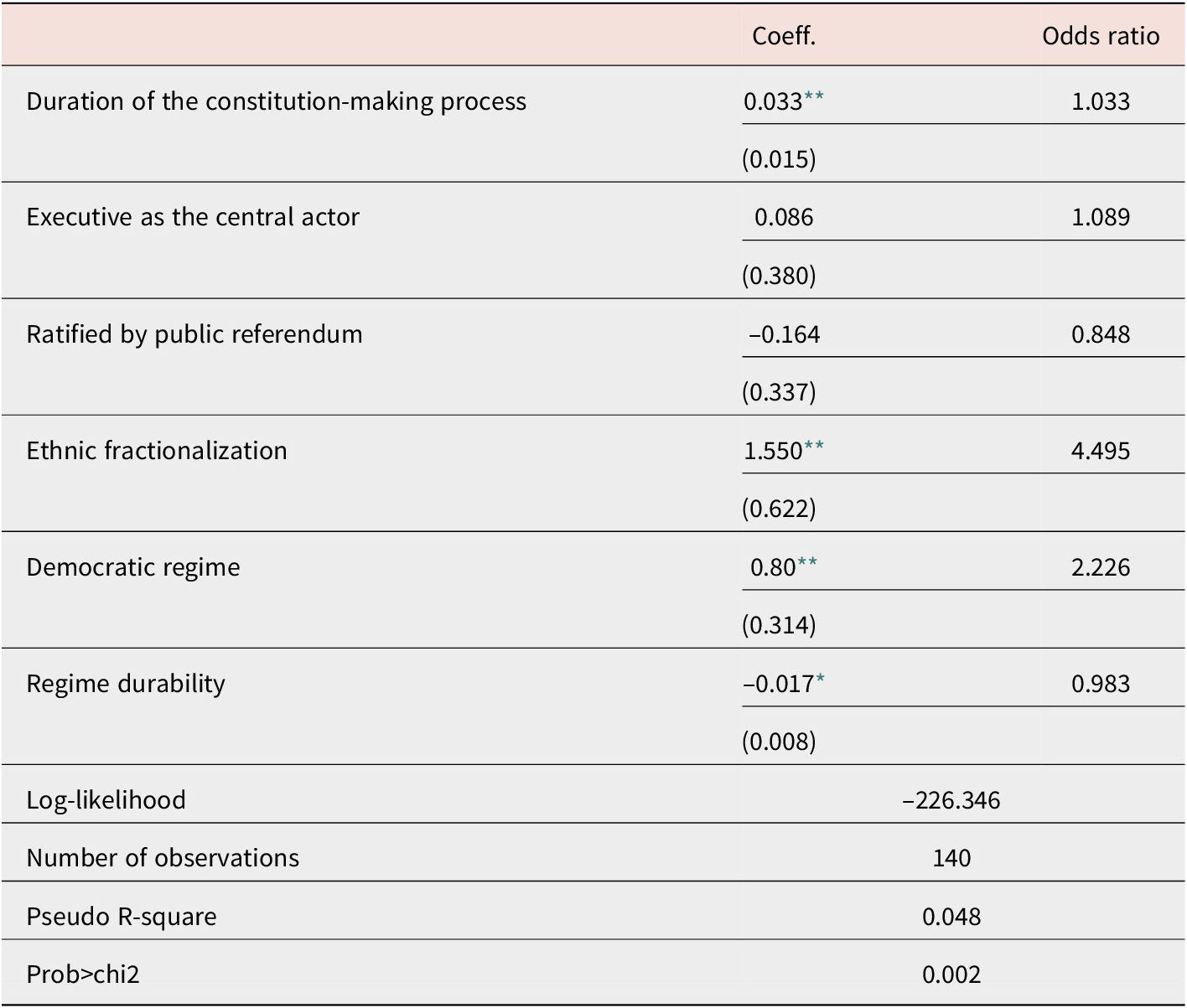
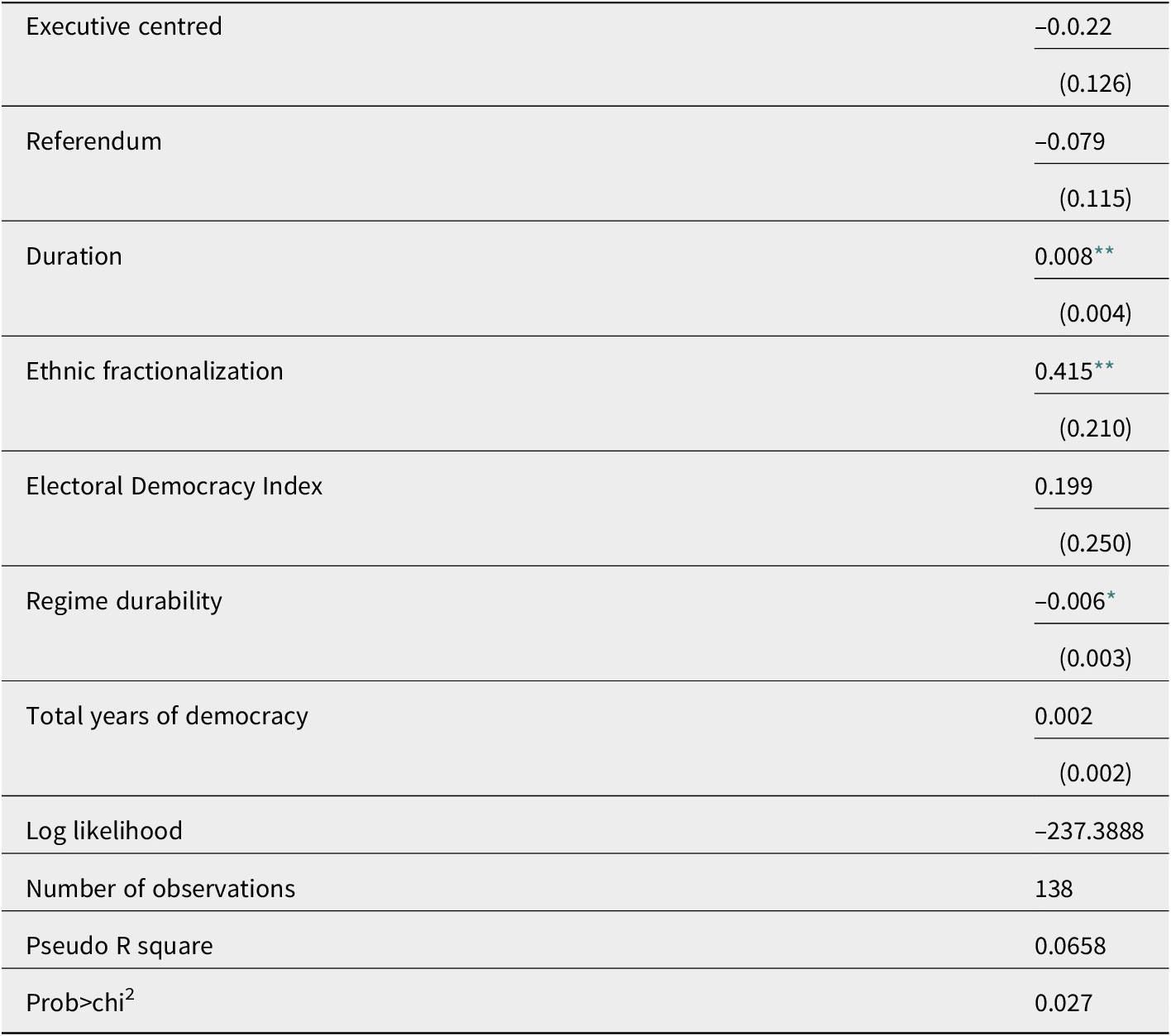
The dependent variable of the given hypothesis, de jure judicial independence, is coded on a 0–6 categorical scale. Since the dependent variable is measured on a categorical scale, I use ordered logistic regression.Footnote 15 The empirical results presented in Table 2 show a significantly positive relationship between the duration of the constitution-making process and de jure judicial independence. In other words, as the duration of the constitution-making process increases, it is more likely that the constitution will have higher protections for judicial independence. To show the specific impact of the duration, the marginal fixed effect and the change in predicted probabilities for low, medium, and high levels of de jure judicial independence are presented. Low judicial independence refers to the constitutions that include only one out of six constitutional protections for judicial independence. Middle judicial independence refers to the constitutions that include three constitutional protections for judicial independence. High de jure independence refers to constitutions that include five constitutional protections.Footnote 16
Ordered logistic regression analysis
Note: Standard errors in parentheses.
* p < 0.1;
** p < 0.05;
*** p < 0.01.
While calculating the marginal effects of the variable, the dummy variables – referendum and executive-centred approach – are set to 1 and all other variables to their means. We create a hypothetical country with a constitution ratified by a public referendum and an executive as the key actor of the constitution-making process. This country has an average level of democratization, ethnic fractionalization and regime durability. Figure 1 shows that as the constitution-making process’s duration increases from one month to 72 months, the probability of having many protections for judicial independence in the constitution (high de jure judicial independence) increases by almost 40 per cent. If a constitution is written in one month, the probability of having high de jure judicial independence is 24 per cent. However, when it is written in five years, this increases to almost 60 per cent. In other words, with each additional ten months of constitution-writing, the probability of increasing de jure judicial independence increases by 5 per cent. This finding supports our hypothesis and shows that as the duration of the constitution-making process increases, it is more likely that the constitution will have higher protections for judicial independence. It is essential to remember that the duration of the constitution-making process is used to measure the power distribution among all actors involved. While equal power distribution extends the duration of the constitution-making process, unequal power distribution shortens the constitutional design period.
Change in probability of high de jure judicial independence across duration.

When we look at the control variables, we see that only ethnic fractionalization and durability of the regime significantly impact de jure judicial independence. The empirical results presented in Table 1 show that as the ethnic fractionalization of the country increases, it is more likely that the new constitution will have higher levels of de jure judicial independence. The marginal effect graph shows that as ethnic fractionalization goes from minimum to maximum, the probability of having high de jure judicial independence increases by almost 30 per cent (see Figure A2 in the Appendix).
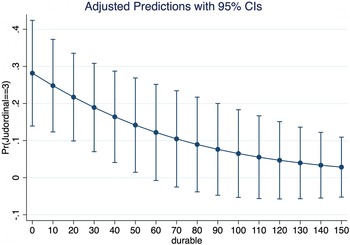
The other control variable that appears to significantly impact de jure judicial independence is the ‘durability of the regime’ variable. It has a significantly negative effect, meaning that as the durability of a regime increases, the probability of including many protections for judicial independence in the constitution decreases. In other words, regardless of whether the regime is democratic or authoritarian during the first years of the new regime, the probability of formulating a constitution with high levels of judicial independence appears to be higher. Based on these findings, one can also argue that when the political regime endures for many years, the executive would more easily curtail the power of the judiciary since, compared with the new regimes, legitimacy or public support would not be much of a concern. The marginal effects graph shows that for relatively old regimes (those more than 60 years old), the ‘durability of the regime’ would not significantly impact de jure judicial independence. However, for new regimes (less than 60 years old), as regime durability increases the probability of having an independent judiciary decreases. In a new state, in contrast, the likelihood of having a constitution with high judicial independence would be almost 30 per cent. After 50 years, this drops to nearly 15 per cent (see Figure A3 in the Appendix).
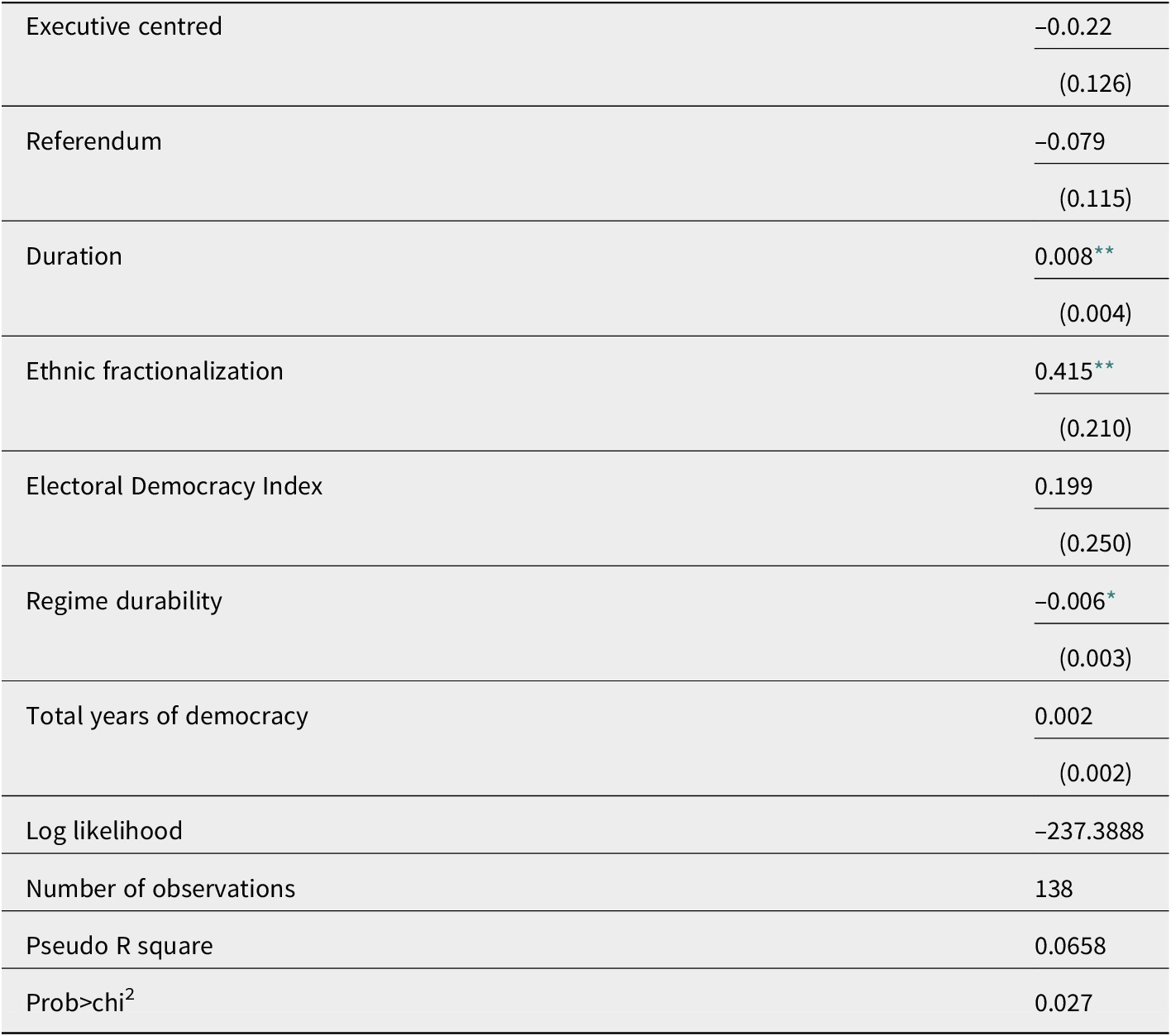
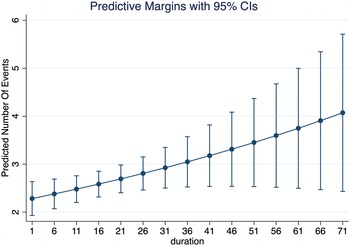
We conducted further statistical analyses to check the robustness of the empirical results and test whether some outliers were driving the results. First, the impact of the duration of the constitution-making process on de jure judicial independence was tested using Poisson regression analysis. The results are similar to the previous findings (Table A1 in the Appendix).Footnote 17 The results indicate that as the duration of the constitution-making process increases, the number of constitutional guarantees for judicial independence also increases. Figure A4 in the Appendix shows that when a constitution is written in a few months, the number of constitutional protections is around two. Yet, when the duration of the constitution-making process increases to three years, the number of protections increases to almost three. When the duration increases to six years, the number of protections increases to four. One might also argue that the effect of duration on de jure judicial independence is heteroskedastic so that in low levels of duration de jure judicial independence will be low, in moderately high durations judicial independence level will rise, but in very long constitution-making processes de jure judicial independence will decline. In this regard, the Breusch-Pagan test was done and no presence of heteroskedasticity was detected (chi2 = 0.66; Prob > 0.417).
Finally, one might argue that certain types of regimes may adopt certain types of constitution-making processes. For instance, the executive may be the key actor in the constitution-making process under authoritarian regimes. In contrast, under democratic regimes, the legislature may be the key actor. Suppose this type of a strong correlation between the electoral democracy index and the identity of the constitution-making process’s key actor is proved. In that case, the study will have a multicollinearity problem. I used the variance inflation factor (VIF) to check for collinearity between our independent variables. The mean VIF is 1.19, which does not pose any problem regarding multicollinearity. The low correlation between these two independent variables theoretically makes sense, even if the executives in authoritarian regimes tried to increase the legitimacy of the new constitution, and for this reason appointed constituent assemblies as the key actors of the constitution-making process.
VI. Concluding remarks
To explain the establishment of judicial independence, the existing studies on insurance theory use political competition as an indicator of political uncertainty and measure it by taking the difference between the proportion of seats held by the first and second parties in the legislative branch (Aydin Reference Aydin2013; Ginsburg and Versteeg Reference Ginsburg and Versteeg2014; Stephenson Reference Stephenson2003). Yet this creates theoretical and methodological problems. First, new constitutions are usually adopted right after crisis-like situations such as a war, coup or declaration of independence, when the parliament is usually dissolved. In those cases, using the parliamentary seats’ distribution to measure political competition becomes impossible. Second, in the context of transitional regimes epitomized by deep polarization and mistrust, assuming the incoming government will respect the judiciary that the outgoing government established may be problematic. Third, the insurance theory assumes that due to the potential public backlash, the costs of violating judicial independence would be high. Still, for this the public should appear as a credible control and constraint mechanism. For all these reasons, this article asserts that to measure post-constitutional political uncertainty, one should consider not only the power distribution among the ‘political’ actors but also the power distribution among all actors involved in the constitution-making process, including the public and civil society.
Comparing the constitution-making processes of the constitutions of Egypt (2012) and Tunisia (2014), this study has presented the ‘duration of the constitution-making process’ as an alternative measure of post-constitutional political uncertainty. The theoretical framework asserts that as the length of the constitution-making process increases, the possibility of deliberation at the public level will increase. This, in turn, helps to develop trust among polarized political actors and increase political actors’ perception of the public as a credible control and constraint mechanism. This ensures that the incoming government will respect the independence of the newly established institutions and will lead to the adoption of democratic constitutions that establish an independent and powerful judiciary. In the second part of the article, to test this argument, we used a large dataset that covered information on the content and design processes of 140 countries’ most recent constitutions adopted between 1945 and 2018. The empirical results indicated that as the constitution-making process’s duration increases, the number of constitutional guarantees for judicial independence also increases.
As a result, this study makes theoretical and methodological contributions to the constitution-making and judicial politics literature. First, the theoretical framework of this study suggests that the political actors’ perception of post-constitutional uncertainty is shaped not just by the power distribution among the political actors, but also by the power of the public. Perceiving the public as a powerful actor would ensure that the incoming government would respect the independence of the newly established institutions. As a result, this expectation may convince the ruling elite to establish independent and powerful democratic institutions. Building on the insurance theory, we believe that this theoretical approach provides an explanation for the establishment of judicial independence that can be applied even in transitional regimes epitomized by deep polarization and mistrust. Second, using the duration of the constitution-making as an alternative indicator of power distribution among the key actors of the drafting process helps us to test the validity of the insurance theory in political contexts where there is no data for legislative seat distribution. Moreover, we believe that by using this indicator, it will be possible to empirically answer any research question that looks at the effect of power distribution during the constitution-making process.
Appendix
Model using Poisson regression analysis
Standard errors in parentheses.
Frequency distribution of the key variables.
Change in probability of high de jure judicial independence across ethnic fractionalization.

Change in probability of high de jure judicial independence across durability of the regime.

Predictive margins of duration after Poisson model.





 Open access

