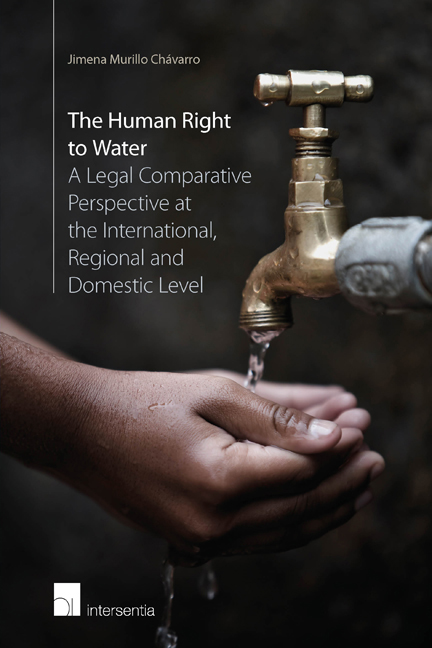
 The Human Right to Water
 A Legal Comparative Perspective at the International, Regional and Domestic Level
Book contents
- Frontmatter
- Dedication
- Contents
- List of Abbreviation
- Table of Cases and Other Materials
- Table of Treaties and Other Instruments
- Chapter 1 General Introduction
- Chapter 2 Emergence, Definition and Core Content of the Human Right to Water
- Chapter 3 Recognition of the Human Right to Water at the International Level
- Chapter 4 Recognition of the Human Right to Water at the Regional Level
- Chapter 5 Recognition of the Human Right to Water at the Domestic Level: a Case Study Approach
- Chapter 6 Extraterritorial Application of the Human Right to Water in a Transboundary Watercourse Context
- Chapter 7 General Conclusions
- Bibliography
- Index
Chapter 5 - Recognition of the Human Right to Water at the Domestic Level: a Case Study Approach
Published online by Cambridge University Press: 15 December 2017
Book contents
- Frontmatter
- Dedication
- Contents
- List of Abbreviation
- Table of Cases and Other Materials
- Table of Treaties and Other Instruments
- Chapter 1 General Introduction
- Chapter 2 Emergence, Definition and Core Content of the Human Right to Water
- Chapter 3 Recognition of the Human Right to Water at the International Level
- Chapter 4 Recognition of the Human Right to Water at the Regional Level
- Chapter 5 Recognition of the Human Right to Water at the Domestic Level: a Case Study Approach
- Chapter 6 Extraterritorial Application of the Human Right to Water in a Transboundary Watercourse Context
- Chapter 7 General Conclusions
- Bibliography
- Index
Summary
INTRODUCTION
Under the international law of human rights, each state has a primary obligation towards its citizens and other individuals living within its territory. These obligations were devised to protect individuals from the exercise of power of the territorial state. Therefore, human rights are normally framed within a territorial perspective, creating a vertical relationship (states to individuals). As a result, human rights identify certain obligations and responsibilities of states (duty bearers) towards the mentioned individuals or groups of people (rights holders). Due to the existence of this vertical relationship, human rights are generally implemented domestically. For this reason, this chapter examines at the national level, whether some states in South America have recognised the human right to water, and if so, whether this right is recognised as a derivative or independent right, and how it is implemented.
A number of countries in South America have already adopted the human right to water as an independent right in their constitution, their legislation or by the jurisprudence of their courts. One of the first South American countries, if not the first, that recognised the human right to water was Colombia. The Colombian Constitutional Court, characterised as being a progressive court, recognised as early as 1992 the right to water in its jurisprudence. This Court declared that the supply of drinking water is a fundamental right. In recent years, the Peruvian Constitutional Tribunal recognised the human right to water through its jurisprudence. This right is also explicitly incorporated into the constitution of other South American states. In most cases, the constitutional recognition was triggered by the negative effects of the privatisation of drinking water services experienced in those countries. For instance, on 31 October 2004 Uruguayan citizens voted in favour of a constitutional reform that recognised drinking water and sanitation as a fundamental right, in response to a previous privatisation process. The Uruguayan Constitution now stipulates that drinking water services shall exclusively and directly be provided by public entities. Subsequently, Ecuador in 2008 and Bolivia in 2009 also reformed their constitutions and unambiguously incorporated the human right to water. Other countries recognise the human right to water through their national legislation. This is the case for Venezuela, Paraguay and Peru.
Information
- Type
- Chapter
- Information
- The Human Right to WaterA Legal Comparative Perspective at the International, Regional and Domestic Level, pp. 199 - 282Publisher: IntersentiaPrint publication year: 2015
Accessibility standard: Unknown
Why this information is here
This section outlines the accessibility features of this content - including support for screen readers, full keyboard navigation and high-contrast display options. This may not be relevant for you.Accessibility Information
Accessibility compliance for the PDF of this chapter is currently unknown
and may be updated in the future.