


For patients with treatment-refractory schizophrenia, clozapine represents the most effective and proven treatment. It is clinically effective in reducing symptoms and increasing social functioning and/or quality of life for 40-60% of treated patients (Reference Wahlbeck, Cheine and EssaliWahlbeck et al, 2001). However, these benefits come at a cost. The acquisition cost of clozapine is several times that of conventional antipsychotics. Furthermore, clozapine is associated with some life-threatening side-effects that require continual blood monitoring. These factors contribute to clinicians' reluctance to prescribe clozapine and, recently, it has been shown that clozapine prescribing is affected by postcode (Reference Purcell and LewisPurcell & Lewis, 2000). We suggest a lack of evidence-based prescribing rather than financial costs as the main reason for these variations.
The majority of patients report that they would rather stay on clozapine than return to their old treatments (Reference Rosenheck, Chang and ChoeRosenheck et al, 2000). In addition, there is some evidence that people who remain on clozapine show reduced in-patient care requirements. Those continuing for 2 years show the greatest gains, with a two-thirds reduction in the number of admissions and total time spent in hospital compared with those who discontinued clozapine (Reference Hayhurst, Brown and LewisHayhurst et al, 2002). Unfortunately, the rate of discontinuation is high, with 44% of the patients in the Hayhurst study discontinuing over a 2-year period and 30% discontinuing within the first 6 months. Because of the known efficacy of clozapine and the problem of discontinuation, this study was designed to try to establish the reasons for early discontinuation (before 6 months) where the beneficial effects on symptoms, social functioning and/or quality of life might not yet be noticeable in an NHS service.
Method
Consecutive patients starting treatment on clozapine in the South London and Maudsley NHS Trust over a 6-month period from 19 July 1999 were followed for 6 months' post-registration. This included patients at five separate hospitals (Bethlem, Maudsley, St Thomas's, Guy's and Lewisham). Pharmacists at the different sites collected initial data on registration and the date of discontinuation (if any). Demographic data on registered patients were collected, including gender, age and ethnicity. The clinical data included their consultant, ward and hospital and whether the patient was newly registered or restarting therapy. Reasons for discontinuation were recorded following a review of the clozapine patient monitoring records and hospital patient medical records.
Results
More than two-thirds of the 54 patients started on clozapine were men. They ranged in age from 19 to 93, with an average age of 40 years. Comparison data of people with psychosis in the community service from the PRiSM Psychosis study (Reference Thornicroft, Strathdee and PhelanThornicroft et al,1998) showed a similar age profile and ethnicity rates, but gender distribution was different as there were equal numbers of men and women in the community sample.
For more than 25% of the patients, this was not the first time they had been registered for clozapine. There was also a skew in the frequency of prescriptions, with one hospital alone accounting for 46% of registrations and one consultant registering 10 patients while the majority only registered a single person. However, individual wards did not seem to constitute a significant factor in new registrations.
Of the 54 patients who were registered for clozapine within the Trust, seven of them had discontinued by 3 months and a further 10 by 6 months post-registration, making a total of 17 people (31%) who discontinued. Table 1 shows the distribution of reasons for discontinuation.
Reasons for discontinuation
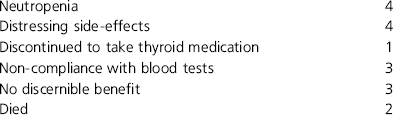
| Neutropenia | 4 |
| Distressing side-effects | 4 |
| Discontinued to take thyroid medication | 1 |
| Non-compliance with blood tests | 3 |
| No discernible benefit | 3 |
| Died | 2 |
In order to test whether there were any factors that predicted discontinuation, all the socio-demographic and clinical variables were entered into a survival analysis using Cox's regression together with a variable reflecting the NHS trust concerned as, at the time of the study, two large NHS trusts had just amalgamated. Time to discontinuation was the event predicted and the two people who died were assumed to be censored data. The results show that age and the hospital where the patient was registered produced a significant model (w2=19.664, d.f.=2, P<0.001). For each year of age, there is a 5.7% increase in the likelihood of discontinuing. Being registered as part of the Bethlem/Maudsley Trust reduced the chance of discontinuing by a factor of 3. The analysis was repeated after excluding patients referred from outside the catchment area. This did not affect the overall results, the corresponding figures being 5.2% and a factor of 2.36.
Discussion
This was a naturalistic study of clozapine continuation in patients prescribed the drug as part of a local service. Apart from gender, the patients prescribed clozapine were representative of those in contact with local psychiatric services (compare Reference Thornicroft, Strathdee and PhelanThornicroft et al,1998).
The discontinuation rate in this study was 31% at 6 months, which is similar to the levels quoted in other literature (Reference Hayhurst, Brown and LewisHayhurst et al, 2002; Reference Tuunainen and GilbodyTuunainen & Gilbody, 2000). As the beneficial effects of clozapine are reported to be gained cumulatively over 6 months and sometimes up to 12 months post-registration, the beneficial effects could not have been obvious for the early drop-out group (i.e. within 3 months). Despite this, the reason given for two early discontinuations was a lack of beneficial effects.
Two-thirds (10 out of 17) of the patients who discontinued clozapine at 6 months did so because of adverse effects. Many of these adverse effects (e.g. sedation, hypersalivation and postural hypotension) tend to wear off over time but if they persist, management strategies are required to deal with them (see Reference LiebermanLieberman, 1998). One older Caucasian man developed hyperglycaemia and had all the risk factors previously described by Mir and Taylor (Reference Mir and Taylor2001). Two patients discontinued treatment because of hypertension, which is an uncommon adverse effect and tends to occur in the first 4 weeks (Reference Taylor, Shapland and LaverickTaylor et al, 2000). Hypotensive therapy is rarely warranted. Hypotension, however, is common and is likely to occur at the beginning of treatment. Dose adjustment with a reduction in the rate of dose increase is generally all that is required. Clozapine is also involved in many clinically-significant drug-drug interactions. Some medications, such as the antithyroid drug, carbimazole, can cause blood dyscrasias and their concomitant use with clozapine increases the risk of such reactions. The results of this risk-benefit analysis would have contributed to the decision to discontinue clozapine in order for a patient to take his/her anti-thyroid medication.
There have been no consistent findings for the variables that increase the risk of clozapine discontinuation. Moeller et al (Reference Moeller, Chen and Steinberg1995) and Rosenheck et al (Reference Rosenheck, Chang and Choe2000) have shown an effect of ethnicity, but this did not affect continuations with clozapine in our study.
A further negative finding is that registration status was not associated with discontinuation. We are not aware of any other study addressing registration status, but it seems clear that discontinuing clozapine after an initial registration is not a bar to successful engagement on the drug in the future.
The positive findings were that clozapine discontinuation was significantly greater among older patients, with the figures from the survival analysis suggesting a 5.7% increase in the probability of discontinuation with each year of age. According to Rosenheck et al (Reference Rosenheck, Chang and Choe2000), in the comparison between clozapine and haloperidol, younger age was a predictor of continuation with treatment, irrespective of which medication patients received. In this study, continuation with treatment was greater with clozapine. Age was also a factor in discontinuation with clozapine in a study carried out by Munro et al (Reference Munro, O'Sullivan and Andrews1999). They found that for each 10-year increase in age, the risk of withdrawal increased by 33%. This suggests that establishment on clozapine might be considered as early as possible.
The other interesting characteristic significantly associated with discontinuation was the site of the prescription. One set of hospitals with a long history of clozapine prescription that also prescribed to the majority of patients was associated with more persistence on the drug. This may reflect different practices among clinicians or variations in hospital policies. It is, however, unlikely to reflect geographical differences in patient populations as most socio-economic data on the two areas show great similarities and the prevalence of new cases is high in two boroughs that were split between the two trust sites examined here. The hypothesis we would like to suggest is that practice does make perfect and that the more experience clinicians have with prescribing clozapine, the better the rates of continuation are likely to be. This may be because this experience allows both consultants and other clinical staff to develop expertise in encouraging people to adhere to this treatment, particularly in the early stages when there may be a very high burden of side-effects. The one clinician with the greatest number of patients on clozapine appeared to have lower discontinuation rates, although the clinician factor was not supported by any of our analyses. As in the Purcell and Lewis (Reference Purcell and Lewis2000) study, the relationship of the number of prescriptions for clozapine might be because of an increased awareness of evidence-based practice in the hospital settings associated with an academic institution. However, what is also clear from this study is that when clozapine is prescribed more widely in an institution, the continuation rates increase.
In conclusion, discontinuation of clozapine is affected by the age of the patient and the prescribing practices of the base hospital. More data are required to elucidate whether the differences relate to the clinician and his or her team, their specific use of clozapine or the hospital support for maintaining these patients. However, the results do suggest that increased use of clozapine may provide clinicians with the further skills to choose both the likely successful candidates and to manage any resultant side-effects.
Declaration of interest
E.W. has received lecture fees from Eli Lilly and Zanofisynolab, D.D.-M. has received funds from Eli Lilly and AstraZeneca, T.W. has received unrelated and unrestricted charitable grants and lecture fees from Novartis, AstraZeneca and Janssen Pharmaceuticals, N.W. is now supported by an unrelated grant from GlaxoSmithKline.


 Open access


eLetters
No eLetters have been published for this article.