





INTRODUCTION
Jean-Baptiste Lainé (formerly “Mantle”) is among the largest and most extensively excavated Northern Iroquoian sites currently known from Ontario, Canada (Birch and Williamson Reference Birch and Williamson2013): hereafter J-BL. Based on the material culture and the absence of all but minimal European trade goods (two pieces of European copper, one piece of iron), a date for the site was originally proposed as ca. AD 1500–1530 (also Williamson et al. Reference Williamson, Burchell, Fox and Grant2016: 238; Williamson Reference Williamson2014: 6) (note: all calendar dates in this paper are AD). Further, it was argued that the site was the last village occupation of a contiguous sequence of three village sites in the West Duffins drainage belonging to the very same community and comprising (in sequential order) the Draper, then Spang and then J-BL sites. The initial pair of radiocarbon (14C) dates from J-BL lay on the reversal/plateau in the 14C calibration curve 1480–1630. They could support calendar ages around 1500 or around 1600. In keeping with understandings of the local ceramic seriation and the presence of only a very small quantity of European metal at the site, Birch and Williamson (Reference Birch and Williamson2013) therefore proposed a date of ca. 1500–1530. This was entirely reasonable given the knowledge then available.
Subsequent analysis of additional 14C dates from these three sites suggested a major chronological revision (Manning et al. Reference Manning, Birch, Conger, Dee, Griggs, Hadden, Hogg, Bronk Ramsey, Sanft, Steier and Wild2018a). Those from Draper clearly indicated a date range in the earlier to mid-16th century, and not the mid-15th century or ca. 1450–1475 as previously supposed (e.g., Williamson et al. Reference Williamson, Burchell, Fox and Grant2016: 242; Birch and Williamson Reference Birch and Williamson2013: 30): Figure 1 (note: for a description of each model in each Figure in this paper, see Methods below and in particular the Supplementary Material). It was generally assumed and stated that the Draper site was “undoubtedly occupied prior to Mantle” (Williamson et al. Reference Williamson, Burchell, Fox and Grant2016: 242). Given ethnohistoric understandings and archaeological evidence regarding the frequent relocations of Iroquoian villages in the sixteenth century, on the order of once every 20–40 years or less (Warrick Reference Warrick1988; Fitzgerald Reference Fitzgerald1990: 123–133; Fitzgerald et al. Reference Fitzgerald, Knight and Bain1995:120; Birch and Williamson Reference Birch and Williamson2015; Birch et al. Reference Birch, Manning, Sanft and Conger2021: 66–67), the 14C dates from all three sites were consistent with favoring the archaeologically inferred settlement relocation sequence as probable: Draper then Spang then J-BL. The result, if this ordering of the sites is accepted, given the clear (non-ambiguous) placement of the Draper 14C data, was that both Spang and then J-BL must be after the earlier to mid-16th century. This analysis appeared to resolve what was otherwise a dating ambiguity looking at the Spang or J-BL 14C evidence in isolation. It suggested a date for the J-BL site ca. 1587–1623 at 95.4% probability, nearly a century more recent than previously assumed. This result was of course an initial surprise, since it ran contrary to the conventional expectations.
14C data from the Draper, Ontario, site from Manning et al. (Reference Manning, Birch, Conger, Dee, Griggs, Hadden, Hogg, Bronk Ramsey, Sanft, Steier and Wild2018a) modeled in isolation. See Methods. (a) Overall site model. (b) Modeled start Boundary. (c) Modeled Date query applied to the site Phase. (d) Modeled end Boundary. Data from OxCal (Bronk Ramsey Reference Bronk Ramsey2009a, Reference Bronk Ramsey2009b) version 4.4.4 and IntCal20 (Reimer et al. Reference Reimer, Austin, Bard, Bayliss, Blackwell, Ramsey, Butzin, Cheng, Edwards, Friedrich, Grootes, Guilderson, Hajdas, Heaton, Hogg, Hughen, Kromer, Manning, Muscheler, Palmer, Pearson, van der Plicht, Reimer, Richards, Scott, Southon, Turney, Wacker, Adolphi, Büntgen, Capano, Fahrni, Fogtmann-Schulz, Friedrich, Köhler, Kudsk, Miyake, Olsen, Reinig, Sakamoto, Sookdeo and Talamo2020) with curve resolution set at 1 year.

If the inferred settlement relocation sequence is correct, then the 14C picture was, and is, clear. In the past, several such “readily recognizable site relocation sequences of contact period Iroquoian groups in southern Ontario and New York” (Fitzgerald et al. Reference Fitzgerald, Knight and Bain1995:118) formed more or less standard assumptions within the field. However, do we continue to regard the accepted inferred Draper-Spang-Mantle (J-BL) settlement sequence (Birch and Williamson Reference Birch and Williamson2013) as secure? Times and thinking continue to change and (hopefully) improve: the 14C-led rethink of this period in northeastern North America, in particular, has led to critical re-assessment of a number of past assumptions and theoretical constructs (e.g., Birch Reference Birch2020; Birch et al. Reference Birch, Manning, Sanft and Conger2021; Manning et al. Reference Manning, Birch, Conger, Dee, Griggs and Hadden2019, Reference Manning, Lorentzen and Hart2021). In particular, recent work based on both social network analysis and 14C has now strongly questioned several past assumptions concerning inferred linear site sequences/order relationships, and in turn the nature and extent of population circulation and movement between villages in different sequences (e.g., Manning and Hart Reference Manning and Hart2019; Birch and Lesage Reference Birch and Lesage2020; Hart Reference Hart2020; Birch and Hart Reference Birch and Hart2021; Manning et al. Reference Manning, Lorentzen and Hart2021).
Today, greater skepticism might therefore be addressed towards the hypothesis of an inferred linear site relocation sequence for the Draper, Spang, and J-BL sites. It remains possible from the available 14C evidence, but it should not be considered a priori to form the only potential historical trajectory. Indeed, recent geophysical prospection and renewed excavations at Spang revealed neither the site layout nor the dense quantities of material expected, based on comparisons with Draper and J-BL (Curtis and Birch Reference Curtis and Birch2020). Although additional excavation is required for resolution, this recent work has raised further questions about the nature and intensity of occupation of Spang and whether it is isomorphic with either the Draper or J-BL community. Thus, although consideration of the 14C evidence from each site would indicate that some degree of order relationship is most likely, this need not necessarily be linear. It could instead include possible overlaps or alternatively be non-contiguous. In general, assessed today, it is clearly a desideratum to try to evaluate, and date, each such village site independent of any past assumptions regarding inter-village chronological relationships derived merely from archaeological “inference” (and so avoid a circular logic chain). Indeed, it has become clear that material culture cannot be used arbitrarily as a comprehensive guide to past community/ethnic identification and thus does not provide a refined temporal measure for settlement ordering in northeastern North America (e.g., Gaudreau and Lesage Reference Gaudreau and Lesage2016; Birch and Lesage Reference Birch and Lesage2020). A caveat should therefore apply to previous work relying solely on such inference-based assumptions pending independent confirmation (e.g., Manning et al. Reference Manning, Lorentzen and Hart2021).
We therefore re-examine the dating of J-BL in isolation. We use only evidence available directly from the site itself. This is a challenge, as the 14C data from the site inherently offer two possible dating solutions. But, in reality, it is possible for only one of these to be correct. We identify the likely plausible solution for the site, but also note the possible problems. We find that the 14C dates available on selected wood-charcoal from early in the site’s history, and the in-built age represented within these, are central to resolving what is otherwise an ambiguous situation, along with use of the archaeologically inferred intra-site sequence. Such an intra-site sequence here refers to where distinct ordered phases can be archaeologically observed and so provide the elements where C > B > A, etc., in an OxCal Sequence analysis (Bronk Ramsey Reference Bronk Ramsey1995, Reference Bronk Ramsey2009a). Note: OxCal Chronological Query Language (CQL2) terms, like Sequence, Phase, Boundary, when used in the context of OxCal employment, are shown in Courier font. While our paper addresses the J-BL case, the issues and approaches discussed apply to other similar cases affected by dating ambiguities created by calibration curve taphonomy.
J-BL Site Data, Materials Available, and Issues to be Addressed
Jean-Baptiste Lainé (Mantle), J-BL: Site Data
There is a substantial set of 14C dates on samples from J-BL (Manning et al. Reference Manning, Birch, Conger, Dee, Griggs, Hadden, Hogg, Bronk Ramsey, Sanft, Steier and Wild2018a). The majority are on short-lived plant remains (n=34), a smaller set are on wood-charcoal (n=8) (see Supplementary Material). The focus on short-lived materials is typical of archaeological dating using 14C in recent decades where priority is placed on short-lived materials securely associated with a context of interest (the target event). The logic is that the dated material (the relevant short-lived organic material) offers a 14C age that is the same as the contemporary atmospheric 14C value. Thus, the dated event (the sample) is deemed equivalent to the target event (the context of interest) in 14C terms (Waterbolk Reference Waterbolk1971; Dean Reference Dean1978). However, a problem comes when the relevant 14C age is not unique, and instead the same 14C age can describe two or more quite discrete calendar periods as occurs when the dated event falls on a wiggle/reversal/plateau in the 14C calibration curve. If there is a (securely) known time series, for example from stratigraphy, then such ambiguities can be resolved. This has been a mainstay of work applying Bayesian chronological modeling where the constraints of known order (sequence), and potentially other prior information, allows for resolution of what was otherwise ambiguous (Buck et al. Reference Buck, Kenworthy, Litton and Smith1991, Reference Buck, Cavanagh and Litton1996; Bronk Ramsey Reference Bronk Ramsey1995, Reference Bronk Ramsey2001, Reference Bronk Ramsey2009a; Bayliss Reference Bayliss2009). However, when dealing with a single, discrete, and relatively short overall episode, the situation is more problematic.
J-BL is one such problematic example. Modeled in isolation, the dates on short-lived samples, even just those placed into the archaeologically inferred intra-site sequence (only those 22 of the 34 dates on short-lived plant samples that can be so associated with a specific Phase within the intra-site Sequence), yield an ambiguous result: Figure 2a. Substantial probability lies either around 1500 or alternatively around 1600. The sequence over a short calendar period—and again these Late Woodland village sites are understood to have had lifetimes of no more than ca. 40 years and typically around 20 or 25 years (Warrick Reference Warrick1988; Birch et al. Reference Birch, Manning, Sanft and Conger2021: 66–67)—cannot discriminate between the two possible calendar locations. If we remove the inferred intra-site sequence, and add in the other 12 dates on short-lived plant samples lacking a specific association within the intra-site sequence, a similar ambiguity results. Considering the most likely 68.3% range from a Date query addressed to the site Phase yields ca. 1484–1508 (37.4%) or 1596–1617 (30.9%): Figure 2b. These two date placements, seemingly almost equally likely, are around 100 years apart and yield very different historical narratives.
Modeled results from the 14C dates on short-lived plant remains from the J-BL site. (a) Only samples securely associated with each Phase from the intra-site Sequence, analyzed using this Sequence. (b) Modeled results from the set of 34 14C dates on short-lived plant remains from the J-BL site treated as one Phase (no intra-site Sequence). Data from Manning et al. (Reference Manning, Birch, Conger, Dee, Griggs, Hadden, Hogg, Bronk Ramsey, Sanft, Steier and Wild2018a). See Methods and Supplementary Material. The Boundaries from start through end of the Sequence are shown along with Date queries applied to each of the successive Phases from the intra-site Sequence. Data from OxCal (Bronk Ramsey Reference Bronk Ramsey2009a, Reference Bronk Ramsey2009b) version 4.4.4 and IntCal20 (Reimer et al. Reference Reimer, Austin, Bard, Bayliss, Blackwell, Ramsey, Butzin, Cheng, Edwards, Friedrich, Grootes, Guilderson, Hajdas, Heaton, Hogg, Hughen, Kromer, Manning, Muscheler, Palmer, Pearson, van der Plicht, Reimer, Richards, Scott, Southon, Turney, Wacker, Adolphi, Büntgen, Capano, Fahrni, Fogtmann-Schulz, Friedrich, Köhler, Kudsk, Miyake, Olsen, Reinig, Sakamoto, Sookdeo and Talamo2020) with curve resolution set at 1 year.

Possible Constraints on Site Dating
If we only had the 14C dates on the short-lived samples, there appears an inherent ambiguity we cannot resolve. Additional data and constraints are required in such cases (as discussed by Meadows et al. Reference Meadows, Rinne, Immel, Fuchs, Krause-Kyora and Drummer2020; Manning et al. Reference Manning, Birch, Conger and Sanft2020). An ideal solution is where a wood-charcoal sample securely associated with a site context provides a tree-ring sequence covering several decades or more and hence potentially a specific (non-ambiguous) 14C-wiggle-match (Pearson Reference Pearson1986; Bronk Ramsey et al. Reference Bronk Ramsey, van der Plicht and Weninger2001; Galimberti et al. Reference Galimberti, Bronk Ramsey and Manning2004; Hogg et al. Reference Hogg, Gumbley, Boswijk, Petchey, Southon, Anderson, Roa and Donaldson2017). Analogous examples from the earlier Hallstatt 14C plateau period include Quarta et al. (Reference Quarta, Pezzo, Marconi, Tecchiati, Elia and Calcagnile2010); Jacobsson et al. (Reference Jacobsson, Hamilton, Cook, Crone, Dunbar, Kinch, Naysmith, Tripney and Xu2018); and Manning et al. (Reference Manning, Smith, Khatchadourian, Badalyan, Lindsay, Greene and Marshall2018b). Where available, this can provide not only a terminus post quem (TPQ) or date for the last extant tree-ring or waney edge (and cutting and use date) but, if it is sufficiently long enough to define a unique (or at least overwhelmingly likely) solution, it can resolve the previous ambiguity. Typically, this means a wiggle-match ca. 50+ years in length given the properties of the calibration curve in the last millennium, although even shorter tree-ring sequences linked to specific contexts within a site history can nonetheless be informative (Manning et al. Reference Manning, Birch, Conger and Sanft2020; Manning et al. Reference Manning, Lorentzen and Hart2021). An example in the time period of interest is the Warminster, Ontario, site (Manning et al. Reference Manning, Birch, Conger, Dee, Griggs, Hadden, Hogg, Bronk Ramsey, Sanft, Steier and Wild2018a, Reference Manning and Hart2019). Here what would have been an ambiguous result considering just the 14C dates on short-lived samples from the site is resolved because of a wiggle-match on the 57 years (tree-rings) preserved of a Larix laricina post from a longhouse at the site. Since the external part of this sample is poorly preserved and there is no evidence of original outermost tree-rings or waney edge or bark, we may assume that this post sample is missing a number (unknown) of original outermost tree-rings. The wiggle-match placement of the last extant tree-ring from this structural element therefore reasonably sets a TPQ for the occupation of the site: Figure 3.
Dating model for the Warminster site, Ontario in isolation. Data from Manning et al. (Reference Manning, Birch, Conger, Dee, Griggs, Hadden, Hogg, Bronk Ramsey, Sanft, Steier and Wild2018a, Reference Manning and Hart2019). See Methods. (a) Summary of modeled results for the Warminster dates from the site Phase on short-lived plant materials only. Ambiguous result. (b) Modeled results incorporating the TPQ information available from a wiggle-match of a post from a structure at the site—this resolves the dating ambiguity. Compare Date query for (b) versus Date query for (a) Data from OxCal (Bronk Ramsey Reference Bronk Ramsey2009a, Reference Bronk Ramsey2009b) version 4.4.4 and IntCal20 (Reimer et al. Reference Reimer, Austin, Bard, Bayliss, Blackwell, Ramsey, Butzin, Cheng, Edwards, Friedrich, Grootes, Guilderson, Hajdas, Heaton, Hogg, Hughen, Kromer, Manning, Muscheler, Palmer, Pearson, van der Plicht, Reimer, Richards, Scott, Southon, Turney, Wacker, Adolphi, Büntgen, Capano, Fahrni, Fogtmann-Schulz, Friedrich, Köhler, Kudsk, Miyake, Olsen, Reinig, Sakamoto, Sookdeo and Talamo2020) with curve resolution set at 1 year.

There is no such wiggle-match tree-ring sample available from J-BL. We must instead consider other available constraints. Late Woodland village sites usually lack clear vertical stratigraphic sequences. Nonetheless, careful excavation and recording can often determine some aspects of progressive site history: an intra-site sequence (the Draper site provides a notable case where such intra-site sequencing for Late Woodland sites was first archaeologically recognized in detail: Finlayson Reference Finlayson1985). For example, there can be evidence of certain structures being extended from their initial built form, or for a subsequent structure as built over (superimposed) on a previous (and hence earlier) structure or feature, or there is other evidence of settlement reorganization or expansion or contraction to which an earlier versus later time characterization may be applied. Such an intra-site sequential history is argued in detail for J-BL with an internal site (village) history running from early to later contexts (Birch and Williamson Reference Birch and Williamson2013: 65–77; ASI 2012)—in particular, it is observed that “there is a distinct difference in settlement pattern between the early and late phases” (ASI 2012: 20). Such direct site sequence inference from careful observation and excavation is the basis to practical well-conducted archaeology, and can be regarded as “known” prior information that may usefully and justifiably inform modeling.
However, even where present, such sequences within a village lifetime of less than 40 years in total, and on average maybe 20–25 years, typically fail to provide sufficiently distinctive constraints to offer unique placements on the 14C calibration curve if they occur at periods where there is a reversal or plateau (e.g., ca. 1480–1630). Indeed, this is the basic problem. Whether a Phase or a Sequence, if the total period represented via data and constraints, from start to end, is less than around ca. 50 years or more, then there is often no unique solution in the case of a reversal/plateau that creates two or more possible periods—allowing for measurement errors—with similar 14C dates.
We arrive at the remaining potential source of resolution—commonly lacking because of the focus on dating short-lived plant remains in recent archaeological work using 14C. Even if there is no wiggle-match wood-charcoal sample available, dates on wood-charcoal from the site occupation Phase add a TPQ constraint. The very in-built age incorporated into a wood-charcoal sample, and previously deemed to render wood-charcoal a non-ideal dating material (e.g., Schiffer Reference Schiffer1986), in fact can offer a key temporal constraint in such circumstances: a TPQ. Further, where available, deliberate selection of some of these samples on the basis of (i) including those from earlier contexts at a site (where an intra-site sequence is recognized), and (ii) including older or inner-most available tree-rings from the available set of samples, can serve to clarify and add to the period of time that a set of such data will represent in terms of the “post” in the TPQ. This expansion of time incorporated is important, since the time occupied by the wood-charcoal TPQ can help identify a unique placement for the site data overall by ruling out what was otherwise an alternative.
Wood-Charcoal TPQ Evidence
In the case of J-BL, there are eight 14C dates on wood-charcoal samples—and each of these samples is from an early context at the site in terms of the intra-site sequence (the Early Phase in Manning et al. Reference Manning, Birch, Conger, Dee, Griggs, Hadden, Hogg, Bronk Ramsey, Sanft, Steier and Wild2018a): Feature 427—a refuse-filled depression that predates the later House 46; Feature 648—a pit feature associated with the early phase Houses 60 and 61; Feature 718—a pit feature associated with a support post belonging to the early phase House 1 (ASI 2012). An additional point must also be emphasized. None of these wood-charcoal samples represented exterior tree-rings (bark, waney edge, sapwood) or likely shorter-lived samples (twigs, smaller round wood), and several were instead selected deliberately as representing likely heartwood samples. The original aim in selection was to identify and include material with a reasonable amount of “post” in the TPQ for the reasons outlined above. The samples are thus a selection from a possible population of charcoal samples with some bias towards older ages maximizing the “post” in the relevant TPQ. The TPQ provided thus applies to the Early Phase of the site and, given the dated tree rings are all at least some (unknown) number of rings = years, from several years to decades to even centuries, before the respective cutting and use dates, it is very likely that this TPQ applies to all the dates on short-lived plant material from the site. Hence the eight dates likely form a TPQ for the entire period of the J-BL site. Figure 4a shows the calibration of the eight dates on the wood-charcoal with no modeling. Given that there are several years to a few decades to some centuries of “post” in all the relevant TPQs, this implies that the date for the occupation of J-BL is after the earliest likely calibrated date ranges for all these samples (and so the most recent group of the dates on wood-charcoal). If we were to take the very earliest year from the most likely 68.3% calibrated ranges as indicative of about the earliest even plausible, versus most likely, TPQ (to which then some years to decades to centuries should be added, NB) this is 1178, 1431, 1456, 1491, 1501, 1509, 1510, and 1521. The later grouping, suggesting similar ages that likely reflect the beginning of 68.3% ranges indicating the real TPQ for the site, suggests that this must, at the absolute minimum, be after, and after by some years to some decades, these starting points of 1501–1521. This minimum scenario suggests that the relevant TPQ likely rules out much of, or even all of, the earlier of the two possible date regions for the site identified in Figures 2a and 2b. Such a conclusion is even more evident if we consider the median values for the non-modeled calibrated probabilities. These are 1199, 1437, 1476, 1563, 1567, 1568, 1571 and 1572, very much ruling out the earlier of the two possible date regions for the site identified in Figures 2a and 2b.
(a) The eight 14C dates on wood-charcoal from J-BL shown, non-modeled, as calibrated calendar age probability distributions against the IntCal20 14C calibration curve. The earliest date of the most likely 68.3% ranges is indicated in each case. (b) The eight 14C dates on wood-charcoal from J-BL modeled in a Phase with the closing Boundary defining the date or most closely defined TPQ. (i) with the Charcoal Outlier_Model, (ii) with the Charcoal Plus Outlier_Model, and (iii) using an exponential Phase with a Tau_Boundary paired with a Boundary. (c) Details of the end of Phase Boundaries in (b) defining the date or most closely defined TPQ in each case.

The idea that dates on wood-charcoal samples provide TPQ information is well known. The type of information they describe has also been investigated and suitable quantifications offered. Assuming that there is at least a group of (that is several) 14C dates on a population of wood-charcoal from a context, then, if the sample is a random selection from the possible population, we may assume that these dates will likely offer a specific form of TPQ distribution. A minority of samples may exhibit substantial in-built age (i.e., inner, older tree-rings from longer-lived trees) but most are likely to come from outer wood (simple principles of allometry indicate that ca. 70% of wood volume comes from the radial outer 30% of tree-rings) or from relatively juvenile samples (smaller young trees or branches used for many purposes including fuel, where felling and processing large trees is not desirable nor efficient). Thus, a broadly exponential distribution can be anticipated with most dates offering only modest to relatively short to negligible TPQs, and only a few dates offering large to very substantial TPQs (where potentially long-lived tree species are involved). This expected form of wood-charcoal age distribution can be modeled in several ways (Dee and Bronk Ramsey Reference Dee and Bronk Ramsey2014), with reasonable and generally similar results from, in OxCal (Bronk Ramsey Reference Bronk Ramsey2009a, Reference Bronk Ramsey2009b; Dee and Bronk Ramsey Reference Dee and Bronk Ramsey2014), use of the Charcoal Outlier_Model, the Charcoal Plus Outlier_Model, or an exponential Phase model using a Tau_Boundary paired with a Boundary. In each case, the in-built age modeled from the wood-charcoal samples offers a constraint, a TPQ, for the dates from the site on short-lived samples. Figure 4b shows the models and Figure 4c shows the detail of the Boundary immediately following a Phase with the eight J-BL wood-charcoal dates under the above three approaches. However, as explained above, the eight J-BL wood-charcoal samples were not an entirely random sample of all the available wood-charcoal samples. They were deliberately selected to include some samples maximizing the “post” in the TPQ. Hence the results shown in Figures 4b and 4c are if anything minimum requirements and the real relevant age is likely more recent. Therefore, whereas Dee and Bronk Ramsey (Reference Dee and Bronk Ramsey2014) argued that an After TPQ model was the least successful or appropriate approach for a random population of dates on wood-charcoal, in this particular case, where the wood-charcoal samples were deliberately selected to include some older material and were not an entirely random selection, we might argue the opposite. All the dates on the wood-charcoal are likely before any of the dates on short-lived plant material at J-BL. Thus, although the logic of an exponential distribution within the wood-charcoal dates likely applies, the end TPQ may be regarded in this case as a TPQ Boundary for all the dates on short-lived samples and hence the site Phases that these represent. They should not, in this case, be seen as potential temporal elements within the site occupation Phases.
Site Duration
A further element of known information applies to Late Woodland sites. As noted above, ethnohistoric and archaeological information attests that the lifetimes of Late Woodland villages were relatively short. In cases where the calendar age range available from a set of 14C dates describes possible long ranges of likely substantially more than ca. 40 years, we may assume that not all this large age range is in fact equally likely. As discussed in previous work, we may consider the effect of applying an assumption reflecting this prior information (Manning et al. Reference Manning, Birch, Conger and Sanft2020; Birch et al. Reference Birch, Manning, Sanft and Conger2021). Incorporating this site duration limit assumption can take the form of a constraint applied to an Interval query applied to the overall site Phase. Or alternatively, we may use a Difference query applied to the time period between the start Boundary and end Boundary describing the overall site duration. An appropriate solution appears to be a constraint that is to a degree flexible and so able to respect the available data. Thus, the data should be able to overwhelm the prior assumption if they contradict this expectation—and, if so, indicate a problem with this assumption. A Normal distribution offers one satisfactory solution. Given statements in the literature of site duration of no more than ca. 40 years and average lifetimes of around 20 or 25 years, we might choose an anticipated Normal distribution of e.g., N(20,10). Thus a query along the lines of Interval (“Site Duration”,N(20,10)). Perhaps even better is use of a Log Normal distribution. While the population of all settlements will exhibit a median or average value, it is unlikely the overall distribution of site durations is symmetrical. It is likely that most probability should focus around durations from e.g., 10–25 years with then relatively little probability from 30+ and very especially 40+ years, but with a long tail to allow for the occasional exception. Thus an expected site duration of the form LnN(ln(20),ln(2)) or similar seems useful. Thus a query along the lines of Interval (“Site Duration”, LnN(ln(20),ln(2))).
Over-Compression of Site Durations
A group of dated events from a village site are inherently related, even if unordered. In Bayesian chronological modeling this group of unordered events should be considered as a portion of a population of events that should be treated as a whole. The default assumption is a random population of events sampled from a uniform distribution (a Phase) between a start and an end Boundary (Buck et al. Reference Buck, Litton and Smith1992) as implemented in OxCal (Bronk Ramsey Reference Bronk Ramsey1995). Without this step, the events are considered as entirely independent of each other. This leads to a wider chronological spread than is realistic (Steier and Rom Reference Steier and Rom2000; Bronk Ramsey 2000; Reference Bronk Ramsey2001). However, in reverse, as a consequence of using a Phase circumscribed by Boundaries, there is also a danger in trying to constrain a site occupation to be too short, and especially in a single, isolated, case, where there is considerable dating intensity applied. Indeed, once there are a reasonable number of samples from the dated context, then, unless the target date lies on a plateau in the calibration curve that spreads probability, the OxCal Phase command if anything tends to slightly overly compress dating probability as the number of dated elements within the Phase increases. Usually this is not a real concern, but, when the overall Phase duration is relatively short and if there are a number of 14C dates with good precision, this can indeed become a problem. For example, the correct date can in fact fail to be within the 68.3% highest posterior density (hpd) range in some instances. We outline and discuss five hypothetical cases in the Supplementary Material to illustrate this issue. The key relevance of this topic here is that it may serve to increase/decrease the likelihood of an incorrect placement of site dating probability in a case where there is an ambiguity available due to 14C calibration curve taphonomy. In such cases, constraining TPQ data from wood-charcoal (and best a wiggle-match) can therefore help prevent such complications.
METHODS
Our paper reviews and investigates a number of different dating models. The primary 14C data for the sites that are modeled are from a published study (Manning et al. Reference Manning, Birch, Conger, Dee, Griggs, Hadden, Hogg, Bronk Ramsey, Sanft, Steier and Wild2018a: Table S1) (see Supplementary Material). Labels for the samples in the Figures are sometimes abbreviated for reasons of display space: for example, F = Feature. The modeling employs OxCal (Bronk Ramsey Reference Bronk Ramsey2009a, Reference Bronk Ramsey2009b) version 4.4.4 and the IntCal20 14C calibration curve (Reimer et al. Reference Reimer, Austin, Bard, Bayliss, Blackwell, Ramsey, Butzin, Cheng, Edwards, Friedrich, Grootes, Guilderson, Hajdas, Heaton, Hogg, Hughen, Kromer, Manning, Muscheler, Palmer, Pearson, van der Plicht, Reimer, Richards, Scott, Southon, Turney, Wacker, Adolphi, Büntgen, Capano, Fahrni, Fogtmann-Schulz, Friedrich, Köhler, Kudsk, Miyake, Olsen, Reinig, Sakamoto, Sookdeo and Talamo2020) with curve resolution set at 1 year. Where shown, the lines under probability distributions indicate the modeled 68.3% and 95.4% ranges. Successful models should yield overall model diagnostic OxCal Amodel and Aoverall values that are above the approximate satisfactory threshold value of 60. They should also minimize the numbers of apparent outliers identified. In addition, we should only accept as plausible those models where individual convergence (C) values are ≥95. In order to increase the likelihood of model runs returning acceptable Convergence values, we increased the kIterations value from the default value by factors of ×10 and ×100 in some cases (this lengthens the computer time for a model to complete). Models were run to completion and/or >15M iterations.
The specifics of each dating model are defined in the Figures via the OxCal keywords cited and the groupings indicated. The Supplemental Material provides further description of the models shown in each Figure. Where there are multiple 14C dates on the same sample these were combined into a weighted average (Ward and Wilson Reference Ward and Wilson1978) using the OxCal R_Combine function. Within the R_Combine, the OxCal SSimple Outlier_Model is applied to each date. The OxCal General Outlier_Model is applied to the R_Combine result as a whole. The OxCal General Outlier_Model is also applied to each date on a short-lived sample. These outlier models identify the probability that a date or weighted average is an outlier and accordingly down-weight these outliers in the analysis. As indicated in each Figure, the 14C dates on wood-charcoal are variously modeled using (i) the OxCal Charcoal Outlier_Model (Bronk Ramsey Reference Bronk Ramsey2009b), (ii) the Charcoal Plus Outlier_Model (Dee and Bronk Ramsey Reference Dee and Bronk Ramsey2014), and (iii) an exponential Phase model (using a Tau_Boundary paired with a Boundary), to allow approximately for the in-built age present and to quantify a dating estimate for an end Boundary for a Phase comprising these wood-charcoal dates and which is then a TPQ for the site Phase(s).
RESULTS
The results from the preliminary discussion and data and analysis reviewed in that discussion and illustrating the “topics to address,” are shown in Figures 1–4 and Supplementary Material Figures S1–S3.
Here, we discuss the analysis of J-BL. The key preliminary observation is that the 14C dates on wood-charcoal from the Early Phase (of the intra-site Sequence) at J-BL not only set a very definite TPQ for any later Phases within the intra-site Sequence, but, since none are outermost tree-rings and several were selected as heartwood to try to maximize the “post” in the TPQ, they in fact very likely set a TPQ for the entire J-BL village occupation (see with Figure 4). We therefore consider three possible models.
Figure 5 shows a simplified (two-Phase: Early, Later) intra-site Sequence with those samples linked with one or other (only) of these groupings following the discussion of Birch and Williamson (Reference Birch and Williamson2013: 65–77; see also ASI 2012). We simplify as the more detailed intra-site Sequence in the Manning et al. (Reference Manning, Birch, Conger, Dee, Griggs, Hadden, Hogg, Bronk Ramsey, Sanft, Steier and Wild2018a) paper involves a degree of subjective assessment, whereas the Early to Later differentiation within the site history is clear. The aim here is to be as objective as possible. The eight dates on wood-charcoal samples from Early contexts are included within the Early Phase and the Charcoal Outlier_Model is applied to these wood-charcoal dates. Selected results are listed in Table 1 (see note to Table 1). The 68.3% hpd dates resolved for the start Boundary (1591–1611) and the end Boundary (1612–1634) for the site Sequence indicate a likely date range for the site around 1600.
J-BL dating model using the 22 dates on short-lived plant material from specific contexts within the intra-site Sequence (see Figure 2a) and with the wood-charcoal dates placed in the Early Phase with the Charcoal Outlier_Model applied. (a) model, (b)–(e), details of the model.

Selected results from the models shown/used in Figures 5-7. *This is the Boundary “Date or Close TPQ Charcoal” in Figure 7.

Different runs of such models can produce slightly differing results (especially at the less likely extremes of ranges). Use of higher kIterations values can reduce instances of minor, low probability, possible ranges. We illustrate such small differences here through comparison/contrast between the results listed/shown. Figure 5 shows a kIterations = 3000 model run, Table 1 gives results from a default kIterations run; Figure 6 shows a default kIterations model run, Table 1 lists a kIterations = 3000 model run. Figure 7 and Table 1 both show/list the kIterations = 3000 model run. The text cites the kIterations = 3000 model run in each case.
Figure 6 shows the same model but with the Charcoal Plus Outlier_Model applied. The results are very similar: selected elements are listed in Table 1 (see note to Table 1). The 68.3% hpd dates resolved for the start Boundary (1590–1612) and the end Boundary (1612–1635) for the site Sequence again indicate a likely date range for the site around 1600.
Results of details of the model in Figure 5 when re-run using the Charcoal Plus Outlier_Model.

Figure 7 uses the same intra-site Sequence but places this after a TPQ from the wood-charcoal samples modeled as an exponential Phase. This better reflects the known information that the wood-charcoal samples dated were deliberately selected to try to maximize the length of the “post” in the TPQ (see above). Selected results are listed in Table 1. The 68.3% hpd dates resolved for the start Boundary (1592–1610) and the end Boundary (1613–1635) for the site Sequence are, again, very similar to those in the Figures 5 and 6 models, and indicate a likely date range for the site around 1600.
The wood-charcoal dates are placed in an exponential Phase (Tau_Boundary paired with Boundary) with the closing Boundary (the TPQ) employed then as the start Boundary for the J-BL dating model using the 22 dates on short-lived plant material from specific contexts within the intra-site Sequence (see Figure 2a) as in Figures 5 and 6. (a) the model, (b)–(e) details of the model.

There are in addition another 12 14C dates on short-lived plant remains from contexts that could not be associated with a single Phase within the intra-site Sequence but instead belonged to multiple Phases (e.g., both Early and Later). We include these in the models shown in Figures 8, 9 and 10. Figure 8 considers an overall J-BL Phase with two independent Phases within this, one with the dates from the multiple contexts and one with the intra-site Sequence in Figures 5–7. The eight dates on wood-charcoal are applied to each of these two independent Phases via the Charcoal Outlier_Model. The date ranges for selected elements of this model are listed in Table 2. The Date query for the overall J-BL Phase including both separate Phases yields a most likely 68.3% hpd range of 1597–1618. This indicates a likely date for the site around 1600. A re-run version of this model with the Charcoal Plus Outlier_Model offers very similar results: Table 2. Figure 9 considers a site model (overall site Phase and two independent Phases) as in Figure 8 but places all the site occupation Phases as after a TPQ set by an exponential Phase with the eight wood-charcoal dates. The date ranges for selected elements of this model are listed in Table 2. The Date query for the overall J-BL Phase including both separate Phases yields a most likely 68.3% hpd range of 1596–1620. Again, this indicates a likely date for the site around 1600. Finally, in Figure 10 we consider a dating model for the J-BL site that ignores the intra-site Sequence and simply places all the data (on short-lived samples and wood-charcoal) within a single site Phase: see Table 3. This approach, while simple and efficient, clearly risks potentially exacerbating the Phase compression issue (see above). We apply the Charcoal Outlier_Model to the dates on wood-charcoal in order to address (approximately) the in-built TPQ element incorporated into these samples. The Date query for the site Phase yields a most likely 68.3% hpd range of 1596–1616, a time range very similar to those found above. In the J-BL case we prefer the Charcoal Outlier_Model since the additional assumption involved in the Charcoal Plus Outlier_Model, allowing for a “minute level of probability for the presence of intrusive material” (Dee and Bronk Ramsey Reference Dee and Bronk Ramsey2014: 92), is less likely since we know that we selected wood-charcoal from early in the site Phase and only dated samples that did not include outermost tree-rings and so deliberately increased the available amount of in-built age. In practice, there is only a very small difference, but use of the Charcoal Plus Outlier_Model creates a very small (ca. 2%) probability for the earlier date range for the site (Table 3).
The J-BL dating model using all 34 dates from the site on short-lived plant remains. An overall site Phase incorporates one Phase with the intra-site Sequence in Figure 5 and another Phase with the 12 dates from contexts with multiple associations within the site Sequence. Each Phase is independent within the overall site Phase. The wood-charcoal dates are used twice, applied to each Phase using the Charcoal Oulier_Model. (a) overall model. (b) Date query and (c) an Interval query applied to the overall site Phase.

The J-BL dating model using all 34 dates from the site on short-lived plant remains with an exponential Phase containing the dates on wood-charcoal forming a TPQ for the site occupation contexts in an expanded version of the Figure 7 model. (a) overall model. (b) the TPQ from the exponential Phase with the wood-charcoal. (c) the Date query on the overall site Phase.

Dating model for the J-BL site placing all data within a single site Phase (thus ignoring the intra-site Sequence) with the dates on wood-charcoal included in this Phase with the TPQ element applied via the Charcoal Outlier_Model. 95.4% hpd modeled calendar ranges, only, indicated by the line under each probability distribution.

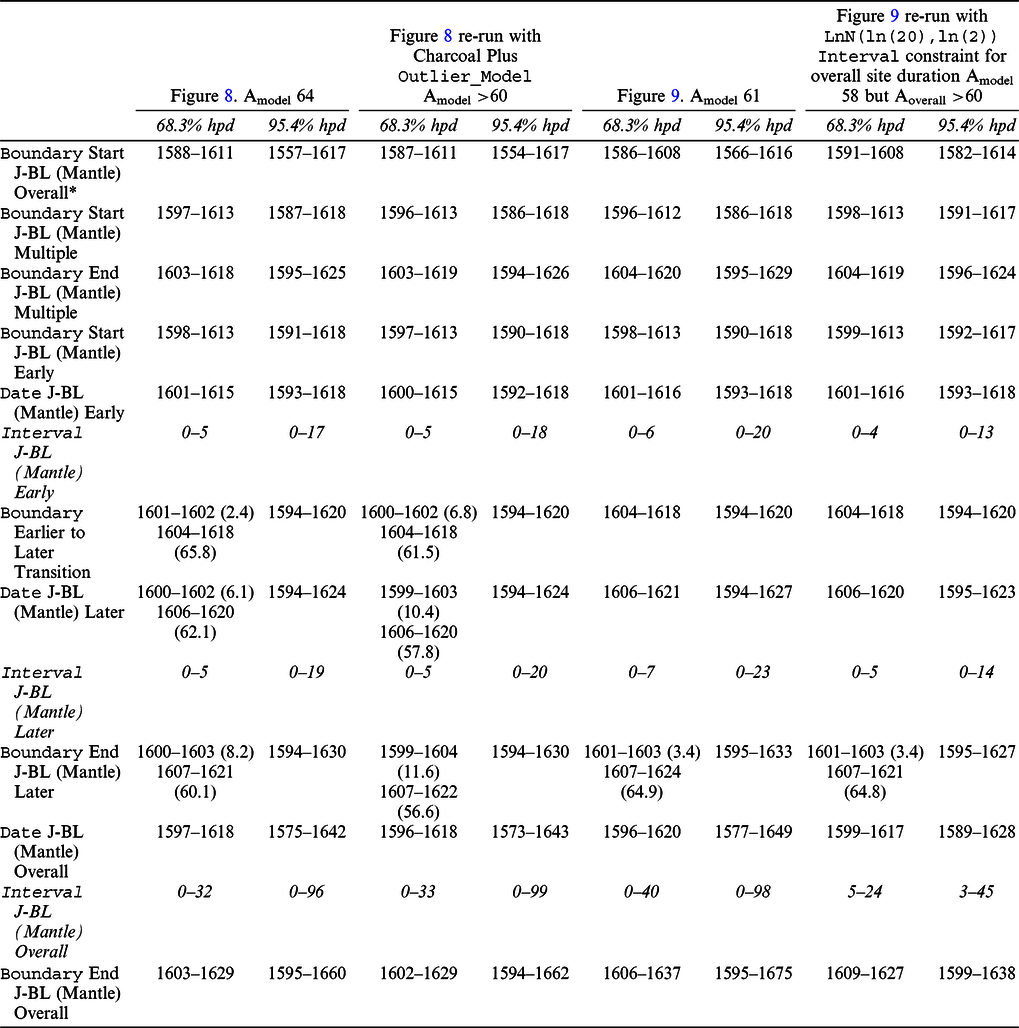
Selected results from the model shown in Figure 10 and for re-runs of versions of this model with the Charcoal Plus Outlier_Model and with N(20,10) and LnN(ln(20),ln(2)) constraints on an Interval query applied to the site Phase (using the Figure 10 model with Charcoal Outlier_Model). In the case of the N(20,10) model we report also on 2 additional models runs (all with kIterations set at 3000) to illustrate the approximate range in possible early placement outcomes, with all reporting unsatisfactory Amodel and Aoverall values. These two runs with even lower Amodel and Aoverall values (ca. 31/32) found no later range probability within the 95.4% hpd ranges. The maximum alternative age range values from the other two runs are listed in the parentheses under each element in the table in red. (Please see electronic version for color table.)

Therefore, across a range of analyses, the most likely date range for the J-BL site appears clear. However, an alternative much earlier date placement in the first couple of decades of the 16th century seems perfectly possible. We already know that this alternative range is entirely possible from the dates on the short-lived samples (Figure 2). The question is whether it is plausible to achieve this dating range including the information incorporated in the dates on wood-charcoal. Often the answer is no: models do not achieve satisfactory Amodel and Aoverall values—these are less than the satisfactory threshold of 60, and/or Convergence values are not satisfactory (<95) for the individual elements. For example, if we run all the dates in one single Phase (ignoring the intra-site Sequence as in Figure 10) with the Charcoal Outlier_Model and then apply in addition a N(20,10) constraint on an Interval query for the site Phase then this usually, when there is satisfactory Convergence, leads to a model result that finds the early age range (see Table 3). But from several model runs the best Amodel value is ca. 42 and the Aoverall value is ca. 34, both well below the satisfactory threshold value of 60. Many other runs offering similar dating placements achieved lower Amodel and Aoverall values in the ca. 32/31 range. Four elements (one weighted average comprising three dates, and three separate dates including two of the wood-charcoal dates) exhibit unsatisfactory individual Agreement values. In other cases, those with poor Convergence values and/or poor Amodel and Aoverall values, the probability is split. For example, a run of this same model yielding Amodel ca. 60 and Aoverall ca. 48 placed the Date query 1487–1527 (34.3), 1584–1627 (60.1) and 1943–1951 (1.1) at 95.4% hpd—but the Convergence values for the individual elements dated in the model were all <30 and thus entirely unsatisfactory. Hence such a model is not used. Successful models do not exhibit these diagnostic failings.
Therefore, we only regard as potentially acceptable those model results with satisfactory Amodel and Aoverall values and satisfactory Convergence values. An example is the re-run version of the Figure 10 model with the addition of a LnN(ln(20),ln(2)) constraint on an Interval query for the site Phase listed in Table 3. This has all satisfactory Convergence values and Amodel and Aoverall values of ca. 65. In other examples, a re-run of the Figure 10 model but incorporating an Interval constraint of either N(20,10) or LnN(ln(20),ln(2)) achieves very similar results. The Date query for the overall J-BL Phase including both separate Phases yields a most likely 68.3% hpd ranges in each case of 1599–1617. The difference is that the added constraint and very slight additional compression leads to the Amodel values dipping just below 60 (58 in each case) and the Aoverall value for the N(20,10) model doing the same (at 59). The LnN(ln(20),ln(2)) model achieves an Aoverall value just over 60. We show selected results from this model in Table 2.
It should be noted that other combinations can lead to models that complete with satisfactory Convergence values and the earlier date solution. But in such cases the Amodel/Aoverall values are well below the satisfactory level and a number of individual samples exhibit poor Agreement values (see Supplementary Material and Figures S4, S5). We can thus reject all such model run outcomes as unsatisfactory based on the criteria of failing either or both satisfactory Convergence values and Amodel/Aoverall values. In reverse, only models that resolve the more recent date range ca. 1600 offered satisfactory diagnostic values. Hence, we regard this as the robust date range for the J-BL site. (One question that may arise: can we rule out the possibility of two periods of occupation at the site: one around 1500 and one around 1600? Yes: see Supplementary Material.)
DISCUSSION
14C dating the J-BL site is a challenge. The properties of the calibration curve in the relevant period, a reversal/plateau ca. 1480–1630, render dating a short-duration village site primarily from 14C dates on short-lived plant remains ambiguous. The additional information provided by an intra-site Sequence alone, over such a short total duration, does not help to resolve since the period is not long enough to describe a unique or clearly more likely solution versus the calibration curve. Thus, if we only had the dates on short-lived samples, no matter how many and how precise, we would have ambiguity. Indeed, having too many such dates might inhibit finding the correct solution in a case of such a reversal/plateau ambiguity due to a tendency to overly compress (narrow) dating ranges for a Phase (Supplementary Material Figures S1–S3).
Obtaining resolution therefore depends on additional constraints being available. If the aim is to avoid the circularity in assumptions about local site sequences, these constraints need to come from independent, site-specific, 14C data. In the absence of a distinctive 14C wiggle-match, we have shown that this can be achieved using the in-built age (TPQ) incorporated into the eight 14C dates on wood-charcoal available from the site, especially if it is known that such samples are selected to maximize the length of the in-built time element. Hence dates on wood-charcoal selected from the initial Phase of a site Sequence and dates on tree-rings from some such samples that are not just from outer/outermost tree-rings or shorter-lived round wood/twigs, etc. This means reversing the usual logic of sample selection solely aimed at trying to get as close to the target event as possible, and instead including some samples that define the range of a TPQ.
We found across several plausible scenarios that incorporation of these eight dates on wood-charcoal (versus either 22 or 34 dates on short-lived plant remains) permitted satisfactory resolution of the dating ambiguity (Figures 5–10). These models all pointed to dates for the J-BL site around or just after 1600. In contrast, those model runs that achieved satisfactory Convergence values and yet found an earlier date solution (early 16th century) could clearly be distinguished as not satisfactory with poor Amodel and Aoverall values and with a number of individual elements with poor Agreement values (Supplementary Material Figures S4, S5 or the N(20,10) model reported in Table 3).
We can consider the characteristics of such modeling. For example, we can investigate an approximate simulation, where we have sites dated ca. 1500 and ca. 1600, each represented by 10 randomly simulated 14C dates (R_Simulate) on short-lived samples, and then instances of 1 to 10 dates on wood-charcoal samples randomly simulated from an exponential distribution over ca. 0–500 years, for the 1500 case, as R_Simulate(“”,1500+(100*rand())*ln(rand()),15) and treated with the Charcoal Outlier_Model. In each case the set of dates are modeled in a Phase with start and end Boundary within a Sequence with curve resolution here left at the default of 5 years and a measurement on each date assumed as ±15 14C years (see Supplementary Material). Across 10 runs of each of the models we show where there was a >10% and >20% incorrect late or early range within the 95.4% hpd range for the start or end Boundary or a Date query on the Phase in cases with satisfactory Convergence values (Figure 11). In each case, while there is some potential ambiguity at the 10%+ to 20%+ level in several cases with ≤4 wood-charcoal dates, there is no >20% erroneous early or late probability region within the 95.4% hpd ranges once >5 wood-charcoal samples are available. The one instance of a major, >80%, incorrect probability result (shown in Supplementary Materials Figure S7) was for a 1500 case with just three wood charcoal TPQ dates. It is evident that there is a greater possibility of an incorrect placement of the 1500 site versus the 1600 site, but, again, there is no incorrect placement with >20% probability once 6 or more charcoal TPQ dates are employed.
Summary of runs of simulation models for sites dated 1500 and 1600 with 10 randomly simulated 14C dates on short-lived samples and variously 1 to 10 dates randomly simulated on wood-charcoal samples with the Charcoal Outlier_Model applied. The figure shows how many runs produced results with satisfactory Convergence values (≥95) with 10+% and 20+% probability assigned to an incorrect respectively more recent (1500 case) or older (1600 case) date range within the 95.4% hpd ranges. These models used the default curve resolution of 5 years and the default kIterations value.

The J-BL case has rather more dates on short-lived samples than the example summarized in Figure 11. We thus re-ran the simulation for the 1500 case with 30 simulated dates on short-lived samples in each case (see Supplementary Material and Figure S10). While in all cases a few runs identified incorrect probability in the 10+% and 20+% ranges, in only 3 of 94 cases with satisfactory Convergence was there a strong probability (here arbitrarily defined as >70% probability within the 95.4% hpd range) for the incorrect date range—versus merely degrees of ambiguity. None of these occurred in cases with ≥6 wood-charcoal samples (and indeed only one where there were ≥4 wood charcoal dates). Thus, in the J-BL case, with eight wood-charcoal TPQ dates representing a good range of TPQ values (see Figure 4a), with satisfactory OxCal model agreement and Convergence, and no ambiguity, we may assume with good confidence that the calendar placement determined is correct (Figures 5–10).
We may also assess the J-BL dataset itself. For example: (a) how many of the wood-charcoal dates from most recent (mR) or very oldest (vO) are necessary to avoid substantial ambiguity using the Charcoal (CHAR) Charcoal Plus (CHAR+) or Tau_Boundary approaches expressed in terms of the start and end Boundary for the J-BL site Phase; and (b) what approximate range of TPQ dates are required to remove ambiguity. Figure 12a shows (left) the probability of an earlier (pre-1541) range within the 95.4% hpd range for the start and end Boundary for the secure intra-site Sequence at J-BL depending progressively on 1 to 8 wood-charcoal dates in order from either most recent or very oldest with the three model approaches. Figure 12b does the same with all the dates treated in one site Phase. In each case, if we can make a firm TPQ assumption and apply the Tau_Boundary approach, there is no earlier ambiguity. With the Charcoal Outlier_Model, regardless of whether we start with the most recent or very oldest wood-charcoal age, by the time there are 6 such dates the probability of an ambiguous result is <25% and with all eight dates it is 0–5%. It is (self-)evident that it is important to have a sample that does not include solely the oldest TPQ dates to avoid a possible early-shift ambiguity since such data cannot exclude this. On the right side of Figure 12a and b the ambiguity percent for dating various combinations of a middle (M), old (O) or most recent (mR) or very oldest (vO) TPQ dates are shown (with M arbitrarily selected as GrM-13838 and O as GrM-13842). To better remove ambiguity it is clear that (a) creating the criteria for the assumption that all samples establish a TPQ for the subsequent Phase (the assumption in the Tau_Boundary model as used above) is strongest, and (b) otherwise it is best to have as wide a range of TPQs represented as possible (the mR, M vO models).
Probabilities of an (incorrect—see this paper) too old (pre-1541) date within either the Start (S) Boundary or End (E) Boundary for J-BL under a range of scenarios with variously 1–8 wood-charcoal dates included progressively either from most recent (mR = GrM-13837) or oldest (vO = GrM-13844) or via a mixture from mR, “middle” = M = GrM-13838, “old” = O = GrM-13842 or vO using the Charcoal (CHAR) or Charcoal Plus (CHAR+) Outlier models or via the Tau_Boundary paired with a Boundary model with this End Boundary cross-referenced as the Start Boundary for the Site Sequence/Phase. Only data where the Convergence was ≥95 included. (a) J-BL site data from secure contexts within the intra-site Sequence with the End Boundary treated as a TPQ and cross-referenced as the Start Boundary for the Site Sequence or Site Phase. (b) J-BL site data treated as one single Phase and including all available 14C dates. The grey bar in each case indicates probabilities of ≤10% for the “early” date range within the 95.4% hpd ranges. Data from OxCal and IntCal20 with calibration curve resolution set at 1 year.

Overall, relatively fine margins are at stake in a dating case like this. Even a few less dates on wood-charcoal, and, in particular, without the 2 or 3 dates on wood-charcoal which, allowing for their in-built age as a TPQ, specifically run strongly against the early date possibility for J-BL, could lead to a different result, or a return to ambiguity. In retrospect, in a case like this, running additional dates on selected wood-charcoal would likely make the situation even clearer and certainly more robust. For example, whereas the versions of the Figure 9 model with the addition of the N(20,10) or LnN(ln(20),ln(2)) constraint on the Interval query with the current J-BL dataset led to Amodel and Aoverall values just under the satisfactory threshold value of 60 (see above), if we simply had twice as much wood-charcoal data (so a repeat of the eight dates available) these values become respectively satisfactory at 63 & 63 and 63 & 65. We highlight this issue, since it runs contrary to most recent advice in archaeological 14C dating to focus, even exclusively, on dates from short-lived samples. Instead, in cases of short-duration site occupations on reversals/plateaus in the 14C calibration curve, use of a balanced portfolio of dates, with some selected to add a range of in-built age TPQs from wood-charcoal, and some direct dates from short-lived samples, will maximize prospects of successful dating (as shown here for Draper, Figure 1, and J-BL, Figures 5–10). This point applies to other cases and periods where plateaus and reversals in the calibration curve create potential dating ambiguities.
Our investigation finds that the only coherent and satisfactory overall dating solution for J-BL is a date range around 1600 (as reported previously: Manning et al. Reference Manning, Birch, Conger, Dee, Griggs, Hadden, Hogg, Bronk Ramsey, Sanft, Steier and Wild2018a). This date is much more recent than the previous age estimate of 1500–1530. It complicates conventional sweeping generalizations based on specific ethnohistorical inferences that have been extrapolated to infer the timing of ancestral Huron-Wendat population resettlements. These include a statement by Champlain (the account dating to 1615–16) that the Trent Valley was abandoned by the Arendahronon for fear of enemies (Biggar Reference Biggar1922-1936: 3:59) and that of Lalement who, in 1639, reported (i) that the Arendahronon had relocated to Wendake some “fifty” years ago, and (ii) that the Tahontaerat, whose assumed origins are on the north shore of Lake Ontario, had done the same some “thirty” years previously (Thwaites Reference Thwaites1896–1901, 16:227). The result has been the entrenchment of 1590 and 1610 as representing the termination of permanent settlement in each area (Trigger Reference Trigger1985: 157; Williamson Reference Williamson2014: 35), regardless of the very large regions and uncertainty of actual years. We appreciate for those scholars attached to these seemingly firm historical waypoints that the 14C-based date range presented herein for J-BL may be unacceptable. However, when one considers the likely short duration of site occupation and the uncertainties involved in estimation of Lalement’s informant of what constituted 30 or 50 years in the past, we find the totality of the data and historical accounts reconcilable. Further, we have shown that this 14C-based date range is robust with appropriate incorporation of the wood-charcoal TPQ and also the archaeologically inferred intra-site Sequence. Any alternative (earlier) solution fails to offer a satisfactory model result in terms of OxCal Convergence values for several elements, or OxCal Amodel or Aoverall values. We also identify a tendency with large numbers of dates from a Phase for over-compression on the calendar time-scale. In a case like J-BL, this can in fact tend to raise the probability for the incorrect (early) date solution. Hence again the key role of the in-built age TPQ from the wood-charcoal to prevent such over-compression from potentially leading to an incorrect date placement.
A most likely date for J-BL in a range between 1595 to 1626 (extremes of the 68.3% ranges in Tables 1 and 2 for Early and Late Phases, or for the Overall Phase, Table 2, or for those one-Phase site models with satisfactory Amodel and Aoverall values in Table 3) supports the re-assessments of the dates for this site as discussed in recent publications (Manning et al. Reference Manning, Birch, Conger, Dee, Griggs, Hadden, Hogg, Bronk Ramsey, Sanft, Steier and Wild2018a; also Birch et al. Reference Birch, Manning, Sanft and Conger2021). The specific date applies solely to the J-BL site. Other sites should only be dated and assessed on the basis of dates directly on appropriate samples from each such site. Thus, despite the field’s reliance on site sequence models in past work, we should not build wider chronologies based on either previously inferred site relocation sequences nor previously inferred site groupings and relationships.
14C dates and Bayesian chronological modeling have prompted a substantive methods and theory critique of previously assumed models of chronology and, as importantly, socio-economic practices in northeastern North America (Manning et al. Reference Manning, Birch, Conger, Dee, Griggs, Hadden, Hogg, Bronk Ramsey, Sanft, Steier and Wild2018a; 2021; Manning and Hart Reference Manning and Hart2019; Birch et al. Reference Birch, Manning, Sanft and Conger2021). The evidence indicates that the dates for some sites need radical revision (e.g., Draper, J-BL), whereas long assumed dates for other sites are confirmed (e.g., Warminster). Overall, the underlying assumptions behind the conventional chronology have to be re-examined from first principles—regarding especially the use and the interpretation of the presence or absence of trade goods at different sites (for an example of the same from the southeastern United States, see Holland-Lulewicz et al. 2019). Going forward, each site should be dated independently on its own evidence, avoiding the incorporation of unjustified inferences. In order to overcome the challenges created by a reversal and plateau in the calibration curve, this especially requires use of wood-charcoal samples securely associated with a site occupation Phase in order to achieve non-ambiguous date estimates. Ideally this should be via a tree-ring defined 14C “wiggle-match.”
However, when this is not possible, use of the in-built age TPQ accessible through dating wood-charcoal samples can suffice, especially when these samples are deliberately selected to include a range of time (range of TPQs) within the set of such samples. As evident in the analyses in this paper, selecting samples that (i) accentuate the “post” in the TPQ so that this forms a likely start Boundary for a site occupation, and/or (ii) selecting and dating a reasonable range of wood-charcoal samples—including some from heartwood and likely substantially older than the relevant felling/use date—in order that these describe a substantive period of time from closer to the use context to many decades to a century-plus older allow us to rule out ambiguity. As evident in this paper, a set of several such samples is usually required to capture the temporal range necessary to exclude ambiguity.
ACKNOWLEDGMENTS
We thank the Huron-Wendat Nation for the opportunity to investigate their ancestral history. Access to samples and data from the Draper, Spang, and Jean-Baptiste Lainé (Mantle) sites was provided by the Canadian Museum of History, Parks Canada, and Archaeological Services Inc. Access to samples from the Warminster site was provided by the University of Toronto. We thank the NSF, award BCS 1727802, the Department of Classics and the College of Arts and Sciences, Cornell University, and the Office of the Vice President for Research, University of Georgia, for the funding that supported this research. We thank the reviewers and editors for their helpful critiques and for improving the text.
Supplementary material
To view supplementary material for this article, please visit https://doi.org/10.1017/RDC.2022.23


 Open access

