


The involvement of patients is a priority of the Government’s efforts to improve the National Health Service (NHS) (Department of Health, 2000a ). Current policy states that involving patients leads to ‘more responsive services with better outcomes of care’ (Department of Health, 1999a ). Indeed, one of the six elements of a quality service, according to Appleby (Reference Appleby2000), involves being ‘ user-led’, i.e. guided by patients’ views on how services should develop. This reflects a general trend in health services in Western democracies (Reference Crawford, Rutter and ManleyCrawford et al, 2002; Reference Say and ThomsonSay & Thomson, 2003).
There is limited evidence supporting the notion that involving service users leads to more accessible, better-quality services (Reference Beresford and CroftBeresford & Croft, 1993; Reference Baker, Bullen and De VilleBaker et al, 1997; Reference Crawford, Rutter and ManleyCrawford et al, 2002; Reference Simpson and HouseSimpson & House, 2002). However, there is no consensus on how best to engage patients in health service planning (Reference McIverMcIver, 1991; Reference Baker, Bullen and De VilleBaker et al, 1997; Reference KelsonKelson, 1997). The National Service Framework for Mental Health created a working group to develop research tools with service users to assess their views on how services can best meet their needs (Department of Health, 2000b ). There are some reports of the perceptions of programme directors and clients regarding the effectiveness of methadone treatment (Reference Mavis, Devoss and StoffelmayrMavis et al, 1991). However, there is no substantial report in the medical literature of the treatment preferences of the users of addiction services. The objective of this study was to assess the preference of people with opiate dependency attending a substance misuse facility for the various treatment options.
Method
Study participants were recruited by the researcher from people attending Marina House, the Maudsley Hospital community substance misuse facility. All participants were interviewed by a trained psychiatrist (J.L.) and satisfied DSM-IV research diagnostic criteria for current opiate or opioid dependence (American Psychiatric Association, 1994). Their socio-demographic and clinical characteristics were elicited using the Maudsley Addiction Profile (Reference Marsden, Gossop and StewartMarsden et al, 1998) and Severity of Dependence Scale (Reference Gossop, Darke and GriffithsGossop et al, 1995). Opioid drug use was confirmed by the results of urine tests that formed part of the treatment programme.
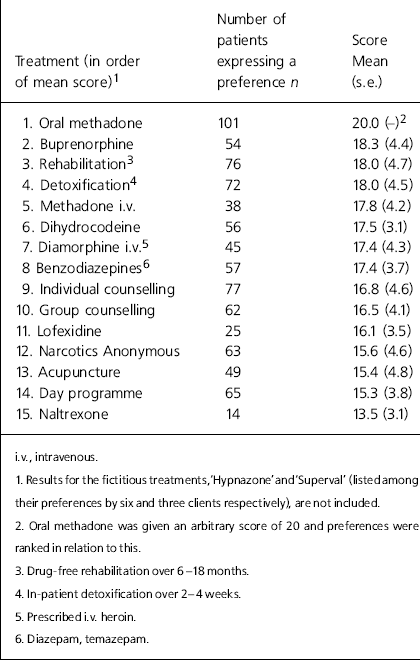
A modified Q-sort technique was used to obtain patient preferences (Reference BlockBlock, 1978; Reference YalomYalom, 1985). Participants were given cards stating 17 treatment options (Table 1) with the instruction: ‘ Please place these treatments in order from the one that you think is most likely to stop you using street heroin to the one that you think is least helpful’ (intravenous and oral methadone were presented as separate options and were both available from the service providers). The participants then placed the cards in order on a table, with the treatments they rated highest furthest away and those ranked lowest nearest to them. The order of preference was recorded. If patients did not recognise a particular treatment or had no views on preference these options were not rated and the cards were placed in a separate pile. Two cards referred to fictitious drugs (‘Hypnazone’ and ‘Superval’) to act as tests of reliability. The participants were then asked to remove from their preference list treatments that they had never experienced. The order of preference for treatments that the person had actualy received was then recorded in the same manner. The orders of preferences were compared by giving ‘oral methadone’ an arbitrary score of 20. Other preferences were ranked in relation to this. Finally, patients were asked: ‘Do you think out-patient detoxification or maintenance is most likely to stop you using street heroin?’ (detoxification was defined as ‘the dose of drug prescriptions is reduced gradually over 3-6 months’ and maintenance was defined as ‘drug prescriptions for as long as you want it’).
Preference rankings of 15 different treatment options
| Treatment (in order of mean score)1 | Number of patients expressing a preference n | Score Mean (s.e.) |
|---|---|---|
| 1. Oral methadone | 101 | 20.0 (-)2 |
| 2. Buprenorphine | 54 | 18.3 (4.4) |
| 3. Rehabilitation3 | 76 | 18.0 (4.7) |
| 4. Detoxification4 | 72 | 18.0 (4.5) |
| 5. Methadone i.v. | 38 | 17.8 (4.2) |
| 6. Dihydrocodeine | 56 | 17.5 (3.1) |
| 7. Diamorphine i.v.5 | 45 | 17.4 (4.3) |
| 8 Benzodiazepines6 | 57 | 17.4 (3.7) |
| 9. Individual counselling | 77 | 16.8 (4.6) |
| 10. Group counselling | 62 | 16.5 (4.1) |
| 11. Lofexidine | 25 | 16.1 (3.5) |
| 12. Narcotics Anonymous | 63 | 15.6 (4.6) |
| 13. Acupuncture | 49 | 15.4 (4.8) |
| 14. Day programme | 65 | 15.3 (3.8) |
| 15. Naltrexone | 14 | 13.5 (3.1) |
Participants gave written informed consent. Approval to undertake the study was obtained from the South London and Maudsley NHS Trust research ethics committee.
Results
None of those recruited met the exclusion criterion of being unable to give informed consent because of mental illness, illiteracy or poor understanding of English. Two people agreed to take part in the project but did not complete both the interview and card sort. The 104 people who completed the study had the following background characteristics: 62% male, 76% White European, 89% unemployed, mean age 34 (s.e. 0.7) years, age of first heroin use 20.6 (s.e. 0.6) years, and the mean Severity of Dependence Scale score was 10.3 (s.e. 0.3). In the previous month, 55% had injected opiates or other drugs, 65% had used cocaine or ‘crack’, heroin had been used on an average of 21 (s.e. 1) days, and the typical daily spending on heroin was £32 (s.e. £ 2). Three participants did not rank oral methadone among their treatment options; these results were excluded from the analysis as these preferences could not be compared with those of other respondents. The preferences reported in the results are therefore based on 101 respondents. Thirty-five people (34%) believed that maintenance was superior to detoxification in preventing illicit heroin use. There was no significant difference between this group and those who believed detoxification to be superior, in terms of duration of heroin use: 15.5 (s.e. 1.5) years v. 13.9 (s.e. 0.8) years; P=0.06 (two-tailed t-test).
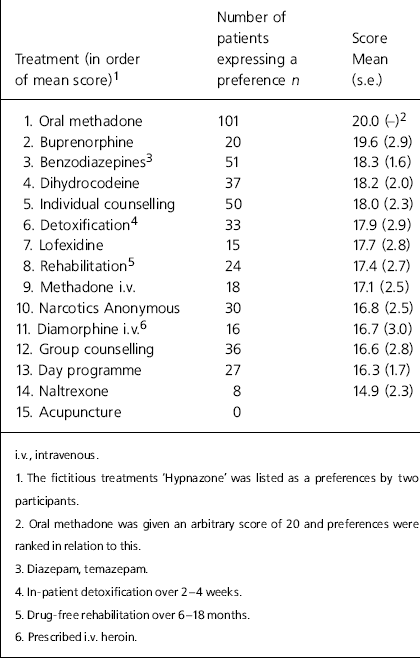
The top preferences in the participants’ initial ranking included both pharmacological and psychosocial options. Preferences for oral methadone, buprenorphine, drug-free rehabilitation (for 6-18 months) and in-patient detoxification (over 2-4 weeks) were each reported by a majority of participants (Table 1). Preferences for treatments that the participants had personally experienced also comprised both pharmacological and psychosocial options (Table 2). Whereas all participants had experienced oral methadone treatment, fewer than half had direct exerience of many of the other treatment options.
Preference rankings of treatments that participants had personally experienced
| Treatment (in order of mean score)1 | Number of patients expressing a preference n | Score Mean (s.e.) |
|---|---|---|
| 1. Oral methadone | 101 | 20.0 (-)2 |
| 2. Buprenorphine | 20 | 19.6 (2.9) |
| 3. Benzodiazepines3 | 51 | 18.3 (1.6) |
| 4. Dihydrocodeine | 37 | 18.2 (2.0) |
| 5. Individual counselling | 50 | 18.0 (2.3) |
| 6. Detoxification4 | 33 | 17.9 (2.9) |
| 7. Lofexidine | 15 | 17.7 (2.8) |
| 8. Rehabilitation5 | 24 | 17.4 (2.7) |
| 9. Methadone i.v. | 18 | 17.1 (2.5) |
| 10. Narcotics Anonymous | 30 | 16.8 (2.5) |
| 11. Diamorphine i.v.6 | 16 | 16.7 (3.0) |
| 12. Group counselling | 36 | 16.6 (2.8) |
| 13. Day programme | 27 | 16.3 (1.7) |
| 14. Naltrexone | 8 | 14.9 (2.3) |
| 15. Acupuncture | 0 |
Discussion
Although there is considerable interest in involving users in planning services, little is known about the views of the clients of substance use facilities. Brown et al (Reference Brown, Gauvey and Meyers1971) and Chein et al (Reference Chein, Gerard and Lee1964) reported the views of opiate users on reasons for initiating and withdrawing from heroin use. Mavis et al (Reference Mavis, Devoss and Stoffelmayr1991) found that methadone patients in drug-free programmes were sceptical about the efficacy of methadone, whereas clients receiving methadone treatment reported it to be beneficial. These results can be partly explained by patient selection: when patients are given a choice, each service is likely to attract patients who sympathise with that service’s objectives and methods. There are many dramatic and literary reports on the experience of addiction, several of which are based on direct experience (Reference Day and SmithDay & Smith, 2003). However, this paper is one of only a few reports of formal research into users’ preference for substance misuse treatment in the UK.
The top four preferences - oral methadone, buprenorphine, rehabilitation and detoxification - are recognised by purchasers as treatment priorities (National Treatment Agency for Substance Misuse, 2002a ). The next three preferences, however, were more controversial treatments: intravenous methadone, oral dihydrocodeine and i.v. diamorphine. The use of injectables in the treatment of substance misuse has always been the subject of controversy, and dihydrocodeine is not licensed for use in opiate dependence (Department of Health, 1999b ; Home Office, 2000). There is Government support for the use of prescribed injectables, but services will probably be reluctant to provide them (National Treatment Agency for Substance Misuse, 2002b ; Reference LutyLuty, 2003).
No evidence was found to support the view that participants’ previous experience of treatment might influence their perception of effectiveness. Prescribed injectables were ranked lower in Table 2 than in Table 1, suggesting that injectables were less desirable in practice than clients might imagine; however, further analysis of the results from Table 1 showed no difference in preferences for treatment between those who had been prescribed injectables and those who had not. It was notable that both benzodiazepines and dihydrocodeine were apparently rated more highly by those who had experienced treatment with these agents (Table 2) than the overall preferences reported in Table 1. This apparent preference arose because a greater proportion of participants had used these drugs than had experienced rehabilitation or detoxification, and disappeared when the results were analysed separately for participants who had direct experience of rehabilitation and detoxification. Finally, the responses were analysed separately for participants who had experienced three or more forms of treatment (including at least one non-drug therapy). The results were very similar to the ranking in Table 2, with no treatment changing its position by more than one place.
Drug-free rehabilitation and in-patient detoxification were rated highly among the preferences. It was also notable that two-thirds of participants believed that detoxification was better than maintenance therapy. This is particularly encouraging, as it indicates that treatment-seeking participants were motivated to overcome their dependence on both prescribed and illicit drugs. It is perhaps regrettable that evidence shows maintenance is probably superior to detoxification in preventing illicit opiate use (National Consensus Development Panel, 1998).
Strengths and limitations of the study
The list of treatments was restricted to eight pharmacological and seven psychosocial treatments, to avoid presenting participants with an unmanageable number of options (combining the options from each group would lead to 56 permutations). Nevertheless, they were still presented with a substantial number of choices (17 including the fictitious drugs). Participants were asked to distinguish between detoxification and maintenance treatments. Unfortunately the study could not determine the preferred combination of other drugs, regimens and psychosocial support, and this could be the subject of further research.
The people in this study were very similar to patients notified in 2000-2001 to English regional drug misuse databases, and other research samples, in terms of age, gender, ethnicity and socio-demographic status (Reference Gossop, Darke and GriffithsGossop et al, 1995; Government Statistical Office, 2000). Nevertheless, they were people with opiate dependency seeking treatment from a teaching hospital substance misuse facility with a ‘ harm reduction’ rather than an ‘abstinence’ philosophy, which is likely to attract patients with similar preferences. The results may not be typical of other community samples.
Two fictious agents (‘Hypnazone’ and ‘Superval’) were included in the treatment preference lists to ensure that participants understood the procedure. All but six patients correctly identified and excluded these options from their preferences. However, another limitation of the study is the reliance on self-report of preferences to a clinician employed at the treatment centre, raising the possibility that patients would report preferences that they imagined the researcher would approve of, rather than expressing genuine opinions.
In conclusion, the results suggest that both pharmacological and psychosocial treatments are desirable options for people seeking treatment of their opiate dependency. These options include in-patient detoxification and rehabilitation. There is also a significant demand for both injectable drugs and dihydrocodeine.
Acknowledgements
Dr M. Farrell was the principal applicant on the ethical committee application. All funding for the project was provided by the principal author (J.L.).


 Open access


eLetters
No eLetters have been published for this article.