





Introduction
Interactions among patients and medical professionals are rooted in story, as discourse related to illness experience is nuanced by the individual’s history, beliefs, and perceptions. The value of these stories has been cultivated through the development of narrative medicine, a subfield that utilizes story as a driver for research, education, and clinical care (Kirmayer et al. Reference Kirmayer, Gomez-Carrillo, Sukhanova, Mezzich, Appleyard, Glare, Snaedal and Wilson2023). Narrative medicine has evolved into a field of study and incorporates elements of provider education and competency, addresses direct clinical practice, and examines the theoretical notion of the use of narrative in medical settings (Charon Reference Charon2001; Palla et al. Reference Palla, Turchetti and Polvani2024). More generally, narrative-based approaches utilize techniques that are rooted in narrative, such as open-ended interviewing or the use of psychosocial interventions that inspire the production of stories. These stories provide insight into the patient experience, allowing for the contextualization and presentation of the illness trajectory (Kirmayer et al. Reference Kirmayer, Gomez-Carrillo, Sukhanova, Mezzich, Appleyard, Glare, Snaedal and Wilson2023).
The use of narrative-based approaches in medical settings provides benefits to both clinicians and patients. Narratives reveal the intricacies of the illness experience (Charon Reference Charon2007), probing the, ‘narrativity of disease, of health, of healing, and of the relation between the sick person and the one who tries to help’ (Charon Reference Charon, Rudnytsky and Charon2008, 26). Narrative-based approaches provide opportunities for the patient to reframe their illness, promoting a sense of healing and validation (Kirmayer et al. Reference Kirmayer, Gomez-Carrillo, Sukhanova, Mezzich, Appleyard, Glare, Snaedal and Wilson2023). In turn, narrative-based approaches encourage maintenance of perceived identity through the production of story, especially within the context of changing functions and roles as part of the chronic illness experience (Clandinin et al. Reference Clandinin, Cave and Cave2010; McLean and Pasupathi Reference McLean and Pasupathi2010; Morris Reference Morris2008; Slocum Reference Slocum2021; Slocum et al. Reference Slocum, Howard and Villano2017).
Other benefits of narrative-based approaches include promotion of trust between the patient and provider (Charon Reference Charon2001; Thoele et al. Reference Thoele, Gunalp and Baran2020), inspiration of provider curiosity, empathy, and understanding (Charon Reference Charon2007; Charon et al. Reference Charon, Hermann and Devlin2016; Fox et al. Reference Fox, Park and Hildebrand-Chupp2023; Kemper et al. Reference Kemper, Schwatz and Wilson2020; Mehl-Madrona et al. Reference Mehl-Madrona, McFarlane and Mainguy2021; Mirsa-Hebert et al. Reference Mirsa-Hebert, Isaacson and Kohn2012), and reduction of compassion fatigue and burn-out due to secondary trauma (Kemper et al. Reference Kemper, Schwatz and Wilson2020; Loy and Kowalsky Reference Loy and Kowalsky2024; Winkel Reference Winkel2016). While much of the theoretical focus of narrative medicine has emphasized the role of the provider, narrative-based approaches are more directly focused on patient responses (Gibson Reference Gibson2021; Kaye et al. Reference Kaye, Rockwell and Lemmon2022). Patient-specific benefits, such as improved quality of life (QoL) (Kheirbek et al. Reference Kheirbek, Marr and Herr2019) and sense of peace (Wise et al. Reference Wise, Marchand and Roberts2018), have been documented in literature utilizing narrative-based approaches. Patients also report that narrative-based interventions inspire a sense of healing (Charon Reference Charon2006, Reference Charon2009; Charon et al. Reference Charon, Hermann and Devlin2016; De Bemedetto et al. Reference De Benedetto, de Castro and de Carvalho2007; Divinsky Reference Divinsky2007; Greenhalgh and Hurwitz Reference Greenhalgh, Hurwitz, Greenhalgh and Hurwitz1998; Kalitzkus and Matthiessen Reference Kalitzkus and Matthiessen2009; Launer Reference Launer2002; Lewis Reference Lewis2011).
While the benefits of narrative-based approaches have been documented in patients with chronic illnesses, such as cancer (Slocum et al. Reference Slocum, Howard and Villano2017; Wise et al. Reference Wise, Marchand and Roberts2018) and heart disease (Kheirbek et al. Reference Kheirbek, Marr and Herr2019; Slocum et al. Reference Slocum, Hart and Guglin2019), the use of these techniques with persons with amyotrophic lateral sclerosis (pALS) has not been reviewed. PALS may be particularly situated to benefit from narrative-based interventions due to the impact of the disease on expressive communication. ALS is a neurodegenerative disease that results in the death of motor neurons, leading to muscle atrophy and the eventual loss of controlled movements. The disease impacts the ability to independently breathe, speak, and swallow effectively over time (National Institute of Neurological Disorders and Stroke (NINDS) 2024). Individuals with locked-in syndrome (a phenomenon sometimes experienced in the final stages of ALS) are left with significantly limited communication abilities, which are sometimes confined to vertical eye movement (Laureys et al. Reference Laureys, Pellas and Van Eeckhout2005; Rowland and Schneider Reference Rowland and Schneider2001). Previous research has emphasized the importance of effective communication with patients with locked-in syndrome, noting the alignment between effective communication and the patient’s sense of personhood (Nizzi et al. Reference Nizzi, Blandin and Demertzi2018; Séguin et al. Reference Séguin, Moulin and Fornoni2016).
Despite expressive communication challenges, narrative-based approaches may be beneficial for gathering more information about the experiences of pALS. Narrative-based interventions may also serve as appropriate methods for therapeutic intervention to address the psychosocial complexities of the disease. The scope of this review includes: studies on interventions intended to directly benefit pALS, studies that examine the illness experience of pALS, and studies involving secondary analysis of illness narratives of pALS with the aim of providing a comprehensive review of the use of narrative-based approaches in thispopulation.
Methods
A literature search was conducted utilizing terms related to the diagnosis of ALS and the use of narrative-based approaches. Searches were performed via the EMBASE, CINAHL, and PsycInfo databases, utilizing the terms, ‘amyotrophic lateral sclerosis’ OR ‘Lou Gehrig’s disease’ OR ‘motor neuron disease’ AND ‘narrative medicine’ OR ‘life review’ OR ‘dignity therapy’ OR ‘narrative-based intervention’ OR ‘narrative intervention’ OR ‘narrative therapy’ OR ‘narrative interview’ OR ‘storytelling’ OR ‘illness narrative’ OR ‘illness experience.’ Additionally, the same terms were utilized to gather results from the first 2 pages of Google Scholar (for each secondary term) as part of the screening process. No constrictions were placed on year of publication. Each title and abstract was uploaded into Covidence and screened using inclusion and exclusion criteria (see Table 1). A full-text article review was conducted for articles that met the inclusion criteria.
Inclusion and exclusion criteria

Results
Following the removal of 134 duplicate articles, 154 articles were identified for screening. One hundred two articles were excluded during the screening process, leaving a total of 52 articles for full-text review. Thirty-two studies were selected for data extraction. Figure 1 provides the PRISMA flow diagram for visualization of the study selection process.
PRISMA diagram of study selection process.

Further analysis revealed 4 overarching classifications of articles (see Table 2). The first category, the implementation of narrative-based psychosocial intervention (n = 3), solely includes studies using dignity therapy with pALS. The second category (n = 14) features the use of narrative-based interviewing to explore the experiences of pALS. The third category (n = 4) consists of studies utilizing narrative-based approaches to gather data to address a particular need in the pALS population, such as exploring the reasons for lack of engagement in nationally funded social services. The final category (n = 7) includes articles that utilize secondary analysis of narrative data to establish overarching themes related to living with ALS.
Classification of articles

Narrative-based approaches for psychosocial intervention: dignity therapy
Few studies (n = 3) explored narrative-based psychosocial intervention in pALS through the use of dignity therapy (Aoun et al. Reference Aoun, Chochinov and Kristjanson2015; Bentley et al. Reference Bentley, O’Connor and Kane2014; Meira et al. Reference Meira, Silva and Chochinov2024). Dignity therapy is an intervention in which individuals nearing end-of-life are presented with guiding questions to promote reminiscence of monumental life events (Chochinov Reference Chochinov2002; Martinez et al. Reference Martinez, Arantzamendi and Belar2017). This intervention facilitates the exploration of advice, words of wisdom, or memories that the person nearing death wishes to highlight for their loved ones. Interviews are recorded, transcribed, revised, and returned to the participant to share as a legacy document (Chochinov Reference Chochinov2002).
The 3 identified studies reported mixed results on the effectiveness of dignity therapy in pALS. Earlier studies (Aoun et al. Reference Aoun, Chochinov and Kristjanson2015; Bentley et al. Reference Bentley, O’Connor and Kane2014) showed no significant differences between pre- and post-intervention quantitative measurements utilizing the Patient Dignity Inventory (PDI). On the other hand, a more recent study completed by Meira et al. (Reference Meira, Silva and Chochinov2024) found significant pre- and post-test changes in PDI scores for this population, with an even greater positive change noted in the post-intervention assessment completed a week later. Additionally, Bentley et al. (Reference Bentley, O’Connor and Kane2014) found no significant differences in Herth Hope Index scores on the group level but did find statistically significant positive changes on the individual level. There were no significant differences in terms of spiritual well-being. Aoun et al. (Reference Aoun, Chochinov and Kristjanson2015) also found no significant changes in measures of patient hopefulness or anxiety and depression levels. On the other hand, Meira et al. (Reference Meira, Silva and Chochinov2024) reported significant positive effects on several physical and psychosocialmeasures.
While there are inconsistencies in the quantitative evidence for the effectiveness of dignity therapy in pALS, participants reported positive effects across all 3 studies. In general, pALS found dignity therapy to be helpful for promoting a sense of intimacy with loved ones (Aoun et al. Reference Aoun, Chochinov and Kristjanson2015; Bentley et al. Reference Bentley, O’Connor and Kane2014) and for fostering recognition of important life goals and memories (Meira et al. Reference Meira, Silva and Chochinov2024). PALS were generally satisfied with the intervention (Aoun et al. Reference Aoun, Chochinov and Kristjanson2015) and found it to be acceptable (Aoun et al. Reference Aoun, Chochinov and Kristjanson2015; Bentley et al. Reference Bentley, O’Connor and Kane2014). Dignity Therapy can promote a reduction in perceived sense of suffering (Meira et al. Reference Meira, Silva and Chochinov2024), and many of the participants reported they would recommend the intervention to other pALS (Aoun et al. Reference Aoun, Chochinov and Kristjanson2015; Bentley et al. Reference Bentley, O’Connor and Kane2014).
Narrative-based approaches to explore the illness experience
Sixteen studies utilized narrative-based interviews to explore the experiences of pALS or pALS and their care partners. These papers are further organized into 4 areas of focus: experiences across different periods of the disease trajectory (n = 5), sociocultural aspects of living with the disease (n = 5), psychosocial challenges (n = 4), and open-ended exploratory studies (n = 2).
Time-focused studies
Time-focused studies examined the illness experiences of pALS or pALS and their care partners across particular stages of the disease, such as the diagnostic period or the end stages (Mistry and Simpson Reference Mistry and Simpson2013; O’Brien et al. Reference O’Brien, Whitehead and Jack2011a; Remm et al. Reference Remm, Halcomb and Stephens2019; Spoden et al. Reference Spoden, Wenzel and Erdmann2024; Whitehead et al. Reference Whitehead, O’Brien and Jack2011). While these studies addressed factors relevant to other subcategories described, such as the psychosocial challenges of navigating life with ALS, these studies were structured with emphasis on disease stage, making time a primary theme for the organization of each article.
Three studies (Mistry and Simpson Reference Mistry and Simpson2013; O’Brien et al. Reference O’Brien, Whitehead and Jack2011a; Remm et al. Reference Remm, Halcomb and Stephens2019) explored the ALS diagnostic experience and the transition to living with the disease through use of semi-structured or narrative interviews with either pALS or pALS and their care partners. These studies utilized thematic analysis to contextualize experiences across the populations during this stage of the disease course. Remm et al. (Reference Remm, Halcomb and Stephens2019) explored logistic and psychosocial aspects of the diagnostic experience, including barriers impacting the timeliness of diagnosis, perceptions of being dehumanized by healthcare professionals, support received from loved ones, and the experience of finding a new sense of control after diagnosis. O’Brien et al. (Reference O’Brien, Whitehead and Jack2011a) interviewed pALS and care partners, likewise exploring psychosocial aspects of care. This article is structured by time period within the diagnostic course, beginning with the initial onset of symptoms, moving to the experience of receiving the diagnosis, then exploring the ways in which participants processed the diagnosis after confirmation. Lastly, Mistry and Simpson (Reference Mistry and Simpson2013) conducted interviews with pALS to examine the process of diagnosis followed by the transition to life after diagnosis. This study utilized a combination of thematic analysis and temporal structure to organize themes across the interviews, using direct quotes from pALS to divide each subsection of the results.
Only 2 studies (Spoden et al. Reference Spoden, Wenzel and Erdmann2024; Whitehead et al. Reference Whitehead, O’Brien and Jack2011) focused on the end-stage and bereavement phases of the ALS journey. Whitehead et al. (Reference Whitehead, O’Brien and Jack2011) utilized narrative interviews with pALS and care partners, focusing on the wishes of pALS at the end-of-life and the emotional responses of care partners after the deaths of their loved ones. Similarly, Spoden et al. (Reference Spoden, Wenzel and Erdmann2024) explored perspectives on end-of-life decision-making, particularly noting strategies used to approach these decisions. Analysis of participant interviews revealed the 2 overarching themes of avoiding thoughts and discussions related to end-of-life and taking initiative to plan for end-of-life, with some participants alternating between these strategies (Spoden et al. Reference Spoden, Wenzel and Erdmann2024).
Sociocultural and relational studies
Two studies (Oh et al. Reference Oh, Schepp and McGrath2014; Yuan et al. Reference Yuan, Peng and Zeng2021) explored the experiences of pALS and care partners through an ethnographic lens. Oh et al. (Reference Oh, Schepp and McGrath2014) utilized several methods, including observation, photo-elicitation, and semi-structured interviewing, to collect data on pALS and care partners living in South Korea. Results were organized using the metaphor of a ‘journey,’ dividing subthemes into ‘off the course’ to describe early symptoms, ‘drifting’ to describe relational difficulties, and ‘on a new boat’ to represent shifts in goals and relationships (Oh et al. Reference Oh, Schepp and McGrath2014, p. E6–E7). Yuan et al. (Reference Yuan, Peng and Zeng2021) utilized a phenomenological approach with semi-structured interviews to examine the experiences of Chinese pALS. This study revealed themes such as adapting sense of self, providing support for the care partner, and coming to terms with the reality of the diagnosis (Yuan et al. Reference Yuan, Peng and Zeng2021).
Additionally, this review included 2 studies that analyzed the illness experiences of pALS with a specific focus on changes in relationships (Cobb and Hamera Reference Cobb and Hamera1986; Foley et al. Reference Foley, Timonen and Hardiman2016). Cobb and Hamera (Reference Cobb and Hamera1986) utilized open-ended interviews with a longitudinal design to capture changes in the perspectives of pALS in regards to their relationships with loved ones and with the healthcare system. Although the sample size was limited (2 participants), this study engaged perspectives of pALS across a range of topics over the span of a year. In particular, this study highlighted changes that occurred socially with decline in expressive communication (Cobb and Hamera Reference Cobb and Hamera1986).
Foley et al. (Reference Foley, Timonen and Hardiman2016) explored the perspectives of pALS, focusing on the perceived impact of the disease on their respective care partners. Participants expressed concern about being a burden to their loved ones but also noted ways in which they provided emotional support to their families. At times, they felt obligated to align care decisions with the wishes of their care partners. They often expressed heightened concern about the well-being of their care partners and other loved ones (Foley et al. Reference Foley, Timonen and Hardiman2016).
Lastly, a single study (Bolmsjö and Hermeren Reference Bolmsjö and Hermeren2001) utilized interviews with pALS and care partners to compare the needs and perceptions of these 2 groups. Bolmsjö and Hermeren (Reference Bolmsjö and Hermeren2001) focused on the differences between the groups, noting that they are often combined, as if the patient and the care partner were a single entity. The care partner is almost considered as an ‘appendage’ to the patient (Spackman Reference Spackman1991). This study brings attention to the differing experiences of pALS and care partners in terms of how they contextualize the diagnosis, how they view the future, and the types of support they feel are needed (Bolmsjö and Hermeren Reference Bolmsjö and Hermeren2001).
Psychosocial studies
Four studies focused on psychosocial aspects of living with ALS, primarily related to disease challenges and supportive mechanisms (Brown and Addington-Hall Reference Brown and Addington-Hall2008; Hecht et al. Reference Hecht, Hillemacher and Grasel2002; Locock et al. Reference Locock, Ziebland and Dumelow2009; Pinto et al. Reference Pinto, Geraghty and Yardley2021). Two of these studies highlighted the implementation and effectiveness of coping mechanisms used by pALS (Brown and Addington-Hall Reference Brown and Addington-Hall2008; Hecht et al. Reference Hecht, Hillemacher and Grasel2002). Brown and Addington-Hall (Reference Brown and Addington-Hall2008) identified 4 types of narratives used to describe the disease experience and coping mechanisms: ‘sustaining’ (focusing on the positive aspects of life), ‘enduring’ (experiencing suffering), ‘preserving’ (maintaining life), and ‘fracturing’ (losing function and having concern for the future)(204).
Additionally, Hecht et al. (Reference Hecht, Hillemacher and Grasel2002) explored the perceptions of pALS on the most negative aspects of living with the disease. Participants commonly noted difficulties with expressive communication, social isolation, and lack of independence with self-care tasks. Results showed that loss of speech, loss of mobility, and having knowledge of the poor prognosis of the disease were the most challenging aspects of living with ALS. The most frequently identified coping mechanisms included the utilization of family support, the application of technical aids, and use of ‘unspecific coping mechanisms’ (Hecht et al. Reference Hecht, Hillemacher and Grasel2002, 27).
Pinto et al. (Reference Pinto, Geraghty and Yardley2021) utilized semi-structured interviews with pALS and care partners to examine the emotional impacts of ALS. The authors attempted to interview care partners separately from pALS but conducted some joint interviews to promote ease of communication and comfort for the participants. Following an inductive analysis, the most commonly identified triggers of emotional distress included loss of function and perceived control, uncertainty about the future, management of frequent change, and lack of support from healthcare professionals or programs. Strategies that mediated the impact of the disease included maintaining a positive outlook, finding a sense of control, receiving support from others, and taking space from the disease (Pinto et al. Reference Pinto, Geraghty and Yardley2021).
Lastly, Locock et al. (Reference Locock, Ziebland and Dumelow2009) utilized narrative interview methods with pALS and individuals with experience caring for someone with ALS to examine biological disruption and repair, concepts that have been used to describe adaptation of the sense of self in the setting of chronic disease (Bury Reference Bury1982; Charmaz Reference Charmaz1987; Lawton Reference Lawton2003; Pierret Reference Pierret2003; Williams Reference Williams2000). The authors found overarching themes related to shifts in personal identity, disruption of previous routines, changes in relationships, and exploration of strategies to adapt to change (Locock et al. Reference Locock, Ziebland and Dumelow2009).
Open-ended exploratory studies
The last subcategory of approaches included 2 studies that were open-ended in nature (Gunton et al. Reference Gunton, Hansen and Schellenberg2021; King et al. Reference King, Duke and O’Connor2009). Participants were either engaged in questioning or encouraged to contribute narrative data through different mediums (such as through use of photos) without being prompted with a particular guiding focus. Gunton et al. (Reference Gunton, Hansen and Schellenberg2021) utilized photovoice (Catalani and Minkler Reference Catalani and Minkler2010) as a method to explore the experiences of pALS and their care partners. Participants were asked to take pictures that captured life with the disease. These images and captions were utilized to prompt further discussion. The study revealed themes of functional decline, isolation, hope, difficulty with the healthcare system, and having to face the diagnosis (Gunton et al. Reference Gunton, Hansen and Schellenberg2021).
King et al. (Reference King, Duke and O’Connor2009) utilized various mediums, such as field notes, prose, and photographs, as catalysts for discussion of the ALS disease experience. These data were interpreted using an ‘ongoing change and adaptation’ model that seeks to contextualize decision-making within the greater context of change (King et al. Reference King, Duke and O’Connor2009, 747). Participants noted their perceptions of physical and emotional aspects of the disease as well as their reactions to change. Additionally, the study revealed methods of addressing and adapting to these changes, such as passively denying the change or utilizing functional techniques to increase independence (King et al. Reference King, Duke and O’Connor2009).
Narrative-based approaches to address a specific need of pALS
The third category of articles utilized narrative-based approaches to meet a specific need or answer a particular question that affects the larger pALS population (Ciotti et al. Reference Ciotti, Bianconi and Saraceni2018; Hsieh et al. Reference Hsieh, Irish and Foxe2016; Jeppesen et al. Reference Jeppesen, Rahbek and Gredal2015; O’Brien et al. Reference O’Brien, Whitehead and Murphy2011b). Each study was grounded in the common goal of acquiring more information related to a specific topic for the benefit of the pALS population as a whole, rather than solely the individuals involved in the study. For example, Hsieh et al. (Reference Hsieh, Irish and Foxe2016) examined autobiographical memory retrieval for pALS and controls with a narrative-based approach. Results revealed that pALS actually verbalized more details in response to narrative story probes in comparison to the control population. Additionally, as the disease progressed, pALS reported more frequent reminiscence on past events compared to controls (Hsieh et al. Reference Hsieh, Irish and Foxe2016).
In a unique study by Jeppesen et al. (Reference Jeppesen, Rahbek and Gredal2015), the authors used interviews with pALS to produce journalistic narratives as a means of communicating illness experiences. The researchers combined patient responses with field notes taken during the interviews to craft narratives reflective of the content recorded. Participant stories captured elements of normality among the everyday lives of people affected by ALS, highlighting aspects of family life, loss of abilities due to the disease, and navigation of the medical system (Jeppesen et al. Reference Jeppesen, Rahbek and Gredal2015).
From the rehabilitation field, Ciotti et al. (Reference Ciotti, Bianconi and Saraceni2018) utilized narrative-based techniques to establish functional goals for pALS within the context of the World Health Organization (WHO) International Classification of Functioning, Disability, and Health (ICF) framework (WHO 2001). Participants were engaged in narrative interviews to reveal areas of concern and importance to each person with ALS. These concerns were then mapped onto the ICF framework to establish patient-centered rehab goals (Ciotti et al. Reference Ciotti, Bianconi and Saraceni2018).
Lastly, O’Brien et al. (Reference O’Brien, Whitehead and Murphy2011b) conducted narrative interviews with pALS and their care partners to identify barriers to the acquisition and use of home-based social services in the United Kingdom. Interview analysis revealed that pALS experienced uncertainty regarding whether they qualified for services, had concerns about the quality and consistency of services, and maintained desire to avoid change and preserve autonomy (O’Brien et al. Reference O’Brien, Whitehead and Murphy2011b).
Secondary analysis of narrative data
The final subcategory of articles involved the analysis of previously recorded data, including both elicited and unelicited narratives (Locock et al. Reference Locock, Mazanderani and Powell2012; Mazanderani et al. Reference Mazanderani, Locock and Powell2012; O’Brien and Clark Reference O’Brien and Clark2006; Sakellariou Reference Sakellariou2015, Reference Sakellariou2016; Sakellariou et al. Reference Sakellariou, Boniface and Brown2013; Sakellariou et al. Reference Sakellariou, Nissen and Warren2021). In instances of elicited narratives, the data were collected from previous qualitative studies and were reanalyzed from a particular lens to explore a topic more closely. These studies generally focused on a small subset of participants. Subjects of analysis included negotiation of home modifications (Sakellariou Reference Sakellariou2015), navigation of shifts in prognosis (Sakellariou et al. Reference Sakellariou, Nissen and Warren2021), exploration of methods for problem solving (Sakellariou Reference Sakellariou2016), and analysis of the use of metaphorical language (Locock et al. Reference Locock, Mazanderani and Powell2012). One secondary analysis (Mazanderani et al. Reference Mazanderani, Locock and Powell2012) used previous interview data from pALS and care partners to explore the differences in the perspectives of those affected by ALS versus Parkinson’s disease. Another study utilized data from previous dyad interviews to explore the use of joint interviewing to document illness experience (Sakellariou et al. Reference Sakellariou, Boniface and Brown2013).
There was only a single study (O’Brien and Clark Reference O’Brien and Clark2006) that examined unsolicited illness narratives that were published electronically. This study analyzed public websites created by pALS and primarily reported the demographic data of the authors as opposed to thematic content. O’Brien and Clark (Reference O’Brien and Clark2006) noted that more men participated in online publishing of the ALS illness experience compared to women and that unskilled labor was the most commonly identified profession of the authors.
Discussion
This review examined the use of narrative-based approaches with pALS and care partners to gain insight into the application of these types of methods with this specific population. In examining the goals, structures, implementation, and results of included studies, the literature reveals opportunities for use of narrative-based approaches to promote improved understanding of the experiences of pALS, to generate ideas for solving problems that affect the greater pALS population, and to provide psychosocial or therapeutic support. While the studies were divided into 4 categories (approaches for psychosocial intervention, illness experiences, addressing specific needs, and secondary analysis of data), the types of narrative-based approaches utilized in the literature could be more simply placed into 2 overarching categories: studies that reveal the lived experiences of pALS and studies that provide a particular intervention to promote the well-being of pALS.
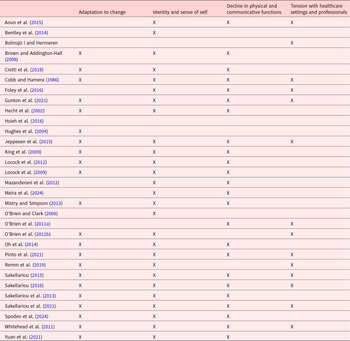
Several themes were identified upon examination of the studies that explored the lived experiences of pALS. Due to small sample sizes and the heterogeneity of illness experiences, the results of these studies cannot be strictly applied to the greater pALS population; however, it should be noted that there were recurrent themes across the literature (Table 3). A focus on adaptation to changes that occur with disease progression, both physically and psychologically, was prominent across numerous studies (Brown and Addington-Hall Reference Brown and Addington-Hall2008; Ciotti et al. Reference Ciotti, Bianconi and Saraceni2018; Cobb and Hamera Reference Cobb and Hamera1986; Gunton et al. Reference Gunton, Hansen and Schellenberg2021; Hecht et al. Reference Hecht, Hillemacher and Grasel2002; Hughes et al. Reference Hughes, Sinha and Higginson2004; Jeppesen et al. Reference Jeppesen, Rahbek and Gredal2015; King et al. Reference King, Duke and O’Connor2009; Locock et al Reference Locock, Mazanderani and Powell2012; Locock et al. Reference Locock, Ziebland and Dumelow2009; Mistry and Simpson Reference Mistry and Simpson2013; O’Brien et al. Reference O’Brien, Whitehead and Murphy2011b; Oh et al. Reference Oh, Schepp and McGrath2014; Pinto et al. Reference Pinto, Geraghty and Yardley2021; Remm et al. Reference Remm, Halcomb and Stephens2019; Sakellariou Reference Sakellariou2015, Reference Sakellariou2016; Sakellariou et al. Reference Sakellariou, Boniface and Brown2013; Sakellariou et al. Reference Sakellariou, Nissen and Warren2021; Spoden et al. Reference Spoden, Wenzel and Erdmann2024; Whitehead et al. Reference Whitehead, O’Brien and Jack2011; Yuan et al. Reference Yuan, Peng and Zeng2021). PALS and care partners frequently highlighted the effects of decline in physical and communicative function, often noting the loss of mobility and the inability to articulate clearly as heightened concerns (Aoun et al. Reference Aoun, Chochinov and Kristjanson2015; Brown and Addington-Hall Reference Brown and Addington-Hall2008; Ciotti et al. Reference Ciotti, Bianconi and Saraceni2018; Cobb and Hamera Reference Cobb and Hamera1986; Foley et al. Reference Foley, Timonen and Hardiman2016; Gunton et al. Reference Gunton, Hansen and Schellenberg2021; Hecht et al. Reference Hecht, Hillemacher and Grasel2002; Jeppesen et al. Reference Jeppesen, Rahbek and Gredal2015; King et al. Reference King, Duke and O’Connor2009; Locock et al. Reference Locock, Mazanderani and Powell2012; Locock et al. Reference Locock, Ziebland and Dumelow2009; Mazanderani et al. Reference Mazanderani, Locock and Powell2012; Meira et al. Reference Meira, Silva and Chochinov2024; Mistry and Simpson Reference Mistry and Simpson2013; O’Brien et al. Reference O’Brien, Whitehead and Jack2011a; Oh et al. Reference Oh, Schepp and McGrath2014; Pinto et al. Reference Pinto, Geraghty and Yardley2021; Sakellariou Reference Sakellariou2015, Reference Sakellariou2016; Sakellariou et al. Reference Sakellariou, Boniface and Brown2013; Sakellariou et al. Reference Sakellariou, Nissen and Warren2021; Spoden et al. Reference Spoden, Wenzel and Erdmann2024; Whitehead et al. Reference Whitehead, O’Brien and Jack2011; Yuan et al. Reference Yuan, Peng and Zeng2021).
Overarching themes

Additionally, numerous studies noted the examination and shifting of personal identity in pALS, with particular focus on changes in the perception of self as well as the perceived notions of others (Aoun et al. Reference Aoun, Chochinov and Kristjanson2015; Bentley et al. Reference Bentley, O’Connor and Kane2014; Brown and Addington-Hall Reference Brown and Addington-Hall2008; Ciotti et al. Reference Ciotti, Bianconi and Saraceni2018; Cobb and Foley et al. Reference Foley, Timonen and Hardiman2016; Gunton et al. Reference Gunton, Hansen and Schellenberg2021; Hamera Reference Cobb and Hamera1986; Hecht et al. Reference Hecht, Hillemacher and Grasel2002; Jeppesen et al. Reference Jeppesen, Rahbek and Gredal2015; King et al. Reference King, Duke and O’Connor2009; Locock et al. Reference Locock, Mazanderani and Powell2012; Locock et al. Reference Locock, Ziebland and Dumelow2009; Mazanderani et al. Reference Mazanderani, Locock and Powell2012; Meira et al. Reference Meira, Silva and Chochinov2024; Mistry and Simpson Reference Mistry and Simpson2013; O’Brien and Clark Reference O’Brien and Clark2006; O’Brien et al. Reference O’Brien, Whitehead and Murphy2011b; Oh et al. Reference Oh, Schepp and McGrath2014; Pinto et al. Reference Pinto, Geraghty and Yardley2021; Remm et al. Reference Remm, Halcomb and Stephens2019; Sakellariou et al. Reference Sakellariou, Boniface and Brown2013; Sakellariou Reference Sakellariou2015, Reference Sakellariou2016; Sakellariou et al. Reference Sakellariou, Nissen and Warren2021; Spoden et al. Reference Spoden, Wenzel and Erdmann2024; Yuan et al. Reference Yuan, Peng and Zeng2021; Whitehead et al. Reference Whitehead, O’Brien and Jack2011; Yuan et al. Reference Yuan, Peng and Zeng2021). Some studies highlighted tensions between the values of pALS and the values of their medical professionals (Jeppesen et al. Reference Jeppesen, Rahbek and Gredal2015) or care partners (Foley et al. Reference Foley, Timonen and Hardiman2016). Participants noted frustrations with their interactions with healthcare professionals and identified greater healthcare system needs (Bolmsjö and Hermeren Reference Bolmsjö and Hermeren2001; Cobb and Hamera Reference Cobb and Hamera1986; Gunton et al. Reference Gunton, Hansen and Schellenberg2021; Hughes et al. Reference Hughes, Sinha and Higginson2004; O’Brien et al. Reference O’Brien, Whitehead and Jack2011a, Reference O’Brien, Whitehead and Murphy2011b; Oh et al. Reference Oh, Schepp and McGrath2014; Pinto et al. Reference Pinto, Geraghty and Yardley2021; Remm et al. Reference Remm, Halcomb and Stephens2019; Sakellariou Reference Sakellariou2015, Reference Sakellariou2016; Sakellariou et al. Reference Sakellariou, Nissen and Warren2021; Whitehead et al. Reference Whitehead, O’Brien and Jack2011). Future research should address the relationship between communication and identity of self in this population, possibly within the context of social interaction with loved ones and medical professionals.
The 3 studies that implemented a narrative-based approach to specifically address psychosocial challenges in pALS (Aoun et al. Reference Aoun, Chochinov and Kristjanson2015; Bentley et al. Reference Bentley, O’Connor and Kane2014; Meira et al. Reference Meira, Silva and Chochinov2024) each utilized dignity therapy, an intervention that has been highly studied across different populations. These studies revealed mixed quantitative measurement outcomes but overall positive effects from the anecdotal perspectives of patients. All other studies included in this review either addressed a particular question about living with ALS or aimed to explore the more general lived experience of this population. It could be argued that information gained from narrative-based approaches could be utilized to develop more targeted psychosocial interventions that are also rooted in narrative; however, this direct connection has not yet been made for pALS. This gap in knowledge calls for future research to address the ways in which the information gathered about lived experiences could be used to provide more robust psychosocial support for this population. Future studies should examine the use of narrative-based psychosocial intervention in pALS – whether newly developed or previously established – to promote more comprehensive psychosocial care for this population.
Limitations
As previously noted, the heterogeneity of study type, participant focus, and overarching goals of the studies in this review may impact the direct implications for the greater pALS population. ALS is a relatively uncommon disease (Jones Reference Jones2020), and the progression of functional decline is generally quite rapid (Ciotti et al. Reference Ciotti, Bianconi and Saraceni2018), particularly in motor speech function for patients with the bulbar-onset variant of the disease (Eshghi et al. Reference Eshghi, Yunusova and Connaghan2022). Time limitations could also be a factor, as utilizing alternative means of communication, such as partner-assisted scanning, is often time-consuming (Radtke et al. Reference Radtke, Tate and Happ2012). Lack of clarity regarding the disease etiology (CDC 2024) and the absence of a cure for the disease may also be factors limiting research on this population, especially in cultures that have the tendency to distance themselves from the death experience (Feifel Reference Feifel and Scotch1977; Knutson Reference Knutson and Scotch1970; Krant Reference Krant1974; Krisman-Scott Reference Krisman-Scott2003). Further clarification regarding the difficulties related to implementation of narrative-based approaches with pALS should be prioritized in future studies.
Lastly, the open-ended search strategy lent itself to a broader means of organization and interpretation of the data. Nevertheless, the pALS population is understudied, and it was therefore considered practical to incorporate any relevant study to achieve an accurate representation of research in this arena.
Conclusion
Narrative-based approaches can be utilized to explore the illness experiences of pALS and their care partners, providing opportunities to improve understanding of the lived experience of this population. Future research should consider the overarching themes presented in this review (adaptation to change, identity of self, decline in physical and communicative abilities, and tension among pALS and healthcare systems), as they have been identified as important areas of focus by pALS, in hopes of generating new methods of psychological support for this population.
Acknowledgments
The author would like to express appreciation and acknowledgement of Dr. Isabell May and Dr. Lynn McPherson at the University of Maryland, Baltimore for their feedback and mentorship throughout this research process.
Competing Interests
The author declares none



 Open access

