

Introduction
In the preceding chapters of this volume, we have developed a set of concepts and measurement tools to characterize policymaking and the nature of the policy debate in the wake of policy proposals put forward by governments in order to come to terms with the refugee crisis. In Chapter 1, we introduced the notion of politicization, which captures how salient and how polarized the given policy debate becomes among the political elite. In Chapters 6, 7, and 8, we focused on the intensity of the conflict between the respective actors in the debate. A crucial component underpinning these measures, which forms the backbone of our PPA dataset, is what we call the issue direction of the actions; in other words, whether the actor undertaking the action expresses a broad agreement or disagreement, or takes a neutral stance toward the policy in question. Aggregating these issue direction codes for a given unit of analysis – an entire episode, a given time period in an episode, or for a given actor – provides a glimpse of where the political elite (or particular elite groups) stand on the policy and by extension, how much elite resistance the governments face when enacting the policy.
In line with our previous analyses, we use the political elite in a rather holistic sense; not only does it capture the entire government apparatus as well as the parliamentary wings of the ruling coalition, but it also includes opposition parties (both the mainstream opposition and radical challengers), civil society organizations (including humanitarian groups, social movement organizations, experts, media, union, church, and other organized actors outside the party-political arena), and international actors (EU institutions and other governments). Such a broad interpretation of the political elite notwithstanding, we emphasize its distinction from the “demand side” of the policymaking equation that we focus on in Chapter 13: general public opinion in relation to the refugee crisis. In other words, the notion of elite support that constitutes the dependent variable of this chapter refers to the average position held by actors who act on behalf of political institutions or organizations with a capacity to reach and influence the opinion of broad audiences and the general public.
In an important departure from the previous chapters, the empirical analysis we provide in the present chapter takes an explicitly longitudinal perspective. Rather than asking why certain episodes face more or less elite support (on average), we inquire about the determinants of the ups and downs of such support over time within a given episode, while relegating much of the between-episode variation in support levels to episode-specific fixed effects. This is not to say that we consider context as irrelevant. Episodes play out across different geographical units in different time periods and in different issue domains. Accordingly, we will introduce some of the contextual variables – namely country type, episode type, and the phase of the refugee crisis – as possible moderators of the longitudinal drivers of elite support. Moreover, we distinguish between two types of drivers of support, which also serve as the most important organizing principle of this chapter: exogenous drivers that affect the overall level of elite support at any given point in time and endogenous interactions between actors. The analysis of the interactions investigates whether the ups and downs of support by one type of actor affect the contemporaneous or subsequent levels of support by another type of actor. The implicit theoretical framework we adopt thus assumes that in addition to the pressure of the crisis that affects all political actors involved in the policymaking process, actors also engage in strategic interactions, weighing the pros and cons of supporting government initiatives, voicing their opposition, or staying in the shadows of neutral ambiguity.
The unit of analysis of the chapter is the episode-month. With this choice, we aim to strike a balance between a temporal unit that is amenable to a meaningful aggregation of elite preferences (i.e., capturing enough observations for valid measurement), the availability of other longitudinal indicators as independent variables (e.g., problem pressure in the form of refugee flows and political pressure from the radical right are indicators that are available only on a monthly basis), and sufficient granularity that allows us to construct proper time series for statistical analysis. Especially the latter consideration proved somewhat problematic because fifteen of the forty episodes in our study lasted less than ten months, and ten episodes less than half a year. The prevalence of such short time series in our data is an important feature to keep in mind when we discuss some of the methodological choices in the empirical analysis. With this caveat in mind, the choice of the episode-month as the unit of analysis yields a time-series cross-section (TSCS) dataset of 644 observations with sufficient statistical power for valid inference.
The chapter is organized as follows. The next section provides a brief overview of the literature on elite support behind policymaking, emphasizing a lacuna present in the field: a heavy focus on the consequences of such support in the policymaking process for policy output and for public opinion in contrast to the relatively scant attention paid to its drivers. The third section aims to fill in this lacuna by putting forward a set of theoretical expectations on the drivers of elite support both on the systemic and on the actor-specific level. The fourth section describes the most important methodological choices, while the fifth section constitutes our empirical analysis, again structured along the systemic and the actor-specific levels. The last section concludes with a summary of our main findings and their implications.
The Importance of Elite Support behind Government Policies
In an abstract sense and from the perspective of various constraints that governments face, the policy challenge in the refugee crisis is no different from other policy challenges in the past. In addition to the exigencies of the underlying problem pressure, the constraints imposed by public opinion, and the institutional capacity of the state to address the problem, governments also need to reckon with potential dissent among the political elite. Alternatively put, the degree to which the government is able to rally elite support behind its policies may be a crucial determinant of the policies’ success.
The empirical literature on this matter documents a close link between the degree and type of elite support and policy output. One strand in this literature is largely informed by the American experience on asymmetric policy representation (Bartels Reference Bale2016; Hacker and Pierson Reference Hacker and Pierson2010). Gilens and Page (Reference Gingrich and Häusermann2014) take stock of a large dataset of policy issues (1,779 in total) and show that the final policy output bears a closer resemblance to business groups’ and the economic elites’ preferences than to those of the average citizens and mass-based interest groups. Grossmann, Mahmood, and Isaac (Reference Gruber, Barlai, Fähnrich, Griessler and Rhomberg2021) find a similar effect of organized groups in American politics. However, the authors emphasize partisan differences with regard to the type of organized interest whose support tends to determine the policies’ ultimate fate. Burstein and Linton (Reference Burstein and Linton2002) provide a meta-analysis from published political science journal articles to evaluate the relative importance of different kinds of elite support. They arrive at a more nuanced conclusion: Political organizations’ support for policies is most likely to have an impact when it resonates with the electoral concerns of politicians. That said, electoral considerations do not typically feature in most accounts of interest group politics. A case in point is Schamis (Reference Schattschneider1999), who emphasizes the role of elite support by business groups behind economic liberalization in Latin America, in contrast to the popular view of technocratic insulation at the top being the factor most conducive to structural reform programs (Haggard and Kaufman Reference Hatton2018). In neither of these accounts do electoral considerations take a central role, suggesting that elite support (or the lack thereof) has an autonomous influence on the policy process.
That said, elite groups’ impact on public opinion may very well be an alternative mechanism through which elites influence policymaking. Such an impact has been most extensively documented in the foreign policy domain via survey experiments. Whether respondents are cued by celebrity endorsements of a given course of action proposed by the government (Frizzell Reference Frizzell2011) or are exposed to the views of the military elite or policy advisors (Golby, Feaver, and Dropp Reference Gray, Lewicki, Gray and Elliott2018; Saunders Reference Scarpa and Schierup2018), their responses tend to align more closely with the proposed policy compared to nontreated individuals in these experiments. Similar effects were found in the issue domain of climate change policies. Kammermann and Dermont (Reference Kasimis and Kassimi2018) study the interaction between elite opinion and citizen preferences across a range of climate change policies in Switzerland and uncover the impact of elite support behind such policies on public opinion. Rinscheid, Pianta, and Weber (Reference Ripoll Servent and Trauner2021) come to similar conclusions in an empirical setting based on American respondents with regards to support for the phase-out of fossil fuel–powered cars and the deployment of carbon capture technology: When political parties endorse one of these policies, citizens’ support for the policies increases but only when they trust the party in question. All in all, elite support for public policies that are high on the political agenda across various issue domains and by various elite groups appears to have a clear and consistent link with public support for the issues in question. In other words, not only does elite support facilitate the enaction of public policies, but it also goes a long way in selling them to the public.
A common feature of these accounts is that implicitly, they tend to take elite preferences as given. While this assumption may be valid for certain types of elite groups in the case of certain types of policies (such as the role of business groups vis-à-vis economic liberalization or the role of military elites vis-à-vis foreign interventions), in the face of novel types of problem pressure with uncertain consequences, such as the refugee crisis we are studying, this assumption is highly problematic. Besides its impact on the policy process, we thus need to ask about the origins of elite support. In this regard, however, the extant literature provides significantly fewer cues. Though various features of elite groups and the policy debate, such as the institutional networks connecting elites (Van Gunten Reference Vincenzi2015), horizontal trust between them (Weinberg Reference Werts, Scheepers and Lubbers2022), or the role of policy framing when faced with policies that potentially conflict with their interests (Teigen and Karlsen Reference Tétényi, Barczikay and Szent‐Iványi2020) have been identified as possible determinants of elite support, we lack a coherent account of the origins of elite support behind government policies. Tellingly, in a two-wave survey of MEPs’ immigration attitudes some time before the refugee crisis, Lahav and Messina (Reference Laubenthal2005) document a convergence of views without specifying the driving mechanisms. This chapter thus takes up the task of specifying some of these mechanisms and subjects them to empirical testing on our PPA dataset.
Exogenous Drivers and Endogenous Interactions between the Elites in the Refugee Crisis
To begin conceptualizing the potential drivers of elite support for the forty national policy episodes that we study in this volume, we would like to remind the reader of the basic building blocks of our theoretical framework as outlined in Chapter 2. In one way or another, all the episodes were responses to the mounting problem pressures in the form of asylum applications overburdening the capacity of the countries’ asylum systems. Moreover, as policymakers sought to address the problem by erecting border fences and/or reforming the countries’ asylum system, they also had to reckon with pressures emanating from the exceptional salience of immigration in the minds of the public and the rising fortunes of radical right challenger parties that were uniquely well positioned to capitalize on the crisis. Throughout the book, we refer to these two forms of political constraints as political pressure.
How is the political elite expected to react in the face of such pressures? When these pressures mount, various elite groups are likely to weigh the expected costs and benefits of support and opposition to the governments’ policy initiatives. Though the salience of the refugee crisis is likely to vary across the different elite groups, they have a shared interest in putting the issue on the political agenda, lest they risk appearing out of touch with the concerns of ordinary citizens or a narrower subset thereof who are directly affected by immigration (e.g., via wage competition). Once they engage with the policies, elite groups next have to decide whether the expected cost of supporting the initiatives outweighs the expected benefits. The cost of support mainly derives from sharing responsibility for the potential failure of the policy in controlling refugee flows and/or equipping the asylum system for the reception and integration of asylum claimants. The benefits of support in turn derive from the perception that elite groups take the problem seriously and act as a voice of ordinary citizens clamoring for policy solutions. This consideration chimes in with the “rally-around-the-flag” perspective in crisis politics (Mueller Reference Müller and Rietig1970); In response to rising problem pressure and expectations from the general public, even potential dissenters among the political elite are under pressure to suspend criticism and temporarily support government initiatives. An additional source of benefits accruing from such support by the elite is that it allows them to come across as temporary policy allies of the government, which in turn may prompt the latter to offer policy concessions on other issue domains that are of greater importance for the respective elite groups.
The balance of these considerations thus suggests that in response to the crisis shock, the elite is expected to provide a temporary boost to government initiatives. However, we need to disentangle the impact of the two separate sources of pressures. While problem pressure may indeed prompt the elite to align behind governments, political pressure – especially when it comes from the radical right – may act as a countervailing force. Political pressure from the radical right is a signal to the other elite groups that public discontent with the proposed policies is palpable, and acting as a voice of such discontent may thus become a viable political strategy. This consideration leads us to put forward the baseline hypothesis for this chapter that expects opposite impacts emanating from the two sources of pressure that governments face.
H1: While mounting problem pressure leads to a (temporary) boost to elite support, increasing political pressure prompts the elite to oppose the proposed policy initiatives.
These considerations, however, need to be contextualized. Mounting problem and political pressures have vastly different implications across the types of countries, the types of episodes on the agenda, and the different phases of the refugee crisis. The underlying conditioning principle across these contexts is the notion of contestability. We posit that the degree to which the political elite perceives the government initiatives as contestable depends on their country’s structural location vis-à-vis refugee flows, the range of possible policy alternatives on the table, and the availability of a precedent and policy templates to be borrowed from other countries.
Starting with country types, an important distinction lies between the strategic calculation of elite actors in frontline countries on the one hand and transit and destination countries on the other. In frontline countries, the authorities can credibly scapegoat EU institutions and other member states for failing to relieve the asymmetrical burden that these countries face solely due to the “bad luck” of geography. In such a context, openly opposing government initiatives to get the problem under control carries the risk of being seen as obstructing the national cause and contributing to the perceived sense of injustice and grievances. In transit and destination countries, on the other hand, the appropriate policy response to the crisis is more contentious, pitting proponents of a relatively open asylum regime against the hardliners clamoring for a closed-door immigration regime in general and an uncompromising stance on sticking to the Dublin rules in particular. In this context, the public positions of elite groups are likely to diverge, giving rise to a higher level of dissent to government initiatives compared to the frontline states.
Similar considerations apply for the differential response of the elites across episode types. Again, elite support in response to mounting pressure is likely to depend on the perceived viability of policy alternatives. These alternatives are more likely to be present in cases of asylum reform because eligibility criteria, appeal conditions, return procedures, and various other aspects of the asylum systems are subject to legitimate contention in the absence of an acute sense of urgency to act. Border controls, by contrast, are desperate moves to get the situation under control with no other immediate policy alternative being in sight. In the face of such an emergency, it is thus considerably riskier for elite groups to challenge governments. We thus expect that elite incentives to dissent in the face of rising problem and political pressure are reduced when border control measures are on the political agenda.
Finally, we expect the temporal evolution of the broader refugee crisis to act as a third moderator of the elite response to government initiatives. As we outlined in Chapter 5, the refugee crisis can be conceptualized in terms of three distinct phases. The first phase is characterized by rising refugee flows across the Mediterranean without any overarching European or even national response commensurate to the scale of the problem to come. The second phase begins in the early summer of 2015 with the first border control measures imposed by the Hungarian authorities and the first European push toward a communitarian solution (the Relocation Scheme). The peak (and end) of the second phase is the EU–Turkey agreement signed in March 2016. We regard the period following the agreement as a distinct phase because with the externalization of border controls, refugee flows were significantly reduced, and the sense of urgency considerably abated. We argue that elite incentives to respond to the problem and political pressures vary across the phases. The greatest scope for dissent exists in the early phase, when no European or national policy solutions are forthcoming as templates that governments can adopt, and critical voices against early policy initiatives come across as highly credible in the absence of viable templates. As countries put up border barriers one after the other in the heat of the crisis and remolded their asylum systems in a comparable fashion, these critical voices became less credible, and the pressure on the elite to fall in line increased. We thus expect that in the later phases, elite groups have become more likely to support government initiatives in response to rising problem and political pressures. To summarize the three conditional hypotheses below:
H2a: Rising problem and political pressures lead to a higher level of dissent among the political elite in transit and destination states than in frontline states.
H2b: Rising problem and political pressures lead to a higher level of dissent among the political elite during policy debates on asylum rules compared to debates on border control measures.
H2c: Rising problem and political pressures lead to a higher level of dissent among the political elite during the early phase of the crisis compared to subsequent phases.
Thus far, we have implicitly treated the political elite somewhat monolithically, under the assumption that there is a common core of incentives they react to in a comparable fashion. We now relax the assumption and formulate expectations on group-specific behavior. Specifically, we identify four types of elite groups in line with the categorization we have put forward in Chapter 6. One part of the elite is closely affiliated with the government as members of governing parties, members of the cabinet, or members of other institutions under the direct control of the national government. We shall refer to these elites as governing elites. The second elite group we analyze separately consists of members of opposition parties, either from the mainstream opposition or from radical challengers. The third elite group consists of EU and other supranational institutions as well as foreign governments. Fourth, we also include in the analysis what we have broadly referred to as civil society groups, comprising social movement organizations, churches, unions, media actors, experts, academics, and other actors whose elite standing derives less from holding the levers of political power than from their potential to sway public opinion. We shall refer to these groups as civil society elites.
Though group-specific elite behavior may also depend on the external pressure that the governments face in the refugee crisis, we shall focus in this second part of the analysis on endogenous dynamics between elite groups, namely on their responsiveness to the actions of other elite groups who may be allies or potential rivals. An intuitive conceptualization of such responsiveness is the expected level of support for the governments’ policy initiatives by one elite group as a function of the changing levels of support provided by the other elite groups.
Starting with the governing elite, we expect that it is the most sensitive to opposition support because other elite groups have an indirect influence at best on the fate of the policy and on the electoral standing of governments. Opposition parties, by contrast, can present policy alternatives in parliament and other institutional venues, and the government is under pressure to react to such alternatives. Moreover, opposition groups have the potential to mobilize crowds, putting the government under pressure in the protest arena. However, it is an open question whether the government, in response to dissent from the opposition, closes ranks behind the proposal or whether, alternatively, critical voices within the government are reinforced and it splits on the issue, especially when the opposition strategically seeks to precipitate such splits (Whitaker and Martin Reference Wihtol de Wenden2022). Given the urgency of the problem pressure the government faces and the electoral threat from the radical right, we expect closing ranks to be a more likely scenario because, under heightened media scrutiny, any split is likely to become public and detrimental to government survival, as exemplified by the splits in the Swedish governing coalition during the refugee crisis.
Turning to the opposition, it is most likely to respond to the actions of its potential allies. One such group of allies are critical voices in the government itself. However, splits in the government are likely to provide only temporary momentum to opposition offensives because potential dissenters within the government are unlikely to want to risk losing office by providing open support to opposition parties. International and civil society support, by contrast, are more reliable power resources because they have the potential to legitimate opposition discourse. Empirically, the opposition and civil society groups have been shown to act in concert against government proposals on various occasions in the recent past (Kriesi et al. Reference Bojar, Gessler, Hutter and Kriesi2020). We thus expect that lower (higher) levels of support behind government policies by international and civil society groups are likely to decrease (increase) support by the opposition.
Does a mirror logic apply for the determinants of support by international institutions and civil society? To some extent, the likely answer is affirmative: Both international and civil society groups have something to gain when they wish to express opposition to government policies and other elite groups share their critical stance – because coordinated opposition is likely to legitimate dissent. However, we expect this logic to hold particularly for civil society groups because international actors need to be seen as (at least somewhat) neutral arbiters between the governing elite and dissenting groups. It is particularly risky for international actors to openly side with opposition forces, lest they be accused of interfering with domestic politics of a sovereign member state. We thus expect that civil society groups are likely to voice dissent in response to dissent by the opposition and international actors, whereas the position of international actors is less likely to be driven by the position of the governments’ domestic opponents. To summarize these expectations in a third set of hypotheses below:
H3a: The governing elite is most responsive to opposition dissent. Specifically, in response to dissent (reduced levels of support) by the opposition, the governing elite is likely to close ranks and reduce dissent (increase levels of support) within its own ranks.
H3b: Opposition groups are likely to increase dissent (reduce levels of support) in response to dissent by civil society groups and international actors.
H3c: International and civil society groups are likely to increase dissent (reduce levels of support) in response to dissent by civil society groups and international actors, respectively.
H3d: Civil society groups are more likely to increase dissent (reduce levels of support) in response to dissent by the opposition rather than international actors.
Method: A Longitudinal Analysis of Elite Support
As already indicated in the introduction to this chapter, our sample consists of a total of 644 observations where the unit of analysis is the episode month. In theory, the data structure is well suited for a TSCS (time-series cross-section) design with episode fixed effects to control for the systematically different average levels of support across units (episodes) that may be correlated with the models’ covariates. What sets the dataset apart from the most common TSCS designs is that the episodes (or at least a subset thereof) do not unfold simultaneously, and there is a considerable imbalance in the length of the individual series. One serious complication that arises from the relatively short (T < 10) series for a large part of the episodes is the well-known dynamic panel data bias (Nickell Reference Niemann and Speyer1981) in case of a dynamic specification. To assess the gravity of the problem, we inspected the dynamic nature of the dependent variable, the average level of elite support both in its systemic and in its actor-specific forms.Footnote 1 Reassuringly, the dependent variable displays little persistence over time, with an autoregressive coefficient of around 0.2. To visually convey this lack of persistence of the series, Figure 10.1 shows the evolution of the dependent variable for the ten longest episodes in our sample. The sudden spikes and drops of the series indicate that shocks dissipate rather quickly, making the behavior of the dependent variable not all that dissimilar from a white noise series. Substantively speaking, this pattern is somewhat puzzling at first because one would expect relatively stable elite preferences toward a given policy initiative over time. However, one must remember that the support variable is an aggregated measure of various actors and depending on which particular institutions act in a given episode month, it is likely to be rather volatile. Moreover, while some episode-months are rich in action, others are averages of only a handful of observations, further adding to observed volatility. With this volatility in mind, we consider that specifying the models in static terms poses little risk for biased coefficient estimates and goes a long way toward addressing the dynamic panel data bias in the case of short time series.
The evolution of average elite support over time

Other complications that may arise in time-series cross-section designs is the biased estimates for the standard errors of the coefficients due to panel-level heteroscedasticity and autocorrelation in the residuals. To get around this problem, we employ Beck and Katz’s (Reference Beck and Katz1995) recommended tool of panel corrected standard errors with a Prais–Winsten correction of the residuals. As the autocorrelation coefficient estimates (rho) reveal, however, autocorrelation was a marginal concern in most of the models, further underscoring the white noise–like behavior of the dependent variable.
All the estimated models shown below thus regress the average level of elite support (either in its systemic or its actor-specific form) on the key covariates of interest, a control for an episode-specific time trend and the episode-specific fixed effects. The key covariates in the first part of the analysis are the pressure indicators, all standardized between 0 and 1 so that the coefficient estimates are directly comparable on the same scale. The key covariates in the second part where we seek to predict the group-specific levels of support are the support variables for the other three elite groups. In the baseline models that test for the overall impact of the exogenous drivers (H1) as well as the models testing for interactions between the actors (H3a–H3c), contextual variables are included in the models as controls. In the models that test the three conditional hypotheses (H2a–H2c), interactions of the conditioning characteristics (type of state, episode, and phase) with the pressure indicators are introduced as additional covariates.
One important and open-ended decision we had to take was the temporal form of the time-varying covariates (exogenous drivers and support levels of the other actors). We had no strong theoretical priors to inform us whether the covariates should be introduced in a contemporaneous form or with lag(s). Introducing them with lags has the advantage of guarding against simultaneity bias, especially in the case of the interactive models, where the different elite groups may influence each other in a reciprocal fashion. However, not allowing for contemporaneous impacts runs the risk of arriving at false negative conclusions based on the coefficient estimates because a month may be a long enough time for a change in elite behavior to show up in the policy debate. The pragmatic compromise we took was running separate models for contemporaneous impacts and for one- and two-month lags.Footnote 2 In case of multiple coefficients showing up as significant, we selected as the final model the one that produced the best fit based on the R2 statistic.
Results
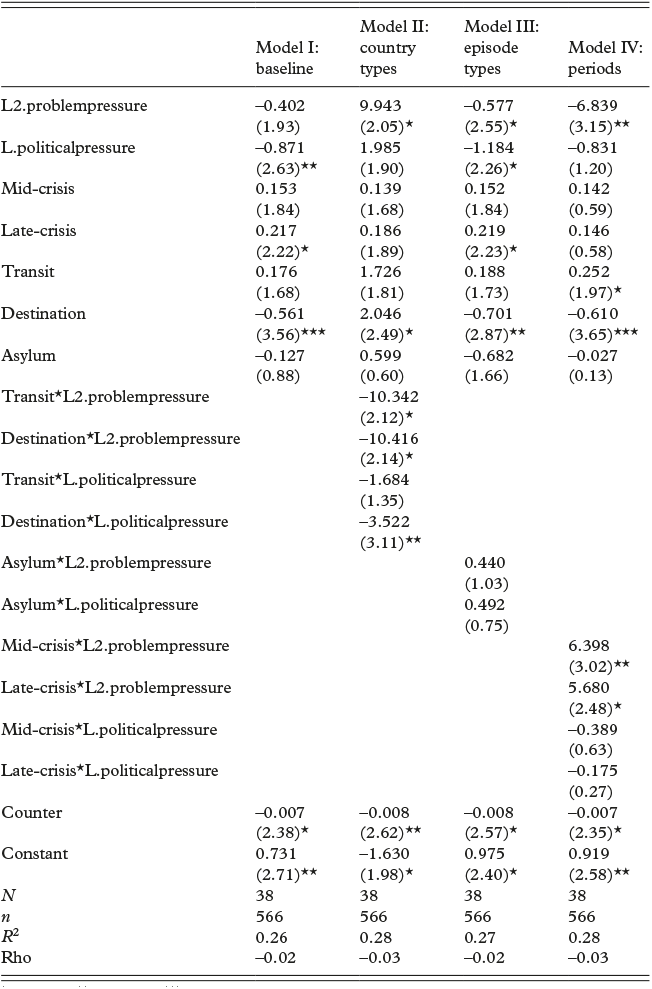
We begin the analysis with laying out the baseline model in Table 10.1. The passage of time (see “counter” variable) exerts a small but steady drop in average levels of elite support, suggesting that elites tend to distance themselves from the policy proposals over time. The impact over a month is a trivial-sounding 0.007, but over a year it accumulates to over 0.08 (with the dependent variable defined on the –1 to 1 scale). In terms of country types, destination countries tend to display a significantly lower level of elite support, in accordance with our expectation regarding the more contentious nature of policymaking in such countries. The impact is rather large, amounting to a 0.6 lower level of support in these countries compared to frontline states. Furthermore, the third phase of the crisis that begins with the signing of the EU–Turkey agreement tends to be associated with higher levels of elite support. This is again consistent with the idea that with the availability of policy templates from other countries, the scope and incentives for elite dissent are reduced. Finally, the estimates for the policy type (a dummy for asylum reforms as distinct from border control measures) are also largely consistent with our expectations that the scope for dissent is greater in the case of asylum policies, even if the effect is not significant.
* p < 0.05; ** p < 0.01; *** p < 0.001
The central question of this chapter, however, concerns the reaction of the elites to rising problem and political pressure. The coefficient estimates of the corresponding coefficients are only partly in line with our expectations. Rising problem pressure is associated with a significantly lower level of elite support two months later, though the estimate is just short of the 5 percent significance level when the variable is introduced together with the political pressure variable. Therefore, in contrast to the rally-around-the-flag dynamics, if anything, the elite appears to distance themselves from the government initiatives in response to mounting problem pressure. We can only speculate at this point about the driving mechanism behind this effect. However, it appears to be the case that highlighting the potential risks (or outright failure) of the proposed policy remedies is viewed by the elite as the less risky option compared to tagging along with the governments’ agenda. The estimate is also substantively meaningful: The predicted difference between elite support between the sample minimum and the sample maximum of the standardized problem pressure variable is 0.40. The impact of political pressure, by contrast, is in the expected negative direction, with a substantively larger impact compared to problem pressure: The difference between the sample minimum and the sample maximum of political pressure gives rise to a 0.90 difference in the predicted level of elite support. Finally, no statistically significant effect is found for the impact of political pressure emanating from the higher salience of the immigration issue, so we omitted this coefficient estimate from the final models.
Before we proceed to the interactive models, it is worth stressing the difference in the temporal dynamics between the two pressure variables. While the impact of problem pressure shows up with two-month lag, political pressure exerts an instantaneous and one-month lagged impact on elite behavior (though we included only the one-month lag in the final model for ease of interpretation). One possible explanation is that rising political pressure is not just a trigger but also a manifestation of elite discontent. In other words, as the elite turns away from governments, a part of the electorate takes note by turning toward parties that own the immigration issue in general and act as the loudest critics of governments’ handling of the refugee crisis in particular.
How do these impacts vary across the contextual characteristics we have identified above following the notion of contestability? We reestimate the models with each pressure variable introduced in interaction with the contextual covariates (Models II, III, and IV), and we calculate the marginal effects (Figures 10.2 and 10.3) of the pressure variables across the different contexts. Similar to the baseline models, the salience variable does not produce any significant estimates across any of the contexts. The impact of problem pressure, however, clearly separates frontline states from transit and destination states. In fact, the negative overall estimate we have found for the problem pressure variable (at its second lag) is restricted to transit and destination states, whereas in frontline states, we find a large positive estimate (amounting to a change in average level of support of around 10 for a full swing between the sample minimum and sample maximum level of problem pressure). This impact clearly lies outside the range of the elite support variable, but this is due to the fact that the typical level of problem pressure – as measured by submitted asylum claims – is considerably lower in frontline states than in transit and destination states. In fact, the sample maximum in this country group on the standardized scale of the problem pressure variable is a mere 0.03, so the estimated positive impact needs to be evaluated accordingly: Moving from the sample minimum to the sample mean in this country group, for instance, amounts to a change of 0.3 on the scale of the average support variable.
The impact of problem pressure across country types, episode types, and crisis periods

The impact of political pressure across country types, episode types, and crisis periods

Turning to the conditional impact of problem pressure across episode types, there is some evidence for the conditioning role of episode types, but the impact goes against our expectations. Rather than asylum reforms, it is during debates on border measures that rising problem pressure leads to a higher level of dissent by the political elite, as is evidenced by the negative and significant estimate of the problem pressure variable during such episodes. The conditional role of the crisis periods, however, conforms to our expectations: While the impact of rising problem pressure in the early phase leads to a large drop in elite support, the impact is small and statistically indistinguishable from 0 in the subsequent phases. To quantify the impact, we need to again consider that the typical level of elite support was considerably lower in this first phase of the crisis. A move from the sample minimum to the sample mean in this period (0.03 on the standardized problem pressure scale) thus amounts to a drop of around 0.2 in elite support.
The conditioning role of political pressure from the radical right across the contextual characteristics we study in this chapter is very similar to that of problem pressure. While the political elite in destination states reacts to rising political pressure by stepping up dissent, the corresponding estimates in transit and frontline states are statistically indistinguishable from 0. As for episode types, we observe a pattern identical to the impact of problem pressure: Contrary to expectations, it is border control debates that prompt the elite to oppose policy initiatives in response to political pressure, whereas the impact of this form of pressure during asylum debates is nonsignificant. Finally, in contrast to the impact of problem pressure, the impact of political pressure does not appear to significantly diverge across the phases of the crisis. The point estimates for political pressure throughout all the crisis phases are negative and comparable in size, though the estimate falls short of significance in the first crisis phase, probably due to the relatively few episodes and observations falling in this phase of the crisis. As for the substantive size of the estimates, most of the impacts are larger than for problem pressure. For instance, a move from the sample minimum to the sample maximum political pressure in destination states amounts to a drop of 0.8 in elite support. The corresponding move in border episodes is even greater, amounting to a drop of no less than 1.2 in elite support. Overall, in line with the baseline models, we can claim that the substantive impact of political pressure is larger than that of problem pressure.
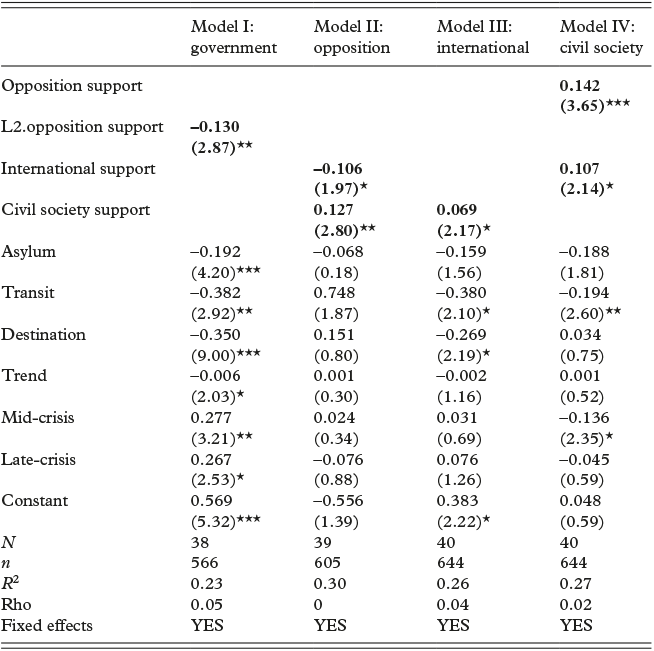
Turning to the impact of interactions between the elites, Table 10.2 shows the model estimates with group-specific level of support as the dependent variable and the contemporaneous and the lagged levels of support by the other elite groups as the key independent variables alongside the contextual controls and episode-specific time trends.
* p < 0.05; ** p < 0.01; *** p < 0.001
Starting with the government itself (Model I), its level of support only appears to be influenced by opposition dissent, in line with our expectations. The impact is significant only at its second lag. Dissent by the opposition thus appears to push potential dissenters within the government to fall in line. Alternatively put, at higher levels of opposition support, government dissenters are under less pressure to close ranks and feel freer to express reservations about the government’s policy initiatives.
Model II provides only partial evidence for the legitimating momentum that we expected to play a role behind opposition behavior. Though the impact of civil society support is positive and significant in its contemporaneous form, there is a simultaneous negative impact of international support. Rather than gaining legitimacy from international actors’ criticism of the government, a tentative interpretation of this finding is that the opposition is under pressure to line up behind governments when the latter are under attack from international actors. Regardless of the particular mechanism at play, it seems that domestic civil society elites are more reliable allies of opposition parties when it comes to decisions to oppose the governments’ policy initiatives.
In terms of the last two actor types (Models III and IV), our expectations regarding the more limited impact on international actors’ behavior compared to civil society elites’ behavior are well supported by the data. Support by international actors appears to be independent of both government and opposition support, in line with our expectations that they cannot be seen as openly taking sides in domestic political conflict. Civil society elites’ support, however, does affect international actors’ behavior. Though the estimate is substantively smaller than the estimates found for government and opposition actors’ behavior, it nevertheless suggests that international actors are emboldened in their criticism of national governments when notionally independent domestic groups step up their own criticism of the policy initiatives. Finally, the largest and most consistent estimates are found for the behavior of these civil society groups: The direction of their support follows the change in support of international and opposition groups. The legitimation logic that we expected to drive the behavior of the three elite groups outside the governing elite is thus borne out most clearly for civil society groups by the data.
When thinking of these interaction patterns among elite groups that we have uncovered in the group-specific longitudinal analysis, a cautionary note is in order. By allowing for contemporaneous estimates due to the possibility of relatively quick reactions (within a month window) that may not show up in the lagged estimates, we opened up the possibility of simultaneity bias. The possibility of such simultaneous causation is especially pertinent when the reversal of the dependent and independent variables in the respective models produces similar estimates. In our models above, opposition–civil society interactions are a case in point. The impact of civil society support on opposition behavior and the impact of opposition support on civil society behavior are both estimated to play out simultaneously at a comparable magnitude. This may indeed be a sign of mutually legitimating dynamics between the respective parties, but more advanced longitudinal techniques, such as vector autoregressive (VAR) models, would be needed to disentangle the particular causal order among the elite groups’ reaction pattern.
Conclusion
In this chapter, we sought to introduce a longitudinal perspective in the study of the policy debates of the refugee crisis at the national level. Specifically, we aimed to uncover the determinants of elite support – broadly understood – behind government policies in the context of the forty policy episodes that we study throughout the book. We have seen that somewhat surprisingly (partly due to the heterogenous nature of elite groups), the average level of support by the elite shows considerable volatility over the course of the policy episodes. We conjectured that some of this temporal fluctuation can be explained by three different sets of variables: the changing political and problem pressure that governments face, the contextual characteristics that may moderate this relationship, and the endogenous dynamics unfolding between different elite groups.
Though many of these drivers indeed turn out to be statistically significant and substantively important drivers of elite support, some of the patterns we have found partly or fully went against our prior expectations. Thus, far from the elite closing ranks behind government proposals as the “rally-around-the-flag” perspective may suggest, nongovernment elites rather use the strategic opportunity offered by mounting problem pressure to articulate opposition to these proposals and signal distance from governments as a result. However, this dynamic is mostly confined to destination and transit states, and it is more prominent during debates on border controls and in the early phase of the crisis. By contrast, the impact of political pressure is largely in line with our expectations: In response to the growing strength of the radical right, the elite steps up dissent, with the strongest effect found, again, in destination states. A tentative explanation for why elites are particularly sensitive to these pressures in destination states is that these governments had the highest “degree of freedom” as far as the management of the crisis is concerned; hence, they proved the most vulnerable to domestic political conflict when the risk of policy failure became manifest.
In addition to responding to external pressure, elite groups were also shown to engage in strategic behavior with respect to each other. While dissenters within governments are responsive only to partisan opposition actors, the behavioral calculus among opposition, civil society, and international actors is more complex. In one way or another and to different degrees, they follow in each other’s footsteps and form a latent alliance against government proposals. An exception to this rule is the opposition’s reaction to international intervention: In response to criticism from international actors, opposition parties tend to side with governments, arguably in response to an increasingly critical public opinion of the EU’s and the international community’s management of the refugee crisis.
These strategic responses of various elite groups to each other add an important insight to one of our previous chapters (Chapter 6) on domestic conflict lines. We showed in that chapter that the bulk of the conflict played out between governments and (some of) their domestic and international opponents depending on a host of contextual characteristics of the episodes. What remained hidden in that analysis due to the lack of a longitudinal dimension is how these opponents dynamically interact. The inclusion of such a longitudinal dimension allowed us to shed light on this omission: The governments’ opponents systematically respond to each other’s expressed level of support to the government’s initiatives, albeit sometimes with substantial lags. Though the government, by virtue of its central role in the policy process, is indeed the main originator or the target of conflict, other actors hardly act in isolation when they decide on their response strategies.
An important limitation of this elite-focused analysis is its disproportionate focus on the supply side of the policy process. Though the inclusion of our two political pressure variables did incorporate public opinion as a potential driver of elite behavior, our dataset did not provide sufficiently rich and systematic information on the most visible and audible voices of public engagement: protest activity.
Introduction
In this chapter, we study the role of the EU and fellow member states in national policymaking during the refugee crisis. As we have already pointed out, the relationship between the EU and domestic politics has often been characterized as a two-level game. The two-level game concept is specifically related to international negotiations and captures the fact that international agreements have to be ratified at home. In the EU polity, however, the two-level game is not only or not even in the first place related to international negotiations. In the EU multilevel polity, the relationship between international and domestic politics is a two-way street, with international, that is, supra- and transnational, politics spilling over into domestic policymaking, and vice versa, domestic politics spilling over into EU policymaking. The interlocking of policymaking at the EU level with policymaking at the domestic level is particularly complex in a policy domain like asylum policy, where the EU and the member states share responsibility for policy. Moreover, such policymaking is complicated by the fact that the arena of cross-level policymaking in the EU is hardly structured by formal rules, which makes unilateral action by member states as likely as cooperative problem solving.Footnote 1
For our analysis of this two-level game in the refugee crisis, we shall distinguish between two types of interactions between EU agencies and the member states, which we have already introduced in the theory chapter: “top-down” interventions, when EU policymaking or policymaking in other member states intervenes in domestic policies of a given member state, and “bottom-up” interventions, when domestic policymaking influences EU politics or the politics of other member states. In addition, we shall subdivide each type of intervention based on the prevailing conflict that has triggered it – an international (supranational or transnational) or a domestic conflict. Scholars of European integration have used the concept of “Europeanization” to assess the top-down effects of European interventions on domestic politics, that is, the “domestic adaptation to European integration” (Graziano and Vink Reference Green and Hobolt2006). This focus on top-down effects was a reaction to the long-term bottom-up focus on exploring the dynamics and potential outcomes of the European integration process (Börzel Reference Börzel2002: 193). Following Börzel (Reference Börzel2002), we propose to study here both the ways in which member state governments attempt to shape European policy outcomes and the ways in which they adapt to European policies. In contrast to our predecessors, however, we focus not on the eventual effects of Europeanization on national policy outcomesFootnote 2 (although we come back to them in the conclusion of the chapter) but on the conflictual interactions between EU policymaking and policymaking in the member states.
First, we analyze the politicization of the forty national episodes in quantitative terms in order to show that episodes involving cross-level interventions are more highly politicized than purely domestic episodes. In a second step, we then choose episodes from four countries – Greece, Italy, Hungary, and Germany – to show in more detail how the cross-level interactions in the policymaking process operated during the refugee crisis.
A Typology of Cross-Level Interactions
Depending on the prevailing conflict, there are essentially two ways in which EU policymakers intervene in a top-down fashion in domestic politics. In the first way, there is a vertical conflict between the EU and a member state or a horizontal conflict between some member states with respect to the implementation of EU policy. The government of a given member state may fail to implement the joint EU policy, due to either lack of resources or lack of will. This is Börzel’s (Reference Börzel2002) case of “foot-dragging.” Such behavior by a member state may lead to attempts on the part of EU agencies to directly intervene in the implementation of EU policy at the domestic level. Domestic policymakers may welcome such interventions as they increase their capacity to act, but they are more likely to resist them because such interventions tend to come with strings attached. In the domain of asylum policy, as we have seen, the Dublin regulation places a major burden on frontline states for the implementation of the policy, and it is the frontline states that experienced difficulties in assuming their responsibilities during the refugee crisis. These difficulties led the destination states together with EU agencies to push for direct EU interventions in the frontline states – to improve their reception capacity (establishment of hotspots) and their capacity to patrol the external borders (upscaling Frontex into the EBCG) or to prevent secondary migration within the EU (as in transnational border conflicts between member states). Greece above all has been the object of EU interventions of this type.
In the second version of top-down interventions, it is the outcome of domestic policymaking that triggers an EU intervention into domestic politics. In this case, there is no question of foot-dragging with respect to EU policy – what is at stake here is the implementation of domestic policy that is the result of unilateral domestic policymaking and that is incompatible with or explicitly violates EU policy. In this case, the EU intervention is designed to prevent the unilateral domestic policy from being implemented. In the domain of asylum policy, this type of intervention has been applied to some of the policies regarding asylum rules adopted by Hungary because of their disregard for the rule of law.
Depending on the prevailing type of conflict, there are also two types of bottom-up interventions by member states in EU politics. The first version reminds us of Börzel’s “uploading” strategy, that is, a member state’s strategy of pushing a policy at the EU level that reflects the member state’s policy preferences and minimizes its implementation costs. Börzel conceived of this strategy, however, mainly in terms of regulation policies, while in the asylum policy domain during the refugee crisis, this kind of strategy applied above all to capacity building. According to this strategy, a member state unilaterally deals with an international challenge and adopts a policy that serves to substitute for the failure of the EU to adopt a joint policy to deal with the challenge in question. Bottom-up interventions by member state governments of this “self-help” type may be triggered by externalities created by a third country or by other member states. In the refugee crisis, this kind of intervention occurred in the case of frontline and transit states, which took a number of unilateral measures to police the external borders of the EU. Examples are the cases of Greece and Italy, which unilaterally had to deal with third countries – Turkey in the case of Greece and Libya in the case of Italy – in the absence of joint EU action. Hungary, too, built its own fences to unilaterally secure the external border of the EU, and Austria, in turn, organized the transnational cooperative effort to close the Balkan route as a substitute for the EU–Turkey agreement that had yet to materialize. Internal border closures can also be considered as examples of this type of bottom-up interventions to the extent that one member state unilaterally takes “rebordering” measures, that is, closes its borders with another member state and/or pushes back refugees coming from another member state.
In the second version of bottom-up interventions, domestic policymakers in some member states appeal to the EU and/or other member states to solve some domestic policy conflict. This appeal either calls for support in policy implementation (to alleviate the domestic burden) or attempts to signal that policy implementation at the domestic level is impossible because of too much domestic resistance. In the refugee crisis, it is the frontline and destination states that sought support for the redistribution of the refugees from the EU and the other member states. Germany above all sought the cooperation of its fellow member states for the accommodation of asylum seekers. Greece, as the frontline state most directly hit by refugee arrivals in summer and fall 2015, appealed to the EU for support to make up for its lack of capacity to deal with the inflow of refugees. The most conspicuous example of bottom-up signaling in reaction to EU measures during the refugee crisis is the Hungarian quota referendum, which was organized to send a message to the EU decision-makers that the EU’s relocation policy was incompatible with the situation in Hungarian domestic politics. Hungary’s use of domestic politics at the EU level most closely corresponds to what Putnam (Reference Putnam1988) originally had in mind with the two-level game concept: Weakness at home is a strength on the international stage. Domestic conflict implies the impossibility of a government cooperating internationally: Its hands are tied, and it cannot participate in joint solutions such as the redistribution of refugees across member states. Note that the domestic conflict, as in the case of the Hungarian quota referendum, may be deliberately created by the government of the member state for the purpose of strengthening its position in EU-level negotiations.
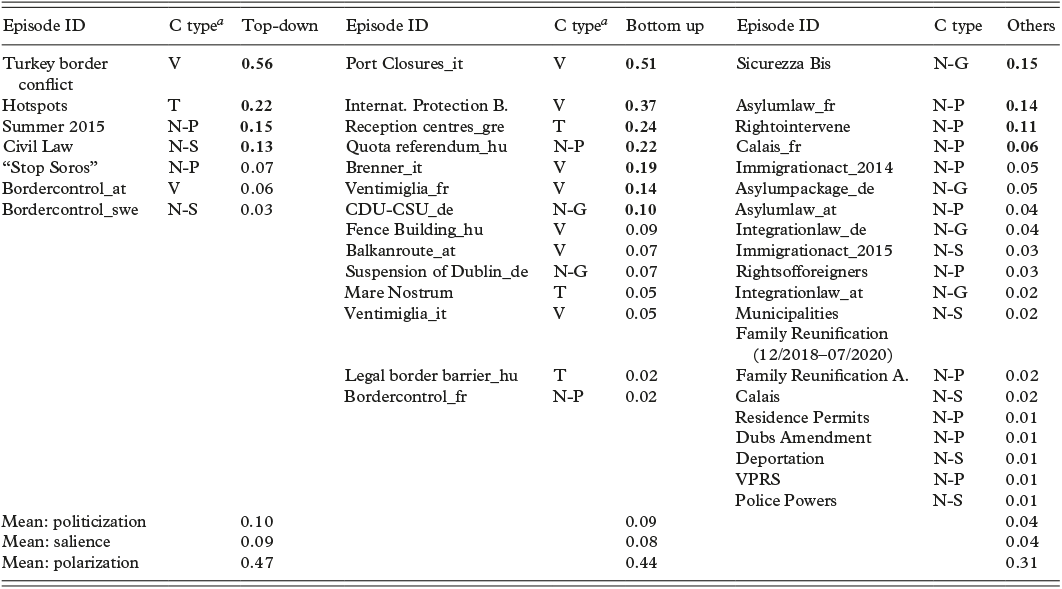
For the empirical classification of the national episodes into top-down and bottom-up types, we rely on the information about EU and member state actors targeting actors from the respective other level – domestic actors targeting international (supra- and transnational) actors and vice versa. Since such cross-level targeting is comparatively rare, we chose a low threshold to distinguish episodes with cross-level interactions from purely domestic episodes: If more than 20 percent of the actions in a given episode target actors from the respective other level, we classify it as a cross-level episode. Among the cross-level episodes thus identified, bottom-up targeting prevailed empirically. To qualify for the top-down types, at least 40 percent of the cross-level targeting actions had to be top-down. Based on prevailing conflict types, international or domestic conflicts (see Chapter 7), we then classify top-down and bottom-up episodes into their respective versions (see Table A11.1 in the appendix to this chapter for details).
a Conflict type: V = vertical, T = transnational, N-P = national-partisan, N-S = national-societal, N-G = national-intragovernmental.
Table 11.1 provides an overview over the four types of cross-level policy interactions and presents the episodes that are classified into the corresponding types. Six episodes (15 percent) are of the top-down type, four of the first variant, triggered by EU policies, and two of the second variant, triggered by domestic policymaking. Thirteen episodes (33 percent) represent bottom-up cross-level interactions, nine of which were triggered by EU policymaking and four by domestic policymaking. The remaining twenty-one episodes (53 percent) are of a purely domestic type.
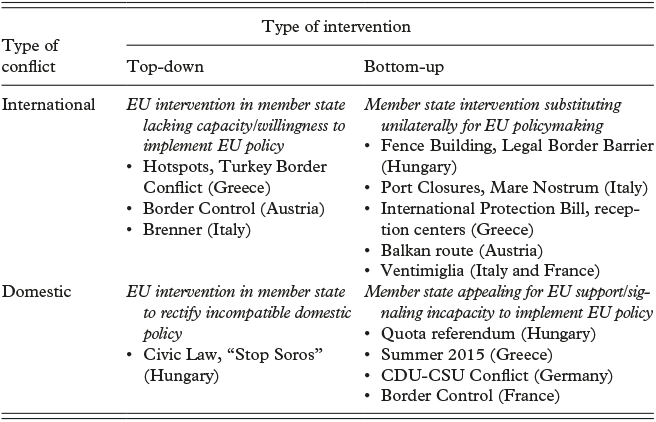
Note that the distinction between cross-level and purely domestic episodes is closely related to the policy domain and to the type of conflict. Thus, all top-down episodes deal with border control issues, and all except one of the bottom-up episodes (the Greek International Protection Bill) also deal with border control issues or with relocation. By contrast, only five of the twenty-one domestic episodes are concerned with border control – the Italian Sicurezza laws, the Calais case (in both France and the UK this episode hardly involved European actors at all), Swedish border control, and the German suspension of the Dublin rules. In addition, two domestic episodes deal with resettlement/relocation – the British VPRS episode and the Swedish episode devoted to relocation between Swedish municipalities. Note that the very important case of the German suspension of the Dublin rules is misclassified by the rules applied here, that is, it is not classified as a cross-level episode. As we shall discuss in the next chapter in more detail, it is actually a case of a bottom-up cross-level episode, which we can see only when we link it systematically to the EU–Turkey agreement, an EU-level episode that was crucial for German policymaking during the crisis.
Cross-Level Politicization of Policymaking Episodes
This section presents a quantitative analysis of the politicization of the forty domestic policy episodes in order to show that cross-level episodes tend to be more highly politicized. The politicization of a policymaking episode is generally a function of exogenous and endogenous factors. Among the exogenous factors, as we have argued previously, the problem pressure and the political pressure exerted on the policymakers are crucial. The problem pressure is exogenous to the extent that the policymakers cannot influence the number of arrivals of refugees, at least not in the immediate term. The policy heritage – the combination of the responsibilities assigned to the member states by the prevailing EU policy and the limited resources available to come to terms with these responsibilities – is likely to restrict the options of the policymakers, especially in frontline and transit states. We expect the enormous problem pressure in these member states to contribute to the politicization of the policy episodes, independently of the political pressures.
The political pressure includes pressure from both domestic and international (supra- and transnational) politics. Domestic political pressure is likely to be endogenous to the domestic policymaking process. It may be driven by the national opposition, by domestic civil society actors, or by opposing factions within the country’s governing parties. Top-down international pressure by EU agencies and by other member states is a more exogenous factor that is likely to add and run counter to this domestic pressure. As Benz (Reference Bélanger and Meguid1992: 163f) has argued, linking domestic decision-making arenas with international arenas is likely to increase the conflict intensity of policymaking processes. Cross-level interactions introduce conflicts with supranational authorities and with other member states into domestic policymaking, which expands the scope of conflict and thus contributes to the politicization of national episodes. In particular, cross-level interactions may provide the government with an incentive to deliberately create domestic pressure to reinforce its position in the cross-level policymaking process. The politicization of domestic policymaking episodes by the national government may provide it with the reason for why it is unable to comply with EU policy requirements or for why it is required to unilaterally adopt policies that are incompatible with EU policies.
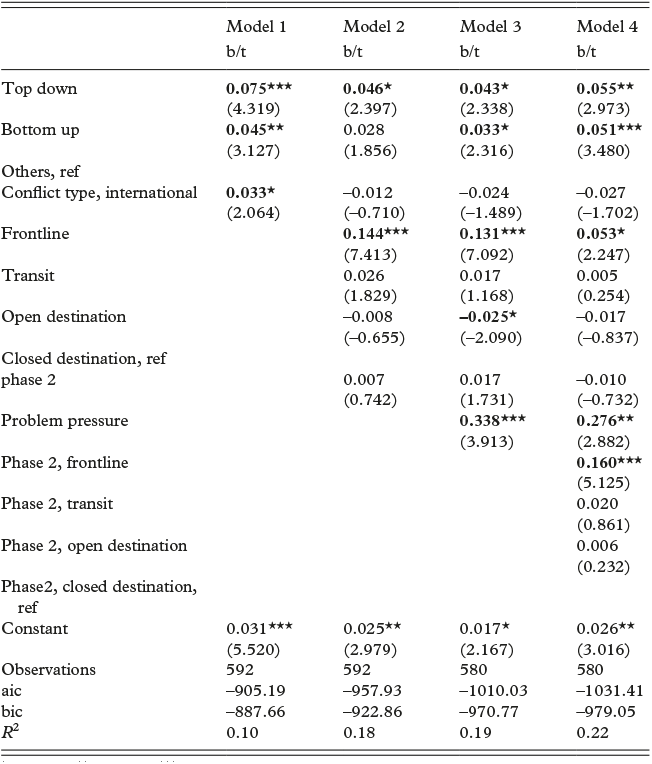
To test these expectations, we have created a dataset where the episode month constitutes the unit of analysis, that is, each episode is broken down into monthly units for which we calculate the level of politicization. The independent variables are the characteristics of the episode (cross-level interaction [top-down, bottom-up, or purely domestic] and conflict type [international or domestic]), type of member state, phase of the crisis (pre- and post-EU–Turkey agreement), and problem pressure. Table 11.2 presents the results of four increasingly complex regression models to explain the monthly politicization of the forty episodes. The first model includes only the characteristics of the episode, the second model adds the country type and the phase, the third model adds problem pressure, and the fourth model adds interactions between country type and phase.
* p < 0.05; **p < 0.01; ***p < 0.001
b = regression coefficients; t = t-values; Ref = reference category
Model 1 confirms the expectation that cross-level interactions increase the politicization of national policymaking episodes. Both top-down and bottom-up episodes are, on average, significantly more politicized than purely domestic episodes. Moreover, international conflicts are more highly politicized than domestic ones. The expansion of the scope of conflict beyond domestic politics apparently leads to an increase in politicization at the domestic level. Adding country type and phase in Model 2 doubles the R2 from 0.10 to 0.18. Model 2 indicates that the politicization of the episodes has been greater in frontline states than in the other types of member states, a result that is attributable to the fact that all episodes in frontline states with the exception of one were characterized by cross-level interactions. Once we control for this effect, the effect of the cross-level interactions is considerably attenuated, and the effect of conflict type vanishes. The phase has, on average, no impact on politicization, which means that episodes before and after the adoption of the EU–Turkey agreement were equally politicized.
Model 3 adds our indicator for problem pressure, which has a highly significant effect on politicization, independently of the effects of the indicators already included in Model 2. Adding problem pressure, however, hardly modifies the effects of the indicators previously introduced, which is to suggest that the greater politicization of the episodes in frontline states is attributable not only to problem pressure but also to some extent to endogenous political pressure. Nor does adding problem pressure modify the R2. Model 4 specifies that the increased politicization in the frontline states occurs mainly in the second phase, that is, after the peak of the crisis when the immediate problem pressure has become less pronounced. This is yet another indication that the politicization of the crisis in the frontline states was, to some extent at least, the endogenous result of domestic politics and only partly the result of exogenous problem pressure. Once we take the endogenous politicization in the frontline states into account, the effect of the two cross-level interactions on the politicization of the episodes is again significantly enhanced. In other words, cross-level policymaking increases the politicization of the episodes in general and is not a specialty of the frontline states.
Having clarified this general point, we now turn to a detailed analysis of the variety of cross-level policymaking in the four member states, where it was most important during the refugee crisis. The Greek case will serve to illustrate both EU policy triggering top-down EU interventions to increase the domestic capacity of a frontline state to deal with the crisis and bottom-up demands of a frontline state for EU support. The case of Italy, our second frontline state, will focus on bottom-up efforts to substitute unilaterally for EU policy but will also feature an episode of top-down intervention by the EU to come to terms with externalities created by Italian policy for its neighbors. In contrast to the Greek case, the Italian example will show how factors endogenous to domestic policymaking are creating international conflicts and cross-level interactions. Third, the Hungarian case will above all serve to discuss top-down and bottom-up cross-level interactions that are rooted in conflicts endogenously created in domestic politics. Finally, the German episode will show how domestic policymaking in a member state can trigger EU policymaking in support of the member state.
Greece: The Frontline State Facing the Most Conspicuous International Interventions
Greece is the member state where intervention in domestic politics by EU agencies and governments from a third country (Turkey) and from other member states were most conspicuous. All five Greek episodes are characterized by international conflicts, which are associated either with top-down interventions in domestic politics or with bottom-up interventions of Greece at the EU level. Moreover, all Greek episodes respond to extraordinary problem pressure, given that Greece was the member states where the arrivals of refugees were concentrated, both in phase 1 and at the end of phase 2 of the crisis.
Phase 1: Summer 2015 and Hotspots
At the peak of the refugee crisis, the politicization of asylum policymaking in Greece was closely aligned with the politicization of the crisis at the EU level, as is shown by the left-hand graph in the first row of Figure 11.1, which presents the politicization of the Greek episodes by phase and adds the politicization of the EU episodes (mostly focusing on Hotspots, EBCG, Relocation and the EU–Turkey agreement) in phase 1. The negotiations related to the EU–Turkey agreement, and even more directly the elaboration of the hotspot approach and the transformation of Frontex into the EBCG, were of immediate concern to Greece. Accordingly, Greek policymaking in summer and fall 2015 and in early 2016 took place in the shadow of EU policymaking.
Politicization of Greek episodes


In summer 2015, when Greece was first hit by the flood of refugee arrivals, the country was in fact preoccupied with the bailout process and not properly equipped and hardly willing to deal with the inflow of refugees (see Chapter 4). As is argued by Nestoras (Reference Netjes and Binnema2015: 19), the “intention to use the migration crisis in order to leverage some form of financial relief – extra funds or relaxed bailout terms – or simply to claim a moral high ground was evident from the beginning of Syriza’s term in power.”Footnote 3 There was “an explicit attempt to connect the Euro-crisis with the migration crisis and bargain with Greece’s position as a gateway to Europe” (p. 20). Nestoras cites Defense Minister Panos Kammenos, the leader of Syriza’s far right coalition partner, who did not hold back when he threatened (in March 2015) to send migrants, including jihadists, to western Europe: “If Europe leaves us in the crisis, we will flood it with migrants.”Footnote 4 In the summer 2015 episode, the Greek government appealed to the EU for funds to manage the refugees. But once the EU promised to deliver, Greece was unable to administer the promised funds. Only in mid-September did the Commission announce that it had received all the required documentation regarding the management of these funds and promised to process it as quickly as possible to release the first 30 million euros (of a total allotted sum of more than 500 million euros). The Greek ministers and deputy ministers responsible for migration and foreign affairs multiplied the declaratory statements and symbolic gestures, as did the EU commissioner for interior affairs and migration, Demetri Avramopoulos, a Greek, as well as an assortment of government and EU spokespersons. But nothing much actually happened. The Greek opposition was asking for the resignation of the minister of migration policy, criticizing the government for “deafening inaction” and “complete absence of a plan.” And on August 28, in the midst of the crisis, the whole government did, indeed, resign – but for reasons having to do with the bailout, not with the refugee crisis.
As is shown by the right-hand graph in the top row of Figure 11.1, this first episode was immediately followed by the more intensely politicized episode of the hotspots. The latter episode is both an EU-level episode and a Greek episode, and it represents the most clear-cut case of a top-down intervention of EU agencies and fellow member states in the domestic policymaking of a member state. What we present here is the politicization of the episode in Greece, which covers the period from October 2015, when the first deal to implement the hotspot policy was struck, to May 2016, when the final makeshift migrant camps were evacuated and the hotspot approach was fully implemented. The two graphs in the bottom row of Figure 11.1 document that during this period, domestic and cross-level politicization developed in lock-step, reaching comparable levels. The same applies to top-down and bottom-up cross-level politicization.
At the end of summer 2015, domestic politics loomed large in Greece as the country was preparing for new elections, which were to take place on September 20. Moreover, domestic politics were still dominated by the issue of the bailout and the memorandum process. With the preceding government having resigned, it was up to the Greek president to perform the symbolic gestures in asylum policy during the interregnum. The new government, which was practically the same as the old one, took office immediately after the elections, at a moment when the European governments were in the thrall of the relocation issue, which they tried to resolve under German pressure. Under the pressure of the events, the exchanges between the new government and European officials, presidents, prime ministers, and ministers of other EU member states became ever more intense, not only at European summits but also in bilateral meetings on the phone and in person. European worthies came to visit Greece to inspect the sites and to get an idea of the proportions of the problem, while Greek officials intervened with the Commission and fellow ministers in other member states to explain the Greek predicament. The EU expected Greece to set up hotspots and promised its help in setting them up, but Greece was reluctant to do so because it was afraid that the hotspots would be perceived as an alternative to relocations. Several ministers proposed that an alternative could be to build the hotspots and refugee centers directly in Turkey. Of course, when Prime Minister Alexis Tsipras went to Ankara to explore the prospects of such a proposal, he found that the Turkish prime minister, Davutoglu, was afraid of the exact same trap, that is, that relocations would never happen once hotspots were set up, and was therefore similarly reluctant to construct them in Turkey, which meant that the hot potato returned again to Greece.
As time passed, the pressure on the Greek government to get things done – to construct the hotspots and to stop the inflow – increased. The Greek strategy of evading the issue – an example of Börzel’s “foot-dragging” – proved to be increasingly vulnerable to the demand from other member states to exclude it from the Schengen area and to the determination of the Balkan countries to shut down their borders. Demands from the V4 countries for the removal of Greece from the Schengen area in December 2015 provoked a reply from the Greek minister of foreign affairs, who pointed out that the dimensions of the problem were bigger than any country of any size could handle and that it was unreasonable to expect a national solution from Greece for the joint problem. Greek protests notwithstanding, by the end of November 2015, the North Macedonian government started putting up a fence and sent police to the border, blocking the continuation of the flows along the Balkan route. Concurrently, the European institutional pressure on Greece to conform increased, and threats of excluding it temporarily from Schengen persisted. Eventually, at the end of January, the Commission gave Greece a three-month “warning” to fix the issues with border control and registration, or a temporary suspension from Schengen would be imposed. Moreover, at the West Balkan conference at the end of February 2016, under the leadership of Austria, the western Balkan countries – four EU member states (Austria, Bulgaria, Croatia, and Slovenia) and six candidate countries from the western Balkans (Albania, Bosnia-Herzegovina, Kosovo, Macedonia, Montenegro, and Serbia) – agreed to shut down their borders. They started to do so immediately after the conference.
Faced with this threat, in January 2016, Greece joined Germany in its efforts to come to an agreement with Turkey. At this point, Prime Minister Tsipras explicitly stated that the key to the refugee crisis was “transferring the focus of the refugee crisis management to Turkey.” By early February, the Greek government admitted Turkey to its list of “safe countries,” so the returns to Turkey could be legally unblocked. By mid-February 2016, Germany and the key EU actors, in turn, took the side of Greece in its struggle with the Balkan countries, with Chancellor Merkel, EU Council president Tusk, and EU Commission president Juncker declaring over a succession of days that Greece could not be left to fend for itself and that the solution of closing the Balkan route was not really a solution. The EU assumed a mediating role between the two “blocks” of member states that faced each other at this point, the “hardline” transit and bystander states led by Austria, which wanted Greece to control its borders or be expelled from Schengen, and the more moderate western destination states, like Germany and France, which were more focused on the maintenance of Schengen.
With respect to the hotspots, the Greek government ended up taking some necessary steps. At the summit in mid-December, Prime Minister Tsipras assured German chancellor Merkel that the hotspots would be completed within the next two months. To this end, the government mobilized the army to speed up their construction at the end of January 2016. Conscripts serving on Lesvos and the other islands assisted in the construction. Locals protested and blockaded the hotspot installations, but the mainstream opposition chose to mostly leave the refugee crisis outside of domestic political conflict. Eventually, the episode became a race to the finish line, to halt the refugee flows and set up the hotspots before Greece was expelled de facto or de jure from the Schengen zone. The EU–Turkey agreement was a huge relief to the tension, as was completion of the hotspots, owing much to the army’s assistance. It is not clear whether the hotspots and Frontex’s assistance would have been able to stem the tide of refugees without the agreement with Turkey that ground arrivals to a halt. The episode formally ended with the disbandment of the camp at Idomeni on the Macedonian border in late May 2016.
Phase 2: International Protection Bill, Reception Centers, and the Turkey Border Conflict
The three remaining Greek episodes all occurred within a short time span at the very end of the period covered by our analysis in late 2019/early 2020, and they are closely interrelated. As is shown in Figure 11.1, all three episodes were very short and highly politicized, with domestic and international politicization again moving in lock-step. The first two of the episodes – the International Protection Bill and the reception centers – were dominated by bottom-up politicization, while in the last episode – the Turkey Border Conflict, the most highly politicized episode overall – top-down politicization prevailed. The separation of the three episodes is somewhat artificial, as they all took place against the background of mounting problem pressure, that is, increasing arrivals of refugees, overcrowded refugee camps on the Greek islands, and increasing tensions between Greece and Turkey. The latter were spurred by repeated threats of Turkish president Erdogan to “flood Europe with migrants,” but they had wider ramifications: The tensions between the two countries also involved issues about the limits of the maritime border, the Cyprus issue and sea energy fields near the island, as well as the ripples this created in their Middle Eastern alliances and interventions. For brevity’s sake, we focus here on the last episode – the Turkey Border Conflict. We shall discuss the other two episodes in the following chapter.
The last Greek episode, the Turkey Border Conflict, is a top-down episode, mostly because of a combination of the intensified stand-off with Turkey and increasing supportive interventions by EU officials and fellow member states on behalf of Greece. Greece fought on two fronts – with Turkey and with its European allies. The confrontation with Turkey was indeed critical in this short episode. It started only a couple of days after the previous episode – the island standoff on the detention centers – with the deterioration of the situation at the land border between the two countries. Turkish officials declared that Turkey “could no longer prevent refugees from illegally entering Greece.” During the night of February 28, 2020, a large number of refugees tried to cross the land borders but were prevented from doing so by Greek riot police and army units. Greece was accusing Turkey of “weaponizing the refugees,” while Turkey was accusing Greece of teargassing innocent people and even of killing or injuring multiple refugees with its indiscriminate use of force. Greece ramped up its frontier military presence as a response, while the Turkish minister of the interior on March 5 responded by sending 1,000 special forces units to Evros in order “to stop the efforts of the Greek army in obstructing migrants from crossing the borders.” While President Erdogan ratcheted up his rhetorical attacks on Greece, calling the Greek government “fascist and barbaric,” he showed a more pragmatic approach toward the EU. On March 11, he noted that he would retain the open border policy until the EU was ready to discuss financial assistance, visa liberalization, and a customs union with Turkey – objectives of the original EU–Turkey agreement that had fallen by the wayside.
While clashing with Turkey, the Greek government initiated a round of contacts with EU officials asking for their support in the effort to seal the Evros border. Commission president von der Leyen, European council president Michel, and EPP president Weber all expressed their support for Greece. The Greek government soon increased the resources for implementing its border closure, continuously sending more army and police units; asked Frontex to deploy its rapid intervention unit; and, most importantly, suspended the right to lodge asylum applications for a month. However, the flow of refugees toward the border continued unabated, turning the border into a conflict zone. Prime Minister Mitsotakis meanwhile made a symbolic helicopter visit to the border, accompanied by von der Leyen, Michel, and EP president Sassoli. In contrast to the hotspot episode in the first phase, Greece now found unwavering support not only from EU top officials, but also from Austria, Croatia, and the Netherlands, countries that had previously been protagonists in scolding Greece. The general secretary of the Austrian ÖVP went as far as pledging his “full support personally, materially and financially towards Greece and the Balkan countries, stating that Austria and Hungary would not be blackmailed by Erdogan.” The foreign minister of Austria rushed to meet his Greek colleague in Athens a few days later, declaring that Greece was “defending its borders not against the thousands of miserable victims who have been manipulated by Turkey, but against Turkey’s cynical use of human suffering.” Austrian chancellor Kurz would also visit Athens to declare his unwavering support against Turkey’s cynical blackmail. Germany’s reaction was more measured. It emphasized that despite recent developments, in the medium-term what mattered was the maintenance of the EU–Turkey agreement. Chancellor Merkel, unlike the Austrians, simply called President Erdogan, telling him that piling pressure on the Greeks was the wrong way to proceed but also assuring him that if the Europeans were unwilling, Germany was ready to provide bilateral support to Turkey instead. Merkel and Mitsotakis discussed the ongoing crisis in Berlin and attempted to find a solution that satisfied both Greece and Turkey.
The episode ended with the exploding Covid-19 crisis. As this crisis took hold of everybody’s mind, the tone of the discussion started deescalating, with the Greek government declaring that there was a mutually advantageous solution, which lay in the improvement of some aspects of the EU–Turkey agreement of 2016. At the same time, border crossing attempts were scaled down, as fewer and fewer refugees appeared at the border, thus defusing the tension. As the borders generally closed down on both sides to contain the pandemic, on March 21, the last groups of refugees tried, unsuccessfully, to cross. The episode ended at the European level with Mitsotakis pleading for a renewal of the EU–Turkey agreement, a new agreement that would stipulate a flow of money inversely related to the flow of migrants rather than providing a lump sum to Turkey and that would guarantee a greater presence of Frontex at the Greek border.
Italy: A Frontline State Substituting Domestic Policy for Joint EU Solutions
Italy is the other frontline state in our country selection – a frontline state that was, however, much less affected by the refugee crisis of 2015–16 than Greece was. Four of the five Italian episodes concern cross-level interactions, mainly of the bottom-up type with prevailing international conflicts – the Mare Nostrum, Brenner, and Ventimiglia episodes during the first phase and the episode of Port Closures during the second phase. To these episodes should be added the EU–Libya conflict, an EU-level episode that was actually initiated by unilateral policy measures on the part of Italy. As is shown in the left-hand graph of Figure 11.2, the Mare Nostrum episode and one of the border disputes (Ventimiglia) preceded the peak of the refugee crisis, while the other border dispute (Brenner) took place at the peak of the crisis. The most politicized episode, however, about Port Closures, occurred late in the second phase and was almost entirely unconnected to problem pressure exerted by the crisis. The right-hand graph of Figure 11.2 indicates that these episodes also gave rise to domestic politicization, but international politicization prevailed, except for the very last episode, the purely domestic episode concerning the Sicurezza decrees.
Politicization of Italian episodes

Phase 1: Mare Nostrum and Border Conflicts with Neighboring States
Already before the refugee crisis of 2015–16 hit Europe, Italy faced flows of refugees coming from northern Africa by boat across the Mediterranean. The first Italian episode, the year-long policy of Mare Nostrum, preceded the refugee crisis but was a harbinger of things to come. It represents a bottom-up attempt by Italy to solve a problem that a pan-Italian consensus considered to be a problem for joint EU operations. Initiated by the center left government of Letta, Mare Nostrum was a project that involved deploying the Italian armed forces and coast guard near the Strait of Sicily, with the dual objective of performing humanitarian rescues and arresting human traffickers and smugglers. Mare Nostrum built on previously existing search and rescue schemes but greatly expanded the resources and personnel made available for such operations. It was enacted after a horrible shipwreck near the Strait of Sicily on October 3, 2013, left more than 360 drowned immigrants. Mare Nostrum operated for a year before it was partially replaced by a common smaller-scale EU project, the operation Triton.
This episode was characterized by constant Italian requests for EU intervention, the EU’s reluctance to make more than a minimum effort, EU claims and admissions by Italian authorities that they were interpreting their Dublin duties creatively, and demands by the domestic opposition (Lega’s Salvini) to stop rescue operations altogether and focus on building capacity and reception centers in Africa instead. Italian calls on the EU member states to take action were above all articulated by Prime Minister Renzi and Minister of the Interior Alfano but would be echoed across the entire Italian political system. The more he was pressured by the domestic opposition, the more pressure Alfano would put on the EU to come forward with a solution. Even Napolitano, the president of the republic, intervened to defend the record of Mare Nostrum but also to plead for European help. Eventually, another shipwreck near Lampedusa and a more concrete proposal by Alfano mobilized the EU to promise to launch an operation that would complement Mare Nostrum. In the end, Alfano unilaterally decided to substitute Triton for Mare Nostrum, while the responsible EU commissioner (Malmström) delivered only a smaller-scale operation that the EU member states could agree upon. The final outcome was a downgrade of the Mare Nostrum operation.
The second and third Italian episodes examined in phase 1 are transnational conflicts with neighboring EU member states over Italy’s border control capacity and operations. The first of these two episode involves the Italian and French governments’ confrontation over Ventimiglia, where a large number of refugees had gathered to attempt to pass over the French border. The practice of the Italian border police (to unofficially allow those crossings) and the practice of the French border police (to return immigrants to Italy in a move of dubious legality) was causing frictions between the two countries. The episode is concentrated in time, as almost all action occurred in June 2015, just before the eruption of the main European crisis, which served to shift attention elsewhere. Importantly, the Ventimiglia clash incited the EU to discuss the issue and agree on some basic principles. Thus, the episode gave rise to a three-way meeting between the ministers of the interior of Italy (Alfano), France (Cazeneuve), and Germany (De Maizière), where it was agreed that EU policy ought to be based on the twin pillars of responsibility (to register and identify) and solidarity (to distribute and provide aid). While an overall agreement on EU policy was not reached at this point, the outlines of such an agreement were laid down, as the main part of the refugee crisis was about to begin. The same themes were discussed when French president Hollande and Italian prime minister Renzi met in Milan, where a second migrant camp had mushroomed at the train station. This top-level meeting helped smooth the two countries’ differences and reduce the political tension. Eventually, the episode ended with the dismantling of the migrant camps, amid organized protests by Italian activists. With the spotlight moving elsewhere, the Ventimiglia camp was dismantled in a police operation three months later, on September 30, 2015.
A similar story, but without migrants actually camping near the border, took place in the clash between Italy and Austria during spring 2016 – the Brenner episode. In this episode, the EU Commission became involved, trying to mediate between the two member states, which makes it a top-down episode. The EU Commission had at first warned Italy about its lack of effort in tackling registration, but after the Austrian government’s announcement that it was planning to increase controls at Brenner Pass or close it altogether, the Commission changed sides and berated the Austrians for not respecting the Schengen and Dublin treaties, in a barrage of statements by EU Commission President Juncker and migration commissioner Avramopoulos. It is important to understand that the Brenner Pass episode occurred at the peak of the crisis and escalated in the shadow of the Austrian presidential elections, where the candidate of the radical right, Norbert Hofer, triumphed in the first round (on April 24) and was expected to win the run-off (on May 22). Within such a context, there was much less tolerance for straying from the Dublin rules and much more readiness to act in a unilateral way. The Austrian government invoked reasons similar to the ones that had led to its southeast border closures in late 2015 – the lack of registration of migrants in Italy and Italy’s unwillingness to adhere to the Dublin rules. Italian prime minister Renzi, in turn, claimed, among other things, that border closures and the widespread refusal to share the burdens of this epochal challenge put the union at risk. This confrontation was more long-lived and acrimonious than the French–Italian one, as it centered not on the semiformal actions of police bodies but on the official actions of two EU member state governments. In the end, in a manner similar to what happened to Greece, the Austrian chancellor reassured everyone that since the Italian authorities were ramping up their efforts to perform their duties on migration, the Brenner Pass – the bottleneck pass that links Austria and Italy – would remain open.
Later in 2016, the Mare Nostrum episode got some sort of a rerun with the EU–Libya agreement, one of our six EU-level episodes. Just as the EU operation Triton followed upon the earlier unilateral Italian operation, the EU–Libya agreement was closely linked to an earlier Italian policy response. Thus, in September 2016, the Italian center left government had reached an agreement with Libya’s national unity government to implement a series of urgent measures aimed at managing the migrant crisis and preventing deaths at sea. In February 2017, building on the Italian response, the Malta Declaration of the EU Council confirmed the cooperation with Libya and increased the funding of Libya’s efforts to stop the flow of migrants across the Mediterranean. Accordingly, the EU subsequently assisted the Libyan coast guard in intercepting and returning migrants to Libya. The episode was a low-key affair that was hardly politicized at all at the EU level, but it once again illustrates the bottom-up cross-level interaction where unilateral policy measures by a member state at first substitute for EU policy and are then taken over by the EU as its own policy.
The episode of Port Closures, the second most politicized of all national episodes, is yet another instance of unilateral Italian action undertaken in the absence of EU policymaking, but one that was much more contested by fellow member states. What characterizes this episode is that it was largely created for domestic political purposes in the absence of acute problem pressure. While it achieved the domestic electoral purposes of the Lega (its public support rose sharply as a result of the events linked to this episode; see Figure 4.6), it failed to incite the EU to support Italy.
When the new populist Italian government took office in early June 2018, just before the EU summit that was supposed to solve Merkel’s internal problems with Seehofer (see the section on Germany below), the new minister of the interior, Salvini, traveled to Libya for talks on the migrant crisis. He called for the establishment of asylum processing centers and “regional disembarkation platforms,” ideas that were prominent at the summit meeting but were subsequently rejected by Libya and its North African neighbors. Salvini, however, pursued his agenda of reducing arrivals, increasing expulsions, and cutting the costs for maintaining the alleged refugees in Italy – independently of the Libyan response. He did so by focusing on the rescue ships that brought refugees they had picked up in the Mediterranean to Italian ports.
Singlehandedly, Salvini politicized this issue by creating a series of incidents involving individual rescue ships. For a few months, the incidents with these ships filled the Italian news and drew the public’s attention to the migration issue. The series of events started with the case of the Aquarius, which Salvini faced only a few days after assuming the post of minister of the interior. The Aquarius, a German NGO ship carrying 629 refugees, was trying to enter an Italian port after having been refused entry into Malta. Salvini announced that Italy was going to close its ports as well. Subsequent incidents involved the Ubaldo Diciotti, a vessel of the Italian coast guard, and the Lifeline, a ship flying the Dutch flag. Salvini refused to let the refugees on these ships disembark. More incidents with other ships followed. The episode was concluded with the final tour of the Aquarius, which was again denied docking rights by Italy and ended up in Malta. At this point, the ship was flying the Panamanian flag. Pressured by Italy, Panama recalled the ship’s right to fly its flag, essentially ending the presence of NGO rescue boats in Italian waters. The episode of Italian Port Closures lasted until September and was then immediately followed by the one of the Sicurezza decrees, a purely domestic legislative episode also initiated by Salvini, which codified the ad hoc measures he had adopted during the summer to regulate flows, reception, and returns of refugees.
Domestically, the politicization of the port closures gave rise to great tensions between the two partners of the new populist coalition, with ministers of the M5S and the M5S president of the Chamber of Deputies distancing themselves from Salvini. But politicization also spilled over to the transnational and European levels, with other member states and the EU Commission responding in contrasting ways to the Italian port closures. On the one hand, in reaction to the first incident, the socialist Sanchez government in Spain said it would let the Aquarius disembark in Valencia. Commissioner Oettinger praised the Spaniards and announced that Europe should show more solidarity. No similar response materialized with regard to the Ubaldo Diciotti. For the Lifeline, an ad hoc agreement was reached for the ship to land in Malta and to distribute the immigrants aboard the ship among seven EU countries, Italy included. The main negative reaction came from French president Macron, who called the Italian stance cynical and irresponsible, while the Italian government retorted by calling Macron a hypocrite who had not offered to take any immigrants himself and had enforced much more rigid and cynical reception policies. Salvini did not miss a chance to remind Macron who was responsible for the situation in Libya, while Prime Minister Conte first canceled a planned visit to Paris and then went to Paris anyway. On the other hand, the Hungarian, Austrian, and Slovak governments supported Salvini, noting with pleasure his decisiveness in stopping the smuggling routes. The EU Commission meanwhile once again took a mediating stance, refusing to be involved in the transnational conflicts, expressing sympathy for Italian concerns, and trying to bring the new government to the table. However, the ad hoc decisions to redistribute migrants from each ship did not result in a redesign of the Dublin agreement or any meaningful sharing scheme.
Hungary: A Variety of Cross-Level Interactions Rooted in Domestic Conflicts
All five Hungarian episodes involve cross-level interactions, though they were of varying types. Two episodes – the Fence Building and the Legal Border Barrier Amendment – refer to unilateral actions by Hungary to substitute for joint EU measures to protect the external border. Two episodes – the Civil Law of 2017 imposing a financial disclosure requirement on all NGOs receiving funding from abroad and the “Stop Soros” package of 2018 imposing an even more onerous special “migration tax” on all organizations deemed to aid immigrants – are domestic measures in Hungary that led to EU interventions to rectify domestic policy. The fifth episode – the quota referendum of 2016, the Hungarian response to the European attempt to introduce a relocation scheme – represents the case of a domestic policy signaling to the EU and the other member states domestic obstacles to the implementation of EU policy. The quota referendum was the most politicized Hungarian episode and the most politicized of all national episodes. Four of the five Hungarian episodes were highly politicized, even when compared to the high level of politicization of episodes in frontline states (see Table 5.2).
Figure 11.3 presents the politicization of the Hungarian episodes. The left-hand graph compares the border control episodes (Fence Building and Legal Border Barrier Amendment) with the episodes addressing asylum rules (Quota Referendum, Civil Law, and Stop Soros) and with the EU episodes addressing asylum rules (Relocation and Dublin Reform). As we can see, at first, the Hungarian politicization of border control moves in parallel with the politicization of asylum rules at the EU level. The two developments, however, part ways as the crisis starts in earnest. Moreover, the politicization of asylum rules at the domestic level is completely uncoupled from the corresponding politicization at the EU level. It unfolds in three waves that correspond to the three episodes dealing with relocation quotas, Civil Law, and Soros. The politicization of the Hungarian asylum rules proves to have been much more intense than the politicization of these rules at the EU level and also more intense than the politicization of border controls, except for the very beginning of the crisis, when Hungary started with its fence building. Contrary to what we have observed in the frontline states, the Hungarian politicization essentially follows a domestic logic, as is illustrated by the right-hand graph of Figure 11.3: Throughout the crisis, the domestic politicization has been more intense than the cross-level politicization. We focus here on the bottom-up episodes, since the Hungarian top-down episodes (Fence Building and the Legal Border Barrier Amendment) have already been discussed in some detail in Chapter 6.
Politicization of the episodes in Hungary

The Quota Referendum
The Hungarian quota referendum was held on October 2, 2016. The government submitted the following highly biased question to citizens: “Do you want the European Union to be able to mandate the relocation of non-Hungarian citizens into Hungary even without the approval of the National Assembly?” The referendum vote was preceded by an equally biased campaign. Eventually, 98.4 percent of those who voted answered no to the question, but in spite of the government’s relentless mobilization, turnout did not reach the required quorum of 50 percent. Nevertheless, the referendum marked a turning point both in Hungarian domestic politics and in the EU’s management of the refugee crisis. Domestically, it marked the final stand of Jobbik as the standard bearer of the Hungarian radical right. Internationally, even if the final turnout failed to pass the quorum, making the outcome constitutionally void, it laid bare the European right’s almost limitless potential to politicize the EU’s relocation scheme for domestic political purposes, which ultimately led to its demise. The referendum followed up on Hungary and Slovakia’s joint appeal to the ECJ against the EU’s relocation decision, which would eventually be upheld by the ECJ in September 2017.
The quota referendum is a bottom-up case of cross-level interactions rooted in domestic conflicts. It was designed “to send a clear message to Brussels that it is only up to the Hungarians, with whom they want to live in their country” (László Kövér, speaker of the National Assembly). The cross-level interactions in this case were mainly driven by the Hungarians themselves who attempted to signal to the EU the domestic opposition to the relocation scheme, while EU-level actors were comparatively silent in the debate. Roughly 6 percent of total actions were of the top-down type, a rather meager share considering that the episode as a whole was targeted against an EU-level decision. By contrast, no less than 20 percent of the actions involved bottom-up interactions. Although most of the EU-level actions were targeted against the proposal, the Hungarian government could rely on some degree of support from the EU and fellow member states. Thus, in the run-up to the vote, the Dutch migration minister, representing the rotating presidency of the EU, argued that it was up to the member states to find a way to discuss the decisions in Brussels. Manfred Weber, the president of the EPP in the EP, conceded that the will of the people always mattered and added that the Hungarian government had the right to ask its citizens for their opinion. Once the results of the vote became public, a European Commission spokesperson emphasized the “democratic will” of the Hungarian people, and Robert Fico, the Slovak prime minister holding the EU presidency at that time, stated that he considered the referendum to be a legitimate and democratic tool and that he fully accepted its outcome.
The Hungarian voices directed at Europe were numerous: Prime Minister Orbán announced that he initiated the referendum to prevent an EU compulsory quota system in violation of EU law. According to him, it was unacceptable to make decisions over the heads of the people that would greatly change the lives of future generations, as the admission quota would change the ethnic, cultural, and religious profile of Hungary and Europe. His decision to introduce a referendum vote was not against Europe, he claimed, but for the protection of European democracy. He said that he called the Hungarian voters to war so that there would be no mandatory relocation quota, and he likened the attempt of Brussels to determine whom Hungary should accept to the communist dictatorship. Szijjártó, the foreign minister, added that western European politicians always talked about the importance of democracy, and then, when a government asked its people for their opinion on an important issue, they questioned the most democratic tool, the referendum: “What is this, if not double standards, hypocrisy and ambiguity?” According to him, the union’s proposal to penalize the rejection of quotas was “simple blackmail.”
Hungarian spokespersons not only defended democracy but also insisted on national sovereignty. Prime Minister Orbán claimed that a referendum was the only thing that could not be taken lightly in Brussels. According to him, if the Hungarian referendum was successful, Brussels would have to back down: “The Hungarian government wants a democratic European Union, whose internal relations, rules of life, ethnic composition and culture are determined by Europeans, not by a bureaucratic elite in Brussels acting against the will of the peoples of Europe.” He added that uncontrolled immigration was not a human rights issue but a security issue. After the vote, Prime Minister Orbán informed Jean-Claude Juncker, president of the European Commission, by letter about the outcome of the quota referendum on October 2. The prime minister indicated that in order to enforce the will of the overwhelming majority of the participants in the referendum, the cabinet had decided to initiate an amendment to the constitution. In his letter, Orbán claimed that the amendment proposed by the government would be in full compliance with EU law.
Two Additional Episodes on Asylum Rules
The Civil Law and the Soros Law represent domestic conflicts that gave rise to disciplining top-down interventions on the part of the EU, since these laws violated fundamental European values. If the quota referendum was still directly connected to the EU-level politicization of the relocation scheme, the domestic politicization of the Civil Law and the Soros Law could no longer be credibly related to migrant flows as an existential threat to Hungary’s security and sovereignty and to interventions at the EU level. As a result, the grace period that characterized the Orbán government’s immediate response to the crisis turned into a domestic war of attrition between the government and civil society in which the latter could count on the unwavering support of the parliamentary opposition, EU actors, and civil society organizations themselves. With respect to cross-level interactions, both of these laws were challenged by infringement procedures launched by the European Commission. Moreover, the EP also took measures by accepting the Sargentini report, with a detailed list of the Hungarian government’s various infringements of the rule of law, including “Stop Soros”, in September 2018. Both the Civil Law and the “Stop Soros” Law were ultimately struck down by the European Court of Justice in 2020.
Germany: Seeking EU Support to Overcome Domestic Conflicts
Germany provides two episodes of domestic, intragovernmental conflicts that led the government to seek support from the EU to solve the domestic conflicts. The first example concerns the episode of the suspension of the Dublin regulation by Germany in September 2015. This episode is classified as a purely domestic episode, which is misleading because it is intimately linked to the EU–Turkey agreement, which served as the German chancellor’s plan B to come to terms with the domestic conflict that had been unleashed by her unprecedented decision to suspend the Dublin regulation and to admit refugees to Germany who had traveled from Greece across the Balkan route to ask for asylum in Germany. The episode of the EU–Turkey agreement is an EU-level episode – but one that was intensely discussed in Germany. According to the criteria applied to classify cross-level episodes, the German discussion of this agreement would qualify as a bottom-up cross-level episode: More than 40 percent of the actions reported in the German debate on the EU–Turkey agreement involved cross-level interactions, and the overwhelming majority of these cross-level interactions were of the bottom-up type. We shall discuss this episode in more detail in the next chapter. The other example of intragovernmental German conflicts spilling over to the European level is the CDU-CSU Conflict in summer 2018, which also induced the German chancellor to seek support at the EU level to solve her differences with her coalition partners. This episode qualifies as a bottom-up cross-level episode rooted in domestic conflicts.
Figure 11.4 shows the close alignment of German domestic politicization with the politicization of asylum rules (Relocation Quota and Dublin Reform) at the EU level during the first phase and then again in summer 2018. This alignment is a result of spillover processes from German policymaking to the EU level. In the first phase, as Germany attempted to come to terms with the crisis domestically, it at the same time put pressure on the other member states to get the relocation quota passed in the Council of Ministers in an attempt to share the burden of reception and integration of asylum seekers. It is only once Germany failed to obtain a relocation scheme from its fellow member states that it turned to an agreement with Turkey as the second best solution. The renewed alignment of German policymaking with the politicization of asylum rules at the EU level in summer 2018 is the result of yet another spillover of domestic German conflicts to the EU level. In both instances, it was mainly intragovernmental conflicts that led to the cross-level politicization of policymaking.
Politicization of German episodes and EU episodes concerning asylum rules

The border control issue returned to German politics when Horst Seehofer, the head of the CSU and the most vocal critic of Merkel’s open-doors approach in 2015–16, became minister of the interior in Merkel’s new grand coalition cabinet that took office in March 2018. It was Seehofer’s attempt to implement his hardline asylum policy that gave rise to the second border control episode in Germany. In early June 2018, Seehofer insisted on turning back at the German border two categories of refugees: those who had already been registered in other countries and those against whom a reentry ban had been imposed in the past. He met with resistance on the part of Chancellor Merkel, who had legal and practical objections and pleaded for a coordinated European solution instead. The issue unleashed an open power struggle between the two, which developed into a highly politicized episode (although it does not register as such in Table 5.2, because of its very short duration).
On June 18, 2018, Merkel asked Seehofer for a two-week timeout to solve the issue at the European level. More specifically, Merkel wanted to negotiate bilateral return agreements with Italy and Greece so that refugees could be returned in a coordinated manner, plus a “European solution” that she promised to offer as an alternative to Seehofer’s approach involving rejections at the border. A week and a half before the upcoming European summit, there was, however, little clarity about what such a “European solution” would look like. Merkel intensified cross-national negotiations in preparation for the upcoming summit. First, she seized upon the occasion of the Franco–German summit at Merseburg Castle on June 19 to discuss curbing migration with French president Emmanuel Macron. Macron assured Chancellor Merkel (CDU) of his support to find, “together with some other states,” solutions to sending back already registered refugees. Macron promised to speak to Italy’s new prime minister Giuseppe Conte, who had just taken office as the head of the Lega–M5S coalition government. Next, she relied on EU Commission president Jean-Claude Juncker for the organization of a preparatory summit of “interested states” in the run-up to the European summit of June 28–29. At the request of Merkel, Juncker invited the heads of state and government of sixteen particularly affected EU countries (among them Austria, Italy, France, Greece, Bulgaria, and Spain) to Brussels for a meeting a week before the summit of the European Council to discuss a “European solution” to the migration crisis.
Meanwhile, Seehofer insisted on sending a signal to the German public. He ordered that the federal police should, starting on July 1, reject refugees against whom a reentry ban had been imposed in the past, and he reiterated the proposal to reject refugees who had already been registered for asylum in another EU country. He threatened to break up the coalition if his plan were not adopted, and CSU parliamentary group leader Alexander Dobrindt no longer ruled out that the dispute over the refugee policy could mean the end of the union party comprised of CDU and CSU. The SPD, in turn, was urging the coalition partners CDU and CSU to resolve their asylum dispute before the next coalition committee meeting. Federal president Steinmeier (SPD) heavily criticized the conflict between CDU and CSU and supported Merkel’s plea for a joint EU solution to the conflict about the reform of the European migration policy.
In the government declaration in the Bundestag just before the European summit, Chancellor Merkel (CDU) spoke engagingly. She warned against a unilateral German solution and suggested that asylum policy could become a fateful issue for the future of Europe. Seehofer was not present in the plenum, and the CSU reacted coolly. At the summit in Brussels, Merkel fought for her job. At first, a compromise failed to materialize. Merkel met with massive resistance from Italian prime minister Giuseppe Conte, who blocked all decisions that had been prepared in the run-up to the summit. He asked for a radically new policy, which would include abandoning the Dublin rule. Although Germany and Italy shared common interests as key frontline and destination states, they failed to find a common ground at the meeting. While Conte was ready to understand the asylum issue as one concerning the whole of Europe, he refused to accept that the obligation to rescue people at sea implied the obligation to treat their asylum requests in the name of all of Europe. EU Council president Donald Tusk and EU Commission president Jean-Claude Juncker were then forced to cancel their scheduled press conference. Eventually, however, the heads of state arrived at an agreement: A concept for disembarkation platforms would have to be elaborated for refugees who had been rescued in the Mediterranean – this was a measure to reduce the attractiveness of the business model of smugglers (in response to an old Italian demand and building on an idea of Tusk). In addition, so-called controlled centers were to be built by member states on a voluntary basis, where decisions would be taken about who had a right to protection (an idea of Macron). The recognized refugees would be distributed over the member states – on a voluntary basis. However, much was still unclear about details and, as it turned out, the proposals remained a dead letter.
Merkel, however, was relieved. She had achieved little in terms of a solution to the migration crisis but a lot in terms of saving her chancellorship. At the press conference following the summit, she was asked whether the result of the summit was functionally equivalent to the immediate rejection of already registered refugees at the border (as demanded by Seehofer and the CSU). She claimed that if everything were to be implemented as discussed, the adopted proposal would be more than functionally equivalent and there would be real progress. Seehofer insisted that the summit solution was not functionally equivalent, but, surprisingly, in a direct meeting between the two on July 2, he and Merkel arrived at a compromise. Refugees who were caught at the border, although not allowed to enter or stay in Germany because they had been already rejected previously (a very small group indeed), were exempted from the compromise because Seehofer had already ordered the federal police to reject them at the border after July 1. Refugees who had already been registered in another country where they had asked for asylum (a larger, but still comparatively small, group of 35,000 persons per year) would be directly returned to the country responsible for them – but only if there was an agreement with the country in question. If there was no such agreement, they would be rejected at the border with Austria. Those refugees who were rejected were to be put into buildings of the federal police close to the border or in the transit zone of the Munich airport (the so-called transit centers).
Nobody knew exactly what the compromise implied in practice and whether it was legally possible to implement it. The SPD angrily opposed the transit centers, and the opposition voiced a sharp critique. Austrian prime minister Sebastian Kurz, caught off guard by this asylum compromise, issued a sharp reaction: “We are certainly not ready to conclude contracts at the expense of Austria.” In a subsequent joint meeting, Seehofer and Kurz decided to increase the pressure on the Italian government to take back refugees who desired to go to Germany. Meeting shortly afterward, the interior ministers of Germany, Austria, and Italy tried to negotiate an agreement about the return of asylum seekers to Italy. Meanwhile, Merkel tried to accommodate the SPD, declaring that under the German constitution, asylum seekers could be held in transit centers for a maximum of two days. If the transfer to the country where they had already been registered was not successful within this lapse of time, they would have to be brought to regular facilities. Nevertheless, Seehofer considered his conflict with Chancellor Merkel about the refugee policy to be over: There were disagreements about content but no personal bad feelings, he claimed. They could “look each other in the eye” even after an argument. Seehofer justified his threat of resignation by claiming that he would not allow himself to be thrown out of office by a chancellor “who was Chancellor only because of me.” On July 10, he finally presented his “master plan” for migration policy for faster asylum procedures and more consistent deportations, which he had already announced in March, even before the new government was sworn in, but was prevented from publishing by the conflict with the chancellor. Facilitated by the EU-level interlude, the compromise in early July essentially served as a face-saving device for Merkel and Seehofer and did not change much in Germany’s asylum policy.
Conclusion
In this chapter, we took a closer look at the cross-level episodes, which include roughly half of the national episodes of our study. This is a remarkably high share, which indicates that national asylum policymaking is taking place in the shadow of EU policymaking. These episodes have been more intensely politicized than purely domestic episodes, since they involved the expansion of conflict beyond the national borders both in a transnational and in a vertical direction. Cross-level episodes have either been rooted in domestic conflicts that expanded up into the international realm or in international conflicts that were closely associated with domestic politics. We have presented a fourfold typology of such cross-level episodes, which distinguishes between top-down and bottom-up cross-level interventions for both international and domestic conflicts. Top-down interventions involve attempts of EU agencies and/or fellow member states to impose EU policy implementation on a defaulting member state – either by providing support or by imposing disciplinary measures – or to prevent a member state from implementing domestic policies that are incompatible with fundamental EU values. Support may be forthcoming in terms of capacity building (providing the member state with additional resources), in terms of regulation (adapting some policies to the needs of the member state), or in more exclusively symbolic terms. As we have seen, additional resources have been provided to Greece in the hotspot episode, and to Italy in the context of Triton and the EU–Libya agreement. Support has also been pledged in more symbolic terms, as in the case of Greece’s border conflict with Turkey and in the case of the German intragovernmental conflict in 2018. However, in regulatory terms, support for frontline and destination states has not been forthcoming, and several of the episodes just ended nowhere, with the attention of the public and policymakers turning elsewhere and leaving the issue lingering. Calling a defaulting member state back to order may include material sanctions but also punishments such as exclusion, shaming, and shunning, as is illustrated by the Hungarian Civil Law and “Stop Soros” episodes. In the refugee crisis, such measures have been ineffective.
Bottom-up interventions involve unilateral policy measures on the part of a member state to substitute for EU policies that have not been forthcoming, the appeal by a member state to the EU/fellow member states for help, or its signaling of the impossibility of implementing joint policies. Faced with unilateral measures by member states, the EU/fellow member states may attempt to mediate between the member state adopting the measure and other member states directly concerned by the externalities of the measure, as has occurred in several of the cases we have reviewed here (the border conflicts between member states, the Italian Port Closures). The EU may also attempt to develop a policy of its own that is able to build on and replace the unilateral policy of the member state in question, as in the cases of Mare Nostrum, the EU–Libya agreement, and the EU–Turkey agreement (which served to replace the unilateral Balkan Route Closure). But the unilateral action by a member state may also prevent the EU from adopting joint solutions and have a paralyzing effect, like the Hungarian quota referendum and the associated actions of the V4.
The intense cross-level interactions in the domestic episodes during the refugee crisis demonstrate the interdependencies between the member states and between the member states and the EU in this policy domain. At the same time, they also demonstrate the difficulties in coming to joint solutions, even under great pressure, and the amount of effort that it takes to search for joint policies in a polity that requires consensual decision-making.
Introduction
In the previous chapter, we analyzed the different ways national episodes are linked to the transnational and supranational levels. In this chapter, we shall analyze the different ways one and the same EU-level episode spills over to national-level decision-making. For this purpose, we have a closer look at the most important episode at the EU level – the EU–Turkey agreement, for which we coded the policymaking process not only based on international sources but also based on the national press in four of our eight member states. We selected the two countries most concerned by this agreement – Germany (as the open destination state that received the largest number of refugees) and Greece (as the frontline state where the largest number of refugees arrived during the peak of the crisis). In addition, we chose one transit state (Hungary) and one closed destination state (the UK). While Hungary was also directly concerned, since large numbers of refugees had crossed its territory before it closed it off by building fences at its southern borders, the UK as a nonmember of the Schengen area was least concerned by this episode. In comparing the national debates, we expect the episode to have been particularly salient in the media of the two most concerned members, and this is, indeed, the case. Of the 1,574 actions we coded based on the two types of press sources on this episode, roughly a third (34.6 percent) come from the Greek media, a sixth (17.8 percent) from the German media, an eighth (13.3 percent) from the Hungarian, and a sixteenth (6.4 percent) from British sources. The remainder (27.8 percent) were reported in the international press.
In the literature, the question of the Europeanization of the public debate in the member states has been prominent (e.g., Koopmans and Statham Reference Koopmans and Statham2010; Risse-Kappen Reference Rokkan2015). In the present chapter, we start by reversing the perspective. We ask, based on the EU–Turkey agreement, to what extent the debate on EU policymaking has been domesticated and to what extent the conflict configuration at the EU level is transformed in the national debate about an EU policymaking process. The first section of the chapter is devoted to these questions. In addition, we attempt to show that the very same episode has very different implications for domestic policymaking. For this purpose, we zoom in on the politicization of the agreement in Germany and Greece in particular. In the two countries most concerned by the agreement, it gave rise to bottom-up attempts to solicit support from EU agencies and fellow member states. In the case of Germany, support for the EU–Turkey agreement was vital for the political survival of the chancellor: It allowed her to escape from the trap of her open-doors policy. If she was the driving force in negotiating this agreement with Turkey, she could clinch it only with the support of the EU authorities and all the other member states. Once the agreement had been concluded, the episode faded from the attention of the German public. In Greece, by contrast, support from the EU and the other member states was needed once the agreement had been concluded. For Greece, the agreement had an ambivalent character: While it successfully stopped the inflow of refugees, it left a large number of them stranded within Greek borders, and Greece could provide for them only with support from the EU and the other member states. In fact, the consequences of the agreement in Greece lingered for several years and led to two new domestic episodes at the very end of our observation period.
The Actors Involved in the Debate on the EU–Turkey Agreement
In Chapter 7, we have seen that at the EU-level, member state governments and EU actors play a dominant role in the policymaking process and that international conflicts prevail. The member state governments provide the pivotal link between the domestic and the international levels of EU policymaking. Accordingly, we expect that the domestic debate on EU policymaking processes in a given member state places greater emphasis than the international debate does on the contribution of domestic actors from the state in question to the EU-level policymaking process. First, we expect that the national debate pays particular attention to the role of the member state’s own government in EU-level policymaking. From the domestic point of view, it is the national executive that is the main representative of the national interest in the EU policymaking process. In addition, we expect other domestic actors to be more prominent in the national debate as well. EU policymaking is likely to be contested at the national level, that is, the scope of conflict expands to some national actors who do not become visible in the international debate but who have a role to play in the determination of the government’s position in EU policymaking. In the domain of asylum policy, these national actors are not expected to primarily include interest associations, as is posited by intergovernmentalists, but rather political parties and civil society organizations, as posited by postfunctionalists. Third, EU actors are key interlocutors of the national government in each member state, which implies that the greater focus on domestic actors is unlikely to be at the expense of EU actors. Instead, we expect the greater focus on domestic actors to reduce the focus on national actors from other member states. In this regard, the German government is likely to be a special case, given its key role in the management of the refugee crisis in general and in particular in the negotiation processes of the EU–Turkey agreement. In other words, we expect the German government to be more present than any other foreign government in the other member states as well.
Table 12.1 provides a first assessment of these expectations. The first part of the table shows that member state governments are generally even more prominent in the four national debates than in the debate at the EU level. But, as expected, this is not at the expense of a lesser representation of EU actors. Only in the UK debate are EU actors less present than in the international debate. This part of the table also confirms that, in addition to national governments, other domestic actors also get more attention in the national debates than in the debate at the EU level. The increased presence of national actors is particularly striking in the German and the UK debates. The national government is also very much present in the Greek debate, but other domestic actors participate comparatively rarely in Greece. Except for Hungary, the increased presence of domestic actors is above all at the expense of the third country, Turkey. The more detailed data in the second part of the table indicate that, as expected, the increased presence of domestic actors is also at the expense of actors from other member states (both governments and other actors), which are much more present in the EU-level debate than in the national debates. As expected, the German government is an exception in this respect, since it is, indeed, quite present not only at the EU level but also in the debates of the other member states. This is additional evidence for the exceptional role played by the German government in this EU episode.
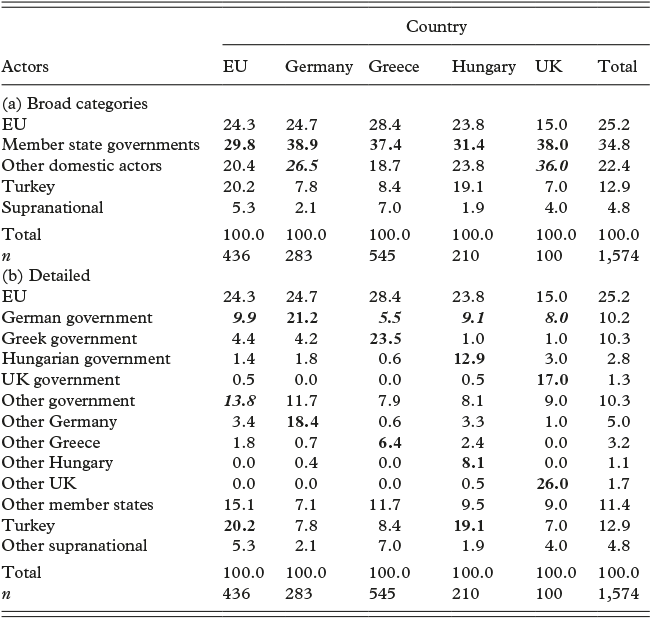
Table 12.2 presents the target actors of the EU–Turkey debate at the different levels. Three types of actors predominate as targets – EU actors, Turkey (except in the UK debate), and the national government (except in the Hungarian debate). Other domestic actors are essentially irrelevant as target actors. A more detailed analysis shows that, with the exception of Hungary, these other domestic actors mainly target the national government, which underlines the key role of the national government in linking the national debate to EU-level policymaking. Note that the Hungarian government seems to fulfill this linkage role to a lesser extent than the governments of the other member states do. Germany, in turn, is exceptional to the extent that Turkey constitutes by far the most important target in the German debate, which once again reflects the fact that it was German actors, above all the German chancellor, who directly negotiated with Turkey. The relative absence of Turkey as a target actor in the UK, by contrast, points to the relative lack of importance of the episode for the UK.
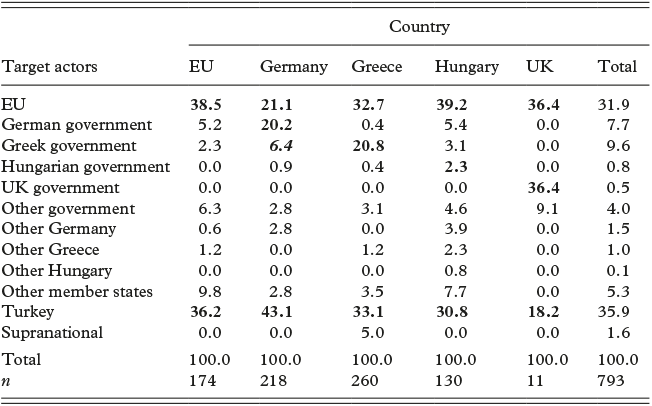
The key role of Germany in this episode also becomes apparent if we consider the role of top leaders in the decision-making process for this episode. As Table 12.3 shows, national top leaders dominate the national debates in every country except Hungary, where the two top leaders from Turkey – President Erdoğan and Prime Minister Davutoğlu – are even more present than the Hungarian prime minister, Orbán. Angela Merkel, the German chancellor, not only dominates in Germany, together with EU top leaders – Juncker, the Commission president, and Tusk, the president of the European Council – she also dominates at the EU level, together with the two Turkish top leaders. She accounts for no less than 6.7 percent of the actions reported at the EU-level (compared to her accounting for 4.6 percent of the actions in all the EU-level episodes taken together; see Table 7.3) and also has a strong presence in the national press of the other member states. In the German debate, she is responsible for 10.6 percent of the actions. This confirms Merkel’s key role in this episode. In the other countries, the prime ministers also dominate – Alexis Tsipras in Greece (8.8 percent of the Greek actions), Victor Orbán in Hungary (5.7 percent of the Hungarian actions), and David Cameron in the UK (8.0 percent of the UK actions).
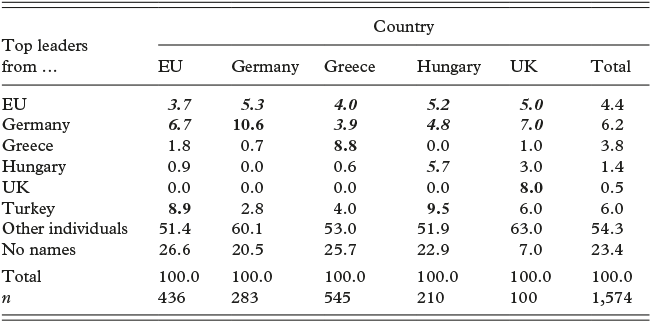
a Major actors in bold, secondary actors in italic
The exceptional role of German actors in this episode is also confirmed once we consider the role of the various actors in the different phases of the policymaking process. To be sure, EU actors dominate all the stages of this process, as can be seen from Table 12.4. But German actors were responsible for no less than one fourth of the actions in the negotiation phase, most of which were accounted for by the German top leader, and, together with EU and Turkish actors, German actors also dominated the claims making. By contrast, actors from Greece were responsible for the bulk of the actions in the implementation phase. This contrast between the engagement of German and Greek actors indicates the different significance of the episode for the two countries most concerned. For Germany, the episode became less relevant once the agreement had been concluded, while it took on its greatest significance for Greece in the implementation phase.
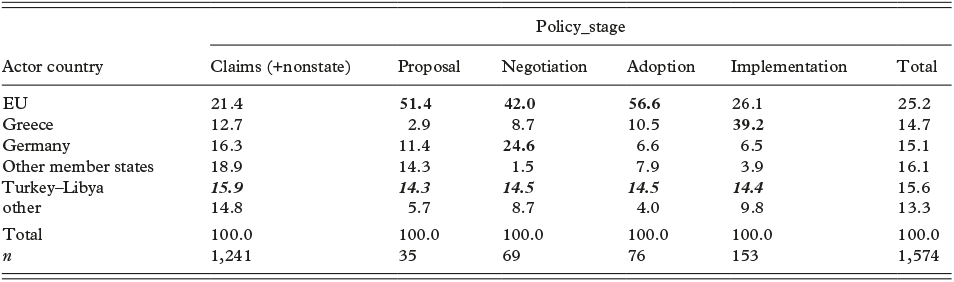
a Major actors in bold, secondary actors in italic and bold
Finally, we compare the conflict configurations at the EU level with the configurations that we observe based on the national debates. At the EU level, we found previously that the EU–Turkey episode was characterized by the conflict between the EU/its member states and Turkey (see Chapter 7). As is shown in Table 12.5, the same conflict structure emerges from the German and the Hungarian debates. In the case of the Greek debate, this conflict is still the most pronounced, but it appears to be much weaker than in the EU or in the German and Hungarian debates.Footnote 1 This is quite surprising, given the fact that the Greek debate of the EU–Turkey episode was by far the most salient one. As it turns out, however, the Greek debate was far less conflictive than the debates in the other countries. In terms of polarization, too, it was the least polarized of all the debates compared. The Greeks covered this episode a lot, but overwhelmingly in positive or neutral terms. There was less critique of the agreement in the Greek debate than in the other countries. This may not be so surprising after all, given that Greece was the main beneficiary of the agreement.
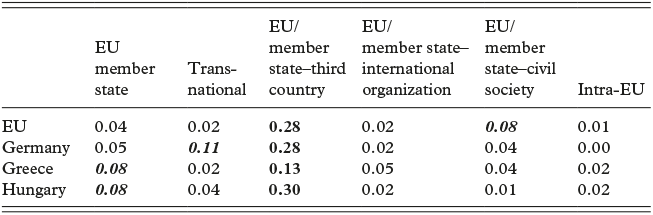
a Major conflict lines are in in bold, and minor conflict lines are in italic-bold.
The Politicization of the EU–Turkey Agreement in Germany
Compared to the German national episodes, the German debate of the EU–Turkey episode was much more politicized. This is shown by Figure 12.1, which presents the politicization of the three purely domestic episodes in Germany during the first phase – the suspension of the Dublin regulation (the case of Border Control), the revision of the Asylum Law, and the introduction of the Integration Law – in relation to the politicization of the EU–Turkey agreement in Germany.
Politicization of German episodes, phase 1

The politicization of crisis policymaking in Germany starts with the suspension of the Dublin regulation and the revision of the asylum law, which run largely in parallel. After an early peak in fall 2015, the intensity of the politicization of these two episodes subsequently declines and reaches very low levels as they end. The episode of the Integration Law is generally little politicized. By contrast, the EU–Turkey agreement has already been more politicized than the domestic episodes in late fall 2015 and, at its peak in spring 2016, reached a level that was far beyond German domestic episodes and comparable to some of the highest levels of politicization of domestic episodes in the frontline states.
Table 12.6 indicates the salience of the different types of actors in the four episodes in phase 1. It distinguishes between international actors – including the EU, Turkey and other governments, and domestic actors – the chancellor, the national government (including other national institutions such as regional governments), and the government coalition partners – the CDU-CSU (senior coalition partner) and the SPD (junior coalition partner) as well as the combined opposition and civil society organizations (CSOs). As the table shows, the relevant actors vary considerably by type of episode. In the case of the EU–Turkey agreement, the public debate was dominated by international actors: Roughly half of the actions reported on the policymaking process about this agreement were accounted for by international actors – EU actors (24.7 percent), other member state governments or supranational actors (19.1 percent; most prominent among them being the governments of Greece, Austria, and Hungary, and other supranational actors), and Turkey (7.8 percent). The other half of the actions in this episode is roughly equally divided between the chancellor, government actors, governing parties, opposition parties, and CSOs. This cast of actors differs sharply from the domestic episodes, where the international actors are only marginally present (Border Control) or entirely absent (Asylum Rules and Integration Law). In the domestic episodes, the governing parties prevail, together with the government in the cases of Asylum Rules and Integration Law, with the opposition and CSOs taking the secondary role.
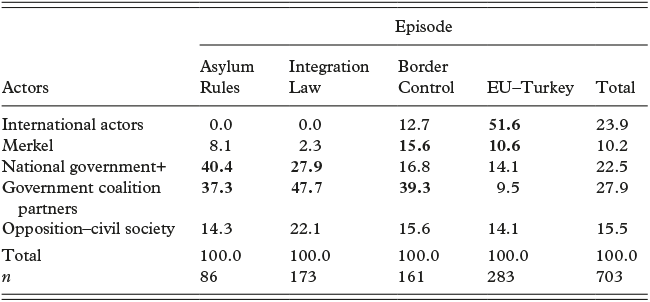
It is noteworthy that Chancellor Merkel played an outsize role in the EU–Turkey agreement and in the episode on border control, where she accounts for roughly the same share of actions as the rest of her government. As the driving force behind the suspension of the Dublin regulation and the EU–Turkey agreement, she is most conspicuously present in these two episodes, where she provided the linchpin between the two levels of the decision-making process. Note, however, that she was not omnipresent in all episodes of crisis decision-making, as is illustrated by the integration law, where the specialists of the policy subsystem remained in charge and she played only a minor role. This is to suggest that even under crisis conditions, crisis policymaking does not always shift to the top executive. In the case of the German integration law – a legislative novelty for Germany that the SPD, the junior coalition partner, had demanded and that had been in the making for a long time – the crisis actually provided the window of opportunity to finally get it done.
As already mentioned, the EU–Turkey agreement was the German chancellor’s plan B for alleviating the German burden of hosting asylum seekers once the relocation mechanism had failed. Germany, and the German chancellor in particular, were heavily involved in the decision-making process for this agreement, as is documented in the previous tables. As outlined in Chapter 5, Chancellor Angela Merkel had made the unprecedented decision to keep the borders open for refugees during the night of September 4, 2015. Her decision meant that Germany suspended the Dublin regulation for Syrian refugees. Germany did reintroduce identity checks for refugees at the border on September 14, but no one who applied for asylum was refused entry. Subsequently, in spite of massive internal critique, Chancellor Merkel kept insisting on her open-doors policy.
Merkel’s decision to suspend the Dublin regulation was immediately criticized by representatives of foreign governments, members of her own party, and members of the opposition, which led Merkel to defend her decision in repeated public statements. Thus, members of the Austrian and Hungarian governments accused Germany of attracting the floods of Syrian refugees by keeping its doors open. Prime Minister Orbán declared that refugees were “Germany’s not Europe’s problem.” Critique also came from the EU: In December, Donald Tusk, the president of the EC, called for a reversal of the chancellor’s refugee policies. He demanded that the Dublin rules be respected and called on European states to limit the influx of refugees coming to Europe. “We can’t run away from our commitments. Not even Germany,” he declared. Domestic critique came above all from Merkel’s own party, especially from Horst Seehofer, the leader of the CSU and prime minister of Bavaria. Seehofer went as far as threatening to file a complaint of unconstitutionality against the chancellor’s decision to open German borders for refugees (see the case study in Chapter 6).
Domestically, the chancellor defended herself by describing the refugee crisis as a great national duty, comparing it to the challenges posed by the reunification of Germany and drawing parallels between the refugee crisis and the Eurozone crisis. She reiterated her optimistic stance: “I will say it again and again. We can and we will do it.” She also appealed to the German public by appearing in the famous TV talk show Anne Will one Sunday night in early October. Internationally, she originally (in mid-September 2015) appealed to the other member states for help and asked for a joint EU summit, pointing out that there was a need to discuss border controls with Greece and Turkey and to address the conflicts in the countries of origin. She promised that Germany would lead by example, that is, by taking in more refugees than the quota requirement stipulated. In return, she expected that other member states would follow with their more limited means. In a speech before in the European Parliament in early October, she appealed to European values and called for more support for refugees.
It was only after the failure of the relocation scheme in late September that support from Turkey became the crucial plan B for Merkel. On October 18, she traveled to Ankara to meet President Erdoğan to negotiate what was then still called the joint action plan, which had been elaborated by Frans Timmermans, the EU Commission’s vice president. From this point on, she systematically pursued an agreement with Turkey. In November, she intensified her efforts at the G20 meeting in Turkey, where she discussed a “quota solution” with Turkish prime minister Davutoğlu. While the German coalition partners continued to battle over the asylum packages, Merkel called for a concerted action at the European level, pointing out that without the help of Turkey, the number of refugees coming to Germany would not be reduced. On November 24, at yet another European summit on the refugee crisis, European heads of state met with President Erdoğan, and Merkel declared that Turkey would be a key partner in finding a solution to the crisis but failed to find an agreement. In the new year, Merkel pursued the negotiations with Turkey. Thus, she and Turkish prime minister Davutoğlu met with their cabinets in Berlin for the first German–Turkish government consultations on January 22, a meeting that ended without any new resolutions. While the V4 countries, together with Austria and Bulgaria, opted for closing the Balkan route, Merkel continued to single-mindedly bet on a deal with Turkey. Thus, at the EU summit on February 18, she demanded that negotiations with Turkey be continued. Eventually, the EU–Turkey summit in early March was the turning point, and in the final rounds of negotiations in the first half of March, Merkel played a crucial role.
After its adoption, the agreement was criticized by the domestic opposition from the left and by CSOs as well as international NGOs such as Amnesty International. In response to such critique, Merkel again traveled to Turkey. In April, she went to visit a refugee camp on the Turkish border with Syria; in May, she went to meet President Erdoğan. She wanted to provide evidence that the agreement was sensible and working as planned, to reassure the Turkish president of Germany’s commitment to the agreement, and to voluntarily accept additional contingents of refugees. In May 2016, she continued to defend the agreement before the German public on TV, invoking the humanitarian responsibility of the EU.
The Politicization of the EU–Turkey Agreement in Greece
Greece is the other member state where the EU–Turkey agreement has been heavily politicized. Figure 12.2 presents the politicization of the Greek episodes in phase 1. However, even if the agreement was heavily politicized in Greece, its politicization did not reach the level of the politicization of the hotspot episode to which it was closely linked. As we have already observed above, the EU–Turkey agreement episode in Greece was not very conflict intensive and comparatively little polarized. This is not to say that there was no opposition to the agreement: Civil society organizations; the radical left opposition; and even parts of Syriza, the governing party, criticized the implications of the deal for refugees in Greece. But the EU proved to be generally highly supportive, Turkey proceeded to implement its part of the deal, and Greece also received support from other international actors. Domestically, the Greek prime minister defended the agreement, as did the government and the mainstream opposition.
Politicization of Greek episodes, phase 1

Table 12.7 presents the salience of the various types of actors in the three Greek episodes during phase 1. The dominance of international actors is striking not only in the EU–Turkey episode, where international actors account for almost two thirds of the actions but also in the two domestic episodes that we have already discussed in the previous chapter. Compared to Germany, the national government and especially the governing parties generally play a more limited role, which again confirms the extent to which Greece was the object of top-down interventions in this first phase of the crisis. As for the Greek prime minister, he is conspicuously present in all the three episodes, although his position is somewhat less prominent than the position of the German chancellor in the two episodes where she was most important.
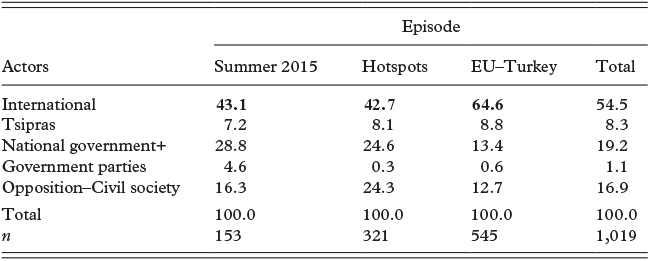
Phase 1: The Management of the Refugees Trapped in Greece
The Greek debate before the adoption of the agreement was closely intertwined with the creation of the hotspots and of an EU border and coast guard capable of controlling the EU borders between Greece and Turkey. Greece was fighting on two fronts: On the one hand, it was struggling with Turkey, accusing it of supporting people smugglers, with Turkey replying that it was doing what was possible and claiming that it was stopping 500 persons every day. Repeatedly, the Turkish President turned to threatening not only Greece but the European leaders as well that he would flood the EU with refugees if the EU did not offer Turkey a better deal for its support in managing the refugee crisis. On the other hand, Greece was struggling with the other European member states, which reminded it of its responsibilities as a frontline state. When the agreement was eventually reached, it was perceived to be a diplomatic success of Greece (and Cyprus) by Greek prime minister Alexis Tsipras. He claimed that Greece had achieved the best available deal with regard to the refugee issue, but he also warned that the agreement would be difficult to implement and that a key condition for its success would be a reduction in refugee flows. The main opposition party, ND, agreed, calling the agreement a “positive step.” But it added that the agreement had to be implemented effectively, and it had some doubts about the government’s capacity to do so.
Greece’s prime minister warned that the number of refugees crossing the border to Greece could not be limited unless the smugglers on the Turkish side of the border were stopped. EU migration commissioner Avramopoulos asked the EU to increase pressure on Turkey to crack down on smugglers. Turkish and Greek officials serving as liaison officers were installed on both sides to monitor the deal. And Turkey did, indeed, abide by the agreement. As a matter of fact, the number of arrivals dropped sharply after the agreement was signed: While the average number of arrivals was around 2,000 per day in January and February 2016, it fell to 130 in April 2016. If Greece had counted more than 860,000 arrivals in 2015, the number of arrivals dropped to 36,000 in the year after the deal was signed, before climbing again to nearly 75,000 in 2019. In addition, the number of dead and missing migrants in the Aegean Sea decreased from 1,175 cases in the 20 months before the agreement to 310 in the period after its adoption in March 2016 until March 2019.Footnote 2 In spite of a lot of frustration on the Turkish side, this centerpiece of the agreement held.
On the Greek side, after the adoption of the agreement, the debate focused on its implementation, which put great pressure on the country. Economically battered by the Euro area crisis, Greece did not have the capacity to deal with the large number of refugees who were now trapped in the country as a result of the agreement. The hotspots on the islands were no longer open facilities where refugees passed through on their way to northern Europe; rather, the refugees were now confined to these camps. As a result of the agreement, roughly 60,000 refugees were stranded in Greece – in the camps on the islands, in the port of Piraeus, and at the Greek northern border in Idomeni. Overcrowding in substandard living conditions and destitution became an integral part of the asylum process in Greece, contrary to reception obligations and human rights standards of the member states. This situation was heavily criticized by NGOs. Thus, a few days after the conclusion of the agreement, Doctors Without Borders (Médecins Sans Frontières), one of the key nongovernmental organizations helping refugees and migrants arriving in Greece, announced that it would stop all activities linked to the hotspots on the Greek islands of Lesvos and Samos. The NGO said its decision was prompted by its objections to the agreement, which it described as a “cynical mechanism” that jeopardized asylum and showed “contempt” for humanitarian needs. The NGO had also temporarily withdrawn from the refugee camp in Idomeni, this time citing concerns about the safety of its staff. One month later, it was the turn of Oxfam to denounce the European Union for its failure to deliver a fair and safe system for receiving refugees in Greece: “Europe has created this mess and it needs to fix it in a way that respects people’s rights and dignity.” Oxfam highlighted problems at the overcrowded hotspots on Lesvos (Moria), where riots had occurred at that time. In addition, the UNHCR expressed its disapproval and suspended cooperation in harsh terms: “UNHCR has till now been supporting the authorities in the so-called hotspots on the Greek islands, where refugees and migrants were received, assisted, and registered. Under the new provisions, these sites have now become detention facilities. Accordingly, and in line with our policy on opposing mandatory detention, we have suspended some of our activities at all closed centres on the islands. This includes provision of transport to and from these sites. However, UNHCR will maintain a presence to carry out protection monitoring, to ensure that refugee and human rights standards are upheld, and to provide information on the rights and procedures to seek asylum.”Footnote 3
In order to implement the EU–Turkey agreement for the return of refugees from Greece to Turkey and to speed up the procedures pertaining to asylum requests, Greece’s parliament, under high time pressure, adopted an asylum amendment bill on April 1 that adapted the Greek legislation to the EU directive on asylum procedures. It also introduced provisions for registering refugees, allowing them to find work and to qualify for international protection. In addition, immediately after the adoption of the agreement, Greece had appealed to its European partners for logistic help to implement the deal. In response to such calls for help, the Commission had immediately started coordinating the implementation of the agreement, and the EU border agency Frontex called on the EU member states to provide 1,500 police and 50 readmissions experts. On April 1, approximately 350 Frontex officers from Germany, France, Portugal, Estonia, Latvia, and Lithuania arrived on Lesvos to assist in the readmission process for the refugees and migrants. In the end, 397 police and 47 readmission experts were actually provided.
However, the situation on the islands hardly improved. By the end of May, the mayor of Lesvos, one of the islands most affected by refugee flows, urged the government to speed up the asylum application procedure, as the extended stay of refugees and migrants on the island was causing stress and frictions for applicants. “The delay of the asylum procedures requires de facto that refugees stay in Lesvos for a long time. This creates frustration and friction between our guests, some of which have already turned to delinquency, given the lack of money and fear of their possible readmission to Turkey,” the mayor wrote in a letter to the government. The mayor of another island, Chios, accused the government of ignoring the gravity of the situation, especially after the NGOs had left and nobody knew how to deal with the situation.
While the overall responsibility for managing migration flows in Greece rested with the Greek authorities, the Commission and EU member states continued to provide support to the Greek authorities in the implementation of the EU–Turkey agreement to improve migration management and reception conditions in Greece. EU actions focused in particular on helping to alleviate the situation on the Greek islands. By 2019, over 2.07 billion euro in EU funding had been allocated to Greece to support migration management since the start of 2015, including 816 million euro in emergency assistance and over 643 million euro for projects under the EU Emergency Support Instrument. The European Border and Coast Guard Agency and the European Asylum Support Office deployed staff on the ground in Greece to support the Greek authorities. The Commission also deployed a team in Athens and ensured a permanent presence on the hotspot islands. Since 2016, a permanent Commission representative has been stationed on both Samos and Lesvos to support the Greek and international partners on the ground.Footnote 4
Phase 2: International Protection Bill and Reception Centers
Nevertheless, the situation for refugees in Greece remained tense. Two of the three Greek episodes that occurred within a short time span at the very end of the period covered by our analysis in late 2019/early 2020 and that we introduced in the previous chapter (see Figure 11.1) – the International Protection Bill and the reception centers, once again concerned the management of the refugees in Greece. By the time these episodes took place, the situation in the camps on the Greek islands had hardly improved at all. As pointed out in the previous chapter, these two episodes were dominated by bottom-up cross-level politicization. Together with the Turkey Border Conflict, which we discussed in the previous chapter, they took place against the background of mounting problem pressure, that is, increasing arrivals of refugees, overcrowded refugee camps on the Greek islands, and increasing tensions between Greece and Turkey.
The first of the two interlinked episodes concerns the International Protection Bill (IPB), the first act related to immigration policy adopted by the recently elected New Democracy government. The bill was not directly concerned with border control; rather, it was designed to streamline domestic Greek asylum rules, once again attempting to improve and accelerate the asylum and return processes. Among other things, the bill was intended to relieve the pressure on the islands and to construct new “closed” centers for rejected asylum seekers, who would be confined to these new centers. The domestic debate of the bill was dominated by civil society organizations claiming that it contravened international law and would not work anyway, but to no avail – the bill passed without much ado in parliament. However, resistance to some of the bill’s provisions continued among the islanders in Lesvos, Chios, and other afflicted islands, who were wary of the prospect of getting new “closed” centers in their neighborhoods. Regional and municipal authorities demanded that after five years of shouldering the problem, the easternmost islands should be unburdened from refugee reception. The domestic debate was accompanied by an intense international debate: At the same time as it introduced the bill, the government was trying to entice and contain Turkey and to get support from the other European member states. On the one hand, it accused Turkey of gradually allowing more migrants to slip through its borders to get more concessions from Europe, and it appealed to Turkey for support of a commonly beneficial solution to the problem. On the other hand, it multiplied meetings with representatives of fellow member states in order to raise their awareness of the imminent threat at the border with Turkey and to induce them to share the burden. The other member states responded by providing assurances or by pointing out that the key was to return nonrecognized asylum seekers to Turkey as envisaged under the EU–Turkey agreement.
The domestic conflict with the islanders intensified in the second episode, which was focused on the detention centers on the islands. The regional authorities of the Northern Aegean, where most centers were to be built, adopted a collision course with the national government, engaging in protest participation as well as judicial challenges to the government’s plans. They feared that once built, the centers would sprawl like Moria on Lesvos and consolidate the image of the islands as “migrant barracks.” It did not help that the government decided to expropriate real estate on the islands to build the new centers. The standoff between the government and the islanders culminated in a confrontation of far right and far left groups, each opposing the hotspots for their own reasons, with riot police that had been sent to supervise and protect the start of the construction process. Faced with a sort of low-key guerilla warfare, the government eventually retreated, asking the riot police to return to Athens and promising to delay the construction of the centers and to “consult” with local authorities.
At the same time, the international conflict continued, with the Greek government continuing to fight an international bottom-up battle on two fronts. On the one hand, Greece continued to blame Turkey for using the refugees to blackmail the European Union. The Turkish government responded by criticizing Greece for manipulating the data concerning the refugee crisis, for its inhumane treatment of the migrants, as well as for pushing illegal migrants back to the Turkish borders. On the latter points, Turkey was joined by the UNHCR, which warned that the conditions in the Greek reception centers were awful, asked Greece to make sure that the new asylum procedures were in line with international law, and pointed out that the UN was generally opposed to detention centers for asylum seekers. In addition, in April 2020, Amnesty International and many others documented how Greece systematically used “pushbacks” and other human rights abuses to prevent refugees from entering the EU.Footnote 5 On the other hand, the Greek government both criticized its European partners for their lack of solidarity (e.g., for their lack of willingness to accommodate 3,000 unaccompanied migrant minors) and asked for a reform of the Dublin regulation, as well as for EU support for decongesting the islands, for financing the new accommodation and predeparture units, for border controls by boosting Frontex, and for returning rejected asylum seekers to Afghanistan. In the European Council’s debates on the Multiannual Financial Framework (MFF), which were going on at the time, the Greek government fought for increasing the funds for migration/refugees.
Conclusion
In this chapter, we have shown how an EU policymaking episode is domesticated in national policymaking, and how this works out differently depending on the member state. We have compared the debates in four member states and then zoomed in on the debates in the two member states most concerned. For Germany, this episode was instrumental in solving a domestic conflict between the chancellor and the governing parties, including her own party. Once the agreement was sealed, the German debate did not entirely subside, but its intensity lessened and eventually faded out. The Greek debate, by contrast, picked up shortly before the conclusion of the agreement and then stayed intense during the implementation phase. Several years after the agreement had been concluded, it gave rise to new domestic episodes in Greece, since the problems it created for Greece continued to remain unsolved.
While the EU–Turkey Deal stopped the inflow of refugees, it did not work out as expected in other respects, with important implications for Greece. According to the deal, all refugees who would enter Greece after March 20, and those whose asylum applications were not accepted, would be returned to Turkey on chartered ships. However, the return of refugees to Turkey developed only sluggishly and despite the rapid adaptation of Greek asylum law to the new situation, only 2,441 migrants had been returned three years after the signing of the agreement.Footnote 6 Also, the promise of one-to-one resettlements did not work out as expected: From March 2016 to March 2021, only slightly more than 28,000 Syrian refugees were resettled in the European Union from Turkey, far short of the maximum 72,000 outlined in the deal. Discussions of bringing Turkey into the European Union and easing visa processes for Turks meanwhile mostly stalled, as President Erdoğan’s government increasingly turned authoritarian after the coup in summer 2016. The agreement did not usher in a period of harmonization of EU–Turkish relationships. As we have seen in the previous chapter, in early 2020, Turkey’s president moved to reopen the border for refugees, using Turkey’s geopolitical position as a buffer between Syria and Europe to put renewed pressure on the EU and on Greece in particular.
But the deal succeeded in externalizing a significant part of the management of the EU’s refugee crisis to Turkey. In exchange for stopping the flow of refugees to the EU, it provided Turkey with 6 billion euros to arrange for the refugees if not with the other goods it originally promised. The exchange of funds for the management of refugees, the part of the EU–Turkey Deal that worked, provided a blueprint for other externalization agreements – with Libya and Morocco. Moreover, the New Pact on Migration and Asylum presented by the European Commission on September 23, 2020, assigned a prominent place to cooperation with third countries of origin and transit of migrations flows.Footnote 7 The German presidency progress report on key elements of a European migration and asylum policy stated in 2020 that “action on promoting and advancing tailor-made partnerships with key third countries needs to be taken without further delay and with the aim to show tangible results.”Footnote 8 In the eyes of some critics, however, the new pact only proposed “more of the same,” which they did not consider to be enough to improve the EU’s management of its external borders.Footnote 9
On its fifth anniversary in spring 2021, leaders in both Turkey and Europe suggested that the agreement would endure in some form or another. Commission president von der Leyen and European Council president Charles Michel met with President Erdoğan in Ankara on April 6 and signaled that additional funding for Turkey was forthcoming, as long as the country continued upholding its end of the agreement.Footnote 10 In June 2021, a new 3.5 billion euro package for Turkey was on the table of the Commission, to be disbursed until 2024.Footnote 11 The proposal included an additional 2.2 billion euro for Jordan, Lebanon, and Syria. The commission wanted to “gradually move from humanitarian priorities to socio-economic support and development,” according to the draft text. This would include “funding for migration management and border control,” precisely the areas rights activists and parliament have flagged as being of serious concern. Meanwhile, the reception camps for asylum seekers on the Greek islands of Leros and Kos were almost empty, and on Samos and Chios only a few hundred migrants remained. Only on Lesvos did 5,000 migrants continue to live in a provisional tent camp with a capacity of 8,000 people.Footnote 12


 Open access