


1. Introduction and motivation
In recent years, the consolidation of brands into larger corporate groups has reshaped the automotive and commercial vehicle industries and their product development processes (PDP). Organizations such as Daimler Truck, Stellantis, and TRATON seek to increase synergies in research and development (R&D) by implementing PDPs across multiple brands. The primary goal for complex collaborations lies in reducing costs, accelerating innovations, and achieving economies of scale through shared modular platforms and joint engineering activities (Reference Schuh, Gartzen, Rodemann and BasseSchuh et al., 2017; Reference Gawer and CusumanoGawer & Cusumano, 2014).
However, collaboration across multi-brand organizations and national boundaries results in numerous challenges. Each company within a multi-brand organization presents distinct structures, processes, and corporate cultures, which can complicate alignments (Reference Mitschang, Paliyenko, Fastabend, Roth and KreimeyerMitschang et al., 2025; Reference Beernaert, Etman, De Bock, De Baar and ClassenBeernaert et al., 2022; Reference Sirmon, Hitt, Ireland and GilbertSirmon et al., 2011). As result, interfaces between organizations are a critical element of joint multi-brand PDPs. Interfaces represent not only technical and responsibility-related interfaces, but also organizational and cultural dependencies that determine the efficiency and success of multi-brand collaborations (Reference Oertwig, Krenz and LindemannOertwig et al., 2021; Reference Lakemond, Berggren and Van WeeleLakemond et al., 2006; Reference BrowningBrowning, 2001; Reference Eppinger and SalminenEppinger & Salminen, 2001).
The better these interfaces are designed, managed, and operationalized, the more efficiently multi-brand engineering activities can be executed and the more customer value can be created. As more brands are linked together, there is a disproportionate rise in interface complexity: Interface management therefore becomes both, a driver of efficiency and a source of risk (Reference Beernaert, Etman, De Bock, De Baar and ClassenBeernaert et al., 2022; Reference Danilovic and BrowningDanilovic & Browning, 2007; Reference MaurerMaurer, 2007). This contribution focuses on the interfaces in multi-brand R&D organizations, which divide development tasks and responsibilities among the collaborating entities and require seamless exchange and alignment. While models for visualizing and analyzing interfaces in PDPs have been proposed in the literature, initial observations suggest that approaches may be faced with limitations when visualizing multi-brand cases (Reference Beernaert, Etman, De Bock, De Baar and ClassenBeernaert et al., 2022). This paper is motivated by the hypothesis that traditional interface models demonstrate little to no capability of adequately capturing the heterogeneity and interdependencies between the entities in multi-brand PDPs. The work aligns with design science interests in systems integration, complexity management, and socio-technical interface design across organizational boundaries.
2. Problem clarification and goal
The systematic design and governance of such interfaces, as well as their analysis and visualization, represents a key challenge in multi-brand PDPs. Within the multi-brand context, such organizational constellations must be in a coordinated, standardized manner spanning multiple corporate entities. As engineering activities are distributed across multiple brands, the number of connections and dependencies arises rapidly: This leads to increasing complexity and challenges in terms of coordination (Reference Beernaert, Etman, De Bock, De Baar and ClassenBeernaert et al., 2022; Reference Axelson and RichtnérAxelson & Richtner, 2017; Reference Mitschang, Paliyenko, Fastabend, Roth and KreimeyerMitschang et al., 2025).
Furthermore, the complexity arises from organizational heterogeneity, since the companies involved differ in their structure and processes; cultural diversity, resulting in from distinct corporate histories and work practices; and distributed responsibilities, with tasks and decisions-making authorities being spread across brands and locations (Reference Mitschang, Paliyenko, Fastabend, Roth and KreimeyerMitschang et al., 2025). Together, these dimensions together make interface management in multi-brand PDPs difficult to model, compare, and control (Reference Sirmon, Hitt, Ireland and GilbertSirmon et al., 2011; Reference Oertwig, Krenz and LindemannOertwig et al., 2021).
While several models for visualizing and analyzing interfaces in PDPs have been established, these were predominantly devised for single-brand or intra-organizational settings. When applied to multi-brand PDPs, they may face inherent limitations due to the specific characteristics of the collaborating partners. Traditional matrix-based models, such as the Design Structure Matrix (DSM) or the Multi-Domain Matrix (MDM), offer a systematic representation of structural and complex dependencies and information flows (Reference Eppinger and BrowningEppinger & Browning, 2012; Reference Danilovic and BrowningDanilovic & Browning, 2007). In contrast, graph-driven or data-driven approaches – including network analysis and neural-network-based representations – emphasize dynamic relationships and complex interactions patterns between collaborating entities (Asur & Parthasarathy 2009; Reference Graber and SchwingGraber & Schwing, 2020). While matrix models provide structural clarity and analytical precision, graph-based models offer flexibility and adaptability but often lack transparency regarding complex organizational and socio-technical factors (Reference Graber and SchwingGraber & Schwing, 2020; Reference Sosa, Eppinger and CraigSosa et al., 2004).
Consequently, this contribution builds on the assumption that current models for interface visualization and analysis only partly address the multi-dimensional complexity inherent in the multi-brand context. The insufficient ability of these models to represent the interplay between technical, organizational, and cultural dependencies limits their effectiveness in guiding coordination and decision-making. This gap provided the motivation for a systematic review of existing models and for defining requirements that future modeling approaches must fulfill in order to support the visualization and analysis of interfaces in multi-brand PDPs (Reference Oertwig, Krenz and LindemannOertwig et al., 2021; Reference Mitschang, Paliyenko, Fastabend, Roth and KreimeyerMitschang et al., 2025).
Based on the previous problem clarification, the objectives of this contribution are defined as follows:
-
1. Characterization of multi-brand PDPs: to describe the structures, dependencies, and boundary conditions that distinguish multi-brand PDPs.
-
2. Analysis of interface requirements: to identify the specific requirements and challenges that arise with respect to interfaces in multi-brand PDPs.
-
3. Assessment of existing models: to investigate to what extent existing methods are applicable in multi-brand contexts and to identify their limitations.
Taken together, these considerations underscore the urgent need for robust models and methods that can capture the unique dependencies and dynamics of multi-brand PDPs. The following chapters will systematically characterize these processes and evaluate the suitability of current modeling approaches.
3. Methodology
This contribution employs a structured multi-step methodology to investigate the challenges and limitations of modeling interfaces in multi-brand PDPs. Part of that is a systematic literature review (SLR), using targeted keyword and snowballing techniques across academic databases and selected industry reports to identify relevant studies and characterizations related to multi-brand PDPs, interface modeling, and organizational collaborations. The SLR covered 1996-2025 across Scopus, Web of Science, IEEE Xplore, and SpringerLink. The following search string returned 457 results: (“multi-brand” OR “inter-brand”) AND (“product development” OR PDP) AND (platform or “platform sharing” or “modular kit”). The screening process was executed in two stages – beginning with a screening of the title and abstract, then continuing with a screening of the full text. 47 contributions had been identified once the SLR was complete. Inclusion focused on engineering-centric studies of multi-brand or interorganizational PDPs, whereas exclusions removed pure marketing or non-empirical opinion pieces. Snowballing added seminal works. The scope of this contribution is to focus on engineering-centric, cross-brand settings, with particular attention paid to the automotive and heavy vehicle industries.
Based on the literature synthesis, initial requirements for interface models were derived and operationalized into assessment criteria (Section 4). Subsequently, a set of modeling approaches was selected for evaluation, including matrix-based models, model-based models, and process-driven, variability, and network/graph-based models (Section 5). Each model was assessed qualitatively against the derived criteria, considering both theoretical grounding and practical applicability. These findings were triangulated with empirical insights from published case studies, as well as industry documentation where available.
4. Characterization of multi-brand PDPs
This chapter illustrates different characteristics and the resulting complexity of multi-brand PDPs. In general, the multi-brand PDPs of the large business groups under review differ in several details. However, they pursue the same goal in terms of establishing collaborative engineering activities. The pursuit of efficiency and innovation through the utilization of shared resources has the potential to introduce new layers of organizational, technical, and cultural complexity, particularly at the interfaces between brands and the engineering domains. The subsequent chapter is structured as follows: First, the term “multi-brand PDP” is defined and various forms of collaborations are presented. Secondly, an examination of the triggers, opportunities, and risks of multi-brand PDPs is conducted, along with an analysis of their impact on the complexity of interfaces. Thirdly, the requirements regarding models for visualizing and analyzing multi-brand interfaces are characterized on the basis of the preceding considerations.
4.1. Definitions and forms of multi-brand PDPs
For this contribution, the term “multi-brand PDP” is defined as follows: A multi-brand-PDP is the coordinated development of products, modules, or platforms across two or more distinct brands within a corporate group or alliance. This approach extends beyond traditional single-brand or supplier-based collaborations by integrating multiple brand identities, development logics, and governance structures within one product architecture.
Different organizational forms have emerged in practice. Joint ventures and shared R&D organizations enable deep technical collaborations and are often established following mergers and acquisitions, with platform development serving as a mechanism for R&D integration (Reference Cabigiosu, Zirpoli and BeckerCabigiosu et al., 2014; Reference Hollauer, Frisch, Wilberg, Omer and LindemannHollauer et al., 2017). In contrast, contractual co-development alliances, in contrast, rely on negotiated openness and flexibility to access complementary capabilities while balancing autonomy and control (Reference ReuerReuer, 2024; Reference GerwinGerwin, 2004). Large interorganizational projects (LIPs) represent temporary multi-actor constellations requiring hybrid coordination and trust-based governance (Reference Roehrich, Davies, Tyler, Mishra and BendolyRoehrich et al., 2024). The selection of a structure depends on strategic intent, required knowledge integration, and the targeted equilibrium between commonality and brand differentiation (Reference Silva, Pimenta, Oprime and FodraSilva et al., 2025).
4.2. Drivers, advantages, and risks of multi-brand PDPs
The literature identifies several key drivers for the adoption of multi-brand PDPs. Economies of scale and accelerated time-to-market are prominent motivations. Platform and modular strategies enable faster and more cost-effective differentiation across brands (Reference Silva, Pimenta, Oprime and FodraSilva et al., 2025; Reference Brovar, Kazanskii, Tapia and FortinBrovar et al., 2024). Risk sharing and access to complementary capabilities are also key. Alliances and joint ventures provide mechanisms for distributing technological and market uncertainties (Reference ReuerReuer, 2024; Reference Cabigiosu, Zirpoli and BeckerCabigiosu et al., 2014; Reference GerwinGerwin, 2004). Regulatory and technological pressures often necessitate the use of shared platforms to maintain product variety at acceptable costs (Reference Roehrich, Davies, Tyler, Mishra and BendolyRoehrich et al., 2024; Reference Bannasch, Rossi and ThaidigsmannBannasch et al., 2017).
Multi-brand PDPs offer substantial advantages. These include savings on costs and development time saving, broader market coverage, and the pooling of knowledge and risk (Reference Silva, Pimenta, Oprime and FodraSilva et al., 2025; Reference ReuerReuer, 2024). However, they also involve significant risks. Inter-brand platform sharing can dilute brand distinctiveness and negatively affect customer perception (Reference Wichmann, Wiegand and ReinartzWichmann et al., 2021; Reference OlsonOlson & Erik, 2009). The increased need for coordination and governance raises the risk of intellectual property leakage and administrative overhead (Reference ReuerReuer, 2024; Reference Roehrich, Davies, Tyler, Mishra and BendolyRoehrich et al., 2024). Excessive divergence from shared platforms can undermine anticipated benefits resulting in commonality cost traps (Reference Brovar, Kazanskii, Tapia and FortinBrovar et al., 2024; Reference CameronCameron, 2011; Reference Jung and SimpsonJung & Simpson, 2016).
It is important to note that while these drivers and risks are widely discussed, the literature does not always agree on their relative importance or the best strategy for managing them. For example, some studies emphasize the inevitability of brand dilution in platform sharing (Reference OlsonOlson & Erik, 2009), while others highlight successful mitigation through governance and different strategies (Reference Wichmann, Wiegand and ReinartzWichmann et al., 2021). This constant debate underscores the need for further empirical research.
4.3. Complexity drivers at interfaces
Compared to single-brand PDPs, multi-brand PDPs introduce additional complexity – especially at interfaces. The number of interfaces and dependencies rises, with more connections between brands, organizations, processes, and technical systems. The increasing number of interfaces can lead to rising risk of iteration, rework, misalignment, and coordination costs (Reference Brovar, Kazanskii, Tapia and FortinBrovar et al., 2024; Reference Beernaert, Etman, De Bock, De Baar and ClassenBeernaert et al., 2022). Analytical frameworks such as the DSM or MDM could identify these interdependencies and visualize information flow cycles that affect cost and schedule performance (Reference BrowningBrowning, 2001; Reference Jung and SimpsonJung & Simpson, 2016).
The trade-off between commonality and variety drives the complexity:
-
• Excessive standardization limits brand differentiation, whereas excessive variety increases cost and integration risk (Reference Jung and SimpsonJung & Simpson, 2016; Reference Thevenot, Alizon, Simpson and ShooterThevenot et al., 2007).
-
• Brand-related complexity at interfaces must balance the need for distinct brand identities with the effectiveness of shared platforms, making it a challenge to manage brand-related requirements at shared interfaces (Reference Wichmann, Wiegand and ReinartzWichmann et al., 2021; Reference OlsonOlson & Erik, 2009).
-
• Governance complexity at interfaces fuels the need to coordinate responsibilities, contractual agreements, and trust-based mechanisms across multiple brands and organizations, thereby increasing the complexity of interface management (Reference ReuerReuer, 2024; Reference Roehrich, Davies, Tyler, Mishra and BendolyRoehrich et al., 2024).
-
• Concurrent engineering across corporate boundaries intensifies the need for synchronization demands and clear communication at interfaces, as misalignments can propagate quickly (Reference Silva, Pimenta, Oprime and FodraSilva et al., 2025).
Existing models and management tools provide partial solutions but remain limited in dynamic and loosely coupled environments. Matrix-based and model-based approaches often depend on stable dependency data and clearly defined ownership structures, which are rarely present in evolving multi-brand setups (Reference Brovar, Kazanskii, Tapia and FortinBrovar et al., 2024). Practical barriers include fragmented data sources, incompatible toolchains, and insufficient stakeholder engagement (Reference Trase and FinkTrase & Fink, 2014; Reference HauseHause, 2018).
4.4. Requirements for models to visualize multi-brand PDP interfaces
Addressing these challenges requires models capable of capturing multi-level dependencies across products, processes, and organizations while maintaining scalability and interpretability. The literature identifies three complementary requirement domains:
-
1. Representation of multi-level dependencies: Models should be able to capture the various types and domains of dependencies that exist at interfaces (Reference Brovar, Kazanskii, Tapia and FortinBrovar et al., 2024).
-
2. Support for responsibility and change management: It is essential that models enable the clear assignment of responsibilities, rights, and change management at interfaces, so that all stakeholders understand their roles and obligations (Reference HauseHause, 2018).
-
3. Facilitation of information flow and traceability: Models must follow the consistent flow and traceability of information across interfaces, ensuring transparency and alignment throughout the product development lifecycle (Reference Trase and FinkTrase & Fink, 2014).
Despite these advances, open research questions remain. Integration between DSM, MBSE, and PLM across brands is still fragmented, and the organizational dimension of model adoption particularly the alignment of modeling cultures across brands remains underexplored (Reference Brovar, Kazanskii, Tapia and FortinBrovar et al., 2024).
4.5. Example structure of a multi-brand PDP
Figure 1 illustrates a generic representation of a multi-brand PDP. The diagram, inspired by common industry practices, follows a V-model logic in which customer requirements are consolidated across brands and translated into shared platform specifications. These platform-level developments serve as the foundation for brand-specific derivatives that are subsequently validated and delivered to individual customers. The figure emphasizes how shared modules, architectures, and processes converge at the platform level while diverging again to address distinct brand identities and market segments.
Generic multi-brand PDP setup based on V-model (VDI2206)

It must be noted that this representation serves purely as an illustrative example. In practice, the specific design and governance of multi-brand PDPs are unique to each multi-brand organization and often constitute confidential internal information. Nevertheless, such generic visualizations are useful for conceptualizing the interplay between shared and brand-specific development layers, providing a contextual foundation for addressing modeling approaches in subsequent sections.
5. Assessment of model for visualizing interfaces in multi-brand PDP
The increasing interdependencies of technical systems, brands, and organizations in the multi-brand context have made the visualization and control of interfaces a key challenge in engineering activities. As mentioned in Section 4, multi-brand PDPs differ fundamentally from single-brand settings due to additional layers of complexity at technical, organizational, and governance levels. These cannot be successfully managed by informal coordination or isolated dependencies, which are unable to formalize responsibilities and maintain digital consistency across brands (Reference Eppinger and BrowningEppinger & Browning, 2012; Reference Brovar, Kazanskii, Tapia and FortinBrovar et al., 2024; INCOSE, 2023). The objective of this section is therefore to assess the suitability of existing modeling approaches for visualizing and analyzing multi-brand interfaces. The assessment aims to identify the extent to which different models fulfill the criteria that are derived in the following section.
5.1. Derivation of assessment criteria
The criteria employed in this section were derived systematically from the empirical and conceptual challenge of multi-brand PDPs identified in Section 4 and from the evidence collected in the underlying literature review. The review derived seven operational criteria:
-
1. C1: Multi-level coverage (product/process/organization)
Multi-brand interfaces typically span technical components, processes sequences, and organizational responsibilities simultaneously. The models must therefore represent cross-domain couplings so that structural misalignments and boundary effects become visible (Reference Eppinger and BrowningEppinger & Browning, 2012; Reference Danilovic and BrowningDanilovic & Browning, 2007; Reference Sosa, Eppinger and CraigSosa et al., 2004).
-
2. C2: Governance and interface control
In multi-brand corporations, formalizing who owns, controls, and is authorized to change an interface is essential for managing intellectual property, security, and compliance risks. Models must therefore either embed governance artifacts or allow seamless derivation of artifacts such as Interface Control Documents (INCOSE, 2023; Reference HauseHause, 2018; Reference Vipavetz, Shull, Infeld and PriceVipavetz et al., 2016).
-
3. C3: Dependency analysis
The ability to detect feedback loops, coupled sub-systems, and modular boundaries is a primary function of interface modeling, because such structures drive iteration, rework, and schedule risk in multi-brand projects (Reference BrowningBrowning, 2001; Reference Jung and SimpsonJung & Simpson, 2016; Reference MaurerMaurer, 2007).
-
4. C4: Temporal dynamics and versioning
Multi-brand PDPs evolve through releases, branches, and asynchronous development rhythms across brands. Models must therefore support temporal views, baselining, and version control, so that change propagation and synchronization risk can be assessed (Reference Brovar, Kazanskii, Tapia and FortinBrovar et al., 2024; SysML, 2025)
-
5. C5: Digital continuity
Reliable interface visualization in distributed settings requires consistent, machine-readable data across engineering tools. Models must enable or fit into a digital thread to avoid manual reconciliation and preserve traceability across lifecycle stages (Reference Trase and FinkTrase & Fink, 2014; Reference Brovar, Kazanskii, Tapia and FortinBrovar et al., 2024). Furthermore, digital continuity builds the foundation for the usage of modern tools such as AI-based systems in engineering activities (Reference Steidl, Golendukhina, Felderer and RamlerSteidl et al., 2016).
-
6. C6: Stakeholder comprehensibility and communicability
Multi-brand PDPs involve heterogeneous stakeholders (engineers, product managers, legal, brand owners); a useful model must therefore be interpretable by these audiences or provide tailored views so that decisions about interfaces and trade-offs can be made collaboratively (OMG, 2025; Reference Silva, Pimenta, Oprime and FodraSilva et al., 2025)
-
7. C7: Maturity and standardization
Practical application depends on the maturity and adoption of the modeling approach. Standards, tool support, and community practice reduce implementation friction in industrial multi-brand context (INCOSE, 2023; SysML, 2025).
These criteria are not independent from one another: for example, C1 and C3 jointly drive the need for C5, because complex cross-domain dependencies cannot be kept consistent without tool chain integration. Likewise, C2 places additional demands on C4 and C6, because governance artifacts must be both actionable for machines and readable for humans.
In essence, the criteria outlined above form the foundation for holistic assessment of interface modeling methods. By considering both individual and combined requirements, the subsequent analysis can identify strengths, limitations, and potential complementarities among existing approaches.
5.2. Consolidation and clustering of models
To ensure a systematic and comparable assessment, the models identified in the literature review were clustered according to methodological similarity and scope of application. This clustering process followed two complementary logics: theoretical coherence and practical complementarity. Models that shared common analytical foundations or addressed comparable dimensions of interface management were grouped together. At the same time, clustering considered how these models could jointly cover different aspects of multi-brand PDP complexity. Five clusters were established:
-
• Cluster A: Matrix-based approaches (structural dependency analysis)
-
• This cluster comprises models such as the DSM, DMM, and MDM (Reference BrowningBrowning, 2001; Reference Danilovic and BrowningDanilovic & Browning, 2007; Reference MaurerMaurer, 2007). These methods represent dependencies between system elements in compact matrix form, enabling detection of feedback loops, modular structures, and cross-domain couplings (Reference Brovar, Kazanskii, Tapia and FortinBrovar et al., 2024). They are particularly effective for structural analysis but require supplementary mechanisms to capture governance and temporal evolution (Reference Eppinger and BrowningEppinger & Browning, 2012; Reference Danilovic and BrowningDanilovic & Browning, 2007).
-
• Cluster B: Model-based System Engineering (MBSE) and governance artifacts
-
• This cluster includes SysML models, Interface Control Documents (ICDs), and related systems-engineering frameworks (INCOSE, 2023; Reference Vipavetz, Shull, Infeld and PriceVipavetz et al., 2016; SysML, 2025). MBSE models formalize interfaces through ports, flows, and interface blocks, providing traceability across product architectures (Reference Vipavetz, Shull, Infeld and PriceVipavetz et al., 2016). ICDs complement this by establishing formal ownership and a change-control mechanism. This supports digital continuity and governance but requires harmonized toolchains and organizational alignment (INCOSE, 2023).
-
• Cluster C: Process and Enterprise Architecture (EA) models
-
• Business process modeling notations (BPMN) such as BPMN 2.0 and enterprise architecture frameworks such as ArchiMate 3.2 represent cross-organizational collaboration and responsibility flows (OMG, 2011; The Open Group, 2022). They are highly effective in visualizing inter-brand collaboration processes, decision flows, and responsibility allocation, but provide only limited technical interface detail (Reference HauseHause, 2018). When integrated with MBSE models, they bridge the gap between organizational and technical perspectives (Reference Brovar, Kazanskii, Tapia and FortinBrovar et al. 2024).
-
• Cluster D: Variability and Product Line Engineering (PLE) models
-
• Feature models (FODA) and Orthogonal Variability Models (OVM) visualize commonality and variability across brands (Reference Reinhartz-Berger and FiglReinhartz-Berger & Figl, 2014). They capture brand-specific options and configuration spaces, thereby clarifying where differentiation occurs on shared platforms (Reference Reinhartz-Berger and FiglReinhartz-Berger & Figl, 2024). However, they do not inherently analyze dependencies of interfaces at system level and thus must be coupled to DSM or MBSE frameworks (Reference Brovar, Kazanskii, Tapia and FortinBrovar et al., 2024).
-
• Cluster E: Network and graph-based analyses
-
• Drawing on organizational network theory, these models such as those by Sosa, Reference Sosa, Eppinger and CraigSosa et al. (2004), and Reference Eppinger and SalminenEppinger and Salminen (2001) analyze patterns of interaction between product components and development teams. They help detect misalignments between product architectures and organizational communication, offering insights into coordination structures and boundary effects (Reference Sosa, Eppinger and CraigSosa et al., 2004). While rich in diagnostic power, they lack the formal rigor required for interface definition and configuration (Reference Sosa, Eppinger and CraigSosa et al., 2004).
The clustering thus reflects both the diversity of available modeling paradigms and their potential complementarities in addressing the multidimensional nature of multi-brand PDPs.
5.3. Assessment of model clusters
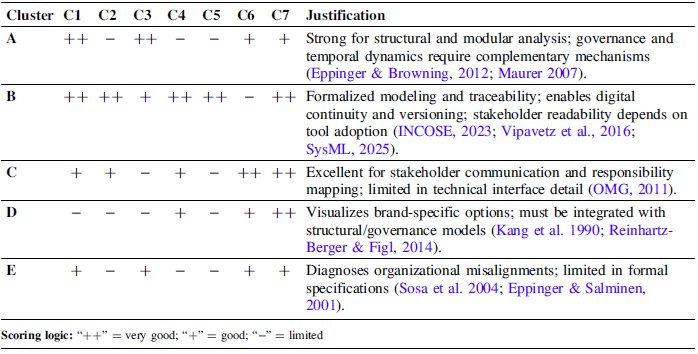
Each cluster was evaluated against the seven criteria derived in Section 5.1 (C1-C7). The evaluation followed a qualitative scoring logic supported by references to key literature. Table 5.1 summarizes the comparative results below.
Comparative assessment of model clusters against criteria C1-C7

Scoring logic: “++” = very good; “+” = good; “−” = limited
The evaluation followed a two-step procedure: First, each cluster was assessed holistically, considering the collective strengths of its constituent models. In order to avoid false precision, individual models were not rated separately to avoid false precision; instead, the focus was on what a methodological family can deliver when applied coherently. Second, justifications were derived from empirical findings from the literature review and triangulated with expert-practice references. Additionally, the comparative assessment presented in Table 5.1 was discussed and validated in a workshop with experts from the field, ensuring practical relevance and robustness of the evaluation.
Matrix-based models (Cluster A) excel in the identification of dependencies and modular boundaries (C1, C3), providing a foundation for complexity reduction. However, they lack built-in governance or lifecycle control (C2, C4, C5). MBSE models (Cluster B) complement this by formalizing interface ownership, providing version control, and supporting digital thread integration (C2, C4, C5). Yet their comprehensibility for non-engineering stakeholders (C6) could lead to some challenges. Process and EA models (Cluster C) close this gap through accessible, organization-level visualizations, enabling joint governance and communication, albeit with less technical depth (C3). Variability models (Cluster D) and network analyses (Cluster E) provide additional perspectives: The former capture brand differentiation logic, while the latter diagnose coordination and alignment issues. Together, they enrich the understanding of multi-brand dependencies beyond the purely technical view.
5.4. Results and interpretation
The comparative result highlights that no single modeling paradigm can address the full set of criteria required in multi-brand PDPs. Instead, the findings suggest a combinatorial modeling strategy:
-
• Matrix and MBSE integration: MDM/DMM models should be used to identify structural dependencies and fed into SysML or MBSE environments for governance and lifecycle management (Reference Brovar, Kazanskii, Tapia and FortinBrovar et al., 2024; Reference Danilovic and BrowningDanilovic & Browning, 2007).
-
• Process and governance coupling: BPMN and ArchiMate models complement MBSE by visualizing responsibilities, collaboration protocols, and decision flows between brands (OMG, 2011; The Open Group, 2022).
-
• Variability and network extensions: FODA/OVM and SNA-based analyses help contextualize technical interfaces within brand strategies and organizational structures (Reference Sosa, Eppinger and CraigSosa et al., 2004; Reference Reinhartz-Berger and FiglReinhartz-Berger & Figl, 2014).
Despite methodological advances, several persistent challenges remain: First, tool chain heterogeneity continues to hinder digital continuity. Integrating DSM or MDM with MBSE and PLM systems often requires custom connectors or manual synchronization, limiting the scalability of digital threads (Reference Brovar, Kazanskii, Tapia and FortinBrovar et al., 2024). Second, data access and IP governance are major concerns in the multi-brand context. Even when MBSE tools technically allow for model sharing, organizational policies and brand protection often restrict transparency (INCOSE, 2023). Third, temporal evolution and version control remain insufficiently modeled. DSM-based representations are static snapshots, while SysML offers improved, but still emerging, capabilities for configuration and branching (SysML, 2025). Finally, stakeholder engagement and interpretability continue to limit adoption. While BPMN improves accessibility, it must be tightly coupled with formal models to ensure semantic consistency (Reference HauseHause, 2018; Reference Trase and FinkTrase & Fink, 2014).
5.5. Reflection
This section provides a structured, literature-based assessment of modeling approaches for visualizing and analyzing interfaces in multi-brand contexts. By combining criteria derived from both theory and practice, the assessment demonstrates that no single model or notation can adequately capture the technical, organizational, and governance dimensions of multi-brand complexity. Instead, a multi-cluster modeling strategy is required. Unlike prior analyses that examine single notations in isolation, this cluster-based assessment compares methodological families against multi-brand-specific criteria (C1-C7) and provides the foundation for compositional adoption paths.
6. Discussion and conclusion
This contribution defines and characterizes the term “multi-brand PDP” and provides a structured overview of existing models for interface visualization and analysis in multi-brand PDPs, highlighting their applicability and limitations. The analysis demonstrates that while all models considered in this contribution offer complementary perspectives, none alone fully addresses the multidimensional complexity of multi-brand contexts. Key challenges include organizational heterogeneity, distributed responsibilities, governance alignment, and the need for digital continuity across brands.
The results indicates that a combinatorial modeling strategy integrating structural dependency analysis, formal interface governance, process transparency, and variability management is required to manage multi-brand interfaces effectively. However, the effectiveness of such integrated approaches remains empirically unvalidated. The next step is therefore a systematic validation through multiple case studies in engineering organizations operating established multi-brand PDPs. These studies will assess which modeling paradigms and combinations thereof are most suitable under real conditions, using authentic industrial data.
Practically, an integrated modeling architecture can enhance interface efficiency by making dependencies, responsibilities, and variability constraints transparent across domains. A structured cross-domain analysis of completeness and change impact enables early identification of coordination bottlenecks and governance gaps, thereby reducing iteration cycles and improving interface robustness across brand boundaries. In conclusion, this contribution establishes a structured foundation for multi-brand interface modeling by clustering existing approaches and deriving multi-dimensional requirements.


 Open access

