

1.1 Introduction
The purpose of this chapter is to survey the status of linguistics in the curricula of US master’s-level teacher training programs for second language (L2) instructional contexts, specifically, Teaching English to Speakers of Other Languages (TESOL) and other language education targeting various learner populations. Later, we explain our methodology and results for considering the presence of linguistics courses in graduate TESOL and other language education programs. Reflecting on the linguistic landscape of these programs and the needs they serve, we note that L2 instruction in the United States is endemic to a wide variety of educational environments that may change rapidly with immigration. L2 teaching may be for learners of new or additional languages in dedicated L2, foreign language, or mainstream classrooms with monolingual native as well as multilingual non-native and heritage language speakers. As such, all language classrooms should be considered, potentially or definitively, instructionally L2.
The need for this work is predicated upon a troubling and long-standing separation in the academic and research agendas of linguistics and L2 studies. Widdowson (Reference Widdowson2020) reconsiders the relationship between linguistics and language education and aptly historicizes the contentiousness that has existed between the two fields. As noted there as well as in other research (Hudson Reference Hudson2004; Petray Reference Petray2004; Spolsky & Hult Reference Spolsky and Hult2008; Riddle Reference Riddle and Carter2012; Correa Reference Correa2014), some purists have held that theoretical linguistics does not apply to education (Chomsky Reference Chomsky and Mead1966/1971; Sampson Reference Sampson1980; Olson & Faigley Reference Olson and Faigley1991). Zhang and Miller (Reference Zhang and Miller2023) describe this disciplinary rift as creating compartmentalization, boundaries, and “discontinuities between theory and practice or between knowledge generation and sharing, as well as between various socio-cultural or educational settings … [hindering] the development of insights into the complexity of education and efforts to improve education.” Precisely. The divide between theoretical linguistics and language education is counterproductive, and such a breach undermines endeavors for all who are concerned with language processes and use, language teaching, and language learning.
Despite some formalist views, confirmation of linguistics being germane to language teaching and learning (whether in a traditional or L2 classroom) has been well established. The same is true for the benefits that theoretical linguistics draws from applied linguistics and second language studies (Widdowson Reference Widdowson2000; Slabakova, Leal & Liskin-Gasparro Reference Slabakova, Leal and Liskin-Gasparro2015; White Reference White2023), a topic more fully explored in different iterations by several chapters in this collection. While Spier (Reference Spier2024) comprehensively studies the general state of linguistics education in American colleges and universities, research on the field’s application specifically to teacher education has also been well evidenced since at least the 1960s.
Scholarship addressing linguistics’ place in teacher education includes research coming from various venues. Lefevere (Reference Lefevre1965) and Adams, Sobin, and Lockerman (Reference Adams, Sobin and Lockerman1969) advocate that teacher training should include education in linguistics. Dinneen (Reference Dinneen1974), de Klerk (Reference de Klerk1992), Carter (Reference Carter1982/2012), and Curzan (Reference Curzan2013) also argue for the importance of linguistics’ presence in teacher education. Similarly, Grabe, Stoller, and Tardy (Reference Grabe, Stoller, Tardy, Hall and Eggington2000), Byrnes (Reference Byrnes2002), Bartels (Reference Bartels2005), and Johnson (Reference Johnson2009) all assert a prominent place for applied linguistics in teacher education. Further, Hudson (Reference Hudson2004) rightly argues that language teaching needs three “finished products” from linguistics: general ideas about language, theoretical models of language and its systems, and accessible descriptions. Updating this (2004) research, Hudson (Reference Hudson2020) explores the history of pedagogical linguistics as a two-way bridge between linguistics and education, where information crosses both from linguistics to education and from education to linguistics, calling on linguists to take stock of education’s impact on language. LaFond and Dogancay-Aktuna (Reference LaFond and Dogancay-Aktuna2009) reveal the importance of linguistic theory in enhancing teachers’ language awareness and professional development. Unsurprisingly, Safford and Kelly’s (Reference Safford and Kelly2010) study on bi- and multilingual student teachers’ training verifies the significance of linguistic capital to the candidates’ own cultural and pedagogic agency and ability to empathize with their multilingual students. Similarly, Correa (Reference Correa2014) argues that linguistics’ place in L2 teaching curricula should be updated and proposes that pedagogy should examine language in a scientific, systematic manner and highlight language dimensions directly relevant to language educators.
With prolific research in this area along with recommendations to increase specific and essential linguistics training for educators, our research’s primary goal was to determine if these recommendations had been heeded in US programs. The following sections detail our discovery of (1) the specific courses required by TESOL versus other kinds of language teacher education programs across the United States, (2) the level of integration of linguistics into these programs along with possible effects on ESOL 5362 and PRAXIS test outcomes, and (3) recommendations for programmatic changes.
1.2 Methodology
So, what is the status of linguistics in higher education language teacher training programs? To begin to answer this question for a selection of the wide-ranging post-baccalaureate degrees that educate language teachers, we examined two general L2 teacher education program types that, arguably, should include linguistics in their curricula, MA/MS TESOL and MA/MS Education majors that concentrate on language. We defined our field of data using the National Center for Education Statistics’ (NCES) Classification of Instructional Programs (CIP) code taxonomy, developed by the US Department of Education. We determined which programs to investigate, first, by searching the Integrated Postsecondary Education Data System (IPEDS) for institutions reporting completions between 2011 and 2020 for CIP code 13.14, the academic area designation for Teaching English as a Second or Foreign Language.Footnote 1 From this resulting set of institutions, listed alphabetically, we analyzed all active master’s-level TESOL degree programs and at least one other master’s-level language teacher degree for the same respective schools, whether for early childhood, elementary, secondary, or adult literacy education.
A few methodological caveats bear mentioning. First, this research originated for a symposium sponsored by the Linguistics in Higher Education Committee for the 2016 annual meeting of the Linguistic Society of America (LSA) (Linguistic Foundations for Second Language Teaching and Learning Symposium). That early stage of research was a pilot that investigated 100 graduate IPEDS programs, two from each of the fifty US states. This chapter’s expanded study more than doubles the number of institutions assessed and updates the programmatic data. Second, while examining undergraduate language teacher education programs would also be of interest and awaits future study, we have considered only master’s degrees. Finding that language teacher training varies widely from state to state, including baccalaureate, non-degree post-baccalaureate certification, graduate degree, and graduate-level licensure-only education, we wanted to make certain curricula and their data were comparable. Third, we adjusted our list or eliminated some institutions and programs from our analyses to ensure equivalent and analyzable data: An institution’s website may have offered no or very limited curricular information, programs appearing twice in the IPEDS list may have been duplicative (for example, the same degree and curriculum offered both online and in person), an institution may have been shuttered, a program may have been closed, or a program listed in the IPEDS data may have been an undergraduate degree or a graduate-level non-degree certificate. Any of these cases would have skewed our results, so we culled a strict list of only active master’s degree programs whose curricula could be analyzed using our methodology.
As Section 1.3 indicates, our initial list of programs from 261 US universities and colleges was whittled down to 219 after eliminating non-analyzable and non-master’s degree programs, duplications, and closures. Thus, we examined 118 sets of private university programs and 101 sets of public university programs, each set by institution comprising at least one TESOL MA/MS (or equivalent) degree and at least one MA/MS (or equivalent) language-oriented degree in early childhood, elementary, secondary, or adult literacy education. Analyzing the curricula of these active language teacher education programs, we sought to discover how course information revealed the status of linguistics in them. We reviewed institutional website information for this purpose, including program, department, and school pages, links, and downloadable documents such as course catalogs, curriculum guides, and student handbooks. We had two objectives: (1) to discover the presence or absence of linguistics courses in program curricula and (2) to discern linguistics’ importance to (or foundational role in) these programs in terms of required or elective coursework. By determining if linguistics courses were curricularly present, if they were required or elective, and which areas of study were represented by course title, we were able to classify the level of integration of the field into these programs.
1.3 Results
An initial troubling, and notable, finding from this study is the number of master’s level TESOL programs and entire institutions that have shuttered in the last decade, a trend that has escalated dramatically since the 2020–2021 COVID pandemic. Castillo and Welding (Reference Castillo and Welding2024) report that, nationwide, at least 61 public or nonprofit colleges have closed, merged, or announced closures or mergers since March 2020 for reasons dealing with accreditation issues, financial turmoil due to lack of funding, enrollment declines, and the pandemic, as well as, in a small number of cases, mergers for the involved institutions’ mutual benefit. From our initial list of 261 schools that were reported by IPEDS to offer master’s in TESOL programs at some point prior to 2020, the following alphabetical list of 42 schools indicates where, to date, 7 institutions have closed completely (represented in bold below) and 35 graduate TESOL degree programs have been suspended (dates of closure are given where available):
1. Albright College – TESOL program closed, date unavailable
2. Alliant International University – TESOL program closed August 2022
3. Biola University – TESOL program closed 2024
4. Bob Jones University – TESOL program closed, date unavailable
5. Cardinal Stritch University – Institution closed May 2023
6. Central Michigan University – TESOL program closed, date unavailable
7. Central Washington University – TESOL program closed after 2019
8. Clarkson University – TESOL program closed March 2024 (transferred to Siena College)
9. Concordia University-Portland – Institution closed 2022
10. D’Youville College – TESOL program closed, date unavailable
11. Dominican University – TESOL program closed, date unavailable
12. Duquesne University – TESOL program closed, date unavailable
13. Emporia State University – TESOL program closed 2021
14. Fairfax University of America – TESOL program closed after 2019-20
15. Fresno Pacific University – TESOL program closed, date unavailable
16. Holy Names University – Institution closed 2023
17. Johns Hopkins University – TESOL program closed 2018
18. Judson University – TESOL program closed, date unavailable
19. La Salle University – TESOL program closed after 2022–2023
20. Lincoln Christian University – Institution closed 2024
21. Lindenwood University – TESOL program closed 2015
22. Loyola Marymount University – TESOL program closed after 2018–2019
23. Madonna University – TESOL program closed after 2023–2024
24. Marlboro College Graduate & Professional Studies – Institution closed 2020
25. Marymount University – TESOL program closed, date unavailable
26. MidAmerica Nazarene University – TESOL program closed, date unavailable
27. Minnesota State University Moorhead – TESOL program closed 2021
28. Moody Bible Institute – TESOL program closed after 2023–2024
29. Multnomah University – Institution closed 2024 (merged with Jessup University)
30. Oklahoma City University – TESOL program closed, date unavailable
31. Seattle University – TESOL program closed, date unavailable
32. Texas Southmost College – TESOL program closed before 2011 (institution transitioned to independent community college in 2011 after University Texas-Brownsville partnership ended)
33. The College of New Rochelle – Institution closed 2019
34. The Evergreen State College – TESOL program closed 2012
35. University of Miami – TESOL program closed, date unavailable
36. University of North Carolina-Chapel Hill – TESOL program not offeredFootnote 2
37. University of Scranton – TESOL program closed, date unavailable
38. University of the Southwest – TESOL program closed after 2014
39. University of Toledo – TESOL program closed 2020
40. Western Carolina University – TESOL program closed 2018
41. Whitworth University – TESOL program closed 2016
42. Xavier University – TESOL program closed 2020
It is unfortunate but unsurprising that some universities and colleges have been unable to weather the economic storm resulting from the lingering effects of the Great Recession of 2007–2008 and COVID pandemic financial sector woes. Higher education has already been experiencing budgetary strains due to decreased state funding, rising costs of education, higher student debt loads, growing economic disparities, and even shifts in perception about the value of a college degree influencing those who might attend to seek other avenues of career training, and the pandemic worsened that environment significantly after COVID-era federal funding expired. Jackson and Saenz (Reference Jackson and Saenz2021) report:
Heading into the COVID-19 recession, state higher education funding nationally was still below its level in 2008 (just before the Great Recession took hold) … Between school years 2008 and 2019, after adjusting for inflation, funding fell by $3.4 billion nationally; 37 states cut per-student funding, six of them by more than 30 percent. On average, states cut spending by $1,033 (11.6 percent) per student.
This situation spells disaster for language learner populations who already are seen by state governments as less of a priority.
Along with this trend, enrollment declines forecast for higher education due to demographic changes since the 2007–2008 US recession (see Bauman’s Reference Bauman2024 Chronicle of Higher Education article) and a marked decrease in college students being required to take courses in languages other than English (see Winter 2023 of the MLA Newsletter) paint a dim picture for multilingual education in the United States. Whether dwindling enrollment is caused by a drop in birth rates, high school graduates choosing alternate paths in post-secondary education instead of college, or attitudinal shifts away from the humanities and towards science, technology, engineering, and math (STEM) majors, the socioeconomic landscape at home and abroad remains linguistically rich and diverse. Ignoring the fact that many career paths require some level of proficiency in more than one language is short-sighted and disadvantages employers, their future workers, and the industries to which they attend. Likewise, we must expect the intercultural knowledge that comes from learning another language to be a necessary soft skill for language-learners-as-workers in the global marketplace. The loss of language teacher training programs underscores the threat to language education and references a US tradition of multilingualism and the communicative expertise needed to be a multilingual professional being undervalued and unappreciated. As one applied linguistics expert rightly argues, “The choice to be ML [monolingual] is out of step with global politics and economics and with children’s lives in the 21st century. We can no longer afford an ML [monolingual] frame of reference” (Zurer-Pearson Reference Zurer-Pearson2010: 341–342). Indeed, the need for remaining programs to educate language teachers effectively as linguistically informed practitioners to serve these educational and global marketplace demands has never been more dire.
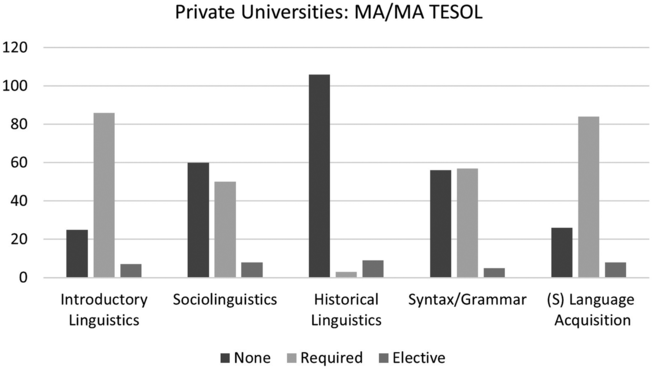
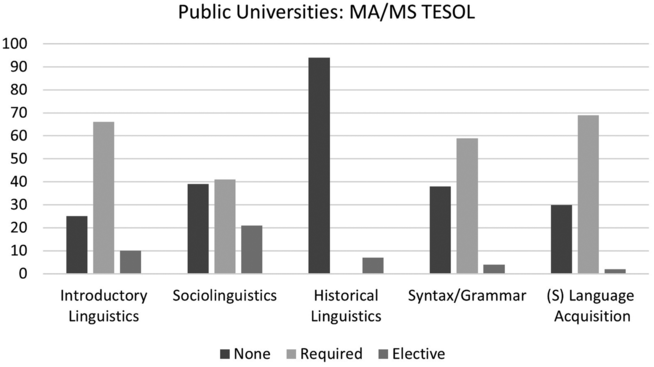
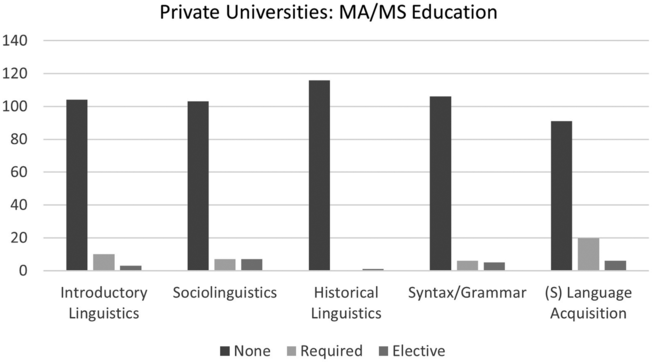
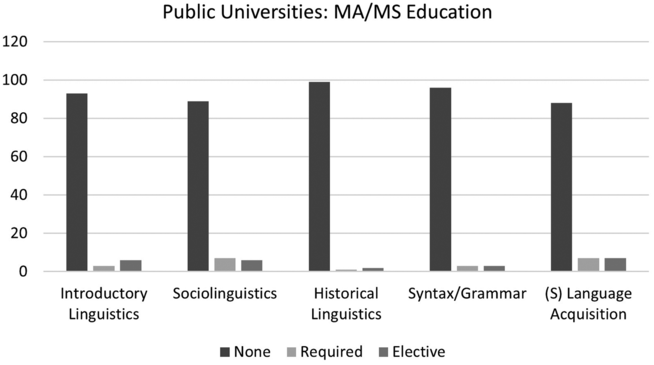
Figures 1.1–1.4 establish that TESOL programs, as expected, require more foundational language and linguistic courses, such as an overview course (labeled Introductory Linguistics in many programs), sociolinguistics (or a similarly named course on the cultural and social aspects of language and its variation), a syntax or grammar course that investigates syntactic and morphosyntactic patterning in target or frequently found languages (for example, depending on a school’s location and the communities where educators are likely to teach, some courses prioritize Spanish syntax or a syntactic comparison between English and Spanish), and a language acquisition course concentrating on the development of language structure and use in first and/or second language acquisition (SLA). Historical linguistics was one type of course we hypothesized might be offered more in the MA/MS English programs that became part of this study. Our firsthand experience with several English departments included a course such as this, which can help with language tasks such as understanding diachronic language change or reading/teaching Old and Middle English texts. As the reader will see, our hypothesis proved incorrect, leading us to conclude that our experiences were not typical of others and/or speculate that departments who offer this subarea are likely those at larger universities with robust linguistics departments catering to several majors.

Figure 1.1 Analysis of 118 private university programs in MA/MS TESOL, M.Ed TESOL, MA Engl-TESOL, MS Education-TESOL, MAT in ESL, MS Ed in English Language Learning and Teaching, and related degree labels.
Figure 1.1Long description
The bar graph compares data for 5 courses namely, Introductory Linguistics, Sociolinguistics, Historical Linguistics, Syntax or Grammar, and Second Language Acquisition by none, required, and elective each. Introductory Linguistics and Second Language Acquisition have the maximum values for the required category, followed by Syntax or Grammar and Historical Linguistics. Historical Linguistics, Sociolinguistics, Syntax and Grammar, Second Language Acquisition, and Introductory Linguistics have decreasing order of values for the category none. Historical Linguistics, Second Language Acquisition and Sociolinguistics, Introductory Linguistics, and Historical Linguistics have decreasing values in order for the category elective.

Figure 1.2 Analysis of 101 public university programs in MA/MS TESOL, M.Ed TESOL, MA Engl-TESOL, MS Education-TESOL, MAT in ESL, MS Ed in English Language Learning and Teaching, and related degree labels.
Figure 1.2Long description
The bar graph compares data for 5 courses namely, Introductory Linguistics, Sociolinguistics, Historical Linguistics, Syntax or Grammar, and Second Language Acquisition by none, required, and elective each. Historical Linguistics, Sociolinguistics, and Syntax or Grammar, Second Language Acquisition, and Introductory Linguistics have decreasing order of values for the category none. Sociolinguistics, Introductory Linguistics, Historical Linguistics, Syntax or Grammar, and Second Language Acquisition have decreasing values in order for the category elective. Second Language Acquisition, Introductory Linguistics, Syntax and Grammar, and Sociolinguistics have decreasing values in order for the category Required. Historical Linguistics has no bars for the category required.

Figure 1.3 Analysis of 118 private university programs in MA/MS Education, MA Teaching, MS Secondary Education, M. Ed. in Teaching and Learning, and related degree labels.
Figure 1.3Long description
The bar graph compares data for 5 courses namely, Introductory Linguistics, Sociolinguistics, Historical Linguistics, Syntax or Grammar, and Second Language Acquisition by none, required, and elective each. None has the highest range of values varying between 90 and 120, approximately with Historical Linguistics, Syntax and Grammar, Introductory Linguistics, Sociolinguistics, and Second Language Acquisition in decreasing order of values. Second Language Acquisition, Introductory Linguistics, Sociolinguistics, Syntax or Grammar, and Historical Linguistics in decreasing order of values for the category required. Sociolinguistics, Second Language Acquisition, Syntax or Grammar, Introductory Linguistics, and Historical Linguistics have decreasing order of values for the category elective.

Figure 1.4 Analysis of 101 public university programs in MA/MS Education, MA Teaching, MS Secondary Education, M. Ed. in Teaching and Learning, and related degree labels.
Figure 1.4Long description
The bar graph compares data for 5 courses namely, Introductory Linguistics, Sociolinguistics, Historical Linguistics, Syntax or Grammar, and Second Language Acquisition by none, required, and elective each. None has the highest range of values varying between 85 and 100, approximately with Historical Linguistics, Syntax and Grammar, Introductory Linguistics, Sociolinguistics, and Second Language Acquisition in decreasing order of values. Second Language Acquisition and Sociolinguistics, Introductory Linguistics and Syntax or Grammar, and Historical Linguistics in decreasing order of values for the category required. Second Language Acquisition, Introductory Linguistics, Sociolinguistics, Syntax or Grammar, and Historical Linguistics have decreasing order of values for the category elective.
As predicted and shown in Figures 1.1–1.2,Footnote 3 our results indicate that TESOL master’s programs overwhelmingly outnumber other kinds of university degrees in language teacher training in their adoption of linguistics as foundational. The majority of TESOL degrees in our study require Introduction to Linguistics (69%) and Sociolinguistics (41.5%). Significantly fewer of the other types of language teacher training programs, labeled as Master of Arts in Teaching/Master’s in Education (MAT/MEd, MA/MS Ed), require Introductory Linguistics (5.9%) and/or Sociolinguistics (6.3%).
An unexpected difference in results from the 2016 pilot compared to this chapter’s expanded study is a change in frequency for Introductory Linguistics or Sociolinguistics courses to be required. When we first began analyzing programs for the 2016 LSA panel, the MA/MS Education programs we analyzed required Introductory and Sociolinguistics classes at higher rates, 20% and 15% respectively. These results still fall short of TESOL programs’ requirements, but as mentioned above, the expanded study and more recent data show a dramatic fall in Education’s requirement rates, 5.9% and 6.3%, respectively. What has precipitated this decrease in linguistics being required? One possible answer lies with local school districts and state boards of education. While US high school graduation requirements nationwide continue to evolve (in some cases, being softened) for various reasons such as bolstering graduation rates and funding issues, states and/or school districts are simultaneously experiencing a lack of funding and other resources for English learner classes. Universities also may play a part in this change by shifting support away from the humanities and towards STEM fields without recognizing the benefit that an additional language would have for those careers, softening their own matriculation requirements such as piloting three-year (ninety-credit hour) degree tracks,Footnote 4 and offering alternative teacher-prep/lateral entry training programs that are more like a certificate than a complete degree, with fewer requirements.Footnote 5 Programmatic changes may also be caused by ideological shifts in educational requirements and preferences.
These results both highlight the ways that master’s in TESOL candidates are better prepared to apply some areas of linguistics to their teaching and underscore the handicap that education majors and their students face by limited exposure to such essential subject matter in a country with an ever-growing English learner population.
Our results also demonstrate curricular differences between private and public university programs. In our initial 2016 pilot, private university programs were shown to require more linguistic courses than public institutions. That finding is confirmed in this chapter’s updated and expanded investigation. As shown in Figure 1.1, private university TESOL programs require Introductory Linguistics 73% of the time, while public universities’ TESOL programs, shown in Figure 1.2, do so only 65% of the time. While with much less frequency, we see a similar distribution of private versus public requirements in other language teacher training degrees, as depicted in Figures 1.3–1.4: Private schools require an introductory course 8.4% of the time, while public institutions require it only 2.9% of the time. Similarly, private TESOL programs also require courses in second language acquisition (SLA) 71% of the time, while public programs do so at 68%. Beyond TESOL program findings, the distribution for inclusion of SLA in other language teacher education master’s degrees is also notable, with private institution programs requiring SLA at 17%, while only 7% of public institutions do the same.
Zooming in on one state accentuates the glaring discrepancies between TESOL and other language teacher education program requirements that, seemingly, have no direct relationship to the cultural, ethnic, racial, or linguistic heterogeneity of the local landscape. New York is now the seventh most racially and ethnically diverse state and fourth in linguistic diversity (Map Shows Most 2024). New York state public higher education includes the State University of New York (SUNY) and City University of New York (CUNY) systems, dual systems within one state. SUNY schools feature a more traditional bucolic college environment, while CUNY campuses are housed in the five New York City (NYC) boroughs and mainly for urban commuters. Funding differs; SUNY is financed by the state as a whole, while CUNY is supported by both the state and separate city funding. The differences in diversity for NYC versus the state are noteworthy. For example, Albany as the state capital is in upstate New York, has a population of 101,228 (2023 Population Estimates 2019), and is less diverse than NYC but is still linguistically diverse. The top three languages spoken, other than English, include Spanish, Chinese (combined Mandarin and Cantonese), and French (including Cajun). Albany’s top ten languages also include Urdu, Polish, and Tagalog (Tampone Reference Tampone2022). Contrast that with NYC, the world’s most linguistically diverse city, with an estimated 8.2 million residents who speak over 800 languages (Lubin Reference Lubin2017). Given these demographics, one might expect the CUNY system to have more linguistics requirements within a TESOL or an education degree.
Looking closely at SUNY-Albany’s TESOL program, curricular analyses show introductory linguistics and sociolinguistics are present, but they are elective options instead of required. Two requirements are a syntax/grammar/structure course and a phonetics/phonology course. Other SUNY campuses (Brockport, Cortland, and Fredonia) require Introductory Linguistics and one (S)LA course, but sociolinguistics is not even an elective in their respective TESOL degrees. Like SUNY-Albany, SUNY-Cortland also requires a syntax/grammar/structure course. Overall, SUNY universities do not match requirements for their TESOL master’s programs.
In contrast, the SUNY system’s Education master’s degrees require zero linguistics courses. No courses were listed as electives, either. Each SUNY school labels the degree differently: the Albany campus has an MS in Secondary Education (one education track and one world languages track); the Brockport campus has an MS Education–English Education; SUNY-Cortland has an MAT in Secondary Education, and the Fredonia campus has an MA in English Adolescent Education. Especially for the SUNY-Albany degree, we find it peculiar that a world languages education track would not require at least one linguistics course!
Moving to the CUNY system with City, Hunter, Lehman, and Queens campuses, one would clearly expect in the most linguistically diverse city in the world, there must be more linguistics requirements in their language teacher training programs. In fact, CUNY TESOL programs do require linguistics more comprehensively than the SUNY TESOLs. Each campus requires four similar courses: (1) introductory linguistics, (2) (S)LA, (3) syntax/grammar/structure, and (4) an L2 teaching and assessment course. Further, CUNY programs require two–three additional courses, differing slightly in specific requirements: phonetics/phonology; reading, writing, literacy; listening, speaking, pronunciation; and/or sociolinguistics and SLA addressing diverse languages and classrooms.
While TESOL fares well at CUNY for a curricular focus on linguistics, switching to their Education programs, none require an introductory course. Of all the NYC borough-based campuses, City CUNY has the most requirements: (1) syntax/grammar/structure, (2) reading/writing/literacy, (3) listening/speaking/pronunciation, (4) Spanish linguistics, (5) sociolinguistics and (S)LA course on diversity, and (6) teaching/assessing L2 learners. CUNY-Hunter similarly requires socio, syntax/grammar/structure, and [S]LA courses. The campus at Lehman requires reading/writing/literacy, teaching/assessing L2 learners, Issues in Bilingualism (categorized as sociolinguistics due to the course description), and a bilingual course (categorized as [S]LA due to the course description). CUNY-Queens requires no linguistics and offers zero electives. These details reveal that programmatic requirement alignment is conspicuously absent in an education system that spans one large metropolis, much less across state system requirements.
These results generally highlight that private schools are equipping soon-to-be teachers with more foundational language and linguistic knowledge than public university programs. Public universities are wildly different. One explanation is that public institutions tend to have an in-state student enrollment goal, often due to state funding statutes. Private schools rarely have a similar regulation. Students also choose private institutions for reasons in addition to earning their degree, including school size, religious affiliation, prestige, and family legacy. For example, anecdotally, one author has maintained contact with four MA education majors from 2021 to 2022. None was born or raised in the state where they attended university. One is now a student in speech language pathology, another is working in Connecticut, a third is a research assistant at the University of Maryland, and the fourth continued studies at Harvard and is now teaching in a Massachusetts public school. Perhaps private programs serve a wider range of needs and recognize a majority of their students will not, typically, teach in local, public schools, so the curricula are designed to give them the deepest knowledge that would benefit an educational setting anywhere. Yet, the CUNY institutions are all public colleges populated mainly by commuters. While CUNY-City had six linguistics courses required, CUNY-Queens had zero for the Master’s in Education.
1.4 Discussion
As explained above, the results of this study indicate that, compared to their counterparts in other areas of language teacher education, master’s-level TESOL programs do a better job of providing linguistics curricular content to train L2 teachers to be linguistically prepared and have pedagogically actionable knowledge about language (KAL) for effective language learner instruction. While it makes sense that TESOL programs founded in the applied linguistics discipline would, in fact, follow this trend, not all language teacher education programs (TESOL or otherwise) are equal in their curricular dedication to linguistics. Based on a variety of factors such as faculty and departmental resources, program history, institutional culture, and educational backgrounds of faculty tasked with teaching language educators, programs vary by the number of credits required and which courses are highlighted as required or elective.
We wondered if teachers coming from programs requiring linguistics would evidence that knowledge in teacher test scores. To that end and to extend our programmatic analysis, we contacted the Educational Testing Service (ETS) to see if teacher testing results might correlate with the programs our study determined as richer in linguistic curricular content. We provided them with our list of institutions from the IPEDS data used to identify TESOL programs with a 13.14 CIP code. After communicating with ETS analyst Jonathan Steinberg about the possibilities, he determined these could be used (although the process needed to include examinees seeking licensure for speech-language pathology or audiology because the same test is used) to generate aggregate performance statistics on the English to Speakers of Other Languages (ESOL) test 5362 and, potentially, for the Foundations of Linguistics subscale category. In the end, the Foundations of Linguistics subscale category score element of the request was beyond the technological capacity of ETS’s back-end support team. ETS confirmed they could supply mean score and pass rate results.Footnote 6
After confirming our request via a signed Data Usage Agreement, ETS lead analyst Steinberg and his colleagues looked at average scores across states and compared aggregate data for all programs with linguistics to data from programs without linguistics. In examining pass rates, ETS identified four groups to consider based on the presence or absence of linguistics in programs and the requirement/non-requirement of their ESOL 5362 exam: (1) programs with linguistics where ESOL 5362 is a required test; (2) programs with linguistics where ESOL 5362 is not required; (3) programs without linguistics where ESOL 5362 is a required test; and (4) programs without linguistics where ESOL 5362 is not required. In determining pass results, a minimum passing score of 155 on ESOL 5362 was used, since this is the cut-off for most states (some states may use a value lower or higher than this 155).
Using a Test Date Range of 1 September 2016 to 31 August 2021, programs with linguistics instruction saw a 97.7% pass rate for ESOL 5362 (5,546 examinees, and 5,421 earned a minimum score of 155, with a mean score of 177). For the same date range, programs with no linguistics instruction saw a pass rate of 95.2% (7,838 test-takers, and 7,462 passed with a minimum score of 155, with a mean of 176.15). Thus, ETS’s analysis yielded results that support our claim of stronger linguistics knowledge demonstrating stronger test performance, although not as strong as we had predicted. ETS was not able to supply results of the Foundations of Linguistics subscale category findings, which might have provided more nuanced results that further demonstrate which candidates were strongest. As well, while ESOL 5362 is designed to measure basic linguistic and pedagogical knowledge for candidates interested in teaching English speakers of other languages at the elementary or secondary school level (see https://praxis.ets.org/test/5362.html), how that correlates with excellence in applying linguistics knowledge in the instructional setting is another issue. Performing well on a test and performing well in the classroom are not the same. We know ESOL 5362 test-takers from programs requiring linguistics performed slightly higher based on mean score, and they passed at a higher rate than those from programs not requiring linguistics. Thus, their knowledge base was higher by a slim margin. But, when considering states that do or do not require the exam for licensure, and while performance was slightly higher for test-takers in states where the exam is required, no significant difference existed for those in programs requiring linguistics and for those not requiring linguistics. More research is needed to explore these findings.
The PRAXIS exam is another ETS-sponsored external device designed to measure pedagogical knowledge and skills, including those related to language, reading, and writing, among others. However, since PRAXIS 1 and PRAXIS 2 are required by only thirty-six states, there is no equivalent way to evaluate the programmatic differences we discovered. These tests measure the academic proficiency of prospective teachers at the beginning and middle (or end) of their training. In each state, the department of education sets the minimum scores needed to pass each subject matter test (available at https://praxis.ets.org/scores). For example, in North Carolina, the Middle School English Language Arts test (ETS test #5047) requires a passing score of 164. In Pennsylvania, the same test is not required; instead, teacher trainees will take the Pennsylvania Grades 4–8 Subject Concentration: English Language Arts test (ETS test #5156) and need a passing score of 156. On the West Coast, in California, Praxis exams are not required except for audiology and speech-language pathology. And in randomly selected Kansas, the Middle School Language Arts test (ETS test #5047, like North Carolina) requires a 158 to pass. These licensure test results, patterns of difference in state usage or passing score, and the curricular variabilities in programs across the nation identified in this chapter’s study demonstrate that determining takeaways is a complex endeavor. Our curricular analyses reveal differences in where linguistics is an integral part of language teacher education. The ESOL 5362 assessment of which candidates score well and where suggests linguistics presence in a curriculum may have an impact, even if modest; yet other factors must be responsible for why and how effective linguistically informed L2 instruction occurs in the classroom. Identifying those factors will require further study.
1.5 Conclusion
So, what can programs, departments, and schools do to integrate linguistics into language teacher education more definitively? As language teacher trainers, ourselves, we are keenly aware that finite resources and institutional or state requirements may limit how much curricular change can be undertaken; there is too much on our plates already. Still, because the stakes are so high for L2 learners and their futures, as well as for communities that benefit from a well-educated, communicatively competent, multilingual workforce, we encourage programs to amp up the integration of linguistics in their programs to the best of their capacity. If programs are unable to add new courses, adding linguistics content at a topic level into existing courses is a viable workaround when limitations restrict the ability to do a whole-scale curricular overhaul. Chapters 2–14 in this collection eloquently explain how linguistics relates to L2 endeavors, a starting point for how course revision could be accomplished with this goal in mind. If programs are able to undergo significant change and want to model strong programs with ample linguistics requirements, examples from both public and private institutions include those at Ball State University, SUNY Binghamton, California State University–Northridge, Hamline University, Indiana State University–Terre Haute, Northeastern Illinois University, Southern Illinois University, Teachers College at Columbia University, and the University of Texas. Requiring courses in introductory linguistics, grammar (which may include morphology and/or syntax), SLA, and sociolinguistics better equips educators and amplifies their linguistically informed pedagogical approaches to best serve learner needs. Finally, education programs (for elementary and middle grades English Language Arts, secondary English literature and writing courses, as well as other language courses) should hire or have on staff at least one linguistics faculty member who specializes in educational and applied linguistics.
Hamada and Miller (Reference Hamada, Miller, Zhang and Miller2023) make clear that TESOL education leads the pack in embracing its disciplinary origins of applied linguistics and SLA, despite having some linguistics’ ground to make up because of a focus on education and instruction, rather than language acquisition and learning. As they argue, “K-12 schools in the US have a pressing need for more qualified teachers to educate all ELs [English language learners] with academic excellence. In order to achieve this goal, teacher education programs need to be willing to cross boundaries between traditional disciplines” (Hamada & Miller Reference Hamada, Miller, Zhang and Miller2023: 145). This study echoes that trend but adds to it an emphasis on introductory linguistics and grammar/syntax for a majority of programs. The need for linguistically trained language teachers includes pre-school, kindergarten, elementary, middle grades, secondary, and adult EL education, as well as foreign language and mainstream English classrooms in multilingual and multicultural districts, regions, and states.
While not exhaustive, this study begins to answer whether or not the integration of linguistics into teacher education programs is sufficient and/or significant. As discussed, linguistics is widely asserted to be a foundational discipline contributing to language teacher education, whether the context of instruction is for first, second, or foreign language learners. Minimally, all language teachers must be equipped with a solid background in introductory linguistics to understand the target language’s sound, morpheme and word-level, phrase and sentence-level, and discourse/pragmatic-level subsystems in order to better prepare their own students for optimal language acquisition. Additionally, an understanding of sociolinguistics is important for pre- and in-service teachers to better prepare their own students for grasping the sociocultural and ideological aspects of the target language and the cultures where it is spoken. The same is true for teachers’ knowledge of the physiological underpinnings of how language develops in children and the psychological dimensions of acquiring new languages in late adolescence and beyond through the study of first and second language acquisition.
While some language teacher education programs highly integrate linguistics into their curricula and prepare their graduate students with deeper language inquiry, more preparation in linguistics is needed across the board. The complexity of program development and state requirements may restrict the variety or number of courses able to be offered; however, linguistics must be a central component in program development and program revision discussions. Future research may indicate how gaps in teacher preparation for linguistics negatively impact language instruction and suggest innovative ways to integrate linguistics into an already packed teacher education curriculum.
1.6 Project Ideas and Discussion Questions
1. Project Ideas: Explore a language teacher education program at either the graduate or undergraduate level at your institution or another you have access to. Research the program by reviewing catalog information or interviewing a faculty member to determine answers to these questions: Are any linguistics courses required or offered as an elective for this program, and if so which ones? For a program’s total number of credits, what percentage are language or linguistics courses? Does the undergraduate or graduate level and/or the curricular home of the program seem to impact the chances for linguistics to be part of the curriculum?
2. What are the reasons a TESOL or language teacher education program may or may not offer or require linguistic courses? How do the faculty, support staff, financial, institutional, library, and administrative resources available (or not available) for a given program impact its ability to update curricula so that new courses in areas of need and relevance can be made available to teachers in training?
3. What advantages or disadvantages can you see to requiring one or more of the following courses in a language teacher education program – introductory linguistics, sociolinguistics, grammar/syntax, and second language acquisition? Are there other linguistics courses or topics you would argue should be included? What challenges might these courses present for teachers in training or for the faculty who teach them, and how can those challenges be overcome?
4. One argument made in this chapter is that language teachers of all learners should be trained to teach L2-oriented material and concepts. Do you agree or disagree, and why?
5. What other kinds of linguistically oriented knowledge about language should language teachers have to make their teaching more effective and inclusive?