




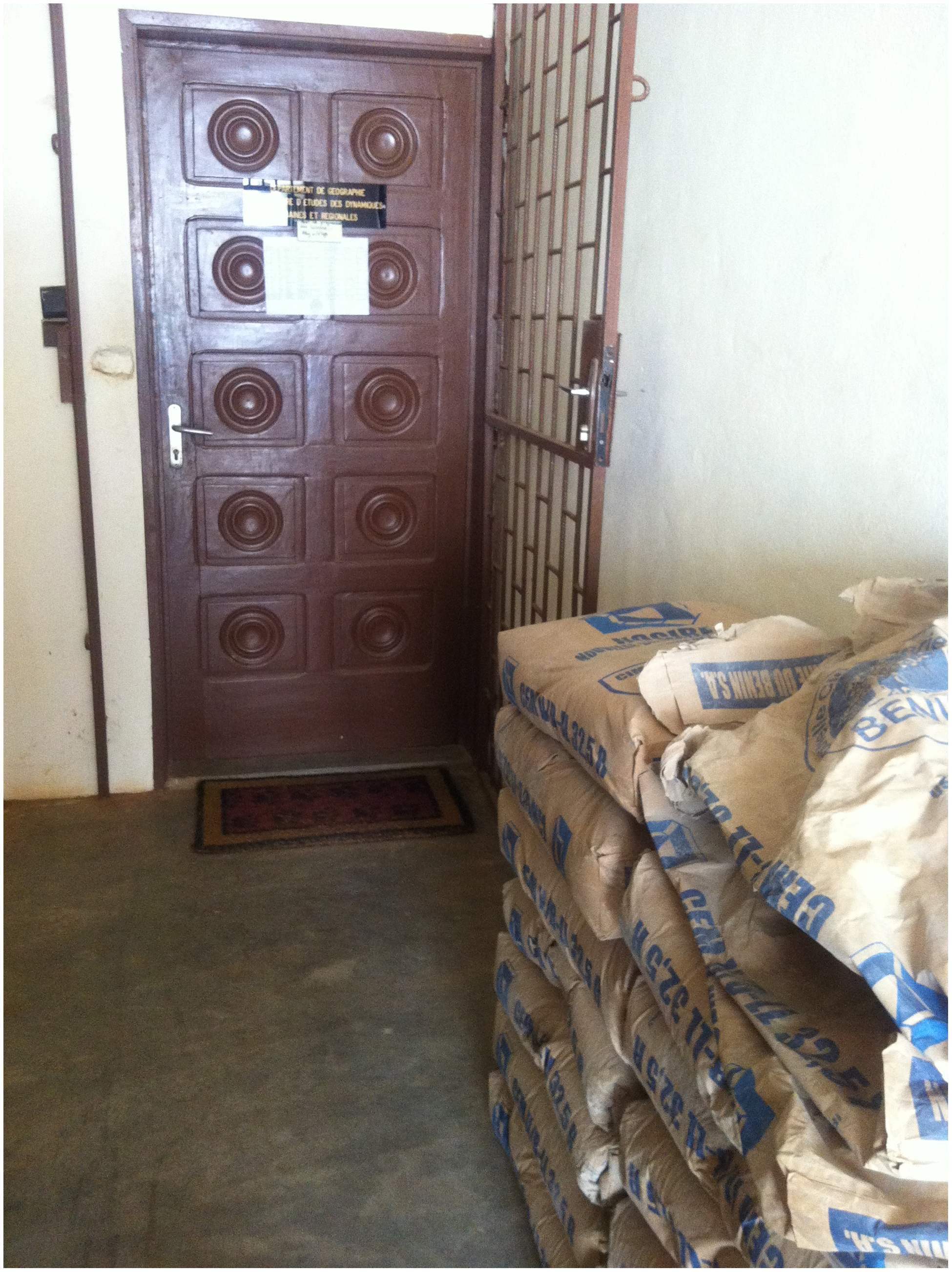
‘What we need to question is bricks, concrete, glass, our table manners, our utensils, our tools, the way we spend our time, our rhythms. To question that which seems to have ceased forever to astonish us.’ Such is the invitation made by the novelist Georges Perec (Reference Perec1997) in his essay ‘L’infra-ordinaire’. I often thought about this quote when, from 2016 to 2019, I was living in Benin and working at the University of Abomey-Calavi in Cotonou. During my time at the university, I was surprised to see bags of cement stored in front of the collective office door (Figure 1). And these bags remained in this prominent position for almost an entire year. Each day as I passed them on the way into my office, I wondered where they came from, who had paid for them and what they were going to be used for.
Cement bags stored in front of the geography professors’ office, University of Abomey-Calavi, Cotonou, Benin, October 2016.
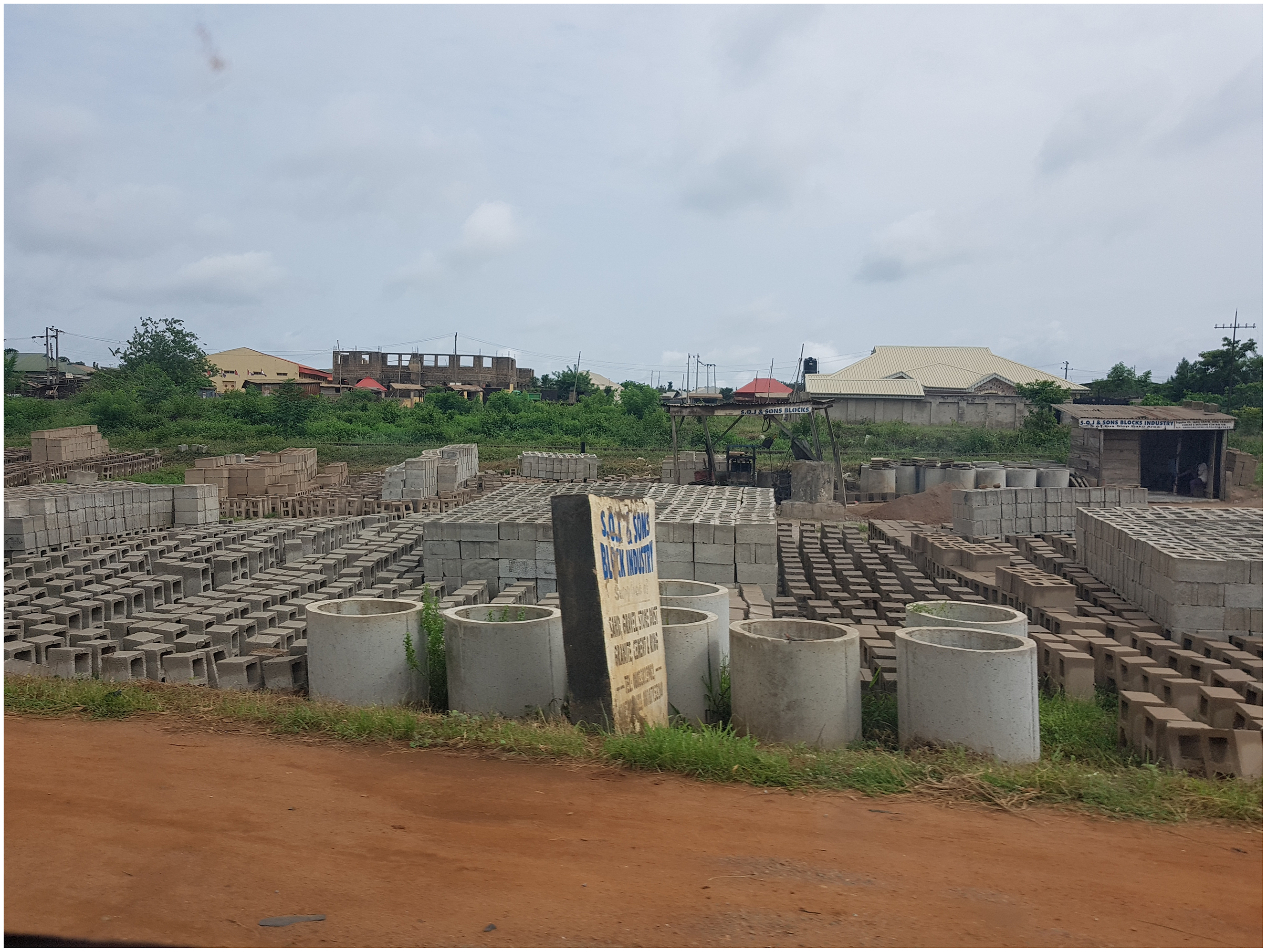
At Georges Perec’s invitation, I began to question the omnipresence of bags of cement and concrete blocks, which can be bought at any hour of the day or night on the streets of Lagos, Cotonou and Porto-Novo (Figure 2). Main roads are lined with hardware stores selling cement, steel reinforcing bars, piles of gravel and sand. Mixed together, cement, water, gravel and sand give birth to concrete. In this part of Africa, concrete is increasingly taking hold of physical landscapes, popular consciousness and everyday conversations.
Sale of concrete blocks, Lagos, Nigeria, June 2018.
Tracing the trajectory of concrete in Africa is very relevant. At the time of colonization, it was an imported material reserved for the colonial elites and neighbourhoods, as David Morton demonstrated in the case of Maputo (Morton Reference Morton2019). Since decolonization, concrete has become a privileged material of development and a symbol of modernity (Herz etal. Reference Herz, Schröder, Focketyn, Baan and Webster2015). It is associated with economic growth and seen as a lever of development (World Bank 2016). In a few decades, concrete has become ubiquitous and a common denominator in most areas across the city: in the city centre, where cranes build modern skyscrapers for the elite; in the middle-class neighbourhoods, where ordinary households incrementally construct their homes; and in the precarious suburbs, where poor people seek to build in concrete to protect themselves from precariousness. Today, concrete has become a total social fact of the city: rich and poor alike have to deal with it.
This article explores how cement and concrete (re)shape African urban environments and human lives. My approach is inspired by Marxist theories, and I use the conceptual framework developed by Henri Lefebvre on the production of space to grasp contemporary city-making in Africa (Lefebvre Reference Lefebvre1974). According to Lefebvre, urban space is both a product and a producer, which in turn acts on the societies that produced it. Urban space is today increasingly linked to concrete, which is the material that underlies its production. Concrete is heuristic because it is both substance and matter when it is in the state of cement powder, it is a material when the cement turns into concrete, and it becomes a thing when it is found in the form of cement bags and concrete blocks. Following the flow of cement and concrete, this article examines what kind of space is produced by concrete, who experiences it, for whom it is conceived, and how this material shapes urban forms, the lives of city dwellers and their urban futures. By investigating three dimensions associated with concrete – its links with capital, its social meanings for inhabitants-builders, and its ecological impacts – this article aims to contribute to recent work on urban materiality (Hoffman Reference Hoffman2017; Archambault Reference Archambault2018; Reference Archambault2021a; Smith Reference Smith2019; Dawson Reference Dawson2021; Reference Dawson2023; Choplin Reference Choplin2020a; Reference Choplin2023) that analyses the major role of everyday stuff in African cities (see Fontein and Smith Reference Fontein and Smith2023).
I propose to unpack the major role of cement and concrete by taking the urban corridor emerging between Abidjan and Lagos as a case study. On this 1,000 kilometre strip, cement highways link the cities of Abidjan, Accra, Lomé, Cotonou, Porto-Novo and Lagos, shaping a mega-urban region of 40 million inhabitants who live, move and build in concrete. This region is set to have one of the largest urban concentrations of the twenty-first century (OECD and SWAC 2020), not just in Africa but in the world. This is also the region where I conducted ethnographic research from 2016 to 2019 on the world of concrete in West Africa, as a researcher at the French National Research Institute for Sustainable Development (IRD) based at the University of Abomey-Calavi in Cotonou (Benin). During this research I followed the social lives of cement as it moves from production plants to construction sites across this urban corridor. During these thirty months in the field, I met cement tycoons, entrepreneurs, political stakeholders, architects, sellers of cement and the ordinary men and women who plan, build and dream of the ‘Concrete City’ (Choplin Reference Choplin2023).
This article is divided into four parts. First, I explain how and why flows of building materials are a useful ethnographic entry point from which to understand urban production in contemporary Africa. Second, I investigate the urban forms linked with concrete and capital flows. I argue that concrete has become the material that accompanies the neoliberal, capitalist turn of African cities. Third, I analyse the social relations and imaginaries that urban dwellers develop with concrete. These cement bags and concrete blocks are not only at the core of the capitalist production of the city; they are also central to the urban experience of inhabitants who build with them. In the fourth part, I question the futures of these urban forms and lives produced by concrete as the durability of this material is questioned and its production raises crucial ecological issues. Concrete is a multifaceted material: it is at the same time a symbol of capital investment for politicians and financial investors, a symbol of success and emancipation for the inhabitants, and a symbol of environmental degradation for ecological activists. Analysing the potentials but also the limits and contradictions raised by this now contested material, I shed light on the complexity of the production of urban spaces in West Africa.
Material matters in urban Africa
By looking at new contemporary urban forms through the lens of cement and concrete, this article places material back at the heart of analyses. Referring to the ‘material turn’ in social sciences, it focuses on the role of commodities and materials in the construction of social reality (Miller Reference Miller2005; Bennett and Joyce Reference Bennett and Joyce2013). Drawing on Arjun Appadurai’s (Reference Appadurai1986) suggestion to follow the social life of things, I follow bags of cement and flows of concrete as an entry point from which to analyse the production of urban space. In their ‘treatise on nomadology’, Gilles Deleuze and Félix Guattari (Reference Deleuze and Guattari1980: 454) explain that knowing materials requires following them – to ‘follow the matter-flow’. In line with Deleuze and Guattari’s ‘matter-flow’ approach, Tim Ingold (Reference Ingold2012) also proposes to ‘return to the matter of materials’ and to pay attention to the socio-material relation that humans develop with certain ‘critical’ materials of our time, such as concrete or ice (Simonetti and Ingold Reference Simonetti and Ingold2018). These materials reveal things about the evolution of people’s relations with their environment. Drawing on Bruno Latour’s actor–network theory (Reference Latour2005), I consider concrete not as an inert material but as an ‘actant’: a bag of cement or a block of concrete interacts with human and non-human actors. Concrete has agency and makes sense of the world, especially in West Africa, where it is emerging as a dominant form in contemporary urban landscapes.
In contrast to other high-value material commodities such as copper (Rubbers Reference Rubbers2020; Blaszkiewicz Reference Blaszkiewicz, Larmer, Guéné, Peša, Henriet and Taylor2021), gas and oil (Soares de Oliveira Reference Soares de Oliveira2007; Appel etal. Reference Appel, Mason and Watts2015; Appel Reference Appel2019), the limestone, gravel and sand used to manufacture cement and concrete have received little attention in the social sciences. Scholarly interest in West African sand is quite recent (Dawson Reference Dawson2021; Reference Dawson2023), and similarly sand has emerged only recently as a problem for global policymakers (UNEP 2022). Cement and concrete themselves are the subject of increasing research interest in history (Simonnet Reference Simonnet2005; Forty Reference Forty2012; for Mozambique, see Morton Reference Morton2019), economy (Byiers etal. Reference Byiers, Karaki and Vanheukelom2017; White Reference White, McNamee, Pearson and Boer2015), political economy (Harvey Reference Harvey2016; Jappe Reference Jappe2020), anthropology (Archambault Reference Archambault2018; Reference Archambault2021a; Reference Archambault2021b) and geography (Choplin Reference Choplin2020a; Reference Choplin2020b; Reference Choplin2023). Studying material flows from a geographical and an urban perspective also builds on recent work on infrastructures (Larkin Reference Larkin2013; Silver Reference Silver2014; Mizes Reference Mizes2016; Pollio etal. Reference Pollio, Cirolia and Pieterse2022). Concrete gives political and social meanings to these infrastructures as well as the buildings and roads that are made out of it (Harvey Reference Harvey2010; Harvey and Knox Reference Harvey and Knox2015). This article also analyses the construction industries, which are ‘highly visible, yet at the same time particularly opaque’ (Smith Reference Smith2019; Reference Smith2023). By interrogating the urban futures built with concrete, it also questions the environmental impact of the construction industry in Africa, an issue that deserves deeper investigation (Van Damme Reference Van Damme2018; Schmidt etal. Reference Schmidt, Otieno, Olonade, Radebe, Van Damme and Tunji-Olayeni2020).
This article proposes to discuss the role of building materials as a core element in the production of space and urban capitalism in West Africa. It aims to reflect on urban studies and African urbanism by complementing works on the urban practices of ordinary people (Pieterse and Simone Reference Pieterse and Simone2017; De Boeck and Baloji Reference De Boeck and Baloji2016) and on urbanization, finance and real estate links (Watson Reference Watson2014; Goodfellow Reference Goodfellow2017; Reference Goodfellow2020; Wiegratz Reference Wiegratz2018; Gillespie Reference Gillespie2020; Mizes and Donovan Reference Mizes and Donovan2022). Using a Marxist framework, cement can be considered as a commodity: it forms part of a chain of production within which it possesses both a utility (use value) and a price (exchange value). Its use and exchange value are relatively uniform in Africa: a 50 kilogram bag of cement costs on average between €5 and €8. Its price depends on supply (availability and distance to a cement plant), state subsidies and the market’s demand systems. But its value depends on its position in the supply chain and its state: for example, the price of the newly extracted and manufactured powder differs from that of a bag of cement (the object sold), and, in turn, these are both less expensive than laid concrete (its result). In other words, cement is a commodity whose value is produced when turned into concrete. An ordinary bag of cement has the capacity to convert a plot into a building, land into real estate, and therefore to become capital.
Henri Lefebvre, who has written extensively on the production of space and the transformation of the city into a commodity space for the reproduction of capital (Lefebvre Reference Lefebvre1974), has said little about concrete or cement. In The Urban Revolution, he simply defined urbanism as ‘the physical trace on land of human dwelling of stone, cement or metal’ (Lefebvre Reference Lefebvre1970: 151). Before him, in the 1950s, Guy Debord (Reference Debord2000: 25–6) and the situationists criticized functionalist architects and urban planners, including Le Corbusier, for using reinforced concrete to create ‘des taudis types’ (standardized slums) and a ‘machine à habiter’ in the shape of a box. More recently, in Abstract from the Concrete, published in 2016, David Harvey makes the link between capitalism, concrete and the production of the urban. He takes the example of concrete consumption in China, where a third of the national economy depends on construction. As a ‘spatial fix’ (Harvey Reference Harvey2001; Reference Harvey2016), concrete gives capital an anchor and enables capitalism to regenerate. The philosopher Anselm Jappe demonstrated how concrete is closely associated with capitalist development, to the point of calling concrete a ‘weapon of mass construction of capitalism’ (Jappe Reference Jappe2020). Flows of materials are therefore a heuristic entry point from which to explore the immaterial flows of capital. With the spread of neoliberalism since the 1980s, cities have become major strategic political and economic spaces for the reproduction of capital and the elite (Harvey Reference Harvey1989: 11). In the context of inter-urban competition, African cities have also been transformed by rising monetarization and the financialization of land by urban policies. This capitalist mode of production of urban environments in Africa directly questions the materiality of the city and its impacts on social relations and on the built environment. Because concrete is increasingly contested, its materiality matters. Although the question of building materials, the construction sector and their environmental impact looms large across Africa, scholars have offered little analysis of this subject.
Concrete, capital and city-making
When linked to the construction industry and the real estate market, concrete becomes a means of capital storage and investment that is particularly resilient in economically unstable countries. Along the Lagos–Abidjan corridor, it has become an essential medium for liberalization and extraverted accumulation and provides a connection to international financial flows. Since the early 2000s, numerous integrated cement plants have opened across West Africa, accompanying the urban growth and construction boom (Choplin Reference Choplin2020a).
In this part of Africa, as elsewhere, urbanization has become a ‘business model’ (Datta Reference Datta2015) fashioned by presidential decrees and megaprojects and located within bankable showcase territories auctioned to the highest investment bidders. In city centres and in a few strategic places on the periphery (waterfronts, satellite cities), tower blocks and megaprojects rise out of the earth within weeks, a fast-paced process that encourages massive digging, fast high-rise building, and theregeneration of capitalism (Watson Reference Watson2014; Van Noorloos and Kloosterboer Reference Van Noorloos and Kloosterboer2018; Goodfellow Reference Goodfellow2017; Côté-Roy and Moser Reference Côté-Roy and Moser2019). The Eko Atlantic city project in downtown Lagos is certainly a compelling example of a megaproject. Despite widespread objections, the project’s concrete and glass towers are held up as a success story in Africa (Adama Reference Adama2018; Mendelsohn Reference Mendelsohn2018). Smaller projects are also under construction in Cotonou – the new smart city called Sèmè City (Choplin and Hertzog Reference Choplin, Hertzog, Labbe and Sorensen2020) – and in Accra – Appolonia, a new private satellite city in the suburbs of the capital city (Fält Reference Fält2019), and along the waterfront (Gillespie Reference Gillespie2020). In parallel, national governments, and sometimes presidents themselves, have launched so-called social housing programmes and public–private partnerships, which in fact target middle and upper classes and the diaspora (N’goran etal. Reference N’goran, Fofana and Akindès2020). In Côte d’Ivoire, Alassane Ouattara launched his PPLSE (Presidential Social and Affordable Housing Programme) in 2013; in Benin, Patrice Talon launched his ‘programme for 200,000 social housing units’ in 2018; in 2020, Macky Sall promised Senegal 100,000 social homes in the next five years; and Faure Gnassingbé has promised 20,000 homes to the people of Togo. In these projects, concrete materializes new forms of urban governance with public–private partnerships, circuits of monetary exchange linked to hedge funds and development banks, and regimes of accumulation connected to the ‘offshore’ economy and its financial hubs (Soares de Oliveira Reference Soares de Oliveira2021).
In West Africa, the production of urban space is driving local economies and creating conditions for the production and reproduction of entrepreneurial elites. In 2011, Nigerian billionaire banker Tony Elumelu coined the concept of ‘Africapitalism’ to refer to businesses headed by Africans who describe themselves as entrepreneurs, philanthropists and liberals. They argue for African capital to be reinvested in the continent, both to generate profits and for its ‘positive effects’ on African populations (Idemudia and Amaeshi Reference Idemudia and Amaeshi2019). Aliko Dangote – the cement magnate and Africa’s richest man – is a prominent and outspoken Africapitalist who articulates a new link between concrete and Africa’s new capitalism. Dangote Company is one of the best examples of these new assemblages of local cement production, entrepreneurial activities and the political ties of the people involved in the construction sector. According to Forbes magazine, Dangote has become the wealthiest individual in Africa and the only African in Bloomberg’s list of the ‘fifty most influential people’ in the world. In the space of two decades, Dangote managed to shake up a cement sector largely dominated by big private foreign multinationals with subsidiaries in Africa, such as the Swiss-French Holcim (Lafarge) and the German HeidelbergCement. In contrast, Dangote has created a new model of cement production in which regional industry is now largely owned by Africans, and its materials are sourced and processed in West Africa. Some countries have ceased importing cement, which was once considered a ‘colonial’ product (see Bigon Reference Bigon2016 for Dakar; Morton Reference Morton2019 for Maputo). Since the 2000s, Dangote himself has opened more than ten integrated cement plants in West Africa and has begun the challenging work of supplying energy to rural limestone quarries in his push to produce cement locally. Dangote’s infrastructural achievements transformed Nigeria into a self-sufficient cement-producing country (Akinyoade and Uche Reference Akinyoade and Uche2018), which subsequently became Africa’s leader in intra-continental cement exports (see Dangote 2021). Dangote epitomizes the Africanization of cement, now presented as a local material that is ‘made in Africa’ (Choplin Reference Choplin2020a). In this respect, Dangote is refashioning Africa’s figure of the entrepreneur and the concept of success, illustrating a new approach to making a fortune through the business of producing the city’s material form.
African elites are now investing heavily in urban spaces and in particular in the concrete towers that Tom Goodfellow (Reference Goodfellow2017) describes as ‘skeleton cityscapes’. Taking Kigali and Addis Ababa as examples, he explains that high-end real estate is mainly speculative and is considered to be the ‘safest bet’ for investments. These investment strategies are widely promoted by consultancy firms such as the well-known McKinsey Global Institute and Knight Frank, the global real estate and property consultancy. The Knight Frank Africa Report 2022/2023 aims to be ‘[t]he ultimate guide to the real estate market performance and opportunities in the World’s most exciting continent’ (Knight Frank 2022: 1). It highlights the real estate investment opportunities and urban growth hotspots in which to invest (Lagos, Abidjan and Addis Ababa) and ranks cities according to prime office yield opportunities. It is mentioned, for example, that, ‘in Lagos, rents currently stand 22% higher than they were in 2019’ (ibid.: 6).
A concrete boom accompanies these capitalist investments and marketing discourses about Africa as ‘the last frontier of capitalism’ (Watson Reference Watson2014) and ‘Africa Rising’. Yet these discourses should be relativized and deconstructed, as they are formulated by investors, financial partners, local governments and African entrepreneurs, and they valorize the capitalistic class and elite accumulation (Ouma Reference Ouma2020). For Alexander Beresford (Reference Beresford2016: 6), who also questions and nuances this optimistic ‘Africa Rising’ discourse, one central question remains: ‘If Africa is indeed “rising”, who benefits from it?’ Achille Mbembe (Reference Mbembe2015: 2) also questions this form of contemporary capitalism in Africa. For him, these discourses, above all, have allowed Africa to become ‘a region where some of the most advanced formal and informal experiments in neoliberal deregulation have taken place’. For Mbembe, ‘this form of capitalism is mostly extractive’. And concrete is the extracted material underlying the capitalistic production of the urban. It is associated with large capital projects, asset flows, financialization and accumulating elites. Yet, it is not only a speculative material; as a heavily affectively charged material (Archambault Reference Archambault2018), it also builds and shapes daily social relations.
The social life of concrete
In French-speaking West Africa, children learn to read and write with Mamadou and Bineta’s Book of Reading French for African Schools (Davesne Reference Davesne1996). Lesson 55 is entitled ‘The beautiful houses in my village’: ‘In my village, there are not only huts: there are also beautiful and solid houses whose walls are built with bricks and cement and whose roofs are covered with tiles or corrugated iron’ (ibid.: 76). Concrete houses are described as naturally beautiful. The pupils are then invited to copy and memorize the new words: concrete, bricks, cement, tiles and corrugated iron. This lesson recalls the fairy tale of the Three Little Pigs, which has shaped the imaginations of millions of children. It teaches us that houses made of wood and straw are useless – that only houses built of bricks and cement can protect us against the wolf and therefore, metaphorically, against any danger. In this fable, and in the collective imagination it has fed, concrete is valued for the superior durability and protection it is able to provide for the household.
In this section, I decipher the production of African cities from below, with a focus on those who construct their own houses with cement and concrete (Canel etal. Reference Canel, Delis and Girard1990; Gastrow Reference Gastrow2017). For the great majority of African urban dwellers/builders, these materials are synonymous with hope, dreams and emancipation. As Julie Archambault (Reference Archambault2018; Reference Archambault2021a) argues for Mozambique, cement is a highly coveted object: it is an object of aspiration, emotion and desire. She explains how cement bags are becoming new currencies of exchange and markers of attention, including in romantic relationships, similar to the social role that mobile phones played in the 2000s. Concrete is widely accessible and relatively cheap. The enthusiasm for it also emanates from its apparent simplicity. Mixing cement does not require a steady electrical power source nor does it require formal training or literacy. In Cotonou, most people know the proportions for mixing cement into concrete to make bricks – one wheelbarrow of cement, two wheelbarrows of sand, three wheelbarrows of gravel – thanks to the explanatory pictograms on the bags. They also know that you can make up to thirty blocks with one 50 kilogram bag. The desire to build and own a private concrete house – ‘Construire son chez,’ as Beninese and Togolese people say – is one of the main driving forces behind the production of West African cities (Guézéré Reference Guézéré2011). Describing how their homes are currently – or rather, perpetually – under construction, homeowners often say that they are building their houses ‘bit by bit’. In West Africa, the city is built day by day, brick by brick, depending on often intermittent revenues.
I met François, a caretaker, in 2016. He bought his plot in the suburbs of Cotonou (Benin) in 2004. It took him three years to pay off the price of the land (1.5 million CFA francs) and six years to save enough to start construction in 2010. ‘I bought a tonne of cement and asked a mason to come to make the blocks. Then another tonne later on. After the blocks, I waited to find more money.’Footnote 1 Between buying the land in 2004 and moving into the house, almost thirteen years went by. François estimates that he spent 2.5 million CFA francs. ‘And it still isn’t entirely finished,’ he added. For precariously employed people such as François, who have difficulty accessing a bank or who do not trust bank credits, buying cement bags and building bit by bit according to their means is a way to hoard resources or invest. Incremental construction is clearly a way to stockpile money, overcome economic insecurity and anticipate the insecurity of retirement, when there is no more money coming in. A bag of cement is seen as both a short-term and a long-term investment: if it costs 3,500 CFA francs to buy, it is potentially worth much more once the powder is mixed with water and sand and turned into concrete blocks. By lining up the concrete blocks, the owner of the bag of cement can become a property owner. Many homeowners now understand building in concrete as a means of affirming their social position or of achieving upward social mobility. Getting a house built is something of a rite of passage into maturity and adulthood, and it allows young men to gain the title of ‘head of the family’ (Bertrand Reference Bertrand2013). Completing this rite brings recognition from family and from urban society, both of which operate within a capitalist mode of accumulation. In Lagos, Lyndsay Sawyer (Reference Sawyer2016) describes the social pressure on people in the middle classes to have built or purchased their own home once they reach their middle to late thirties. For the Beninese geographer Moïse Chabi (Reference Chabi2013: 266), ‘building constitutes an instrument for measuring social success and the position that the individual merits within the family’. To demonstrate success, to achieve property security, and to be autonomous, much more than a desire to escape urban pollution and crowds, or to have a big compound: these are the main reasons why people want to own a piece of land, a permanent house, and to move to the outskirts of the city. These different objects of desire and markers of success coincide with clearly identified stages in life. As Norbert explained, it is a ‘natural process to acquire a motorbike at twenty, a plot of land at thirty, and then to build a concrete house at forty’.Footnote 2
Building is therefore a way of ‘preparing the future’ and ‘preserving the future’ for one’s children (Nielsen Reference Nielsen2011). As Norbert summarized, building then becomes the main objective in life:
During the day I think about cement. At night, I dream of cement … Everybody wants their own ‘place’ [son ‘chez’]. As soon as you start working, you want your own place, so you tighten your belt. You save bit by bit first to buy the plot, then to build your house. In the end, often, you finish everything when you reach retirement and that’s when you die, just when you finally take possession of your property.
Norbert’s philosophy affirms that building is a lifetime project. In an urban society marked by uncertainty and financial insecurity, building a house and renting some rooms is one of the few ways to guarantee a regular income for the ‘twilight years’. As a result, many people never stop building.
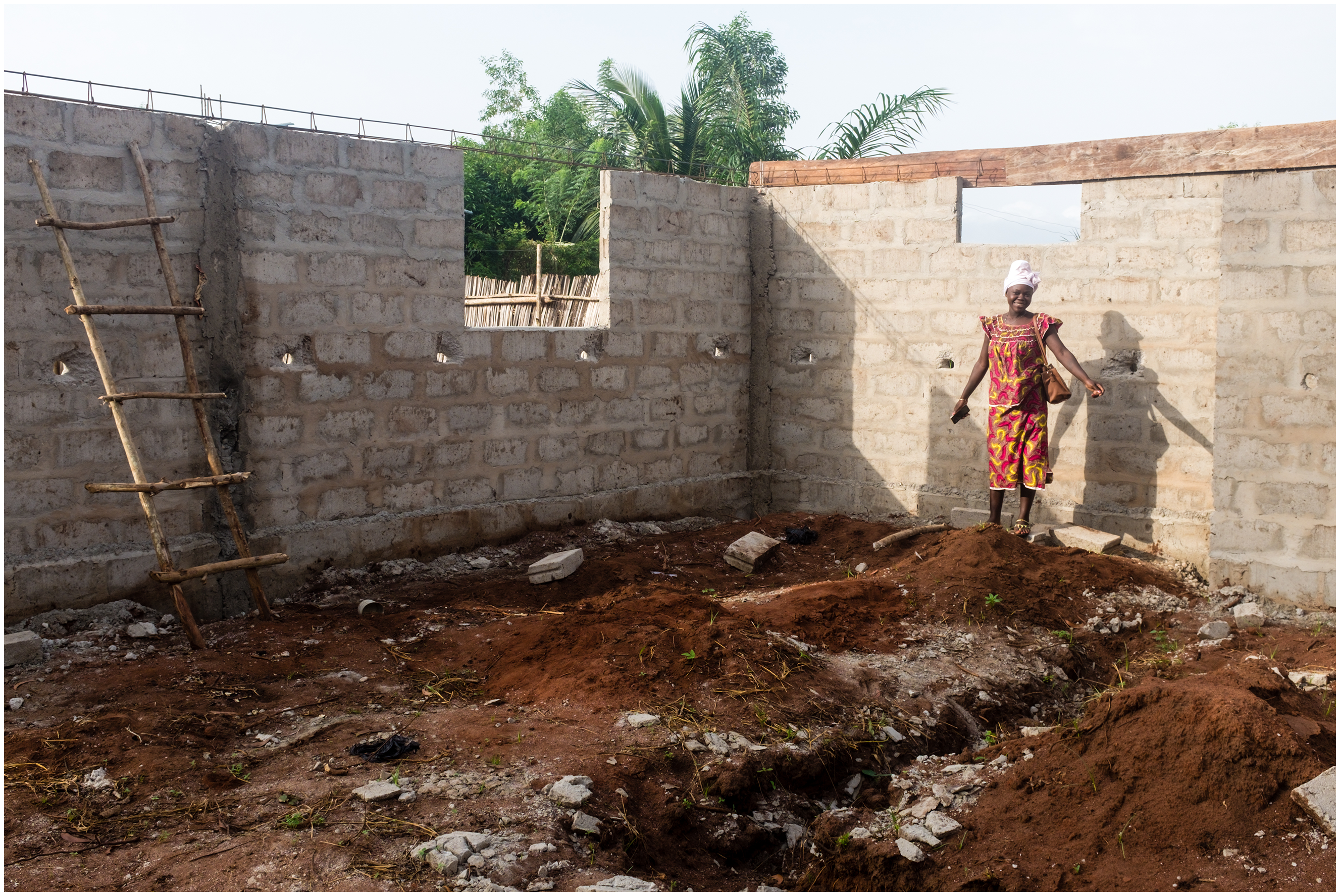
Concrete also contributes to the assertion of social, gendered and sexual power, as indicated by the names and logos chosen by the cement manufacturers: many of them imply strength, such as ‘bouclier’ (shield) and ‘cuirasse’ (breastplate); others refer to powerful and dominant animals such as ‘buffle’ (buffalo), ‘bélier’ (ram), ‘elephant’ and ‘eagle’. As Norbert claimed, anyone who builds with concrete is both virile and ‘tough’. Advertisements for cement and construction materials feature men with large bellies, a sign of success referencing the manager or civil servant comfortably settled in his air-conditioned office, secure in his important post and the salary that will allow him to buy the necessary building materials to construct his own concrete home. In West Africa, as elsewhere across the world, the construction sector and construction sites are masculine places: nearly all builders in this sector are men. Historically, the cement and concrete industry has been a male-dominated field, where the presence of women is below 15 per cent.Footnote 3 In Ghana, only 3 per cent of workers employed in the construction sector are women, yet women often play a major but invisible role in house construction (Eyifa-Dzidzienyo Reference Eyifa-Dzidzienyo2012). In Bamako, Monique Bertrand shows that women are deeply involved in the real estate market – they buy land, commission construction, hire builders, manage the accounts – although they rarely participate in the physical labour of concrete construction (Bertrand Reference Bertrand2001). Most women I encountered in Cotonou, Lomé, Lagos or Accra generally knew the price of a bag of cement, how to mix concrete, and the different stages of construction. And of the dozen building projects I followed during my field research, three were supervised by women. It is common for a woman to be both owner and client, and to play an active part in the process of building, monitoring progress, supervising construction sites and negotiating the prices of materials. Elinor is one such woman who is familiar with the construction process. On my first visit in September 2017, she explained that she does not need an architect because, as she put it, ‘I had all the plans in my head’ (Figure 3).Footnote 4
Elinor’s site in 2017, Cotonou. © M. Lozivit.
Elinor managed many aspects of the construction herself: for example, she purchased building materials from the nearest hardware store. One year later, in 2018, with the work nearing completion, Elinor confessed that she had remained openly sceptical of the foreman to prevent him from raising the prices or keeping materials for himself. Elinor claimed that she was always on her guard. ‘If you’re not careful,’ she went on, ‘it’ll cost you an arm and a leg! And if you’re a woman on your own as well, you have to show that you know what you’re doing if you don’t want to be cheated.’ She finished the construction of her house in December 2018. She confessed: ‘I wanted to build in order to have my own house, not to be dependent on anybody. I am happy because I have a house, my house. Even if I am not yet married, my family respects me.’Footnote 5 In that case, concrete appeared as a key to independence and emancipation. In a patriarchal system dominated by fathers, brothers and oldest sons (Bertrand Reference Bertrand2013), many women, as well as younger sons, build homes on their own as a way to unyoke themselves from family hierarchies.
Concrete can also form the basis of claims for greater integration into the city and for urban citizenship. In Maputo, for example, cement was historically restricted to colonial settlements, and David Morton (Reference Morton2019) has interpreted the use of cement among urban residents as a political act of defiance and protest addressed to authorities. Claudia Gastrow (Reference Gastrow2017: 233) offers a similar analysis of concrete construction in Luanda’s informal neighbourhoods. With the use of concrete, ‘houses could no longer simply be dismissed as “anarchic”, but had to be taken seriously as objects of good urbanism, through which demands and rights could be articulated’. Permanent structures, strong foundations and multistorey buildings symbolize the legitimacy of presence. In this sense, concrete embodies the right to be and to remain in the city – a first step towards a right to the city (Lefebvre Reference Lefebvre1968). In Cotonou, George, the chief of Ladji, an informal settlement located on the banks of the lagoon, asserted that concrete was a strong symbol in his neighbourhood, which was threatened with recurrent evictions: ‘The government cannot evict us, as if we didn’t exist. We have invested a lot of money to build concrete houses. If we didn’t have the right to stay, if it wasn’t our place, we would never have spent so much money.’Footnote 6 Concrete has the power to signify presence, durability and legitimacy. It is part of ‘the political materiality of cities’ (Pilo’ and Jaffe Reference Pilo’ and Jaffe2020): the various documents, technologies or infrastructures and consumer products that shape socio-political life in the city. In Cotonou, Porto-Novo and Lagos, I observed similar processes and therefore I conclude that, in precarious neighbourhoods, concrete blocks have both become the new ingot of the poor and underpin their claims to political legitimacy as urban citizens.
Contesting concrete, seeking ecological alternatives
In this final part, I question the concrete urban futures that are unfolding in relation to the environment. The relationship between concrete and nature has always been and remains ambiguous: ‘Concrete is not natural but that is not to say it is unnatural: it has the capacity to resist nature and so gives us power over nature’ (Forty Reference Forty2012: 43). Concreting over nature is thus a lasting way to tame it, to protect individuals from its hazards. At the same time, however, the (over)production and (over)consumption of cement and concrete are threatening the very future of our species. In a context of dwindling resources – in particular, non-renewable fossil resources (limestone, stone, sand) essential to its production – concrete raises questions of duration, maintenance and repair, and, through them, questions about social, economic and environmental futures in general.
Many urban residents consider concrete homes as ‘permanent and durable’ and requiring little maintenance; this is appreciated in this part of tropical West Africa, where floods are frequent. As one proverb in Côte d’Ivoire puts it: ‘Bricks don’t rot!’ As George, the chief of Ladji, explains: ‘Building with cement is the only way to stay out of the rain and the rising waters. And you don’t have to rebuild the houses, like dirt houses, after every rainy season.’Footnote 7 Concrete is therefore seen as a means of resisting heavy rainfall and climatic events. Yet concrete is not as durable as people think: it is, in fact, an obsolescent material. The recent collapse of Genoa’s Morandi Bridge in 2018, which killed forty-three people in Italy, revealed to the world that, although concrete had long been promoted as solid and eternal, it is actually quite fragile. The lifespan of reinforced concrete is estimated at fifty to seventy years (Forty Reference Forty2012). After this use-by date, buildings and infrastructures require large-scale maintenance operations. Building collapses already occur repeatedly across the African continent, where they cause hundreds of deaths each year (Boateng Reference Boateng2018; Smith Reference Smith2019; Reference Smith2020). Structures are built quickly, by underqualified builders, often with poor-quality materials, without respecting proportions and international norms, and without building permits. The numerous collapses suggest that the life of cement will be shorter across the continent due to the poor dosages and low-quality materials widely used in the mixing of concrete. In a context where financial resources are limited, what is at stake is the question of who will pay for repairs to buildings when they reach the end of their life.
Moreover, concrete is not a material adapted to the extreme heat and humidity of tropical climates (Gough etal. Reference Gough, Yankson, Wilby, Amankwaa, Abarike, Codjoe, Griffiths, Kasei, Kayaga and Namilse2019; Rohat etal. Reference Rohat, Flacke, Dosio, Dao and van Maarseveen2019). When I visited François at his new home on the outskirts of Cotonou, he told me how happy he was to see his sacrifices bear fruit in the form of a home. But he also confessed to one of his home’s central flaws: ‘The problem is that it is too hot inside. At night, I get up to sleep outside because it’s too much for me. And then, there are the mosquitoes.’Footnote 8 The story of François and what he termed his ‘uninhabitable house’ is common. Many people across West Africa report that they often sleep badly because of the extreme heat accentuated by concrete.
Ideas about concrete’s properties, particularly its strength and endurance, are not necessarily matched by its material qualities in real contexts – buildings collapse, overheat and deteriorate. These various findings remind us that concrete has recently sparked criticism in Africa and across the world. At a time of global climate change and rising ecological awareness, concrete is under fire: ecological activists and international experts have denounced the cement industry as one of the most polluting in the world, responsible for 7 per cent of all carbon emissions (Habert etal. Reference Habert, Miller, John, Provis, Favier, Horvath and Scrivener2020; IPCC 2022). Moreover, concrete is a non-permanent and unsustainable material that requires immense amounts of sand and gravel, both of which the United Nations Environment Programme has categorized as a diminishing resource across the world (UNEP 2022).
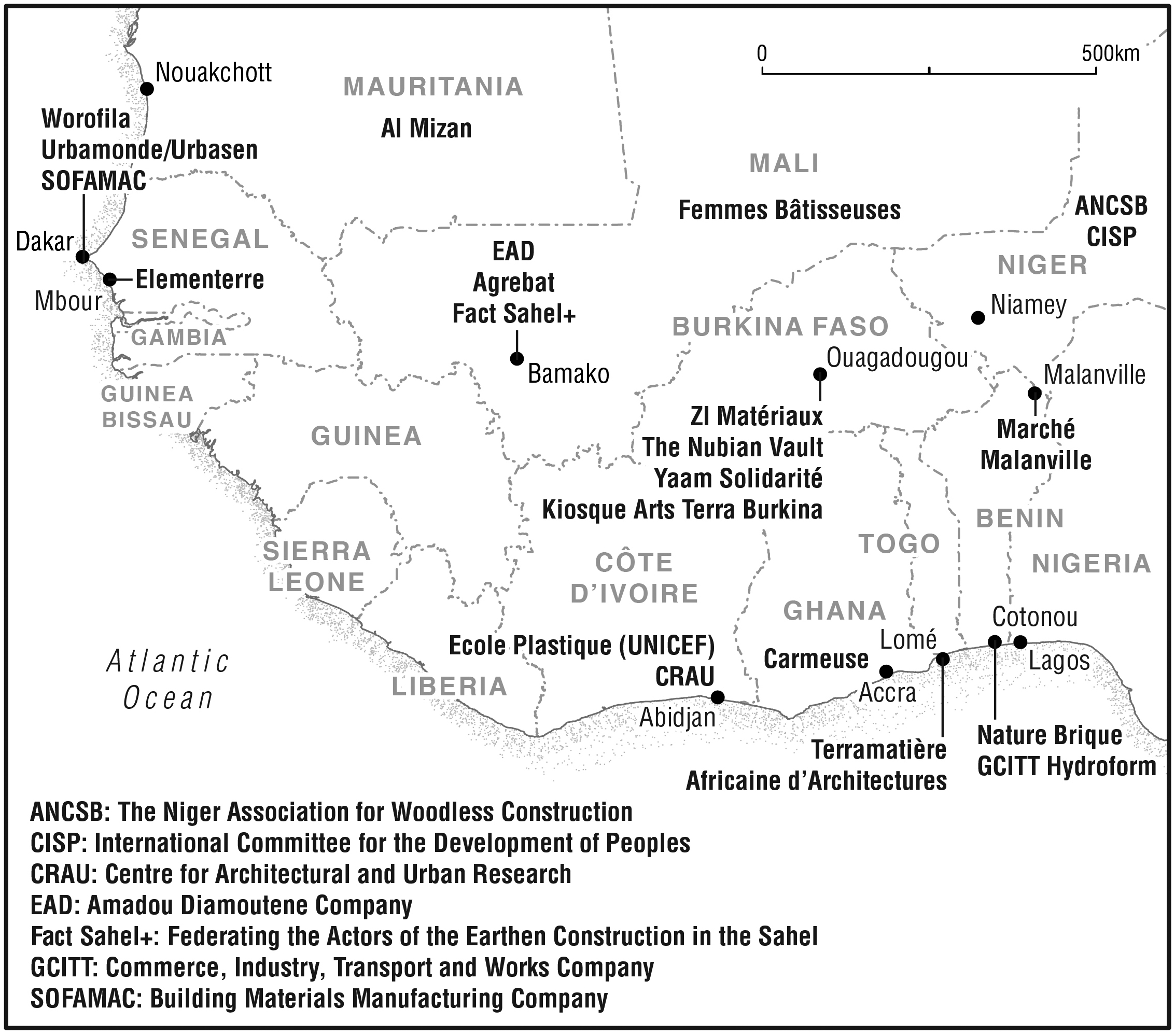
Throughout West Africa, a growing number of initiatives seek to find alternatives to all-concrete buildings and to offer solutions both to the demand for affordable housing and to the need for thermal comfort. These initiatives spread knowledge about the benefits of building with local and renewable materials, such as earth, which are easy to use, widely affordable, and generally require less cement. In 2015, for example, UNESCO launched the Terra Award, a global prize awarded for contemporary architecture using raw earth. Every year, the Terra Award Sahel+ prize – the African version of the Terra Award – goes to the best projects and initiatives built using raw earth (Vandermeeren Reference Vandermeeren2020). In Europe, in the USA and also in Africa, various networks and initiatives, launched by architects and NGOs and supported by donors and academic institutions, promote alternative methods of construction. Scholars are testing the possibility of developing binding agents other than cement; they are also training builders in these techniques (Van Damme and Houben Reference Van Damme and Houben2018; Habert etal. Reference Habert, Miller, John, Provis, Favier, Horvath and Scrivener2020; Schmidt etal. Reference Schmidt, Otieno, Olonade, Radebe, Van Damme and Tunji-Olayeni2020). In France, the research centre CRAterre (International Centre for Earthen Architecture), based in Grenoble, is developing projects across the world with compressed earth block (CEB) technology, which is emerging as a potentially viable option in terms of price and sustainable objectives. CRAterre has trained many masons and entrepreneurs in West Africa who are now promoting earth construction and the use of CEBs. In Dakar, Doudou Deme, a civil engineer, has created Elementerre, a company specializing in the production of blocks made with earth and typha, an invasive plant that grows in wetlands. In the Sahel area, the association La Voûte Nubienne (The Nubian Vault) promotes the use of adobe – a technique that originated in Nubia in Egypt – which can be formed into arches and domes. This material can be incorporated into walls, allowing buildings to be roofed without the use of timber or corrugated iron. The Fact Sahel+ is another active network: it aims to bring together African and European builders, architects, artists and students to explore more sustainable ways of building. On Facebook and WhatsApp, several hundred members – overwhelmingly from Africa— send pictures of their construction sites, exchange information on technical solutions to develop a low-carbon sector, participate in online debates about alternatives to concrete, and promote alternative building materials, such as wood, earth, straw and aircrete (a lightweight building material with high compression strength, buoyancy and thermal insulation) (Degani Reference Degani2020). At present, initiatives appear to be dispersed and limited to a few individuals, but the emergence of these networks and exchange platforms could quickly change the situation and give visibility to ecological alternatives (Figure 4).
Map of alternative construction initiatives, 2020. © A. Choplin, M. Lozivit and Milesmap.
These emerging critiques are supported by African architects who insist on the urgency of designing more sustainable ways of living. Some of these architects, such as the Burkinabe Francis Kéré, the Ivorian Issa Diabaté, the Nigerian Mariam Kamara, the British Ghanaian David Adjaye, the Scottish Ghanaian Lesley Lokko and the Togolese Sénamé Koffi Agbodjinou, play a key role in reviving lost skills, recognizing the importance of vernacular architecture, and raising awareness of more sustainable ways of building. In 2021, the publication of the rich seven-volume Architectural Guide: sub-Saharan Africa (Meuser and Dalbai Reference Meuser and Dalbai2021) invited professional architects to rediscover and recognize the importance of African techniques and materials for building. In March 2022, Francis Kéré was awarded the Pritzker Architecture Prize (the equivalent of the Nobel Prize for architecture). He is the first African to receive it, marking a significant change in the international perception and recognition of African architecture. Against current architectural trends that glorify concrete, Francis Kéré promotes vernacular know-how and calls for the (re)use of local materials such as earth and wood. In 2023, the Scottish Ghanaian architect and novelist Lesley Lokko, founder of the African Futures Institute, a school of architecture and public events platform, was appointed Officer of the Order of the British Empire (OBE). She is also the curator of the 18th Venice Biennale of Architecture in 2023. Through these awards and initiatives, in a more or less indirect way, a new critique of concrete is emerging, calling for African architecture to be recognized, existing Africapitalist and extractivist practices questioned, and another urban future imagined.
Conclusion: concrete utopia/dystopia
As a product and a producer of urban space – to reuse Henri Lefebvre’s expression – concrete is now part of West African materiality, culture and identity. Although inert, cement and concrete play a major role as a binding agent between landscapes, cities and lives. Seen as the driving force of capitalism and development, concrete has sparked enthusiasm from development partners, cement and construction companies and ordinary urbanites. Since the decolonization era, it has come to symbolize progress, modernity and capitalist prosperity. The city that is currently unfolding in West Africa, with its high-rise towers of concrete, glass and steel, can be considered a new icon of African capitalism produced through extraverted elite accumulation. But African cities such as Cotonou and Lagos are linked not only to capitalism and speculation. Bags of cement and concrete blocks are also full of promises and desires, and they feed the imaginary of emergence and success, as well as a desire to end dependence and precarity for many ordinary urbanites. Tracing material flows demonstrates that, although the same bags of cement circulate and are used along the corridor, different types of buildings, neighbourhoods, cities and social relationships are subsequently unearthed. The urban materiality produced from this process is intrinsically linked to the ways in which local communities express their attachment to land and to place, with the value they assign to cement and concrete.
As Georges Perec reminds us, while cement and concrete are widely contested for their effects on climate change, they can still astonish us. For all the contradictions it epitomizes, concrete inspires numerous urban utopias and dystopias across Africa. In the film The Tower: a concrete utopia (De Boeck and Baloji Reference De Boeck, Baloji, Holm and Kallehauge2015), the concrete tower built in the heart of Kinshasa by a Congolese doctor illustrates both aspects. The doctor has erected a wildly extravagant fourteen-storey health centre and wellness complex that towers over the area’s existing low-lying concrete structures. In front of Baloji and De Boeck’s camera, the doctor explains that this tower ‘will become a model for everyone… a useful tower, inhabited and habitable’.Footnote 9 This concrete tower is pure utopia, deriving directly from the doctor’s imagination (Cane Reference Cane2021). Yet his dream remains largely unrealized, its construction stalled due to lack of funds, transforming his utopian vision into a dystopian ruin (see Hoffman Reference Hoffman2017 for Monrovia; Archambault Reference Archambault2021b for Maputo). The ambivalences of concrete reflect and shape people’s ambiguous relationships to imagined urban and personal futures. African urban materiality is now mostly made of concrete. And African urban futures could also be marked by concrete, as imagined by the Afrofuturist movement – for example in Lagoon, Nnedi Okorafor’s science fiction novel (Okorafor Reference Okorafor2014), or in the Marvel films Black Panther and Wakanda Forever, where Birnin Zana, the capital of the fictional country of Wakanda, is a futuristic city at once concrete, vegetated and technologized. These utopias/dystopias call for a new ‘Afrotopia’ (Sarr Reference Sarr2016) where African cities could be seen as places of alternatives, possibilities, as ‘creative metastases’ (Mbembe Reference Mbembe2020: 25) in which to invent new ways of inhabiting the world.
Acknowledgements
I extend my warmest thanks to the anonymous reviewers for their relevant and insightful comments. Finally, I am especially grateful and indebted to my colleague James Christopher Mizes, who reviewed and edited this article.
Armelle Choplin is Associate Professor of Geography and Urban Planning at the University of Geneva. Her research explores how cities are produced and experienced in West Africa. Combining ethnographic methods and comparative analysis, her interests focus on urban governance, the construction industry, housing, and land and property issues.


 Open access

