

Introduction
Over the last ten years, the quest for new uranyl minerals in inactive uranium mines, especially in Jáchymov, Czech Republic and the Red Canyon, southeastern Utah, USA, has proven remarkably successful. There are optimal conditions for the growth of secondary minerals in the abandoned mining adits and tunnels due to high relative air humidity and stable temperatures. The complex specific geochemistry at both localities (see the Discussion section) has led to the formation of more than 30 new uranyl sulfates that have been collected from efflorescent encrustations on tunnel walls and characterised as valid minerals (see, e.g. Škácha et al., Reference Škácha, Plášil and Horák2019; Kampf et al., Reference Kampf, Olds, Plášil, Marty, Perry, Corcoran and Burns2021 and references therein). Crystallographic studies on these minerals have revealed some exciting features not previously observed in natural or synthetic phases (Gurzhiy and Plášil, Reference Gurzhiy and Plášil2019). New types of clusters, chains and sheets of polyhedra were identified. The great diversity observed for uranyl sulfate minerals stems primarily from many possible linkages between uranyl coordination polyhedra and sulfate tetrahedra. Here, we describe a new uranyl sulfate, oldsite, an Fe2+-analogue of svornostite (Plášil et al., Reference Plášil, Hloušek, Kasatkin, Novák, Čejka and Lapčák2015b). It has been found at the North Mesa Mine group, Temple Mountain, San Rafael district, Emery County, Utah, USA and was approved by the Commission on New Minerals, Nomenclature and Classification of the International Mineralogical Association (IMA2021-075, Plášil et al., Reference Plášil, Kampf, Ma and Desor2021). The description is based on one holotype specimen deposited in the collections of the Natural History Museum of Los Angeles County, 900 Exposition Boulevard, Los Angeles, CA 90007, USA, catalogue number 76159. The new mineral is named after American mineralogist Travis A. Olds (born 1990), currently curator at the Carnegie Museum of Natural History in Pittsburgh, in recognition of his contributions to uranium mineralogy and crystallography. Dr. Olds’ research is focused on the descriptive mineralogy and crystal chemistry of secondary minerals and hexavalent uranium. He has been involved in the description of more than 24 new minerals, of which 21 contain uranium.
Occurrence
Oldsite was discovered on specimens collected from the North Mesa mine group by one of the authors (JD). In the mines of the North Mesa mine group, ore occurs in lenses of conglomeratic sandstone, scattered nodules in the sandstone, and in massive layers in the conglomerate near its contacts with other rocks. Near the base of the Shinarump conglomerate, high-grade asphaltic ore, with galena and sphalerite, occurs in silicified and calcified logs (Schindler et al., Reference Schindler, Hawthorne, Huminicki, Haynes, Grice and Evans2003). Oldsite is a post-mining alteration product resulting from the oxidation of primary ores in the humid underground environment and subsequent deposition with a variety of secondary minerals forming efflorescent crusts on the surfaces of mine walls. Oldsite has been found on pyrite-rich asphaltite at the contact zone of the U–V mineralised sandstone. The mineral association comprises alum-(K), halotrichite, metavoltine, quartz, römerite, stanleyite, sulphur, szomolnokite and mathesiusite.
Physical and optical properties
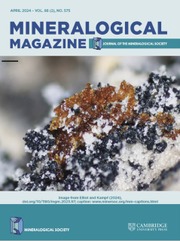
Oldsite crystals are rectangular blades flattened on {010} and elongated on [001]. The crystal forms observed were {100}, {010}, {001}, {00$\bar{1}$ } and possibly {101} and/or {102}. Crystals, up to ~0.3 mm in length, occur as isolated individuals and in subparallel to divergent groups (Fig. 1). The mineral is yellow in colour and transparent with a vitreous lustre. Its streak is very pale yellow. The mineral is non-fluorescent. The Mohs hardness is ~2, by analogy with svornostite. Crystals are brittle with irregular, splintery fracture. Cleavage is excellent on {100} and perfect on {010}. Oldsite dissolves readily in room-temperature H2O. The density measured by flotation in a mixture of methylene iodide and toluene is 3.31 g⋅cm–3; the calculated density is 3.298 g⋅cm–3 for the empirical formula and 3.330 g⋅cm–3 for the ideal formula.
Diverging group of yellow oldsite blades with blue stanleyite and white szomolnokite on asphaltum. The field of view is 0.68 mm across.

Optically, oldsite is biaxial (+), with α = 1.552(2), β = 1.556(2) and γ = 1.588(2) (measured in white light). The 2V measured directly on a spindle stage is 37(1)°; the calculated 2V is 39.6°. Dispersion is r < v, moderate. The optical orientation is X = b, Y = a and Z = c. The mineral is non-pleochroic. The Gladstone–Dale compatibility index 1 – (K P/K C) for the empirical formula is –0.001, in the superior range (Mandarino, Reference Mandarino2007), using k(UO3) = 0.118, as provided by Mandarino (Reference Mandarino1976) and 0.005 (also superior) for the ideal formula.
Raman spectroscopy
Raman spectroscopy was conducted on a Horiba XploRA PLUS using a 532 nm diode laser, a 100 μm slit, a 1800 gr/mm diffraction grating and a 100× (0.9 NA) objective. The Raman spectrum of oldsite from 4000 to 60 cm–1 is shown in Fig. 2.
Raman spectrum of oldsite recorded with a 532 nm laser.

Raman bands at 3620, 3546 and 3498 cm–1 are attributed to υ O–H stretching vibrations of symmetrically non-equivalent H2O molecules. The inferred O–H⋅⋅⋅O hydrogen bond lengths, using the empirical relation given by Libowitzky (Reference Libowitzky1999), vary in the range ~3.2 to 2.9 Å. A very weak band at 1618 cm–1 (too weak to see in Fig. 2) is attributable to υ2 (δ) H–O–H bending vibrations. Bands at 1218, 1192 and 1154 cm–1 are attributed to triply degenerate υ3 (SO42–) antisymmetric stretching vibrations and those at 1040, 1025, 1002 and 986 cm–1 to υ1 (SO42–) symmetric stretching vibrations. (Those have higher relative intensity compared to υ3, which is in line with the general behaviour of symmetrical modes in Raman.) A very weak band at 952 cm–1 and a very strong one at 859 cm–1 are assigned to υ3 (UO2)2+ antisymmetric and υ1 (UO22+) symmetric stretching vibrations. The approximate U–O bond length inferred from the respective wavenumbers of the UO22+ vibrations after Bartlett and Cooney (Reference Bartlett and Cooney1989) is ~1.76 Å, which is in line with the structure determination (see below). Bands at 642 and 592 cm–1 are attributed to triply degenerate υ4 (δ) (SO42–) bending vibrations. A doublet at 463 and 446 cm–1 is assigned to υ2 (δ) (SO42–) bending vibrations. A weak band at 329 cm–1 can be assigned to the υ (U–Oligand) vibrations. A band of medium intensity at 186 cm–1 with shoulders can be assigned to split, doubly degenerate υ2 (δ) (UO22+) bending vibrations. Bands at 88 (shoulder) and 75 cm–1 are attributable to lattice vibrations.
Chemical composition
Analyses of oldsite (4 points) were performed at Caltech on a JEOL 8200 electron microprobe in wavelength dispersive spectroscopy mode. Oldsite crystals are too thin and fragile to polish, so the blades were mounted on carbon tape and carbon coated; the analyses were then done on unpolished crystal faces. The mineral is very beam-sensitive. Analytical conditions were 15 kV accelerating voltage, 2 nA beam current and a 15 μm beam diameter. Insufficient pure material is available for CHN or thermal gravimetric analysis; however, the fully ordered structure unambiguously established the quantitative content of H2O. The beam sensitivity of the mineral and analyses conducted on flat but slightly uneven crystal faces accounts for the low analytical total. Analytical data are given in Table 1. The empirical formula (calculated on the basis of 28 O atoms per formula unit) is K1.93(Fe2+0.53Zn0.31V3+0.09Mg0.08)Σ1.02[(U0.98O2)(S1.01O4)2]2(H2O)8. The ideal formula is K2Fe2+(UO2)2(SO4)4(H2O)8, which requires K2O 7.83, FeO 5.97, UO3 47.57, SO3 26.63, H2O 11.99, total 100 wt. %.
Chemical composition (wt.%) for oldsite.

* Based on the structure.
S.D. – standard deviation
X-ray crystallography and structure refinement
Powder X-ray diffraction was done using a Rigaku R-Axis Rapid II curved imaging plate microdiffractometer, with monochromatised MoKα radiation. A Gandolfi-like motion on the φ and ω axes was used to randomise the sample and observed d-values and intensities were derived by profile fitting using JADE Pro software (Materials Data, Inc.). The powder data are presented in Supplementary Table S1 (available as Supplementary material, see below).
The single-crystal structure data were collected at room temperature using a Rigaku SuperNova diffractometer equipped with Atlas S2 CCD detector and a microfocus source utilising monochromated MoKα radiation. The crystallographic properties and the experimental and refinement details are given in Table 2. The CrysAlis software was used for data processing, including application of an empirical multi-scan absorption correction. The structure was solved using the intrinsic phasing algorithm of the SHELXT program (Sheldrick, Reference Sheldrick2015). Refinement proceeded by full-matrix least-squares on F 2 using Jana2020 (Petříček et al., Reference Petříček, Dušek and Palatinus2020). The structure solution found all non-hydrogen atom sites; U, S and Fe atoms were refined to full occupancy with anisotropic displacement parameters; O atoms were refined with isotropic displacement parameters; H atoms could not be found using the current data. As the structure crystallises in a non-centrosymmetric orthorhombic space group, an inversion twin was implemented in the refinement, giving a slightly negative Flack parameter and, thereby, confirming the dominance of one enantiomer present in the studied crystal. Atom coordinates and displacement parameters are given in Table 3, selected bond-distances in Table 4 and a bond-valence analysis in Table 5. The crystallographic information file has been deposited with the Principal Editor of Mineralogical Magazine and is available as Supplementary material (see below).
Data collection and structure refinement details for oldsite.

Atom coordinates and displacement parameters (Å2) for oldsite.†

†Refined occupancy for K1 and K2 are 0.932(9) and 0.928(11), respectively.
Selected bond distances (Å) for oldsite.

Symmetry codes = (i) −x + 3/2, −y + 1, z + 1/2; (ii) x + 1, y + 1, z + 1; (iii) −x + 1/2, −y, z + 3/2; (iv) −x, y, z; (v) −x + 1/2, −y, z − 3/2; (vi) x + 3/2, −y, z + 3/2; (vii) x + 1, y, z + 1; (viii) −x + 3/2, −y, z + 1/2; (ix) −x + 2, y, z; (x) x, y − 1, z; (xv) −x + 1, y, z; (xvi) −x + 1, y − 1, z; (xvii) −x, y, z + 1.
Bond valence analysis for oldsite. Values are expressed in valence units*.

* Bond valence parameters are from Gagné and Hawthorne (Reference Gagné and Hawthorne2015). sum–H – the sum of the BV without the contribution of the H-bonds; sum+H – the sum of the BV including assumed H-bonds (considering the theoretical H-bond strength of 0.8 vu; after Brown, Reference Brown2002); theor[H] – theoretical number of additional weak H-bonds that the O atom could accept; nH2O – number of H2O molecules/cell considering site-multiplicities and Z = 2.
Description and discussion of the structure
The structure of oldsite contains one U, two S, one Fe, two K and 18 O sites in the asymmetric unit. The U site is surrounded by seven O atoms forming an UO7 pentagonal bipyramid, the typical coordination for U6+ in which the two short apical bonds of the bipyramid constitute the uranyl group (see, e.g. Burns, Reference Burns2005). Five equatorial O atoms (Oeq) complete the U coordination environment. The pentagonal UO7 bipyramid shares four equatorial vertices with sulfate tetrahedra such that each tetrahedron is linked to two uranyl bipyramids to form an infinite chain. The free, non-linking equatorial vertex of the uranyl bipyramid is occupied by an H2O molecule based on bond-valence calculations. The H-bonding via this H2O molecule (O4 atom, Fig. 3a) weakly links the chains into a sheet-like structure. Such infinite chains have been found in other uranyl sulfates, for instance, in svornostite (Plášil et al., Reference Plášil, Hloušek, Kasatkin, Novák, Čejka and Lapčák2015b), bobcookite (Kampf et al., Reference Kampf, Plášil, Kasatkin and Marty2015), rietveldite (Kampf et al., 2017) and in the synthetic compounds K2[(UO2)(SO4)2(H2O)](H2O) (Ling et al., Reference Ling, Sigmon, Ward, Roback and Burns2010) and Mn(UO2)(SO4)2(H2O)5 (Tabachenko et al., Reference Tabachenko, Serezhkin, Serezhkina and Kovba1979). The Fe site is octahedrally coordinated by two O atoms and four H2O groups. Each of the two O atoms of the Fe-octahedron is shared with SO4 tetrahedra in a different chain, thereby linking adjacent chains. The long K–O bonds provide additional linkages between chains, involving either O atoms of the SO4 groups or apical O atoms of the uranyl ion (Fig. 3b). The structural formula obtained from the refinement is K1.86Fe[(UO2)(SO4)2]2(H2O)8. The lower refined occupation factors for both of K sites in the structure of oldsite lead to significant improvement of the fit (decrease of U eq values and drop in R-factors). Nevertheless, the exact charge balancing mechanism (most probably via protonisation of some of the apical O atoms of the SO4 tetrahedra) remains unclear based on the current data.
Crystal structure of oldsite. (a) Part of the infinite uranyl sulfate chain found in the crystal structure of oldsite. UO7 bipyramids are yellow, SO4 tetrahedra light yellow (transparent), O atoms are red, except for the O4 atom (H2O molecule) in aqua blue. (b) Structure viewed down [010]. Colour scheme as in (a); plus, Fe-octahedra green, K atoms lavender (and shown as thermal ellipsoids at 75% probability).

Discussion – chemical composition of uranyl sulfates, their formation and occurrence
Uranyl sulfate minerals form under oxidising conditions from aqueous solutions with high SO4 activity. These conditions are typically related to the post-mining processes involving oxidative dissolution of sulfides, known as acid-mine-drainage (AMD) phenomena (e.g. Evangelou and Zhang, Reference Evangelou and Zhang1995; Edwards et al., Reference Edwards, Bond, Druschel, Mcguire, Hamers and Banfield2000; Brugger et al., Reference Brugger, Meisser and Burns2003; Plášil et al., Reference Plášil2014). Although we now know that uranyl sulfate minerals are relatively common in the post-mining assemblages of uranium mines, until recently, these assemblages had been largely overlooked and surprisingly, few natural uranyl sulfate phases were previously known and defined as valid mineral species. This situation began to change in 2012. Since then, many new uranyl sulfates have been discovered and described (Fig. 4).
Graph showing the rising number of known uranyl sulfate minerals throughout recent years.

Increases in the rate of new mineral descriptions are often attributed to technological advances (Barton, Reference Barton2019). However, the last two decades have seen a significant jump forward in analytical techniques, especially related to X-ray and electron diffraction, enabling the analysis of much smaller crystals, measuring only a few tens of micrometres across or even smaller. This includes the more common use of electron diffraction tomography (or 3D electron diffraction) (Gemmi and Lanza, Reference Gemmi and Lanza2019; Gemmi et al., Reference Gemmi, Mugnaioli, Gorelik, Kolb, Palatinus, Boullay, Hovmöller and Abrahams2019). Indeed, these advances have contributed to the rapid increase in the number of well-characterised new uranyl sulfate minerals.
Perhaps of greater impact, however, has been the recognition that studies of low-temperature uranyl phases provide highly valuable insights into the transport of uranium in environmental systems. In the past, scientists investigating ore deposits tended to overlook or only superficially consider post-mining mineral assemblages, focusing on ore minerals and their formation processes. For example, at Jáchymov (formerly known under the German name St. Joachimsthal) in the Czech part of Erzgebirge mountains, Schneeberg and Johanngeorgenstadt (in the German part of Erzgebirge), or Krunkelbach (Schwarzwald, Germany), studies generally focused on hydrothermal vein mineralisation. These localities (except for Krunkelbach) have been important to mineralogists since the start of mineralogy as a Science (see their original descriptions by the classical mineralogists Weissbach, Vogl, Schrauf and others in the 19th Century). The post-mining mineral associations at these deposits usually involve uranopilite, minerals of the zippeite group (undistinguishable at that time and considered as the single species zippeite) and schröckingerite. In the past, these minerals have often been referred to simply as ‘uranium yellows or ochres’.
Unlike the occurrences noted above, sedimentary rocks play a prominent role in the U occurrences in the Lodève area, Héraults, Occitannie, France; nevertheless, the ore content (proportion of pitchblende vs. sulfidic ores), the gangue minerals and the properties of the surrounding rocks (notably, the buffering role of carbonates), as well as the climate (moderate, marine to continental), leads to the formation of similar mineral associations.
Since the description of meisserite (Plášil et al., Reference Plášil, Kampf, Kasatkin, Marty, Škoda, Silva and Čejka2013b) from the Blue Lizard mine in Red Canyon of SE Utah (USA), the U deposits of the eastern Colorado Plateau region of the United States, also hosted by sedimentary rocks, have yielded an extensive suite of uranyl sulfates with unprecedented compositions and structural topologies. A ternary diagram (Fig. 5) displays the molar composition of 42 well-characterised uranyl sulfates, and Fig. 6 contains graphs of the charge deficiency-per-anion (CDA) with molar proportions of H2O and SO4 in structural units, both emphasising several important points that help elucidate the formation of uranyl sulfate minerals. The majority of the newly discovered uranyl sulfates from the Red Canyon area and other localities in Utah and Colorado, have medium to low H2O content, high content of SO4, and relatively low content of U, placing them in the central and the left portion of the ternary. For the solutions more concentrated in alkalis, and less so in U, a greater rate of evaporation (as documented by the field observations), leads to phases with high concentrations of Na and K (and other alkalis and alkaline earths) and lower H2O content. The solutions from which these minerals crystallised can be viewed as micro-equivalents to those of Glauber Springs, the Western-Bohemian spa in Františkovy lázně city, known for Glauber's salt, Na2SO4(H2O)10. Referring back to Fig. 5, the mineral seaborgite, LiNa6K2(UO2)(SO4)5(SO3OH)(H2O) (Kampf et al., Reference Kampf, Olds, Plášil, Marty, Perry, Corcoran and Burns2021), can be regarded as kind of an end-member in so far as it has the lowest proportion of H2O and a high content of alkaline cations (here also with Li), as well as a high proportion of SO4. Interestingly, its CDA value of 0.18 valence units (vu), is not unusual among the uranyl sulfates (Fig. 6) when compared, e.g. to klaprothite, péligotite or meisserite. Their CDA values are very high (>0.30 vu) for uranyl oxysalts (e.g. Schindler and Hawthorne, Reference Schindler and Hawthorne2008) and for oxysalts in general (Hawthorne and Schindler, Reference Hawthorne and Schindler2008). This high value is related, to some extent, to the crystal-chemical stability of the structure within the chemical system consisting of the components UO7, SO4, H2O and Na. The most typical range in CDA for uranyl sulfates is 0.15 to 0.25 vu, reflecting again, to some extent, the pH range over which the structural units of these minerals are stable (see Hawthorne and Schindler, Reference Hawthorne and Schindler2008 and references therein).
Ternary diagram showing the composition of the 42 well-characterised uranyl sulfate minerals. References: Burns, Reference Burns2001; Burns et al., Reference Burns, Deely and Hayden2003; Kampf et al., Reference Kampf, Plášil and Kasatkin2014, Reference Kampf, Plášil, Kasatkin and Marty2015a, Reference Kampf, Plášil, Kasatkin, Marty and Čejka2015b, Reference Kampf, Kasatkin, Čejka and Marty2015c, Reference Kampf, Plášil, Kasatkin, Marty and Čejka2017a, Reference Kampf, Plášil, Kasatkin, Marty, Čejka and Lapčák2017b, Reference Kampf, Plášil, Čejka, Marty, Škoda and Lapčák2017c, Reference Kampf, Sejkora, Witzke, Plášil, Čejka, Nash and Marty2017d, Reference Kampf, Plášil, Nash and Marty2018a, Reference Kampf, Plášil, Nash and Marty2018b, Reference Kampf, Olds, Plášil, Marty and Perry2019a, Reference Kampf, Plášil, Kasatkin, Nash and Marty2019b, Reference Kampf, Olds, Plášil, Nash and Marty2019c, Reference Kampf, Olds, Plášil, Nash and Marty2020, Reference Kampf, Olds, Plášil, Marty, Perry, Corcoran and Burns2021, Reference Kampf, Olds, Plášil, Nash and Marty2022a, Reference Kampf, Plášil, Olds, Ma and Marty2022b, Reference Kampf, Plášil, Olds and Marty2022c; Kasatkin et al., Reference Kasatkin, Plášil, Chukanov, Škoda, Nestola, Agakhanov and Belakovskiy2022, Mereiter, Reference Mereiter1982; Pekov et al., Reference Pekov, Krivovichev, Yapaskurt, Chukanov and Belakovskiy2014; Plášil et al., Reference Plášil, Dušek, Novák, Čejka, Císařová and Škoda2011, Reference Plášil, Hauser, Petříček, Meisser, Mills, Škoda, Fejfarová, Čejka, Sejkora, Hloušek, Johannet, Machovič and Lapčák2012a, Reference Plášil, Hloušek, Veselovský, Fejfarová, Dušek, Škoda, Novák, Čejka, Sejkora and Ondruš2012b, Reference Plášil, Fejfarová, Wallwork, Dušek, Škoda, Sejkora, Čejka, Veselovský, Hloušek, Meisser and Brugger2012c, Reference Plášil, Kasatkin, Škoda, Novák, Kallistová, Dušek, Skála, Fejfarová, Čejka, Meisser, Goethals, Machovič and Lapčák2013a, Reference Plášil, Kampf, Kasatkin, Marty, Škoda, Silva and Čejka2013b, Reference Plášil, Veselovský, Škoda, Novák, Sejkora, Čejka, Škácha and Kasatkin2014a, Reference Plášil, Kampf, Kasatkin and Marty2014c, Reference Plášil, Hloušek, Kasatkin, Škoda, Novák and Čejka2015a, Reference Plášil, Hloušek, Kasatkin, Novák, Čejka and Lapčák2015b; Plášil and Škoda, Reference Plášil and Škoda2015.

The structural units of 42 well-characterised uranyl sulfate minerals characterised by the charge-deficiency per anion (CDA) value and its relationship with the molar proportion of the H2O and SO4 in the structural units (s.u.). The most frequent range of the CDA in uranyl sulfates (presented in the histogram above) is highlighted in both graphs (CDA vs. H2O and CDA vs. SO4) as yellow fields. See Fig. 5 for the key and reference list.

The minerals with high H2O, high U (+ other cations) and lesser SO4 contents dominate the lower right portion of the ternary (Fig. 5). Among these, it is uranopilite, [(UO2)6(SO4)O2(OH)6(H2O)6](H2O)8 (Dauber, Reference Dauber1854; Vogl, Reference Vogl and Pöhlig Verlag1856; Weisbach, Reference Weisbach1882; Burns, Reference Burns2001), which can be viewed as a transitional phase between pure uranyl-oxide hydroxy-hydrate minerals, such as schoepite, [(UO2)4O(OH)6](H2O)6, and metal-cation-free uranyl sulfates, such as shumwayite, [(UO2)(SO4)(H2O)2]2⋅H2O (Kampf et al., Reference Kampf, Plášil, Kasatkin, Marty, Čejka and Lapčák2017b). Uranopilite is a typical alteration product of uraninite weathering in Jáchymov; uranopilite has been found growing directly on pitchblende lying in a small puddle at the foot-wall of the mining adit. Minerals such as straßmannite, gurzhiite, uranopilite, as well as johannite or deliensite, often occur in association with schröckingerite, NaCa3(UO2)(CO3)3(SO4)F⋅10H2O (Schrauf, Reference Schrauf1873; Mereiter, Reference Mereiter1986). This is another mineral that typically forms underground from water seepage on tunnel walls or associated with other uranyl carbonates (but also sulfates, such as zippeite-group minerals and uranopilite) at contact with mine waters and also in direct contact with the weathered surface of the pitchblende.
Acknowledgements
An anonymous referee, Associate Editor Mike Rumsey and Structure Editor Pete Leverett are highly thanked for their comments that helped improve the manuscript. A portion of this study was funded by the John Jago Trelawney Endowment to the Mineral Sciences Department of the Natural History Museum of Los Angeles County. This research was also financially supported by the Czech Science Foundation (project 20-11949S to JP).
Supplementary material
To view supplementary material for this article, please visit https://doi.org/10.1180/mgm.2022.106.
Competing interests
The authors declare none.


 Open access

