





Plain language summary
This study examines Ennio Flaiano’s 1947 novel Tempo di uccidere (“A Time to Kill”) to investigate the author’s stance on Italian colonialism in Ethiopia as expressed in his book. The novel tells the story of an Italian lieutenant during the 1935–1936 Ethiopian campaign who kills an Ethiopian woman and then commits other crimes while trying to escape his sense of guilt. Scholars have long debated whether it criticizes colonialism or simply follows the exotic adventure genre popular at the time. The ambiguity stems from the narrative structure: the story is told from the lieutenant’s perspective, which alternates between repeating fascist propaganda and expressing disgust for colonial violence. In addition, the protagonist only heals after confessing his crimes to an Ethiopian man (probably the father of the girl killed), yet ultimately escapes punishment. This ambiguity is compounded by the novel’s complex narrative technique, where the perspective shifts between the narrator-I and the experiencing-I, and through the latter’s identification with other characters, both conquerors and colonized.
To investigate this question, we manually annotated the entire novel, identifying different narrative perspectives (focalizations): passages focused on the narrator, Italian soldiers, Ethiopian people and descriptions of landscapes and people. The annotated text was then analyzed using computational methods, including word frequency analysis, stylometric clustering, part-of-speech tagging and syntactic role analysis.
The computational findings reveal an unexpected result. At the grammatical level, Ethiopian and Italian characters receive comparable agency: both groups appear with similar frequency as subjects of active sentences performing actions. Lexical analysis offers other interesting insights. Ethiopian characters are often described using generic terms suggesting passivity –“woman” and “old man” – while Italian soldiers are depersonalized as “types” through the military rank (soldier, sergeant and major), yet being more often associated with active, transitive verbs indicating intentional action (to teach, to convince, to accumulate). On the contrary, when the experiencing-I imagines Ethiopian perspectives, he attributes to them active verbs of perception and internal states (to recognize, to desire, to know), suggesting psychological depth. Despite the attempt of exploring more in-depth the indigenous interiority, the content of these “perspectives” is often self-referential: rather than genuinely attempting to understand others, the protagonist projects his own anxieties and desires onto them, seeing himself reflected back. However, the protagonist himself appears with diminished agency, suggesting he views himself as subjected to military forces beyond his control rather than as an active agent – a pattern that deflects personal and historical responsibility.
Together, these patterns reveal that Flaiano’s ambiguity was not evasion but deliberate narrative strategy. By refusing to provide clear patterns or fixed representations, the narrative forces readers to confront the instability of colonial categories themselves – exposing how propaganda’s stereotypes and colonialism’s role assignments rely on simplification rather than genuine encounter.
Introduction
In 1947, Ennio Flaiano (1910–1972), an Italian journalist and writer particularly active since the Thirties as prolific critic (especially cinematographic) and screenwriter, with his only full-length novel Tempo di uccidere (Flaiano Reference Flaiano1947), won the first edition of Premio Strega.Footnote 1 It was a controversial and unexpected win:Footnote 2 not only Flaiano was not a full-time novelist, but the book is set during the Ethiopian campaign (1935–1936), the colonial enterprise massively propagandized by Mussolini’s regime (Collotti Reference Collotti2000; Deplano Reference Deplano2015; Stefani Reference Stefani2007) to win to the Italians a “deserved” posto al sole (“place in the sun”); a campaign the author experimented in first person in his youth. While the campaign garnered wide consensus at the beginning – leveraging imperialist feelings dating back to the very first years of Italian unificationFootnote 3 – with the overthrow of the Fascist regime the liberal and democratic parties in power resolutely distanced themselves from the responsibility of the colonial enterprises – not only from the one promoted by Mussolini, but also from the ones driven during the previous liberal government.Footnote 4 This resulted in a gradual fading from the public memory of the colonial occupations and the crimes perpetrated in the African countries under Italian control, which lasted at least until the Seventies within the historical debate,Footnote 5 and even today in the public opinion: indeed, public discussion on the topic are rare,Footnote 6 and it is widespread a common superficial opinion that Italians were good people (“italiani brava gente”), and their dominion was less cruel and impactful than the one of other powers (Calchi Novati Reference Calchi Novati2008; Del Boca Reference Del Boca1992, Reference Del Boca1998; Filippi Reference Filippi2021).
In this context of general suppression of colonial memory, the victory of Flaiano’s novel seems curious, especially as we consider the plot, that engages directly with the themes of guilt and atonement.Footnote 7 While this fact might be interpreted as reflecting an intention to publicly discuss the experience of colonialism, the historical setting was underestimated, and the novel was probably interpreted as a derivation of the colonial literary genre (heir of the oldest exotic literature, see Bongie Reference Bongie1991), which was largely popular in Italy at the turn of 19th and 20th centuries,Footnote 8 or in the vein of existential novels, such as Camus’ L’Étranger and Conrad’s Heart of Darkness (Baraldi Reference Baraldi2004; Comparini Reference Comparini2017). Perhaps the widespread rumor about the author’s closeness to the right-wing circles of his publisher Longanesi also contributed to the failure to recognize the “historicity” of the setting, and consequently the little attention paid to a possible critical attitude toward the Ethiopian Campaign.Footnote 9
Beginning with the pioneering work of Sergio Pautasso (Reference Pautasso and Sergiacomo1992), first published in 1976, and continuing with Orlandini (Reference Orlandini1992) and Domenichelli (Reference Domenichelli, Domenichelli and Fasano1997), the interpretation of the novel substantially changed. These analyses stressed the historical significance of the setting and the plot and strongly recognized Ennio Flaiano’s critical stance toward colonialism. Following this path, throughout the 2000s, many studies flourished which connected Tempo di uccidere with postcolonial criticism, proclaiming the novel as the first postcolonial work in Italian literature (Baraldi Reference Baraldi2004; Bazzocchi Reference Bazzocchi2012; Benvenuti Reference Benvenuti2012; Brunetti Reference Brunetti and Derobertis2010; Maxia Reference Maxia2010; Mengozzi Reference Mengozzi2016; Nasson Reference Nasson2012; Palumbo Reference Palumbo2002; Prisco Reference Prisco2012; Re Reference Re2017; Skocki Reference Skocki2012). This interpretation is strengthened by the war journal written by the author during his participation in the Ethiopian campaign: now published under the title Aethiopia: appunti per una canzonetta (Ethiopia: Notes for a Ditty) (Flaiano Reference Flaiano2020). In it, through the forms of short notes or aphorisms, Flaiano subtly ironizes the expectations of colonial enterprise as conveyed by fascist propaganda versus the reality faced by the soldiers, and with a clear stance emerging from a stinging sarcasm rather than open declaration, he denounces the violent crimes committed during the military operations. The existence of this war journal and the fact that some episodes reported here were later incorporated into the novel suggest that Flaiano had been reflecting on the material for years before deciding to shape it into a book.
Research question
Even though the cultural context and the progression of the studies may justify the differing interpretations, it is true that the novel itself provides ample room for discussion, and it is still debated whether Flaiano’s position in the book can truly be considered anti-colonial. Ambiguity arises first from the narrative construction of the novel: the story is told from the lieutenant’s point of view, whose inner voice describes and comments on the events as they occur. His thoughts, however, oscillate between a propagandist mindset which declares white superiority over the colonized, stereotypically reproduced, and a harsh intolerance toward the members of the Italian army and their behaviors and attitudes. The plot development, as mentioned, recalls some of the topical elements of the existential novel – such as the encounter with the other as a destabilizing element which challenges the mental sanity of the conqueror – while other elements appear to convey a critic toward colonialism: the protagonist only heals when forced to confront his crime recognizing the other’s autonomy and individuality. In addition, the perspicuity of the message – as it seems to be driven by the plot development – is called into doubt by the very last chapter, in which individual guilt is downplayed by a second lieutenant (interpreted as the author alter-egoFootnote 10 ) who blames fate and the unpredictable sequence of events for the crimes committed, for which, indeed, the lieutenant is never charged.
Several questions arise: Did Flaiano choose the African setting to consciously convey critical elements toward colonialism, or merely to comply with the tradition of a literary genre? Does he deconstruct the reassuring interpretation of the eschatological end for transferring the blame from the individual to the society who planned and performed the colonial occupation? Or is it instead a way for declaring non-culpability for crimes that occurred during the campaign, as they are related to accidents and the story refers more to a path in the inner consciousness (where the others are nothing but a part of landscape)? Even if the textual and contextual elements strongly discourage interpreting the novel within the traditional framework of the colonial literary genre,Footnote 11 the question still arises: Why would the author have omitted to clarify his position on colonialism, concealing his criticism behind the ambiguous and elusive moral stance of his character?
This study positions itself within the literary debate concerning Flaiano’s stance toward colonialism in his novel Tempo di uccidere. Without the claim of reaching a definitive solution, its primary goal is to contribute to the debate by introducing new evidence derived from computational analysis. By exploring closely the diegetic level of the novel with a bottom-up approach, this research aims to integrate quantitative data and close reading to attain a more solid and nuanced conception of the novel, stimulating new interpretative perspectives.
Research focus and setting
As mentioned, several contradictory elements emerge from the narrative level. Summarizing:
-
• The agent has a propagandist mindset.
-
• The agent experiences disgust and blame for the way the relationship with the other is constructed (despite being himself framed by the same biased perspective).
-
• The agent only heals when he admits his guilt to the indigenous.
-
• The agent escapes condemnation with the Italian authority for his crimes (committed not just against the woman, but also against other soldiers).
Even more prominently, the diegetic level itself complicates the interpretation. While focalization belongs to the experiencing-I, internal and homo-diegetic, occasionally a narrator-I (extradiegetic), distanced from the agent by an uncertain amount of time, reveals its presence. These intrusions are made clear by indexical reference to the narrator’s storyworld (e.g., shift of verbal tense) or by anticipations or judgmental comments about the limited perspective of the experiencing character. The intrusion is in fact quite scattered, and while the narrator’s presence pushes the reader to expect a higher degree of knowledge and interpretation of the events in progress, the narrator basically hides himself within the agent perspective, rarely commenting and leaving the erroneous thoughts and actions of the agent unjudged.Footnote 12 This creates a disturbing effect of uncertainty: the perspective of the experiencing-I comes out diminished and weakened, and both the narrator and the experiencing-I end up appearing unreliable.Footnote 13
Another much more frequent kind of embedded focalization enriches this complex picture: connecting with other characters as the plot unfolds, the experiencing-I identifies with the secondary characters he encounters, expressing their (supposed) feelings, thoughts and reflections. In this way, the perspective moves dynamically across these focalizing windows, shifting the point of view in a play of refraction. In this subtle and complex play, once the narrator’s moral reliability is compromised, what remains missing and doubtful is the author’s perspective. Ambiguity, therefore, seems precisely the deconstructive effect that Flaiano pursues through narrative techniques.
From the hypothesis that the subtle interplay of focalizations is crucial in shaping this deliberate ambiguity, functional to the construction of the novel’s narrative and meaning, we have focused the analysis on the diegetic levels, first conducting a manual annotation to distinguish the different focalizations present in the novel. Then, we analyzed the annotated segments with several supervised and unsupervised methods. The fully exploratory bottom-up approach is described in the following paragraphs. In the end, through qualitative analysis of the results, we will draw some conclusions that may advance the comprehensive interpretation of the novel.
Theoretical framework
Before delving into the annotation process, we will clarify the concept of “focalization” as developed in narratology studies. Generally conceived as “the submission of (potentially limitless) narrative information to a perspectival filter” (Jahn Reference Jahn2007, 94), the coinage of the term dates back to Gérard Genette in 1972 (Genette Reference Genette1980), whose distinction between “who sees?” and “who speaks?” posed the basis for all the following theorizations. It was Mieke Bal in 1985 (Bal Reference Bal2009) who reduced Genette’s triadic division (internal, external and zero focalization) into a binary (character-bound or internal, and external, merging Genette’s zero and external focalization), also highlighting the existence of focalized objects: imperceptible (thoughts, feelings, etc.) and perceptible (actions, appearances, etc.). Bal’s revision criticizes the confusion in Genette’s model between the point-of-view and the knowledge paradigm (the “restriction of narrative information”), as the external focalizer is supposed to know more than the other characters in the story, on which the distinction between external and zero focalization found reason. O’Neill (Reference O’Neill2002), later pointed out the complexity of focalization techniques in action, speaking about “compound” and “embedded” focalizations, which particularly fit our case study. Leaving aside the complex debates following Genette’s theorization and O’Neill and Bal’s revisions,Footnote 14 we adopt the term focalization as it highlights not only that the story is told from the point of view of a single character, but also that the narrative information is designed “to create other effects such as suspense, mystery, puzzlement, etc.” (Niederhoff Reference Niederhoff and Hühn2011).
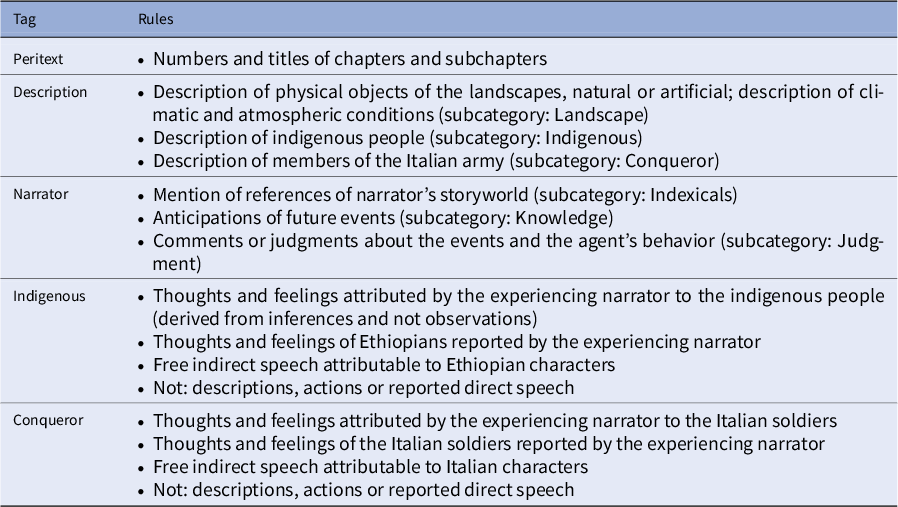
The aim of this study is not to challenge the theoretical concept, which has been fruitfully debated also in the light of post-narratology,Footnote 15 but rather to demonstrate that such compound focalization exists in Flaiano’s novel, and it is rather informative for the comprehensive interpretation of the novel, especially with regard to the anti-colonial perspective. Following Bal’s and O’Neill’s schemas, we may say that the external narrator (F1) acts as a focalizer to transfer the primary point of view by which the story is told to the experiencing-I (F2), who in turn yields his focalization to secondary characters (both indigenous and Italians), acting as a focalizer for episodic third degree focalizations (F3). In this way, the agent processes reality by transferring his perspective through another’s eyes, trying to give meaning to the people and the natural elements he encounters, and conjecturing about their motivations, thoughts, expectations and feelings.Footnote 16 Notably, there are no clear boundaries between these three layers of focalization, and the distinction can only be inferential by looking at linguistic and semantic signals, as listed in the following table.
Before digging further, one important preliminary clarification is needed: even when critical elements toward colonialism are recognized in the novel, the term “postcolonial” when associated with Flaiano’s work must be considered a general synonym for “anti-colonial,” given the precise cultural orientation and the ongoing debate surrounding the label “postcolonial” in this field of study. It is evident that the reflection on colonialism in the Forties could not have been enriched with a mature and conscious opposition to the colonial discourse as it is now conducted – even if it may serve today as testimony and a stimulus within the postcolonial studies – but it should rather be considered in connection with anti-fascism and with the historically situated experience of the Ethiopian campaign as promoted by Mussolini.
Methodologies
This section will go through the annotation process and the computational analysis conducted on the annotated text.
Annotation coding
Given that the main research question of this study is to investigate the novel’s stance toward the colonialist campaign, the annotationFootnote 17 focused on three different types of focalization which are considered informative of the relationship between colonizers and colonized as depicted in the novel:
-
1. Narrator: Focalization on the narrator-I, who occasionally interrupts the agent’s focalization. This category was divided into three subcategories, according to the linguistic and semantic triggers which made the perspective shift detectable: Indexicals (referring to mentions of place/time or other references not referable to the agent’s storyworld, see Klauk, Köppe, and Onea Reference Klauk, Köppe and Onea2012), Knowledge (showing a higher degree of knowledge than the agent) and Judgment (commenting or expressing judgment on the character’s thoughts/actions).Footnote 18
-
2. Conqueror: Focalization on one of the members of the Italian army, as filtered through the experiencing-I’s identification.
-
3. Indigenous: Focalization on indigenous men and women, as filtered through the experiencing-I’s identification.
The annotation is made under the hypothesis that each focalization differentiates from the other, in a way that contributes to the effect of unclarity and uncertainty of ideological stance conveyed by the novel, which, as we will argue, gives shape to the expression of anti-colonialism. We included in the annotation a fourth class:
-
4. Description: Within this category, we distinguished between Landscape, Indigenous and ConquerorFootnote 19 descriptions, according to the object depicted.
Although descriptions occupy a distinct narratological status within the narrative and diegetic framework, we decided to include this additional annotation category considering that no part of the novel appears to exhibit a “zero” focalization. Since everything is filtered through the experiencing-I – when not through one of the listed embedded focalizations – it seemed interesting to detect the way the experiencing-I actually sees and describes the objects in his reality, whether they are colonizers or colonized, or mere elements of the natural and artificial landscape. In other words, the hypothesis is that in the descriptive sequences, as well as in the embedded focalizations, the protagonist transfers his own perspective toward external elements, which may thus function as an extension of focalized passages. A fifth category, Peritext,Footnote 20 labeled the chapters’ titles and numeration for exclusion. Once the categories of interest were defined, we developed a set of annotation rules to ensure consistency in the process. The rules are reported in Table 1.
Annotation guidelines
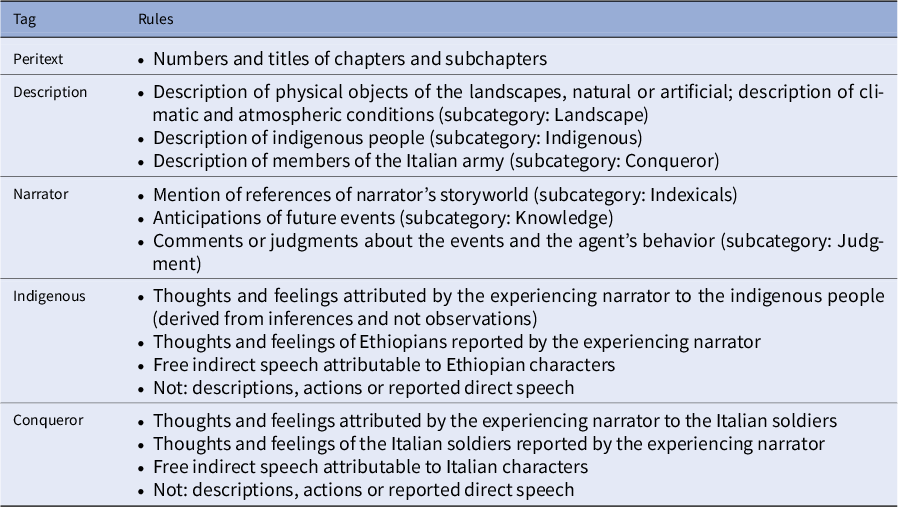
The plain text was derived from the 2016 digital edition in the BUR collection published by Rizzoli (Flaiano Reference Flaiano2016). The annotation was performed at sentence level to ensure consistency, given the difficulty of clearly attributing single words to a certain focalization; moreover, using the sentence as a unit would ensure a better balance between the categories for the computational analysis. We used the software INCePTION (Klie et al. Reference Klie, Bugert, Boullosa, de Castilho and Gurevych2018), as it allows for hierarchical tagging and has an integrated parser for sentence splitting. For multiple categories within simple sentences (very rare), we avoided overlapping and we assigned the sentence to the category to which the higher number of words referred. For multiple categories in complex sentences, we divided complex sentences into simple sentences, assigning each segment to the category to which the highest number of words referred.
The annotation was performed in a two-round manual process by two annotators, corresponding to the authors of this study. Annotator 1 annotated the entire text, while annotator 2 annotated four chapters out of seven.
Inter-annotator agreement was measured using Cohen’s Kappa at sentence level. Agreement was calculated on a predefined subset of the corpus that included sentences 1–1,005; 1,598–2,175; 3,069–3,853 and 5,283–5,601, corresponding to chapters 1, 3, 5 and 7, that were annotated by both authors. Inter-annotator agreement was computed separately for each annotation layer. For the Description layer, global multi-class agreement was almost perfect ( $\kappa = 0.83$
), while for the Focalization layer it was substantial (
$\kappa = 0.83$
), while for the Focalization layer it was substantial ( $\kappa = 0.80$
). At the level of individual labels, the per-label binary Cohen’s Kappa values show consistently high agreement across both annotation layers when interpreted using the same scale adopted for the global analysis. In the Description layer, agreement is almost perfect for Indigenous and Soldier (
$\kappa = 0.80$
). At the level of individual labels, the per-label binary Cohen’s Kappa values show consistently high agreement across both annotation layers when interpreted using the same scale adopted for the global analysis. In the Description layer, agreement is almost perfect for Indigenous and Soldier ( $\kappa = 0.84$
in both cases), indicating a very stable and shared understanding of these descriptive categories, while Landscape achieves substantial agreement (
$\kappa = 0.84$
in both cases), indicating a very stable and shared understanding of these descriptive categories, while Landscape achieves substantial agreement ( $\kappa = 0.74$
), suggesting slightly greater interpretive flexibility in identifying environmental descriptions. A similar pattern is observed in the Focalization layer, where Indigenous (
$\kappa = 0.74$
), suggesting slightly greater interpretive flexibility in identifying environmental descriptions. A similar pattern is observed in the Focalization layer, where Indigenous ( $\kappa = 0.88$
) and Conqueror (
$\kappa = 0.88$
) and Conqueror ( $\kappa = 0.84$
) reach almost perfect agreement, confirming strong alignment in the identification of narrative point of view, whereas Narrator shows substantial agreement (
$\kappa = 0.84$
) reach almost perfect agreement, confirming strong alignment in the identification of narrative point of view, whereas Narrator shows substantial agreement ( $\kappa = 0.80$
), likely reflecting borderline cases between explicit narrator focalization and more neutral perspectives.
$\kappa = 0.80$
), likely reflecting borderline cases between explicit narrator focalization and more neutral perspectives.
We then discussed the divergent annotations, reached agreement on which to use in the analysis and prepared the annotations for the full novel.Footnote 21
Explorative analysis
Once the annotation process was completed, the annotated segments were imported into a Python environmentFootnote 22 and prepared for the analysis. To generate the code, we manually prompted the Claude.ai chatbot (model Sonnet 4.5) (Anthropic 2024) with single session for each analysis, and then we verified the alignment of the resulting code with the outcome expected.Footnote 23
Below are listed the methodology applied for each analysis conducted:
-
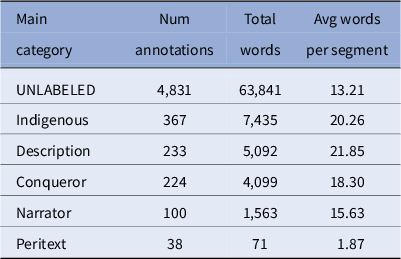
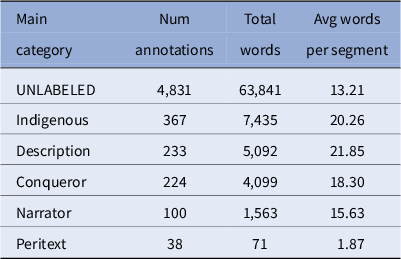
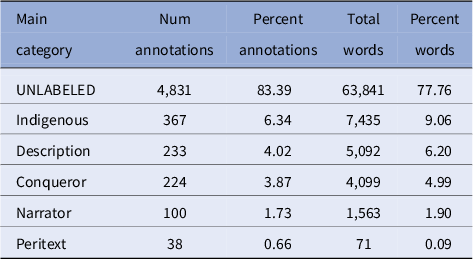
1. We explored category summaries to verify correspondence with the counts directly available in INCePTION’s statistics tool and to test the data frame structure. The results are reported in Tables A1–A4. The only divergent category, Peritext, showed discrepancies because chapter numbers and titles were merged into a single span when adjacent. Since peritexts were excluded from the analysis, this issue was not addressed further.
-
2. We identified the most frequent words (MFW) for each focalization category, setting a threshold of 80 words to obtain interpretable lists. We chose not to apply stopword filtering, except for articles and prepositions. Conjunctions and pronouns were retained as they may provide valuable information at the syntactic and semantic levels. For cross-category comparison, we extracted unique words for each category and performed a qualitative analysis of the results. This approach was preferred over statistical significance testing, as methods such as the Log-Likelihood Ratio and TF-IDF tend to foreground context-dependent elements – such as character names, character-specific pronouns and verbal forms associated with first or third person – which could reflect whether the focalization is anchored in the experiencing-I or transferred to another character. While statistically significant, these features do not necessarily highlight patterns of interest for this analysis.
-
3. We applied an unsupervised approach using the Stylo package for stylometric analysis. The aim was to determine whether distinctions between focalization categories were linguistically motivated and thus detectable through cluster analysis, and at which lexical level (most frequent function words versus less frequent content words). The Narrator category was excluded due to its limited size, which was not comparable with the other categories. For the analysis, we segmented annotated sentences into 100-word chunks and then randomly combined five chunks into single units. This procedure ensured sufficient textual density for each sample and independence from narrative sequencing. The analysis was performed on two different corpora: a balanced corpus with equal numbers of chunks per category (8) and an unbalanced corpus using the full dataset. Cluster analysis was tested with various parameters, with optimal results obtained using the full corpus and cosine Delta as the distance measure.
-
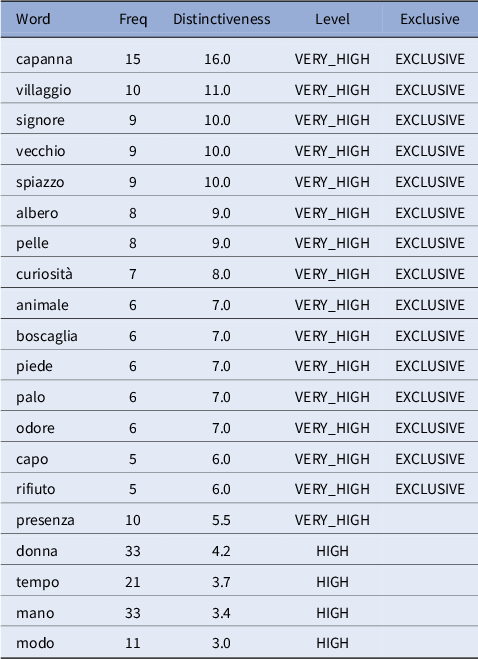
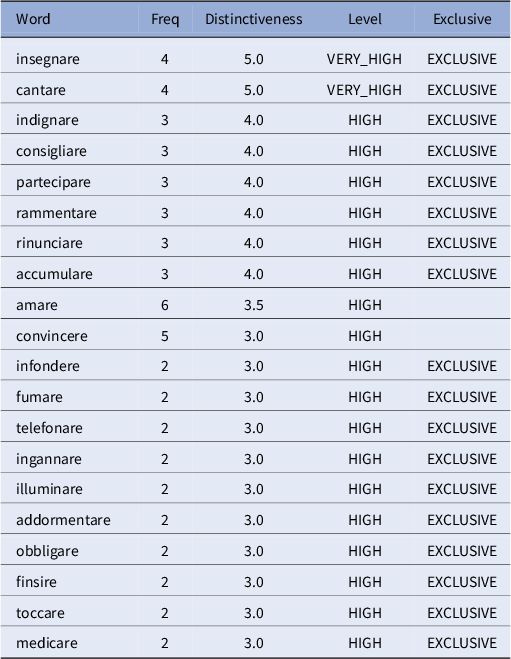
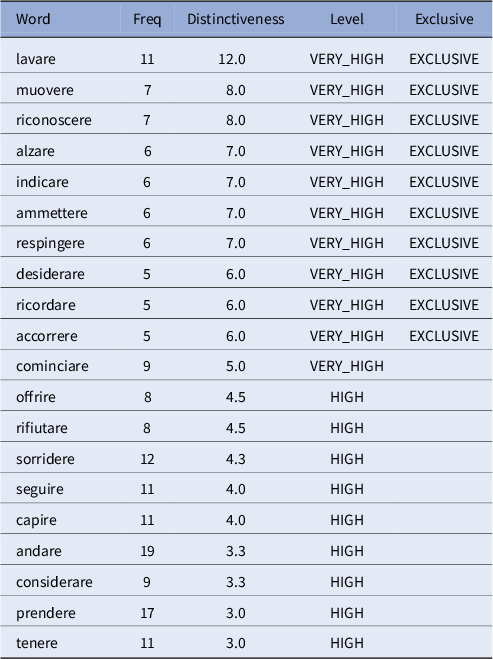
4. We then moved to the syntactic level, exploring the part-of-speech (POS) distribution for each category. POS distribution is particularly informative for semantic aspects, such as agency, topics and modality. POS tagging was performed with Stanza (Qi et al. Reference Qi, Zhang, Zhang, Bolton, Manning, Celikyilmaz and Wen2020), due to its updated curation and good performance proven for Italian texts (98.4% UPOS accuracy; see https://stanfordnlp.github.io/stanza/performance.html). To assess whether POS distributions differed significantly across categories, we performed a chi-square test and calculated effect size using Cramér’s V; results were then evaluated applying Bonferroni correction for multiple comparisons. Subsequently, we conducted a qualitative analysis of three grammatical categories with higher semantic content: nouns, verbs and adjectives. We compared only the two contrasting categories of Indigenous and Conqueror, to which we also merged segments labeled as Indigenous and Conqueror within the Description category. To identify the most distinctive words for each focalization category, we applied a simple distinctiveness ratio: $(\text {count}_{\text {category_A}} + \text {smoothing}) / (\text {count}_{\text {category_B}} + \text {smoothing})$
, and assigned a distinctiveness score (distinctiveness ratio
$\times $
frequency) based on the following thresholds: ratio >= 5.0: VERY HIGH; ratio >= 3.0: HIGH; ratio >= 2.0: MODERATE; ratio < 2: LOW. We analyzed only words with the two highest scores through close reading.
$(\text {count}_{\text {category_A}} + \text {smoothing}) / (\text {count}_{\text {category_B}} + \text {smoothing})$
, and assigned a distinctiveness score (distinctiveness ratio
$\times $
frequency) based on the following thresholds: ratio >= 5.0: VERY HIGH; ratio >= 3.0: HIGH; ratio >= 2.0: MODERATE; ratio < 2: LOW. We analyzed only words with the two highest scores through close reading. -
5. The final analysis examined syntactic role distribution to quantify agency representation across narrative categories. Following discourse analysis approaches to agency (Hart Reference Hart2010; Leeuwen Reference Leeuwen2008), we used dependency parsing to identify how Indigenous and Conqueror categories are positioned syntactically as agents (doers of actions) or patients (recipients of actions).Footnote 24
Dependency parsing was performed using Stanza (Qi et al. Reference Qi, Zhang, Zhang, Bolton, Manning, Celikyilmaz and Wen2020),Footnote 25 which assigns syntactic dependencies to each word in a sentence. We operationalized agency through the following syntactic roles:
-
• Agent roles: Segments where nominal subjects appear in active constructions (nsubj), indicating entities actively performing actions.
-
• Patient roles: Segments where entities appear as direct objects (obj), or subjects in passive constructions (nsubj:pass), indicating entities affected by or undergoing actions performed by others.
This analysis measures syntactic role distribution within segments annotated by focalization category. Since focalization reflects the experiencing-I’s perspective, Indigenous-focalized segments predominantly feature Indigenous characters as subjects and agents, while Conqueror-focalized segments position the colonizer in these roles. However, it should be noted that not every grammatical subject or object in a segment necessarily corresponds semantically to the assigned focalization category.Footnote 26 The agent/patient ratios thus reflect how each perspective is syntactically constructed: whether Indigenous or Conqueror focalizations are characterized by more agentive (subject-oriented) or patient-oriented (object-oriented) syntactic structures. For each segment, we calculated the agent/patient ratio as the number of agent roles divided by the number of patient roles. A ratio greater than 1 indicates predominant active agency, while a ratio less than 1 indicates more frequent patient positioning. We additionally analyzed verb transitivity patterns: transitive verbs (with direct objects) indicate actions performed on others, while intransitive verbs represent self-contained actions. Statistical significance of differences in agent/patient ratios between categories was assessed using the Mann–Whitney U test (
$\alpha =0.05$
). -



Results and discussion
In this section, we summarize and discuss the results obtained from each of the explorative analysis conducted and listed above.
Summary of annotations
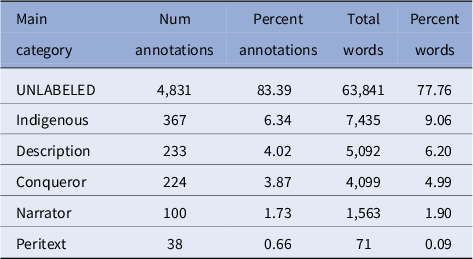
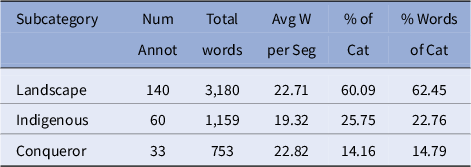
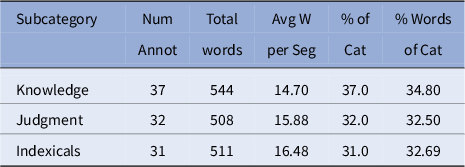
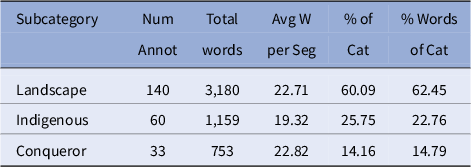
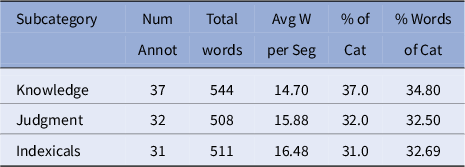
Tables A1–A4 summarize the number of annotations, total words and average word count for each category. This overview is useful for evaluating group comparability: notably, the most frequent focalization shifts from the experiencing-I is toward Indigenous people, both by number of annotated sentences and total words. This suggests an attempt to engage the protagonist more intensively with Indigenous people, not merely through actions or verbal exchanges, but through efforts at intellectual and emotional identification. Descriptive passages are also well represented (233 annotations), predominantly Landscape descriptions (A3), with Indigenous descriptions ranking second. Focalization shifts to the narrator’s perspective are less frequent and equally distributed among the three subcategories.
The identification of the Judgment subcategory proved particularly challenging, as it was not always clear whether judgments stemmed from the narrator’s retrospective reflection or from the protagonist’s inconsistent purposes and intentions throughout the plot.Footnote 27 Contrary to what has been claimed elsewhere (Orlandini Reference Orlandini1992), the ethical framework’s uncertainty does not appear to result from opposition between narrator and experiencing character, but rather from the main focalizer’s continuous attempts to escape his own perspective by inferring and inventing others’ experiences. However, close reading reveals that the content of these embedded focalizations is often self-referential: these are not genuine attempts to understand the other, but rather efforts to see himself from outside by projecting his vision onto his interlocutors.
Most frequent words comparative analysis
The first exploratory analysis compared MFW and identified unique words for each category. Table A5 reports a shortened version of the frequency tables, showing the 20 MFW per category. Full results are available in the GitHub repository (https://github.com/slilli23/Flaiano-Computational-Narratology).
Qualitative analysis of lexical distribution reveals distinctive patterns of focalization and agency attribution. At the highest frequencies, the adversative conjunction ma (“but”) shows marked frequency in Narrator segments (1.32%) compared to Description (0.69%), suggesting narratorial intervention in embedded passages with a corrective attitude. Modal expressions pervade the text, creating an atmosphere of epistemic uncertainty that characterizes the focalizer’s perspective. The adverb forse (“perhaps”) appears consistently across categories (0.7%–0.8%, except Description), as do conditional forms avrebbe (“he/she/it should have”) and sarebbe (“he/she/it should be”) (0.3%–0.4%).
The verb voleva (“he/she wanted”) appears predominantly in Conqueror segments (0.71%) compared to Indigenous segments (0.25%) and is absent from the Narrator’s top frequencies. More significantly, despite the substantial quantitative disparity between unannotated segments (experiencing-I focalization) and annotated segments, the ratio of volevo (“I wanted”) (61 occurrences) to voleva (“he/she wanted”) (38 occurrences) remains relatively balanced. This distribution contradicts expectations for an internally focalized narrative, where volevo (“I wanted”) should predominate given the protagonist’s subjective perspective. This pattern suggests that the protagonist attributes agency to the Other – particularly the colonial apparatus – in disproportionate measure, as if perceiving himself as subject to a superior will emanating from the military machine.
Epistemic privilege manifests through the verb sapevo (“I knew”), which appears 53 times in unannotated segments (focalized on the agent) compared to 10 occurrences in Conqueror-focalized segments and 13 in Indigenous-focalized segments. This distribution marks the agent’s privileged access to knowledge within the narrative framework. Gender marking reveals a process of objectification operating through taxonomizing language. The term donna (“woman”) distributes across categories with highest frequency in Indigenous segments, while uomo (“man”) appears exclusively in Description segments related to soldiers. This pattern indicates that generic gender terms function as classificatory tools rather than individuating markers: the colonized are identified through the “passive” gender, the colonizer through the stereotypical “active” gender. This reduction to categorical types (donna, uomo) effectively strips individuals of particularity and reinforces the power asymmetry inherent in the colonial encounter.
Stylometric analysis
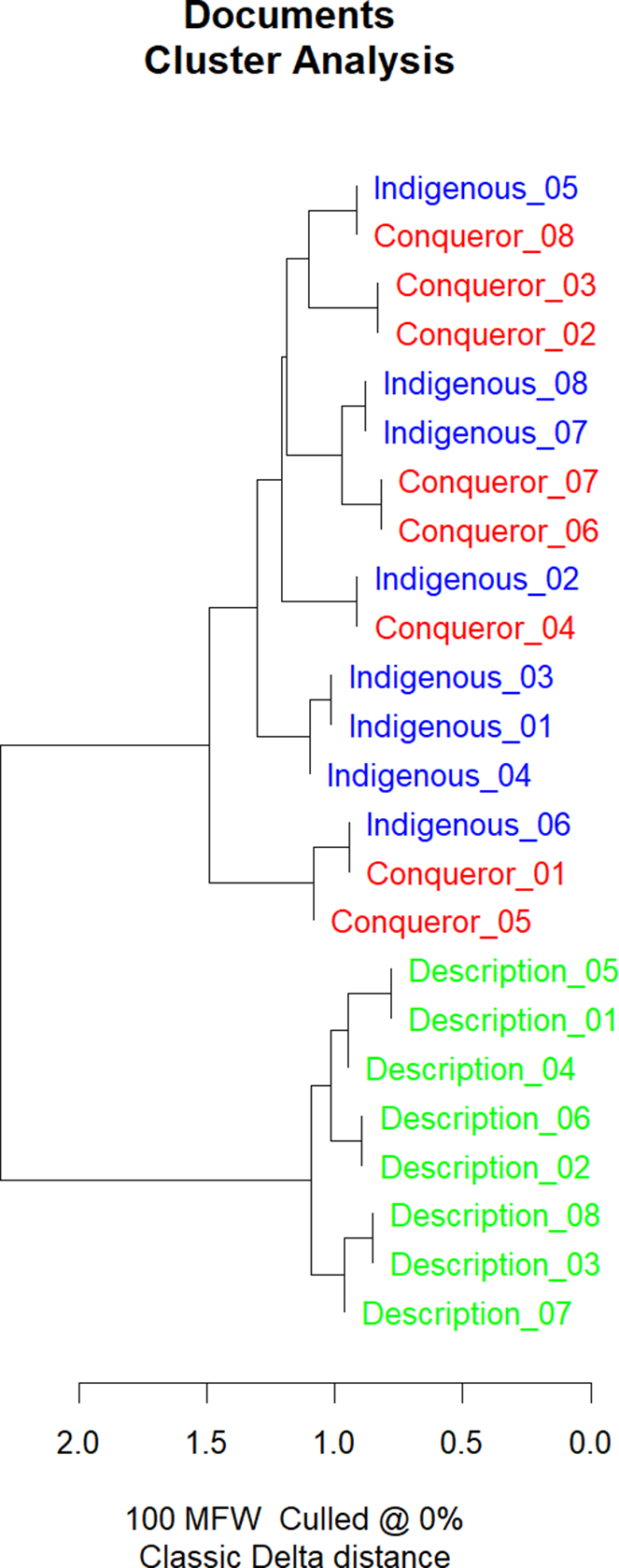
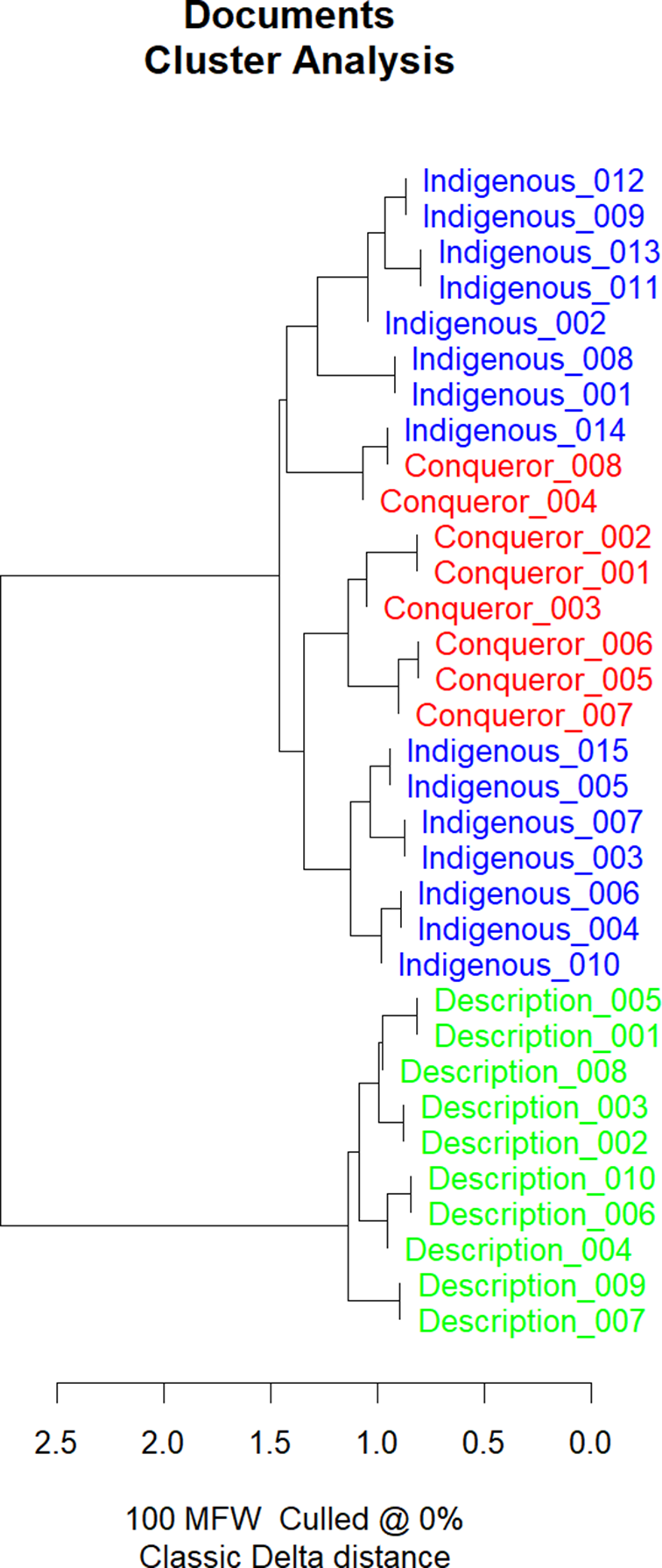
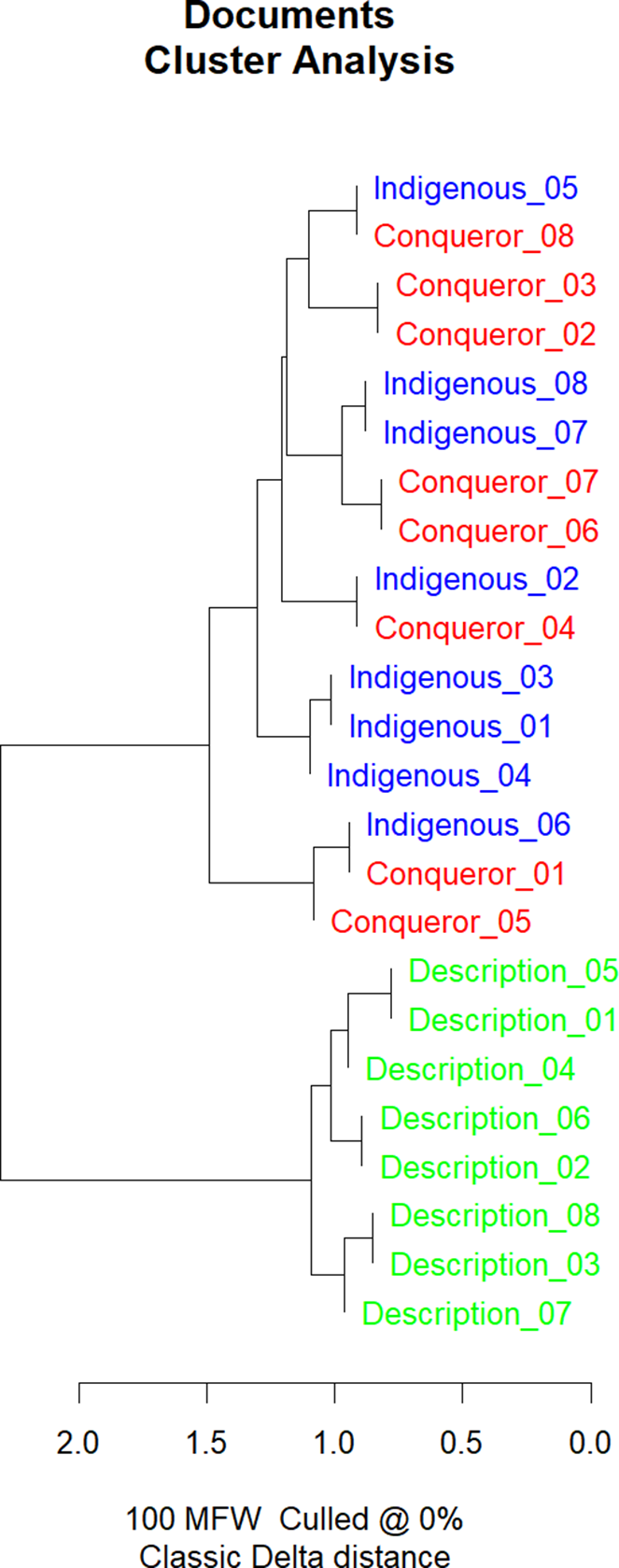
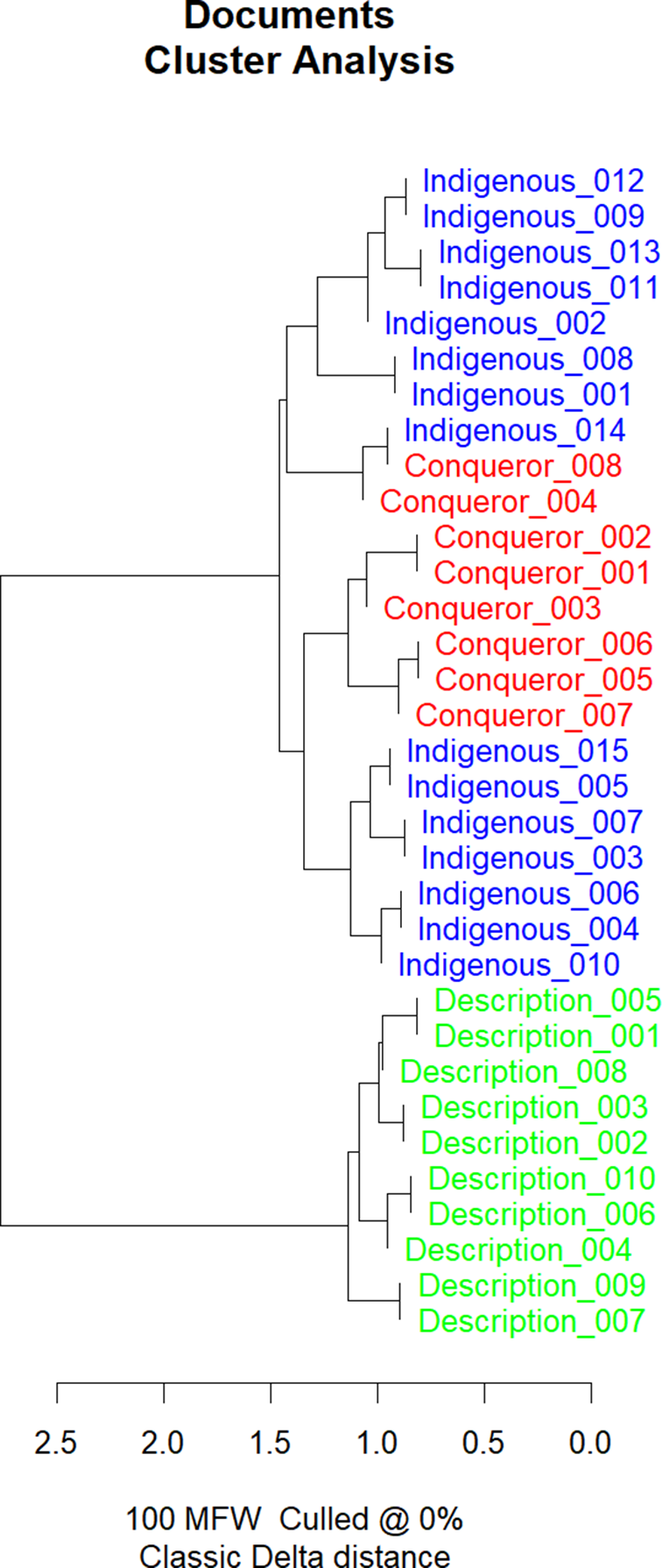
Stylometric cluster analysis using the R package Stylo (Eder, Rybicki, and Kestemont Reference Eder, Rybicki and Kestemont2016) explored whether the annotations reflect linguistically detectable frequency-based differences, continuing the exploration begun with the qualitative MFW analysis. Cluster analysis revealed a clear distinction of Description chunks at default settings (100 MFW, no culling, Classic Delta), as shown in Figure A1. This indicates clear linguistic divergence between descriptive passages and narrative passages with focalization shifted to external characters, which is readily explained by the different syntactic constructions characteristic of descriptive versus narrative discourse.
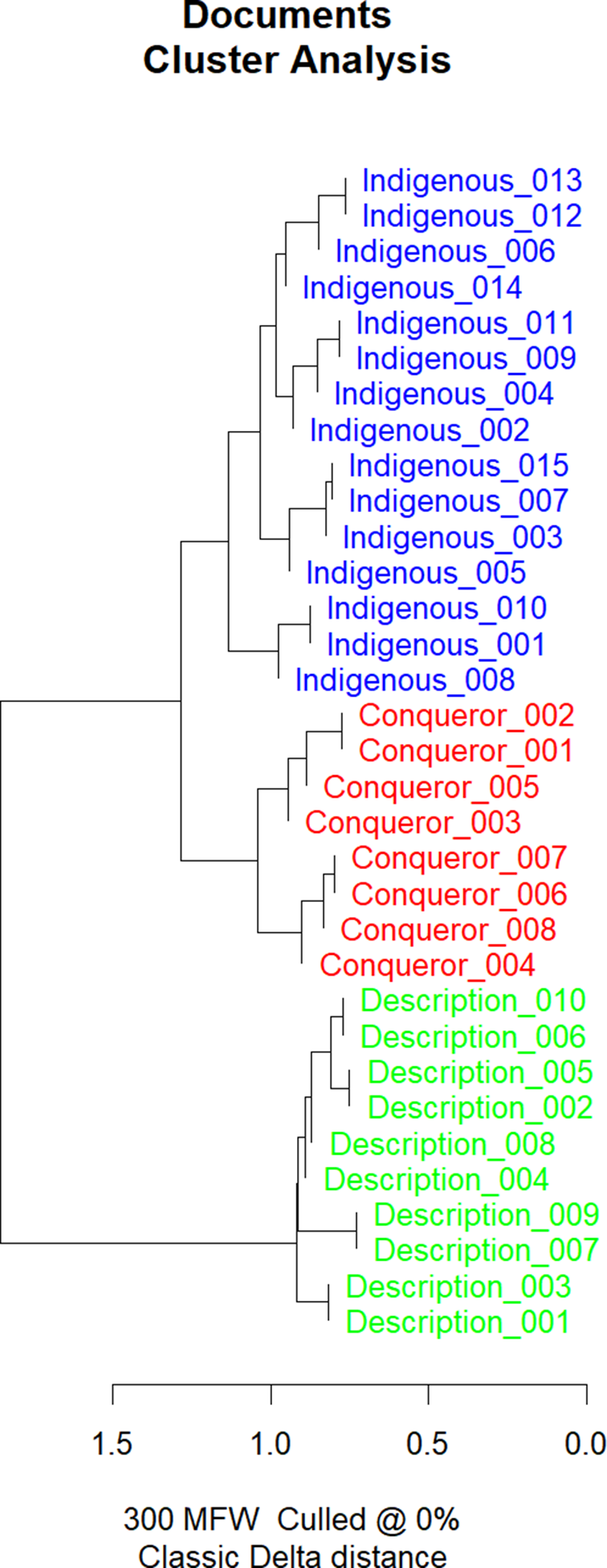
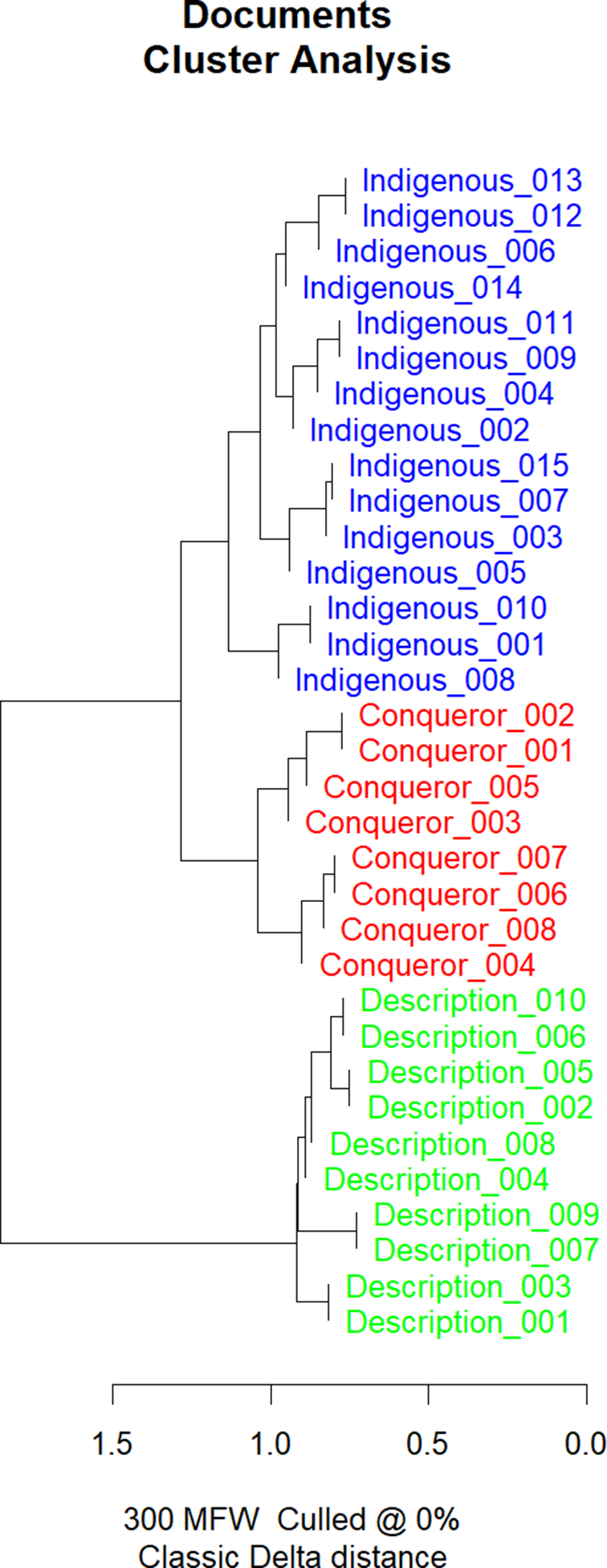
Differentiation between the two focalization categories (Indigenous and Conqueror) was achieved only when the entire corpus was used, with performance improving as the MFW threshold increased (see Figure A2). Optimal performance, with correct distinction of all three categories, was reached at 300 MFW using Classic Delta (see Figure A3). Cosine Delta improved performance, achieving satisfactory results at 150 MFW, while culling showed no beneficial effect. These results indicate that at the syntactic level (lower MFW thresholds), only the Description category shows relevant characterization. However, as the threshold increases to include more content words – moving toward the semantic level – the two focalization categories also differentiate. While this merged quantitative analysis does not reveal which specific features ultimately distinguish the two focalizations, the unsupervised approach provides solid evidence of the robustness of both the research design and the annotation process.
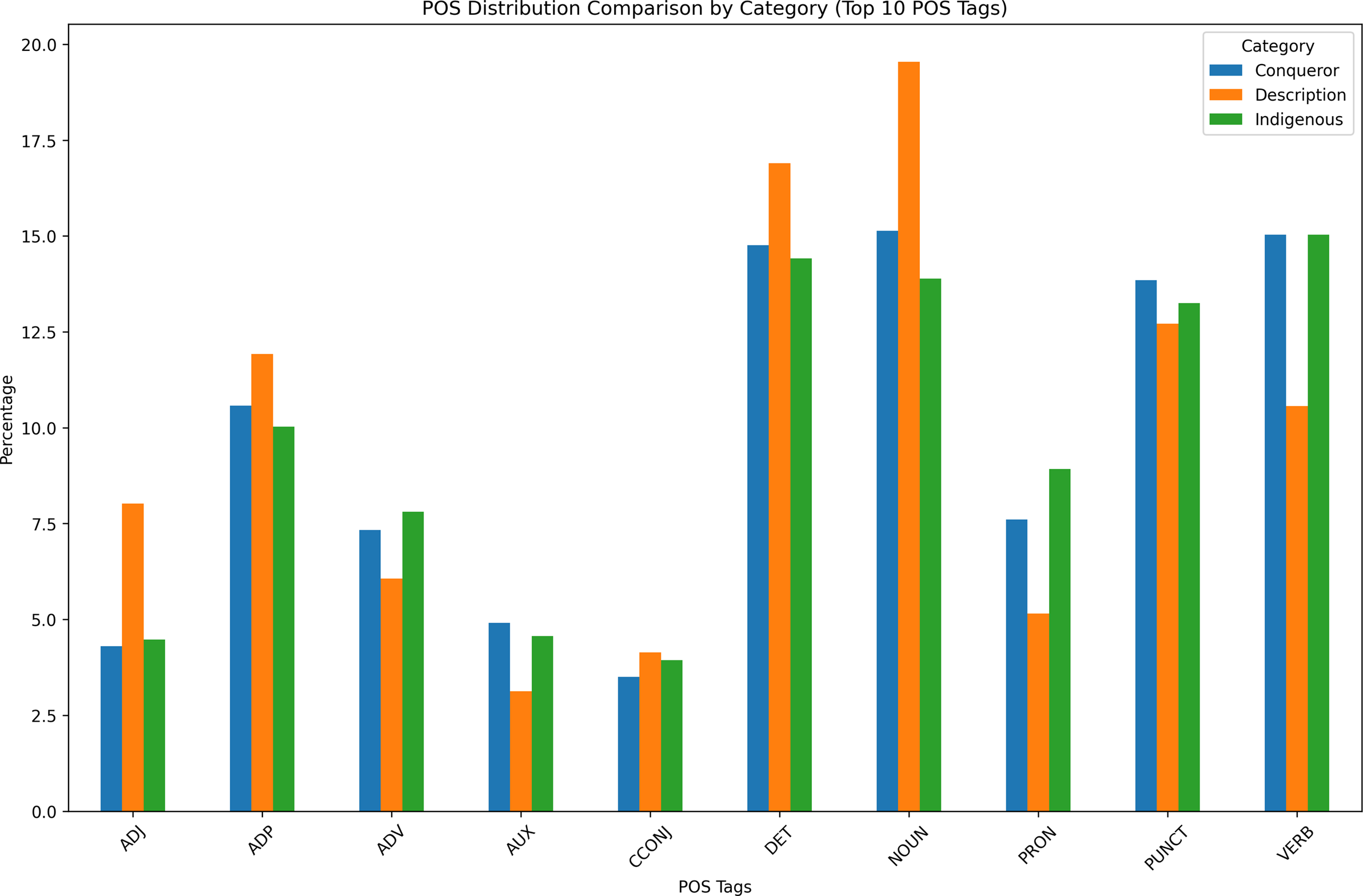
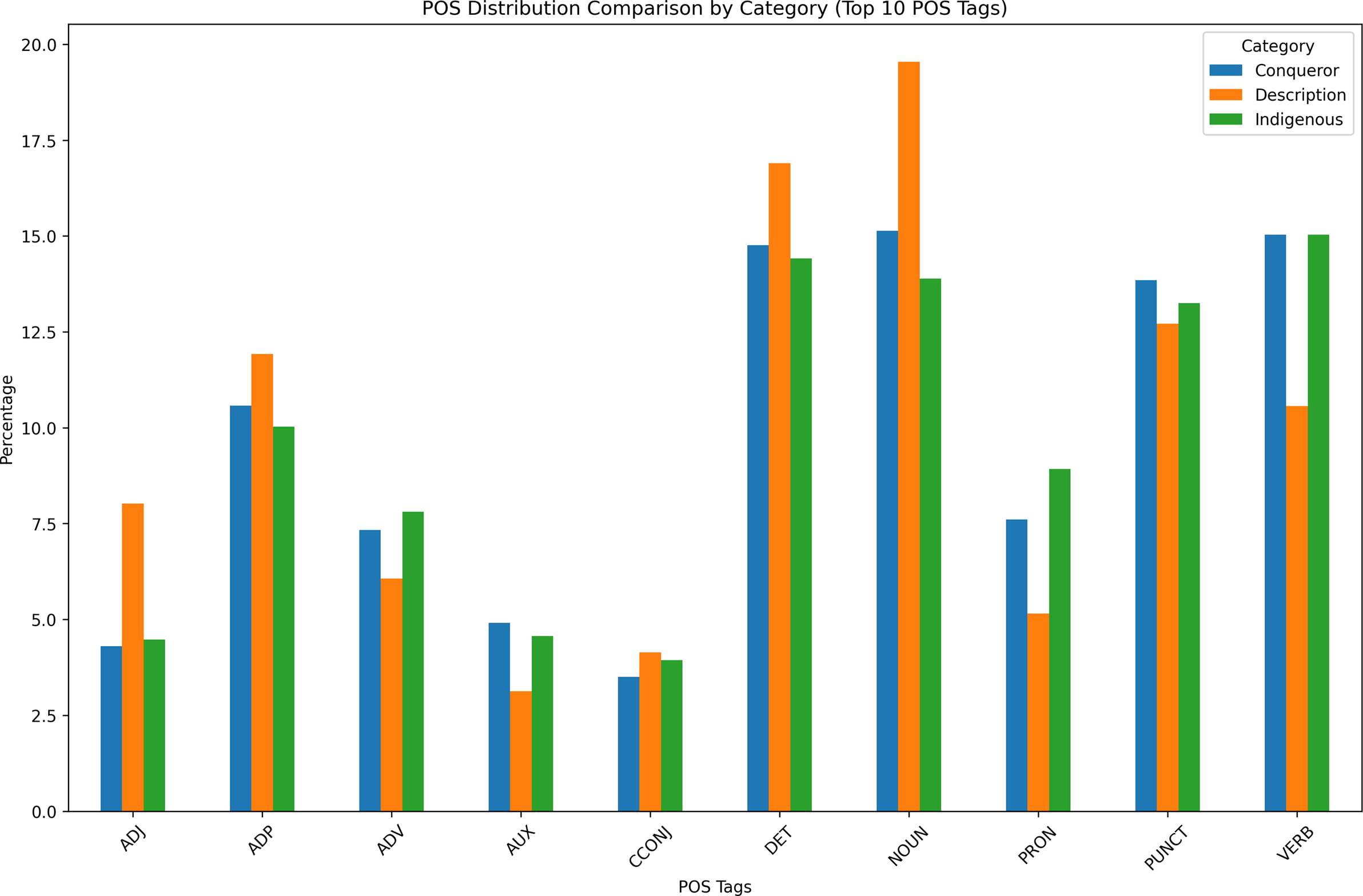
Part-of-speech distribution analysis
POS distribution analysis (see Figure A4) aimed at detecting whether there are significant differences in POS distribution across categories. Significance test revealed that 11 of 13 POS categories have significant associations with narrative categories, which remained significant after stringent Bonferroni correction ( $\alpha = 0.00385$
). Unsurprisingly, description passages are characterized by over-representation of descriptive elements (ADJ:
$\alpha = 0.00385$
). Unsurprisingly, description passages are characterized by over-representation of descriptive elements (ADJ: $+8.43, p < 0.001$
; NOUN:
$+8.43, p < 0.001$
; NOUN: $+7.16, p < 0.001$
) and under-representation of dynamic narrative elements (VERB:
$+7.16, p < 0.001$
) and under-representation of dynamic narrative elements (VERB: $-6.63$
, PRON:
$-6.63$
, PRON: $-6.63$
, both
$-6.63$
, both $p < 0.001$
); results confirmed by effect size analysis (ADJ:
$p < 0.001$
); results confirmed by effect size analysis (ADJ: $p = 2.81 \times 10^{-24}$
, NOUN:
$p = 2.81 \times 10^{-24}$
, NOUN: $p = 1.30 \times 10^{-20}$
; VERB, PRON: both
$p = 1.30 \times 10^{-20}$
; VERB, PRON: both $p < 10^{-16}$
). This pattern clearly aligns with the functional distinction between static landscape description and dynamic character interaction.
$p < 10^{-16}$
). This pattern clearly aligns with the functional distinction between static landscape description and dynamic character interaction.
Continuous measures analysis also revealed significant differences in linguistic complexity between narrative categories. Description passages showed the lowest lexical diversity ( $M = 0.843$
) but highest content word density (Function/Content =
$M = 0.843$
) but highest content word density (Function/Content = $0.955$
), consistent with descriptive vocabulary and low usage of function words. Conversely, Indigenous passages demonstrated the highest grammatical complexity (Function/Content =
$0.955$
), consistent with descriptive vocabulary and low usage of function words. Conversely, Indigenous passages demonstrated the highest grammatical complexity (Function/Content = $1.076$
) while maintaining high lexical diversity (
$1.076$
) while maintaining high lexical diversity ( $M = 0.874$
), suggesting more varied interactive language (Kruskal–Wallis tests: both
$M = 0.874$
), suggesting more varied interactive language (Kruskal–Wallis tests: both $p < 0.001$
).
$p < 0.001$
).
These results, even if predictable and not informative for semantic differences between the categories, still are fundamental as they once again confirm the robustness of the annotation schema for all the categories identified.
Part-of-speech qualitative analysis
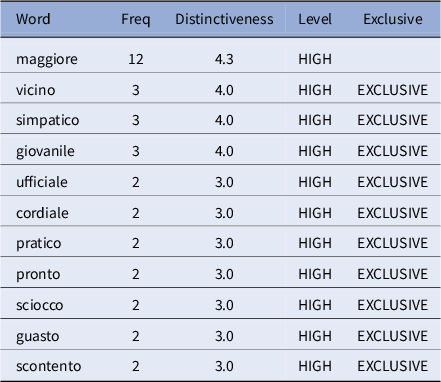
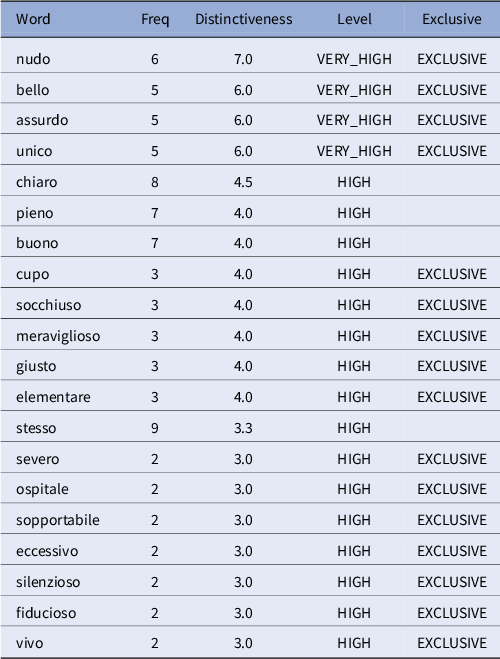
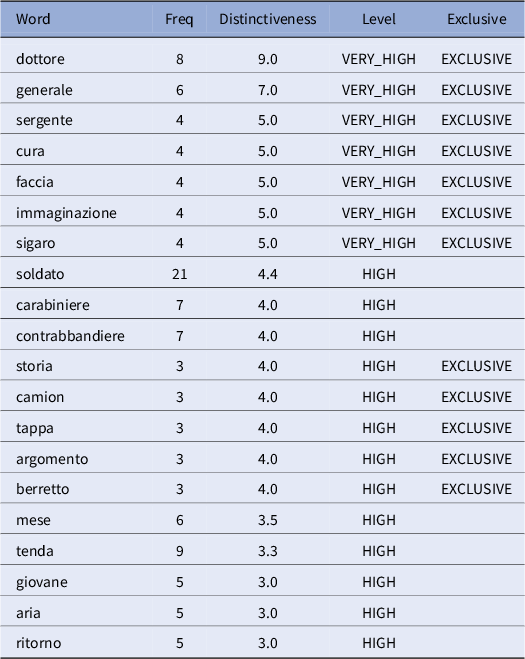
The second phase of POS analysis examined the MFW within each grammatical category, focusing exclusively on the two focalization categories (Indigenous and Conqueror), merged with their respective Description subcategories. The frequency tables reported in Tables A6–A11 reveal several interesting patterns.
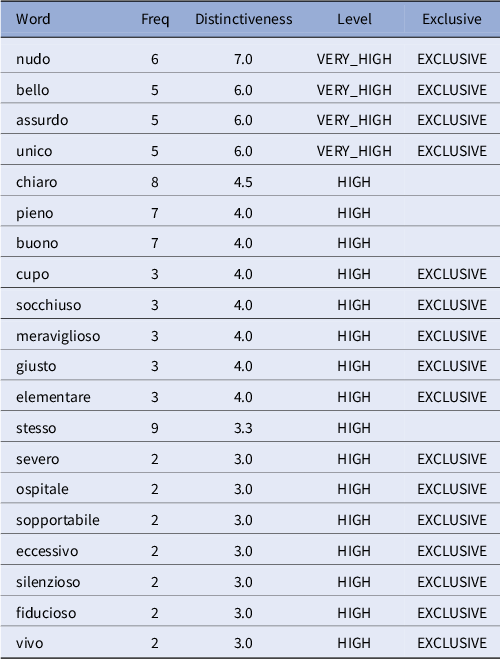
Within adjectives, Indigenous characters are depicted – both through internal focalization and external description – with a perception of the world marked by wonder and naivety (chiaro “clear,” bello “beautiful,” assurdo “absurd,” meraviglioso “marvelous”), as well as through more direct contact with natural existence (nudo “naked,” pieno “full,” cupo “dark”). Adjectives referring to moral qualities and values are also well represented (buono “good,” giusto “just,” severo “severe,” ospitale “hospitable”). Conversely, Italian army members appear characterized by more superficial attitudes, embodying a petty bourgeois perspective (giovanile “youthful,” cordiale “cordial,” sciocco “foolish,” scontento “discontent”).
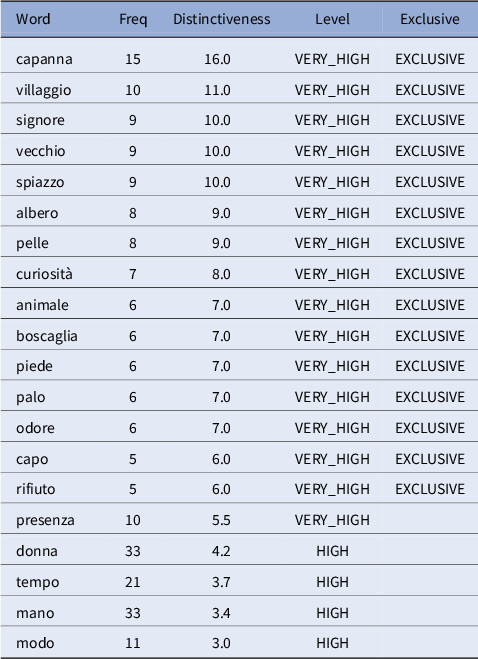
Noun analysis offers equally interesting insights. The conqueror representation shows insistence on military positions (soldato “soldier,” generale “general,” maggiore “major,” dottore “doctor,” carabiniere “carabineer,” sergente “sergeant”), which is understandable given that Italian characters receive no proper names, unlike Ethiopians (Johannes, Mariam and Elias).Footnote 28 This strengthens the depersonalization of soldiers, who are regarded as “types” rather than individuals, embodying negative qualities, such as laziness, trickery, machismo and careerism. In Indigenous passages, the most frequent nouns show high generalization (donna “woman,” vecchio “old man,” corpo “body,” tempo “time,” presenza “presence”) and close connection with nature and material existence (capanna “hut,” villaggio “village,” spiazzo “clearing,” animale “animal,” odore “smell”). Most significantly, several terms relate to relational dynamics between colonizer and colonized, particularly in the novel’s final section when the lieutenant recuperates with Johannes in the “ghost” village (where inhabitants have been killed in retaliation): signore (“sir/lord”), colpo (“blow”), rifiuto (“refusal”), fastidio (“annoyance”), curiosità (“curiosity”) and volontà (“will”).
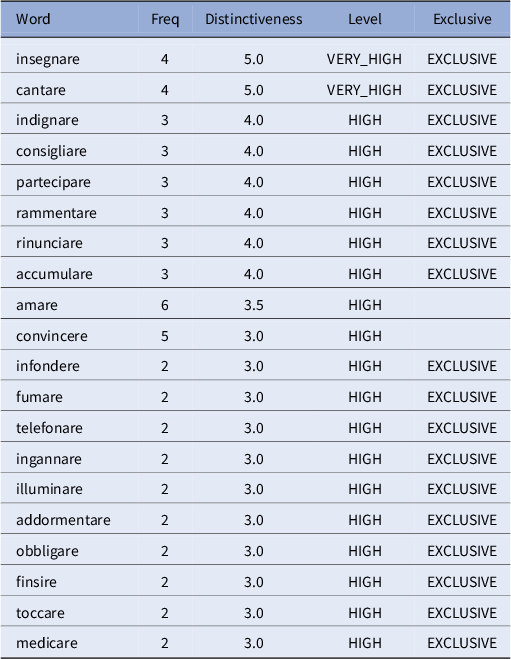
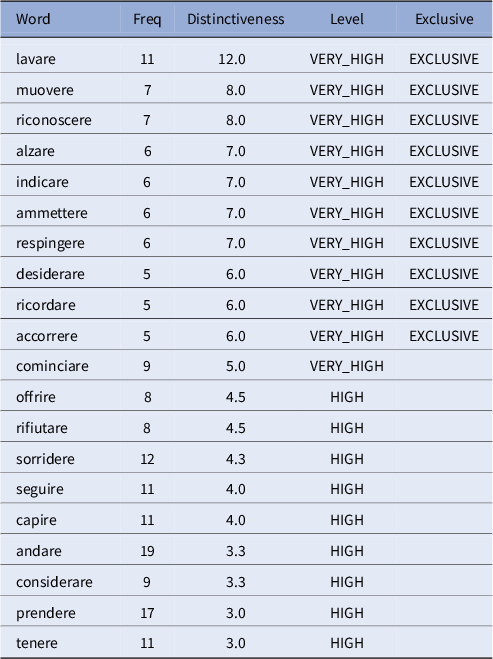
Verb analysis reveals markedly different patterns between categories. Conqueror-related verbs show higher transitivity (amare “to love,” insegnare “to teach,” convincere “to convince,” accumulare “to accumulate”), while Indigenous-related verbs express actions primarily involving the subject and often modifications of internal state and perception (lavare “to wash,” andare “to go,” riconoscere “to recognize,” sorridere “to smile,” desiderare “to desire,” conoscere “to know”). Some verbs reveal mediation and response dynamics in the colonial encounter, showing alternating attitudes (seguire “to follow,” ammettere “to admit,” respingere “to reject,” offrire “to offer,” rifiutare “to refuse”).
This qualitative analysis reveals that colonizer and colonized are represented through stereotypical elements associated with both groups, yet simultaneously demonstrates the author’s effort to interpret Indigenous interiority through focalization techniques. The higher number of distinctive verbs associated with the Indigenous category – despite comparable segment size – suggests that stereotypical representation affects colonizers more than colonized. Ethiopian thoughts and feelings provoke the author’s curiosity, employing immersion and imagination to recreate their inner world and render it accessible to Europeans. This process, however, remains incomplete: when the soldier finally leaves Africa, his acquired consciousness amounts to nothing more than a faint, disgusting smell that he can easily ignore along with accountability for his actions.
Syntactic role analysis
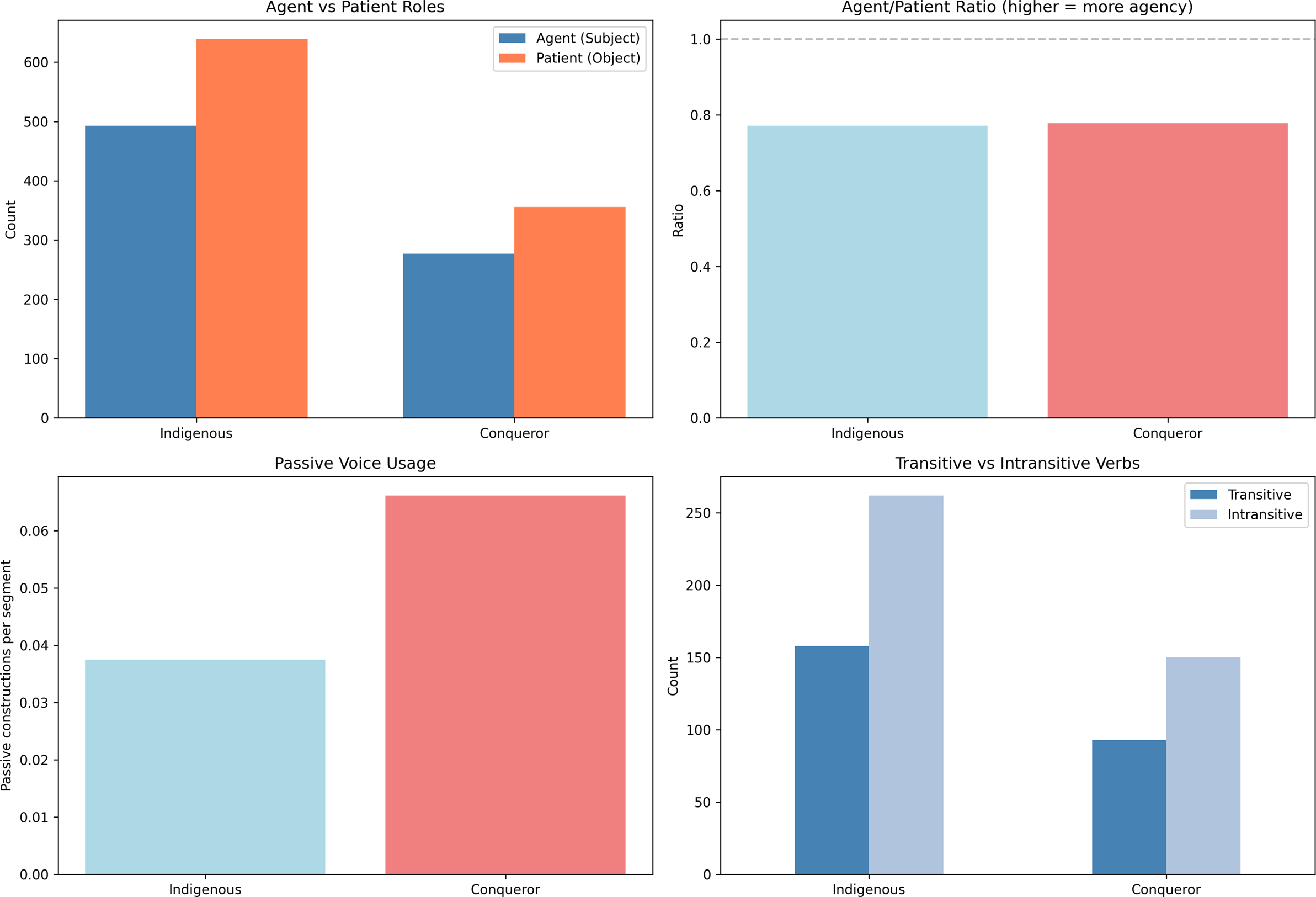
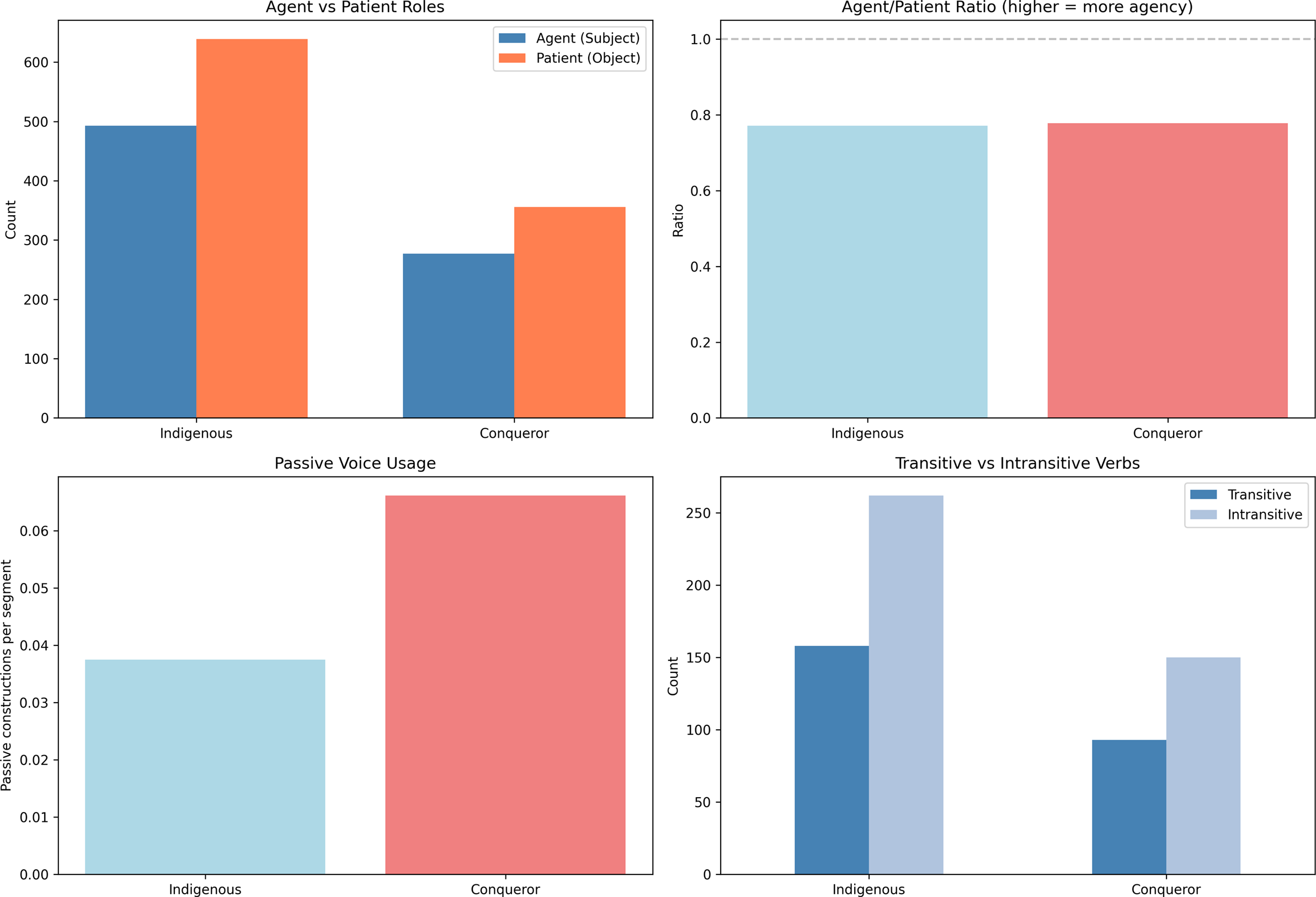
Syntactic role analysis explored agency attribution to the contrasting categories of colonized and colonizer. The analysis revealed no significant differences between the two groups, as shown in Table A12 and Figure A5. Agency appears equally distributed between characters regardless of group affiliation. Both Ethiopians and Italians occupy more patient than agent roles (agent/patient ratios: Indigenous 0.77, Conqueror 0.78), suggesting that characters are represented as subjected to historical and social forces beyond their control. Both categories also exhibit predominantly intransitive verb usage, reinforcing this pattern of limited agentive capacity.
Notably, Conqueror-focalized passages show slightly higher passive construction rates (0.07 vs. 0.04 per segment), although this difference is not statistically significant. This syntactic framing reflects the occupiers’ paradoxical position: despite their role as invaders, they find themselves as impostors, incapable of becoming meaningful participants in the occupied land or of providing significant knowledge to native inhabitants. This mirrors the plot’s trajectory, in which the protagonist progressively relinquishes control and places himself in Johannes’ hands. Reading the protagonist’s individual experience as emblematic of national defeat illuminates the novel’s final chapter: guilt and responsibility lose accountability as the perpetrators of colonial violence position themselves as victims of historical forces. While contemporary readers might interpret this as an evasion of honest reflection on colonial crimes, at the time of publication (1947) this representation challenged fascist propaganda’s portrayal of colonial soldiers as a monolithic, infallible entity. By revealing the occupiers’ vulnerability and confusion, Flaiano offered a counter-narrative to official colonial discourse.
As noted in the methodology section, this analysis captures agency distribution within focalized segments but does not track character-specific agency throughout the entire narrative. A comprehensive account would require extending the analysis to the complete text using lexical filters, co-reference resolution and Named Entity Recognition to track specific characters across all narrative modes, including non-focalized passages. Such character-based analysis would distinguish between focalization-based agency (whose perspective dominates) and character-based agency (how specific individuals are syntactically positioned regardless of focalization). This distinction is particularly relevant for colonial discourse analysis, where power asymmetries may manifest through both narrative perspective and grammatical framing of character actions.Footnote 29
Conclusion
The exploratory analysis conducted provided interesting insights for interpreting Flaiano’s novel Tempo di uccidere within the framework of postcolonial literature. On the one hand, it demonstrated how the author constructs a subtle play of embedded perspectives that destabilize the reader’s search for a clear ethical stance within the novel, obscuring a definitive authorial point of view. The diminished authority of the experiencing/narrator-I deliberately fails to provide a solid interpretative guide, while the layering of reflected perspectives succeeds in representing the complexity of the colonial experience. This complexity lies not only in the actual dynamics of confrontation and clash between conquerors and indigenous people, but especially in the controversial tension between inner conscience and external actions, between individual motivation and historical constraints. The consistency of these focalization processes is demonstrated by unsupervised cluster analysis and POS distribution analysis, where the focalizing categories emerge with statistical significance.
On the other hand, our analysis revealed how – despite Flaiano’s incorporation of stereotypical elements from the colonial and exotic genre – the focalization through the Other’s perspective represents an attempt to fill the epistemological gap that the conqueror experiences in confrontation with indigenous people. Although this identification process occurs through the colonizer’s gaze, as embedded focalizations, it still testifies to an effort of understanding and decoding the colonized from within, moving beyond the epistemic certainty that derives from presumed cultural and material superiority. POS qualitative analysis illuminates the complex representation of Indigenous characters, revealing a larger and more varied set of verbs denoting perceptive and cognitive acts referred to Ethiopians, as well as numerous nouns and adjectives with moral connotation. Conversely, the most distinctive words referred to Italian soldiers picture a scarce willingness for in-depth analysis, basically revolving around objects of everyday life or reflecting a mentality typically bourgeois. Moreover, Italians lack proper names and are identified only by their military rank, which contributes to depersonalize them and reduce them to functional roles within the military apparatus. For the same reason, colonizers show higher frequencies of passive voice and intransitive actions than active and transitive ones in sentences where they are the embedded focalizers: both categories, colonizers and colonized, appear thus impotent in the face of the abstract military machine that reduces soldiers to blank labels and makes the colonized victims by their mere existence.
In conclusion, the analysis shows how the representation of indigenous people and conquerors does not rely peacefully on stereotypical patterns, but rather exploits those literary and propagandist conventions to subvert the familiar comfort that they traditionally emanate. In this interpretative light, the final chapter – where the lieutenant loses accountability for his crimes – can be coherently read as an ironical overthrow expressed through the voice of the author’s alter-ego: the military machine ridicules and nullifies the protagonist’s journey through his conscience, a journey where the relation with the Other had been confronted and resolved through mutual recognition. The lieutenant can peacefully return home and pretend nothing has happened – exactly as Flaiano himself experienced after the colonial campaign. The crimes he denounced with his characteristically ironic mark in the war journal remain nothing but a note: “Non mi sono mai così divertito come in questi giorni. Ricordarsene.”Footnote 30
Data availability statement
All data and code supporting this study are openly available. The annotated corpus, the output files and analysis results, and Google Colab notebooks for replication can be accessed at https://github.com/slilli23/Flaiano-Computational-Narratology. The original novel Tempo di uccidere (Flaiano Reference Flaiano1947) is under copyright and must be obtained separately.
Disclosure of use of AI tools
The authors declare that generative AI tools were used for this study in the following phases: brainstorming, Python programming, statistical analysis, stylistic and formal revision and copy-editing. The intellectual content (research idea, research design, annotation, qualitative analysis, interpretation of results, draft writing and references) originates entirely from the human authors. The authors take full responsibility for the accuracy and integrity of the work.
Author contributions
Conceptualization: S.L.; Formal analysis: S.L. and D.R.; Methodology: S.L.; Validation: D.R.; Writing – original draft: S.L.; Writing – review and editing: D.R.
Funding statement
The authors declare that no specific funding has been received for this article.
Competing interests
The authors declare no competing interests.
Ethical standards
The authors affirm that this research did not involve human participants.
Appendix
Tables
Number of sentences (or segments) annotated and sentence length
Number of words
Description subcategories
Narrator subcategories
Most frequent words by narrative category (top 20)

Most distinctive adjectives in Conqueror corpus (top 20)
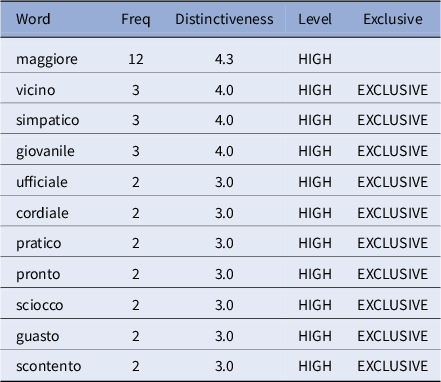
Most distinctive adjectives in Indigenous corpus (top 20)
Most distinctive nouns in Conqueror corpus (top 20)
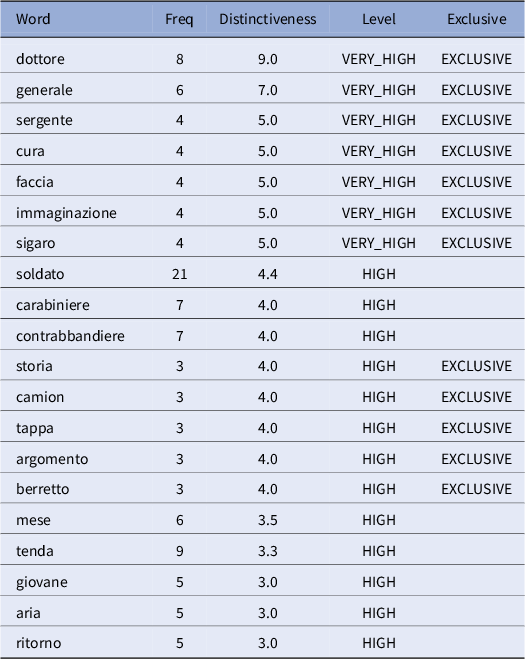
Most distinctive nouns in Indigenous corpus (top 20)
Most distinctive verbs in Conqueror corpus (top 20)
Most distinctive verbs in Indigenous corpus (top 20)
Syntactic role distribution by category

Figures
Cluster analysis with balanced corpus (100 MFW, Classic Delta).
Cluster analysis with full corpus (150 MFW, Classic Delta).
Cluster analysis with full corpus (300 MFW, Classic Delta).
POS distribution comparison by category.
Syntactic role analysis: Agent/patient ratios for Indigenous and Conqueror categories.





 Open access


Rapid Responses
No Rapid Responses have been published for this article.