

In July 2004 the Remembering the Dead project carried out its first excavation season in the cemetery area of the ancient Latin town of Crustumerium (Rome, Italy). The excavations were conducted in collaboration between Dr Rajala (Department of Archaeology, University of Cambridge) and Dr di Gennaro (Director of the Archaeological Area of Crustumerium, Soprintendenza di Roma) and financed partly by the British Academy and the Finnish Cultural Foundation. The core team was composed of researchers and students working in Britain, Italy and Finland, who share research interests in central Italy and/or funerary archaeology and digital methods. The aim of the project is to shed new light on the funerary practices in central Italy during the pre-Roman times. In addition, the project tries to salvage knowledge from the tombs in peril due to the continued activities of tomb robbers.
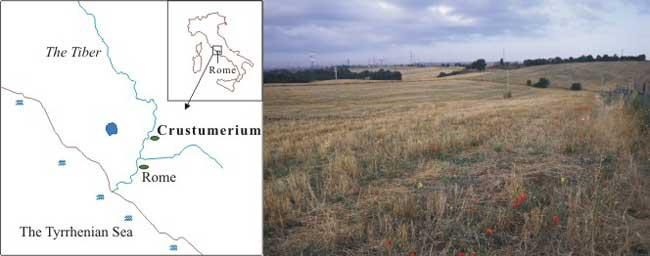
Crustumerium in central Italy.

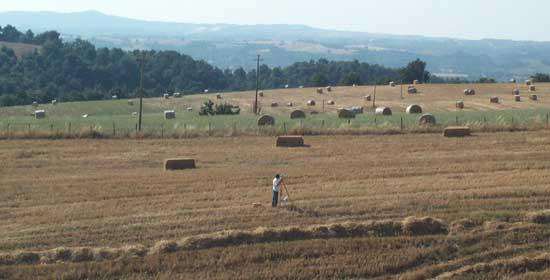
Creating a local elevation model.

Crustumerium (Figure 1) was one of the pre-Roman Latin towns that competed with the rising polity of Rome before the Archaic period. The continuous settlement can be traced back to the ninth century BC; the centre experienced its heyday during the seventh century BC. Along with the nearby Fidenae, Crustumerium came under the influence of Rome during the regal period, and then, ceased to exist as an independent entity around the year 500 BC when it was definitively conquered by the Romans. Shortly afterwards, at the beginning of the fourth century BC the urban centre disappeared as well (cf. Quilici & Quilici Gigli 1980 di Gennaro 1999, Reference AmorosoAmoroso 2000; 2002; 2004).
The project uses computerised methods to record the funerary structures and analyse them and their landscape. The tombs are seen as part of a ritual landscape of the community, and therefore, the project has chosen a research strategy that combines GIS and field archaeology to accumulate new data and find spatial and temporal relationships at a local level. Computers are used as a tool to study this Iron Age and Archaic community through its funerary practices and the resulting creation and representation of the memories and the statuses of the deceased. New excavations targeting the lesser-known Archaic period will help create an understanding of the relative importance of Crustumerium, its local identities and its possibilities to oppose the power of Rome. During the first season there was also an anthropological component in the form of interviews in order to study different attitudes towards excavating tombs.
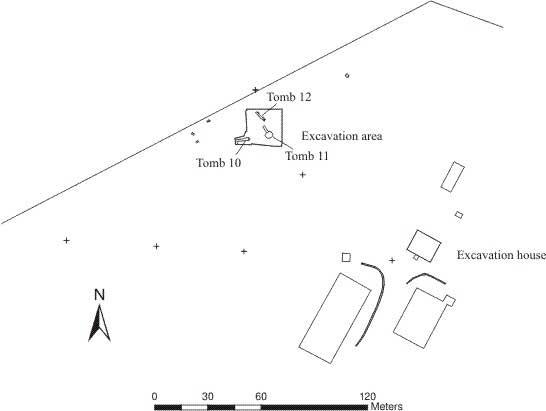
Plan of the excavation area.

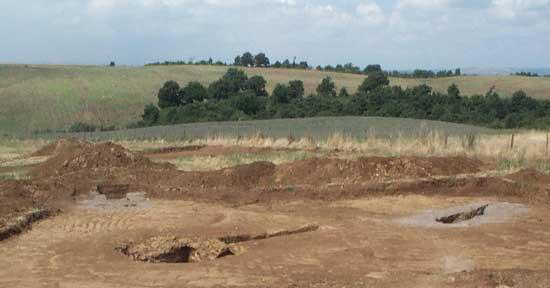
Three tombs in the excavation area.

The excavation was carried out as a standard context excavation applying single context recording. Most of the plans and sections were recorded digitally with a total station. Digital measurements are conducted in collaboration with Muuritutkimus Ky (Finland) who provided Nikon 350-NPL total station and the 3dWin programme created by 3D Systems. The excavation was preceded by a gridded surface collection and the creation of a local elevation model (Figure 2). Both traditional and digital photographs were taken; all imagery is also stored in digitised format.
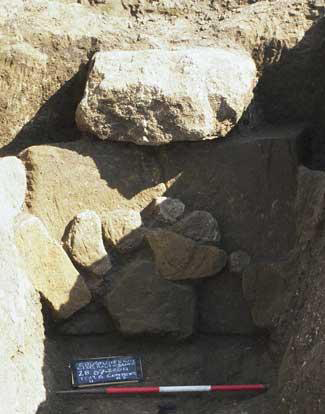
During the first season three chamber tombs were revealed in an area of 400 square metres (Figures 3 and 4). One of these was excavated in its entirety; due to the local geological conditions, the chamber had collapsed, and thus, the burials were intact (Figure 5). Although the excavation of the find layer of the chamber produced data on the presentation of gender and status, the most important finds were structural. Since the recent research excavations in Archaic cemeteries have been relatively rare (albeit those at Eretum), little is known or published about the original closure features of the tombs. Fortunately, at Cisterna Grande the original slabs and blockages have survived in two instances (Figure 6). The double structures safeguarding the entrances suggest that the dromoi leading to the chambers may have been partially or fully filled between burials.
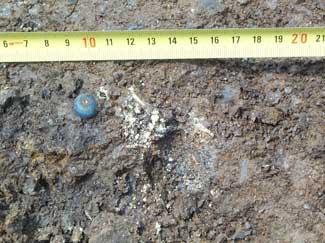
Detail from the female burial. A glass pearl in situ.

Slabs closing the doorway of the chamber tomb 11.

The excavations at Crustumerium have just received a grant from the Finnish Academy, which secures the continuation of the excavations in 2005 and 2006 together with an additional study season, followed by the final publication in 2008.