





1. Introduction
Sightlines towards background Active Galactic Nuclei (AGN) are important probes of the circumgalactic environment, providing a pencil beam sample of all the multi-phase gas along the line of sight. In particular, Lyman- $\alpha$
absorption lines in the restframe UV provide most of our current knowledge about neutral atomic hydrogen (H i) in the distant Universe (e.g. Wolfe, Gawiser, & Prochaska Reference Wolfe, Gawiser and Prochaska2005).
$\alpha$
absorption lines in the restframe UV provide most of our current knowledge about neutral atomic hydrogen (H i) in the distant Universe (e.g. Wolfe, Gawiser, & Prochaska Reference Wolfe, Gawiser and Prochaska2005).
Radio measurements of 21 cm absorption can also provide information about H i in the distant Universe, particularly at $z\lt1.7$
where Lyman-
$z\lt1.7$
where Lyman- $\alpha$
is not yet redshifted enough to be detectable by ground-based optical instruments, complicating the study of H i-rich Damped Lyman-
$\alpha$
is not yet redshifted enough to be detectable by ground-based optical instruments, complicating the study of H i-rich Damped Lyman- $\alpha$
(DLA) systems with
$\alpha$
(DLA) systems with $N_{\text{HI}} \geq 2\times10^{20}\,\text{cm}^{-2}$
(e.g. Kanekar & Briggs Reference Kanekar and Briggs2004; Morganti, Sadler, & Curran Reference Morganti, Sadler and Curran2015). The optical depth of the 21 cm absorption line is inversely related to the gas excitation (spin) temperature, so the H i line is most sensitive to cold neutral gas with a spin temperature below
$N_{\text{HI}} \geq 2\times10^{20}\,\text{cm}^{-2}$
(e.g. Kanekar & Briggs Reference Kanekar and Briggs2004; Morganti, Sadler, & Curran Reference Morganti, Sadler and Curran2015). The optical depth of the 21 cm absorption line is inversely related to the gas excitation (spin) temperature, so the H i line is most sensitive to cold neutral gas with a spin temperature below ${\sim} 300$
K (Morganti & Oosterloo Reference Morganti and Oosterloo2018).
${\sim} 300$
K (Morganti & Oosterloo Reference Morganti and Oosterloo2018).
In this paper, we report the discovery of redshifted 21 cm H i absorption along the line of sight to an intellectually (and physically) scintillating radio quasar, PKS 0405-385. The layout of the paper is as follows. In Section 2 we summarise what was known about PKS 0405-385 before the discovery of the intervening H i presented here, including estimates of its angular size, and historical importance. In Section 3, we present the new H i detection towards this source and briefly discuss its line characteristics. Section 4 offers a more complete analysis of the nature of PKS 0405-385 and the intervening gas based on new optical data (Section 4.2) and an up-to-date radio lightcurve (Section 4.3). We discuss a few theoretical considerations on the propagation of the light from PKS 0405-385 through foreground matter in Section 5. Throughout this work, we adopt a flat, $\Lambda$
cold dark matter (
$\Lambda$
cold dark matter ( $\Lambda$
CDM) cosmology in line with values from Planck Collaboration (2020);
$\Lambda$
CDM) cosmology in line with values from Planck Collaboration (2020); $\Omega_{\mathrm{m}}$
= 0.315,
$\Omega_{\mathrm{m}}$
= 0.315, $\Omega_\Lambda = 0.685$
, and
$\Omega_\Lambda = 0.685$
, and $H_0 =67.4\,\text{km s}^{-1}\text{Mpc}^{-1}$
.
$H_0 =67.4\,\text{km s}^{-1}\text{Mpc}^{-1}$
.
2. The history of PKS 0405-385
PKS 0405-385 (J0406-3826) is an $m_i = 18.10\,$
mag quasar at
$m_i = 18.10\,$
mag quasar at $z = 1.28$
primarily known today as an early and extreme example of an Intraday Variable (IDV) radio source. In observations taken with the Australia Telescope Compact Array (ATCA) in 1996, it showed hour-to-hour variations as high as 50% at
$z = 1.28$
primarily known today as an early and extreme example of an Intraday Variable (IDV) radio source. In observations taken with the Australia Telescope Compact Array (ATCA) in 1996, it showed hour-to-hour variations as high as 50% at $4.8\,$
GHz, an order of magnitude more extreme than the variability seen in the previously most variable IDV source, OJ 287 (Kedziora-Chudczer et al. Reference Kedziora-Chudczer1997). At the time, scattering theory suggested such variations could only be produced towards a background source with an angular size less than 5
$4.8\,$
GHz, an order of magnitude more extreme than the variability seen in the previously most variable IDV source, OJ 287 (Kedziora-Chudczer et al. Reference Kedziora-Chudczer1997). At the time, scattering theory suggested such variations could only be produced towards a background source with an angular size less than 5 $\,\unicode{x03BC}$
as, which would have made this the smallest known radio quasar (Kedziora-Chudczer et al. Reference Kedziora-Chudczer1997). The initial IDV activity lasted several months, with a second period of IDV observed in 1998 (Kedziora-Chudczer et al. Reference Kedziora-Chudczer, Laing and Blundell2001; Kedziora-Chudczer Reference Kedziora-Chudczer2006). During the second period of IDV, 4 nights of optical observations were conducted by H.B. on the ANU 40 inch Telescope at Siding Springs Observatory. The data were also reduced by H.B. using standard IRAF procedures (Tody Reference Tody, Hanisch, Brissenden and Barnes1993). A standard deviation in relative photometry between PKS 0405-385 and a comparison star of similar magnitude at R-band was 0.08 mag based on 11 measurements taken between 7 December and 10 December of that year. This variability was not deemed significant at the time, and the data went unpublished; it will be discussed more thoroughly in a future work, along with other archival data on PKS 0405-385. No further episodes of IDV were seen in a monitoring programme that continued until April 2002 (Kedziora-Chudczer Reference Kedziora-Chudczer2006), and a few years later, Rickett (Reference Rickett2002) presented a revised distance to the Galactic scattering screen responsible for IDV, increasing the source size estimation.
$\,\unicode{x03BC}$
as, which would have made this the smallest known radio quasar (Kedziora-Chudczer et al. Reference Kedziora-Chudczer1997). The initial IDV activity lasted several months, with a second period of IDV observed in 1998 (Kedziora-Chudczer et al. Reference Kedziora-Chudczer, Laing and Blundell2001; Kedziora-Chudczer Reference Kedziora-Chudczer2006). During the second period of IDV, 4 nights of optical observations were conducted by H.B. on the ANU 40 inch Telescope at Siding Springs Observatory. The data were also reduced by H.B. using standard IRAF procedures (Tody Reference Tody, Hanisch, Brissenden and Barnes1993). A standard deviation in relative photometry between PKS 0405-385 and a comparison star of similar magnitude at R-band was 0.08 mag based on 11 measurements taken between 7 December and 10 December of that year. This variability was not deemed significant at the time, and the data went unpublished; it will be discussed more thoroughly in a future work, along with other archival data on PKS 0405-385. No further episodes of IDV were seen in a monitoring programme that continued until April 2002 (Kedziora-Chudczer Reference Kedziora-Chudczer2006), and a few years later, Rickett (Reference Rickett2002) presented a revised distance to the Galactic scattering screen responsible for IDV, increasing the source size estimation.
IDV notwithstanding, PKS 0405-385 is a strong ( Jy) source used as part of the International Celestial Reference Frame (Charlot et al. Reference Charlot2020), and at high energies, it is a Fermi GeV gamma-ray blazar. Gong et al. (Reference Gong2022) noted quasi-periodic outbursts on a ${\sim}$
2.8 yr timescale in Fermi data between August 2008 and November 2021; however, that trend has not continued in more recent years (Abdollahi et al. Reference Abdollahi2023). A visual examination of both long term radio monitoring with the ATCA, and v-band optical monitoring with the ASAS-SN network also shows several outbursts at both radio and optical wavelengths over this period (Stevens et al. Reference Stevens2012; Kochanek et al. Reference Kochanek2017). These outbursts are physically unrelated to any IDV at radio frequencies; such multiwavelength flaring is often seen in blazars and is typically explained by shocks forming in the core and propagating out along the radio jet (e.g. Beaklini, Dominici, & Abraham Reference Beaklini, Dominici and Abraham2017).
${\sim}$
2.8 yr timescale in Fermi data between August 2008 and November 2021; however, that trend has not continued in more recent years (Abdollahi et al. Reference Abdollahi2023). A visual examination of both long term radio monitoring with the ATCA, and v-band optical monitoring with the ASAS-SN network also shows several outbursts at both radio and optical wavelengths over this period (Stevens et al. Reference Stevens2012; Kochanek et al. Reference Kochanek2017). These outbursts are physically unrelated to any IDV at radio frequencies; such multiwavelength flaring is often seen in blazars and is typically explained by shocks forming in the core and propagating out along the radio jet (e.g. Beaklini, Dominici, & Abraham Reference Beaklini, Dominici and Abraham2017).
In the optical-IR, PKS 0405-385 is not red by the definition of Ross et al. (Reference Ross2015) ( $r_{\rm AB} - {\rm W4}_{\rm Vega} \gt 14\,$
mag), having
$r_{\rm AB} - {\rm W4}_{\rm Vega} \gt 14\,$
mag), having $r_{\rm AB} - {\rm W4}_{\rm Vega} = 11.3$
mag, nor is it red using the more relaxed definition of Glowacki et al. (Reference Glowacki2019) (
$r_{\rm AB} - {\rm W4}_{\rm Vega} = 11.3$
mag, nor is it red using the more relaxed definition of Glowacki et al. (Reference Glowacki2019) ( $W2 - W3 \gt 3.5$
), as it has a WISE colour
$W2 - W3 \gt 3.5$
), as it has a WISE colour $W2 - W3 =2.56$
mag. Thus although there is a high H i detection rate towards red quasars, this is not one such source (Carilli et al. Reference Carilli, Menten, Reid, Rupen and Yun1998; Glowacki et al. Reference Glowacki2019; Dutta et al. Reference Dutta, Raghunathan, Gupta and Joshi2020). Also in the optical, this quasar has only one published spectrum, from Véron et al. (Reference Véron1990), in which it is identified as a
$W2 - W3 =2.56$
mag. Thus although there is a high H i detection rate towards red quasars, this is not one such source (Carilli et al. Reference Carilli, Menten, Reid, Rupen and Yun1998; Glowacki et al. Reference Glowacki2019; Dutta et al. Reference Dutta, Raghunathan, Gupta and Joshi2020). Also in the optical, this quasar has only one published spectrum, from Véron et al. (Reference Véron1990), in which it is identified as a $z=1.285$
quasar based on Mg ii and C iii] emission. An earlier spectrum was discussed by Savage & Wright (Reference Savage and Wright1981), who incorrectly placed the source at
$z=1.285$
quasar based on Mg ii and C iii] emission. An earlier spectrum was discussed by Savage & Wright (Reference Savage and Wright1981), who incorrectly placed the source at $z=2.04$
based on (mis)identifications of C iv and Ly
$z=2.04$
based on (mis)identifications of C iv and Ly $\alpha$
. However, this earlier spectrum was not published. Véron et al. (Reference Véron1990) note the presence of absorption lines in their spectrum, but state that the resolution is insufficient to attempt identification. There is passing mention in Kedziora-Chudczer et al. (Reference Kedziora-Chudczer1997) of an intervening absorption system at
$\alpha$
. However, this earlier spectrum was not published. Véron et al. (Reference Véron1990) note the presence of absorption lines in their spectrum, but state that the resolution is insufficient to attempt identification. There is passing mention in Kedziora-Chudczer et al. (Reference Kedziora-Chudczer1997) of an intervening absorption system at $z=0.875$
in the Véron et al. (Reference Véron1990) spectrum, identified by R.W. Hunstead in 1996, presumably based on the association of absorption features in the Véron et al. (Reference Véron1990) spectrum with Fe ii and Mg ii. We present in the following section the first secure identification of this intervening system.
$z=0.875$
in the Véron et al. (Reference Véron1990) spectrum, identified by R.W. Hunstead in 1996, presumably based on the association of absorption features in the Véron et al. (Reference Véron1990) spectrum with Fe ii and Mg ii. We present in the following section the first secure identification of this intervening system.
3. A new discovery: Intervening H i
Two intervening 21 cm H i lines were detected in a radio spectrum of PKS 0405-385 taken on 21 March 2024 as part of the First Large Absorption Survey in H i (FLASH; Allison et al. Reference Allison2022; Yoon et al. Reference Yoon2025) conducted with the Australian SKA Pathfinder (ASKAP). FLASH is an untargeted search for H i at redshifts $0.42 \lt z \lt 1$
towards all bright (
$0.42 \lt z \lt 1$
towards all bright ( $S\geq 30\,$
mJy) radio sources in the southern sky excluding the Galactic plane. The FLASH spectral cubes have a
$S\geq 30\,$
mJy) radio sources in the southern sky excluding the Galactic plane. The FLASH spectral cubes have a ${\sim} 30\,$
arcsec spatial and 18.5 kHz spectral resolution, and each FLASH spectrum uses the full 288 MHz instantaneous bandwidth of the ASKAP radio telescope at 712–1,000 MHz (Hotan et al. Reference Hotan2021). A one dimensional spectrum is automatically extracted towards each source above the chosen flux density threshold, averaged over the beam, and continuum subtraction is performed in both the visibility and image plane as part of the ASKAPsoft pipeline (Allison et al. Reference Allison2022).
${\sim} 30\,$
arcsec spatial and 18.5 kHz spectral resolution, and each FLASH spectrum uses the full 288 MHz instantaneous bandwidth of the ASKAP radio telescope at 712–1,000 MHz (Hotan et al. Reference Hotan2021). A one dimensional spectrum is automatically extracted towards each source above the chosen flux density threshold, averaged over the beam, and continuum subtraction is performed in both the visibility and image plane as part of the ASKAPsoft pipeline (Allison et al. Reference Allison2022).
The spectrum of PKS 0405-385 is available from the public archive,Footnote
a
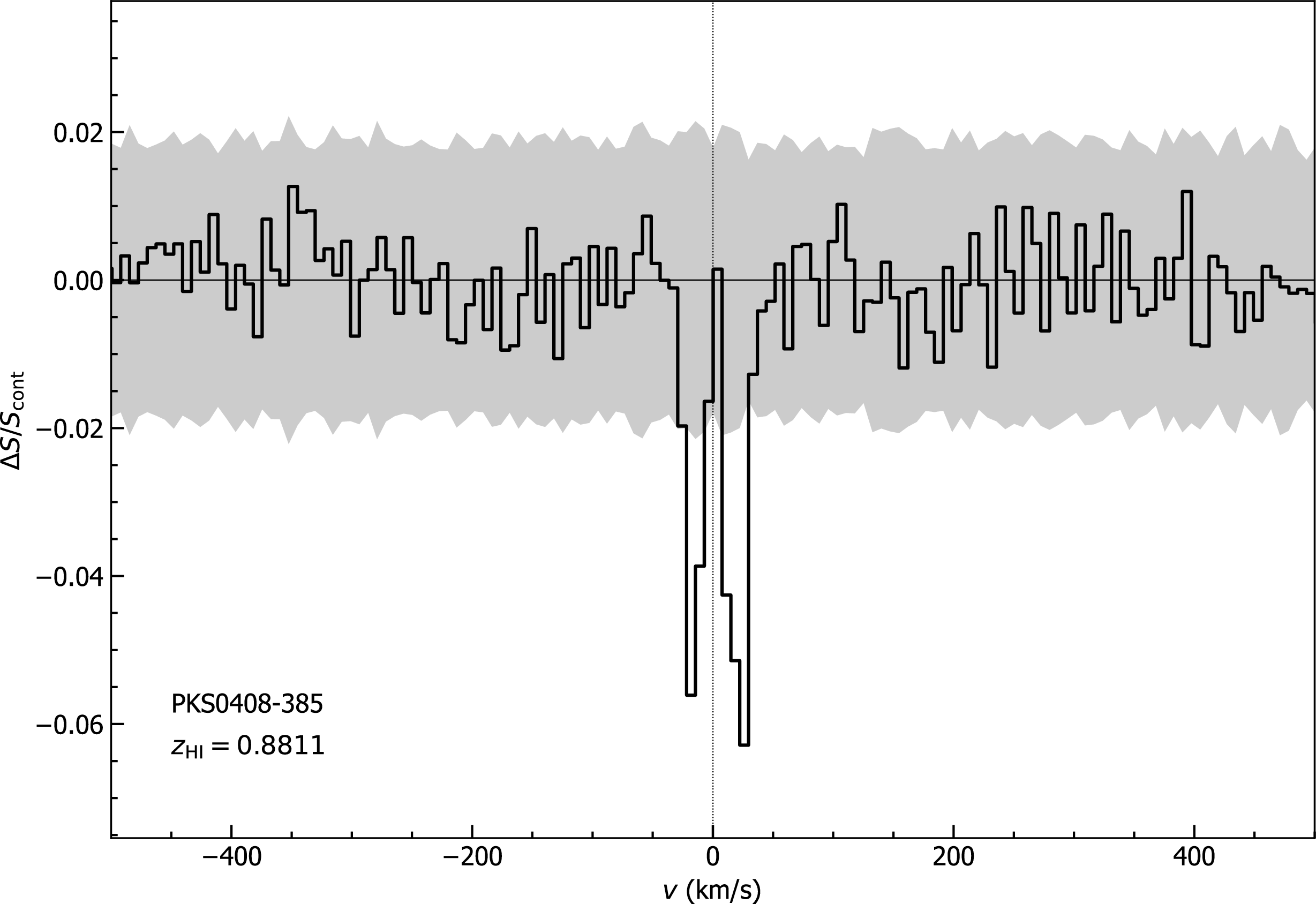
where it is listed as component 3a of scheduling block SB 60306 (FLASH field 212). The segment of the spectrum containing the intervening H i detection is shown in Figure 1, where two narrow components are clearly visible with a peak-to-peak velocity separation of approximately $45\,\text{km s}^{-1}$
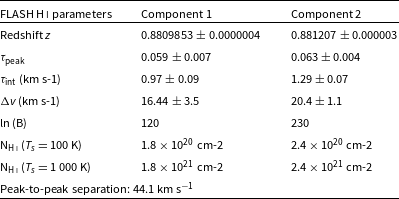
. The characteristics of these lines are outlined in Table 1 and were obtained using FLASHfinder (Allison, Sadler, & Whiting Reference Allison, Sadler and Whiting2012).
$45\,\text{km s}^{-1}$
. The characteristics of these lines are outlined in Table 1 and were obtained using FLASHfinder (Allison, Sadler, & Whiting Reference Allison, Sadler and Whiting2012).
ASKAP spectrum of the intervening H i lines towards PKS 0405-385. The velocity scale is relative to the systemic redshift of $z=0.88115$
. The y-axis indicates the absorption strength as a fraction of the continuum flux density. The grey band indicates
$z=0.88115$
. The y-axis indicates the absorption strength as a fraction of the continuum flux density. The grey band indicates $5\times$
the per-channel noise, taken from a blank sky spectrum around the target.
$5\times$
the per-channel noise, taken from a blank sky spectrum around the target.

H i linefinder measurements for PKS 0405-385, derived from fitting a simple Gaussian profile to each component. The first five rows correspond to output from the linefinder, the redshift (z) peak and integrated optical depths ( $\tau_{\text{peak}}$
,
$\tau_{\text{peak}}$
, $\tau_{\text{int}}$
), the velocity width (
$\tau_{\text{int}}$
), the velocity width ( $\Delta v$
) calculated as
$\Delta v$
) calculated as $\Delta v = \tau_{\rm int}/\tau_{\rm peak}$
and the logarithm of the Bayes factor, a statistical measure of the preference for a line existing at this location in the spectrum (
$\Delta v = \tau_{\rm int}/\tau_{\rm peak}$
and the logarithm of the Bayes factor, a statistical measure of the preference for a line existing at this location in the spectrum ( $\ln\,(\text{B})$
). The column density in the last two rows is derived using the familiar equation,
$\ln\,(\text{B})$
). The column density in the last two rows is derived using the familiar equation, $N_{\text{HI}} = 1.823 \times 10^{18}\,T_s \times f^{-1}\int\tau(\nu)d\nu$
and assuming covering factor
$N_{\text{HI}} = 1.823 \times 10^{18}\,T_s \times f^{-1}\int\tau(\nu)d\nu$
and assuming covering factor $f=1$
and two different spin temperatures for the gas.
$f=1$
and two different spin temperatures for the gas.

The estimated H i column densities suggest that this is a DLA system, and we note that its column only increases if we assume ${T}_{s}\gt100\,$
K, as is likely at large galactic radii. This quasar-DLA pair is therefore a potential analogue to the intervening system detected in H i towards PKS 1127-2145 (Kanekar & Chengalur Reference Kanekar and Chengalur2001), where the H i profile was seen to vary in optical depth over the course of 6 months, later attributed to scintillation caused by Galactic scattering (Macquart Reference Macquart2005). It should also be measured against the quasar-DLA pair seen towards PKS 2355-106. There, a second, intervening H i absorption component separated from the first by
${T}_{s}\gt100\,$
K, as is likely at large galactic radii. This quasar-DLA pair is therefore a potential analogue to the intervening system detected in H i towards PKS 1127-2145 (Kanekar & Chengalur Reference Kanekar and Chengalur2001), where the H i profile was seen to vary in optical depth over the course of 6 months, later attributed to scintillation caused by Galactic scattering (Macquart Reference Macquart2005). It should also be measured against the quasar-DLA pair seen towards PKS 2355-106. There, a second, intervening H i absorption component separated from the first by ${\sim} 55\,\text{km s}^{-1}$
appeared between initial GMRT observations in 2006 and follow up with both MeerKAT and GMRT in 2010. This variability in the H i profile has been interpreted as the product of proper motion of the background source, since the quasar is canonically compact at VLBI resolution and showed insufficient variability in its radio continuum for scintillation to explain the observed variations in H i optical depth (Srianand et al. Reference Srianand2022). The lensed system PMN J0134-0931 is another useful comparison, shown in Kanekar & Briggs (Reference Kanekar and Briggs2003) to exhibit a H i absorption profile with two strong, narrow components separated by
${\sim} 55\,\text{km s}^{-1}$
appeared between initial GMRT observations in 2006 and follow up with both MeerKAT and GMRT in 2010. This variability in the H i profile has been interpreted as the product of proper motion of the background source, since the quasar is canonically compact at VLBI resolution and showed insufficient variability in its radio continuum for scintillation to explain the observed variations in H i optical depth (Srianand et al. Reference Srianand2022). The lensed system PMN J0134-0931 is another useful comparison, shown in Kanekar & Briggs (Reference Kanekar and Briggs2003) to exhibit a H i absorption profile with two strong, narrow components separated by ${\sim} 250\,\text{km s}^{-1}$
which is reproducible in models with a single, intervening galaxy disc sampled at discrete locations by separate, high surface brightness components of the background radio source. Moreover, recent high resolution, L-band follow-up of 12 FLASH detections with the Very Long Baseline Array (VLBA) revealed eleven sources with complex or extended structure on milliarcsecond scales, including the only detection in that sample to have a two component profile, PKS 2007-245 (Aditya et al. Reference Aditya2025). The velocity separation between the components there was
${\sim} 250\,\text{km s}^{-1}$
which is reproducible in models with a single, intervening galaxy disc sampled at discrete locations by separate, high surface brightness components of the background radio source. Moreover, recent high resolution, L-band follow-up of 12 FLASH detections with the Very Long Baseline Array (VLBA) revealed eleven sources with complex or extended structure on milliarcsecond scales, including the only detection in that sample to have a two component profile, PKS 2007-245 (Aditya et al. Reference Aditya2025). The velocity separation between the components there was $25\,\text{km s}^{-1}$
. Although not an exact analogue (PKS 2007-245 has lobes spanning
$25\,\text{km s}^{-1}$
. Although not an exact analogue (PKS 2007-245 has lobes spanning ${\sim}40\,$
mas), the velocity separation between the two H i components here may similarly suggest an underlying complex or core-jet structure in the radio continuum source, where each component draws a discrete sightline through the intervening H i gas.
${\sim}40\,$
mas), the velocity separation between the two H i components here may similarly suggest an underlying complex or core-jet structure in the radio continuum source, where each component draws a discrete sightline through the intervening H i gas.
Most crucially though, the redshift of this intervening system ( $z\approx0.881$
) corresponds nicely with the redshift of the intervening line (
$z\approx0.881$
) corresponds nicely with the redshift of the intervening line ( $z\approx0.875$
) which was identified some 30 yr ago in the original Véron et al. (Reference Véron1990) spectrum, but never followed up.
$z\approx0.875$
) which was identified some 30 yr ago in the original Véron et al. (Reference Véron1990) spectrum, but never followed up.
4. PKS 0405-385 revisited: New observations
Spurred on by this new detection of intervening H i from an untargeted search, we have revisited PKS 0405-385 to see what can be learnt about both the quasar and this intervening system with additional radio and optical data.
Since the redshift of the newly-discovered H i gas aligns closely with that of the absorption line reported in the original optical spectrum, it offers potential new insight into the multi-phase interstellar (or circumgalactic) medium of the intervening system, if this system can be more securely identified.
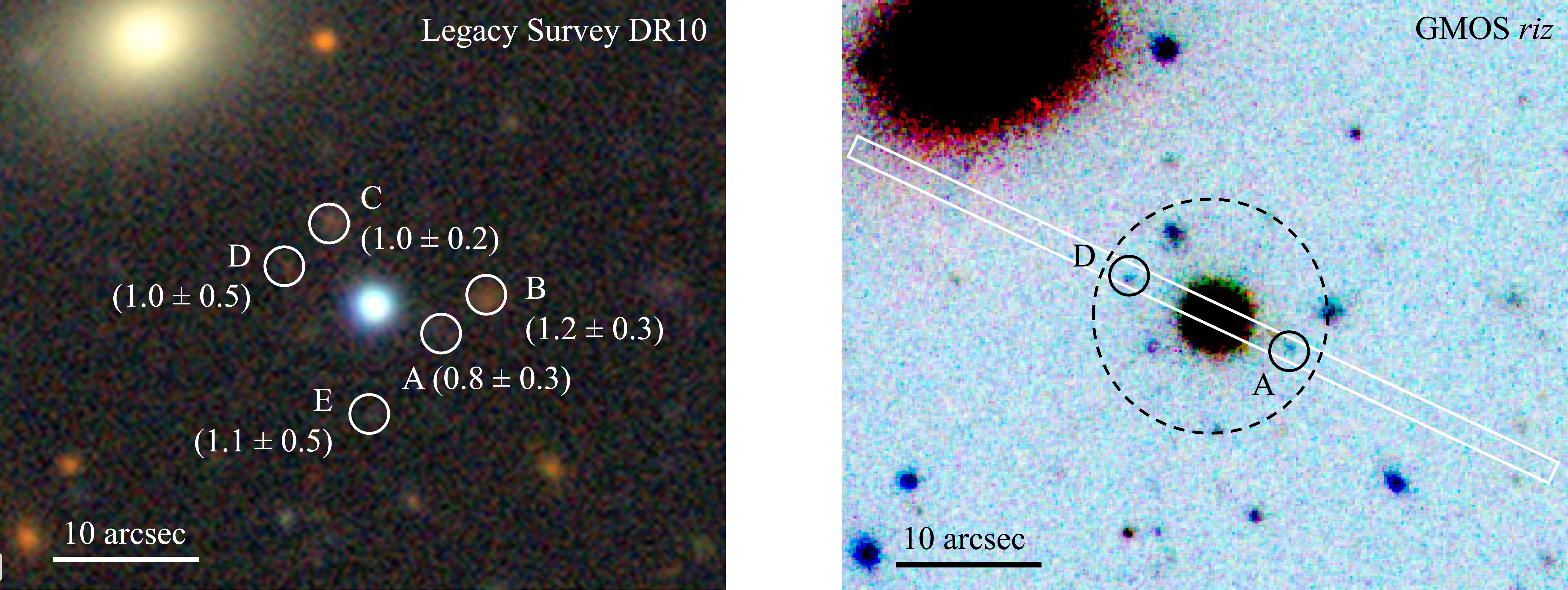
Images from DR10 of the Legacy Survey (Dey et al. Reference Dey2019) reveal five nearby galaxies labelled counter-clockwise A–E in Figure 2, left, which have DR9 photometric redshifts broadly commensurate with the FLASH detection given their uncertainties $( 0.8 \lt z_{\text{phot}} \lt 1.2)$
. Out of these candidates, Galaxy A has the closest redshift to the FLASH detection at
$( 0.8 \lt z_{\text{phot}} \lt 1.2)$
. Out of these candidates, Galaxy A has the closest redshift to the FLASH detection at $z = 0.8 \pm 0.3$
, making it the most likely host of the H i gas. Furthermore, Galaxy A has the bluest optical colours of these candidates (
$z = 0.8 \pm 0.3$
, making it the most likely host of the H i gas. Furthermore, Galaxy A has the bluest optical colours of these candidates ( $g - i = 0.58$
mag from the Legacy Survey DR10) and is therefore likely starforming, so a high H i mass would not be surprising. Should this indeed be the host, the quasar sightline is passing through gas at an impact parameter of
$g - i = 0.58$
mag from the Legacy Survey DR10) and is therefore likely starforming, so a high H i mass would not be surprising. Should this indeed be the host, the quasar sightline is passing through gas at an impact parameter of ${\sim} 36\,$
kpc (
${\sim} 36\,$
kpc ( $5.07\,$
arcsec), probing the circumgalactic medium at a distance where strong absorption lines are common, at least at earlier cosmic times (Adelberger et al. Reference Adelberger2005). Alternatively, the H i may exist in the ISM of another galaxy for which the light in the legacy images is entirely blended with that of the background quasar, due to its extremely small impact parameter. As a third and final alternative, galaxies A–E may form a foreground group, in which case the H i detected in FLASH may sample a clumpy, extragalactic medium, evidence of galaxy-galaxy interactions (c.f. Weng et al. Reference Weng2022). Unfortunately, the Legacy Survey photometric redshifts are not accurate enough to distinguish between these pictures; optical spectroscopy is required. To achieve this, we obtained fast turnaround time on the 8.1 m Gemini South telescope, using the Gemini Multi-Object Spectrograph (GMOS) for both optical imaging and spectroscopy under project GS-2024B-FT-215 (P.I. Yoon). An analysis of this new optical data is presented below.
$5.07\,$
arcsec), probing the circumgalactic medium at a distance where strong absorption lines are common, at least at earlier cosmic times (Adelberger et al. Reference Adelberger2005). Alternatively, the H i may exist in the ISM of another galaxy for which the light in the legacy images is entirely blended with that of the background quasar, due to its extremely small impact parameter. As a third and final alternative, galaxies A–E may form a foreground group, in which case the H i detected in FLASH may sample a clumpy, extragalactic medium, evidence of galaxy-galaxy interactions (c.f. Weng et al. Reference Weng2022). Unfortunately, the Legacy Survey photometric redshifts are not accurate enough to distinguish between these pictures; optical spectroscopy is required. To achieve this, we obtained fast turnaround time on the 8.1 m Gemini South telescope, using the Gemini Multi-Object Spectrograph (GMOS) for both optical imaging and spectroscopy under project GS-2024B-FT-215 (P.I. Yoon). An analysis of this new optical data is presented below.
Left: three colour image taken from DR10 of the Legacy Survey (Dey et al. Reference Dey2019) of a region centred on PKS 0405-385. Five nearby galaxies visible in the image are identified as A–E. Galaxies A–E all have photometric redshifts from DR9 of the Legacy Survey within the range $\left[0.8, 1.2\right]$
as indicated in the image, with Galaxy A closest to the redshift of the FLASH detection at
$\left[0.8, 1.2\right]$
as indicated in the image, with Galaxy A closest to the redshift of the FLASH detection at $z = 0.8\pm0.3$
. Right: three colour image from Gemini GMOS obtained as part of follow up on this source. The white rectangle indicates the positioning of the slit used to obtain spectroscopy, aligned to span both PKS 0405-385 and Galaxy A (coincidentally also spanning Galaxy D). The circle indicates a region of radius 50 kpc at
$z = 0.8\pm0.3$
. Right: three colour image from Gemini GMOS obtained as part of follow up on this source. The white rectangle indicates the positioning of the slit used to obtain spectroscopy, aligned to span both PKS 0405-385 and Galaxy A (coincidentally also spanning Galaxy D). The circle indicates a region of radius 50 kpc at $z = 0.881$
, the redshift of the FLASH detection, centred on PKS 0405-385.
$z = 0.881$
, the redshift of the FLASH detection, centred on PKS 0405-385.

4.1. GMOS imaging
Our imaging observations comprise $3\times100$
s in each of the r and i bands, and
$3\times100$
s in each of the r and i bands, and $3\times80$
s in the z-band, all obtained on 10 December 2024. Data pre-processing and reduction were performed using DRAGONS (Data Reduction for Astronomy from Gemini Observatory North and South; Labrie et al. Reference Labrie2023). We re-identified galaxies A–E in the resulting three colour composite image, shown in Figure 2, right. No additional nearby galaxies were identified in the GMOS images. Also shown in Figure 2, right is the alignment used for longslit spectroscopy (253.0 deg E of N), to ensure both PKS 0405-385 and the most likely candidate, Galaxy A, would be captured. The circle centred on PKS 0405-385 represents a region of radius 50 kpc at
$3\times80$
s in the z-band, all obtained on 10 December 2024. Data pre-processing and reduction were performed using DRAGONS (Data Reduction for Astronomy from Gemini Observatory North and South; Labrie et al. Reference Labrie2023). We re-identified galaxies A–E in the resulting three colour composite image, shown in Figure 2, right. No additional nearby galaxies were identified in the GMOS images. Also shown in Figure 2, right is the alignment used for longslit spectroscopy (253.0 deg E of N), to ensure both PKS 0405-385 and the most likely candidate, Galaxy A, would be captured. The circle centred on PKS 0405-385 represents a region of radius 50 kpc at $z = 0.881$
, the redshift of the FLASH detection.
$z = 0.881$
, the redshift of the FLASH detection.
4.2. GMOS spectroscopy
Spectroscopic observations were carried out on 9 December 2024 under arcsecond seeing conditions using the B600 grating ( $R\sim 1\,688$
, or
$R\sim 1\,688$
, or ${\sim}0.8$
nm full width half maximum at 510 nm) and a slit width of 1.5 arcsec. Data acquisition was split into
${\sim}0.8$
nm full width half maximum at 510 nm) and a slit width of 1.5 arcsec. Data acquisition was split into $4 \times 900$
s exposures, binned
$4 \times 900$
s exposures, binned $2 \times2$
in both directions, with two sets using a central wavelength of 510 nm and two set to 520 nm, to fill the gap between detectors. The spectra have a resulting wavelength coverage of approximately
$2 \times2$
in both directions, with two sets using a central wavelength of 510 nm and two set to 520 nm, to fill the gap between detectors. The spectra have a resulting wavelength coverage of approximately $3\,550$
–
$3\,550$
– $6\,780$
Å.
$6\,780$
Å.
Data pre-processing and reduction were once again performed with DRAGONS, and RV correction to the heliocentric frame was performed using Astropy’s SpecCoord class. Initial line and redshift identification was made with a modified version of MARZ (Manual and Automatic Redshifting Software; Hinton et al. Reference Hinton, Davis, Lidman, Glazebrook and Lewis2016) with additional, restframe-UV lines. Equivalent Width (EW) measurements were performed with the Specutils package within Astropy (Astropy-Specutils Development Team 2019). The co-added, reduced spectrum has a median signal to noise ratio SNR $=107$
per pixel across the full spectrum.
$=107$
per pixel across the full spectrum.
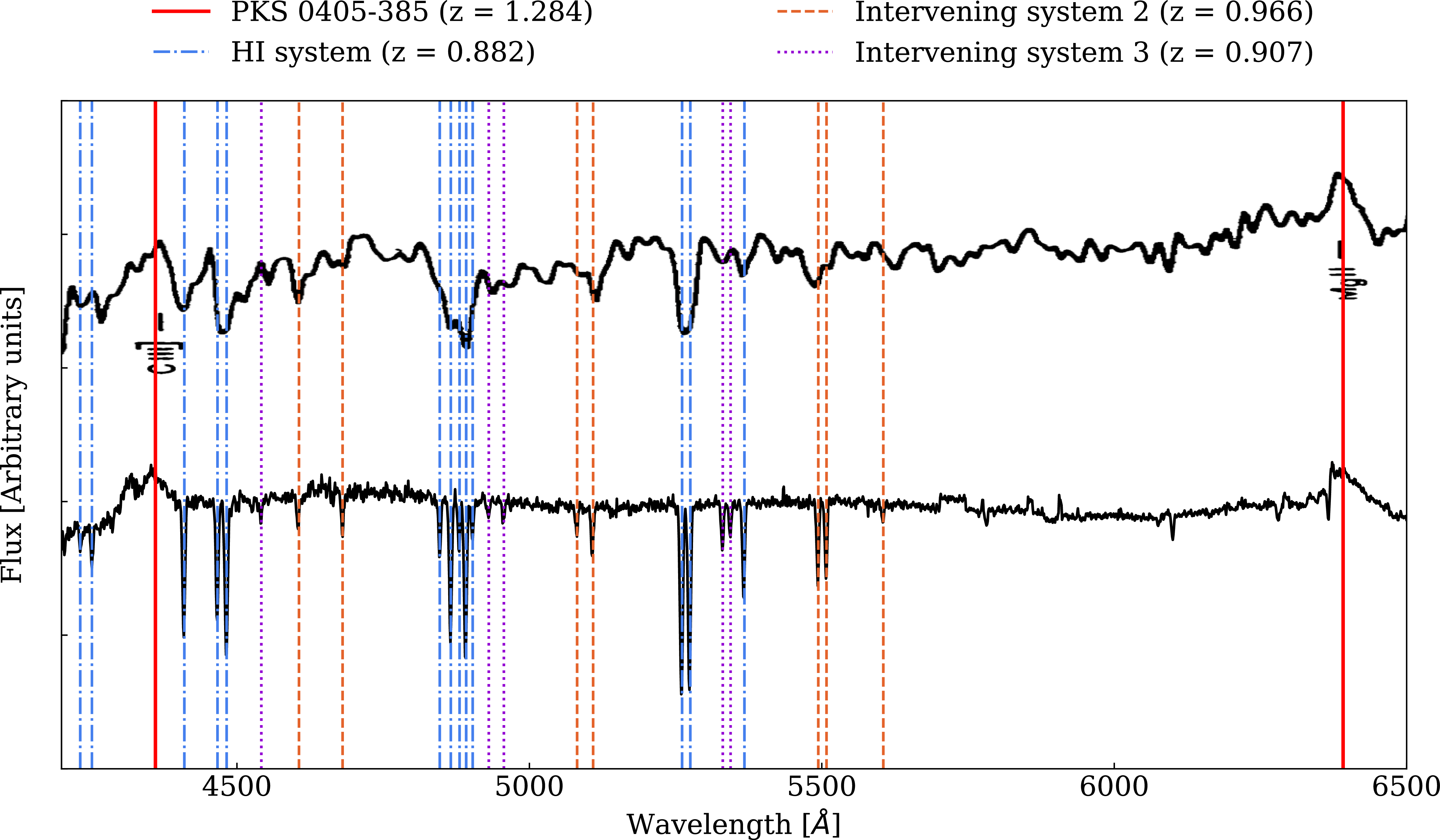
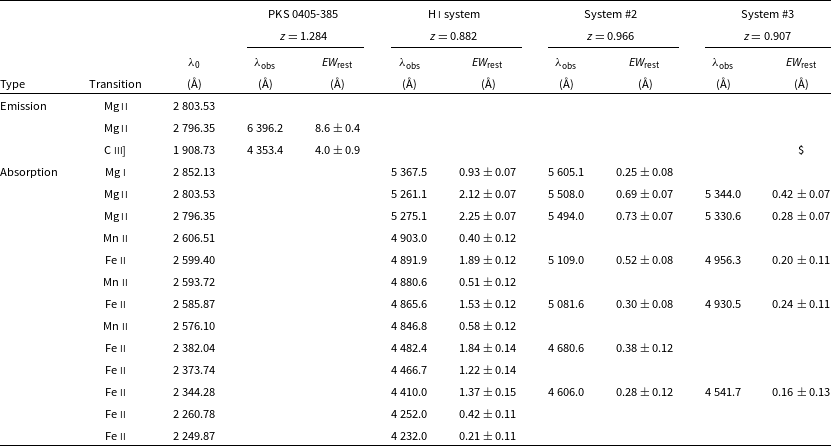
The new GMOS spectrum is shown in Figure 3 alongside the original spectrum from Véron et al. (Reference Véron1990). The full list of lines identified in the new spectrum is given in Table 2. The signal-to-noise ratio was not sufficient to extract useable spectra towards the intervening system(s). In both spectra, the Mg ii doublet and C iii] from PKS 0405-385 are visible in emission, indicated by the red solid lines in Figure 2. Given the width of the C iii] feature, it is likely in fact to be a blend of C iii] ( $\lambda$
1908.83), Si iii (
$\lambda$
1908.83), Si iii ( $\lambda$
1892), and Al iii (
$\lambda$
1892), and Al iii ( $\lambda$
1860), the ratios of which can provide insight into the Eddington accretion rate of the quasar (Marziani & Sulentic Reference Marziani and Sulentic2014; Martínez-Aldama et al. Reference Martínez-Aldama2018). However, we leave further, detailed discussion of the emission line properties of PKS 0405-385 to future work, ideally with a higher resolution spectrum in which these blended features can be better resolved and subsequently modelled.
$\lambda$
1860), the ratios of which can provide insight into the Eddington accretion rate of the quasar (Marziani & Sulentic Reference Marziani and Sulentic2014; Martínez-Aldama et al. Reference Martínez-Aldama2018). However, we leave further, detailed discussion of the emission line properties of PKS 0405-385 to future work, ideally with a higher resolution spectrum in which these blended features can be better resolved and subsequently modelled.
The GMOS spectrum clearly resolves the Mg ii doublet in absorption at $z = 0.882$
(blue dot-dashed lines), which is unresolved but visible in the Véron et al. (Reference Véron1990) spectrum also. Furthermore, the GMOS spectrum shows several other absorption lines at this redshift, including iron lines at
$z = 0.882$
(blue dot-dashed lines), which is unresolved but visible in the Véron et al. (Reference Véron1990) spectrum also. Furthermore, the GMOS spectrum shows several other absorption lines at this redshift, including iron lines at ${\sim} 4\,400$
Å, and iron and manganese lines at
${\sim} 4\,400$
Å, and iron and manganese lines at ${\sim} 4\,880$
Å, both of which also align with unresolved features in the Véron et al. (Reference Véron1990) spectrum. These suggest our original H i detection is towards at least one galaxy at
${\sim} 4\,880$
Å, both of which also align with unresolved features in the Véron et al. (Reference Véron1990) spectrum. These suggest our original H i detection is towards at least one galaxy at $z=0.882$
which we refer to henceforth as the ‘H i system’. There are possibly also several more lines at the redshift of the FLASH H i line, including Zn ii
$z=0.882$
which we refer to henceforth as the ‘H i system’. There are possibly also several more lines at the redshift of the FLASH H i line, including Zn ii $+$
Cr ii (
$+$
Cr ii ( $\lambda$
2062.66), and Zn ii
$\lambda$
2062.66), and Zn ii $+$
Mg i (
$+$
Mg i ( $\lambda$
2026.14). However, these fall at an observed wavelength
$\lambda$
2026.14). However, these fall at an observed wavelength $\lambda_o \lt 4\,300$
Å, where the noise in our new GMOS spectrum is higher, so these detections are currently of low significance.
$\lambda_o \lt 4\,300$
Å, where the noise in our new GMOS spectrum is higher, so these detections are currently of low significance.
Interestingly, we also identify two further intervening systems at $z = 0.966$
(‘Intervening System 2’, orange dashed lines) and
$z = 0.966$
(‘Intervening System 2’, orange dashed lines) and $z=0.907$
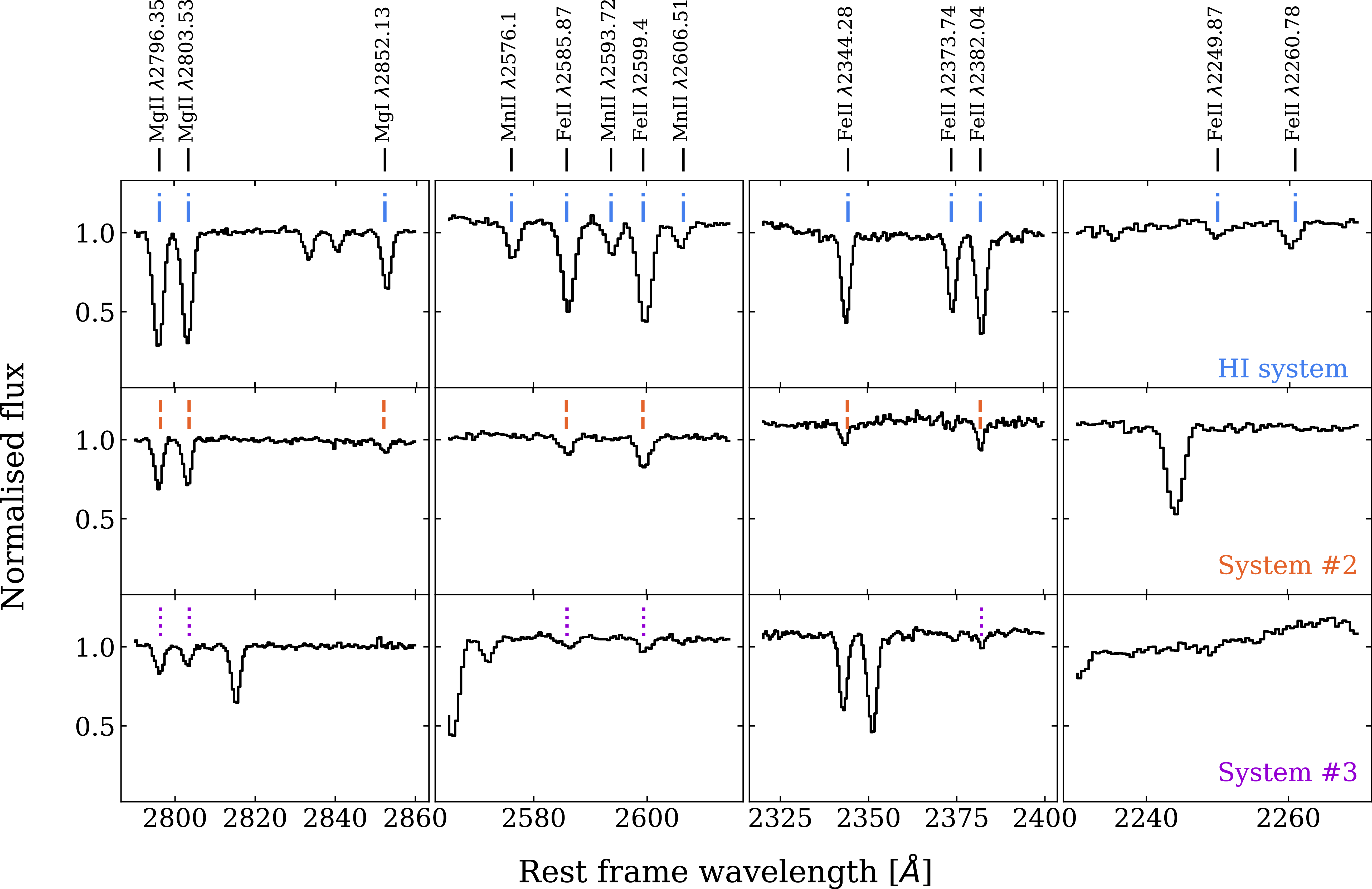
(‘Intervening System 3’, violet dotted lines), for which several absorption features agree with low-significance features in the Véron et al. (Reference Véron1990) spectrum. Again, the GMOS spectrum shows the Mg ii doublet, Mg i and several iron lines at the redshift of the second intervening system, and Mg ii and Fe ii lines at the redshift of the third. Higher resolution cutouts around the detected lines for all three systems are provided in Figure 4. The wavelength range of our spectrum (
$z=0.907$
(‘Intervening System 3’, violet dotted lines), for which several absorption features agree with low-significance features in the Véron et al. (Reference Véron1990) spectrum. Again, the GMOS spectrum shows the Mg ii doublet, Mg i and several iron lines at the redshift of the second intervening system, and Mg ii and Fe ii lines at the redshift of the third. Higher resolution cutouts around the detected lines for all three systems are provided in Figure 4. The wavelength range of our spectrum ( $3\,550$
–
$3\,550$
– $6\,780$
Å) does not extend to cover typical strong, nebular emission lines such as [Oii], [Oiii] or H
$6\,780$
Å) does not extend to cover typical strong, nebular emission lines such as [Oii], [Oiii] or H $\beta$
at the redshift of any of our intervening systems, so we cannot search for these either against the bright quasar spectrum, or at the location along the slit corresponding to Galaxy A.
$\beta$
at the redshift of any of our intervening systems, so we cannot search for these either against the bright quasar spectrum, or at the location along the slit corresponding to Galaxy A.
The original optical spectrum from Véron et al. (Reference Véron1990) (top) compared to our new spectrum taken with GMOS-S (bottom). Vertical lines indicate emission lines associated with background quasar PKS 0405-385 (red, solid), absorption lines associated with the intervening galaxy detected in FLASH data (blue, dot-dashed), and two further, previously unidentified intervening galaxies (orange, dashed and violet, dotted). Lines were identified using MARZ and the new Gemini spectrum only. Nevertheless, a number of lines from both intervening systems are visible in the original (Véron et al. Reference Véron1990) spectrum.

Lines identified in the GMOS spectrum assigned to each system. We note that the Mg ii doublet seen in emission at the redshift of PKS 0405-385 is not resolved. All $\lambda_{\text{obs}}$
values have a measurement uncertainty of
$\lambda_{\text{obs}}$
values have a measurement uncertainty of $\pm0.05\,$
Å, and the redshifts should likewise be considered to have a measurement uncertainty of
$\pm0.05\,$
Å, and the redshifts should likewise be considered to have a measurement uncertainty of $\pm0.0005$
.
$\pm0.0005$
.

Cutouts from the continuum-subtracted GMOS spectrum presented in Figure 3 centred on the regions in which absorption lines are seen at the redshift of the H i system (top row) the second, intervening system at $z = 0.966$
(middle row) and the third at
$z = 0.966$
(middle row) and the third at $z = 0.907$
(bottom row). Vertical lines in each subplot indicate the detection of an absorption line corresponding to the labels at the top of the figure.
$z = 0.907$
(bottom row). Vertical lines in each subplot indicate the detection of an absorption line corresponding to the labels at the top of the figure.

A re-examination of the FLASH spectrum within $\pm500\,\text{km s}^{-1}$
of
$\pm500\,\text{km s}^{-1}$
of $z = 0.907$
and
$z = 0.907$
and $z = 0.966$
reveals no H i detection at the
$z = 0.966$
reveals no H i detection at the $3\,\sigma$
level. However, combining the root mean square noise in optical depth of the FLASH spectrum locally (
$3\,\sigma$
level. However, combining the root mean square noise in optical depth of the FLASH spectrum locally ( $\tau_{\text{rms}} = 0.004$
) with the average full width zero intensity of intervening H i from Curran (Reference Curran2021) (
$\tau_{\text{rms}} = 0.004$
) with the average full width zero intensity of intervening H i from Curran (Reference Curran2021) ( $108\,\text{km s}^{-1}$
), we can place an upper limit on the amount of cold, neutral gas at the redshift of these second and third intervening systems. We estimate that they must each have
$108\,\text{km s}^{-1}$
), we can place an upper limit on the amount of cold, neutral gas at the redshift of these second and third intervening systems. We estimate that they must each have $N_{\text{HI}} \leq 1.3\times10^{20}\,\text{cm}^{-2}$
(
$N_{\text{HI}} \leq 1.3\times10^{20}\,\text{cm}^{-2}$
( ${T}_{s} = 100\,$
K,
${T}_{s} = 100\,$
K, $f=1$
), which would make these sub-DLA systems. We note here that the H i system would be considered iron rich using the classification scheme of Dutta et al. (Reference Dutta2017) (
$f=1$
), which would make these sub-DLA systems. We note here that the H i system would be considered iron rich using the classification scheme of Dutta et al. (Reference Dutta2017) ( $EW_{\text{rest}} \gt 1.0\,$
Å), who found that such systems were four times more likely to exhibit H i absorption than their iron poor counterparts (like intervening systems 2 and 3) at
$EW_{\text{rest}} \gt 1.0\,$
Å), who found that such systems were four times more likely to exhibit H i absorption than their iron poor counterparts (like intervening systems 2 and 3) at $0.5 \lt z \lt 1.5$
. However, to say more on the abundances of metals in this intervening gas requires higher spectral resolution and, for system 3 at least, higher signal to noise also.
$0.5 \lt z \lt 1.5$
. However, to say more on the abundances of metals in this intervening gas requires higher spectral resolution and, for system 3 at least, higher signal to noise also.
Ultimately, our question as to the origin of the detected H i remains unanswered. Since we were unable to extract any identifiable spectral features at the location of Galaxy A in addition to PKS 0405-385, we were unable to either confirm or disprove this as the host of the intervening H i. Furthermore, many absorption features in the GMOS spectrum are likely saturated making it impossible to deduce abundances, though such analysis would theoretically be possible with the combined detection of (unsaturated) metal lines and neutral H i with well-constrained velocity dispersion. Integral field spectroscopy spanning PKS 0405-385 and galaxies A–E, along with deeper optical imaging, will be key to securely identifying both intervening systems seen in absorption against PKS 0405-385 and further analysing their metallicity.
4.3. Radio monitoring
As discussed in Section 1, PKS 0405-385 is an interesting source itself, exhibiting both powerful, episodic IDV and intermittent $\gamma$
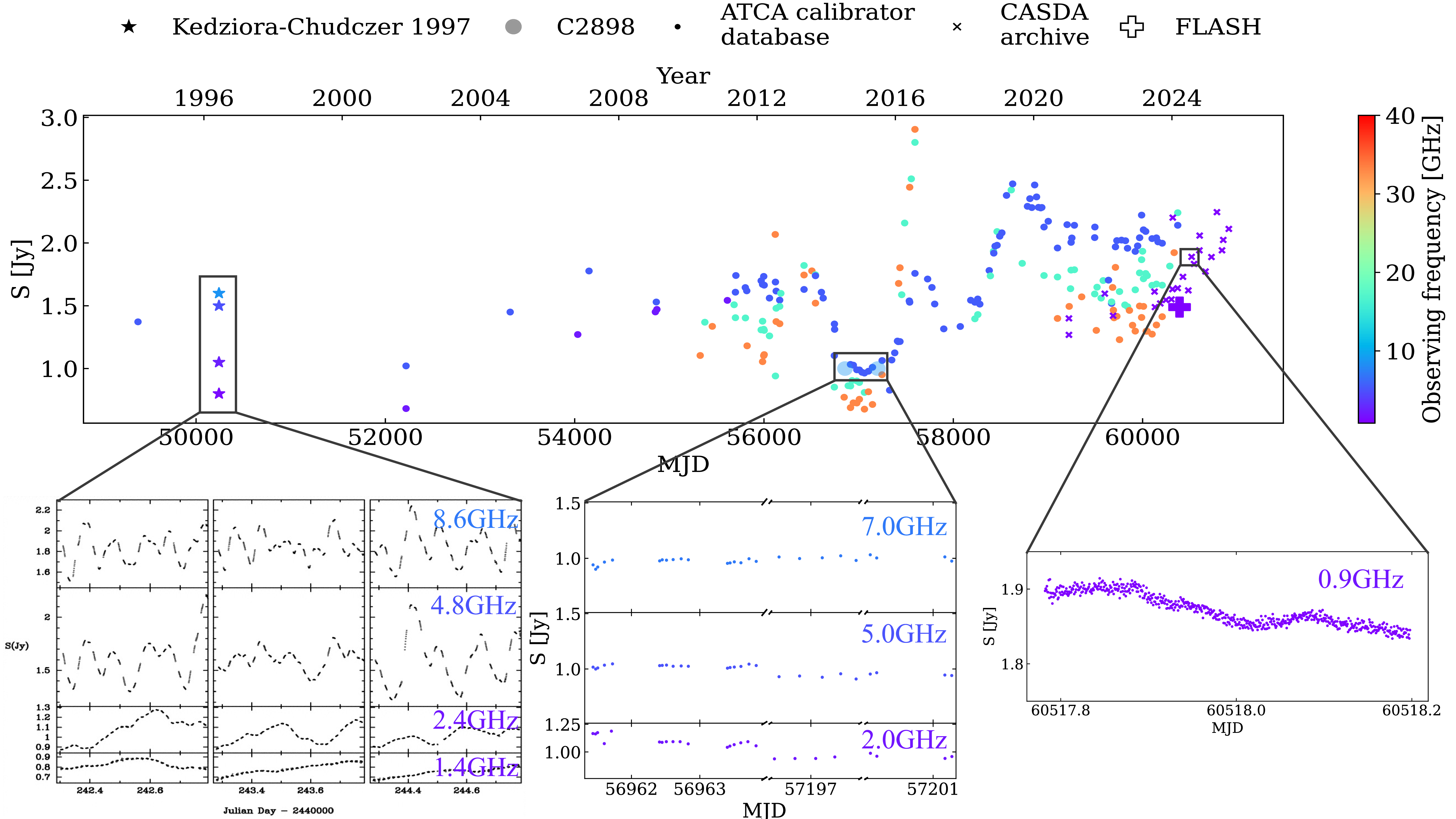
-ray flares. As a result, it has been the subject of long-running radio monitoring, both targeted and incidental, which we compile and present here for the first time in Figure 5 alongside the original IDV observations (lower-left inset). PKS 0405-385 has been regularly monitored with the ATCA over the frequency range 5–40 GHz under observing programmes C007 and C1730 (Stevens et al. Reference Stevens2012) since 2010 (filled circles in Figure 5). PKS 0405-385 was also one of the sources included in a search for intra-day variability at 2, 5, and 7 GHz under observing programme C2898 between July 2014 and June 2015 (larger, semi-transparent circles). No evidence for IDV was seen (lower-centre inset plot), and the longer-term monitoring indicates the source was at its most quiescent over that year. However, just as that programme ended, PKS 0405-385 underwent a rapid brightening, reaching historically high flux densities in mid-2016 in the 15 and 7 mm bands. PKS 0405-385 is also a calibrator source for the Atacama Large Millimetre Array (ALMA), and 90–240 GHz observations show a peak in flux density coincident with this 2016 flare.Footnote
b
We also re-imaged a 10-h observation at 0.95 GHz from the Evolutionary Map of the Universe survey (EMU Norris et al. Reference Norris2011) taken with ASKAP in June 2025 using dstools (Pritchard Reference Pritchard2025). This is shown in the bottom right inset plot, where there is only minor variability at the level of 1% over the course of several hours. However, we note that even in the original (Kedziora-Chudczer et al. Reference Kedziora-Chudczer1997) data, the variability was weakest below
$\gamma$
-ray flares. As a result, it has been the subject of long-running radio monitoring, both targeted and incidental, which we compile and present here for the first time in Figure 5 alongside the original IDV observations (lower-left inset). PKS 0405-385 has been regularly monitored with the ATCA over the frequency range 5–40 GHz under observing programmes C007 and C1730 (Stevens et al. Reference Stevens2012) since 2010 (filled circles in Figure 5). PKS 0405-385 was also one of the sources included in a search for intra-day variability at 2, 5, and 7 GHz under observing programme C2898 between July 2014 and June 2015 (larger, semi-transparent circles). No evidence for IDV was seen (lower-centre inset plot), and the longer-term monitoring indicates the source was at its most quiescent over that year. However, just as that programme ended, PKS 0405-385 underwent a rapid brightening, reaching historically high flux densities in mid-2016 in the 15 and 7 mm bands. PKS 0405-385 is also a calibrator source for the Atacama Large Millimetre Array (ALMA), and 90–240 GHz observations show a peak in flux density coincident with this 2016 flare.Footnote
b
We also re-imaged a 10-h observation at 0.95 GHz from the Evolutionary Map of the Universe survey (EMU Norris et al. Reference Norris2011) taken with ASKAP in June 2025 using dstools (Pritchard Reference Pritchard2025). This is shown in the bottom right inset plot, where there is only minor variability at the level of 1% over the course of several hours. However, we note that even in the original (Kedziora-Chudczer et al. Reference Kedziora-Chudczer1997) data, the variability was weakest below $2\,$
GHz, so this does not place a strong constraint on the recent level of IDV in this source; higher frequency observations are needed. Kedziora-Chudczer et al. (Reference Kedziora-Chudczer, Laing and Blundell2001) postulate that the IDV observed in 1996 ceased as a result of the increasing size of the scintillating component, although an alternative explanation could invoke changes in the properties of the scattering screen, as seen towards PKS 1257-326 (Koay et al. Reference Koay2011).
$2\,$
GHz, so this does not place a strong constraint on the recent level of IDV in this source; higher frequency observations are needed. Kedziora-Chudczer et al. (Reference Kedziora-Chudczer, Laing and Blundell2001) postulate that the IDV observed in 1996 ceased as a result of the increasing size of the scintillating component, although an alternative explanation could invoke changes in the properties of the scattering screen, as seen towards PKS 1257-326 (Koay et al. Reference Koay2011).
The radio lightcurve of PKS 0405-385 compiled from targeted monitoring programmes C007 and C1730 (filled circles) with the ATCA, labelled as ‘ATCA calibrator database’. We additionally show the original, broadband fluxes from Kedziora-Chudczer et al. (Reference Kedziora-Chudczer1997) (stars), with an inset showing the IDV detected during those observations (bottom, left), as well as a later ATCA monitoring programme C2898 during which IDV was not observed (larger, semi-transparent circles, middle inset). Further, coincidental observations of PKS 0405-385 are taken from the CASDA archive (crosses), including the FLASH observations (filled vertical cross), and a 10-h pointing observed as part of the Evolutionary Map of the Universe survey (EMU Norris et al. Reference Norris2011).

It is well established that radio flares in blazars are often accompanied by the ejection of a new parsec-scale jet component which can dominate the total flux density, and which can initially be sufficiently compact to produce IDV if a suitable scattering screen is present along the line of sight. Unfortunately, there was no IDV monitoring programme in operation during the 2016 outburst to test this hypothesis, so broadband monitoring during and immediately after future flares would prove extremely useful in this regard.
At higher resolutions, Kedziora-Chudczer et al. (Reference Kedziora-Chudczer, Laing and Blundell2001) derive an upper limit of 0.15 mas on the size of the core based on 8.4 GHz VLBA observations, which places an upper limit on the linear size of the core of 1.3 pc. Jet components are also visible in their 2.3 and 8.4 GHz images, extending up to 20 mas from the core, but the limited number of observations preclude a reliable estimate of apparent jet component speeds.
The linear polarisation of PKS 0405-385 was also studied from the period of IDV observed in 1996, and Rickett et al. (Reference Rickett, Kedziora-Chudczer and Jauncey2002) determined the variations could be best explained by three, compact components forming an oblique source of $14\times20\,\unicode{x03BC}\text{as}$
at 4.8 GHz, corresponding to a linear size of approximately
$14\times20\,\unicode{x03BC}\text{as}$
at 4.8 GHz, corresponding to a linear size of approximately $0.3\,$
pc at the source redshift. Current best estimates then put the PKS 0405-385 core at
$0.3\,$
pc at the source redshift. Current best estimates then put the PKS 0405-385 core at $0.3$
–
$0.3$
– $1.3\,$
pc. At the redshift of the H i, the core emission has a linear extent of only
$1.3\,$
pc. At the redshift of the H i, the core emission has a linear extent of only ${\sim} 1.5\,$
pc, easily subtended by a typical H i cloud which is thought to span
${\sim} 1.5\,$
pc, easily subtended by a typical H i cloud which is thought to span ${\sim}$
a few parsecs in local (
${\sim}$
a few parsecs in local ( $z\lesssim 0.1$
), extragalactic systems (Srianand et al. Reference Srianand2013; Gupta et al. Reference Gupta2018), or perhaps as much as
$z\lesssim 0.1$
), extragalactic systems (Srianand et al. Reference Srianand2013; Gupta et al. Reference Gupta2018), or perhaps as much as ${\sim} 10$
pc in the analogous
${\sim} 10$
pc in the analogous $z\sim0.3$
quasar-DLA pair PKS 1127-2145 already discussed in Section 3 and presented in Kanekar & Chengalur (Reference Kanekar and Chengalur2001). Contemporary VLBI observations, ideally at or close to the frequency of the H i detection as in Aditya et al. (Reference Aditya2025), will be crucial to understanding the structure of PKS 0405-385, and may also provide insight into why it illuminates two H i structures with discrete velocities.
$z\sim0.3$
quasar-DLA pair PKS 1127-2145 already discussed in Section 3 and presented in Kanekar & Chengalur (Reference Kanekar and Chengalur2001). Contemporary VLBI observations, ideally at or close to the frequency of the H i detection as in Aditya et al. (Reference Aditya2025), will be crucial to understanding the structure of PKS 0405-385, and may also provide insight into why it illuminates two H i structures with discrete velocities.
5. PKS 0405-385 revisited: Propagation effects
In light of our new observations presented in Section 4, we consider here a few possibilities as to how the intervening matter from the three systems might affect the propagation of light from PKS 0405-385.
5.1. Could PKS 0405-385 be gravitationally lensed?
We now know there are three intervening galaxies along the line of sight to PKS 0405-385 close enough in angular separation to produce absorption lines in its spectrum. We might therefore consider whether the mass along this sightline is sufficient to gravitationally lens the background emissions of the blazar. For a source at $z_s\approx1.284$
and lens
$z_s\approx1.284$
and lens $z\approx0.882$
, the critical column density of matter required for strong gravitational lensing – that is, multiple imaging and/or significant magnification – to occur is
$z\approx0.882$
, the critical column density of matter required for strong gravitational lensing – that is, multiple imaging and/or significant magnification – to occur is $0.89\,\mathrm{g}\,\mathrm{cm}^{-2}$
, with our assumed cosmology.
$0.89\,\mathrm{g}\,\mathrm{cm}^{-2}$
, with our assumed cosmology.
The surface density of neutral hydrogen seen in the H i system is only $1\times10^{-3}\,\mathrm{g}\,\mathrm{cm}^{-2}$
, almost three orders of magnitude below that required for lensing. Since we cannot constrain the abundances of the gas in the intervening H i system from our current data, we cannot determine the complete gas surface density, let alone the total matter density along the line of sight. As a first approximation then, we can consider the total matter surface density in our own solar neighbourhood. McKee et al. (Reference McKee, Parravano and Hollenbach2015) put the local Galactic H i density at
$1\times10^{-3}\,\mathrm{g}\,\mathrm{cm}^{-2}$
, almost three orders of magnitude below that required for lensing. Since we cannot constrain the abundances of the gas in the intervening H i system from our current data, we cannot determine the complete gas surface density, let alone the total matter density along the line of sight. As a first approximation then, we can consider the total matter surface density in our own solar neighbourhood. McKee et al. (Reference McKee, Parravano and Hollenbach2015) put the local Galactic H i density at ${\sim} 2\times10^{-3}\,\text{g}\,\text{cm}^{-2}$
, remarkably close to the H i surface density detected in FLASH. They put the total matter surface density at
${\sim} 2\times10^{-3}\,\text{g}\,\text{cm}^{-2}$
, remarkably close to the H i surface density detected in FLASH. They put the total matter surface density at ${\sim} 1\times10^{-2}\,\text{g}\,\text{cm}^{-2}$
, still two orders of magnitude below the gravitational lensing threshold if this were the density intersected at
${\sim} 1\times10^{-2}\,\text{g}\,\text{cm}^{-2}$
, still two orders of magnitude below the gravitational lensing threshold if this were the density intersected at $z=0.882$
. Of course the matter distribution in the H i system might be entirely unlike our own Milky Way and is almost certainly sampled by the PKS 0405-385 sightline at a different galactic radius, but in the absence of additional data it is impossible to say more. Furthermore, physical association between the three systems seen in absorption is unlikely, as they are separated along the line of sight by tens of Mpc (interpreting observed redshifts as cosmological) and in velocity by tens of thousands of
$z=0.882$
. Of course the matter distribution in the H i system might be entirely unlike our own Milky Way and is almost certainly sampled by the PKS 0405-385 sightline at a different galactic radius, but in the absence of additional data it is impossible to say more. Furthermore, physical association between the three systems seen in absorption is unlikely, as they are separated along the line of sight by tens of Mpc (interpreting observed redshifts as cosmological) and in velocity by tens of thousands of $\text{km s}^{-1}$
(assuming instead that redshift differences are due to peculiar motion). Therefore, there is currently no evidence for any additional mass contribution at group or cluster scales. In short it is unlikely that the light from PKS 0405-385 is lensed by the foreground systems, but a better understanding of their baryonic matter content will help to better constrain this problem.
$\text{km s}^{-1}$
(assuming instead that redshift differences are due to peculiar motion). Therefore, there is currently no evidence for any additional mass contribution at group or cluster scales. In short it is unlikely that the light from PKS 0405-385 is lensed by the foreground systems, but a better understanding of their baryonic matter content will help to better constrain this problem.
5.2. What effect does Galactic scattering have?
Macquart (Reference Macquart2005) showed that a multi-component H i profile could appear variable due to Galactic scattering and propagation effects. We cannot say anything of the variability in our H i system from one H i observation, though followup during an episode of IDV would be particularly interesting to search for spectral line variability. Nevertheless, it is worth considering whether scintillation can offer further insights into the structure of PKS 0405-385, and the intervening gas.
In the original Kedziora-Chudczer et al. (Reference Kedziora-Chudczer1997) paper, the angular size of the PKS 0405-385 core was constrained to $\lt 5\,\unicode{x03BC}$
as, the Fresnel scale at which scintillation becomes significant for a scattering screen of Galactic plasma at a distance of 500 pc. However a screen at 30 pc is perfectly reasonable and would require an angular diameter less than
$\lt 5\,\unicode{x03BC}$
as, the Fresnel scale at which scintillation becomes significant for a scattering screen of Galactic plasma at a distance of 500 pc. However a screen at 30 pc is perfectly reasonable and would require an angular diameter less than $20\,\unicode{x03BC}$
as; indeed screens at or below 10 pc have since been observed (Reardon et al. Reference Reardon2025; Wang et al. Reference Wang2021), further relaxing the source size constraints to
$20\,\unicode{x03BC}$
as; indeed screens at or below 10 pc have since been observed (Reardon et al. Reference Reardon2025; Wang et al. Reference Wang2021), further relaxing the source size constraints to $38\,\unicode{x03BC}$
as, corresponding to a linear size of
$38\,\unicode{x03BC}$
as, corresponding to a linear size of ${\sim} 0.3$
pc at
${\sim} 0.3$
pc at $z=1.284$
, similar to the size derived from VLBI in Section 4.3.
$z=1.284$
, similar to the size derived from VLBI in Section 4.3.
Of course, we now know from Section 4.2 that there are at least three intervening systems along the line of sight towards PKS 0405-385, each with their own ISM. Therefore Galactic plasma is not the only possible source of scattering (or angular broadening); we must also consider how the medium of the three intervening systems might contribute to the angular source size and variability.
5.3. Could there be scattering from intervening systems?
The theoretical breakthrough made by Macquart (Reference Macquart2005) as mentioned in Section 5.2 was motivated by Kanekar & Chengalur (Reference Kanekar and Chengalur2001), who originally considered whether Interstellar Scintillation (ISS) caused by the ISM of an intervening galaxy might cause intraday fluctuations in both the background radio continuum and intervening H i line profiles of a similar quasar-galaxy pair. We consider again whether the plasma in such intervening systems could contribute meaningfully to angular scattering, which would in turn minimise any observed ISS and artificially increase the angular diameter of PKS 0405-385.
H i absorption traces a different phase of the ISM to that responsible for angular scattering (cold, neutral as opposed to ionised), but we can still use it to make a first order approximation on the expected level of scattering, provided that we assume some relationship between the two phases. We can derive one such relationship by looking at the pulse broadening of pulsars as a function of Galactic H i column density. Using the scattering time measurements from the Australia Telescope National Facility (ATNF) pulsar catalogue (Manchester et al. Reference Manchester, Hobbs, Teoh and Hobbs2005) and a model of Galactic H i from Kalberla & Kerp (Reference Kalberla and Kerp2009), a H i column of ${\sim} 4.2\times10^{20}\,\text{cm}^{-2}$
as seen towards PKS 0405-385 might produce a scattering angle
${\sim} 4.2\times10^{20}\,\text{cm}^{-2}$
as seen towards PKS 0405-385 might produce a scattering angle $\alpha \sim 0.1$
–
$\alpha \sim 0.1$
– $1\,\text{mas}$
at 1 GHz in our Galaxy, or something a factor of approximately 4 lower at
$1\,\text{mas}$
at 1 GHz in our Galaxy, or something a factor of approximately 4 lower at $z = 0.882$
, where it would correspond to intrinsically higher frequency and hence weaker scattering. At the frequencies at which IDV was observed and at the redshift of the FLASH detection, this drops to
$z = 0.882$
, where it would correspond to intrinsically higher frequency and hence weaker scattering. At the frequencies at which IDV was observed and at the redshift of the FLASH detection, this drops to  , just below the threshold required to quench the IDV produced by the Galactic screen discussed in Section 5.2, or significantly affect the angular size of PKS 0405-385. Since the H i column density towards intervening systems 2 and 3 is even lower than the H i system, this framework would suggest they contribute an even smaller scattering angle to the light coming from PKS 0405-385. We must reiterate that the above is only a first order approximation of the effect of these intervening screens.
Once more, higher resolution optical spectroscopy would provide crucial insights into the mechanics of intergalactic scattering by allowing us to better constrain the multiphase gas along the line of sight. Coupled with further radio monitoring to detect new occurrences of IDV – potentially with a time-domain study of the H i profile – this extra data may offer new insights into plasma physics from cosmological distances to our own, Galactic neighbourhood.
6. Summary
A reconsideration of PKS 0405-385 shows it is in possession of a compact component $0.3$
–
$0.3$
– $1.3\,$
pc based on both VLBI imaging and a better understanding of Galactic scattering. The linear scales probed by the ISS intra-day variability are 0.3 pc or less at the H i absorption frequency, so the IDV is likely to change across the HI absorption profile. Furthermore, long-term radio monitoring reveals several periods of rapid brightening indicative of episodic blazar activity from a compact core with structure seen on a scale of 1.3 pc with VLBI at 8.4 GHz. So, the HI absorption and its variability could be useful for ongoing studies of jet lifecycles.
$1.3\,$
pc based on both VLBI imaging and a better understanding of Galactic scattering. The linear scales probed by the ISS intra-day variability are 0.3 pc or less at the H i absorption frequency, so the IDV is likely to change across the HI absorption profile. Furthermore, long-term radio monitoring reveals several periods of rapid brightening indicative of episodic blazar activity from a compact core with structure seen on a scale of 1.3 pc with VLBI at 8.4 GHz. So, the HI absorption and its variability could be useful for ongoing studies of jet lifecycles.
Coincidentally, in an untargeted search for H i absorption conducted as part of the ASKAP-FLASH survey, intervening H i was detected towards PKS 0405-385 at $z=0.882$
, corresponding to the redshift of absorption lines reportedly identified in the original optical spectrum of the source. Previous VLBI images and flares in ATCA monitoring suggest that the structure of the parsec-scale jet in PKS 0405-385 may have multiple components; a core and a bright jet component at the epoch of our FLASH observation could explain the two H i features separated by
$z=0.882$
, corresponding to the redshift of absorption lines reportedly identified in the original optical spectrum of the source. Previous VLBI images and flares in ATCA monitoring suggest that the structure of the parsec-scale jet in PKS 0405-385 may have multiple components; a core and a bright jet component at the epoch of our FLASH observation could explain the two H i features separated by ${\sim} 45\,\text{km s}^{-1}$
if each continuum component samples a different region of an intervening disc, or an extragalactic, clumpy medium. However, more recent VLBI observations would be required to confirm the presence of such structure today. We obtained Gemini GMOS spectroscopy towards PKS 0405-385 and the potential host of the H i gas to confirm the presence of the intervening system, and we identified the (likely) original, optical absorption lines at this redshift as the Mg ii doublet, with additional Fe ii and Mn ii absorption features revealed in the new spectrum. However, we could not confirm Galaxy A as the host of the H i due to a lack of spectral resolution and signal-to-noise. Nevertheless, a number of other metal lines are also identifiable in the spectrum at this redshift, and we further identify the presence of two further, iron-rich intervening systems at
${\sim} 45\,\text{km s}^{-1}$
if each continuum component samples a different region of an intervening disc, or an extragalactic, clumpy medium. However, more recent VLBI observations would be required to confirm the presence of such structure today. We obtained Gemini GMOS spectroscopy towards PKS 0405-385 and the potential host of the H i gas to confirm the presence of the intervening system, and we identified the (likely) original, optical absorption lines at this redshift as the Mg ii doublet, with additional Fe ii and Mn ii absorption features revealed in the new spectrum. However, we could not confirm Galaxy A as the host of the H i due to a lack of spectral resolution and signal-to-noise. Nevertheless, a number of other metal lines are also identifiable in the spectrum at this redshift, and we further identify the presence of two further, iron-rich intervening systems at $z = 0.907$
and
$z = 0.907$
and $z=0.966$
, which are not currently detected in H i. The gaseous systems detected in intervening absorption are not likely to contribute to either IDV or scatter broadening of the background quasar. Scattering, and even interstellar scintillation in intervening galaxies does have a noticeable effect on Fast Radio Bursts, which are extragalactic sources with an extremely small diameter. Comparison to H i absorption in cases such as this one will be interesting, but is beyond the scope of this paper.
$z=0.966$
, which are not currently detected in H i. The gaseous systems detected in intervening absorption are not likely to contribute to either IDV or scatter broadening of the background quasar. Scattering, and even interstellar scintillation in intervening galaxies does have a noticeable effect on Fast Radio Bursts, which are extragalactic sources with an extremely small diameter. Comparison to H i absorption in cases such as this one will be interesting, but is beyond the scope of this paper.
The evolution of metallicity at the redshifts probed by the intervening systems towards PKS 0405-385 is not well studied, largely due to a lack of optically-selected DLAs at these distances. This leaves the period just after cosmic noon critically under-explored, although we know star formation rates begin to decline here and gas distributions must therefore change (Madau & Dickinson Reference Madau and Dickinson2014). The case of PKS 0405-385 clearly demonstrates that radio selection of DLAs via intervening 21-cm absorption is a viable pathway to understanding metallicity evolution in this period. This technique will only grow in power with the progress of large-area, untargeted searches for H i in absorption such as FLASH. In all such cases though, the most interesting science can only be extracted from these systems with sufficient multiwavelength data. Repeat radio spectral observations will allow us to search for variability in the H i absorption features which has seldom been detected (Kanekar & Chengalur Reference Kanekar and Chengalur2001; Srianand et al. Reference Srianand2022; Allison et al. Reference Allison2017), while optical spectroscopy with an Integral Field Unit is needed to properly constrain the redshifts of the handful of galaxies identified in our optical images to high precision. This will allow us to not only constrain the metal abundances for all intervening systems, but also determine the kinematic properties of the H i with higher precision (inflow, outflow, rotation), and spatially disentangle all the multiphase components of the gas haloes intersecting PKS 0405-385 (e.g. Péroux et al. Reference Péroux2019; Weng et al. Reference Weng2022). In short, higher spatial and spectral resolution optical data is crucial to further disentangle the light of PKS 0405-385 and the intervening systems, in order to better understand the properties of the gas probed by this not-so-compact radio quasar.
Acknowledgements
The authors wish to thank Prof. Max Pettini for enlightening discussion and advice on the analysis of DLA absorption systems, Prof. Tom Oosterloo for pointing out data in the the ALMA calibrator catalogue, Dr. Mark Walker for helpful comments on the history surrounding PKS 0405-385, and Dr. Kimberly Emig for her helpful comments on a mature version of this manuscript. The authors also wish to thank the anonymous referee for their helpful comments, which improved the overall clarity of this work.
EFK is supported by an Australian Government Research Training Program (RTP) Scholarship.Footnote c HY is supported by the National Research Foundation of Korea (NRF) grant funded by the Korea government (MSIT) (RS-2025-00516062). MG is supported through UK STFC Grant ST/Y001117/1. MG acknowledges support from the Inter-University Institute for Data Intensive Astronomy (IDIA). IDIA is a partnership of the University of Cape Town, the University of Pretoria and the University of the Western Cape. For the purpose of open access, the author has applied a Creative Commons Attribution (CC BY) licence to any Author Accepted Manuscript version arising from this submission
This scientific work uses data obtained from Inyarrimanha Ilgari Bundara, the CSIRO Murchison Radio-astronomy Observatory. We acknowledge the Wajarri Yamaji People as the Traditional Owners and native title holders of the Observatory site. CSIRO’s ASKAP radio telescope is part of the Australia Telescope National Facility (https://ror.org/05qajvd42). Operation of ASKAP is funded by the Australian Government with support from the National Collaborative Research Infrastructure Strategy. ASKAP uses the resources of the Pawsey Supercomputing Research Centre. Establishment of ASKAP, Inyarrimanha Ilgari Bundara, the CSIRO Murchison Radio-astronomy Observatory and the Pawsey Supercomputing Research Centre are initiatives of the Australian Government, with support from the Government of Western Australia and the Science and Industry Endowment Fund.
This paper includes archived data obtained through the CSIRO ASKAP Science Data Archive, CASDA.
Analysis in this paper is based on observations obtained under project GS-2024B-FT-215 (P.I. Yoon) at the international Gemini Observatory, a programme of NSF NOIRLab, which is managed by the Association of Universities for Research in Astronomy (AURA) under a cooperative agreement with the U.S. National Science Foundation on behalf of the Gemini Observatory partnership: the U.S. National Science Foundation (United States), National Research Council (Canada), Agencia Nacional de Investigación y Desarrollo (Chile), Ministerio de Ciencia, Tecnología e Innovación (Argentina), Ministério da Ciência, Tecnologia, Inovações e Comunicações (Brazil), and Korea Astronomy and Space Science Institute (Republic of Korea).
This research uses services or data provided by the Astro Data Lab, which is part of the Community Science and Data Center (CSDC) Program of NSF NOIRLab. NOIRLab is operated by the Association of Universities for Research in Astronomy (AURA), Inc. under a cooperative agreement with the U.S. National Science Foundation. (Fitzpatrick et al. Reference Fitzpatrick, Peck, Benn and Seaman2014; Nikutta et al. Reference Nikutta, Fitzpatrick, Scott and Weaver2020; Juneau et al. Reference Juneau, Olsen, Nikutta, Jacques and Bailey2021).
The DESI Legacy Imaging Surveys consist of three individual and complementary projects: the Dark Energy Camera Legacy Survey (DECaLS), the Beijing-Arizona Sky Survey (BASS), and the Mayall z-band Legacy Survey (MzLS). DECaLS, BASS, and MzLS together include data obtained, respectively, at the Blanco telescope, Cerro Tololo Inter-American Observatory, NSF’s NOIRLab; the Bok telescope, Steward Observatory, University of Arizona; and the Mayall telescope, Kitt Peak National Observatory, NOIRLab. NOIRLab is operated by the Association of Universities for Research in Astronomy (AURA) under a cooperative agreement with the National Science Foundation. Pipeline processing and analyses of the data were supported by NOIRLab and the Lawrence Berkeley National Laboratory (LBNL). Legacy Surveys also uses data products from the Near-Earth Object Wide-field Infrared Survey Explorer (NEOWISE), a project of the Jet Propulsion Laboratory/California Institute of Technology, funded by the National Aeronautics and Space Administration. Legacy Surveys was supported by: the Director, Office of Science, Office of High Energy Physics of the U.S. Department of Energy; the National Energy Research Scientific Computing Center, a DOE Office of Science User Facility; the U.S. National Science Foundation, Division of Astronomical Sciences; the National Astronomical Observatories of China, the Chinese Academy of Sciences and the Chinese National Natural Science Foundation. LBNL is managed by the Regents of the University of California under contract to the U.S. Department of Energy. The complete acknowledgements can be found at https://www.legacysurvey.org/acknowledgment/.
The Photometric Redshifts for the Legacy Surveys (PRLS) catalogue used in this paper was produced thanks to funding from the U.S. Department of Energy Office of Science, Office of High Energy Physics via grant DE-SC0007914.
Data availability
ASKAP data, including the ASKAP-FLASH spectrum presented in Section 3, and the continuum fluxes used in Section 4.3, are publicly available from the CSIRO ASKAP Science Data Archive (CASDA); https://research.csiro.au/casda/. Flux densities obtained from extended monitoring with the Australia Telescope Compact Array are publicly available via the ATOA; https://data.csiro.au/domain/atoaObservation, and data newly presented here from GMOS-S are available via the Gemini archive; https://archive.gemini.edu/. All other data available upon reasonable request to the corresponding author.











 Open access

