Introduction
A comprehensive treatment of all New Religious Movements (NRMs) connected with Islam would be impossible, as there are so many of them. This Element, therefore, takes a selective approach. It looks at the major periods in the history of Islam and at examples of the most important types of NRM found in each period. The objective is to show how and why different types of NRM develop, not to provide a catalog of NRMs in Islam. Many important NRMs are therefore ignored, and not all the NRMs discussed are necessarily large and important. What matters is their function as examples. Similarly, the objective is not to provide an exhaustive discussion of the NRMs that are mentioned, so in most cases only some of the available scholarly literature is used.
The Element does not assume in-depth knowledge of Islam, but it does use a number of Islamic technical terms that have no real equivalent in English. These are glossed on first use, and there is also a glossary at the end of the Element.
Structure
This Element divides NRMs first by period and then by type. The periods are the formative, the “middle” period, early modernity, mass modernity, and late modernity – the period in which we now live. The formative period stretches from the beginnings of Islam with the revelation of the Quran to the Prophet Muhammad in 610 AD to around 1000 AD, by which time the main practices and doctrines of Islam had taken a form close to that which they have today. Early modernity starts in the nineteenth century, with the sudden irruption into the Muslim world of a West that had already modernized. The “middle” period is distinguished by being neither formative nor modern.
The formative period sees divisions caused by leadership disputes and the emergence of Shi‘i imam-led NRMs, a type of NRM that is also found in all subsequent periods. The middle period sees “restorationist” NRMs, which aim to return to the pure simplicity of the Islam of the formative period, and “hybrid” NRMs that draw on multiple sources, including sources other than Islam, and often develop into separate religions.
Modernity brings new types of NRM. As well as imam-led, restorationist, and hybrid NRMs, there are also “defensive” NRMs and “liberal NRMs,” as well as mass movements. As a result of globalization, these are found in the West as well as in the Muslim world.
Terminology
The term “NRM” was originally developed to replace the terms “sect” and “cult,” both of which had been used fruitfully by scholars to denote particular religious formations, but had acquired pejorative associations in general use. There are several understandings of what an NRM is. There is also discussion of the extent to which standard definitions of NRMs – developed in a Western context – are appropriate in other contexts (Reader Reference Reader2005). This Element combines two recent definitions of NRM and makes two further modifications to them to fit them to Islam.
In 2004, two leading scholars discussed what an NRM was. J. Gordon Melton proposed that what was special about NRMs was that they were “religious groups that have been found, from the perspective of the dominant religious community … to be not just different, but unacceptably different.” What makes a group “unacceptably different” varies depending on place and time, he argued, but it is often “differences on key beliefs” and sometimes types of behavior, including separatism, violence, and apocalypticism (Melton Reference Melton2004, 79–80, 82–3). This definition draws on the criterion of “tension” introduced into the discussion of church and sect by Bryan Wilson (Reference Wilson1970, 23).
Eileen Barker (Reference Barker2004) accepted Melton’s emphasis on unacceptability, but thought the relationship was more between the NRM and the “host society” than “the dominant religious community” (Barker Reference Barker2004, 97). She argued, however, that this was of secondary importance to the fact that an NRM must be new, because newness has certain consequences, most importantly for the members of the NRM, who will “tend to be considerably more enthusiastic [than most people] about their new beliefs and practices” (Barker Reference Barker2004, 94). This, she noted, is the criteria of voluntariness emphasized by Wilson (Reference Wilson1970, 28). To this she added the importance of charismatic authority (Barker Reference Barker2004, 96).
This Element agrees with Melton that what most defines an NRM is rejection by the dominant religious community or, following Barker, the host society. Neither Melton nor Barker considered the state, as they were both thinking in modern Western terms, where the state is generally responsive to public opinion regarding the acceptability of a religious group and does not take a leading role itself. States in the Muslim world, however, do not just respond to public opinion, and need to be added to this first part of the definition: What most defines an Islamic NRM is rejection by the dominant religious community, the host society, or political authority.
A second modification is required because although it is often the dominant religious community, host society, or political authority that does the rejecting, declaring a person or group to be heretical or a danger to the public, depending on the period, it can also be the other way around: The NRM rejects the dominant religious community, society, or political authority. This may then cause political authority to turn on the NRM, but the dynamics are still different, and our definition has to be widened again.
Barker emphasized the importance of an NRM being new, and this Element also considers a group an NRM if its beliefs or practices are extremely unusual, even in the absence of rejection. We will encounter in this Element NRMs whose theology and practice are so different from mainstream Islam that it is not obvious whether it even makes sense to call them Islamic. In some cases, they develop into different religions. Extreme novelty needs to be added to our definition.
This risks bringing in the problematic concept of “orthodoxy,” which is generally not appropriate when dealing with Islam, because Islam is structured in such a way that no single authority can define what is or is not true. There is no pope. There is no orthodoxy. But even in the absence of orthodoxy, there is still originality, which can be dramatic.
For the purposes of this Element, then, an NRM in Islam is a group that
a) originates in the religion taught by the Prophet Muhammad (570–632) and
b) is rejected by the dominant religious community, the host society, or political authority or
c) is extremely novel in its theology or practice.
A group is not an NRM if it does not satisfy these criteria. Sufi orders, for example, are generally not considered NRMs, for reasons explained later in this Element.
No religious movement can remain “new” indefinitely, and we will see that NRMs in Islam generally either become “denominations” or fade away. “Denomination” is the term used by sociologists to describe old and institutionalized religious communities that are often dominant in one area. The Catholic Church is the dominant denomination in Italy, and the Lutheran Church is the dominant denomination in Finland. Germany has two denominations (Catholic and Lutheran) and America, unusually, has even more. Once an NRM has become a denomination, it ceases to be an NRM.
In English, the terms “Islamic” and “Muslim” and are often used interchangeably, but this Element will follow Arabic practice and use “Islam” to describe the religion and “Muslim” the person. A “Muslim country” is thus a country with a Muslim majority, while an “Islamic state” is a state that claims to be organized in accordance with the religion of Islam. Most Muslim countries do not claim to be Islamic states.
Classification
There is a lot of research on individual Islamic NRMs, on which this Element draws, and also studies of particular groups of NRMs (currently, on anything connected with jihad), but almost no examination of Islamic NRMs as a transhistorical category, with the result that there are no established typologies. Some years ago I proposed a typology for sects in Islam (Sedgwick Reference Sedgwick2000), but most of these were not NRMs, and with regard to NRMs, my typology did no more than distinguish between types that were more or less unacceptable. That typology will therefore not be used in this Element. In a recent Handbook of Islamic Sects and Movements, Muhammad Afzal Upal and Carole M. Cusack (Reference Upal and Cusack2021) distinguished between Sunni and Shi‘i traditions, and then between fundamentalists/extremists, Sufism, and “in between and on the fringes of Islam,” by which they meant groups that are far from normative Sunni Islam (Upal and Cusack Reference Upal and Cusack2021, vii–x). The basic distinction between Sunni and Shi‘a is an important one, as it is the most basic classification used within the study of Islam, and will be used throughout, as will the category of Sufism. The classification of a group as fundamentalist/extremist is more difficult, as it is always subjective, and the terms are more pejorative than analytic. Whether or not a movement is on the fringes is also difficult, as all NRMs are to some extent on the fringes, since they have to be different from mainstream normativity. These other classifications, therefore, will not be used.
Another typology was presented by Yvonne Haddad and Jane Smith (Reference Haddad and Smith1993) in the introduction to their book on “Islamic sectarian communities in North America.” Thinking beyond North America, they distinguished between “traditional Islamic sects” and “modern Islamic sects,” which they date from the advent of colonialism. Their “traditional” sects are the NRMs discussed in this Element’s formative period and their “modern” sects are those presented in its early modern period.
Haddad and Smith were right in assigning a role to colonialism in the development of “modern” sects. They identified four types of modern sect: anticolonial jihads, “reform movements that tried to emulate the values of the conquering West while rejuvenating Islamic teaching,” millenarian groups, and universalists (Haddad and Smith Reference Haddad and Smith1993, 9). This Element also sees (“defensive”) anticolonial jihads and (“liberal”) reform movements as major types. Millenarianism and universalism, however, are not types in themselves but secondary characteristics of NRMs that will be classified on other bases. The major types of NRM discussed in this Element, then, are
1. Imam-led
2. Restorationist
3. Hybrid
4. Defensive
In addition, there are “liberal” and “mass” NRMs.
We will see in this Element that some NRMs can be explained in terms of the circumstances in which they arise, but some types of NRM are transhistorical, deriving from the authority structures of Islam itself. Sometimes these authority structures are strong, reinforced by the dominant religious community, the host society, or political authority. Even so, they are periodically challenged. Sometimes political authority is weak or in the hands of non-Muslims, the dominant religious community is not Islamic, or the Islamic religious community is not dominant. In all these cases, it is easier for NRMs to arise.
1 Authority Structures and the Limits on Religious Innovation
At its origin, Islam itself was an NRM with a very simple authority structure. The Prophet Muhammad received his instructions from God, and the Muslims followed the instructions of the Prophet. Some of the Prophet’s followers were closer to him than others, as we can see from the hadith, which supplement the Quran to constitute with it the canonical texts of Islam. The hadith consist of a mass of short accounts (individually, hadiths) of what the Prophet and the first Muslims said and did in particular circumstances.
After the death of the Prophet in 632, other authority structures had to be developed. The Prophet had combined religious and political authority, and it was at first unclear whether these authority types should be separated or combined. In religious terms, all agreed that no one could fully replace the Prophet. The revelation of Islam ended with his death. The authority of the revelation passed to the canonical texts that record it, namely the Quran and hadith. They were read to establish what was required, permitted, and prohibited. A further category was innovation (bida), something that was not customary or required and might actually be forbidden. In principle, the concept of innovation marks the boundaries of Islam. According to one oft-cited hadith, “Every innovation is a deviation, and every deviation leads to the fire [of hell]” (Al-Nasa’i. n.d., no. 1578).
Someone, however, had to decide what is and what is not an innovation and, in general, to interpret the canonical texts. There was initially disagreement about whether or not any one person had special authority in this respect. Some thought that the Prophet’s son-in-law, Ali ibn Abi Talib (600–661), had inherited a lesser version of the Prophet’s authority as leader or imam of the Muslims; some did not. The term “imam” came to mean different things for those who saw Ali as the divinely authorized successor of the Prophet and those who did not. The name Ali is much used, and there are several other people with that name in this Element, but when the name is used on its own, it refers to Ali ibn Abi Talib.
There also emerged a scholarly class of “learned ones,” called ulama in Arabic, a plural noun. Members of the ulama, one of whom is called an alim (Arabic plurals do not follow Indo-European patterns), are not priests, if a priest is understood as a person specially equipped to perform particular acts such as a sacrifice or a marriage. Any sane adult Muslim can lead the ritual prayer (salat) that is the central ritual of Islam, though a woman cannot lead men, and a marriage simply requires consent and witnesses, who should be sane, adult, and Muslim. The ulama did, however, establish a de facto collective monopoly over interpretation of the canonical texts, and hence over education and the law, as the law (called the Sharia) was based on these canonical sources. The Sharia is not only law in the Western sense, however, but also all the rules that a Muslim should follow, from worship to ethics. For these purposes, scholarly expertise is needed, not just adulthood, the status of Muslim, and sanity. The ulama, collectively, are the dominant religious authority in Islam, after the imam according to one view, or on their own according to the other view.
The First Divisions: Sunni, Shi‘i, and Ibadi
After the death of the Prophet, the first divisions in Islam were generated by leadership disputes. These disagreements happened at the same time as a remarkable series of conquests outside the Arabian Peninsula where Islam started, so what was at stake was rule over a growing empire, not just a religious community. They resulted in the division of the early Muslims into three groups: Sunni, Shi‘i, and Ibadi. These three groups make up contemporary Islam. It is from them that all the NRMs discussed in this Element subsequently derived.
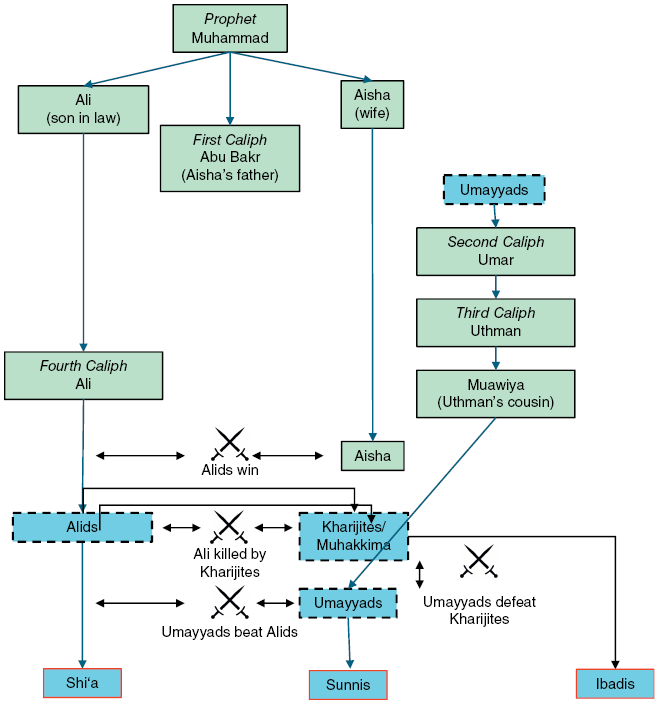
These divisions started with two different versions of what happened shortly before the Prophet died. According to one version, shortly before his death, he had appointed Ali to succeed him. According to another version, he appointed nobody specific, which was why Abu Bakr (573–634), the father of the Prophet’s wife Aisha (614–678), took over as Caliph, or successor of the Prophet. What happened next is complicated (see Figure 1). It was essentially a political crisis that had religious consequences.
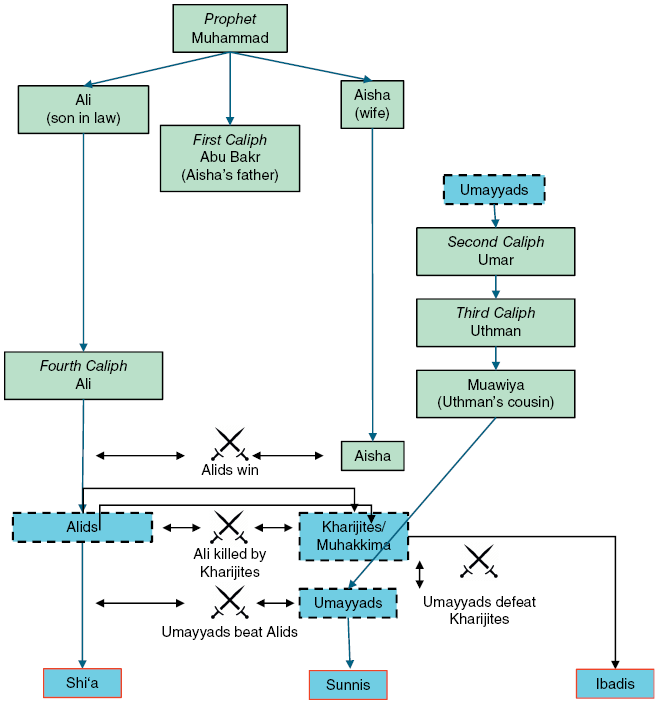
Figure 1 Long description
Diagram shows three lines originating from Prophet Muhammad and a fourth line of Umayyads. Line from Prophet divides into three branches; Ali as fourth Caliph, Abu Bakr as first Caliph, and Aisha as participant in battle against Ali . From Ali derive the Alids and thus the Shi‘a as well as the Kharijites who kill Ali. Umayyads are shown providing second and third Caliphs and then Muawiya, who beats the Alids, giving rise to the Sunnis. The Ibadis derive from the Kharijites.
After his death, Abu Bakr was succeeded as Caliph by two other relations of the Prophet, Umar ibn al-Khattab (584–644) and then Uthman ibn Affan (d. 656), who belonged to the powerful Umayyad clan. The Prophet and Abu Bakr had belonged to other clans. The Caliph Uthman lost support, and a rebellion against him led to his death. At this point Ali took over as Caliph, but never won the support of the Umayyad clan or of Abu Bakr’s daughter, Aisha. A split thus developed between Ali and his supporters on the one hand and Aisha and the Umayyads on the other hand. A third group came into being when, after an indecisive battle between the first two groups, Ali’s own support split, and some of his former supporters turned against him, though without becoming supporters of the Umayyads (Vaglieri Reference Vaglieri, Holt, Lambton and Lewis1977). This third group, known by its enemies as the Kharijites (leavers or dissenters), was later defeated so comprehensively that none of their early documents survived, and it is hard to be sure what they actually believed. The Kharijites are the first NRM in Islam.
One group of Kharijites did survive, however, and their most distinctive view is that individual Muslim communities can be ruled by an elected imam, that is, there is no need for a single ruler. They became known as the Ibadis, after their leader Abdallah ibn Ibad (d. c. 700). Ibadi groups survived in various places, the largest in Oman, where the Imamate of Oman was conquered by the neighboring Sultanate of Muscat in 1959, forming the Sultanate of Muscat and Oman, now known as the Sultanate of Oman. After his defeat in 1959, the last Ibadi imam fled into exile, and no new imam was elected after his death in 2009 (Gaiser Reference Gaiser2021). The Ibadis still exist, even without an imam. For most of history, however, they have been of strictly local importance, mostly in Oman but also in a few other places.
After a series of battles between Ali and the Umayyads, Ali was killed by a Kharijite, his eldest son Hasan ibn Ali (625–670) was defeated by Muawiya (d. 680), an Umayyad relation of Uthman who proclaimed himself Caliph, and his younger son Husayn ibn Ali (626–680) was defeated and killed by Muawiya’s son and successor Yazid ibn Muawiya (644–683) (Vaglieri Reference Vaglieri, Holt, Lambton and Lewis1977). This left the Muslims divided into three factions or shi‘a, one faithful to Ali and his sons, one faithful to the Umayyads – that is, to Muawiya and his successors – and a third taking neither position. The faction faithful to Ali became known as “the Shi‘a” (adjectival form: Shi‘i), and the faction faithful to the Umayyads became known, much later, as the Sunnis, joined by some who had remained neutral and even by some former supporters of Ali. The third, as we have seen, became the Ibadis.
Each of these groups sees itself as the “real” Muslims and regards the other two as NRMs of illegitimate origins. They have never been reconciled, despite various attempts. As Islamic theology developed over the centuries, it developed separately for each group, so three groups of theologians came to three sets of sometimes different conclusions on many issues, though the Ibadis often agreed with the Sunnis. What had started as new political movements in time became old religious movements, or denominations.
Imams and Madhhabs
While religious authority in Sunni Islam lies with the ulama, it is more complicated for the Shi‘a, as they also ascribe religious authority to the imams: Ali, Hasan, Husayn, and their descendants, whom they regard as infallible in religious matters. The Sunnis also use the term imam, but in a very different sense. A Sunni imam is whoever is leading the prayer and may also run a mosque. A Shi‘i imam is a divinely authorized and protected successor to the Prophet.
The institution of the imam makes it harder for the Shi‘a than for the Sunnis to resolve major differences of opinion. No Sunni alim has, in principle, any more authority than any other alim, though there are, of course, more and less experienced and more or less brilliant and charismatic ulama, and the best-qualified and most-respected alim in a particular city or country is often awarded a title such as mufti (giver of answers to difficult questions) or mujtahid (interpreter). Thus, at least in principle, the correct interpretation of Islam is, for Sunnis, that reached by the consensus of the ulama. The concept of consensus is of great importance, understood as second only to the Quran and the hadith. Once consensus has been reached on any particular question, there is normally no need to revisit that question, so in practice the consensus supersedes the sources on which it is based. It could be said that Sunni Islam is what the consensus of the Sunni ulama says it is.
When, as inevitably happens, differences of opinion emerge within the ulama, this does not matter for the Sunnis, as in principle no one’s view is more right than anybody else’s or, putting it differently, everyone is right. This was the solution to the problem posed by the emergence of different regional consensuses in the ninth and tenth centuries. These regional consensuses became known as madhhabs, literally “departures,” generally called “schools” in English in the sense of “school of thought.” After a process of consolidation, the Sunnis ended with four madhhabs or recognized versions of the consensus, each known after the alim who was regarded as having founded it. The four Sunni madhhabs disagree on certain points, then, but they are all right. Each madhhab now dominates a particular geographical area, so that Turks normally follow the madhhab of Abu Hanifa (699–767), and Indonesians normally follow the madhhab of al-Shafi’i (767–820). Normally, only members of the ulama know anything about any madhhab other than the one they themselves follow. The madhhabs are the single most important institution within premodern Sunni Islam.
Since the consolidation of the Sunni madhhabs, there have been periodic disagreements about how far one may depart from the consensus of any particular madhhab and about what exactly that consensus is, but in practice the basic answer that everyone is right continues to work, unless someone is very clearly absolutely and completely wrong. This arrangement has minimized the emergence of NRMs in Sunni Islam, and as we will see below, one thing that automatically turns a group into an NRM is for it to reject the madhhabs.
Life is more complicated for the Shi‘a, given the institution of the imam. When an imam dies, sometimes everyone is agreed on who the next imam is, but sometimes this is not the case. All Shi‘a start with Ali, Hasan, and Husayn, but there was disagreement about who succeeded Husayn after his death in 680, and there have been many subsequent disagreements in the history of Shi‘i Islam (see Figures 2, 3, and 4). Each time there was a disagreement about the succession, an NRM resulted. Some of these consolidated over time into denominations, but they were all originally NRMs and are one of the major varieties of NRM within Islam. In this Element, they are termed “imam-led NRMs.”
Imam-led NRMs and resulting denominations have had followings of varying sizes. The largest Shi‘i denomination today is known as “the Twelvers,” and constitutes the majority of the population in Iran and Iraq, and a regional majority in some other countries; the smallest imam-led NRM has only a few hundred followers, and some are extinct. Most Shi‘i Muslims today are Twelvers, so the term “Shi‘a,” used without modification, now means Twelver Shi‘a.
Imam-led NRMs
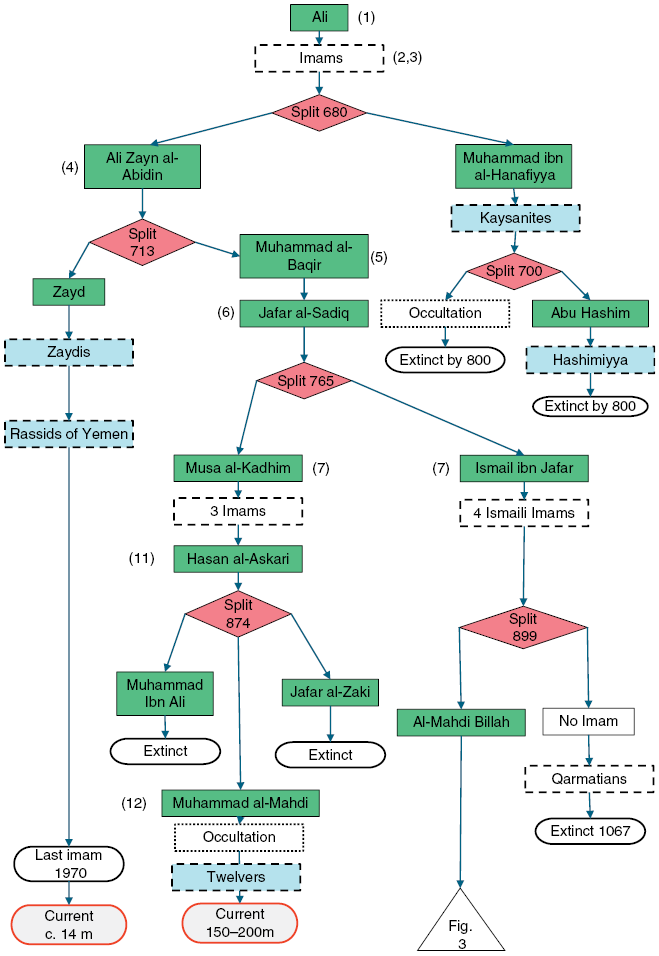
The early imam-led NRMs are shown in Figure 2. They are NRMs primarily because they each reject each other and are also often rejected by the dominant political authority. After disagreements in 680, 765, and 874, one line ends with a twelfth imam, Muhammad al-Mahdi, who is understood to have gone into “occultation” in 874. That is, he is absent from this world, but not dead. He is expected to reappear at the end of time, rather as many Jews expect the Messiah and many Christians expect the second coming of Jesus. This doctrine of occultation explains why there have been no subsequent major splits in Twelver Shi‘ism; since 874, there have been no successions to disagree about. The Twelvers are free of the structural weakness that leads to so many splits in other forms of Shi‘ism, which is one reason why they have become the largest Shi‘i denomination.
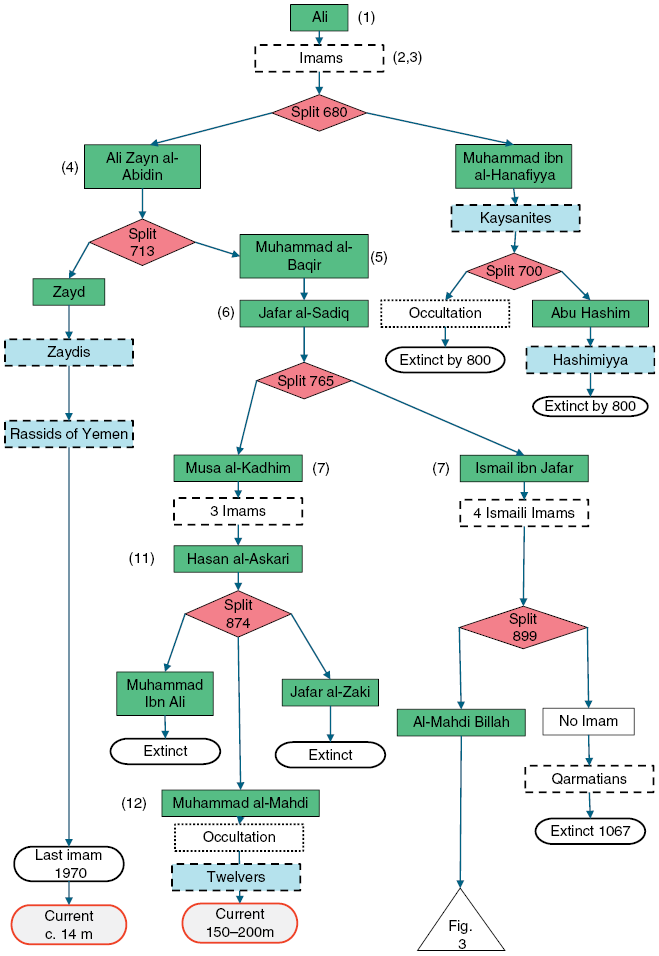
Figure 2 Long description
Diagram shows multiples lines deriving from Ali via six succession disputes. Imams are numbered according to the system used by the Twelvers. The first split in 680 is between Ali Zayn al-Abidin and Muhammad ibn al-Hanafiyya, the latter giving rise to the Kaysanites, extinct by 800. The former leads to a split in 713 between Zayd, giving rise to the Zaydis now numbered at circa 14 million, and the main line that splits after Jafar al-Sadiq in 765 to give rise to a line following Musa al-Kadhim and another following Ismail ibn Jafar. This line becomes the Ismailis, further shown in Figure 3. The line following Musa al-Kadhim splits in 874, giving three lines, two extinct and one developing into the Twelvers, currently between 150 and 200 million.
Figure 2 shows two claimants to the imamate in the line of in 680, Ali Zayn al-Abidin (d. 712) and Muhammad ibn al-Hanafiyya (d. 700). The followers of Muhammad ibn al-Hanafiyya, known as the Kaysanites, had disappeared by 800, and the followers of Ali Zayn al-Abidin formed the main Shi‘i line from which the Twelvers derive. Figure 2 also shows two claimants to the imamate in the line of Ali Zayn al-Abidin in 765. One, Musa al-Kadhim (745–799), is part of the Twelver line. The other, Ismail ibn Jafar (d. 765 or 775), is the origin of many other lines, known collectively as “Ismailis.” Their further development is shown in Figure 3 and discussed below. The main imam-led NRMs will each be considered briefly; others, of which there are many, will not.
Kaysanites
The Kaysanites (right line on Figure 2) followed Muhammad ibn al-Hanafiyya as imam and are named after Abu Amra Kaysan (d. c. 686), a senior commander in the forces that supported him. They were short-lived and included several separate groups whose beliefs were regarded by other Muslims as “extreme” (ghulat). Some of what was said about them is probably propaganda spread by their enemies. It is unlikely, for example, that any of them actually worshipped a wooden chair that was said to have been used by Ali. One group, however, did believe in reincarnation, and also held that the “spirit of God” had been incarnate in the Prophet Muhammad, and had then transferred through Ali and other imams to Muhammad ibn al-Hanafiyya (Madelung Reference Madelung2012). Although the Kaysanites vanished, unusual “extreme” beliefs of this type survived to resurface in other groups in later centuries. The obvious origin of the belief in reincarnation is Greek philosophy (for example, Pythagoras), and the obvious origin of the belief in the incarnation of the divine in a human being is Christianity, but there is no surviving evidence of where these beliefs actually came from.
Zaydis and Houthis
The Zaydis (far left line on Figure 2) moved to Yemen – a mountainous land that has always been difficult to control and so is hospitable for minorities – in the 890s. They established a line of ruling imams that lasted, with some interruptions, until 1970, when it was overthrown after a civil war between the last Zaidi imam and a group of socialist army officers (Hovden Reference 79Hovden2022). Between the 890s and 1970 there were several succession disputes and splits, but none of them gave rise to a lasting alternative line, and so are not shown in Figure 2. That the Zaydis established a state and a dynasty fits with the original conception of the imamate at the time of Ali: The imam was to have both religious and political authority, after the model of the Prophet. There were also shorter-lived Zaydi states elsewhere in the region.
Since 1970, there has been no Zaydi imam, but there are still many Zaydis in Yemen, though more Sunnis. The Houthi tribe is Zaydi and the basis of the Houthi movement that conquered much of western Yemen during the civil war that started in 2014 (Salmoni, Loidolt, and Wells Reference Salmoni, Loidolt and Wells2010, 94–107).
Fatimids and the Esoteric
Like the Zaydis, the Ismailis, following imams descended from Ismail ibn Jafar, established a state to give political form to their imam’s combined political and religious authority. They called themselves “Fatimids” after Ali’s wife Fatima bint Muhammad (d. 632), the daughter of the Prophet. With the support of disaffected tribes from North Africa, the Fatimids conquered the Egyptian capital, Fustat, in 969, building a new city, now called Cairo. From Cairo they established control over Syria and the eastern part of the Arabian Peninsula, and for some time it looked as if they would take the whole of the Muslim world. In the event, however, Fatimid expansion failed, and after a series of internal crises, Cairo fell to the Sunni forces of the great commander Saladin (1137–1193) in 1171. Sunni Islam again became the norm from North Africa to Damascus.
Under the Fatimids, Ismaili theology developed an emphasis on the esoteric and the secret that is not found in any other branch of Islam. This included emphasizing the esoteric meanings of exoteric practices such as fasting. It also included keeping certain doctrines and texts secret from younger members of the group, and in all cases from outsiders (Walker Reference Walker and Walker2023). The various Ismaili-derived NRMs to be discussed all have some form of secrecy which, together with taqiyya (prudence) and endogamy, has helped their survival over the centuries. To aid their survival against persecution by the Sunni majority, Ismaili (like all Shi‘a) may find it “prudent” to pretend to be Sunni, and this is acceptable, or even encouraged.
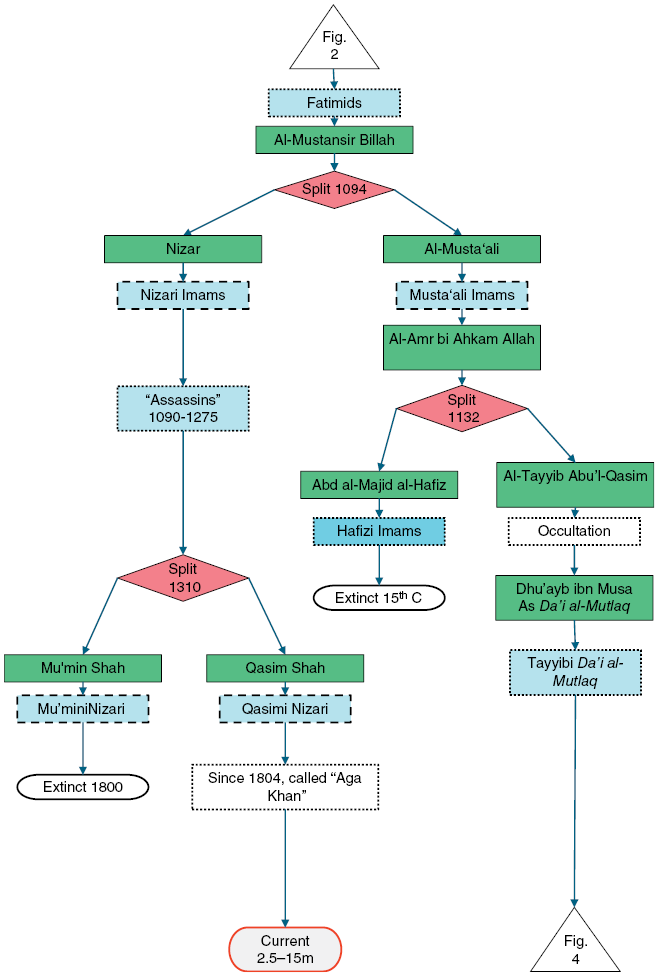
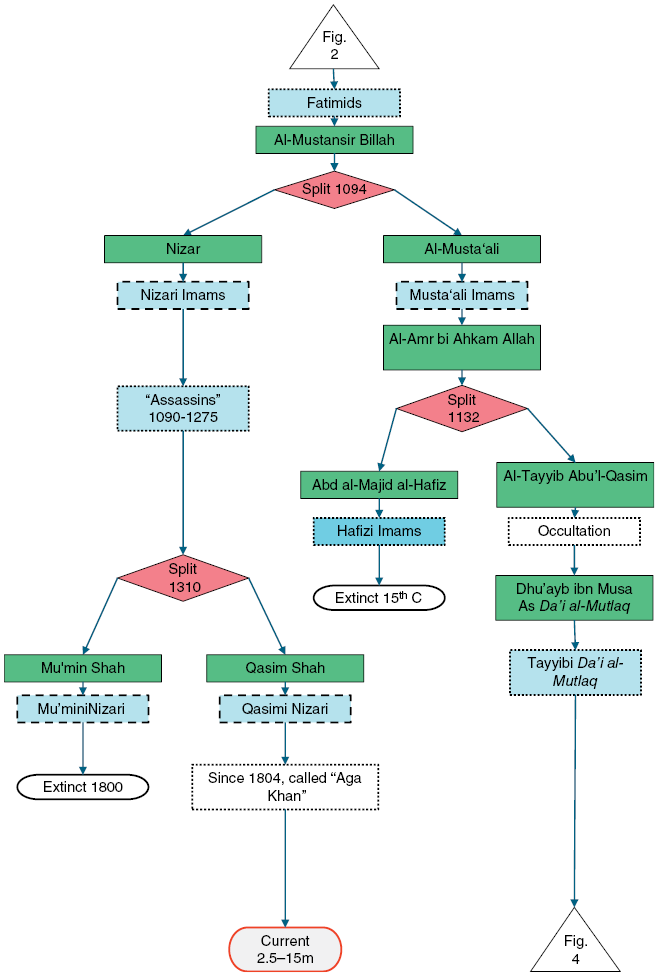
Figure 3 Long description
Diagram starts with the Fatimids, splitting in 1094 between Nizar and al-Musta’ali. The former gives us the Assassins and a 1310 split between Mu’mini Nizaris who are extinct by 1800 and Qasimi Nizaris, currently between 2.5 and 15 million, led now by the Aga Khan. The latter gives us the Musta’ali imams and a split in 1132 between Hafizis, extinct by the fifteenth century, and what becomes the Tayyibis, further shown in Figure 4.
The Assassins and the Agha Khan
As the Fatimid empire’s expansion stalled at the beginning of the middle period, three further splits gave rise to four more Ismaili NRMs, as shown in Figure 3. Two of these are now extinct. The first split created Nizari and Musta‘ali lines. The Nizaris are best known for the quasi-state they established in Persia (now Iran) and Syria, based on a string of fortresses, that was finally destroyed by the Mongol invasions in 1256. They became famous among Europeans as “the Order of the Assassins.” “Assassin” is a French version of the Arabic hashshashin, “hash-users,” a pejorative term applied by outsiders. Even if the Nizaris did not generally use hashish, they did indeed make ample use of targeted assassinations to maintain their power against that of their enemies. The explanation for this was strategic as much as theological.
After the defeat of the Assassins by the Mongols and a subsequent split, the Qasimi Nizaris survived in Persia, away from the growing Sunni hegemony in the west. They continued for centuries as an obscure, small religious group, not as a state, but established a following in Gujarat, the Indian region opposite Oman, where Hindu converts to Nizari Ismaili Shi‘ism became a distinct ethnic group known as Khojas, from the Persian khwaja, a gentleman. This is now the single largest group of Qasimi Nizaris (Steinberg Reference Steinberg2011, 35).
The Qasimi Nizari imams became internationally prominent in the early nineteenth century, when they established a cooperative relationship with the British in India. The British awarded their imam the title of Aga Khan (great king) and the status of prince, and the family grew very wealthy. Today, the term “Ismaili,” used without qualification, means Qasimi Nizari Ismaili, of whom there are between 2.5 million and 15 million (Steinberg Reference Steinberg2011, 35). The Ismailis are not endogenous, and the current imam, Rahim al-Hussaini, Aga Khan V (b. 1971), has an American wife and a British mother. His seat is in Lisbon, and like his father and grandfather, he dresses in Western style, in well-cut suits. He both leads his followers, who regard him as the divinely protected successor of the Prophet, and supervises a variety of global welfare projects. These Ismailis are now the biggest Shi‘i group after the Twelvers.
The Bohras
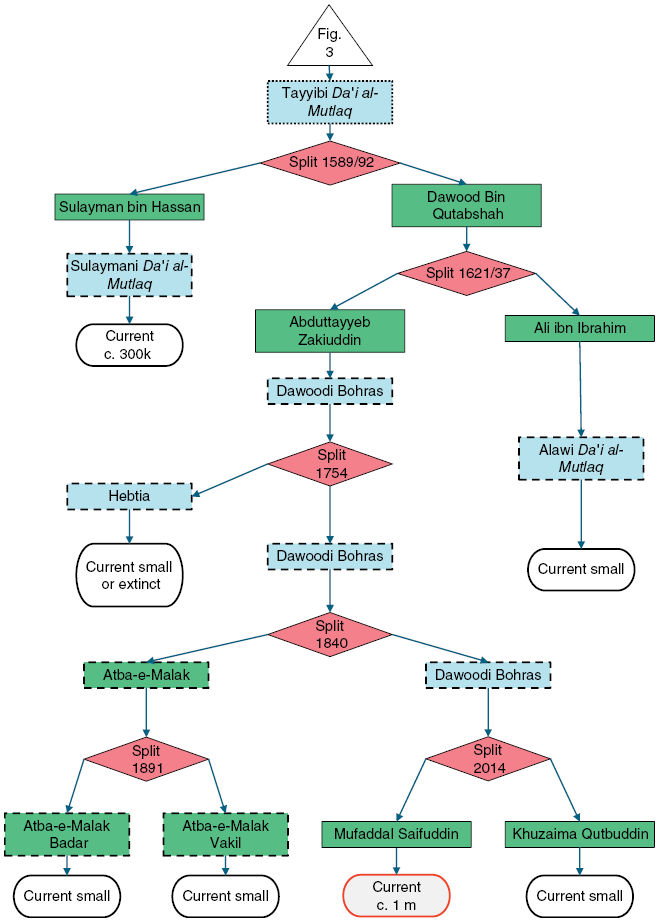
After a further split in 1132, the Qasimi Musta‘ali Ismailis, who moved to Yemen and then to Gujarat, adopted a new approach to the imamate. Rather than consigning their imam to occultation like the Twelvers or maintaining a line of living imams like the Qasimi Nizaris, their Tayyibi branch appointed an “Absolute Preacher” (al-da‘i al-mutlaq) to represent their imam (Blank Reference Blank2017, 88). There was no requirement for the Absolute Preacher to belong to any particular family. This might have solved the problem of succession disputes, but did not. As Figure 4 shows, the Tayyibis suffered a further six splits, the latest in 2014 (Blank Reference Blank2017, 93–4). Most of these further lines have survived, but are very small. The largest is the so-called “Bohras,” a term that comes from the Gujarati vepara, trade.
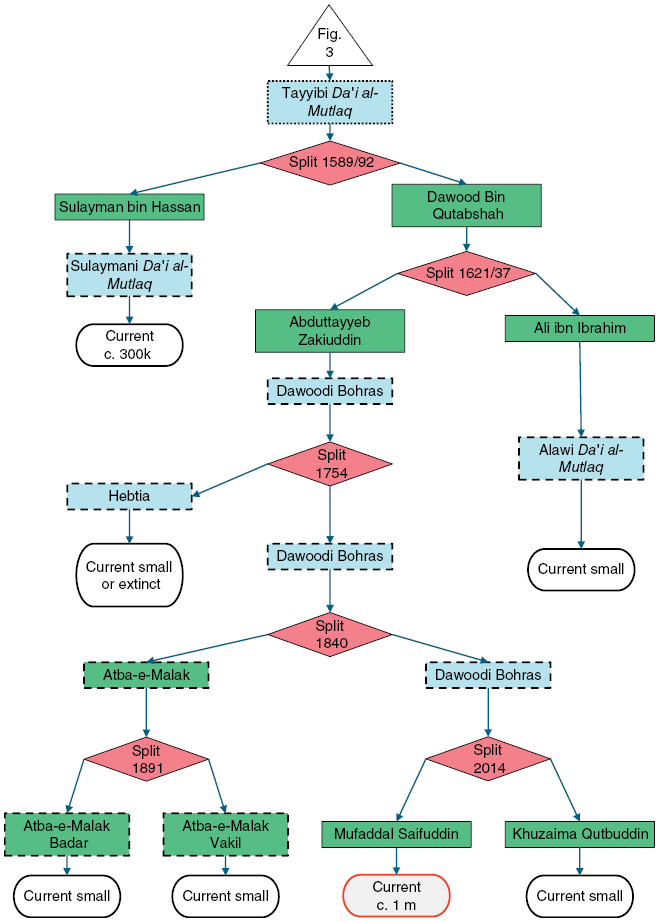
Figure 4 Long description
Diagram starts with the Tayyibi Da’l al-Mutlaq, giving rise to a number of minor lines and one major line that gives us today’s Dawoodi Bohras, around one million. All other lines remain small or become extinct. There are numerous splits, the most recent in 2014.
The Bohras have, over the centuries, been very successful as traders across the Indian Ocean, and are today well-established in India, East Africa, and Cairo, where they have been busy restoring monuments erected by their Fatimid ancestors. The current Absolute Preacher, Mufaddal Saifuddin (b. 1946), dresses in robes, and since 1978 his followers also use distinctive dress. He is followed by some one million people and is treated as a nonterritorial sovereign by some governments.
The Sufi Revolution
The ulama have a monopoly over the interpretation of Islam and thus over teaching and the law, but they share their monopoly over preaching with a different kind of religious authority, the Sufis, so called because they once wore robes of wool (suf in Arabic). The Sufis are in a sense the monks of Islam, but Islam has no monks – there are several hadiths that say it should not, and the consensus has long accepted this. Sufis focus on prayer and asceticism, but in other ways they are indeed not monks. They take a vow of obedience, but no vow of chastity or poverty. They have families and jobs alongside their Sufi activities. For most Sufis, Sufism is a part-time activity.
Since the “Sufi revolution” of the thirteenth and fourteenth centuries, many (but not all) individual Sufis give their vow of obedience to a Sufi guide, known as a shaykh (elder) or murshid (guide), and this brings into being a group known as a tariqa, literally a path, often translated into English as “order.” A tariqa led by one shaykh may consist of as few as twenty people, or as many as hundreds of thousands. It may be old, and own property, or it may be new, and have no physical form other than its members. When new, it might be an NRM, except that it is not considered unacceptable by the dominant religious community and it is not particularly novel in its beliefs or practice. A new tariqa is a new instance of a well-established phenomenon, and it follows well-established patterns. A tariqa is also not a denomination. One is Sunni or Shi‘i and then follows a tariqa, if one does – many do not. The popularity of tariqas varies. Sometimes and in some places tariqa has been the norm, and sometimes and in some places it is unknown.
As a Sufi tariqa is not generally an NRM, and as there is much excellent literature on Sufism, this Element will only consider Sufism in the rare cases when it does result in an NRM.
Conclusion
During the formative period of Islam, an early disagreement resulted in the division of the Muslims into three groups, Sunni, Shi‘i, and Khariji, the Kharijis being the first real NRM in Islam. One Khariji group survived in Oman and a few other places, where they are of strictly local importance. Sunni and Shi‘i Muslims developed two different authority structures, the Shi‘a answering to divinely appointed imams, and the Sunnis to the consensus of their ulama, in the form of one of four madhhabs.
The madhhab structure discouraged the development of NRMs, but the imam structure led to repeated splits and so to repeated imam-led NRMs, starting in 680 and found most recently in 2014. The imam-led NRM is a permanent feature of Islam. Twelver Shi‘a escaped this problem when their twelfth imam went into occultation, but the Ismailis, after establishing the Fatimid empire, which might have conquered the whole Muslim world but did not, split into many different NRMs. The two most important were the Nizaris, known in the West as the Assassins, and the Bohras, both of which still exist.
The Sufi revolution at the end of the formative period led to many Sufi tariqas, but these are not NRMs, though – as we shall see – they sometimes develop into NRMs.
As a religion, Islam has generally been very successful at maintaining unity. As of 2026, there are some two billion Muslims in the world, the vast majority of them Sunni, following the Sunni consensus. The vast majority of non-Sunni Muslims are Twelver Shi‘a, in practice following a second consensus that is on most, or at least many, points not so different from the Sunni consensus. Despite this, various types of NRM did arise over subsequent centuries, sometimes challenging the consensus, sometimes untroubled by the consensus when the dominant religious group, political authority, or both were weak. Modernity also brought further, new types of NRM.
2 The Middle Period
The formative period saw the emergence of the first imam-led NRMs, a process that has continued until the present day. The post-formative and premodern middle period then saw the development of two further types of NRM: “restorationist” or Mahdist if Sunni, and in other cases “hybrid.”
Sunni Restorationism
In general, the scope for the emergence of Sunni NRMs was minimized by the institution of the madhhab and the absence of any figure comparable to a Shi‘i imam. This system was not, however, proof against movements that denied the validity of the madhhabs and insisted on returning to the original sources, the Quran and hadith, so as to restore the pure and original religion of Islam. This position, known as “restorationism,” is found in many religions. The Protestant Reformation in Europe, for example, was restorationist. Restorationist NRMs are NRMs because they reject the dominant religious community and political authority.
Restorationism in Islam sometimes takes the form of Mahdism, movements led by someone who is seen as the Mahdi or “guided one.” The Mahdi is expected to come at the end of time, guided by God to lead the Muslims against the forces of evil. Mahdism is by definition millenarian. A Mahdi has as much authority as a Shi‘i imam, and for the Shi‘a, the Mahdi is the twelfth imam. For Sunnis, a Mahdi needs religious legitimacy, and will normally be a reformist. In theory, there is only one Mahdi, who has not yet come (assuming we are not currently in the last days), but in practice many people have been recognized as Mahdis over the centuries. In retrospect, they can all be seen to have been false Mahdis, as the final days have not arrived. The Mahdi is the weak point in the edifice of Sunni religious authority, just as succession to the imam is the weak point in the Shi‘i edifice of authority.
Restorationist NRMs of the middle period normally came into conflict with the political authorities, and these conflicts were often understood – controversially – by the restorationist side as jihad. War between Muslims is not encouraged by Islam, but war against non-Muslims is encouraged and is termed jihad, short for jihad fi sabil Allah, struggle on the path of God. The term jihad is also sometimes used metaphorically to describe spiritual struggle against the ego. Participation in jihad is a religious duty, and those fighting jihad are entitled to material benefits and also to a guaranteed place in heaven if they fall in battle. The consensus was and is that anyone who self-identifies as a Muslim should be treated as such, but some restorationists and all Mahdists abandoned this consensus, classifying those who did not follow their understanding of Islam as non-Muslims. This is known as takfir, declaring someone to be an infidel (often mistranslated as excommunication, which is something a bit different). It makes it possible to recast a war with other Muslims as a jihad, which encourages the participation of volunteers. Jihad on its own does not make an NRM, as it is a means to an end, not an end in itself. But it combines comfortably with many types of NRM.
The Almohads
The best-known Mahdist NRM of the middle period was led by Muhammad ibn Abdullah ibn Tumart (d. 1129), a Moroccan alim who rejected the madhhabs, claimed to be the Mahdi, and declared jihad against the sultan of Morocco and parts of what is now Portugal and Spain, Ali ibn Yusuf (d. 1143). Ibn Tumart stressed the oneness (tawhid) of God, with the result that his followers were called al-Muwahhidun, oneness-ers, Hispanicized as Almohade and Anglicized as Almohads.
Ibn Tumart had developed a particular antipathy to the Maliki madhhab, which was the dominant one in Morocco (Messier Reference Messier2010, 142). He was an activist more than a theorist, and in the absence of any clear presentation of his theology, there is disagreement about its exact details or origins, but he seems to have preferred the Quran and hadith to the writings of later ulama (García-Arenal Reference 78García-Arenal2006, 163, 178; Messier Reference Messier2010, 142), a standard restorationist position. He also condemned a range of practices that were forbidden by many hadith but in practice found socially acceptable in Morocco, notably the use of musical instruments, social mixing between men and women, and the consumption of wine. His followers accordingly destroyed any musical instruments that they found as well as shops that sold them and emptied vats of wine (Messier Reference Messier2010, 141). His criticisms extended to Sultan Ali ibn Yusuf for tolerating these practices, meaning that he was proclaiming the unacceptability of the dominant religious community, the host society, and the political authority. He found himself arrested and interrogated on more than one occasion and finally fled with his closest followers to the High Atlas mountains, where his own tribe lived. There he proclaimed himself to be the Mahdi, was accepted as such, and organized a tribal confederation against Sultan Ali ibn Yusuf, whom he declared a rebel against God, along with the sultan’s followers (García-Arenal Reference 78García-Arenal2006, 173), against whom jihad was a religious duty (Lagardère Reference Lagardère1998, 15).
The Almohads’ first attack against Sultan Ali ibn Yusuf’s capital, Marrakesh, in 1130 was defeated and Ibn Tumart killed. After fighting and ultimately defeating the Sultan Ali ibn Yusuf and some other local rulers in Morocco and Spain, his successor Abd al-Mumin (1093–1164) declared himself amir al-muminin (commander of the believers) (García-Arenal Reference 78García-Arenal2006, 174) and founded a dynasty, legitimized by the preaching of Ibn Tumart, that lasted until 1248, finally vanishing only in 1699.
As an NRM, the Almohads were first restorationist, then Mahdist (and thus millenarian) and jihadi. Ibn Tumart’s followers were poor mountain tribesmen, and their attack on Marrakesh and the urban elites was certainly not only motivated by religious fervor. Political and religious motivations were both present, but as they combined comfortably rather than contradicting each other, there was no need to distinguish one from the other.
Ibn Taymiyya
The leading Sunni restorationist of the middle period was Taqi al-Din ibn Taymiyya (1263–1328), not a Mahdist jihadi but an alim who spent most of his life relatively peacefully in Damascus. He was an original and controversial thinker, with a small but devoted following.
Ibn Taymiyya rejected the consensus of the ulama as incorporated in the madhhabs. His point of reference was instead the pure and original Islam of the first Muslims, known as the Salaf (ancestors). “The way of the Salaf,” he wrote, “is to interpret literally the Quranic verses and hadiths” (cited in Haykel Reference Haykel and Meijer2009, 38). A qualified scholar (such as himself) should return to the original sources and read these texts literally, avoiding the use of analogy (qiyas) in interpreting them.
Ibn Taymiyya’s restorationism, which came to be termed “Salafism,” led to a number of conclusions. He objected to the widespread practices of celebrating the anniversary (mawlid) of the Prophet, and of visiting the graves of saints to seek intercession. He took particular exception to the theology and practices of Shi‘ism and to the mystical theories of the great Sufi theologian Ibn Arabi (d. 1240). He denied the validity of one standard form of divorce, and the use of hashish, which was widely tolerated. He thus rejected many of the practices of the host society, as well as the dominant religious community, and so came into conflict with the political authority – even if he never explicitly rejected it. He attracted many enemies, especially among the ulama and the Sufis, and was repeatedly arrested, tried, and condemned. He died in prison in Damascus (Laoust Reference Laoust2012).
Unlike Ibn Tumart, Ibn Taymiyya did not lead a jihad or declare himself to be the Mahdi. He did, however, practice takfir, though against a different political authority: the Ilkhanid Mongols, who invaded Syria in 1305, and who had converted to Islam in 1295. On the face of it, resisting them could not be jihad. Ibn Taymiyya’s solution was to argue that the Ilkhanids were not really Muslim because they did not observe all the rules of Islam (Laoust Reference Laoust2012), which, as recent converts, they probably did not.
Also unlike Ibn Tumart, who was never very important beyond Morocco, Ibn Taymiyya left a memory that survived him and still matters today. His writings and those of his student Ibn Qayyim al-Jawziyya (d. 1350) inspired a later NRM in Istanbul, the Kadızadeli Movement, named after Kadızade Mehmet (1528–1635), an alim who followed Ibn Taymiyya’s methods and also many of his conclusions, adding condemnations of coffee and of tobacco smoking to Ibn Taymiyya’s condemnation of hashish (Currie Reference Currie2015).
The Kadızadeli Movement was followed by many ulama and some ordinary people, and attracted the support of Sultan Murad IV (1612–1640), perhaps because the Sultan found the Kadızadelis useful allies against the Bektashis, who are discussed in the next subsection. Kadızade translated some of Ibn Taymiyya’s work into Ottoman Turkish for the benefit of the sultan. The Kadızadeli Movement, then, was in the unusual position of rejecting the dominant religious community, but not political authority, which supported it.
Kadızade was succeeded on his death by Muhammad al-Ustuwani (d. 1661), under whom the Kadızadelis acted on their disapproval of Sufism by demolishing a Sufi lodge; al-Ustuwani was exiled to Cyprus because of the controversies and public disorder to which this NRM gave rise. Rejection of the host community, then, finally led to rejection by a later political authority. Despite this, enough Kadızadelis remained in Istanbul to demolish a Bektashi shrine in 1668. The movement finally disappeared from Istanbul in the 1680s (Currie Reference Currie2015).
Hybrid NRMs
Unlike these Sunni NRMs, some other NRMs developed theologies and practice quite different from anything found elsewhere within Islam. This is what makes them NRMs. Many developed over time into separate religions and became denominations in their own right. The dominant religious community became used to them, even if it still continued to reject them from time to time. They were all hybrid, drawing on non-Islamic as well as Islamic sources.
Nusayris and Druze
Originating in the ninth century, the Nusayris, now often called the Alawis, are found mostly in Syria. The Assad family that ruled Syria from 1971 to 2024 were Alawis. They were originally named for Muhammad Ibn Nusayr al-Namiri (d. 883), who led one of the several religious movements that emerged after the death of the eleventh Shi‘i imam in 874. The Nusayris might be classed as an imam-led NRM like the Ismailis were it not that they did not recognize anyone as imam and instead developed an extremely unusual theology that proposed divine incarnation in a trinity consisting of Ali, Muhammad, and Salman the Persian (a follower of the Prophet). Other trinities in Nusayri sacred history include Joshua and Moses plus one other, and Peter and Jesus plus one other. Nusayris do not follow the Sharia, Nusayri rituals have little to do with Islam, and they are secret; one is said to involve the consumption of bread and wine, evidently inspired by the Christian communion. Festivals are taken from the Christian and Islamic calendars, but given quite different meanings (Friedman Reference Friedman2009; Goldsmith Reference Goldsmith2018). The Nusayris gathered in the mountains around Latakia on the Syrian coast, where they still form the majority. They protected themselves through taqiyya, with the true faith known only to certain families. Today many present themselves as Twelver Sh‘ia, and some may have actually become Twelver Sh‘ia.
A comparable group in the eleventh century was called the Druze by outsiders, after one of its founders, Muhammad ibn Isma’il al-Darazi (d. 1018), but which called themselves Muwahhidun (like the followers of Ibn Tumart). Al-Darazi, a Persian, led the movement together with another Persian, Hamza ibn Ali (985–1021), both based in Fatimid Cairo. The movement’s theology was also innovative, as it held that the Sharia had been superseded and that the Ismaili imam and Fatimid Caliph al-Hakim bi-Amr Allah (985–1021) was an incarnation of God, rather as Christians conceive of Jesus. Al-Hakim was apparently sympathetic to the new movement, but vanished in 1021, probably murdered by courtiers because of his increasingly eccentric behavior. Before then, a split had developed between Hamza ibn Ali and al-Darazi, who was executed. The founder of the Druze, then, is really Hamza ibn Ali, even though the group is named after al-Darazi (Hodgson Reference Hodgson1962).
The Druze maintained that al-Hakim had gone into occultation and refused to recognize his successor. They are, then, also not an imam-led NRM. The Fatimids attempted to put down the new movement, and the Druze left Egypt for Syria, where they established themselves in the mountains, protecting themselves (again) through taqiyya and endogamy. In 1046, they stopped accepting new members, adopting a doctrine of reincarnation according to which every Druze child was the reincarnation of a deceased Druze. They thus became an ethnic as well as religious minority that has survived centuries of persecution. They, too, also developed a system whereby the true faith was known only to certain families (Firro Reference Firro2013). In the modern period, the Druze have been divided between Lebanon, Syria, and Israel and have presented themselves somewhat differently in each country. In Israel they stress their non-Islamic identity and serve in the IDF, the Israeli army.
Qizilbash, Bektashis, and Alevis
Anatolia, a Greek territory that was settled by Turkish warriors after 1071, and Mesopotamia, the northern part of the Fertile Crescent that is today in Iraq, were overrun by Mongols in the middle of the thirteenth century and only came under firm government again with the Ottomans during the fifteenth century. Both areas provided fertile ground for numerous NRMs between the thirteenth and fifteenth centuries. Many are known only by name, as few produced texts, and even fewer have survived. Some groups in the area maintained pre-Islamic religions, notably Christianity, but also followers of an ancient pre-Zoroastrian Iranian tradition that evolved over time into what is now known as Yazidism, which has acquired Islamic features over the centuries but is not originally of Islamic origin (Kreyenbroek Reference Kreyenbroek2012).
Another group in the area, the Ahl-i Haqq or “people of Truth,” may also have a pre-Islamic Iranian origin, but developed a belief system that included “extremist” Shi’i beliefs resembling those of the eighth-century Kaysanites, an imam-led NRM. They believe in a series of divine incarnations, including Ali and, less usually, Sultan Sahak (fifteenth or sixteenth century). These incarnations are accompanied by four angels and a fifth spirit, who is female. The Ahl-i Haqq have a caste of hereditary priests who officiate over so-called jam meetings at which a sacrifice is made (either an animal or fruit and nuts) and the presence of Sultan Sahak is invoked (van Bruinessen Reference van Bruinessen2009).
Other NRMs included so-called Qizilbash, red-heads, distinguished by their red headwear, who were loyal to a local tariqa, the Safavid tariqa (Baltacıoğlu-Brammer Reference Baltacıoğlu-Brammer and Matthee2021) and regarded with suspicion by the Ottomans, who accused them of heresy, rejection of the Sharia, and the practice of incest (Dressler Reference Dressler2008). There is no evidence of the latter practice. The earliest Qizilbash documents we have are from the sixteenth century, and these and other sources reveal a general Shi‘i orientation. Some texts portray Ali as divine, however, and recognize reincarnation, distinctive positions similar to the Ahl-i Haqq, with whom the Qizilbash may have been related (van Bruinessen Reference van Bruinessen and van Bruinessen2011). The Qizilbash also fasted in the month of Muharram, not Ramadan like everyone else, and made pilgrimage to the tomb of Hajji Bektash (d. 1271), a Persian Sufi whom they venerate, not to Mecca. Their central ceremony is the jam (gathering, spelled cem in modern Turkish), a commemoration that includes dance and the consumption of either a sweet sherbet or alcohol (wine or raki, a distilled spirit), depending on the region. In Islamic terms, this is very unusual, especially given the general Islamic ban on alcohol. The jam is led by dedes (grandfathers), hereditary priests who came from so-called ojak (hearth) families, which did not intermarry with other families (Dressler Reference Dressler2008). Again, the Qizilbash resemble the Ahl-i Haqq. The Safavid tariqa that they supported, however, became gradually more military and more Shi‘i (Baltacıoğlu-Brammer Reference Baltacıoğlu-Brammer and Matthee2021), and in 1501 took control of Azerbaijan, from where it succeeded in conquering the whole of Persia. It thus transformed from a tariqa into a dynasty that lasted until 1736, and made Persia the Shi‘i-majority country that it remains today as Iran.
Another unusual variety of tariqa in Anatolia was the Bektashiyya, named after Hajji Bektash. This group was loyal to the Ottomans, who reorganized it in the sixteenth-century into a hierarchical organization that they encouraged to absorb the Qizilbash and similar groups, which it did, at the cost of adopting some of their beliefs and ceremonies (Zarcone Reference Zarcone2014). The Ahl-i Haqq, however, were not absorbed and continue to exist today. The Bektashiyya developed a system governed by the trinity of God, Muhammad, and Ali, and also recognized the twelve imams and reincarnation. Like the Shi‘a, they practiced taqiyya. Their major ritual was performed in connection with the initiation of a new Bektashi and included various steps, culminating in the symbolic hanging of the initiate and ending in a dance in which both men and women participate (Zarcone Reference Zarcone2014).
The Bektashiyya at first did not come into conflict with political authority, but became closely associated with the Ottoman military elite, the Janissaries. This meant, however, that they were suppressed in 1826 at the same time as the Janissaries themselves were. They survived, however, in Istanbul, where they often merged with Freemason orders, and in Albania, where they are today recognized not as a tariqa but as a separate religion, on par with Islam and Christianity (Zarcone Reference Zarcone2014).
The remaining Qizilbash began to identify during the later nineteenth century as Alevis, as did some Bektashis (Dressler Reference Dressler2008). “Alevite” is the Turkish form of the Arabic “Alawi” used by the Nusayris, but despite having the same name, the two groups have distinct origins, beliefs, and practices. What they have in common is that they find the term Alevite/Alawi less pejorative than Qizilbash or Nusayri. Alevis are generally regarded as Muslims in Turkey, where they number some twenty million and seek to avoid conflict with the dominant religious group, while in Germany (which, unlike Turkey, has a non-Muslim majority) they sometimes present themselves as a distinct religion (Sökefeld Reference Sökefeld and Özkul2022). This may position them better in relation to their German host society.
Conclusion
Restorationist and hybrid NRMs are found in the same middle period, but that period was very long, providing room for two distinct types of NRM.
The restorationist Sunni NRMs of the middle period have in common that they rejected the consensus of the ulama and condemned many practices of their host society. At the same time, they had different relations with political authority, attacking it in the case of the Almohads, being attacked by it in the case of Ibn Taymiyya, and being first supported and then repressed by it in the case of the Kadızadelists. Theologically, their Islam was more restrictive than the consensus on certain points, but otherwise generally in line with it. What mattered was that they rejected the madhhabs.
Hybrid NRMs, in contrast, were religiously highly inventive. Despite their different geographical origins, their beliefs and ceremonies had something in common. Most proposed some form of divine incarnation, often understood in terms of a trinity. They accepted reincarnation and minimized or rejected the Sharia. They used the doctrine of taqiyya to protect themselves. They were led by a hereditary priesthood maintained through endogamy. Their central ceremony included variations on the consumption of bread and wine, fruit, or sherbert, and often mixed-gender dancing. Divine incarnation, the trinity, and the ritual consumption of bread and wine are also found in Christianity, from which they were perhaps borrowed; Anatolia had originally been Christian. The influence of pre-Islamic Iranian religion is also possible, as are the “extremist” beliefs of the Kaysanites. The loosely controlled Anatolia of this period, where the dominant religious group and political authority were both weak, provided fertile ground for religious synthesis and invention.
3 Early Modernity
In 1798 a French army under Napoleon Bonaparte (1767–1821) landed in Egypt and quickly defeated the much bigger but worse trained and worse equipped Egyptian army at the Battle of the Pyramids. This was not the first encounter between the modern West and the Muslim world, however. The expanding European powers generally avoided the Muslim heartlands until quite late, but more peripheral territories like the East Indies (now Indonesia) and India (now India, Pakistan, and Bangladesh) had fallen under Dutch and British control, respectively, during the seventeenth and eighteenth centuries.
The arrival of modernity in the Muslim world was inextricably linked with European imperialism. In areas under European control, the machinery of a modern state was built by the Europeans; in countries that hoped to avoid European control, building modern armies, administrations, and economies as fast as possible was part of “defensive modernization,” reform programs that aimed to copy the powerful states that had been developed in Europe over previous centuries. This meant ministries, codes of commercial law, land registration, and schools and institutes to train those who were to staff and administer the new states.
Two very different types of Islamic NRM came into being during these developments. The first type, found on the peripheries of the Muslim world, resisted European imperialism and modernization through jihad. They are classed as “defensive” and, sometimes, as “restorationist.” They rejected, and were rejected by, political authority, which is what makes them NRMs. The second type, found in the intellectual, economic, and political centers of the Muslim world, where it was thought that jihad against the more powerful Europeans would get nowhere, welcomed modernization and the liberal values that it promoted, and sought to adjust Islam to it, producing a synthesis of Islam and liberalism. They are NRMs for this reason and because they also rejected the dominant religious community. These are the anticolonial jihads and the reform movements identified by Haddad and Smith (Reference Haddad and Smith1993, 9). The peripheral jihadi movements will be discussed first.
In the same period, two Islamic NRMs in Persia, the Shaykhi and Babi movements, developed into what is now seen as an independent religion, the Bahá’í Faith. These important NRMs are unfortunately not covered in this Element for lack of space. In some ways they resembled imam-led NRMs, and in other ways hybrid NRMs. For further details, see Amanat (Reference Amanat1989), McMullen (Reference McMullen2000), and Matthiesen (Reference Matthiesen2014).
Peripheral Jihad
The eighteenth and nineteenth centuries saw a number of jihadi NRMs arise on the peripheries of the Muslim world, in desert regions that had never really come under the full control of the imperial centers, and in sub-Saharan Africa. Most arose in direct reaction to modernization, which they opposed. In this sense, they were defensive. They were all, to a greater or lesser degree, restorationist as well. Some, however, had no obvious connection to modernity, for example, in West Africa, where a series of jihads were waged by Fulani cattle pastoralists against longer-established tribes, some of whom were Muslim. These jihads were mostly the result of ethnic conflict resulting from migration and consequent rivalries (Rodney Reference Rodney1968). Religion consolidated conflicts that arose for nonreligious reasons. Paradoxically, the most important and influential NRM of all, the Wahhabi movement, has no obvious connection with modernity. It was, however, restorationist in the tradition of Ibn Taymiyya.
Many peripheral jihadi NRMs were of Sufi origin, discussed below. There were also several new and energetic Sufi tariqas that did not launch jihads, which this section will not cover. The periodic coming into being of new tariqas is a standard feature of Islam, and they are not NRMs.
It is easy to explain why the practice of jihad proved so popular on the peripheries. As we have seen, participation in jihad is a religious duty, and those fighting jihad are entitled to spoils and booty from those they defeat and to a guaranteed place in heaven if they fall in battle. That a war is a jihad thus encourages part-time volunteer soldiers, and was an important factor in the early expansion of Islam, as well as in the case of the Almohads. Jihad then faded into insignificance over later centuries as Muslim empires made more and more use of full-time professional soldiers, who had to be recruited and rewarded in different ways from those used for part-time volunteers. Jihad was largely irrelevant for later empires. The eighteenth and nineteenth centuries, however, saw a revival of jihad, as fighters were mobilized not by established states, but by the NRMs on the periphery, in tribal societies in which periodic conflict between tribes was endemic.
Wahhabism
The earliest jihadi movement was the least typical, as it was restorationist rather than defensive. This was the Wahhabi movement, named after Muhammad ibn Abd al-Wahhab (1703–1792), an alim from Najd, a remote region in the middle of the Arabian Peninsula. He followed in the footsteps of early restorationists and launched a reform program based on the methodology and conclusions of Ibn Taymiyya. He too rejected the madhhabs and the consensus of the ulama, and condemned many well-established religious and social practices, especially those associated with Sufism, as innovation. Instead, he preached that Muslims should turn from polytheism to monotheism (tawhid) by returning to the Quran and the hadith, and follow them and them alone. His followers were thus known as al-Muwahhidun, the same title used by the followers of Ibn Tumart centuries earlier and also by the early Druze. Like Ibn Tumart and Ibn Taymiyya, he narrowed the understanding of who was considered to be a Muslim. For Ibn Abd al-Wahhab’s Muwahhidun, anyone who did not follow the Wahhabi understanding of true monotheism was a non-Muslim (Bunzel Reference Bunzel2023, 49–66).
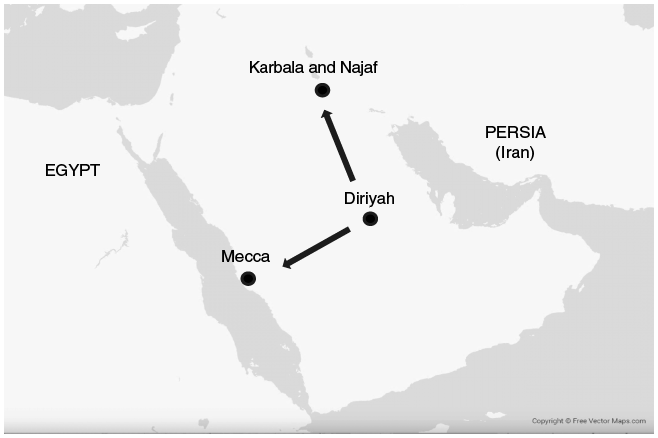
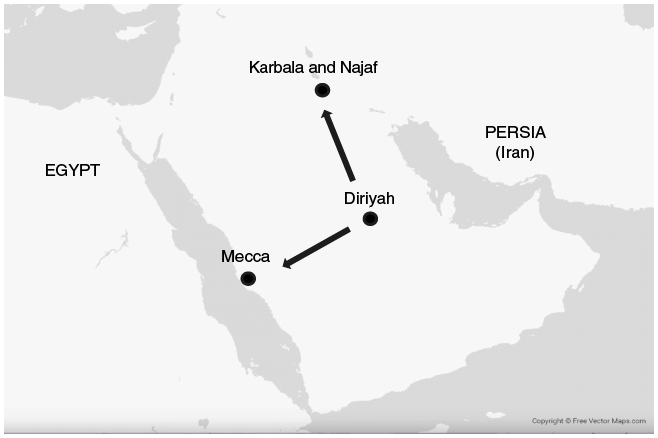
In 1744, Ibn Abd al-Wahhab formed an alliance with a local tribal chief, Muhammad ibn Saud of Diriyah (1687–1765), bringing into being a small armed NRM. This launched a jihad against neighboring tribes, whose Islam Ibn Abd al-Wahhab considered so far from monotheism that it made them non-Muslims, even though they themselves self-identified as Muslim. This jihad grew, continuing after the death of its two founders to recruit ever more followers and to attack further and further away from Diriyah, finally reaching the great Shi‘i shrine cities of Najaf and Karbala to the north in 1802, and then the holiest city of Islam, Mecca, to the west, in 1806 (see Figure 5). At this point the Wahhabis were fighting not just local tribes but the Ottoman Empire itself, since Iraq was then part of the Empire and Mecca was one of the Empire’s most prized possessions. By 1818 an army under Ottoman orders had, it thought, destroyed the Wahhabs, executing their leaders and destroying their capital at Diriyah (Bunzel Reference Bunzel2023, 201–20, 224–6).
Diriyah and surroundings;
The Wahhabis began unnoticed in a peripheral and sparsely populated desert region, but ended up as the most dramatic Islamic NRM for many centuries. The mystery is why this particular movement should start in 1742. It can hardly be explained in terms of European expansion or defensive modernization, as there is no indication that Ibn Abd al-Wahhab ever met a European. The first contact of the Wahhabis with modernization was with the superior armament and training of the Ottoman troops that destroyed the movement in 1818. There was no new political upheaval or economic distress (so far as we know) to explain the start of the movement. The works of Ibn Taymiyya had been around for centuries, and had only once before inspired a major NRM, the Kadızadeli movement.
What is less of a mystery is why, once started, the Wahhabi movement was such a success. Intertribal conflict is pervasive in tribal societies like the that of Najd, and in such circumstances the idea that one’s own group was fighting a jihad, not just another battle with the neighbors, had a strong impact; it also served as an excellent basis for tribal alliances. The tribesmen in question were relatively easy to convince of the rightness of the Wahhabi mission, given that they were almost all illiterate, and were in no position to critically evaluate the claims of Ibn Abd al-Wahhab. There were few ulama in the area to help them; ulama are more plentiful in urban centers than on the peripheries.
Although the Ottomans thought in 1818 that they had destroyed Wahhabism, they were wrong. It survived in relative obscurity during the rest of the century, and re-emerged in 1902. In the 1920s it again expanded to the west, taking Mecca for a second time in 1924. This time there was no Ottoman Empire to stop it, and the dominant power in the area, the British, had been persuaded in advance to acquiesce. After adding some more territories, the Wahhabi realm was organized into the Kingdom of Saudi Arabia in 1932. Saudi Arabia for many years maintained as its state religion a somewhat liberalized version of Wahhabism, which accepted the Hanbali madhhab and did not regard non-Wahhabi Muslims as non-Muslims. It was further liberalized by a series of reforms starting in 2017.
Other Jihads
Several other jihadi movements, rather than condemning Sufi practices as the Wahhabis did, had Sufi origins. During the Russian conquest of Chechnya and Daghestan in the North Caucasus that began in 1817, opposition was led by Muhammad ibn Ismail (d. 1832) and then by Shamil (1797–1871), both of whom were shaykhs of the Naqshbandi tariqa. Their jihad lasted from 1829 to 1859 (Zelkina Reference Zelkina2002). In Algeria, resistance to the French occupation that started in 1830 was led by Abd al-Qadir ibn Muhyi al-Din (1808–1883), a Qadiri Sufi, who fought the French from 1832 until 1842 (Brower Reference 77Brower2011). In western China, during a period of general disorder that saw a number of ethnic and religious conflicts and much brutality on the part of the Qing dynasty, the most important leader of the Dungan Revolt (1862–1877) against the Qing was Ma Hualong (d. 1871), shaykh of the Jahriyya, a Chinese Sufi order derived from the Naqshbandiyya (Kim Reference Kim2004).
Later in the century, a jihad against the “Turkish” occupation of Sudan (technically Ottoman, but in fact Egyptian) in 1881 was led by Muhammad Ahmad ibn Abdullah (1843–1885) of the Samaniyya tariqa, who proclaimed himself the Mahdi, with the result that his followers were called the Mahdists. His successor Abdallahi ibn Muhammad (1846–1899) ruled Sudan until defeated by a joint British-Egyptian force between and 1896 and 1898 (Searcy Reference Searcy2010). Muhammad ibn Abdallah Hassan (1856–1920), a Sufi of the Salihiyya tariqa, likewise led a jihad against the British in Somalia between 1899 and 1920 (Lewis Reference Lewis1988, 63–91). Sayyid Muhammad ibn Ali al-Idrisi (1876–1924), an Ahmadi Sufi, led a jihad against the Ottomans in Asir, then in northwest Yemen, between 1906 and 1917; the Emirate of Asir that he established survived until 1934, when it was annexed by Saudi Arabia (Bang Reference Bang1996). Ahmed al-Sharif al-Senussi (1873–1933), a Sanusi Sufi, led a jihad against the Italians in Libya from 1912 until his defeat by the Italians’ British allies in 1916 during the First World War (Evans-Pritchard Reference Evans-Pritchard1954, 104–33).
All of these jihads save that of Muhammad ibn Ali al-Idrisi ultimately failed militarily, given that their opponents had modern armies with modern weapons, and they did not. At the Battle of Omdurman that ended the Mahdist State in Sudan, the British used the world’s first fully automatic machine gun (the Maxim gun). Some 11,000 Mahdists were killed, while the British lost only 48 men (Gordon Reference Gordon2019). The Ottoman army that Muhammad ibn Ali al-Idrisi successfully defeated was less modern than the Russian, French, and British armies, and he had the advantage of mountainous terrain. After the loss of Libya by Italy during the Second World War, however, al-Senussi’s cousin Idris (1890–1983) was appointed king of Libya by the United Nations, and reigned until the 1969 coup led by Muammar Gaddafi (d. 2011).
These military-religious movements are in most cases easy enough to explain. Foreign invasion generated resistance in the North Caucasus, Algeria, Sudan, and Somalia. In the absence of any political state, that resistance, which was restorationist as well as anti-foreign, was organized as a jihad, led by a figure with religious legitimacy, namely a Sufi shaykh. The Russian, French, and British invaders were clearly non-Muslim. The Egyptians were not, but were often working in conjunction with the British, and had created considerable disruption through their attempts to stop the slave trade, allowed under the Sharia but not by the British. In western China, there had been no recent invasion, but the Qing were certainly non-Muslim, and the general disorder of the times was quite as disruptive as any invasion. This chaos included the Taiping Rebellion (1850–1864), which involved not Muslims but an NRM of Christian origin and led to millions of deaths (as did the Dungan Revolt).
Asir had not been invaded by anyone but had been part of the Ottoman empire since 1517. Ottoman control had generally been light, however, and sometimes nonexistent, until the modernizing Ottoman state started trying to bring Yemen (including Asir) under central control in 1872. This involved an attempt to raise taxes and, after 1877, to implement the new Ottoman law code (the mejelle) in place of the Sharia. This was close to an occupation, and thus generated a rebellion in Yemen proper.
Another exception is that Muhammad Ahmad in Sudan declared himself to be the Mahdi, which none of the other leaders of the time did. As such, he went beyond calling for tawhid to make modifications to the Sharia and formally abolished all tariqas in the territories under his control, replacing them with a quasi-tariqa of his own. As a self-declared Mahdi, his movement is the prime example of Haddad and Smith’s millenarian groups (Reference Haddad and Smith1993, 9). Millenarianism, however, is not a general characteristic of the NRMs of this period: What was general was severe disruption resulting from invasion, migration, disorder, or modernization.
Liberal NRMs
Early modernity in the major centers of the Muslim world had dramatic consequences for the ulama, especially the Sunni ulama. Reform programs promoting modernization deliberately ended their monopoly over education and the law, establishing parallel institutions – secular schools and courts that judged according to secular law codes – that followed Western models. The ulama monopoly over intellectual life was lost along with their monopoly over education, as people who were not religious authorities (ulama) began to read, and also to write – not commentaries on the exegesis of the Quran, but articles in newspapers and even fiction. With the ulama’s loss of their dominion over intellectual life came the end of the authority of the consensus of the ulama that had restrained both religious innovation and the coming into being of Sunni NRMs for almost a thousand years.
New ideas came fast. Elites learned to read French or English and encountered the ideas of the Enlightenment and nineteenth-century works on history, sociology, and natural science. Others read newspaper articles written by local journalists, who in some cases simply translated articles from the European press. Older ideas, however, remained dominant among most of the people, as only a minority went to the new schools. Literacy in Egypt was around 4 percent in 1897 (Yousef Reference Yousef2016, 19), and between 5 and 15 percent in Turkey in 1914 (Georgeon Reference Georgeon1995, 171–3). Modernization was very uneven, affecting men and urban elites far more than women and the rural population.
For those who experienced them, these structural and intellectual changes resulted in what was, in effect, a reformation. It has often been said by Westerners that what Islam needs is a reformation: in the view of some, the reformation has already happened. It gave rise to a number of NRMs.
The German social theorist Peter Wagner (Reference Wagner1994) has identified three phases of modernity, which he called “restricted liberal modernity,” “organized modernity,” and “extended liberal modernity.” Restricted liberal modernity was “the heyday of liberal ideology, with the bourgeoisie in the ascendancy,” and was restricted in the sense that it did not extend beyond the bourgeoisie. It was succeeded by organized modernity, during which modernity spread more widely and included, most importantly, the workers. Finally came extended liberal modernity, when “under conditions of the full inclusion of all members of society, the organizing and disciplining institutions are dismantled and respective practices relaxed” (Wagner Reference Wagner1994, 16–8). Wagner’s description of the third phase is somewhat utopian.
These phases can also be found, in one way or another, in the Muslim world, and Wagner’s periodization will be used below. The term “liberal” was used in the title of a classic book on the first period, Arabic Thought in the Liberal Age, 1798–1939 by the Lebanese-British historian Albert Hourani (Reference Hourani1962), and so will be used to describe the NRMs belonging in Wagner’s first phase. What Wagner calls “organized” modernity is more often called “mass” modernity, the term that will be used here. “Extended” modernity is called “late” modernity, a less utopian term that will be used instead.
Liberal modernity was about bourgeois intellectuals and the printing press, and the two NRMs of the liberal age discussed in the following subsections were both founded by influential men who aimed to reform Islam to equip it for the modern age. They wrote mostly for the modernizing elites, from whom they attracted their support. They are often labeled “modernists.” Their reformed Islam was hybrid, incorporating not practices and theology from non-Islamic religion, but from liberal modern Western thought. They also attracted the opposition of the traditional ulama, which saw their reforms as close to kufr (disbelief) and often saw their proponents as actual disbelievers. They had little impact on the masses, whom they did not address.
These reformers also drew on earlier Islamic thought. It is tempting, but wrong, to exaggerate the extent to which the arrival of European modernity constitutes a break in the history of Islam (Brown Reference Brown1996, 2–6). The arrival of European modernity, however, was what caused a new crop of NRMs of a variety never seen before. Two are discussed in this Element. A third notable one, the Ahmadiyya, is not discussed.
Sir Syed Ahmad Khan and the Aligarh Movement
The earliest notable liberal reformer of Sunni Islam was Syed Ahmad Khan (1817–1898), a South Asian whose title Syed marked both descent from the Prophet and aristocratic birth. He was born into a family of courtiers at the Moghul court, once the seat of power of the Muslim rulers of India, by then surviving in largely ceremonial form in British-occupied India. As a young man he became part of the British imperial administration, working as a magistrate. He entered public life in the aftermath of a general uprising against the British that started in 1857 and was put down with considerable force. During this uprising Syed Ahmad remained loyal to the British. After it, he started a major study of the Christian Bible that culminated in a three-volume Commentary on the Bible. In one volume, he took the Gospel of Matthew verse by verse, interpreting it in terms acceptable to both Christians and Muslims, attempting to show that the messages of the Bible and the Quran were fundamentally the same (Graham Reference Graham1974 [1885], 48). This is a prime example of Haddad and Smith’s “universalism,” the idea that all religions are in fundamental agreement with each other and therefore universally valid. Syed Ahmad’s own practice was also modernist: wearing “modern” (Turkish-style) headwear, eating chicken slaughtered by non-Muslims, and using a European-style table and chairs at home. He always stressed the importance of loyalty to the British crown.
Syed Ahmad’s own education was traditional, but he absorbed modern ideas, including specifically Protestant ones, from the British with whom he was in contact. He spent seventeen months in England between 1869 and 1870, accompanied by two of his sons, who knew English and interpreted for him (Lelyveld Reference 80Lelyveld1978, 104–5). This is where his interest began to focus on religion (Lelyveld Reference Lelyveld, Saikia and Raisur Rahman2019, 75). His initial interest had been in social reform, he wrote, but he found that social questions were inseparable from religious ones. India, he thought, needed a Luther to help the Muslims rediscover original, pure Islam (Siddiqi Reference 82Siddiqi1967, 289–90). On the face of it, Syed Ahmad was declaring himself a restorationist, but his restorationism was very different from that of Ibn Taymiyya or Muhammad ibn Abd al-Wahab. While they sought a pure Islam in the Quran and hadith, Syed Ahmad imagined it on the basis of his conversations with Protestant missionaries, what he had seen in England, and an independent reading of the Quran, downplaying the authority of the consensus of the ulama, which he did not regard as binding (Siddiqi Reference 82Siddiqi1967, 291–3). This approach allowed a reformer considerable latitude, since disregarding the ulama meant that almost any question could be reopened. Downgrading the authority of the hadith removed the basis of many well-established conclusions. In general, the Quran sets out broad principles, and the hadith provide the details.
Syed Ahmad then went one step further, distinguishing religion, which he restricted to beliefs and worship, from worldly affairs (including politics), over which he allowed Islam no jurisdiction (Siddiqi Reference 82Siddiqi1967, 294–7).
The relationship between science and religion was one of the major issues of the nineteenth century, for Western Christians as well as those Muslims who became aware of it. Syed Ahmad’s position was that, “if there is some apparent contradiction, then the work of God [nature] is always before us, and we cannot deny it. In this case the word of God [the Quran] will be proved false which is impossible and, therefore, the two must be in conformity with each other” (cited in Siddiqi Reference 82Siddiqi1967, 300). Our understanding of the Quran, then, must be adjusted to agree with what science tells us about nature. In practice, Syed Ahmad worked hard to provide naturalistic explanations of miracles reported in the Quran. He presented angels, demons, heaven, and hell as metaphorical (Lelyveld Reference 80Lelyveld1978, 110, 130–1).
Syed Ahmad was not only a reformist writer but also the leader of what became known as the Aligarh Movement, named after the city near Delhi where he established an “Anglo-Oriental College” to provide a high-quality English-style education to the Indian elites.
The views of Syed Ahmad may perhaps not seem very radical today, but they were radical at the time. His movement was an NRM because he was rejecting the dominant religious community as unacceptable, and his theology was remarkably inventive and hybrid.
Muhammad Abduh and the Renaissance
A second notable liberal reformer of Sunni Islam was Muhammad Abduh (1849–1905), the Egyptian counterpart to Syed Ahmad, who followed Syed Ahmad in many ways but was more influential in the Arab world, if only because he wrote in Arabic. Muhammad Abduh came from a rural rather than a court background, but soon made his way into elite circles after completing a conventional ulama education in Cairo at al-Azhar, Egypt’s venerable center of Islamic scholarship. In addition to this, he was introduced to a range of nonstandard ideas by an Iranian political activist, Jamal al-Din al-Afghani (1838–1897), who moved to Cairo after being expelled from Turkey. For some time Abduh worked as a journalist, following al-Afghani’s progressive, constitutionalist, and anti-imperialist politics, which were as modern as Syed Ahmad’s had been, but very different in their orientation. Al-Afghani never showed loyalty to any monarch or government, Muslim or European. These politics led to Abduh’s own exile from Egypt, initially to Lebanon (Sedgwick Reference Sedgwick2009).
In Lebanon, Abduh taught religion at an experimental school that had been established to combine modern education – until then offered mostly by Christian missionary schools – to Muslims. His lectures from this period were later published as a book, and the influence of the French liberal historian François Guizot (1787–1874), whose Brief History of Civilization in Europe (1828) is visible. Guizot traced the decline of civilization after the end of the classical age, the triumph of unreason under Catholic obscurantism, and the recovery from the Middle Ages through the Renaissance and the triumph of reason in the Enlightenment. Abduh applied this framework to the history of Islam, which he understood as an originally rational religion that had been corrupted by obscurantists and needed to be rescued from its own dark ages by the growth of reason (Sedgwick Reference Sedgwick2009). Abduh’s line on science and religion was the same as that of Syed Ahmad.
After leaving Lebanon for Paris, then the preeminent home of reason (and anticlericalism), Abduh abandoned his earlier radicalism and returned to Egypt, where he made his peace with the government and worked as a judge. He then served as a member of a government commission investigating al-Azhar, and finally as the government appointee to the highest religious authority in the country, with the title Mufti of the Egyptian Realm (Scharbrodt Reference Scharbrodt2022). This post, for which he was partly qualified by his early training if not by his subsequent career, made him the preeminent alim in the Arab Sunni world.
As Mufti, Abduh promoted his liberal and rationalist understanding of Islam, which was well received in reformist circles – the audience for which it was intended – and very unpopular among most of the ulama. Abduh was finally forced to resign from most of his positions in 1905, after criticism by conservatives to which he was laid open after losing the support of the monarch for political reasons. Already ill, he died soon afterward (Sedgwick Reference Sedgwick2009).
Abduh never established a formal organization of any sort, but he had many followers and admirers, who together constituted an informal movement that they called the Nahda (Renaissance). One member of this was Qasim Amin (1863–1908), a jurist who had studied in France, and who in 1899 published a revolutionary work on The Liberation of Women (Tahrir al-mar’a). Another, later member was Ali Abdel Raziq (1888–1966), whose Islam and the Principles of Governance (Al-Islam wa-usul al-hukm, 1925) advanced the argument that Islam, as a religion, had no role to play in government or politics (Scharbrodt Reference Scharbrodt2022, 224–9), the same argument that had been made in India by Syed Ahmad.
One of the most important younger members of Abduh’s circle was Rashid Rida (1865–1935), a Syrian journalist who moved to Egypt to avoid strict Ottoman censorship and launched a newspaper called The Lighthouse (al-Manar) that aligned itself closely with Abduh, printing many of his writings. Rida agreed with Abduh’s reformism, but not with his politics. Abduh admired Europe, where he went for his summer vacations. Rida did not like Europe and traveled there only once. Abduh died at the height of European power, but Rida lived through the beginning of the end of European power during the First World War. After the fall of the Ottoman Empire, he returned to his native Syria, then newly independent, and turned to politics, becoming President of the Syrian National Congress. When France invaded in 1920 and ended Syrian independence, Rida returned to Egypt, his politics ever more anti-European and nationalist. The late Rida, who had his own circle, was no longer really part of Abduh’s movement.
Conclusion
Both types of early modern NRM can, in general, be explained by European imperialism, to which reactions differed markedly depending on geography. A defensive jihadi response seemed to make sense on the peripheries of the Muslim world, even though in the end the only jihad that actually prevailed was in Asir, which succeeded in excluding modernizing Ottoman influences until it was absorbed by Saudi Arabia. In all other cases, European military might won out in the end. In Egypt and in India, prior experience had made it clear that resistance to the British was hopeless, and two liberal NRMs developed as part of the reformist response to this experience.
The big exception is the Wahhabis. They do not fit the general pattern. They were closer to Ibn Tumart than to the peripheral jihads or to Muhammad Abduh. Even if there is a general pattern, this does not mean that all NRMs in a particular period will fit it.
4 The Mass Age
The jihadi NRMs of early modernity were peripheral and, in many ways, the last gasp of a bygone age. The liberal NRMs of the urban centers heralded a new age, however, that of the next stage of modernity: mass modernity. In both the West and the Muslim world, the “masses” of mass modernity were the fruit of urbanization and industrialization. The lower middle classes and industrial workers in Europe were organized into labor unions and, in some countries, into mass political organizations like the Communist Party or the various nationalist parties inspired by Italian Fascism (black shirts), including the German Nazi Party (brown shirts). They were addressed by mass media, large-circulation newspapers written in a simpler style than those of the liberal age, and radio, which became widespread in Europe during the 1920s.
Industrialization in the Muslim world happened later than in the West, but in the period between the two world wars, there were more and more Muslims who approximated the European masses. There were middle-ranking and junior government employees, students, and a small industrial working class. They were targeted by local Communist parties, established in Egypt in 1922, in Syria and Lebanon in 1924, and in Iraq in 1934. Turkey was somewhat different, as a Communist Party of Turkey was founded in Soviet-controlled Baku in September 1920, but was banned in Turkey in 1925, and never made much progress. Muslim urban masses were also targeted by fascist-inspired parties: the Syrian Social Nationalist Party (armbands, 1932), Young Egypt (green shirts, 1933), the Wafdist Vanguard, also in Egypt (blue shirts, 1935), Futuwwa Youth Movement in Iraq (mostly khaki shirts, 1935), and the Phalange in Lebanon (black shirts, 1936). In Turkey, the ruling Republican People’s Party was not exactly fascist, but was the basis of an authoritarian one-party state with an ideology that resembled fascism. As a ruling party, it worked to mobilize the masses, not to attract them.
It was against this background that there emerged mass-oriented NRMs in Egypt, Turkey, India, and the United States. All attempted to achieve their socioreligious aims by means of building large, organized memberships. All were NRMs that came into conflict with the dominant religious community, the host society, or political authority. Some were also restorationist and defensive, but their mass nature is what really distinguishes them. We will consider the Egyptian, Turkish, and US movements, all of which are estimated to have gathered about two million followers each.
The Muslim Brotherhood in Egypt
The single most important Islamic NRM of mass modernity was the Muslim Brotherhood (in full, the Society of the Muslim Brothers), founded in Egypt in 1928 but first prominent on the national scene after 1932. Unlike any other preceding Islamic movement, it was carefully organized after fascist and communist models, and combined Islam with social and political objectives. Despite periods of severe repression, it has proved robust and successful. Groups inspired by it were established elsewhere in the Arab world in the 1930s, with organizations modeled on it, and often named after it, becoming more and more popular everywhere after 1945. The Muslim Brotherhood as it exists today differs in many ways from that of 1932; if it had not adjusted to fit the times, it would hardly have survived for almost a century. It also differs today from country to country, reflecting different local circumstances. It is no longer one centralized organization, but more of a franchise, a basic model that is developed locally. What is called “political Islam” or “Islamism” takes many forms, but all of them owe something to the original Egyptian Muslim Brotherhood.
The founder of the Muslim Brotherhood, Hassan al-Banna (1906–1949), was a provincial primary school teacher, not a member of the elite like Syed Ahmad Khan or Muhammad Abduh, or a member of the ulama. He was a Sufi of the Hasafi tariqa, and his first venture into Islamic activism was as secretary of the Hasafi Charity Society, the purpose of which was to teach ethical character and to oppose Christian missionaries (Houston Reference Houston2018).
Al-Banna was, like almost everyone in Egypt at that time, opposed to the British, who remained present and influential despite Egypt’s formal independence. He was also opposed to the secularization and cultural Westernization that had accompanied modernization and British control. He aimed to restore Egypt and the wider Muslim world to the straight path of Islam, including observance of the Sharia. He was not a restorationist; however, as he did not focus on the Quran and hadith. Nor was he a liberal reformer. His inspiration was Rashid Rida more than Muhammad Abduh.
Al-Banna’s vision for the Brotherhood was that its members should be “monks by night, knights by day,” a phrase sometimes applied to the companions of the Prophet. The training of the Brothers was thus partly spiritual, following Sufi precedent, and partly practical, following various models, including military training and ideals of self-help. The Sufi origin of the Brotherhood’s spiritual practice was at first openly acknowledged, but as new members began to echo Wahhabi and modernist condemnations of Sufism, these origins were first forgotten and then actively denied. The practices, however, remained, including vigils, particular prayers, and periodic self-examination, an ancient Sufi practice that the Brotherhood modernized by distributing printed forms (Elsässer Reference Elsässer2019).
Any organization that aims to bring about fundamental change faces a strategic choice between a top-down and bottom-up approach. The European socialist movement had faced this choice. Although everyone agreed on the importance of the grassroots work of organizing labor and raising proletarian class consciousness, in the end the socialist movement split between the top-down approach of the Bolsheviks and the bottom-up approach of the Social Democrats. The Bolsheviks seized power in Russia in the October Revolution of 1917. The Social Democrats built labor unions and political parties and came to power in many European countries by electoral means. Hassan al-Banna, at least at first, took the bottom-up approach, organizing local branches of the Brotherhood that focused on spiritual and practical development. This is what makes the Brotherhood a religious movement, not a purely political one. It also made the Brotherhood a robust organization in the face of persecution. It is easier to destroy a purely political group than a religious one.
The political activities of the Brotherhood took many forms over the first twenty years of its existence. In the 1930s, it was a pressure group, publishing a newspaper and sending open letters to politicians. In 1942, it tried presenting candidates for parliament, but multiple obstacles were put in its way and none were elected. There were discussions with disaffected army officers, indicating interest in participation in a military coup. Finally, one section of the Brotherhood, the so-called “special section,” collected arms, which were not hard to find in Egypt in the aftermath of the Second World War (Lia Reference Lia1989).
Egyptian politics during the late 1940s and 1950s resulted in the transformation of the Brotherhood from Egypt’s leading mass organization into a persecuted remnant. In 1948, violence erupted between the Brotherhood and the Egyptian state, culminating in the banning of the Brotherhood by Prime Minister Nokrashy (1888–1948), the assassination of Nokrashy by the Brotherhood in December 1948, and the assassination of al-Banna in February 1949 by persons unknown, probably from Egyptian state security. Al-Banna was succeeded by a respected judge who had previously been a sympathizer rather than a member of the Brotherhood, Hassan al-Hudaybi (1891–1973), in an attempt to clean up the Brotherhood’s image after these violent events.
Then, in 1952, a military coup installed a group of “Free Officers” as Egypt’s new government. The king was exiled, parliament was suspended, and political parties, including the Communist Party, banned, but the Brotherhood was not banned, as several of the Free Officers had previously had good relations with al-Banna and other Brothers. A power struggle developed between General Muhammad Naguib (1901–1984), the new president, who was allied with the Brotherhood, and Colonel Gamal Abdel Nasser (1918–1970), one of the main leaders of the coup, who was not. The triumph of Nasser in 1954 saw General Naguib placed under house arrest and the senior members of the Brotherhood jailed. Most were tortured, some were executed, and the first phase in the history of the Brotherhood ended. What had started with the Brotherhood rejecting the dominant religious community and the host society ended with a new political authority rejecting the Brotherhood using the powers of a modern authoritarian state.
The next phase in the history of the Brotherhood took place mostly outside Egypt, as Brothers who had fled abroad established or supported comparable movements elsewhere. In Egypt, a more radical version of al-Banna’s vision was developed by a younger Brother, Sayyid Qutb (1906–1966), who argued for the top-down approach, for Islamists as a “vanguard” to establish an Islamic state. The original grassroots approach of al-Banna was followed by many, however, and Muslim Brothers today are busy organizing schools and health clinics for the poor, and practicing the Sufi-derived spiritual exercises that al-Banna borrowed from the Hasafiyya and other tariqas as part of its general education or training program (Elsässer Reference Elsässer2019, Reference Elsässer2021). After the death of Nasser, repression in Egypt was relaxed, and after the fall of President Hosni Mubarak in 2011, a Brotherhood candidate was elected president – only to be toppled by another military coup in 2013.
Nurcus and the Gülen Movement
A comparable NRM was established in the very special circumstances of the early Turkish Republic. The once mighty, multi-ethnic, Islamically legitimized Ottoman Empire had been losing territory for centuries before it entered the First World War on the German side, and consequently lost both the war and its Arab territories. The leaders of the Turkish Republic that emerged out of its ruins aimed to replace the old imperial model with an ethnically homogeneous nation-state inspired by the leading European models of the time, above all the French republic. This meant, among other things, restricting religion to the private sphere by eliminating Islam from the public sphere, bringing mosques and preachers under tight government control, and abolishing the Sufi tariqas and seizing their assets. The early Turkish republican conception of secularism overlapped with anticlericalism and even atheism.
The Nurcus
One of those who resisted this forced secularization was Said Nursi (d. 1960), a Kurdish alim who had made a name for himself in the early Turkish Republic, which he supported during the War of Independence, and as a result of his distinguished military service during the First World War (Vahide Reference Vahide2005, 131–3). He changed his position as the republic became more secular, never rejecting it in principle, but calling for the central place of Islam and the Sharia to be restored (Yavuz Reference Yavuz1999, 587–9; Vahide Reference Vahide2005).
Nursi became widely known for his Messages of Light (Risale i-nur), a collection of texts written over several decades. He was admired for his endurance under multiple persecutions and imprisonments visited on him and his followers by the Turkish authorities (Vahide Reference Vahide2005, 215–7), who doubted his loyalty to the republic and wanted to stop circulation of his Messages. Printing the Messages was not allowed until 1957, when the militant secularism of the early republic moderated somewhat (Vahide Reference Vahide2005, 322).
The contents of the Messages were mostly the Sunni Islam that Nursi had learned as a young man. To this he added a condemnation of modern secularism, nationalism, loss of belief, and Bolshevism. His mission was to rescue Muslims from doubt, and to this end he also discussed the relationship between Islam and natural science (Yavuz Reference Yavuz1999, 591–2; Vahide Reference Vahide2005, 192–4). The discoveries of natural science had been used in Turkey, as in Europe, during the nineteenth century as an argument against the revealed truths of religion. Nursi’s Messages were very popular among wide swaths of the Turkish population. Their positions would have been unremarkable in most of the Arab world; it was the move of the Turkish state away from Sunni Islam toward secularism that made them seem radical.
The Messages survived and spread because Nursi’s followers made copies by hand (Yavuz Reference Yavuz1999, 589). In the more liberal atmosphere of the 1950s, the number of followers grew, including many university students, and hundreds of study centers were established, first in Istanbul and then around Turkey (Vahide Reference Vahide2005, 309, 322, 330). The Nurcus, as the followers of Nursi were called, resembled the Muslim Brotherhood in their national coverage, use of local groups, and size, though they had no overt political mission.
Unlike the Brotherhood, and unlike any other NRM we have considered so far, the Nurcus did not reject the dominant religious community. They rejected a new political and social order and were in turn rejected by political authority. The age of mass modernity was also an age of strong states.
The Gülen Movement
One of Nursi’s followers was Fethullah Gülen (1921–2024) (Tee Reference Tee, Upal and Cusack2021, 89), an alim. His organizational model was different from the Nurcus, as his study centers focused not only on the Messages but also on providing after-school tutoring to high school students, delivered by university students. Adherence to the movement was not explicit as the price of admission to the tutoring, but tutoring proved an excellent means of recruitment, and many of yesterday’s high school students became Gülen followers and tomorrow’s tutors (Tee Reference Tee, Upal and Cusack2021, 89–90, 94–6). After some years, Gülen added private schools and boarding houses to the tutoring centers. These included personal tutors who focused on moral and religious development as well as regular school classes. All accounts suggest meticulous organization. Then came a newspaper and a television station (Sunier Reference Sunier2024, 112). Finally, the movement started founding its own universities. The objective of all this educational activity was to raise a “golden generation” of well-trained Muslims who might transform society (Sunier Reference Sunier2024, 105, 117).
In addition to these institutions, Gülen’s movement, later called Hizmet (service, Turkish), adopted a weekly social and devotional practice, the sohbet (community meeting, Turkish), similar to the Nurcu meetings. This was both an educational and ritual activity (Sunier Reference Sunier2024, 103). Hizmet’s teachings were based on an interpretation of Sunni Islam developed by Nursi and refined by Gülen, notably with the addition of themes on love derived from Sufism (Tee Reference Tee, Upal and Cusack2021, 90–2).
As the Gülen movement grew, it developed political and business connections. It became allied with Turkey’s Islamist movement and its leader, Recep Tayyip Erdoğan (b. 1954). Gülen and Erdoğan shared the objective of re-Islamizing Turkish society, much as Nursi had, but by building a golden generation in the case of Gülen, and through the ballot box in the case of Erdoğan. Gülen’s followers were told to vote for Erdoğan, and Gülen provided “a loyal support base scattered throughout the civil service, the police force and the judiciary” (Tee Reference Tee, Upal and Cusack2021, 100). When Erdoğan, as president of Turkey, moved to purge secularist opponents within the Turkish state and army, Gülen-affiliated prosecutors facilitated this, probably manufacturing evidence in the process (Tee Reference Tee, Upal and Cusack2021, 100–1).
The details of the movement’s business connections are less clear. It seems that what started with financial assistance from religious businessmen who approved of Gülen’s ideas and the Gülen movement’s activities (Tee Reference Tee, Upal and Cusack2021, 96–7) developed into a trust-based business network. As the network grew, so did financial contributions to the movement. As the movement grew better connected, richer, and larger, it began to expand internationally (Tee Reference Tee, Upal and Cusack2021, 99–100). One direction of expansion was into Central Asia, and another was the West, especially Germany and the Netherlands with their large Turkish minorities, but also the United States, where Gülen moved in 1999 (Sunier Reference Sunier2024, 112). Gülen schools were established across America, and in many European countries as well (Sunier Reference Sunier2024, 106–7, 114).
The Gülen movement’s extraordinary success was the origin of its downfall. There were Gülen followers everywhere, which is what had originally made Gülen so useful for Erdoğan, but also made him dangerous. Relations between Erdoğan and Gülen deteriorated (Tee Reference Tee, Upal and Cusack2021, 102–3). Hizmet was increasingly rejected by political authority. In 2016, a poorly planned military coup against Erdoğan’s government was attempted, and failed. Rightly or wrongly, Erdoğan blamed the Gülen movement; it is hard to say, as coups are by their nature secret operations that leave no paper trail. The Turkish government mounted an operation to destroy the Gülen movement, imprisoning leading members, firing public employees and teachers, and closing schools and universities. Diplomatic pressure was brought on other countries to eliminate the movement in their territory, and at least some complied (Tee Reference Tee, Upal and Cusack2021, 86, 104). Before the movement could recover, Gülen died in 2024, at the age of 83. The movement he created still exists. Whether it will survive and grow or wither and fade remains to be seen.
The Nation of Islam in the United States
Also in the interwar period during which the Brotherhood and the Nurcus developed, but against a very different background, the Nation of Islam emerged, a US-based NRM that aimed at building a mass membership among Black Americans. It was initially very different theologically from Sunni or Shi’i Islam, to the extent that one might ask to what extent it makes sense to call it “Islamic” at all. The originality of its beliefs and activities makes it an NRM, as do subsequent tensions. As time passed, however, it grew closer to Sunni Islam, which is why it is included in this Element.
In the early twentieth century, there were several attempts to form mass movements among Black Americans, including the National Association for the Advancement of Colored People (founded in 1909), which focused on rights and representation, and the Universal Negro Improvement Association (founded in 1916), which understood Black Americans as members of an African nation.
The Moorish Science Temple, founded in Chicago in the 1920s by Drew Ali (1886–1929, formerly T. Drew), went one step further. It identified Black Americans not only as members of a nation that was different from that of white Americans, but also as followers of a religion that was different from that of (most) white Americans: Islam. Black Americans do indeed often have Muslim ancestry, as many of the enslaved people from whom they are descended were taken from areas of West Africa where there were many Muslims. According to Drew Ali’s The Holy Koran of the Moorish Holy Temple of Science (Reference Drew1927), Black Americans were Moors, descended from Moroccans, who were themselves originally from Canaan (the Levant), and had founded Mecca and were the people of Jesus. Drew Ali identified himself as a prophet sent to summon the “Asiatics” of America to repent from sin and return to Islam before the final days (Drew Ali Reference Drew1927, 56–80). The Noble Prophet Drew Ali’s The Holy Koran had nothing in common with the standard Quran, consisting mostly of an imaginative alternative life of Jesus taken from an Aquarian Gospel (Dowling Reference Dowling1907/1911) to which was appended a list of recommendations for good living taken from a neo-Rosicrucian book of instructions for good living (Ramatherio [pseud.] Reference Ramatherio1925/1954) (Nance Reference Nance2002).
After Drew Ali’s death, his message was carried further by Wallace Fard Muhammad (active 1912–1934), who founded the “Nation of Islam” in 1930. This became a large mass movement in the 1950s and 1960s. Its original message, following closely on Drew Ali, was strong on sacred history and weak on formal theology. The theology it did have included the One God, Allah, but rather than moving from God to the Prophet Muhammad as mainstream Islam does, it held Wallace Fard Muhammad to be Allah, and his successor Elijah Muhammad (1897–1975, formerly Robert Poole) to be Fard’s prophet.
The sacred history told by the Nation of Islam borrowed the idea of the twelve tribes of Israel from the Bible, adding a thirteenth tribe that was marooned on the moon and therefore died out, leaving twelve tribes on earth. All of these were Black. A scientist called Yakub then created white men, evil and violent, who tricked Black men into obeying them, partly through the invention of Christianity (Curtis Reference Curtis IV2002, 179).
The salvation offered by the Nation of Islam was primarily this-worldly: emancipation from the evil white race and the recovery by the Black race of its original position of superiority. In the short term, the Nation of Islam offered its followers a disciplined lifestyle, free from alcohol, drugs, tobacco, music, and casual sex, stressing the family, industriousness, cleanliness, and dressing smartly (Curtis Reference Curtis IV2002, 174–7, 179). This way of living was a liberation from the degradation of Black Americans brought by generations of white oppression.
Nation of Islam evangelists originally preached to African Americans who knew nothing of Islam, which at that time had no significant presence in America. By the 1950s, however, as the Nation of Islam became increasing well known, some American Sunni Muslims began to criticize it. Its positions were becoming unacceptable to the growing Muslim community. Its Black nationalist positions were also rejected by much of its (white) host society.
Elijah Muhammad at first tried to bolster his Islamic credentials by going on the umra pilgrimage to Mecca with his sons. He published instructions on how to perform the salat that corresponded with Sunni practice except that the words of the salat were to be said in English (Curtis Reference Curtis IV2002, 182–3), not Arabic as is usual. Even so, salat were practiced little or not at all for many decades (Curtis Reference Curtis IV2002, n. 73, p. 194).
Over time, however, the Nation of Islam became closer to Sunni Islam, especially after the death of Elijah Muhammad. A senior and charismatic member, Malcolm X (1925–1965, formerly Malcolm Little, and later Malik el-Shabazz), gradually adopted mainstream Sunni Islam and became an outspoken critic of the Nation of Islam after performing the hajj in 1964. He also became internationally celebrated, welcomed by the Saudi Crown prince, honored by the President of Algeria, invited to speak at the Oxford Union and to join the government of Ghana (Assensoh and Alex-Assensoh Reference Assensoh and Alex-Assensoh2013). Shortly after his return to the United States, he was assassinated, possibly by members of the Nation of Islam loyal to Elijah Muhammad.
Despite this setback, the movement toward Sunni Islam continued. Warith Deen Mohammed (1933–2008), a son of Elijah Muhammad who took over the Nation of Islam after his father’s death, worked to transform it into a standard Sunni group. He founded the American Muslim Mission, which became the American Society of Muslims, a group dominated by African Americans practicing Sunni Islam. Not everyone followed Mohammed, however. Louis Farrakhan (b. 1933, formerly Louis Eugene Walcott) re-established the original Nation of Islam for these dissidents. Yet even this resurrected Nation grew closer and closer to Sunni Islam, and by the 2020s was performing Friday prayers that were hard to tell from Sunni practice. Nevertheless, the group retained aspects of the original Nation of Islam, including a tendency to quote from the Bible as well as the Quran (Nation of Islam 2025). A third cohort no longer belongs to either of the groups descended from the historical NRM and simply live and practice as ordinary Sunni Muslims. In addition, there are small groups derived from the Nation of Islam during the 1960s, notably the Moorish Orthodox Church of America and the Five-Percent Nation.
Conclusion
The three NRMs of the mass age that we have considered were all large movements that used innovative structures to organize a sizeable membership. They were also, to varying extents, nationalist movements with political importance. In Egypt, the Muslim Brotherhood recruited mostly middle- and lower-middle-class Muslims aiming at national revival and against the British occupier. It became so large and powerful that it was seen as a threat to the prerevolutionary and postrevolutionary governments, both of which banned and suppressed it. It inspired similar movements across the Arab world, and survived to see its candidate elected president of Egypt, before it was again banned and suppressed. In Turkey, the Nurcus recruited religious Muslims and aimed at an Islamic revival against the secularist republic. They survived persecution, and their successor, the Gülen movement, became so large and powerful that it was initially an invaluable support for the Erdoğan government and then a threat that was banned and suppressed. In the United States, the Nation of Islam recruited working-class Black Americans aiming at a national (Black) revival, becoming so large that it attracted much official and societal (white) resistance. It was neither banned nor suppressed, however, perhaps because in the end it was a minority within a minority, and so not seen a serious threat to majority society.
5 Sufism in the West
The Nation of Islam was not the only Islamic NRM to develop in the West. A number of Sufi-based NRMs also emerged, the culmination of a Western fascination with Sufism that started in the seventeenth century and took organized form under the new social and intellectual conditions created first by the First World War, and then again during the “New Age” that dawned in the later 1960s. They are NRMs not because they were rejected or in conflict, but because of their extreme novelty. They were, again, hybrid. The biggest Western Sufi group was the Naqshbandiyya, led by Nazim al-Haqqani (1922–2014, originally Mehmet Nâzım Âdil), a charismatic English-speaking Turkish-Cypriot shaykh, but this was close enough to standard Sufism, and paid enough attention to the Sunni Sharia, to be classed as a new Sufi tariqa, not an NRM. With occasional exceptions, Shaykh Nazim’s Naqshbandiyya was not especially hybrid.
The Early Sufis
Western readers of accounts of travels in the “Orient” became familiar with Sufism from the seventeenth century onward. Many were fascinated by the Neoplatonic element in Sufi theology, especially when progressive intellectuals began to look beyond the boundaries of Christianity after the Enlightenment. Translations of Sufi poetry were also popular, especially during the second half of the nineteenth century, when a loose translation of the Rubáiyát of Omar Khayyám took America by storm (Isani Reference Isani1977). There was disagreement about whether or not this was a Sufi work, but even so Sufism became known, and seen positively, among progressive circles in America and Europe.
Late nineteenth-century America provided fertile ground for NRMs. The best known are the Latter-day Saints (Mormons) (from the 1820s), the Theosophical Society (from 1875), and the Christian Scientists (from 1879). Less prominent but still interesting were the Missouri Platonists, who were in fact mostly Neoplatonists. They introduced articles about Sufism in their journal The Platonist and one of their members announced the foundation of a Sufic Circle in 1887 (Bowen Reference Bowen2015, 103–7). All these NRMs were closer to liberal modernity than to mass modernity. The Sufic Circle did not flourish; nothing more is heard of it. But later attempts at going beyond Sufi thought to Sufi action did succeed, resulting in several NRMs.
Inayat Khan
The first Sufi-based group to grow into a mature NRM was led by Inayat Khan (1882–1927), an Indian musician who attracted his first follower in San Francisco in 1911 while on a musical tour of America. He built up an NRM called the Sufi Order, and later the Sufi Movement, in London and Paris after the end of the First World War.
Inayat Khan called his movement “Sufi” rather than identifying it with any particular tariqa, even though he himself had followed a shaykh of the Chishti tariqa in India. The main difference between his movement and mainstream Sunni Sufism was its universalism. For Inayat Khan, Sufism was something older and greater than Islam, and any follower of any religion could be a Sufi. There are two obvious sources for this unusual position, which became very popular in the West. One is that the European term “mysticism” was sometimes translated into Muslim languages as tasawwuf, Sufism. Although what Inayat Khan was saying was not true of Sufism in the Muslim world, it was true of mysticism in general, which is indeed older and in some sense above all religions. Some followers of all religions have been mystics. The other source is the Theosophical Society. Inayat Khan had met members of the Theosophical Society in New York on his first visit to the West and had then established himself in London with Theosophical help. Many former Theosophists were among his closest and most influential followers (Sedgwick Reference Sedgwick2016, 162–71). The Theosophical Society was universalist, finding truth especially in Hinduism and Buddhism but excluding no religion.
Inayat Khan himself first tried to spread Islam under the guise of universal mysticism. As time passed, however, under Theosophical influences and with a growing following, Islam became less and less present, though the “Sufi names” given members remained (generally) of Islamic origin, and the Sufi Order became more and more hybrid. The Sufi Order was joined by another organization, the Church of All, which organized weekly Universal Worship that followed Protestant models found in England and the Netherlands, save that readings were from the sacred texts of all religions, not just the Bible (Sedgwick Reference Sedgwick, Yazaki and Conway2025a). Prayers invoked the universal “Spirit of Guidance,” known “as Rama, as Krishna, as Shiva, as Buddha … as Abraham, as Solomon, as Zarathustra, as Moses, as Jesus, as Mohammed, and in many other names and forms” (Inayat Khan Reference Inayat1925; Inayat Khan Reference Inayat and Tweedale1924, 237).
The Sufi Movement, as the Sufi Order became, developed a complex organizational structure with boards and national representatives in various countries, from Brazil to Norway. This structure would have provided a good basis for a large worldwide movement, but the Sufi Movement remained limited in size, and thus rather top-heavy, though well financed – many followers in England and especially the Netherlands were wealthy. One reason the hoped-for expansion did not happen was the unexpected early death of Inayat Khan in 1927. By this time, a view was growing among some followers that he was not just a great spiritual leader, but also a divine incarnation. One text refers to “Him” with the capital H reserved in English for references to God (Sedgwick Reference Sedgwick, Yazaki and Conway2025a).
After Inayat Khan’s death, the Sufi Order’s institutional structures secured its survival and the survival of the various branches of the Church of All, especially in the Netherlands. This “official” structure lacked dynamism, however, perhaps partly because it was so institutional, and subsequent growth depended on groups that split away from it, discussed in the following subsections.
The Maryamiyya
Another Sufi-based NRM was established in Switzerland in 1933 by Frithjof Schuon (1907–1998), a follower of the French esotericist René Guénon (1886–1951), who had combined a perennialist version of universalism with anti-modernism to form an intellectual movement known as Traditionalism or Perennialist Traditionalism (Sedgwick Reference Sedgwick2004). Guénon believed that the esoteric core of all religions was the “primoradial tradition,” and that this tradition survived in its purest form in the Hindu Vedanta and in Sufism. He had moved to Cairo in 1930, where he joined a tariqa and continued writing articles, books, and letters. He also held that the modern world, by which he meant the modern West, was characterized by the loss of tradition, and was therefore destined to collapse. Only the few who understood the primordial tradition might survive this.
Guénon was the center of an intellectual movement, not an NRM. Schuon, however, established a European branch of the Alawiyya, an Algerian tariqa, that did become an NRM. The Swiss Alawiyya was, at its start, little different from any other branch of a tariqa: that was the point. The object of the exercise was to access the primordial tradition, so the tariqa had to be traditional. Even if the rituals that the group followed were standard, however, the theology that motivated its members was not. Guénon’s thought, as developed by Schuon, was more important for them than the Prophet Muhammad, and the Quran was merely an interesting text, not the basis of everything (Sedgwick Reference Sedgwick2004, 83–90). In terms of beliefs, the Swiss Alawiyya was an NRM from the beginning.
As time passed, Schuon’s universalist interest in other religions took him and his followers ever further from mainstream Sunni understandings, making his group more and more of an NRM. First came an interest in the Virgin Mary, who spoke to Schuon in visions, leading him to change the name of his order, which had become independent of its Algerian headquarters, to “Maryamiyya” in her honor. As the Maryamis pointed out, Islam also honors Mary, who is mentioned in the Quran. Sunni Muslims, however, do not venerate the Virgin in the way that Catholics do, nor in the way that the Maryamiyya did. Next came an interest in Native American religion, specifically that of the Lakota, and their Sun Dance ritual. Schuon moved to Bloomington, Indiana, and he and his followers began to follow Sioux practice as well as Sufi practice. The focus on Schuon himself grew, and followers began to use his Sioux-inspired paintings of sacred figures as icons, a focus for meditation. Schuon’s followers kept all these practices separate – no icons, for example, were used in the room reserved for Sufi practice. Despite this, Schuon’s followers were, even if at different times, following practices drawn from Islam, Christianity, and Native American religion, while the central focus was increasingly Schuon himself, not the Prophet Muhammad or God. Finally, as has happened in NRMs before and after, controversy erupted over the sexual practices of the leader, Schuon (Sedgwick Reference Sedgwick2004, 148–53, 170–7).
The Maryamiyya was never big, but was influential because so many Maryamis were themselves talented and notable persons: writers, academics, and artists. The two most prominent American academics were Seyyed Hossein Nasr (b. 1933), a professor at George Washington University whose books were read not only in their English originals but with even more enthusiasm in Turkish and Bosnian translations, and Huston Smith (1919–2016), whose The World’s Religions was one of the most popular textbooks in America. Both made many appearances on television. There were many other Maryamis, in America and around the world, who were almost as influential as these two.
The New Age
The term “New Age” can be understood in two ways: as an approach to religion and spirituality (Løøv Reference Løøv2024), or as a time period. As Margrethe Løøv has argued, while it is in many ways no more than “a continuation of a long and uninterrupted tradition of esotericism in Western culture,” it also had its own characteristics: “Individualism, holism, spiritual evolutionism, and a rejection of the dualism and reductionism of mainstream science and religion are some major themes. New Age practices … are often directed toward the development of the individual or humankind. A critical attitude toward absolutism and dogmatism permeates the field, and results in mutual tolerance between various interpretations and subtraditions” (Løøv Reference Løøv2024, 56). Mutual tolerance implies both universalism and synthesis.
The New Age, originally understood as the Age of Aquarius that was to follow the Age of Pisces and bring in a new era of peace and love, seemed to many to start in the late 1960s with the counterculture movement, iconic events such as the Summer of Love in San Francisco (1967) and the Beatles going to India (1968). It might be seen as the start of later modernity; at any rate, it does not fit with organized mass modernity. There is no obvious end point, but parts of the counterculture became mainstream (Løøv Reference Løøv2024, 19–21; Aupers, Houtman, and Watts Reference Aupers, Houtman and Watts2025, 25–36), and other parts faded away, until the Summer of Love began to look slightly quaint, and nearly everyone went back to work.
Idries Shah and The Tradition
The single most-read author on Sufism of the New Age was Idries Shah (1924–1996), born in India but brought up in England by his Indian-born father and his Scottish mother. His first interest was in magic and witchcraft, but after he became friends with the celebrated English writer and poet Robert Graves (1895–1985), he and Graves became interested in Sufism, and Graves helped arrange the publication of Shah’s first book on the topic, The Sufis, in 1964. With a long introduction by Graves, the book was guaranteed attention and sold remarkably well. Like Inayat Khan, Shah understood Sufism as universal. It was also mysterious and unreachable. The Sufis was followed by many other books, not all of which were really about Sufism. Several, for example, retold the tales of Mulla Nasrudin, a wise fool in the folk stories of many Muslim lands, who has nothing to do with Sufism. Shah successfully repackaged this folk wisdom for Western audiences (Sedgwick Reference Sedgwick2016, 209–21). Some books also repackaged the teachings of George Gurdjieff (d. 1949), the Armenian-Russian teacher of the “Fourth Way.” Gurdjieff was not a Sufi, but the tales of his youth that he told involved Sufis, which led some to see him as having been taught by Sufis.
Shah was more interested in writing than in leading an NRM, and when he won control of an existing English-based NRM that had started as a group of followers of Gurdjieff, he disbanded it, but kept the proceeds from the sale of its property. When another Gurdjieff group in Paris that had lost its own leader appealed to him, he handed the group to his brother Omar Ali-Shah (1922–2005), who transformed it into an NRM called “The Tradition.” This NRM grew especially large in Latin America, first in Argentina and then in Brazil and Mexico, with followers also in Spain. The Tradition was an unusual NRM, partly because its center of gravity was in Latin America and partly because of its very hybrid nature. Its teachings and practices were an innovative synthesis, drawn partly from the works of Idries Shah, partly from Gurdjieff, and partly from Omar’s own version of Sufism. Its members came mostly from the upper-middle classes, partly because that is where it became fashionable, and partly because the rich were better able to provide the large sums of money that the NRM collected in the form of fees and donations (Sedgwick Reference Sedgwick, Bubello and Pasi2025b). Omar Ali-Shah was the focus of the NRM, but it survived in diminished form after his death, led by one of his sons.
Sufi Sam and the Later Inayatis
One of the beneficiaries of The Sufis was Samuel Lewis (1896–1971), an American generally known as “Sufi Sam.” Lewis had once been a follower of Inayat Khan, but after Inayat Khan’s death the American branch of the Sufi Movement had turned to Meher Baba (1894–1969), an Indian guru seen by his followers as an incarnation of the divine. Lewis wound up alone in San Francisco, where he had begun to lead a few young people whose interest in Sufism had been awakened by The Sufis (Sedgwick Reference Sedgwick2016, 225–30). His following grew, and a film from 1970 shows him leading hundreds of young people in San Francisco’s Golden Gate Park in dances derived from Sufi dhikr, the communal ceremony of repetitive prayer that is special to Sufism. Following Lewis’s lead, the group alternated Sufi Islamic formulas with Hindu ones (Video Free America 1970). Lewis’s Sufism was as universalist as Inayat Khan’s had been, and Lewis, who was Jewish, worked together with Zalman Schachter-Shalomi (1924–2014), a revivalist rabbi who was also tending to the young people of the New Age (Mayse Reference Mayse2021), as well as with Vilayat Inayat Khan (1916–2004), a son of Inayat Khan who had started his own Sufi Order in the United States, independent of the official Sufi Movement in the Netherlands. Vilayat established a Sufi commune in an abandoned Shaker village in upstate New York and attracted a large following of young people, not just at his commune but across North America and parts of Europe. He also held well-attended annual summer camps in the Alps. His lectures and writings were based on his father’s teachings, but adjusted to the young audience he addressed, using more Hindu and Buddhist concepts than Islamic ones (Sedgwick Reference Sedgwick2016, 231–3).
After the death of Lewis, as the heat of the New Age began to cool, his followers split. One group focused on the dances he had started, now called Dances of Universal Peace. Small groups still practice these dances, from Mexico to Colorado and Germany, sometimes in cooperation with other branches of the Sufi Order and sometimes independently. The Dances of Universal Peace are so universal that they give equal space to all the major religious traditions, sometimes including Goddess Worship. Participants frequently know almost nothing about Sufism other than the names of Sufi Sam and Inayat Khan. They are low intensity and perhaps better described as a new religious practice than a new movement. Although they have a distant origin in Islam, there is no longer anything particularly Islamic about them.
After the death of Vilayat in 2004, one of his sons, Zia Inayat-Khan (b. 1971) took over to lead a third generation of the NRM started by his grandfather before the First World War. Zia’s branch grew closer to mainstream Sunni Islam, just as the Nation of Islam had, and for similar reasons. As the number of Muslims in America grew, it became increasingly difficult to maintain nonstandard positions that had once passed without comment. The idea that any group could be “the” Sufi Order was difficult to maintain when more and more people knew that in fact there were many Sufi tariqas. As a result, Zia renamed his group “the Inayatiyya,” following the standard Sufi practice whereby a tariqa is named after its founder. Zia and his wife self-identify as Muslims, but do not require their followers to be Muslim; they offer spiritual services to all interested Americans. The inheritors of Inayat Khan, then, have gone in one direction with the Dances of International Peace, and an opposite direction under Zia.
Conclusion
Western Sufi-based NRMs have in common their derivation from Sufism and their creative and hybrid modification of Sufi and Islamic theology and practice. This is what makes them NRMs. They avoided conflict with any dominant religious community or host society, let alone political authorities, because the boundaries of the acceptable in the West after the First World War had become very wide. There are many examples of Western NRMs in this period that had no connection with Islam and were found unacceptable by the host society, accused of psychological manipulation of their followers and of causing harm to followers, their families, or society in general. Some NRMs have indeed done some or all of these things. But our Sufi-based NRMs, of which there were many in the New Age period, were rarely suspected of anything bad. Something similar can be said of Subud, an NRM that originated in Indonesia and spread globally from the 1950s onward. Subud drew more on Indonesian folk religion than on Islam, however, and so is not discussed here.
6 Salafis and Jihadis
The start of the twenty-first century brought a new type of modernity, late modernity. It is harder to see the nature of this phase of modernity than it is to say what characterized liberal and mass modernity, as it is the period that we still inhabit. It is reasonably clear, however, that late modernity is no longer defined by mass organizations and mass media. It is ever more globalized, and globalization has given rise to a new variety of global Islamic NRM. These come in two main varieties: restorationist Salafism and global jihadism.
Salafism
Salafism, according to the title of one of the best collections of scholarly work on the topic (Meijer Reference Meijer2009), is “Islam’s New Religious Movement.” It is not Islam’s only NRM, but it is certainly the most important NRM in contemporary, late-modern Islam. Its theology is not new, as it develops the work of Ibn Abd al-Wahhab and Ibn Taymiyya. It is, again, restorationist. What is new is its ubiquity, which derives in part from the way it fits the conditions of late modernity, especially in the West. It is not a single organization, but a collection of ulama, study circles, mosques, and websites that share a common approach to Islam and many common conclusions.
The term Salafism is used because Salafis aim to follow the way of the Salaf, as did Ibn Taymiyya in the fourteenth and fifteenth centuries (see Section 3). The implication that other Muslims do not follow the Salaf, however, is one that most non-Salafi Muslims would reject. What actually distinguishes the Salafis is not what they do follow but what they do not: the consensus of the ulama that was developed after the age of the Salaf. In this, Salafism differs little from Ibn Taymiyya, the Kadızadelis, or Ibn Abd al-Wahhab. Celebrating the Prophet’s birthday and the visiting of graves are condemned, as is anything to do with Shi‘ism, smoking tobacco, or listening to music.
There are a number of celebrated twentieth-century ulama who have contributed to contemporary Salafism and are routinely cited along with Ibn Taymiyya and Ibn Qayyim al-Jawziyya. The two most important were Abd al-Azīz bin Baz (1910–1999) and Muhammad Nasir al-Din al-Albani (1914–1999). It is ironic that a movement that in principle rejects the consensus of the ulama since the days of the Salaf has developed its own internal consensus, represented above all by these scholars.
Bin Baz was a Saudi alim, trained in the later Wahhabi tradition. He was appointed vice president of the Islamic University of Medina on its creation in 1961, in which capacity (and later as its president) he implemented the Saudi government’s policy of promoting (Wahhabi) Islam as an alternative to the secular Arab nationalism then being spread by Nasser’s Egypt. From 1993 to 1999, he was Grand Mufti of Saudi Arabia, holding the highest religious office in the kingdom. In both roles – university president and Grand Mufti – his conservative positions on a variety of questions were treated as authoritative, although his conviction that the sun circles the earth (Al-Azm Reference Al-Azm2007, 292) attracted some ridicule, especially abroad.
Al-Albani, as his name suggests, was an Albanian, whose Muslim parents moved to Syria in 1923 to escape Albania’s growing secularism. He spent much of his life in Syria, also working under Bin Baz at the Islamic University of Medina from 1961 to 1963, and moving in 1979 to Jordan. He was a specialist in hadith, and challenged the generally accepted consensus that had classified hadith as sound, fair, or weak, proposing a reclassification of his own. Given the centrality of the hadith for Islam, this had serious consequences. It led al-Albani to the conclusion, revolutionary in the Saudi Arabia of the 1960s, that women did not have to cover their faces, a conclusion that lost him his job at the Islamic University of Medina. It also prompted him to advocate two changes to ways of doing the salat: holding the hands higher than usual and, most dramatically, praying with one’s shoes on rather than removing them first, as was normal. He also insisted that men should wear their gowns (or, in some circumstances, pants) several inches shorter than was common. In most other respects he followed the standard conclusions of the early Wahhabis, condemning the later Wahhabi reliance on the Hanbali madhhab (Lacroix Reference Lacroix and Meijer2009). His version of Salafism became very widespread, partly through his own teaching in Saudi Arabia, Syria, and Jordan, and partly because followers of his controlled the Islamic University of Medina, which remained the main institution for training foreign ulama (Lacroix Reference Lacroix and Meijer2009). This is an important cause of the subsequent global spread of Salafism.
Although conclusions regarding such matters as celebrating the Prophet’s birthday, smoking, and the Shi‘a are generally agreed among Salafis, conclusions regarding politics differ widely. Bin Baz preached loyalty to the Saudi state. Al-Albani taught that one should avoid politics as a distraction from religion and attacked the Muslim Brotherhood for their preoccupation with politics. Some Salafis instead sympathized with the Brotherhood’s view that political action was appropriate, while others agreed with Qutb that the replacement of insufficiently Islamic regimes with truly Islamic governments was an absolute priority.
The JSM and a New Mahdi
While Salafism is indeed Islam’s New Religious Movement par excellence in one way, in another, it is an intellectual movement, not an organization. The Salafi milieu in Saudi Arabia in the 1960s gave rise to what was, in a narrower sense, a classic NRM, the Salafi Group that Commands Right and Forbids Wrong (al-Jama al-Salafiyya al-Muhtasiba, JSM). It was established by students from the Islamic University of Medina who were encouraged by Bin Baz to practice activism to encourage right and forbid wrong; it was also inspired by al-Albani, whose views on dress and prayer they generally followed. The JSM came to public notice after breaking the windows of women’s clothing stores to destroy the mannequins inside, which they regarded as idols. One is reminded of Ibn Tumart. Over the next ten years, the JSM established branches all over Saudi Arabia. In 1977, it split, with a minority following Juhayman al-Utaybi (1936–1980), a poorly educated but charismatic ex-soldier of Bedouin origin. Al-Utaybi escaped a police raid into the desert, where he lived for two years developing a conviction that the arrival of the Mahdi was imminent. In 1978, he identified his follower Muhammad al-Qahtani as the Mahdi, and in 1979 led his followers, armed, into the Grand Mosque in Mecca. This developed into a siege that ended when special forces stormed the mosque. Al-Qahtani was already dead. Al-Utaybi was captured and executed, as were sixty-two other people. The remainder were imprisoned and the JSM was dissolved (Hegghammer and Lacroix Reference Hegghammer and Lacroix2007). It had come into dramatic conflict with political authority, repeating the pattern first seen with Ibn Tumart.
Salafism in the West
The global spread of Salafism was helped by international students returning to their home countries from the Islamic University of Medina, enrollments at which grew as the cost of air travel fell and Saudi oil wealth paid for scholarships. It was also helped by Saudi and Gulf financial support for Salafi institutions abroad. This, however, does not on its own explain the success of the Salafis. There was something about Salafism that made it very attractive in late modernity. The basic ideas behind Salafism had been around since Ibn Taymiyya and had only become popular a few times after then, and never to the extent that they are popular today, especially in the West.
Olivier Roy (Reference Roy2004) has understood Salafism’s global appeal as a consequence of globalization. Second- and third-generation Muslims in the West, of whom there are more and more, are separated from the culturally-embodied Islam of their parents, and therefore look for a de-territorialized “true” Islam (Roy Reference Roy2004). Certainly, young European Muslims often report that the Islam of their parents was “cultural,” while they have found “true” Islam, by which they mean Salafi Islam. This is partly because the Salafis are very active online, so that anyone searching the Internet for Islamic resources will find many Salafi websites.
A further explanation is that the strictness of Salafi Islam may appeal to those who feel threatened by secularization and Westernization. Salafis see themselves as the “saved sect” described in a famous hadith about how Muslims will split into seventy-three sects, of which seventy-two will perish in the fires of hell. In sociological terms, participation in Salafi study circles offers a strong identity and an experience of fellowship. Ironically, this is precisely what Sufi tariqas offered in an earlier age.
Beyond this, one characteristic of late modernity may be increased (apparent) individualization, typified by the way in which people read unique feeds on their smartphones rather than reading mass-produced newspapers. To young people used to researching everything themselves, finding the proof of a conclusion in Quran and hadith is much more convincing than being told the answer by a parent or an alim.
Global Jihad
The events of September 11, 2001, brought to everyone’s attention a global Islamic NRM, al-Qaeda. Like its successor, the Islamic State movement, al-Qaeda was closely associated with Salafism. Many came to see Salafism as the ideology behind the actions of al-Qaeda and the Islamic State movement, rather as Maoism had been the ideology behind extreme left terrorist movements during the second half of the twentieth century. This is not the case. Although most jihadis are Salafis, most Salafis are not jihadis. Salafism is not primarily about politics. Jihad is about war, not what happens after it. The global jihads of the twenty-first century were the successors to the anticolonial jihads of the nineteenth century, again defensive, though their attempt to defend the Muslims took a much more aggressive form.
Al-Qaeda
Al-Qaeda’s origins lie in the globalization of Islamic politics during the Cold War. It started not as an NRM but as a Pakistan-based Arab group assisting the Afghan resistance to Soviet occupation. Given the Cold War context, it was no surprise that just as the Soviets supported the Afghan Communists, the United States supported the Afghan resistance, though with arms and money rather than with soldiers. So far, so political. The religious element was that the Afghan resistance understood its fight against the Soviets and the Afghan Communists as jihad. Washington DC had no particular objection to this; whatever worked was fine, and the self-understanding of the resistance as mujahidin (jihadists) evidently worked well.
The founder of what later became al-Qaeda was a Palestinian preacher, Abdallah Azzam (1941–1989), who saw the occupation of Afghanistan by non-Muslim Soviets as an echo of the occupation of Palestine by non-Muslim Israelis. He saw jihad as the appropriate defensive response in both cases, a view with which the Salafi Grand Mufti of Saudi Arabia agreed. He, therefore, moved to Pakistan, where in 1984 he established a “Services Bureau” that aimed to provide support and training for non-Afghan Muslims who wanted to join the jihad in Afghanistan.
Azzam had by then passed through a period as a member of the Muslim Brotherhood and another period as an activist in the secular and somewhat Marxist Palestine Liberation Organization (PLO), before ending up as a Salafi teaching in Saudi Arabia. His Services Bureau grew with the financial assistance of Osama bin Laden (1957–2011), a Saudi Salafi from one of his country’s richest families. It also received strategic assistance from Ayman al-Zawahiri (1951–2022), an Egyptian surgeon who had joined a jihadi resistance group in Egypt, not part of the Muslim Brotherhood but inspired by Qutb and his theories of direct action. Al-Zawahiri moved to Pakistan to help the jihad with his medical skills, but after joining forces with Azzam and Bin Laden became a full-time leader of what was by then called al-Qaeda (McGregor Reference McGregor2003; Gohel Reference Gohel2024).
A Palestinian, a Saudi, and an Egyptian in Pakistan, with a number of followers from other Arab countries, were a global force. They adopted a global strategy, attacking the United States in various ways, on the basis that in a global struggle it was necessary to knock out the global leader of the other side. They agreed with the Chinese military strategist Sun Tzu (d. 496 BC) that “attack is the secret of defense; defense is the planning of an attack” (Sun Tzu Reference Sun1910, 25). Al-Qaeda did not, in fact, knock out the United States, but the nation did emerge severely weakened in the Middle East as a consequence of its response to 9/11. It is not the purpose of this section to assess the successes and failures of US foreign policy, but it is important to understand what al-Qaeda was trying to do and why, especially since it is possible to understand al-Qaeda in terms of blind hatred of all things American. Al-Qaeda’s members were indeed anti-American, as well as Salafis who read the rules of jihad very literally. They were also political activists who wanted to liberate the Palestinians from the Israelis and their American allies, to liberate the Egyptians from their corrupt despots and their American allies, and to liberate the Muslims generally. Their conflict was not with local political authority but with global political authority in a globalized world. Their theology was not particularly new, but their global strategy was.
Islamic State
Al-Qaeda started as one movement based in Pakistan, then in Sudan, then in Afghanistan, and finally back in Pakistan where the remains of its central leadership were eliminated by US forces in 2011. Its initial success, however, inspired a number of other similar groups, which called themselves “al-Qaeda in …” whichever area was appropriate. One of these groups, al-Qaeda in Mesopotamia, operated initially in Iraq and then also in Syria; the historical region of Mesopotamia included both Iraq and the northern parts of Syria. Al-Qaeda in Mesopotamia went through various forms, expanding the territory under its control until, in 2014, it took the major Iraqi city of Mosul and declared a Caliphate (Byman Reference Byman2016). This “Islamic State” did not last very long before it was destroyed by a coalition of Syrian, Iraqi, Kurdish, Russian, and American forces, with some help from the Jordanians, the British, and the French. It was astonishing that it came into existence in the first place, the first new state to be founded by jihadis since the early nineteenth century. Its success was made easier as it could move into the power vacuum created in the east by the US-led coalition’s destruction of the Iraqi state and army after 2003, and in the west by the partial collapse of the Syrian state during the Syrian civil war.
At its maximum extent, the Islamic State had a population of some twelve million people, about the same numbers as Belgium. Most of them were not in any sense members of an NRM, though some or even many Sunnis saw the Islamic State as a Sunni response to the new Shi’i-majority regime in Iraq and the Alawi-dominated regime in Syria. Its leadership was composed in part of men who differed little from the members of al-Qaeda, from which the group had originally derived – namely, Salafis theologically, committed to Sunni victory politically (Byman Reference Byman2016). It also included former officers in Saddam Hussein’s Iraqi army, from captains to lieutenant colonels. Their professional expertise helps explain the success of the Islamic State army (Hubbard and Schmitt Reference Hubbard and Schmitt2014). To what extent they were motivated by continuing the fight against America and the Shi’a who had taken power in Baghdad, and to what extent they were themselves Salafis motivated by faith, is unknown.
The Islamic State is distinguished by its extraordinary, if short-lived, success, the difference between its strategy and that of al-Qaeda, and its remarkable brutality. Strategically, it was less global than al-Qaeda. Its conflict was with local political authority, not global political authority. It did not focus on weakening a global enemy on the other side of the world, but on taking and holding territory in the Arab heartland. This difference had nothing to do with religion; it was a strategic choice. Its remarkable brutality, however, was partly Salafi in its origin, as well as partly about the character of individuals, as in all cases of brutality. A literal Salafi reading of the hadith leads inescapably to the conclusion that the enemies of the Muslims should be killed or enslaved, and that the owners of female slaves may have sex with them, whether the slaves like it or not. Slavery and sex with slaves were standard practices in the Muslim world in the middle period. The consensus of the ulama (and of society as a whole) has since turned away from this, but Salafis are not swayed by the consensus. Even one of the most brutal acts of the Islamic State, the burning alive of a captured Jordanian pilot, was justified by the Islamic State’s Organization for Research and Giving of Fatwas in religious terms, discussing the proper interpretation of a verse of the Quran and of a relevant hadith (Bawaba 2015). A Salafi would have to accept the methodology used to reach the conclusion that burning the pilot alive was legitimate, even if they did not like that conclusion, as most Salafis surely did not.
Just as the initial apparent success of al-Qaeda inspired other groups to adopt the al-Qaeda brand, the initial apparent success of the Islamic State had the same effect. Although the original Islamic State has now vanished from Mesopotamia, a number of Islamic State affiliates are found elsewhere, most notably in West Africa. Whether any of them will grow to the size of the original Islamic State remains to be seen. It is not impossible.
Conclusion
The Salafis and the jihadi NRMs discussed in this section follow long-established trends in Islamic history, but in new ways. The Salafis were restorationist, and the jihadis were defensive, a globalized version of nineteenth-century anticolonial resistance. In principle they hoped to subdue the entire globe for Islam, which is rather more than defensive, but in practice they were focused on the United States and the infidel regimes of the Middle East. Twentieth- and twenty-first-century US foreign policy was not the same as nineteenth-century British or French colonial policy, but some Arabs saw it that way.
The Salafis, taken as a whole, are an NRM because they reject the dominant religious community: the madhhabs and the consensus of the ulama. That has become less unusual since the arrival of modernity. They also reject the practices of the host society and of Muslims in general, who often smoke, listen to music, go to the movies, and wear pants long enough to touch their shoes. The two jihadi NRMs just examined are NRMs because they reject the dominant political authority.
7 Modern Hybrids
While late modern Salafi restorationists followed a narrow, literal reading of Quran and hadith, other late modern NRMs in countries where Muslims are a minority have moved toward local norms, rather as the liberal NRMs did, but often more dramatically. This is what makes them NRMs. Examples can be found everywhere, but this section focuses on Nigeria, where Muslims live side by side with Christians, and the West, where Muslims live in societies where a dramatic “gender revolution” has taken place over the last seventy-five years.
Nigeria
Postcolonial Africa offers many examples of NRMs, often in some way hybrid. Most are of Christian origin (Christelow Reference Christelow1985, 77; Turner Reference Turner1993, 24–32; Kouvouama Reference Kouvouama1999), partly because most Islamic movements in Africa are Sufi tariqas and so not NRMs. Nevertheless, there are NRMs of Islamic origin. Two of these are considered further.
NAFSAT
The Nasrul‐Lahi‐il Fathi Society of Nigeria, founded in Lagos in 1995, is known by its initials as NAFSAT. “Nasr Allah al-Fatih” is Arabic for “Victory of God the Conqueror,” but NAFSAT prefers to translate it as “the help of God.” NAFSAT is, unashamedly, copying models developed by the Pentecostal Christian churches that have been so successful in Africa in the twenty-first century. It even has its own university because, as a NAFSAT official told a researcher, “all big Pentecostal churches have a university, so we thought we also needed one” (Janson Reference Janson2020, 426). The immediate impulse behind NAFSAT, then, is the Pentecostal presence in Nigeria.
NAFSAT organizes Sunday services based on Pentecostal models, conducts business activities as the Pentecostals do, and sends missionaries (called “missioners”) to prisons, orphanages, and hospitals, as well as to radio and television studios (Janson Reference Janson2020, 429). Its Sunday services (called asalatu, from the Arabic salat) attract thousands of people, usually dressed in uniform white (Adetona Reference Adetona2012, 104). The services are gender separated, run from 8:30 am until 12:30, and were described by one researcher as “spectacular” (Janson Reference Janson2020, 423–5). They start with prayers of praise of the Prophet using a prayer book (not otherwise found in Islam). Then comes Quran recitation, during which money is collected (again not otherwise found). This is followed by a “lecture,” which one researcher found was in English (the language of aspiration) and on the topic of prayer as the key to success. “Pray ceaselessly and your problems will be solved,” said the lecturer. “If you want to be successful in life, then raise your hands.” The response was “a mass of outstretched arms.” Then came “prayer requests” submitted by attendees at the start of the service, and “testimonies” by individuals who had received various sorts of blessing as a result of their prayers (Janson Reference Janson2020, 427). Another account has the service ending with actual salat (Soares Reference Soares, Ellis and van Kessel2009, 194–5) rather than outstretched arms.
In addition to this service, there are more prayer meetings and numerous other activities, including professional networking meetings, management courses, healing, and a dating service for younger members (Adetona Reference Adetona2012, 105–6; Janson Reference Janson2020, 419, 424). NAFSAT’s business activities include a travel agency that specialized in hajj, a community bank, and a malt drink, Nasmalt, which is on sale at its Sunday services (Janson Reference Janson2020, 426), but is not aimed only at NAFSAT members. NAFSAT is not alone in producing its own malt drink: in South Korea, an offshoot of the Unification Church, the Tongil Group, also produces and sells a malt drink, McCol (Kirk Reference Kirk2010). Generally, NAFSAT plans its activities with careful attention to branding and marketing (Soares Reference Soares, Ellis and van Kessel2009, 193–4).
NAFSAT has been extraordinarily successful, with branches all over Nigeria, and also abroad, notably in the United States and the United Kingdom. It is a little hard to say what its theology really is. Its headline messages about prayer and success do not actually contradict mainstream Islam, but have little to do with mainstream Islam’s own primary emphases. In the view of one non-NAFSAT Nigerian alim, NAFSAT has copied the Christians to the extent that they have ended up behaving like Christians (Soares Reference Soares, Ellis and van Kessel2009, 195). For this alim at least, NAFSAT has gone beyond what is acceptable, and so counts as an NRM in the terms used in this Element. There is no single dominant religious group in Nigeria, which certainly helps NAFSAT avoid conflict.
NAFSAT is also an NRM because it is so different. In the view of Janson (Reference Janson2020), “NAFSAT can be considered a typical Yoruba phenomenon: it is the shared culture and ethnicity that makes the appropriation of Christian elements by Yoruba Muslims possible and acceptable” (Janson Reference Janson2020, 421). The Yoruba are a West African ethnic group found in and beyond Nigeria who are famed for their strong identity, some of whom are Muslim, some Christian, and some following traditional Yoruba religion.
Chrislam
Another type of NRM that is also predominantly Yoruba is “Chrislam,” a hybrid of Islam, Christianity, and some parts of traditional Yoruba religion, again reflecting the unusual religious makeup of Nigeria. It exists in the form of three separate NRMs, possibly inspired by each other but operating separately – two in Lagos, the largest city in Nigeria and predominantly Yoruba, and one in the provincial city of Ogbomoso. All are in areas where Islam and Christianity coexist with Yoruba religion. The earliest movement was Ifeoluwa (love of God, Yoruba), founded in 1976 by Tela Tella, originally a Muslim (Janson Reference Janson2016, 654). Then came Chrislamherb, founded in the 1980s by Samusideen-Oladimeji Saka, also originally a Muslim and formerly a successful herbalist, who incorporated Yoruba herbalism along with Christianity and Islam; he later changed the name of his group to Oke Tude (Mountain of Losing Bondage, Yoruba) after the government refused to register the group under its original name (Williams Reference Williams2019, 7–8, n. 18). Last of all came the Ogbomoso Society of Chrislam, founded in 2005 by five men of varied origins: Christian, Muslim, and some following Yoruba religion (Williams Reference Williams2019, 10, 13–14).
All three NRMs are small, with 50 to 100 followers for Ifeoluwa and 1,500 for Oke Tude, the largest, which perhaps benefitted from its founder’s pre-existing fame as a herbalist (Janson Reference Janson2016, 654, 659; Williams Reference Williams2019, 7). All are universalist, maintaining that God is one, and that the different religions are therefore one, even though people divide God’s religion into multiple forms and then dispute with one another on that basis. As one follower of the Ogbomoso Society of Chrislam said, “These monotheistic religions are of the same essence … They are from the same source” (Williams Reference Williams2019, 15). The same point was also made in prayers and in sermons, which refer to “God, the God of Abraham, Jesus, Muhammad, God of the Universe” (Williams Reference Williams2019, 15–16). All incorporate elements from multiple religions into their practice, usually citing both Quran and Bible (Janson Reference Janson2016, 655; Williams Reference Williams2019, 13–14). In the case of the Ogbomoso Society of Chrislam, Yoruba proverbs and the Odu Ifá, a Yoruba sacred text, are included (Williams Reference Williams2019, 13–14). Ritual is also syncretic, for example in the case of the Ogbomoso Society of Chrislam, which starts its “Tabernacle Gathering” with “Yemaya Wudu.” Yemaya is an orisha (Yoruba divine spirit or goddess) associated with water and wudu is the Islamic practice of ritual purification, performed with water. Yemaya Wudu is performed with bowls of water prepared by a Babalawo (priest, Yoruba) with sacred herbs. Worshippers wash in all sorts of different ways that mostly have nothing to do with Islamic wudu, some making the sign of the cross and speaking of baptism as they do so (Williams Reference Williams2019, 12–17).
The founders of all three movements claim a divine vision or command as the source of their movements, and Tella is also writing an Ifeoluwa text as the complete version of the Quran and Bible (Janson Reference Janson2016, 655). The movements’ preaching and ritual, however, are so carefully and creatively constructed that it suggests a deliberate attempt to create a synthesis. Followers of Oke Tude are predominately poor and female, and seem attracted by the various forms of healing that Ska the herbalist offers (Janson Reference Janson2016, 657; Williams Reference Williams2019, 8). Followers of the Ogbomoso Society of Chrislam, in contrast, are predominately well-educated and prosperous, and reported various persecutions they endured for the sake of their faith (Williams Reference Williams2019, 18–19). One young man, for example, was beaten up by his Muslim father and thrown out of his family, with the result that he also lost his job, which was with his uncle (Williams Reference Williams2019, 20). Suffering for their faith in this way is a sign of commitment.
These Chrislam groups are NRMs because of the originality of their practices and their theology, which is hybrid as well as universalist. The (relative) absence of conflict may once again be ascribed to the absence of any single dominant religious group in Nigeria, and especially in Yorubaland.
The West
Muslims in the West live alongside Christians, as they do in Nigeria, but the Western beliefs and practices that have recently had the most impact are those relating to gender, although there has also been some adoption of Christian models, as we will see. The gender revolution has two main aspects: an earlier one relating to women (feminism) and a later one relating to LGBTQIA+ people. Mainstream Western views on both issues have changed dramatically over the last fifty-five years, while mainstream views in the Muslim world have not. The Muslim world is not unique in this respect: Christian perspectives on these issues in Africa have also changed relatively little, and the same is true, to a lesser extent, in Russia. This creates the same tension within Islam as it does within some Christian churches.
The two issues resemble each other in certain ways, but also differ. In the case of Muslim women, the issue is partly philosophical and partly practical. The Sharia contains many rules about family life, some of which seem, especially in the context of modern Western social structures, to put women at a disadvantage. In the case of LGBTQIA+ Muslims, the issue is social and identitarian, as Queer Muslims (the term this section will now use) face multiple exclusions – from mainstream society as Muslims and as Queer, and also from their families and other Muslims.
Maryam Mosque
Feminism has a long history in the Muslim world, going back to The Liberation of Women written by Muhammad Abduh’s follower Qasim Amin in the nineteenth century and even before that. One problem is that the Sharia deals with issues of family law in great detail and assumes a relationship between men and women in which, for many purposes, the man is in a superior position. A feminist position can be constructed easily enough by simply ignoring the Sharia and its sources, but this has never been a satisfactory solution for Muslims who want to be both believers and feminists.
Some Muslim feminists are termed “Islamic feminists” as they ground their thought in Islam. Considerable effort has been put into constructing a feminist Islamic theology. Amina Wadud (b. 1952), for example – an American who was brought up as a Baptist Christian and reached Islam through Buddhism – is primarily a scholar. She wrote two important books on Islamic feminism (Wadud Reference Wadud1999, Reference 83Wadud2006). She is also an activist and became internationally famous in 2005 when she led Friday prayers in New York. While Islam does not reserve a priesthood for men as Christianity did through most of its existence – if only because there is no priesthood – the Sharia requires that while a man can lead men in prayer and a woman can lead women in prayer, only a man can lead both men and women. This is the rule that Wadud deliberately broke. Although her theology is original and creative and she has many readers, she never established an actual movement and in general she has remained within the bounds of the acceptable.
An NRM partly inspired by her work, however, was established in Copenhagen, Denmark, in 2015, and named the Maryam Mosque. Its two leaders were a woman, Sherin Khankan (b. 1974, formerly Ann Christine Khankan), and a man, Hicham Mouna (1987–2018). Both were born in Denmark, Khankan of a Finnish Christian mother and a Syrian Muslim father, and Mouna of two Moroccan parents. Khankan was not brought up in any particular religion, but turned to Islam in 1993 at the age of 19 (Petersen Reference 81Petersen2022, 38). Mouna, in contrast, was brought up as a Sunni Muslim and came to reject Sunnism, though not Islam, as he grew up, under the influence of Danish rationalism and anti-dogmatism (Petersen Reference 81Petersen2022, 75–9). Together they founded first a group called FemIslam, and then the Maryam Mosque.
The Maryam Mosque is a mosque in the sense of a community, not an actual building. In 2016 it began to hold women-only Friday prayers, led by Khankan, in the common room of a coworking space, for which reason Jesper Petersen describes it as a “pop-up mosque” (Petersen Reference 81Petersen2022, 177). Khankan went further than Wadud in excluding men altogether, which – somewhat ironically – had the effect of making her actions accord with the Islamic consensus. There is no objection in Islam to a woman leading women in prayer. The taboo that was broken by Khankan was not an Islamic one, but the former Christian taboo on female priests.
Friday prayers were not, however, Khankan’s starting point. Her first religious activity was to marry a Muslim woman and a non-Muslim man, which is forbidden by the consensus. The wedding was a synthesis of Protestant Christian and Islamic practice, in the end more Christian than Islamic, reflecting Khankan’s universalism: She holds that all religions are equally paths to God and continues to go to Danish churches at Easter (Petersen Reference 81Petersen2022, 45). Christian marriages have to be celebrated by a priest or pastor, while Muslim marriages are seen as an agreement between two parties. The Western model, however, has become very familiar to Muslims who watch Western movies, and Khankan used a version of the hallowed words of the Christian service, right down to ending with “You may now kiss the bride.” Only after this did the couple sign the marriage contract that is the centerpiece of a marriage in Sunni Islam (Petersen Reference 81Petersen2022, 149–59). Since the Maryam Mosque was not registered with the Danish state as a religious community, the marriage had no legal effect, and under most understandings of the Sharia, it had no effect either. But for the couple in question and the Maryam Mosque, it did have meaning.
From marriage the Maryam Mosque moved on to divorce, also a problem for women under the Sunni Sharia. While a man may unilaterally divorce his wife without reference to any other authority, a wife may only divorce her husband by order of a Sharia court. This gives rise to major problems in countries like Denmark, where there is no Sharia court system, since a divorce ordered by a non-Muslim court is thought by many to have no effect under the Sharia. In some countries, such as Great Britain, the problem is solved by Sharia Councils that have no status under civil law but are recognized as ritually competent by most Muslims. No such system, however, existed in Denmark. When the case of a Muslim woman who had been divorced by a Danish state court from a husband who had left Denmark was brought to Khankan, she and Mouna decided to help, and issued a divorce document that they hoped had more validity under the Sharia than the decision of a non-Muslim court (Petersen Reference 81Petersen2022, 166–73).
Another innovation occurred in Friday prayers. One researcher noted that the “pop-up” room was decorated with two calligraphic medallions bearing the name of God and the name of the Prophet, supported on a table at the front of the room. The table was decorated with a cloth, candlesticks, and flowers, and the researcher noted that it strongly resembled a Christian altar (Petersen Reference 81Petersen2022, 193–5).
The juridical and religious practices of the Maryam Mosque differ sufficiently from mainstream Sunni practice for it to be qualified as an NRM, as Mouna himself noted: “The Islam we follow is not the same [as that in other mosques]; it does not even look like the same religion. It may just as well be another religion” (Petersen Reference 81Petersen2022, 79). The NRM was never large, and it is possible that there were more journalists at the press conference that followed its inaugural Friday prayers than there were participants in the prayers. It is, however, remarkably creative, and hybrid in its adoption of mainstream Danish practices.
Queer NRMs
There have been lesbian, gay, and bisexual Muslims for many centuries, as the genre of homoerotic Arab poetry shows. Trans people have also been allowed for in the Sharia. But if Muslim society has sometimes tolerated lesbian and gay relationships, the Sharia never has, thus producing a major problem for Muslims who want to be both believers and adopt Queer identities and lifestyles. This is especially an issue in the West, where Queer identities are much more prevalent than in the Muslim world.
Just as there is much writing by feminist Muslims, there is much writing by Queer Muslims, though this tends to focus more on social theory than on theology, perhaps because of the difficulty of reinterpreting the consensus of the ulama to accommodate Queer norms. There are exceptions, of which one of the most creative is Scott Siraj al-Haqq Kugle (b. 1969, formerly Scott Alan Kugle), who has constructed ingenious theological arguments for the acceptability of homosexuality in Islam (Kugle Reference Kugle and Safi2003). Writings grounded in social theory tend to stress intersectionality and the way that being both Queer and Muslim is to be doubly excluded by heteronormative white society. In the words of a sympathetic researcher, “QTN [Queer, Trans, and Nonbinary] Muslims must combat the intersecting and interlocking systems of homophobia, transphobia, Islamophobia, and racism. In addition to facing sexual and gender oppression, QTN Muslims navigate an Islamophobic and Orientalist world with pervasive cultural norms that pit Islam and gender/sexual liberation against one another” (Golriz Reference Golriz2025, 82–3). Some Queer Muslim thinkers adopt a very wide view of the issue, stressing the need for “transformative justice,” including resistance to capitalism and “decolonized wisdom sharing and reclamation” as part of the same struggle (Yaffa Reference Yaffa2022, 543–5).
There are many spaces – physical and intellectual – that are designed to support Queer Muslims, however. Some venues present ethnicity rather than religion, such as a Montreal-based film festival that also takes place in Brussels, which exhibits LGBTQ+ Afro cinema and arts, and welcomes people of African and Muslim heritage, not just practicing Muslims. There is also Merhaba Funky Party (Merhaba: welcome, Turkish), a regular event in Brussels that offers “Gay/Belly Dance, Cha‘abi, Raï, Pop Turque, House Oriental, Rnb, Disco Funk, Balkan” (Boussalem Reference Boussalem2023, 1661, 1666). Some spaces, however, are religious, giving rise to Islamic NRMs. The el-Tawhid Juma Circle of Unity Mosques, based in Canada, coordinates “Unity Mosques” in Canada and the United States – pop-up mosques that welcome mixed groups of straight and Queer Muslims. Given the resistance of many or even most mainstream Muslims, these groups make sure to conceal their locations and memberships (Mastracci Reference Mastracci2016).
Although there is quite a lot of research on Queer Muslims, there is less research on Queer Muslim groups. One exception is Golshan Golriz (Reference Golriz2025), who interviewed members of three Queer Islamic NRMs, which she calls QTNROs (Queer, Trans, and Nonbinary Religious Organizations), in Toronto (Golriz Reference Golriz2025, 81). Golriz’s interviews, like other sources, reveal the relief of many Queer Muslims on finding a space where they did not have to abandon their Queerness to be Muslim, or their Islam to be Queer. It also discusses the activities of the QTNROs, which go beyond merely providing spaces for Friday prayers (Golriz Reference Golriz2025, 99) and for discussion and networking into theology and activism. Theologically, the QTNROs stress diversity within Islam, which one organizer described as “a ‘strategy’ to ‘undermine’ harmful and rigid representations of Islam” (Golriz Reference Golriz2025, 90). This is a sensible strategy, given the difficulty of arguing against the consensus concerning Queer practices: to question the existence of any consensus in the first place. Without getting into details, organizers reject “the representation of Islam as being inherently oppressive. Rather … leaders promoted Islam itself as being peaceful and welcoming” (Golriz Reference Golriz2025, 91).
The QTNROs assert their visibility by arranging groups of fifteen to twenty members to go together to mainstream mosques (or Jamat Khana for the Ismailis) to make a statement by their presence, which is generally noted and, they report, attracts raised eyebrows and whispers (Golriz Reference Golriz2025, 96). Another form of activism is direct, as when a form for Ismailis to register their intention to join those welcoming the Agha Khan made no provision for same-sex couples. A visit to the organizers in which a Queer Ismaili organization threatened to raise the issue in the Canadian press led to a redesign of the form to accommodate same-sex couples (Golriz Reference Golriz2025, 98–9).
The popularity of these Queer NRMs is easy to explain. Queer identities and the struggle to establish and protect them are a central part of contemporary progressive Western modernity. Given this, there were bound to be Muslims in the West who came out as Queer and formed groups to provide safe spaces, especially given the tendency of Western Islamophobic discourse to label Islam as oppressive and homophobic.
Conclusion
The hybrid NRMs discussed in this section are mostly small (NAFSAT is the exception) and do not represent a major trend in the Muslim world as a whole, but they illustrate what is possible in areas where there is no Muslim majority and no dominant Islamic group. The Nigerian NRMs adopt the coloring and texture of multireligious Yorubaland. The Feminist and Queer NRMs adopt the coloring and texture of the contemporary West, Denmark in one case and Toronto in the other.
Salafism and global jihad reflect both late modernity and older models of NRMs. NAFSAT, Chrislam, the Maryam mosque, and Queer NRMs are connected to classic Islamic models, but inhabit a different world. They are novel to a degree that would not be possible in the Muslim heartlands, but with ever-increasing globalization, Islam is more and more a global religion, and more and more often a minority religion.
Conclusion
This Element has visited many NRMs in Islam, defined, following the approaches of J. Gordon Melton and Eileen Barker, and adapted to the special circumstances of Muslim history. An NRM is distinguished by rejection of or by the dominant religious community, the host society, or political power. A group is also an NRM if it is extremely novel in its beliefs or practice.
Transhistoric types were Shi’i imam-led NRMs, restorationist NRMs, and hybrid NRMs. Then, in addition, modernity brings defensive NRMs, liberal NRMs, and mass movements. Globalization also brought Islamic NRMs to the West, both as mass movements and NRMs derived from Sufism and leading into the New Age.
The formative period of Islam saw the split between Sunni and Shi‘i Muslims and the emergence of the first-ever NRM in Islam: the Kharijis, the origin of the Ibadi denomination, now found mostly in Oman. During this period, after the death of the Prophet, religious authority in Sunni Islam passed to the ulama, whose consensus was incorporated in the madhhabs, a structure that discouraged the formation of NRMs. Religious authority in Shi‘i Islam, in contrast, passed to the divinely chosen imams, with the result that there were many succession disputes that resulted in splits and new NRMs, starting in the formative period, continuing into the middle period, and occurring most recently in 2014. These NRMs are termed imam-led NRMs. One Shi‘i group avoided this problem because they held that the twelfth imam had gone into occultation in 874. This group, the Twelvers, has since avoided succession disputes and has become the largest Shi‘i denomination.
Both these patterns are specific to Islam. The madhhab system is in practice unusually tolerant, rejecting very few movements as unacceptable, while the imam system has led to unusually many splits, in which each side rejects the other’s authority and results in two new NRMs.
The Middle period saw two new types of NRM. For Sunnis, there were restorationists, who abandoned the consensus of the ulama to return to what they believed was the pure original Islam that they found in the Quran and Hadith. As well as rejecting the dominant religious community, they attacked certain practices of the host society. Their relations with political authority, however, varied: from launching jihad against it to being supported by it. There were also self-declared Mahdis.
The hybrid NRMs of the Middle period were often highly innovative, borrowing from other religions, and ending up very far from any Islamic religious consensus, in terms of both belief and practice. This reflected the weakness of the dominant religious community and of political authority in the areas and periods in which they developed.
Modernity brought a range of NRMs of new types. Early modernity brought defensive jihads and liberal reformist movements, while later modernity brought mass movements in Egypt and Turkey that were NRMs not because of distinctive theology but because of their rejection of political authority, and political authority’s persecution of them. In the United States, where there was at first no dominant religious community that had anything to do with Islam, the Nation of Islam was also a mass movement. But it was an NRM because of its very unusual theology, not because of struggles with political authority. Over time, the Nation of Islam moved toward mainstream Sunni Islam.
Modernity also brought Sufi-based NRMs to the West. In this instance, they were NRMs not because of rejection by or of anyone, but because of their theological diversity. All were in one way or another universalist, blending Sufism with other religions. Some parts of this phenomenon moved toward mainstream Sunni Islam over time, as did the Nation of Islam, as the increase in the number of mainstream Sunni Muslims in the West gave rise to a nascent dominant Islamic community.
Finally, late modernity brought the global spread of Salafism, which fit well with the conditions of the time, and the global jihadism of al-Qaeda. It is important to remember that while most jihadis are Salafis, most Salafis are not jihadis. Late modernity also brought hybrid NRMs that adjusted innovatively to models in their surroundings, producing Pentecostal Islamic NRMs, Chrislamic NRMs, feminist NRMs, and Queer NRMs, all hybrid.
NRMs in Islam are sometimes encouraged by factors internal to Islam and sometimes by external factors. The Shi‘i understanding of the imam has led to many NRMs; the somewhat comparable Sunni idea of the Mahdi has also helped create NRMs, though it does not on its own cause them. The Sunni idea of the madhhabs has protected Sunni Islam against NRMs, though at times a restorationist rejection of the madhhabs has been a cause of NRMs. The idea of jihad has also helped develop numerous NRMs, though it has never caused them on its own.
But NRMs in Islam are not just about Islam. Modernity and Western colonialism lay behind anticolonial jihads and liberal reform movements, and modern techniques of organization permitted the creation of mass NRMs. The absence of dominant Islamic groups has also facilitated the growth of unusual and sometimes universalist NRMs, whether in post-Mongol Anatolia, Nigeria, or the West. Taking this the other way round, the presence of dominant Islamic groups has evidently discouraged the growth of NRMs, not through close supervision, but perhaps by simply reminding everyone of the mainstream model.
We can expect Islam as a whole to remain generally successful in maintaining unity, as it has been since the formative period. We can also expect to see occasional new imam-led NRMs and for the consensus to be periodically challenged by restorationists, as has been happening almost from the beginning. The hybrid NRMs that absorbed non-Islamic theology and practices in post-Mongol Anatolia are unlikely to recur in quite the same way, but hybrid NRMs in areas where there is no Muslim majority will doubtless continue to form. The conditions of early and mass modernity have passed, even if some of the NRMs that they gave rise to still exist. The big question is where late modernity will take us – all of us, not just Muslims, members of NRMs or not.
Glossary of Technical Terms
- Alim
Learned person, an expert in Islam. Plural: ulama.
- Dhikr
The communal ceremony of repetitive prayer that is special to Sufism.
- Hadith
Short accounts of what the Prophet and the first Muslims said and did in particular circumstances. Together with the Quran, the canonical texts of Islam.
- Hajj
Rituals performed at the Kaaba in Mecca and nearby. Often described in European languages as a “pilgrimage,” as the rituals have to be performed at a particular place, which entails travel.
- Imam (Shi‘i)
The divinely appointed political and religious leader of the Muslims, protected from error.
- Imam (Sunni)
The person leading a ritual prayer.
- Islam
The religion preached by the Prophet Muhammad.
- Jam
Ritual meeting for Ismailis, Qizilbash, Ahl-i Haqq, or Alevis.
- Jihad
War against non-Muslims. Sometimes used metaphorically to describe spiritual struggle against the lower self.
- Madhhab
Recognized version of the consensus of the ulama. Often described as a “school of law” in European languages as the consensus covers law among other topics, and as an intellectual group can be termed a “school.”
- Mahdi
Divinely guided leader of the Muslims at the end of time.
- Mufti
Senior alim who gives answers to difficult questions.
- Mujtahid
Senior alim who interprets the Sharia.
- Muslim
A person who identifies with Islam rather than with Christianity, Judaism, some other religion, or as an atheist. Sometimes an ethnic designation as much as a religious one.
- Quran
Revelations given to the Prophet Muhammad, understood to be the actual words of God. Together with the hadith, the canonical texts of Islam.
- Salat
The ritual prayer that is the center of Islamic worship.
- Sharia
Laws and rules derived from Quran and hadith by the Ulama, covering all aspects of life and worship.
- Shaykh
Sufi guide or master.
- Shi‘a
Faction of Muslims believing that Ali was the rightful successor of the Prophet.
- Sunni
Muslims not believing that Ali was the rightful successor of the Prophet.
- Taqiyya
Prudence, the doctrine that allows a Shi‘i to pretend to be a Sunni.
- Tariqa
Group of Sufis under a shaykh.
- Ulama
Learned people, experts in Islam. Single: alim.
- Wudu
State of purity for ritual purposes; ritual washing that produces this state.
Founding Editor
†James R. Lewis
Wuhan University
The late James R. Lewis was a Professor of Philosophy at Wuhan University, China. He was the author or co-author of 128 articles and reference book entries, and editor or co-editor of 50 books. He was also the general editor for the Alternative Spirituality and Religion Review and served as the associate editor for the Journal of Religion and Violence. His prolific publications include The Cambridge Companion to Religion and Terrorism (Cambridge University Press 2017) and Falun Gong: Spiritual Warfare and Martyrdom (Cambridge University Press 2018).
Series Editor
Rebecca Moore
San Diego State University
Rebecca Moore is Emerita Professor of Religious Studies at San Diego State University. She has written and edited numerous books and articles on Peoples Temple and the Jonestown tragedy. Publications include Beyond Brainwashing: Perspectives on Cultic Violence (Cambridge University Press 2018) and Peoples Temple and Jonestown in the Twenty-First Century (Cambridge University Press 2022). She is reviews editor for Nova Religio, the quarterly journal on new and emergent religions published by the University of Pennsylvania Press.
About the Series
Elements in New Religious Movements go beyond cult stereotypes and popular prejudices to present new religions and their adherents in a scholarly and engaging manner. Case studies of individual groups, such as Transcendental Meditation and Scientology, provide in-depth consideration of some of the most well known, and controversial, groups. Thematic examinations of women, children, science, technology, and other topics focus on specific issues unique to these groups. Historical analyses locate new religions in specific religious, social, political, and cultural contexts. These examinations demonstrate why some groups exist in tension with the wider society and why others live peaceably in the mainstream. The series highlights the differences, as well as the similarities, within this great variety of religious expressions.