




Public performances among the Maya were imbued with deep social significance, where group identity and social cohesion allowed collective participation in open spaces that served multiple functions, and provided a platform for political legitimization and ideological expression. Textual sources document the profound impact of these performances, not only in how they were received by the Maya, but also in the way they were censured during the colonial period by the Spanish friars, who punished their enactment, despite their continued clandestine performance (Zalaquett Reference Zalaquett2015). Ethnographic and historical sources further indicate that these representations evolved in response to social and historical circumstances. Likewise, plazas, temples, and palaces are not inert settings, but rather cultural spaces with their own biographies, these places may be maintained or reconstructed over time, adapting to ideological and political shifts. For this reason, dance, music, and song, as performative elements were rooted in shared ideologies, and could be analyzed through an integrated perspective that draws on archaeological, historical, and ethnographic data. This approach enables a more comprehensive understanding of the importance of performative acts among the Maya and the changes, or continuities, that have undergone throughout their history (Houston et al. Reference Houston, Stuart and Taube2006; Zalaquett, Reference Zalaquett2015).
Numerous studies have contributed to the understanding of sound-making instruments in the ancient Maya world that were played in those performances. Flores and Flores (Reference Flores Dorantes and García1981) conducted an organological study of 355 Maya whistles, analyzing their tonal and volumetric properties. Arrivillaga (Reference Arrivillaga1985) focused on the classification systems and iconographic representations of both ancient and contemporary Maya aerophones. Velázquez (Reference Velázquez Cabrera2002) examined double clay whistles buried in temples at Yaxchilán (Zalaquett Reference Zalaquett2021; Zalaquett and Bautista Reference Zalaquett and Martínez2017). Research conducted by Ruíz (Reference Ruíz Guzmán1998) on ocarinas and flutes from Calakmul included archaeometric analysis, which confirmed both local and foreign production origins on the basis of raw material composition (Zalaquett Reference Zalaquett2021; Zalaquett and Bautista Reference Zalaquett and Martínez2017; Zalaquett et al. Reference Zalaquett, del Domínguez Carrasco, Ortiz, Suárez and Morales2019). Other important contributions include Rodens (Reference Rodens2006) on Maya drums, Garrido (Reference Garrido2008) on pre-Hispanic figurines as musical instruments, and Bourg (Reference Bourg2005), who explored the role of music in multimedia representations of Maya culture. Studies in Mesoamerica have examined the acoustic characteristics of ceremonial architecture. For example, at Chichen Itza, the Great Ballcourt has acoustic properties that allow for the efficient propagation of sound along its parallel walls, creating effects such as the whispering gallery and flutter echoes, which were likely used in ritual ceremonies (Lubman Reference Lubman2013). Besides the effects observed in the Great Ballcourt, the pyramid of El Castillo produces an echo that resembles the call of a bird when a handclap is made in front of its staircase. Several researchers have noted that this sound resembles “the call of the Quetzal,” a bird that held significant symbolic importance in Maya culture (Bilsen Reference Bilsen2006; Declercq et al. Reference Declercq, Degrieck, Briers and Leroy2003, Reference Declercq, Degrieck, Briers and Leroy2004; Lubman Reference Lubman1998). This effect was used in this work as the “Quetzal echo,” a term proposed by the authors to describe the acoustic effect and is the result from a sound wave diffraction phenomenon. However, it should be noted that the identification of the echo with the Quetzal bird call is based on perceptual similarity and symbolic interpretation rather than biological evidence, as the quetzals did not inhabit in the region around Chichen Itza. Similarly, in Plazuelas and Cañada de la Virgen, Guanajuato, sunken courts exhibit acoustics that favor speech intelligibility and the use of specific musical instruments, as reflected in the analysis of Clarity (C50 and C80) parameters (Ramos-Amezquita and Ibarra-Zarate Reference Ramos-Amezquita and Ibarra-Zarate2013). Similar acoustic phenomena have been observed in the Andes, such as in Chavín de Huántar, where enclosed architectural galleries amplified conch shell trumpet sounds in ritual contexts (Kolar Reference Kolar2014, Reference Kolar2017, Reference Kolar2018). These comparisons highlight the varied but significant ways sound was integrated into sacred architecture across different pre-Columbian cultures.
Archaeoacoustics as a new interdisciplinary field offers a powerful tool to explore the experiential and performative dimensions in ancient architecture. Recent reviews highlight the rapid expansion of archaeoacoustic research worldwide, emphasizing the growing integration of acoustic measurement, digital modeling, sensory archaeology, and cultural interpretation across diverse archaeological contexts (Díaz-Andreu Reference Díaz-Andreu2025; Navas-Reascos et al. Reference Navas-Reascos, Alonso-Valerdi and Ibarra-Zarate2023a). In this framework, sound is increasingly understood not only as a physical phenomenon but as a key component of past human experience and social practice.
In the Edzna case, the monumental scale and spatial configuration of plazas, platforms, and structures suggest that these spaces were not only visually impressive but were also designed to structure auditory experiences during ceremonial events. The decision to employ acoustic analysis arises from the recognition that sound, speech, and performance were central to ritual life in ancient Maya, emphasizing their embodied experience of space, interpreting how sonic conditions may have structured collective perception, ritual timing, and elite presence in sacred spaces.
The archaeological site of Edzna stands as evidence of the architectural and acoustic skills of the ancient Maya in areas such as the Main Plaza, the Great Acropolis, and the Small Acropolis. The first study conducted by Navas-Reascos and colleagues (Reference Navas-Reascos, Naal-Ruiz, Alonso-Valerdi and David2023b) offered an exploratory acoustic analysis of these key spaces using balloon bursts as the sound source. That initial investigation identified general acoustic tendencies and suggested that certain spaces may have been intentionally designed to support distinct auditory experiences, ranging from large public ceremonies to more intimate gatherings.
Building on that work, a second and more extensive measurement campaign was conducted and reported by Navas-Reascos and colleagues (Reference Navas-Reascos, Wilhelm-deAlba, Alonso-Valerdi and Ibarra-Zarate2023c), employing additional equipment and controlled acoustic signals, including Logarithmic Sine Sweep (LSS) and Maximum Length Sequence (MLS). That study primarily focused on documenting the measurement methodology and making the resulting dataset openly available for future research.
The present study builds upon the dataset generated during these second measurements and focuses on the detailed analysis and interpretation of the acoustic results. Rather than describing the measurement procedure, which has been documented elsewhere, this research examines the acoustic parameters obtained from the dataset in order to explore how sound may have contributed to the spatial and social dynamics of the site. In doing so, the study shifts the emphasis from data acquisition toward interpretative analysis, providing a contextualized evaluation of acoustic behavior within Maya ceremonial architecture through the integration of quantitative acoustic parameters with archaeological interpretation. In particular, the study considers the potential influence of environmental conditions, such as temperature and wind, on sound propagation (Ingard Reference Ingârd1953), factors that are especially relevant in open-air archaeological contexts and that remain underexplored in archaeoacoustic field studies.
These environmental variables can significantly influence acoustic behavior in Edzna and therefore must be considered when interpreting the measured acoustic parameters. Wind speed gradients affect the curvature of sound rays, which bend downward with the wind and upward against it, while temperature variations can also modify propagation paths. Similarly, Daigle and colleagues (Reference Daigle, Embleton and Piercy1986), Rasmussen (Reference Rasmussen1986), Wilson (Reference Wilson2003) investigate how wind and temperature gradients, along with turbulence, affect outdoor sound propagation. Their studies provide models for predicting sound behavior under different atmospheric conditions and highlight the importance of these variables in shaping acoustic environments near the ground, particularly in stratified atmospheres.
It is also important to consider that the current state of the site structures lacks the original stucco coatings. For this reason, the absorption index of this material was measured using a preserved sample from the site. Additionally, the acoustic absorption characteristics of the human body were considered, as these plazas likely hosted large gatherings of people actively participating in ceremonies.
This article is structured as follows: the first section presents the archaeological investigations conducted at Edzna and provides contextual information about the site. The second section describes the acoustic methodology and measurement procedures applied in the field. The third section presents the results of the acoustic analyses. The fourth section discusses the implications of these findings within archaeological and cultural frameworks. Finally, the last section offers the main conclusions of the study.
Archaeological investigations in Edzna
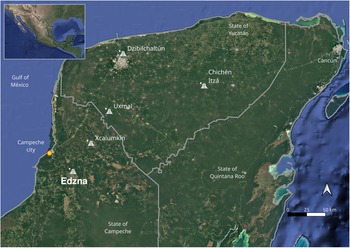
Edzna is located in a vast and fertile valley surrounded by hills about 50 kilometers southeast of Campeche city. The site is located at approximately 790575 m E, 2169000 m N (UTM Zone 15N, WGS84). South of the site, a slope leads directly to the Champoton River basin, about 65 kilometers straight from the settlement (Benavides Reference Benavides Castillo1997:28, Reference Benavides Castillo2014:26; Pallán Reference Pallán Gayol2009:11). It is suggested that the high-water retention capacity of the clay soils in this area, particularly valuable during the dry season, was a key factor in the selection of the Edzna area for settlement. Human occupation in the valley began during the Middle Preclassic period (600–300 b.c.) (Forsyth Reference Forsyth1983:221; Pallán Reference Pallán Gayol2009:12), and persisted through to the Late Postclassic period (a.d. 1200–1521) (Benavides Reference Benavides Castillo1997:30). After it was abandoned, it stayed hidden by a thick tropical forest from the colonial period until the nineteenth century at the end of the Porfirio Diaz era, when farmers described ruins at the nearby Hontun farm. In 1927, Nazario Quintana Bello reported the presence of well-preserved buildings (Benavides Reference Benavides Castillo1997:18; Pallán Reference Pallán Gayol2009:13). A map showing the location of the Edzna archaeological site is presented in Figure 1.
Map showing the location of the archaeological site of Edzna in Campeche, Mexico. Map produced in QGIS by Arturo Caballero Altamirano.

Figure 1 Long description
The map displays the location of the Edzna archaeological site in the State of Campeche, Mexico. Campeche City is marked with an orange dot, while Edzna is represented by a larger pyramid icon and a larger label.. The map includes several notable landmarks such as Dzibilchaltún, Uxmal, Xcalumkín and Chichén Itzá, each marked with a white triangle. The map outlines the State of Yucatán and the State of Quintana Roo, with Cancun labeled on the northeastern coast. The Gulf of Mexico is visible to the west. A scale bar indicates distances up to 50 km and a compass rose shows north orientation. An inset map in the top left corner provides a broader view of the region within Mexico.
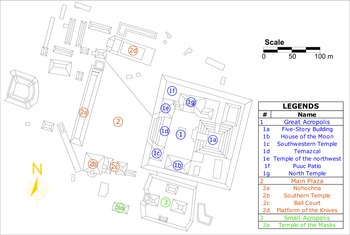
In pre-Hispanic times, Edzna was part of a cultural subregion of the Maya area known today as the “center of Campeche” (Pallán Reference Pallán Gayol2009:12), and covered about 3 kilometers east to west and 2 km north to south, featuring monumental architecture and residential units over 14 kilometers squared. The ceremonial center is a large area bounded to the west by the Nohochna, to the north by the Platform of the Knives, to the south by the Ball Court and the Southern Temple, and to the east by the Great Acropolis (Benavides Reference Benavides Castillo1997:28), see Figure 2.
Map showing the main center of the archaeological site of Edzna, Campeche, Mexico.
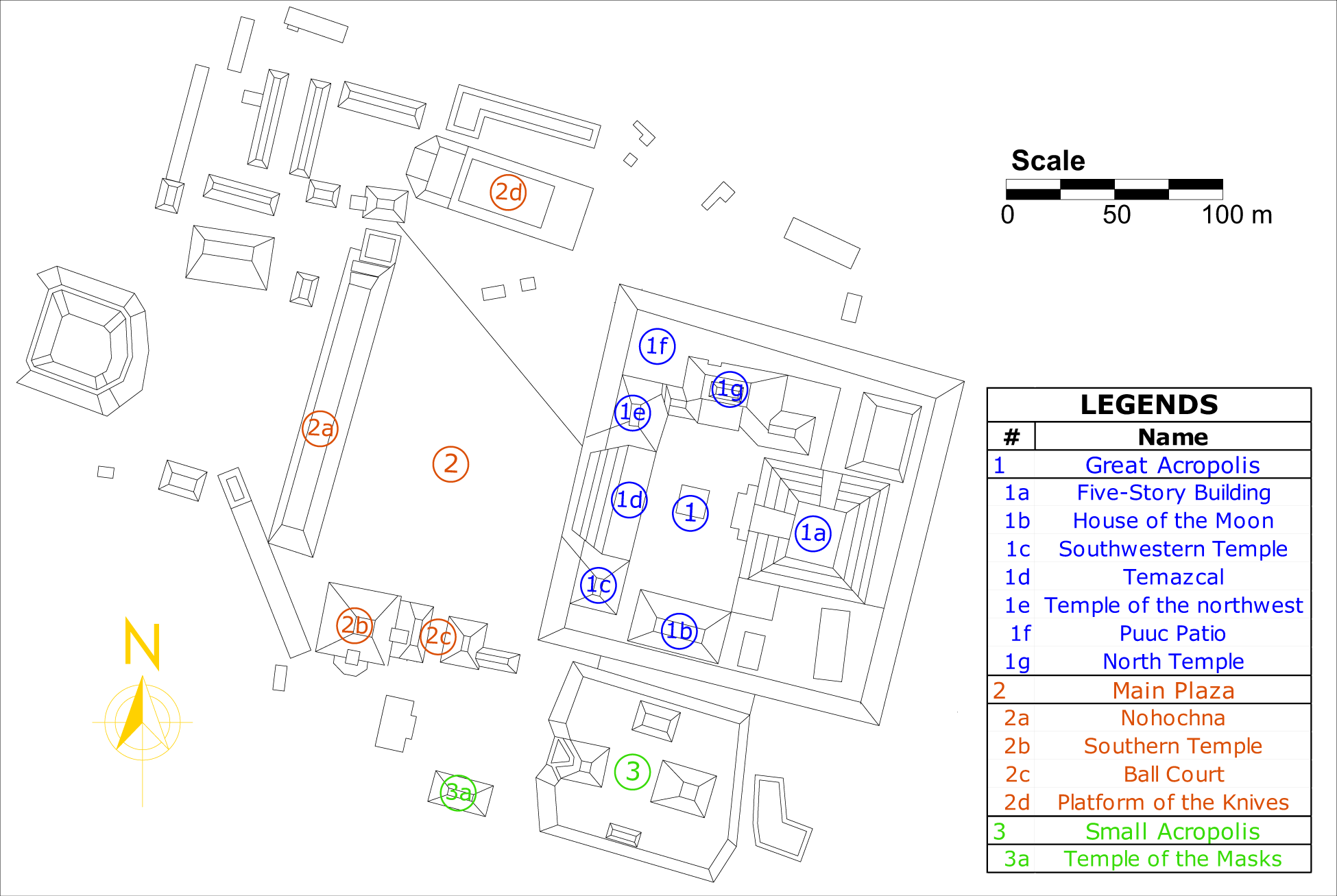
Figure 2 Long description
The map illustrates the main center of the archaeological site of Edzna in Campeche, Mexico. It features a scale bar indicating distances from 0 to 100 meters. The map is oriented with a compass pointing north. The site is divided into three main areas: Great Acropolis, Main Plaza and Small Acropolis. The Great Acropolis includes structures labeled 1a to 1g, such as the Five-Story Building (1a), House of the Moon (1b), Southwestern Temple (1c), Temazcal (1d), Temple of the northwest (1e), Puuc Patio (1f) and North Temple (1g). The Main Plaza is marked with structures 2a to 2d, including Nohochna (2a), Southern Temple (2b), Ball Court (2c) and Platform of the Knives (2d). The Small Acropolis contains the Temple of the Masks (3a). Each area is color-coded: Great Acropolis in blue, Main Plaza in orange and Small Acropolis in green. The map provides a detailed layout of the site, highlighting the spatial arrangement and architectural features.
The Great Acropolis is the most significant architectural group, with a square base, with each side measuring 160 m. Around it are 20 smaller monumental groups, including the Five-Story Building, the House of the Moon, the Southwestern Temple, the Temazcal, Temple of the Northwest, and the Puuc Patio (Benavides Reference Benavides Castillo1997:28; Pallán Reference Pallán Gayol2009:51). The west patio of the Five-Story Building is surrounded by several constructions. A platform located at the center of the patio appears to have been used for various ritual activities. On the eastern side of the patio, a large fragment of a monolithic frame was found embedded in the first step of the staircase, possibly representing an entrance to the underworld and associated with celestial symbolism. Architectural orientation and symbolic elements at Edzna suggest that ceremonial spaces were closely linked to cosmological and ritual practices (Benavides Reference Benavides Castillo2014:80). Previous studies indicate that certain structures, including the Five-Story Building and the Small Acropolis, may have been aligned with significant solar events associated with agricultural and ceremonial cycles (Benavides Reference Benavides Castillo2014; Pallán Reference Pallán Gayol2009). Epigraphic evidence further indicates the political and ritual importance of the site between the seventh and ninth centuries a.d., reinforcing the interpretation of these architectural spaces as settings for formal gatherings and ceremonial performances (Benavides Reference Benavides Castillo2014:80). This broader cultural context provides a framework for interpreting how sound and performance may have contributed to the experiential dimension of these spaces.
The Nohochna is a lengthy rectangular construction, measuring 135 m in length, 31 m in width, and an average height of 9 m, and is oriented north south. It has wide, continuous staircases on both long sides, over 110 meters in length. The staircase has 15 tall and wide steps on the eastern side, suggesting a possible secondary use as seating for events held in the Main Plaza. This structure clearly had astronomical functions, and seemed suitable for various meetings, such as political or military councils, religious or educational activities, ceremonies like dances, banquets, or processions, and storage, and distribution of materials or objects (Benavides Reference Benavides Castillo2014:147). In the Maya area, similar structures include Structure 44 of Dzibilchaltun, the Palace of the Governor in Uxmal, Aguateca, Structure 1 of Becán, Comalcalco, Building D2 of Kohunlich, and Building 29 of Naadzcaan, among others (Benavides Reference Benavides Castillo2014:148).
It is important to recognize that the architectural spaces evaluated in this study, the Main Plaza, the Great Acropolis, and the Small Acropolis, represent constructions that have undergone multiple phases of use, modification, and symbolic transformation throughout the history of Edzna. These spaces are not fixed or immutable; rather, they possess a biography that reflects changing sociopolitical ideologies, ritual practices, and architectural strategies. As noted by Zalaquett (Reference Zalaquett2015), plazas, temples, and palaces are cultural settings that may be maintained, redefined, or rebuilt according to the needs of each generation. In this sense, the acoustic characteristics measured today are the result of a long-term architectural process, and any interpretation must be situated within that historical depth. This perspective reinforces the importance of considering both continuity and change in the performative and ritual use of space across time. Regarding the construction sequence of this site, during the Late Preclassic period (300 b.c. to a.d. 100), the remnants correspond to Peten-type buildings made of large, regularly cut stone blocks. This period could include various sectors of the base of the Great Acropolis, the Temple of the Masks, and possibly the initial phases of the Substructure in the Five-Story Building (Benavides Reference Benavides Castillo1997:191). Later, during the Late Classic period (a.d. 600–700), Peten buildings were covered by Chenes-type architecture, which might correspond to the first level of the west side of the Five-Story Building and the stone teeth located west of the House of the Moon. The initial construction phases of the impressive Nohochna are dated between a.d. 600 and 800, on the basis of ceramic materials; however, later stages appear to have undergone modifications during the Terminal Classic (Benavides Reference Benavides Castillo1997:191; Pallán Reference Pallán Gayol2009:55). During the Classic-Late Terminal period (a.d. 700–800), the Puuc architectural style emerged, possibly as early as a.d. 500, reaching its full development by a.d. 650 and lasting until a.d. 910. This period corresponds to the most visible part of the Five-Story Building, from the second to the fourth levels, with its upper frieze exceeding 30 meters in height. The construction of the Puuc Patio is dated after a.d. 700 (Benavides Reference Benavides Castillo1997:191; Pallán Reference Pallán Gayol2009:55). In the Terminal Classic (a.d. 800–900), some buildings display features of “Chontal” architecture, like sites in eastern Tabasco and western Campeche. These include the temple above the Five-Story Building (Benavides Reference Benavides Castillo1997:30). During the Terminal Classic-Postclassic period (a.d. 900–1100), the latest constructions include the C-shaped Platform at the base of the North Temple, and the north staircase of the Five-Story Building, among others (Benavides Reference Benavides Castillo1997:42).
In Edzna, the contextual relationship between architectural structures and monuments erected by different rulers was intentionally altered since pre-Hispanic times, interpreted as the presumed arrival of external groups. This is evidenced by the destruction and relocation of many stelae from their original location, associated with the erection of new sanctuaries and monuments, events dated to the Terminal Classic. Monuments were gathered at the base of the Small Acropolis, where some were re-erected while others were buried. Epigraphic studies have identified a sequence of 10 rulers starting in a.d. 633 and ending in a.d. 869. References to Edzna have also been found at sites such as Altar de los Reyes, Tikal, and Itzimté, while mentions of places such as Calakmul, Itzán, Xcalumkín, and Piedras Negras were found in Edzna (Benavides Reference Benavides Castillo1997:124, Reference Benavides Castillo2014:82; Pallán Reference Pallán Gayol2009:53).
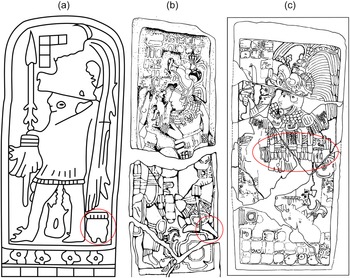
Regarding the archaeological materials that could indicate the presence of musical or sound activities in Edzna, there are some references found in the iconography of the stelae and other iconographic and epigraphic materials from it. In Stela 13, discovered at the base of the Small Acropolis in 1927, though it is suggested it might have been embedded in the central chamber (east wall) of the temple atop the Five-Story Building (Benavides Reference Benavides Castillo1997:166), an image of a high-ranking official holding a feather-decorated spear can be observed. His large headdress also features notably long feathers and is stylistically attributed to the Terminal Classic period. A curious detail is the vessel depicted in the lower section (Benavides Reference Benavides Castillo2014:116), which could represent a drum because it clearly has a membrane on its upper edge and is very similar to the image of several drums depicted on vessels and on Stela 3 from Ceibal (Zalaquett Reference Zalaquett2021) (Figure 3a). Stela 2, originally located at the base of the Small Acropolis, is associated with Ruler 7, who appears to be officiating a ritual in conjunction with a ball game. He holds his scepter-manikin and adopts a dance posture, as indicated by the position of his feet; a stance identified by various iconographic and epigraphic studies in the Maya area as being associated with ritual dancing. His right leg is shown wearing a knee pad, and he wears a characteristic thick protective belt. Below, to the left, a Figure of clearly lower rank is depicted, dressed in a more complete ballplayer’s outfit, including knee pads (Pallán Reference Pallán Gayol2009:151) (Figure 3b). Stela 18, whose original location is unknown, was commissioned by Ruler 5. This stela describes the celebration of a period ending and describes him possibly carrying a “rattle-holder” and dancing (Benavides Reference Benavides Castillo1997:150) (Figure 3c).
(a) Stela 13. Redrawn from (Benavides Reference Benavides Castillo2014) by Guillermo Wilhelm de Alba, (b) Stela 2. Redrawn from (Benavides Reference Benavides Castillo1997) by Ángel Moisés López Larraga, (c) Stela 18. Redrawn from (Benavides Reference Benavides Castillo1997) by Ángel Moisés López Larraga.
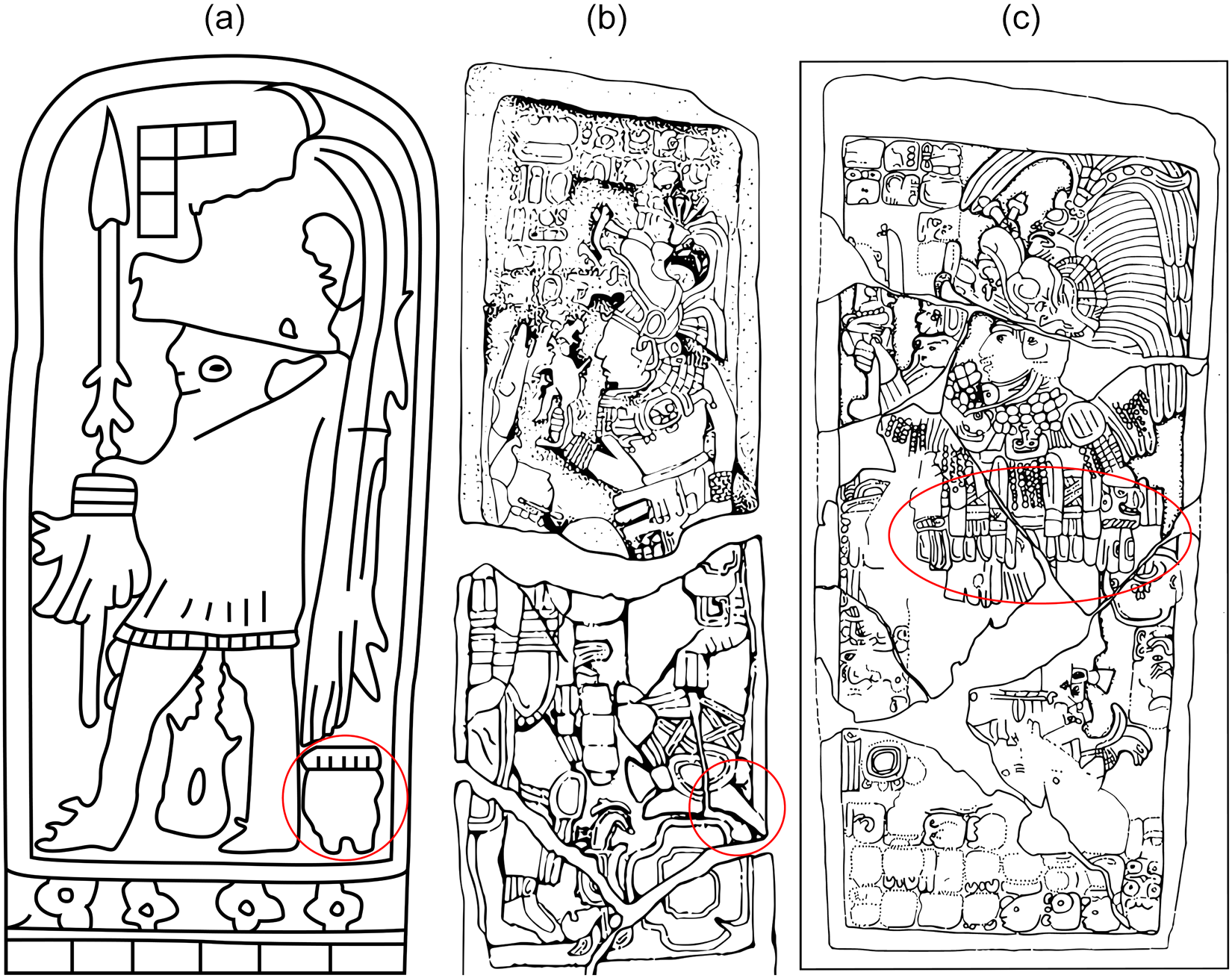
Figure 3 Long description
The image A shows Stela 13, featuring a high-ranking official holding a feather-decorated spear. The official wears a large headdress with long feathers. A vessel, possibly a drum, is depicted in the lower section. The image B shows Stela 2, associated with Ruler 7, who is officiating a ritual with a ball game. He holds a scepter-manikin and adopts a dance posture. His right leg has a knee pad and he wears a thick protective belt. A figure of lower rank is dressed in a complete ballplayer’s outfit, including knee pads. The image C shows Stela 18, commissioned by Ruler 5, celebrating a period ending. It possibly depicts him carrying a rattle-holder and dancing. Each stela has specific elements circled, highlighting particular details in the iconography.
Through these stelae, it could be shown that some main individuals were involved in activities implying the presence of sounds and music. In Stela 18, the belts of various rulers carry shell rattles and stone axe blades that clatter and produce sounds.
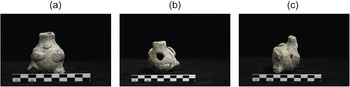
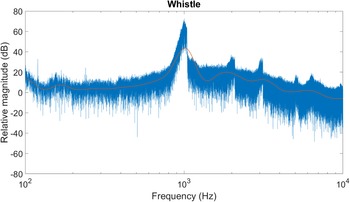
As for the evidence of sound-making instruments that have been excavated, a whistle was found as an isolated object, featuring a resonating chamber (Inventory No. 10-566628), currently stored in the Cultural Goods Warehouse of the Instituto Nacional de Antropología e Historia (INAH) Center in Campeche. This whistle was modeled with a smooth surface and pillowed decoration, with slip and granular paste. It represents a possible long-trunked mammal, with an open mouth, large eyes, and straight ears. It features an indirect frontal beak mouthpiece and a truncated conical ellipsoid inflation channel measuring 1.20 cm x 1.83 cm; see Figure 4. This instrument was recorded in an anechoic chamber, and in Figure 5 it shows the spectrum of this whistle. It can be observed that the whistle has its fundamental frequency around 1 kHz. In addition to the main peak, other peaks at higher frequencies can be identified, corresponding to its harmonics. This frequency profile is useful for analyzing whether certain instruments may have been preferred for use in the plazas of Edzna, which will be further discussed in the following sections.
(a) Front view whistle, whose open mouth forms the inflation channel, (b) bottom view whistle where the air exit mouth is detected, (c) side view whistle. Photographs by Francisca Zalaquett.

Figure 4 Long description
Image A shows the front view of a whistle with an open mouth forming the inflation channel. Image B displays the bottom view where the air exit mouth is visible. Image C presents the side view of the whistle. Each image includes a scale for reference, featuring alternating black and white squares.
Whistle spectrum frequency.

Figure 5 Long description
Whistle. The x- axis label is Frequency (Hz). The x- axis range is 10 superscript 2 to 10 superscript 4. The y- axis label is Relative magnitude (dB). The y- axis range is minus 80 to 80. A single line is plotted. The line rises to a sharp peak near 10 superscript 3 on the x- axis, then drops and continues with smaller peaks and fluctuations toward 10 superscript 4.
Methodology
This study investigates how the physical properties of space shape sound behavior and, in turn, how this may have influenced social cohesion, political authority, and religious symbolism. To achieve this, impulse responses (IR) were measured, representing how an acoustic space reacts to a short sound impulse and providing the basis for deriving several acoustic parameters. These parameters included the Reverberation Time (RT20), which indicates how long it takes for sound energy to decay by 20 dB after the source stops; Speech Clarity (C50) and Instrument Clarity (C80), which quantify the balance between early and late arriving sound energy within 50 ms and 80 ms, respectively, and thus describe the intelligibility of speech and musical sounds; Definition (D50), expressing the proportion of early sound energy relative to the total energy and reflecting the perceived clarity of a space; and Sound Strength (G), which measures the acoustic amplification of a source compared to a reference free-field condition (Navas-Reascos et al. Reference Navas-Reascos, Naal-Ruiz, Alonso-Valerdi and David2023b). Together, these descriptors allowed to understand the potential acoustic functions and symbolic meanings of the different architectural areas within Edzna. Integrating technical acoustic data with archaeological, iconographic, and ethnohistoric evidence, it was aimed to contribute to the growth of research that treats acoustics not merely as a physical property of space, but as a meaningful cultural and symbolic dimension of past human life.
Although the ISO 3382-1:2009 standard was originally designed for acoustic characterization of enclosed spaces, in the absence of specific standards for open archaeological environments, it was adapted as a structured methodological reference. This ensured reliable and comparable results and allowed for the consistent calculation of acoustic parameters such as RT20, C50, C80, and D50 across different measurement locations, ensuring methodological rigor despite the open-air setting.
The methodology relied on specific equipment, including an HP ProBook 640 G2 laptop, a Behringer UMC 404 HD audio interface, a Behringer DR115DSP speaker, and a Shure MX 150 B/O microphone with a windscreen. Additionally, a Neumann KU 100 binaural head, a Bruel & Kjaer type 2270 sound level meter with a microphone head 4189 and preamplifier ZC 0032, and a Bruel & Kjaer 4231 acoustic calibrator were employed. Using this equipment, the total calculated error in the whole electroacoustic chain was ±1.5 dB. It was essential to develop a calibration process before the electroacoustic system was used to conduct the acoustic measurements. This procedure ensured that the individual responses of the connected equipment did not interfere with the obtained data. To accomplish this, a method known as inverse filtering, as detailed in the study by Ibarra and colleagues (Reference Ibarra, Ledesma and Lopez-Caudana2018), was employed. During calibration, the microphone was positioned 1 m away from the speaker at a height of 1.2 m. Additionally, a minimum separation of 1 m from surrounding walls was considered, minimizing the impact of reflections on the calibration process.
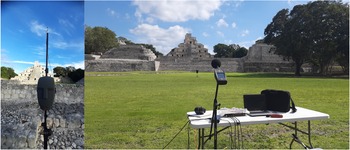
Measurements began with measuring background noise, which was consistently found to be 35 dBA across the archaeological site. Following this, the system levels were adjusted to ensure optimal speaker output and microphone levels, achieving a Sound Pressure Level (SPL) of 115 dB at 1 m for accurate acoustic measurements without any distortion. Three microphones were strategically positioned: two within the binaural head at a height of 1.6 meters and another 40 cm above the head at 2 m, all placed at least 1 m away from any reflective surfaces following ISO 3382-1:2009 standard. The speaker was set up at the same height of 1.6 m, with recordings made from two positions at each measurement point to capture reflection data accurately: directly in front (0°) and opposite (180°) of the initial setup. Figure 6 displays images from the acoustic measurements
Experimental setup during the acoustic measurements at Edzna. The figure shows the binaural head, microphones, and recording equipment positioned in front of the Five-Story Building.

Figure 6 Long description
Image A shows a binaural head with microphones positioned on a stone surface, facing a historic building. The sky is clear with a few clouds. Image B displays a table with recording equipment, including a microphone and a laptop, set up on a grassy area in front of a large stone building with multiple levels. Trees are visible on either side of the building and the sky is partly cloudy.
.
Measurements involved generating and recording two types of signals: LSS and MLS. LSS signal was selected as the primary tool for analysis due to its robustness against environmental noise and its capacity to handle nonlinear system behavior effectively. These signals were processed using inverse filtering, allowing for the precise reconstruction of the impulse response, which is essential for accurate acoustic parameter extraction in outdoor archaeological contexts. In contrast, MLS signals are more susceptible to distortion and require inverse filtering to correct for system nonidealities. In this study, no inverse filtering was applied to MLS data, and they were included only to enable a qualitative comparison of signal structure and environmental response under identical measurement conditions.
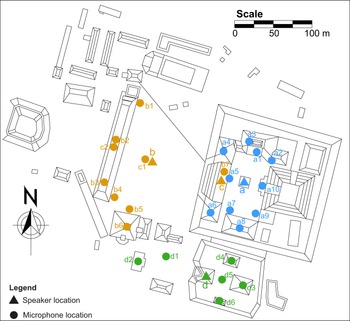
Weather conditions during the campaign averaged 76 percent relative humidity, 11.5 km/h wind speed, and 34°C. In total, 32 LSS and 32 MLS recordings were made; from these, 25 were selected for each case, covering key points across the Main Plaza (Orange), Great Acropolis (Blue), and Small Acropolis (Green), as shown in Figure 7. Each signal was trimmed to 2.625 s (0.125 s before and 2.5 s after the impulse response), and SPL levels were verified to ensure validity. The dataset with complete information can be found in Navas-Reascos and colleagues (Reference Navas-Reascos, Wilhelm-deAlba, Alonso-Valerdi and Ibarra-Zarate2023c).
Measurement points at the Edzna archaeological site: ▲ sound source and ● sound recorder.

Figure 7 Long description
The map of the Edzna archaeological site displays locations marked by symbols. Speaker locations are indicated by triangles, while microphone locations are shown as circles. The map includes a scale bar ranging from 0 to 100 meters and a compass for orientation. The site is divided into three areas: Main Plaza, Great Acropolis and Small Acropolis. In the Main Plaza, orange circles (b1 to b6) and triangles (b, c1, c2) represent microphone and speaker locations. In the Great Acropolis, blue circles (a1 to a10) and triangles (a, c) denote microphone and speaker locations. In the Small Acropolis, green circles (d1 to d6) and triangles (d) indicate microphone and speaker locations. The map provides a detailed layout of measurement points across the site.
These three architectural spaces were chosen due to their prominence and distinctive configurations, which suggest potential ritual, civic, and performative uses. The interpretation that they supported ceremonial events is reinforced by archaeological, iconographic, and textual evidence highlighting the central role of plazas and elevated platforms in Maya sociopolitical life (Inomata Reference Inomata2006; Lucero Reference Lucero2003; Zalaquett Reference Zalaquett2015).
This approach aligns with recent research trends in archaeoacoustics, where methodological flexibility and interdisciplinary approaches are often required to address the specific acoustic and preservation challenges of ancient architectural spaces (Boren Reference Boren, Díaz-Andreu and da Rosa2024; Díaz-Andreu Reference Díaz-Andreu2025; Kolar Reference Kolar2018; Navas-Reascos et al. Reference Navas-Reascos, Alonso-Valerdi and Ibarra-Zarate2023a).
Subsequently, the analysis was divided into two parts. Firstly, results were obtained in the time domain: the data were filtered between 10 Hz and 10 kHz, IR was plotted over time, and acoustic parameters were calculated. Secondly, analyses were conducted in the frequency domain: the Fast Fourier Transform (FFT) of the signal was performed, then filtered between 10 Hz and 10 kHz, and with these data, graphical representations of the signal spectrum and spectrogram were generated. All this information was stored for each measurement point.
Results
The results are presented and divided into time and frequency domains. For the computation of acoustic parameters (RT20, C50, C80, and D50), only the LSS impulse responses processed with inverse filtering were considered. The MLS results, which were not corrected through inverse filtering, are therefore not reported.
Time domain results
In this section, the results of the time domain study are presented. For this results, one representative point from each zone is included, as the behavior across different points within the same area did not present significant variation. These signals allow to visualize the behavior of the sound wave over time, beginning with the moment the sound is emitted and followed by its subsequent reflections. Together with the frequency domain information and the acoustic parameters, these results contribute to interpretations regarding the intentionality and possible acoustic design of the different spaces at the archaeological site of Edzna.
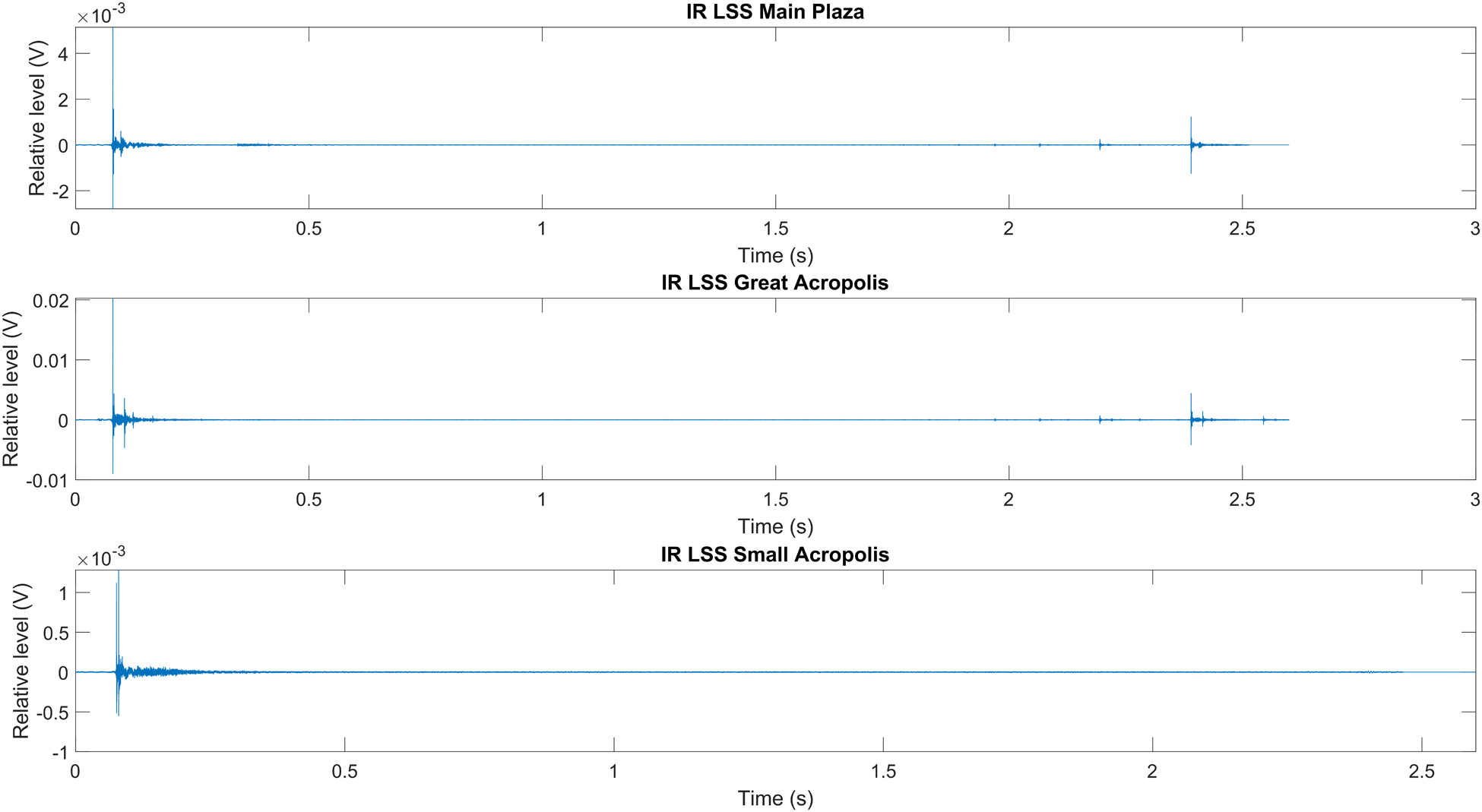
For the analysis, three representative measurement points were selected: b7 for the Main Plaza, a10 for the Great Acropolis, and d2 for the Small Acropolis. Figure 8 presents the LSS impulse responses for these areas.
IR of the LSS measurements of the three main areas: Main Plaza (b7), Great Acropolis (a10), and Small Acropolis (d2).

Figure 8 Long description
The image A showing a line graph titled IR LSS Main Plaza. The horizontal axis label is Time (s), with values 0, 0.5, 1, 1.5, 2, 2.5. The vertical axis label is Relative level (V), with a scale note times 10 superscript negative 3. The plotted line shows a sharp spike near time 0, then a near-flat line close to 0 and a small spike near about 2.5 seconds. The image B showing a line graph titled IR LSS Great Acropolis. The horizontal axis label is Time (s), with values 0, 0.5, 1, 1.5, 2, 2.5, 3. The vertical axis label is Relative level (V), with a scale note times 10 superscript negative 3. The plotted line shows a sharp spike near time 0, then a near-flat line close to 0 and a small spike near about 2.5 seconds. The image C showing a line graph titled IR LSS Small Acropolis. The horizontal axis label is Time (s), with values 0, 0.5, 1, 1.5, 2, 2.5. The vertical axis label is Relative level (V), with a scale note times 10 superscript negative 3. The plotted line shows a sharp spike near time 0, then a near-flat line close to 0.
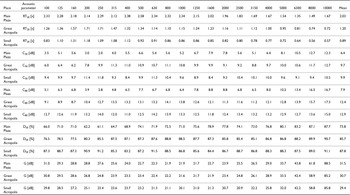
In Figure 8, clear differences could be observed between the studied spaces. In both the Main Plaza and the Great Acropolis, high-level reflections appear after approximately two seconds, indicating the presence of strong late reflections that could have amplified or reinforced sound during events. By contrast, the Small Acropolis shows a much faster decay with fewer late reflections, suggesting a more intimate acoustic environment. These distinctions may reflect different intended uses of the spaces, large-scale gatherings and ceremonies in the Main Plaza and Great Acropolis, versus smaller-scale or more controlled events in the Small Acropolis. Additionally, the results of the acoustic parameters using LSS measurements are presented, see Table 1.
Acoustic parameters obtained of the LSS measurements at different frequencies

Table 1 Long description
The table lists frequency-band acoustic results from 100 to 10,000 hertz for three places (Main Plaza, Great Acropolis, Small Acropolis), reporting RT20 in seconds, C50 and C80 in decibels, D50 in percent, and G in decibels, plus a mean for each row. Reverberation time is highest at the Main Plaza across most bands (mean RT20 2.03 s), lower at the Great Acropolis (1.20 s), and lowest at the Small Acropolis (0.89 s). Clarity and definition follow the opposite pattern: Small Acropolis has the highest mean C50 (9.9 dB), C80 (12.9 dB), and D50 (87.8 percent), Great Acropolis is intermediate (C50 9.7 dB, C80 12.4 dB, D50 85.7 percent), and Main Plaza is lowest (C50 6.4 dB, C80 7.9 dB, D50 73.8 percent). For all three places, RT20 generally decreases toward higher frequencies, while C50, C80, and D50 generally increase, indicating clearer sound at higher frequencies. Strength G is similar in mean across sites (about 29 to 32 dB) but rises sharply at the highest bands, reaching roughly mid 80s to high 80s dB at 10,000 hertz. Comparisons should be made within the same parameter and frequency band because the measures use different units and represent different aspects of acoustics.
Table 1 summarizes the acoustic parameters derived from the LSS measurements across octave and third-octave frequency bands. The Main Plaza shows relatively high RT20 values (around two seconds), indicating the presence of strong reflections that could enhance sound projection during large gatherings. The Great Acropolis presents shorter RT20 (close to one second), combined with higher C50 and C80 values, suggesting that this area favored speech intelligibility and musical detail in smaller-scale events. The Small Acropolis demonstrates the lowest RT20 (below 1 second on average) with consistently high C50 and C80 and D50, pointing to an acoustic setting optimized for conversation or ritual discourse. The variation in G across the three spaces further emphasizes their distinct acoustic functions, reflecting architectural strategies that shaped different auditory experiences in the ceremonial landscape of Edzna.
Frequency domain results
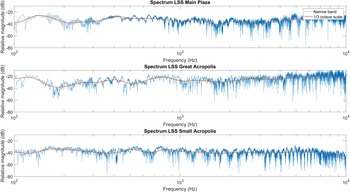
The spectrum results of the LSS signal for the different areas are presented in Figure 9.
Figure 9 illustrates the spectral responses obtained from the LSS measurements conducted in the Main Plaza, the Great Acropolis, and the Small Acropolis. The narrow-band curves (blue) and the 1/3-octave band curves (orange) reveal notable differences in the acoustic behavior of each space. The Main Plaza and Great Acropolis exhibit stronger energy distribution in the mid-frequency range (200–1000 Hz), which corresponds to the human vocal range and suggests favorable conditions for speech and chanting during public ceremonies. In contrast, the Small Acropolis presents a smoother decay and less energy in the higher frequencies, consistent with a more intimate acoustic environment. These variations highlight how each architectural area may have been intentionally designed to reinforce specific types of sound experiences, ranging from large-scale public events to smaller, more private gatherings. Also, the spectrograms of the LSS study areas are shown in Figure 10
Spectrum of the LSS measurements, narrow band (blue line) and 1/3-octave bands (orange line) of the three main areas: Main Plaza, Great Acropolis, and Small Acropolis.

Figure 9 Long description
The image contains three line graphs titled 'Spectrum LSS Main Plaza,' 'Spectrum LSS Great Acropolis,' and 'Spectrum LSS Small Acropolis.' Each graph compares narrow band (blue line) and 1 slash 3 octave bands (orange line). The x-axis is labeled 'Frequency (Hz)' ranging from 10 superscript 0 to 10 superscript 3. The y-axis is labeled 'Relative Amplitude Level (decibels)' ranging from minus 40 to 40. In the Main Plaza graph, the narrow band line shows a jagged pattern with fluctuations, while the 1 slash 3 octave line is smoother, indicating less variation. Notable peaks and dips occur throughout the frequency range. The Great Acropolis graph displays similar characteristics, with the narrow band line showing more pronounced fluctuations compared to the smoother 1 slash 3 octave line. The Small Acropolis graph also follows this pattern, with the narrow band line exhibiting significant jaggedness and the 1 slash 3 octave line remaining relatively smooth. Overall, the narrow band lines are more detailed, capturing finer variations, while the 1 slash 3 octave lines provide a broader, smoother overview of the spectrum levels across the three areas.
Spectrograms of the LSS measurements of the three main areas: Main Plaza, Great Acropolis, and Small Acropolis.

Figure 10 Long description
Spectrogram LSS Main Plaza. Spectrogram LSS Great Acropolis. Spectrogram LSS Small Acropolis. Three stacked spectrogram heatmaps compare LSS measurements using the same axes and the same color scale. Common axes and scale for all three spectrograms: The x-axis is labeled Time (s) with tick labels 0.5, 1, 1.5, 2 and 2.5. The y-axis is labeled Frequency (Hz) with tick labels 10 squared, 10 cubed and 10 to the power of 4. Each spectrogram has a vertical color scale labeled Relative magnitude with tick labels minus 50, minus 100, minus 150 and minus 200. Spectrogram LSS Main Plaza: The heatmap shows a broad band of higher relative magnitude concentrated at lower frequencies across most of the time range, with scattered vertical streaks and patches extending into mid and higher frequencies at multiple times. Spectrogram LSS Great Acropolis: The heatmap shows a broad low-frequency band across the time range, with more frequent mid-frequency patches and vertical streaks than the Main Plaza spectrogram, including several narrow vertical features that extend upward toward higher frequencies. Spectrogram LSS Small Acropolis: The heatmap shows a more uniform low-frequency band across the time range, with fewer distinct mid-frequency and high-frequency streaks and fewer isolated patches compared with the other two spectrograms.
.
In the spectrograms shown in Figure 10, the reflections seen in Figure 8 can be observed. Reflections with a high level are visible in both the Main Plaza and the Great Acropolis. They provide detailed time-frequency representations of the LSS signals recorded in the Main Plaza, the Great Acropolis, and the Small Acropolis. In all the cases, it was observed that the strongest energy concentrations are found in the mid-frequency range (200–1000 Hz), which aligns well with the human vocal range and suggests that the architecture may have been acoustically favorable for speech or chant-based ritual performance. Moreover, the time persistence of reflections, visible as sustained horizontal bands, provides insight into how sound energy lingered after the initial impulse. In ritual or ceremonial contexts, such sustained echoes could enhance the immersive or sacred perception of sound, extend the duration of sonic presence, and reinforce symbolic meaning. Although these interpretations are necessarily exploratory, they highlight the potential of time-frequency analysis as a tool for understanding not only the acoustic response of space but also the experiential and performative dimensions of sound in ancient Maya public ceremonies.
Additionally, all these structures were covered in pre-Hispanic times with stucco, for this reason an acoustic characterization of an original stucco sample recovered in Edzna was conducted. This material was provided by INAH Campeche, who granted access to a fragment obtained during a new excavation in the Nohochna area. The sample was cut and adapted for use in an impedance tube, which enabled the measurement of its sound absorption coefficient (α). This system operates in a frequency range from 200 Hz to 3 kHz.
Figure 11 illustrates the experimental setup and material used for the absorption test. Figure 11a shows the impedance tube employed for the acoustic characterization. Figure 11b displays the original stucco fragment provided by INAH Campeche, and Figure 11c presents the stucco sample positioned inside the impedance tube. Figure 12 shows the resulting absorption curve, which reflects the material’s frequency-dependent acoustic behavior.
Experimental setup for the stucco absorption test. (a) Impedance tube used for the measurement, (b) original stucco fragment obtained from a recent excavation, provided by INAH Campeche, (c) stucco sample placed inside the impedance tube.

Figure 11 Long description
Image A shows an impedance tube setup used for acoustic measurement, supported by wooden blocks on a blue surface. Image B displays a stucco fragment next to a measurement scale and a yellow note with text. Image C shows a stucco sample placed inside the impedance tube, with a hand holding the tube.
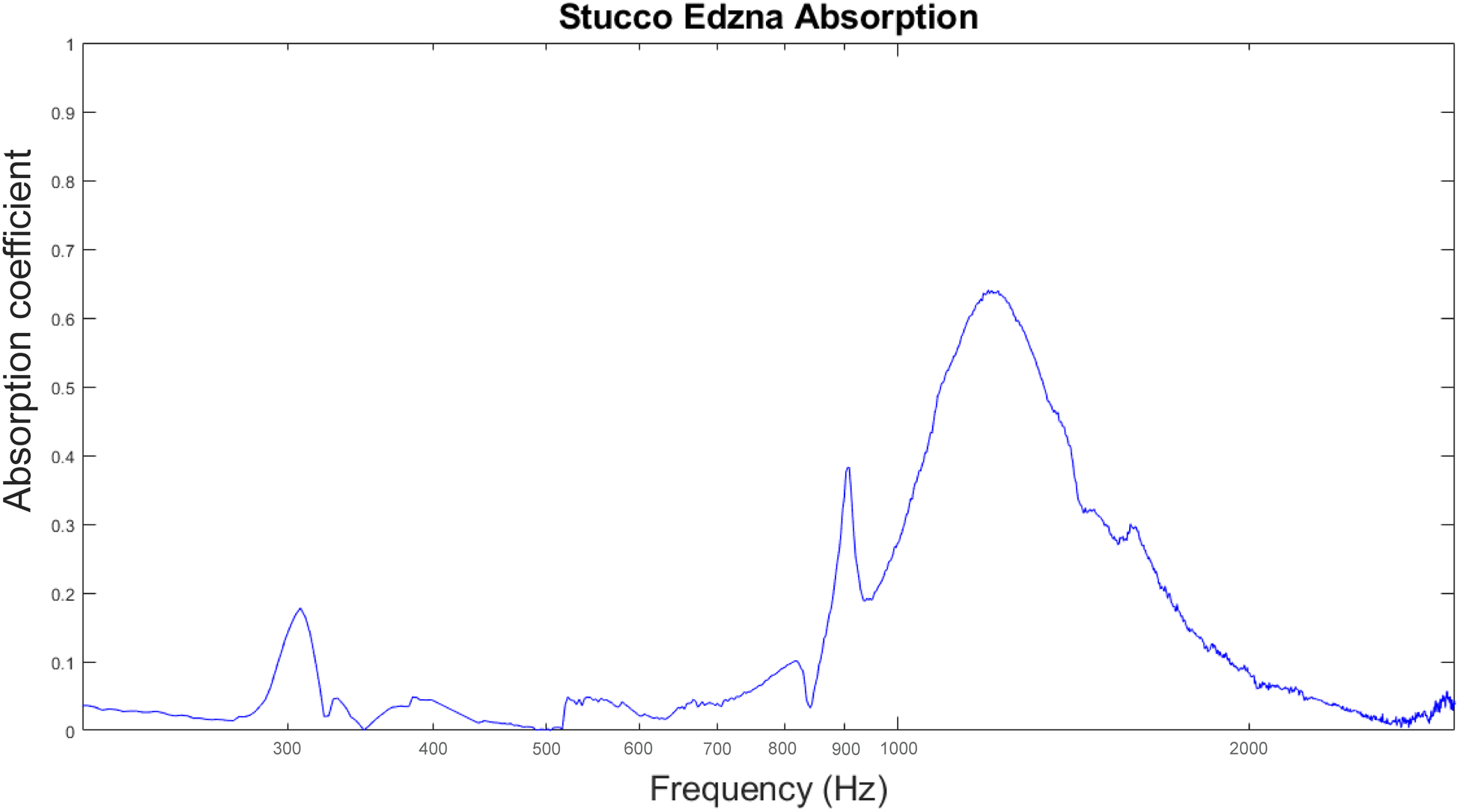
Sound absorption curve of original stucco sample from Edzna, measured using an impedance tube in the 200 Hz to 3 kHz frequency range.

Figure 12 Long description
Stucco Edzna Absorption. The x-axis label is Frequency (Hz). The x-axis shows tick labels at 300, 400, 500, 600, 700, 800, 900, 1000 and 2000. The y-axis label is Absorption Coefficient. The y-axis ranges from 0 to 1 with tick labels at 0, 0.1, 0.2, 0.3, 0.4, 0.5, 0.6, 0.7, 0.8, 0.9 and 1. A single line is plotted. It starts near 0.03 at the left edge, rises to about 0.18 near 300, drops back near 0.02 by about 350 and stays near 0.02 to 0.05 through about 800. It rises to about 0.10 near 850, spikes to about 0.38 near 900, drops to about 0.20 near 930, then rises to a peak of about 0.65 near 1200. It declines to about 0.45 near 1400, to about 0.30 near 1600 and to about 0.10 near 2000. It approaches about 0.02 near the right edge, with a small rise to about 0.05 at the end.
Figure 12 also presents the absorption coefficient (α) of the original stucco sample plotted across a range of frequencies. The curve shows minimal absorption below 500 Hz, with a notable increase starting around 800 Hz. The absorption reaches its peak near 1.2 kHz, followed by a gradual decline. This pattern suggests that the stucco material exhibits limited effectiveness in dampening low-frequency sounds but is more responsive in the upper mid-frequency range. Such behavior implies that frequencies associated with human speech intelligibility and certain musical harmonics (particularly in the 1–1.5 kHz range) would have been subtly attenuated by the surface materials. This attenuation may have contributed to a softening or diffusion of mid-frequency sounds in ceremonial spaces, potentially shaping the acoustic texture of ritual performances held in this environment.
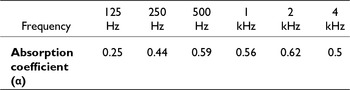
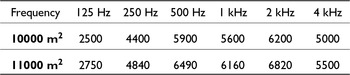
The acoustic measurements in this study were conducted without the presence of people. The acoustic influence of audiences has been widely discussed in architectural acoustics, where human occupancy is commonly modeled as an equivalent absorption area added to the space. In studies of performance spaces, the presence of people is often represented through absorption coefficients assigned per person, allowing researchers to estimate how crowd density modifies sound propagation and speech intelligibility (e.g., Kinsler et al. Reference Kinsler, Frey, Coopens and Sanders1992; Recuero Reference Recuero López2000). To explore how human occupancy might have influenced sound behavior during ancient performances, the sound absorption introduced by individuals occupying the Main Plaza of Edzna was estimated. Two scenarios were considered: only the plaza occupied (10,000 m2) and the plaza together with the Nohochna occupied, increasing the effective area to 11,000 m2. Considering the absorption coefficient of a person reported by Zalaquett (Reference Zalaquett2015) (Table 2). Assuming a density of two people per square meter, an audience of approximately 20,000 to 22,000 individuals was estimated for the respective areas. Using the equation (see Table 3):
Absorption coefficient of a person (Zalaquett Reference Zalaquett2015)
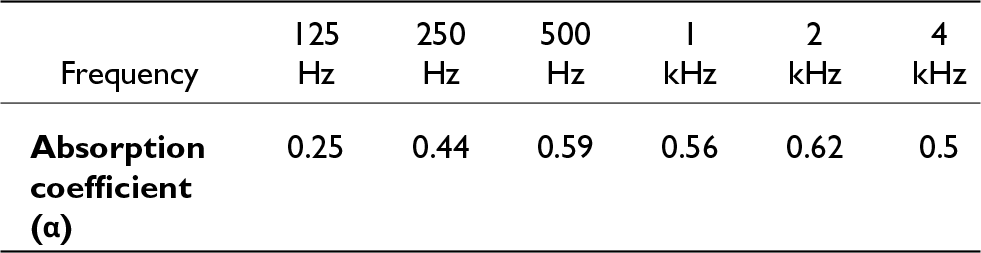
Table 2 Long description
The table reports a person’s sound absorption coefficient across octave-band frequencies from 125 Hz to 4 kHz. Absorption starts low at 125 Hz at 0.25 and increases to 0.44 at 250 Hz and 0.59 at 500 Hz. It remains similar at 1 kHz at 0.56, then reaches the highest value at 2 kHz at 0.62. At 4 kHz it drops slightly to 0.50. Overall, absorption generally increases from low to mid frequencies, peaks around 2 kHz, and then decreases at the highest frequency listed. Values are specific to the measured person and conditions, so results may differ with posture, clothing, and room setup.
Absorption = α(f) × Area
Total absorption in the Main Plaza
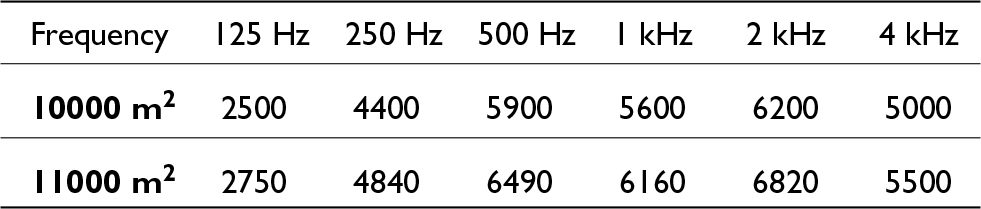
Table 3 Long description
The table reports total sound absorption values for two floor areas, 10000 square meters and 11000 square meters, across octave-band center frequencies from 125 Hz to 4 kHz. For 10000 square meters, absorption rises from 2500 at 125 Hz to 6200 at 2 kHz, then drops to 5000 at 4 kHz. For 11000 square meters, absorption rises from 2750 at 125 Hz to 6820 at 2 kHz, then drops to 5500 at 4 kHz. At every frequency listed, the 11000 square meter values are higher than the 10000 square meter values. In both rows, the highest absorption occurs at 2 kHz and the lowest occurs at 125 Hz, indicating stronger absorption in the mid to high frequencies than in the low frequencies. The increase from 10000 to 11000 square meters is consistent across bands, suggesting absorption scales upward with area in this dataset. No units beyond the area labels are provided, so comparisons should be interpreted as relative differences between the two cases rather than absolute performance benchmarks.
Table 3 shows the calculated total absorption. The results indicate very high absorption values at mid and high frequencies, reaching an equivalent absorption area of 6,200 m2 at 2,000 Hz for the plaza alone and up to 6,820 m2 when including the Nohochna. These findings suggest that high-pitched sounds, such as small whistles, rattles, and high female voices, would be significantly absorbed and thus lose intelligibility in such crowded settings. Conversely, low and mid-frequency sounds (e.g., drums, conch shell trumpets, male voices) would remain more acoustically robust, making them more suitable for large-scale public performance. These results reinforce the idea that the choice of instruments and vocal registers in ritual contexts may have been influenced not only by symbolic or cultural factors, but also by practical acoustic considerations related to crowd density and spatial configuration.
Discussion
In recent years, archaeoacoustics has increasingly moved toward integrative research frameworks that combine empirical acoustic measurements, digital modeling, and experiential interpretations to investigate how ancient built environments shaped sensory perception and social interaction. Within this broader methodological development, the results obtained at Edzna provide field-based acoustic evidence derived from direct measurements under real environmental conditions.
Previous studies in Mesoamerican and other archaeological contexts have emphasized the importance of linking measurable acoustic parameters with broader questions concerning performance, ritual practice, and spatial organization (Díaz-Andreu Reference Díaz-Andreu2025). Within archaeoacoustic research, this approach reflects a broader shift toward integrating acoustic measurement with interpretations of sensory experience and performative space in ancient societies. Rather than treating sound purely as a physical phenomenon, recent scholarship emphasizes its role in shaping social interaction, ritual performance, and the perception of monumental architecture. In this sense, the acoustic properties documented at Edzna contribute to ongoing discussions about how built environments structured collective sensory experiences in ceremonial landscapes.
The present findings contribute to this line of research by documenting how sound propagation varies across architecturally differentiated spaces at the site, suggesting that acoustic properties may have influenced how ritual and social experiences were perceived within the ceremonial center. This empirical approach complements recent computational and multisensory methodologies, including GIS- and virtual-reality-based reconstructions developed for Maya sites such as Copán (Richards-Rissetto et al. Reference Richards-Rissetto, Primeau, Witt, Goodwin, Landeschi and Eleanor2023). Whereas those studies primarily rely on digital spatial modeling to reconstruct sensory landscapes, the field measurements presented here provide direct acoustic characterization of the built environment, offering a complementary perspective on how sound may have been experienced in Maya ceremonial contexts. Together, these complementary approaches contribute toward a more comprehensive framework for understanding the multisensory dimensions of ancient Maya ceremonial spaces.
While there is no universally accepted standard for acoustic measurements in open archaeological spaces, important methodological contributions have been made. For example, the work of Kolar at Chavín de Huántar (Kolar Reference Kolar2014, Reference Kolar2017, Reference Kolar2018). Their studies combined empirical measurement with sensory and ritual theory, offering a model for integrating acoustic data with archaeological interpretation. In the present study, a rigorous and well-established methodology was implemented and adapted to the specific conditions of the Edzna site, based on the ISO 3382-1:2009 standard, to ensure precise data collection. This approach allows for standardization, ensuring the repeatability and reproducibility of the measurements. The time-domain analysis focused on the evaluation of acoustic parameters (see Figure 8). This confirms the effectiveness of the rigorous methodology, supported by the prior calibration using the inverse filtering method, which provides comparable results. However, when compared to the second measurements in MLS, different values were identified, possibly attributable to the type of signal used and the lack of the use of the inverse filter technique. Although MLS signals were also recorded during the field campaign, these measurements were not corrected using inverse filtering, which limits their direct comparability with the calibrated LSS results presented here. For this reason, MLS measurements are mentioned only as a qualitative reference, while the detailed analysis focuses on the LSS data, which provide more reliable and standardized acoustic parameters.
Regarding the parameters C50 and C80, which assess the intelligibility of speech and music, respectively (Adithya et al. Reference Pillai, Murugan and Gupta2022; Galindo et al. Reference Galindo, Zamarreño and Girón1999; Martellotta Reference Martellotta2010), it is observed that the levels are significantly above the recommendations to be considered as levels with good intelligibility. According to Carrion (Reference Carrion1998); Paini and colleagues (Reference Paini, Gade and Rindel2006); Rindel (Reference Rindel2023); Taghipour and colleagues (Reference Taghipour, Athari, Gisladottir, Sievers and Eggenschwiler2020), it is suggested that these levels should be higher than two dB to consider an enclosed space with high intelligibility. In this case, the recorded values notably exceed this threshold, which means that the area has high intelligibility. This can also be corroborated with the D50 parameter, which also shows intelligibility in percentage and likewise presents high values. Similarly, the G parameter indicates that the place provides good sound reinforcement, which can be beneficial for the sound to reach all listeners clearly without the need for amplification, allowing the audience to hear with greater clarity and detail. However, it can also cause an excessive amount of sound reflections, leading to prolonged reverberation. This can make the sound become confusing and less intelligible, especially for speech, creating “atmospheric” environments in the area.
The RT20 values measured in the Main Plaza suggest acoustic conditions capable of sustaining sound energy over perceptible durations, potentially enhancing auditory envelopment during collective gatherings. This reverberant quality, combined with the high values of C50 and D50, implies that while speech intelligibility was preserved, sound events—such as chants, music, or ritual proclamations—would have been amplified and enriched by lingering reflections. These conditions may have favored large-scale ceremonies involving musical instruments, rhythmic patterns, or collective vocal participation in front of temples and platforms. In contrast, the smaller acropolises, which present lower RT20 values and slightly more reflective configurations, may have supported more intimate or controlled ritual scenarios involving a limited audience or restricted access.
These results differ from the preliminary balloon-based measurements reported in Navas-Reascos and colleagues (Reference Navas-Reascos, Naal-Ruiz, Alonso-Valerdi and David2023b). While earlier measurements suggested general sound propagation tendencies in the Main Plaza, the calibrated LSS methodology provides a more precise characterization of energy decay and intelligibility patterns, allowing a refined interpretation of acoustic behavior across the ceremonial spaces.
Sites like Chichen Itza demonstrate a different approach: the Great Ballcourt produces whispering gallery and flutter echo effects, likely used in ritual ceremonies (Lubman Reference Lubman2013), while the pyramid of El Castillo generates a handclap echo resembling the call of a bird (Bilsen Reference Bilsen2006; Declercq et al. Reference Declercq, Degrieck, Briers and Leroy2003, Reference Declercq, Degrieck, Briers and Leroy2004; Lubman Reference Lubman1998). These effects reflect a more symbolic and perceptual use of sound, likely intended to evoke supernatural associations. By contrast, Edzna’s acoustic strategy seems to have combined symbolic resonance with practical audibility, ensuring that speech and music reached large audiences during public rituals. This pattern is also observed in other regions, such as the sunken courts of Guanajuato, where architectural acoustics enhance speech intelligibility and support the performance of musical instruments (Ramos-Amezquita and Ibarra-Zarate Reference Ramos-Amezquita and Ibarra-Zarate2013). These comparisons illustrate variability in how architectural acoustics operated across Mesoamerican ceremonial contexts, suggesting diverse acoustic functions associated with different ritual settings.
In relation to the frequency analysis, the frequency responses of the LSS signals are notably similar, showing minimal spectral variations (see Figure 9). This consistency is mainly due to the calibration system using inverse filtering, which effectively reduces measurement variability. However, the spectrograms for the LSS indicate a significant presence of late reflections (see Figure 10). This phenomenon is likely influenced by the complex interaction between sound propagation and the site’s atmospheric conditions, such as temperature and wind speed (Daigle et al. Reference Daigle, Embleton and Piercy1986; Ingard Reference Ingârd1953; Rasmussen Reference Rasmussen1986; Wilson Reference Wilson2003). Temperature and wind gradients can bend acoustic rays, extending the travel distance of sound waves.
In open-air sites like Edzna, environmental conditions, particularly temperature inversions, humidity, and wind, can significantly alter acoustic characteristics. Higher humidity increases high-frequency absorption, while temperature layers and wind direction can bend sound paths and influence energy decay rates. The relatively warm and humid conditions during the measurements likely preserved mid-frequency transmission but attenuated high-frequency reflections, which helps explain the rapid decay observed in the spectrograms. The late reflections detected in the LSS signals may result not only from architectural diffraction but also from atmospheric scattering and stratification, especially under calm conditions. Such environmental effects would have varied with seasonal festivals, day–night cycles, and the presence of large crowds, which locally modify temperature and airflow. The vast open spaces and varying topography of Edzna allow substantial wind fluctuations, which modify velocity gradients and thus affect propagation paths. In some areas, heights exceeding 40 meters amplify these effects, generating intricate sound trajectories and contributing to the site’s unique acoustic behavior.
These environmental factors highlight the complexity of interpreting acoustic behavior in open archaeological settings. Interpretations linking acoustic measurements with past auditory experience necessarily involve inferential reasoning grounded in both physical evidence and historical context. Recent methodological discussions in archaeoacoustics emphasize that reconstructions of past listening conditions should be understood as probabilistic interpretations rather than direct reproductions of historical reality (Boren Reference Boren, Díaz-Andreu and da Rosa2024). In this sense, the interpretations proposed here use measurable acoustic parameters as a framework for exploring plausible experiential conditions while acknowledging the limits imposed by preservation state and environmental change.
Building on the preceding analyses, it is possible to explore how the distinct acoustic characteristics of each space might align with different ceremonial or functional uses. When analyzing the acoustic results of each area within Edzna, certain interpretations can be proposed regarding their potential uses, without asserting definitive historical functions. These interpretations are consistent with preliminary observations reported in Navas-Reascos and colleagues (Reference Navas-Reascos, Naal-Ruiz, Alonso-Valerdi and David2023b), but the present study expands that initial assessment by incorporating calibrated LSS measurements and environmental analysis, allowing a more detailed evaluation of acoustic behavior.
It is important to note, however, that the architectural configuration of Edzna reflects multiple construction phases spanning different chronological periods. The present acoustic analysis evaluates the current state of preservation of the built environment rather than reconstructing specific historical configurations. Changes in architectural volume, surface materials, and spatial organization associated with successive construction stages may have altered sound propagation conditions over time: such architectural transformations likely modified reverberation patterns, sound diffusion, and audience audibility across different occupational periods. Consequently, the acoustic behavior documented here should be understood as representative of the site’s present configuration. Future research integrating architectural chronology with acoustic simulation models could explore how modifications across construction phases may have influenced auditory experience in different periods of occupation.
Within these interpretative limits, the acoustic properties of the Main Plaza suggest it could have supported large-scale rituals, possibly involving musical instruments such as the whistle presented in this study. As shown in Figure 5, the frequency response of the whistle would likely not have been significantly altered by the acoustics of the site. In contrast, the Great Acropolis may have been suitable for smaller, more intimate gatherings, potentially involving elite participants. Finally, the Small Acropolis, given its acoustic characteristics, appears to be a space that could have been favorable for speech and conversation, perhaps serving as a resting area or a place for public discourse. However, it is essential to acknowledge that these interpretations are hypothetical and based on current reverberation conditions, which may differ from those of the past due to changes in architecture, vegetation, and materials.
The Main Plaza, due to its spatial openness and centrality, could be interpreted as a site for large-scale communal events. This is supported by archaeological layouts that emphasize sightlines and access, and by ethnographic parallels describing plazas as settings for ritual dances, ancestor veneration, and political displays (Lucero Reference Lucero2003; Zalaquett Reference Zalaquett2015). The elevated Great Acropolis, by contrast, exhibits restricted access and symbolic prominence, aligning with elite-controlled performances or restricted ceremonial activities (Inomata Reference Inomata2006; Inomata and Coben Reference Inomata and Coben2006). The Small Acropolis, with its more contained structure and lower sound strength values, may have facilitated more intimate or transitional rituals, possibly involving preparation or rest between major events.
Pre-Hispanic musical practices in Maya society involved a wide range of sound-producing instruments, including drums, flutes, rattles, and whistles, each with distinct symbolic and ceremonial functions. Ethnohistorical and archaeological sources suggest that such instruments were used in both elite and communal settings to mark calendrical events, offerings, dances, and communication with deities (Flores and Flores Reference Flores Dorantes and García1981; Hammond Reference Hammond1972a, Reference Hammond1972b; Zalaquett Reference Zalaquett2021; Zalaquett and Bautista Reference Zalaquett and Martínez2017; Zalaquett and Espino Reference Zalaquett and Ortiz2018; Zalaquett et al. Reference Zalaquett, Sierra and Jiménez2013, Reference Zalaquett, Nájera and Sotelo2014, Reference Zalaquett, del Domínguez Carrasco, Ortiz, Suárez and Morales2019) . This rich organological tradition supports the interpretation that the acoustic properties of Edzna’s ceremonial spaces, particularly their ability to enhance clarity and sustain reflections, were well-suited to amplify percussive rhythms, wind tones, and voice modulations during rituals.
Although the acoustic measurements were conducted without the presence of an audience, it is useful to consider how human occupancy may have influenced sound propagation during ancient performances. Previous archaeoacoustic studies have noted that large crowds can significantly modify acoustic behavior by introducing substantial sound absorption, particularly at mid and high frequencies (Kopij and Pilch Reference Kopij and Pilch2019; Kopij et al. Reference Kopij, Pilch, Drab and Popławski2023; Zalaquett Reference Zalaquett2015). A hypothetical scenario was explored for the Main Plaza of Edzna assuming dense audience occupation. Under such conditions, high-frequency sounds, such as small whistles, rattles, or higher vocal registers, would likely experience greater attenuation, whereas low- and mid-frequency sounds, including drums, conch shell trumpets, and lower voices, would remain more acoustically robust. Rather than representing measured acoustic conditions, this estimation illustrates how crowd presence may have influenced auditory perception during large-scale ceremonies, suggesting that performance practices and instrument selection could have interacted with spatial and social dynamics within the plaza.
The acoustic results indicate that the architectural layout of the plaza generated conditions that balanced projection, resonance, and intelligibility, characteristics consistent with ritual performance and large-scale public communication. Rather than implying intentional acoustic design, these results suggest that sound may have functioned as a contributing factor shaping experiential and social dynamics within Maya ceremonial architecture.
Conclusions
This study explores how ancient societies, particularly the Maya, integrated sound into their architectural and ceremonial practices, offering new perspectives on the sensory dimensions of built environments. Beyond its acoustic characterization, this study contributes to understanding how empirical acoustic measurements can inform interpretations of ceremonial space while remaining methodologically cautious regarding historical reconstruction. The results contribute to broader discussions in Mesoamerican archaeology by highlighting potential relationships between architectural design, performance practices, and sensory experience in the organization of ceremonial and public life at Edzna.
Rather than reporting new primary acoustic conditions already identified through preliminary balloon-based measurements (Navas-Reascos et al. Reference Navas-Reascos, Naal-Ruiz, Alonso-Valerdi and David2023b), the present study refines their interpretation through calibrated LSS measurements, environmental considerations, and expanded discussion, providing a more robust framework for understanding acoustic experience in Maya ceremonial architecture. Archaeological and iconographic evidence suggests the cultural relevance of sound and musical performance within Maya ceremonial practices.
This study highlights the value of multidisciplinary approaches combining archaeological interpretation and acoustic measurement for understanding sensory experience in ancient civilizations. By integrating archaeological evidence with acoustic analysis, it presents a more holistic understanding of Edzna as a dynamic ceremonial environment where sound formed part of social and architectural experience, opening new avenues for research on the role of sound in ancient societies.
While the present study is based on empirical acoustic measurements collected onsite, computational acoustic simulations are recognized as a valuable complementary tool. These simulations could help explore hypothetical reconstructions or evaluate how architectural modifications might have influenced sound behavior in ancient times. Future research will incorporate simulation models to assess the impact of architectural elements, materials, and source positions across the three studied areas. This approach will expand the interpretive potential of our acoustic data and contribute to a deeper understanding of how sound shaped experience in Maya ceremonial spaces.
The findings from Edzna highlight the value of integrating empirical acoustic measurement with archaeological interpretation to investigate the sensory dimensions of ancient ceremonial spaces. By documenting how sound behaves within the architectural configuration of the site, this study contributes to ongoing efforts to understand how built environments structured collective experience in Maya ritual contexts. Future research integrating acoustic simulation, architectural chronology, and comparative analyses with other Maya sites may further clarify how sound interacted with architectural change and ceremonial practice across different periods of occupation.
Author contributions
Conceptualization (G.N-R.), Investigation (G.N-R, F.Z., L.M.A-V. and D.I.I-Z.), Methodology (G.N-R and L.M.A-V.), Resources (D.I.I-Z., F.Z. and L.M.A-V.), Writing (G.N-R. and F.Z.), Writing: review and editing (L.M.A-V., F.Z. and D.I.I-Z.), Visualization (G. N-R. and F.Z.), Supervision (D.I.I-Z. and L.M.A-V.), and Project administration (G.N-R., D.I.I-Z., F.Z.s and L.M.A-V.).
Acknowledgements
The authors would like to express our gratitude to Secretaría de Ciencia, Humanidades, Tecnología e Innovación (SECIHTI). Additionally, we would like to extend thanks to the NeuroTechs and Acoustic Innovation Research (AIR) research groups for their guidance and support throughout this investigation. We are also grateful to PhD Antonio Benavides and PhD Adriana Velazquez Molet from INAH Campeche for granting us access to the archaeological site, and for their generosity and cooperation. Finally, we thank Guillermo Wilhelm de Alba, Ángel Moisés López Larraga, and Arturo Caballero Altamirano for their help in drawing some of the figures.
Competing interests
The authors declare none.
Data availability statement
The data that support the findings of this study are described in the article. https://www.nature.com/articles/s41597-023-02577-2.
Funding statement
Secretaría de Ciencia, Humanidades, Tecnología e Innovación, CVU: 740424; Tecnológico de Monterrey, CVU: 740424. This work was carried out thanks to the support of PAPIIT funds No. IN403724, entitled “Maya Soundscapes. Diachronic Analysis of their Instruments, Architecture, and Biological, Geographical, and Meteorological Elements That Are Part of Their Daily Life,” from the Center for Mayan Studies, Institute of Philological Research, National Autonomous University of Mexico.



 Open access

