


1. Introduction
Sex-based differences in confidence have long been recognized as an important factor influencing persistence, identity, and performance in engineering education; much of the prior literature frames these differences using the construct of gender, whereas the present study reports differences by sex as recorded in institutional enrolment data. (Reference Cech, Rubineau, Silbey and SeronCech, 2011). Numerous studies have shown that women in engineering report lower confidence than men even when their academic performance is equal or higher (Reference Chachra and KilgoreChachra & Kilgore, 2009). These confidence disparities have been linked to differences in self-efficacy and professional identity, both of which strongly affect motivation and long-term retention in engineering (Reference Marra, Rodgers, Shen and BogueMarra, 2009). Understanding how confidence develops in men and women during design-focused learning experiences is therefore critical for building inclusive and effective engineering programs. This study is grounded in prior literature on confidence, self-efficacy, sex-related differences, and design learning in engineering education, drawing explicitly on foundational and contemporary work to situate the present contribution.
This study investigates whether previously reported improvements in student confidence from short, design-integrated exercises occur similarly for male and female students. It extends prior work which showed that confidence increased significantly following four design exercises embedded within a materials engineering course (Reference KraussKrauss, 2025). The earlier analysis treated the student population as homogeneous with respect to sex. However, if confidence and self-efficacy develop differently for males and females, the conclusions drawn from the prior study may not generalize without accounting for sex. This expanded analysis therefore examines whether the same exercises influence confidence equivalently across sexes and whether sex moderates either initial confidence, final confidence, or confidence change. The present analysis extends prior published work by incorporating additional cohorts, introducing sex-disaggregated hypotheses, and applying new statistical tests that were not part of the earlier study.
Confidence plays a central role in students’ ability to translate analytical knowledge into design reasoning. Introductory design courses are now widely recognized as critical environments for building that confidence, providing structured opportunities for creative problem-solving and self-assessment (Reference Besterfield-Sacre, Amaya, Shuman, Atman and PorterBesterfield-Sacre et al., 1998). Yet, when design instruction is separated from engineering science content, students may struggle to connect theoretical understanding to practical design problems, leading to lower perceived competence (Reference Brennan, Hugo and GuBrennan et al., 2013). Research suggests that authentic, applied experiences, particularly those that involve iteration, reflection, and collaboration, can strengthen both technical ability and self-efficacy (Reference McKenna and HirschMcKenna & Hirsch, 2005).
The present work builds directly on this foundation, analysing sex-based differences in self-reported confidence across four short design exercises focused on yield and strength, creep, impact, and fatigue. It examines whether male and female students begin with comparable confidence levels, achieve similar final confidence after the exercises, and experience equivalent gains. Because confidence relates closely to identity and belonging within engineering, even subtle sex-based differences may have implications for persistence and equity. The study’s nearly balanced sex composition offers a distinctive context for interpretation: a setting with near parity by sex may suppress or alter confidence differences commonly reported at institutions with larger disparities. The contribution of this work lies in testing whether previously observed confidence gains from short design exercises generalize across sex in a larger, longitudinal dataset.
2. Study
2.1. Study description
This study builds on the earlier work cited and includes an expanded cohort of students enrolled over seven semesters (fall 2021, spring 2022, fall 2022, spring 2023, fall 2023, fall 2024, and fall 2025). The combined dataset includes 426 students (201 female, 225 male), with participant counts reported separately for each design exercise. The larger sample size increases statistical power and provides a more reliable basis for examining confidence differences by sex across multiple design exercises. Because confidence measures are inherently variable, the inclusion of additional student cohorts improves stability in mean values and enhances the ability to detect subtle differences that may not have been evident with smaller sample sizes.
Participants were second through fourth year undergraduate students enrolled in a materials engineering course at a small STEM-focused liberal arts undergraduate institution, having completed the relevant theoretical and laboratory instruction prior to each exercise. The study was conducted in an undergraduate materials engineering course in which students completed four short design exercises during the semester. Each design exercise required the application of course concepts to practical problems, including yield and strength, creep, impact, and fatigue. These exercises were introduced after students had received the relevant domain knowledge instruction and therefore address students following what would normally be completion of the training on these topics. All design exercises were short, in-class activities administered immediately following relevant instructional content and completed over a standard 75-minute class equivalent (conducted as two half class periods per exercise).
At the start and end of each design exercise, students were asked to rate their confidence in addressing the problem on a nine-point scale, where one indicated no confidence and nine indicated absolute confidence. Self-reported confidence has been widely used as a valid proxy for self-efficacy in engineering design education, including prior studies examining design confidence and professional identity (Reference McKenna and HirschMcKenna & Hirsch, 2005). This produced paired pre- and post-exercise confidence scores for each participant. Data from students who did not complete both pre- and post-responses for a given design exercise were excluded from the analysis. The resulting dataset contained confidence measures for all four exercises, with separate indicators for initial confidence and final confidence which permitted calculation of change in confidence (Δ) for each student. The prior analysis demonstrated significant increases in confidence across exercises when all participants were considered together, this expanded dataset allows a closer examination of whether those changes occur similarly for men and women. The increased cohort size also makes it possible to distinguish between random variation and systematic differences in confidence associated with sex or exercise context. Responses were coded by sex using self-reported data recorded in institutional enrolment records. The combined dataset included approximately equal representation of men and women, consistent with the sex distribution in the program. Student confidence was rated on a nine-point Likert scale, where 1 indicated no confidence, 2 highly unconfident, 3 moderately unconfident, 4 mildly unconfident, 5 neither confident nor unconfident, 6 mildly confident, 7 moderately confident, 8 highly confident, and 9 absolute confidence.
2.2. Design exercise 1, tie-rod in tension
In Exercise 1, students designed a tie-rod in tension by selecting material from provided options under varying objective and constraint conditions and modifying geometry. Students were asked to select from a list of eight materials (properties provided: Young’s Modulus, Yield Strength, Ultimate Tensile Strength, Density, Cost per kilogram, and Embodied Energy). The functions, objectives, and constraints were varied over four cases focusing on total mass, cost, embodied energy and mass, and cost with a free variable in the range of acceptable rod radii. The changes in the objectives and constraints were deceptively simple but resulted in significant challenges for student designers. Students were asked to respond to the following five survey statements:
Statement 1: I am confident in my ability to translate design objectives, functions, and constraints into the parameters required for material selection decisions.
Statement 2: I am confident in my ability to select the best material for a tie-rod design to minimize cost, weight, embodied energy, or other factors of interest.
Statement 4: I am confident in my ability to select the best material for a tie-rod design so that it will not yield or such that it will not break.
Statement 5: I am confident in my ability to select the best geometry and material combination for a tie-rod design so that it will not yield or such that it will not break and be lowest cost, mass, or other factors of interest.
2.3. Design exercise 2, compressed disc at elevated temperature
Design exercise 2 considered a disc subject to constant displacement compression under an elevated temperature (relaxation) and a tie-rod under constant loading at elevated temperature. Students were to find the lightest or lowest cost material from eight provided for each condition. Variations in test temperature or duration were included as part of the problem conditions. Students were asked to respond to the following survey statements:
Statement 1: I am confident in my ability to translate design objectives, functions, and constraints into the parameters required for creep.
Statement 2: I am confident in my ability to translate design objectives, functions, and constraints into the parameters required for relaxation.
Statement 4: I am confident in my ability to select the best material for a spring design so that it will not creep unacceptably.
Statement 5: I am confident in my ability to select the best material for a spring design so that it will not undergo unacceptable relaxation.
2.4. Design exercise 3, impact car bumper with temperature considerations
Design exercise 3 focused on a simplified model of a car bumper subjected to impact loading at different temperature conditions. Students had to select the best material from a provided list of eight choices that best met requirements for being low cost, lightweight, and environmentally low cost. Geometry variations were permitted in some cases. Students were asked to respond to the following survey statements:
Statement 1: I am confident in my ability to translate design objectives, functions, and constraints into the parameters required for a design that must absorb an impact load.
Statement 2: I am confident in my ability to translate design objectives, functions, and constraints into the parameters required for a design subject to impact load at cold temperatures.
Statement 4: I am confident in my ability to select the best material for a spring design so that it will absorb the required energy with consideration of potential ductile-to-brittle transition.
Statement 5: I am confident in my ability to select the best material and geometry combination for a bumper design so that it will meet the objective of being environmentally sustainable.
2.5. Design exercise 4, fatigue failure
Design exercise 4 focused on the topic of fatigue. Eight materials with their properties and fatigue testing data were available to the students. This exercise considered the design of a cyclically loaded tie-rod in tension. Goals included making a lightweight tie-rod that had a prescribed lifetime, a low-cost tie-rod with a higher lifetime, a low-cost and low embodied-energy tie-rod with a prescribed lifetime, and a tie-rod of longest possible lifetime and low embodied energy. Students were asked to respond to the following five survey statements:
Statement 1: I am confident in my ability to translate design objectives, functions, and constraints into the parameters required for a design that must work under cyclic loading.
Statement 2: I am confident in my ability to alter geometry as a design parameter to accommodate cyclic loading.
Statement 4: I am confident in my ability to select the best material for a tie-rod design subjected to cyclic loading of a defined minimum number of cycles.
Statement 5: I am confident in my ability to select the best material and geometry combination for a tie-rod design subjected to cyclic loading to optimize for different objectives.
2.6. Statement 3 across design exercises
One statement was repeated for each design exercise. This item, Survey Statement 3, was relevant to all exercises in that it generally described confidence in translating a set of objectives, functions, and constraints into a performance metric. This recurring item allowed the comparison of confidence across exercises independent of topic.
Statement 3: I am confident in my ability to generate a design performance metric separated by Function, Geometry, and Material.
2.7. Hypotheses
The study investigates eight hypotheses concerning possible sex differences in self-reported confidence. The first three hypotheses examine the aggregated responses across all four design exercises and proposed that there would be no statistically significant differences between men and women in initial confidence, final confidence, or change in confidence, H1–H3 respectively. The next three hypotheses evaluated these same measures within each design exercise individually, testing whether initial, final, or change in confidence varied by sex for each of the four design exercises, H4–H6 respectively. The final two hypotheses, H7 and H8, focused specifically on Statement 3, which appeared in every design exercise and served as an anchor for general design reasoning, proposing that there would be no significant sex difference in either initial or final confidence for this recurring item across the design exercises (Reference Carberry, Gerber and MartinCarberry et al., 2018; Reference McKenna and HirschMcKenna & Hirsch, 2005). Together, these hypotheses explore whether sex-based differences exerted any consistent influence on confidence in engineering design experience or whether earlier observed differences would diminish when assessed in a larger, more balanced, and longitudinal dataset.
3. Results and statistical treatment
The study was conducted in an undergraduate materials engineering course in which students completed four short design exercises on yield and strength, creep, impact, and fatigue. Each exercise followed the corresponding theoretical instruction and reinforced learning by connecting analytical understanding with practical design application. Students rated their confidence on a nine-point scale before and after each exercise, producing paired initial, final, and change (Δ) confidence measures for analysis by sex across all exercises.
3.1. Statistical treatment
Statistical analyses were conducted to test for sex-related differences in self-reported confidence across three sets of hypotheses. The first set (H1–H3) evaluated all design exercises collectively, excluding Statement 3, the repeated statement included in all exercises, to determine whether men and women differed in initial, final, or change in confidence. The second set (H4–H6) examined each design exercise independently to identify any topic-specific effects. The third set (H7–H8) focused exclusively on Statement 3, which appeared in every exercise, to evaluate whether repeated exposure to this recurring item produced changes in confidence that depended on sex.
For all analyses, multiple linear regression was used with sex entered as a binary variable (male = 1, female = 0) and design exercise identifiers (DE2–DE4) included as categorical predictors. Dependent variables were mean confidence ratings for initial, final, and delta (final − initial) measures. Interaction terms between sex and design exercise were included in the full models to assess whether the relationship between sex and confidence differed by exercise. Effect sizes were expressed using Hedges’ g, a small-sample bias–corrected measure suitable for unequal group sizes. Ninety-five percent confidence intervals for all plotted means were calculated for reference.
3.2. Results
3.2.1. Combined design exercises
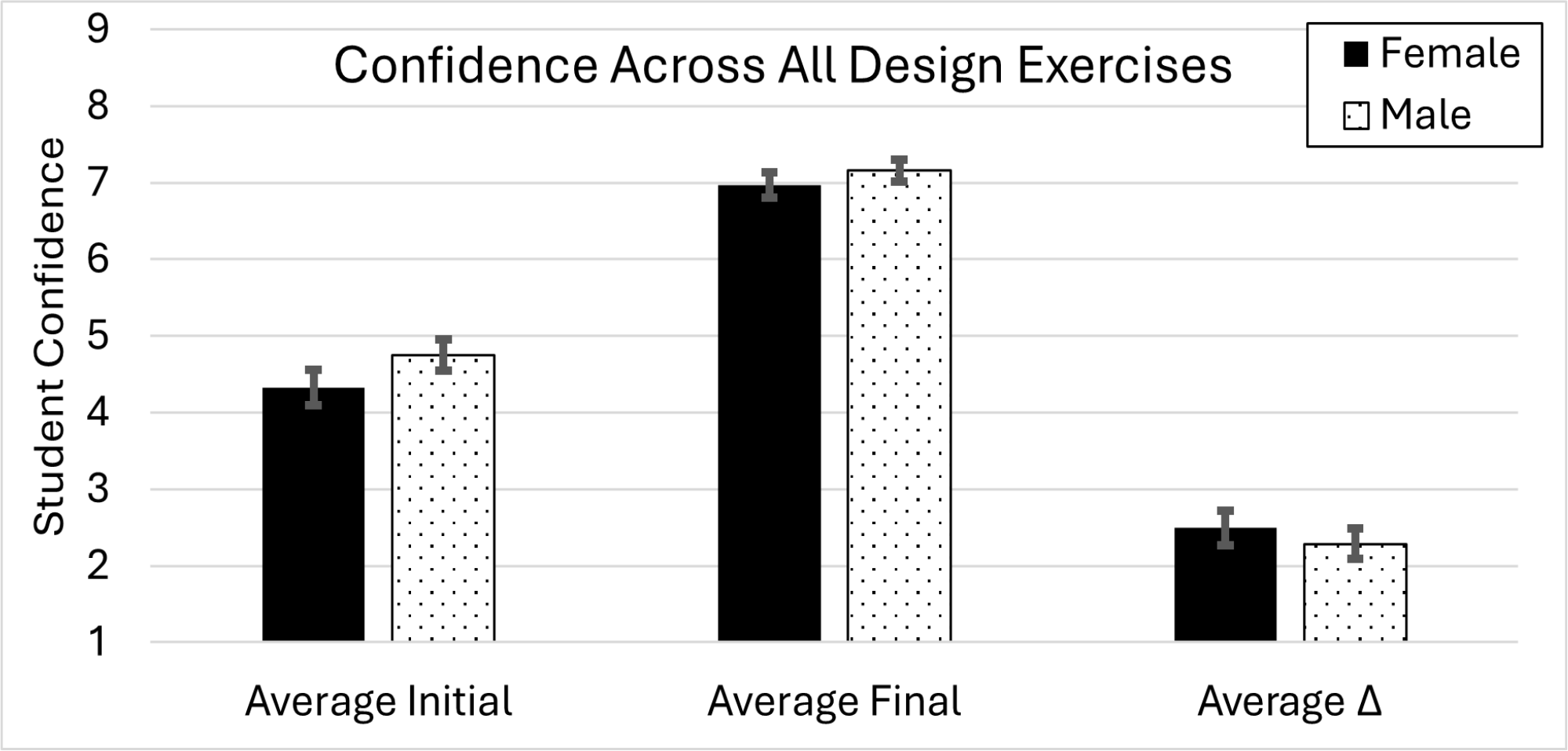
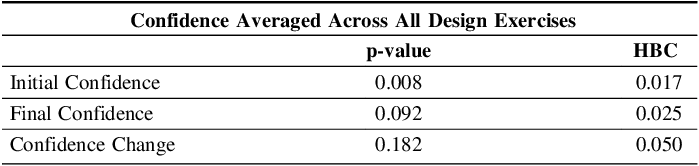
The collective treatment of initial, final, and change in confidence across all design exercises for statements 1, 2, 4, and 5 (excluding the repeated statement 3 which is evaluated separately) demonstrates a statistically significant difference in confidence between female (n = 201) and male (n = 225) students only for initial confidence, as seen in Figure 1. Statistical results are shown in Table 1.
Female and male student confidence across all design exercises and the change in confidence from initial to final. Error bars indicate 95% confidence levels

Statistical comparison of initial, final, and change in confidence of men and women averaged across all design exercises

3.2.2. Individual design exercises
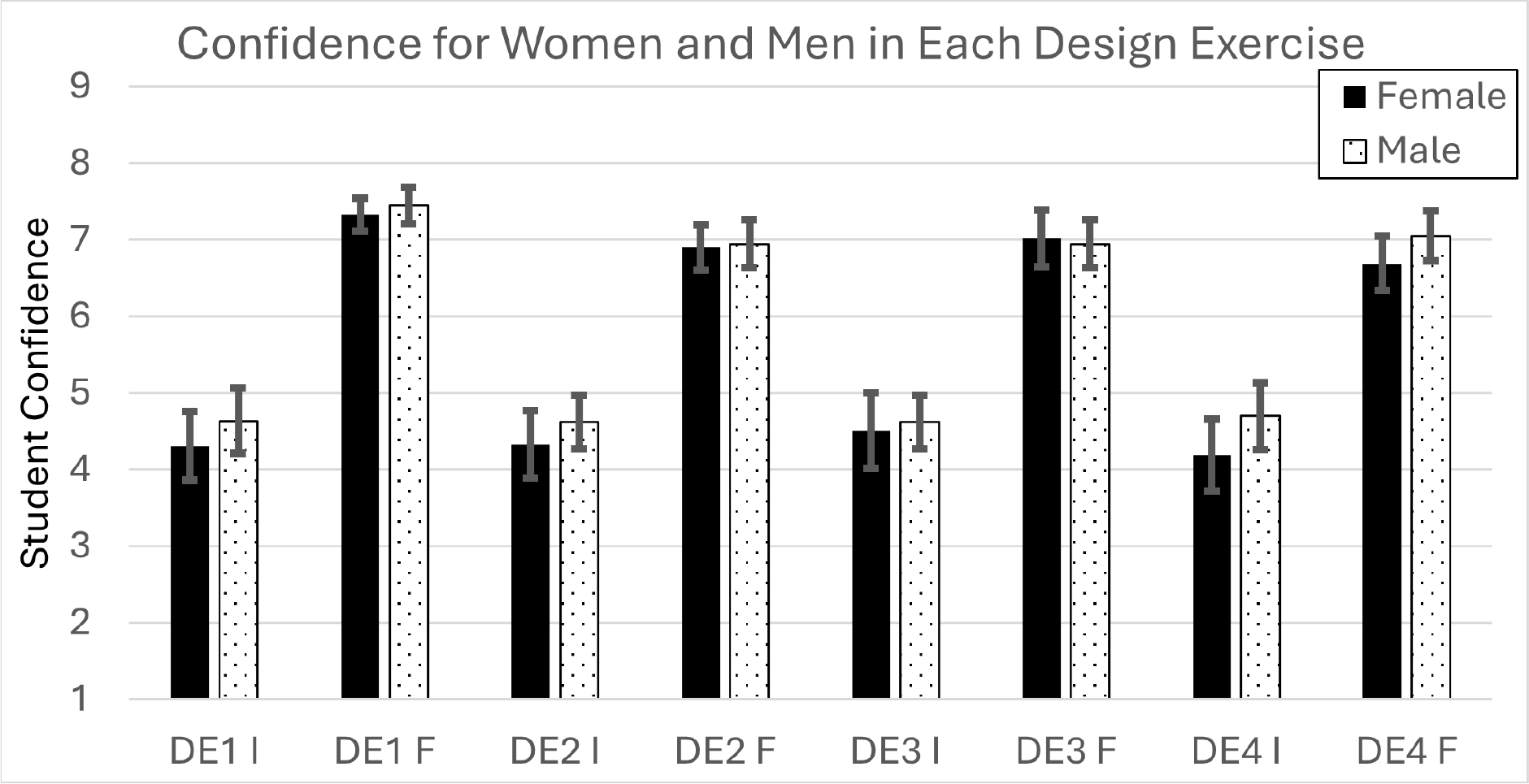
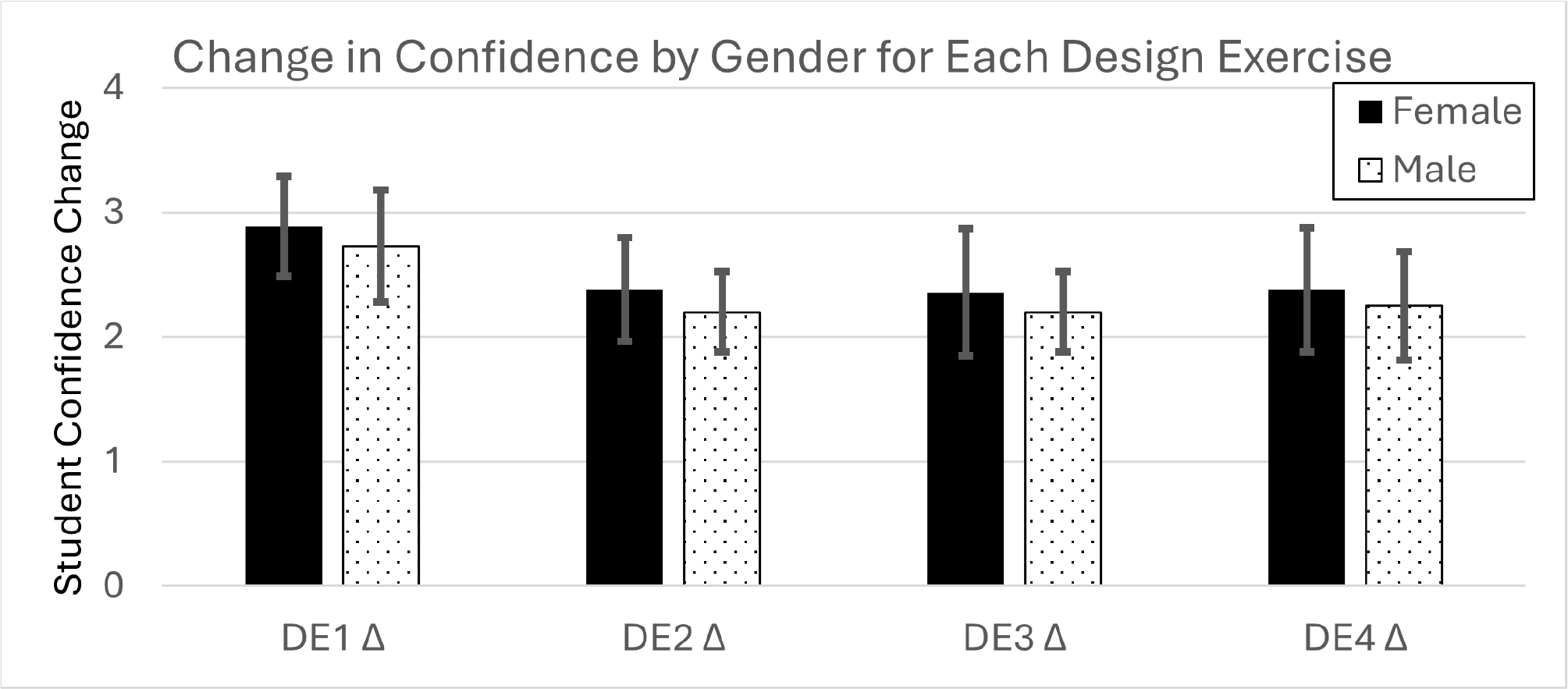
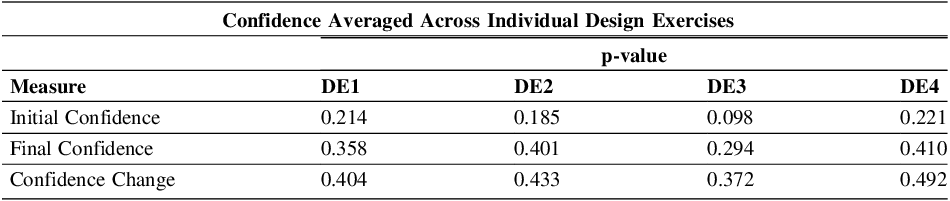
The individual treatment of initial, final, and change in confidence for each design exercises for statements 1, 2, 4, and 5 (excluding the repeated statement 3 which is evaluated separately) demonstrates no statistically significant difference in confidence between men and women students for initial or final confidence, as seen in Figure 2, or for change in confidence, as seen in Figure 3. The number of participants in this study for each design exercise is (Female/Male) DE1: 47/53, DE2: 52/60, DE3: 49/60, DE4: 53/54. Table 3 shows the result of the main effects regression with none rising no statistical significance.
Initial (I) and final (F) student confidence for each design exercise averaged over statements 1, 2, 4, and 5. Error bars indicate 95% confidence levels

Change in student confidence for each design exercise averaged over statements 1, 2, 4, and 5. Error bars indicate 95% confidence levels

Statistical comparison of initial, final, and change in confidence of men and women averaged across each individual design exercise

3.2.3. Statement 3 across individual design exercises
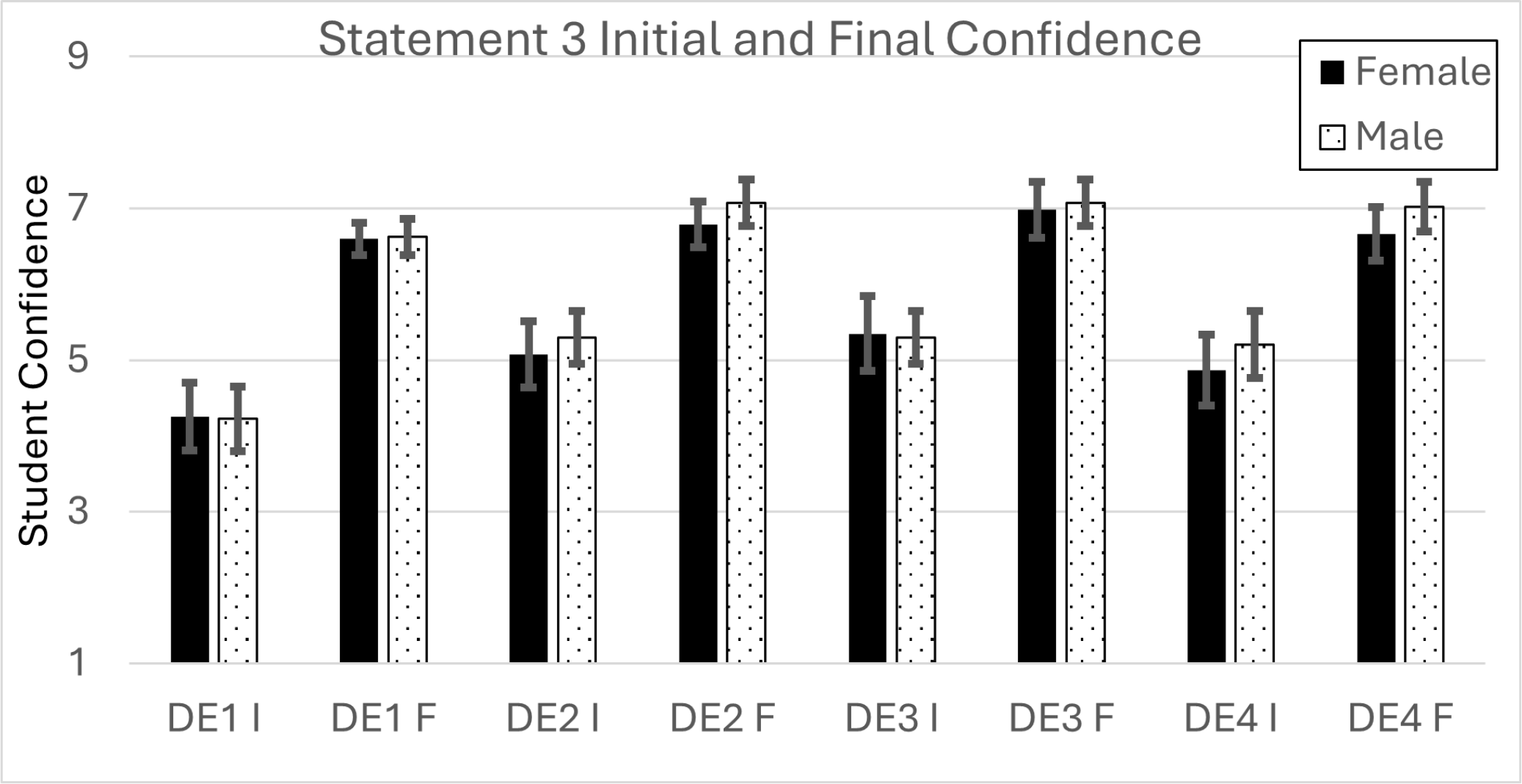
Statement 3 was intentionally repeated across exercises to serve as a topic-independent anchor enabling comparison of general design reasoning confidence. The individual treatment of initial, final, and change in confidence for each design exercises for statement 3 demonstrates no statistically significant difference in confidence between men and women students for initial or final confidence, as seen in Figure 4. The number of participants in this study for each design exercise is (Female/Male) DE1: 47/53, DE2: 52/58, DE3: 49/58, DE4: 53/54. However, there is a statistical difference between initial confidence for Design Exercise 1 and subsequent design exercises for all participants though this does not differ statistically significantly by sex when tested for interaction as seen in Table 4. Statistical models including sex-by-exercise interaction terms do not support a repetition-driven explanation for changes in Statement 3 confidence.
Initial (I) and final (F) student confidence for each design exercise averaged over statement 3 only. Error bars indicate 95% confidence levels

Statistical comparison of initial and final confidence of men and women averaged across each individual design exercise for statement 3 alone

3.2.4. Statisical summary
The term ‘sex’ is used consistently throughout to reflect the binary variable recorded in institutional enrolment data. For the combined analysis excluding Statement 3, the regression model for initial confidence was statistically significant (F(4, 416) = 8.67, p < .001, R2 = 0.077). Males reported higher initial confidence than females (β = 0.30, p = 0.008), a difference that remained significant after Holm–Bonferroni correction (adjusted α = 0.0167). In contrast, final confidence (p = 0.092) and change in confidence (p = 0.182) did not differ significantly by sex, with adjusted α thresholds of 0.0250 and 0.0500 respectively. The corresponding Hedges’ g values indicated a small-to-moderate effect for initial confidence (approximately 0.30) and negligible effects for final and change in confidence. These findings show that although men began with slightly higher confidence, the difference was eliminated by the end of the exercises.
When each design exercise (DE1–DE4) was analysed individually, none showed statistically significant differences in initial, final, or delta confidence by sex. Within-exercise effect sizes were small (|g| < 0.20) and confidence intervals overlapped substantially, indicating genuine similarity between groups rather than limited statistical power. Both male and female students showed comparable gains in confidence across all topics.
For the recurring Statement 3, initial confidence increased significantly across exercises (F(4, 416) = 8.67, p < .001, R² = 0.077), with significant coefficients for DE2 (β = 0.95, p = 0.0003), DE3 (β = 1.46, p < .001), and DE4 (β = 0.81, p = 0.002). These results indicate that students’ confidence in generating a design performance metric improved for subsequent design exercises following the first. The main effect of sex (β = 0.30, p = 0.10) and all interaction terms (p > .25) were non-significant, showing that both groups improved at similar rates. For final confidence on Statement 3, the model was not significant (F(4, 416) = 2.08, p = 0.083, R² = 0.020); only DE3 reached nominal significance (β = 0.47, p = 0.019), which did not remain significant after Holm–Bonferroni correction (adjusted α = 0.0167).
In summary, across all analyses, only initial confidence for the combined design exercises showed a statistically significant difference by sex. Final and change in confidence did not differ significantly, and no localized differences were found for individual exercises. The recurring Statement 3 showed steady increases in confidence for all students, with no interaction by sex. These results indicate that while male students began with slightly higher confidence, both groups demonstrated equivalent improvement and final confidence levels through repeated design-based learning experiences.
4. Discussion
Women reported a lower initial confidence collectively across the design exercise topics than men in this study. This difference was statistically significant after Holm–Bonferroni correction and represents the only case where sex predicted confidence. Final confidence and overall confidence gains did not differ significantly by sex, indicating that the exercises elevated confidence for all students and eliminated the initial gap by the conclusion of each activity. The convergence of confidence levels between men and women suggests that authentic design experiences can normalize affective outcomes without penalizing either group. There was no statistical significance between men and women for initial, final, or change in confidence for the individual design exercises. This may reflect the lower power of these exercises as the numerical (but not statistical) trend of lower initial confidence in female students is observed in each of these design exercises.
These findings parallel broader research on self-efficacy and identity formation in engineering education. Confidence is a central construct within Bandura’s framework of self-efficacy, shaping motivation, persistence, and performance in technical domains (Reference BanduraBandura, 1977). Prior work has consistently shown confidence differences between men and women are not explained by differences in achievement (Reference Whitcomb, Kalender, Nokes-Malach, Schunn and SinghWhitcomb, 2020) but rather by cultural and identity-related factors (Reference Liquete, Dekoninck and WiskerLiquete et al., 2025). The present results reinforce this interpretation. Women entered exercises less confident despite equivalent mastery of the prerequisite content, implying that confidence in design is partly determined by perceived belonging rather than by technical readiness. Final confidence was no longer statistically different between men and women following the exercises suggesting that the application of content to design was effective in mitigating the initial gap without negatively impacting any students.
Statement 3, the recurring prompt across all four exercises, produced a distinct pattern. Initial confidence for this statement increased significantly from Design Exercise 1 to the subsequent exercises, showing that students retained confidence related to the general ability to define performance metrics in terms of Function, Geometry, and Material. However, this growth was not sex-dependent, and final confidence values did not differ across design exercises after correction. The absence of sex-based effects in Statement 3 suggests that increasing confidence from recurring design activities is equally beneficial to both groups in this study.
Together, the results indicate that short, structured design exercises can provide equitable confidence growth in engineering science courses incorporating structured design activities. The pattern of higher male initial confidence but equal final confidence supports the interpretation that design-centered learning acts as a normalizing experience, enabling students who initially undervalue their abilities to reach similar self-efficacy levels as their peers. Such convergence is pedagogically significant given the established relationships between confidence, identity, and persistence in engineering programs (Reference Carberry, Gerber and MartinCarberry et al., 2018). When students leave each design activity equally confident, they are more likely to perceive themselves as competent contributors to engineering practice, reinforcing motivation and professional identity.
5. Utility and educational implications
Understanding how confidence develops across repeated design experiences provides important insight into both learning processes and identity formation in engineering education. Confidence is a core component of self-efficacy, which influences motivation, persistence, and performance in technical domains (Reference BanduraBandura, 1977). Numerous studies have demonstrated that differences in confidence between men and women in engineering are not necessarily aligned with differences in ability or achievement (Reference Whitcomb, Kalender, Nokes-Malach, Schunn and SinghWhitcomb, 2020). Rather, they reflect broader patterns of identity and belonging within engineering culture (Reference Litzler, Samuelson and LorahLitzler et al., 2014). In this study, students entered each design exercise having already completed the corresponding laboratory and theoretical content, yet their initial confidence varied by sex. These findings suggest that self-efficacy in design contexts is not solely determined by technical preparation but is also shaped by affective factors and prior experiences. The exercises appear to eliminate the initial confidence gap for women without reducing men’s confidence. This pattern indicates that the design process serves as a normalizing experience, promoting equity in confidence by providing authentic, mastery-oriented opportunities for both groups.
This outcome is particularly important given the strong relationship between confidence, identity, and persistence in engineering pathways (Reference Dasgupta and StoutDasgupta & Stout, 2014). Enhancing confidence may improve students’ perceived engineering identity and sense of belonging, which have been linked to sustained engagement and career choice (Reference Hirshfield and ChachraHirshfield & Chachra, 2019). Design-based pedagogies that foster self-efficacy, such as open-ended team projects and structured reflection, can thus contribute meaningfully to sex-based equity and the broader professional development of engineering students. The findings presented here reinforce the pedagogical value of design-based learning for supporting equitable confidence development among engineering students and suggest it is effectively applied in engineering science courses. Because confidence is both an outcome and a driver of engagement, interventions that reduce sex-based differences in initial confidence can have long-term benefits for persistence, participation, and professional identity. Educators and institutions seeking to promote inclusive excellence in engineering education should therefore consider design-centered approaches not only as vehicles for technical learning but also as mechanisms for enhancing self-efficacy and belonging. These results suggest that equity in confidence can be achieved through authentic, mastery-oriented experiences that preserve rigor while improving affective outcomes, a balance critical to shaping future engineers who are both capable and confident.
6. Conclusions and future work
Across multiple design exercises, students exhibited strong and consistent gains in confidence after completing short, structured design challenges that integrated analytical and creative reasoning. Although men entered the sequence with higher initial confidence, this difference disappeared following each exercise. The normalization of confidence across sexes occurred without a reduction in male confidence or a change in overall learning gains, indicating that these design exercises provide equitable benefits for all students. The results confirm that authentic, mastery-oriented design experiences can equalize affective outcomes, supporting both technical competence and self-efficacy.
The nearly balanced sex composition of the participating cohorts may have moderated the magnitude of confidence differences compared with more traditionally male-dominated environments. It remains possible that institutions with less parity would exhibit larger initial disparities or slower convergence. Future research should therefore examine similar interventions in settings with varying sex ratios to determine whether the observed normalization effect depends on classroom demographics. Additional work should also consider intersections of sex with race and ethnicity, since representation of minoritized groups remains low and may further shape affective outcomes (Reference Sperling, Mburi, Gray, Schmid and SaterbakSperling et al., 2024).
In sum, the data suggest that design exercises not only reinforce technical competence but also serve as affective interventions that promote self-efficacy and inclusion. Authentic, mastery-oriented challenges that connect theory with application appear to reduce sex-based confidence gaps and may thereby contribute to improved persistence and belonging in engineering education. Longitudinal studies that follow students beyond a single course could clarify whether the elimination of initial confidence differences persists over time and contributes to long-term retention in engineering programs. Analysis of solution correctness is outside the scope of the present work and represents an important direction for future research.Collectively, the findings demonstrate that design-centered learning experiences have dual value: they reinforce technical knowledge while serving as effective, inclusive mechanisms for improving affective outcomes. As engineering education continues to prioritize both competence and belonging, structured design exercises offer a scalable approach to fostering equity in confidence and professional identity.


 Open access

