
Skip to main content Accessibility help
×
  • Cited by 2
      • Edited by Michael Bach, Institute for Research and Development on Inclusion and Society, Ontario and Toronto Metropolitan University, Nicolás Espejo-Yaksic, Exeter College, Oxford, Universiteit Leiden and University College Cork
      Show more authors
    • You may already have access via personal or institutional login
    • Select format
    • Publisher:
      Intersentia
      Publication date:
      03 April 2024
      11 October 2023
      ISBN:
      9781839704284
      9781839703348
      Dimensions:
      Weight & Pages:
      Dimensions:
      Weight & Pages:
    • Subjects:
      Law, Human Rights
    You may already have access via personal or institutional login
  • Selected: Digital
    Add to cart View cart Buy from Cambridge.org
    Subjects:
    Law, Human Rights

    Book description

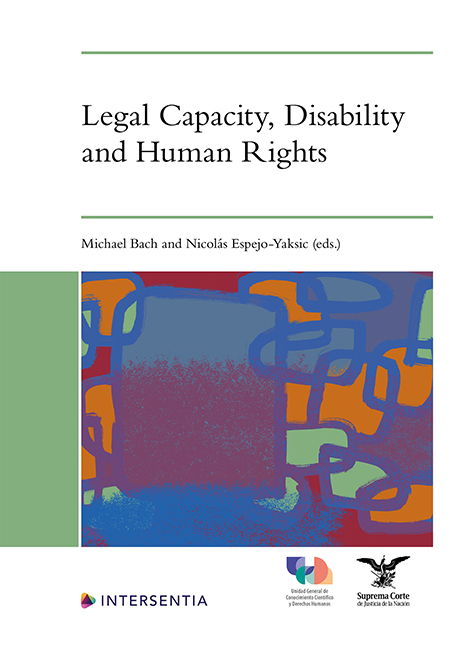
    Article 12 of the UN Convention on the Rights of Persons with Disabilities recognises the equal right to exercise legal capacity without discrimination based on disability, and obliges state parties to ensure access to the support a person may require in exercising it. Since its adoption, there has been a growing body of work by the UN Committee on the Rights of Persons with Disabilities, domestic and human rights courts, legal and policy researchers and civil society activists critically examining laws which restrict or remove the exercise of legal capacity based on disability. Traditionally, this work has focused on constitutional and legal standards regulating the exercise of legal capacity - guardianship or substitute decision making laws and mental health laws. However, reforming legal capacity seems to be an all-encompassing enterprise, which requires deeper attention to be paid to its historical, social and legal foundations, as well as the wide array of institutions that it permeates and their internal coherence. Legal Capacity, Disability and Human Rights comprises chapters by key legal scholars and practitioners in the field of legal capacity, disability and human rights from the Americas, Europe, Asia, Oceania and Africa. The book aims to achieve three main goals to address the aforementioned issues.

    Refine List

    Actions for selected content:

    Select all | Deselect all
    • View selected items
    • Export citations
    • Download PDF (zip)
    • Save to Kindle
    • Save to Dropbox
    • Save to Google Drive

    Save Search

    You can save your searches here and later view and run them again in "My saved searches".

    Please provide a title, maximum of 40 characters.
    ×

    Contents

    Metrics

    Full text views

    Total number of HTML views: 0
    Total number of PDF views: 0 *
    Loading metrics...

    Book summary page views

    Total views: 0 *
    Loading metrics...

    * Views captured on Cambridge Core between #date#. This data will be updated every 24 hours.

    Usage data cannot currently be displayed.

    Accessibility standard: Unknown

    Why this information is here

    This section outlines the accessibility features of this content - including support for screen readers, full keyboard navigation and high-contrast display options. This may not be relevant for you.

    Accessibility Information

    Accessibility compliance for the PDF of this book is currently unknown and may be updated in the future.
