

Introduction
The U.S. Temporary Assistance for Needy Families (TANF) serves as a safety net program providing cash and noncash assistance to families in need, with the aim of enhancing self-sufficiency. It operates through two funding sources: federal block grants (federal TANF) and state Maintenance of Effort (MOE) funds. The TANF funding structure transitioned from categorial to block grants through the enactment of the Personal Responsibility and Work Opportunity Act (PRWORA) in 1996. This shift was intended to grant states greater flexibility, allowing them to design programs tailored to their clients’ needs.Footnote 1
Central discussions surrounding the block grant system focus on two primary concerns: (1) the appropriate allocation of funds to intended services and (2) the risk of diverting funds away from targeted populations (Jacobsen & McGuire, Reference Jacobsen and McGuire1996). States are required to allocate TANF funds in accordance with TANF purposes.Footnote 2 However, these purposes are broadly defined, granting states substantial discretion in apportioning funds across various categories. While TANF funds are predominantly directed towards core areas,Footnote 3 there has been a notable trend over the past decade towards increasing the proportion allocated to state Earned Income Tax Credit (EITC) programs. State EITC programs, modelled after the federal EITC – an anti-poverty program that provides tax credits to assist low-income working individuals – offer state tax credits that are typically a percentage of the federal EITC. Expenditures on state EITC programs rank third in TANF fund allocation, following core activities and administrative costs, the latter of which covers operational expenses rather than direct program funding. The diversion of TANF funds to state EITCs constitutes a significant portion of the overall allocation, with approximately 9 percent of TANF funds directed towards refundable tax credits, primarily in the form of state EITCs (Azevedo-McCaffrey & Safawi, Reference Azevedo-McCaffrey and Safawi2022). This shift may be motivated by the belief that directing funds to state EITCs more effectively supports low-income working families compared with low-income nonworking individuals seeking job opportunities. Nonetheless, the increasing allocation of TANF funds to state EITC programs raises concern, as these funds could otherwise be directed to families in more immediate need.
Despite the potential for state EITC programs funded through TANF to reduce TANF recipients’ benefits, it is not definitive that diverting TANF funds to state EITC programs will necessarily diminish the resources available for TANF beneficiaries. Both programs are integral components of U.S. anti-poverty policies and share the common objective of promoting self-sufficiency and reducing poverty. The primary concern regarding the allocation of TANF funds to state EITCs stems from the differences in eligibility criteria of their target populations. State EITC eligibility requires meeting both financial and non-financial criteria, including having earned income from working. In contrast, TANF does not require applicants to have earned incomes at the time their eligibility is determined. The TANF Recipients’ Characteristics and Financial Circumstances report for fiscal year (FY) 2017 indicates that roughly 72 percent of TANF adult recipients are unemployed, with only 12.6 percent of recipient families earning income. Consequently, TANF recipients are frequently excluded from state EITC benefits, leading to apprehensions that reallocating TANF funds to state EITC programs might reduce the assistance available to low-income families with nonworking adults. Nevertheless, it is important to recognise that there is some overlap in the target populations of these programs, as TANF recipients who are employed can also benefit from state EITC programs.
As of 2017, only twenty-three out of 100 families in poverty receive TANF cash assistance (Schott, Floyd, & Burnside, Reference Schott, Floyd and Burnside2015), indicating that TANF’s direct impact on poverty reduction may be limited. In situations where cash assistance program such as TANF fall short of their intended impact, states may consider directing resources towards programs that demonstrate greater efficiency in achieving their goals. Utilising TANF funds for both working and nonworking low-income families becomes an effective response to tackle the complicated issue of poverty.
With an increasing number of states channelling TANF funds to expand state EITC programs (see Fig. 1), this paper investigates whether this diversion negatively impacts TANF recipients. If state EITC programs are funded by TANF funds at the expense of eligible TANF recipients’ benefits, such diversion could reduce their overall income (TANF and/or non-TANF incomes) and potentially widen changes in the poverty gap. Given that TANF recipients are required to meet eligibility and work requirements during their benefit receipt, it is reasonable to assume that many impoverished families leave TANF sooner than necessary due to various reasons, including lifetime limits, eligibility requirement, sanctions or increased earnings from work.Footnote 4
Classification of states by TANF fund diversion into state EITC program.

This study explores whether states’ diversion of TANF funds widens changes in the poverty gap for current TANF recipients and investigates whether this diversion also affects former TANF recipients. This article is structured as follows: the next section reviews the theoretical background on the anti-poverty effects of TANF and EITC programs, discusses the potential influence of TANF fund diversion on changes in the poverty gap, and outlines the research hypotheses. The subsequent section details the data and methods employed in the study. The presentation and discussion of empirical findings follow in the next section. The final section offers conclusions and implications for policy and research.
TANF and its anti-poverty effect
The current transformation of TANF, which mandates recipients to work in exchange for assistance, aligns with the welfare activation trends observed in various Organisation for Economic Co-operation and Development (OECD) countries during the late 1990s. Welfare activation emphasises reducing entitlements and requiring unemployed recipients to participate in work activities (Eriksen & Molander, Reference Eriksen and Molander2019; Wright, Reference Wright2016). Similar to many other countries, such as the UK and Norway, the United States implemented welfare reform in 1996. Since then, the literature on TANF has predominantly revolved around the repercussions of the welfare reform, generating a substantial body of research investigating how the economic wellbeing of recipients has changed after the welfare reform. This extensive body of work has primarily examined the impact of welfare reform and/or TANF policies – such as work requirements, sanctions, and time limits – on two main aspects: (1) TANF receipt and (2) the economic wellbeing of recipients. However, research findings regarding the effects of welfare reform have been inconsistent.
Some studies have pointed to positive consequences of welfare reform, indicating that welfare reform increased earnings/incomes of families (Schoeni & Blank, Reference Schoeni and Blank2000) or those of female-headed families (Grogger, Reference Grogger2003; Meyer & Sullivan, Reference Meyer and Sullivan2004)Footnote 5 while reducing welfare use/caseloads (Blank, Reference Blank2001; Moffitt, Reference Moffitt and Danziger1999). On the contrary, another line of research has argued that the impact of TANF on poverty is relatively modest. Hoynes, Page and Stevens (Reference Hoynes, Page and Stevens2006) suggest that TANF effects on the poverty are not substantial. While they find evidence that TANF program contributes to increasing incomes of low-income families, it is important to note that TANF transfers phase out at income levels below the poverty threshold. In addition, others have demonstrated that a substantial number of TANF recipients remained in poverty, even after the adoption of welfare reform (Brauner & Loprest, Reference Brauner and Loprest1999; Slack et al., Reference Slack, Magnuson, Berger, Yoo, Coley, Dunifon and Osborne2007).
Despite calls for more research on the long-term effect of welfare reform on the economic wellbeing or self-sufficiency of welfare leavers (Blank, Reference Blank2002), less is known about the duration of employment maintenance after leaving TANF and whether their working conditions (e.g. earnings, disposable incomes, and job status) improves as work hours increase. A few studies have indicated that former TANF recipients who left TANF due to employment and earnings were not significantly better off in terms of employment, incomes and earnings (Acs & Loprest, Reference Acs and Loprest2007). Specific research focussing on female householders with children has yielded similar findings, revealing declining employment rates over time and economic hardships following exit from TANF (Cancian et al., Reference Cancian, Haveman, Meyer and Wolfe2002; Cancian & Meyer, Reference Cancian and Meyer2000). It is also reported that former welfare recipients show a high likelihood of returning to the welfare system due to low earnings and unstable job status (Anderson, Halter, & Gryzlak, Reference Anderson, Halter and Gryzlak2004).
In summary, studies on the immediate consequences of TANF (e.g. changes in TANF caseloads or short-term changes in employment and earnings) have yielded inconsistent findings. Furthermore, the long-term effects of TANF on recipients who voluntarily or involuntarily left the program have not been adequately examined. Given this landscape, it remains challenging to definitely conclude that TANF, as a safety net program, has significantly contributed to poverty reduction amongst low-income families.
Earned Income Tax Credits (EITC) as an effective tool to reduce poverty
Earned Income Tax Credits (EITC) is a federal cash transfer program in the United States. Introduced in 1975, the EITC aimed to alleviate Social Security tax burdens of low-income working families. Its primary objective is to reduce the reliance on welfare programs, increase self-sufficiency and promote employment amongst low-income working families (Mendenhall MSW, Reference Mendenhall2006). In discussion about the working poor, research has highlighted that this group often does not receive benefits they qualify for in comparison with other groups, such as the non-working poor (Bendick, Reference Bendick1980; Kim & Mergoupis, Reference Kim and Mergoupis1997; Meyers & Lee, Reference Meyers and Lee2003). This argument is supported by analysing participation rates of eligible working poor individuals compared with non-working poor individuals for public assistance programs such as Food Stamps, TANF and Medicaid. Despite significant expansions of welfare program (e.g. EITC, Medicaid and Child Health Insurance Program) in the 1990s, working poor families still faced challenges accessing certain forms of assistance, such as childcare services and health insurance (Meyers & Lee, Reference Meyers and Lee2003; Seccombe & Amey, Reference Seccombe and Amey1995). In these situations where fewer benefits are offered to the working poor, the EITC has emerged as a successful program that both incentivises and rewards the work of low-income working families, becoming the largest cash transfer program in the U.S.
The effectiveness of the federal EITC has been assessed as it gradually expanded. Research findings consistently indicate that the EITC effectively reduces poverty (Haskins, Reference Haskins, Blank and Haskins2001; Gundersen & Ziliak, Reference Gundersen and Ziliak2004).Footnote 6 Its anti-poverty effects are particularly pronounced amongst low-income families with children (Kim, Reference Kim2001; Ozawa & Hong, Reference Ozawa and Hong2003), although there are various aspectsFootnote 7 that need further modification to alleviate poverty (Eamon, Wu, & Zhang, Reference Eamon, Wu and Zhang2009). Studies analysing the impact of EITC have utilised income/earnings, employment or poverty levels of low-income families to measure economic success or wellbeing. The labour supply incentives of the EITC vary on the basis of individual characteristics (e.g. marital status, working status, gender and education attainment). However, previous studies have offered consistent findings that the EITC encourages labour force participation amongst single parents with children (Eissa &Liebman, Reference Eissa and Liebman1996; Grogger, Reference Grogger2003; Meyer & Rosenbaum, Reference Meyer and Rosenbaum2001) and increases the incomes of low-income families (Hoynes & Patel, Reference Hoynes and Patel2018).
Eissa and Liebman (Reference Eissa and Liebman1996) provide evidence that the EITC encourages labour force participation amongst single women with children, and these effects are greater amongst those with less than a high school education. Unlike most studies focussing solely on the impact of federal EITC, Neumark and Wascher, Reference Neumark and Wascher2000) estimate the impact of both federal and state EITC on transitioning out of poverty by comparing earnings and employmentFootnote 8 of families with earnings below and above the poverty level. Their findings confirm that both federal and state EITCs have a positive impact on employment, especially for single mothers who initially were not in the workforce.
The effects of EITC have been mainly discussed in terms of whether it induces employment and whether it increases or decreases work hours. While labour supply disincentives do exist for married women eligible for the EITC (Eissa & Hoynes, Reference Eissa and Hoynes1998, Reference Eissa and Hoynes2004; Hoynes & Patel, Reference Hoynes and Patel2018), the EITC is known to encourage employment amongst single women with children, as mentioned earlier. It also offsets labour supply distortions that might arise amongst female welfare recipients (Eissa & Hoynes, Reference Eissa and Hoynes1998). However, evidence regarding the impact of the EITC on work hours of single mothers has been inconsistent. For instance, Eissa and Liebman (Reference Eissa and Liebman1996) find no evidence that the EITC leads to a decrease in work hours amongst single mothers already in the workforce. However, other studies support the positive effects of the EITC on work hours of single mothers (see Meyer and Rosenbaum, Reference Meyer and Rosenbaum2001; Grogger, Reference Grogger2003). This mixed evidence may result from the income ranges studied. For instance, Eissa and Liebman (Reference Eissa and Liebman1996) specifically concentrate on the phase-out range, wherein EITC benefits decrease as income exceeds a certain threshold. In contrast, other studies seem to consider the entire income spectrum of single mothers.
TANF fund diversion to state EITCs: its impact on TANF recipients
TANF programs are often referred to as a failure, as evidenced by the decline in TANF receipt and low benefit levels. In addition to these issues, the allowability of TANF expenditures – though legally permissible – has recently been criticised for straying from the program’s intended goals. According to a report by CBPP (2023), states have significantly reduced the portion of their federal and state TANF funds spent on core areas, diverting TANF funds to other programs such as childcare, refundable tax credits or pre-K/Head Start. On average, in FY 2021, states spent only 22.6 percent of their combined (federal and state) TANF funds on basic assistance, with state spending ranging from 4 percent to 75 percent (Shrivastava, Reference Shrivastava2023). These statistics suggest that the diversion of TANF funds may leave out those most in need, instead supporting families with incomes well above the poverty line.
The same report also points out states’ current practices of carrying over TANF fundsFootnote 9 and urges policy changes to ensure that a majority of TANF funds are spent on basic assistance, with a recalibrated focus on people with incomes below the federal poverty level. In 2021, states’ unspent TANF funds totalled $8 billion, nearly half of the total annual TANF block grants (Shrivastava, Reference Shrivastava2023). Additionally, sixteen states had unspent TANF funds equal to or exceeding their annual block grants (Shrivastava, Reference Shrivastava2023). States should not be criticised merely for carrying over TANF funds if they have adequately spent their allocations to assist those with incomes below the federal poverty level. In such cases, an increase in carried-over funds could reflect a decline in caseloads. However, given that the average proportion of eligible individuals receiving cash assistance between 2016 and 2018 was estimated at less than 30 percent (Falk, Reference Falk2023), it can be argued that states need to make greater efforts to include more eligible individuals and provide additional cash assistance. The current level of TANF spending may not be sufficient to address the needs of those who qualify assistance.
Given the uncertainty surrounding the effects of TANF on the economic wellbeing of recipients, states may find it more effective to utilise a portion of TANF funds to support the state EITC to reduce poverty for several reasons. First, the state EITC does not discourage work amongst single parents, alleviating concerns about potential welfare dependency (Beverly, Reference Beverly2002); TANF has been criticised for its incentive structure that distorts labour supply (Gruber, Reference Gruber2000). Second, the tax credits offered by the EITC provide beneficiaries with a sense of social inclusion (Sykes et al., Reference Sykes, Križ, Edin and Halpern-Meekin2015), resulting in less stigma compared with other means-tested programs (Martin & Prasad, Reference Martin and Prasad2014).
Unlike the extensive studies that have examined the impact of states’ discretion in designing the TANF program – focussing on eligibility rules, work requirements and sanctions – prior research has paid less attention to how states spend federal and state TANF funds at their discretion or empirically explored the impact of TANF fund diversion on recipients. Although there is no empirical evidence to support that the diversion of TANF funds negatively affects current recipients, it is reasonable to expect harm, given that the majority of adult TANF recipients are unemployed with no earned income, making them particularly vulnerable to reductions in basic assistance. While some TANF recipients, especially those who are working, might benefit from other programs, such as state EITC programs supported by the diverted funds, the overall impact of TANF fund diversion is likely detrimental to current recipients. Conversely, it may benefit some former recipients, particularly those who exited TANF due to employment. This underscores the need for empirical studies to explore the true impact of TANF fund diversion on recipients.
Drawing on prior literature’s concerns about the diversion of TANF funds and the effectiveness of EITC for the working poor, this study hypothesises that state governments’ decision to assist the working poor by utilising TANF funds for state EITC programs could negatively impact current TANF recipients, leading to an increase in changes in the poverty gap, as the majority of these recipients are unemployed. However, the impact on former TANF recipients is less clear, given the diverse reasons for their exit. While some former recipients who exited due to employment may benefit from state EITC, others are less likely to benefit if their exit was due to sanctions or non-compliance with work requirements. As a measure of poverty, this study employs 50 percent of the state median income of households with children as a threshold, as commonly practised by many researchers (Brady, Finnigan, & Hübgen, Reference Brady, Finnigan and Hübgen2017; Gornick & Jäntti, Reference Gornick and Jäntti2012; Parolin, Reference Parolin2019), and assesses the poverty gap by calculating the difference between this threshold and the average income of recipients. To analyse changes in the poverty gap, the disparity between the poverty gap at time points t and t−1 is calculated and used in the analysis.
Hypothesis 1: States allocating TANF funds (federal TANF funds + state MOE funds) to state EITC programs are expected to be associated with an increase in changes in the poverty gap for current TANF recipients, compared with states that do not allocate TANF funds to state EITC programs.
Hypothesis 2: States allocating TANF funds (federal TANF funds + state MOE funds) to state EITC programs will not experience significant changes in the poverty gap for former TANF recipients, compared with states that do not allocate TANF funds to state EITC programs.
Data and method
Data
To examine the impact of states’ TANF diversion on changes in the poverty gap for both current and former TANF recipients, this study uses multiple data sources, including the U.S. Census and various TANF reports provided by the Office of Family Assistance (OFA). The dependent variable is the change in the poverty gap, where the poverty gap is defined as the difference between 50 percent of the state median income for households with children and the average income of TANF recipients. The change in the poverty gap is calculated by subtracting the poverty gap at time point t−1 from the poverty gap at timepoint t.
The average income of TANF recipients includes both TANF incomes (i.e. TANF benefits) and non-TANF incomes, as some recipients are employed. For current TANF recipients with both TANF and non-TANF income, their combined income is used, while for former TANF recipients, who only have non-TANF income, their average non-TANF income is employed in the calculation. The U.S. Census Bureau provides data on the median income of households with children, while information regarding TANF and non-TANF incomes for current and former recipients is derived from the OFA’s annually released Characteristics and Financial Circumstances of TANF Recipients report.
In addition to the primary models using 50 percent of the state median income for households with children, a widely used standard for calculating the poverty gap, the ‘poverty threshold’ issued by the Census Bureau – used for the official poverty measure – is also used as a benchmark. This is because 50 percent of the state median income for households with children may be too high a threshold for TANF recipients.Footnote 10 The main models using 50 percent of the state median income for households with children are reported in models 1 and 2, while the additional analyses are reported in models 3 and 4.
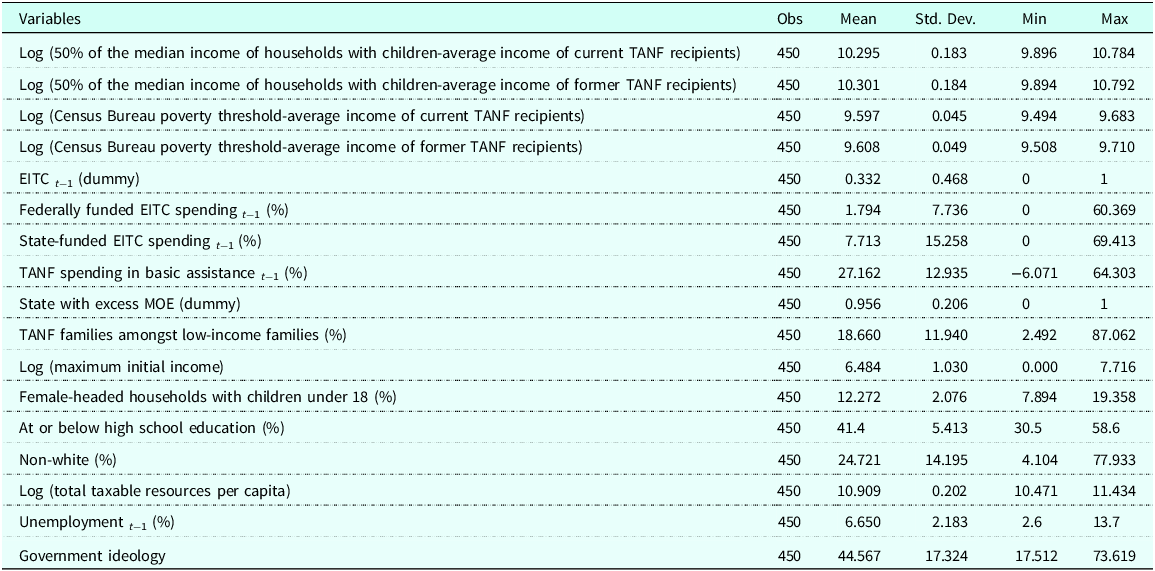
Each model incorporates the same independent and control variables. The primary independent variable is a dummy variable indicating whether states allocate TANF funds to state EITC programs. A positive (or negative) coefficient of TANF fund diversion indicates greater instability (or improved stability) and a widening (or narrowing) poverty gap over time. Additionally, the percentages of EITC funded by federal sources (federal TANF funds) and EITC funded by state MOE funds are included as two other independent variables to assess whether the funding source impacts changes in the poverty gap in distinct ways. However, their impacts are not hypothesised, as it is unclear whether states’ use of either federal TANF funds or state MOE funds to expand state EITC programs would lead to differential spending behaviours that could benefit or harm current and former TANF recipients. States utilise either federal TANF funds or state MOE funds, or sometimes a combination of both, to offer state EITC benefits. Only a few states employ both federal and state MOE funds for their EITC program. As presented in Table 1, there is huge variation in states’ diversion of TANF funds to state EITC programs, ranging from 0 percent to 60.37 percent of federal TANF funds and from 0 percent to 69.41 percent of state MOE funds, although the average is less than 10 percent for both funding sources.
Descriptive statistics

To address cases in which some states allocate more state MOE funds than required, a dummy variable is included to identify states that report exceeding the minimum requirements, termed ‘excess MOE’.Footnote 11 Noting the concern that states are reducing their spending on core activities, an annual percentage of TANF expenditures allocated to basic assistanceFootnote 12 is included in the analysis. The Office of Family Assistance (OFA) provides annual TANF Financial Data containing information on expenditures across various categories. Data on states’ annual TANF expenditures and the number of households receiving TANF benefits are derived from the same TANF financial data provided by OFA.
Furthermore, other TANF-related variables that might influence changes in the poverty gap are taken into account. First, the percentage of TANF-receiving families amongst low-income families is included. Low-income families are defined as those with incomes below 100 percent of the poverty level estimated by the U.S. Census Bureau. There is considerable variation amongst states in the proportion of TANF-receiving families amongst low-income families. For example, in 2013, this proportion ranged from approximately 87.1 percent in Maine to 2.8 percent in Wyoming. Second, the maximum monthly initial earnings a family of three is allowed to have and still be eligible for TANF benefits are included. The amounts of initial earnings that states do not count when determining TANF applicants’ eligibility vary across states, indicating different levels of generosity in the TANF program. Empirical evidence shows mixed effects: stringent TANF policies lower the odds of working poor women transitioning to TANF recipients, but also discourage them from becoming working non-poor (Cheng, Reference Cheng2010). Information on the number of families with incomes below 100 percent of the poverty level is gathered from the U.S. Census Bureau, and the data regarding the maximum initial earnings are obtained from the Urban Institute website.
This study employs a set of state economic and demographic factors as control variables to examine the influence of the internal state economy and demographic composition on changes in the poverty gap. Given that TANF clients are predominantly female householders with children, the models include a percentage of female-headed households with children under 18 years. To capture the economic conditions and the fiscal capacity of states, this study utilises the previous year’s unemployment rate and the total taxable resources per capita, with data obtained from the Department of Labor and the Department of Treasury (DOT), respectively. For demographic composition, variables such as the percentage of non-white individuals and the percentage of individuals aged 25 years or older with a high school degree or less are included. All data were collected from the U.S. Census Bureau. Lastly, the government ideology, as defined by Berry et al. (Reference Berry, Fording, Ringquist, Hanson and Klarner2010), is incorporated into the model, as the ideology of state governments may influence the prioritisation of assistance to the working poor over the non-working poor. Higher values of the government ideology variable indicate a more liberal orientation of the state government. Descriptive statistics of all variables used in this study are presented in Table 1.
Method
The dataset used in this study is a balanced panel of all fifty states over a span of 9 years from 2008 to 2016. The primary models (models 1 and 2) presented in Table 2 are analysed using a fixed-effects estimation method on the basis of the Hausman test. The test results show that all models significantly reject the null hypothesis with p-values less than 0.01, indicating that fixed-effects estimation is preferred over random-effects estimation. The model specification is as follows:
 $$\eqalign{ & \Delta {y_{it}} = {\beta _{0{\rm{\;}}}} + {\beta _1}{\rm{\;}}TANF{\rm{\;}}Diversio{n_{it - 1}} + {\beta _2}{\rm{\;}}Proportion{\rm{\;}}of{\rm{\;}}Federally{\rm{\;}}funded{\rm{\;}}EIT{C_{it - 1}} \cr & + {\beta _3}{\rm{\;}}Proportion{\rm{\;}}of{\rm{\;}}State{\rm{\;}}MOE{\rm{\;}}funded{\rm{\;}}EIT{C_{it - 1}} + {\beta _4}{\rm{\;}}{X_{it}} + {\alpha _i} + {\delta _t} + {u_{it}} \cr} $$
where $\Delta {y_{it}}$
denotes changes in the poverty gap within state i at time of t, and X
it
represents time-varying covariates related to the TANF program and demographics that could potentially influence changes in the poverty gap. State-fixed effects (α
i
) have been incorporated to account for time-invariant factors unique to each state that might impact changes in the poverty gap. Additionally, the parameter δ
t
corresponds to year-fixed effects, accounting for unobserved effects that change over time while remaining constant across states.
$\Delta {y_{it}}$
denotes changes in the poverty gap within state i at time of t, and X
it
represents time-varying covariates related to the TANF program and demographics that could potentially influence changes in the poverty gap. State-fixed effects (α
i
) have been incorporated to account for time-invariant factors unique to each state that might impact changes in the poverty gap. Additionally, the parameter δ
t
corresponds to year-fixed effects, accounting for unobserved effects that change over time while remaining constant across states.
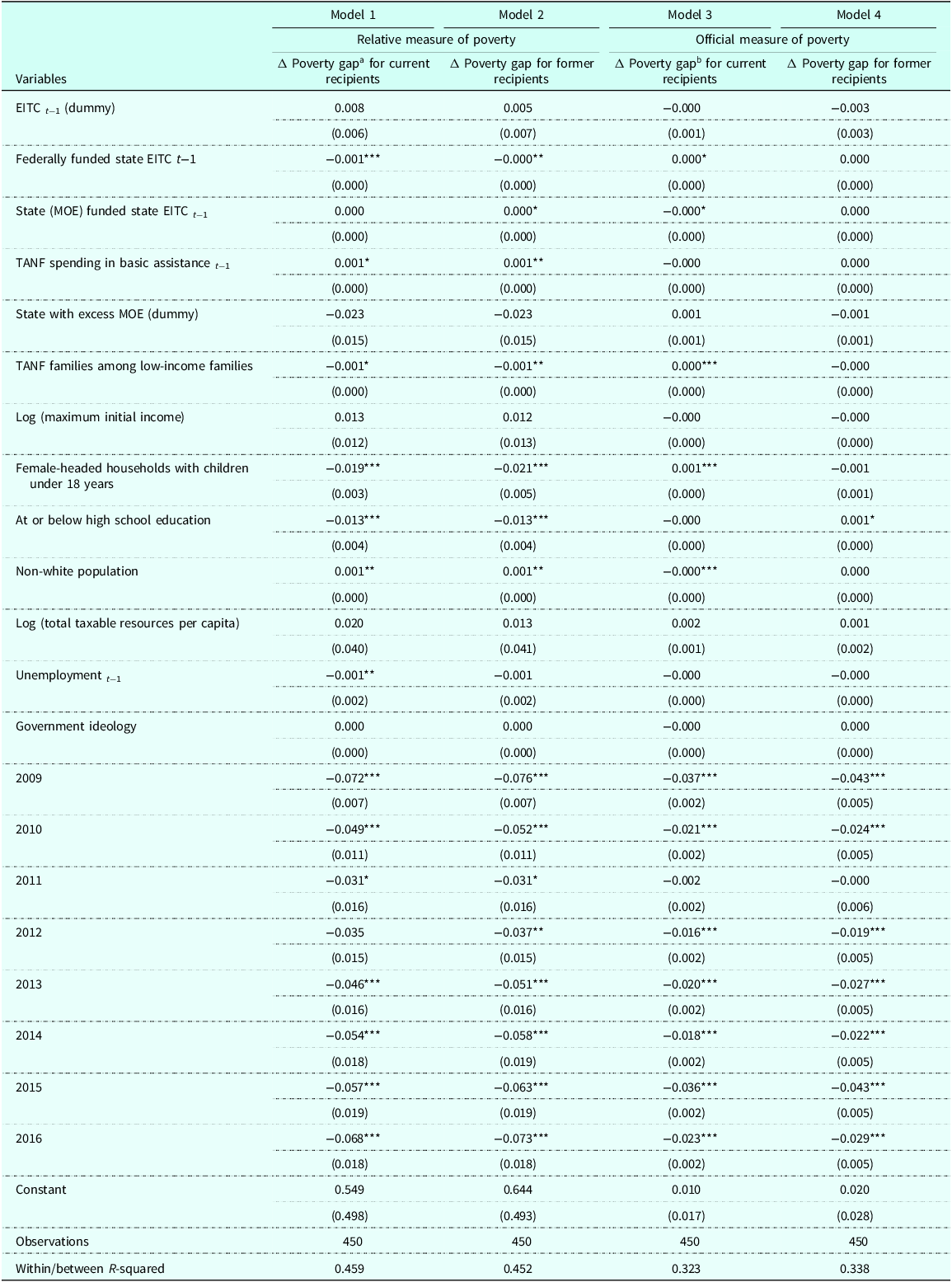
The impact of states’ TANF fund diversion on changes in the poverty gap

Note: ***p < 0.01, **p < 0.05, *p < 0.1; standard errors are clustered by states. Models 3 and 4 are analysed using random-effects estimation on the basis of the results of the Hausman test.
a The poverty gap is measured by the difference between 50 percent of the median income of households with children and the average incomes of TANF recipients. In terms of changes in the poverty gap, the difference between the poverty gap at timepoint t and t−1 is calculated and then subjected to logarithmic transformation for analytical purpose.
b In Models 3 and 4, the threshold used to calculate the poverty gap is the ‘poverty threshold’ issued by the Census Bureau. For the final models, the poverty threshold for a family size of two with one child is applied.
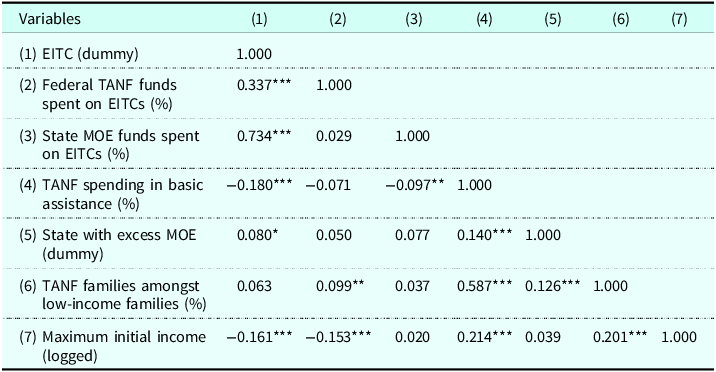
As presented in Table 1 in the Appendix, the correlations between the variables are all below 0.6, except the correlation between the EITC dummy variable and the proportion of state MOE funded EITC. The correlation between these variables is 0.734, which slightly exceeds the generally accepted threshold of 0.7. As a diagnostic to detect multicollinearity, variance inflation factor (VIF) values are calculated. VIF values for each variable are less than 4, with an average VIF value of 2.43. Considering correlations and VIF values, it can be inferred that the model is not substantially impacted by serious multicollinearity issues. To address concerns related to heteroscedasticity and autocorrelation, standard errors clustered by states are provided.
Results
As presented in Table 2, the utilisation of TANF funds for state EITC programs is not statistically associated with changes in the poverty gap across all models, thus failing to support the first and second hypotheses. This result suggests that states’ diversion of TANF funds to state EITC programs does not lead to significant changes, either a contraction or expansion, in the poverty gap experienced by both current and former TANF recipients. However, it becomes evident that the nature of funding sources – whether they originate from federal TANF funds or state MOE funds – exerts varied effects on changes in the poverty gap. According to models 1 and 2, a 1-percentage-point increase in the proportion of federal TANF funds diverted to state EITC programs leads to a 0.1 percent and 0.0 percent reduction in changes in the poverty gap for current and former TANF recipients, respectively. Conversely, the proportion of state MOE funds allocated to state EITC programs does not significantly affect changes in the poverty gap for current recipients, but the changes in the poverty gap for former recipients increases by 0.0 percent for every 1-percentage-point increase in the proportion of state MOE funds allocated to state EITC programs.
When the poverty threshold set by the Census Bureau is used to calculate changes in poverty gap, the results are quite different from those using 50 percent of the state median income for households with children. According to models 3 and 4, a 1-percentage-point increase in the proportion of federal TANF funds spent on state EITC is associated with a 0 percent increase in changes in the poverty gap for current recipients by 0 percent. In contrast, a 1-percentage-point increase in the proportion of state MOE funds diverted to state EITC programs leads to a decrease in the changes in the poverty gap for current recipients by 0.0 percent. While there is some evidence suggesting that the funding source may have a differential impact on changes in the poverty gap, it would be premature to draw definitive conclusions about the positive or negative effects of funding sources on changes in the poverty gap. This caution is warranted because the coefficients are nearly zero with small standard errors, and the directions of the coefficients shift depending on the threshold used in calculating changes in the poverty gap.
Contrary to the concerns raised by Schott, Floyd and Burnside (Reference Schott, Floyd and Burnside2015), the proportion of TANF spending on basic assistance, including cash assistance, exhibits a positive association with changes in the poverty gap for both current and former TANF recipients. As shown in models 1 and 2, a 1-percentage-point increase in the proportion of both federal TANF funds and state MOE funds diverted to state EITC programs leads to a 0.1 percent increase in changes in the poverty gap for current and former recipients. However, when the Census poverty threshold is used, as shown in models 3 and 4, the proportion of TANF spending on basic assistance has no notable effect on changes in the poverty gap.
In relation to other TANF-related variables, the discernible impact appears, at best, to be minimal. Firstly, states that allocate MOE funds beyond the mandated minimum do not seem to contribute to a reduction in changes in the poverty gap for both either current or former TANF recipients, as indicated by the lack of statistical significance across all models. Next, as shown in models 1 and 2, states with a higher proportion of TANF families amongst low-income families exhibit a negative association with changes in the poverty gap for both current and former TANF recipients. Specifically, a 1-percentage-point increase in the proportion of TANF families amongst low-income families leads to a 0.1 percent decrease in changes in the poverty gap for both current and former recipients. However, in models 3 and 4, which use the Census Bureau’s poverty threshold, the results differ. Here, a 1-percentage-point increase in the proportion of TANF families amongst low-income families results in a 0.1 percent increase in changes in the poverty gap, with no significant influence on changes in the poverty gap for former recipients. The maximum initial earnings families are allowed to have while remaining eligible for TANF is not significantly associated with changes in the poverty gap for either current or former TANF recipients across all models.
Overall, the demographic and economic characteristics of each state seem to be significant in predicting changes in the poverty gap for current and former TANF recipients. Amongst the demographic factors, states with a larger proportion of female-headed households with children under 18 years tend to see a reduction in changes in the poverty gap across all models. Specifically, as shown in models 1 and 2, a 1-percentage-point increase in female-headed households with children under 18 years corresponds to a decrease of approximately 1.9 and 2.1 percentage points in the changes in the poverty gap for current and former TANF recipients, respectively. Additionally, a higher proportion of individuals with high school degrees or less in a state is associated with a greater likelihood of reducing changes in the poverty gap for both current and former TANF recipients. The racial composition of state residents also significantly affects changes in the poverty gap. A 1-percentage-point increase in the proportion of the non-white population in a state results in a 0.1 percent increase in changes in the poverty gap for both current and former TANF recipients. However, the impact of state demographic variables on changes in the poverty gap is less substantial in models 3 and 4, as indicated by the statistical significance and the size of coefficients.
Regarding the economic characteristics of states, a state’s fiscal capacity does not significantly affect changes in the poverty gap for either current or former TANF recipients across all models. However, the unemployment rates from the previous year are negatively associated with changes in the poverty gap, but only for current recipients, presenting no significant effect in other models. A 1-percentage-point increase in the previous year’s unemployment rate in a state leads to a reduction in changes in poverty gap for current TANF recipients by 0.1 percent. This result seems contrary to the commonly accepted argument that unemployment increases poverty (Ayala, Cantó & Rodríguez, Reference Ayala, Cantó and Rodríguez2017; Blank & Blinder, Reference Blank and Blinder1985). Nevertheless, some evidence suggests a pronounced trade-off between poverty and unemployment within the labour category of low-paying jobs. Lastly, state government ideology shows no significant association with changes in the poverty gap.
Discussion
This study makes both academic and practical contributions. Academically, it establishes a foundation for further empirical examinations of TANF fund diversion. Concerns have been raised about how states manage their TANF block grants, with suggestions that such management could result in fewer financial resources available for TANF programs (Schott, Floyd & Burnside, Reference Schott, Floyd and Burnside2015). However, previous literature has not empirically investigated whether this diversion generates negative consequences for TANF clients or those in need. Given the increasing number of states diverting TANF funds to other programs, this topic is likely to become a subject of debate as new legislation regarding TANF expenditures is proposed.
In 2023, the Department of Health and Human Services (DHHS) proposed rulemakingsFootnote 13 related to TANF expenditures to strengthen the program role as a safety net and ease administrative burdens. These proposed rulemakings include clarifications of terms related to program purposes and regulations guiding state TANF expenditures, as well as revisions of regulations to ensure that only governmental spending is counted as state MOE expenditure. These proposals aim to encourage states to be more responsible in their TANF spending to meet program purposes. It is critical to assess states’ flexibility in implementing TANF, particularly in terms of spending practices, to determine whether it effectively serves those most in need, as aligned with TANF’s purposes, and to evaluate the effects of TANF fund diversion, given the concerns about states’ current spending practices and calls for more targeted TANF expenditures.
Additionally, the empirical findings of this study suggest that states’ diversion of TANF funds does not disadvantage low-income nonworking individuals at the expense of benefitting low- to moderate-income workers. Within the 9-year scope of this study, the diversion of TANF funds does not negatively impact the severity of poverty as measured by changes in the poverty gap for both current and former TANF recipients. Models 3 and 4 present the results of additional tests conducted using a different threshold for calculating changes in the poverty gap. These additional test outcomes also reveal that the diversion of TANF funds does not lead to changes in the poverty gap for current and former TANF recipients.
From a practical perspective, this finding offers meaningful policy implications for public managers and professionals responsible for allocating funds to programs with similar or aligned objectives. This study proposes that TANF fund diversion could be a decision made by states to pursue poverty reduction, particularly when the anti-poverty impact of TANF remains inconclusive. Assuming that states maintain their TANF eligibility criteria and benefit levels unchanged, the utilisation of TANF funds to support low-income working individuals could contribute to an overall reduction in poverty, provided it does not adversely affect current and potential TANF recipients. Similarly, states’ discretion in managing TANF funds, based on the unique characteristics of their resident populations, could lead to the development of more targeted approaches, yielding improved outcomes related to poverty reduction.
There are several limitations to the analyses presented in this study. First, this study does not discuss the diminishing role of the TANF program or assess the adequacy of its eligibility criteria and benefit levels in effectively supporting low-income families. Consequently, the findings of this study do not address how to lift low-income nonworking or working individuals out of poverty. Given that most TANF recipients do not earn income, and TANF benefit levels fall considerably below the federal poverty line, it is evident that the TANF program has not successfully fulfilled its intended goals of fostering self-sufficiency and providing essential assistance. A comprehensive discussion on poverty reduction should include not only tax credit policies aimed at stimulating employment amongst low- to moderate-income workers, but also public assistance programs that function as a fundamental safety net, lifting low-income nonworking individuals out of poverty and enhancing their employment prospects. In this context, this study lacks a thorough perspective on understanding poverty reduction.
Additionally, certain empirical findings of this study require further examination. For instance, it is essential to investigate why federal TANF funds and state MOE funds allocated to state EITC programs exhibit distinct effects on changes in the poverty gap. It is presumed that if states utilise federal TANF funds to expand state EITC programs, they can conserve state funds that might otherwise have been allocated for such expansion. This reallocation could potentially reduce poverty if those funds are redirected towards other state programs with the shared goal of poverty reduction. Moreover, the positive association between states’ expenditure on basic assistance and changes in the poverty gap for both current and former recipients is puzzling but does not inherently suggest that TANF plays a negative role in reducing changes in the poverty gap. This is because there has been consistent criticism that TANF cash benefit levels are insufficient to adequately address the basic and ongoing needs of low-income individuals (Thompson, Azevedo-Mccaffrey, & Carr, Reference Thompson, Azevedo-Mccaffrey and Carr2023a, Reference Thompson, Azevedo-Mccaffrey and Carr2023b). Similarly, the negative association between the previous year’s unemployment rate and changes in the poverty gap for current TANF recipients is counterintuitive. One possible explanation is that reducing unemployment can result in lower real wages, subsequently decreasing real incomes and increasing poverty (Agéno, Reference Agéno2004). To fully understand the negative impact of unemployment on changes in the poverty gap experienced by both current and former TANF recipients, additional information, such as the extent of wage decline, is needed.
Lastly, this study acknowledges the possibility that empirical results could change if the number of states spending TANF funds on state EITC programs and the proportion of TANF spending on the state EITC programs increase significantly beyond current levels. Future research could explore determining the optimal level of TANF spending diverted to state EITC programs that effectively improves poverty conditions without compromising the benefits of potential and ongoing TANF recipients.
The TANF program is undergoing significant changes following President Biden’s signing of the Fiscal Responsibility Act (FRA) of 2023. This Act revises the base year used for calculating caseload reduction credits from FY 2005 to FY 2015, effective in FY 2026, and addresses the elimination of practices such as ‘issuing small checks’, which some states have exploited to meet TANF work requirementsFootnote 14 (Falk, Reference Falk2023). These changes will tighten states’ compliance with TANF work requirements, prompting states to reconsider the current manner in which TANF funds are being utilised to ensure their spending practices effectively encourage work-eligible TANF recipients to meet tougher work requirements. In this context, it is necessary to explore the effective composition of TANF expenditures to promote TANF recipients’ work engagement and self-sufficiency and to reduce the overall poverty gap.
Conclusions
This study aimed to answer whether states’ diversion of TANF funds to the state EITC program increases changes in the poverty gap experienced by both current and former TANF recipients, in light of concerns that diverting TANF funds to other programs could diminish the benefits that current or potential TANF recipients might otherwise receive. This study finds no evidence suggesting that the diversion of TANF funds leads to negative consequences by increasing changes in the poverty gap for TANF recipients, at least within the 9-year timeframe covered by this study. While the allocation of federal TANF funds to state EITC programs appears to contribute to reducing changes in the poverty gap, the impact is minimal, as indicated by the coefficients’ proximity to zero.
Competing interests
The author declares none.
Appendix
Correlation among independent variables

Note: ***p < 0.01, **p < 0.05, *p < 0.1.


 Open access

