





Normative fluctuations in progesterone and oestradiol during the luteal phase of the menstrual cycle can be associated with affective, behavioural and somatic symptoms. Although mild premenstrual symptoms are common in females, with about 90% experiencing at least one symptom during their reproductive years, Reference Dennerstein, Lehert and Heinemann1 in individuals with core premenstrual disorders (PMDs), these symptoms are associated with considerable distress and impairment in everyday life. Core PMDs comprise premenstrual syndrome (PMS), which affects about 20–30% of females of reproductive age, Reference Dennerstein, Lehert and Heinemann1,Reference Steiner, Macdougall and Brown2 and premenstrual dysphoric disorder (PMDD), which is at the most severe end of the spectrum and affects about 3% of females of reproductive age. Reference Reilly, Patel, Unachukwu, Knox, Wilson and Craig3 Core PMDs are characterised by the cyclic recurrence of symptoms that are confined to the luteal phase of the menstrual cycle and subside shortly after the onset of menses. PMDD is recognised as a depressive disorder in the DSM-5, 4 and has also recently been added to the ICD-11. 5 Based on the DSM-5, a diagnosis of PMDD requires the presence of at least five symptoms out of 11 symptom categories, including at least one affective symptom, that significantly interfere with work or school performance, usual activities or relationships with others. The criteria for PMS, according to the American College of Obstetricians and Gynecologists (ACOG), are mostly equivalent to those for PMDD, with the exception that only one symptom from any domain must be present and must interfere with normal activities. 6 Given that the timing of symptoms is a key criterion, a diagnosis of PMS or PMDD requires confirmation of symptoms by prospective daily self-ratings over at least two consecutive menstrual cycles, although a provisional diagnosis can be made by a clinician. 4,6 In the present study, the terms PMS and PMDD are used in accordance with the ACOG and DSM-5 criteria, respectively, unless otherwise stated.
Regarding the aetiology of PMDs, current research assumes that hypersensitivity to normative cycle-related changes in progesterone and oestradiol, and their metabolites, in particular allopregnanolone, may underlie the symptoms. Reference Hantsoo and Epperson7–Reference Schmidt, Nieman, Danaceau, Adams and Rubinow12 A possible pathway through which individuals develop this hypersensitivity may be an abnormal sensitisation in the stress response system and a dysregulation of the interaction between the hypothalamic-pituitary-gonadal (HPG) axis, which is involved in controlling the release of gonadal hormones, and the hypothalamic-pituitary-adrenal (HPA) axis, the major neuroendocrine stress response system. Reference Eisenlohr-Moul, Rubinow, Schiller, Johnson, Leserman and Girdler13–Reference Schweizer-Schubert, Gordon, Eisenlohr-Moul, Meltzer-Brody, Schmalenberger and Slopien15 Indeed, stress has repeatedly been implicated in the development, maintenance and exacerbation of PMS symptoms, Reference Beddig, Reinhard and Kuehner16–Reference Lee and Im18 with evidence suggesting a dampened HPA axis function in PMS, reflected by lower cortisol levels, Reference Girdler, Pedersen, Straneva, Leserman, Stanwyck and Benjamin19–Reference Nayman, Schricker, Reinhard, Dreer, Richter and Kuehner21 a delayed and attenuated cortisol awakening response, Reference Beddig, Reinhard and Kuehner16,Reference Hou, Huang and Zhou22 and a blunted cortisol response to stress. Reference Hamidovic, Davis and Soumare23,Reference Huang, Zhou, Wu, Wang and Zhao24
The association between stress and premenstrual symptoms is also evident on a subjective level: studies suggest that premenstrual symptoms are associated with higher levels of subjective stress, and symptoms appear to be exacerbated during times of stress. Reference Fontana and Badawy25–Reference Yamamoto, Okazaki, Sakamoto and Funatsu31 This relationship might be particularly relevant during the luteal phase of the menstrual cycle, pointing to cycle-related effects on the relationship between subjective stress and premenstrual symptoms. Reference Gonda, Fountoulakis, Csukly, Telek, Pap and Rihmer32 In a literature review on stress and premenstrual symptoms published in 2016, the authors qualitatively analysed 48 studies based on their objectives, designs, methods and findings. Although the review highlighted a relevant relationship between stress and premenstrual symptoms, it also noted methodological differences between the studies and inconsistent results concerning potential moderating factors. Reference Lee and Im18
Exposure to trauma, as a particularly severe stressor, might further contribute to the assumed hypersensitivity to hormonal fluctuations and has been identified as a major risk factor for developing PMDs. Reference Islas-Preciado, Flores-Celis, González-Olvera and Estrada-Camarena33 Both longitudinal and cross-sectional studies have reported an association between PMS and multiple different types of trauma, including childhood abuse, Reference Azoulay, Reuveni, Dan, Goelman, Segman and Kalla34–Reference Soydas, Albayrak and Sahin37 sexual assault Reference Golding and Taylor38,Reference McKinnon39 and combat-related trauma. Reference McKinnon39 This was supported by a meta-analysis from 2021, based on five case–control studies, which found that individuals who had experienced physical or sexual violence during childhood or adolescence were almost twice as likely to develop PMS as individuals without such experiences. Reference Islas-Preciado, Flores-Celis, González-Olvera and Estrada-Camarena33
Aims of the present systematic review and meta-analyses
Overall, the current state of research points to a relevant association between stress and premenstrual symptoms. However, no comprehensive synthesis of evidence has been conducted so far. The present study aims to consolidate the broad field of research and to improve understanding of the relationship between stress and premenstrual symptoms. Focusing on self-reported stress, we systematically reviewed and meta-analytically aggregated the current state of research, conducting three separate meta-analyses to address different research questions: The first meta-analysis (MA1) integrated evidence from studies assessing the relationship between premenstrual symptom severity and stress levels, aiming to estimate the magnitude of this association. A positive association was predicted. The second meta-analysis (MA2) sought to examine whether differences in subjective stress levels between individuals with and without core PMDs are cycle phase-dependent. We predicted higher stress levels in individuals with versus without PMDs and a larger group difference during the luteal phase compared with the follicular phase. The third meta-analysis (MA3) aimed to assess the impact of traumatic experiences on the occurence of premenstrual symptoms. We predicted that individuals with a history of trauma would show higher odds of experiencing PMS compared with individuals without a history of trauma. Finally, in all analyses, we assessed the influence of critical moderators, including publication year, mean age of the sample, study region and operationalisation of premenstrual symptoms and (traumatic) stress.
Method
Before conducting all searches, this systematic review and meta-analysis was preregistered with PROSPERO (identifier: CRD42021244503). Deviations from the protocol can be found in the Supplementary Material (see Supplementary File 1 available at https://doi.org/10.1192/bjp.2025.10311). We followed the guidelines of the Preferred Reporting Items for Systematic Reviews and Meta-Analyses (PRISMA). Reference Page, Moher, Bossuyt, Boutron, Hoffmann and Mulrow40
Conceptualisation of stress and premenstrual symptoms
This review included studies that examined the relationship between premenstrual symptoms and self-reported stress, conceptualised as either a stressor or the appraisal of stress. Stressors include minor stressful events in everyday life, such as work overload or being stuck in traffic jam (known as daily hassles) Reference Almeida, Wethington and Kessler41 and major life events, such as the death of a loved one or dismissal from work. Reference Holmes and Rahe42 We further considered traumatic experiences as particularly severe stressors, and examined their impact on premenstrual symptoms in a separate analysis. Traumatic experiences are events that involve threat of death, physical harm or psychological harm that may lead to strong emotional responses. Reference Mueser, Rosenberg, Goodman and Trumbetta43
Search strategy and selection criteria
The literature search was based on a three-step search strategy and included studies from the first available date up to August 2024. A first search was conducted in June 2021, using the following electronic databases: Web of Science, PubMed, PsycINFO and Scopus. Additionally, the first 500 search results on Google Scholar were assessed for inclusion. The search syntax used in each database can be found in Supplementary File 2 (Table 1). The second search tier took place in November 2023, using the same databases and search strings as in the first stage, aiming to update the study sample with the most recent research published since 2021. In this step, we assessed the first 100 search results on Google Scholar – to identify any older relevant studies that may not have been indexed in 2021 – as well as the 100 most recent records. The final search was performed on 27 August 2024 to identify the most recent eligible studies before the completion of the analyses. In addition to the database search, reference lists of eligible papers were screened to retrieve further studies of interest. Both published and unpublished research reports, including dissertations and preprints, were eligible for inclusion. No year or language restrictions were applied.
The criteria for inclusion in one of the three meta-analyses were: (a) assessment of both self-reported stress and premenstrual symptom severity (either categorical or continuous); (b) provision of effect sizes for the relationship between stress and premenstrual symptoms, or, alternatively, sufficient information for effect sizes to be calculated (when such data were unavailable, corresponding authors were contacted to request the missing information); and (c) participants were menstruating individuals of reproductive age (age between 15 and 49 years 44 ). Studies with participants outside this age range were also included if the provided information indicated that the participants were postmenarcheal and premenopausal.
The exclusion criteria were as follows: (a) studies investigating participants who were pregnant or breastfeeding at the time of the study, or (b) with irregular cycles (fluctuations ≥5 days or as stated by study authors) or cycle lengths of <21 or >35 days, Reference Munro, Critchley and Fraser45 (c) studies with animals as subjects and (d) qualitative studies and review articles. Effect sizes were extracted if at least one distinguishable subsample met the eligibility criteria. For instance, if a publication reported a group of female participants compared against a male group, only data from the first group were extracted. When studies reported separate data for subsamples with and without additional disorders (e.g. major depression), data from the subsample without comorbidities were extracted.
Additional specific eligibility criteria were defined for each of the three meta-analyses.
Meta-analysis 1: stress and premenstrual symptom severity
Studies were eligible for inclusion if (a) they investigated the relationship between self-reported stress and premenstrual symptom severity, and (b) Pearson’s r, and subsequently, Fisher’s z, could be extracted or calculated from the information provided.
Meta-analysis 2: stress and PMS – influence of cycle phase
Studies were eligible for inclusion if (a) they compared stress levels between individuals with core PMD and a control group (individuals without core PMD or only mild premenstrual symptoms), (b) data on this difference in stress levels were available from the same sample (within-participants design) for at least one measurement during the follicular phase and one measurement during the luteal phase of the menstrual cycle, and (c) the provided data allowed for the extraction or calculation of Cohen’s d.
Meta-analysis 3: traumatic experiences as a risk factor for PMS
Studies were eligible for inclusion if they assessed (a) exposure to a traumatic event and (b) the severity of PMS symptoms, and (c) provided an odds ratio for the association between traumatic experience and PMS or sufficient data to calculate the odds ratio.
As the literature search yielded a large number of publications with major limitations, such as the lack of information on measures used, we defined the following further quality criteria for the main meta-analyses, to ensure the validity of the statistical results: (a) journal publications had to be published in a peer-reviewed journal that is indexed by Journal Citation Reports (2023) 46 and (b) publications had to report which assessment tools they used for both stress and premenstrual symptoms. Dissertations and preprints were included in the main analyses if criterion (b) was fulfilled. Although data were extracted from all studies that met the initial eligibility criteria, the main meta-analytic results reported were based on the studies that fulfilled these additional quality criteria.
Study selection and coding
Study selection and coding were carried out in two stages. Both involved equal steps, with the difference that in the second stage in 2024, the screening, data extraction and study quality assessment was carried out in parallel by C.B. and S.N., with good interrater agreement both for screening titles and abstracts (94.6%) and selecting full texts (97.7%). In 2021, those steps were completed by C.B. alone (first data extracted on 3 September 2021). Additionally, 20% of the eligible studies from 2021 were randomly selected for independent coding and study quality assessment by L.H.O.R. After screening titles and abstracts for inclusion, full texts of potentially relevant articles were reviewed for eligibility. For sources published in languages other than English or German, Google Translate was used for data extraction.
The primary outcome was statistical data on the relationship between PMS (symptoms) and stress. Secondary outcomes for moderator analyses included characteristics of publication (year of publication, publication type, country of study), study characteristics (operationalisation of stress, operationalisation of premenstrual symptoms, prospective versus retrospective assessment of premenstrual symptoms, consideration of hormonal contraceptive use in the samples), sample characteristics (population, sample size, mean age), symptom domain (MA1), information on the cycle phase (MA2) and time frame of the traumatic event (MA3). If data on the sample age were only available in the form of age groups, the mean age was approximated. Interrater reliability for data extraction was high. For categorical moderators, the lowest agreement was 91.3% (publication type in MA1). Similarly, intraclass correlation coefficients for effect size extraction and related data demonstrated high reliability: MA2 (1.00 in 2021, 0.98 in 2024), MA3 (1.00 in both years), MA1 (0.78 in 2021, 0.998 in 2024). Any disagreements regarding the eligibility of studies or coding of study characteristics were discussed until consensus was reached. The full coding scheme is openly available at https://osf.io/mcjsb/.
Quality assessment
All eligible studies were assessed for methodological quality by using customised tools for each meta-analysis (see https://osf.io/mcjsb/), primarily based on the Joanna Briggs Institute Critical Appraisal Checklist for Analytical Cross-Sectional Studies Reference Munn, Moola, Riitano and Lisy47 (MA1) and the Quality Assessment Tool for Observational Cohort and Cross-Sectional Studies by the National Heart, Lung, and Blood Institute (MA2 and MA3), 48 with adaptations made for each meta-analysis. Taking all aspects together, the studies were then rated as either poor, fair or good, based on the rating scheme.
Synthesis approach
Statistical analyses were performed in R for Windows (version 4.4.1 49 ), using the R package metafor (version 3.0.2 Reference Viechtbauer50 ). Three-level random-effects meta-analyses were performed to account for the multilevel structure of the data; that is, several studies reported multiple effect sizes. Variance was thus considered at three levels: sampling variance around the estimated population effect (level 1), variance between effect sizes within studies (level 2) and variance between studies (level 3). Reference Van den Noortgate, López-López, Marín-Martínez and Sánchez-Meca51 Model fit was tested with log-likelihood ratio tests, comparing the three-level model with models omitting either between- or within-study variance. We applied the restricted maximum likelihood estimation and used cluster-robust sandwich estimators for the standard errors. Additionally, prediction intervals were calculated to provide a range within which the true effect sizes of future studies are expected to fall. The R code used for all analyses can be accessed here: https://osf.io/mcjsb/.
Summary effect
Meta-analysis 1 (correlational)
Pearson’s r was extracted, or – if not directly reported – computed or transformed, to estimate the bivariate association between the severity of premenstrual symptoms and stress. All correlations were keyed in the same direction, with a positive correlation coefficient indicating an association of higher stress levels with more severe premenstrual symptoms. For synthesis, Pearson’s r was converted to Fisher’s z and later converted back to r for interpretation purposes.
Meta-analysis 2 (cycle differences)
Cohen’s d was used to estimate the mean difference in stress levels between individuals with and without PMS for each cycle phase, with higher values indicating higher stress scores in the PMS group (reference group) compared with the control group. In two studies where relevant data were only provided graphically, Reference Gallant, Popiel, Hoffman, Chakraborty and Hamilton52, Reference Petersen, London, Liang, Ghahremani, Gerards and Goldman53 group means and standard errors were extracted with the R package metaDigitise. Reference Pick, Nakagawa and Noble54
Meta-analysis 3 (traumatic stress)
To quantify the overall effect of traumatic experiences on the occurrence of PMS symptoms, the odds ratio (unadjusted, if available) was used as a summary effect size, with log-transformed values (logOdds) used for data synthesis. When frequency data were available in a 2 × 2 format, the escalc() function of the metafor package was used to directly compute the logOdds and the corresponding sampling variances. If no frequency data were available and no (unadjusted) odds ratios were reported, the available data were converted into logOdds by using formulas from Cooper et al. Reference Cooper, Hedges and Valentine55 To facilitate interpretation, logOdds were later transformed back to odds ratios. Two of the studies reported more than one comparison with the same control group. Reference Pilver, Levy, Libby and Desai56,Reference Takeda, Tadakawa, Koga, Nagase and Yaegashi57
Heterogeneity and moderator analyses
The distribution of effect sizes across studies was visualised by forest plots adapted to multilevel meta-analyses, plotting the study-specific effects and their precision, along with confidence intervals reflecting the sampling variance of individual effect sizes. Reference Fernández-Castilla, Declercq, Jamshidi, Beretvas, Onghena and Van den Noortgate58 Heterogeneity between and within studies was assessed with log-likelihood ratio tests and by calculating I 2 for each level of the model. Furthermore, prediction intervals were provided for each meta-analysis. Moderating variables were investigated by subgroup analyses and meta-regressions. Continuous moderator variables were centred around their means and categorical moderator variables were dummy-coded.
Robustness and assessment of reporting biases
We conducted leave-one-out sensitivity analyses to evaluate the robustness of the results. Reference Chambers59 Given that the performance of publication bias assessment methods varies under different conditions, Reference Carter, Schönbrodt, Gervais and Hilgard60 we employed a comprehensive sensitivity analysis approach to assess publication bias, applying and reporting results from multiple complementary methods. Publication bias was assessed both visually, using power-enhanced funnel plots, and statistically, by the skewness of the standardised deviates, precision effect test (PET) regressions and three-parameter selection models (3PSMs). The skewness of the standardised deviates (T S ) quantifies asymmetry in the distribution of effect sizes, capturing both magnitude and direction. T S can take any real value, where 0 indicates no skewness, positive values suggest missing studies on the left side of the funnel plot, and negative values indicate missing studies on the right. Reference Lin and Chu61 We classified skewness – and thus publication bias risk – as mild (<0.5), considerable (0.5–1) or substantial (>1). Reference Murad, Chu, Lin and Wang62 Additionally, we computed precision effect test/precision effect estimation with standard error (PET-PEESE) models, Reference Stanley and Doucouliagos63 regressing effect sizes on their standard errors (PET) or squared standard errors (PEESE), and applied 3PSM Reference Iyengar and Greenhouse64 to explore the likelihood of significant versus non-significant findings. 3PSM was chosen over other selection models as simulation studies have demonstrated its overall good performance. Reference Carter, Schönbrodt, Gervais and Hilgard60,Reference McShane, Böckenholt and Hansen65 We set the cut-off point for the 3PSM at P = 0.05. For the leave-one-out sensitivity analyses and assessment of publication bias, we used two-level models (i.e. the common random-effects model), aggregating the effect sizes within each study.
Results
Search results
Figure 1 provides a flow diagram of the screening and study selection process. The literature search yielded a total of 3876 records. After removing duplicates, the titles and abstracts of 2269 records were screened according to the inclusion criteria, ultimately leading to 314 studies that were reviewed in full text. Missing data from 27 studies were requested from corresponding authors with available contact information. Of these, seven requests were answered (response rate 26%), allowing additional information for three studies to be obtained. Following the primary eligibility criteria, data from n = 106 publications were extracted, which reported results from k = 104 studies: MA1, n = 71; MA2, n = 13; MA3, n = 26. An overview of main study characteristics can be found in Supplementary File 5 (Tables 1–3).
Flow diagram following Preferred Reporting Items for Systematic Reviews and Meta-Analyses (PRISMA) standards. PMS, premenstrual syndrome.

Quality assessment and exclusion of data
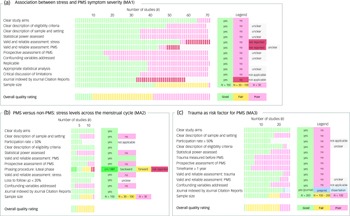
Quality assessments of all studies are outlined in Fig. 2(a)–(c). Overall, study quality was low and only a small number of studies (nine out of 104) were rated as good. Particularly in MA1, there were considerable limitations in the study quality because of failures to report important information, such as the assessment tools used for premenstrual symptoms and stress (see Fig. 2(a)). Notably, only few studies assessed premenstrual symptoms prospectively over at least one menstrual cycle (MA1, 21%; MA2, 64%; MA3, 23%). For detailed quality ratings per study, please refer to Supplementary File 6 (Tables 1–3).
Overview of quality ratings for all studies, including those not meeting stricter eligibility criteria. Design adapted from Reference Dubol, Epperson, Sacher, Pletzer, Derntl and Lanzenberger66 . Journal Citation Reports (2023). 46 The customised tools used for each meta-analysis are available here: https://osf.io/mcjsb/. MA1, meta-analysis 1; MA2, meta-analysis 2; MA3, meta-analysis 3; PMS, premenstrual syndrome.

Based on the additional quality criteria, 38 publications were excluded from the main analyses. The following sections refer to the reduced study pool from 68 publications. Meta-analytic results considering all publications are provided in Supplementary File 4 (Table 1).
Meta-analytic results
Sixty-eight publications (k = 67) with j = 188 effect sizes were included in the three meta-analytic models, encompassing data from 38 494 participants (for a list of all included papers, see Supplementary File 3). All articles were published in English.
Operationalisations of key constructs
Across all three meta-analyses, assessment methods for (traumatic) stress varied considerably. Most studies measured stress appraisal, using validated questionnaires (e.g. Perceived Stress Scale Reference Cohen, Kamarck and Mermelstein67 ), subscales on perceived event stressfulness or single-item measures. The remaining studies included in MA1 and MA2 examined stressors – either as daily hassles or as life events – or operationalised stress, using the Depression Anxiety Stress Scales, Reference Lovibond and Lovibond68 reporting data on the stress subscale. The latter was categorised as assessing ‘unspecified tension’, as its items primarily capture a general state of arousal rather than explicitly assessing perceived stress, daily hassles or life events. Traumatic experiences were assessed by validated questionnaires, (diagnostic) interviews or single items. A comprehensive overview of the stress and trauma assessment methods and their classification for subgroup analyses is provided in Supplementary File 7 (Tables 1 and 2).
Regarding premenstrual symptom assessment, most studies – particularly in MA1 and MA3 – relied on retrospective questionnaires (e.g. Premenstrual Symptom Screening Tool Reference Steiner, Macdougall and Brown2 ) or structured interviews (e.g. Structured Clinical Interview for DSM-5 for PMDD Reference Accortt, Bismark, Schneider and Allen69 ). Only a few employed daily prospective assessments across at least one menstrual cycle (e.g. Daily Record of Severity of Symptoms Reference Endicott, Nee and Harrison70 ). Studies investigating cycle effects (MA2) primarily used prospective assessments. In the primary studies, classification into the PMS group was based either on PMDD criteria, PMS criteria or on symptom severity scores. Detailed information on the instruments used in each primary study is available in Supplementary File 5 (Tables 1–3).
Summary effects
All three multilevel meta-analytic models yielded significant summary effects and showed superior model fits compared with the two-level models (Supplementary File 4, Table 2). The leave-one-out analyses revealed that one study Reference Antosz-Rekucka and Prochwicz71 had a disproportionate influence on the meta-analytic outcomes of two meta-analyses (MA1 and MA3), contributing with exceptionally large effect sizes. Consequently, this study was excluded from the subsequent primary analyses (for detailed influence diagnostics, refer to Supplementary File 4, Tables 7–9), reducing the data-set to 66 studies.
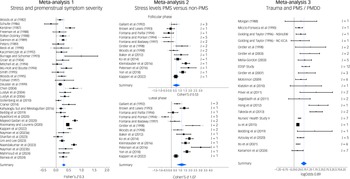
Figure 3 displays the distribution of effect sizes for each meta-analysis. The statistical results showed a significant relationship between stress and PMS symptoms in all meta-analyses: (a) MA1 (k = 35, j = 72, n = 6616) yielded a significant moderate correlation between stress and premenstrual symptom severity (r = 0.29, t(72) = 7.50, P < 0.001, 95% CI 0.23–0.36); (b) MA2 (k = 13, j = 44, n = 1249) yielded a significant large standardised mean difference between core PMDs and controls (d = 0.79, t(44) = 3.65, P = 0.003, 95% CI 0.32–1.26; results per cycle phase are reported in the next section); and (c) MA3 (k = 21, j = 69, n = 30 924) indicated that individuals with traumatic experiences had approximately 2.5 times higher odds of experiencing PMS compared with individuals without a traumatic history (odds ratio 2.45, t(69) = 6.93, P < 0.001, 95% CI 1.87–3.23). Significant heterogeneity was observed in all meta-analyses: I 2 MA1 = 84.64% (level 2: 15.5%, level 3: 69.15%; prediction interval −0.09 to 0.60), I 2 MA2 = 90.61 % (level 2: 12.97%, level 3: 77.65%; prediction interval −1.01 to 2.58), I 2 MA3 = 91.38 % (level 2: 33.5%, level 3: 57.88%; prediction interval 0.71–8.45).
Forest plots for the three-level multilevel analyses. Black lines reflect the total precision of each study, considering the number of effect sizes and variability between them. Grey lines correspond to the study precision based on the sampling variance. J = number of effect sizes per study. The indicated Fisher’s z corresponds to r = 0.29, the logOdds corresponds to odds ratio 2.45. Depicted Cohen’s d values are derived from separate multilevel meta-analysis per cycle phase. Forest plots based on Fernández-Castilla et al. Reference Fernández-Castilla, Declercq, Jamshidi, Beretvas, Onghena and Van den Noortgate58 EDSP Study, Early Developmental Stages of Psychopathology Study; NC-ECA, North Carolina Epidemiologic Catchment Area Study; NSHLEW, National Study of Health and life Experiences of Women; PMDD, premenstrual dysphoric disorder; PMS, premenstrual syndrome.

Moderator analyses
Meta-regressions testing the moderating effect of publication year and mean sample age yielded no significant results (for details refer to Supplementary File 4, Table 3 for statistical results and Figs. 1–3 for bubble plots).
MA1 revealed larger effect sizes in studies investigating students as participants (r = 0.38, 95% CI 0.30–0.46), compared with studies with samples from the community (r = 0.22, 95% CI 0.14–0.30, P = 0.006). Furthermore, when contrasting conceptualisations of stress/stressors to another, the association for daily hassles (r = 0.33, 95% CI 0.21–0.44) was significantly stronger compared with life events (r = 0.18, 95% CI 0.09–0.26). No significant differences were observed between the remaining stress categories, including perceived stress (r = 0.28, 95% CI 0.18–0.37) and unspecified tension (r = 0.41; 95% CI 0.00–0.70). In MA2, cycle phase (luteal versus follicular phase) and categorisation of premenstrual symptoms (PMS versus PMDD) emerged as significant moderators. Greater mean differences in stress levels between individuals with core PMDs versus controls were found in the luteal (d Lut = 1.01, 95% CI 0.46–1.57) compared with the follicular phase (d Fol = 0.58, 95% CI 0.15–1.01, P = 0.012). Furthermore, mean differences in stress levels were greater in studies comparing PMDD samples with controls (d PMDD = 1.17, 95% CI 0.49–1.85) versus studies comparing PMS samples with controls (d PMS = 0.33, 95% CI −0.30 to 0.95, P = 0.043). In MA3, no omnibus test of moderators was significant. Contrasting individual subgroups, largest effect sizes were found in studies linking premenstrual symptoms to PTSD (odds ratio 4.33, 95% CI 2.92–6.44), compared with unspecified type of trauma (odds ratio 1.96, 95% CI 1.43–2.68, P = 0.025) and in studies investigating PMDD as the outcome (odds ratio 3.47, 95% CI 2.09–5.76), compared with PMS symptoms (odds ratio 1.87, 95% CI 1.36–2.59, P = 0.019) or PMS (odds ratio 1.93, 95% CI 1.34–2.79, P = 0.036). Subgroup analyses examining study region, symptom domain (MA1), prospective versus retrospective assessment of premenstrual symptoms, publication type and consideration of hormonal contraception use revealed no significant effects in any of the meta-analyses. A detailed summary of all subgroup analyses is presented in Supplementary File 4 (Tables 4–6).
Publication bias
Sunset funnel plots (Fig. 4) show a slight rightward asymmetry for MA1 and MA3, suggesting potential publication bias. However, statistical analyses did not confirm this for MA1, except when the outlier Reference Antosz-Rekucka and Prochwicz71 was included in a sensitivity analysis. In contrast, MA3 showed considerable evidence of publication bias, with significant skewness (T S = 1.44, P = 0.007), significant PET (β 0 = 0.31, P < 0.001; β 1 = 1.72, P < 0.001) and PEESE (β 0 = 0.40, P < 0.001; β 1 = 2.33, P = 0.007) models and a lower likelihood of non-significant results (ω 2 = 0.25, P < 0.001). In MA2, no evidence of publication bias was found across all assessment approaches. For detailed results of publication bias assessments, refer to Supplementary File 4, Tables 10–12.
Sunset funnel plots displaying effect sizes and standard errors, with colour gradients indicating power.

Discussion
This study systematically examined the association between self-reported stress and premenstrual symptoms by conducting three independent multilevel meta-analyses. Overall, our findings suggest that stress is significantly associated with more severe premenstrual symptoms, and that traumatic experiences may contribute to an elevated risk of premenstrual symptoms. In the following sections, we will discuss both the quantitative findings and the methodological limitations identified in the existing literature.
Summary of findings
Findings from the three meta-analyses indicated that (a) higher stress levels are associated with more severe premenstrual symptoms (r = 0.29); (b) individuals with core PMD experience higher stress levels than individuals without core PMD (d = 0.79), particularly during the luteal phase of the menstrual cycle (d Lut = 1.01); and (c) traumatic experiences are associated with about 2.5 times higher odds for developing PMS. The effects were particularly pronounced in individuals with PMDD compared with those with milder premenstrual symptoms.
The results highlight the role of stress in premenstrual symptoms and support the theory of heightened stress sensitisation as a possible pathway for the development and maintenance of premenstrual symptoms. Reference Girdler, Straneva, Light, Pedersen and Morrow20,Reference Huang, Zhou, Wu, Wang and Zhao24,Reference Klatzkin, Bunevicius, Forneris and Girdler72 In individuals with core PMDs, regulation of the stress response might be impaired because of reduced excitability of the GABAA receptor in response to allopregnanolone, Reference Hantsoo and Epperson11 leading to an increased sensitivity to stress during the luteal phase associated with allopregnanolone fluctuations. Reference Schweizer-Schubert, Gordon, Eisenlohr-Moul, Meltzer-Brody, Schmalenberger and Slopien15 Elevated stress levels in individuals with core PMDs, which are particularly pronounced during the luteal phase, support the assumption that hormonal fluctuations during this cycle phase, in conjunction with a dysregulation of the HPG and HPA axes, may give rise to the symptoms and associated heightened levels of stress. Since traumatic experiences, particularly during childhood, can lead to long-term alterations in stress response patterns, Reference Ehlert73,Reference Radley, Kabbaj, Jacobson, Heydendael, Yehuda and Herman74 trauma might further contribute to the pathway between stress sensitisation and core PMDs, and might thereby trigger hormonal sensitivity in susceptible females. Evidence of the link between trauma and hormone sensitivity was also provided by a study in individuals with menstrually related mood disorders, which found that in participants with a history of abuse, cyclical increases in progesterone and oestradiol predicted more severe premenstrual mood symptoms. Reference Eisenlohr-Moul, Rubinow, Schiller, Johnson, Leserman and Girdler13 Furthermore, previous work suggests a luteal phase-specific effect of childhood adversity on stress and mood in individuals with core PMDs. Reference Nayman, Schricker, Reinhard and Kuehner75 The HPA profile of core PMDs coupled with the associated sensitivity to hormonal fluctuations during the luteal phase might therefore be unique compared with other mental disorders.
Limitations
The results of the present meta-analyses should be interpreted in light of some limitations, which may arise either from methodological decisions made during the review process or from limitations inherent in the primary studies themselves, including gaps in available data.
One important limitation is that our review exclusively relied on self-reported stress measures. As such, our data do not allow for conclusions about the biological stress reactivity or regulatory aspects of the biological stress systems in individuals with PMDs. To address this gap, a systematic review and meta-analysis focusing on the association between core PMDs and cortisol (re)activity is currently underway (PROSPERO: CRD420251052804). This work will allow for a more comprehensive understanding of stress in premenstrual symptoms.
In addition, the lack of longitudinal and experimental studies limits our ability to draw conclusions regarding the directionality of effects. Thus, it remains unclear whether stress exacerbates symptom severity or increases susceptibility to premenstrual symptoms, or whether the symptoms themselves contribute to elevated stress levels. Further adding to this uncertainty is the absence of data on the timing of stress levels and premenstrual symptom assessment, particularly in the case of MA1. As a result, it remains unclear whether stress levels were measured in direct proximity to symptom onset or at a more distant time point. This limitation is particularly relevant, as the temporal relationship between stress exposure or perception and symptom manifestation may affect both the strength and direction of observed associations. Future research should aim to clarify this aspect by incorporating precise longitudinal designs and time-lag analyses. Moreover, it remains unclear within which time frame following a trauma the odds of developing PMS are increased. Likewise, it is not yet known whether specific age ranges exist in which traumatic experiences are particularly associated with an increased risk of PMS, and to what extent the status of the reproductive system may play a role in this regard.
Beyond these factors, potential confounding influences also warrant consideration. We cannot draw conclusions regarding the potential role of comorbid disorders, as we did not specifically investigate the role of comorbidities such as depression, anxiety disorders or other psychiatric conditions, despite their possible influence on the relationship between stress and premenstrual symptoms.
Another factor affecting the robustness of our findings is the evidence of a risk of publication bias, suggesting selective reporting in MA3. Accordingly, the effect size for the relationship between trauma and premenstrual symptoms might be inflated.
Methodological heterogeneity between primary studies represents an additional limitation. The rather inclusive eligibility criteria applied in our meta-analyses allowed for substantial variation in study designs and operationalisation, contributing to the observed heterogeneity. Particularly, the multitude of assessment tools used across primary studies required the summarisation of instruments into broader categories for moderator analyses. Although this approach enabled synthesis across a diverse body of literature, it may have obscured more fine-grained or nuanced effects.
Finally, the potential impact of hormonal factors on the relationship remains unclear. Specifically, the roles of endogenous hormonal fluctuations during the menstrual cycle and exogenous hormonal modulation through contraceptive use cannot be determined based on our data. Only a few primary studies explicitly accounted for menstrual cycle phases, and there was inconsistent consideration of hormonal contraceptive use across participants. Although moderator analyses did not reveal significant effects, hormonal contraceptives influence oestradiol and progesterone levels, thereby altering menstrual cycle dynamics, and are associated with distinct HPA axis activity compared with naturally cycling individuals. Reference Bencker, Gschwandtner, Nayman, Grikšienė, Nguyen and Nater76 Additionally, hormonal contraceptives can have mood-stabilising effects and are commonly used as a treatment for PMDs by suppressing the hormonal fluctuations central to symptom manifestation. Reference Bencker, Gschwandtner, Nayman, Grikšienė, Nguyen and Nater76,Reference Hofmeister and Bodden77 Some primary studies failed to account for hormonal contraceptive use, whereas others included individuals using hormonal contraceptive without addressing its potential impact on results. This inconsistency may have introduced variability in the findings and affected the magnitude of the observed effects. The lack of methodological rigour in handling hormonal contraceptive use and assessing menstrual cycle dynamics highlights the need for future research to systematically assess and account for hormonal status as a critical variable.
Issues in current research practice
Our systematic review revealed significant quality issues in the available research. Several studies did not adhere to basic methodological standards, such as providing information on the assessment tools used, thereby impeding replicability. Further, some aspects specific to menstrual cycle research were neglected in multiple studies. This includes, for example, the consideration and valid assessment of menstrual cycle phases. Given that premenstrual symptoms in PMDs are restricted to the luteal phase of ovulatory cycles, Reference Hammarbäk, Ekholm and Bäckström78 it is important to validate the luteal phase and ovulatory cycles by using objective ovulation tests such as chromatographic ovulation tests. Furthermore, in the current research landscape, only a small proportion of studies prospectively assessed premenstrual symptoms by using daily symptom ratings across the menstrual cycle, which is a requirement for a valid diagnosis. This approach is crucial for confirming that symptoms are confined to the luteal phase rather than occurring throughout the entire cycle, ensuring a clear distinction from other mental disorders or the premenstrual exacerbation of other underlying disorders. However, the majority of primary studies have used retrospective assessments, which, as evidence suggests, may reduce specificity and lead to an overestimation of premenstrual symptoms. Reference Eisenlohr-Moul, Girdler, Schmalenberger, Dawson, Surana and Johnson79,Reference Henz, Ferreira, Oderich, Gallon, Castro and Conzatti80 In future research, it is therefore essential to use valid assessment tools for both premenstrual symptoms and stress, to clearly define concepts, and to take the menstrual cycle and confounding factors into account.
Future directions
Our findings point to gaps in the current research landscape, particularly concerning the temporal dynamics and the integration of psychological, biological and social factors. Future research should focus on longitudinal studies taking both within- and between-participant variations into consideration. This will allow for a deeper exploration of the temporal effects of experiencing symptoms versus the broader impact of having PMDs in general. Diary studies comparing the daily stress levels of individuals with and without core PMDs across the entire menstrual cycle could provide valuable insights into the temporal dynamics between premenstrual symptoms and stress. In addition, more research is needed to elucidate the psychobiological stress response in individuals with PMDs. A comprehensive framework of how, in the context of PMDs, alterations in the biological stress response relate to differences in subjective stress levels, and to what extent hormonal fluctuations across the menstrual cycle play a role in this regard, is still lacking.
Enhancing the understanding of the mechanisms and causes underlying premenstrual symptoms holds the promise of discovering effective treatments for PMDs. In addition to first-line psychopharmacological treatment of PMDD with antidepressants and hormonal contraceptives, Reference Hofmeister and Bodden77 stress management training might be a promising approach for the psychological treatment of core PMDs. Reference Han, Cha and Kim81 As in individuals with core PMDs, the stress level appears to be particularly pronounced in the luteal phase, those affected may particularly benefit from stress management methods during this cycle phase.
In conclusion, this study represents the first systematic review and statistical aggregation on the relationship between premenstrual symptoms and stress. Our findings indicate a relevant association between self-reported stress and premenstrual symptom severity. This association may be particularly strong during the luteal phase of the cycle, and trauma as particularly severe stressor was associated with increased odds of developing PMS or PMDD. Future studies should focus on the temporal dynamics of stress and premenstrual symptoms across the menstrual cycle, as well as their interactions with biological factors such as allopregnanolone and biomarkers of stress.
Supplementary material
The supplementary material for this article can be found at https://doi.org/10.1192/bjp.2025.10311
Data availability
The data and analysis code are openly available at https://osf.io/mcjsb/files/github.
Acknowledgements
The first author is a recipient of a DOC Fellowship of the Austrian Academy of Sciences at the Institute of Clinical and Health Psychology of the University of Vienna (26796). We thank Sarah Mannion for proofreading this manuscript and Erika Comasco for her valuable feedback on earlier versions of the manuscript.
Author contributions
C.B. was responsible for study conceptualisation, methodology, project administration, formal analysis, investigation, data curation and visualisation, and wrote the original draft of the manuscript. U.S.T. supervised the study, contributed to the methodology and reviewed and edited the manuscript. L.H.O.R. and S.N. contributed to the investigation and data curation, and reviewed and edited the manuscript. U.M.N. supervised the study, provided resources and reviewed and edited the manuscript.
Funding
This research received no specific grant from any funding agency, commercial or not-for-profit sectors.
Declaration of interest
None.



 Open access


eLetters
No eLetters have been published for this article.