

1. Introduction
Given the significance of the independence–unification (IU, hereafter) issue in Taiwan, a rich body of literature has identified a range of factors that affect Taiwanese people’s IU views, including demographic characteristics and political orientations. However, most existing literature has focused on internal factors within Taiwan, with relatively scant attention to external factors – notably the influence of mainland China. Furthermore, few existing studies have distinguished between the short-term and long-term effects of such factors on IU views. This paper thus seeks to address the following question: Does the China factor matter to IU views in Taiwan? If it does, how does it affect individuals’ attitudes toward the IU issue?
This study challenges established perspectives on the determinants influencing IU views by introducing a new factor – the China factor – and systematically examines its effect on Taiwanese people’s IU attitudes. We argue that individuals’ IU views are a complex function of multiple determinants: Internal factors within Taiwan contribute only partially to understanding individuals’ views on the IU issue, and the China factor also accounts for variations in such views. The reasons for this argument are multifaceted. First, the inherent nature of the IU issue – one end of the IU spectrum is unification with mainland China – implies the salience of the China factor. Second, mainland China-related factors have long been embedded in Taiwan’s politics. Accordingly, as a pivotal issue in Taiwan, the IU issue is inevitably influenced by the China factor. Third, the growing cross-Strait contacts, both official and private, are more likely to exert significant influence on Taiwanese citizens’ perceptions of mainland China and, in turn, their attitudes toward the IU issue. Taken together, we contend that the China factor is critical to explaining the IU views in Taiwan, particularly in recent years.
More specifically, we contend that the China factor – encompassing Taiwanese people’s mainland China-related impressions and experiences – exerts considerable influence on their positions along the IU spectrum, particularly during the period marked by significant cross-Strait events, such as the COVID-19 pandemic. We argue that a more positive impression of mainland China and life experiences in mainland China are both associated with a reduced likelihood of supporting Taiwan independence. Employing within-between random effects modelling to analyse panel data collected by the Taiwan Institute for Governance and Communication Research (TIGCR) from 2018 to 2022 (Huang and Chang, Reference Huang and Chang2023), this paper confirms that the China factor does matter to IU views in Taiwan, even after controlling for a range of internal factors within Taiwan. Taiwanese citizens’ impressions of mainland China have significant short- and long-term effects on their IU stances, whereas short-term life experiences in mainland China exert long-term influences on IU views.
The finding that Taiwanese citizens’ attitudes toward the IU issue are contingent on the China factor has two implications for the study of IU views in Taiwan. First, an individual’s position on the IU view is a co-production of internal factors within Taiwan and the China factor. It is therefore essential to incorporate the China factor when accounting for the variation in IU views. Second, this paper suggests several avenues for future research. Theoretically, subsequent studies could examine the conditions under which the China factor influences IU views and the interrelationships between the two dimensions of the China factor. For instance, given that Taiwanese people’s experiences in mainland China may shape their impressions and sentiments, the nexus between the China factor and the IU issue is likely more sophisticated than our preliminary analysis suggests, thereby meriting further inquiry. Methodologically, panel data and within-between random effects modelling provide robust tools for disentangling the short-term and long-term effects of independent variables on the dependent variable, and thus can be extended to address a broad array of research questions.
The remainder of this paper is organised as follows. Section 2 reviews the key arguments and empirical findings in the existing literature on the determinants of IU views, while identifying their limitations. Section 3 elaborates on why and how the China factor matters to people’s IU attitudes. Section 4 introduces the data and statistical models employed to test the theoretical hypothesis, followed by a presentation of empirical results in Section 5. Finally, Section 6 offers concluding remarks.
2. Existing research
The IU issue has occupied a central position in Taiwan’s political landscape since its democratisation in the late 1980s. Domestically, this issue is a fundamental political cleavage, serving as the bedrock of party competition in Taiwan. This renders it a focal point of elections at all levels and a crucial determinant of voting choices (Hsieh and Niou, Reference Hsieh and Niou1996; Lin et al., Reference Lin, Chu and Hinich1996). Externally, this issue is closely linked to cross-Strait relations and even regional security in East Asia. As a result, there has been a surge of research on the IU issue over the past twenty years in the social science field.
The existing literature on the IU issue has addressed a series of research questions, and our discussion focuses on the primary factors shaping Taiwanese people’s IU views. People weigh a range of perceptual and rational considerations when confronting the IU issue (Wu, Reference Wu1992; Chen and Chou, Reference Chen and Chou2004; Wu, Reference Wu2005; Yu and Lim, Reference Yu and Lim2013). Perceptually, individuals take into account their feelings about Taiwan or mainland China, and their evaluations of the current situation. Rationally, given that the IU issue bears on the future outcomes, individuals also deliberate over the potential impacts of any action that could change the status quo – independence or unification – on their careers, personal lives, and family well-being (Chen and Chou, Reference Chen and Chou2004). Given the complexity of how IU views are formed, scholars have provided various explanations for understanding the variations in IU views. The three most prominent categories of determinants in the literature are: (1) demographic characteristics (e.g., gender, age, and education), (2) key political orientations (e.g., party identification and ethnic identity), and (3) evaluations of relevant politico-economic situations (e.g., approval of Tsai Ing-wen’s handling of cross-Strait relations and retrospective evaluation of national economy).
First, demographic characteristics, such as gender, age, and education, shape people’s attitudes toward the IU issue. Yang and Liu (Reference Yang and Liu2009) argue that there are considerable differences in the opinions of females and males regarding the issues and concerns related to nationalism in Taiwan, which leads to variations in IU views. However, the empirical evidence regarding the relationship between gender and IU views is mixed. Several studies reveal that males tend to favour unification (e.g., Weng and Sun, Reference Weng and Sun1995; Chang and Wu, Reference Chang and Wu1997; Wang, Reference Wang2012), whereas some find that IU stances are independent of gender (e.g., Huang, Reference Huang2019; Tsai et al., Reference Tsai, Wang and Wang2019; Tsai and Tsai, Reference Tsai and Tsai2022). Age is also confirmed to be associated with the position on the IU views (Sheng, Reference Sheng2002; Chen and Chou, Reference Chen and Chou2004). Younger generations were more inclined toward Taiwan independence because they experienced Taiwan’s democratic transition when they became eligible to vote (Lin, Reference Lin2015) and received a Taiwan-centred school education (Huang, Reference Huang2019). Regarding education, Chang and Wu (Reference Chang and Wu1997), focusing on the impact of education on IU attitudes, reveal that education level exerts three types of effects (i.e., the threshold effect, homogenising effect, and the dividing effect), and these effects differ among people of distinct backgrounds. However, the empirical record on the effects of education level is quite muddled.
Second, two enduring political orientations – party identification and ethnic identity – are widely tested and accepted determinants of IU views. The IU issue has been the most significant cleavage between political parties in Taiwan, leading to two coalitions of parties: the Pan-blue and Pan-green coalitions. The Pan-blue coalition advocates for closer ties with mainland China, while the Pan-green coalition seeks Taiwan independence (Hsieh and Niou, Reference Hsieh and Niou1996; Achen and Wang, Reference Achen, Wang, Achen and Wang2017). It is widely recognised that the two political coalitions hold divergent stances on the IU issue (Sheng and Liao, Reference Sheng, Liao, Achen and Wang2017). Consequently, supporters of different political parties tend to adopt distinct positions regarding this matter. Advocates of the Pan-blue parties – with the Kuomintang as their representative – support unification, while those identifying with the Pan-green parties, represented by the Democratic Progressive Party (DPP, hereafter), lean toward independence. The association between party identification and IU views has been well-documented in existing literature (e.g., Sheng, Reference Sheng2002; Yu and Lim, Reference Yu and Lim2013). Additionally, several in-depth studies have indicated that the link between Pan-green identification and IU views is more robust than that between Pan-blue identification and IU views (Chang and Huang, Reference Chang and Huang2011; Wang, Reference Wang2012; Tsai et al., Reference Tsai, Wang and Wang2019).
In terms of ethnic identity, it exhibits greater stability over time compared to IU views and also exerts a significant impact on people’s IU attitudes (Lin, Reference Lin2012). In comparison to those with a ‘dual identity,’ those who self-identify as ‘Chinese’ tend to support unification, whereas those who self-identify as ‘Taiwanese’ lean toward independence (Sheng, Reference Sheng2002; Tsai and Tsai, Reference Tsai and Tsai2022; Wang, Reference Wang2012). Furthermore, party identification demonstrates even stronger explanatory power than ethnic identity does in explaining the variation in IU views. For example, Chang and Huang (Reference Chang and Huang2011) use structural equation models to meticulously examine the relationships among ethnic identity, national identity (the IU views discussed here), and party identification, and they find that there is no significant causality between national identity and ethnic identity after controlling for party identification.
Finally, variation in individuals’ views of the IU issue can also be attributed to short-term evaluations of the current situation. Tsai and Tsai (Reference Tsai and Tsai2022) argue that Tsai Ing-wen promptly struck back at the Chinese government’s call for reunification, and people differ in approval of her response, which led to variations in their IU stances. If individuals are satisfied with Tsai’s reactions, they are likely to agree with her position on cross-Strait relations, which prefers independence. Conversely, those with negative assessments of her performance tend to support independence. Therefore, positive evaluations of Tsai’s cross-Strait relations are related to pro-independent attitudes, and vice versa. Moreover, due to the economic integration between mainland China and Taiwan, it is reasonable that people’s evaluations of Taiwan’s economic situation are associated with their IU views. Using within-between models to analyse panel data, Tsai and Tsai (Reference Tsai and Tsai2022) find strong evidence that the evaluations of Tsai’s performance regarding cross-Strait relations and retrospective evaluations of the national economy have significant effects on citizens’ IU attitudes: Positive evaluations are associated with a preference for independence.
In summary, while a substantial body of literature has theoretically and empirically accounted for variations in individuals’ IU views, few studies have examined whether and how individuals’ positions shift over time. Drawing on panel data from Taiwan’s Election and Democratization Study (TEDS) conducted in 2001 and 2004, Tsai et al. (Reference Tsai, Wang and Tossutti2008) confirm the instability of citizens’ IU stances, that is, some individuals moved from a pro-unification position to favouring maintaining the status quo. This instability can be attributed to partisanship, ethnic identity, and retrospective economic evaluations. Huang (Reference Huang2019) traces the evolution of IU views from 1996 to 2016 through an analysis of six independent surveys, identifying that the shift in people’s attitudes toward the IU issue is largely attributed to the 1999 Taiwan-centred high school curriculum and long-term generational replacement. Consistent with this, Huang (Reference Huang2019) posits that the distribution of IU views will tend to favour maintaining the status quo and supporting independence, as younger generations emerge as the mainstream electorate in Taiwan (Huang, Reference Huang2019). Tsai and Tsai (Reference Tsai and Tsai2022) acknowledge the influence of dramatic events and apply the rally ‘round-the-flag effect to explain the change in IU views. By analysing TIGCR 2018 and 2019, they distinguish between a set of short- and long-term factors shaping IU views. Specifically, Tsai and Tsai (Reference Tsai and Tsai2022) identify that valuations of cross-Strait relations and the national economy are both long- and short-term determinants of IU views, while media exposure exerts short-term effects, and Tsai’s approval and partisanship have long-term effects.
To conclude, existing studies have examined the between-individual variations in IU views, attributing them to individuals’ demographic characteristics, political orientations, and evaluations of politico-economic situations. We suggest that these studies suffer from two notable limitations. First, they have paid relatively scant attention to the external factors – specifically the China factor – or have even neglected it entirely. While internal factors within Taiwan undoubtedly matter as they shape individuals’ IU views during the broader process of political socialisation, they alone cannot fully account for the variations in such views. Although a handful of scholars have referenced the China factor, they have either failed to explicitly define its concept or restricted their investigations to specific subgroups (e.g. Taiwanese youth), rather than employing a nationally representative sample (e.g., Kuan, Reference Kuan2018). Second, we still lack a systematic understanding of the stability of individual IU views, especially regarding how these preferences change when Taiwanese citizens encounter events related to mainland China and cross-Strait relations. Therefore, to address these limitations, the subsequent section will not only explore why and how the China factor matters to IU views but also distinguish between the intra-individual temporal effects and the inter-individual cross-sectional effects.
3. Effects of the China factor on IU views
This paper is not the first to highlight the role of the China factor in shaping Taiwanese people’s IU views; however, it seeks to offer a comprehensive understanding of variation of individuals’ IU stances from the perspective of the China factor – especially during the challenging period (i.e., 2020–2022) – and strives to establish a more robust empirical foundation for such theoretical discussions. This section first reviews several existing studies that have referenced the China factor. Then it discusses why the China factor matters to IU views in Taiwan and proposes our definition and classification of the China factor. Finally, it elaborates on how two dimensions of the China factor respectively affect individuals’ attitudes toward the IU issue.
Given the relationship between mainland China and Taiwan, some scholars have examined the relationship between the China factor and Taiwan’s politics, including the IU issue (Niou, Reference Niou, Philip and James2008; Kuan, Reference Kuan2018), political evaluation (Lin, Reference Lin2014), voting behaviour (Wu and Liao, Reference Wu and Liao2015; Yang, Reference Yang2020), and the Sunflower Movement (Tsai and Chen, Reference Tsai and Chen2015). Niou (Reference Niou, Philip and James2008) is the first paper that theoretically and empirically examines the effect of the China factor on Taiwan’s politics. Following Niou’s seminal work, several scholars have referenced the China factor when examining the IU issue, including Kuan (Reference Kuan2018) and Wang (Reference Wang2022). This extant literature on the China factor has neither fully clarified its nature nor explicated the mechanism through which it affects IU views. We will elaborate on the findings and limitations of these studies in the following discussion.
The studies referenced above provide evidence that China influences IU views, but there seems to be no common language regarding a unique meaning of the ‘China factor.’ Additionally, it is necessary to ascertain whether Niou’s (Reference Niou, Philip and James2008) findings still work in the current situation and whether results drawn from Taiwanese youth can be generalised to all Taiwanese people. More importantly, these studies that have referenced the China factor have not yet distinguished between its short- and long-term effects. Accordingly, while building on their insights, this paper goes beyond them both theoretically and empirically: It proposes a clearly defined concept of the China factor and elaborates on why and how it influences IU views.
3.1. Definition and classification of the China factor
Niou (Reference Niou, Philip and James2008) proposes three types of the China factor to explain people’s preferences for Taiwan independence: (1) perceptions of the China threat, (2) confidence in the United States’ defense, and (3) attitudes toward trade and security. Analysis results drawn from the 2005 Taiwan National Security Survey confirm the importance of these factors related to China. In Niou’s conceptualisation, the China factor is closely linked to mainland China’s threat against Taiwan, which stems from China’s threat of force and economic integration. This conceptualisation may overlook other dimensions, even though mainland China’s threat undeniably constitutes one dimension of the China factor. Before the operationalisation of the China factor, neither Kuan (Reference Kuan2018) nor Wang (Reference Wang2022) explicitly defines it. In short, the extant conceptualisation of the China factor is underspecified.
We contend that the China factor is constituted by affective and behavioural dimensions. Affective factors serve as the most stable variable in shaping individuals’ IU views (Wu, Reference Wu1992). The behavioural dimension functions as a triggering mechanism, which in turn induces changes in the affective dimension and ultimately leads to shifts in attitude. However, most existing studies on the China factor have exclusively focused on either its behavioural or affective dimension, resulting in misinterpretations of the concept itself and the mechanism through which it affects IU stances. In view of this, the China factor, as conceptualised in this study, refers to Taiwanese people’s mainland China-related impressions and experiences. The former encompasses the attitudinal dimension, while the latter covers the behavioural dimension. More specifically, it comprises two components: (1) individuals’ impressions of mainland China and (2) their (short- and long-term) life experiences in mainland China. We argue that variations in these two aspects among Taiwanese individuals contribute to differences in their attitudes toward the IU issue.
3.2. Why the China factor matters to IU views
We contend that the China factor should be taken into consideration in discussions of Taiwanese citizens’ IU views for three reasons. First, the inherent nature of the IU issue inextricably links it to the China factor. Consistent with most previous research, we treat the IU view as a unidimensional concept, wherein independence and unification are framed as mutually exclusive options.Footnote 1 More specifically, individuals who endorse Taiwan nationalism are highly likely to oppose reunification with mainland China, whereas those who identify with mainland China as their ancestral homeland tend to reject Taiwan independence. When confronting the IU issue, individuals typically weigh their attachments to Taiwan or mainland China, evaluate the current situation, and anticipate the potential impacts of independence or unification on their own livelihoods, careers, and family members (Chen and Chou, Reference Chen and Chou2004). Such considerations are all deeply intertwined with the China factor. While opinions on Taiwan are directly influenced by internal factors within Taiwan, attitudes toward mainland China are often shaped by individuals’ perspectives of China. These perspectives may be formed directly from personal experiences and/or indirectly via sources such as family members’ experiences, news, and social media. It follows that individuals’ perceptions of mainland China should be equally important as those of Taiwan in shaping their positions on the IU issue they occupy.
Second, the China factor has long been embedded in Taiwan’s politics (Tsai and Chen, Reference Tsai and Chen2015). Its influence operates primarily through two channels: economic benefits and military threats (Niou, Reference Niou, Philip and James2008; Wang, Reference Wang2017). With the rise of China, its influence expanded beyond macroeconomic and political domains to permeate the daily lives of Taiwanese citizens. Accordingly, as a pivotal political issue in Taiwan, the IU issue is inevitably influenced by the China factor.
Finally, the China factor is directly associated with IU views in Taiwan, as increasing numbers of Taiwanese citizens have acquired information and life experiences related to mainland China in recent decades, driven by cross-Strait economic integration and social exchanges. Most Taiwanese individuals spend the majority of their lives in Taiwan, immersing themselves fully in the Taiwanese context. Nevertheless, the increasingly frequent cross-Strait contacts since 2000 have afforded them opportunities to access more information about mainland China and even to gain direct experiences, such as travelling to China or residing there temporarily. These experiences more or less change individuals’ perspectives on the IU issue, contributing to inter-individual variations.
We contend that the China factor has an increasingly significant influence on IU views in recent years. Public attitudes toward the IU issue are based on their perceptual cognition and rational calculation. Perceptual cognition encompasses party identification and ethnic identity, whereas rational calculation entails assessing the potential ramifications of actions that would alter the status quo (i.e., independence or unification). These considerations are susceptible to major events (Chen and Chou, Reference Chen and Chou2004: 155–156). Over the past five years, cross-Strait relations have been shaped by several significant events, including the COVID-19 pandemic since late 2019, Tsai’s re-election in 2020, and nuanced shifts in Sino-U.S. relations. Drawing on the ‘rational public’ theory, which posits that public responses to international events follow predictable patterns (Page and Shapiro, Reference Page and Shapiro1992; Shapiro and Page, Reference Shapiro and Page1988), Taiwanese people’s reactions to these major events are likely reflected in their IU attitudes.
In conclusion, given the inherent nature of the IU issue, mainland China’s enduring involvement in Taiwan’s politics, and the permeation of cross-Strait relations into Taiwanese people’s daily lives, it is reasonable to posit that the China factor exerts a significant influence on Taiwanese people’s IU views, especially IU views in the last five years. Stated differently, the China factor merits inclusion in analyses of the determinants shaping people’s IU stances.
3.3. How the China factor affects IU views
Building on existing literature, we argue that the China factor has both short- and long-term effects on IU views. The stability of IU views is tied to individuals’ responses to major events and their personal experiences. Major events, and the impressions they engender, can alter individuals’ attitudes both in the short and long term. This is because people often react swiftly to such events, potentially inducing an immediate shift in their IU views. Over time, moreover, these events may subtly reshape individuals’ perceptions. Like demographic characteristics and enduring attitudes, life experience – conceived as time-invariant factors in the short term – can account for inter-individual variation in IU views. Consequently, the China factor, encompassing perceptions of mainland China and life experiences there, is posited to affect IU views in both the short and long term.
Prior to examining how the two dimensions of the China factor affect IU views, it is essential to explicitly distinguish between short- and long-term effects. Short-term effects, as defined here, denote observable immediate shifts in IU views, whereas long-term effects refer to profound, enduring changes in such views. These two types of effects differ along three dimensions: time scale, nature of effects, and causal mechanisms. In terms of time scale, short-term effects exhibit an immediate association with their triggering factors, whereas long-term effects operate over an extended time span, often involving cumulative or lagged effects. Second, short-term effects are typically superficial, direct, or immediate responses, which tend to diminish as the triggering factor dissipates. In contrast, long-term effects are characterised by profound, indirect, or persistent changes, rendering them more stable and resistant to reversal. Regarding causal mechanisms, short-term effects involve a concise causal chain and can be readily observed using cross-sectional data or short-term tracking. Conversely, long-term effects entail more complex causal chains involving one or more mediating factors, which necessitate long-term tracking to elucidate. In summary, short-term effects here refer to immediate responses, while long-term effects correspond to enduring imprints.
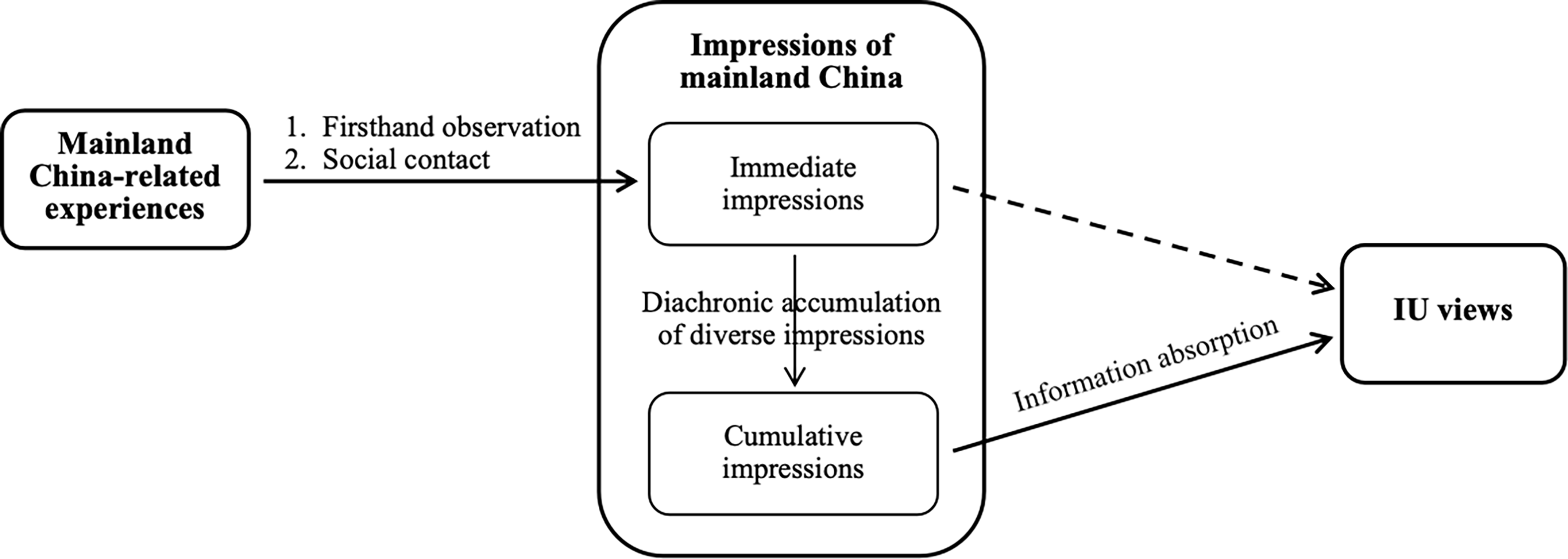
Figure 1 illustrates how two dimensions of the China factor influence IU views through distinct mechanisms. Specifically, impressions of mainland China exert both short-term and long-term effects on IU views, whereas mainland China-related experiences only exert long-term effects.
Theoretical framework of China factor’s causal effects on IU views.
Source: By the author.
Notes: The dashed line denotes the short-term effect, while the solid lines denote the long-term effect.

First, we propose that the impression of mainland China constitutes a primary factor exerting a direct and significant influence on people’s perspectives on the IU issue in both the short and long term. Individuals often form judgments based on their impressions of a given subject (Forgas, Reference Forgas2011). Given that the left end of the IU spectrum denotes unification with mainland China, it follows that impressions of mainland China strongly affect attitudes toward assimilation into it. Analysing representative telephone survey data conducted in 2010, Yu and Lim (Reference Yu and Lim2013) show that citizens with good impressions of mainland China are more likely to support unification across diverse conditions, including economic, living, ideological, and political ones.
Additionally, studies focusing on Taiwanese youth and examining their impressions of the Chinese government and citizens have yielded contradictory findings. For example, using in-depth interviews and surveys, Keng and Tseng (Reference Keng and Tseng2010) find that short-term visits to the mainland and related exchanges significantly improved Taiwanese students’ perceptions – particularly among those favouring Pan-green parties – of mainland China, the Communist Party of China, and the lives of Chinese citizens, though their political identity remained largely unchanged. Kuan (Reference Kuan2018) argues that young people’s preferences toward mainland China or its government constitute an important yet often overlooked factor affecting their IU views. This claim is confirmed by his analysis of the 2015 Taiwan National Security Survey data, which shows that higher favourability toward the Chinese government among youth correlates with lower support for Taiwan independence. Similarly, studies based on longitudinal interviews with Taiwanese youths who visited mainland China during the winter and summer vacations reveal that as these Taiwanese youths’ impressions of mainland China improved, their sense of a One China identity was enhanced (Wang, Reference Wang2019), and their support for unification increased (Wang, Reference Wang2022). Whether these youth-specific findings can be generalised to the broader Taiwanese population remains to be empirically validated.
As Figure 1 shows, impressions of mainland China also affect IU views in the long term; that is, immediate impressions – whether positive or negative – undergo long-term accumulation over time, eventually evolving into a relatively stable perception and then shape IU stances through information absorption. More specifically, Taiwanese individuals with more favourable impressions of mainland China typically engage in scrutiny and critical acceptance of information about mainland China reported by Taiwan’s domestic media. They are also more likely to proactively seek out information about mainland China through diverse channels, thereby developing a more comprehensive understanding of its development model, institutions, and current realities. Consequently, people with more favourable impressions of mainland China typically exhibit lower support for Taiwan independence than those with negative impressions do.
Therefore, we propose that Taiwanese people’s IU views vary significantly depending on their impressions of mainland China. Moreover, given that cognition can exert long-term effects on identity formation, we anticipate that not only do current impressions induce immediate shifts in attitudes toward the IU issue, but impressions formed in recent years also have enduring influences. Drawing on the above discussions, we propose the following hypotheses:
Hypothesis 1 Better impressions of mainland China are associated with a reduced likelihood of supporting Taiwan independence.
Hypothesis 1–1 [Short-term effect] An Individual’s support of Taiwan independence will decrease as his or her impression of mainland China improves.
Hypothesis 1–2 [Long-term effect] Individuals who have better impressions of mainland China are less supportive of Taiwan independence than individuals who have worse impressions.
The other dimension of the China factor – life experiences in mainland China, regardless of duration – has effects on individuals’ IU views. This is because Taiwanese citizens gain firsthand observations and accumulate social capital through travel to or residence in mainland China, which in turn shapes their IU stances. Most Taiwanese people spend the majority of their lives in Taiwan, limiting their exposure to mainland China’s context. They often rely on mass media and social media for information about mainland China, which may disseminate biased or even fake information. This phenomenon may be particularly pronounced during DPP’s administrations. However, when provided with opportunities to travel to and live in mainland China, especially as members of organised groups, they gain ways to build connections with the region and come into close contact with mainland Chinese people. These experiences can significantly increase the likelihood of gaining firsthand information and intuitive understandings of mainland China, which in turn shapes their attitudes toward IU issues.
Travelling to or living in mainland China in person (e.g., making investments, conducting business, holding employment, settling down, and studying) fosters a deeper understanding and trust of the country (Keng et al., Reference Keng, Liu and Chen2009), while also dispelling previously held negative impressions and perspectives (Keng and Tseng, Reference Keng and Tseng2010; Wu et al., Reference Wu, Liao and Yang2016; Wang, Reference Wang2019; Reference Wang2020). Taiwanese individuals were often deeply impressed by the economic and social development when they visited mainland China and interacted with reception personnel (Keng and Tseng, Reference Keng and Tseng2010; Wang, Reference Wang2019). In addition to personally witnessing the development and realities of life in mainland China, they also establish social connections with local people in their daily lives. Social contact can reduce discrimination against a given ethnic group (Pettigrew, Reference Pettigrew1998) because people form friendships through repeated interactions, which can effectively reduce hostility and change previously held stereotypes (Wang, Reference Wang2019). Over time, they not only disseminate information related to mainland China but also develop shared interests with mainland Chinese citizens while maintaining these connections. To summarise, such experiences potentially reshape individuals’ perceptions of the host location, mitigate pre-existing prejudices, alleviate perceived threats, and prompt comparisons between cross-Strait development models. Consequently, these experiences may shift their assessments of institutional inclinations.
Long-term life experiences ought to induce more significant shifts in individuals’ IU views than short-term trips do, as they foster more true acquaintance rather than merely casual contact. Grounded in mutual understanding and trust, true acquaintance is more effective in mitigating negative impressions compared to casual acquaintance (Allport, Reference Allport1954: 263–268). It is noteworthy that the effects of life experiences on shaping and altering opinions are not attained overnight. Instead, such experiences subtly transform people’s perspectives on the IU issue through the accumulation of social capital. As a result, life experiences in mainland China are expected to have a long-term effect on IU views.Footnote 2
In terms of observations in real-world politics, the Chinese government has implemented a series of measures aimed at engaging with Taiwan, including facilitating visits to the mainland and attracting Taiwan residents (especially young people) to work and study there through preferential policies. President Xi Jinping (Reference Xi2019) delivered a speech at the commemorative meeting marking the 40th anniversary of the issuance of A Message to Compatriots in Taiwan, saying ‘We treat our compatriots in Taiwan as equals, and will continue paving the way for them to share first the mainland’s development opportunities and ensure that our compatriots and enterprises from Taiwan receive the same treatment as those from the mainland, thus giving them a greater sense of fulfillment.’ As intended, these initiatives seek to improve Taiwanese people’s impression of the mainland, thereby promoting the peaceful development of cross-Strait relations and advancing the cause of national reunification.
According to panel studies conducted by Wang and his colleagues, some Taiwanese youths who visited mainland China changed their perceptions of the IU issue. Specifically, students showed reduced support for Taiwan independence and increased willingness to endorse unification following their visits (Wang and Li, Reference Wang and Li2012; Wang, Reference Wang2015). We contend that beyond short-term visits and trips, long-term life experiences – such as studying, working, and engaging in business activities – can also alter individuals’ IU stances. Drawing on Allport’s (Reference Allport1954) contact hypothesis, we suggest that such changes in the living environment, accumulation of personal experiences, and concomitant social interactions can enhance Taiwanese people’s understanding of mainland China and mitigate the stereotypes stemming from long-term separation. These cognitive shifts, in turn, are posited to induce changes in attitude toward the IU issue. Taken together, the following hypothesis is proposed:
Hypothesis 2 [Long-term effect] Individuals with life experiences in mainland China are less likely to support Taiwan independence than other people.
4. Method
4.1. Data
We employ secondary data called the 2018–2022 TIGCR Political Polarization Survey (TIGCR-PPS 2018–2022) (Huang and Chang, Reference Huang and Chang2023) to test our theoretical hypotheses.Footnote 3 It is a five-year face-to-face panel survey with a nationally representative sample on political communication, attitudes, and behaviours. It was conducted each year by the TIGCR between 2018 and 2022. The cross-wave merged data consist of 4,507 respondents aged 18 and above, of whom 1,277 respondents completed questionnaires five times.
TIGCR-PPS 2018–2022 is well-suited to test our hypothesis for two reasons. First, these scarce panel data allow us to trace citizens’ responses to a series of the same questions so that we can separate the effects of the long- and short-term determinants of IU views. Second, TIGCR-PPS 2018–2022 covers all measures of our interest. Third, since it is a nationally representative sample, we can generalise the findings drawn from this panel to Taiwan’s population.
4.2. Measures
To measure our dependent variable, we use a 0–10-point scale of IU views, in which 0 represents ‘support for immediate declaration of Taiwan independence’ and 10 represents ‘support for unification with China immediately.’Footnote 4 As a frequently-used measure of IU views, the 11-point scale indicator has been applied by several scholars, such as Sheng et al. (Reference Sheng, Liao, Achen and Wang2017); Huang (Reference Huang2019); and Huang and Kuo (Reference Huang and Kuo2022) We reverse the indicator to have 0 as immediate unification and 10 as immediate independence. We consider it as a semi-interval level measurement in the following analyses. To ensure that our findings are sustained when a different dependent variable is used, we also rerun the models using a 6-point scale of IU views.
According to our two hypotheses, we employ three main explanatory variables. They are Taiwanese citizens’
-
1. Impressions of Mainland China based on China’s COVID-19 pandemic control (drawn from the surveys conducted in 2020, 2021, and 2022, respectively).Footnote 5 It is measured by asking respondents, ‘has China’s COVID-19 epidemic controlling made your impressions of China better, worse, or unchanged?’ Responses are classified as ‘gotten much better,’ ‘gotten somewhat better,’ ‘unchanged,’ ‘gotten somewhat worse,’ and ‘gotten much worse.’ The responses are reverse-coded for data analysis.
-
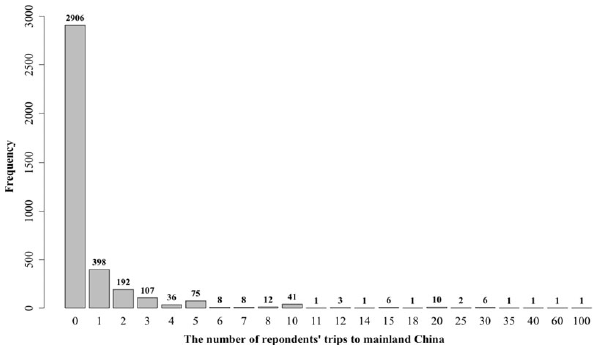
2. Trips to mainland China (2019). Respondents were asked the total number of their trips to mainland China (not including Hong Kong and Macau). The distribution of this indicator is extremely right-skewed, ranging from 0 to 100 (see Figure A1 in the appendix). Outliers may distort the estimated regression coefficients. Therefore, we recode this measure into a binary variable that takes the value of 1 if respondents have travelled to mainland China and 0 if they have never been to China. To check the robustness of our analysis results, we merge the cases more than 10 times and rerun the analyses.
-
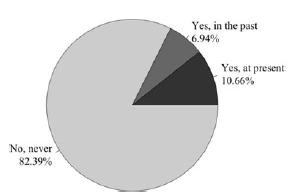
3. Long-term life experiences in mainland China (2019). More specifically, respondents were asked whether they or their family members have engaged in business activities, held employment, settled down, or studied in mainland China. Participant’s responses consist of ‘yes, at present,’ ‘yes, in the past,’ and ‘no, never.’ We are interested in the differences in individuals’ IU views between those with long-term life experiences in mainland China and those without such experiences;, therefore, we merge the former two responses, and thus this measure becomes dichotomous, in which 1 represents respondents or their family members who had life experiences in mainland China and 0 otherwise. We conduct the robustness check using this initial three-category indicator.Footnote 6
The second and third indicators represent two types of experiences regarding mainland China. The former represents a short-term life experience, while the latter represents a long-term one.
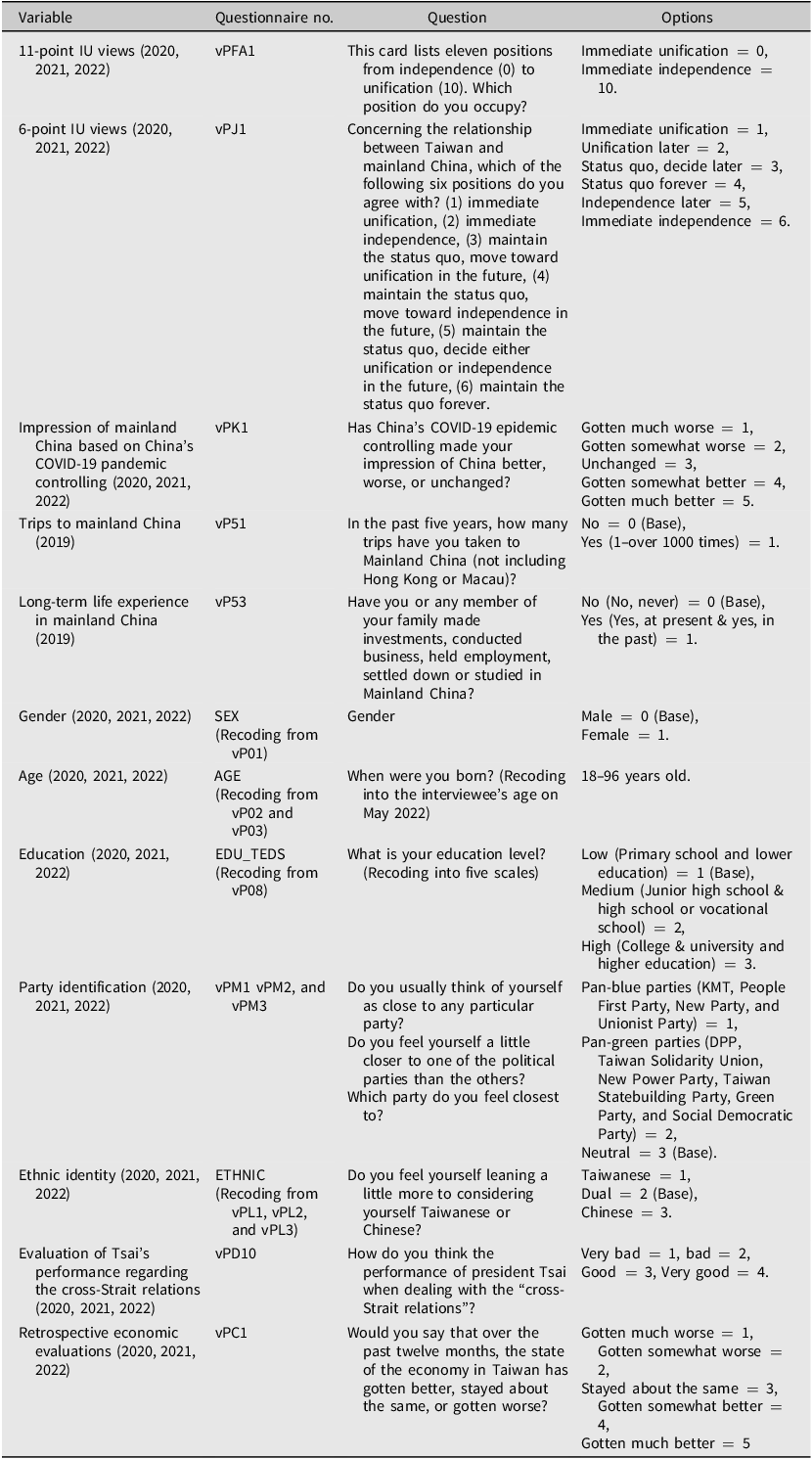
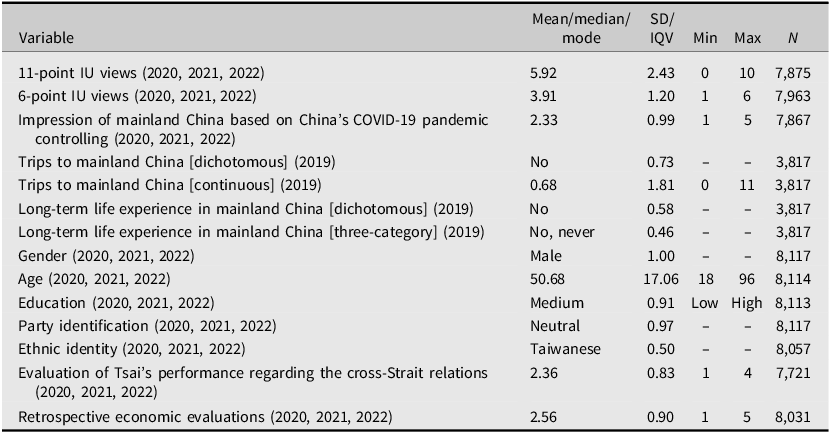
According to previous research, we also include some confounding variables shown to be relevant to Taiwanese people’s IU views in our models. We first control for gender, age, and education to eliminate the interference of demographic background. Second, we include party identification and ethnic identity, which are two key factors that proved to be associated with Taiwanese people’s attitudes toward the IU issue. Finally, we incorporate citizens’ evaluations of Tsai’s performance regarding cross-Strait relations and retrospective economic evaluations. All of these control variables are drawn from the 2020–2022 survey. For more information about these variables, please refer to Table A1 and Table A2 in the appendix. Due to occasional missing data on one or more variables, the precise number of respondents is over 2000.
4.3. Model specification
We apply within-between models to examine how the China factor shapes Taiwanese people’s IU views, in particular, to identify whether the impression of mainland China is a short- and/or long-term determinant of IU views.
Within-between random-effects (RE, hereafter) models can be used to separate short- and long-term effects of explanatory variables on dependent variables. Relative to fixed-effects (FE) models, RE models offer greater advantages in analysing panel data and time-series cross-sectional (TSCS) data, owing to their generalisability and extendibility (Bell and Jones, Reference Bell and Jones2015).Footnote 7 As an extension of the RE model, the within-between formulation provides a better solution to heterogeneity bias – a common issue in panel data analysis – than alternative formulations do. This is because within-between models explicitly model heterogeneity bias rather than merely correcting for it (Bell and Jones, Reference Bell and Jones2015: 142–143).Footnote 8
When the independent variable is continuous, a standard RE model for analysing panel data would be: $\text{Lower level (the individual-year level) model:} y_{i,t}=\beta _{0, i}+\beta _{1}x_{i,t}+e_{i,t}$ $e_{i,t} \sim N(0, {\sigma }_{e}^{2})$ $\text{Higher level (the individual level) model :} \beta _{0, i}=\gamma _{0}+\gamma _{1}z_{i}+u_{i}$ $u_{i} \sim N(0, {\sigma }_{u}^{2})$
where y i, t denotes the individual i’s independent variable in year t and x i, t denotes a (series of) time-varying explanatory variable(s) with the coefficient β 1. β 0, i is the varying intercept at the individual-year level, which is a function of the intercept γ 0 and a (series of) time-invariant explanatory variables z i with coefficient γ 1. e i,t and u i denote the residual term at the lower and higher level, respectively.Footnote 9 They are assumed to be Normally distributed with the expected value 0 and the variance σ e 2 and σ u 2, respectively.
Combining Equations (1) and (3), we can get an alternative form of the RE model: $y_{i,t}=\gamma _{0}+\beta _{1}x_{i,t}+\gamma _{1}z_{i}+\left(u_{i}+e_{i,t}\right)$
where the exogeneity assumption Cov(x i,t , u i ) = 0 may not hold. This endogeneity typically stems from multiple processes associated with a given time-varying explanatory variable (Bell and Jones, Reference Bell and Jones2015: 137). Such explanatory variables contain two parts: One is specific to the individual that does not vary over time (x i B ) and the other denotes the difference within individuals over time (x i,t W ) (Bell and Jones, Reference Bell and Jones2015:137). They are so-called ‘between’ and ‘within’ effects: $x_{i,t}={x}_{i}^{B}+{x}_{i,t}^{W}$
In other words, the covariance between u
i
and e
i,t
comes from the covariance between x
i
B
and x
i,t
W
. We can account for the between effect by including $\overline{x}_{i}$
– the individual i’s mean of x
i,t
– into the higher-level model (Mundlak, Reference Mundlak1978):
$\overline{x}_{i}$
– the individual i’s mean of x
i,t
– into the higher-level model (Mundlak, Reference Mundlak1978): $\beta _{0, i}=\gamma _{0}+\gamma _{1}z_{i}+\gamma _{2}\overline{x}_{i}+u_{i}$
Combining Equations (1) and (7), we have: $y_{i,t}=\gamma _{0}+\beta _{1}x_{i,t}+\gamma _{2}\overline{x}_{i}+\gamma _{1}z_{i}+(u_{i}+e_{i,t})$
where γ
2 – the ‘contextual’ effect – models the difference between the within and between effects (Bell and Jones, Reference Bell and Jones2015, 141). Compared to Mundlak’s (Reference Mundlak1978) original formulation, within-between RE modelling provides better estimations three reasons: (1) Within-between modelling separates the within and between effects with temporal data; (2) By adding group mean centring x
i,t
, within-between modelling solves the problem of collinearity so that it can provide more stable and precise estimates; and (3) $\overline{x}_{i}$
s can be removed without the risk of heterogeneity bias returning to the lower-level variables if there is multicollinearity between
$\overline{x}_{i}$
s can be removed without the risk of heterogeneity bias returning to the lower-level variables if there is multicollinearity between $\overline{x}_{i}$
s and other time-invariant variables (Bell and Jones, Reference Bell and Jones2015:142).
$\overline{x}_{i}$
s and other time-invariant variables (Bell and Jones, Reference Bell and Jones2015:142).
Let γ 2 = β 2 − β 1 (Berlin et al., Reference Berlin, Kimmel, Ten Have and Sammel1999) and rearrange Equation (8), we have the general formulation of within-between RE modelling: $y_{i,t}=\gamma _{0}+\beta _{1}(x_{i,t}-\overline{x}_{i})+\beta _{2}\overline{x}_{i}+\gamma _{1}z_{i}+(u_{i}+e_{i,t})$
where β 1 is the within effect of x i, t and β 2 is the between effect (Bartels Reference Bartels2008; Leyland, Reference Leyland2010). Stated differently, β 1 captures the intra-individual effects (i.e., short-term effects) of the explanatory variable on the dependent variable and β 2 captures the inter-individual effects (i.e., long-term effects) which are constant over time. Consequently, within-between RE models can distinguish between short- and long-term effects.
To disentangle the short-term effect and the long-term effect of the impressions of mainland China on IU views, while simultaneously estimating the effects of life experiences in mainland China, we specify the following within-between RE model: $\eqalign{ {\rm{IU\;view}}{{\rm{s}}_{i,t}} = \ & {\beta _0} + {\beta _1}({\rm{Impressions\;of\;mainland\;Chin}}{{\rm{a}}_{i,t}} \cr & - {\overline {{\rm{Impressions\;of\;mainland\;China}}} _i}) + {\beta _2}{\overline {{\rm{Impressions\;of\;mainland\;China}}} _i} \cr & + {\beta _3}\left( {{\rm{Evaluations\;of\;cross}} - {\rm{Strait\;relation}}{{\rm{s}}_{i,t}} - {{\overline {{\rm{Evaluations\;of\;cross}} - {\rm{Strait\;relations}}} }_i}} \right) \cr & + {\beta _4}{\overline {{\rm{Evaluations\;of\;cross}} - {\rm{Strait\;relations}}} _i} \cr & + {\beta _5}\left( {{\rm{Economic\;evaluation}}{{\rm{s}}_{i,t}} - {{\overline {{\rm{Economic\;evaluations}}} }_i}} \right) \cr & + {\beta _6}{\overline {{\rm{Economic\;evaluations}}} _i} + {\alpha _1}{\rm{Trips\;to\;mainland\;China}}_i^{2019} \cr & + {\alpha _2}{\rm{Long}} - {\rm{term\;life\;experiences\;in\;mainland\;China}}_i^{2019} + {\gamma _1}{\rm{Femal}}{{\rm{e}}_i} \cr & + {\gamma _2}{\rm{Ag}}{{\rm{e}}_i} + {\gamma _3}{\rm{Medium\;level\;of\;\;Eduatio}}{{\rm{n}}_i} + {\gamma _4}{\rm{High\;level\;of\;\;Eduatio}}{{\rm{n}}_i} \cr & + {\gamma _5}{\rm{Pan}} - {\rm{blue\;partie}}{{\rm{s}}_i} + {\gamma _6}{\rm{Pan}} - {\rm{green\;partie}}{{\rm{s}}_i} \cr & + {\gamma _7}{\rm{Taiwanese\;identit}}{{\rm{y}}_i} + {\gamma _8}{\rm{Chinese\;identit}}{{\rm{y}}_i} + {u_i} + {e_{i,t}} \cr}$
where IU views
i,t
indicating the respondent i’s position on the independence–unification issue in year t, is our dependent variable. Our main explanatory variable and control variables are listed at the right-hand side of Equation (2). Impressions of mainland China
i,t
means the respondent i’s impressions of mainland China based on China’s COVID-19 pandemic control in year t. $\overline{{\rm Impressions\ of\ mainland\ China}}_{i}$
indicates the mean of Impressions of mainland China
i,t
, namely the respondent i’s average impressions of mainland China over the given years. Similarly, evaluations of cross − Strait relations
i, t
and economic evaluations
i,t
denote the respondent i’s evaluations of Tsai’s performance regarding the cross-Strait relations and retrospective economic evaluation in year t, respectively.
$\overline{{\rm Impressions\ of\ mainland\ China}}_{i}$
indicates the mean of Impressions of mainland China
i,t
, namely the respondent i’s average impressions of mainland China over the given years. Similarly, evaluations of cross − Strait relations
i, t
and economic evaluations
i,t
denote the respondent i’s evaluations of Tsai’s performance regarding the cross-Strait relations and retrospective economic evaluation in year t, respectively. $\overline{{\rm Evaluations\ of\ cross}-{\rm Strait\ relations}}_{i}$
and
$\overline{{\rm Evaluations\ of\ cross}-{\rm Strait\ relations}}_{i}$
and $\overline{{\rm Economic\ evaluations}}_{i}$
are their respective means. Accordingly, β
1, β
3, and β
5 capture the overall within effects, namely the temporal intra-individual effects. β
2, β
4, and β
6 capture the between effects, specifically the cross-sectional inter-individual effects which remain invariant over time. Two additional indicators of the China factor – specifically, variables measuring the trips to mainland China and long-term life experiences in mainland China variables – are only available in the 2019 survey. However, due to the COVID-19 pandemic, such experiences remained relatively stable after 2020, allowing us to treat these two factors as time-invariant variables in model specification. Here, α
1 and α
2 represent their respective coefficients. γ
1 to γ
8 capture the effects of several covariates previously shown to be associated with citizens’ IU views, including gender, age, education, party identification, and ethnic identity.
$\overline{{\rm Economic\ evaluations}}_{i}$
are their respective means. Accordingly, β
1, β
3, and β
5 capture the overall within effects, namely the temporal intra-individual effects. β
2, β
4, and β
6 capture the between effects, specifically the cross-sectional inter-individual effects which remain invariant over time. Two additional indicators of the China factor – specifically, variables measuring the trips to mainland China and long-term life experiences in mainland China variables – are only available in the 2019 survey. However, due to the COVID-19 pandemic, such experiences remained relatively stable after 2020, allowing us to treat these two factors as time-invariant variables in model specification. Here, α
1 and α
2 represent their respective coefficients. γ
1 to γ
8 capture the effects of several covariates previously shown to be associated with citizens’ IU views, including gender, age, education, party identification, and ethnic identity.
As Equations (11) and (12) show, we assume that u i and e i,t , which denote the error terms at the higher and lower levels, respectively, are normally distributed with mean 0 and variances σ u 2 and σ e 2, respectively. $u_{i} \sim N(0, {\sigma }_{u}^{2})$ $e_{i,t} \sim N(0, {\sigma }_{e}^{2})$
5. Empirical results
This section discusses the results obtained from the empirical analysis. We start by presenting the distribution of IU views in the past several years. Then we demonstrate the results of the within-between model and check the robustness of these findings.
5.1. Distribution of IU views and three explanatory variables
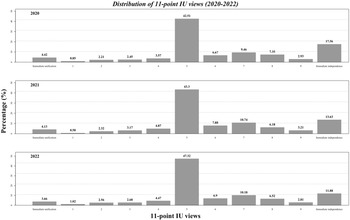
Several conclusions can be drawn from the distribution of Taiwanese citizens’ IU views between 2020 and 2022 (see Figure 2). First, each respondent occupied a distinct position on the independence–unification spectrum, resulting in a relatively dispersed distribution. Notably, the majority of respondents selected the midpoint (5) when asked about their IU positions across the three years, comprising over 40% of those who provided valid answers to this question. This indicates that the majority of Taiwanese people preferred maintaining the status quo over immediately pursuing Taiwan independence or unification with mainland China.

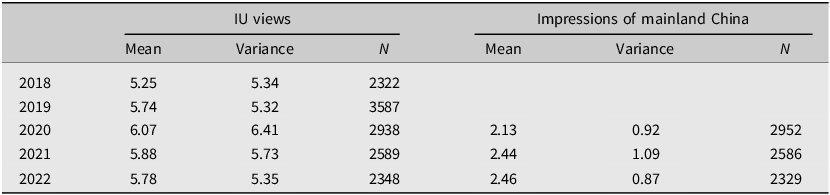
Respondents were distributed across the remaining ten positions to varying degrees. For example, the second most frequently selected option was 1 – indicating support for the immediate declaration of Taiwan independence – followed by 3, which represents a position between independence and maintaining the status quo. However, the number of respondents endorsing these two positions was much lower than those selecting 5. Furthermore, IU positions were heterogeneous in 2020 (variance = 6.41), indicating significant inter-individual differences in IU views during that year (see the left panel of Table 1). Overall, there was a remarkable diversity in Taiwanese citizens’ IU views, especially across the ten positions excluding the midpoint.
Main statistics of IU views and impressions of Mainland China

Source: Huang and Chang (Reference Huang and Chang2023).
Second, the overall distribution of IU views has exhibited subtle changes in the past three years. The most prominent trend is a steady increase in the percentage of respondents selecting the midpoint (5), accompanied by a decline in those choosing the extreme positions (0 and 10). The proportions of the respondents opting for intermediate positions (1–4 or 6–9) have remained relatively consistent across the three-year period. In other words, a growing number of individuals have shifted away from advocating immediate unification or immediate independence toward supporting the maintenance of the status quo. Taken together, the panel data offer strong evidence that there are significant intra-individual and inter-individual variations in IU views.
Figure 3 illustrates distinct trends in individual-level IU views between 2018 and 2022.Footnote 10 Specifically, among the 3,201 respondents who reported their IU views in at least two survey waves, 1,506 respondents (approximately 47.05%) exhibited an increasingly inclined toward Taiwan independence, while 1,407 respondents (43.96%) showed a growing tendency to support unification with mainland China. The slopes reflecting the magnitude of attitude change among these respondents were primarily concentrated within the range of –2 to 2. Only 288 participants (9.00%) maintained stable IU views over the five-year period.
Trend of IU views at the individual level (2018–2022).
Source: Huang and Chang (Reference Huang and Chang2023).

We further confirm that the IU views become less stable when the observation period is expanded. As shown in the left panel of Table 1, the annual mean IU score on the 11-point scale forms a bell-shaped curve between 2018 and 2022. The highest mean IU score was observed in 2020, indicating that Taiwanese citizens expressed the strongest support for Taiwanese independence in that year. There was a significant and sustained upward trend in support for independence from 2018 to 2020, followed by a gradual decline thereafter. The average score in 2022 was roughly equivalent to that in 2019 – prior to the outbreak of the COVID-19 pandemic in 2020 – suggesting that the effect of this event may diminish over time. On average, Taiwanese citizens exhibited greater support for Taiwan independence in the post-2020 period compared to the pre-2020 period.Footnote 11
Regarding our independent variable, people’s average impressions of mainland China based on China’s COVID-19 pandemic control from 2020 to 2022 showed an increasing trend. This trend suggests that impressions of mainland China were least favourable in 2020, with a slight improvement over the subsequent two years (see the right panel of Table 1). When examining the relationship between individuals’ impressions of mainland China and their IU views, an intriguing pattern emerges: Taiwanese individuals shifted away from the independence end of the IU spectrum as their impression of mainland China improved from 2020 to 2022. In other words, the preliminary evidence supports our Hypothesis 1, indicating that Taiwanese people’s impressions of mainland China may account for the variations in IU views.
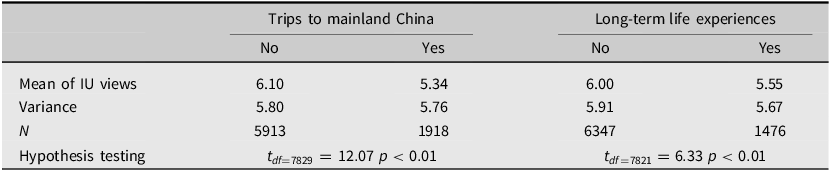
Descriptive statistics presented in Table 2 further indicate that two indicators that measure mainland China-related experiences are associated with IU views. The left panel of Table 2 indicates that the average IU views of respondents who have never been to mainland China is significantly higher than that among those who have travelled to mainland China. These results suggest that individuals who have never visited mainland China are more likely to support Taiwanese independence compared to those who have travelled there. Similarly, the right panel of Table 2 reveals that respondents without long-term life experiences in mainland China tend to lean toward independence. In summary, the descriptive statistics provide preliminary evidence that both dimensions of the China factor exert effects on Taiwanese people’s IU views.
Descriptive statistics of IU views by mainland China-related experiences

Source: Huang and Chang (Reference Huang and Chang2023).
5.2. Main results of within–between modelling
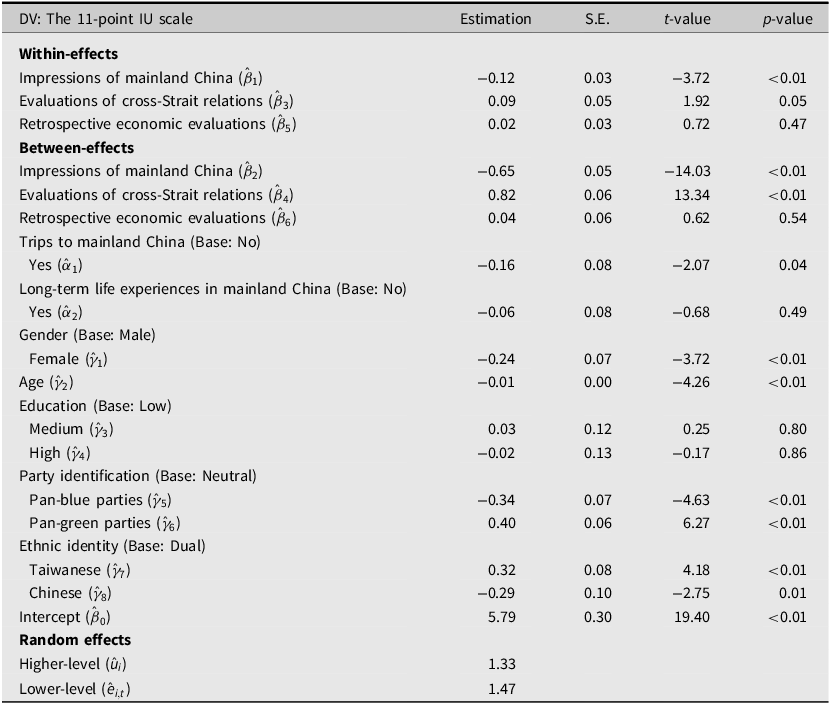
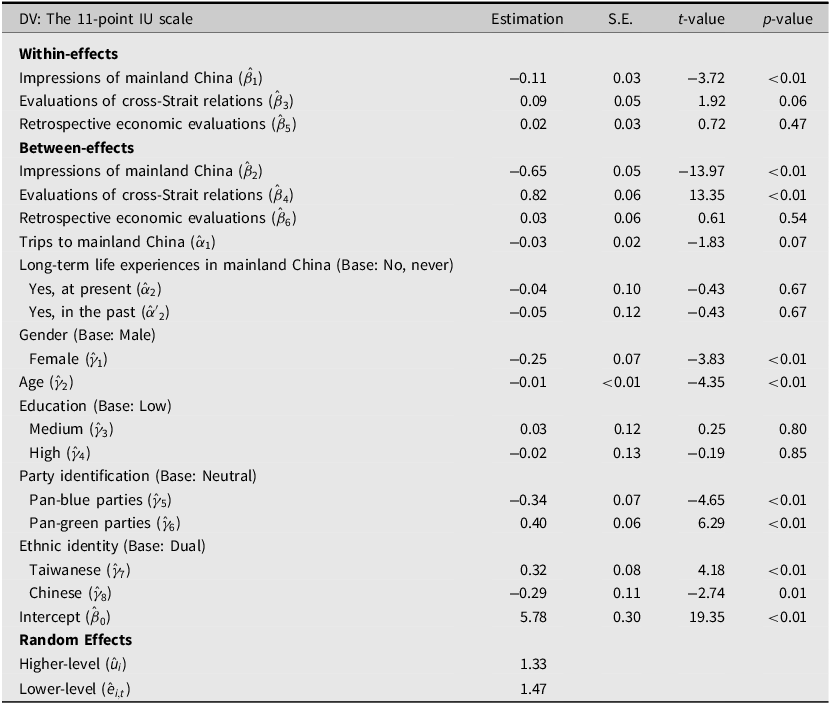
Evidence in Table 3 shows that impressions of mainland China have both short- and long-term effects on IU views. The two estimated coefficients of the ‘impressions of mainland China’ variable (i.e., ${{\hat \beta }_1}\;{\rm{and}}\;{{\hat \beta }_2}$
) are −0.12 and −0.65, and both are statistically significant (p < 0.01). The results have two primary implications. First, the within effect suggests that as individuals’ impressions of mainland China improve due to mainland China’s COVID-19 pandemic control, they are less inclined to support Taiwanese independence. Second, the between effect suggests that individuals with more positive impressions of mainland China are less supportive of Taiwanese independence than others. More importantly, compared to the other two time-varying variables – evaluations of cross-Strait relations and retrospective economic evaluations – impressions of mainland China demonstrate stronger explanatory power.
${{\hat \beta }_1}\;{\rm{and}}\;{{\hat \beta }_2}$
) are −0.12 and −0.65, and both are statistically significant (p < 0.01). The results have two primary implications. First, the within effect suggests that as individuals’ impressions of mainland China improve due to mainland China’s COVID-19 pandemic control, they are less inclined to support Taiwanese independence. Second, the between effect suggests that individuals with more positive impressions of mainland China are less supportive of Taiwanese independence than others. More importantly, compared to the other two time-varying variables – evaluations of cross-Strait relations and retrospective economic evaluations – impressions of mainland China demonstrate stronger explanatory power.
Within-between model of IU viewsFootnote 13

Source: Huang and Chang (Reference Huang and Chang2023).
Notes: N = 2465, Model fit: AIC = 28013.30, BIC = 28143.30, Pseudo-R 2 (fixed effects) = 0.32, Pseudo-R 2 (total) = 0.63, Entity ICC = 0.45.
Within-between model of IU views

Experiences pertaining to mainland China have also been shown to impact IU views. The estimated coefficient for the ‘trips to mainland China’ variable (i.e., ${{\hat \alpha }_1}$
) is negative and statistically significant. The result indicates that individuals who have visited China are, on average, less likely to support Taiwan independence compared to those who have not. The new insights and experiences gained from travel to mainland China, especially the information that differs from their past perceptions, may lead to a change in IU stances. Therefore, individuals who have travelled to mainland China are more prone to being pro-unification than those who have never been to China.
${{\hat \alpha }_1}$
) is negative and statistically significant. The result indicates that individuals who have visited China are, on average, less likely to support Taiwan independence compared to those who have not. The new insights and experiences gained from travel to mainland China, especially the information that differs from their past perceptions, may lead to a change in IU stances. Therefore, individuals who have travelled to mainland China are more prone to being pro-unification than those who have never been to China.
However, the ‘long-term life experiences in mainland China’ variable (i.e., ${{\hat \alpha }_2}$
) has a negative sign but missed the cutoff level of significance. The reasons behind this insignificant result are twofold. First, it may be attributed to the wording of the question related to this variable. This question refers to ‘you or any member of your family,’ meaning that these experiences may belong to respondents’ family members instead of themselves. Furthermore, this question does not specify the timing of these experiences. As Allport’s (Reference Allport1954) contact hypothesis argues, whether racial contact can eliminate ethnic prejudice still hinges on the ‘quality’ and ‘quantity’ of such contact. It is possible that these experiences occurred a long time ago. As a result, their IU views are not influenced by these experiences that are not their own and happened long ago, leading to an insignificant regression result. Another plausible reason for the lack of a significant association between long-term life experiences and IU views is that favourable impressions from short-term travel either fade gradually over time or, with prolonged exposure, positive and negative effects counteract one another – resulting in no detectable significant effect.
${{\hat \alpha }_2}$
) has a negative sign but missed the cutoff level of significance. The reasons behind this insignificant result are twofold. First, it may be attributed to the wording of the question related to this variable. This question refers to ‘you or any member of your family,’ meaning that these experiences may belong to respondents’ family members instead of themselves. Furthermore, this question does not specify the timing of these experiences. As Allport’s (Reference Allport1954) contact hypothesis argues, whether racial contact can eliminate ethnic prejudice still hinges on the ‘quality’ and ‘quantity’ of such contact. It is possible that these experiences occurred a long time ago. As a result, their IU views are not influenced by these experiences that are not their own and happened long ago, leading to an insignificant regression result. Another plausible reason for the lack of a significant association between long-term life experiences and IU views is that favourable impressions from short-term travel either fade gradually over time or, with prolonged exposure, positive and negative effects counteract one another – resulting in no detectable significant effect.
In terms of other factors, our results align with those reported in the existing literature. First, gender and age are significantly associated with IU stances: Male and younger individuals are more supportive of Taiwan’s independence. However, there is no significant correlation between educational attainment and IU views. Several studies have revealed that education level has limited explanatory power relative to other determinants (e.g., Chang and Wu, Reference Chang and Wu1997; Keng et al., Reference Keng, Liu and Chen2009; Tsai and Tsai, Reference Tsai and Tsai2022). Second, party identification and ethnic identity emerge as two robust predictors of IU views, confirming the results of previous research. Supporters of Pan-blue parties and those with a Chinese identity tend to favour unification with mainland China, whereas adherents of Pan-green parties and proponents of Taiwanese nationalism lean toward Taiwan independence.
Third, evaluations of Tsai’s performance in managing cross-Strait relations have a long-term effect on IU views, whereas retrospective economic evaluations show no significant effects. Both the estimated intra-individual and inter-individual effects of cross-Strait relations evaluations are positive and statistically significant. The results indicate that individuals who are more satisfied with Tsai’s handling of cross-Strait relations exhibit greater support for Taiwanese independence relative to others. Retrospective economic evaluations are positively associated with the IU stances, but the correlations are not statistically significant, suggesting that retrospective evaluations of Taiwan’s economy have neither short- nor long-term effects. Notably, in contrast to Tsai and Tsai’s (Reference Tsai and Tsai2022) findings, our results show that the effects of retrospective economic evaluations diminish when incorporating the China factor into the analysis. In other words, the China factor – particularly Taiwanese people’s impressions of mainland China – possesses stronger explanatory power for variations in IU views.
5.3. Robustness check
As a set of robustness checks, we change the measurement of our dependent variable and explanatory variables.
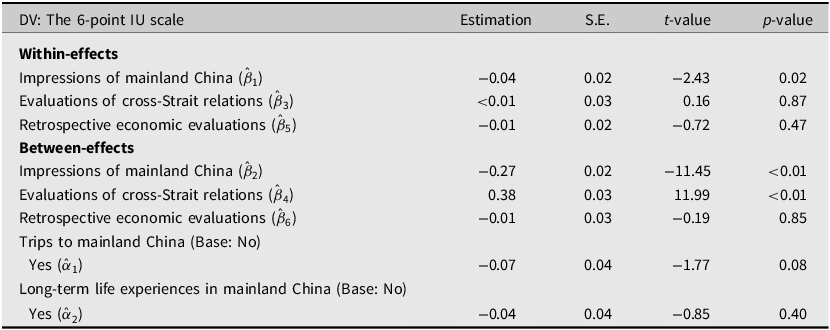
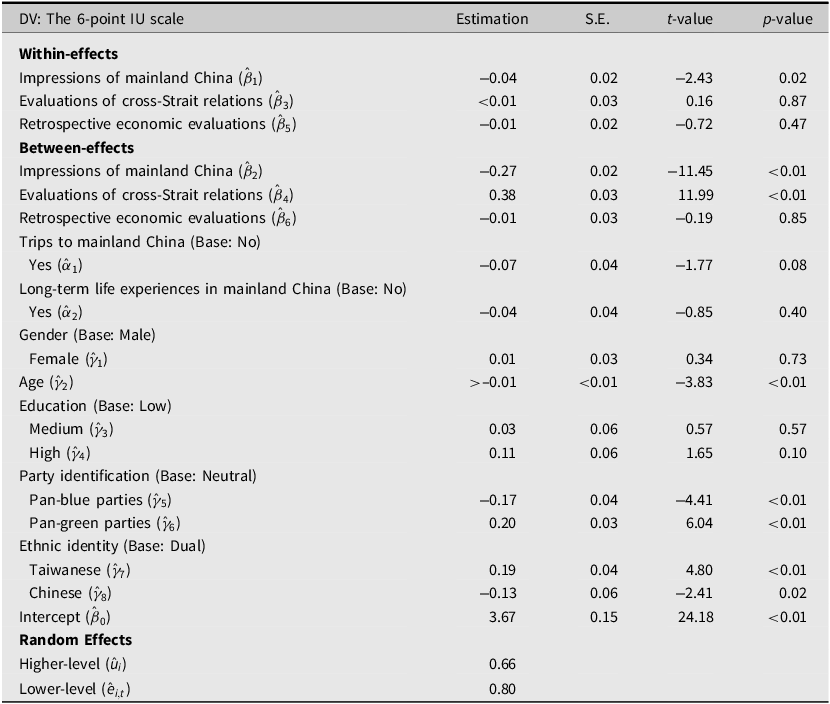
To ensure the robustness of our findings when changing the indicator of the dependent variable, we also rerun the within-between model using the 6-point IU scale, which is another widely utilised measure of Taiwanese people’s IU views. The core results hold in our robustness check.Footnote
12
First, both regression coefficients of the ‘impressions of mainland China’ variable (i.e., ${{\hat \beta }_1}\;{\rm{and}}\;{{\hat \beta }_2}$
) are still significantly negative, supporting H1. These results suggest that, holding other factors constant, better impressions are associated with a lower likelihood of supporting Taiwan independence. Second, the coefficient for the ‘trips to mainland’ variable is negatively signed and statistically significant at the 0.1 level, suggesting that travel to mainland China reduces support for independence. The estimated coefficient on the ‘long-term life experiences in mainland China’ variable has a negative sign but is statistically insignificant at the conventional level.
${{\hat \beta }_1}\;{\rm{and}}\;{{\hat \beta }_2}$
) are still significantly negative, supporting H1. These results suggest that, holding other factors constant, better impressions are associated with a lower likelihood of supporting Taiwan independence. Second, the coefficient for the ‘trips to mainland’ variable is negatively signed and statistically significant at the 0.1 level, suggesting that travel to mainland China reduces support for independence. The estimated coefficient on the ‘long-term life experiences in mainland China’ variable has a negative sign but is statistically insignificant at the conventional level.
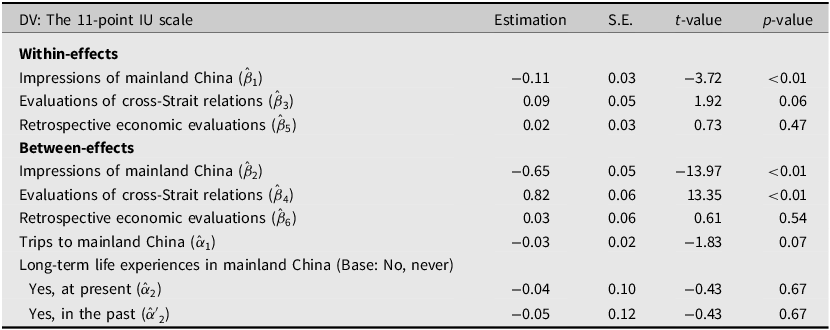
In addition, we modify the coding scheme of the two indicators of mainland China-related experiences. ‘Trips to mainland China’ is coded as a continuous variable (ranging from 0 to 11) and ‘long-term life experience in mainland China’ is coded as a three-category variable (‘yes, at present,’ ‘yes, in the past,’ and ‘no, never.’). Table 5 demonstrates that core results remain consistent.Footnote 14 First, both regression coefficients of the ‘impressions of mainland China’ variable retain their statistically significant negative signs, indicating that impressions of mainland China still have significant short- and long-term effects on IU views. Second, the number of trips to mainland China is significantly negative with support for independence, suggesting that the more frequently Taiwanese individuals travel to mainland China, the less inclined they are to favour Taiwanese independence. However, there is only weak evidence that long-term mainland China-related life experiences may change people’s IU stances.
Within-between model of IU views

In summary, our findings are sustained after changing the measurement of key variables, indicating that the China factor does matter to IU views, particularly the Taiwanese citizens’ impressions of mainland China.
6. Discussion and conclusion
This study is not the first to highlight the role of the China factor in shaping IU views in Taiwan. It does, however, advance our substantive understanding of variation in individuals’ IU stances amid contentious periods by explicitly defining and operationalising the China factor, while providing robust empirical evidence to substantiate these theoretical discussions.
This study conceptualises the China factor as Taiwanese people’s mainland China-related impressions and experiences and categorises it into two components corresponding to the affective and behavioural dimensions, respectively. Analysing newly collected panel data named TIGCR-PPS 2018–2022, we find that the China factor exhibits strong explanatory power for IU views, even after controlling for the determinants emphasised in existing literature. The impressions of mainland China based on its COVID-19 pandemic control not only exert significant effects on individuals’ IU views over time but also account for inter-individual differences. Short-term experiences in mainland China are primarily responsible for variations between individuals. Specifically, more favourable impressions of mainland China and prior visits to mainland China are associated with a lower likelihood of supporting pro-independence stances. These results are corroborated by a series of robustness tests.
The authors acknowledge that the above findings are preliminary, leaving ample room for further inquiry. Our theoretical framework facilitates a comprehensive understanding of Taiwanese people’s IU views, positing that individual variations in IU attitudes are shaped by both intra-Taiwanese and external factors. Despite the need for further investigation, one conclusion emerges beyond the exploratory scope of this study: The China factor warrants greater scholarly attention. Analytically, it is crucial to emphasise that future research on IU views should incorporate the China factor – particularly Taiwanese people’s impressions of mainland China. Empirically, future surveys should also track Taiwanese people’s general impressions of mainland China.
This study leads to several directions for future work. Theoretically, further studies could examine the conditions under which the China factor influences IU views and the interrelationships between its two dimensions. One potential research question is the mechanism through which the China factor shapes IU views. As Zaller (Reference Zaller1992:6) notes, ‘Every opinion is a marriage of information and predisposition.’ Taiwanese individuals exhibit variations in their predisposition toward the IU issue. Zaller’s (Reference Zaller1992) Receive-Accept-Sample Model posits that individuals differ in their capacity to acquire information and translate it into opinions, which are associated with their political awareness. As a result, we can further explore the conditional role of political awareness in moderating the relationship between the China factor and IU views. For instance, building on our preliminary findings, we can investigate whether higher levels of political awareness amplify the effect of life experiences in mainland China on IU positions. In addition, given that Taiwanese people’s experiences in mainland China may affect their impressions and sentiments, the nexus between the China factor and the IU issue in Taiwan is likely more sophisticated than our preliminary study suggests, thereby meriting further inquiry. Methodologically, panel data and within-between random effects modelling provide robust tools for distinguishing between the short-term and long-term effects of independent variables on the dependent variable, and thus can be extended to address a broad array of research questions.
Appendix
The number of trips from Taiwan to mainland China in the past five years.
Source: Huang and Chang (Reference Huang and Chang2023).

Long-term life experience in mainland China.
Source: Huang and Chang (Reference Huang and Chang2023).

Variables and operationalisation

Source: Huang and Chang (Reference Huang and Chang2023).
Notes: ‘Questionnaire No.’ refers to questionnaire No. in merged TIGCR-PPS 2018–2022 survey data.
Summary statistics of variables

Source: Huang and Chang (Reference Huang and Chang2023).
Notes: We compute median as the most ‘typical’ value of education, compute mode as the most ‘typical’ value of long-term life experience in mainland China, gender, party identification and ethnic identity, and employ the index of qualitative variation (IQV) (Rae, 1968) to describe the degree of dispersion of these variables. The other five variables are summarised by means and standard deviations (SD). N indicates the number of observations between the time period comprised.
Within-between model of IU views

Source: Huang and Chang (Reference Huang and Chang2023).
Notes: N = 2482, Model fit: AIC = 19384.81, BIC = 19514.96, Pseudo-R 2 (fixed effects) = 0.27, Pseudo-R 2 (total) = 0.56, Entity ICC = 0.40.
Within-between model of IU views

Source: Huang and Chang (Reference Huang and Chang2023).
Notes: N = 2465, Model fit: AIC = 28021.17, BIC = 28158.02, Pseudo-R2 (fixed effects) = 0.32, Pseudo-R2 (total) = 0.63, Entity ICC = 0.45.


 Open access

