Book contents
- Frontmatter
- Contents
- Notes on contributors
- Acknowledgements
- Preface
- Part I Making amends with the past
- Part II Legacies of colonialism and racism in social work
- Part III Social work’s contested ideologies
- Part IV Social work’s complicity with institutionalisation and detention
- Part V Survivor perspectives and contemporary reflections
- Index
14 - Facing the legacy of social work: coming to terms with complicity in systemic inequality and social injustice
Published online by Cambridge University Press: 20 January 2024
By

Book contents
- Frontmatter
- Contents
- Notes on contributors
- Acknowledgements
- Preface
- Part I Making amends with the past
- Part II Legacies of colonialism and racism in social work
- Part III Social work’s contested ideologies
- Part IV Social work’s complicity with institutionalisation and detention
- Part V Survivor perspectives and contemporary reflections
- Index
Summary
Introduction
As the contributors to this volume illustrate, social work has a troubled history. It has been complicit in the internment of Japanese Americans during the Second World War, apartheid in South Africa, the stolen generations and refugee detention in Australia and dictatorships in Nazi Germany, Franco's Spain and in Argentina and Chile, to name just a few of the case studies in this book. The premise of the book is that the profession has an ethical obligation to acknowledge this history and to learn from it. Only then can it chart an ethical future free of the legacy of the past. Ferguson (2019) notes that this ‘horrible history’ involved social workers actively colluding with oppressive policies of the state. In other instances, they acquiesced or remained silent in the face of policies and practices that reproduced oppression.
How do we understand this accommodation to injustice? Did it involve ignorance and lack of awareness of what they doing? Did they believe that they were ‘doing good’? What does this mean for present-day complicity with injustice? How culpable are current social workers for inaction against injustice?
Can social work become a radical profession?
Those of us who are part of the radical tradition of social work have sought to find a way that social work can be revitalised to address the contradictions arising from the state organisation of the profession through progressive, radical, critical, anti-oppressive and structural forms of theorising and practice. Since the emergence of the radical critique of social work in the 1970s, there have been ongoing debates about the limitations and potential of alternative forms of practice to bring about significant social change and about whether social work could become a radical profession. There were numerous dimensions to the radical critique of social work. The major elements of it were: (i) social work is a social control mechanism that ‘cools out’ clients and keeps them submissive; (ii) social work is a professional elitist activity that is more concerned with its own self-interest than with meeting client needs; (iii) social work's values foster conformity to middle-class norms; (iv) social work individualises and pathologises problems that are social and political in character; and (v) social work operates in a theoretical vacuum in that it lacks an adequate knowledge base (Bailey and Brake, 1975; Galper, 1975; Corrigan and Leonard, 1978).
Information
- Type
- Chapter
- Information
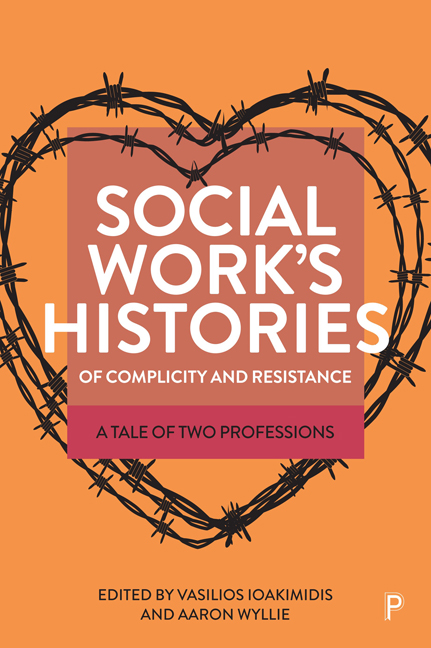
- Social Work's Histories of Complicity and ResistanceA Tale of Two Professions, pp. 219 - 232Publisher: Bristol University PressPrint publication year: 2023
Accessibility standard: Unknown
Why this information is here
This section outlines the accessibility features of this content - including support for screen readers, full keyboard navigation and high-contrast display options. This may not be relevant for you.Accessibility Information
Accessibility compliance for the PDF of this chapter is currently unknown
and may be updated in the future.