III.5 - Reflections on our Critical Service Learning Provision: Is it Critical or Are We Social Justice Dreamers?
Published online by Cambridge University Press: 02 March 2021
Edited by

Summary
Introduction
In 2013 we ran a small but successful service learning pilot in the department of sociology at Nottingham Trent University (NTU). Immediately following the pilot, service learning was added to our BA Sociology, BA Criminology and MA Public Sociology provision as core modules. In brief, we argue our version of service learning sits within a social justice orientation, often referred to as critical service learning. Simply put, this involves students working in partnership with our notfor-profit community on social justice issues for the purpose of social change and mutual benefit for community partners and students. These are big claims. Whether the service learning we do at NTU genuinely extends beyond the dream of social justice is at the heart of this chapter.
The chapter begins by defining service learning followed by an exploration of the traditional versus critical service learning debate, an overview of our practices and values and why and how we do it. To illustrate and interrogate our practices we introduce three projects to highlight the traditional-critical learning debate and, finally, offer ideas for discussion on how to build sustainable and critical service learning. In presenting these reflections we hope to re-energise our social justice aspirations, share our practices and extend opportunities for critical dialogue with those engaged in public sociology education.
Defining service learning and introducing the traditional versus the critical debate
There are many schools, colleges and universities delivering many versions of service learning. Students provide a ‘service’ to the community for a specific purpose or goal and, in return, learn through the experience. Service learning can be embedded within the curriculum for disciplinary connections, with or without academic credit and/or part of volunteering strategies. At the least critical level, it can be described as an experiential learning opportunity; students learn whilst providing a ‘service’ for, or determined by, the community. The ‘service’ can take a variety of forms including traditional research, planning an event, promoting/evaluating new initiatives for partners. Whilst relatively new to the UK, service learning has a long history in North American universities where it is largely embedded and resourced as a university-wide endeavour. In other words, it has become institutionalised (Furco, 1996; Jacoby, 2014). Importantly, we recognise the label of service learning as new to the UK, but acknowledge the practice is not.
Information
- Type
- Chapter
- Information
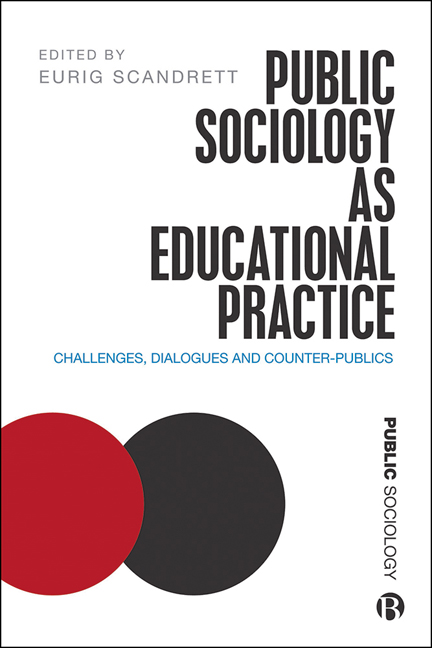
- Public Sociology as Educational PracticeChallenges, Dialogues and Counter-Publics, pp. 299 - 314Publisher: Bristol University PressPrint publication year: 2020
Accessibility standard: Unknown
Why this information is here
This section outlines the accessibility features of this content - including support for screen readers, full keyboard navigation and high-contrast display options. This may not be relevant for you.Accessibility Information
Accessibility compliance for the PDF of this chapter is currently unknown
and may be updated in the future.