





Management Implications
Educating the public about invasive, noxious weeds is widely recognized as an important component of management. Humans are responsible for managing invasive plants, and furthermore, invasive plants are often spread by humans and their activities. We conducted a general population survey to assess Montanans’ views on noxious weeds. Overall, the survey results support noxious weed advertising and education efforts to the public. Survey respondents worry about the negative effects of noxious weeds and believe the problem is serious. The many outdoor activities in which Montanans engage may provide opportunities for values-based transmission of information about noxious weeds. Many valid venues exist for transmitting such information, led by the Internet. The importance of the Internet suggests that practitioners should improve its utilization and link information more effectively. Also arguing in favor of informational efforts is the universal pattern that emerges in the data wherein people engaged with these informational methods view noxious weeds as a serious problem and demonstrate behaviors to prevent the spread of noxious weeds. Informational exposure is related to activities such as burning or throwing burs in the garbage, washing nonmotorized gear, and washing motorized equipment. Finally, the survey provides some ideas about ways to provide targeted information to younger adults and women, who claim and demonstrate less knowledge about noxious weeds overall. In their totality, these results are useful for defining a path forward for future educational efforts.
Introduction
Education is often touted as one of the most important aspects of invasive species management (Cole et al. Reference Cole, Keller and Garbach2016; Cordeiro et al. Reference Cordeiro, Marchante, Castro and Marchante2020; Reis et al. Reference Reis, Marchante, Freitas and Marchante2013). Furthermore, because invasive species are often spread through human activities (Birdsall et al. Reference Birdsall, McCaughey and Runyon2012; Panetta and Scanlan Reference Panetta and Scanlan1995; Seekamp et al. Reference Seekamp, Mayer, Charlebois and Hitzroth2016a; Taylor Davis et al. Reference Taylor Davis, Brummer, Taper, Wing and Rew2012), public engagement in invasive species management and prevention is critical (Cordeiro et al. Reference Cordeiro, Marchante, Castro and Marchante2020; Reis et al. Reference Reis, Marchante, Freitas and Marchante2013). Awareness of invasive species, and in particular invasive plants, can vary across audiences and geographic areas (Daab and Flint Reference Daab and Flint2010; Kapler et al. Reference Kapler, Thompson and Widrlechner2012; Steele et al. Reference Steele, Chandran, Grafton, Huebner and McGill2006). Despite resources being devoted to educating the public about invasive species, there has been minimal effort to measure effectiveness (Marzano et al. Reference Marzano, Dandy, Bayliss, Porth and Potter2015). Evaluation of aquatic invasive species education campaigns have indicated a positive relationship between exposure to campaign messaging and increased knowledge and practice of recommended actions by targeted audiences (Larson et al. Reference Larson, Phillips-Mao, Quiram, Sharpe, Stark, Sugita and Weiler2011; Seekamp et al. Reference Seekamp, McCreary, Mayer, Zack, Charlebois and Pasternak2016b).
We had a unique opportunity to evaluate education efforts for invasive, noxious weeds in Montana. In 1994, a general population survey was conducted via telephone to evaluate Montanans’ knowledge about noxious weeds. The objectives of the 1994 survey were to determine the knowledge level and attitudes of people in Montana about noxious weeds, how they used the outdoors with respect to noxious weed spread, and the best methods of disseminating information to people unaware of noxious weeds (see Sheley et al. Reference Sheley, Jacobs and Floyd1996, including the questions asked in table 1 on p. 593). Results of the survey were used to develop a statewide noxious weed awareness and educational plan, which included the creation of the Montana Noxious Weed Education Campaign (MNWEC) in 1996. The mission of the MNWEC is to educate the people of Montana about the economic and environmental impacts of noxious weeds and encourage the public to participate in ecologically based integrated weed management. State and federal governmental agencies, university personnel, county noxious weed districts, tribal land management agencies, and nongovernmental organizations assist with directing the activities of the MNWEC.
Percent of respondents (n = 779–799 depending on the question) saying a source contributes “a lot” to the spread of noxious weeds, including breakdowns by gender and age groups. a
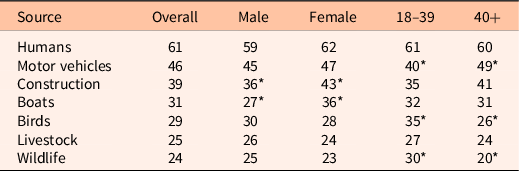
a These percentages utilize the post hoc analytical weights. Sources are listed in descending order by overall percentage. An asterisk indicates that the difference across gender or age categories is significant at the P ≤ 0.05 level using a test for a difference in proportions.
Over the last 25 yr, the MNWEC has engaged in a variety of educational activities and noxious weed messaging, including direct (e.g., presentations, workshops, trade show booths) and indirect (e.g., publications, radio, television, outdoor advertising, social media) efforts. Education and outreach efforts have intensified since the MNWEC reorganized in 2012. Intensification of efforts from 2015 to 2019 focused on targeting specific audiences identified in the 1994 survey: educators and students; recreationists (horseback riders, hunters, backpackers, bikers, and trail users); real estate professionals; and tourists. From 2015 to 2019, the MNWEC attended 98 outreach and education events that accumulated to 1,372 contact hours and 325 educational booth hours in direct contact with the MNWEC’s specified audiences. During the same time frame, a total of $35,000 was spent on outdoor advertising billboards, $20,000 on noxious weed-themed educational television ads, and $19,000 on print advertising targeting hunters and anglers. Two other audiences that have received increased educational efforts from the MNWEC are real estate professionals and small-acreage landowners. In 2016, the MNWEC developed an online, accredited training program designed to increase the knowledge of real estate professionals so that upon completion they could provide outreach and additional resources to their clients. Since its inception, 140 real estate professionals have completed this course.
Given the 25-yr history of noxious weed education and the previous survey effort (Sheley et al. Reference Sheley, Jacobs and Floyd1996), we conducted a general population survey in 2019 to assess the views and behaviors of Montanans as they relate to noxious weeds. The purpose of this paper is to describe the results of that survey and propose new approaches for disseminating noxious weed information.
Materials and Methods
We implemented a mail-based survey to maximize response rate and representativeness, with survey administration managed by the Human Ecology Learning and Problem Solving (HELPS) Lab at Montana State University. The HELPS Lab has determined that mail surveys produce the highest response rate of any single mode in Montana, a finding replicated by researchers in other locales (Converse et al. Reference Converse, Wolfe, Huang and Oswald2008; Guo et al. Reference Guo, Kopec, Cibere, Li and Goldsmith2016). The mailing included a cover letter, questionnaire (Supplementary Appendix S1), and business reply envelope. The cover letter emphasized that knowledge or opinions about noxious weeds were not prerequisites for completing the questionnaire and that having responses from people with differing levels of knowledge and interest would be helpful. The questionnaire was composed of 29 questions covering topics such as knowledge and perception of noxious weeds, engagement in various outdoor activities, behaviors associated with preventing noxious weed spread, sources of information for learning about noxious weeds, perception of noxious weed knowledge level, and demographics (e.g., age, gender, level of education). Further, an open-ended format to replicate the 1994 method as closely as possible was used to ask respondents to name the most and second-most damaging noxious weeds in Montana. Respondents were instructed not to conduct any research and were only told to mention such weeds if they were able to do so. Data collection ran from March to May 2019. The population of interest was all Montana adults, with a random sample stratified by county and gender.
The mailing achieved a response rate of 18%, with 830 responses from 4,582 valid mailing addresses. The response rate was uniform across different areas of the state, operationalized as weed district area council geographies. However, the pool of respondents was older (75% aged 50 or more) and slightly more male (58%) than the general adult population of Montana. Given the relationship between age and gender and other variables in the data set, the HELPS Lab constructed post hoc analytical weights for the data. Population data from the U.S. Census Bureau allowed for the construction of weights based on the conjunction of age and gender categories in Montana. These weights ensure that the age and gender distributions in the data match those in the general adult population in Montana. Using a hypothetical example, if women aged 18 to 29 constituted 5% of the population but only 2.5% of the respondents, a respondent with those characteristics would receive a weight of 2. The inverse would be true for individuals overrepresented in the respondent pool, as their weights would be less than 1. Weighted descriptive statistics reported are more representative of Montana’s adult population than are the raw numbers. However, we also occasionally report the raw numbers for more direct comparability with the 1994 numbers (Sheley et al. Reference Sheley, Jacobs and Floyd1996), and we indicate when we are doing so. In terms of other respondent characteristics, most respondents (90% unweighted) are landowners in Montana. The pool of respondents also reports a greater level of higher education overall than the actual population of Montana, with 47% (unweighted) reporting at least a 4-yr college degree as compared with 31% for the population based on census data.
Beyond the reporting of descriptive statistics, we also utilize inferential statistics to test for differences between groups and to evaluate the predictors of the ability to name a noxious weed. For the former, we typically employ difference in proportions tests, which assess whether the difference between two proportions (e.g., 0.70 and 0.60) is meaningful. This is a z-test with a null hypothesis that the two proportions are the same. A result with a low P-value provides confidence that the two proportions are indeed different. We also employ the more familiar independent group t-test for differences in means. Here again the null hypothesis is one of equivalence, with a low P-value result supporting an interpretation that the two associated population means are different. Finally, we use logistic regression as a nonlinear model for the binary dependent variable of whether an individual can name a noxious weed that appears on the official Montana list. Linear regression models assume a continuous dependent variable and are therefore inappropriate in this case. Logistic regression is designed to account for the functional form with a binary dependent variable (Long and Freese Reference Long and Freese2006).
Results and Discussion
Outdoor Activities
The questionnaire compiled information about the frequency with which respondents have engaged in a range of outdoor activities over the last 3 yr, as previous research has shown that knowledge of noxious weeds and invasive plants is greater among those who regularly participate in outdoor activities (Eiswerth et al. Reference Eiswerth, Yen and van Kooten2011; Sheley et al. Reference Sheley, Jacobs and Floyd1996). In our data, driving automobiles on dirt roads or across fields is the most common activity (46% of respondents); followed by hiking or backpacking (41%); working outside in fields, ditches, pastures, or forested areas (37%); fishing (24%); riding motorized off-road vehicles (20%); and hunting (17%). Respondents engaged in other activities listed on the questionnaire but to a lesser extent (Supplementary Table S1, which also breaks down results by gender and age groups). Some of these figures seem high, and we suspect some respondents interpreted the question to mean the average within the season for each activity. Nonetheless, this information remains useful for identifying potential spread vectors and values. Further, such information is useful for understanding possible vectors of noxious weed spread and for developing targeted educational messaging to audiences engaging in specific activities in which those vectors are present. Understanding what outdoor activities Montanans engage in most often can also help to identify their key values (e.g., people who engage in fishing may value clean water and healthy fish populations). Other work has proven that targeted messaging that appeals to an audience’s values can be an effective approach for prompting change in behavior regarding environmental actions (Jarreau et al. Reference Jarreau, Altinay and Reynolds2015).
Knowledge of Noxious Weeds
Montanans were generally aware of noxious weeds in 1994, though they felt they lacked knowledge about them (Sheley et al. Reference Sheley, Jacobs and Floyd1996). At that time, 76% of respondents said that noxious weeds were a serious or very serious problem, but 67% said they knew little to nothing about them (Sheley et al. Reference Sheley, Jacobs and Floyd1996). In our 2019 survey, 48% (unweighted) of respondents report “little” or “no” knowledge about noxious weeds, a 19-point improvement since 1994. A difference in proportions test provides evidence that this difference (67% vs. 48%) is statistically meaningful (z = 9.08, P < 0.001), to the extent these numbers are directly comparable. The weighted response from 2019, which more accurately represents female and younger (18- to 29-yr-old) respondents than do the raw data, is 54%, a 13-point improvement (z = 4.37, P ≤ 0.001). For individuals who have seen or participated in at least one informational activity about noxious weeds, the percentage is even lower (44%). These results (when considered with other results presented later) suggest that 25 yr of educational efforts are improving Montanans’ knowledge concerning noxious weeds. Despite improvement, however, nearly half of Montanans surveyed claim to know little to nothing about noxious weeds, suggesting there is room for additional improvement. Considering progress more recently, 40% of respondents claim their knowledge of noxious weeds has increased “a little” (33%) or “a lot” (7%) in the last 5 yr.
We interpret the ability of a respondent to name a noxious weed as another indicator of knowledge. Respondents in the aggregate named 27 of 35 noxious weeds on the Montana state list. The most-named weeds are knapweed (spotted and diffuse) (Centaurea spp.) (named by 50% of respondents, unweighted), leafy spurge (Euphorbia esula L.) (26%), and Canada thistle [Cirsium arvense (L.) Scop.] (13%). These three weeds (i.e., Centaurea spp., E. esula, C. arvense) are the same as the top three weeds named in 1994 (and match the top three in Yung et al. Reference Yung, Chandler and Haverhals2015). Overall awareness of these species has increased compared with 1994, when 43%, 14%, and 9% of respondents, respectively, produced the names of those species. Difference in proportions tests for the three species (e.g., 50% vs. 43% for Centaurea spp.) indicate that these differences over time are real (z = 2.32, P ≤ 0.010; z = 4.80, P ≤ 0.001; z = 2.06, P ≤ 0.020). This improvement in ability to name species has occurred regardless of changes in the abundance of these three species across Montana (Duncan Reference Duncan2008; Montana Department of Agriculture 2017), suggesting respondents’ awareness is not simply a matter of these species being more visible. Interestingly, our results indicate that 53% of male respondents can name at least two noxious weeds, whereas only 37% of female respondents are able to do so (z = 4.49, P ≤ 0.001). Similarly, 37% of women report knowing “something” or “a lot” about noxious weeds, as compared with 53% of men (z = 4.48, P ≤ 0.00). Such results indicate that future educational efforts should target women.
We also asked how respondents had learned about noxious weeds, and 49% reported learning from family and friends, 29% consulted with the local weed district or Extension office, 27% obtained information from local advertisements, and 25% received information from neighbors. Information sources were similar to those identified by Lubeck (Reference Lubeck2018), in which more than 80% of landowners reported that they receive their knowledge from friends or family, followed by other landowners (72%), weed districts (50%), Extension (48%), and neighborhood networks (44%). Research from Wisconsin concluded that boaters tend to receive information about aquatic invasive species mostly through lake associations, family, and friends (Witzling et al. Reference Witzling, Shaw and Seiler2016). Broadly, research into environmental education has indicated that people receive information through a variety of social interactions, with personal and face-to-face interactions being particularly effective for influencing changes in behavior (Gifford and Nilsson Reference Gifford and Nilsson2014; Howell et al. Reference Howell, Shaw and Alvarez2015; Werner et al. Reference Werner, Sansone and Brown2008). This reinforces the importance of social networks for sharing information about invasive species.
Perception of Noxious Weed Problem
Similar to results from other surveys about noxious weeds in Montana (Lubeck Reference Lubeck2018; Sheley et al. Reference Sheley, Jacobs and Floyd1996; Yung et al. Reference Yung, Chandler and Haverhals2015), a large majority of respondents indicate that noxious weeds are a “serious” (36%) or “very serious” (32%) problem. Views on seriousness generally increase incrementally with age. Further, the relationship between self-reported knowledge about noxious weeds and views of problem seriousness is moderately strong (Pearson’s r = 0.43).
We asked Montanans about the importance of different negative impacts associated with noxious weeds, because we were interested in how future educational efforts could appeal to peoples’ values. Eighty-two percent of respondents indicate that loss of native plants is “very important” or “extremely important” to them personally, followed by increased risk of wildfire (82%), loss of biodiversity (81%), loss of wildlife habitat (80%), loss of farmers’ crop production (78%), increased soil erosion (76%), loss of forage for livestock (75%), reduced recreation opportunities in streams and lakes (68%), and loss to the recreation industry through degrading landscapes (63%). Twenty-five years earlier, 19% of survey respondents could not name any impact of noxious weeds (using an open-ended question format), even though a strong majority (76%) viewed noxious weeds as a serious problem (Sheley et al. Reference Sheley, Jacobs and Floyd1996).
Noxious weeds have adaptations that facilitate dispersal via humans and animals, and humans who work or recreate in areas infested with noxious weeds may become a vector for seed spread (Coleman et al. Reference Coleman, Sindel, van der Meulen and Reeve2011; Panetta and Scanlan Reference Panetta and Scanlan1995; Taylor Davis et al. Reference Taylor Davis, Brummer, Taper, Wing and Rew2012). Survey respondents’ knowledge reflects this understanding, with 61% identifying humans as contributing “a lot” to the spread of noxious weeds; this was higher than for any other source of spread (Table 1). These results differ from those of Sheley et al. (Reference Sheley, Jacobs and Floyd1996), in which wind, livestock, and wildlife were the most mentioned vectors. Interestingly, at that time more than one-third of respondents (38%) provided answers that were not recognized by weed professionals as common vectors, and only 5% mentioned vehicles as contributors to seed spread (Sheley et al. Reference Sheley, Jacobs and Floyd1996). Though the question format was different in 2019, 86% of respondents say that motor vehicles spread noxious weeds either “some” or “a lot.” This suggests that Montanans’ knowledge of how humans contribute to seed dispersal may have changed in useful ways over the past 25 yr.
Behaviors Associated with Noxious Weeds
Self-reported behaviors to prevent the spread of noxious weeds appear to have increased over time, and our results support other noxious weed–related surveys in Montana (Lubeck Reference Lubeck2018; Yung et al. Reference Yung, Chandler and Haverhals2015) that suggested Montanans believe their personal actions can help control weeds. Specifically, nearly half of respondents say they do “a little more” (32%) or “a lot more” (12%) about noxious weeds as compared with 5 yr ago, and 64% who own or rent land have performed weed control activities on their land. Similarly, Yung et al. (Reference Yung, Chandler and Haverhals2015) reported that 78% of surveyed landowners conducted weed control. A majority (64%) of our respondents report that they throw burs or seeds stuck to their clothing or pets into a trash receptable to help reduce noxious weed spread. Seventy percent of respondents who recreate with livestock on public lands (e.g., packing into the backcountry) report using noxious weed seed–free forage. Respondents who participate in nonmotorized activities report the preventative behavior of washing gear “sometimes” (39%) or “always” (31%) before and after recreating. For respondents who participate in motorized activities, 40% report they “sometimes” wash vehicles, and 29% report they “always” wash vehicles. Parts of vehicles where washing is concentrated included the body (63%) and wheels (62%). These self-reported behaviors are encouraging, especially considering vehicles readily disperse seeds across substantial distances (Taylor Davis et al. Reference Taylor Davis, Brummer, Taper, Wing and Rew2012), and roads are particularly influential to noxious weed distribution (Birdsall et al. Reference Birdsall, McCaughey and Runyon2012).
A pattern emerges with relationships among age group, self-reported knowledge, and behavior. In particular, respondents in the 18- to 39-yr-old age group report knowing less about noxious weeds (35% know “something” or “a lot” vs. 51% for older respondents, z = 3.24, P ≤ 0.001) and are less likely to engage in behaviors to limit noxious weed spread. Fifty-six percent of 18- to 39-yr-olds are able to name at least one noxious weed, compared with 73% of respondents aged 40 and higher (z = 3.58, P ≤ 0.001). Furthermore, the 18 to 39 age group is less likely to throw seeds or burs in the garbage or to burn them (52% vs. 78%, z = 5.40, P ≤ 0.001). The belief that government is responsible for the environment could explain why this age group is less knowledgeable than older survey respondents; a 30-yr study conducted by Wray-Lake et al. (Reference Wray-Lake, Flanagan and Osgood2010) found that “high school seniors consistently believe that the government is more responsible for the environment than they are.” Future educational efforts should target this age group to highlight that everyone has a personal responsibility to act in ways that stop the spread of noxious weeds, particularly in the context of being proactive and cleaning gear before and after recreational activities in which they commonly engage.
Outreach and Education Materials
Respondents who have seen advertising and promotional materials are more likely to view noxious weeds as a serious problem and are more likely to engage in preventative behaviors. Of the specific outreach activities undertaken in the last 5 yr by the MNWEC, 35% of respondents have seen television advertisements, followed by radio advertisements (32%), Adopt a Trailhead Montana signs (30%), newspaper advertisements (29%), advertisements in fishing regulation guidebooks (29%), “Pretty Wildflower? Think Again” billboards (28%), and advertisements in hunting regulations guidebooks (28%) (see Supplementary Table S2, including breakdowns by gender and age categories). Only 8% of respondents were familiar with the PlayCleanGo campaign (playcleango.org), which was the subject of a separate question, with 40% of those respondents stating that it has affected their decision making.
Importantly, respondents who saw advertisements or educational materials are more likely to engage in behaviors that are helpful for reducing the spread of noxious weeds. Table 2 shows 13 different MNWEC-related outreach methods covered in the questionnaire, along with an overall average “seriousness” score and corresponding scores for those who have engaged with the outreach method and those who have not. The seriousness score is based on responses to a questionnaire item about the seriousness of the noxious weed problem. In all 13 cases, the seriousness score is higher among individuals who have seen the material. About half of these differences are statistically significant, led by advertisements in hunting regulation guidebooks.
Association between exposure to Montana Noxious Weed Education Campaign (MNWEC)-related outreach materials and respondent assessments of the seriousness of the noxious weed problem. a
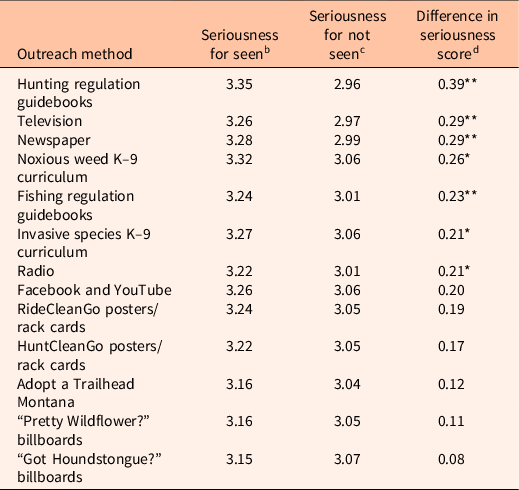
a Seriousness was scored on a scale of 1–4, with 1 meaning “not serious at all” and 4 meaning “very serious.”
b The average seriousness score for individuals who have seen advertising in particular venues or have engaged in particular educational activities.
c The average for individuals who have not seen the advertising or not engaged in the educational activities.
d The difference between seen and not seen. The asterisks are for the results of independent group t-tests for the difference in means. *P ≤ 0.05; **P ≤ 0.01.
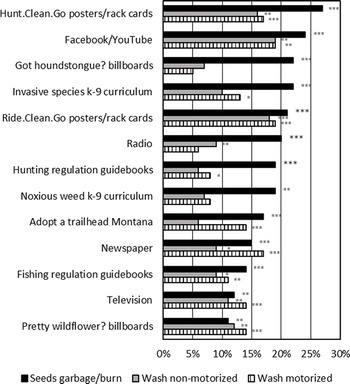
Figure 1 illustrates differences in three behaviors related to reducing the spread of noxious weeds based on whether individuals have seen advertisements or participated in educational activities. The three behaviors are: (1) always throwing seeds in the garbage or burning them, (2) always washing nonmotorized gear, and (3) always washing motorized equipment. Across the 13 different outreach methods, this yields 39 comparisons. All of these differences are in the expected direction (i.e., people exposed to the outreach are more likely to engage in the desirable behaviors), and 31 of the differences are statistically significant. This is strikingly consistent evidence.
Difference in reported behaviors (i.e., always throw seeds in the garbage or burn seeds, always wash nonmotorized gear, and always wash motorized equipment) for those exposed and not exposed to outreach materials about noxious weeds. Bars indicate the difference in percent of respondents who engage in behavior for those exposed to outreach material vs. those not exposed. For example, 86% of individuals who have seen HuntCleanGo posters or rack cards always throw seeds in the garbage or burn seeds, whereas 59% of people who have not seen HuntCleanGo advertisements do so. The difference is 27 percentage points, as shown by the first black bar in the figure. Asterisks indicate whether the differences are significant, based on difference in proportions tests. *P ≤ 0.05; **P ≤ 0.01; ***P ≤ 0.001.

A universal pattern across these analyses is that people who have seen advertisements or engaged in educational activities are more likely to see the problem of noxious weeds as serious and are more likely to engage in behaviors to stop their spread. Similarly, research from the southwestern United States showed that people who were more knowledgeable about invasive plants and viewed them as a problem were more likely to engage in volunteer activities to control invasive plants (Tidwell and Brunson Reference Tidwell and Brunson2008). While it is possible that respondents who are already more attuned to the problem of noxious weeds are more likely to see and recognize advertisements, the relationship in our data between seeing advertisements and engaging in activities to stop noxious weed spread is encouraging and supports continuation of educational efforts.
With the goals of helping the MNWEC more effectively communicate with and educate its target audiences, we asked respondents to indicate the primary source they would turn to for learning more about noxious weeds. The most popular answer is the Internet (62%), followed by the local Extension office (13%) or county weed district (12%) (Table 3). Some differences emerge among age groups when responding to this question. Notably, younger respondents are more likely than older respondents to look toward the Internet (z = 5.28, P ≤ 0.01), while older respondents are more likely than younger respondents to look toward the local Extension office (z = 4.28, P ≤ 0.01) and county weed district (z = 3.34, P ≤ 0.01). Respondents were given the option of providing open-ended responses to this question; the most popular answers were government agencies and websites, signposts at trailheads or public access sites, and farm/ranch stores.
Percent of respondents (n = 631) indicating that a source would be the primary place they would look for information on noxious weeds, including breakdowns by gender and age groups. a

a These percentages utilize the post hoc analytical weights. Information sources are listed in descending order by overall percentage. An asterisk indicates that the difference across gender or age categories is significant at the P ≤ 0.05 level using a test for a difference in proportions.
We also asked respondents to rate the personal effectiveness of various information delivery methods. Results show a variety of delivery methods with similar levels of potential effectiveness, including noxious weed websites, brochures, billboards, and social media (Table 4). This contrasts with the more limited list of dissemination methods in Sheley et al. (Reference Sheley, Jacobs and Floyd1996), in which television, newspaper, and radio were convincingly the best way to disseminate noxious weed information. The change in effective delivery methods over the last 25 yr is likely a reflection of advances in technology, the broad variety of ways in which information is communicated today, and the role of interpersonal communication via the Internet and social media in influencing pro-environmental behaviors (Han and Xu Reference Han and Xu2020). We think that many methods need to be used to expand noxious weed educational messaging and delivery, and that the methods of delivery should be tailored to meet the values and communication norms of specific target audiences (Albrecht Reference Albrecht1996; Hine et al. Reference Hine, Reser, Morrison, Phillips, Nunn and Cooksey2014; Kilian et al. Reference Kilian, Hennigs and Langner2012; Kotler and Zaltman 1971).
Percent of respondents (n = 736–767 depending on the question) indicating that an information method would be very effective for them personally, with breakdowns by gender and age groups. a

a These percentages utilize the post hoc analytical weights. Information methods are listed in descending order by overall percentage. An asterisk indicates that the difference across gender or age categories is significant at the P ≤ 0.05 level using a test for a difference in proportions.
The results also show some meaningful differences across groups. Women are more likely than men to think social media pages will be very effective for them personally (z = 3.08, P ≤ 0.01). Younger respondents similarly see social media pages as more effective than do older respondents (z = 6.35, P ≤ 0.01). Women are also more likely to view brochures distributed with vehicle registrations as more effective than do men (z = 4.28, P ≤ 0.01), while younger respondents are more likely to see social media advertisements as effective (z = 5.28, P ≤ 0.01). As discussed later, these differences have implications for messages and methods that target particular groups.
Predictors of Knowledge
Finally, with a full set of variables in hand, we look at predictors of the ability to name a noxious weed. Table 5 shows logistic regressions for the binary outcome variable of whether the individual was able to name at least one noxious weed accurately when asked for an example in an open-ended format. The first model specification includes 10 independent variables, including self-reported knowledge about noxious weeds (which is anticipated to be a strong predictor but could also be viewed as an alternative measurement of knowledge). The second model specification includes the same independent variables but drops self-reported knowledge. Having seen noxious weed advertisements in hunting or fishing regulation guidebooks is a significant predictor (P ≤ 0.01 in the first model specification) for being able to name a noxious weed, again bolstering arguments for information campaigns. Frequency of hiking and working outside are also significant predictors (P ≤ 0.01 and P ≤ 0.05, respectively). Finally, learning about noxious weeds from the local weed district (P ≤ 0.01) and from family or friends (P ≤ 0.001) also contributes to the ability to name a noxious weed.
Logistic regressions for predictors of ability to name a noxious weed. a
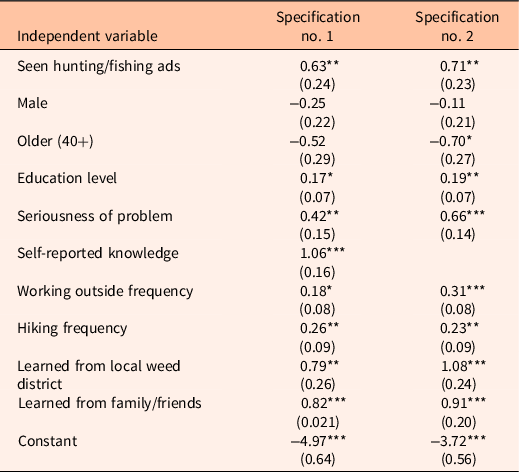
a The dependent variable is a binary indicator of whether the individual can (= 1) or cannot (= 0) name a noxious weed that appears on the official Montana list. The main numbers are coefficients, with standard errors in parentheses. The number of cases for the first specification is 712 and for the second is 714. Pseudo R2 for the first specification is 0.27 and for the second is 0.21. Asterisks indicate significance at different levels with *P ≤ 0.05; **P ≤ 0.01; ***P ≤ 0.001.
Recommendations and Proposed Actions
Though the implementation of different survey methods poses challenges for comparison over time, there is evidence that Montanans are now more knowledgeable about noxious weeds and human-based spread than they were 25 yr ago. This supports the continuation of advertising and education efforts. Further, the importance of family and friends in disseminating information points toward finding ways to get information into social networks. Generally, Montanans engage in a wide range of outdoor activities, and they are worried about the effects of noxious weeds and about the seriousness of the noxious weed problem. These results point toward values-based advertising and educational campaigns being useful.
Montanans see information about noxious weeds in many different places and perceive the potential effectiveness of many different advertising methods, including those that were not options 25 yr ago. However, the Internet was identified as the place most Montanans would go first to find additional information about noxious weeds. In the future, a multifaceted educational approach should continue, with a focus on making easily discoverable content available on the Internet. An example would be continued promotion of the MNWEC’s website as a trusted resource. Given the results of this survey, it may benefit the MNWEC to collaborate on the presentation of Internet information (website text, photos, and messaging) with other agencies in Montana that promote noxious weed education through their own websites. A coordinated effort would strengthen and increase outreach efforts across Montana. Another example would be to continue (and expand if possible) current advertising campaigns that appear to be “working” and are visible as noted by participants in the survey.
Behaviors related to noxious weeds are arguably more important than knowledge and awareness. Our results suggest that individuals with exposure to various informational efforts are more likely to consider noxious weeds a serious problem and are more likely to engage in behaviors to stop the spread of noxious weeds. Ultimately, getting people to name noxious weeds may be a lot to ask, but seeing advertisements unmistakably influences the kinds of behaviors that will do the most to stop the spread of weeds. This is encouraging news and helps to define a path forward for future educational efforts.
The 2019 survey showcased programs and projects that have been effective and highlighted areas in which improvement is necessary. Based on the results, MNWEC intends to continue its highly visible advertising campaigns (outdoor advertising billboards and television ads) that are action oriented and encourage participation in weed prevention activities. The MNWEC also intends to work with its partner organizations to provide the public with simplified websites for easy access to information about noxious weeds, resources, best management practices, and prevention methods. Finally, the MNWEC intends to use information obtained through this survey to design and develop new materials that target groups identified as underserved by using the information dissemination methods that members of these groups name as potentially most effective.
Supplementary material
To view supplementary material for this article, please visit https://doi.org/10.1017/inp.2021.35
Acknowledgments
We are grateful to survey participants and staff at the HELPS Lab. This project was supported with funding from the Montana Noxious Weed Trust Fund (grant no. 2018-007). JMM is supported by NIFA-USDA Hatch MONB000363. No conflicts of interest have been declared.




 Open access

